
Payload Information
General Information of This Payload (ID: PAY0XBVCC)
| Name |
SG3199 (SC-DR002)
|
|||||
|---|---|---|---|---|---|---|
| Target | Human deoxyribonucleic acid (hDNA) | |||||
| Structure |
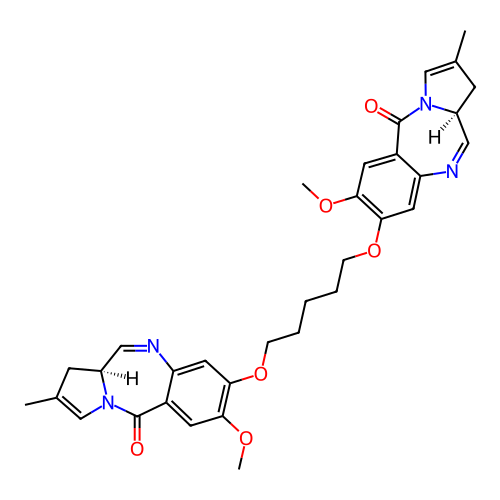
|
|||||
|
|
||||||
Each Antibody-drug Conjugate Related to This Payload
Full Information of The Activity Data of The ADC(s) Related to This Payload
Loncastuximab tesirine [Approved in 2021]
Identified from the Human Clinical Data
| Experiment 1 Reporting the Activity Date of This ADC | [1] | ||||
| Efficacy Data | Objective Response Rate (ORR) |
48.28%
|
|||
| Patients Enrolled |
Relapsed or refractory diffuse large B-cell lymphoma (DLBCL) after two or more multiagent systemic treatments, who had measurable disease and Eastern Cooperative Oncology Group performance status 0-2.
|
||||
| Administration Dosage |
Intravenously on day 1 of each 21-day cycle, at 150 ug/kg for two cycles, then 75 ug/kg thereafter, for up to 1 year or until disease relapse or progression, unacceptable toxicity, death, major protocol deviation, pregnancy, or patient, investigator, or sponsor decision.
|
||||
| Related Clinical Trial | |||||
| NCT Number | NCT03589469 | Phase Status | Phase 2 | ||
| Clinical Description |
A phase 2 open-label single-arm study to evaluate the efficacy and safety of loncastuximab tesirine in patients with relapsed or refractory diffuse large B-cell lymphoma (DLBCL) (LOTIS-2).
|
||||
| Primary Endpoint |
Overall response rate assessed by central review. 70 of 145 patients had complete or partial response (overall response rate 48.28% [95% CI 39.9-56.7]); 35 had complete response and 35 had partial response.
|
||||
| Other Endpoint |
Median time to first response (complete response or partial response) was 41.00 days (IQR 38.00-44.00). Median duration of response was 10.30 months (95% CI 6.9-not estimable); 13.40 months (10.30-not estimable) for patients with complete response and 5.70 months (1.70-not estimable) for patients with partial response. The probability of responders maintaining responses for 9 months or longer was 64.0%. Median progressionfree survival was 4.90 months (95% CI 2.90-8.30), median overall survival was 9.90 months (6.70-11.50), and median relapse-free survival was 13.40 months (10.30-not estimable).
Click to Show/Hide
|
||||
| Experiment 2 Reporting the Activity Date of This ADC | [2] | ||||
| Efficacy Data | Objective Response Rate (ORR) |
59.40%
|
|||
| Patients Enrolled |
R/R B-cell non Hodgkin lymphoma (NHL); had failed or were intolerant to established therapies, or for whom no other established treatment options were available.
|
||||
| Administration Dosage |
5 to 200 ug/kg; intravenously over 1 hour, once every 3 weeks (one cycle) by a 3+3 dose-escalation design.
|
||||
| Related Clinical Trial | |||||
| NCT Number | NCT02669017 | Phase Status | Phase 1 | ||
| Clinical Description |
A phase 1 dose-escalation study to evaluate the tolerability, safety, pharmacokinetics, and antitumor activity of ADCT-402 in patients with relapsed or refractory b-cell lineage non Hodgkin lymphoma (B-NHL).
|
||||
| Primary Endpoint |
The MTD was not established during the trial due to the low level of DLTs, 150 ug/kg dose for expansion and phase 2.
|
||||
| Other Endpoint |
For loncastuximab tesirine 120 ug/kg,Median Progression-Free Survival (mPFS)=4.80 months.The median PFS OS=11.60 months.
|
||||
| Experiment 3 Reporting the Activity Date of This ADC | [3] | ||||
| Efficacy Data | Complete Remission (CR) |
26.70%
|
|||
| Patients Enrolled |
Adults (age 18 years) with histologically confirmed relapsed/refractory B-non Hodgkin lymphoma (World Health Organization 2008 classification18 ) who were intolerant to established therapy, for whom established therapy had failed, or for whom no other treatment options were available in the opinion of the investigator were eligible to participate.
|
||||
| Administration Dosage |
3 + 3 dose escalation at 15 to 200 ug/kg and dose expansion at 120 and 150 ug/kg; IV infusion over 60 minutes once every 3 weeks (day 1 of each 21-day cycle).
|
||||
| Related Clinical Trial | |||||
| NCT Number | NCT02669017 | Phase Status | Phase 1 | ||
| Clinical Description |
A phase 1 dose-escalation study to evaluate the tolerability, safety, pharmacokinetics, and antitumor activity of ADCT-402 in patients with relapsed or refractory B-cell lineage non Hodgkin lymphoma (B-NHL).
|
||||
| Primary Endpoint |
The recommended dose of loncastuximab tesirine for Phase 2 is 150 ug/kg Q3W for 2 doses followed by 75 ug/kg Q3W for subsequent doses. The 150 ug/kg dose was selected as a dose with encouraging responses but lower frequency of AEs than observed with the 200 u/kg dose. Overall response rate (ORR) in evaluable patients was 45.60%, including 26.70% complete responses (CR). Median PFS was 3.10 months (95% CI 2.70-4.20) in all patients with B-NHL, 2.8 months (95% CI 1.90-3.80) in patients with DLBCL, 4.80 months (95% CI 1.10-7.80) in patients with MCL, and could not be determined in those with FL due to the low number of events. Median OS was 8.3 months (95% CI 6.70-10.70) in all patients with B-NHL, 7.5 months (95% CI 6.00-9.80) in patients with DLBCL, and was not reached in patients with MCL or FL due to low number of events.
Click to Show/Hide
|
||||
| Other Endpoint |
PK exposure similarity between loncastuximab tesirine total antibody and PBD-conjugated antibody indicated good stability in serum.Accumulation by Cycle 2 for patients on a Q6W dosing regimen was lower than that of those on Q3W dosing: mean accumulation of 1.22 and 1.33 for PBD-conjugated antibody and total antibody on Q6W regimens compared with 1.72 and 1.74 on Q3W regimens. There was substantial variability in PK exposure and PK parameters assessed for PBD-conjugated antibody, total antibody, and SG3199.
Click to Show/Hide
|
||||
| Experiment 4 Reporting the Activity Date of This ADC | [4] | ||||
| Efficacy Data | Complete Remission (CR) |
40.20%
|
|||
| Patients Enrolled |
R/R B-acute lymphocytic leukemia (ALL) for standard therapies had failed, intolerant to standard therapies, or no other treatment options were available, in the opinion of the investigator, were eligible for the study, other key inclusion criteria included Eastern Cooperative Oncology Group (ECOG) performance status of 0 to 2.
|
||||
| Administration Dosage |
15 to 150 ug/kg once every 3 weeks (Q3W) or 50 ug/kg IV weekly.
|
||||
| Related Clinical Trial | |||||
| NCT Number | NCT02669264 | Phase Status | Phase 1 | ||
| Clinical Description |
A phase 1, open-label, adaptive dose-escalation, multicenter study to evaluate the tolerability, safety, pharmacokinetics, and anti-tumor activity of ADCT-402 in patients with relapsed or refractory B-cell lineage acute lymphoblastic leukemia (B-ALL).
|
||||
| Primary Endpoint |
Part II (dose expansion portion) utilized the doses of 120 and 150 ug/kg, selected based on antitumor activity and tolerability seen during part I. The overall response rate (ORR) in patients with DLBCL, mantle cell lymphoma, and follicular lymphoma was 42.30%, 46.70%, and 78.60%, respectively.
|
||||
| Other Endpoint |
The median progression-free survival (PFS) was 3.10 months in all patients with B-NHL and 2.80 months in patients with DLBCL, whereas the median OS was 8.30 months in all patients and 7.50 months in patients with DLBCL.
|
||||
| Experiment 5 Reporting the Activity Date of This ADC | [5] | ||||
| Efficacy Data | Complete Remission (CR) |
46.16%
|
|||
Rovalpituzumab tesirine [Phase 3 (discontinued)]
Identified from the Human Clinical Data
| Experiment 1 Reporting the Activity Date of This ADC | [6] | ||||
| Efficacy Data | stable disease (SD) |
21%
|
|||
| Patients Enrolled |
Eligible participants had DLL3-high (≥75% tumor staining) advanced SCLC progressing after first-line platinum therapy (ECOG 0-1, measurable disease), excluding those with recent cardiovascular events, leptomeningeal metastases, >1 prior regimen, active infections, other malignancies within 2 years, or prior topoisomerase I inhibitors.
|
||||
| Administration Dosage |
Rovalpituzumab tesirine IV administration (dosing based on actual body weight) on Day 1 of a 42-day cycle for 2 cycles, with up to 2 additional cycles permitted.
|
||||
| Related Clinical Trial | |||||
| NCT Number | NCT03061812 | Phase Status | PHASE3 | ||
| Clinical Description |
A Randomized, Open-Label, Multicenter, Phase 3 Study of Rovalpituzumab Tesirine Compared With Topotecan for Subjects With Advanced or Metastatic DLL3high Small Cell Lung Cancer (SCLC) Who Have First Disease Progression During or Following Front-Line Platinum-Based Chemotherapy (TAHOE)
|
||||
| Primary Endpoint |
The primary endpoint evaluated overall survival (OS) from randomization to death (Kaplan-Meier method) with median follow-up of 20-20.6 months across treatment arms, censoring at last documented alive date or study termination (12 Feb 2020), with survival data collected every 6 weeks post-treatment.
|
||||
| Other Endpoint |
Secondary endpoints included progression-free survival (PFS), objective response rate (ORR), clinical benefit rate (CBR), and duration of response (DOR) per RECIST v1.1 via CT scans (assessed every 6-9 weeks), plus EORTC QLQ-C15-PAL physical functioning score changes at Week 7 (0-100 scale), with median follow-up matching OS timeframe.
|
||||
| Experiment 2 Reporting the Activity Date of This ADC | [6] | ||||
| Efficacy Data | progressive disease (PD) |
54%
|
|||
| Patients Enrolled |
Eligible participants had DLL3-high (≥75% tumor staining) advanced SCLC progressing after first-line platinum therapy (ECOG 0-1, measurable disease), excluding those with recent cardiovascular events, leptomeningeal metastases, >1 prior regimen, active infections, other malignancies within 2 years, or prior topoisomerase I inhibitors.
|
||||
| Administration Dosage |
Rovalpituzumab tesirine IV administration (dosing based on actual body weight) on Day 1 of a 42-day cycle for 2 cycles, with up to 2 additional cycles permitted.
|
||||
| Related Clinical Trial | |||||
| NCT Number | NCT03061812 | Phase Status | PHASE3 | ||
| Clinical Description |
A Randomized, Open-Label, Multicenter, Phase 3 Study of Rovalpituzumab Tesirine Compared With Topotecan for Subjects With Advanced or Metastatic DLL3high Small Cell Lung Cancer (SCLC) Who Have First Disease Progression During or Following Front-Line Platinum-Based Chemotherapy (TAHOE)
|
||||
| Primary Endpoint |
The primary endpoint evaluated overall survival (OS) from randomization to death (Kaplan-Meier method) with median follow-up of 20-20.6 months across treatment arms, censoring at last documented alive date or study termination (12 Feb 2020), with survival data collected every 6 weeks post-treatment.
|
||||
| Other Endpoint |
Secondary endpoints included progression-free survival (PFS), objective response rate (ORR), clinical benefit rate (CBR), and duration of response (DOR) per RECIST v1.1 via CT scans (assessed every 6-9 weeks), plus EORTC QLQ-C15-PAL physical functioning score changes at Week 7 (0-100 scale), with median follow-up matching OS timeframe.
|
||||
| Experiment 3 Reporting the Activity Date of This ADC | [6] | ||||
| Efficacy Data | Partial Response (PR) |
14%
|
|||
| Patients Enrolled |
Eligible participants had DLL3-high (≥75% tumor staining) advanced SCLC progressing after first-line platinum therapy (ECOG 0-1, measurable disease), excluding those with recent cardiovascular events, leptomeningeal metastases, >1 prior regimen, active infections, other malignancies within 2 years, or prior topoisomerase I inhibitors.
|
||||
| Administration Dosage |
Rovalpituzumab tesirine IV administration (dosing based on actual body weight) on Day 1 of a 42-day cycle for 2 cycles, with up to 2 additional cycles permitted.
|
||||
| Related Clinical Trial | |||||
| NCT Number | NCT03061812 | Phase Status | PHASE3 | ||
| Clinical Description |
A Randomized, Open-Label, Multicenter, Phase 3 Study of Rovalpituzumab Tesirine Compared With Topotecan for Subjects With Advanced or Metastatic DLL3high Small Cell Lung Cancer (SCLC) Who Have First Disease Progression During or Following Front-Line Platinum-Based Chemotherapy (TAHOE)
|
||||
| Primary Endpoint |
The primary endpoint evaluated overall survival (OS) from randomization to death (Kaplan-Meier method) with median follow-up of 20-20.6 months across treatment arms, censoring at last documented alive date or study termination (12 Feb 2020), with survival data collected every 6 weeks post-treatment.
|
||||
| Other Endpoint |
Secondary endpoints included progression-free survival (PFS), objective response rate (ORR), clinical benefit rate (CBR), and duration of response (DOR) per RECIST v1.1 via CT scans (assessed every 6-9 weeks), plus EORTC QLQ-C15-PAL physical functioning score changes at Week 7 (0-100 scale), with median follow-up matching OS timeframe.
|
||||
| Experiment 4 Reporting the Activity Date of This ADC | [6] | ||||
| Efficacy Data | Objective Response Rate (ORR) |
15%
|
|||
| Patients Enrolled |
Eligible participants had DLL3-high (≥75% tumor staining) advanced SCLC progressing after first-line platinum therapy (ECOG 0-1, measurable disease), excluding those with recent cardiovascular events, leptomeningeal metastases, >1 prior regimen, active infections, other malignancies within 2 years, or prior topoisomerase I inhibitors.
|
||||
| Administration Dosage |
Rovalpituzumab tesirine IV administration (dosing based on actual body weight) on Day 1 of a 42-day cycle for 2 cycles, with up to 2 additional cycles permitted.
|
||||
| Related Clinical Trial | |||||
| NCT Number | NCT03061812 | Phase Status | PHASE3 | ||
| Clinical Description |
A Randomized, Open-Label, Multicenter, Phase 3 Study of Rovalpituzumab Tesirine Compared With Topotecan for Subjects With Advanced or Metastatic DLL3high Small Cell Lung Cancer (SCLC) Who Have First Disease Progression During or Following Front-Line Platinum-Based Chemotherapy (TAHOE)
|
||||
| Primary Endpoint |
The primary endpoint evaluated overall survival (OS) from randomization to death (Kaplan-Meier method) with median follow-up of 20-20.6 months across treatment arms, censoring at last documented alive date or study termination (12 Feb 2020), with survival data collected every 6 weeks post-treatment.
|
||||
| Other Endpoint |
Secondary endpoints included progression-free survival (PFS), objective response rate (ORR), clinical benefit rate (CBR), and duration of response (DOR) per RECIST v1.1 via CT scans (assessed every 6-9 weeks), plus EORTC QLQ-C15-PAL physical functioning score changes at Week 7 (0-100 scale), with median follow-up matching OS timeframe.
|
||||
| Experiment 5 Reporting the Activity Date of This ADC | [6] | ||||
| Efficacy Data | Complete response (CR) |
0.30%
|
|||
| Patients Enrolled |
Eligible participants had DLL3-high (≥75% tumor staining) advanced SCLC progressing after first-line platinum therapy (ECOG 0-1, measurable disease), excluding those with recent cardiovascular events, leptomeningeal metastases, >1 prior regimen, active infections, other malignancies within 2 years, or prior topoisomerase I inhibitors.
|
||||
| Administration Dosage |
Rovalpituzumab tesirine IV administration (dosing based on actual body weight) on Day 1 of a 42-day cycle for 2 cycles, with up to 2 additional cycles permitted.
|
||||
| Related Clinical Trial | |||||
| NCT Number | NCT03061812 | Phase Status | PHASE3 | ||
| Clinical Description |
A Randomized, Open-Label, Multicenter, Phase 3 Study of Rovalpituzumab Tesirine Compared With Topotecan for Subjects With Advanced or Metastatic DLL3high Small Cell Lung Cancer (SCLC) Who Have First Disease Progression During or Following Front-Line Platinum-Based Chemotherapy (TAHOE)
|
||||
| Primary Endpoint |
The primary endpoint evaluated overall survival (OS) from randomization to death (Kaplan-Meier method) with median follow-up of 20-20.6 months across treatment arms, censoring at last documented alive date or study termination (12 Feb 2020), with survival data collected every 6 weeks post-treatment.
|
||||
| Other Endpoint |
Secondary endpoints included progression-free survival (PFS), objective response rate (ORR), clinical benefit rate (CBR), and duration of response (DOR) per RECIST v1.1 via CT scans (assessed every 6-9 weeks), plus EORTC QLQ-C15-PAL physical functioning score changes at Week 7 (0-100 scale), with median follow-up matching OS timeframe.
|
||||
| Experiment 6 Reporting the Activity Date of This ADC | [7] | ||||
| Patients Enrolled |
Eligible patients had DLL3-expressing (≥1% tumor cells), progressive advanced solid tumors refractory to ≥1 prior therapy, ECOG 0-1, and adequate organ function. Key exclusions included active infections, recent cardiovascular events, prior PBD-based drugs, uncontrolled comorbidities, pregnancy/breastfeeding, or other malignancies within 3 years (except specified exceptions). CNS metastases required stability post-treatment.
Click to Show/Hide
|
||||
| Administration Dosage |
Rovalpituzumab tesirine 0.2-0.4 mg/kg administered intravenously on Day 1 of each 6-week cycle. Dexamethasone 8 mg administered orally twice daily on Day -1, Day 1 (the day of dosing), and Day 2 of each 6-week cycle.
|
||||
| Related Clinical Trial | |||||
| NCT Number | NCT02709889 | Phase Status | PHASE1|||PHASE2 | ||
| Clinical Description |
An Open-Label Study of Rovalpituzumab Tesirine in Subjects With Delta-Like Protein 3-Expressing Advanced Solid Tumors
|
||||
| Primary Endpoint |
The study assessed treatment-emergent adverse events (TEAEs) across neuroendocrine (NEC) and non-NEC disease groups, including serious TEAEs and drug-related events leading to discontinuation/dose reduction, graded per NCI CTCAE v4.03 from first dose through 30 days post-treatment (mean 1 cycle, range 1-5 cycles).
|
||||
| Other Endpoint |
Efficacy endpoints included objective response rate (ORR), clinical benefit rate (CBR), duration of response (DOR), progression-free survival (PFS), and overall survival (OS) assessed per RECIST v1.1 up to 35.2 months. Pharmacokinetic analysis measured rovalpituzumab tesirine serum concentrations during Cycle 1, with anti-therapeutic antibodies (ATA) evaluated at Day 1 and 42 days post-last dose.
Click to Show/Hide
|
||||
| Experiment 7 Reporting the Activity Date of This ADC | [8] | ||||
| Patients Enrolled |
Eligible participants must have previously received ≥1 rovalpituzumab tesirine dose in a parent study. Retreatment candidates (Arm A) required initial treatment tolerance, prior clinical benefit (stable disease or better), ≥12-week progression-free interval post-treatment, ECOG 0-1, adequate organ function, and stable CNS metastases if applicable. Exclusion criteria prohibited enrollment of subjects without prior rovalpituzumab tesirine study participation.
Click to Show/Hide
|
||||
| Administration Dosage |
Rovalpituzumab tesirine (0.3 mg/kg or previously adjusted dose) administered intravenously once every 6 weeks beginning on Day 1 (day of dosing). Subjects will receive rovalpituzumab tesirine on Day 1 of each 6-week cycle, omitting every third cycle until disease progression or study drug discontinuation.
|
||||
| Related Clinical Trial | |||||
| NCT Number | NCT03543358 | Phase Status | PHASE2 | ||
| Clinical Description |
A Multicenter, Long-Term, Rollover Extension Study of Rovalpituzumab Tesirine
|
||||
| Primary Endpoint |
The study monitored treatment-emergent adverse events (TEAEs) and serious TEAEs in participants receiving rovalpituzumab tesirine treatment or retreatment from first dose until 70 days post-last dose (up to ~5 years), with investigator-assessed causality and severity grading per standard definitions.
|
||||
| Experiment 8 Reporting the Activity Date of This ADC | [9] | ||||
| Patients Enrolled |
Eligible participants must be ≥18 years with chemotherapy-naïve extensive-stage SCLC showing ≥75% DLL3 expression, ECOG 0-1, adequate organ function, and stable CNS metastases if present, excluding those with prior SCLC treatments, significant comorbidities, recent cardiovascular events, active infections, pregnancy, other malignancies within 3 years, or PBD-based drug exposure.
Click to Show/Hide
|
||||
| Administration Dosage |
Rovalpituzumab Tesirine 0.3 mg/kg IV infusion; Rovalpituzumab Tesirine 0.3 mg/kg IV infusion followed by Cisplatin 80 mg/m2 and Etoposide 100 mg/m2 IV infusion.
|
||||
| Related Clinical Trial | |||||
| NCT Number | NCT02819999 | Phase Status | PHASE1 | ||
| Clinical Description |
A Study of Rovalpituzumab Tesirine (SC16LD6.5) in the Frontline Treatment of Patients With Extensive Stage Small Cell Lung Cancer
|
||||
| Primary Endpoint |
The study evaluates dose-limiting toxicities (DLTs) within 21 days post-dose and treatment-emergent adverse events (TEAEs) through 30 days after treatment in Phase 1a, along with Grade >2 lab abnormalities and 4-year progression-free survival (PFS) as key safety endpoints for DLL3-expressing SCLC patients receiving rovalpituzumab tesirine monotherapy or combination therapy.
Click to Show/Hide
|
||||
| Other Endpoint |
Phase 1b assesses efficacy outcomes including best overall response, duration of response, clinical benefit rate, and overall survival over 4 years, while monitoring pharmacokinetic parameters (Cmax, AUC, T1/2 etc.), anti-drug antibodies, TEAEs, vital signs, and ECOG performance status throughout the 4-year study period.
|
||||
| Experiment 9 Reporting the Activity Date of This ADC | [10] | ||||
| Patients Enrolled |
Eligible patients must have extensive-stage SCLC with ECOG 0-2 and adequate organ function, excluding those with significant cardiac abnormalities (QTcF >470/450ms, conduction defects, LVEF<0.30, arrhythmia history), active infections, pregnancy, prior PBD exposure, or hypersensitivity to study drug components.
|
||||
| Administration Dosage |
0.3 mg/kg rovalpituzumab tesirine intravenously on Day 1 of every 6-week treatment cycle for 2 cycles omitting every third cycle
|
||||
| Related Clinical Trial | |||||
| NCT Number | NCT02874664 | Phase Status | PHASE1 | ||
| Clinical Description |
An Intensive QT/QTc Study to Investigate the Effects of Rovalpituzumab Tesirine on Cardiac Ventricular Repolarization in Subjects With Small Cell Lung Cancer
|
||||
| Primary Endpoint |
The primary endpoint evaluates QTcF interval changes from baseline over 12 weeks using Holter monitor-derived ECG parameters in patients treated with rovalpituzumab tesirine.
|
||||
| Other Endpoint |
Secondary endpoints include 12-week ECG parameter changes (RR, PR, QRS, waveform), QTcF-plasma concentration correlation, arrhythmia events stratified by QTcF changes, safety monitoring through 30 days post-treatment, efficacy outcomes (ORR, DOR, PFS, OS, CBR) assessed up to 24 months, and pharmacokinetic analysis (Cmax, AUC) during treatment cycles.
Click to Show/Hide
|
||||
| Experiment 10 Reporting the Activity Date of This ADC | [11] | ||||
| Patients Enrolled |
Inclusion requires ineligibility for standard Rovalpituzumab Tesirine trials, with potential case-by-case pediatric enrollment consideration, while no exclusion criteria are established for participation.
|
||||
| Related Clinical Trial | |||||
| NCT Number | NCT03503890 | Phase Status | N.A. | ||
| Clinical Description |
Expanded Access to Rovalpituzumab Tesirine
|
||||
| Experiment 11 Reporting the Activity Date of This ADC | [12] | ||||
| Patients Enrolled |
Eligible participants were ≥18 years with progressive SCLC after 1-2 prior platinum regimens (ECOG 0-1), adequate organ function, controlled CNS metastases, and proper contraception, excluding those with active CNS disease, uncontrolled cardiac conditions, recent anticancer therapies (<14-21 days), QTcF >450/470ms, HIV/Hepatitis, or hypersensitivity to drug components.
Click to Show/Hide
|
||||
| Administration Dosage |
Rovalpituzumab tesirine will be administered as a single agent, at increasing dose levels as permitted based on real-time assessment of safety and tolerability, intravenously over 30 minutes. Doses will be repeated on Day 1 of each 21-day or 42-day cycle until either unacceptable toxicity or evidence of disease progression occurs.
|
||||
| Related Clinical Trial | |||||
| NCT Number | NCT01901653 | Phase Status | PHASE1|||PHASE2 | ||
| Clinical Description |
Phase I/II Open Label Dose Escalation Study of the Safety, Pharmacokinetics, and Preliminary Efficacy of SC16LD6.5 as a Single Agent in Patients With Recurrent Small Cell Lung Cancer
|
||||
| Primary Endpoint |
The primary endpoint assessed the Maximum Tolerated Dose (MTD) of Rovalpituzumab Tesirine during dose escalation (Phase 1a), defined as the highest dose below which ≥2 of 3-6 subjects experienced dose-limiting toxicities within 21-42 days across tested doses (0.05-0.8 mg/kg every 21/42 days).
|
||||
| Other Endpoint |
Secondary endpoints included efficacy measures (ORR, DOR, CBR, PFS, OS) evaluated per RECIST v1.1 by investigators and independent review, with median observation periods of 4-7 months (up to 14.6 months), plus pharmacokinetic analysis of ADC Cmax and AUC during treatment cycles.
|
||||
| Experiment 12 Reporting the Activity Date of This ADC | [13] | ||||
| Patients Enrolled |
Eligible participants were adults with DLL3-positive (≥1% tumor staining) SCLC progressing after ≥2 prior regimens (including platinum), having measurable disease, ECOG 0-1, and adequate organ function, while excluding those with active infections, recent cardiovascular events, uncontrolled comorbidities, concurrent corticosteroids >20mg/day, other malignancies within 3 years, or prior PBD exposure unless undergoing protocol-specified retreatment.
Click to Show/Hide
|
||||
| Administration Dosage |
0.3 mg/kg rovalpituzumab tesirine administered intravenously on Day 1 of each 42-day cycle (every 6 weeks; Q6W) for 2 cycles. An additional 2 cycles of rovalpituzumab tesirine (retreatment) was permitted for eligible participants.
|
||||
| Related Clinical Trial | |||||
| NCT Number | NCT02674568 | Phase Status | PHASE2 | ||
| Clinical Description |
An Open-label, Single-Arm, Phase 2 Study Evaluating the Efficacy, Safety and Pharmacokinetics of Rovalpituzumab Tesirine (SC16LD6.5) for Third-line and Later Treatment of Subjects With Relapsed or Refractory Delta-Like Protein 3-Expressing Small Cell Lung Cancer (TRINITY)
|
||||
| Primary Endpoint |
The primary efficacy endpoints evaluated objective response rate (confirmed CR/PR per RECIST v1.1) and overall survival over a mean follow-up of 29 weeks (up to 122.4 weeks), with tumor assessments conducted by both investigators and independent review committees.
|
||||
| Other Endpoint |
Secondary endpoints included overall response rate (unconfirmed CR/PR), duration of response, progression-free survival, clinical benefit rate (CR/PR/SD≥42 days), pharmacokinetic measurements, immunogenicity (ATA), and treatment-emergent adverse events during initial treatment, all analyzed over the same 122.4-week maximum observation period.
|
||||
| Experiment 13 Reporting the Activity Date of This ADC | [14] | ||||
| Patients Enrolled |
Eligible participants were adults with extensive-stage SCLC progressing after ≥1 platinum regimen (ECOG 0-1), excluding those with active autoimmune diseases or prior immuno-oncology/PBD-based therapy, with adequate organ function required for enrollment.
|
||||
| Administration Dosage |
Participants will receive 2 doses of 0.3 mg/kg rovalpituzumab tesirine by intravenous (IV) infusion 6 weeks apart (Day 1 of Cycles 1 and 3), and 2 doses of 360 mg nivolumab IV 3 weeks apart beginning on Cycle 2 (Day 1 of Cycles 2 and 3).
|
||||
| Related Clinical Trial | |||||
| NCT Number | NCT03026166 | Phase Status | PHASE1|||PHASE2 | ||
| Clinical Description |
A Phase 1/2 Study on the Safety of Rovalpituzumab Tesirine Administered in Combination With Nivolumab or Nivolumab and Ipilimumab for Adults With Extensive-Stage Small Cell Lung Cancer
|
||||
| Primary Endpoint |
The primary safety endpoints evaluated dose-limiting toxicities (DLTs) over 12 weeks per NCI CTCAE v4.03 criteria, including Grade 4 hematologic events and clinically significant Grade 3/4 non-hematologic AEs, with adverse event monitoring continuing until 100 days post-treatment (median treatment duration 53-65 days).
|
||||
| Experiment 14 Reporting the Activity Date of This ADC | [15] | ||||
| Patients Enrolled |
Eligible participants had ED-SCLC with ongoing benefit (SD/PR/CR) after 4 platinum cycles (randomized 3-9 weeks post-cycle 4), ECOG 0-1, controlled CNS metastases, and tumor tissue for DLL3 testing, excluding prior non-platinum therapies, recent radiotherapy (except PCI/palliative), or PBD-based drug exposure.
|
||||
| Administration Dosage |
Rovalpituzumab tesirine/dexamethasone every 6 weeks (q6 wk); omitting every third cycle.
|
||||
| Related Clinical Trial | |||||
| NCT Number | NCT03033511 | Phase Status | PHASE3 | ||
| Clinical Description |
A Randomized, Double-Blind, Placebo-Controlled Phase 3 Study of Rovalpituzumab Tesirine as Maintenance Therapy Following First-Line Platinum-Based Chemotherapy in Subjects With Extensive Stage Small Cell Lung Cancer (MERU)
|
||||
| Primary Endpoint |
The primary endpoint assessed overall survival (OS) in DLL3-high extensive-stage SCLC patients, defined as months from randomization to death (Kaplan-Meier method), with median study duration of 11.9 months until death/loss to follow-up/study termination.
|
||||
| Other Endpoint |
Secondary analyses included OS in all randomized participants (same methodology) and EORTC QLQ-C30 physical functioning domain changes from baseline (0-100 scale, higher=better QoL), measured every 6 weeks until Week 78.
|
||||
| Experiment 15 Reporting the Activity Date of This ADC | [16] | ||||
| Patients Enrolled |
Eligible participants had advanced SCLC progressing after ≥2 prior regimens (including platinum), ECOG 0-1, and adequate organ function, while excluding those with prior PBD-based drug exposure to ensure treatment-naive status for the experimental therapy.
|
||||
| Administration Dosage |
Part A Dose Escalation: Rovalpituzumab tesirine intravenous (IV) (various doses and dose regimens) on Day 1 of each 6-week cycle; Part B Dose Expansion: Rovalpituzumab tesirine dosed at regimen (s) previously demonstrated in Part A to not to exceed the maximum tolerated dose (MTD).
|
||||
| Related Clinical Trial | |||||
| NCT Number | NCT03086239 | Phase Status | PHASE1 | ||
| Clinical Description |
An Open-Label Study on the Safety and Tolerability of Rovalpituzumab Tesirine in Japanese Patients With Advanced, Recurrent Small Cell Lung Cancer
|
||||
| Primary Endpoint |
The primary safety endpoint assessed dose-limiting toxicities (DLTs) during the first 3 weeks of Cycle 1 using NCI CTCAE v4.03 criteria, evaluating hematologic and non-hematologic adverse events for toxicity thresholds.
|
||||
| Other Endpoint |
Key efficacy measures included objective response rate (ORR), duration of response (DOR), progression-free survival (PFS), overall survival (OS), and clinical benefit rate (CBR) per RECIST v1.1, with assessments conducted from first dose through minimum 18-week follow-up (42 days post-treatment) and extended OS monitoring up to 24 months.
|
||||
| Experiment 16 Reporting the Activity Date of This ADC | [17] | ||||
| Patients Enrolled |
Eligible participants had DLL3-expressing SCLC progressing after ≥2 prior regimens (including platinum), ECOG 0-1, measurable disease, and stable CNS metastases if present, while excluding those with recent cardiovascular events, active infections, other malignancies within 3 years, prior PBD exposure, or hypersensitivity to study drug components.
Click to Show/Hide
|
||||
| Administration Dosage |
Rovalpituzumab tesirine 0.3 mg/kg administered intravenously on Day 1 of each 6-week cycle plus oral dexamethasone 8 mg twice daily on Day -1, Day 1, and Day 2 of 6-week each cycle.
|
||||
| Related Clinical Trial | |||||
| NCT Number | NCT03334487 | Phase Status | PHASE3 | ||
| Clinical Description |
Open-Label, Single Arm, Phase 3b Study Evaluating the Safety of Rovalpituzumab Tesirine for Third-Line and Later Treatment of Subjects With Relapsed or Refractory DLL3 Expressing Small Cell Lung Cancer
|
||||
| Primary Endpoint |
The primary safety outcome evaluated high-grade (≥Grade 3) treatment-emergent adverse events (TEAEs) over approximately 32 months using NCI CTCAE v4.03 criteria, with severity assessments conducted at each study visit to monitor treatment-related toxicities.
|
||||
| Other Endpoint |
Key efficacy measures included progression-free survival (PFS), overall survival (OS), objective response rate (ORR), and clinical benefit rate (CBR) per RECIST v1.1, along with quality-of-life assessments via EORTC QLQ-C15-PAL and QLQ-LC13 questionnaires, all monitored over approximately 32 months to evaluate treatment impact on disease progression and patient-reported outcomes.
Click to Show/Hide
|
||||
| Experiment 17 Reporting the Activity Date of This ADC | [18] | ||||
| Patients Enrolled |
Key eligibility requires ECOG 0-2 (0-1 for combinations), adequate organ function, and disease-specific prior therapy profiles. Notable exclusions include: recent immunosuppressants (14-day washout), active autoimmune/inflammatory conditions, uncontrolled CNS metastases, CYP3A modifiers for venetoclax arm, and prior PBD exposure for SCLC cohort. The study incorporates rigorous safety monitoring through 90-day follow-up after last dose (up to 24 months total), with special attention to immune-related AE risks and drug-specific toxicities.
Click to Show/Hide
|
||||
| Related Clinical Trial | |||||
| NCT Number | NCT03000257 | Phase Status | PHASE1 | ||
| Clinical Description |
A Multicenter, Phase 1, Open-Label, Dose-Escalation Study of ABBV-181 as Monotherapy and in Combination With Another Anti-Cancer Therapy in Subjects With Advanced Solid Tumors
|
||||
| Primary Endpoint |
This multi-part phase 1 study evaluates budigalimab (anti-PD-1) across three treatment settings: monotherapy dose escalation (Part 1), combination with rovalpituzumab tesirine in SCLC (Part 2), and combination with venetoclax in NSCLC (Part 3). Primary objectives include determining MTD/RP2D through DLT evaluation (≤33% incidence threshold), characterizing PK parameters (t1/2, Cmax, Tmax, AUC), and assessing safety profiles over 6-month dose-finding periods. Pharmacokinetic sampling continues for 12 weeks post-dose.
Click to Show/Hide
|
||||
| Other Endpoint |
Secondary objectives assess antitumor activity through RECIST v1.1-defined endpoints (ORR, CBR, PFS, DOR) with 30-day post-treatment follow-up. Combination arms include additional PK analyses for co-administered agents (rovalpituzumab tesirine/venetoclax). The study employs a traditional 3+3 design for dose escalation, with expansion cohorts requiring measurable disease and specific prior therapy exposure (e.g., PD-1/PD-L1 naïve status for SCLC cohort, 1 prior PD-1/L1-containing regimen for NSCLC cohort).
Click to Show/Hide
|
||||
| Experiment 18 Reporting the Activity Date of This ADC | [19] | ||||
| Efficacy Data | Objective Response Rate (ORR) |
10%
|
|||
| Patients Enrolled |
Extensive-stage small-cell lung cancer (ES-SCLC) who had completed four cycles of front-line platinum-based chemotherapy (cisplatin or carboplatin with etoposide or irinotecan) at least 3 weeks but not more than 9 weeks before randomization and had stable disease, PR, or CR per RECIST v.1.1.
|
||||
| Administration Dosage |
0.30 mg/kg intravenous Rova-T on day 1 of each 6-week cycle, omitting every third cycle.
|
||||
| Related Clinical Trial | |||||
| NCT Number | NCT03033511 | Phase Status | Phase 3 | ||
| Clinical Description |
A randomized, double-blind, placebo-controlled phase 3 study of rovalpituzumab tesirine as maintenance therapy following first-line platinum-based chemotherapy in subjects with extensive stage small cell lung cancer (MERU).
|
||||
| Primary Endpoint |
Median age of all randomized patients (N=748) was 64 years; 78.00% had TNM stage IV disease. At futility analysis of the subset with DLL3-high tumors, the hazard ratio for OS was 1.07 (95% confidence interval: 0.84-1.36) favoring the placebo arm,with median OS of 8.50 and 9.80 months in the Rova-T and placebo arms,respectively; futility criteria were met. Rova-T significantly improved PFS versus placebo by investigator assessment (4.00 versus 1.40 mo,hazard ratio=0.48, p < 0.001).
Click to Show/Hide
|
||||
| Experiment 19 Reporting the Activity Date of This ADC | [20] | ||||
| Efficacy Data | Objective Response Rate (ORR) |
12.40
14.30 13.20 % |
|||
| Patients Enrolled |
Advanced stage DLL3-positive small-cell lung cancer (SCLC).
|
||||
| Administration Dosage |
0.30 mg/kg Rova-T intravenously infused over 30 minutes once every 6 weeks for two cycles.
|
||||
| Related Clinical Trial | |||||
| NCT Number | NCT02674568 | Phase Status | Phase 2 | ||
| Clinical Description |
An Open-label, Single-Arm, Phase 2 Study Evaluating the Efficacy, Safety and Pharmacokinetics of Rovalpituzumab Tesirine (SC16LD6.5) for Third-line and Later Treatment of Subjects With Relapsed or Refractory Delta-Like Protein 3-Expressing Small Cell Lung Cancer (TRINITY).
|
||||
| Primary Endpoint |
OrR was 12.40%, 14.30%, and 13.20% in all, DLL3-high, and DLL3-positive patients,respectively. Median OS was 5.60 months in all patients and 5.70 months in DLL3-high patients.
|
||||
| Experiment 20 Reporting the Activity Date of This ADC | [21] | ||||
| Efficacy Data | Objective Response Rate (ORR) |
17.14
8.82 % |
|||
| Patients Enrolled |
101 with NEC/NET (large-cell NEC, gastroenteropancreatic NEC, neuroendocrine prostate cancer, and other NEC/NET) and 99 with other solid tumors (melanoma, medullary thyroid cancer [MTC], glioblastoma, and other).
|
||||
| Administration Dosage |
The recommended phase II dose (RP2D) was 0.30 mg/kg every 6 weeks (q6w) for two cycles.
|
||||
| Related Clinical Trial | |||||
| NCT Number | NCT02709889 | Phase Status | Phase 1/2 | ||
| Clinical Description |
An open-label study of rovalpituzumab tesirine in subjects with delta-like protein 3-expressing advanced solid tumors.
|
||||
| Primary Endpoint |
The recommended phase II dose (RP2D) was 0.30 mg/kg every 6 weeks (q6w) for two cycles. At the RP2D, grade 3/4 adverse events included anemia (17.00%), thrombocytopenia (15.00%), and elevated aspartate aminotransferase (8.00%). Responses were confirmed in 15/145 patients (10.34%) treated at 0.30 mg/kg, including 9/69 patients (13.04%) with NEC/NET. Rova-T at 0.30 mg/kg q6w had manageable toxicity, with antitumor activity observed in patients with NEC/NET, melanoma, MTC, and glioblastoma.
Click to Show/Hide
|
||||
| Other Endpoint |
In pooled patients with NEC/NET expressing a high level of DLL3 (50% DLL3-positive tumor cells), the ORR was 17.14% (6/35) and 34.29% (12/35) had a BOR (all PRs). In those with NEC/NET expressing a low level of DLL3 (1-49% DLL3-positive tumor cells), the ORR was 8.82% (3/34) and the BOR rate was 14.70% (5/34) (all PRs). The median PFS values for pooled patients with NEC/NET expressing high and low levels of DLL3 were 4.30 months (95% CI, 2.7-6.1) and 3.30 months (95% CI, 2.40-4.80), respectively. The median OS values for patients expressing high and low levels of DLL3 were 7.40 months (95% CI, 5.60-13.10) and 7.10 months (95% CI, 4.30-9.90), respectively.
Click to Show/Hide
|
||||
| Experiment 21 Reporting the Activity Date of This ADC | [22] | ||||
| Efficacy Data | Objective Response Rate (ORR) |
34.50
31.60 50.00 50.00 % |
|||
| Patients Enrolled |
Progressive small-cell lung cancer (SCLC) who had previously been treated with at least one prior line of platinum-containing chemotherapy were enrolled if they were naive to PD-1/PD-L1targeting agents, had ECOG performance status 0-1, measurable disease per RECIST v1.1 or disease evaluable by tumor antigen assessment, and adequate bone marrow, cardiac, hepatic, and renal functions.
Click to Show/Hide
|
||||
| Administration Dosage |
Budigalimab 375 mg via intravenous infusion every 3 weeks and Rova-T was administered as a dose of 0.30 mg/kg intravenously, on day 1 of the first and third 3-week cycle.
|
||||
| Related Clinical Trial | |||||
| NCT Number | NCT03000257 | Phase Status | Phase 1 | ||
| Clinical Description |
A multicenter, phase 1, open-label, dose-escalation study of ABBV-181 as monotherapy and in combination with another anti-cancer therapy in subjects with advanced solid tumors.
|
||||
| Primary Endpoint |
In patients with DLL3 score 75.00% (n = 19) the response rate was similar to the total evaluable population, with an ORR of 21.10% (90% CI: 7.50-41.90).
|
||||
| Experiment 22 Reporting the Activity Date of This ADC | [23] | ||||
| Efficacy Data | Objective Response Rate (ORR) |
50.00
63.00 33.00 % |
|||
| Patients Enrolled |
Extensive-stage small-cell lung cancer (ES SCLC), with a response of stable disease or better after the prestudy CE cycle per the Response Evaluation Criteria in Solid Tumors version 1.1, Eastern Cooperative Oncology Group performance status of 0 to 1, and absent or treated central nervous system metastases.
|
||||
| Administration Dosage |
Rova-T monotherapy (0.30 mg/kg, every 6 [q6] wk 2; cohort 1; n = 4); Rova-T induction (0.30 mg/kg, q6 wk 2) followed by CE every 21 days (q21) 4 (cohort 2; n = 5); Rova-T (0.10 or 0.20 mg/kg, q6 wk 2) overlapping with CE q21 4 (cohort 3; n = 14); and Rova-T maintenance (0.30 mg/kg, q6 wk 2) after CE q21 4 (cohort 4; n = 3).
|
||||
| Related Clinical Trial | |||||
| NCT Number | NCT02819999 | Phase Status | Phase 1 | ||
| Clinical Description |
A study of rovalpituzumab tesirine (SC16LD6.5) in the frontline treatment of patients with extensive stage small cell lung cancer.
|
||||
| Primary Endpoint |
Median age was 66 years, and 73.00% had Eastern Cooperative Oncology Group performance status of 1. In cohort 3,seven patients (50%) had confirmed objective responses,with a median progression-free survival of 5.20 months and median overall survival of 10.30 months.
|
||||
Discovered Using Patient-derived Xenograft Model
| Experiment 1 Reporting the Activity Date of This ADC | [24] | ||||
| Efficacy Data | Tumor Growth Inhibition value (TGI) | ≈ 16% | High DLL3 expression (DLL3+++) | ||
| Method Description |
The inhibitory activity of Rova-T against cancer cell growth was evaluated in various human cancer cell lines in vivo. The cells were treated with 0.1 mg/kg.
|
||||
| In Vivo Model | Neuroblastoma PDX model (PDX: COG-N-415x) | ||||
| Experiment 2 Reporting the Activity Date of This ADC | [24] | ||||
| Efficacy Data | Tumor Growth Inhibition value (TGI) | ≈ 30% | High DLL3 expression (DLL3+++) | ||
| Method Description |
The inhibitory activity of Rova-T against cancer cell growth was evaluated in various human cancer cell lines in vivo. The cells were treated with 0.3 mg/kg.
|
||||
| In Vivo Model | Neuroblastoma PDX model (PDX: COG-N-415x) | ||||
| Experiment 3 Reporting the Activity Date of This ADC | [24] | ||||
| Efficacy Data | Tumor Growth Inhibition value (TGI) | ≈ 33% | High DLL3 expression (DLL3+++) | ||
| Method Description |
The inhibitory activity of Rova-T against cancer cell growth was evaluated in various human cancer cell lines in vivo. The cells were treated with 1 mg/kg weekly x 1.
|
||||
| In Vivo Model | Neuroblastoma PDX model (PDX: COG-N-415x) | ||||
| Experiment 4 Reporting the Activity Date of This ADC | [24] | ||||
| Efficacy Data | Tumor Growth Inhibition value (TGI) | ≈ 40.74% | High DLL3 expression (DLL3+++) | ||
| Method Description |
The inhibitory activity of Rova-T against cancer cell growth was evaluated in various human cancer cell lines in vivo. The cells were treated with 0.1 mg/kg.
|
||||
| In Vivo Model | Neuroblastoma PDX model (PDX: COG-N-452x) | ||||
| Experiment 5 Reporting the Activity Date of This ADC | [24] | ||||
| Efficacy Data | Tumor Growth Inhibition value (TGI) | ≈ 50.90% | High DLL3 expression (DLL3+++) | ||
| Method Description |
The inhibitory activity of Rova-T against cancer cell growth was evaluated in various human cancer cell lines in vivo. The cells were treated with 0.1 mg/kg.
|
||||
| In Vivo Model | Neuroblastoma PDX model (PDX: COG-N-519x) | ||||
| Experiment 6 Reporting the Activity Date of This ADC | [24] | ||||
| Efficacy Data | Tumor Growth Inhibition value (TGI) | ≈ 59.81% | High DLL3 expression (DLL3+++) | ||
| Method Description |
The inhibitory activity of Rova-T against cancer cell growth was evaluated in various human cancer cell lines in vivo. The cells were treated with 0.3 mg/kg.
|
||||
| In Vivo Model | Neuroblastoma PDX model (PDX: COG-N-452x) | ||||
| Experiment 7 Reporting the Activity Date of This ADC | [24] | ||||
| Efficacy Data | Tumor Growth Inhibition value (TGI) | ≈ 73.87% | High DLL3 expression (DLL3+++) | ||
| Method Description |
The inhibitory activity of Rova-T against cancer cell growth was evaluated in various human cancer cell lines in vivo. The cells were treated with 0.3 mg/kg.
|
||||
| In Vivo Model | Neuroblastoma PDX model (PDX: COG-N-519x) | ||||
| Experiment 8 Reporting the Activity Date of This ADC | [24] | ||||
| Efficacy Data | Tumor Growth Inhibition value (TGI) | ≈ 78.50% | High DLL3 expression (DLL3+++) | ||
| Method Description |
The inhibitory activity of Rova-T against cancer cell growth was evaluated in various human cancer cell lines in vivo. The cells were treated with 0.6 mg/kg.
|
||||
| In Vivo Model | Neuroblastoma PDX model (PDX: COG-N-452x) | ||||
| Experiment 9 Reporting the Activity Date of This ADC | [24] | ||||
| Efficacy Data | Tumor Growth Inhibition value (TGI) | ≈ 83% | High DLL3 expression (DLL3+++) | ||
| Method Description |
The inhibitory activity of Rova-T against cancer cell growth was evaluated in various human cancer cell lines in vivo. The cells were treated with 0.6 mg/kg.
|
||||
| In Vivo Model | Neuroblastoma PDX model (PDX: COG-N-415x) | ||||
| Experiment 10 Reporting the Activity Date of This ADC | [24] | ||||
| Efficacy Data | Tumor Growth Inhibition value (TGI) | ≈ 94.14% | High DLL3 expression (DLL3+++) | ||
| Method Description |
The inhibitory activity of Rova-T against cancer cell growth was evaluated in various human cancer cell lines in vivo. The cells were treated with 0.6 mg/kg.
|
||||
| In Vivo Model | Neuroblastoma PDX model (PDX: COG-N-519x) | ||||
| Experiment 11 Reporting the Activity Date of This ADC | [24] | ||||
| Efficacy Data | Tumor Growth Inhibition value (TGI) | ≈ 94.83% | High DLL3 expression (DLL3+++) | ||
| Method Description |
The inhibitory activity of Rova-T against cancer cell growth was evaluated in various human cancer cell lines in vivo. The cells were treated with 0.6 mg/kg.
|
||||
| In Vivo Model | Neuroblastoma PDX model | ||||
Discovered Using Cell Line-derived Xenograft Model
| Experiment 1 Reporting the Activity Date of This ADC | [24] | ||||
| Efficacy Data | Tumor Growth Inhibition value (TGI) | ≈ 99% | High DLL3 expression (DLL3+++) | ||
| Method Description |
The inhibitory activity of Rova-T against cancer cell growth was evaluated in various human cancer cell lines in vivo. The cells were treated with 1 mg/kg weekly x 3.
|
||||
| In Vivo Model | COG-N-415 neuroblastoma model | ||||
| In Vitro Model | Neuroblastoma | COG-N-415 cells | CVCL_AQ23 | ||
Camidanlumab tesirine [Phase 2 (discontinued)]
Identified from the Human Clinical Data
| Experiment 1 Reporting the Activity Date of This ADC | [25] | ||||
| Efficacy Data | Progression Free Survival |
9.1 months
|
|||
| Patients Enrolled |
Key inclusion criteria: Adults (≥18 years, ≥16 in US) with relapsed/refractory cHL (≥3 prior therapies including BV+CPI, or ≥2 if HSCT-ineligible), measurable disease (Lugano 2014), ECOG 0-2, and adequate organ function. FFPE tumor tissue and negative beta-HCG (WOCBP) required. Contraception mandated for 9.5 months (females) or 6.5 months (males) post-treatment.
Click to Show/Hide
|
||||
| Related Clinical Trial | |||||
| NCT Number | NCT04052997 | Phase Status | PHASE2 | ||
| Clinical Description |
A Phase 2, Open-Label, Single-Arm Study to Evaluate the Efficacy and Safety of Camidanlumab Tesirine (ADCT-301) in Patients With Relapsed or Refractory Hodgkin Lymphoma
|
||||
| Primary Endpoint |
The study evaluates efficacy endpoints including ORR (CR+PR per Lugano 2014), DOR (time from first response to progression/death), CR rate, RFS (time from CR to progression/death), PFS (time from first dose to progression/death), and OS (time from first dose to death). Safety assessments cover TEAEs (from first dose to 30 days post-last dose or new therapy start), SAEs (life-threatening events/hospitalization), ECOG status (0-5 scale), and HSCT recipients. PK parameters (Cmax, AUC, CL, T1/2, Vss, AI) are analyzed for total antibody, PBD-conjugated antibody, and SG3199 warhead across Cycles 1-2 (21-day cycles). ADA responses and HRQoL changes (EQ-5D-5L VAS, FACT-Lym) are monitored.
Click to Show/Hide
|
||||
| Experiment 2 Reporting the Activity Date of This ADC | [26] | ||||
| Efficacy Data | Overall response (OR) |
71%
|
|||
| Patients Enrolled |
Eligible participants were adults (≥18 years) with relapsed/refractory lymphoma (WHO-confirmed), ECOG 0-2, adequate organ function (ANC≥1500/uL, platelets≥75,000/uL, bilirubin≤1.5×ULN), and measurable disease (Lugano 2014). Exclusions included active GVHD, recent transplant (<60 days), autoimmune diseases, uncontrolled comorbidities (e.g., QTc≥450ms), or prior ADCT-301 hypersensitivity. Pregnancy, breastfeeding, or inadequate recovery from prior therapy (non-hematologic toxicity >Grade 1) also excluded participation.
Click to Show/Hide
|
||||
| Administration Dosage |
Participants received an intravenous (IV) infusion of camidanlumab tesirine (3 ug/kg) on Day 1 of each 3-week treatment cycle, for a maximum of 2 cycles.
|
||||
| Related Clinical Trial | |||||
| NCT Number | NCT02432235 | Phase Status | PHASE1 | ||
| Clinical Description |
A Phase 1 Adaptive Dose-Escalation Study to Evaluate the Tolerability, Safety, Pharmacokinetics, and Antitumor Activity of ADCT-301 in Patients With Relapsed or Refractory Hodgkin Lymphoma and Non-Hodgkin Lymphoma
|
||||
| Primary Endpoint |
The study evaluated dose-limiting toxicities (DLTs) during Cycle 1-2 (21-day cycles), including hematologic (Grade 3-4 febrile neutropenia, Grade 4 thrombocytopenia/anemia) and non-hematologic events (Grade 4 tumor lysis, ≥Grade 3 AEs, ≥Grade 2 neuropathy/skin ulcers). The recommended Phase 2 dose was determined by safety data. Treatment-emergent AEs (TEAEs) and serious AEs (SAEs) were monitored for 84 days post-last dose (median treatment: 43 days).
Click to Show/Hide
|
||||
| Other Endpoint |
Efficacy endpoints per Lugano 2014 criteria included ORR (CR: complete metabolic/radiologic response; PR: >50% node reduction), DoR (time from response to progression/death), PFS (time from first dose to progression/death), and OS (time to death). Pharmacokinetics (Cmax, Tmax, AUC, half-life, clearance) were analyzed for HuMax-TAC antibody, PBD-conjugated antibody, and free warhead SG3199 across Cycles 1-2. ADA responses were assessed via ECLIA.
Click to Show/Hide
|
||||
| Experiment 3 Reporting the Activity Date of This ADC | [27] | ||||
| Efficacy Data | Objective Response Rate (ORR) |
28%
|
|||
| Patients Enrolled |
Eligible participants were adults with advanced/metastatic solid tumors (specific types varied by study phase) refractory to standard therapy, measurable disease per RECIST, ECOG 0-1, and adequate organ function. Key exclusions included autoimmune diseases, recent infections linked to GBS, active CNS metastases, significant comorbidities, or prior CD25 antibody therapy. Combination therapy cohorts excluded patients with intolerance/history of severe immune-related toxicities from checkpoint inhibitors. Contraception requirements were strictly enforced.
Click to Show/Hide
|
||||
| Administration Dosage |
Camidanlumab tesirine is administered as a 30-minute intravenous (IV) infusion on Day 1 of each cycle. Participants treated with camidanlumab tesirine as monotherapy, in the initial dose cohort will receive 20 ug/kg Q3W and the highest dose was 150 ug/kg Q3W.
|
||||
| Related Clinical Trial | |||||
| NCT Number | NCT03621982 | Phase Status | PHASE1 | ||
| Clinical Description |
A Phase 1b, Open-label, Dose-escalation and Dose-expansion Study to Evaluate the Safety, Tolerability, Pharmacokinetics, and Antitumor Activity of Camidanlumab Tesirine (ADCT-301) as Monotherapy or in Combination in Patients With Selected Advanced Solid Tumors
|
||||
| Primary Endpoint |
The safety profile was assessed through treatment-emergent adverse events (TEAEs) graded by CTCAE v4.0, including serious adverse events (SAEs), dose interruptions/reductions, and dose-limiting toxicities (DLTs) observed during ADCT-301 monotherapy and combination therapy with pembrolizumab over up to 3 years. Safety monitoring covered clinical lab values, vital signs, ECG, and ECOG performance status.
Click to Show/Hide
|
||||
| Other Endpoint |
Efficacy endpoints included overall response rate (ORR), duration of response (DOR), progression-free survival (PFS), and overall survival (OS) per RECIST v1.1. Pharmacokinetic parameters (Tmax, AUC, Cmax, clearance, half-life) and anti-drug antibody (ADA) responses were evaluated for ADCT-301 components in serum during treatment cycles, with discontinuation of PK/ADA sampling if therapy switched to pembrolizumab alone.
Click to Show/Hide
|
||||
| Experiment 4 Reporting the Activity Date of This ADC | [27] | ||||
| Efficacy Data | Disease control rate (DCR) |
44%
|
|||
| Patients Enrolled |
Eligible participants were adults with advanced/metastatic solid tumors (specific types varied by study phase) refractory to standard therapy, measurable disease per RECIST, ECOG 0-1, and adequate organ function. Key exclusions included autoimmune diseases, recent infections linked to GBS, active CNS metastases, significant comorbidities, or prior CD25 antibody therapy. Combination therapy cohorts excluded patients with intolerance/history of severe immune-related toxicities from checkpoint inhibitors. Contraception requirements were strictly enforced.
Click to Show/Hide
|
||||
| Administration Dosage |
Camidanlumab tesirine is administered as a 30-minute intravenous (IV) infusion on Day 1 of each cycle. Participants treated with camidanlumab tesirine as monotherapy, in the initial dose cohort will receive 20 ug/kg Q3W and the highest dose was 150 ug/kg Q3W.
|
||||
| Related Clinical Trial | |||||
| NCT Number | NCT03621982 | Phase Status | PHASE1 | ||
| Clinical Description |
A Phase 1b, Open-label, Dose-escalation and Dose-expansion Study to Evaluate the Safety, Tolerability, Pharmacokinetics, and Antitumor Activity of Camidanlumab Tesirine (ADCT-301) as Monotherapy or in Combination in Patients With Selected Advanced Solid Tumors
|
||||
| Primary Endpoint |
The safety profile was assessed through treatment-emergent adverse events (TEAEs) graded by CTCAE v4.0, including serious adverse events (SAEs), dose interruptions/reductions, and dose-limiting toxicities (DLTs) observed during ADCT-301 monotherapy and combination therapy with pembrolizumab over up to 3 years. Safety monitoring covered clinical lab values, vital signs, ECG, and ECOG performance status.
Click to Show/Hide
|
||||
| Other Endpoint |
Efficacy endpoints included overall response rate (ORR), duration of response (DOR), progression-free survival (PFS), and overall survival (OS) per RECIST v1.1. Pharmacokinetic parameters (Tmax, AUC, Cmax, clearance, half-life) and anti-drug antibody (ADA) responses were evaluated for ADCT-301 components in serum during treatment cycles, with discontinuation of PK/ADA sampling if therapy switched to pembrolizumab alone.
Click to Show/Hide
|
||||
| Experiment 5 Reporting the Activity Date of This ADC | [28] | ||||
| Patients Enrolled |
Inclusion: Adults ≥18 with relapsed/refractory AML, MDS, or MDS/MPN post-allogeneic transplant, stable GVHD (grade 1), creatinine clearance ≥60ml/min, liver function within limits, no pregnancy, and immune suppression ≤20mg prednisone/day. Exclusion: Active infections, CNS disease, recent cancer therapy (3 years), hypersensitivity to CD25 antibodies, severe autoimmune diseases, or recent infections (HSV, EBV, CMV, SARS-CoV-2, etc.).
Click to Show/Hide
|
||||
| Administration Dosage |
Patients will receive ADCT-301 37.5 ug/kg infused day 1,8, and 15 of a q3week cycle. Patients will have up to 2 cycles to assess response and safety to therapy and if they are not progressing may continue for up to 6 cycles.
|
||||
| Related Clinical Trial | |||||
| NCT Number | NCT04639024 | Phase Status | PHASE2 | ||
| Clinical Description |
An Open-label Pilot Study to Evaluate the Safety and Efficacy of ADCT-301 in Patients With Relapsed or Refractory Acute Myeloid Leukemia, Myelodysplastic Syndrome, or Myeloproliferative Neoplasms.
|
||||
| Primary Endpoint |
The study evaluates ADCT-301's morphologic complete response rate (primary endpoint, up to 3 years) and safety (adverse events within 12 weeks post-last dose).
|
||||
| Experiment 6 Reporting the Activity Date of This ADC | [29] | ||||
| Patients Enrolled |
Eligibility requires relapsed/refractory CD25+ AML/ALL (WHO criteria), ECOG 0-2, adequate organ function (creatinine ≤1.5mg/dL, ALT/AST ≤2×ULN, bilirubin ≤1.5×ULN), and WBC <15,000/uL. Exclusions include active CNS leukemia, GVHD, recent transplant (≤60 days), HIV/HBV/HCV, QTc ≥450ms, prior immunogenicity to CD25 antibodies, or other malignancies (exceptions: non-melanoma skin cancer, in situ cancers). Concurrent experimental therapies or unresolved toxicities (>Grade 1) are prohibited.
Click to Show/Hide
|
||||
| Administration Dosage |
Weekly administration - Participants will receive an IV infusion of ADCT-301, on Days 1, 8, and 15 of each 3-week (21-day) cycle.3-week administration - Participants will receive an IV infusion of ADCT-301, on Day 1 of each 3-week (21-day) cycle.The dose escalation will be conducted according to a 3+3 design.
|
||||
| Related Clinical Trial | |||||
| NCT Number | NCT02588092 | Phase Status | PHASE1 | ||
| Clinical Description |
A Phase 1, Open-label, Dose-escalation, Multicenter Study to Evaluate the Tolerability, Safety, Pharmacokinetics, and Activity of ADCT 301 in Patients With Relapsed or Refractory CD25-positive Acute Myeloid Leukemia (AML) or CD25-positive Acute Lymphoblastic Leukemia
|
||||
| Primary Endpoint |
The study evaluates dose-limiting toxicities (DLTs) in Cycle 1 (Days 1-21), defining hematologic DLTs as Grade 3+ neutropenia/thrombocytopenia or Grade 4 anemia with hypocellular marrow (≥6 weeks) and non-hematologic DLTs as Grade 4 tumor lysis, Grade 3+ AEs (excluding alopecia), or Grade 2+ neuropathy. The recommended dose for Part 2 is determined by safety data from Part 1. Treatment-emergent adverse events (TEAEs) and serious adverse events (SAEs) are monitored up to 24 weeks post-treatment, with SAEs including life-threatening events, hospitalization, or death.
Click to Show/Hide
|
||||
| Other Endpoint |
Efficacy endpoints include duration of response (DOR) from first response to progression/death, overall response rate (ORR) as CR/CRi/PR rates, and overall survival (OS) from first dose to death. Pharmacokinetics (Cmax, Tmax, AUC, half-life, clearance) are analyzed for PBD-conjugated antibody, total antibody, and free warhead (SG3199) in Q3W and QW dosing schedules. Anti-drug antibodies (ADA) are assessed through Cycle 2.
Click to Show/Hide
|
||||
| Experiment 7 Reporting the Activity Date of This ADC | [30] | ||||
| Efficacy Data | Complete Remission (CR) |
48.60
35.00 6.50 10.00 7.10 0.00 % |
|||
| Patients Enrolled |
Relapsed or refractory classical Hodgkin lymphoma or non-Hodgkin lymphoma, an Eastern Cooperative Oncology Group performance status 0-2, who had no therapies available to them with established clinical benefit for their disease stage were enrolled.
|
||||
| Administration Dosage |
Intravenously (3-150 ug/kg) once every 3 weeks.
|
||||
| Related Clinical Trial | |||||
| NCT Number | NCT02432235 | Phase Status | Phase 1 | ||
| Clinical Description |
A phase 1 adaptive dose-escalation study to evaluate the tolerability, safety, pharmacokinetics, and antitumor activity of ADCT-301 in patients with relapsed or refractory Hodgkin lymphoma and non-Hodgkin lymphoma.
|
||||
| Primary Endpoint |
The maximum tolerated dose was not reached. The recommended doses for expansion were 30 ug/kg and 45 ug/kg for patients with classical Hodgkin lymphoma and 80 ug/kg for patients with T-cell non-Hodgkin lymphomas. No recommended doses for expansion were defined for B-cell non-Hodgkin lymphomas.
|
||||
| Other Endpoint |
In the cHL cohort,ORR (95% CI) was 86.49% at 45 ug/kg (32/37 patients [71.20-95.50]) and 55.00% at 30 ug/kg (11/20 patients [31.50-76.90]); 48.65% (18/37 patients) and 35.00% (7/20 patients) achieved CR. Median (95% CI) DOR for the cHL population was 6.64 months (5.06-8.11),and was 7.16 months (4.57-8.51) in patients treated at 45 ug/kg.
|
||||
| Experiment 8 Reporting the Activity Date of This ADC | [31] | ||||
| Patients Enrolled |
Antecedent myelodysplastic syndrome who received treatment with hypomethylating agents and subsequently presented with CD25-positive AmL, or patients with R/R CD25-positive acute lymphocytic leukemia (ALL) who had failed or were intolerant to any established therapy, or for whom no other treatment options were available.
|
||||
| Administration Dosage |
Intravenously at 3-92 ug/kg once every three weeks (Q3W) or 30 or 37.50 ug/kg every week (QW).
|
||||
| Related Clinical Trial | |||||
| NCT Number | NCT02588092 | Phase Status | Phase 1 | ||
| Clinical Description |
A phase 1, open-label, dose-escalation, multicenter study to evaluate the tolerability, safety, pharmacokinetics, and activity of ADCT 301 in patients with relapsed or refractory CD25-positive acute myeloid leukemia (AML) or CD25-positive acute lymphoblastic leukemia.
|
||||
| Primary Endpoint |
Two patients achieved complete responses with incomplete hematologic recovery; one each at 30.00 and 37.50 ug/kg QW.
|
||||
| Other Endpoint |
Of 16 patients with post-baseline disease assessments, two patients treated on the QW dosing regimen had a complete response (CR).
|
||||
| Experiment 9 Reporting the Activity Date of This ADC | [32] | ||||
| Patients Enrolled |
Relapsed or refractory classical Hodgkin lymphoma and non-Hodgkin lymphoma.
|
||||
| Administration Dosage |
45 ug/kg Q3W for 2 cycles and then 30 ug/kg Q3W thereafter; intravenous administration.
|
||||
| Related Clinical Trial | |||||
| NCT Number | NCT02432235 | Phase Status | Phase 1 | ||
| Clinical Description |
A phase 1 adaptive dose-escalation study to evaluate the tolerability, safety, pharmacokinetics, and antitumor activity of ADCT-301 in patients with relapsed or refractory Hodgkin lymphoma and non-Hodgkin lymphoma.
|
||||
| Primary Endpoint |
The ORR was 40%,representing 51 responders (patients achieved a best overall response of confirmed PR).
|
||||
| Other Endpoint |
Of the 130 patients included in the safety analysis, 27 (20.77%) experienced grade2 increased GGT, 17 (13.08%) experienced a grade2 neurologic AE,and 18 (13.85%) experienced a grade2 autoimmune AE at cycle 6.
|
||||
Discovered Using Cell Line-derived Xenograft Model
| Experiment 1 Reporting the Activity Date of This ADC | [33] | ||||
| Efficacy Data | Tumor Growth Inhibition value (TGI) | ≈ 11.60% | Moderate CD25 expression (CD25++; 76,000 CD25 molecules/cell) | ||
| Method Description |
Camidanlumab tesirine induces efficient tumor cell killing in CDX models of an anaplastic large cell lymphoma (ALCL) cell line Karpas 299 with moderate CD25 expression (molecules per cell surface=76000). Compared with injection of vehicle (PBS), ADCT-301 administered intravenously (i.v.) at a mean tumor volume of 160 mm3 as a single dose at 0.1 mg/kg.
Click to Show/Hide
|
||||
| In Vivo Model | Anaplastic large cell lymphoma CDX model | ||||
| In Vitro Model | ALK-positive anaplastic large cell lymphoma | Karpas-299 cells | CVCL_1324 | ||
| Experiment 2 Reporting the Activity Date of This ADC | [33] | ||||
| Efficacy Data | Tumor Growth Inhibition value (TGI) | ≈ 41.50% | High CD25 expression (CD25+++; 310,000 CD25 molecules/cell) | ||
| Method Description |
Camidanlumab tesirine induces efficient tumor cell killing in CDX models of an anaplastic large cell lymphoma (ALCL) cell line Su-DHL-1 with high CD25 expression (molecules per cell surface=310000).ADCT-301 was administered intravenously at mean tumor volume of 155 mm3 at single doses of 0.3 mg/kg and tumor growth compared with that observed after injection of vehicle (PBS).
Click to Show/Hide
|
||||
| In Vivo Model | Anaplastic large cell lymphoma CDX model | ||||
| In Vitro Model | Anaplastic large cell lymphoma | SU-DHL-1 cells | CVCL_0538 | ||
| Experiment 3 Reporting the Activity Date of This ADC | [33] | ||||
| Efficacy Data | Tumor Growth Inhibition value (TGI) | ≈ 51.30% | High CD25 expression (CD25+++; 310,000 CD25 molecules/cell) | ||
| Method Description |
Camidanlumab tesirine induces efficient tumor cell killing in CDX models of an anaplastic large cell lymphoma (ALCL) cell line Su-DHL-1 with high CD25 expression (molecules per cell surface=310000).ADCT-301 was administered intravenously at mean tumor volume of 155 mm3 at single doses of 0.3 mg/kg and tumor growth compared with that observed after injection of vehicle (PBS).
Click to Show/Hide
|
||||
| In Vivo Model | Anaplastic large cell lymphoma CDX model | ||||
| In Vitro Model | Anaplastic large cell lymphoma | SU-DHL-1 cells | CVCL_0538 | ||
| Experiment 4 Reporting the Activity Date of This ADC | [33] | ||||
| Efficacy Data | Tumor Growth Inhibition value (TGI) | ≈ 68.40% | Moderate CD25 expression (CD25++; 76,000 CD25 molecules/cell) | ||
| Method Description |
Camidanlumab tesirine induces efficient tumor cell killing in CDX models of an anaplastic large cell lymphoma (ALCL) cell line Karpas 299 with moderate CD25 expression (molecules per cell surface=76000). Compared with injection of vehicle (PBS), ADCT-301 administered intravenously (i.v.) at a mean tumor volume of 160 mm3 as a single dose at 0.2 mg/kg.
Click to Show/Hide
|
||||
| In Vivo Model | Anaplastic large cell lymphoma CDX model | ||||
| In Vitro Model | ALK-positive anaplastic large cell lymphoma | Karpas-299 cells | CVCL_1324 | ||
| Experiment 5 Reporting the Activity Date of This ADC | [33] | ||||
| Efficacy Data | Tumor Growth Inhibition value (TGI) | ≈ 93.20% | Moderate CD25 expression (CD25++; 76,000 CD25 molecules/cell) | ||
| Method Description |
Camidanlumab tesirine induces efficient tumor cell killing in CDX models of an anaplastic large cell lymphoma (ALCL) cell line Karpas 299 with moderate CD25 expression (molecules per cell surface=76000). Compared with injection of vehicle (PBS), ADCT-301 administered intravenously (i.v.) at a mean tumor volume of 160 mm3 as a single dose at 0.4 mg/kg.
Click to Show/Hide
|
||||
| In Vivo Model | Anaplastic large cell lymphoma CDX model | ||||
| In Vitro Model | ALK-positive anaplastic large cell lymphoma | Karpas-299 cells | CVCL_1324 | ||
| Experiment 6 Reporting the Activity Date of This ADC | [33] | ||||
| Efficacy Data | Tumor Growth Inhibition value (TGI) | ≈ 94.10% | High CD25 expression (CD25+++; 310,000 CD25 molecules/cell) | ||
| Method Description |
Camidanlumab tesirine induces efficient tumor cell killing in CDX models of an anaplastic large cell lymphoma (ALCL) cell line Su-DHL-1 with high CD25 expression (molecules per cell surface=310000).ADCT-301 was administered intravenously at mean tumor volume of 155 mm3 at single doses of 0.6 mg/kg and tumor growth compared with that observed after injection of vehicle (PBS).
Click to Show/Hide
|
||||
| In Vivo Model | Anaplastic large cell lymphoma CDX model | ||||
| In Vitro Model | Anaplastic large cell lymphoma | SU-DHL-1 cells | CVCL_0538 | ||
| Experiment 7 Reporting the Activity Date of This ADC | [33] | ||||
| Efficacy Data | Tumor Growth Inhibition value (TGI) | ≈ 97.10% | Moderate CD25 expression (CD25++; 76,000 CD25 molecules/cell) | ||
| Method Description |
Camidanlumab tesirine induces efficient tumor cell killing in CDX models of an anaplastic large cell lymphoma (ALCL) cell line Karpas 299 with moderate CD25 expression (molecules per cell surface=76000).Vechicle (PBS), ADCT-301 (dar 2.2), nonbinding ADC (DAR 2.1) or Adcetris (DAR~4) were administered intravenously at a mean Karpas 299 tumor volume of 130mm3 as single doses at 0.5 mg/kg.
Click to Show/Hide
|
||||
| In Vivo Model | Anaplastic large cell lymphoma CDX model | ||||
| In Vitro Model | ALK-positive anaplastic large cell lymphoma | Karpas-299 cells | CVCL_1324 | ||
| Experiment 8 Reporting the Activity Date of This ADC | [33] | ||||
| Efficacy Data | Tumor Growth Inhibition value (TGI) | ≈ 98.40% | Moderate CD25 expression (CD25++; 76,000 CD25 molecules/cell) | ||
| Method Description |
Camidanlumab tesirine induces efficient tumor cell killing in CDX models of an anaplastic large cell lymphoma (ALCL) cell line Karpas 299 with moderate CD25 expression (molecules per cell surface=76000). Compared with injection of vehicle (PBS), ADCT-301 administered intravenously (i.v.) at a mean tumor volume of 160 mm3 as a single dose at 0.6mg/kg.
Click to Show/Hide
|
||||
| In Vivo Model | Anaplastic large cell lymphoma CDX model | ||||
| In Vitro Model | ALK-positive anaplastic large cell lymphoma | Karpas-299 cells | CVCL_1324 | ||
| Experiment 9 Reporting the Activity Date of This ADC | [33] | ||||
| Efficacy Data | Tumor Growth Inhibition value (TGI) | ≈ 98.80% | High CD25 expression (CD25+++; 310,000 CD25 molecules/cell) | ||
| Method Description |
Camidanlumab tesirine induces efficient tumor cell killing in CDX models of an anaplastic large cell lymphoma (ALCL) cell line Su-DHL-1 with high CD25 expression (molecules per cell surface=310000).ADCT-301 was administered intravenously at mean tumor volume of 155 mm3 at single doses of 0.6 mg/kg and tumor growth compared with that observed after injection of vehicle (PBS).
Click to Show/Hide
|
||||
| In Vivo Model | Anaplastic large cell lymphoma CDX model | ||||
| In Vitro Model | Anaplastic large cell lymphoma | SU-DHL-1 cells | CVCL_0538 | ||
Revealed Based on the Cell Line Data
| Experiment 1 Reporting the Activity Date of This ADC | [33] | ||||
| Efficacy Data | Half Maximum Growth Inhibitory Concentration (GI50) |
0.26 pM
|
Moderate CD25 expression (CD25++; 17,000 CD25 molecules/cell) | ||
| Method Description |
The inhibitory activity of ADCT-301 against cancer cell growth was evaluated in various human cancer cell lines in vitro. CD25-positive and -negative cell lines were incubated with increasing concentrations of ADCT-301 or free warhead (SG3199) for 96 hours before processing by the MTS assay.
|
||||
| In Vitro Model | Chronic eosinophilic leukemia | EoL-1 cells | CVCL_0258 | ||
| Experiment 2 Reporting the Activity Date of This ADC | [33] | ||||
| Efficacy Data | Half Maximum Growth Inhibitory Concentration (GI50) |
4.96 pM
|
High CD25 expression (CD25+++; 310,000 CD25 molecules/cell) | ||
| Method Description |
The inhibitory activity of ADCT-301 against cancer cell growth was evaluated in various human cancer cell lines in vitro. CD25-positive and -negative cell lines were incubated with increasing concentrations of ADCT-301 or free warhead (SG3199) for 96 hours before processing by the MTS assay.
|
||||
| In Vitro Model | Anaplastic large cell lymphoma | SU-DHL-1 cells | CVCL_0538 | ||
| Experiment 3 Reporting the Activity Date of This ADC | [33] | ||||
| Efficacy Data | Half Maximum Growth Inhibitory Concentration (GI50) |
17.07 pM
|
Moderate CD25 expression (CD25++; 76,000 CD25 molecules/cell) | ||
| Method Description |
The inhibitory activity of ADCT-301 against cancer cell growth was evaluated in various human cancer cell lines in vitro. CD25-positive and -negative cell lines were incubated with increasing concentrations of ADCT-301 or free warhead (SG3199) for 96 hours before processing by the MTS assay.
|
||||
| In Vitro Model | ALK-positive anaplastic large cell lymphoma | Karpas-299 cells | CVCL_1324 | ||
| Experiment 4 Reporting the Activity Date of This ADC | [33] | ||||
| Efficacy Data | Half Maximum Growth Inhibitory Concentration (GI50) |
19.6 pM
|
High CD25 expression (CD25+++; 167,000 CD25 molecules/cell) | ||
| Method Description |
The inhibitory activity of ADCT-301 against cancer cell growth was evaluated in various human cancer cell lines in vitro. CD25-positive and -negative cell lines were incubated with increasing concentrations of ADCT-301 or free warhead (SG3199) for 96 hours before processing by the MTS assay.
|
||||
| In Vitro Model | Hodgkin lymphoma | HDLM-2 cells | CVCL_0009 | ||
| Experiment 5 Reporting the Activity Date of This ADC | [33] | ||||
| Efficacy Data | Half Maximum Growth Inhibitory Concentration (GI50) | > 6667 pM | Negative CD25 expression (CD25-; <1,000 CD25 molecules/cell) | ||
| Method Description |
The inhibitory activity of ADCT-301 against cancer cell growth was evaluated in various human cancer cell lines in vitro. CD25-positive and -negative cell lines were incubated with increasing concentrations of ADCT-301 or free warhead (SG3199) for 96 hours before processing by the MTS assay.
|
||||
| In Vitro Model | Adult acute myeloid leukemia | KG-1 cells | CVCL_0374 | ||
| Experiment 6 Reporting the Activity Date of This ADC | [33] | ||||
| Efficacy Data | Half Maximum Growth Inhibitory Concentration (GI50) | > 6667 pM | Negative CD25 expression (CD25-; <1,000 CD25 molecules/cell) | ||
| Method Description |
The inhibitory activity of ADCT-301 against cancer cell growth was evaluated in various human cancer cell lines in vitro. CD25-positive and -negative cell lines were incubated with increasing concentrations of ADCT-301 or free warhead (SG3199) for 96 hours before processing by the MTS assay.
|
||||
| In Vitro Model | T lymphocytic leukemia | HuT 78 cells | CVCL_0337 | ||
| Experiment 7 Reporting the Activity Date of This ADC | [33] | ||||
| Efficacy Data | Half Maximum Growth Inhibitory Concentration (GI50) | > 6667 pM | Negative CD25 expression (CD25-; <1,000 CD25 molecules/cell) | ||
| Method Description |
The inhibitory activity of ADCT-301 against cancer cell growth was evaluated in various human cancer cell lines in vitro. CD25-positive and -negative cell lines were incubated with increasing concentrations of ADCT-301 or free warhead (SG3199) for 96 hours before processing by the MTS assay.
|
||||
| In Vitro Model | Burkitt lymphoma | Daudi cells | CVCL_0008 | ||
| Experiment 8 Reporting the Activity Date of This ADC | [33] | ||||
| Efficacy Data | Half Maximum Growth Inhibitory Concentration (GI50) | > 6667 pM | Negative CD25 expression (CD25-; <1,000 CD25 molecules/cell) | ||
| Method Description |
The inhibitory activity of ADCT-301 against cancer cell growth was evaluated in various human cancer cell lines in vitro. CD25-positive and -negative cell lines were incubated with increasing concentrations of ADCT-301 or free warhead (SG3199) for 96 hours before processing by the MTS assay.
|
||||
| In Vitro Model | Burkitt lymphoma | Ramos cells | CVCL_0597 | ||
| Experiment 9 Reporting the Activity Date of This ADC | [33] | ||||
| Efficacy Data | Half Maximum Growth Inhibitory Concentration (GI50) |
7.49
1.11 pM ng/mL |
Moderate CD25 expression (CD25++; 96,000 CD25 molecules/cell) | ||
| Method Description |
The inhibitory activity of ADCT-301 against cancer cell growth was evaluated in various human cancer cell lines in vitro. CD25-positive and -negative cell lines were incubated with increasing concentrations of ADCT-301 or free warhead (SG3199) for 96 hours before processing by the MTS assay.
|
||||
| In Vitro Model | Hodgkin lymphoma | L-540 cells | CVCL_1362 | ||
Epratuzumab-cys-tesirine [Phase 1/2 (discontinued)]
Identified from the Human Clinical Data
| Experiment 1 Reporting the Activity Date of This ADC | [34] | ||||
| Patients Enrolled |
Key eligibility: CD22+ (≥20% blasts) B-ALL patients (Ph+ allowed after TKI failure) with ≥5% marrow blasts, ECOG 0-2, adequate organ function (Cr≤1.5mg/dL, LVEF≥45%), WBC<15K/uL. Exclusions: active CNS leukemia, GVHD, recent transplant (<60d), HIV/HepB/C+, ADA+, prior VOD, uncontrolled comorbidities, or recent anticancer therapy (<14d/5 half-lives). Strict contraception required (16 weeks post-treatment).
Click to Show/Hide
|
||||
| Administration Dosage |
Patients receive ADCT-602 by vein over 30 minutes on day 1. Courses repeat every 21 in the absence of disease progression or unacceptable toxicity. Patients who achieve CR/CRi receive ADCT-602 every 28 days.
|
||||
| Related Clinical Trial | |||||
| NCT Number | NCT03698552 | Phase Status | PHASE1|||PHASE2 | ||
| Clinical Description |
A Phase I/II Study to Evaluate the Safety and Anti-Tumor Activity of ADCT-602 Targeting CD22 in Patients with Relapsed or Refractory B-Cell Acute Lymphoblastic Leukemia
|
||||
| Primary Endpoint |
Primary objectives include MTD determination via 3+3 dose escalation (DLTs assessed over 21 days), toxicity incidence (CTCAE-graded), RP2D selection, and CR/CRi rate evaluation (Simon's two-stage design) in relapsed/refractory B-ALL patients.
|
||||
| Other Endpoint |
Secondary endpoints comprise ORR, OS, PFS, PK profiling (4 samples within 6h post-dose), and QT interval assessment via EKG monitoring.
|
||||
| Experiment 2 Reporting the Activity Date of This ADC | [35] | ||||
| Related Clinical Trial | |||||
| NCT Number | NCT03698552 | Phase Status | Phase 1 | ||
| Clinical Description |
A phase 1/2 study to evaluate the safety and anti-tumor activity of ADCT-602 targeting CD22 in patients with relapsed or refractory B-cell acute lymphoblastic leukemia.
|
||||
| Experiment 3 Reporting the Activity Date of This ADC | [36] | ||||
| Patients Enrolled |
R/R B-acute lymphocytic leukemia (ALL).
|
||||
| Administration Dosage |
A 3+3 dose-escalation design was used for phase 1. ADCT-602 was initially given IV once every 3 weeks (30 ug/kg, n=3; 60 ug/kg, n=4; 90 ug/kg, n=4); based on the PK data, the administration schedule was later amended to weekly infusions (30 ug/kg, n=3; 40 ug/kg, n=4; 50 ug/kg, n=3).
|
||||
| Related Clinical Trial | |||||
| NCT Number | NCT03698552 | Phase Status | Phase 1 | ||
| Clinical Description |
A phase 1/2 study to evaluate the safety and anti-tumor activity of ADCT-602 targeting CD22 in patients with relapsed or refractory b-cell acute lymphoblastic leukemia.
|
||||
| Primary Endpoint |
In this phase 1 study in pts with very heavily pretreated R/R B-ALL with a median of 5 prior lines of therapy and high baseline bone marrow tumor burden, single-agent ADCT-602 was well tolerated with no DLTs noted. Two pts achieved MRD-negative remission. Dose escalation in the weekly schedule continues and 2 additional dose levels (40 ug/kg weekly and 50 ug/kg weekly) are planned. PK data, available for 9 pts treated at every 3-week schedule [30 ug/kg, n=3; 60 ug/kg, n=4; 90 ug/kg, n=2] showed rapid clearance of antibody with mean apparent half-life of <1 day during Cycle 1. This supported transitioning ADCT-602 administration to the weekly dosing.
Click to Show/Hide
|
||||
| Experiment 4 Reporting the Activity Date of This ADC | [37] | ||||
| Patients Enrolled |
R/R B-acute lymphocytic leukemia (ALL).
|
||||
| Administration Dosage |
A 3+3 dose-escalation design was used for phase 1. ADCT-602 was initially given IV once every 3 weeks (30 ug/kg, n=3; 60 ug/kg, n=4; 90 ug/kg, n=4); based on the PK data, the administration schedule was later amended to weekly infusions (30 ug/kg, n=3; 40 ug/kg, n=4; 50 ug/kg, n=3).
|
||||
| Related Clinical Trial | |||||
| NCT Number | NCT03698552 | Phase Status | Phase 1 | ||
| Clinical Description |
A phase 1/2 study to evaluate the safety and anti-tumor activity of ADCT-602 targeting CD22 in patients with relapsed or refractory B-cell acute lymphoblastic leukemia.
|
||||
| Primary Endpoint |
In this phase 1 study in pts with very heavily pretreated R/R B-ALL with a median of 5 prior lines of therapy and high baseline bone marrow tumor burden, single-agent ADCT-602 was well tolerated with one pt with DLT noted at the 50 mg/kg weekly dose level. Notably, all 3 pts treated at this dose level had evidence of clinical activity with 2/3 pts achieving MRD negative CR.
Click to Show/Hide
|
||||
Mipasetamab uzoptirine [Phase 1 (discontinued)]
Identified from the Human Clinical Data
| Experiment 1 Reporting the Activity Date of This ADC | [38] | ||||
| Efficacy Data | Stable disease (SD) |
47.10%
|
|||
| Patients Enrolled |
Eligible participants are adults (≥18 years) with locally advanced/metastatic solid tumors (specific sarcoma subtypes, NSCLC, or AXL-amplified tumors) refractory to standard therapy, measurable disease per RECIST 1.1, ECOG 0-1, and adequate organ function. Key exclusions include active CNS metastases (unless treated and stable ≥4 weeks), significant third-space fluid accumulation, recent infections requiring IV therapy, chronic diarrhea (CTCAE Grade 2+), or experimental medication use within 14 days prior to treatment initiation.
Click to Show/Hide
|
||||
| Administration Dosage |
As of 04 December 2023, 18 sarcoma patients (15 [83%], soft tissue sarcoma [STS] and 3 [17%] bone sarcoma), unselected for AXL expression, with a median number of 3 prior lines of therapy (1-10), were enrolled in 4 different dose cohorts: 7.5mg, 11mg, 13mg and 15mg. Reasons for treatment discontinuation were disease progression (10 pts [55.6%]), adverse events (3 pts [16.7%]) and consent withdrawal (2 pts [11.1%]). Treatment emergent adverse events (TEAE) were seen in 17 pts (94.4%). Most common TEAE (all grades and relationship [≥20%]) were palmar-plantar erythrodysesthesia syndrome (7 pts [38.9%]); anemia (6 pts [33.3%]); rash maculopapular (5 pts [27.8%]); cheilitis and constipation (4 pts each [22.2%]). TEAE≥grade 3 were seen in 9 pts (50%). Most common TEAE≥grade 3 (≥10%) were GGT increase (2 pts [11.1%]). Two dose limiting toxicities were seen: cheilitis grade 2 and grade 3 at 15mg and 13mg respectively. Cutaneous reactions, all grades, are more prominent in higher doses. Maximum tolerated dose (MTD) has not been established.
Click to Show/Hide
|
||||
| Related Clinical Trial | |||||
| NCT Number | NCT05389462 | Phase Status | PHASE1 | ||
| Clinical Description |
A Phase 1b, Open-Label, Dose-Escalation and Dose-Expansion Study to Evaluate the Safety, Tolerability, Pharmacokinetics, and Antitumor Activity of Mipasetamab Uzoptirine (ADCT-601) Monotherapy and in Combination with Other Anti-Cancer Therapies in Patients with Selected Advanced Solid Tumors
|
||||
| Primary Endpoint |
The study evaluates safety by monitoring adverse events (AEs), serious adverse events (SAEs), dose-limiting toxicities (DLTs) during the first 21 days, and dose modifications/interruptions over approximately 2 years, with comprehensive assessments including vital signs, lab tests, and ECG monitoring.
|
||||
| Other Endpoint |
Efficacy is measured by overall response rate (ORR), duration of response (DOR), progression-free survival (PFS), and overall survival (OS) over 2 years. Pharmacokinetic analysis includes serum concentration measurements of ADCT-601 components (total antibody, PBD-conjugated antibody, and unconjugated warhead SG3199) with parameters like Cmax, Tmax, AUC, and half-life, alongside immunogenicity assessment through anti-drug antibody (ADA) responses and titers.
Click to Show/Hide
|
||||
| Experiment 2 Reporting the Activity Date of This ADC | [38] | ||||
| Efficacy Data | Partial Response (PR) |
11.80%
|
|||
| Patients Enrolled |
Eligible participants are adults (≥18 years) with locally advanced/metastatic solid tumors (specific sarcoma subtypes, NSCLC, or AXL-amplified tumors) refractory to standard therapy, measurable disease per RECIST 1.1, ECOG 0-1, and adequate organ function. Key exclusions include active CNS metastases (unless treated and stable ≥4 weeks), significant third-space fluid accumulation, recent infections requiring IV therapy, chronic diarrhea (CTCAE Grade 2+), or experimental medication use within 14 days prior to treatment initiation.
Click to Show/Hide
|
||||
| Administration Dosage |
As of 04 December 2023, 18 sarcoma patients (15 [83%], soft tissue sarcoma [STS] and 3 [17%] bone sarcoma), unselected for AXL expression, with a median number of 3 prior lines of therapy (1-10), were enrolled in 4 different dose cohorts: 7.5mg, 11mg, 13mg and 15mg. Reasons for treatment discontinuation were disease progression (10 pts [55.6%]), adverse events (3 pts [16.7%]) and consent withdrawal (2 pts [11.1%]). Treatment emergent adverse events (TEAE) were seen in 17 pts (94.4%). Most common TEAE (all grades and relationship [≥20%]) were palmar-plantar erythrodysesthesia syndrome (7 pts [38.9%]); anemia (6 pts [33.3%]); rash maculopapular (5 pts [27.8%]); cheilitis and constipation (4 pts each [22.2%]). TEAE≥grade 3 were seen in 9 pts (50%). Most common TEAE≥grade 3 (≥10%) were GGT increase (2 pts [11.1%]). Two dose limiting toxicities were seen: cheilitis grade 2 and grade 3 at 15mg and 13mg respectively. Cutaneous reactions, all grades, are more prominent in higher doses. Maximum tolerated dose (MTD) has not been established.
Click to Show/Hide
|
||||
| Related Clinical Trial | |||||
| NCT Number | NCT05389462 | Phase Status | PHASE1 | ||
| Clinical Description |
A Phase 1b, Open-Label, Dose-Escalation and Dose-Expansion Study to Evaluate the Safety, Tolerability, Pharmacokinetics, and Antitumor Activity of Mipasetamab Uzoptirine (ADCT-601) Monotherapy and in Combination with Other Anti-Cancer Therapies in Patients with Selected Advanced Solid Tumors
|
||||
| Primary Endpoint |
The study evaluates safety by monitoring adverse events (AEs), serious adverse events (SAEs), dose-limiting toxicities (DLTs) during the first 21 days, and dose modifications/interruptions over approximately 2 years, with comprehensive assessments including vital signs, lab tests, and ECG monitoring.
|
||||
| Other Endpoint |
Efficacy is measured by overall response rate (ORR), duration of response (DOR), progression-free survival (PFS), and overall survival (OS) over 2 years. Pharmacokinetic analysis includes serum concentration measurements of ADCT-601 components (total antibody, PBD-conjugated antibody, and unconjugated warhead SG3199) with parameters like Cmax, Tmax, AUC, and half-life, alongside immunogenicity assessment through anti-drug antibody (ADA) responses and titers.
Click to Show/Hide
|
||||
| Experiment 3 Reporting the Activity Date of This ADC | [40] | ||||
| Patients Enrolled |
Eligible patients must be ≥18 years with locally advanced/metastatic solid tumors (including breast, colorectal, NSCLC, and ovarian cancers) refractory to standard therapy, measurable disease per RECIST 1.1, ECOG 0-1, and adequate organ function. Key exclusions include active autoimmune/CNS diseases, uncontrolled comorbidities, recent anticancer therapy (<14 days), QTcF >480 ms, pregnancy, or live vaccines. Contraception is required during and for 16 weeks post-treatment.
Click to Show/Hide
|
||||
| Administration Dosage |
As of data cutoff (April 12, 2019), 8 pts were treated at doses of 50-100 ug/kg. The median (range) age was 70 (46-77) years. Pathological subtypes enrolled are colorectal cancer (4 pts) and chondrosarcoma, head and neck carcinoma, ovarian carcinoma, and esophageal carcinoma (1 pt each). Six pts had received ≥4 previous lines of therapy. One pt treated at 100 ug/kg had a dose-limiting toxicity of grade 3 hematuria, which resulted in hospitalization and was possibly related to ADCT-601. The most common treatment-emergent adverse events, regardless of relationship to ADCT-601, were abdominal pain, erythema, fatigue, peripheral edema, and maculopapular rash (each occurring in 2 pts). The following 4 pts had undergone disease assessment at data cutoff: 1 pt (chondrosarcoma) had a partial response, 1 pt (head and neck carcinoma) had stable disease, and 2 pts (ovarian carcinoma and esophageal carcinoma) had progressive disease.
Click to Show/Hide
|
||||
| Related Clinical Trial | |||||
| NCT Number | NCT03700294 | Phase Status | PHASE1 | ||
| Clinical Description |
A Phase 1, Open-Label, Dose-Escalation Study to Evaluate the Safety, Tolerability, Pharmacokinetics, and Antitumor Activity of ADCT-601 in Patients With Advanced Solid Tumors
|
||||
| Primary Endpoint |
The study evaluates safety by assessing dose-limiting toxicities (DLTs) during the first treatment cycle (21-42 days depending on dosing schedule) and determines the maximum tolerated dose (MTD) through monitoring adverse events (AEs), serious adverse events (SAEs), and dose modifications over a 2-year follow-up period with treatment cycles every 3-6 weeks.
Click to Show/Hide
|
||||
| Other Endpoint |
Efficacy endpoints include overall response rate (ORR) and disease control rate (DCR) per RECIST 1.1, duration of response (DOR), and overall survival (OS), all measured over a 2-year period to assess the treatment's antitumor activity.
|
||||
Discovered Using Patient-derived Xenograft Model
| Experiment 1 Reporting the Activity Date of This ADC | [44] | ||||
| Efficacy Data | Tumor Growth Inhibition value (TGI) | ≈ 35% | Positive AXL expression (AXL+++/++) | ||
| Method Description |
In vivo antitumor activity of ADCT-601 in BRCA1-mutated ovarian cancer PDX model. Single-dose (0.15 mg/kg,q.d.) ADCT-601 and isotype-control ADC (B12-PL1601) were administered intravenously (day 1) to treatment groups of 8 mice.
|
||||
| In Vivo Model | BRCA1-mutated ovarian cancer PDX model (PDX: CTG-0703) | ||||
| Experiment 2 Reporting the Activity Date of This ADC | [44] | ||||
| Efficacy Data | Tumor Growth Inhibition value (TGI) | ≈ 57.40% | Positive AXL expression (AXL+++/++) | ||
| Method Description |
The antitumor activity of ADCT-601 was tested in a range of human solid tumor xenograft models covering multiple indications. Single-dose (0.075 mg/kg,q.d.). ADCT-601 and isotype-control ADC (B12-PL1601) were administered intravenously (day 1) to treatment groups of 8 mice.
|
||||
| In Vivo Model | Pancreatic cancer PDX model (PDX: PAXF1657) | ||||
| Experiment 3 Reporting the Activity Date of This ADC | [44] | ||||
| Efficacy Data | Tumor Growth Inhibition value (TGI) | ≈ 65.80% | Negative AXL expression (AXL-) | ||
| Method Description |
In vivo antitumor activity of ADCT-601 in BRCA1-mutated ovarian cancer PDX model. Single-dose (0.15 mg/kg,q.d.) ADCT-601 in combination with olaparib (50 mg/kg) and isotype-control ADC (B12-PL1601) were administered intravenously (day 1) to treatment groups of 8 mice.
|
||||
| In Vivo Model | BRCA1-mutated ovarian cancer PDX model (PDX: CTG-0703) | ||||
| Experiment 4 Reporting the Activity Date of This ADC | [44] | ||||
| Efficacy Data | Tumor Growth Inhibition value (TGI) | ≈ 68.70% | Negative AXL expression (AXL-) | ||
| Method Description |
In vivo antitumor activity of ADCT-601 in a MMAE-resistant NCI-H1299 NSCLC model. Single-dose (0.50 mg/kg,q.d.) ADCT-601 and isotype-control ADC (B12-PL1601) were administered intravenously (day 1) to treatment groups of 8 mice.
|
||||
| In Vivo Model | MMAE-resistant non-small cell lung cancer PDX model (PDX: NCI-H1299) | ||||
| Experiment 5 Reporting the Activity Date of This ADC | [44] | ||||
| Efficacy Data | Tumor Growth Inhibition value (TGI) | ≈ 72.10% | Positive AXL expression (AXL+++/++; 88,000 copy number) | ||
| Method Description |
In vivo antitumor activity of ADCT-601 in a MMAE-resistant NCI-H1299 NSCLC model. Single-dose (1.00 mg/kg,q.d.) ADCT-601 and isotype-control ADC (B12-PL1601) were administered intravenously (day 1) to treatment groups of 8 mice.
|
||||
| In Vivo Model | MMAE-resistant non-small cell lung cancer PDX model (PDX: NCI-H1299) | ||||
| Experiment 6 Reporting the Activity Date of This ADC | [44] | ||||
| Efficacy Data | Tumor Growth Inhibition value (TGI) | ≈ 84.90% | Positive AXL expression (AXL+++/++; 88,000 copy number) | ||
| Method Description |
The antitumor activity of ADCT-601 was tested in a range of human solid tumor xenograft models covering multiple indications. Single-dose (0.15 mg/kg,q.d.). ADCT-601 and isotype-control ADC (B12-PL1601) were administered intravenously (day 1) to treatment groups of 8 mice.
|
||||
| In Vivo Model | Pancreatic cancer PDX model (PDX: PAXF1657) | ||||
| Experiment 7 Reporting the Activity Date of This ADC | [44] | ||||
| Efficacy Data | Tumor Growth Inhibition value (TGI) | ≈ 96.90% | Positive AXL expression (AXL+++/++; 88,000 copy number) | ||
| Method Description |
The antitumor activity of ADCT-601 was tested in a range of human solid tumor xenograft models covering multiple indications. Single-dose (0.30 mg/kg,q.d.). ADCT-601 and isotype-control ADC (B12-PL1601) were administered intravenously (day 1) to treatment groups of 8 mice.
|
||||
| In Vivo Model | Pancreatic cancer PDX model (PDX: PAXF1657) | ||||
| Experiment 8 Reporting the Activity Date of This ADC | [44] | ||||
| Efficacy Data | Tumor Growth Inhibition value (TGI) | ≈ 98.50% | Positive AXL expression (AXL+++/++; 36,000 copy number) | ||
| Method Description |
The antitumor activity of ADCT-601 was tested in a range of human solid tumor xenograft models covering multiple indications. Single-dose (1 mg/kg,q.d.) 0.ADCT-601 and isotype-control ADC (B12-PL1601) were administered intravenously (day 1) to treatment groups of 8 mice.
|
||||
| In Vivo Model | Esophageal caner PDX model (PDX: ES0195) | ||||
Discovered Using Cell Line-derived Xenograft Model
| Experiment 1 Reporting the Activity Date of This ADC | [44] | ||||
| Efficacy Data | Tumor Growth Inhibition value (TGI) | ≈ 69.40% | Positive AXL expression (AXL+++/++) | ||
| Method Description |
The antitumor activity of ADCT-601 was tested in a range of human solid tumor xenograft models covering multiple indications. Single-dose (0.30 mg/kg,q.d.). ADCT-601 and isotype-control ADC (B12-PL1601) were administered intravenously (day 1) to treatment groups of 8 mice.
|
||||
| In Vivo Model | kidney cancer CDX model | ||||
| In Vitro Model | Renal cell carcinoma | SN12C cells | CVCL_1705 | ||
| Experiment 2 Reporting the Activity Date of This ADC | [44] | ||||
| Efficacy Data | Tumor Growth Inhibition value (TGI) | ≈ 86.20% | Positive AXL expression (AXL+++/++) | ||
| Method Description |
The antitumor activity of ADCT-601 was tested in a range of human solid tumor xenograft models covering multiple indications. Single-dose (0.60 mg/kg,q.d.). ADCT-601 and isotype-control ADC (B12-PL1601) were administered intravenously (day 1) to treatment groups of 8 mice.
|
||||
| In Vivo Model | kidney cancer CDX model | ||||
| In Vitro Model | Renal cell carcinoma | SN12C cells | CVCL_1705 | ||
| Experiment 3 Reporting the Activity Date of This ADC | [44] | ||||
| Efficacy Data | Tumor Growth Inhibition value (TGI) | ≈ 97.60% | Positive AXL expression (AXL+++/++) | ||
| Method Description |
The antitumor activity of ADCT-601 was tested in a range of human solid tumor xenograft models covering multiple indications. Single-dose (1.00 mg/kg,q.d.). ADCT-601 and isotype-control ADC were administered intravenously (day 1) to treatment groups of 10 mice.
|
||||
| In Vivo Model | Triple-negative breast cancer CDX model | ||||
| In Vitro Model | Breast adenocarcinoma | MDA-MB-231 cells | CVCL_0062 | ||
| Experiment 4 Reporting the Activity Date of This ADC | [44] | ||||
| Efficacy Data | Tumor Growth Inhibition value (TGI) | ≈ 98.50% | Positive AXL expression (AXL+++/++) | ||
| Method Description |
The antitumor activity of ADCT-601 was tested in a range of human solid tumor xenograft models covering multiple indications. Single-dose (1.00 mg/kg,q.d.). ADCT-601 and isotype-control ADC (B12-PL1601) were administered intravenously (day 1) to treatment groups of 8 mice.
|
||||
| In Vivo Model | Kidney cancer CDX model | ||||
| In Vitro Model | Renal cell carcinoma | SN12C cells | CVCL_1705 | ||
Revealed Based on the Cell Line Data
| Experiment 1 Reporting the Activity Date of This ADC | [44] | ||||
| Efficacy Data | Half Maximal Inhibitory Concentration (IC50) |
0.02 nM
|
Positive AXL expression (AXL+++/++; 46,000 copy number) | ||
| Method Description |
In vitro cytotoxicity was determined by incubation of cell lines with serial dilutions of ADCT-601,the nonbinding control ADC,or the free PBD dimer cytotoxin SG3199 for 5-8 days at 37°C in a 5% CO2-gassed,humidified incubator. ADCT-601 selectively inhibited the growth of a panel of seven AXL-positive human cancer cell lines and two AXL-negative cell lines.
Click to Show/Hide
|
||||
| In Vitro Model | Lung adenocarcinoma | SK-LU-1 cells | CVCL_0629 | ||
| Experiment 2 Reporting the Activity Date of This ADC | [44] | ||||
| Efficacy Data | Half Maximal Inhibitory Concentration (IC50) |
0.11 nM
|
Positive AXL expression (AXL+++/++; 88,000 copy number) | ||
| Method Description |
In vitro cytotoxicity was determined by incubation of cell lines with serial dilutions of ADCT-601,the nonbinding control ADC,or the free PBD dimer cytotoxin SG3199 for 5-8 days at 37°C in a 5% CO2-gassed,humidified incubator. ADCT-601 selectively inhibited the growth of a panel of seven AXL-positive human cancer cell lines and two AXL-negative cell lines.
Click to Show/Hide
|
||||
| In Vitro Model | Ovarian serous cystadenocarcinoma | SK-OV-3 cells | CVCL_0532 | ||
| Experiment 3 Reporting the Activity Date of This ADC | [44] | ||||
| Efficacy Data | Half Maximal Inhibitory Concentration (IC50) |
0.35 nM
|
Positive AXL expression (AXL+++/++; 79,000 copy number) | ||
| Method Description |
In vitro cytotoxicity was determined by incubation of cell lines with serial dilutions of ADCT-601,the nonbinding control ADC,or the free PBD dimer cytotoxin SG3199 for 5-8 days at 37°C in a 5% CO2-gassed,humidified incubator. ADCT-601 selectively inhibited the growth of a panel of seven AXL-positive human cancer cell lines and two AXL-negative cell lines.
Click to Show/Hide
|
||||
| In Vitro Model | Breast adenocarcinoma | MDA-MB-231 cells | CVCL_0062 | ||
| Experiment 4 Reporting the Activity Date of This ADC | [44] | ||||
| Efficacy Data | Half Maximal Inhibitory Concentration (IC50) |
0.47 nM
|
Positive AXL expression (AXL+++/++; 24,000 copy number) | ||
| Method Description |
In vitro cytotoxicity was determined by incubation of cell lines with serial dilutions of ADCT-601,the nonbinding control ADC,or the free PBD dimer cytotoxin SG3199 for 5-8 days at 37°C in a 5% CO2-gassed,humidified incubator. ADCT-601 selectively inhibited the growth of a panel of seven AXL-positive human cancer cell lines and two AXL-negative cell lines.
Click to Show/Hide
|
||||
| In Vitro Model | Pancreatic ductal adenocarcinoma | PANC-1 cells | CVCL_0480 | ||
| Experiment 5 Reporting the Activity Date of This ADC | [44] | ||||
| Efficacy Data | Half Maximal Inhibitory Concentration (IC50) |
0.59 nM
|
Positive AXL expression (AXL+++/++; 23,000 copy number) | ||
| Method Description |
In vitro cytotoxicity was determined by incubation of cell lines with serial dilutions of ADCT-601,the nonbinding control ADC,or the free PBD dimer cytotoxin SG3199 for 5-8 days at 37°C in a 5% CO2-gassed,humidified incubator. ADCT-601 selectively inhibited the growth of a panel of seven AXL-positive human cancer cell lines and two AXL-negative cell lines.
Click to Show/Hide
|
||||
| In Vitro Model | Glioblastoma | A-172 cells | CVCL_0131 | ||
| Experiment 6 Reporting the Activity Date of This ADC | [44] | ||||
| Efficacy Data | Half Maximal Inhibitory Concentration (IC50) |
0.83 nM
|
Positive AXL expression (AXL+++/++; 79,000 copy number) | ||
| Method Description |
In vitro cytotoxicity was determined by incubation of cell lines with serial dilutions of ADCT-601,the nonbinding control ADC,or the free PBD dimer cytotoxin SG3199 for 5-8 days at 37°C in a 5% CO2-gassed,humidified incubator. ADCT-601 selectively inhibited the growth of a panel of seven AXL-positive human cancer cell lines and two AXL-negative cell lines.
Click to Show/Hide
|
||||
| In Vitro Model | Renal cell carcinoma | SN12C cells | CVCL_1705 | ||
| Experiment 7 Reporting the Activity Date of This ADC | [44] | ||||
| Efficacy Data | Half Maximal Inhibitory Concentration (IC50) |
2.2 nM
|
Positive AXL expression (AXL+++/++; 20,000 copy number) | ||
| Method Description |
In vitro cytotoxicity was determined by incubation of cell lines with serial dilutions of ADCT-601,the nonbinding control ADC,or the free PBD dimer cytotoxin SG3199 for 5-8 days at 37°C in a 5% CO2-gassed,humidified incubator. ADCT-601 selectively inhibited the growth of a panel of seven AXL-positive human cancer cell lines and two AXL-negative cell lines.
Click to Show/Hide
|
||||
| In Vitro Model | Lung large cell carcinoma | NCI-H1299 cells | CVCL_0060 | ||
| Experiment 8 Reporting the Activity Date of This ADC | [44] | ||||
| Efficacy Data | Half Maximal Inhibitory Concentration (IC50) |
9.29 nM
|
Positive AXL expression (AXL+++/++; 79,000 copy number) | ||
| Method Description |
In vitro cytotoxicity was determined by incubation of cell lines with serial dilutions of ADCT-601,the nonbinding control ADC,or the free PBD dimer cytotoxin SG3199 for 5-8 days at 37°C in a 5% CO2-gassed,humidified incubator. ADCT-601 selectively inhibited the growth of a panel of seven AXL-positive human cancer cell lines and two AXL-negative cell lines.
Click to Show/Hide
|
||||
| In Vitro Model | Breast adenocarcinoma | MDA-MB-361 cells | CVCL_0620 | ||
| Experiment 9 Reporting the Activity Date of This ADC | [44] | ||||
| Efficacy Data | Half Maximal Inhibitory Concentration (IC50) |
14.62 nM
|
Positive AXL expression (AXL+++/++; 36,000 copy number) | ||
| Method Description |
In vitro cytotoxicity was determined by incubation of cell lines with serial dilutions of ADCT-601,the nonbinding control ADC,or the free PBD dimer cytotoxin SG3199 for 5-8 days at 37°C in a 5% CO2-gassed,humidified incubator. ADCT-601 selectively inhibited the growth of a panel of seven AXL-positive human cancer cell lines and two AXL-negative cell lines.
Click to Show/Hide
|
||||
| In Vitro Model | ALK-positive anaplastic large cell lymphoma | Karpas-299 cells | CVCL_1324 | ||
ADCT-701 [Phase 1 (discontinued)]
Identified from the Human Clinical Data
| Experiment 1 Reporting the Activity Date of This ADC | [39] | ||||
| Patients Enrolled |
Eligible participants must have histologically confirmed neuroendocrine neoplasms or adrenocortical carcinoma (ACC) with measurable disease (RECIST 1.1), prior standard therapy failure, ECOG ≤2, and adequate organ function. Exclusions include recent anticancer treatments (within 4 weeks), active infections, uncontrolled autoimmune diseases, QTcF ≥480 ms, pregnancy, or live vaccines within 30 days. Contraception is required during and post-treatment (9.5 months for females, 6.5 months for males).
Click to Show/Hide
|
||||
| Administration Dosage |
ADCT-701 in 2microgram/kg-255microgram/kg (weight based dosing), IV over 30 minutes (+15 minutes)
|
||||
| Related Clinical Trial | |||||
| NCT Number | NCT06041516 | Phase Status | PHASE1 | ||
| Clinical Description |
A First-in-Human Phase I Trial With Antibody Drug Conjugate ADCT-701 in Neuroendocrine Tumors and Carcinomas
|
||||
| Primary Endpoint |
The study aims to determine the maximum tolerated dose (MTD) of ADCT-701 by assessing dose-limiting toxicities (DLTs) during Cycle 1 (Days 1-21), with adverse events (AEs) categorized by type and severity grade.
|
||||
| Other Endpoint |
Safety evaluations include monitoring AEs through 30 days post-treatment, while efficacy is assessed via overall response rate (ORR), duration of response (DOR), progression-free survival (PFS), and overall survival (OS) over 5 years. Pharmacokinetic (PK) analysis measures PBD-conjugated antibody, total antibody, and unconjugated warhead SG3199 for up to 2 years, alongside immunogenicity testing for anti-drug antibodies (ADAs).
Click to Show/Hide
|
||||
Olintatug tesirine [Phase 1 (discontinued)]
Identified from the Human Clinical Data
| Experiment 1 Reporting the Activity Date of This ADC | [41] | ||||
| Patients Enrolled |
Eligible participants had advanced/metastatic solid tumors (cholangiocarcinoma, ovarian/prostate/RCC/TNBC), measurable disease per RECIST v1.1 (prostate cancer allowed with bone metastases + PSA ≥2 ng/mL). Exclusions included active infections, symptomatic CNS metastases (unless treated/asymptomatic for ≥4 weeks), clinically significant effusions, CTCAE Grade 2+ diarrhea, ocular surface disease (except managed mild dry eye), and recent experimental drug use (14-day washout).
Click to Show/Hide
|
||||
| Administration Dosage |
Part 1: pts will receive escalating doses of ADCT-901 guided by a 3+3 design (1st dose: 15 ug/kg every 3 weeks [Q3W]; highest dose: 290 ug/kg Q3W). Dose escalation will be evaluated by administering the lowest dose to first 3 pts, then increasing/decreasing the dose based on dose-limiting toxicity (DLT) experienced by pts.
|
||||
| Related Clinical Trial | |||||
| NCT Number | NCT04972981 | Phase Status | PHASE1 | ||
| Clinical Description |
A Phase 1, Open-Label, Dose-Escalation and Dose-Expansion Study to Evaluate the Safety, Tolerability, Pharmacokinetics, and Antitumor Activity of ADCT-901 as Monotherapy in Patients With Selected Advanced Solid Tumors
|
||||
| Primary Endpoint |
Safety was evaluated by AE/SAE incidence (including clinical lab/ECG changes) over 2.5 years, with DLTs tracked during dose escalation (Days 1-21), alongside dose modifications (interruptions/reductions).
|
||||
| Other Endpoint |
Efficacy endpoints (ORR, DOR, PFS, OS) and comprehensive PK parameters (Cmax, Tmax, AUC metrics, half-life, clearance, ADA response) for ADCT-901 components (total antibody, PBD-conjugated antibody, SG3199) were monitored throughout the 2.5-year study period.
|
||||
MT-8633 [Phase 1 (discontinued)]
Identified from the Human Clinical Data
| Experiment 1 Reporting the Activity Date of This ADC | [42] | ||||
| Related Clinical Trial | |||||
| NCT Number | NCT03859752 | Phase Status | Phase 1 | ||
| Clinical Description |
A phase 1, open label, first-in-human study of TR1801-ADC, an antibody drug conjugate (ADC), in patients with select solid tumors expressing c-met.
|
||||
Discovered Using Patient-derived Xenograft Model
| Experiment 1 Reporting the Activity Date of This ADC | [43] | ||||
| Efficacy Data | Tumor Growth Inhibition value (TGI) | ≈ 1.02% | High MET expression (MET+++) | ||
| Method Description |
Each mouse was subcutaneously inoculated at the right flank with a 23 mm (diameter) tumor piece of one of the tested PDX models. Mice were randomly grouped into six groups (n = 10 animals) according to the tumor size average of 200 mm3.A single dose of test articles was administered intravenously into the tail vein at the dose concentrations indicated. TR1801-ADC 0.125 mg/kg.
Click to Show/Hide
|
||||
| In Vivo Model | Colorectal cancer PDX model (PDX: CR3150) | ||||
| Experiment 2 Reporting the Activity Date of This ADC | [43] | ||||
| Efficacy Data | Tumor Growth Inhibition value (TGI) | ≈ 30.20% | High MET expression (MET+++) | ||
| Method Description |
Each mouse was subcutaneously inoculated at the right flank with a 23 mm (diameter) tumor piece of one of the tested PDX models. Mice were randomly grouped into six groups (n = 10 animals) according to the tumor size average of 200 mm3.A single dose of test articles was administered intravenously into the tail vein at the dose concentrations indicated. TR1801-ADC 0.125 mg/kg.
Click to Show/Hide
|
||||
| In Vivo Model | Head and neck squamous cell carcinoma PDX model (PDX: HN0635) | ||||
| Experiment 3 Reporting the Activity Date of This ADC | [43] | ||||
| Efficacy Data | Tumor Growth Inhibition value (TGI) | ≈ 30.40% | Moderate MET expression (MET++) | ||
| Method Description |
Each mouse was subcutaneously inoculated at the right flank with a 23 mm (diameter) tumor piece of one of the tested PDX models. Mice were randomly grouped into six groups (n = 10 animals) according to the tumor size average of 200 mm3.A single dose of test articles was administered intravenously into the tail vein at the dose concentrations indicated. TR1801-ADC 0.125 mg/kg.
Click to Show/Hide
|
||||
| In Vivo Model | Head and neck squamous cell carcinoma PDX model (PDX: HN0696) | ||||
| Experiment 4 Reporting the Activity Date of This ADC | [43] | ||||
| Efficacy Data | Tumor Growth Inhibition value (TGI) | ≈ 34.80% | Moderate MET expression (MET++) | ||
| Method Description |
Each mouse was subcutaneously inoculated at the right flank with a 23 mm (diameter) tumor piece of one of the tested PDX models. Mice were randomly grouped into six groups (n = 10 animals) according to the tumor size average of 200 mm3.A single dose of test articles was administered intravenously into the tail vein at the dose concentrations indicated. TR1801-ADC 0.25 mg/kg.
Click to Show/Hide
|
||||
| In Vivo Model | Colorectal cancer PDX model (PDX: CR0126) | ||||
| Experiment 5 Reporting the Activity Date of This ADC | [43] | ||||
| Efficacy Data | Tumor Growth Inhibition value (TGI) | ≈ 35.40% | Moderate MET expression (MET++) | ||
| Method Description |
Each mouse was subcutaneously inoculated at the right flank with a 23 mm (diameter) tumor piece of one of the tested PDX models. Mice were randomly grouped into six groups (n = 10 animals) according to the tumor size average of 200 mm3.A single dose of test articles was administered intravenously into the tail vein at the dose concentrations indicated. TR1801-ADC 0.125 mg/kg.
Click to Show/Hide
|
||||
| In Vivo Model | Head and neck squamous cell carcinoma PDX model (PDX: HN3533) | ||||
| Experiment 6 Reporting the Activity Date of This ADC | [43] | ||||
| Efficacy Data | Tumor Growth Inhibition value (TGI) | ≈ 37.50% | Moderate MET expression (MET++) | ||
| Method Description |
Each mouse was subcutaneously inoculated at the right flank with a 23 mm (diameter) tumor piece of one of the tested PDX models. Mice were randomly grouped into six groups (n = 10 animals) according to the tumor size average of 200 mm3.A single dose of test articles was administered intravenously into the tail vein at the dose concentrations indicated. TR1801-ADC 0.25 mg/kg.
Click to Show/Hide
|
||||
| In Vivo Model | Colorectal cancer PDX model (PDX: CR3150) | ||||
| Experiment 7 Reporting the Activity Date of This ADC | [43] | ||||
| Efficacy Data | Tumor Growth Inhibition value (TGI) | ≈ 44.60% | High MET expression (MET+++) | ||
| Method Description |
Each mouse was subcutaneously inoculated at the right flank with a 23 mm (diameter) tumor piece of one of the tested PDX models. Mice were randomly grouped into six groups (n = 10 animals) according to the tumor size average of 200 mm3.A single dose of test articles was administered intravenously into the tail vein at the dose concentrations indicated. TR1801-ADC 0.5 mg/kg.
Click to Show/Hide
|
||||
| In Vivo Model | Colorectal cancer PDX model (PDX: CR0126) | ||||
| Experiment 8 Reporting the Activity Date of This ADC | [43] | ||||
| Efficacy Data | Tumor Growth Inhibition value (TGI) | ≈ 45.70% | Negative MET expression (MET-) | ||
| Method Description |
Each mouse was subcutaneously inoculated at the right flank with a 23 mm (diameter) tumor piece of one of the tested PDX models. Mice were randomly grouped into six groups (n = 10 animals) according to the tumor size average of 200 mm3.A single dose of test articles was administered intravenously into the tail vein at the dose concentrations indicated. TR1801-ADC 0.25 mg/kg.
Click to Show/Hide
|
||||
| In Vivo Model | Head and neck squamous cell carcinoma PDX model (PDX: HN0696) | ||||
| Experiment 9 Reporting the Activity Date of This ADC | [43] | ||||
| Efficacy Data | Tumor Growth Inhibition value (TGI) | ≈ 45.70% | Moderate MET expression (MET++) | ||
| Method Description |
Each mouse was subcutaneously inoculated at the right flank with a 23 mm (diameter) tumor piece of one of the tested PDX models. Mice were randomly grouped into six groups (n = 10 animals) according to the tumor size average of 200 mm3.A single dose of test articles was administered intravenously into the tail vein at the dose concentrations indicated. TR1801-ADC 0.25 mg/kg.
Click to Show/Hide
|
||||
| In Vivo Model | Head and neck squamous cell carcinoma PDX model (PDX: HN3533) | ||||
| Experiment 10 Reporting the Activity Date of This ADC | [43] | ||||
| Efficacy Data | Tumor Growth Inhibition value (TGI) | ≈ 47.30% | High MET expression (MET+++) | ||
| Method Description |
Each mouse was subcutaneously inoculated at the right flank with a 23 mm (diameter) tumor piece of one of the tested PDX models. Mice were randomly grouped into six groups (n = 10 animals) according to the tumor size average of 200 mm3.A single dose of test articles was administered intravenously into the tail vein at the dose concentrations indicated. TR1801-ADC 0.25 mg/kg.
Click to Show/Hide
|
||||
| In Vivo Model | Head and neck squamous cell carcinoma PDX model (PDX: HN0635) | ||||
| Experiment 11 Reporting the Activity Date of This ADC | [43] | ||||
| Efficacy Data | Tumor Growth Inhibition value (TGI) | ≈ 53.20% | Moderate MET expression (MET++) | ||
| Method Description |
Each mouse was subcutaneously inoculated at the right flank with a 23 mm (diameter) tumor piece of one of the tested PDX models. Mice were randomly grouped into six groups (n = 10 animals) according to the tumor size average of 200 mm3.A single dose of test articles was administered intravenously into the tail vein at the dose concentrations indicated. TR1801-ADC 0.5 mg/kg.
Click to Show/Hide
|
||||
| In Vivo Model | Head and neck squamous cell carcinoma PDX model (PDX: HN0635) | ||||
| Experiment 12 Reporting the Activity Date of This ADC | [43] | ||||
| Efficacy Data | Tumor Growth Inhibition value (TGI) | ≈ 59.10% | High MET expression (MET+++) | ||
| Method Description |
Each mouse was subcutaneously inoculated at the right flank with a 23 mm (diameter) tumor piece of one of the tested PDX models. Mice were randomly grouped into six groups (n = 10 animals) according to the tumor size average of 200 mm3.A single dose of test articles was administered intravenously into the tail vein at the dose concentrations indicated. TR1801-ADC 0.5 mg/kg.
Click to Show/Hide
|
||||
| In Vivo Model | Head and neck squamous cell carcinoma PDX model (PDX: HN3533) | ||||
| Experiment 13 Reporting the Activity Date of This ADC | [43] | ||||
| Efficacy Data | Tumor Growth Inhibition value (TGI) | ≈ 60.40% | High MET expression (MET+++) | ||
| Method Description |
Each mouse was subcutaneously inoculated at the right flank with a 23 mm (diameter) tumor piece of one of the tested PDX models. Mice were randomly grouped into six groups (n = 10 animals) according to the tumor size average of 200 mm3.A single dose of test articles was administered intravenously into the tail vein at the dose concentrations indicated. TR1801-ADC 0.5 mg/kg.
Click to Show/Hide
|
||||
| In Vivo Model | Head and neck squamous cell carcinoma PDX model (PDX: HN0696) | ||||
| Experiment 14 Reporting the Activity Date of This ADC | [43] | ||||
| Efficacy Data | Tumor Growth Inhibition value (TGI) | ≈ 70.30% | High MET expression (MET+++; IHC H-score=300) | ||
| Method Description |
Each mouse was subcutaneously inoculated at the right flank with a 23 mm (diameter) tumor piece of one of the tested PDX models. Mice were randomly grouped into six groups (n = 10 animals) according to the tumor size average of 200 mm3.A single dose of test articles was administered intravenously into the tail vein at the dose concentrations indicated. TR1801-ADC 0.5 mg/kg.
Click to Show/Hide
|
||||
| In Vivo Model | Colorectal cancer PDX model (PDX: CR3150) | ||||
| Experiment 15 Reporting the Activity Date of This ADC | [43] | ||||
| Efficacy Data | Tumor Growth Inhibition value (TGI) | ≈ 70.80% | High MET expression (MET+++; IHC H-score=295) | ||
| Method Description |
Each mouse was subcutaneously inoculated at the right flank with a 23 mm (diameter) tumor piece of one of the tested PDX models. Mice were randomly grouped into six groups (n = 10 animals) according to the tumor size average of 200 mm3.A single dose of test articles was administered intravenously into the tail vein at the dose concentrations indicated. TR1801-ADC 1 mg/kg.
Click to Show/Hide
|
||||
| In Vivo Model | Head and neck squamous cell carcinoma PDX model (PDX: HN0635) | ||||
| Experiment 16 Reporting the Activity Date of This ADC | [43] | ||||
| Efficacy Data | Tumor Growth Inhibition value (TGI) | ≈ 70.90% | Moderate MET expression (MET++; IHC H-score=173) | ||
| Method Description |
Each mouse was subcutaneously inoculated at the right flank with a 23 mm (diameter) tumor piece of one of the tested PDX models. Mice were randomly grouped into six groups (n = 10 animals) according to the tumor size average of 200 mm3.A single dose of test articles was administered intravenously into the tail vein at the dose concentrations indicated. TR1801-ADC 1 mg/kg.
Click to Show/Hide
|
||||
| In Vivo Model | Colorectal cancer PDX model (PDX: CR0126) | ||||
| Experiment 17 Reporting the Activity Date of This ADC | [43] | ||||
| Efficacy Data | Tumor Growth Inhibition value (TGI) | ≈ 76.50% | Moderate MET expression (MET++; IHC H-score=130) | ||
| Method Description |
Each mouse was subcutaneously inoculated at the right flank with a 23 mm (diameter) tumor piece of one of the tested PDX models. Mice were randomly grouped into six groups (n = 10 animals) according to the tumor size average of 200 mm3.A single dose of test articles was administered intravenously into the tail vein at the dose concentrations indicated. TR1801-ADC 1 mg/kg.
Click to Show/Hide
|
||||
| In Vivo Model | Head and neck squamous cell carcinoma PDX model (PDX: HN0696) | ||||
| Experiment 18 Reporting the Activity Date of This ADC | [43] | ||||
| Efficacy Data | Tumor Growth Inhibition value (TGI) | ≈ 79.40% | Moderate MET expression (MET++; IHC H-score=180) | ||
| Method Description |
Each mouse was subcutaneously inoculated at the right flank with a 23 mm (diameter) tumor piece of one of the tested PDX models. Mice were randomly grouped into six groups (n = 10 animals) according to the tumor size average of 200 mm3.A single dose of test articles was administered intravenously into the tail vein at the dose concentrations indicated. TR1801-ADC 0.125 mg/kg.
Click to Show/Hide
|
||||
| In Vivo Model | Gastric cancer PDX models (PDX: GA0152) | ||||
| Experiment 19 Reporting the Activity Date of This ADC | [43] | ||||
| Efficacy Data | Tumor Growth Inhibition value (TGI) | ≈ 80.50% | Moderate MET expression (MET++; IHC H-score=190) | ||
| Method Description |
Each mouse was subcutaneously inoculated at the right flank with a 23 mm (diameter) tumor piece of one of the tested PDX models. Mice were randomly grouped into six groups (n = 10 animals) according to the tumor size average of 200 mm3.A single dose of test articles was administered intravenously into the tail vein at the dose concentrations indicated. TR1801-ADC 1 mg/kg.
Click to Show/Hide
|
||||
| In Vivo Model | Head and neck squamous cell carcinoma PDX model (PDX: HN3533) | ||||
| Experiment 20 Reporting the Activity Date of This ADC | [43] | ||||
| Efficacy Data | Tumor Growth Inhibition value (TGI) | ≈ 80.90% | High MET expression (MET+++; IHC H-score=300) | ||
| Method Description |
Each mouse was subcutaneously inoculated at the right flank with a 23 mm (diameter) tumor piece of one of the tested PDX models. Mice were randomly grouped into six groups (n = 10 animals) according to the tumor size average of 200 mm3.A single dose of test articles was administered intravenously into the tail vein at the dose concentrations indicated. TR1801-ADC 0.125 mg/kg.
Click to Show/Hide
|
||||
| In Vivo Model | Colorectal cancer PDX model (PDX: CR0126) | ||||
| Experiment 21 Reporting the Activity Date of This ADC | [43] | ||||
| Efficacy Data | Tumor Growth Inhibition value (TGI) | ≈ 81.40% | High MET expression (MET+++; IHC H-score=300) | ||
| Method Description |
Each mouse was subcutaneously inoculated at the right flank with a 23 mm (diameter) tumor piece of one of the tested PDX models. Mice were randomly grouped into six groups (n = 10 animals) according to the tumor size average of 200 mm3.A single dose of test articles was administered intravenously into the tail vein at the dose concentrations indicated. TR1801-ADC 0.125 mg/kg.
Click to Show/Hide
|
||||
| In Vivo Model | Gastric cancer PDX models (PDX: GA3121) | ||||
| Experiment 22 Reporting the Activity Date of This ADC | [43] | ||||
| Efficacy Data | Tumor Growth Inhibition value (TGI) | ≈ 89.20% | Moderate MET expression (MET++; IHC H-score=190) | ||
| Method Description |
Each mouse was subcutaneously inoculated at the right flank with a 23 mm (diameter) tumor piece of one of the tested PDX models. Mice were randomly grouped into six groups (n = 10 animals) according to the tumor size average of 200 mm3.A single dose of test articles was administered intravenously into the tail vein at the dose concentrations indicated. TR1801-ADC 0.25 mg/kg.
Click to Show/Hide
|
||||
| In Vivo Model | Gastric cancer PDX models (PDX: GA0152) | ||||
| Experiment 23 Reporting the Activity Date of This ADC | [43] | ||||
| Efficacy Data | Tumor Growth Inhibition value (TGI) | ≈ 95.10% | High MET expression (MET+++; IHC H-score=300) | ||
| Method Description |
Each mouse was subcutaneously inoculated at the right flank with a 23 mm (diameter) tumor piece of one of the tested PDX models. Mice were randomly grouped into six groups (n = 10 animals) according to the tumor size average of 200 mm3.A single dose of test articles was administered intravenously into the tail vein at the dose concentrations indicated. TR1801-ADC 1 mg/kg.
Click to Show/Hide
|
||||
| In Vivo Model | Colorectal cancer PDX model (PDX: CR3150) | ||||
| Experiment 24 Reporting the Activity Date of This ADC | [43] | ||||
| Efficacy Data | Tumor Growth Inhibition value (TGI) | ≈ 96.30% | Moderate MET expression (MET++; IHC H-score=180) | ||
| Method Description |
Each mouse was subcutaneously inoculated at the right flank with a 23 mm (diameter) tumor piece of one of the tested PDX models. Mice were randomly grouped into six groups (n = 10 animals) according to the tumor size average of 200 mm3.A single dose of test articles was administered intravenously into the tail vein at the dose concentrations indicated. TR1801-ADC 0.25 mg/kg.
Click to Show/Hide
|
||||
| In Vivo Model | Gastric cancer PDX models (PDX: GA3121) | ||||
| Experiment 25 Reporting the Activity Date of This ADC | [43] | ||||
| Efficacy Data | Tumor Growth Inhibition value (TGI) | ≈ 97.60% | Moderate MET expression (MET++; IHC H-score=130) | ||
| Method Description |
Each mouse was subcutaneously inoculated at the right flank with a 23 mm (diameter) tumor piece of one of the tested PDX models. Mice were randomly grouped into six groups (n = 10 animals) according to the tumor size average of 200 mm3.A single dose of test articles was administered intravenously into the tail vein at the dose concentrations indicated. TR1801-ADC 0.5 mg/kg.
Click to Show/Hide
|
||||
| In Vivo Model | Gastric cancer PDX models (PDX: GA0152) | ||||
| Experiment 26 Reporting the Activity Date of This ADC | [43] | ||||
| Efficacy Data | Tumor Growth Inhibition value (TGI) | ≈ 99.10% | Moderate MET expression (MET++; IHC H-score=130) | ||
| Method Description |
Each mouse was subcutaneously inoculated at the right flank with a 23 mm (diameter) tumor piece of one of the tested PDX models. Mice were randomly grouped into six groups (n = 10 animals) according to the tumor size average of 200 mm3.A single dose of test articles was administered intravenously into the tail vein at the dose concentrations indicated. TR1801-ADC 0.5 mg/kg.
Click to Show/Hide
|
||||
| In Vivo Model | Gastric cancer PDX models (PDX: GA3121) | ||||
| Experiment 27 Reporting the Activity Date of This ADC | [43] | ||||
| Efficacy Data | Tumor Growth Inhibition value (TGI) | ≈ 100% | Moderate MET expression (MET++) | ||
| Method Description |
Each mouse was subcutaneously inoculated at the right flank with a 23 mm (diameter) tumor piece of one of the tested PDX models. Mice were randomly grouped into six groups (n = 10 animals) according to the tumor size average of 200 mm3.A single dose of test articles was administered intravenously into the tail vein at the dose concentrations indicated. TR1801-ADC 1 mg/kg.
Click to Show/Hide
|
||||
| In Vivo Model | Gastric cancer PDX models (PDX: GA0152) | ||||
| Experiment 28 Reporting the Activity Date of This ADC | [43] | ||||
| Efficacy Data | Tumor Growth Inhibition value (TGI) | ≈ 100% | Moderate MET expression (MET++) | ||
| Method Description |
Each mouse was subcutaneously inoculated at the right flank with a 23 mm (diameter) tumor piece of one of the tested PDX models. Mice were randomly grouped into six groups (n = 10 animals) according to the tumor size average of 200 mm3.A single dose of test articles was administered intravenously into the tail vein at the dose concentrations indicated. TR1801-ADC 1 mg/kg.
Click to Show/Hide
|
||||
| In Vivo Model | Gastric cancer PDX models (PDX: GA3121) | ||||
Revealed Based on the Cell Line Data
| Experiment 1 Reporting the Activity Date of This ADC | [43] | ||||
| Efficacy Data | Maximum inhibition efficiency (MIE) |
68.30%
|
High MET expression (MET+++; IHC H-score=300) | ||
| Method Description |
Cell viability was determined by measuring the luminescence after adding the CellTiter-Glo 2.0 reagent. Cancer cells were seeded overnight in growth media and incubated at 37°C, 5% CO2,and 95% humidity. starting with concentrations of 100 nM for ADCs for free drug. Cells were exposed to test articlesfor 5 days.
|
||||
| In Vitro Model | Pharyngeal squamous cell carcinoma | Detroit 562 cells | CVCL_1171 | ||
| Experiment 2 Reporting the Activity Date of This ADC | [43] | ||||
| Efficacy Data | Maximum inhibition efficiency (MIE) |
88.80%
|
Moderate MET expression (MET++; IHC H-score=190) | ||
| Method Description |
Cell viability was determined by measuring the luminescence after adding the CellTiter-Glo 2.0 reagent. Cancer cells were seeded overnight in growth media and incubated at 37°C, 5% CO2,and 95% humidity. starting with concentrations of 100 nM for ADCs for free drug. Cells were exposed to test articlesfor 5 days.
|
||||
| In Vitro Model | Lung adenocarcinoma | NCI-H1573 cells | CVCL_1478 | ||
| Experiment 3 Reporting the Activity Date of This ADC | [43] | ||||
| Efficacy Data | Maximum inhibition efficiency (MIE) |
90.50%
|
High MET expression (MET+++; IHC H-score=295) | ||
| Method Description |
Cell viability was determined by measuring the luminescence after adding the CellTiter-Glo 2.0 reagent. Cancer cells were seeded overnight in growth media and incubated at 37°C, 5% CO2,and 95% humidity. starting with concentrations of 100 nM for ADCs for free drug. Cells were exposed to test articlesfor 5 days.
|
||||
| In Vitro Model | Gastric adenocarcinoma | SNU-16 cells | CVCL_0076 | ||
| Experiment 4 Reporting the Activity Date of This ADC | [43] | ||||
| Efficacy Data | Maximum inhibition efficiency (MIE) |
92.40%
|
Moderate MET expression (MET++; IHC H-score=190) | ||
| Method Description |
Cell viability was determined by measuring the luminescence after adding the CellTiter-Glo 2.0 reagent. Cancer cells were seeded overnight in growth media and incubated at 37°C, 5% CO2,and 95% humidity. starting with concentrations of 100 nM for ADCs for free drug. Cells were exposed to test articlesfor 5 days.
|
||||
| In Vitro Model | Colon adenocarcinoma | SW480 cells | CVCL_0546 | ||
| Experiment 5 Reporting the Activity Date of This ADC | [43] | ||||
| Efficacy Data | Maximum inhibition efficiency (MIE) |
92.90%
|
Moderate MET expression (MET++; IHC H-score=180) | ||
| Method Description |
Cell viability was determined by measuring the luminescence after adding the CellTiter-Glo 2.0 reagent. Cancer cells were seeded overnight in growth media and incubated at 37°C, 5% CO2,and 95% humidity. starting with concentrations of 100 nM for ADCs for free drug. Cells were exposed to test articlesfor 5 days.
|
||||
| In Vitro Model | Colon adenocarcinoma | SW1417 cells | CVCL_1717 | ||
| Experiment 6 Reporting the Activity Date of This ADC | [43] | ||||
| Efficacy Data | Maximum inhibition efficiency (MIE) |
95.20%
|
Moderate MET expression (MET++; IHC H-score=173) | ||
| Method Description |
Cell viability was determined by measuring the luminescence after adding the CellTiter-Glo 2.0 reagent. Cancer cells were seeded overnight in growth media and incubated at 37°C, 5% CO2,and 95% humidity. starting with concentrations of 100 nM for ADCs for free drug. Cells were exposed to test articlesfor 5 days.
|
||||
| In Vitro Model | Lung papillary adenocarcinoma | NCI-H441 cells | CVCL_1561 | ||
| Experiment 7 Reporting the Activity Date of This ADC | [43] | ||||
| Efficacy Data | Maximum inhibition efficiency (MIE) |
95.50%
|
Moderate MET expression (MET++; IHC H-score=180) | ||
| Method Description |
Cell viability was determined by measuring the luminescence after adding the CellTiter-Glo 2.0 reagent. Cancer cells were seeded overnight in growth media and incubated at 37°C, 5% CO2,and 95% humidity. starting with concentrations of 100 nM for ADCs for free drug. Cells were exposed to test articlesfor 5 days.
|
||||
| In Vitro Model | Lung adenocarcinoma | NCI-H1373 cells | CVCL_1465 | ||
| Experiment 8 Reporting the Activity Date of This ADC | [43] | ||||
| Efficacy Data | Maximum inhibition efficiency (MIE) |
97.40%
|
Moderate MET expression (MET++; IHC H-score=173) | ||
| Method Description |
Cell viability was determined by measuring the luminescence after adding the CellTiter-Glo 2.0 reagent. Cancer cells were seeded overnight in growth media and incubated at 37°C, 5% CO2,and 95% humidity. starting with concentrations of 100 nM for ADCs for free drug. Cells were exposed to test articlesfor 5 days.
|
||||
| In Vitro Model | Gastric adenocarcinoma | SNU-1 cells | CVCL_0099 | ||
| Experiment 9 Reporting the Activity Date of This ADC | [43] | ||||
| Efficacy Data | Maximum inhibition efficiency (MIE) |
97.50%
|
High MET expression (MET+++; IHC H-score=300) | ||
| Method Description |
Cell viability was determined by measuring the luminescence after adding the CellTiter-Glo 2.0 reagent. Cancer cells were seeded overnight in growth media and incubated at 37°C, 5% CO2,and 95% humidity. starting with concentrations of 100 nM for ADCs for free drug. Cells were exposed to test articlesfor 5 days.
|
||||
| In Vitro Model | Gastric adenocarcinoma | SNU-5 cells | CVCL_0078 | ||
| Experiment 10 Reporting the Activity Date of This ADC | [43] | ||||
| Efficacy Data | Maximum inhibition efficiency (MIE) |
97.60%
|
Moderate MET expression (MET++; IHC H-score=130) | ||
| Method Description |
Cell viability was determined by measuring the luminescence after adding the CellTiter-Glo 2.0 reagent. Cancer cells were seeded overnight in growth media and incubated at 37°C, 5% CO2,and 95% humidity. starting with concentrations of 100 nM for ADCs for free drug. Cells were exposed to test articlesfor 5 days.
|
||||
| In Vitro Model | Lung adenocarcinoma | NCI-H1975 cells | CVCL_1511 | ||
| Experiment 11 Reporting the Activity Date of This ADC | [43] | ||||
| Efficacy Data | Maximum inhibition efficiency (MIE) |
97.80%
|
High MET expression (MET+++; IHC H-score=295) | ||
| Method Description |
Cell viability was determined by measuring the luminescence after adding the CellTiter-Glo 2.0 reagent. Cancer cells were seeded overnight in growth media and incubated at 37°C, 5% CO2,and 95% humidity. starting with concentrations of 100 nM for ADCs for free drug. Cells were exposed to test articlesfor 5 days.
|
||||
| In Vitro Model | Gastric adenocarcinoma | MKN45 cells | CVCL_0434 | ||
| Experiment 12 Reporting the Activity Date of This ADC | [43] | ||||
| Efficacy Data | Maximum inhibition efficiency (MIE) |
98.10%
|
Moderate MET expression (MET++; IHC H-score=173) | ||
| Method Description |
Cell viability was determined by measuring the luminescence after adding the CellTiter-Glo 2.0 reagent. Cancer cells were seeded overnight in growth media and incubated at 37°C, 5% CO2,and 95% humidity. starting with concentrations of 100 nM for ADCs for free drug. Cells were exposed to test articlesfor 5 days.
|
||||
| In Vitro Model | Hypopharyngeal squamous cell carcinoma | FaDu cells | CVCL_1218 | ||
| Experiment 13 Reporting the Activity Date of This ADC | [43] | ||||
| Efficacy Data | Maximum inhibition efficiency (MIE) |
98.90%
|
High MET expression (MET+++; IHC H-score=295) | ||
| Method Description |
Cell viability was determined by measuring the luminescence after adding the CellTiter-Glo 2.0 reagent. Cancer cells were seeded overnight in growth media and incubated at 37°C, 5% CO2,and 95% humidity. starting with concentrations of 100 nM for ADCs for free drug. Cells were exposed to test articlesfor 5 days.
|
||||
| In Vitro Model | Colon carcinoma | HCT 116 cells | CVCL_0291 | ||
| Experiment 14 Reporting the Activity Date of This ADC | [43] | ||||
| Efficacy Data | Maximum inhibition efficiency (MIE) |
99.10%
|
High MET expression (MET+++; IHC H-score=300) | ||
| Method Description |
Cell viability was determined by measuring the luminescence after adding the CellTiter-Glo 2.0 reagent. Cancer cells were seeded overnight in growth media and incubated at 37°C, 5% CO2,and 95% humidity. starting with concentrations of 100 nM for ADCs for free drug. Cells were exposed to test articlesfor 5 days.
|
||||
| In Vitro Model | Cecum adenocarcinoma | NCI-H747 cells | CVCL_1587 | ||
| Experiment 15 Reporting the Activity Date of This ADC | [43] | ||||
| Efficacy Data | Maximum inhibition efficiency (MIE) |
99.30%
|
High MET expression (MET+++; IHC H-score=300) | ||
| Method Description |
Cell viability was determined by measuring the luminescence after adding the CellTiter-Glo 2.0 reagent. Cancer cells were seeded overnight in growth media and incubated at 37°C, 5% CO2,and 95% humidity. starting with concentrations of 100 nM for ADCs for free drug. Cells were exposed to test articlesfor 5 days.
|
||||
| In Vitro Model | Gastric adenocarcinoma | SNU-620 cells | CVCL_5079 | ||
| Experiment 16 Reporting the Activity Date of This ADC | [43] | ||||
| Efficacy Data | Half Maximal Inhibitory Concentration (IC50) |
4.2 pM
|
Moderate MET expression (MET++; IHC H-score=173) | ||
| Method Description |
Cell viability was determined by measuring the luminescence after adding the CellTiter-Glo 2.0 reagent. Cancer cells were seeded overnight in growth media and incubated at 37°C, 5% CO2,and 95% humidity. starting with concentrations of 100 nM for ADCs for free drug. Cells were exposed to test articlesfor 5 days.
|
||||
| In Vitro Model | Lung papillary adenocarcinoma | NCI-H441 cells | CVCL_1561 | ||
| Experiment 17 Reporting the Activity Date of This ADC | [43] | ||||
| Efficacy Data | Half Maximal Inhibitory Concentration (IC50) |
15.6 pM
|
High MET expression (MET+++; IHC H-score=300) | ||
| Method Description |
Cell viability was determined by measuring the luminescence after adding the CellTiter-Glo 2.0 reagent. Cancer cells were seeded overnight in growth media and incubated at 37°C, 5% CO2,and 95% humidity. starting with concentrations of 100 nM for ADCs for free drug. Cells were exposed to test articlesfor 5 days.
|
||||
| In Vitro Model | Gastric adenocarcinoma | SNU-5 cells | CVCL_0078 | ||
| Experiment 18 Reporting the Activity Date of This ADC | [43] | ||||
| Efficacy Data | Half Maximal Inhibitory Concentration (IC50) |
15.8 pM
|
High MET expression (MET+++; IHC H-score=295) | ||
| Method Description |
Cell viability was determined by measuring the luminescence after adding the CellTiter-Glo 2.0 reagent. Cancer cells were seeded overnight in growth media and incubated at 37°C, 5% CO2,and 95% humidity. starting with concentrations of 100 nM for ADCs for free drug. Cells were exposed to test articlesfor 5 days.
|
||||
| In Vitro Model | Gastric adenocarcinoma | MKN45 cells | CVCL_0434 | ||
| Experiment 19 Reporting the Activity Date of This ADC | [43] | ||||
| Efficacy Data | Half Maximal Inhibitory Concentration (IC50) |
190.2 pM
|
High MET expression (MET+++; IHC H-score=295) | ||
| Method Description |
Cell viability was determined by measuring the luminescence after adding the CellTiter-Glo 2.0 reagent. Cancer cells were seeded overnight in growth media and incubated at 37°C, 5% CO2,and 95% humidity. starting with concentrations of 100 nM for ADCs for free drug. Cells were exposed to test articlesfor 5 days.
|
||||
| In Vitro Model | Colon carcinoma | HCT 116 cells | CVCL_0291 | ||
| Experiment 20 Reporting the Activity Date of This ADC | [43] | ||||
| Efficacy Data | Half Maximal Inhibitory Concentration (IC50) |
197.9 pM
|
High MET expression (MET+++; IHC H-score=300) | ||
| Method Description |
Cell viability was determined by measuring the luminescence after adding the CellTiter-Glo 2.0 reagent. Cancer cells were seeded overnight in growth media and incubated at 37°C, 5% CO2,and 95% humidity. starting with concentrations of 100 nM for ADCs for free drug. Cells were exposed to test articlesfor 5 days.
|
||||
| In Vitro Model | Gastric adenocarcinoma | SNU-620 cells | CVCL_5079 | ||
| Experiment 21 Reporting the Activity Date of This ADC | [43] | ||||
| Efficacy Data | Half Maximal Inhibitory Concentration (IC50) |
327.5 pM
|
Moderate MET expression (MET++; IHC H-score=173) | ||
| Method Description |
Cell viability was determined by measuring the luminescence after adding the CellTiter-Glo 2.0 reagent. Cancer cells were seeded overnight in growth media and incubated at 37°C, 5% CO2,and 95% humidity. starting with concentrations of 100 nM for ADCs for free drug. Cells were exposed to test articlesfor 5 days.
|
||||
| In Vitro Model | Hypopharyngeal squamous cell carcinoma | FaDu cells | CVCL_1218 | ||
| Experiment 22 Reporting the Activity Date of This ADC | [43] | ||||
| Efficacy Data | Half Maximal Inhibitory Concentration (IC50) |
346.4 pM
|
Moderate MET expression (MET++; IHC H-score=130) | ||
| Method Description |
Cell viability was determined by measuring the luminescence after adding the CellTiter-Glo 2.0 reagent. Cancer cells were seeded overnight in growth media and incubated at 37°C, 5% CO2,and 95% humidity. starting with concentrations of 100 nM for ADCs for free drug. Cells were exposed to test articlesfor 5 days.
|
||||
| In Vitro Model | Lung adenocarcinoma | NCI-H1975 cells | CVCL_1511 | ||
| Experiment 23 Reporting the Activity Date of This ADC | [43] | ||||
| Efficacy Data | Half Maximal Inhibitory Concentration (IC50) |
1380 pM
|
Moderate MET expression (MET++; IHC H-score=190) | ||
| Method Description |
Cell viability was determined by measuring the luminescence after adding the CellTiter-Glo 2.0 reagent. Cancer cells were seeded overnight in growth media and incubated at 37°C, 5% CO2,and 95% humidity. starting with concentrations of 100 nM for ADCs for free drug. Cells were exposed to test articlesfor 5 days.
|
||||
| In Vitro Model | Colon adenocarcinoma | SW480 cells | CVCL_0546 | ||
| Experiment 24 Reporting the Activity Date of This ADC | [43] | ||||
| Efficacy Data | Half Maximal Inhibitory Concentration (IC50) |
2272.7 pM
|
Moderate MET expression (MET++; IHC H-score=180) | ||
| Method Description |
Cell viability was determined by measuring the luminescence after adding the CellTiter-Glo 2.0 reagent. Cancer cells were seeded overnight in growth media and incubated at 37°C, 5% CO2,and 95% humidity. starting with concentrations of 100 nM for ADCs for free drug. Cells were exposed to test articlesfor 5 days.
|
||||
| In Vitro Model | Lung adenocarcinoma | NCI-H1373 cells | CVCL_1465 | ||
| Experiment 25 Reporting the Activity Date of This ADC | [43] | ||||
| Efficacy Data | Half Maximal Inhibitory Concentration (IC50) |
3230 pM
|
High MET expression (MET+++; IHC H-score=300) | ||
| Method Description |
Cell viability was determined by measuring the luminescence after adding the CellTiter-Glo 2.0 reagent. Cancer cells were seeded overnight in growth media and incubated at 37°C, 5% CO2,and 95% humidity. starting with concentrations of 100 nM for ADCs for free drug. Cells were exposed to test articlesfor 5 days.
|
||||
| In Vitro Model | Cecum adenocarcinoma | NCI-H747 cells | CVCL_1587 | ||
| Experiment 26 Reporting the Activity Date of This ADC | [43] | ||||
| Efficacy Data | Half Maximal Inhibitory Concentration (IC50) |
3494 pM
|
Moderate MET expression (MET++; IHC H-score=180) | ||
| Method Description |
Cell viability was determined by measuring the luminescence after adding the CellTiter-Glo 2.0 reagent. Cancer cells were seeded overnight in growth media and incubated at 37°C, 5% CO2,and 95% humidity. starting with concentrations of 100 nM for ADCs for free drug. Cells were exposed to test articlesfor 5 days.
|
||||
| In Vitro Model | Colon adenocarcinoma | SW1417 cells | CVCL_1717 | ||
| Experiment 27 Reporting the Activity Date of This ADC | [43] | ||||
| Efficacy Data | Half Maximal Inhibitory Concentration (IC50) |
4664 pM
|
High MET expression (MET+++; IHC H-score=295) | ||
| Method Description |
Cell viability was determined by measuring the luminescence after adding the CellTiter-Glo 2.0 reagent. Cancer cells were seeded overnight in growth media and incubated at 37°C, 5% CO2,and 95% humidity. starting with concentrations of 100 nM for ADCs for free drug. Cells were exposed to test articlesfor 5 days.
|
||||
| In Vitro Model | Gastric adenocarcinoma | SNU-16 cells | CVCL_0076 | ||
| Experiment 28 Reporting the Activity Date of This ADC | [43] | ||||
| Efficacy Data | Half Maximal Inhibitory Concentration (IC50) |
11.03 nM
|
High MET expression (MET+++; IHC H-score=300) | ||
| Method Description |
Cell viability was determined by measuring the luminescence after adding the CellTiter-Glo 2.0 reagent. Cancer cells were seeded overnight in growth media and incubated at 37°C, 5% CO2,and 95% humidity. starting with concentrations of 100 nM for ADCs for free drug. Cells were exposed to test articlesfor 5 days.
|
||||
| In Vitro Model | Pharyngeal squamous cell carcinoma | Detroit 562 cells | CVCL_1171 | ||
| Experiment 29 Reporting the Activity Date of This ADC | [43] | ||||
| Efficacy Data | Half Maximal Inhibitory Concentration (IC50) |
13.44 nM
|
Moderate MET expression (MET++; IHC H-score=190) | ||
| Method Description |
Cell viability was determined by measuring the luminescence after adding the CellTiter-Glo 2.0 reagent. Cancer cells were seeded overnight in growth media and incubated at 37°C, 5% CO2,and 95% humidity. starting with concentrations of 100 nM for ADCs for free drug. Cells were exposed to test articlesfor 5 days.
|
||||
| In Vitro Model | Lung adenocarcinoma | NCI-H1573 cells | CVCL_1478 | ||
| Experiment 30 Reporting the Activity Date of This ADC | [43] | ||||
| Efficacy Data | Half Maximal Inhibitory Concentration (IC50) |
24.37 nM
|
Moderate MET expression (MET++; IHC H-score=173) | ||
| Method Description |
Cell viability was determined by measuring the luminescence after adding the CellTiter-Glo 2.0 reagent. Cancer cells were seeded overnight in growth media and incubated at 37°C, 5% CO2,and 95% humidity. starting with concentrations of 100 nM for ADCs for free drug. Cells were exposed to test articlesfor 5 days.
|
||||
| In Vitro Model | Gastric adenocarcinoma | SNU-1 cells | CVCL_0099 | ||
MEDI3726 [Phase 1 (discontinued)]
Identified from the Human Clinical Data
| Experiment 1 Reporting the Activity Date of This ADC | [45] | ||||
| Efficacy Data | Progression Free Survival |
3.9 months
|
|||
| Patients Enrolled |
Eligible participants must be ≥18 years with metastatic castration-resistant prostate cancer (mCRPC) progressing after abiraterone/enzalutamide therapy. Key exclusions include prior PSMA-directed therapies, recent anti-cancer treatments (within 21 days), brain metastases requiring treatment, radiation affecting >25% marrow-bearing bone, or history of significant peripheral vasculopathies.
Click to Show/Hide
|
||||
| Administration Dosage |
As of Sept 27 2019, 33 pts received MEDI3726. Median age was 71.0 yr. Median number of prior regimens was 4. Median follow-up was 5.4 mo. Drug-related AEs occurred in 30 (90.9%), being grade 3/4 in 15 (45.5%), serious in 11 (33.3%) and causing discontinuation in 13 (39.4%). There were no drug-related deaths. One pt at 0.3 mg/kg had a DLT of Grade 3 thrombocytopenia. No MTD was identified per mTPI; the MAD was 0.3 mg/kg.
Click to Show/Hide
|
||||
| Related Clinical Trial | |||||
| NCT Number | NCT02991911 | Phase Status | PHASE1 | ||
| Clinical Description |
A Phase 1/1b Multicenter, Open-label, Dose-escalation and Dose-expansion Study to Evaluate the Safety, Pharmacokinetics, Immunogenicity, and Antitumor Activity of MEDI3726 in Subjects With Metastatic Castration Resistant Prostate Cancer Who Have Received Prior Treatment With Abiraterone or Enzalutamide.
|
||||
| Primary Endpoint |
The study evaluates safety through monitoring adverse events (AEs), serious adverse events (SAEs), and dose-limiting toxicities (DLTs) from informed consent through 90 days post-treatment, with laboratory parameters, vital signs, and ECG changes assessed up to 21-90 days after last MEDI3726 dose.
|
||||
| Other Endpoint |
Efficacy is measured via RECIST v1.1 response, PSA50 reduction, and circulating tumor cell (CTC) conversion over 12-90 days. Pharmacokinetic analysis includes MEDI3726 plasma concentration, Cmax, AUC, clearance, and half-life, alongside immunogenicity assessment through anti-drug antibodies (ADAs) during the 90-day follow-up period.
|
||||
| Experiment 2 Reporting the Activity Date of This ADC | [45] | ||||
| Efficacy Data | Overall suvival (OS) |
10.6 months
|
|||
| Patients Enrolled |
Eligible participants must be ≥18 years with metastatic castration-resistant prostate cancer (mCRPC) progressing after abiraterone/enzalutamide therapy. Key exclusions include prior PSMA-directed therapies, recent anti-cancer treatments (within 21 days), brain metastases requiring treatment, radiation affecting >25% marrow-bearing bone, or history of significant peripheral vasculopathies.
Click to Show/Hide
|
||||
| Administration Dosage |
As of Sept 27 2019, 33 pts received MEDI3726. Median age was 71.0 yr. Median number of prior regimens was 4. Median follow-up was 5.4 mo. Drug-related AEs occurred in 30 (90.9%), being grade 3/4 in 15 (45.5%), serious in 11 (33.3%) and causing discontinuation in 13 (39.4%). There were no drug-related deaths. One pt at 0.3 mg/kg had a DLT of Grade 3 thrombocytopenia. No MTD was identified per mTPI; the MAD was 0.3 mg/kg.
Click to Show/Hide
|
||||
| Related Clinical Trial | |||||
| NCT Number | NCT02991911 | Phase Status | PHASE1 | ||
| Clinical Description |
A Phase 1/1b Multicenter, Open-label, Dose-escalation and Dose-expansion Study to Evaluate the Safety, Pharmacokinetics, Immunogenicity, and Antitumor Activity of MEDI3726 in Subjects With Metastatic Castration Resistant Prostate Cancer Who Have Received Prior Treatment With Abiraterone or Enzalutamide.
|
||||
| Primary Endpoint |
The study evaluates safety through monitoring adverse events (AEs), serious adverse events (SAEs), and dose-limiting toxicities (DLTs) from informed consent through 90 days post-treatment, with laboratory parameters, vital signs, and ECG changes assessed up to 21-90 days after last MEDI3726 dose.
|
||||
| Other Endpoint |
Efficacy is measured via RECIST v1.1 response, PSA50 reduction, and circulating tumor cell (CTC) conversion over 12-90 days. Pharmacokinetic analysis includes MEDI3726 plasma concentration, Cmax, AUC, clearance, and half-life, alongside immunogenicity assessment through anti-drug antibodies (ADAs) during the 90-day follow-up period.
|
||||
| Experiment 3 Reporting the Activity Date of This ADC | [55] | ||||
| Efficacy Data | Composite Response Rate (RR) |
12.10%
|
|||
| Patients Enrolled |
Patients with metastatic castration-resistant prostate cancer after disease progression on abiraterone and/or enzalutamide and taxane-based chemotherapy.
|
||||
| Administration Dosage |
Administered at 0.015-0.30 mg/kg intravenously every 3 weeks until disease progression/unacceptable toxicity; The MTD was not identified; the MAD was 0.30 mg/kg.
|
||||
| Related Clinical Trial | |||||
| NCT Number | NCT02991911 | Phase Status | Phase 1 | ||
| Clinical Description |
A phase 1/1b multicenter, open-label, dose-escalation and dose-expansion study to evaluate the safety, pharmacokinetics, immunogenicity, and antitumor activity of MEDI3726 in subjects with metastatic castration resistant prostate cancer who have received prior treatment with abiraterone or enzalutamide.
|
||||
Discovered Using Cell Line-derived Xenograft Model
| Experiment 1 Reporting the Activity Date of This ADC | [57] | ||||
| Efficacy Data | Tumor Growth Inhibition value (TGI) | ≈ 15.86% | High PSMA expression (PSMA+++; 250,494 PSMA molecules/cell) | ||
| Method Description |
The inhibitory activity of MEDI3726 against cancer cell growth was evaluated in various human cancer cell lines in vivo. The cells were treated with 0.33 mg/kg MEDI3726.
|
||||
| In Vivo Model | PC-3 CDX model | ||||
| In Vitro Model | Prostate carcinoma | PC-3 cells | CVCL_0035 | ||
| Experiment 2 Reporting the Activity Date of This ADC | [57] | ||||
| Efficacy Data | Tumor Growth Inhibition value (TGI) | ≈ 36.17% | Moderate PSMA expression (PSMA++; 43,766 PSMA molecules/cell) | ||
| Method Description |
The inhibitory activity of MEDI3726 against cancer cell growth was evaluated in various human cancer cell lines in vivo. The cells were treated with 0.11 mg/kg MEDI3726.
|
||||
| In Vivo Model | PC-3 CDX model | ||||
| In Vitro Model | Prostate carcinoma | LNCaP cells | CVCL_0395 | ||
| Experiment 3 Reporting the Activity Date of This ADC | [57] | ||||
| Efficacy Data | Tumor Growth Inhibition value (TGI) | ≈ 45.68% | High PSMA expression (PSMA+++; 250,494 PSMA molecules/cell) | ||
| Method Description |
The inhibitory activity of MEDI3726 against cancer cell growth was evaluated in various human cancer cell lines in vivo. The cells were treated with 1 mg/kg MEDI3726.
|
||||
| In Vivo Model | PC-3 CDX model | ||||
| In Vitro Model | Prostate carcinoma | PC-3 cells | CVCL_0035 | ||
| Experiment 4 Reporting the Activity Date of This ADC | [57] | ||||
| Efficacy Data | Tumor Growth Inhibition value (TGI) | ≈ 68.20% | Moderate PSMA expression (PSMA++; 43,766 PSMA molecules/cell) | ||
| Method Description |
The inhibitory activity of MEDI3726 against cancer cell growth was evaluated in various human cancer cell lines in vivo. The cells were treated with 0.33 mg/kg MEDI3726.
|
||||
| In Vivo Model | PC-3 CDX model | ||||
| In Vitro Model | Prostate carcinoma | LNCaP cells | CVCL_0395 | ||
| Experiment 5 Reporting the Activity Date of This ADC | [57] | ||||
| Efficacy Data | Tumor Growth Inhibition value (TGI) | ≈ 76.95% | High PSMA expression (PSMA+++; 250,494 PSMA molecules/cell) | ||
| Method Description |
The inhibitory activity of MEDI3726 against cancer cell growth was evaluated in various human cancer cell lines in vivo. The cells were treated with 1 mg/kg MEDI3726.
|
||||
| In Vivo Model | PC-3 CDX model | ||||
| In Vitro Model | Prostate carcinoma | LNCaP cells | CVCL_0395 | ||
| Experiment 6 Reporting the Activity Date of This ADC | [57] | ||||
| Efficacy Data | Tumor Growth Inhibition value (TGI) | ≈ 93.55% | Negative PSMA expression (PSMA-) | ||
| Method Description |
The inhibitory activity of MEDI3726 against cancer cell growth was evaluated in various human cancer cell lines in vivo. The cells were treated with 0.33 mg/kg MEDI3726.
|
||||
| In Vivo Model | PC-3 CDX model | ||||
| In Vitro Model | Prostate carcinoma | 22RV1 cells | CVCL_1045 | ||
| Experiment 7 Reporting the Activity Date of This ADC | [57] | ||||
| Efficacy Data | Tumor Growth Inhibition value (TGI) | ≈ 98.71% | Negative PSMA expression (PSMA-) | ||
| Method Description |
The inhibitory activity of MEDI3726 against cancer cell growth was evaluated in various human cancer cell lines in vivo. The cells were treated with 1 mg/kg MEDI3726.
|
||||
| In Vivo Model | PC-3 CDX model | ||||
| In Vitro Model | Prostate carcinoma | 22RV1 cells | CVCL_1045 | ||
ADCT-502 [Phase 1 (discontinued)]
Identified from the Human Clinical Data
| Experiment 1 Reporting the Activity Date of This ADC | [46] | ||||
| Patients Enrolled |
Key eligibility: Adults (≥18) with HER2+ metastatic solid tumors, ECOG 0-2 (dose escalation)/0-1 (expansion), adequate organ function (ANC≥1500, platelets≥100K, bilirubin≤1.5×ULN, CrCl≥60). Exclusions: Grade≥3 antibody hypersensitivity, CNS metastases, active HBV/HCV/HIV, recent anticancer therapy, pregnancy, or uncontrolled comorbidities.
Click to Show/Hide
|
||||
| Administration Dosage |
Part 1 (dose escalation): Participants received an infusion of ADCT-502, at escalating doses. Part 1 continued until the maximum tolerated dose or the recommended dose (s) and schedule (s) for expansion were determined.Part 2 (expansion): Participants were due to be assigned to the recommended dose level of ADCT-502 as identified in Part 1 by the Dose Escalation Steering Committee.
Click to Show/Hide
|
||||
| Related Clinical Trial | |||||
| NCT Number | NCT03125200 | Phase Status | PHASE1 | ||
| Clinical Description |
A Phase 1, Open-Label, Dose-Escalation Study to Evaluate the Safety, Tolerability, Pharmacokinetics, and Antitumor Activity of ADCT-502 in Patients With Advanced Solid Tumors With HER2 Expression
|
||||
| Primary Endpoint |
Primary endpoints include DLT assessment (Grade ≥3 per CTCAE v4) during first 21-day cycle, TEAE/SAE monitoring through treatment +30 days, and comprehensive safety evaluations (labs, physical exams, ECOG status, vitals, ECG).
|
||||
| Other Endpoint |
Secondary objectives cover tumor response (ORR/DCR/DOR/PFS/OS assessed q12w per RECIST 1.1), PK analysis (AUC/Cmax/Tmax for total antibody, DAR≥0 species, PBD-conjugated antibody, free warhead SG3199), and immunogenicity (ADA titers).
|
||||
| Experiment 2 Reporting the Activity Date of This ADC | [53] | ||||
| Efficacy Data | Objective Response Rate (ORR) |
20%
|
|||
| Patients Enrolled |
Patients with HER2-positive advanced solid tumors.
|
||||
| Administration Dosage |
Seven dose cohorts (30, 60, 120, 150, 180, 210, 240 ug/kg on day 1, iv once every 3 weeks.
|
||||
| Related Clinical Trial | |||||
| NCT Number | NCT03125200 | Phase Status | Phase 1 | ||
| Clinical Description |
A phase 1, open-label, dose-escalation study to evaluate the safety, tolerability, pharmacokinetics, and antitumor activity of ADCT-502 in patients with advanced solid tumors with HER2 expression.
|
||||
MEDI2228 [Phase 1 (discontinued)]
Identified from the Human Clinical Data
| Experiment 1 Reporting the Activity Date of This ADC | [47] | ||||
| Patients Enrolled |
Eligible patients must be ≥18 years with relapsed/refractory multiple myeloma (IMWG criteria) who exhausted standard therapies, have measurable disease, ECOG 0-1, and adequate organ function. Exclusions include recent stem cell transplants (<90 days), CNS involvement, plasma cell disorders, or conditions interfering with safety assessments.
|
||||
| Administration Dosage |
Single agent MEDI2228, ADC (antibody drug conjugate) will be administered to adult subjects with relapsed/refractory (R/R) multiple myeloma (MM).
|
||||
| Related Clinical Trial | |||||
| NCT Number | NCT03489525 | Phase Status | PHASE1 | ||
| Clinical Description |
A Phase 1, Open-label Study to Evaluate the Safety, Pharmacokinetics, Immunogenicity, and Preliminary Efficacy of MEDI2228 in Subjects With Relapsed/Refractory Multiple Myeloma
|
||||
| Primary Endpoint |
The study evaluates safety through monitoring adverse events (AEs), serious adverse events (SAEs), and dose-limiting toxicities (DLTs) from informed consent through 90 days post-treatment, including laboratory tests, vital signs, and ECG changes assessed up to 21 days after treatment completion.
|
||||
| Other Endpoint |
Pharmacokinetic analysis measures MEDI2228 concentration, clearance, and half-life over 60 days post-treatment while assessing immunogenicity via anti-drug antibodies. Efficacy endpoints including objective response rate, clinical benefit rate, duration of response, progression-free survival, and overall survival are evaluated for up to three years post-enrollment.
Click to Show/Hide
|
||||
| Experiment 2 Reporting the Activity Date of This ADC | [54] | ||||
| Efficacy Data | Objective Response Rate (ORR) |
61%
|
|||
| Patients Enrolled |
Eligible pts were 18 years old with confirmed relapsed/refractory multiple myeloma (R/R MM) as defined by International Myeloma Working Group consensus criteria, had measurable disease, and had an Eastern Cooperative Oncology Group performance status 1. Pts had to have progressed after treatment with three classes of standard-of-care anti-myeloma drugs, including proteasome inhibitors (PIs), immunomodulatory drugs (IMiDs), and monoclonal antibodies (mAbs).
Click to Show/Hide
|
||||
| Administration Dosage |
Administered in the dose of 0.0125-0.20 mg/kg intravenously every 3 weeks (Q3W); The maximum tolerated dose was 0.14 mg/kg Q3W.
|
||||
| Related Clinical Trial | |||||
| NCT Number | NCT03489525 | Phase Status | Phase 1 | ||
| Clinical Description |
A phase 1, open-label study to evaluate the safety, pharmacokinetics, immunogenicity, and preliminary efficacy of MEDI2228 in subjects with relapsed/refractory multiple myeloma.
|
||||
Discovered Using Cell Line-derived Xenograft Model
| Experiment 1 Reporting the Activity Date of This ADC | [58] | ||||
| Efficacy Data | Tumor Growth Inhibition value (TGI) | ≈ 82.05% | |||
| Method Description |
The inhibitory activity of MEDI-2228 against cancer cell growth was evaluated in various human cancer cell lines in vivo. The cells were treated with 0.3 mg/kg MEDI-2228.
|
||||
| In Vivo Model | NSG mice model | ||||
| In Vitro Model | Plasma cell myeloma | MM1.S cells | CVCL_8792 | ||
| Experiment 2 Reporting the Activity Date of This ADC | [58] | ||||
| Efficacy Data | Tumor Growth Inhibition value (TGI) | ≈ 90.46% | |||
| Method Description |
The inhibitory activity of MEDI-2228+NK against cancer cell growth was evaluated in various human cancer cell lines in vivo. The cells were treated with 0.3 mg/kg MEDI-2228.
|
||||
| In Vivo Model | NSG mice model | ||||
| In Vitro Model | Plasma cell myeloma | MM1.S cells | CVCL_8792 | ||
| Experiment 3 Reporting the Activity Date of This ADC | [58] | ||||
| Efficacy Data | Tumor Growth Inhibition value (TGI) | ≈ 99.94% | |||
| Method Description |
The inhibitory activity of MEDI-2228+NK+Dara against cancer cell growth was evaluated in various human cancer cell lines in vivo. The cells were treated with 0.3 mg/kg MEDI-2228.
|
||||
| In Vivo Model | NSG mice model | ||||
| In Vitro Model | Plasma cell myeloma | MM1.S cells | CVCL_8792 | ||
Obtained from the Model Organism Data
| Experiment 1 Reporting the Activity Date of This ADC | [59] | ||||
| Efficacy Data | Tumor Growth Inhibition value (TGI) | ≈ 67.99% | |||
| Method Description |
The inhibitory activity of MEDI-2228 against cancer cell growth was evaluated in various human cancer cell lines in vivo.The cells were treated with 0.4 mg/kg MEDI-2228.
|
||||
| In Vivo Model | CB17 SCID mice model | ||||
| Experiment 2 Reporting the Activity Date of This ADC | [59] | ||||
| Efficacy Data | Tumor Growth Inhibition value (TGI) | ≈ 90.12% | |||
| Method Description |
The inhibitory activity combination of M2 and btz for 2 weeks against cancer cell growth was evaluated in various human cancer cell lines in vivo.
|
||||
| In Vivo Model | CB17 SCID mice model | ||||
Revealed Based on the Cell Line Data
| Experiment 1 Reporting the Activity Date of This ADC | [59] | ||||
| Efficacy Data | Half Maximal Effective Dose (EC50) |
189.7 ng/mL
|
|||
| Method Description |
The inhibitory activity of MEDI-2228 against cancer cell growth was evaluated in various human cancer cell lines in vitro.
|
||||
| In Vitro Model | Plasma cell myeloma | RPMI-8226 cells | CVCL_0014 | ||
MEDI7247 [Phase 1 (discontinued)]
Identified from the Human Clinical Data
| Experiment 1 Reporting the Activity Date of This ADC | [48] | ||||
| Patients Enrolled |
Eligible patients must have relapsed/refractory hematologic malignancies with no standard therapies available, be ≥18 years old, ECOG 0-1, and meet organ function criteria (liver, renal). Contraception is required for sexually active participants. Exclusions include recent chemotherapy/surgery/radiotherapy, unresolved toxicities, active infections (HIV/HBV/HCV), CNS involvement, or high bleeding risk. Prior autologous SCT within 120 days or unresolved transplant-related toxicities also disqualify.
Click to Show/Hide
|
||||
| Administration Dosage |
The study will enroll patients with R/R AML/MM/DLBCL who will receive MEDI7247 IV
|
||||
| Related Clinical Trial | |||||
| NCT Number | NCT03106428 | Phase Status | PHASE1 | ||
| Clinical Description |
A Phase 1 Multicenter, Open-label, Dose-escalation and Dose-expansion Study to Evaluate the Safety, Tolerability, Pharmacokinetics, Pharmacodynamics, Immunogenicity and Antitumor Activity of MEDI7247 in Patients With Selected Relapsed/Refractory Hematological Malignancies
|
||||
| Primary Endpoint |
The study evaluates safety endpoints including adverse events (AEs), serious adverse events (SAEs), and dose-limiting toxicities (DLTs) monitored from informed consent through 90 days post-treatment. Laboratory parameters, vital signs, and ECG results are assessed for changes from baseline up to 21 days post-treatment, covering hematology, serum chemistry, coagulation, urinalysis, and cardiovascular metrics.
Click to Show/Hide
|
||||
| Other Endpoint |
Pharmacokinetic (PK) analysis of MEDI7247 includes maximum concentration (Cmax), area under the curve (AUC), clearance, and terminal half-life, measured from informed consent through 30 days post-treatment. Immunogenicity is assessed via anti-drug antibodies (ADAs). Anti-tumor activity is evaluated by best overall response (BOR), objective response rate (ORR), time to response (TTR), duration of response (DoR), progression-free survival (PFS), and overall survival (OS), tracked up to 3 years post-enrollment.
Click to Show/Hide
|
||||
| Experiment 2 Reporting the Activity Date of This ADC | [49] | ||||
| Patients Enrolled |
Eligible patients must have advanced/metastatic solid tumors refractory to standard therapies, be ≥18 years old, ECOG 0-1, and meet organ function criteria (liver, renal, hematologic). Contraception is required for sexually active participants. Exclusions include active CNS metastases (unless treated/stable), unresolved toxicities (>Grade 1), recent anticancer therapy (within 21 days), prior PBD-ADCs, high-risk cardiac conditions, active infections (HIV/HBV/HCV), pregnancy, or concurrent investigational studies. Major surgery or significant trauma within 21 days also disqualifies.
Click to Show/Hide
|
||||
| Administration Dosage |
Subjects with advanced solid tumors will enroll into the respective arms to receive Medi7247 IV at prescribed dose and schedule
|
||||
| Related Clinical Trial | |||||
| NCT Number | NCT03811652 | Phase Status | PHASE1 | ||
| Clinical Description |
A Phase 1/1b Multicenter, Open-label, Dose-escalation, and Dose-expansion Study to Evaluate the Safety, Tolerability, Pharmacokinetics, Immunogenicity, and Antitumor Activity of MEDI7247 in Patients With Advanced or Metastatic Disease in Selected Solid Tumors
|
||||
| Primary Endpoint |
The study evaluates safety outcomes including adverse events (AEs), serious adverse events (SAEs), and dose-limiting toxicities (DLTs) monitored from informed consent through 90 days post-treatment. Laboratory parameters, vital signs, and ECG results are assessed for changes from baseline up to 90 days post-treatment, covering hematology, serum chemistry, urinalysis, and coagulation metrics.
Click to Show/Hide
|
||||
| Other Endpoint |
Pharmacokinetic (PK) analysis of MEDI7247 includes maximum concentration (Cmax), terminal half-life (t1/2), area under the curve (AUC), and clearance, measured from first dose through 90 days post-treatment. Immunogenicity is assessed via anti-drug antibodies (ADAs). Anti-tumor activity is evaluated by best overall response (BOR), objective response rate (ORR), time to response (TTR), duration of response (DoR), progression-free survival (PFS), disease control (DC), and overall survival (OS), tracked up to 2 years post-enrollment.
Click to Show/Hide
|
||||
SC-002 [Phase 1 (discontinued)]
Identified from the Human Clinical Data
| Experiment 1 Reporting the Activity Date of This ADC | [50] | ||||
| Patients Enrolled |
Eligible patients must have histologically confirmed relapsed/refractory SCLC or LCNEC (≤2 prior regimens), measurable disease by RECIST, ECOG 0-1, and adequate organ function. Key exclusions include active CNS metastases, uncontrolled cardiac disease, hepatitis/HIV infection, or conditions compromising study integrity.
|
||||
| Administration Dosage |
SC-002 will be administered by IV infusion over approximately 30 minutes every 3 weeks
|
||||
| Related Clinical Trial | |||||
| NCT Number | NCT02500914 | Phase Status | PHASE1 | ||
| Clinical Description |
A Phase 1a/1b Dose Escalation and Expansion Study of Single-agent SC-002 in Subjects With Relapsed or Refractory Small Cell Lung Cancer and Large Cell Neuroendocrine Carcinoma
|
||||
| Primary Endpoint |
The study evaluates maximum tolerated dose and safety profile (adverse event incidence) over a 6-month period to establish the therapeutic window of SC-002.
|
||||
| Other Endpoint |
Pharmacokinetic analysis of SC-002 includes comprehensive assessment of AUC, Tmax, Cmax, Ctrough, T1/2, CL, and Vss during treatment cycles, with tumor response measured by RECIST v1.1 criteria at 6 months.
|
||||
| Experiment 2 Reporting the Activity Date of This ADC | [52] | ||||
| Efficacy Data | Objective Response Rate (ORR) |
14.29%
|
|||
| Patients Enrolled |
Small-cell lung cancer (either limited or extensive disease) or large cell neuroendocrine carcinoma that had relapsed or was refractory to treatment following 1 prior systemic chemotherapy and for which no curative therapy was available were eligible for the phase 1a dose-escalation.
|
||||
| Administration Dosage |
7 dose levels (0.025-0.40 mg/kg), 3+3 design.
|
||||
| Related Clinical Trial | |||||
| NCT Number | NCT02500914 | Phase Status | Phase 1a/1b | ||
| Clinical Description |
A phase 1a/1b dose escalation and expansion study of single-agent SC-002 in subjects with relapsed or refractory small cell lung cancer and large cell neuroendocrine carcinoma.
|
||||
| Primary Endpoint |
All patients (N = 35) were included in response analyses. Five patients (14.29%) overall achieved a PR per investigator assessment,with no patients achieving a CR. One patient each had a PR in the 0.20 and 0.30 mg/kg Q3W dose groups, and 3 patients in the 0.40 mg/kg Q9W dose group, fourteen (40.00%) patients achieved stable disease as their best overall response,and 5 had no or an non-evaluable posttreatment scan.
Click to Show/Hide
|
||||
| Other Endpoint |
Nineteen patients had tumor samples that were able to be assessed for DLL3 expression by immunohistochemistry. DLL3-positive expression by immunohistochemistry (DLL3 >0%) was confirmed in 17 patients; 5 were DLL3 high (75.00% DLL3 positive cells). Of DLL3-positive patients, 2 (11.80%) achieved a PR, including 1 patient in the 0.20 mg/kg Q3W cohort and 1 DLL3-high patient in the 0.40 mg/kg Q9W cohort.
Click to Show/Hide
|
||||
| Experiment 3 Reporting the Activity Date of This ADC | [56] | ||||
| Related Clinical Trial | |||||
| NCT Number | NCT02500914 | Phase Status | Phase 1 | ||
| Clinical Description |
A phase 1a/1b dose escalation and expansion study of single-agent SC-002 in subjects with relapsed or refractory small cell lung cancer and large cell neuroendocrine carcinoma.
|
||||
Tamrintamab pamozirine [Phase 1 (discontinued)]
Identified from the Human Clinical Data
| Experiment 1 Reporting the Activity Date of This ADC | [51] | ||||
| Efficacy Data | Partial Response (PR) |
1.72%
|
|||
| Patients Enrolled |
Female patients (age 18 years) with EOC if they had evidence of progressive disease during or within 6 months of receiving a platinum regimen.
|
||||
| Administration Dosage |
1 of 6 dose levels (0.025-0.40 mg/kg) every 3 weeks (Q3W), utilizing a standard 3+3 design (dose-limiting toxicity [DLT] period: 21 days).
|
||||
| Related Clinical Trial | |||||
| NCT Number | NCT02539719 | Phase Status | Phase 1 | ||
| Clinical Description |
A phase 1a/1b dose escalation and expansion study of SC-003 as a single-agent and in combination with ABBV-181 in subjects with platinum-resistant/ refractory ovarian cancer.
|
||||
| Primary Endpoint |
The MTD for the Q3W schedule was 0.30 mg/kg and the SC-003 doses selected for the dose-expansion phase of the study were 0.30 mg/kg and 0.20 mg/kg.
|
||||
| Other Endpoint |
ORR=5.17% (N=3/58), 3 patients achieved PR. All responses were observed at 0.20-0.30mg/kg. Responses were not durable, with only 1 PR confirmed on the follow-up 16-week scan.
|
||||
KK2845 [Phase 1]
Revealed Based on the Cell Line Data
| Experiment 1 Reporting the Activity Date of This ADC | [60] | ||||
| Efficacy Data | Half Maximal inhibitory Concentration (lC50) |
1.09 ng/mL
|
High TIM-3 expression (TIM-3 +++) | ||
| Method Description |
EoL-1, EoL-1/hTIM-3 and Kasumi-3 cells were incubated with increasing concentrations of KK2845 or KM8047-SG3249 in RPMI1640 medium supplemented with 10 vol% (for EoL-1 and EoL-1/hTIM-3 cells) or 20 vol% (for Kasumi-3 cells) heat-inactivated fetal bovine serum, 20 vol% heat-inactivated human serum (Sigma), and a mixture of 100 U/mL penicillin and 100 ug/mL streptomycin at 37 °C for 4 days. After incubation, the cells were treated with Cell Counting Kit-8 (CCK-8, Dojindo Laboratories), and the absorbance was measured using a Multiskan Ascent device (Thermo Fisher Scientific, Ascent Software: version 2.6). Primary AML cells were incubated with increasing concentrations of KM8047-SG3249, KK2845, or CD33-ADC in IMDM medium (Thermo Fisher Scientific) supplemented with 20 vol% heat-inactivated human serum, a mixture of 100 U/mL penicillin and 100 ug/mL streptomycin, 25 ng/mL hIL-3 (Miltenyi Biotec), 25 ng/mL hSCF (Peprotech), 25 ng/mL hGM-CSF (R&D), and 25 ng/mL hG-CSF (R&D) at 37 °C for 4 days. After incubation, the cells were stained by anti-CD45 antibody-FITC (BD Pharmingen, HI30 clone), anti-CD34 antibody-APC (BD Bioscience, 8G12 clone), anti-CD38 antibody-BV421 (BD Bioscience, HIT2 clone) and 7-amino-actinomycin D (7-AAD, Bio-Rad Laboratories). The number of viable cells in the CD34+ fraction, CD34+CD38- fraction, or CD34- fraction in primary AML cells was counted by flow cytometry (FACSVerse, software program: BD FACSUITE-V1.0.5).
Click to Show/Hide
|
||||
| In Vitro Model | Chronic eosinophilic leukemia, not otherwise specified,Chronic eosinophilic leukemia | EoL-1/hTIM-3 cells | CVCL_0258 | ||
| Experiment 2 Reporting the Activity Date of This ADC | [60] | ||||
| Efficacy Data | Half Maximal inhibitory Concentration (lC50) |
49.58 ng/mL
|
Low TIM-3 expression (TIM-3+) | ||
| Method Description |
EoL-1, EoL-1/hTIM-3 and Kasumi-3 cells were incubated with increasing concentrations of KK2845 or KM8047-SG3249 in RPMI1640 medium supplemented with 10 vol% (for EoL-1 and EoL-1/hTIM-3 cells) or 20 vol% (for Kasumi-3 cells) heat-inactivated fetal bovine serum, 20 vol% heat-inactivated human serum (Sigma), and a mixture of 100 U/mL penicillin and 100 ug/mL streptomycin at 37 °C for 4 days. After incubation, the cells were treated with Cell Counting Kit-8 (CCK-8, Dojindo Laboratories), and the absorbance was measured using a Multiskan Ascent device (Thermo Fisher Scientific, Ascent Software: version 2.6). Primary AML cells were incubated with increasing concentrations of KM8047-SG3249, KK2845, or CD33-ADC in IMDM medium (Thermo Fisher Scientific) supplemented with 20 vol% heat-inactivated human serum, a mixture of 100 U/mL penicillin and 100 ug/mL streptomycin, 25 ng/mL hIL-3 (Miltenyi Biotec), 25 ng/mL hSCF (Peprotech), 25 ng/mL hGM-CSF (R&D), and 25 ng/mL hG-CSF (R&D) at 37 °C for 4 days. After incubation, the cells were stained by anti-CD45 antibody-FITC (BD Pharmingen, HI30 clone), anti-CD34 antibody-APC (BD Bioscience, 8G12 clone), anti-CD38 antibody-BV421 (BD Bioscience, HIT2 clone) and 7-amino-actinomycin D (7-AAD, Bio-Rad Laboratories). The number of viable cells in the CD34+ fraction, CD34+CD38- fraction, or CD34- fraction in primary AML cells was counted by flow cytometry (FACSVerse, software program: BD FACSUITE-V1.0.5).
Click to Show/Hide
|
||||
| In Vitro Model | Adult acute myeloid leukemia | Kasumi-3 cells | CVCL_0612 | ||
| Experiment 3 Reporting the Activity Date of This ADC | [60] | ||||
| Efficacy Data | Half Maximal inhibitory Concentration (lC50) |
553.7 ng/mL
|
Low TIM-3 expression (TIM-3+) | ||
| Method Description |
EoL-1, EoL-1/hTIM-3 and Kasumi-3 cells were incubated with increasing concentrations of KK2845 or KM8047-SG3249 in RPMI1640 medium supplemented with 10 vol% (for EoL-1 and EoL-1/hTIM-3 cells) or 20 vol% (for Kasumi-3 cells) heat-inactivated fetal bovine serum, 20 vol% heat-inactivated human serum (Sigma), and a mixture of 100 U/mL penicillin and 100 ug/mL streptomycin at 37 °C for 4 days. After incubation, the cells were treated with Cell Counting Kit-8 (CCK-8, Dojindo Laboratories), and the absorbance was measured using a Multiskan Ascent device (Thermo Fisher Scientific, Ascent Software: version 2.6). Primary AML cells were incubated with increasing concentrations of KM8047-SG3249, KK2845, or CD33-ADC in IMDM medium (Thermo Fisher Scientific) supplemented with 20 vol% heat-inactivated human serum, a mixture of 100 U/mL penicillin and 100 ug/mL streptomycin, 25 ng/mL hIL-3 (Miltenyi Biotec), 25 ng/mL hSCF (Peprotech), 25 ng/mL hGM-CSF (R&D), and 25 ng/mL hG-CSF (R&D) at 37 °C for 4 days. After incubation, the cells were stained by anti-CD45 antibody-FITC (BD Pharmingen, HI30 clone), anti-CD34 antibody-APC (BD Bioscience, 8G12 clone), anti-CD38 antibody-BV421 (BD Bioscience, HIT2 clone) and 7-amino-actinomycin D (7-AAD, Bio-Rad Laboratories). The number of viable cells in the CD34+ fraction, CD34+CD38- fraction, or CD34- fraction in primary AML cells was counted by flow cytometry (FACSVerse, software program: BD FACSUITE-V1.0.5).
Click to Show/Hide
|
||||
| In Vitro Model | Chronic eosinophilic leukemia | EoL-1 cells | CVCL_0258 | ||
References