
Antibody-drug Conjugate Information
General Information of This Antibody-drug Conjugate (ID: DRG0ULCEQ)
| ADC Name |
Rovalpituzumab tesirine
|
|||||
|---|---|---|---|---|---|---|
| Synonyms |
rovalpituzumab tesirine; Rova-T; SC16LD6.5
Click to Show/Hide
|
|||||
| Organization |
Stemcentrx (Top20 MNC) (Originator)
|
|||||
| Drug Status |
Phase 3 (discontinued)
|
|||||
| Drug-to-Antibody Ratio |
2
|
|||||
| Structure |
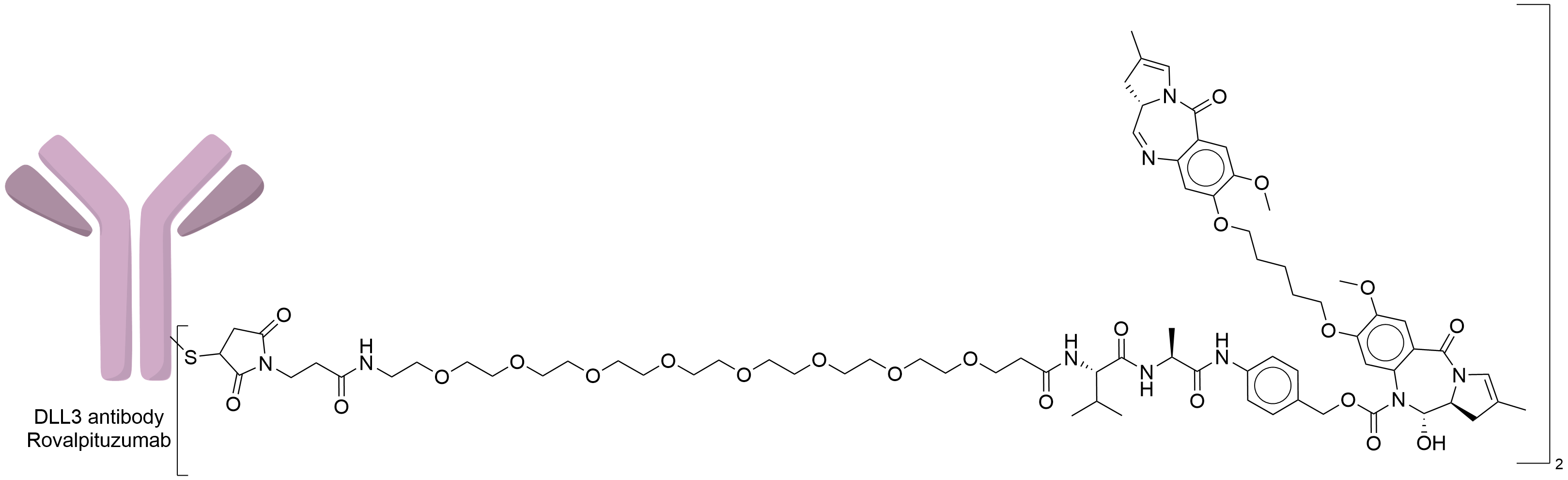
|
|||||
| Antibody Name |
Rovalpituzumab
|
Antibody Info | ||||
| Antigen Name |
Delta-like protein 3 (DLL3)
|
Antigen Info | ||||
| Payload Name |
SG3199 (SC-DR002)
|
Payload Info | ||||
| Payload Target |
Human deoxyribonucleic acid (hDNA)
|
Target Info | ||||
| Linker Name |
Mal-PEG8-Val-Ala-PABC
|
Linker Info | ||||
| Conjugate Type |
Random Cysteines
|
|||||
| Combination Type |
tesirine
|
|||||
| Special Approval(s) |
Orphan drug (FDA)
|
|||||
2027 Update
The disease landscape of This ADC
2027 Update
The clinical trial pipelines of This ADC
| Disease Name | Phase 1 | Phase 2 | Phase 3 | Approved |
|---|---|---|---|---|
| Brain cancer | ||||
| Lung cancer | ||||
| Melanoma | ||||
| Prostate cancer | ||||
| Thyroid cancer | ||||
| Unspecific solid tumor |
General Information of The Activity Data Related to This ADC
Identified from the Human Clinical Data
Discovered Using Patient-derived Xenograft Model
Discovered Using Cell Line-derived Xenograft Model
| Standard Type | Value | Units | Cell Line | Disease Model |
|---|---|---|---|---|
| Tumor Growth Inhibition value (TGI) |
≈ 99
|
%
|
COG-N-415 cells
|
Neuroblastoma
|
Full List of Activity Data of This Antibody-drug Conjugate
Identified from the Human Clinical Data
| Experiment 1 Reporting the Activity Date of This ADC | [1] | ||||
| Efficacy Data | stable disease (SD) |
21%
|
|||
| Patients Enrolled |
Eligible participants had DLL3-high (≥75% tumor staining) advanced SCLC progressing after first-line platinum therapy (ECOG 0-1, measurable disease), excluding those with recent cardiovascular events, leptomeningeal metastases, >1 prior regimen, active infections, other malignancies within 2 years, or prior topoisomerase I inhibitors.
|
||||
| Administration Dosage |
Rovalpituzumab tesirine IV administration (dosing based on actual body weight) on Day 1 of a 42-day cycle for 2 cycles, with up to 2 additional cycles permitted.
|
||||
| Related Clinical Trial | |||||
| NCT Number | NCT03061812 | Clinical Status | PHASE3 | ||
| Clinical Description | A Randomized, Open-Label, Multicenter, Phase 3 Study of Rovalpituzumab Tesirine Compared With Topotecan for Subjects With Advanced or Metastatic DLL3high Small Cell Lung Cancer (SCLC) Who Have First Disease Progression During or Following Front-Line Platinum-Based Chemotherapy (TAHOE) | ||||
| Primary Endpoint |
The primary endpoint evaluated overall survival (OS) from randomization to death (Kaplan-Meier method) with median follow-up of 20-20.6 months across treatment arms, censoring at last documented alive date or study termination (12 Feb 2020), with survival data collected every 6 weeks post-treatment.
|
||||
| Other Endpoint |
Secondary endpoints included progression-free survival (PFS), objective response rate (ORR), clinical benefit rate (CBR), and duration of response (DOR) per RECIST v1.1 via CT scans (assessed every 6-9 weeks), plus EORTC QLQ-C15-PAL physical functioning score changes at Week 7 (0-100 scale), with median follow-up matching OS timeframe.
|
||||
| Experiment 2 Reporting the Activity Date of This ADC | [1] | ||||
| Efficacy Data | progressive disease (PD) |
54%
|
|||
| Patients Enrolled |
Eligible participants had DLL3-high (≥75% tumor staining) advanced SCLC progressing after first-line platinum therapy (ECOG 0-1, measurable disease), excluding those with recent cardiovascular events, leptomeningeal metastases, >1 prior regimen, active infections, other malignancies within 2 years, or prior topoisomerase I inhibitors.
|
||||
| Administration Dosage |
Rovalpituzumab tesirine IV administration (dosing based on actual body weight) on Day 1 of a 42-day cycle for 2 cycles, with up to 2 additional cycles permitted.
|
||||
| Related Clinical Trial | |||||
| NCT Number | NCT03061812 | Clinical Status | PHASE3 | ||
| Clinical Description | A Randomized, Open-Label, Multicenter, Phase 3 Study of Rovalpituzumab Tesirine Compared With Topotecan for Subjects With Advanced or Metastatic DLL3high Small Cell Lung Cancer (SCLC) Who Have First Disease Progression During or Following Front-Line Platinum-Based Chemotherapy (TAHOE) | ||||
| Primary Endpoint |
The primary endpoint evaluated overall survival (OS) from randomization to death (Kaplan-Meier method) with median follow-up of 20-20.6 months across treatment arms, censoring at last documented alive date or study termination (12 Feb 2020), with survival data collected every 6 weeks post-treatment.
|
||||
| Other Endpoint |
Secondary endpoints included progression-free survival (PFS), objective response rate (ORR), clinical benefit rate (CBR), and duration of response (DOR) per RECIST v1.1 via CT scans (assessed every 6-9 weeks), plus EORTC QLQ-C15-PAL physical functioning score changes at Week 7 (0-100 scale), with median follow-up matching OS timeframe.
|
||||
| Experiment 3 Reporting the Activity Date of This ADC | [1] | ||||
| Efficacy Data | Partial Response (PR) |
14%
|
|||
| Patients Enrolled |
Eligible participants had DLL3-high (≥75% tumor staining) advanced SCLC progressing after first-line platinum therapy (ECOG 0-1, measurable disease), excluding those with recent cardiovascular events, leptomeningeal metastases, >1 prior regimen, active infections, other malignancies within 2 years, or prior topoisomerase I inhibitors.
|
||||
| Administration Dosage |
Rovalpituzumab tesirine IV administration (dosing based on actual body weight) on Day 1 of a 42-day cycle for 2 cycles, with up to 2 additional cycles permitted.
|
||||
| Related Clinical Trial | |||||
| NCT Number | NCT03061812 | Clinical Status | PHASE3 | ||
| Clinical Description | A Randomized, Open-Label, Multicenter, Phase 3 Study of Rovalpituzumab Tesirine Compared With Topotecan for Subjects With Advanced or Metastatic DLL3high Small Cell Lung Cancer (SCLC) Who Have First Disease Progression During or Following Front-Line Platinum-Based Chemotherapy (TAHOE) | ||||
| Primary Endpoint |
The primary endpoint evaluated overall survival (OS) from randomization to death (Kaplan-Meier method) with median follow-up of 20-20.6 months across treatment arms, censoring at last documented alive date or study termination (12 Feb 2020), with survival data collected every 6 weeks post-treatment.
|
||||
| Other Endpoint |
Secondary endpoints included progression-free survival (PFS), objective response rate (ORR), clinical benefit rate (CBR), and duration of response (DOR) per RECIST v1.1 via CT scans (assessed every 6-9 weeks), plus EORTC QLQ-C15-PAL physical functioning score changes at Week 7 (0-100 scale), with median follow-up matching OS timeframe.
|
||||
| Experiment 4 Reporting the Activity Date of This ADC | [1] | ||||
| Efficacy Data | Objective Response Rate (ORR) |
15%
|
|||
| Patients Enrolled |
Eligible participants had DLL3-high (≥75% tumor staining) advanced SCLC progressing after first-line platinum therapy (ECOG 0-1, measurable disease), excluding those with recent cardiovascular events, leptomeningeal metastases, >1 prior regimen, active infections, other malignancies within 2 years, or prior topoisomerase I inhibitors.
|
||||
| Administration Dosage |
Rovalpituzumab tesirine IV administration (dosing based on actual body weight) on Day 1 of a 42-day cycle for 2 cycles, with up to 2 additional cycles permitted.
|
||||
| Related Clinical Trial | |||||
| NCT Number | NCT03061812 | Clinical Status | PHASE3 | ||
| Clinical Description | A Randomized, Open-Label, Multicenter, Phase 3 Study of Rovalpituzumab Tesirine Compared With Topotecan for Subjects With Advanced or Metastatic DLL3high Small Cell Lung Cancer (SCLC) Who Have First Disease Progression During or Following Front-Line Platinum-Based Chemotherapy (TAHOE) | ||||
| Primary Endpoint |
The primary endpoint evaluated overall survival (OS) from randomization to death (Kaplan-Meier method) with median follow-up of 20-20.6 months across treatment arms, censoring at last documented alive date or study termination (12 Feb 2020), with survival data collected every 6 weeks post-treatment.
|
||||
| Other Endpoint |
Secondary endpoints included progression-free survival (PFS), objective response rate (ORR), clinical benefit rate (CBR), and duration of response (DOR) per RECIST v1.1 via CT scans (assessed every 6-9 weeks), plus EORTC QLQ-C15-PAL physical functioning score changes at Week 7 (0-100 scale), with median follow-up matching OS timeframe.
|
||||
| Experiment 5 Reporting the Activity Date of This ADC | [1] | ||||
| Efficacy Data | Complete response (CR) |
0.30%
|
|||
| Patients Enrolled |
Eligible participants had DLL3-high (≥75% tumor staining) advanced SCLC progressing after first-line platinum therapy (ECOG 0-1, measurable disease), excluding those with recent cardiovascular events, leptomeningeal metastases, >1 prior regimen, active infections, other malignancies within 2 years, or prior topoisomerase I inhibitors.
|
||||
| Administration Dosage |
Rovalpituzumab tesirine IV administration (dosing based on actual body weight) on Day 1 of a 42-day cycle for 2 cycles, with up to 2 additional cycles permitted.
|
||||
| Related Clinical Trial | |||||
| NCT Number | NCT03061812 | Clinical Status | PHASE3 | ||
| Clinical Description | A Randomized, Open-Label, Multicenter, Phase 3 Study of Rovalpituzumab Tesirine Compared With Topotecan for Subjects With Advanced or Metastatic DLL3high Small Cell Lung Cancer (SCLC) Who Have First Disease Progression During or Following Front-Line Platinum-Based Chemotherapy (TAHOE) | ||||
| Primary Endpoint |
The primary endpoint evaluated overall survival (OS) from randomization to death (Kaplan-Meier method) with median follow-up of 20-20.6 months across treatment arms, censoring at last documented alive date or study termination (12 Feb 2020), with survival data collected every 6 weeks post-treatment.
|
||||
| Other Endpoint |
Secondary endpoints included progression-free survival (PFS), objective response rate (ORR), clinical benefit rate (CBR), and duration of response (DOR) per RECIST v1.1 via CT scans (assessed every 6-9 weeks), plus EORTC QLQ-C15-PAL physical functioning score changes at Week 7 (0-100 scale), with median follow-up matching OS timeframe.
|
||||
| Experiment 6 Reporting the Activity Date of This ADC | [2] | ||||
| Patients Enrolled |
Eligible patients had DLL3-expressing (≥1% tumor cells), progressive advanced solid tumors refractory to ≥1 prior therapy, ECOG 0-1, and adequate organ function. Key exclusions included active infections, recent cardiovascular events, prior PBD-based drugs, uncontrolled comorbidities, pregnancy/breastfeeding, or other malignancies within 3 years (except specified exceptions). CNS metastases required stability post-treatment.
Click to Show/Hide
|
||||
| Administration Dosage |
Rovalpituzumab tesirine 0.2-0.4 mg/kg administered intravenously on Day 1 of each 6-week cycle. Dexamethasone 8 mg administered orally twice daily on Day -1, Day 1 (the day of dosing), and Day 2 of each 6-week cycle.
|
||||
| Related Clinical Trial | |||||
| NCT Number | NCT02709889 | Clinical Status | PHASE1|||PHASE2 | ||
| Clinical Description | An Open-Label Study of Rovalpituzumab Tesirine in Subjects With Delta-Like Protein 3-Expressing Advanced Solid Tumors | ||||
| Primary Endpoint |
The study assessed treatment-emergent adverse events (TEAEs) across neuroendocrine (NEC) and non-NEC disease groups, including serious TEAEs and drug-related events leading to discontinuation/dose reduction, graded per NCI CTCAE v4.03 from first dose through 30 days post-treatment (mean 1 cycle, range 1-5 cycles).
|
||||
| Other Endpoint |
Efficacy endpoints included objective response rate (ORR), clinical benefit rate (CBR), duration of response (DOR), progression-free survival (PFS), and overall survival (OS) assessed per RECIST v1.1 up to 35.2 months. Pharmacokinetic analysis measured rovalpituzumab tesirine serum concentrations during Cycle 1, with anti-therapeutic antibodies (ATA) evaluated at Day 1 and 42 days post-last dose.
Click to Show/Hide
|
||||
| Experiment 7 Reporting the Activity Date of This ADC | [3] | ||||
| Patients Enrolled |
Eligible participants must have previously received ≥1 rovalpituzumab tesirine dose in a parent study. Retreatment candidates (Arm A) required initial treatment tolerance, prior clinical benefit (stable disease or better), ≥12-week progression-free interval post-treatment, ECOG 0-1, adequate organ function, and stable CNS metastases if applicable. Exclusion criteria prohibited enrollment of subjects without prior rovalpituzumab tesirine study participation.
Click to Show/Hide
|
||||
| Administration Dosage |
Rovalpituzumab tesirine (0.3 mg/kg or previously adjusted dose) administered intravenously once every 6 weeks beginning on Day 1 (day of dosing). Subjects will receive rovalpituzumab tesirine on Day 1 of each 6-week cycle, omitting every third cycle until disease progression or study drug discontinuation.
|
||||
| Related Clinical Trial | |||||
| NCT Number | NCT03543358 | Clinical Status | PHASE2 | ||
| Clinical Description | A Multicenter, Long-Term, Rollover Extension Study of Rovalpituzumab Tesirine | ||||
| Primary Endpoint |
The study monitored treatment-emergent adverse events (TEAEs) and serious TEAEs in participants receiving rovalpituzumab tesirine treatment or retreatment from first dose until 70 days post-last dose (up to ~5 years), with investigator-assessed causality and severity grading per standard definitions.
|
||||
| Experiment 8 Reporting the Activity Date of This ADC | [4] | ||||
| Patients Enrolled |
Eligible participants must be ≥18 years with chemotherapy-naïve extensive-stage SCLC showing ≥75% DLL3 expression, ECOG 0-1, adequate organ function, and stable CNS metastases if present, excluding those with prior SCLC treatments, significant comorbidities, recent cardiovascular events, active infections, pregnancy, other malignancies within 3 years, or PBD-based drug exposure.
Click to Show/Hide
|
||||
| Administration Dosage |
Rovalpituzumab Tesirine 0.3 mg/kg IV infusion; Rovalpituzumab Tesirine 0.3 mg/kg IV infusion followed by Cisplatin 80 mg/m2 and Etoposide 100 mg/m2 IV infusion.
|
||||
| Related Clinical Trial | |||||
| NCT Number | NCT02819999 | Clinical Status | PHASE1 | ||
| Clinical Description | A Study of Rovalpituzumab Tesirine (SC16LD6.5) in the Frontline Treatment of Patients With Extensive Stage Small Cell Lung Cancer | ||||
| Primary Endpoint |
The study evaluates dose-limiting toxicities (DLTs) within 21 days post-dose and treatment-emergent adverse events (TEAEs) through 30 days after treatment in Phase 1a, along with Grade >2 lab abnormalities and 4-year progression-free survival (PFS) as key safety endpoints for DLL3-expressing SCLC patients receiving rovalpituzumab tesirine monotherapy or combination therapy.
Click to Show/Hide
|
||||
| Other Endpoint |
Phase 1b assesses efficacy outcomes including best overall response, duration of response, clinical benefit rate, and overall survival over 4 years, while monitoring pharmacokinetic parameters (Cmax, AUC, T1/2 etc.), anti-drug antibodies, TEAEs, vital signs, and ECOG performance status throughout the 4-year study period.
|
||||
| Experiment 9 Reporting the Activity Date of This ADC | [5] | ||||
| Patients Enrolled |
Eligible patients must have extensive-stage SCLC with ECOG 0-2 and adequate organ function, excluding those with significant cardiac abnormalities (QTcF >470/450ms, conduction defects, LVEF<0.30, arrhythmia history), active infections, pregnancy, prior PBD exposure, or hypersensitivity to study drug components.
|
||||
| Administration Dosage |
0.3 mg/kg rovalpituzumab tesirine intravenously on Day 1 of every 6-week treatment cycle for 2 cycles omitting every third cycle
|
||||
| Related Clinical Trial | |||||
| NCT Number | NCT02874664 | Clinical Status | PHASE1 | ||
| Clinical Description | An Intensive QT/QTc Study to Investigate the Effects of Rovalpituzumab Tesirine on Cardiac Ventricular Repolarization in Subjects With Small Cell Lung Cancer | ||||
| Primary Endpoint |
The primary endpoint evaluates QTcF interval changes from baseline over 12 weeks using Holter monitor-derived ECG parameters in patients treated with rovalpituzumab tesirine.
|
||||
| Other Endpoint |
Secondary endpoints include 12-week ECG parameter changes (RR, PR, QRS, waveform), QTcF-plasma concentration correlation, arrhythmia events stratified by QTcF changes, safety monitoring through 30 days post-treatment, efficacy outcomes (ORR, DOR, PFS, OS, CBR) assessed up to 24 months, and pharmacokinetic analysis (Cmax, AUC) during treatment cycles.
Click to Show/Hide
|
||||
| Experiment 10 Reporting the Activity Date of This ADC | [6] | ||||
| Patients Enrolled |
Inclusion requires ineligibility for standard Rovalpituzumab Tesirine trials, with potential case-by-case pediatric enrollment consideration, while no exclusion criteria are established for participation.
|
||||
| Administration Dosage |
.
|
||||
| Related Clinical Trial | |||||
| NCT Number | NCT03503890 | Clinical Status | N.A. | ||
| Clinical Description | Expanded Access to Rovalpituzumab Tesirine | ||||
| Experiment 11 Reporting the Activity Date of This ADC | [7] | ||||
| Patients Enrolled |
Eligible participants were ≥18 years with progressive SCLC after 1-2 prior platinum regimens (ECOG 0-1), adequate organ function, controlled CNS metastases, and proper contraception, excluding those with active CNS disease, uncontrolled cardiac conditions, recent anticancer therapies (<14-21 days), QTcF >450/470ms, HIV/Hepatitis, or hypersensitivity to drug components.
Click to Show/Hide
|
||||
| Administration Dosage |
Rovalpituzumab tesirine will be administered as a single agent, at increasing dose levels as permitted based on real-time assessment of safety and tolerability, intravenously over 30 minutes. Doses will be repeated on Day 1 of each 21-day or 42-day cycle until either unacceptable toxicity or evidence of disease progression occurs.
|
||||
| Related Clinical Trial | |||||
| NCT Number | NCT01901653 | Clinical Status | PHASE1|||PHASE2 | ||
| Clinical Description | Phase I/II Open Label Dose Escalation Study of the Safety, Pharmacokinetics, and Preliminary Efficacy of SC16LD6.5 as a Single Agent in Patients With Recurrent Small Cell Lung Cancer | ||||
| Primary Endpoint |
The primary endpoint assessed the Maximum Tolerated Dose (MTD) of Rovalpituzumab Tesirine during dose escalation (Phase 1a), defined as the highest dose below which ≥2 of 3-6 subjects experienced dose-limiting toxicities within 21-42 days across tested doses (0.05-0.8 mg/kg every 21/42 days).
|
||||
| Other Endpoint |
Secondary endpoints included efficacy measures (ORR, DOR, CBR, PFS, OS) evaluated per RECIST v1.1 by investigators and independent review, with median observation periods of 4-7 months (up to 14.6 months), plus pharmacokinetic analysis of ADC Cmax and AUC during treatment cycles.
|
||||
| Experiment 12 Reporting the Activity Date of This ADC | [8] | ||||
| Patients Enrolled |
Eligible participants were adults with DLL3-positive (≥1% tumor staining) SCLC progressing after ≥2 prior regimens (including platinum), having measurable disease, ECOG 0-1, and adequate organ function, while excluding those with active infections, recent cardiovascular events, uncontrolled comorbidities, concurrent corticosteroids >20mg/day, other malignancies within 3 years, or prior PBD exposure unless undergoing protocol-specified retreatment.
Click to Show/Hide
|
||||
| Administration Dosage |
0.3 mg/kg rovalpituzumab tesirine administered intravenously on Day 1 of each 42-day cycle (every 6 weeks; Q6W) for 2 cycles. An additional 2 cycles of rovalpituzumab tesirine (retreatment) was permitted for eligible participants.
|
||||
| Related Clinical Trial | |||||
| NCT Number | NCT02674568 | Clinical Status | PHASE2 | ||
| Clinical Description | An Open-label, Single-Arm, Phase 2 Study Evaluating the Efficacy, Safety and Pharmacokinetics of Rovalpituzumab Tesirine (SC16LD6.5) for Third-line and Later Treatment of Subjects With Relapsed or Refractory Delta-Like Protein 3-Expressing Small Cell Lung Cancer (TRINITY) | ||||
| Primary Endpoint |
The primary efficacy endpoints evaluated objective response rate (confirmed CR/PR per RECIST v1.1) and overall survival over a mean follow-up of 29 weeks (up to 122.4 weeks), with tumor assessments conducted by both investigators and independent review committees.
|
||||
| Other Endpoint |
Secondary endpoints included overall response rate (unconfirmed CR/PR), duration of response, progression-free survival, clinical benefit rate (CR/PR/SD≥42 days), pharmacokinetic measurements, immunogenicity (ATA), and treatment-emergent adverse events during initial treatment, all analyzed over the same 122.4-week maximum observation period.
|
||||
| Experiment 13 Reporting the Activity Date of This ADC | [9] | ||||
| Patients Enrolled |
Eligible participants were adults with extensive-stage SCLC progressing after ≥1 platinum regimen (ECOG 0-1), excluding those with active autoimmune diseases or prior immuno-oncology/PBD-based therapy, with adequate organ function required for enrollment.
|
||||
| Administration Dosage |
Participants will receive 2 doses of 0.3 mg/kg rovalpituzumab tesirine by intravenous (IV) infusion 6 weeks apart (Day 1 of Cycles 1 and 3), and 2 doses of 360 mg nivolumab IV 3 weeks apart beginning on Cycle 2 (Day 1 of Cycles 2 and 3).
|
||||
| Related Clinical Trial | |||||
| NCT Number | NCT03026166 | Clinical Status | PHASE1|||PHASE2 | ||
| Clinical Description | A Phase 1/2 Study on the Safety of Rovalpituzumab Tesirine Administered in Combination With Nivolumab or Nivolumab and Ipilimumab for Adults With Extensive-Stage Small Cell Lung Cancer | ||||
| Primary Endpoint |
The primary safety endpoints evaluated dose-limiting toxicities (DLTs) over 12 weeks per NCI CTCAE v4.03 criteria, including Grade 4 hematologic events and clinically significant Grade 3/4 non-hematologic AEs, with adverse event monitoring continuing until 100 days post-treatment (median treatment duration 53-65 days).
|
||||
| Experiment 14 Reporting the Activity Date of This ADC | [10] | ||||
| Patients Enrolled |
Eligible participants had ED-SCLC with ongoing benefit (SD/PR/CR) after 4 platinum cycles (randomized 3-9 weeks post-cycle 4), ECOG 0-1, controlled CNS metastases, and tumor tissue for DLL3 testing, excluding prior non-platinum therapies, recent radiotherapy (except PCI/palliative), or PBD-based drug exposure.
|
||||
| Administration Dosage |
Rovalpituzumab tesirine/dexamethasone every 6 weeks (q6 wk); omitting every third cycle.
|
||||
| Related Clinical Trial | |||||
| NCT Number | NCT03033511 | Clinical Status | PHASE3 | ||
| Clinical Description | A Randomized, Double-Blind, Placebo-Controlled Phase 3 Study of Rovalpituzumab Tesirine as Maintenance Therapy Following First-Line Platinum-Based Chemotherapy in Subjects With Extensive Stage Small Cell Lung Cancer (MERU) | ||||
| Primary Endpoint |
The primary endpoint assessed overall survival (OS) in DLL3-high extensive-stage SCLC patients, defined as months from randomization to death (Kaplan-Meier method), with median study duration of 11.9 months until death/loss to follow-up/study termination.
|
||||
| Other Endpoint |
Secondary analyses included OS in all randomized participants (same methodology) and EORTC QLQ-C30 physical functioning domain changes from baseline (0-100 scale, higher=better QoL), measured every 6 weeks until Week 78.
|
||||
| Experiment 15 Reporting the Activity Date of This ADC | [11] | ||||
| Patients Enrolled |
Eligible participants had advanced SCLC progressing after ≥2 prior regimens (including platinum), ECOG 0-1, and adequate organ function, while excluding those with prior PBD-based drug exposure to ensure treatment-naive status for the experimental therapy.
|
||||
| Administration Dosage |
Part A Dose Escalation: Rovalpituzumab tesirine intravenous (IV) (various doses and dose regimens) on Day 1 of each 6-week cycle; Part B Dose Expansion: Rovalpituzumab tesirine dosed at regimen (s) previously demonstrated in Part A to not to exceed the maximum tolerated dose (MTD).
|
||||
| Related Clinical Trial | |||||
| NCT Number | NCT03086239 | Clinical Status | PHASE1 | ||
| Clinical Description | An Open-Label Study on the Safety and Tolerability of Rovalpituzumab Tesirine in Japanese Patients With Advanced, Recurrent Small Cell Lung Cancer | ||||
| Primary Endpoint |
The primary safety endpoint assessed dose-limiting toxicities (DLTs) during the first 3 weeks of Cycle 1 using NCI CTCAE v4.03 criteria, evaluating hematologic and non-hematologic adverse events for toxicity thresholds.
|
||||
| Other Endpoint |
Key efficacy measures included objective response rate (ORR), duration of response (DOR), progression-free survival (PFS), overall survival (OS), and clinical benefit rate (CBR) per RECIST v1.1, with assessments conducted from first dose through minimum 18-week follow-up (42 days post-treatment) and extended OS monitoring up to 24 months.
|
||||
| Experiment 16 Reporting the Activity Date of This ADC | [12] | ||||
| Patients Enrolled |
Eligible participants had DLL3-expressing SCLC progressing after ≥2 prior regimens (including platinum), ECOG 0-1, measurable disease, and stable CNS metastases if present, while excluding those with recent cardiovascular events, active infections, other malignancies within 3 years, prior PBD exposure, or hypersensitivity to study drug components.
Click to Show/Hide
|
||||
| Administration Dosage |
Rovalpituzumab tesirine 0.3 mg/kg administered intravenously on Day 1 of each 6-week cycle plus oral dexamethasone 8 mg twice daily on Day -1, Day 1, and Day 2 of 6-week each cycle.
|
||||
| Related Clinical Trial | |||||
| NCT Number | NCT03334487 | Clinical Status | PHASE3 | ||
| Clinical Description | Open-Label, Single Arm, Phase 3b Study Evaluating the Safety of Rovalpituzumab Tesirine for Third-Line and Later Treatment of Subjects With Relapsed or Refractory DLL3 Expressing Small Cell Lung Cancer | ||||
| Primary Endpoint |
The primary safety outcome evaluated high-grade (≥Grade 3) treatment-emergent adverse events (TEAEs) over approximately 32 months using NCI CTCAE v4.03 criteria, with severity assessments conducted at each study visit to monitor treatment-related toxicities.
|
||||
| Other Endpoint |
Key efficacy measures included progression-free survival (PFS), overall survival (OS), objective response rate (ORR), and clinical benefit rate (CBR) per RECIST v1.1, along with quality-of-life assessments via EORTC QLQ-C15-PAL and QLQ-LC13 questionnaires, all monitored over approximately 32 months to evaluate treatment impact on disease progression and patient-reported outcomes.
Click to Show/Hide
|
||||
| Experiment 17 Reporting the Activity Date of This ADC | [13] | ||||
| Patients Enrolled |
Key eligibility requires ECOG 0-2 (0-1 for combinations), adequate organ function, and disease-specific prior therapy profiles. Notable exclusions include: recent immunosuppressants (14-day washout), active autoimmune/inflammatory conditions, uncontrolled CNS metastases, CYP3A modifiers for venetoclax arm, and prior PBD exposure for SCLC cohort. The study incorporates rigorous safety monitoring through 90-day follow-up after last dose (up to 24 months total), with special attention to immune-related AE risks and drug-specific toxicities.
Click to Show/Hide
|
||||
| Administration Dosage |
.
|
||||
| Related Clinical Trial | |||||
| NCT Number | NCT03000257 | Clinical Status | PHASE1 | ||
| Clinical Description | A Multicenter, Phase 1, Open-Label, Dose-Escalation Study of ABBV-181 as Monotherapy and in Combination With Another Anti-Cancer Therapy in Subjects With Advanced Solid Tumors | ||||
| Primary Endpoint |
This multi-part phase 1 study evaluates budigalimab (anti-PD-1) across three treatment settings: monotherapy dose escalation (Part 1), combination with rovalpituzumab tesirine in SCLC (Part 2), and combination with venetoclax in NSCLC (Part 3). Primary objectives include determining MTD/RP2D through DLT evaluation (≤33% incidence threshold), characterizing PK parameters (t1/2, Cmax, Tmax, AUC), and assessing safety profiles over 6-month dose-finding periods. Pharmacokinetic sampling continues for 12 weeks post-dose.
Click to Show/Hide
|
||||
| Other Endpoint |
Secondary objectives assess antitumor activity through RECIST v1.1-defined endpoints (ORR, CBR, PFS, DOR) with 30-day post-treatment follow-up. Combination arms include additional PK analyses for co-administered agents (rovalpituzumab tesirine/venetoclax). The study employs a traditional 3+3 design for dose escalation, with expansion cohorts requiring measurable disease and specific prior therapy exposure (e.g., PD-1/PD-L1 naïve status for SCLC cohort, 1 prior PD-1/L1-containing regimen for NSCLC cohort).
Click to Show/Hide
|
||||
| Experiment 18 Reporting the Activity Date of This ADC | [14] | ||||
| Efficacy Data | Objective Response Rate (ORR) |
10%
|
|||
| Patients Enrolled |
Extensive-stage small-cell lung cancer (ES-SCLC) who had completed four cycles of front-line platinum-based chemotherapy (cisplatin or carboplatin with etoposide or irinotecan) at least 3 weeks but not more than 9 weeks before randomization and had stable disease, PR, or CR per RECIST v.1.1.
|
||||
| Administration Dosage |
0.30 mg/kg intravenous Rova-T on day 1 of each 6-week cycle, omitting every third cycle.
|
||||
| Related Clinical Trial | |||||
| NCT Number | NCT03033511 | Clinical Status | Phase 3 | ||
| Clinical Description | A randomized, double-blind, placebo-controlled phase 3 study of rovalpituzumab tesirine as maintenance therapy following first-line platinum-based chemotherapy in subjects with extensive stage small cell lung cancer (MERU). | ||||
| Primary Endpoint |
Median age of all randomized patients (N=748) was 64 years; 78.00% had TNM stage IV disease. At futility analysis of the subset with DLL3-high tumors, the hazard ratio for OS was 1.07 (95% confidence interval: 0.84-1.36) favoring the placebo arm,with median OS of 8.50 and 9.80 months in the Rova-T and placebo arms,respectively; futility criteria were met. Rova-T significantly improved PFS versus placebo by investigator assessment (4.00 versus 1.40 mo,hazard ratio=0.48, p < 0.001).
Click to Show/Hide
|
||||
| Experiment 19 Reporting the Activity Date of This ADC | [15] | ||||
| Efficacy Data | Objective Response Rate (ORR) |
12.40
14.30 13.20 % |
|||
| Patients Enrolled |
Advanced stage DLL3-positive small-cell lung cancer (SCLC).
|
||||
| Administration Dosage |
0.30 mg/kg Rova-T intravenously infused over 30 minutes once every 6 weeks for two cycles.
|
||||
| Related Clinical Trial | |||||
| NCT Number | NCT02674568 | Clinical Status | Phase 2 | ||
| Clinical Description | An Open-label, Single-Arm, Phase 2 Study Evaluating the Efficacy, Safety and Pharmacokinetics of Rovalpituzumab Tesirine (SC16LD6.5) for Third-line and Later Treatment of Subjects With Relapsed or Refractory Delta-Like Protein 3-Expressing Small Cell Lung Cancer (TRINITY). | ||||
| Primary Endpoint |
OrR was 12.40%, 14.30%, and 13.20% in all, DLL3-high, and DLL3-positive patients,respectively. Median OS was 5.60 months in all patients and 5.70 months in DLL3-high patients.
|
||||
| Experiment 20 Reporting the Activity Date of This ADC | [16] | ||||
| Efficacy Data | Objective Response Rate (ORR) |
17.14
8.82 % |
|||
| Patients Enrolled |
101 with NEC/NET (large-cell NEC, gastroenteropancreatic NEC, neuroendocrine prostate cancer, and other NEC/NET) and 99 with other solid tumors (melanoma, medullary thyroid cancer [MTC], glioblastoma, and other).
|
||||
| Administration Dosage |
The recommended phase II dose (RP2D) was 0.30 mg/kg every 6 weeks (q6w) for two cycles.
|
||||
| Related Clinical Trial | |||||
| NCT Number | NCT02709889 | Clinical Status | Phase 1/2 | ||
| Clinical Description | An open-label study of rovalpituzumab tesirine in subjects with delta-like protein 3-expressing advanced solid tumors. | ||||
| Primary Endpoint |
The recommended phase II dose (RP2D) was 0.30 mg/kg every 6 weeks (q6w) for two cycles. At the RP2D, grade 3/4 adverse events included anemia (17.00%), thrombocytopenia (15.00%), and elevated aspartate aminotransferase (8.00%). Responses were confirmed in 15/145 patients (10.34%) treated at 0.30 mg/kg, including 9/69 patients (13.04%) with NEC/NET. Rova-T at 0.30 mg/kg q6w had manageable toxicity, with antitumor activity observed in patients with NEC/NET, melanoma, MTC, and glioblastoma.
Click to Show/Hide
|
||||
| Other Endpoint |
In pooled patients with NEC/NET expressing a high level of DLL3 (50% DLL3-positive tumor cells), the ORR was 17.14% (6/35) and 34.29% (12/35) had a BOR (all PRs). In those with NEC/NET expressing a low level of DLL3 (1-49% DLL3-positive tumor cells), the ORR was 8.82% (3/34) and the BOR rate was 14.70% (5/34) (all PRs). The median PFS values for pooled patients with NEC/NET expressing high and low levels of DLL3 were 4.30 months (95% CI, 2.7-6.1) and 3.30 months (95% CI, 2.40-4.80), respectively. The median OS values for patients expressing high and low levels of DLL3 were 7.40 months (95% CI, 5.60-13.10) and 7.10 months (95% CI, 4.30-9.90), respectively.
Click to Show/Hide
|
||||
| Experiment 21 Reporting the Activity Date of This ADC | [17] | ||||
| Efficacy Data | Objective Response Rate (ORR) |
34.50
31.60 50.00 50.00 % |
|||
| Patients Enrolled |
Progressive small-cell lung cancer (SCLC) who had previously been treated with at least one prior line of platinum-containing chemotherapy were enrolled if they were naive to PD-1/PD-L1targeting agents, had ECOG performance status 0-1, measurable disease per RECIST v1.1 or disease evaluable by tumor antigen assessment, and adequate bone marrow, cardiac, hepatic, and renal functions.
Click to Show/Hide
|
||||
| Administration Dosage |
Budigalimab 375 mg via intravenous infusion every 3 weeks and Rova-T was administered as a dose of 0.30 mg/kg intravenously, on day 1 of the first and third 3-week cycle.
|
||||
| Related Clinical Trial | |||||
| NCT Number | NCT03000257 | Clinical Status | Phase 1 | ||
| Clinical Description | A multicenter, phase 1, open-label, dose-escalation study of ABBV-181 as monotherapy and in combination with another anti-cancer therapy in subjects with advanced solid tumors. | ||||
| Primary Endpoint |
In patients with DLL3 score 75.00% (n = 19) the response rate was similar to the total evaluable population, with an ORR of 21.10% (90% CI: 7.50-41.90).
|
||||
| Experiment 22 Reporting the Activity Date of This ADC | [18] | ||||
| Efficacy Data | Objective Response Rate (ORR) |
50.00
63.00 33.00 % |
|||
| Patients Enrolled |
Extensive-stage small-cell lung cancer (ES SCLC), with a response of stable disease or better after the prestudy CE cycle per the Response Evaluation Criteria in Solid Tumors version 1.1, Eastern Cooperative Oncology Group performance status of 0 to 1, and absent or treated central nervous system metastases.
|
||||
| Administration Dosage |
Rova-T monotherapy (0.30 mg/kg, every 6 [q6] wk 2; cohort 1; n = 4); Rova-T induction (0.30 mg/kg, q6 wk 2) followed by CE every 21 days (q21) 4 (cohort 2; n = 5); Rova-T (0.10 or 0.20 mg/kg, q6 wk 2) overlapping with CE q21 4 (cohort 3; n = 14); and Rova-T maintenance (0.30 mg/kg, q6 wk 2) after CE q21 4 (cohort 4; n = 3).
|
||||
| Related Clinical Trial | |||||
| NCT Number | NCT02819999 | Clinical Status | Phase 1 | ||
| Clinical Description | A study of rovalpituzumab tesirine (SC16LD6.5) in the frontline treatment of patients with extensive stage small cell lung cancer. | ||||
| Primary Endpoint |
Median age was 66 years, and 73.00% had Eastern Cooperative Oncology Group performance status of 1. In cohort 3,seven patients (50%) had confirmed objective responses,with a median progression-free survival of 5.20 months and median overall survival of 10.30 months.
|
||||
Discovered Using Patient-derived Xenograft Model
| Experiment 1 Reporting the Activity Date of This ADC | [19] | ||||
| Efficacy Data | Tumor Growth Inhibition value (TGI) | ≈ 16% | High DLL3 expression (DLL3+++) | ||
| Method Description |
The inhibitory activity of Rova-T against cancer cell growth was evaluated in various human cancer cell lines in vivo. The cells were treated with 0.1 mg/kg.
|
||||
| In Vivo Model | Neuroblastoma PDX model (PDX: COG-N-415x) | ||||
| Experiment 2 Reporting the Activity Date of This ADC | [19] | ||||
| Efficacy Data | Tumor Growth Inhibition value (TGI) | ≈ 30% | High DLL3 expression (DLL3+++) | ||
| Method Description |
The inhibitory activity of Rova-T against cancer cell growth was evaluated in various human cancer cell lines in vivo. The cells were treated with 0.3 mg/kg.
|
||||
| In Vivo Model | Neuroblastoma PDX model (PDX: COG-N-415x) | ||||
| Experiment 3 Reporting the Activity Date of This ADC | [19] | ||||
| Efficacy Data | Tumor Growth Inhibition value (TGI) | ≈ 33% | High DLL3 expression (DLL3+++) | ||
| Method Description |
The inhibitory activity of Rova-T against cancer cell growth was evaluated in various human cancer cell lines in vivo. The cells were treated with 1 mg/kg weekly x 1.
|
||||
| In Vivo Model | Neuroblastoma PDX model (PDX: COG-N-415x) | ||||
| Experiment 4 Reporting the Activity Date of This ADC | [19] | ||||
| Efficacy Data | Tumor Growth Inhibition value (TGI) | ≈ 40.74% | High DLL3 expression (DLL3+++) | ||
| Method Description |
The inhibitory activity of Rova-T against cancer cell growth was evaluated in various human cancer cell lines in vivo. The cells were treated with 0.1 mg/kg.
|
||||
| In Vivo Model | Neuroblastoma PDX model (PDX: COG-N-452x) | ||||
| Experiment 5 Reporting the Activity Date of This ADC | [19] | ||||
| Efficacy Data | Tumor Growth Inhibition value (TGI) | ≈ 50.90% | High DLL3 expression (DLL3+++) | ||
| Method Description |
The inhibitory activity of Rova-T against cancer cell growth was evaluated in various human cancer cell lines in vivo. The cells were treated with 0.1 mg/kg.
|
||||
| In Vivo Model | Neuroblastoma PDX model (PDX: COG-N-519x) | ||||
| Experiment 6 Reporting the Activity Date of This ADC | [19] | ||||
| Efficacy Data | Tumor Growth Inhibition value (TGI) | ≈ 59.81% | High DLL3 expression (DLL3+++) | ||
| Method Description |
The inhibitory activity of Rova-T against cancer cell growth was evaluated in various human cancer cell lines in vivo. The cells were treated with 0.3 mg/kg.
|
||||
| In Vivo Model | Neuroblastoma PDX model (PDX: COG-N-452x) | ||||
| Experiment 7 Reporting the Activity Date of This ADC | [19] | ||||
| Efficacy Data | Tumor Growth Inhibition value (TGI) | ≈ 73.87% | High DLL3 expression (DLL3+++) | ||
| Method Description |
The inhibitory activity of Rova-T against cancer cell growth was evaluated in various human cancer cell lines in vivo. The cells were treated with 0.3 mg/kg.
|
||||
| In Vivo Model | Neuroblastoma PDX model (PDX: COG-N-519x) | ||||
| Experiment 8 Reporting the Activity Date of This ADC | [19] | ||||
| Efficacy Data | Tumor Growth Inhibition value (TGI) | ≈ 78.50% | High DLL3 expression (DLL3+++) | ||
| Method Description |
The inhibitory activity of Rova-T against cancer cell growth was evaluated in various human cancer cell lines in vivo. The cells were treated with 0.6 mg/kg.
|
||||
| In Vivo Model | Neuroblastoma PDX model (PDX: COG-N-452x) | ||||
| Experiment 9 Reporting the Activity Date of This ADC | [19] | ||||
| Efficacy Data | Tumor Growth Inhibition value (TGI) | ≈ 83% | High DLL3 expression (DLL3+++) | ||
| Method Description |
The inhibitory activity of Rova-T against cancer cell growth was evaluated in various human cancer cell lines in vivo. The cells were treated with 0.6 mg/kg.
|
||||
| In Vivo Model | Neuroblastoma PDX model (PDX: COG-N-415x) | ||||
| Experiment 10 Reporting the Activity Date of This ADC | [19] | ||||
| Efficacy Data | Tumor Growth Inhibition value (TGI) | ≈ 94.14% | High DLL3 expression (DLL3+++) | ||
| Method Description |
The inhibitory activity of Rova-T against cancer cell growth was evaluated in various human cancer cell lines in vivo. The cells were treated with 0.6 mg/kg.
|
||||
| In Vivo Model | Neuroblastoma PDX model (PDX: COG-N-519x) | ||||
| Experiment 11 Reporting the Activity Date of This ADC | [19] | ||||
| Efficacy Data | Tumor Growth Inhibition value (TGI) | ≈ 94.83% | High DLL3 expression (DLL3+++) | ||
| Method Description |
The inhibitory activity of Rova-T against cancer cell growth was evaluated in various human cancer cell lines in vivo. The cells were treated with 0.6 mg/kg.
|
||||
| In Vivo Model | Neuroblastoma PDX model | ||||
Discovered Using Cell Line-derived Xenograft Model
| Experiment 1 Reporting the Activity Date of This ADC | [19] | ||||
| Efficacy Data | Tumor Growth Inhibition value (TGI) | ≈ 99% | High DLL3 expression (DLL3+++) | ||
| Method Description |
The inhibitory activity of Rova-T against cancer cell growth was evaluated in various human cancer cell lines in vivo. The cells were treated with 1 mg/kg weekly x 3.
|
||||
| In Vivo Model | COG-N-415 neuroblastoma model | ||||
| In Vitro Model | Neuroblastoma | COG-N-415 cells | CVCL_AQ23 | ||
References