
Antibody-drug Conjugate Information
General Information of This Antibody-drug Conjugate (ADC)
| ADC ID |
DRG0FUFBP
|
|||||
|---|---|---|---|---|---|---|
| ADC Name |
Camidanlumab tesirine
|
|||||
| Synonyms |
camidanlumab tesirine; ADCT-301; HuMax-TAC-ADC
Click to Show/Hide
|
|||||
| Organization |
ADC Therapeutics (Originator);Spirogen (Top20 MNC) (Originator) (No Rights);Genmab (No Rights)
|
|||||
| Drug Status |
Phase 2 (discontinued)
|
|||||
| Drug-to-Antibody Ratio |
2.25~2.3
|
|||||
| Structure |
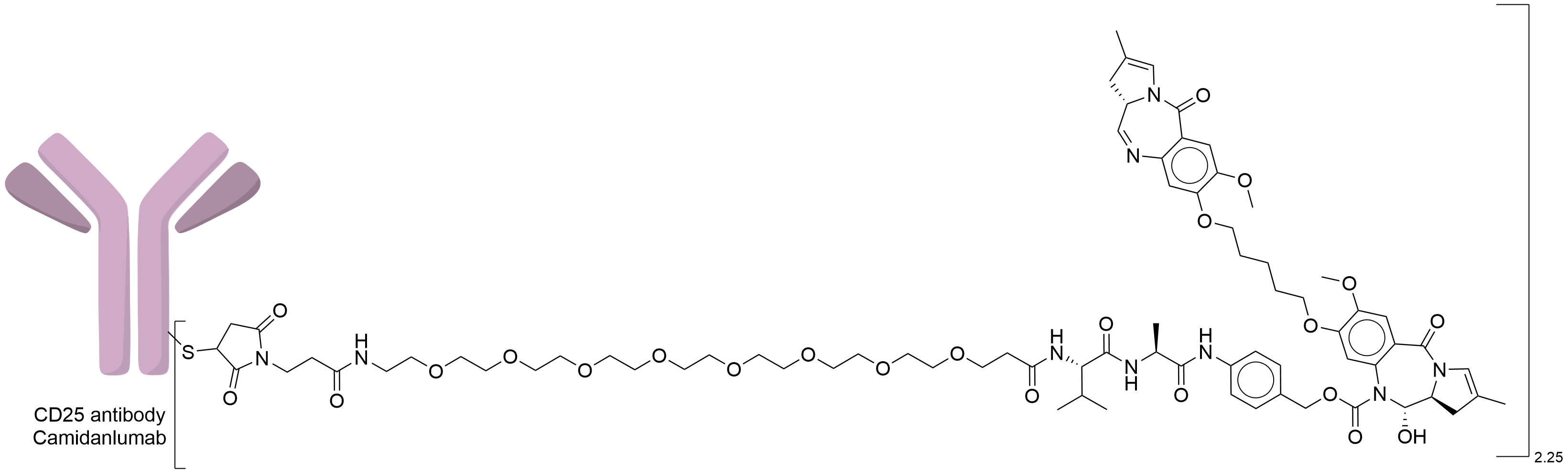
|
|||||
|
|
||||||
| Antibody Name |
Camidanlumab
|
Antibody Info | ||||
| Antigen Name |
Interleukin-2 receptor subunit alpha (IL2RA)
|
Antigen Info | ||||
| Payload Name |
SG3199 (SC-DR002)
|
Payload Info | ||||
| Therapeutic Target |
Human deoxyribonucleic acid (hDNA)
|
Target Info | ||||
| Linker Name |
Mal-PEG8-Val-Ala-PABC
|
Linker Info | ||||
| Conjugate Type |
Random Cysteines
|
|||||
| Combination Type |
tesirine
|
|||||
The indication landscape of This ADC(2027 Update)
The clinical trial pipeline of This ADC(2027 Update)
| Indication | Phase 1 | Phase 1/2 | Phase 2 | Phase 2/3 | Phase 3 | New Drug Application | Approved | |||||
|---|---|---|---|---|---|---|---|---|---|---|---|---|
| Myelodysplastic syndrome |
1 Trials
|
|||||||||||
| Acute myeloid leukaemia |
1 Trials
|
1 Trials
|
||||||||||
| Unspecific non-hodgkin lymphoma |
1 Trials
|
1 Trials
|
||||||||||
| Hodgkin lymphoma |
1 Trials
|
2 Trials
|
||||||||||
| Acute lymphoblastic leukemia |
1 Trials
|
|||||||||||
| Oesophageal cancer |
1 Trials
|
|||||||||||
| Gastric cancer |
1 Trials
|
|||||||||||
| Colorectal cancer |
1 Trials
|
|||||||||||
| Pancreatic cancer |
1 Trials
|
|||||||||||
| Lung cancer |
1 Trials
|
|||||||||||
| Melanoma |
1 Trials
|
|||||||||||
| Breast cancer |
1 Trials
|
|||||||||||
| Ovarian cancer |
1 Trials
|
|||||||||||
| Fallopian tube cancer |
1 Trials
|
|||||||||||
| Kidney cancer |
1 Trials
|
|||||||||||
| Urothelial cancer |
1 Trials
|
|||||||||||
| Head and neck cancer |
1 Trials
|
ADC-specific functional property(2027 Update)
Circulating Stability
| Incubation Time | 7.3days | Release | 50% | Reference |
[1]
|
|---|---|---|---|---|---|
| Incubation Medium | mice serum | ||||
| Description |
In mice serum, the half-lives of the naked antibody HuMax-Tac and camidanlumab tesirine were the same, both were 7.3 days
|
||||
Binding Affinity
| Dissocation Constant (Kd) | Binding Target | Description | Reference |
|---|---|---|---|
| Undisclosed |
CD25
|
ADCT-301 showed strong binding affinity to CD25-positive human anaplastic large cell lymphoma-derived cell lines Karpas 299 and Su-DHL-1
|
[1]
|
General Information of The ADMET Data Related to This ADC(2027 Update)
Absorption
| Standard Type | Value | Units | Description | Reference |
|---|---|---|---|---|
| Maximum Observed Concentration (Cmax) | 648 | ug/L |
Summary of camidanlumab tesirine PK parameters in serum following the 45 ug/kg dose Q3W for the total study population, Cycle 1.
|
[2] |
| Area Under the Concentration-Time Curve (AUC) | 1846 | day*ug/L |
Summary of camidanlumab tesirine PK parameters in serum following the 45 ug/kg dose Q3W for the total study population, Cycle 1, AUCinf.
|
[2] |
| Maximum Observed Concentration (Cmax) | 808 | ug/L |
Summary of camidanlumab tesirine PK parameters in serum following the 45 ug/kg dose Q3W for the total study population, Cycle 2.
|
[2] |
| Area Under the Concentration-Time Curve (AUC) | 2183 | day*ug/L |
Summary of camidanlumab tesirine PK parameters in serum following the 45 ug/kg dose Q3W for the total study population, Cycle 2, AUCinf.
|
[2] |
| Maximum Observed Concentration (Cmax) | 716.4 | ng/mL |
Summary of exposures by occurrence of ORR at cycle 2, Non-responders.
|
[3] |
| Maximum Observed Concentration (Cmax) | 796.8 | ng/mL |
Summary of exposures by occurrence of ORR at cycle 2, Responders.
|
[3] |
| Maximum Observed Concentration (Cmax) | 748.6 | ng/mL |
Summary of exposures by occurrence of ORR at cycle 2, Overall.
|
[3] |
| Maximum Observed Concentration (Cmax) | 501 | ng/mL |
Summary of exposures by occurrence of OS at cycle 2, Non-resonders.
|
[3] |
| Maximum Observed Concentration (Cmax) | 760.9 | ng/mL |
Summary of exposures by occurrence of OS at cycle 2, Resonders.
|
[3] |
| Maximum Observed Concentration (Cmax) | 748.6 | ng/mL |
Summary of exposures by occurrence of OS at cycle 2, Overall.
|
[3] |
| Maximum Observed Concentration (Cmax) | 722.5 | ng/mL |
Summary of exposures by occurrence of increased GGT at cycle 2, no.
|
[3] |
| Maximum Observed Concentration (Cmax) | 931.5 | ng/mL |
Summary of exposures by occurrence of increased GGT at cycle 2, yes.
|
[3] |
| Maximum Observed Concentration (Cmax) | 741.8 | ng/mL |
Summary of exposures by occurrence of increased GGT at cycle 2, overall.
|
[3] |
| Maximum Observed Concentration (Cmax) | 741.3 | ng/mL |
Summary of exposures by occurrence of neurologic AEs at cycle 2, no.
|
[3] |
| Maximum Observed Concentration (Cmax) | 757 | ng/mL |
Summary of exposures by occurrence of neurologic AEs at cycle 2, yes.
|
[3] |
| Maximum Observed Concentration (Cmax) | 741.8 | ng/mL |
Summary of exposures by occurrence of neurologic AEs at cycle 2, overall.
|
[3] |
| Maximum Observed Concentration (Cmax) | 748.4 | ng/mL |
Summary of exposures by occurrence of autoimmune AEs at cycle 2, no.
|
[3] |
| Maximum Observed Concentration (Cmax) | 576.5 | ng/mL |
Summary of exposures by occurrence of autoimmune AEs at cycle 2, yes.
|
[3] |
| Maximum Observed Concentration (Cmax) | 741.8 | ng/mL |
Summary of exposures by occurrence of autoimmune AEs at cycle 2, overall.
|
[3] |
Distribution
| Standard Type | Value | Units | Description | Reference |
|---|---|---|---|---|
| Area Under the Concentration-Time Curve (AUC) | 1846 | day*ug/L |
Summary of camidanlumab tesirine PK parameters in serum following the 45 ug/kg dose Q3W for the total study population, Cycle 1, AUCinf.
|
[2] |
| Volume of Distribution (Vd) | 5.08 | L |
Summary of camidanlumab tesirine PK parameters in serum following the 45 ug/kg dose Q3W for the total study population, Cycle 1.
|
[2] |
| Area Under the Concentration-Time Curve (AUC) | 2183 | day*ug/L |
Summary of camidanlumab tesirine PK parameters in serum following the 45 ug/kg dose Q3W for the total study population, Cycle 2, AUCinf.
|
[2] |
| Volume of Distribution (Vd) | 4.91 | L |
Summary of camidanlumab tesirine PK parameters in serum following the 45 ug/kg dose Q3W for the total study population, Cycle 2.
|
[2] |
Metabolism
| Standard Type | Value | Units | Description | Reference |
|---|---|---|---|---|
| Area Under the Concentration-Time Curve (AUC) | 1846 | day*ug/L |
Summary of camidanlumab tesirine PK parameters in serum following the 45 ug/kg dose Q3W for the total study population, Cycle 1, AUCinf.
|
[2] |
| Area Under the Concentration-Time Curve (AUC) | 2183 | day*ug/L |
Summary of camidanlumab tesirine PK parameters in serum following the 45 ug/kg dose Q3W for the total study population, Cycle 2, AUCinf.
|
[2] |
Excretion
| Standard Type | Value | Units | Description | Reference |
|---|---|---|---|---|
| Elimination Half-Life (t1/2) | 7.3 | days |
In mice serum, the half-lives of the naked antibody HuMax-Tac and camidanlumab tesirine were the same, both were 7.3 days
|
[1] |
| Clearance (CL) | 1.68 | L/day |
Based on phase 1 trial data, increased pharmacokinetic exposure was dose-dependent, and the mean apparent clearance (1.68 L/day) showed moderate to marked interpatient variability
|
[1] |
| Area Under the Concentration-Time Curve (AUC) | 1846 | day*ug/L |
Summary of camidanlumab tesirine PK parameters in serum following the 45 ug/kg dose Q3W for the total study population, Cycle 1, AUCinf.
|
[2] |
| Elimination Half-Life (t1/2) | 2.31 | day |
Summary of camidanlumab tesirine PK parameters in serum following the 45 ug/kg dose Q3W for the total study population, Cycle 1.
|
[2] |
| Clearance (CL) | 1,68 | L/day |
Summary of camidanlumab tesirine PK parameters in serum following the 45 ug/kg dose Q3W for the total study population, Cycle 1.
|
[2] |
| Area Under the Concentration-Time Curve (AUC) | 2183 | day*ug/L |
Summary of camidanlumab tesirine PK parameters in serum following the 45 ug/kg dose Q3W for the total study population, Cycle 2, AUCinf.
|
[2] |
| Elimination Half-Life (t1/2) | 2.69 | day |
Summary of camidanlumab tesirine PK parameters in serum following the 45 ug/kg dose Q3W for the total study population, Cycle 2.
|
[2] |
| Clearance (CL) | 1.37 | L/day |
Summary of camidanlumab tesirine PK parameters in serum following the 45 ug/kg dose Q3W for the total study population, Cycle 2.
|
[2] |
General Information of The Activity Data Related to This ADC
Identified from the Human Clinical Data
Discovered Using Cell Line-derived Xenograft Model
Revealed Based on the Cell Line Data
Full List of Activity Data of This Antibody-drug Conjugate
Identified from the Human Clinical Data
| Experiment 1 Reporting the Activity Date of This ADC | [4] | ||||
| Efficacy Data | Progression Free Survival |
9.1 months
|
|||
| Patients Enrolled |
Key inclusion criteria: Adults (≥18 years, ≥16 in US) with relapsed/refractory cHL (≥3 prior therapies including BV+CPI, or ≥2 if HSCT-ineligible), measurable disease (Lugano 2014), ECOG 0-2, and adequate organ function. FFPE tumor tissue and negative beta-HCG (WOCBP) required. Contraception mandated for 9.5 months (females) or 6.5 months (males) post-treatment.
Click to Show/Hide
|
||||
| Administration Dosage |
.
|
||||
| Related Clinical Trial | |||||
| NCT Number | NCT04052997 | Clinical Status | PHASE2 | ||
| Clinical Description | A Phase 2, Open-Label, Single-Arm Study to Evaluate the Efficacy and Safety of Camidanlumab Tesirine (ADCT-301) in Patients With Relapsed or Refractory Hodgkin Lymphoma | ||||
| Primary Endpoint |
The study evaluates efficacy endpoints including ORR (CR+PR per Lugano 2014), DOR (time from first response to progression/death), CR rate, RFS (time from CR to progression/death), PFS (time from first dose to progression/death), and OS (time from first dose to death). Safety assessments cover TEAEs (from first dose to 30 days post-last dose or new therapy start), SAEs (life-threatening events/hospitalization), ECOG status (0-5 scale), and HSCT recipients. PK parameters (Cmax, AUC, CL, T1/2, Vss, AI) are analyzed for total antibody, PBD-conjugated antibody, and SG3199 warhead across Cycles 1-2 (21-day cycles). ADA responses and HRQoL changes (EQ-5D-5L VAS, FACT-Lym) are monitored.
Click to Show/Hide
|
||||
| Experiment 2 Reporting the Activity Date of This ADC | [5] | ||||
| Efficacy Data | Overall response (OR) |
71%
|
|||
| Patients Enrolled |
Eligible participants were adults (≥18 years) with relapsed/refractory lymphoma (WHO-confirmed), ECOG 0-2, adequate organ function (ANC≥1500/uL, platelets≥75,000/uL, bilirubin≤1.5×ULN), and measurable disease (Lugano 2014). Exclusions included active GVHD, recent transplant (<60 days), autoimmune diseases, uncontrolled comorbidities (e.g., QTc≥450ms), or prior ADCT-301 hypersensitivity. Pregnancy, breastfeeding, or inadequate recovery from prior therapy (non-hematologic toxicity >Grade 1) also excluded participation.
Click to Show/Hide
|
||||
| Administration Dosage |
Participants received an intravenous (IV) infusion of camidanlumab tesirine (3 ug/kg) on Day 1 of each 3-week treatment cycle, for a maximum of 2 cycles.
|
||||
| Related Clinical Trial | |||||
| NCT Number | NCT02432235 | Clinical Status | PHASE1 | ||
| Clinical Description | A Phase 1 Adaptive Dose-Escalation Study to Evaluate the Tolerability, Safety, Pharmacokinetics, and Antitumor Activity of ADCT-301 in Patients With Relapsed or Refractory Hodgkin Lymphoma and Non-Hodgkin Lymphoma | ||||
| Primary Endpoint |
The study evaluated dose-limiting toxicities (DLTs) during Cycle 1-2 (21-day cycles), including hematologic (Grade 3-4 febrile neutropenia, Grade 4 thrombocytopenia/anemia) and non-hematologic events (Grade 4 tumor lysis, ≥Grade 3 AEs, ≥Grade 2 neuropathy/skin ulcers). The recommended Phase 2 dose was determined by safety data. Treatment-emergent AEs (TEAEs) and serious AEs (SAEs) were monitored for 84 days post-last dose (median treatment: 43 days).
Click to Show/Hide
|
||||
| Other Endpoint |
Efficacy endpoints per Lugano 2014 criteria included ORR (CR: complete metabolic/radiologic response; PR: >50% node reduction), DoR (time from response to progression/death), PFS (time from first dose to progression/death), and OS (time to death). Pharmacokinetics (Cmax, Tmax, AUC, half-life, clearance) were analyzed for HuMax-TAC antibody, PBD-conjugated antibody, and free warhead SG3199 across Cycles 1-2. ADA responses were assessed via ECLIA.
Click to Show/Hide
|
||||
| Experiment 3 Reporting the Activity Date of This ADC | [6] | ||||
| Efficacy Data | Objective Response Rate (ORR) |
28%
|
|||
| Patients Enrolled |
Eligible participants were adults with advanced/metastatic solid tumors (specific types varied by study phase) refractory to standard therapy, measurable disease per RECIST, ECOG 0-1, and adequate organ function. Key exclusions included autoimmune diseases, recent infections linked to GBS, active CNS metastases, significant comorbidities, or prior CD25 antibody therapy. Combination therapy cohorts excluded patients with intolerance/history of severe immune-related toxicities from checkpoint inhibitors. Contraception requirements were strictly enforced.
Click to Show/Hide
|
||||
| Administration Dosage |
Camidanlumab tesirine is administered as a 30-minute intravenous (IV) infusion on Day 1 of each cycle. Participants treated with camidanlumab tesirine as monotherapy, in the initial dose cohort will receive 20 ug/kg Q3W and the highest dose was 150 ug/kg Q3W.
|
||||
| Related Clinical Trial | |||||
| NCT Number | NCT03621982 | Clinical Status | PHASE1 | ||
| Clinical Description | A Phase 1b, Open-label, Dose-escalation and Dose-expansion Study to Evaluate the Safety, Tolerability, Pharmacokinetics, and Antitumor Activity of Camidanlumab Tesirine (ADCT-301) as Monotherapy or in Combination in Patients With Selected Advanced Solid Tumors | ||||
| Primary Endpoint |
The safety profile was assessed through treatment-emergent adverse events (TEAEs) graded by CTCAE v4.0, including serious adverse events (SAEs), dose interruptions/reductions, and dose-limiting toxicities (DLTs) observed during ADCT-301 monotherapy and combination therapy with pembrolizumab over up to 3 years. Safety monitoring covered clinical lab values, vital signs, ECG, and ECOG performance status.
Click to Show/Hide
|
||||
| Other Endpoint |
Efficacy endpoints included overall response rate (ORR), duration of response (DOR), progression-free survival (PFS), and overall survival (OS) per RECIST v1.1. Pharmacokinetic parameters (Tmax, AUC, Cmax, clearance, half-life) and anti-drug antibody (ADA) responses were evaluated for ADCT-301 components in serum during treatment cycles, with discontinuation of PK/ADA sampling if therapy switched to pembrolizumab alone.
Click to Show/Hide
|
||||
| Experiment 4 Reporting the Activity Date of This ADC | [6] | ||||
| Efficacy Data | Disease control rate (DCR) |
44%
|
|||
| Patients Enrolled |
Eligible participants were adults with advanced/metastatic solid tumors (specific types varied by study phase) refractory to standard therapy, measurable disease per RECIST, ECOG 0-1, and adequate organ function. Key exclusions included autoimmune diseases, recent infections linked to GBS, active CNS metastases, significant comorbidities, or prior CD25 antibody therapy. Combination therapy cohorts excluded patients with intolerance/history of severe immune-related toxicities from checkpoint inhibitors. Contraception requirements were strictly enforced.
Click to Show/Hide
|
||||
| Administration Dosage |
Camidanlumab tesirine is administered as a 30-minute intravenous (IV) infusion on Day 1 of each cycle. Participants treated with camidanlumab tesirine as monotherapy, in the initial dose cohort will receive 20 ug/kg Q3W and the highest dose was 150 ug/kg Q3W.
|
||||
| Related Clinical Trial | |||||
| NCT Number | NCT03621982 | Clinical Status | PHASE1 | ||
| Clinical Description | A Phase 1b, Open-label, Dose-escalation and Dose-expansion Study to Evaluate the Safety, Tolerability, Pharmacokinetics, and Antitumor Activity of Camidanlumab Tesirine (ADCT-301) as Monotherapy or in Combination in Patients With Selected Advanced Solid Tumors | ||||
| Primary Endpoint |
The safety profile was assessed through treatment-emergent adverse events (TEAEs) graded by CTCAE v4.0, including serious adverse events (SAEs), dose interruptions/reductions, and dose-limiting toxicities (DLTs) observed during ADCT-301 monotherapy and combination therapy with pembrolizumab over up to 3 years. Safety monitoring covered clinical lab values, vital signs, ECG, and ECOG performance status.
Click to Show/Hide
|
||||
| Other Endpoint |
Efficacy endpoints included overall response rate (ORR), duration of response (DOR), progression-free survival (PFS), and overall survival (OS) per RECIST v1.1. Pharmacokinetic parameters (Tmax, AUC, Cmax, clearance, half-life) and anti-drug antibody (ADA) responses were evaluated for ADCT-301 components in serum during treatment cycles, with discontinuation of PK/ADA sampling if therapy switched to pembrolizumab alone.
Click to Show/Hide
|
||||
| Experiment 5 Reporting the Activity Date of This ADC | [7] | ||||
| Patients Enrolled |
Inclusion: Adults ≥18 with relapsed/refractory AML, MDS, or MDS/MPN post-allogeneic transplant, stable GVHD (grade 1), creatinine clearance ≥60ml/min, liver function within limits, no pregnancy, and immune suppression ≤20mg prednisone/day. Exclusion: Active infections, CNS disease, recent cancer therapy (3 years), hypersensitivity to CD25 antibodies, severe autoimmune diseases, or recent infections (HSV, EBV, CMV, SARS-CoV-2, etc.).
Click to Show/Hide
|
||||
| Administration Dosage |
Patients will receive ADCT-301 37.5 ug/kg infused day 1,8, and 15 of a q3week cycle. Patients will have up to 2 cycles to assess response and safety to therapy and if they are not progressing may continue for up to 6 cycles.
|
||||
| Related Clinical Trial | |||||
| NCT Number | NCT04639024 | Clinical Status | PHASE2 | ||
| Clinical Description | An Open-label Pilot Study to Evaluate the Safety and Efficacy of ADCT-301 in Patients With Relapsed or Refractory Acute Myeloid Leukemia, Myelodysplastic Syndrome, or Myeloproliferative Neoplasms. | ||||
| Primary Endpoint |
The study evaluates ADCT-301's morphologic complete response rate (primary endpoint, up to 3 years) and safety (adverse events within 12 weeks post-last dose).
|
||||
| Experiment 6 Reporting the Activity Date of This ADC | [8] | ||||
| Patients Enrolled |
Eligibility requires relapsed/refractory CD25+ AML/ALL (WHO criteria), ECOG 0-2, adequate organ function (creatinine ≤1.5mg/dL, ALT/AST ≤2×ULN, bilirubin ≤1.5×ULN), and WBC <15,000/uL. Exclusions include active CNS leukemia, GVHD, recent transplant (≤60 days), HIV/HBV/HCV, QTc ≥450ms, prior immunogenicity to CD25 antibodies, or other malignancies (exceptions: non-melanoma skin cancer, in situ cancers). Concurrent experimental therapies or unresolved toxicities (>Grade 1) are prohibited.
Click to Show/Hide
|
||||
| Administration Dosage |
Weekly administration - Participants will receive an IV infusion of ADCT-301, on Days 1, 8, and 15 of each 3-week (21-day) cycle.3-week administration - Participants will receive an IV infusion of ADCT-301, on Day 1 of each 3-week (21-day) cycle.The dose escalation will be conducted according to a 3+3 design.
|
||||
| Related Clinical Trial | |||||
| NCT Number | NCT02588092 | Clinical Status | PHASE1 | ||
| Clinical Description | A Phase 1, Open-label, Dose-escalation, Multicenter Study to Evaluate the Tolerability, Safety, Pharmacokinetics, and Activity of ADCT 301 in Patients With Relapsed or Refractory CD25-positive Acute Myeloid Leukemia (AML) or CD25-positive Acute Lymphoblastic Leukemia | ||||
| Primary Endpoint |
The study evaluates dose-limiting toxicities (DLTs) in Cycle 1 (Days 1-21), defining hematologic DLTs as Grade 3+ neutropenia/thrombocytopenia or Grade 4 anemia with hypocellular marrow (≥6 weeks) and non-hematologic DLTs as Grade 4 tumor lysis, Grade 3+ AEs (excluding alopecia), or Grade 2+ neuropathy. The recommended dose for Part 2 is determined by safety data from Part 1. Treatment-emergent adverse events (TEAEs) and serious adverse events (SAEs) are monitored up to 24 weeks post-treatment, with SAEs including life-threatening events, hospitalization, or death.
Click to Show/Hide
|
||||
| Other Endpoint |
Efficacy endpoints include duration of response (DOR) from first response to progression/death, overall response rate (ORR) as CR/CRi/PR rates, and overall survival (OS) from first dose to death. Pharmacokinetics (Cmax, Tmax, AUC, half-life, clearance) are analyzed for PBD-conjugated antibody, total antibody, and free warhead (SG3199) in Q3W and QW dosing schedules. Anti-drug antibodies (ADA) are assessed through Cycle 2.
Click to Show/Hide
|
||||
| Experiment 7 Reporting the Activity Date of This ADC | [9] | ||||
| Efficacy Data | Complete Remission (CR) |
48.60
35.00 6.50 10.00 7.10 0.00 % |
|||
| Patients Enrolled |
Relapsed or refractory classical Hodgkin lymphoma or non-Hodgkin lymphoma, an Eastern Cooperative Oncology Group performance status 0-2, who had no therapies available to them with established clinical benefit for their disease stage were enrolled.
|
||||
| Administration Dosage |
Intravenously (3-150 ug/kg) once every 3 weeks.
|
||||
| Related Clinical Trial | |||||
| NCT Number | NCT02432235 | Clinical Status | Phase 1 | ||
| Clinical Description | A phase 1 adaptive dose-escalation study to evaluate the tolerability, safety, pharmacokinetics, and antitumor activity of ADCT-301 in patients with relapsed or refractory Hodgkin lymphoma and non-Hodgkin lymphoma. | ||||
| Primary Endpoint |
The maximum tolerated dose was not reached. The recommended doses for expansion were 30 ug/kg and 45 ug/kg for patients with classical Hodgkin lymphoma and 80 ug/kg for patients with T-cell non-Hodgkin lymphomas. No recommended doses for expansion were defined for B-cell non-Hodgkin lymphomas.
|
||||
| Other Endpoint |
In the cHL cohort,ORR (95% CI) was 86.49% at 45 ug/kg (32/37 patients [71.20-95.50]) and 55.00% at 30 ug/kg (11/20 patients [31.50-76.90]); 48.65% (18/37 patients) and 35.00% (7/20 patients) achieved CR. Median (95% CI) DOR for the cHL population was 6.64 months (5.06-8.11),and was 7.16 months (4.57-8.51) in patients treated at 45 ug/kg.
|
||||
| Experiment 8 Reporting the Activity Date of This ADC | [10] | ||||
| Patients Enrolled |
Antecedent myelodysplastic syndrome who received treatment with hypomethylating agents and subsequently presented with CD25-positive AmL, or patients with R/R CD25-positive acute lymphocytic leukemia (ALL) who had failed or were intolerant to any established therapy, or for whom no other treatment options were available.
|
||||
| Administration Dosage |
Intravenously at 3-92 ug/kg once every three weeks (Q3W) or 30 or 37.50 ug/kg every week (QW).
|
||||
| Related Clinical Trial | |||||
| NCT Number | NCT02588092 | Clinical Status | Phase 1 | ||
| Clinical Description | A phase 1, open-label, dose-escalation, multicenter study to evaluate the tolerability, safety, pharmacokinetics, and activity of ADCT 301 in patients with relapsed or refractory CD25-positive acute myeloid leukemia (AML) or CD25-positive acute lymphoblastic leukemia. | ||||
| Primary Endpoint |
Two patients achieved complete responses with incomplete hematologic recovery; one each at 30.00 and 37.50 ug/kg QW.
|
||||
| Other Endpoint |
Of 16 patients with post-baseline disease assessments, two patients treated on the QW dosing regimen had a complete response (CR).
|
||||
| Experiment 9 Reporting the Activity Date of This ADC | [11] | ||||
| Patients Enrolled |
Relapsed or refractory classical Hodgkin lymphoma and non-Hodgkin lymphoma.
|
||||
| Administration Dosage |
45 ug/kg Q3W for 2 cycles and then 30 ug/kg Q3W thereafter; intravenous administration.
|
||||
| Related Clinical Trial | |||||
| NCT Number | NCT02432235 | Clinical Status | Phase 1 | ||
| Clinical Description | A phase 1 adaptive dose-escalation study to evaluate the tolerability, safety, pharmacokinetics, and antitumor activity of ADCT-301 in patients with relapsed or refractory Hodgkin lymphoma and non-Hodgkin lymphoma. | ||||
| Primary Endpoint |
The ORR was 40%,representing 51 responders (patients achieved a best overall response of confirmed PR).
|
||||
| Other Endpoint |
Of the 130 patients included in the safety analysis, 27 (20.77%) experienced grade2 increased GGT, 17 (13.08%) experienced a grade2 neurologic AE,and 18 (13.85%) experienced a grade2 autoimmune AE at cycle 6.
|
||||
Discovered Using Cell Line-derived Xenograft Model
| Experiment 1 Reporting the Activity Date of This ADC | [12] | ||||
| Efficacy Data | Tumor Growth Inhibition value (TGI) | ≈ 11.60% | Moderate CD25 expression (CD25++; 76,000 CD25 molecules/cell) | ||
| Method Description |
Camidanlumab tesirine induces efficient tumor cell killing in CDX models of an anaplastic large cell lymphoma (ALCL) cell line Karpas 299 with moderate CD25 expression (molecules per cell surface=76000). Compared with injection of vehicle (PBS), ADCT-301 administered intravenously (i.v.) at a mean tumor volume of 160 mm3 as a single dose at 0.1 mg/kg.
Click to Show/Hide
|
||||
| In Vivo Model | Anaplastic large cell lymphoma CDX model | ||||
| In Vitro Model | ALK-positive anaplastic large cell lymphoma | Karpas-299 cells | CVCL_1324 | ||
| Experiment 2 Reporting the Activity Date of This ADC | [12] | ||||
| Efficacy Data | Tumor Growth Inhibition value (TGI) | ≈ 41.50% | High CD25 expression (CD25+++; 310,000 CD25 molecules/cell) | ||
| Method Description |
Camidanlumab tesirine induces efficient tumor cell killing in CDX models of an anaplastic large cell lymphoma (ALCL) cell line Su-DHL-1 with high CD25 expression (molecules per cell surface=310000).ADCT-301 was administered intravenously at mean tumor volume of 155 mm3 at single doses of 0.3 mg/kg and tumor growth compared with that observed after injection of vehicle (PBS).
Click to Show/Hide
|
||||
| In Vivo Model | Anaplastic large cell lymphoma CDX model | ||||
| In Vitro Model | Anaplastic large cell lymphoma | SU-DHL-1 cells | CVCL_0538 | ||
| Experiment 3 Reporting the Activity Date of This ADC | [12] | ||||
| Efficacy Data | Tumor Growth Inhibition value (TGI) | ≈ 51.30% | High CD25 expression (CD25+++; 310,000 CD25 molecules/cell) | ||
| Method Description |
Camidanlumab tesirine induces efficient tumor cell killing in CDX models of an anaplastic large cell lymphoma (ALCL) cell line Su-DHL-1 with high CD25 expression (molecules per cell surface=310000).ADCT-301 was administered intravenously at mean tumor volume of 155 mm3 at single doses of 0.3 mg/kg and tumor growth compared with that observed after injection of vehicle (PBS).
Click to Show/Hide
|
||||
| In Vivo Model | Anaplastic large cell lymphoma CDX model | ||||
| In Vitro Model | Anaplastic large cell lymphoma | SU-DHL-1 cells | CVCL_0538 | ||
| Experiment 4 Reporting the Activity Date of This ADC | [12] | ||||
| Efficacy Data | Tumor Growth Inhibition value (TGI) | ≈ 68.40% | Moderate CD25 expression (CD25++; 76,000 CD25 molecules/cell) | ||
| Method Description |
Camidanlumab tesirine induces efficient tumor cell killing in CDX models of an anaplastic large cell lymphoma (ALCL) cell line Karpas 299 with moderate CD25 expression (molecules per cell surface=76000). Compared with injection of vehicle (PBS), ADCT-301 administered intravenously (i.v.) at a mean tumor volume of 160 mm3 as a single dose at 0.2 mg/kg.
Click to Show/Hide
|
||||
| In Vivo Model | Anaplastic large cell lymphoma CDX model | ||||
| In Vitro Model | ALK-positive anaplastic large cell lymphoma | Karpas-299 cells | CVCL_1324 | ||
| Experiment 5 Reporting the Activity Date of This ADC | [12] | ||||
| Efficacy Data | Tumor Growth Inhibition value (TGI) | ≈ 93.20% | Moderate CD25 expression (CD25++; 76,000 CD25 molecules/cell) | ||
| Method Description |
Camidanlumab tesirine induces efficient tumor cell killing in CDX models of an anaplastic large cell lymphoma (ALCL) cell line Karpas 299 with moderate CD25 expression (molecules per cell surface=76000). Compared with injection of vehicle (PBS), ADCT-301 administered intravenously (i.v.) at a mean tumor volume of 160 mm3 as a single dose at 0.4 mg/kg.
Click to Show/Hide
|
||||
| In Vivo Model | Anaplastic large cell lymphoma CDX model | ||||
| In Vitro Model | ALK-positive anaplastic large cell lymphoma | Karpas-299 cells | CVCL_1324 | ||
| Experiment 6 Reporting the Activity Date of This ADC | [12] | ||||
| Efficacy Data | Tumor Growth Inhibition value (TGI) | ≈ 94.10% | High CD25 expression (CD25+++; 310,000 CD25 molecules/cell) | ||
| Method Description |
Camidanlumab tesirine induces efficient tumor cell killing in CDX models of an anaplastic large cell lymphoma (ALCL) cell line Su-DHL-1 with high CD25 expression (molecules per cell surface=310000).ADCT-301 was administered intravenously at mean tumor volume of 155 mm3 at single doses of 0.6 mg/kg and tumor growth compared with that observed after injection of vehicle (PBS).
Click to Show/Hide
|
||||
| In Vivo Model | Anaplastic large cell lymphoma CDX model | ||||
| In Vitro Model | Anaplastic large cell lymphoma | SU-DHL-1 cells | CVCL_0538 | ||
| Experiment 7 Reporting the Activity Date of This ADC | [12] | ||||
| Efficacy Data | Tumor Growth Inhibition value (TGI) | ≈ 97.10% | Moderate CD25 expression (CD25++; 76,000 CD25 molecules/cell) | ||
| Method Description |
Camidanlumab tesirine induces efficient tumor cell killing in CDX models of an anaplastic large cell lymphoma (ALCL) cell line Karpas 299 with moderate CD25 expression (molecules per cell surface=76000).Vechicle (PBS), ADCT-301 (dar 2.2), nonbinding ADC (DAR 2.1) or Adcetris (DAR~4) were administered intravenously at a mean Karpas 299 tumor volume of 130mm3 as single doses at 0.5 mg/kg.
Click to Show/Hide
|
||||
| In Vivo Model | Anaplastic large cell lymphoma CDX model | ||||
| In Vitro Model | ALK-positive anaplastic large cell lymphoma | Karpas-299 cells | CVCL_1324 | ||
| Experiment 8 Reporting the Activity Date of This ADC | [12] | ||||
| Efficacy Data | Tumor Growth Inhibition value (TGI) | ≈ 98.40% | Moderate CD25 expression (CD25++; 76,000 CD25 molecules/cell) | ||
| Method Description |
Camidanlumab tesirine induces efficient tumor cell killing in CDX models of an anaplastic large cell lymphoma (ALCL) cell line Karpas 299 with moderate CD25 expression (molecules per cell surface=76000). Compared with injection of vehicle (PBS), ADCT-301 administered intravenously (i.v.) at a mean tumor volume of 160 mm3 as a single dose at 0.6mg/kg.
Click to Show/Hide
|
||||
| In Vivo Model | Anaplastic large cell lymphoma CDX model | ||||
| In Vitro Model | ALK-positive anaplastic large cell lymphoma | Karpas-299 cells | CVCL_1324 | ||
| Experiment 9 Reporting the Activity Date of This ADC | [12] | ||||
| Efficacy Data | Tumor Growth Inhibition value (TGI) | ≈ 98.80% | High CD25 expression (CD25+++; 310,000 CD25 molecules/cell) | ||
| Method Description |
Camidanlumab tesirine induces efficient tumor cell killing in CDX models of an anaplastic large cell lymphoma (ALCL) cell line Su-DHL-1 with high CD25 expression (molecules per cell surface=310000).ADCT-301 was administered intravenously at mean tumor volume of 155 mm3 at single doses of 0.6 mg/kg and tumor growth compared with that observed after injection of vehicle (PBS).
Click to Show/Hide
|
||||
| In Vivo Model | Anaplastic large cell lymphoma CDX model | ||||
| In Vitro Model | Anaplastic large cell lymphoma | SU-DHL-1 cells | CVCL_0538 | ||
Revealed Based on the Cell Line Data
| Experiment 1 Reporting the Activity Date of This ADC | [12] | ||||
| Efficacy Data | Half Maximum Growth Inhibitory Concentration (GI50) | 0.26 pM | Moderate CD25 expression (CD25++; 17,000 CD25 molecules/cell) | ||
| Method Description |
The inhibitory activity of ADCT-301 against cancer cell growth was evaluated in various human cancer cell lines in vitro. CD25-positive and -negative cell lines were incubated with increasing concentrations of ADCT-301 or free warhead (SG3199) for 96 hours before processing by the MTS assay.
|
||||
| In Vitro Model | Chronic eosinophilic leukemia | EoL-1 cells | CVCL_0258 | ||
| Experiment 2 Reporting the Activity Date of This ADC | [12] | ||||
| Efficacy Data | Half Maximum Growth Inhibitory Concentration (GI50) | 4.96 pM | High CD25 expression (CD25+++; 310,000 CD25 molecules/cell) | ||
| Method Description |
The inhibitory activity of ADCT-301 against cancer cell growth was evaluated in various human cancer cell lines in vitro. CD25-positive and -negative cell lines were incubated with increasing concentrations of ADCT-301 or free warhead (SG3199) for 96 hours before processing by the MTS assay.
|
||||
| In Vitro Model | Anaplastic large cell lymphoma | SU-DHL-1 cells | CVCL_0538 | ||
| Experiment 3 Reporting the Activity Date of This ADC | [12] | ||||
| Efficacy Data | Half Maximum Growth Inhibitory Concentration (GI50) | 17.07 pM | Moderate CD25 expression (CD25++; 76,000 CD25 molecules/cell) | ||
| Method Description |
The inhibitory activity of ADCT-301 against cancer cell growth was evaluated in various human cancer cell lines in vitro. CD25-positive and -negative cell lines were incubated with increasing concentrations of ADCT-301 or free warhead (SG3199) for 96 hours before processing by the MTS assay.
|
||||
| In Vitro Model | ALK-positive anaplastic large cell lymphoma | Karpas-299 cells | CVCL_1324 | ||
| Experiment 4 Reporting the Activity Date of This ADC | [12] | ||||
| Efficacy Data | Half Maximum Growth Inhibitory Concentration (GI50) | 19.6 pM | High CD25 expression (CD25+++; 167,000 CD25 molecules/cell) | ||
| Method Description |
The inhibitory activity of ADCT-301 against cancer cell growth was evaluated in various human cancer cell lines in vitro. CD25-positive and -negative cell lines were incubated with increasing concentrations of ADCT-301 or free warhead (SG3199) for 96 hours before processing by the MTS assay.
|
||||
| In Vitro Model | Hodgkin lymphoma | HDLM-2 cells | CVCL_0009 | ||
| Experiment 5 Reporting the Activity Date of This ADC | [12] | ||||
| Efficacy Data | Half Maximum Growth Inhibitory Concentration (GI50) | > 6667 pM | Negative CD25 expression (CD25-; <1,000 CD25 molecules/cell) | ||
| Method Description |
The inhibitory activity of ADCT-301 against cancer cell growth was evaluated in various human cancer cell lines in vitro. CD25-positive and -negative cell lines were incubated with increasing concentrations of ADCT-301 or free warhead (SG3199) for 96 hours before processing by the MTS assay.
|
||||
| In Vitro Model | Adult acute myeloid leukemia | KG-1 cells | CVCL_0374 | ||
| Experiment 6 Reporting the Activity Date of This ADC | [12] | ||||
| Efficacy Data | Half Maximum Growth Inhibitory Concentration (GI50) | > 6667 pM | Negative CD25 expression (CD25-; <1,000 CD25 molecules/cell) | ||
| Method Description |
The inhibitory activity of ADCT-301 against cancer cell growth was evaluated in various human cancer cell lines in vitro. CD25-positive and -negative cell lines were incubated with increasing concentrations of ADCT-301 or free warhead (SG3199) for 96 hours before processing by the MTS assay.
|
||||
| In Vitro Model | T lymphocytic leukemia | HuT 78 cells | CVCL_0337 | ||
| Experiment 7 Reporting the Activity Date of This ADC | [12] | ||||
| Efficacy Data | Half Maximum Growth Inhibitory Concentration (GI50) | > 6667 pM | Negative CD25 expression (CD25-; <1,000 CD25 molecules/cell) | ||
| Method Description |
The inhibitory activity of ADCT-301 against cancer cell growth was evaluated in various human cancer cell lines in vitro. CD25-positive and -negative cell lines were incubated with increasing concentrations of ADCT-301 or free warhead (SG3199) for 96 hours before processing by the MTS assay.
|
||||
| In Vitro Model | Burkitt lymphoma | Daudi cells | CVCL_0008 | ||
| Experiment 8 Reporting the Activity Date of This ADC | [12] | ||||
| Efficacy Data | Half Maximum Growth Inhibitory Concentration (GI50) | > 6667 pM | Negative CD25 expression (CD25-; <1,000 CD25 molecules/cell) | ||
| Method Description |
The inhibitory activity of ADCT-301 against cancer cell growth was evaluated in various human cancer cell lines in vitro. CD25-positive and -negative cell lines were incubated with increasing concentrations of ADCT-301 or free warhead (SG3199) for 96 hours before processing by the MTS assay.
|
||||
| In Vitro Model | Burkitt lymphoma | Ramos cells | CVCL_0597 | ||
| Experiment 9 Reporting the Activity Date of This ADC | [12] | ||||
| Efficacy Data | Half Maximum Growth Inhibitory Concentration (GI50) | 7.49, 1.11 pM, ng/mL | Moderate CD25 expression (CD25++; 96,000 CD25 molecules/cell) | ||
| Method Description |
The inhibitory activity of ADCT-301 against cancer cell growth was evaluated in various human cancer cell lines in vitro. CD25-positive and -negative cell lines were incubated with increasing concentrations of ADCT-301 or free warhead (SG3199) for 96 hours before processing by the MTS assay.
|
||||
| In Vitro Model | Hodgkin lymphoma | L-540 cells | CVCL_1362 | ||
References