
Antibody-drug Conjugate Information
General Information of This Antibody-drug Conjugate (ID: DRG0TZZNJ)
| ADC Name |
Mipasetamab uzoptirine
|
|||||
|---|---|---|---|---|---|---|
| Synonyms |
mipasetamab uzoptirine; ADCT-601; BGB601
Click to Show/Hide
|
|||||
| Organization |
BerGenBio (Originator);ADC Therapeutics;Synaffix;Overland Pharmaceuticals
|
|||||
| Drug Status |
Phase 1 (discontinued)
|
|||||
| Drug-to-Antibody Ratio |
2
|
|||||
| Structure |
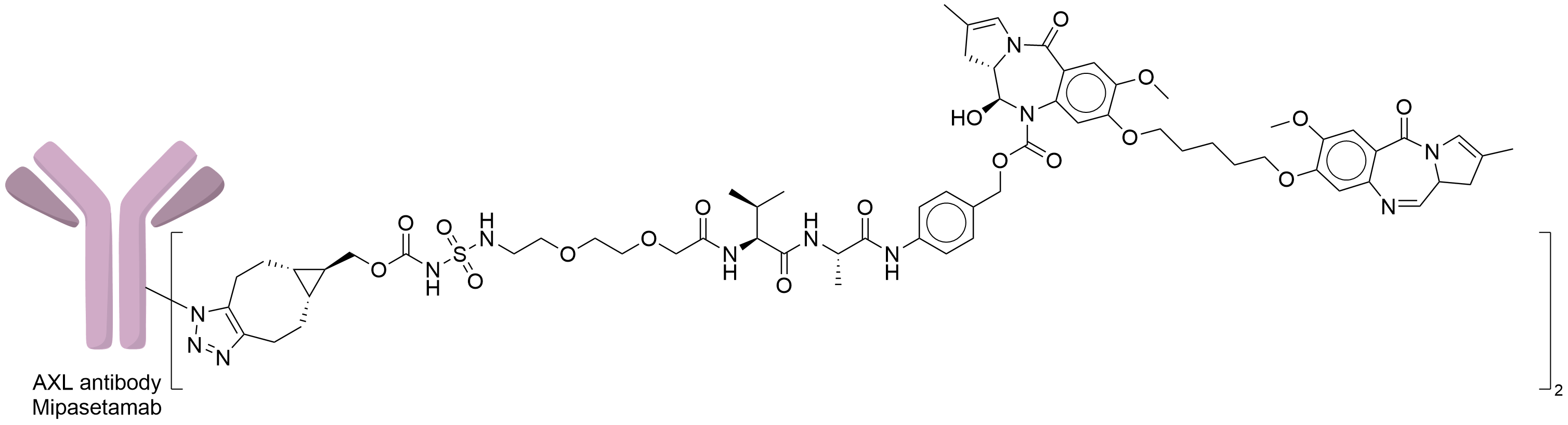
|
|||||
| Antibody Name |
Mipasetamab
|
Antibody Info | ||||
| Antigen Name |
Tyrosine-protein kinase receptor UFO (AXL)
|
Antigen Info | ||||
| Payload Name |
SG3199 (SC-DR002)
|
Payload Info | ||||
| Payload Target |
Human deoxyribonucleic acid (hDNA)
|
Target Info | ||||
| Linker Name |
BCN-HydraSpace-Val-Ala-PABC
|
Linker Info | ||||
| Conjugate Type |
Enzymatic Catalysis
|
|||||
| Combination Type |
uzoptirine
|
|||||
2027 Update
The disease landscape of This ADC
2027 Update
The clinical trial pipelines of This ADC
| Indication | Phase 1 | Phase 2 | Phase 3 | Approved | |||
|---|---|---|---|---|---|---|---|
| Unspecific solid tumor |
1 Trials
|
||||||
| Sarcoma |
2 Trials
|
||||||
| Oesophageal cancer |
1 Trials
|
||||||
| Gastric cancer |
1 Trials
|
||||||
| Colorectal cancer |
1 Trials
|
||||||
| Pancreatic cancer |
2 Trials
|
||||||
| Lung cancer |
2 Trials
|
||||||
| Pleura mesothelioma |
1 Trials
|
||||||
| Breast cancer |
1 Trials
|
||||||
| Ovarian cancer |
1 Trials
|
||||||
| Head and neck cancer |
1 Trials
|
2027 Update
ADC-specific functional property
Bystander Killing Effect
| Bystander Killing Effect | Description | Reference |
|---|---|---|
| yes |
The ability of ADCT-601 to induce bystander killing of AXL-negative tumor cells was assessed via the conditioned medium transfer method. After AXL-positive SN12C cells and AXL-negative Karpas-299 cells were exposed to ADCT-601 and B12-PL1601, targeted AXL-specific cytotoxicity was observed in SN12C cells but not in Karpas-299 cells (ADCT-601 IC50 0.042 nmol/L and 3.51 nmol/L in SN12C and Karpas-299 cells, respectively; isotype-control B12-PL1601 IC50 1.62 nmol/L and 2.92 nmol/L in SN12C and Karpas-299 cells, respectively). When conditioned medium from SN12C or Karpas-299 cells treated with ADCT-601 was transferred to Karpas-299 cells, only the conditioned medium from ADCT-601-treated SN12C (IC50 0.0159 nmol/L), but not Karpas-299 (IC50 2.12 nmol/L), induced bystander killing of Karpas-299 cells. No bystander effect was observed when conditioned medium from B12-PL1601-treated SN12C cells or Karpas-299 cells was transferred onto untreated Karpas-299 cells.
Click to Show/Hide
|
[1]
|
2027 Update
General Information of The ADMET Data Related to This ADC
Absorption
| Standard Type | Value | Units | Description | Reference |
|---|---|---|---|---|
| Maximum Observed Concentration (Cmax) | 49446 | ng/mL |
Assessment of ADCT-601 PK in rats at 3 mg/kg.
|
[1] |
| Time to Maximum Concentration (Tmax) | 1 | h |
Assessment of ADCT-601 PK in rats at 3 mg/kg.
|
[1] |
| Maximum Observed Concentration (Cmax) | 93355 | ng/mL |
Assessment of ADCT-601 PK in rats at 6 mg/kg.
|
[1] |
| Time to Maximum Concentration (Tmax) | 1 | h |
Assessment of ADCT-601 PK in rats at 6 mg/kg.
|
[1] |
Excretion
| Standard Type | Value | Units | Description | Reference |
|---|---|---|---|---|
| Last Quantifiable Concentration (Clast) | 5238 | ng/mL |
Assessment of ADCT-601 PK in rats at 3 mg/kg.
|
[1] |
| Time of Last Quantifiable Concentration (Tlast) | 504 | h |
Assessment of ADCT-601 PK in rats at 3 mg/kg.
|
[1] |
| Elimination Half-Life (t1/2) | 229 | h |
Assessment of ADCT-601 PK in rats at 3 mg/kg.
|
[1] |
| Last Quantifiable Concentration (Clast) | 3771 | ng/mL |
Assessment of ADCT-601 PK in rats at 6 mg/kg.
|
[1] |
| Time of Last Quantifiable Concentration (Tlast) | 504 | h |
Assessment of ADCT-601 PK in rats at 6 mg/kg.
|
[1] |
| Elimination Half-Life (t1/2) | 138 | h |
Assessment of ADCT-601 PK in rats at 6 mg/kg.
|
[1] |
General Information of The Activity Data Related to This ADC
Identified from the Human Clinical Data
Discovered Using Patient-derived Xenograft Model
Discovered Using Cell Line-derived Xenograft Model
Revealed Based on the Cell Line Data
Full List of Activity Data of This Antibody-drug Conjugate
Identified from the Human Clinical Data
| Experiment 1 Reporting the Activity Date of This ADC | [2] | ||||
| Efficacy Data | Stable disease (SD) |
47.10%
|
|||
| Patients Enrolled |
Eligible participants are adults (≥18 years) with locally advanced/metastatic solid tumors (specific sarcoma subtypes, NSCLC, or AXL-amplified tumors) refractory to standard therapy, measurable disease per RECIST 1.1, ECOG 0-1, and adequate organ function. Key exclusions include active CNS metastases (unless treated and stable ≥4 weeks), significant third-space fluid accumulation, recent infections requiring IV therapy, chronic diarrhea (CTCAE Grade 2+), or experimental medication use within 14 days prior to treatment initiation.
Click to Show/Hide
|
||||
| Administration Dosage |
As of 04 December 2023, 18 sarcoma patients (15 [83%], soft tissue sarcoma [STS] and 3 [17%] bone sarcoma), unselected for AXL expression, with a median number of 3 prior lines of therapy (1-10), were enrolled in 4 different dose cohorts: 7.5mg, 11mg, 13mg and 15mg. Reasons for treatment discontinuation were disease progression (10 pts [55.6%]), adverse events (3 pts [16.7%]) and consent withdrawal (2 pts [11.1%]). Treatment emergent adverse events (TEAE) were seen in 17 pts (94.4%). Most common TEAE (all grades and relationship [≥20%]) were palmar-plantar erythrodysesthesia syndrome (7 pts [38.9%]); anemia (6 pts [33.3%]); rash maculopapular (5 pts [27.8%]); cheilitis and constipation (4 pts each [22.2%]). TEAE≥grade 3 were seen in 9 pts (50%). Most common TEAE≥grade 3 (≥10%) were GGT increase (2 pts [11.1%]). Two dose limiting toxicities were seen: cheilitis grade 2 and grade 3 at 15mg and 13mg respectively. Cutaneous reactions, all grades, are more prominent in higher doses. Maximum tolerated dose (MTD) has not been established.
Click to Show/Hide
|
||||
| Related Clinical Trial | |||||
| NCT Number | NCT05389462 | Clinical Status | PHASE1 | ||
| Clinical Description | A Phase 1b, Open-Label, Dose-Escalation and Dose-Expansion Study to Evaluate the Safety, Tolerability, Pharmacokinetics, and Antitumor Activity of Mipasetamab Uzoptirine (ADCT-601) Monotherapy and in Combination with Other Anti-Cancer Therapies in Patients with Selected Advanced Solid Tumors | ||||
| Primary Endpoint |
The study evaluates safety by monitoring adverse events (AEs), serious adverse events (SAEs), dose-limiting toxicities (DLTs) during the first 21 days, and dose modifications/interruptions over approximately 2 years, with comprehensive assessments including vital signs, lab tests, and ECG monitoring.
|
||||
| Other Endpoint |
Efficacy is measured by overall response rate (ORR), duration of response (DOR), progression-free survival (PFS), and overall survival (OS) over 2 years. Pharmacokinetic analysis includes serum concentration measurements of ADCT-601 components (total antibody, PBD-conjugated antibody, and unconjugated warhead SG3199) with parameters like Cmax, Tmax, AUC, and half-life, alongside immunogenicity assessment through anti-drug antibody (ADA) responses and titers.
Click to Show/Hide
|
||||
| Experiment 2 Reporting the Activity Date of This ADC | [2] | ||||
| Efficacy Data | Partial Response (PR) |
11.80%
|
|||
| Patients Enrolled |
Eligible participants are adults (≥18 years) with locally advanced/metastatic solid tumors (specific sarcoma subtypes, NSCLC, or AXL-amplified tumors) refractory to standard therapy, measurable disease per RECIST 1.1, ECOG 0-1, and adequate organ function. Key exclusions include active CNS metastases (unless treated and stable ≥4 weeks), significant third-space fluid accumulation, recent infections requiring IV therapy, chronic diarrhea (CTCAE Grade 2+), or experimental medication use within 14 days prior to treatment initiation.
Click to Show/Hide
|
||||
| Administration Dosage |
As of 04 December 2023, 18 sarcoma patients (15 [83%], soft tissue sarcoma [STS] and 3 [17%] bone sarcoma), unselected for AXL expression, with a median number of 3 prior lines of therapy (1-10), were enrolled in 4 different dose cohorts: 7.5mg, 11mg, 13mg and 15mg. Reasons for treatment discontinuation were disease progression (10 pts [55.6%]), adverse events (3 pts [16.7%]) and consent withdrawal (2 pts [11.1%]). Treatment emergent adverse events (TEAE) were seen in 17 pts (94.4%). Most common TEAE (all grades and relationship [≥20%]) were palmar-plantar erythrodysesthesia syndrome (7 pts [38.9%]); anemia (6 pts [33.3%]); rash maculopapular (5 pts [27.8%]); cheilitis and constipation (4 pts each [22.2%]). TEAE≥grade 3 were seen in 9 pts (50%). Most common TEAE≥grade 3 (≥10%) were GGT increase (2 pts [11.1%]). Two dose limiting toxicities were seen: cheilitis grade 2 and grade 3 at 15mg and 13mg respectively. Cutaneous reactions, all grades, are more prominent in higher doses. Maximum tolerated dose (MTD) has not been established.
Click to Show/Hide
|
||||
| Related Clinical Trial | |||||
| NCT Number | NCT05389462 | Clinical Status | PHASE1 | ||
| Clinical Description | A Phase 1b, Open-Label, Dose-Escalation and Dose-Expansion Study to Evaluate the Safety, Tolerability, Pharmacokinetics, and Antitumor Activity of Mipasetamab Uzoptirine (ADCT-601) Monotherapy and in Combination with Other Anti-Cancer Therapies in Patients with Selected Advanced Solid Tumors | ||||
| Primary Endpoint |
The study evaluates safety by monitoring adverse events (AEs), serious adverse events (SAEs), dose-limiting toxicities (DLTs) during the first 21 days, and dose modifications/interruptions over approximately 2 years, with comprehensive assessments including vital signs, lab tests, and ECG monitoring.
|
||||
| Other Endpoint |
Efficacy is measured by overall response rate (ORR), duration of response (DOR), progression-free survival (PFS), and overall survival (OS) over 2 years. Pharmacokinetic analysis includes serum concentration measurements of ADCT-601 components (total antibody, PBD-conjugated antibody, and unconjugated warhead SG3199) with parameters like Cmax, Tmax, AUC, and half-life, alongside immunogenicity assessment through anti-drug antibody (ADA) responses and titers.
Click to Show/Hide
|
||||
| Experiment 3 Reporting the Activity Date of This ADC | [3] | ||||
| Patients Enrolled |
Eligible patients must be ≥18 years with locally advanced/metastatic solid tumors (including breast, colorectal, NSCLC, and ovarian cancers) refractory to standard therapy, measurable disease per RECIST 1.1, ECOG 0-1, and adequate organ function. Key exclusions include active autoimmune/CNS diseases, uncontrolled comorbidities, recent anticancer therapy (<14 days), QTcF >480 ms, pregnancy, or live vaccines. Contraception is required during and for 16 weeks post-treatment.
Click to Show/Hide
|
||||
| Administration Dosage |
As of data cutoff (April 12, 2019), 8 pts were treated at doses of 50-100 ug/kg. The median (range) age was 70 (46-77) years. Pathological subtypes enrolled are colorectal cancer (4 pts) and chondrosarcoma, head and neck carcinoma, ovarian carcinoma, and esophageal carcinoma (1 pt each). Six pts had received ≥4 previous lines of therapy. One pt treated at 100 ug/kg had a dose-limiting toxicity of grade 3 hematuria, which resulted in hospitalization and was possibly related to ADCT-601. The most common treatment-emergent adverse events, regardless of relationship to ADCT-601, were abdominal pain, erythema, fatigue, peripheral edema, and maculopapular rash (each occurring in 2 pts). The following 4 pts had undergone disease assessment at data cutoff: 1 pt (chondrosarcoma) had a partial response, 1 pt (head and neck carcinoma) had stable disease, and 2 pts (ovarian carcinoma and esophageal carcinoma) had progressive disease.
Click to Show/Hide
|
||||
| Related Clinical Trial | |||||
| NCT Number | NCT03700294 | Clinical Status | PHASE1 | ||
| Clinical Description | A Phase 1, Open-Label, Dose-Escalation Study to Evaluate the Safety, Tolerability, Pharmacokinetics, and Antitumor Activity of ADCT-601 in Patients With Advanced Solid Tumors | ||||
| Primary Endpoint |
The study evaluates safety by assessing dose-limiting toxicities (DLTs) during the first treatment cycle (21-42 days depending on dosing schedule) and determines the maximum tolerated dose (MTD) through monitoring adverse events (AEs), serious adverse events (SAEs), and dose modifications over a 2-year follow-up period with treatment cycles every 3-6 weeks.
Click to Show/Hide
|
||||
| Other Endpoint |
Efficacy endpoints include overall response rate (ORR) and disease control rate (DCR) per RECIST 1.1, duration of response (DOR), and overall survival (OS), all measured over a 2-year period to assess the treatment's antitumor activity.
|
||||
Discovered Using Patient-derived Xenograft Model
| Experiment 1 Reporting the Activity Date of This ADC | [4] | ||||
| Efficacy Data | Tumor Growth Inhibition value (TGI) | ≈ 35% | Positive AXL expression (AXL+++/++) | ||
| Method Description |
In vivo antitumor activity of ADCT-601 in BRCA1-mutated ovarian cancer PDX model. Single-dose (0.15 mg/kg,q.d.) ADCT-601 and isotype-control ADC (B12-PL1601) were administered intravenously (day 1) to treatment groups of 8 mice.
|
||||
| In Vivo Model | BRCA1-mutated ovarian cancer PDX model (PDX: CTG-0703) | ||||
| Experiment 2 Reporting the Activity Date of This ADC | [4] | ||||
| Efficacy Data | Tumor Growth Inhibition value (TGI) | ≈ 57.40% | Positive AXL expression (AXL+++/++) | ||
| Method Description |
The antitumor activity of ADCT-601 was tested in a range of human solid tumor xenograft models covering multiple indications. Single-dose (0.075 mg/kg,q.d.). ADCT-601 and isotype-control ADC (B12-PL1601) were administered intravenously (day 1) to treatment groups of 8 mice.
|
||||
| In Vivo Model | Pancreatic cancer PDX model (PDX: PAXF1657) | ||||
| Experiment 3 Reporting the Activity Date of This ADC | [4] | ||||
| Efficacy Data | Tumor Growth Inhibition value (TGI) | ≈ 65.80% | Negative AXL expression (AXL-) | ||
| Method Description |
In vivo antitumor activity of ADCT-601 in BRCA1-mutated ovarian cancer PDX model. Single-dose (0.15 mg/kg,q.d.) ADCT-601 in combination with olaparib (50 mg/kg) and isotype-control ADC (B12-PL1601) were administered intravenously (day 1) to treatment groups of 8 mice.
|
||||
| In Vivo Model | BRCA1-mutated ovarian cancer PDX model (PDX: CTG-0703) | ||||
| Experiment 4 Reporting the Activity Date of This ADC | [4] | ||||
| Efficacy Data | Tumor Growth Inhibition value (TGI) | ≈ 68.70% | Negative AXL expression (AXL-) | ||
| Method Description |
In vivo antitumor activity of ADCT-601 in a MMAE-resistant NCI-H1299 NSCLC model. Single-dose (0.50 mg/kg,q.d.) ADCT-601 and isotype-control ADC (B12-PL1601) were administered intravenously (day 1) to treatment groups of 8 mice.
|
||||
| In Vivo Model | MMAE-resistant non-small cell lung cancer PDX model (PDX: NCI-H1299) | ||||
| Experiment 5 Reporting the Activity Date of This ADC | [4] | ||||
| Efficacy Data | Tumor Growth Inhibition value (TGI) | ≈ 72.10% | Positive AXL expression (AXL+++/++; 88,000 copy number) | ||
| Method Description |
In vivo antitumor activity of ADCT-601 in a MMAE-resistant NCI-H1299 NSCLC model. Single-dose (1.00 mg/kg,q.d.) ADCT-601 and isotype-control ADC (B12-PL1601) were administered intravenously (day 1) to treatment groups of 8 mice.
|
||||
| In Vivo Model | MMAE-resistant non-small cell lung cancer PDX model (PDX: NCI-H1299) | ||||
| Experiment 6 Reporting the Activity Date of This ADC | [4] | ||||
| Efficacy Data | Tumor Growth Inhibition value (TGI) | ≈ 84.90% | Positive AXL expression (AXL+++/++; 88,000 copy number) | ||
| Method Description |
The antitumor activity of ADCT-601 was tested in a range of human solid tumor xenograft models covering multiple indications. Single-dose (0.15 mg/kg,q.d.). ADCT-601 and isotype-control ADC (B12-PL1601) were administered intravenously (day 1) to treatment groups of 8 mice.
|
||||
| In Vivo Model | Pancreatic cancer PDX model (PDX: PAXF1657) | ||||
| Experiment 7 Reporting the Activity Date of This ADC | [4] | ||||
| Efficacy Data | Tumor Growth Inhibition value (TGI) | ≈ 96.90% | Positive AXL expression (AXL+++/++; 88,000 copy number) | ||
| Method Description |
The antitumor activity of ADCT-601 was tested in a range of human solid tumor xenograft models covering multiple indications. Single-dose (0.30 mg/kg,q.d.). ADCT-601 and isotype-control ADC (B12-PL1601) were administered intravenously (day 1) to treatment groups of 8 mice.
|
||||
| In Vivo Model | Pancreatic cancer PDX model (PDX: PAXF1657) | ||||
| Experiment 8 Reporting the Activity Date of This ADC | [4] | ||||
| Efficacy Data | Tumor Growth Inhibition value (TGI) | ≈ 98.50% | Positive AXL expression (AXL+++/++; 36,000 copy number) | ||
| Method Description |
The antitumor activity of ADCT-601 was tested in a range of human solid tumor xenograft models covering multiple indications. Single-dose (1 mg/kg,q.d.) 0.ADCT-601 and isotype-control ADC (B12-PL1601) were administered intravenously (day 1) to treatment groups of 8 mice.
|
||||
| In Vivo Model | Esophageal caner PDX model (PDX: ES0195) | ||||
Discovered Using Cell Line-derived Xenograft Model
| Experiment 1 Reporting the Activity Date of This ADC | [4] | ||||
| Efficacy Data | Tumor Growth Inhibition value (TGI) | ≈ 69.40% | Positive AXL expression (AXL+++/++) | ||
| Method Description |
The antitumor activity of ADCT-601 was tested in a range of human solid tumor xenograft models covering multiple indications. Single-dose (0.30 mg/kg,q.d.). ADCT-601 and isotype-control ADC (B12-PL1601) were administered intravenously (day 1) to treatment groups of 8 mice.
|
||||
| In Vivo Model | kidney cancer CDX model | ||||
| In Vitro Model | Renal cell carcinoma | SN12C cells | CVCL_1705 | ||
| Experiment 2 Reporting the Activity Date of This ADC | [4] | ||||
| Efficacy Data | Tumor Growth Inhibition value (TGI) | ≈ 86.20% | Positive AXL expression (AXL+++/++) | ||
| Method Description |
The antitumor activity of ADCT-601 was tested in a range of human solid tumor xenograft models covering multiple indications. Single-dose (0.60 mg/kg,q.d.). ADCT-601 and isotype-control ADC (B12-PL1601) were administered intravenously (day 1) to treatment groups of 8 mice.
|
||||
| In Vivo Model | kidney cancer CDX model | ||||
| In Vitro Model | Renal cell carcinoma | SN12C cells | CVCL_1705 | ||
| Experiment 3 Reporting the Activity Date of This ADC | [4] | ||||
| Efficacy Data | Tumor Growth Inhibition value (TGI) | ≈ 97.60% | Positive AXL expression (AXL+++/++) | ||
| Method Description |
The antitumor activity of ADCT-601 was tested in a range of human solid tumor xenograft models covering multiple indications. Single-dose (1.00 mg/kg,q.d.). ADCT-601 and isotype-control ADC were administered intravenously (day 1) to treatment groups of 10 mice.
|
||||
| In Vivo Model | Triple-negative breast cancer CDX model | ||||
| In Vitro Model | Breast adenocarcinoma | MDA-MB-231 cells | CVCL_0062 | ||
| Experiment 4 Reporting the Activity Date of This ADC | [4] | ||||
| Efficacy Data | Tumor Growth Inhibition value (TGI) | ≈ 98.50% | Positive AXL expression (AXL+++/++) | ||
| Method Description |
The antitumor activity of ADCT-601 was tested in a range of human solid tumor xenograft models covering multiple indications. Single-dose (1.00 mg/kg,q.d.). ADCT-601 and isotype-control ADC (B12-PL1601) were administered intravenously (day 1) to treatment groups of 8 mice.
|
||||
| In Vivo Model | Kidney cancer CDX model | ||||
| In Vitro Model | Renal cell carcinoma | SN12C cells | CVCL_1705 | ||
Revealed Based on the Cell Line Data
| Experiment 1 Reporting the Activity Date of This ADC | [4] | ||||
| Efficacy Data | Half Maximal Inhibitory Concentration (IC50) | 0.02 nM | Positive AXL expression (AXL+++/++; 46,000 copy number) | ||
| Method Description |
In vitro cytotoxicity was determined by incubation of cell lines with serial dilutions of ADCT-601,the nonbinding control ADC,or the free PBD dimer cytotoxin SG3199 for 5-8 days at 37°C in a 5% CO2-gassed,humidified incubator. ADCT-601 selectively inhibited the growth of a panel of seven AXL-positive human cancer cell lines and two AXL-negative cell lines.
Click to Show/Hide
|
||||
| In Vitro Model | Lung adenocarcinoma | SK-LU-1 cells | CVCL_0629 | ||
| Experiment 2 Reporting the Activity Date of This ADC | [4] | ||||
| Efficacy Data | Half Maximal Inhibitory Concentration (IC50) | 0.11 nM | Positive AXL expression (AXL+++/++; 88,000 copy number) | ||
| Method Description |
In vitro cytotoxicity was determined by incubation of cell lines with serial dilutions of ADCT-601,the nonbinding control ADC,or the free PBD dimer cytotoxin SG3199 for 5-8 days at 37°C in a 5% CO2-gassed,humidified incubator. ADCT-601 selectively inhibited the growth of a panel of seven AXL-positive human cancer cell lines and two AXL-negative cell lines.
Click to Show/Hide
|
||||
| In Vitro Model | Ovarian serous cystadenocarcinoma | SK-OV-3 cells | CVCL_0532 | ||
| Experiment 3 Reporting the Activity Date of This ADC | [4] | ||||
| Efficacy Data | Half Maximal Inhibitory Concentration (IC50) | 0.35 nM | Positive AXL expression (AXL+++/++; 79,000 copy number) | ||
| Method Description |
In vitro cytotoxicity was determined by incubation of cell lines with serial dilutions of ADCT-601,the nonbinding control ADC,or the free PBD dimer cytotoxin SG3199 for 5-8 days at 37°C in a 5% CO2-gassed,humidified incubator. ADCT-601 selectively inhibited the growth of a panel of seven AXL-positive human cancer cell lines and two AXL-negative cell lines.
Click to Show/Hide
|
||||
| In Vitro Model | Breast adenocarcinoma | MDA-MB-231 cells | CVCL_0062 | ||
| Experiment 4 Reporting the Activity Date of This ADC | [4] | ||||
| Efficacy Data | Half Maximal Inhibitory Concentration (IC50) | 0.47 nM | Positive AXL expression (AXL+++/++; 24,000 copy number) | ||
| Method Description |
In vitro cytotoxicity was determined by incubation of cell lines with serial dilutions of ADCT-601,the nonbinding control ADC,or the free PBD dimer cytotoxin SG3199 for 5-8 days at 37°C in a 5% CO2-gassed,humidified incubator. ADCT-601 selectively inhibited the growth of a panel of seven AXL-positive human cancer cell lines and two AXL-negative cell lines.
Click to Show/Hide
|
||||
| In Vitro Model | Pancreatic ductal adenocarcinoma | PANC-1 cells | CVCL_0480 | ||
| Experiment 5 Reporting the Activity Date of This ADC | [4] | ||||
| Efficacy Data | Half Maximal Inhibitory Concentration (IC50) | 0.59 nM | Positive AXL expression (AXL+++/++; 23,000 copy number) | ||
| Method Description |
In vitro cytotoxicity was determined by incubation of cell lines with serial dilutions of ADCT-601,the nonbinding control ADC,or the free PBD dimer cytotoxin SG3199 for 5-8 days at 37°C in a 5% CO2-gassed,humidified incubator. ADCT-601 selectively inhibited the growth of a panel of seven AXL-positive human cancer cell lines and two AXL-negative cell lines.
Click to Show/Hide
|
||||
| In Vitro Model | Glioblastoma | A-172 cells | CVCL_0131 | ||
| Experiment 6 Reporting the Activity Date of This ADC | [4] | ||||
| Efficacy Data | Half Maximal Inhibitory Concentration (IC50) | 0.83 nM | Positive AXL expression (AXL+++/++; 79,000 copy number) | ||
| Method Description |
In vitro cytotoxicity was determined by incubation of cell lines with serial dilutions of ADCT-601,the nonbinding control ADC,or the free PBD dimer cytotoxin SG3199 for 5-8 days at 37°C in a 5% CO2-gassed,humidified incubator. ADCT-601 selectively inhibited the growth of a panel of seven AXL-positive human cancer cell lines and two AXL-negative cell lines.
Click to Show/Hide
|
||||
| In Vitro Model | Renal cell carcinoma | SN12C cells | CVCL_1705 | ||
| Experiment 7 Reporting the Activity Date of This ADC | [4] | ||||
| Efficacy Data | Half Maximal Inhibitory Concentration (IC50) | 2.2 nM | Positive AXL expression (AXL+++/++; 20,000 copy number) | ||
| Method Description |
In vitro cytotoxicity was determined by incubation of cell lines with serial dilutions of ADCT-601,the nonbinding control ADC,or the free PBD dimer cytotoxin SG3199 for 5-8 days at 37°C in a 5% CO2-gassed,humidified incubator. ADCT-601 selectively inhibited the growth of a panel of seven AXL-positive human cancer cell lines and two AXL-negative cell lines.
Click to Show/Hide
|
||||
| In Vitro Model | Lung large cell carcinoma | NCI-H1299 cells | CVCL_0060 | ||
| Experiment 8 Reporting the Activity Date of This ADC | [4] | ||||
| Efficacy Data | Half Maximal Inhibitory Concentration (IC50) | 9.29 nM | Positive AXL expression (AXL+++/++; 79,000 copy number) | ||
| Method Description |
In vitro cytotoxicity was determined by incubation of cell lines with serial dilutions of ADCT-601,the nonbinding control ADC,or the free PBD dimer cytotoxin SG3199 for 5-8 days at 37°C in a 5% CO2-gassed,humidified incubator. ADCT-601 selectively inhibited the growth of a panel of seven AXL-positive human cancer cell lines and two AXL-negative cell lines.
Click to Show/Hide
|
||||
| In Vitro Model | Breast adenocarcinoma | MDA-MB-361 cells | CVCL_0620 | ||
| Experiment 9 Reporting the Activity Date of This ADC | [4] | ||||
| Efficacy Data | Half Maximal Inhibitory Concentration (IC50) | 14.62 nM | Positive AXL expression (AXL+++/++; 36,000 copy number) | ||
| Method Description |
In vitro cytotoxicity was determined by incubation of cell lines with serial dilutions of ADCT-601,the nonbinding control ADC,or the free PBD dimer cytotoxin SG3199 for 5-8 days at 37°C in a 5% CO2-gassed,humidified incubator. ADCT-601 selectively inhibited the growth of a panel of seven AXL-positive human cancer cell lines and two AXL-negative cell lines.
Click to Show/Hide
|
||||
| In Vitro Model | ALK-positive anaplastic large cell lymphoma | Karpas-299 cells | CVCL_1324 | ||
References