
Payload Information
General Information of This Payload (ID: PAY0VZVPQ)
| Name |
DM1
|
|||||
|---|---|---|---|---|---|---|
| Target | Microtubule (MT) | |||||
| Structure |
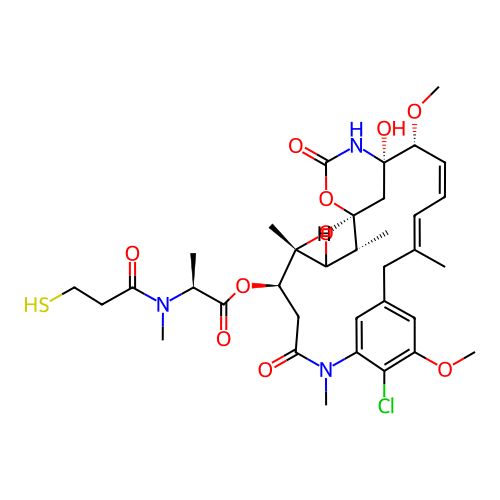
|
|||||
|
|
||||||
Each Antibody-drug Conjugate Related to This Payload
Full Information of The Activity Data of The ADC(s) Related to This Payload
Trastuzumab emtansine [Approved in 2013]
Identified from the Human Clinical Data
| Experiment 1 Reporting the Activity Date of This ADC | [1] | ||||
| Efficacy Data | Objective Response Rate (ORR) |
21.40%
|
Positive HER2 expression (HER2 +++/++) | ||
| Patients Enrolled |
Untreated, asymptomatic BM or controlled brain disease treated with radiotherapy >14 days before enrollment; had received prior HER2-targeted therapy and chemotherapy; and had progressed on or after their most recent treatment of advanced breast cancer.
|
||||
| Administration Dosage |
3.6 mg/kg intravenously every 3 weeks.
|
||||
| Related Clinical Trial | |||||
| NCT Number | NCT01702571 | Phase Status | Phase 3 | ||
| Clinical Description |
A two-cohort, open-label, multicenter study of trastuzumab emtansine (T-DM1) in HER2-positive locally advanced or metastatic breast cancer patients who have received prior anti-HER2 and chemotherapy-based treatment.
|
||||
| Primary Endpoint |
Objective response rate=21.40% (95% CI 14.60-29.60), clinical benefit rate=42.90% (95% CI 34.10-52.00).
|
||||
| Other Endpoint |
Median PFS=5.50 months (95% CI, 5.30-5.60), overall survival =18.90 months (95% CI, 17.10-21.30).
|
||||
| Experiment 2 Reporting the Activity Date of This ADC | [2] | ||||
| Efficacy Data | Objective Response Rate (ORR) |
5.10%
|
Positive HER2 expression (HER2+++/++) | ||
| Patients Enrolled |
HER2 positive advanced urothelial bladder cancer or pancreatic cancer/cholangiocarcinoma
|
||||
| Administration Dosage |
Received singleagent TDM1 2.4 mg/kg once weekly (qw) or 3.6 mg/kg every 3 weeks (q3w).
|
||||
| Related Clinical Trial | |||||
| NCT Number | NCT02999672 | Phase Status | Phase 2 | ||
| Clinical Description |
A study to determine best tumor response with trastuzumab emtansine in human epidermal growth factor receptor 2 (HER2) overexpressing solid tumors (KAMELEON).
|
||||
| Primary Endpoint |
BOR, Urothelial bladder cancer (n=13); PR N=5 (38.46%);SD N=1 (7.7%);PD N=6 (46.2%);NE N=1 (7.69%). Pancreatic cancer/cholangiocarcinoma (n=7) PR N=1 (14.29%);SD N=3 (42.86%);PD N=2 (28.57%); NE N=1 (14.29%).
|
||||
| Other Endpoint |
PFS, Urothelial bladder cancer (n=13), Median PFS, months (95% CI) 2.20 (1.18-4.30), Median OS, months (95% CI) 7.03 (3.75-NE). Pancreatic cancer/cholangiocarcinoma (n=7), Median PFS, months (95% CI) 2.58 (1.31-9.99), Median OS, months (95% CI) NE (1.45-NE).
|
||||
| Experiment 3 Reporting the Activity Date of This ADC | [3] | ||||
| Efficacy Data | Objective Response Rate (ORR) |
5.60%
|
|||
| Patients Enrolled |
38 patients were enrolled and 36 included in efficacy analysis.Patients were treated with the standard intravenous dosing of T- DM1, that is 3.6mg/kg every 3 weeks for a 21-day cycle.
|
||||
| Administration Dosage |
3.6 mg/kg every 3 weeks for a 21-day cycle, until toxicity or progression.
|
||||
| Related Clinical Trial | |||||
| NCT Number | NCT02465060 | Phase Status | Phase 2 | ||
| Clinical Description |
Targeted therapy directed by genetic testing in treating patients with advanced refractory solid tumors, lymphomas, or multiple myeloma (the MATCH screening trial).
|
||||
| Primary Endpoint |
ORR was 2/36 (5.56%) with 90% confidence interval (90% CI, 1.00% to 16.50%)
|
||||
| Other Endpoint |
PFS=23.60%.
|
||||
| Experiment 4 Reporting the Activity Date of This ADC | [4] | ||||
| Efficacy Data | Objective Response Rate (ORR) |
45%
|
Positive HER2 expression (HER2 +++/++) | ||
| Patients Enrolled |
An Eastern Cooperative Oncology Group performance status of 0 or 1 and centrally confirmed, measurable, HER2-positive advanced breast cancer previously treated with trastuzumab and a taxane.
|
||||
| Administration Dosage |
3.6 mg/kg ( trastuzumab emtansine) and 1200 mg (Atezolizumab) intravenously every 3 weeks.
|
||||
| Related Clinical Trial | |||||
| NCT Number | NCT02924883 | Phase Status | Phase 2 | ||
| Clinical Description |
A randomized, multicenter, double-blind, placebo-controlled phase II study of the efficacy and safety of trastuzumab emtansine in combination with atezolizumab or atezolizumab-placebo in patients with HER2-positive locally advanced or metastatic breast cancer who have received prior trastuzumab and taxane based therapy.
|
||||
| Primary Endpoint |
Median PFS=8.20 months (95% CI 5.80-10.70).
|
||||
| Other Endpoint |
Median overall survival was not estimable (95% CI NE-NE); Objective response rate=45.00% (95% CI 28.06-50.30).
|
||||
| Experiment 5 Reporting the Activity Date of This ADC | [5] | ||||
| Efficacy Data | Objective Response Rate (ORR) |
20%
|
High HER2 expression (HER2+++) | ||
| Patients Enrolled |
HER2-positive, metastatic breast cancer previously treated with taxane, trastuzumab, and pertuzumab, and were T-DM1-nave.
|
||||
| Administration Dosage |
The study consisted of a dose de-escalation (dose-finding) cohort, followed by an expansion cohort at the recommended phase II dose (RP2D), T-DM1 3.60 mg/kg intravenously every 21 days, and pembrolizumab 200mg intravenously every 21 days, if one or fewer DLTs were noted in the first six patients at that dose level, it would be declared the RP2D.
|
||||
| Related Clinical Trial | |||||
| NCT Number | NCT03032107 | Phase Status | Phase 1b | ||
| Clinical Description |
A phase 1b study of pembrolizumab in combination with trastuzumab-dm1 in metastatic HER2-positive breast cancer.
|
||||
| Primary Endpoint |
OrR=20.00% (95% CI 5.70%-43.70%), and median PFS=9.60 months (95%CI 2.80-16.00 months).
|
||||
| Other Endpoint |
There were no dose-limiting toxicities. The RP2D was 3.60 mg/kg T-DM1 plus 200 mg pembrolizumab every 21 days.
|
||||
| Experiment 6 Reporting the Activity Date of This ADC | [6] | ||||
| Patients Enrolled |
Newly diagnosed, HER2-positive, nonmetastatic, histologically confirmed, operable primary invasive breast carcinoma.
|
||||
| Administration Dosage |
T-DM1 was dosed at 3.60 mg/kg once every 3 weeks. Trastuzumab was dosed at 6 mg/kg once every 3 weeks after an 8 mg/kg loading dose and started concurrently with the taxane. Pertuzumab was dosed at 420 mg once every 3 weeks after an 840 mg loading dose and administered concurrently with T-DM1 or trastuzumab-plus-taxane. An interval of 3 weeks from the last dose of anthracycline to initiation of HER2-targeted therapy was required. After the taxane-concurrent phase in the trastuzumab-containing arm, trastuzumab-plus-pertuzumab was continued for 1 year. In the T-DM1containing arm, T-DM1-plus-pertuzumab was continued for 1 year.
Click to Show/Hide
|
||||
| Related Clinical Trial | |||||
| NCT Number | NCT01966471 | Phase Status | Phase 3 | ||
| Clinical Description |
A randomized, multicenter, open-label, phase 3 trial comparing trastuzumab plus pertuzumab plus a taxane following anthracyclines versus trastuzumab emtansine plus pertuzumab following anthracyclines as adjuvant therapy in patients with operable HER2-positive primary breast cancer.
|
||||
| Primary Endpoint |
82 (9.90%) IDFS events had occurred in the AC-THP arm and 80 (9.60%) had occurred in the AC-KP arm.
|
||||
| Other Endpoint |
3-year IDFS rates were 94.10% (95% CI, 92.50 to 95.70) with AC-THP and 92.80% (95% CI, 91.00 to 94.50) with AC-KP.
|
||||
Discovered Using Patient-derived Xenograft Model
| Experiment 1 Reporting the Activity Date of This ADC | [7] | ||||
| Efficacy Data | Tumor Growth Inhibition value (TGI) | ≈ 1.10% | Low HER2 expression (HER2+) | ||
| Method Description |
The antitumor activity of T-DM1 was evaluated in various patient-derived xenograft models with different HER2 expression levels. Each cell suspension or tumor fragment was inoculated subcutaneously into specific pathogen-free female nude mice.The tumor-bearing mice were randomized into treatment and control groups based on the tumor volumes, and dosing was initiated on day 0. In this group, 10 mg/kg T-DM1 was i.v. to the tumor-bearing mice.
Click to Show/Hide
|
||||
| In Vivo Model | Breast cancer PDX model (PDX: ST565) | ||||
| Experiment 2 Reporting the Activity Date of This ADC | [7] | ||||
| Efficacy Data | Tumor Growth Inhibition value (TGI) | ≈ 19.20% | Low HER2 expression (HER2+) | ||
| Method Description |
The antitumor activity of T-DM1 was evaluated in various patient-derived xenograft models with different HER2 expression levels. Each cell suspension or tumor fragment was inoculated subcutaneously into specific pathogen-free female nude mice.The tumor-bearing mice were randomized into treatment and control groups based on the tumor volumes, and dosing was initiated on day 0. In this group, 10 mg/kg T-DM1 was i.v. to the tumor-bearing mice.
Click to Show/Hide
|
||||
| In Vivo Model | Breast cancer PDX model (PDX: ST313) | ||||
| Experiment 3 Reporting the Activity Date of This ADC | [7] | ||||
| Efficacy Data | Tumor Growth Inhibition value (TGI) | ≈ 37.60% | High HER2 expression (HER2+++) | ||
| Method Description |
The antitumor activity of T-DM1 was evaluated in various patient-derived xenograft models with different HER2 expression levels. Each cell suspension or tumor fragment was inoculated subcutaneously into specific pathogen-free female nude mice.The tumor-bearing mice were randomized into treatment and control groups based on the tumor volumes, and dosing was initiated on day 0. In this group, 10 mg/kg T-DM1 was i.v. to the tumor-bearing mice.
Click to Show/Hide
|
||||
| In Vivo Model | Gastric cancer PDX model (PDX model: NIBIO G016) | ||||
| Experiment 4 Reporting the Activity Date of This ADC | [7] | ||||
| Efficacy Data | Tumor Growth Inhibition value (TGI) | ≈ 85.20% | Moderate HER2 expression (HER2++) | ||
| Method Description |
The antitumor activity of T-DM1 was evaluated in various patient-derived xenograft models with different HER2 expression levels. Each cell suspension or tumor fragment was inoculated subcutaneously into specific pathogen-free female nude mice.The tumor-bearing mice were randomized into treatment and control groups based on the tumor volumes, and dosing was initiated on day 0. In this group, 10 mg/kg T-DM1 was i.v. to the tumor-bearing mice.
Click to Show/Hide
|
||||
| In Vivo Model | Breast cancer PDX model (PDX: ST225) | ||||
| Experiment 5 Reporting the Activity Date of This ADC | [8] | ||||
| Efficacy Data | Tumor Growth Inhibition value (TGI) | ≈ 90.40% | Positive HER2 expression (HER2+++/++) | ||
| Method Description |
T-DM1 (Genentech) was administered i.p. at 10 mg/kg once per week.
|
||||
| In Vivo Model | Breast cancer PDX model (PDX: PDX12) | ||||
Discovered Using Cell Line-derived Xenograft Model
| Experiment 1 Reporting the Activity Date of This ADC | [7] | ||||
| Efficacy Data | Tumor Growth Inhibition value (TGI) | ≈ 7.10% | Low HER2 expression (HER2+) | ||
| Method Description |
The antitumor activity of T-DM1 was evaluated in various mice xenograft models with different HER2 expression levels; CFPAC-1 (low-expression). Each cell suspension or tumor fragment was inoculated subcutaneously into specific pathogen-free female nude mice.The tumor-bearing mice were randomized into treatment and control groups based on the tumor volumes, and dosing was initiated on day 0. In this group, 10 mg/kg T-DM1 was i.v. to the tumor-bearing mice.
Click to Show/Hide
|
||||
| In Vivo Model | CFPAC-1 cell line xenograft model | ||||
| In Vitro Model | Cystic fibrosis | CFPAC-1 cells | CVCL_1119 | ||
| Experiment 2 Reporting the Activity Date of This ADC | [9] | ||||
| Efficacy Data | Tumor Growth Inhibition value (TGI) | ≈ 15.50% | High HER2 expression (HER2+++) | ||
| Method Description |
The activity of trastuzumab-MCC-DM1 was further investigated in trastuzumab-insensitive mouse xenograft model. After transplantation of MMTV-HER2 Fo5 mammary tumor explants, tumor-bearing nude mice (n = 8 mice per group) were treated once every 3 weeks with 1 mg/kg trastuzmab-MCC-DM1.
|
||||
| In Vivo Model | MMTV-HER2 Fo5 CDX model (Trastuzumab resistant) | ||||
| In Vitro Model | Breast cancer | MMTV-HER2 cells | Mus musculus | ||
| Experiment 3 Reporting the Activity Date of This ADC | [9] | ||||
| Efficacy Data | Tumor Growth Inhibition value (TGI) | ≈ 27.10% | High HER2 expression (HER2+++) | ||
| Method Description |
Naive female beige nude XID mice were inoculated in the mammary fat pad with 20 million tumor cells suspended in 50% phenol redfree Matrigel mixed with culture medium. All animals were randomly assigned into treatment groups, such that the mean tumor volume for each group was 100 to 200 mm3. Nude mice with established tumors were dosed i.v. with Tmab-MCC-DM1 0.3 mg/kg for a total of three injections.
Click to Show/Hide
|
||||
| In Vivo Model | Trastuzumab-resistant breast cancer CDX model | ||||
| In Vitro Model | Invasive breast carcinoma of no special type | BT-474 EEI cells | CVCL_AR96 | ||
| Experiment 4 Reporting the Activity Date of This ADC | [7] | ||||
| Efficacy Data | Tumor Growth Inhibition value (TGI) | ≈ 31.70% | Low HER2 expression (HER2+) | ||
| Method Description |
The antitumor activity of T-DM1 was evaluated in various mice xenograft models with different HER2 expression levels; Capan-1 (weak positive). Each cell suspension or tumor fragment was inoculated subcutaneously into specific pathogen-free female nude mice.The tumor-bearing mice were randomized into treatment and control groups based on the tumor volumes, and dosing was initiated on day 0. In this group, 10 mg/kg T-DM1 was i.v. to the tumor-bearing mice.
Click to Show/Hide
|
||||
| In Vivo Model | Capan-1 cell line xenograft model | ||||
| In Vitro Model | Pancreatic ductal adenocarcinoma | Capan-1 cells | CVCL_0237 | ||
| Experiment 5 Reporting the Activity Date of This ADC | [7] | ||||
| Efficacy Data | Tumor Growth Inhibition value (TGI) | ≈ 33.10% | Negative HER2 expression (HER2-) | ||
| Method Description |
The antitumor activity of T-DM1 was evaluated in various mice xenograft models with different HER2 expression levels; GCIY (negative). Each cell suspension or tumor fragment was inoculated subcutaneously into specific pathogen-free female nude mice.The tumor-bearing mice were randomized into treatment and control groups based on the tumor volumes, and dosing was initiated on day 0. In this group, 10 mg/kg T-DM1 was i.v. to the tumor-bearing mice.
Click to Show/Hide
|
||||
| In Vivo Model | GCIY cell line xenograft model | ||||
| In Vitro Model | Gastric adenocarcinoma | GCIY cells | CVCL_1228 | ||
| Experiment 6 Reporting the Activity Date of This ADC | [10] | ||||
| Efficacy Data | Tumor Growth Inhibition value (TGI) | ≈ 36% | Positive HER2 expression (HER2+++/++) | ||
| Method Description |
Subcutaneous injection of 100,000 cells mixed in 200 mL PBS solution was performed. Two weeks after tumour cell injection, mice were treated with trastuzumab, cetuximab or T-DM1 at a dose of 300 mg/kg via IP injection.
|
||||
| In Vivo Model | SW48 CDX model | ||||
| In Vitro Model | Colon adenocarcinoma | SW48 cells | CVCL_1724 | ||
| Experiment 7 Reporting the Activity Date of This ADC | [10] | ||||
| Efficacy Data | Tumor Growth Inhibition value (TGI) | ≈ 36% | Low HER2 expression (HER2 +) | ||
| Method Description |
SW48, HT-29 and LS174T cells were injected into null mice subcutaneously, followed by treatment with cetuximab, trastuzumab and T-DM1. Two weeks after tumour cell injection, mice were treated with trastuzumab, cetuximab or T-DM1 at a dose of 300 mg/kg via IP injection.
|
||||
| In Vivo Model | SW48 CDX model | ||||
| In Vitro Model | Colon adenocarcinoma | SW48 cells | CVCL_1724 | ||
| Experiment 8 Reporting the Activity Date of This ADC | [11] | ||||
| Efficacy Data | Tumor Growth Inhibition value (TGI) | ≈ 42% | Low HER2 expression (HER2+) | ||
| Method Description |
Subcutaneous injection of 100,000 cells mixed in 200 mL PBS solution was performed. Two weeks after tumour cell injection, mice were treated with trastuzumab, cetuximab or T-DM1 (30 mg/kg, once per week i.p.) for 8 weeks.
|
||||
| In Vivo Model | 11-18 CDX model | ||||
| In Vitro Model | Lung adenocarcinoma | 11-18 cells | CVCL_6659 | ||
| Experiment 9 Reporting the Activity Date of This ADC | [11] | ||||
| Efficacy Data | Tumor Growth Inhibition value (TGI) | ≈ 42% | Low HER2 expression (HER2 +) | ||
| Method Description |
11-18 cells (4,000,000 ) and HCC827 cells (2,000,000 ) were injected subcutaneously into the backs on both sides of the mice. T-DM1 (30 mg/kg, once per week i.p.) for 8 weeks.
|
||||
| In Vivo Model | 11-18 CDX model | ||||
| In Vitro Model | Lung adenocarcinoma | 11-18 cells | CVCL_6659 | ||
| Experiment 10 Reporting the Activity Date of This ADC | [12] | ||||
| Efficacy Data | Tumor Growth Inhibition value (TGI) | ≈ 43.30% | Positive HER2 expression (HER2 +++/++) | ||
| Method Description |
Trastuzumab-emtansine (3 mg/kg, every seven days 4) induces efficient tumor cell killing in cell line-derived models of BT-474/R1-7 cells with HER2 expression with high expression.
|
||||
| In Vivo Model | BT-474 CDX model (T-DM1 resistant) | ||||
| In Vitro Model | Invasive breast carcinoma | BT-474 cells (Trastuzumab emtansine resistant) | CVCL_0179 | ||
| Experiment 11 Reporting the Activity Date of This ADC | [12] | ||||
| Efficacy Data | Tumor Growth Inhibition value (TGI) | ≈ 45% | Positive HER2 expression (HER2 +++/++) | ||
| Method Description |
Trastuzumab-emtansine (3 m ug/kg, every seven days x3) induces efficient tumor cell killing in cell line-derived models of SK-OV-3 cells with HER2 expression with high expression.
|
||||
| In Vivo Model | SK-OV-3 CDX model (Expressing YES1 Y537F) | ||||
| In Vitro Model | Ovarian serous cystadenocarcinoma | SK-OV-3 cells (YES1 Y537F expression) | CVCL_0532 | ||
| Experiment 12 Reporting the Activity Date of This ADC | [9] | ||||
| Efficacy Data | Tumor Growth Inhibition value (TGI) | ≈ 45.50% | High HER2 expression (HER2+++) | ||
| Method Description |
Naive female beige nude XID mice were inoculated in the mammary fat pad with 20 million tumor cells suspended in 50% phenol redfree Matrigel mixed with culture medium. All animals were randomly assigned into treatment groups, such that the mean tumor volume for each group was 100 to 200 mm3. Nude mice with established tumors were dosed i.v. with Tmab-MCC-DM1 1 mg/kg for a total of three injections.
Click to Show/Hide
|
||||
| In Vivo Model | Trastuzumab-resistant breast cancer CDX model | ||||
| In Vitro Model | Invasive breast carcinoma of no special type | BT-474 EEI cells | CVCL_AR96 | ||
| Experiment 13 Reporting the Activity Date of This ADC | [9] | ||||
| Efficacy Data | Tumor Growth Inhibition value (TGI) | ≈ 46.20% | High HER2 expression (HER2+++) | ||
| Method Description |
The activity of trastuzumab-MCC-DM1 was further investigated in trastuzumab-insensitive mouse xenograft model. After transplantation of MMTV-HER2 Fo5 mammary tumor explants, tumor-bearing nude mice (n = 8 mice per group) were treated once every 3 weeks with 3 mg/kg trastuzmab-MCC-DM1.
|
||||
| In Vivo Model | MMTV-HER2 Fo5 CDX model (Trastuzumab resistant) | ||||
| In Vitro Model | Breast cancer | MMTV-HER2 cells | Mus musculus | ||
| Experiment 14 Reporting the Activity Date of This ADC | [10] | ||||
| Efficacy Data | Tumor Growth Inhibition value (TGI) | ≈ 55% | Positive HER2 expression (HER2+++/++) | ||
| Method Description |
Subcutaneous injection of 100,000 cells mixed in 200 mL PBS solution was performed. Two weeks after tumour cell injection, mice were treated with trastuzumab, cetuximab or T-DM1 at a dose of 300 mg/kg via IP injection.
|
||||
| In Vivo Model | HT-29 CDX model | ||||
| In Vitro Model | Colon adenocarcinoma | HT-29 cells | CVCL_0320 | ||
| Experiment 15 Reporting the Activity Date of This ADC | [10] | ||||
| Efficacy Data | Tumor Growth Inhibition value (TGI) | ≈ 55% | Moderate HER2 expression (HER2 ++) | ||
| Method Description |
SW48, HT-29 and LS174T cells were injected into null mice subcutaneously, followed by treatment with cetuximab, trastuzumab and T-DM1. Two weeks after tumour cell injection, mice were treated with trastuzumab, cetuximab or T-DM1 at a dose of 300 mg/kg via IP injection.
|
||||
| In Vivo Model | HT-29 CDX model | ||||
| In Vitro Model | Colon adenocarcinoma | HT-29 cells | CVCL_0320 | ||
| Experiment 16 Reporting the Activity Date of This ADC | [7] | ||||
| Efficacy Data | Tumor Growth Inhibition value (TGI) | ≈ 58.50% | Moderate HER2 expression (HER2++) | ||
| Method Description |
The antitumor activity of T-DM1 was evaluated in various mice xenograft models with different HER2 expression levels; JIMT-1 (moderate positive). Each cell suspension or tumor fragment was inoculated subcutaneously into specific pathogen-free female nude mice.The tumor-bearing mice were randomized into treatment and control groups based on the tumor volumes, and dosing was initiated on day 0. In this group, 10 mg/kg T-DM1 was i.v. to the tumor-bearing mice.
Click to Show/Hide
|
||||
| In Vivo Model | JIMT-1 cell line xenograft model | ||||
| In Vitro Model | Breast ductal carcinoma | JIMT-1 cells | CVCL_2077 | ||
| Experiment 17 Reporting the Activity Date of This ADC | [9] | ||||
| Efficacy Data | Tumor Growth Inhibition value (TGI) | ≈ 58.70% | High HER2 expression (HER2+++) | ||
| Method Description |
Naive female beige nude XID mice were inoculated in the mammary fat pad with 20 million tumor cells suspended in 50% phenol redfree Matrigel mixed with culture medium. All animals were randomly assigned into treatment groups, such that the mean tumor volume for each group was 100 to 200 mm3. Nude mice with established tumors were dosed i.v. with Tmab-MCC-DM1 3 mg/kg for a total of three injections.
Click to Show/Hide
|
||||
| In Vivo Model | Trastuzumab-resistant breast cancer CDX model | ||||
| In Vitro Model | Invasive breast carcinoma of no special type | BT-474 EEI cells | CVCL_AR96 | ||
| Experiment 18 Reporting the Activity Date of This ADC | [11] | ||||
| Efficacy Data | Tumor Growth Inhibition value (TGI) | ≈ 63% | Positive HER2 expression (HER2+++/++) | ||
| Method Description |
Subcutaneous injection of 100,000 cells mixed in 200 mL PBS solution was performed. Two weeks after tumour cell injection, mice were treated with trastuzumab, cetuximab or T-DM1 (30 mg/kg, once per week i.p.) for 8 weeks.
|
||||
| In Vivo Model | H3255 CDX model | ||||
| In Vitro Model | Lung adenocarcinoma | NCI-H3255 cells | CVCL_6831 | ||
| Experiment 19 Reporting the Activity Date of This ADC | [11] | ||||
| Efficacy Data | Tumor Growth Inhibition value (TGI) | ≈ 63% | High HER2 expression (HER2 +++) | ||
| Method Description |
T-DM1 (30 mg/kg, once per week i.p.) for 8 weeks,.
|
||||
| In Vivo Model | H3255 CDX model | ||||
| In Vitro Model | Lung adenocarcinoma | NCI-H3255 cells | CVCL_6831 | ||
| Experiment 20 Reporting the Activity Date of This ADC | [10] | ||||
| Efficacy Data | Tumor Growth Inhibition value (TGI) | ≈ 63.30% | High HER2 expression (HER2 +++) | ||
| Method Description |
SW48, HT-29 and LS174T cells were injected into null mice subcutaneously, followed by treatment with cetuximab, trastuzumab and T-DM1. Two weeks after tumour cell injection, mice were treated with trastuzumab, cetuximab or T-DM1 at a dose of 300 mg/kg via IP injection.
|
||||
| In Vivo Model | LS174T CDX model | ||||
| In Vitro Model | Colon adenocarcinoma | LS174T cells | CVCL_1384 | ||
| Experiment 21 Reporting the Activity Date of This ADC | [11] | ||||
| Efficacy Data | Tumor Growth Inhibition value (TGI) | ≈ 66.70% | Low HER2 expression (HER2+) | ||
| Method Description |
Subcutaneous injection of 100,000 cells mixed in 200 mL PBS solution was performed. Two weeks after tumour cell injection, mice were treated with trastuzumab, cetuximab or T-DM1 (30 mg/kg, once per week i.p.) for 8 weeks.
|
||||
| In Vivo Model | HCC827 CDX model | ||||
| In Vitro Model | Lung adenocarcinoma | HCC827 cells | CVCL_2063 | ||
| Experiment 22 Reporting the Activity Date of This ADC | [9] | ||||
| Efficacy Data | Tumor Growth Inhibition value (TGI) | ≈ 74% | High HER2 expression (HER2+++) | ||
| Method Description |
The activity of trastuzumab-MCC-DM1 was further investigated in trastuzumab-insensitive mouse xenograft model. After transplantation of MMTV-HER2 Fo5 mammary tumor explants, tumor-bearing nude mice (n = 8 mice per group) were treated once every 3 weeks with 10 mg/kg trastuzmab-MCC-DM1.
|
||||
| In Vivo Model | MMTV-HER2 Fo5 CDX model (Trastuzumab resistant) | ||||
| In Vitro Model | Breast cancer | MMTV-HER2 cells | Mus musculus | ||
| Experiment 23 Reporting the Activity Date of This ADC | [13] | ||||
| Efficacy Data | Tumor Growth Inhibition value (TGI) | ≈ 76.54% | Positive HER2 expression (HER2+++/++) | ||
| Method Description |
Inoculate 150 mice with KPL-4 cells at 3 million cells/mouse suspended in HBSS/matrigel, in the thoracic mammary fat pad at a volume of 0.2 ml. When tumors have reached a mean tumor volume of 100-250 mm3, they will be grouped out into 10 groups of 8-10 mice each. A single treatment will be administered intravenously (1 mg/kg) via the tail vein on Day 0.
Click to Show/Hide
|
||||
| In Vivo Model | KPL-4 CDX model | ||||
| In Vitro Model | Breast inflammatory carcinoma | KPL-4 cells | CVCL_5310 | ||
| Experiment 24 Reporting the Activity Date of This ADC | [13] | ||||
| Efficacy Data | Tumor Growth Inhibition value (TGI) | ≈ 82.90% | Positive HER2 expression (HER2+++/++) | ||
| Method Description |
Inoculate 150 mice with KPL-4 cells at 3 million cells/mouse suspended in HBSS/matrigel, in the thoracic mammary fat pad at a volume of 0.2 ml. When tumors have reached a mean tumor volume of 100-250 mm3, they will be grouped out into 10 groups of 8-10 mice each. A single treatment will be administered intravenously (ADC-211, 1 mg/kg plus ADC-106, 5 mg/kg) via the tail vein on Day 0.
Click to Show/Hide
|
||||
| In Vivo Model | KPL-4 CDX model | ||||
| In Vitro Model | Breast inflammatory carcinoma | KPL-4 cells | CVCL_5310 | ||
| Experiment 25 Reporting the Activity Date of This ADC | [9] | ||||
| Efficacy Data | Tumor Growth Inhibition value (TGI) | ≈ 83.90% | High HER2 expression (HER2+++) | ||
| Method Description |
Mice bearing mammary tumor transplants from the MMTV-HER2 Fo5 line were given a single iv injection (10 mg/kg) of Tmab-SPP-DM1, Tmab-SSNPP-DM3, Tmab-SSNPP-DM4, Tmab-MCC-DM1, or vehicle (n=7 mice per group), and tumor growth was monitored for 25 days.
|
||||
| In Vivo Model | MMTV-HER2 Fo5 CDX model (Trastuzumab resistant) | ||||
| In Vitro Model | Breast cancer | MMTV-HER2 cells | Mus musculus | ||
| Experiment 26 Reporting the Activity Date of This ADC | [13] | ||||
| Efficacy Data | Tumor Growth Inhibition value (TGI) | ≈ 84.39% | Positive HER2 expression (HER2+++/++) | ||
| Method Description |
Inoculate 150 mice with KPL-4 cells at 3 million cells/mouse suspended in HBSS/matrigel, in the thoracic mammary fat pad at a volume of 0.2 ml. When tumors have reached a mean tumor volume of 100-250 mm3, they will be grouped out into 10 groups of 8-10 mice each. A single treatment will be administered intravenously (ADC-211, 1 mg/kg plus ADC-106, 1 mg/kg) via the tail vein on Day 0.
Click to Show/Hide
|
||||
| In Vivo Model | KPL-4 CDX model | ||||
| In Vitro Model | Breast inflammatory carcinoma | KPL-4 cells | CVCL_5310 | ||
| Experiment 27 Reporting the Activity Date of This ADC | [9] | ||||
| Efficacy Data | Tumor Growth Inhibition value (TGI) | ≈ 88.70% | High HER2 expression (HER2+++) | ||
| Method Description |
The activity of trastuzumab-MCC-DM1 was further investigated in trastuzumab-insensitive mouse xenograft model. After transplantation of MMTV-HER2 Fo5 mammary tumor explants, tumor-bearing nude mice (n = 8 mice per group) were treated once every 3 weeks with 15 mg/kg trastuzmab-MCC-DM1.
|
||||
| In Vivo Model | MMTV-HER2 Fo5 CDX model (Trastuzumab resistant) | ||||
| In Vitro Model | Breast cancer | MMTV-HER2 cells | Mus musculus | ||
| Experiment 28 Reporting the Activity Date of This ADC | [9] | ||||
| Efficacy Data | Tumor Growth Inhibition value (TGI) | ≈ 90.10% | High HER2 expression (HER2+++) | ||
| Method Description |
The activity of trastuzumab-MCC-DM1 was further investigated in trastuzumab-insensitive mouse xenograft model. After transplantation of MMTV-HER2 Fo5 mammary tumor explants, tumor-bearing nude mice (n = 8 mice per group) were treated once every 3 weeks with 30 mg/kg trastuzmab-MCC-DM1.
|
||||
| In Vivo Model | MMTV-HER2 Fo5 CDX model (Trastuzumab resistant) | ||||
| In Vitro Model | Breast cancer | MMTV-HER2 cells | Mus musculus | ||
| Experiment 29 Reporting the Activity Date of This ADC | [9] | ||||
| Efficacy Data | Tumor Growth Inhibition value (TGI) | ≈ 90.70% | High HER2 expression (HER2+++) | ||
| Method Description |
Naive female beige nude XID mice were inoculated in the mammary fat pad with 20 million tumor cells suspended in 50% phenol redfree Matrigel mixed with culture medium. All animals were randomly assigned into treatment groups, such that the mean tumor volume for each group was 100 to 200 mm3. Nude mice with established tumors were dosed i.v. with Tmab-MCC-DM1 10 mg/kg for a total of three injections.
Click to Show/Hide
|
||||
| In Vivo Model | Trastuzumab-resistant breast cancer CDX model | ||||
| In Vitro Model | Invasive breast carcinoma of no special type | BT-474 EEI cells | CVCL_AR96 | ||
| Experiment 30 Reporting the Activity Date of This ADC | [9] | ||||
| Efficacy Data | Tumor Growth Inhibition value (TGI) | ≈ 92.30% | High HER2 expression (HER2+++) | ||
| Method Description |
KPL-4 human breast tumor cells were inoculated (3 million cells per mouse, in Matrigel) into the mammary fat pads of SCID beige mice. All animals were randomly assigned into treatment groups, such that the mean tumor volume for each group was 100 to 200 mm3. Trastuzumab-maytansinoid conjugates were given by single 15 mg/kg iv injection.
|
||||
| In Vivo Model | Breast cancer CDX model | ||||
| In Vitro Model | Breast inflammatory carcinoma | KPL-4 cells | CVCL_5310 | ||
| Experiment 31 Reporting the Activity Date of This ADC | [9] | ||||
| Efficacy Data | Tumor Growth Inhibition value (TGI) | ≈ 98.70% | High HER2 expression (HER2+++) | ||
| Method Description |
Naive female beige nude XID mice were inoculated in the mammary fat pad with 20 million tumor cells suspended in 50% phenol redfree Matrigel mixed with culture medium. All animals were randomly assigned into treatment groups, such that the mean tumor volume for each group was 100 to 200 mm3. Nude mice with established tumors were dosed i.v. with Tmab-MCC-DM1 15 mg/kg for a total of three injections.
Click to Show/Hide
|
||||
| In Vivo Model | Trastuzumab-resistant breast cancer CDX model | ||||
| In Vitro Model | Invasive breast carcinoma of no special type | BT-474 EEI cells | CVCL_AR96 | ||
| Experiment 32 Reporting the Activity Date of This ADC | [7] | ||||
| Efficacy Data | Tumor Growth Inhibition value (TGI) | ≈ 99.40% | High HER2 expression (HER2+++) | ||
| Method Description |
The antitumor activity of T-DM1 was evaluated in various mice xenograft models with different HER2 expression levels; KPL-4 (strong positive). Each cell suspension or tumor fragment was inoculated subcutaneously into specific pathogen-free female nude mice.The tumor-bearing mice were randomized into treatment and control groups based on the tumor volumes, and dosing was initiated on day 0. In this group, 10 mg/kg T-DM1 was i.v. to the tumor-bearing mice.
Click to Show/Hide
|
||||
| In Vivo Model | KPL-4 cell line xenograft model | ||||
| In Vitro Model | Breast inflammatory carcinoma | KPL-4 cells | CVCL_5310 | ||
| Experiment 33 Reporting the Activity Date of This ADC | [14] | ||||
| Efficacy Data | Tumor Growth Inhibition value (TGI) | ≈ 100% | High HER2 expression (HER2+++) | ||
| Method Description |
Mice were inoculated subcutaneously in the right flank with either 5x10⁶ cells/mouse of BTC cell line KKU-100, mice were randomized to the control group or treatment with T-DM1 20 mg/kg groups.
|
||||
| In Vivo Model | KMCH-1 CDX model | ||||
| In Vitro Model | Combined hepatocellular carcinoma and cholangiocarcinoma | KMCH-1 cells | CVCL_7970 | ||
| Experiment 34 Reporting the Activity Date of This ADC | [15] | ||||
| Efficacy Data | Tumor Growth Inhibition value (TGI) | ≈ 100% | Positive HER2 expression (HER2 +++/++) | ||
| Method Description |
HER2-positive HCC1954 cells were either treated with vehicle (control) or T-DM1 for 5 days, trypsinized, washed in PBS and sorted by flow cytometry based on the surface ROR1 expression. ROR1- and ROR1+ or unfractionated cells were injected into the subcutaneous site of 6-8-week old Nu/J mice (n=3/group).
|
||||
| In Vivo Model | HCC1954 CDX model | ||||
| In Vitro Model | Breast ductal carcinoma | HCC1954 cells | CVCL_1259 | ||
| Experiment 35 Reporting the Activity Date of This ADC | [16] | ||||
| Efficacy Data | Minimal Effective Dose (MED) | < 5 mg/kg | Moderate HER2 expression (HER2++) | ||
| Method Description |
Following the acclimatization period (1 week), the animals were stratified by body weight and randomly assigned to the following group: two T-DM1 groups, treated with 20 mg/kg and 60 mg/kg. Each group consisted of five animals for blood chemistry test as well as five animals for clinical signs and body weight measurements.
|
||||
| In Vivo Model | Gastric cancer CDX model | ||||
| In Vitro Model | Gastric tubular adenocarcinoma | NCI-N87 cells | CVCL_1603 | ||
| Experiment 36 Reporting the Activity Date of This ADC | [16] | ||||
| Efficacy Data | Maximum Tolerated Dose (MTD) | > 20 mg/kg | High HER2 expression (HER2+++) | ||
| Method Description |
Following the acclimatization period (1 week), the animals were stratified by body weight and randomly assigned to the following group: two T-DM1 groups, treated with 20 mg/kg and 60 mg/kg. Each group consisted of five animals for blood chemistry test as well as five animals for clinical signs and body weight measurements.
|
||||
| In Vivo Model | Gastric cancer CDX model | ||||
| In Vitro Model | Gastric tubular adenocarcinoma | NCI-N87 cells | CVCL_1603 | ||
Obtained from the Model Organism Data
| Experiment 1 Reporting the Activity Date of This ADC | [17] | ||||
| Efficacy Data | Tumor Growth Inhibition value (TGI) | ≈ 94.98% | High HER2 expression (HER2 +++) | ||
| Method Description |
An allograft was propagated from the Fo5 mmty transgenic mouse which does not respond to.or responds poorly to HERCEPTIN therapy. Subjects were treated once with ADC (10 mg/kg); and placebo PBS buffer control (Vehicle) andmonitored over 3 weeks.
|
||||
| In Vivo Model | Breast cancer model MMTV-HER2 Fo5 | ||||
Revealed Based on the Cell Line Data
| Experiment 1 Reporting the Activity Date of This ADC | [18] | ||||
| Efficacy Data | Half Maximal Inhibitory Concentration (IC50) |
0.04 nM
|
High HER2 expression (HER2 +++) | ||
| Method Description |
With OHPAS ADCs 1-4 , we first performed cell-based MTT assays against a series of HER2 positive/negative cell lines using the commercially available HER2 ADC, T-DM1 (average DAR 3.5), which we purchased as a positive control.
|
||||
| In Vitro Model | Breast adenocarcinoma | SK-BR-3 cells | CVCL_0033 | ||
| Experiment 2 Reporting the Activity Date of This ADC | [18] | ||||
| Efficacy Data | Half Maximal Inhibitory Concentration (IC50) |
0.14 nM
|
High HER2 expression (HER2 +++) | ||
| Method Description |
With OHPAS ADCs 1-4 , we first performed cell-based MTT assays against a series of HER2 positive/negative cell lines using the commercially available HER2 ADC, T-DM1 (average DAR 3.5), which we purchased as a positive control.
|
||||
| In Vitro Model | Ovarian serous cystadenocarcinoma | SK-OV-3 cells | CVCL_0532 | ||
| Experiment 3 Reporting the Activity Date of This ADC | [19] | ||||
| Efficacy Data | Half Maximal Inhibitory Concentration (IC50) |
0.24 nM
|
High HER2 expression (HER2 +++) | ||
| Method Description |
To determine the IC50 values of the ADCs, different concentrations of each conjugate was directly added to the culture medium. After the cells were cultured for 3 days at 37°C, the number of viable cells was quantified by using the WST- reagent, and the absorbance was measured at OD450.
|
||||
| In Vitro Model | Breast adenocarcinoma | SK-BR-3 cells | CVCL_0033 | ||
| Experiment 4 Reporting the Activity Date of This ADC | [9] | ||||
| Efficacy Data | Half Maximal Inhibitory Concentration (IC50) |
0.24 nM
|
Low HER2 expression (HER2+; IHC 1+) | ||
| Method Description |
The effects of trastuzumab and trastuzumab-maytansinoid conjugates on tumor cell viability were assessed using Cell Titer-Glo. Cells were plated in black-walled 96-well plates (20,000 per well for BT-474; 10,000 cells per well for all other lines) and allowed to adhere overnight at 37°C in a humidified atmosphere of 5% CO2. For measurement of apoptosis, BT-474 and SK-BR-3 were exposed to trastuzumab or trastuzumab-DM for 48 h.
Click to Show/Hide
|
||||
| In Vitro Model | Breast adenocarcinoma | SK-BR-3 cells | CVCL_0033 | ||
| Experiment 5 Reporting the Activity Date of This ADC | [18] | ||||
| Efficacy Data | Half Maximal Inhibitory Concentration (IC50) |
0.26 nM
|
High HER2 expression (HER2 +++) | ||
| Method Description |
With OHPAS ADCs 1-4 , we first performed cell-based MTT assays against a series of HER2 positive/negative cell lines using the commercially available HER2 ADC, T-DM1 (average DAR 3.5), which we purchased as a positive control.
|
||||
| In Vitro Model | Gastric tubular adenocarcinoma | NCI-N87 cells | CVCL_1603 | ||
| Experiment 6 Reporting the Activity Date of This ADC | [19] | ||||
| Efficacy Data | Half Maximal Inhibitory Concentration (IC50) |
1.57 nM
|
High HER2 expression (HER2 +++) | ||
| Method Description |
To determine the IC50 values of the ADCs, different concentrations of each conjugate was directly added to the culture medium. After the cells were cultured for 3 days at 37°C, the number of viable cells was quantified by using the WST- reagent, and the absorbance was measured at OD450.
|
||||
| In Vitro Model | Gastric tubular adenocarcinoma | NCI-N87 cells | CVCL_1603 | ||
| Experiment 7 Reporting the Activity Date of This ADC | [18] | ||||
| Efficacy Data | Half Maximal Inhibitory Concentration (IC50) |
1.76 nM
|
Moderate HER2 expression (HER2 ++) | ||
| Method Description |
With OHPAS ADCs 1-4 , we first performed cell-based MTT assays against a series of HER2 positive/negative cell lines using the commercially available HER2 ADC, T-DM1 (average DAR 3.5), which we purchased as a positive control.
|
||||
| In Vitro Model | Breast ductal carcinoma | JIMT-1 cells | CVCL_2077 | ||
| Experiment 8 Reporting the Activity Date of This ADC | [9] | ||||
| Efficacy Data | Half Maximal Inhibitory Concentration (IC50) |
2.71 nM
|
|||
| Method Description |
The effects of trastuzumab and trastuzumab-maytansinoid conjugates on tumor cell viability were assessed using Cell Titer-Glo. Cells were plated in black-walled 96-well plates (20,000 per well for BT-474; 10,000 cells per well for all other lines) and allowed to adhere overnight at 37°C in a humidified atmosphere of 5% CO2. For measurement of apoptosis, BT-474 and SK-BR-3 were exposed to trastuzumab or trastuzumab-DM for 48 h.
Click to Show/Hide
|
||||
| In Vitro Model | Invasive breast carcinoma | BT-474 cells | CVCL_0179 | ||
| Experiment 9 Reporting the Activity Date of This ADC | [19] | ||||
| Efficacy Data | Half Maximal Inhibitory Concentration (IC50) |
5.89 nM
|
High HER2 expression (HER2 +++) | ||
| Method Description |
To determine the IC50 values of the ADCs, different concentrations of each conjugate was directly added to the culture medium. After the cells were cultured for 3 days at 37°C, the number of viable cells was quantified by using the WST- reagent, and the absorbance was measured at OD450.
|
||||
| In Vitro Model | Invasive breast carcinoma | BT-474 cells | CVCL_0179 | ||
| Experiment 10 Reporting the Activity Date of This ADC | [20] | ||||
| Efficacy Data | Half Maximal Inhibitory Concentration (IC50) |
6.4 nM
|
Positive HER2 expression (HER2 +++/++) | ||
| Method Description |
ADCs 21-23 was performed on HCC827 and NCI-H2228 cells. cells (5 x 10³ cells/well) were cultured in 96-well plates with 100 uL complete medium, and 24 h later the cells were treated in triplicate with varying concentrations of ADCs for 72 h.
|
||||
| In Vitro Model | Breast adenocarcinoma | SK-BR-3 cells | CVCL_0033 | ||
| Experiment 11 Reporting the Activity Date of This ADC | [9] | ||||
| Efficacy Data | Half Maximal Inhibitory Concentration (IC50) |
18.37 nM
|
Low HER2 expression (HER2+; IHC 1+) | ||
| Method Description |
The effects of trastuzumab and trastuzumab-maytansinoid conjugates on tumor cell viability were assessed using Cell Titer-Glo. Cells were plated in black-walled 96-well plates (20,000 per well for BT-474; 10,000 cells per well for all other lines) and allowed to adhere overnight at 37°C in a humidified atmosphere of 5% CO2. Medium was then removed and replaced by fresh culture medium containing different concentrations of trastuzumab, trastuzumab ADC, or free DM1, and the cells incubated for varying periods of time.
Click to Show/Hide
|
||||
| In Vitro Model | Breast adenocarcinoma | MDA-MB-468 cells | CVCL_0419 | ||
| Experiment 12 Reporting the Activity Date of This ADC | [18] | ||||
| Efficacy Data | Half Maximal Inhibitory Concentration (IC50) | > 50 nM | Negative HER2 expression (HER2 -) | ||
| Method Description |
With OHPAS ADCs 1-4 , we first performed cell-based MTT assays against a series of HER2 positive/negative cell lines using the commercially available HER2 ADC, T-DM1 (average DAR 3.5), which we purchased as a positive control.
|
||||
| In Vitro Model | Invasive breast carcinoma | MCF-7 cells | CVCL_0031 | ||
| Experiment 13 Reporting the Activity Date of This ADC | [9] | ||||
| Efficacy Data | Half Maximal Inhibitory Concentration (IC50) | > 100 nM | Negative HER2 expression (HER2 -) | ||
| Method Description |
The effects of trastuzumab and trastuzumab-maytansinoid conjugates on tumor cell viability were assessed using Cell Titer-Glo. Cells were plated in black-walled 96-well plates (20,000 per well for BT-474; 10,000 cells per well for all other lines) and allowed to adhere overnight at 37°C in a humidified atmosphere of 5% CO2. Medium was then removed and replaced by fresh culture medium containing different concentrations of trastuzumab, trastuzumab ADC, or free DM1, and the cells incubated for varying periods of time.
Click to Show/Hide
|
||||
| In Vitro Model | Invasive breast carcinoma | MCF-7 cells | CVCL_0031 | ||
| Experiment 14 Reporting the Activity Date of This ADC | [20] | ||||
| Efficacy Data | Half Maximal Inhibitory Concentration (IC50) |
220 nM
|
Negative HER2 expression (HER2 -) | ||
| Method Description |
ADCs 21-23 was performed on HCC827 and NCI-H2228 cells. cells (5 x 10³ cells/well) were cultured in 96-well plates with 100 uL complete medium, and 24 h later the cells were treated in triplicate with varying concentrations of ADCs for 72 h.
|
||||
| In Vitro Model | Breast adenocarcinoma | MDA-MB-468 cells | CVCL_0419 | ||
| Experiment 15 Reporting the Activity Date of This ADC | [20] | ||||
| Efficacy Data | Half Maximal Inhibitory Concentration (IC50) |
317 nM
|
Negative HER2 expression (HER2 -) | ||
| Method Description |
ADCs 21-23 was performed on HCC827 and NCI-H2228 cells. cells (5 x 10³ cells/well) were cultured in 96-well plates with 100 uL complete medium, and 24 h later the cells were treated in triplicate with varying concentrations of ADCs for 72 h.
|
||||
| In Vitro Model | Lung adenocarcinoma | HCC827 cells | CVCL_2063 | ||
| Experiment 16 Reporting the Activity Date of This ADC | [20] | ||||
| Efficacy Data | Half Maximal Inhibitory Concentration (IC50) | > 500 nM | Negative HER2 expression (HER2 -) | ||
| Method Description |
ADCs 21-23 was performed on HCC827 and NCI-H2228 cells. cells (5 x 10³ cells/well) were cultured in 96-well plates with 100 uL complete medium, and 24 h later the cells were treated in triplicate with varying concentrations of ADCs for 72 h.
|
||||
| In Vitro Model | Invasive breast carcinoma | MCF-7 cells | CVCL_0031 | ||
| Experiment 17 Reporting the Activity Date of This ADC | [17] | ||||
| Efficacy Data | Half Maximal Inhibitory Concentration (IC50) |
8.00-15.00 ng/mL
|
High HER2 expression (HER2+++) | ||
| Method Description |
Exposing mammalian cells having HER2 receptors to ADC in a cell culture medium; culturing the cells for a period from about 6 hours to about 5 days; and measuring cell viability Cell-based in vitro assays were used to measure viability, cytotoxicity, and induction of apoptosis of the ADC of the invention.
|
||||
| In Vitro Model | Breast adenocarcinoma | SK-BR-3 cells | CVCL_0033 | ||
| Experiment 18 Reporting the Activity Date of This ADC | [9] | ||||
| Efficacy Data | Half Maximal Inhibitory Concentration (IC50) |
0 ug/mL
|
Negative HER2 expression (HER2-) | ||
| Method Description |
The effects of trastuzumab and trastuzumab-maytansinoid conjugates on tumor cell viability were assessed using Cell Titer-Glo. Cells were plated in black-walled 96-well plates (20,000 per well for BT-474; 10,000 cells per well for all other lines) and allowed to adhere overnight at 37°C in a humidified atmosphere of 5% CO2. Medium was then removed and replaced by fresh culture medium containing different concentrations of trastuzumab, trastuzumab ADC, or free DM1, and the cells incubated for varying periods of time.
Click to Show/Hide
|
||||
| In Vitro Model | Invasive breast carcinoma of no special type | BT-474 EEI cells | CVCL_AR96 | ||
| Experiment 19 Reporting the Activity Date of This ADC | [9] | ||||
| Efficacy Data | Half Maximal Inhibitory Concentration (IC50) |
0.01 ug/mL
|
Positive HER2 expression (HER2+++/++; HER2 MFI=95.7) | ||
| Method Description |
The effects of trastuzumab and trastuzumab-maytansinoid conjugates on tumor cell viability were assessed using Cell Titer-Glo. Cells were plated in black-walled 96-well plates (20,000 per well for BT-474; 10,000 cells per well for all other lines) and allowed to adhere overnight at 37°C in a humidified atmosphere of 5% CO2. Medium was then removed and replaced by fresh culture medium containing different concentrations of trastuzumab, trastuzumab ADC, or free DM1, and the cells incubated for varying periods of time.
Click to Show/Hide
|
||||
| In Vitro Model | Ovarian serous cystadenocarcinoma | SK-OV-3 cells | CVCL_0532 | ||
| Experiment 20 Reporting the Activity Date of This ADC | [9] | ||||
| Efficacy Data | Half Maximal Inhibitory Concentration (IC50) |
0.01 ug/mL
|
Moderate HER2 expression (HER2++; IHC 2+) | ||
| Method Description |
The effects of trastuzumab and trastuzumab-maytansinoid conjugates on tumor cell viability were assessed using Cell Titer-Glo. Cells were plated in black-walled 96-well plates (20,000 per well for BT-474; 10,000 cells per well for all other lines) and allowed to adhere overnight at 37°C in a humidified atmosphere of 5% CO2. Medium was then removed and replaced by fresh culture medium containing different concentrations of trastuzumab, trastuzumab ADC, or free DM1, and the cells incubated for varying periods of time.
Click to Show/Hide
|
||||
| In Vitro Model | Breast inflammatory carcinoma | KPL-4 cells | CVCL_5310 | ||
| Experiment 21 Reporting the Activity Date of This ADC | [9] | ||||
| Efficacy Data | Half Maximal Inhibitory Concentration (IC50) |
0.03 ug/mL
|
High HER2 expression (HER2+++) | ||
| Method Description |
The effects of trastuzumab and trastuzumab-maytansinoid conjugates on tumor cell viability were assessed using Cell Titer-Glo. Cells were plated in black-walled 96-well plates (20,000 per well for BT-474; 10,000 cells per well for all other lines) and allowed to adhere overnight at 37°C in a humidified atmosphere of 5% CO2. Medium was then removed and replaced by fresh culture medium containing different concentrations of trastuzumab, trastuzumab ADC, or free DM1, and the cells incubated for varying periods of time.
Click to Show/Hide
|
||||
| In Vitro Model | Breast ductal carcinoma | HCC1954 cells | CVCL_1259 | ||
| Experiment 22 Reporting the Activity Date of This ADC | [9] | ||||
| Efficacy Data | Half Maximal Inhibitory Concentration (IC50) |
0.06 ug/mL
|
High HER2 expression (HER2+++) | ||
| Method Description |
The effects of trastuzumab and trastuzumab-maytansinoid conjugates on tumor cell viability were assessed using Cell Titer-Glo. Cells were plated in black-walled 96-well plates (20,000 per well for BT-474; 10,000 cells per well for all other lines) and allowed to adhere overnight at 37°C in a humidified atmosphere of 5% CO2. Medium was then removed and replaced by fresh culture medium containing different concentrations of trastuzumab, trastuzumab ADC, or free DM1, and the cells incubated for varying periods of time.
Click to Show/Hide
|
||||
| In Vitro Model | Lung adenocarcinoma | Calu-3 cells | CVCL_0609 | ||
| Experiment 23 Reporting the Activity Date of This ADC | [9] | ||||
| Efficacy Data | Half Maximal Inhibitory Concentration (IC50) |
0.27 ug/mL
|
Low HER2 expression (HER2+) | ||
| Method Description |
The effects of trastuzumab and trastuzumab-maytansinoid conjugates on tumor cell viability were assessed using Cell Titer-Glo. Cells were plated in black-walled 96-well plates (20,000 per well for BT-474; 10,000 cells per well for all other lines) and allowed to adhere overnight at 37°C in a humidified atmosphere of 5% CO2. Medium was then removed and replaced by fresh culture medium containing different concentrations of trastuzumab, trastuzumab ADC, or free DM1, and the cells incubated for varying periods of time.
Click to Show/Hide
|
||||
| In Vitro Model | Gastric tubular adenocarcinoma | MKN7 cells | CVCL_1417 | ||
Naratuximab emtansine [Phase 2 (discontinued)]
Identified from the Human Clinical Data
| Experiment 1 Reporting the Activity Date of This ADC | [21] | ||||
| Efficacy Data | Objective Response Rate (ORR) |
44.70%
|
|||
| Patients Enrolled |
Eligible participants had R/R DLBCL, FL, MZL/MALT, or MCL (WHO 2008 criteria) with 1-6 prior therapies (including anti-CD20); relapsed DLBCL patients required ≥24-week response post-first-line or ≥8-week response post-HD-ASCT. Exclusions: CLL/SLL, primary refractory DLBCL (<24-week response), HD-ASCT candidates, active hepatitis, pregnancy, prior anti-CD37 therapy, CNS involvement, cardiac dysfunction, or severe lung disease.
Click to Show/Hide
|
||||
| Administration Dosage |
As part of escalation, doses of IMGN529 were doubled from 0.1 mg/kg to 0.8 mg/kg before DLTs were observed.
|
||||
| Related Clinical Trial | |||||
| NCT Number | NCT02564744 | Phase Status | PHASE2 | ||
| Clinical Description |
A Phase 2 Study to Evaluate the Efficacy and Tolerability of Debio 1562 in Combination With Rituximab in Patients With Relapsed and/or Refractory Diffuse Large B-Cell Lymphoma and Other Forms of Non-Hodgkin's Lymphoma
|
||||
| Primary Endpoint |
The study evaluates treatment-emergent adverse events (TEAEs) over 38 months, including clinically significant lab abnormalities (hematology, serum chemistry, urinalysis, coagulation), ECG changes, and vital sign deviations. Secondary outcomes include objective response rate (ORR) based on RECIST criteria (CR: disappearance of target lesions; PR: ≥50% tumor reduction) assessed until disease progression or new therapy initiation.
Click to Show/Hide
|
||||
| Other Endpoint |
Key pharmacokinetic parameters (Cmax, AUC0-t, AUC0-inf, t1/2, CL, Vss, Tmax) for Debio 1562 and rituximab were measured across cycles (21-day intervals) up to 37 months. Efficacy endpoints included PFS (time to progression/death), TTR (time to first response), DOR (response duration), and OS (time to death), with PD defined as new lesions, >50% tumor growth, or nodal enlargement >1.5 cm. Anti-drug antibodies (ADA) against Debio 1562 were monitored.
Click to Show/Hide
|
||||
| Experiment 2 Reporting the Activity Date of This ADC | [28] | ||||
| Efficacy Data | Objective Response Rate (ORR) |
12.82%
|
Positive CD38 expression (CD38+++/++) | ||
| Patients Enrolled |
Lymphoma limited to diffuse large B-cell lymphoma (DLBCL), follicular lymphoma (FL), mantle cell lymphoma (MCL), or marginal zone lymphoma (MZL). Patients were also required to have received at least one prior anti-CD20 based therapeutic regimen, have a life expectancy of greater than 3 months, an Eastern Cooperative Oncology Group Performance status of 2 or lower, and adequate hematological, renal, and hepatic function.
Click to Show/Hide
|
||||
| Administration Dosage |
Conventional 3+3 dose-escalation design; intravenously once every 3 weeks; from 0.10 to 1.80 mg/kg.
|
||||
| Related Clinical Trial | |||||
| NCT Number | NCT01534715 | Phase Status | Phase 1 | ||
| Clinical Description |
A phase 1, multi-center, open-label study of IMGN529 administered intravenously in adult patients with relapsed or refractory non-Hodgkin lymphoma and chronic lymphocytic leukemia.
|
||||
| Primary Endpoint |
A total of five objective responses were observed, resulting in an overall response rate (ORR) of 12.82% (N=39). Four of these (1 complete response [CR] and 3 partial responses [PRs]) occurred in patients with DLBCL, for an ORR of 22% in this lymphoma subset.
|
||||
Discovered Using Cell Line-derived Xenograft Model
| Experiment 1 Reporting the Activity Date of This ADC | [30] | ||||
| Efficacy Data | Tumor Growth Inhibition value (TGI) | ≈ 14.50% | Positive CD38 expression (CD38+++/++) | ||
| Method Description |
IMGN529 induces efficient tumor cell killing in cell line-derived models B-cell NHL of cells with lower CD27 expression, dosed at 2.5 ug/kg , 2 qw3.
|
||||
| In Vivo Model | CD37-positive NHL and CLL model | ||||
| In Vitro Model | Non-Hodgkin lymphoma | Non-Hodgkin lymphoma cells | Homo sapiens | ||
| Chronic lymphocytic leukemia | Chronic lymphocytic leukemia cells | Homo sapiens | |||
| Experiment 2 Reporting the Activity Date of This ADC | [30] | ||||
| Efficacy Data | Tumor Growth Inhibition value (TGI) | ≈ 99% | Positive CD38 expression (CD38+++/++) | ||
| Method Description |
IMGN529 induces efficient tumor cell killing in cell line-derived models B-cell NHL of cells with lower CD27 expression, dosed at 5 ug/kg , 2 qw3.
|
||||
| In Vivo Model | CD37-positive NHL and CLL model | ||||
| In Vitro Model | Non-Hodgkin lymphoma | Non-Hodgkin lymphoma cells | Homo sapiens | ||
| Chronic lymphocytic leukemia | Chronic lymphocytic leukemia cells | Homo sapiens | |||
| Experiment 3 Reporting the Activity Date of This ADC | [30] | ||||
| Efficacy Data | Tumor Growth Inhibition value (TGI) |
100%
|
Positive CD38 expression (CD38+++/++) | ||
| Method Description |
The inhibitory activity of SGN-LIV1A against cancer cell growth was evaluated in various human cancer cell lines in vitro. The cells were treated 1 day.
|
||||
| In Vivo Model | DoHH2 CDX model | ||||
| In Vitro Model | Diffuse large B-cell lymphoma | WSU-NHL cells | CVCL_1793 | ||
| Experiment 4 Reporting the Activity Date of This ADC | [30] | ||||
| Efficacy Data | Tumor Growth Inhibition value (TGI) | ≈ 100% | Positive CD38 expression (CD38+++/++) | ||
| Method Description |
IMGN529 induces efficient tumor cell killing in cell line-derived models B-cell NHL of cells with lower CD27 expression, dosed at 10 ug/kg , 2 qw3.
|
||||
| In Vivo Model | CD37-positive NHL and CLL model | ||||
| In Vitro Model | Non-Hodgkin lymphoma | Non-Hodgkin lymphoma cells | Homo sapiens | ||
| Chronic lymphocytic leukemia | Chronic lymphocytic leukemia cells | Homo sapiens | |||
Revealed Based on the Cell Line Data
| Experiment 1 Reporting the Activity Date of This ADC | [30] | ||||
| Efficacy Data | Half Maximal Inhibitory Concentration (IC50) | < 0.1 nM | |||
| Method Description |
In vitro cytotoxicity was measured by incubating 5000 target cells with indicated agents in complete RPMI-1640 media for 5 days at 37°C. The viability of remaining cells was determined by a colorimetric WST-11 assay.
|
||||
| In Vivo Model | DoHH2 CDX model | ||||
| In Vitro Model | Mantle cell lymphoma | Granta-519 cells | CVCL_1818 | ||
| Experiment 2 Reporting the Activity Date of This ADC | [30] | ||||
| Efficacy Data | Half Maximal Inhibitory Concentration (IC50) | < 0.1 nM | |||
| Method Description |
In vitro cytotoxicity was measured by incubating 5000 target cells with indicated agents in complete RPMI-1640 media for 5 days at 37°C. The viability of remaining cells was determined by a colorimetric WST-10 assay.
|
||||
| In Vivo Model | DoHH2 CDX model | ||||
| In Vitro Model | Diffuse large B-cell lymphoma germinal center B-cell type | DoHH2 cells | CVCL_1179 | ||
| Experiment 3 Reporting the Activity Date of This ADC | [30] | ||||
| Efficacy Data | Half Maximal Inhibitory Concentration (IC50) | < 0.1 nM | Positive CD38 expression (CD38+++/++) | ||
| Method Description |
In vitro cytotoxicity was measured by incubating 5000 target cells with indicated agents in complete RPMI-1640 media for 5 days at 37°C. The viability of remaining cells was determined by a colorimetric WST-9 assay.
|
||||
| In Vivo Model | DoHH2 CDX model | ||||
| In Vitro Model | Diffuse large B-cell lymphoma | Farage cells | CVCL_3302 | ||
| Experiment 4 Reporting the Activity Date of This ADC | [30] | ||||
| Efficacy Data | Half Maximal Inhibitory Concentration (IC50) | < 0.1 nM | |||
| Method Description |
In vitro cytotoxicity was measured by incubating 5000 target cells with indicated agents in complete RPMI-1640 media for 5 days at 37°C. The viability of remaining cells was determined by a colorimetric WST-8 assay.
|
||||
| In Vivo Model | DoHH2 CDX model | ||||
| In Vitro Model | Burkitt lymphoma | BJAB cells | CVCL_5711 | ||
| Experiment 5 Reporting the Activity Date of This ADC | [30] | ||||
| Efficacy Data | Half Maximal Inhibitory Concentration (IC50) | < 1 nM | |||
| Method Description |
In vitro cytotoxicity was measured by incubating 5000 target cells with indicated agents in complete RPMI-1640 media for 5 days at 37°C. The viability of remaining cells was determined by a colorimetric WST-12 assay.
|
||||
| In Vivo Model | DoHH2 CDX model | ||||
| In Vitro Model | Mantle cell lymphoma | JVM-2 cells | CVCL_1319 | ||
Lorvotuzumab mertansine [Phase 2 (discontinued)]
Identified from the Human Clinical Data
| Experiment 1 Reporting the Activity Date of This ADC | [22] | ||||
| Patients Enrolled |
Eligible patients include adults (≥18) with CD56+ hematologic malignancies (AML, high-risk MDS, NK leukemia, ALL, CML blast phase, MF, or BPDCN) refractory to prior therapies, ECOG ≤2, adequate organ function, and proper contraception. Exclusions: IMGN901 allergy/hypersensitivity, active CNS disease, grade ≥3 neuropathy, uncontrolled cardiac/pulmonary/pancreatic conditions, recent major surgery, pregnancy, or protocol non-compliance. Reproductive-age participants must use dual contraception.
Click to Show/Hide
|
||||
| Administration Dosage |
100 mg/m2 by vein on Day 1 and 8 of a 21-day cycle.
|
||||
| Related Clinical Trial | |||||
| NCT Number | NCT02420873 | Phase Status | PHASE2 | ||
| Clinical Description |
An Open-label Phase II Study of Lorvotuzumab Mertansine (IMGN901) in CD56 Expressing Hematological Malignancies
|
||||
| Primary Endpoint |
The primary endpoint is Overall Response Rate (ORR) to IMGN901 in CD56+ hematological malignancies, defined as Complete Remission (CR + CRp + CRi) achieved within three cycles (53-day evaluation).
|
||||
| Other Endpoint |
Secondary data collection focuses on safety monitoring but specific endpoints were not predefined in the provided information.
|
||||
| Experiment 2 Reporting the Activity Date of This ADC | [23] | ||||
| Patients Enrolled |
Eligible patients must have histologically confirmed, relapsed/refractory CD56+ multiple myeloma (≥1 prior therapy, ≤6 regimens at MTD). Key inclusion: ECOG 0-2, adequate organ function, life expectancy ≥12 weeks, no severe neuropathy, cardiac disease, pancreatitis, or active infections. Exclusion: recent stroke, malignancies (except certain in situ cancers), uncontrolled comorbidities, or prior hypersensitivity to monoclonal antibodies. Prior therapy washout: ≥4 weeks for chemo/RT/surgery, ≥2 weeks for biologics. Concurrent bisphosphonates allowed if stable; steroids restricted to specific indications.
Click to Show/Hide
|
||||
| Administration Dosage |
dose escalation study, doses will vary per cohort. patients will receive an IV infusion weekly for two weeks every three weeks.
|
||||
| Related Clinical Trial | |||||
| NCT Number | NCT00346255 | Phase Status | PHASE1 | ||
| Clinical Description |
A Phase I Study to Assess The Safety and Pharmacokinetics of BB-10901 (huN901-DM1) Given as an Intravenous Infusion Weekly for Two Consecutive Weeks Every Three Weeks to Subjects With Relapsed and Relapsed Refractory CD56-Positive Multiple Myeloma
|
||||
| Primary Endpoint |
This study evaluates dose-limiting toxicity (through cycle 1) and maximum tolerated dose (for the duration of the study).
|
||||
| Other Endpoint |
Assessed endpoints include qualitative/quantitative toxicities, pharmacokinetics, and anti-tumor activity (response rate, progression-free survival, overall survival), all measured for the duration of the study.
|
||||
| Experiment 3 Reporting the Activity Date of This ADC | [24] | ||||
| Patients Enrolled |
Eligible patients must be ≥18 years, have ECOG ≤2, meet CD56-positive criteria, and have received 1-3 prior regimens (including lenalidomide/bortezomib if applicable). Exclusions include active infections, significant cardiac disease, recent chemotherapy/radiation, neuropathy ≥grade 2, or inadequate organ function (ANC ≥1000, platelets ≥50K, creatinine ≤1.5x ULN). Strict contraception and compliance with RevAssist® are mandated.
Click to Show/Hide
|
||||
| Administration Dosage |
dose escalation study. dosing on days 1, 8 and 15 every 28 days
|
||||
| Related Clinical Trial | |||||
| NCT Number | NCT00991562 | Phase Status | PHASE1 | ||
| Clinical Description |
An Open-Label Phase I Study of Bb-10901 (IMGN901, huN901-DM10 in Combination With Lenalidomide and Dexamethasone in Patients With CD56-positive Relapsed or Relapsed/Refractory Multiple Myeloma
|
||||
| Primary Endpoint |
The study aims to determine the MTD/RPTD and assess the response rate of the combination therapy in patients with CD56-positive relapsed/refractory multiple myeloma, evaluating efficacy through objective response rate, duration of responses, progression-free survival, and overall survival.
|
||||
| Other Endpoint |
Key pharmacodynamic outcomes and safety parameters, including ORR, CR rates, time to progression, and survival metrics, will be monitored throughout the study duration.
|
||||
| Experiment 4 Reporting the Activity Date of This ADC | [25] | ||||
| Patients Enrolled |
Eligible patients (age ≥1, Karnofsky/Lansky ≥50) must have measurable disease (exceptions: MIBG-avid neuroblastoma), prior standard therapy, and adequate organ function (ANC ≥750-1000/uL, platelets ≥75K-100K/uL, GFR ≥70 mL/min). Exclusions include active CNS metastases, neuropathy ≥grade 2, uncontrolled infections, recent chemotherapy (<3 weeks), pregnancy, or prior IMGN901 exposure. Reproductive-age participants must use contraception.
Click to Show/Hide
|
||||
| Administration Dosage |
Patients receive lorvotuzumab mertansine IV over 1-1.5 hours on days 1 and 8. Treatment repeats every 21 days for up to 17 courses in the absence of disease progression or unacceptable toxicity.
|
||||
| Related Clinical Trial | |||||
| NCT Number | NCT02452554 | Phase Status | PHASE2 | ||
| Clinical Description |
A Phase 2 Study of IMGN901 (Lorvotuzumab Mertansine; NSC#: 783609) in Children With Relapsed or Refractory Wilms Tumor, Rhabdomyosarcoma, Neuroblastoma, Pleuropulmonary Blastoma, Malignant Peripheral Nerve Sheath Tumor (MPNST) and Synovial Sarcoma
|
||||
| Primary Endpoint |
The study evaluates objective response rates (ORR) per RECIST v1.1 in pediatric/adolescent solid tumors (Wilms tumor, rhabdomyosarcoma, neuroblastoma, and other CD56+ malignancies), assessing partial/complete responses over 18 weeks. Toxicity profiles of lorvotuzumab mertansine will be monitored via NCI CTCAE v4.0 for 12 months.
|
||||
| Other Endpoint |
Key endpoints focus on response stratification and safety, with Clopper-Pearson confidence intervals for ORR and detailed toxicity summaries by cycle and attribution.
|
||||
| Experiment 5 Reporting the Activity Date of This ADC | [26] | ||||
| Patients Enrolled |
Eligible patients were ≥18 years with untreated extensive-stage SCLC (ECOG 0-2). Exclusion criteria included pregnancy/lactation and prior SCLC chemotherapy. The control arm served primarily for safety validation rather than powered efficacy comparisons.
|
||||
| Administration Dosage |
Phase 2 regimen is IMGN901, Carboplatin, and Etoposide. IMGN901 to be given on days 1 and 8 every 21 days.
|
||||
| Related Clinical Trial | |||||
| NCT Number | NCT01237678 | Phase Status | PHASE1|||PHASE2 | ||
| Clinical Description |
A Phase 1/2 Study to Assess the Safety and Efficacy of Lorvotuzumab Mertansine in Combination With Carboplatin/Etoposide in Patients With Advanced Solid Tumors Including Extensive Stage Small Cell Lung Cancer
|
||||
| Primary Endpoint |
The primary Phase I objective was determining the MTD of IMGN901 in combination with carboplatin/etoposide for solid tumors, with DLTs assessed during Cycle 1 (21 days), including febrile neutropenia, grade ≥3 toxicities, and treatment-delaying events. Phase II focused on PFS in extensive-stage SCLC patients comparing the IMGN901 triplet regimen against historical carboplatin/etoposide controls.
Click to Show/Hide
|
||||
| Other Endpoint |
Safety profiles were evaluated through TEAEs/SAEs (CTCAE v4.0-graded) until 28 days post-treatment. Secondary efficacy metrics included 6-month PFS rates (experimental arm vs historical 44% benchmark) and median OS, though statistical comparisons were limited by study design.
|
||||
| Experiment 6 Reporting the Activity Date of This ADC | [27] | ||||
| Patients Enrolled |
Prior therapy restrictions: ≤3 chemotherapy lines (ovarian patients require platinum exposure), no recent radiotherapy/immunotherapy (4-week washout), and anthracycline doses below cardiotoxicity thresholds. Concurrent antineoplastic treatments are prohibited.
|
||||
| Administration Dosage |
dose escalation study, dose will vary per cohort. patients will receive an IV infusion once every three weeks.
|
||||
| Related Clinical Trial | |||||
| NCT Number | NCT00346385 | Phase Status | PHASE1 | ||
| Clinical Description |
A Phase I, Open-Label, Dose Escalation Study of Daily Dosing With BB-10901
|
||||
| Primary Endpoint |
Safety and pharmacokinetic assessments will evaluate toxicity (via prothrombin time tests) and IMGN901 conjugate/antibody levels during Cycle 1 (21 days), while efficacy focuses on tumor response rates and neuroendocrine biomarkers (neuron-specific enolase/NCAM) measured every 2 cycles.
|
||||
| Other Endpoint |
Eligible patients (ECOG 0-2, life expectancy ≥3 months) include relapsed/refractory SCLC (1-3 prior regimens), CD56+ neuroendocrine tumors, and select carcinomas (Merkel cell/ovarian). Key exclusions: uncontrolled metastases, significant cardiorespiratory comorbidities, active infections, or pancreatitis risk factors (elevated LFTs/pancreatic enzymes).
Click to Show/Hide
|
||||
| Experiment 7 Reporting the Activity Date of This ADC | [29] | ||||
| Efficacy Data | Objective Response Rate (ORR) |
28.30%
|
Positive CD56 expression (CD56+++/++) | ||
| Patients Enrolled |
Relapsed and/or Refractory CD-56-positive Multiple Myeloma.
|
||||
| Administration Dosage |
40 mg/m2 (up to a maximum of 140 mg) intravenously once every 3 weeks.
|
||||
| Related Clinical Trial | |||||
| NCT Number | NCT00346255 | Phase Status | Phase 1 | ||
| Clinical Description |
BB-10901 in treating patients with relapsed and/or refractory multiple myeloma (IMGN901).
|
||||
| Primary Endpoint |
Objective response rate=28.30%.
|
||||
| Other Endpoint |
Median progression-free survival=26.10 months (95% CI 1-89 weeks).
|
||||
MLN2704 [Phase 1/2 (discontinued)]
Identified from the Human Clinical Data
| Experiment 1 Reporting the Activity Date of This ADC | [31] | ||||
| Patients Enrolled |
The study includes patients with histologically confirmed prostate adenocarcinoma showing progression via physical exam, imaging, or rising PSA despite castrate testosterone levels. Continuous LHRH analog therapy is required if initiated before screening, while prior anti-androgens require progression post-withdrawal. Effective barrier contraception is mandatory.
Click to Show/Hide
|
||||
| Administration Dosage |
Twenty-three patients received MLN2704 at doses of 18 to 343 mg/m2. Eighteen of these patients received ≥ three doses at 4-week intervals.
|
||||
| Related Clinical Trial | |||||
| NCT Number | NCT00052000 | Phase Status | PHASE1 | ||
| Clinical Description |
A Phase 1 Single Ascending Dose Trial of MLN2704 (DM1 Conjugated Monoclonal Antibody MLN591) in Subjects With Metastatic Androgen Independent Prostate Cancer
|
||||
| Experiment 2 Reporting the Activity Date of This ADC | [32] | ||||
| Patients Enrolled |
Eligible patients require histologically confirmed metastatic prostate adenocarcinoma, age ≥18 years, disease progression despite castrate testosterone (<50 ng/dL), and continuous LHRH analog therapy unless surgically castrated. Key exclusions include testosterone >50 ng/dL, recent corticosteroids/chemotherapy, CNS metastases, neuropathy >Grade 2, abnormal labs (platelets <100K/mm 3, ANC <1.5K/mm 3, Hct <27%), active infections, severe cardiac/respiratory/renal/hepatic conditions, or limited life expectancy (<6 months).
Click to Show/Hide
|
||||
| Administration Dosage |
A total of 62 patients received MLN2704 at ascending doses on 4 schedules: weekly (60, 84, 118, and 165 mg/m2; 12 patients); every 2 weeks (120, 168, 236, and 330 mg/m2; 15 patients); every 3 weeks (330 and 426 mg/m2; 18 patients); and on days 1 and 15 of a 6-week schedule (6-week cycle, 330 mg/m2; 17 patients).
|
||||
| Related Clinical Trial | |||||
| NCT Number | NCT00070837 | Phase Status | PHASE1|||PHASE2 | ||
| Clinical Description |
A Phase 1/2 Dose Escalation Trial of Multiple Doses of MLN2704 (DM1 Conjugated Monoclonal Antibody MLN591) in Subjects With Metastatic Androgen-Independent Prostate Cancer
|
||||
F0002-ADC [Phase 1 (discontinued)]
Identified from the Human Clinical Data
| Experiment 1 Reporting the Activity Date of This ADC | [33] | ||||
| Patients Enrolled |
Eligibility criteria require: ECOG 0-1; centrally confirmed relapsed/refractory CD30+ malignancies (prioritizing cHL, ALCL, MF); ≥1 measurable lesion (nodal ≥15mm/extranodal ≥10mm, skin nodules for MF); adequate hematologic/organ function (Hb≥80g/L, NEUT≥1.5×10⁹/L, etc.); washout periods (≥8 weeks post-transplant, ≥4 weeks post-therapy [6 weeks for alkylators]); life expectancy >3 months; and voluntary informed consent.
Click to Show/Hide
|
||||
| Administration Dosage |
Every 21 days for 1 cycle, continue treatment until a maximum 16 cycles. Dose Escalating: 0.3 - 4.8 mg/kg
|
||||
| Related Clinical Trial | |||||
| NCT Number | NCT03894150 | Phase Status | PHASE1 | ||
| Clinical Description |
A Dose-Escalation Study to Evaluate the Safety, Tolerability, Pharmacokinetics, and Efficacy of F0002-ADC in Chinese Patients With Refractory or Recurrent CD30+ Hematologic Malignancies.
|
||||
| Primary Endpoint |
The primary endpoint is MTD (maximum tolerable dose) assessed within 21 days following a single dose administration.
|
||||
| Other Endpoint |
Secondary endpoints include ORR (objective response rate), DOR (duration of response), and PFS (progression-free survival) evaluated every 2 cycles (21-day cycles) until tumor progression/death/3 years; pharmacokinetic parameters (Cmax, AUC, Tmax, T1/2, CL, Vd) and immunogenicity (Anti-F0002-ADC antibodies) measured 1 month post-final dose; with safety monitoring for adverse events and laboratory abnormalities until 1 month post-treatment.
Click to Show/Hide
|
||||
GQ1001 [Phase 1/2]
Identified from the Human Clinical Data
| Experiment 1 Reporting the Activity Date of This ADC | [34] | ||||
| Patients Enrolled |
Eligible patients are HER2+ metastatic breast cancer patients (IHC3+/ISH+, ECOG 0-1, LVEF≥50%) with ≥1 prior trastuzumab-based therapy, measurable lesions, and adequate organ function, excluding those with active CNS metastases, prior DM1-ADC/pyrotinib use (exceptions apply), significant cardiac/ILD history, or uncontrolled infections.
|
||||
| Administration Dosage |
Patients will receive the recommended phase 2 dose of GQ1001 determined in phase I. GQ1001 infusions on day 1 of each 21-day cycle combinate with pyrotinib 320mg orally once daily until disease progression or unacceptable toxicity.
|
||||
| Related Clinical Trial | |||||
| NCT Number | NCT05575804 | Phase Status | PHASE1|||PHASE2 | ||
| Clinical Description |
Phase Ib/II Study of GQ1001 and Pyrotinib in HER2 Positive Metastatic Breast Cancer Patients Who Had Failed Previous Anti-HER2 Treatment(GRACE)
|
||||
| Primary Endpoint |
The study evaluates dose-limiting toxicities (DLTs) and maximum tolerated dose (MTD) in Phase I (21-day cycles), along with treatment-related adverse events (CTCAE v5.0) and objective response rate (ORR, RECIST 1.1) over 24 months.
|
||||
| Other Endpoint |
Pharmacokinetic parameters (Cmax, Ctrough, AUC) for GQ1001, DM1, pyrotinib, and anti-HER2 antibody are assessed in Phase I, while efficacy outcomes (ORR, DoR, DCR, PFS per RECIST 1.1) are tracked across both phases for 24 months.
|
||||
| Experiment 2 Reporting the Activity Date of This ADC | [35] | ||||
| Patients Enrolled |
Eligible patients are adults (≥18) with HER2+ advanced/metastatic solid tumors (breast, gastric/GEJ, or other) refractory to standard therapy, ECOG 0-1, LVEF≥50%, and adequate organ function, excluding those with active brain metastases, significant cardiac/pulmonary disease, unresolved toxicities (>Grade 1), uncontrolled infections, or prior cumulative anthracycline dose >360mg/m2 doxorubicin-equivalent.
Click to Show/Hide
|
||||
| Administration Dosage |
GQ1001 will be administered intravenously every 21 days. Dose Escalation will be guided by a modified 3+3 design.
|
||||
| Related Clinical Trial | |||||
| NCT Number | NCT04450732 | Phase Status | PHASE1 | ||
| Clinical Description |
A Phase 1, First-In-Human, Multicenter, Open-Label, Study of GQ1001, a HER2 Targeted Antibody-Drug Conjugate, Administered Intravenously, in Adult Patients With HER2-Positive Advanced Solid Tumors
|
||||
| Primary Endpoint |
The study evaluates dose-limiting toxicities (DLTs) and determines maximum tolerated dose (MTD) or recommended expansion dose (DRDE) during the first 21-day cycle, with adverse events assessed per NCI CTCAE v5.0 criteria.
|
||||
| Other Endpoint |
Safety assessments include AE monitoring, lab abnormalities, and pharmacokinetic parameters (AUC, Cmax, Tmax, T1/2, MRT, Vd) of GQ1001, along with efficacy outcomes (ORR, DCR, DoR, PFS per RECIST 1.1) and immunogenicity (anti-drug antibodies) over approximately 1 year.
|
||||
| Experiment 3 Reporting the Activity Date of This ADC | [36] | ||||
| Efficacy Data | Partial Response (PR) |
40%
|
|||
| Patients Enrolled |
HER2-positive advanced solid tumors.
|
||||
| Administration Dosage |
Administered intravenously as a monotherapy on Day 1 of 21-day cycles. The starting dose was 1.20 mg/kg, followed by 2.40, 3.60, 4.80, 6.00, 7.20 and 8.40 mg/kg.
|
||||
| Related Clinical Trial | |||||
| NCT Number | NCT04450732 | Phase Status | Phase 1 | ||
| Clinical Description |
A phase 1, first-in-human, multicenter, open-label, study of GQ1001, a HER2 targeted antibody-drug conjugate, administered intravenously, in adult patients with HER2-positive advanced solid tumors.
|
||||
| Experiment 4 Reporting the Activity Date of This ADC | [37] | ||||
| Related Clinical Trial | |||||
| NCT Number | NCT05575804 | Phase Status | Phase 1/2 | ||
| Clinical Description |
Phase 1b/2 study of GQ1001 and pyrotinib in HER2 positive metastatic breast cancer patients who had failed previous anti-HER2 treatment GRACE.
|
||||
AMG 172 [Phase 1 (discontinued)]
Identified from the Human Clinical Data
| Experiment 1 Reporting the Activity Date of This ADC | [38] | ||||
| Efficacy Data | stable disease (SD) |
16.20%
|
|||
| Patients Enrolled |
Eligible subjects require clear cell RCC refractory to ≥2 prior therapies (including a TKI) with measurable disease (RECIST 1.1), ECOG ≤1, adequate hematologic (ANC ≥1.5x10⁹/L, platelets ≥100x109/L) and hepatic function (AST/ALT <3xULN). Exclusions encompass CNS metastases, bleeding disorders, significant cardiac comorbidities (recent MI, CHF NYHA >II, QTcF >470ms), uncontrolled HTN, or active HBV/HCV/HIV infections.
Click to Show/Hide
|
||||
| Administration Dosage |
The study was conducted in two parts for dose exploration and dose expansion on a biweekly dosing schedule. AMG 172 doses of 0.15, 0.3, 0.6, 1.2, 1.6, 1.8, and 2.4 mg/kg were studied in the dose-exploration phase.
|
||||
| Related Clinical Trial | |||||
| NCT Number | NCT01497821 | Phase Status | PHASE1 | ||
| Clinical Description |
A Phase 1 First-in-Human Study Evaluating Safety, Tolerability, Pharmacokinetics and Pharmacodynamics of AMG 172 in Subjects With Relapsed / Refractory Renal Cell Carcinoma
|
||||
| Primary Endpoint |
Primary safety assessments include ≥Grade 3 CTCAE adverse events and clinically significant lab/ECG changes monitored for 28 days post-enrollment. Pharmacokinetic parameters (Cmax, AUC, t½) are evaluated across 12 timepoints within 8 weeks. The MTD will be determined for two dosing schedules (biweekly/triweekly) with tumor response (RECIST 1.1) assessed over 3 years.
Click to Show/Hide
|
||||
| Other Endpoint |
Secondary endpoints include immunogenicity (anti-drug antibodies over 1 year), non-MTD cohort ORR (RECIST 1.1), and clinical benefit via DOR, all evaluated through 3 years.
|
||||
| Experiment 2 Reporting the Activity Date of This ADC | [38] | ||||
| Efficacy Data | progressive disease (PD) |
35.10%
|
|||
| Patients Enrolled |
Eligible subjects require clear cell RCC refractory to ≥2 prior therapies (including a TKI) with measurable disease (RECIST 1.1), ECOG ≤1, adequate hematologic (ANC ≥1.5x10⁹/L, platelets ≥100x109/L) and hepatic function (AST/ALT <3xULN). Exclusions encompass CNS metastases, bleeding disorders, significant cardiac comorbidities (recent MI, CHF NYHA >II, QTcF >470ms), uncontrolled HTN, or active HBV/HCV/HIV infections.
Click to Show/Hide
|
||||
| Administration Dosage |
The study was conducted in two parts for dose exploration and dose expansion on a biweekly dosing schedule. AMG 172 doses of 0.15, 0.3, 0.6, 1.2, 1.6, 1.8, and 2.4 mg/kg were studied in the dose-exploration phase.
|
||||
| Related Clinical Trial | |||||
| NCT Number | NCT01497821 | Phase Status | PHASE1 | ||
| Clinical Description |
A Phase 1 First-in-Human Study Evaluating Safety, Tolerability, Pharmacokinetics and Pharmacodynamics of AMG 172 in Subjects With Relapsed / Refractory Renal Cell Carcinoma
|
||||
| Primary Endpoint |
Primary safety assessments include ≥Grade 3 CTCAE adverse events and clinically significant lab/ECG changes monitored for 28 days post-enrollment. Pharmacokinetic parameters (Cmax, AUC, t½) are evaluated across 12 timepoints within 8 weeks. The MTD will be determined for two dosing schedules (biweekly/triweekly) with tumor response (RECIST 1.1) assessed over 3 years.
Click to Show/Hide
|
||||
| Other Endpoint |
Secondary endpoints include immunogenicity (anti-drug antibodies over 1 year), non-MTD cohort ORR (RECIST 1.1), and clinical benefit via DOR, all evaluated through 3 years.
|
||||
| Experiment 3 Reporting the Activity Date of This ADC | [38] | ||||
| Efficacy Data | Partial Response (PR) |
5.40%
|
|||
| Patients Enrolled |
Eligible subjects require clear cell RCC refractory to ≥2 prior therapies (including a TKI) with measurable disease (RECIST 1.1), ECOG ≤1, adequate hematologic (ANC ≥1.5x10⁹/L, platelets ≥100x109/L) and hepatic function (AST/ALT <3xULN). Exclusions encompass CNS metastases, bleeding disorders, significant cardiac comorbidities (recent MI, CHF NYHA >II, QTcF >470ms), uncontrolled HTN, or active HBV/HCV/HIV infections.
Click to Show/Hide
|
||||
| Administration Dosage |
The study was conducted in two parts for dose exploration and dose expansion on a biweekly dosing schedule. AMG 172 doses of 0.15, 0.3, 0.6, 1.2, 1.6, 1.8, and 2.4 mg/kg were studied in the dose-exploration phase.
|
||||
| Related Clinical Trial | |||||
| NCT Number | NCT01497821 | Phase Status | PHASE1 | ||
| Clinical Description |
A Phase 1 First-in-Human Study Evaluating Safety, Tolerability, Pharmacokinetics and Pharmacodynamics of AMG 172 in Subjects With Relapsed / Refractory Renal Cell Carcinoma
|
||||
| Primary Endpoint |
Primary safety assessments include ≥Grade 3 CTCAE adverse events and clinically significant lab/ECG changes monitored for 28 days post-enrollment. Pharmacokinetic parameters (Cmax, AUC, t½) are evaluated across 12 timepoints within 8 weeks. The MTD will be determined for two dosing schedules (biweekly/triweekly) with tumor response (RECIST 1.1) assessed over 3 years.
Click to Show/Hide
|
||||
| Other Endpoint |
Secondary endpoints include immunogenicity (anti-drug antibodies over 1 year), non-MTD cohort ORR (RECIST 1.1), and clinical benefit via DOR, all evaluated through 3 years.
|
||||
AMG 224 [Phase 1 (discontinued)]
Identified from the Human Clinical Data
| Experiment 1 Reporting the Activity Date of This ADC | [39] | ||||
| Efficacy Data | stable disease (SD) |
30%
|
|||
| Patients Enrolled |
Eligibility required relapsed/refractory MM after ≥3 prior lines (including PI+IMiD), measurable disease per IMWG, and adequate hematologic/organ function (ANC ≥1.0×10^9/L, platelets ≥50-75×10^9/L, LVEF >50%). Excluded: plasma cell leukemia/POMS/Waldenström's, recent SCT (<90 days), QTc >470ms, active CHF (NYHA class III/IV), or anti-tumor therapy within 28 days. Concurrent prednisone ≤30mg/day was permitted.
Click to Show/Hide
|
||||
| Administration Dosage |
In the dose escalation, patients received intravenous AMG 224 every 3 weeks (Q3W) at prespecified doses of 30-300 mg in a 3 + 3 design, with no mandated premedications.
|
||||
| Related Clinical Trial | |||||
| NCT Number | NCT02561962 | Phase Status | PHASE1 | ||
| Clinical Description |
A Phase 1 First in Human Study Evaluating the Safety, Tolerability, Pharmacokinetics and Pharmacodynamics of AMG 224 in Subjects With Relapsed or Refractory Multiple Myeloma
|
||||
| Primary Endpoint |
Dose-limiting toxicities (DLTs) were assessed during the first 28 days using CTCAE v4.0, defining hematologic DLTs as prolonged grade 4 cytopenias (neutropenia >7 days, thrombocytopenia >7 days) or grade 3+ cytopenias with complications (fever/hemorrhage), and non-hematologic DLTs as grade 3+ organ toxicities (liver/kidney), persistent GI toxicity >3 days despite therapy, or cases meeting Hy's Law criteria. Treatment-emergent AEs were monitored through Cycle 4 (12 weeks) including vital signs, labs, and neurologic assessments.
Click to Show/Hide
|
||||
| Other Endpoint |
PK parameters (Cmax, Cmin, AUC, clearance, t1/2) of AMG 224's antibody-drug conjugate (anti-BCMA-MCC-DM1) components were assessed in Cycles 1-2. Efficacy outcomes included best overall response per IMWG-URC (CR/sCR/VGPR/PR), time-to-progression, duration of response (Kaplan-Meier), MRD-negativity rate (sensitivity <1:10^5), and immunogenicity (anti-drug antibodies) over 6 years. Intensive PK sampling occurred pre/post-infusion through 336 hours.
Click to Show/Hide
|
||||
| Experiment 2 Reporting the Activity Date of This ADC | [39] | ||||
| Efficacy Data | progressive disease (PD) |
15%
|
|||
| Patients Enrolled |
Eligibility required relapsed/refractory MM after ≥3 prior lines (including PI+IMiD), measurable disease per IMWG, and adequate hematologic/organ function (ANC ≥1.0×10^9/L, platelets ≥50-75×10^9/L, LVEF >50%). Excluded: plasma cell leukemia/POMS/Waldenström's, recent SCT (<90 days), QTc >470ms, active CHF (NYHA class III/IV), or anti-tumor therapy within 28 days. Concurrent prednisone ≤30mg/day was permitted.
Click to Show/Hide
|
||||
| Administration Dosage |
In the dose escalation, patients received intravenous AMG 224 every 3 weeks (Q3W) at prespecified doses of 30-300 mg in a 3 + 3 design, with no mandated premedications.
|
||||
| Related Clinical Trial | |||||
| NCT Number | NCT02561962 | Phase Status | PHASE1 | ||
| Clinical Description |
A Phase 1 First in Human Study Evaluating the Safety, Tolerability, Pharmacokinetics and Pharmacodynamics of AMG 224 in Subjects With Relapsed or Refractory Multiple Myeloma
|
||||
| Primary Endpoint |
Dose-limiting toxicities (DLTs) were assessed during the first 28 days using CTCAE v4.0, defining hematologic DLTs as prolonged grade 4 cytopenias (neutropenia >7 days, thrombocytopenia >7 days) or grade 3+ cytopenias with complications (fever/hemorrhage), and non-hematologic DLTs as grade 3+ organ toxicities (liver/kidney), persistent GI toxicity >3 days despite therapy, or cases meeting Hy's Law criteria. Treatment-emergent AEs were monitored through Cycle 4 (12 weeks) including vital signs, labs, and neurologic assessments.
Click to Show/Hide
|
||||
| Other Endpoint |
PK parameters (Cmax, Cmin, AUC, clearance, t1/2) of AMG 224's antibody-drug conjugate (anti-BCMA-MCC-DM1) components were assessed in Cycles 1-2. Efficacy outcomes included best overall response per IMWG-URC (CR/sCR/VGPR/PR), time-to-progression, duration of response (Kaplan-Meier), MRD-negativity rate (sensitivity <1:10^5), and immunogenicity (anti-drug antibodies) over 6 years. Intensive PK sampling occurred pre/post-infusion through 336 hours.
Click to Show/Hide
|
||||
| Experiment 3 Reporting the Activity Date of This ADC | [39] | ||||
| Efficacy Data | Partial Response (PR) |
13%
|
|||
| Patients Enrolled |
Eligibility required relapsed/refractory MM after ≥3 prior lines (including PI+IMiD), measurable disease per IMWG, and adequate hematologic/organ function (ANC ≥1.0×10^9/L, platelets ≥50-75×10^9/L, LVEF >50%). Excluded: plasma cell leukemia/POMS/Waldenström's, recent SCT (<90 days), QTc >470ms, active CHF (NYHA class III/IV), or anti-tumor therapy within 28 days. Concurrent prednisone ≤30mg/day was permitted.
Click to Show/Hide
|
||||
| Administration Dosage |
In the dose escalation, patients received intravenous AMG 224 every 3 weeks (Q3W) at prespecified doses of 30-300 mg in a 3 + 3 design, with no mandated premedications.
|
||||
| Related Clinical Trial | |||||
| NCT Number | NCT02561962 | Phase Status | PHASE1 | ||
| Clinical Description |
A Phase 1 First in Human Study Evaluating the Safety, Tolerability, Pharmacokinetics and Pharmacodynamics of AMG 224 in Subjects With Relapsed or Refractory Multiple Myeloma
|
||||
| Primary Endpoint |
Dose-limiting toxicities (DLTs) were assessed during the first 28 days using CTCAE v4.0, defining hematologic DLTs as prolonged grade 4 cytopenias (neutropenia >7 days, thrombocytopenia >7 days) or grade 3+ cytopenias with complications (fever/hemorrhage), and non-hematologic DLTs as grade 3+ organ toxicities (liver/kidney), persistent GI toxicity >3 days despite therapy, or cases meeting Hy's Law criteria. Treatment-emergent AEs were monitored through Cycle 4 (12 weeks) including vital signs, labs, and neurologic assessments.
Click to Show/Hide
|
||||
| Other Endpoint |
PK parameters (Cmax, Cmin, AUC, clearance, t1/2) of AMG 224's antibody-drug conjugate (anti-BCMA-MCC-DM1) components were assessed in Cycles 1-2. Efficacy outcomes included best overall response per IMWG-URC (CR/sCR/VGPR/PR), time-to-progression, duration of response (Kaplan-Meier), MRD-negativity rate (sensitivity <1:10^5), and immunogenicity (anti-drug antibodies) over 6 years. Intensive PK sampling occurred pre/post-infusion through 336 hours.
Click to Show/Hide
|
||||
| Experiment 4 Reporting the Activity Date of This ADC | [39] | ||||
| Efficacy Data | Objective Response Rate (ORR) |
23%
|
|||
| Patients Enrolled |
Eligibility required relapsed/refractory MM after ≥3 prior lines (including PI+IMiD), measurable disease per IMWG, and adequate hematologic/organ function (ANC ≥1.0×10^9/L, platelets ≥50-75×10^9/L, LVEF >50%). Excluded: plasma cell leukemia/POMS/Waldenström's, recent SCT (<90 days), QTc >470ms, active CHF (NYHA class III/IV), or anti-tumor therapy within 28 days. Concurrent prednisone ≤30mg/day was permitted.
Click to Show/Hide
|
||||
| Administration Dosage |
In the dose escalation, patients received intravenous AMG 224 every 3 weeks (Q3W) at prespecified doses of 30-300 mg in a 3 + 3 design, with no mandated premedications.
|
||||
| Related Clinical Trial | |||||
| NCT Number | NCT02561962 | Phase Status | PHASE1 | ||
| Clinical Description |
A Phase 1 First in Human Study Evaluating the Safety, Tolerability, Pharmacokinetics and Pharmacodynamics of AMG 224 in Subjects With Relapsed or Refractory Multiple Myeloma
|
||||
| Primary Endpoint |
Dose-limiting toxicities (DLTs) were assessed during the first 28 days using CTCAE v4.0, defining hematologic DLTs as prolonged grade 4 cytopenias (neutropenia >7 days, thrombocytopenia >7 days) or grade 3+ cytopenias with complications (fever/hemorrhage), and non-hematologic DLTs as grade 3+ organ toxicities (liver/kidney), persistent GI toxicity >3 days despite therapy, or cases meeting Hy's Law criteria. Treatment-emergent AEs were monitored through Cycle 4 (12 weeks) including vital signs, labs, and neurologic assessments.
Click to Show/Hide
|
||||
| Other Endpoint |
PK parameters (Cmax, Cmin, AUC, clearance, t1/2) of AMG 224's antibody-drug conjugate (anti-BCMA-MCC-DM1) components were assessed in Cycles 1-2. Efficacy outcomes included best overall response per IMWG-URC (CR/sCR/VGPR/PR), time-to-progression, duration of response (Kaplan-Meier), MRD-negativity rate (sensitivity <1:10^5), and immunogenicity (anti-drug antibodies) over 6 years. Intensive PK sampling occurred pre/post-infusion through 336 hours.
Click to Show/Hide
|
||||
| Experiment 5 Reporting the Activity Date of This ADC | [51] | ||||
| Efficacy Data | Objective Response Rate (ORR) |
23.00
60.00 % |
|||
| Patients Enrolled |
Relapsed or refractory (R/R) multiple myeloma (MM).
|
||||
| Administration Dosage |
Every 3 weeks (Q3W) at prespecified doses of 30-300 mg in a 3+3 design.
|
||||
| Related Clinical Trial | |||||
| NCT Number | NCT02561962 | Phase Status | Phase 1 | ||
| Clinical Description |
A phase 1 first in human study evaluating the safety, tolerability, pharmacokinetics and pharmacodynamics of AMG 224 in subjects with relapsed or refractory multiple myeloma.
|
||||
| Primary Endpoint |
AmG 224 was generally well tolerated up to 190 mg Q3W.
|
||||
| Other Endpoint |
ORR=23.00% (95% CI,11.00-39.00%), including six responses in dose escalation and three responses in the dose expansion. Two (5.00%) patients were CR and 7 (18.00%) patients were PR.
|
||||
| Experiment 6 Reporting the Activity Date of This ADC | [60] | ||||
| Related Clinical Trial | |||||
| NCT Number | NCT02561962 | Phase Status | Phase 1 | ||
| Clinical Description |
A phase 1 first in human study evaluating the safety, tolerability, pharmacokinetics and pharmacodynamics of AMG 224 in subjects with relapsed or refractory multiple myeloma.
|
||||
AMG 595 [Phase 1 (discontinued)]
Identified from the Human Clinical Data
| Experiment 1 Reporting the Activity Date of This ADC | [40] | ||||
| Efficacy Data | stable disease (SD) |
47%
|
|||
| Patients Enrolled |
Eligible subjects must have recurrent WHO Grade IV GBM (Parts 1-2) or Grade III AA (Part 1 only) with EGFRvIII+ expression (IHC-confirmed), Karnofsky score ≥70%, measurable disease (Macdonald criteria), and adequate organ function (ANC ≥1.5x10⁹/L, QTcF ≤470ms, eGFR >45 mL/min). Exclusions involve recent CNS hemorrhage (>Grade 1), significant neuropathy/ECG abnormalities, active infections, recent radiotherapy (≤12 weeks), or antiangiogenic therapy (bevacizumab within 4 weeks for Part 1; any prior use for Part 2).
Click to Show/Hide
|
||||
| Administration Dosage |
In this phase 1, first-in-human, open-label, sequential-dose, exploration study, adults with recurrent GBM received AMG 595 once every 3 weeks (Q3W) according to incremental dosing cohorts (0.5-3.0 mg/kg).
|
||||
| Related Clinical Trial | |||||
| NCT Number | NCT01475006 | Phase Status | PHASE1 | ||
| Clinical Description |
A Phase 1 First-in-Human Study Evaluating Safety, Tolerability, Pharmacokinetics and Pharmacodynamics of AMG 595 in Subjects With Recurrent Malignant Glioma Expressing Mutant Epidermal Growth Factor Receptor Variant III (EGFRvIII)
|
||||
| Primary Endpoint |
The primary safety assessment includes ≥Grade 3 CTCAE-defined adverse events in lab tests, physical exams, ECGs, or vital signs evaluated 28 days post-enrollment for each cohort. PK parameters (Cmax, Cmin, t½) are analyzed across 8 timepoints over 6 weeks. Objective tumor response in GBM is assessed per Macdonald criteria over 3 years, while DLT evaluation determines the MTD at defined intervals.
Click to Show/Hide
|
||||
| Other Endpoint |
Secondary efficacy measures include clinical benefit rate assessed every 6 months, progression-free survival, and overall survival tracked over 3 years. Immunogenicity (anti-AMG 595 antibodies) is monitored throughout the study period.
|
||||
| Experiment 2 Reporting the Activity Date of This ADC | [40] | ||||
| Efficacy Data | Partial Response (PR) |
6%
|
|||
| Patients Enrolled |
Eligible subjects must have recurrent WHO Grade IV GBM (Parts 1-2) or Grade III AA (Part 1 only) with EGFRvIII+ expression (IHC-confirmed), Karnofsky score ≥70%, measurable disease (Macdonald criteria), and adequate organ function (ANC ≥1.5x10⁹/L, QTcF ≤470ms, eGFR >45 mL/min). Exclusions involve recent CNS hemorrhage (>Grade 1), significant neuropathy/ECG abnormalities, active infections, recent radiotherapy (≤12 weeks), or antiangiogenic therapy (bevacizumab within 4 weeks for Part 1; any prior use for Part 2).
Click to Show/Hide
|
||||
| Administration Dosage |
In this phase 1, first-in-human, open-label, sequential-dose, exploration study, adults with recurrent GBM received AMG 595 once every 3 weeks (Q3W) according to incremental dosing cohorts (0.5-3.0 mg/kg).
|
||||
| Related Clinical Trial | |||||
| NCT Number | NCT01475006 | Phase Status | PHASE1 | ||
| Clinical Description |
A Phase 1 First-in-Human Study Evaluating Safety, Tolerability, Pharmacokinetics and Pharmacodynamics of AMG 595 in Subjects With Recurrent Malignant Glioma Expressing Mutant Epidermal Growth Factor Receptor Variant III (EGFRvIII)
|
||||
| Primary Endpoint |
The primary safety assessment includes ≥Grade 3 CTCAE-defined adverse events in lab tests, physical exams, ECGs, or vital signs evaluated 28 days post-enrollment for each cohort. PK parameters (Cmax, Cmin, t½) are analyzed across 8 timepoints over 6 weeks. Objective tumor response in GBM is assessed per Macdonald criteria over 3 years, while DLT evaluation determines the MTD at defined intervals.
Click to Show/Hide
|
||||
| Other Endpoint |
Secondary efficacy measures include clinical benefit rate assessed every 6 months, progression-free survival, and overall survival tracked over 3 years. Immunogenicity (anti-AMG 595 antibodies) is monitored throughout the study period.
|
||||
PCA062 [Phase 1 (discontinued)]
Identified from the Human Clinical Data
| Experiment 1 Reporting the Activity Date of This ADC | [41] | ||||
| Efficacy Data | progressive disease (PD) |
78.70%
|
|||
| Patients Enrolled |
Eligible patients are ≥18 years old with progressive pCAD+ tumors (excluding HNSCC/ESCC), measurable disease per RECIST v1.1, and ECOG ≤2, with mandatory biopsy consent. Exclusions cover CNS metastases, significant comorbidities, prior pCAD-targeting biologics, recent anticancer treatments (4 weeks for chemotherapy/biologics, 2 weeks for surgery), and abnormal lab values (ANC <1.5, Hgb <9, platelets <100, hepatic/renal dysfunction). Vision-related risks also preclude participation.
Click to Show/Hide
|
||||
| Administration Dosage |
Forty-seven patients were treated at 10 different dose levels of PCA062, ranging from 0.4 to 5.0 mg/kg every 2 weeks administered as a 1-hour intravenous infusion.
|
||||
| Related Clinical Trial | |||||
| NCT Number | NCT02375958 | Phase Status | PHASE1 | ||
| Clinical Description |
A Phase 1 Multi-center, Open-label Dose Escalation and Expansion Study of PCA062 Administered Intravenously in Adult Patients With p-CAD Positive Tumors
|
||||
| Primary Endpoint |
The study evaluates the incidence of dose-limiting toxicities (DLTs) within the first 28 days to determine the safety and tolerability of PCA062, establishing a critical early assessment of potential treatment-related severe adverse effects.
|
||||
| Other Endpoint |
Key safety and efficacy measures include incidence/severity of adverse events, pharmacokinetic parameters (Cmax, Tmax), and immunogenicity (anti-PCA062 antibodies) over 84 days. Clinical endpoints such as overall response rate (ORR), duration of response (DOR), progression-free survival (PFS), and disease control rate (DCR) are monitored throughout treatment cycles (14-day intervals) and up to 18 months to assess therapeutic efficacy.
Click to Show/Hide
|
||||
| Experiment 2 Reporting the Activity Date of This ADC | [53] | ||||
| Efficacy Data | Disease Control Rate (DCR) |
22.60
33.30 22.20 % |
|||
| Patients Enrolled |
Advanced solid tumors expressing P-cadherin, TNBC, head and neck squamous cell carcinoma (HNSCC), esophageal cancer, cervical cancer, and non-small cell lung cancer (NSCLC).
|
||||
| Administration Dosage |
At 10 different dose levels of PCA062, ranging from 0.40 to 5.00 mg/kg every 2 weeks administered as a 1-hour intravenous infusion.
|
||||
| Related Clinical Trial | |||||
| NCT Number | NCT02375958 | Phase Status | Phase 1 | ||
| Clinical Description |
A phase 1 multi-center, open-label dose escalation and expansion study of PCA062 administered intravenously in adult patients with p-CAD positive tumors.
|
||||
| Primary Endpoint |
The MTD was PCA062 3.60 mg/kg every 2 weeks.No patient achieved a complete response. Only 1 patient with stage IV metastatic HNSCC treated at 0.90 mg/kg achieved a confirmed partial response (PR) as best overall response (BOR). The disease control rate (DCR) for the 31 patients with other tumors was 22.60% (95% CI, 9.60-41.10). In patients with HNSCC (n = 6), DCR was 33.30% (95% CI, 4.30-77.70), and in patients with esophageal cancer (n = 9), DCR was 22.20% (95% CI, 2.80-60.00).
Click to Show/Hide
|
||||
TRPH-222 [Phase 1 (discontinued)]
Identified from the Human Clinical Data
| Experiment 1 Reporting the Activity Date of This ADC | [42] | ||||
| Efficacy Data | Objective Response Rate (ORR) |
46%
|
|||
| Patients Enrolled |
Eligible participants must be ≥18 with histologically confirmed relapsed/refractory B-cell NHL (DLBCL, FL, MZL, or MCL), ECOG 0-2. Key exclusions include leukemic lymphoma, double-/triple-hit DLBCL, prior organ transplants, significant neuropathy, cardiovascular disease, or other high-risk comorbidities per investigator assessment.
|
||||
| Administration Dosage |
TRPH-222-100 is an open-label, multicenter study comprised of dose-escalation and dose-expansion stages. TRPH-222 was administered IV once every 3 weeks. 22 patients were enrolled in dose-escalating cohorts of TRPH-222 (0.6 mg/kg to 10 mg/kg) from DLBCL, FL, TFL, MCL and MZL histologies, and 10 patients in a dose-expansion cohort (7.5 mg/kg) focusing on DLBCL and FL histologies.
Click to Show/Hide
|
||||
| Related Clinical Trial | |||||
| NCT Number | NCT03682796 | Phase Status | PHASE1 | ||
| Clinical Description |
Phase 1, Multicenter, Open-Label Study of the Antibody-Drug Conjugate TRPH-222 in Subjects With Relapsed and/or Refractory B-Cell Lymphoma
|
||||
| Primary Endpoint |
The study aims to determine the maximum tolerated dose (MTD) of TRPH-222 over a 21-day timeframe while evaluating safety through adverse events (AEs), serious AEs (SAEs), and treatment-related AEs leading to discontinuation or death.
|
||||
| Other Endpoint |
Tumor activity will be assessed via objective response rate (ORR), progression-free survival (PFS), overall survival (OS), and duration of response (DOR) using Lugano criteria in NHL subtypes. Pharmacokinetic analysis (Cmax, AUC, CL, Vd, t½) will be conducted over multiple cycles, alongside anti-drug antibody (ADA) incidence monitoring.
|
||||
| Experiment 2 Reporting the Activity Date of This ADC | [42] | ||||
| Efficacy Data | Complete Response Rate (CRR) |
31%
|
|||
| Patients Enrolled |
Eligible participants must be ≥18 with histologically confirmed relapsed/refractory B-cell NHL (DLBCL, FL, MZL, or MCL), ECOG 0-2. Key exclusions include leukemic lymphoma, double-/triple-hit DLBCL, prior organ transplants, significant neuropathy, cardiovascular disease, or other high-risk comorbidities per investigator assessment.
|
||||
| Administration Dosage |
TRPH-222-100 is an open-label, multicenter study comprised of dose-escalation and dose-expansion stages. TRPH-222 was administered IV once every 3 weeks. 22 patients were enrolled in dose-escalating cohorts of TRPH-222 (0.6 mg/kg to 10 mg/kg) from DLBCL, FL, TFL, MCL and MZL histologies, and 10 patients in a dose-expansion cohort (7.5 mg/kg) focusing on DLBCL and FL histologies.
Click to Show/Hide
|
||||
| Related Clinical Trial | |||||
| NCT Number | NCT03682796 | Phase Status | PHASE1 | ||
| Clinical Description |
Phase 1, Multicenter, Open-Label Study of the Antibody-Drug Conjugate TRPH-222 in Subjects With Relapsed and/or Refractory B-Cell Lymphoma
|
||||
| Primary Endpoint |
The study aims to determine the maximum tolerated dose (MTD) of TRPH-222 over a 21-day timeframe while evaluating safety through adverse events (AEs), serious AEs (SAEs), and treatment-related AEs leading to discontinuation or death.
|
||||
| Other Endpoint |
Tumor activity will be assessed via objective response rate (ORR), progression-free survival (PFS), overall survival (OS), and duration of response (DOR) using Lugano criteria in NHL subtypes. Pharmacokinetic analysis (Cmax, AUC, CL, Vd, t½) will be conducted over multiple cycles, alongside anti-drug antibody (ADA) incidence monitoring.
|
||||
| Experiment 3 Reporting the Activity Date of This ADC | [50] | ||||
| Efficacy Data | Objective Response Rate (ORR) |
22.70%
|
|||
| Patients Enrolled |
Patients with diffuse large B-cell lymphoma (DLBCL), follicular lymphoma (FL), mantle cell lymphoma (MCL), and marginal zone lymphoma (MZL) were enrolled. Patients had received a median of 4 prior systemic therapy.
|
||||
| Administration Dosage |
TRPH-222 was administered IV 0.60 to 5.60 mg/kg once every 3 weeks.
|
||||
| Related Clinical Trial | |||||
| NCT Number | NCT03682796 | Phase Status | Phase 1 | ||
| Clinical Description |
Phase 1, multicenter, open-label study of the antibody-drug conjugate TRPH-222 in subjects with relapsed and/or refractory B-cell lymphoma.
|
||||
Discovered Using Cell Line-derived Xenograft Model
| Experiment 1 Reporting the Activity Date of This ADC | [63] | ||||
| Efficacy Data | Tumor Growth Inhibition value (TGI) | ≈ 51% | Positive CD22 expression (CD22+++/++) | ||
| Method Description |
In WSU-DLCL2 xenografts once weekly intravenous (IV) dosing with 1 mg/kg TRPH-222.
|
||||
| In Vivo Model | Non-Hodgkin's lymphoma CDX model | ||||
| In Vitro Model | Diffuse large B-cell lymphoma | WSU-DLCL2 cells | CVCL_1902 | ||
| Experiment 2 Reporting the Activity Date of This ADC | [65] | ||||
| Efficacy Data | Tumor Growth Inhibition value (TGI) | ≈ 87% | Positive CD22 expression (CD22+++/++) | ||
| Method Description |
In Granta-519 xenografts,trph-222 was dosed at 10 mg/kg once weekly intravenous (IV).
|
||||
| In Vivo Model | Mantle cell lymphoma CDX model | ||||
| In Vitro Model | Mantle cell lymphoma | Granta-519 cells | CVCL_1818 | ||
| Experiment 3 Reporting the Activity Date of This ADC | [65] | ||||
| Efficacy Data | Tumor Growth Inhibition value (TGI) | ≈ 91% | Positive CD22 expression (CD22+++/++) | ||
| Method Description |
In SU-DHL-2 xenografts,trph-222 was dosed at 10 mg/kg once weekly intravenous (IV).
|
||||
| In Vivo Model | Diffuse large B cell lymphoma CDX model | ||||
| In Vitro Model | Diffuse large B-cell lymphoma | SU-DHL-2 cells | CVCL_9550 | ||
| Experiment 4 Reporting the Activity Date of This ADC | [65] | ||||
| Efficacy Data | Tumor Growth Inhibition value (TGI) | ≈ 100% | Positive CD22 expression (CD22+++/++) | ||
| Method Description |
In SU-DHL-4 xenografts,trph-222 was dosed at 10 mg/kg once weekly intravenous (IV).
|
||||
| In Vivo Model | Diffuse large B cell lymphoma CDX model | ||||
| In Vitro Model | Diffuse large B-cell lymphoma | SU-DHL-4 cells | CVCL_0539 | ||
| Experiment 5 Reporting the Activity Date of This ADC | [65] | ||||
| Efficacy Data | Tumor Growth Inhibition value (TGI) | ≈ 100% | Positive CD22 expression (CD22+++/++) | ||
| Method Description |
In WSU-DLCL2 xenografts once every three-week intravenous (IV) dosing with 10 mg/kg TRPH-222.
|
||||
| In Vivo Model | Non-Hodgkin's lymphoma CDX model | ||||
| In Vitro Model | Diffuse large B-cell lymphoma | WSU-DLCL2 cells | CVCL_1902 | ||
| Experiment 6 Reporting the Activity Date of This ADC | [65] | ||||
| Efficacy Data | Tumor Growth Inhibition value (TGI) | ≈ 100% | Positive CD22 expression (CD22+++/++) | ||
| Method Description |
In WSU-DLCL2 xenografts once weekly intravenous (IV) dosing with 10 mg/kg TRPH-222.
|
||||
| In Vivo Model | Non-Hodgkin's lymphoma CDX model | ||||
| In Vitro Model | Diffuse large B-cell lymphoma | WSU-DLCL2 cells | CVCL_1902 | ||
| Experiment 7 Reporting the Activity Date of This ADC | [65] | ||||
| Efficacy Data | Tumor Growth Inhibition value (TGI) | ≈ 100% | Positive CD22 expression (CD22+++/++) | ||
| Method Description |
In WSU-DLCL2 xenografts once weekly intravenous (IV) dosing with 3 mg/kg TRPH-222.
|
||||
| In Vivo Model | Non-Hodgkin's lymphoma CDX model | ||||
| In Vitro Model | Diffuse large B-cell lymphoma | WSU-DLCL2 cells | CVCL_1902 | ||
Bivatuzumab mertansine [Phase 1 (discontinued)]
Identified from the Human Clinical Data
| Experiment 1 Reporting the Activity Date of This ADC | [43] | ||||
| Patients Enrolled |
Eligible patients (18-80 years) must have histologically confirmed recurrent/metastatic head/neck or esophageal squamous cell carcinoma refractory to standard treatments, measurable disease, ECOG ≤2, and life expectancy ≥3 months. Key exclusions include antibody hypersensitivity, active infections, untreated brain metastases, grade ≥2 neuropathy, significant hematologic/hepatic/renal dysfunction (ANC <1500/mm 3, platelets <100K/mm 3, bilirubin >1.5mg/dl, AST/ALT >3×ULN, creatinine >1.5mg/dl), recent anticancer therapy (<4 weeks), pregnancy, or protocol non-compliance.
Click to Show/Hide
|
||||
| Related Clinical Trial | |||||
| NCT Number | NCT02254044 | Phase Status | PHASE1 | ||
| Clinical Description |
An Open Phase I Dose Escalation Study of Bivatuzumab Mertansine Administered Intravenously Once Per Week for Three Weeks in Patients With Advanced Squamous Cell Carcinoma of the Head and Neck or Esophagus With Repeated Administration Courses in Patients With Clinical Benefit
|
||||
| Primary Endpoint |
The primary objective is to determine the maximum tolerated dose (MTD) of the investigational drug within a 6-month observation period.
|
||||
| Other Endpoint |
Safety evaluations include monitoring adverse events (graded by CTC criteria), clinically significant lab/vital sign abnormalities, and HAHA development for 14 days post-treatment. Pharmacokinetic parameters (AUC0-168, AUC0-tz, AUC0-∞, Cmax, tmax, t1/2, MRT, CL, Vss, Vz, Cpre,ss, Cmin,ss, LI, RA) are assessed for 14 days post-dosing. Tumor response is evaluated per RECIST criteria.
Click to Show/Hide
|
||||
| Experiment 2 Reporting the Activity Date of This ADC | [44] | ||||
| Patients Enrolled |
Eligible patients are women ≥18 years with CD44v6+ (≥50% tumor cells) metastatic breast cancer refractory to anthracyclines/taxanes, measurable lesions (MRI/CT), ECOG ≤2, and life expectancy ≥6 months. Exclusions include antibody hypersensitivity, active infections, untreated brain metastases, grade ≥2 neuropathy, hematologic/organ dysfunction (ANC <1500/mm 3, platelets <100K/mm 3, bilirubin >1.5mg/dl, AST/ALT >3×ULN, creatinine >1.5mg/dl), recent anticancer therapy (<4 weeks), pregnancy, or protocol non-compliance.
Click to Show/Hide
|
||||
| Related Clinical Trial | |||||
| NCT Number | NCT02254005 | Phase Status | PHASE1 | ||
| Clinical Description |
An Open Phase I Single Dose Escalation Study of Bivatuzumab Mertansine Administered Intravenously in Female Patients With CD44v6 Positive Metastatic Breast Cancer With Repeated Administration in Patients With Clinical Benefit
|
||||
| Primary Endpoint |
The study aims to determine the maximum tolerated dose (MTD) of bivatuzumab mertansine within a 21-day evaluation period.
|
||||
| Other Endpoint |
Safety assessments (AEs, lab abnormalities, vital signs) and pharmacokinetic markers (drug concentration, anti-CD44v6-IgG, HAHA development) are monitored for 21 days. Tumor response is evaluated per RECIST criteria over 1 year.
|
||||
| Experiment 3 Reporting the Activity Date of This ADC | [45] | ||||
| Patients Enrolled |
Eligible patients are women ≥18 years with CD44v6+ (≥50% tumor cells) locally recurrent/metastatic breast cancer refractory to anthracyclines/taxanes, having measurable lesions (MRI/CT), ECOG ≤2, and ≥6 months life expectancy. Key exclusions include antibody hypersensitivity, active infections, untreated brain metastases, grade ≥2 neuropathy, significant hematologic/organ dysfunction, recent anticancer therapies (<4 weeks), pregnancy/lactation, or protocol non-compliance.
Click to Show/Hide
|
||||
| Related Clinical Trial | |||||
| NCT Number | NCT02254031 | Phase Status | PHASE1 | ||
| Clinical Description |
An Open Phase I Dose Escalation Study of Bivatuzumab Mertansine Administered Intravenously Once Per Week for Three Weeks in Female Patients With CD44v6 Positive Recurrent or Metastatic Breast Cancer With Repeated Administration Courses in Patients With Clinical Benefit
|
||||
| Primary Endpoint |
The primary objective is to determine the maximum tolerated dose (MTD) of the study drug, with evaluation up to 6 months from treatment initiation.
|
||||
| Other Endpoint |
Secondary outcomes include safety assessments (adverse events graded by CTC criteria, lab abnormalities, vital signs, and HAHA development) and comprehensive pharmacokinetic parameters (AUC, Cmax, tmax, clearance rates, volume of distribution) measured within 14 days post-treatment. Tumor response will be evaluated per RECIST criteria during this same timeframe.
Click to Show/Hide
|
||||
| Experiment 4 Reporting the Activity Date of This ADC | [46] | ||||
| Patients Enrolled |
Enrollment criteria: Adults (≥18 years) with histologically confirmed, measurable recurrent/metastatic disease (MRI/CT), ECOG ≤2, ≥6-month life expectancy, and no active infections/brain metastases. Excluded: hypersensitivity to immunoconjugates, significant cytopenias/organ dysfunction, recent anticancer therapies (<3-4 weeks), pregnancy, or protocol non-adherence.
Click to Show/Hide
|
||||
| Related Clinical Trial | |||||
| NCT Number | NCT02254018 | Phase Status | PHASE1 | ||
| Clinical Description |
An Open Phase I Single Dose Escalation Study of Bivatuzumab Mertansine Administered Intravenously in Patients With Advanced Squamous Cell Carcinoma of the Head and Neck With Repeated Administration in Patients With Clinical Benefit
|
||||
| Primary Endpoint |
The primary endpoint is determining the maximum tolerated dose (MTD) of bivatuzumab mertansine within a 21-day evaluation period in patients with treatment-refractory head and neck squamous cell carcinoma.
|
||||
| Other Endpoint |
Secondary assessments include safety profiles (CTC-graded adverse events, lab/vital sign abnormalities, HAHA development) and efficacy (RECIST tumor response monitored for 1 year), along with pharmacokinetic measurements (drug and anti-CD44v6-IgG concentrations) during the 21-day treatment course.
|
||||
| Experiment 5 Reporting the Activity Date of This ADC | [49] | ||||
| Efficacy Data | Objective Response Rate (ORR) |
0%
|
|||
| Patients Enrolled |
Metastatic breast cancer (MBC) that expresses CD44v6 in at least 50% of tumor cells in primary tumor tissue as assessed by immunohistochemistry, pretreatment with anthracyclines and taxanes, tumor metastases measurable by computed tomography (CT) or magnetic resonance imaging (MRI), life expectancy of at least 6 months, no chemotherapy, radiotherapy or immunotherapy within the last 4 weeks before study entry, adequate organ function, Eastern Cooperative Oncology Group performance score 2.
Click to Show/Hide
|
||||
| Administration Dosage |
One single intravenous infusion over 30 min, dose was escalated in 25 mg/m2 increments up to the maximum tolerated dose (MTD).
|
||||
| Related Clinical Trial | |||||
| NCT Number | NCT02254005 | Phase Status | Phase 1 | ||
| Clinical Description |
An open phase 1 single dose escalation study of bivatuzumab mertansine administered intravenously in female patients with CD44v6 positive metastatic breast cancer with repeated administration in patients with clinical benefit.
|
||||
| Primary Endpoint |
The MTD in this trial could not be determined.
|
||||
| Other Endpoint |
No objective responses were observed. Disease stabilization was achieved in 50.00% of patients independently of dose level.
|
||||
| Experiment 6 Reporting the Activity Date of This ADC | [55] | ||||
| Patients Enrolled |
Ecurrent or metastatic head and neck squamous cell carcinoma (HNSCC) not amenable to established treatments, an ECOG score 2, and an estimated life expectancy of at least 6 months, a tumor diameter of at least 1 cm in CT or MRI scans was also required.
|
||||
| Administration Dosage |
Starting with 25 mg/m2, the dose was escalated in steps of 25 mg/m2 until dose limiting toxicity was observed, intravenously.
|
||||
| Related Clinical Trial | |||||
| NCT Number | NCT02254044 | Phase Status | Phase 1 | ||
| Clinical Description |
An open phase 1 dose escalation study of bivatuzumab mertansine administered intravenously once per week for three weeks in patients with advanced squamous cell carcinoma of the head and neck or esophagus with repeated administration courses in patients with clinical benefit.
|
||||
| Primary Endpoint |
The MTD was 300 mg/m2.
|
||||
| Other Endpoint |
Due to the premature discontinuation of the trial efficacy complying with the study plan could not be assessed. In 3 patients,a partial response at doses of 2.00, 2.75 and 3.25 mg/m2.
|
||||
| Experiment 7 Reporting the Activity Date of This ADC | [56] | ||||
| Related Clinical Trial | |||||
| NCT Number | NCT02254044 | Phase Status | Phase 1 | ||
| Clinical Description |
An open phase 1 dose escalation study of bivatuzumab mertansine administered intravenously once per week for three weeks in patients with advanced squamous cell carcinoma of the head and neck or esophagus with repeated administration courses in patients with clinical benefit.
|
||||
| Experiment 8 Reporting the Activity Date of This ADC | [57] | ||||
| Related Clinical Trial | |||||
| NCT Number | NCT02254031 | Phase Status | Phase 1 | ||
| Clinical Description |
An open phase 1 dose escalation study of bivatuzumab mertansine administered intravenously once per week for three weeks in female patients with CD44V6 positive recurrent or metastatic breast cancer with repeated administration courses in patients with clinical.
|
||||
| Experiment 9 Reporting the Activity Date of This ADC | [58] | ||||
| Related Clinical Trial | |||||
| NCT Number | NCT02254005 | Phase Status | Phase 1 | ||
| Clinical Description |
An open phase 1 single dose escalation study of bivatuzumab mertansine administered intravenously in female patients with CD44v6 positive metastatic breast cancer with repeated administration in patients with clinical benefit.
|
||||
| Experiment 10 Reporting the Activity Date of This ADC | [59] | ||||
| Related Clinical Trial | |||||
| NCT Number | NCT02254018 | Phase Status | Phase 1 | ||
| Clinical Description |
An open phase 1 single dose escalation study of bivatuzumab mertansine administered intravenously in patients with advanced squamous cell carcinoma of the head and neck with repeated administration in patients with clinical benefit.
|
||||
LOP628 [Phase 1 (discontinued)]
Identified from the Human Clinical Data
| Experiment 1 Reporting the Activity Date of This ADC | [47] | ||||
| Patients Enrolled |
Eligibility criteria require documented cKit-positive neoplasms (solid tumors) or AML with specific progression patterns, measurable disease, and blast count limits (AML). Exclusion criteria address CNS metastases, significant comorbidities, prior cKit-directed antibody therapy, pregnancy, and prior bone marrow transplant (AML), ensuring patient safety while maintaining study validity across both tumor types.
Click to Show/Hide
|
||||
| Administration Dosage |
Infusions were given of either 0.3 mg/kg LOP628, without premedication, or 0.15 mg/kg LOP628, with premedication of dexamethasone and cetirizine.
|
||||
| Related Clinical Trial | |||||
| NCT Number | NCT02221505 | Phase Status | PHASE1 | ||
| Clinical Description |
A Phase I, Multicenter, Open-label Dose Escalation and Expansion Study of LOP628, Administered Intravenously in Adult Patients With cKit-positive Tumors and Acute Myeloid Leukemia
|
||||
| Primary Endpoint |
The study assesses the incidence of dose-limiting toxicities (DLTs) over 12 months to determine the maximum tolerated dose/recommended dose for expansion (MTD/RDE) of LOP628, evaluating its safety and feasibility at different dosage levels.
|
||||
| Other Endpoint |
The trial evaluates multiple safety and efficacy endpoints over 30 months, including adverse event incidence, pharmacokinetics (PK) profiles (AUC, Cmax, etc.), and preliminary anti-tumor activity metrics (ORR, DOR, PFS, DCR, BOR). For AML patients, additional assessments like event-free survival (EFS) and duration of response are included to comprehensively characterize LOP628's therapeutic potential across hematological and solid tumor indications.
Click to Show/Hide
|
||||
Discovered Using Cell Line-derived Xenograft Model
| Experiment 1 Reporting the Activity Date of This ADC | [62] | ||||
| Efficacy Data | Tumor Growth Inhibition value (TGI) | ≈ 43.30% | Positive KIT expression (KIT+++/++) | ||
| Method Description |
The in vivo antitumor activity of LOP-628 was evaluated in a c-KIT positive GIST430 xenograft model. Animals were administered a single i.v. injection of the vehicle, IgG-ADC, or LOP628, LMJ729, imatinib.
|
||||
| In Vivo Model | KIT-expressing GIST430 xenograft model | ||||
| In Vitro Model | Gastrointestinal stromal tumor | GIST430 cells | CVCL_7040 | ||
| Experiment 2 Reporting the Activity Date of This ADC | [62] | ||||
| Efficacy Data | Tumor Growth Inhibition value (TGI) | ≈ 46% | Positive KIT expression (KIT+++/++) | ||
| Method Description |
The in vivo antitumor activity of LOP-628 was evaluated in a c-KIT positive NCI-H1048 SCLC xenograft model. Animals were administered a single i.v. injection of the vehicle, IgG-ADC, or LOP628; twice daily 80 mg/kg oral doses of imatinib or the combination of LOP628 with imatinib.
|
||||
| In Vivo Model | KIT-expressing NCI-H1048 SCLC xenograft model | ||||
| In Vitro Model | Lung small cell carcinoma | NCI-H1048 cells | CVCL_1453 | ||
| Experiment 3 Reporting the Activity Date of This ADC | [62] | ||||
| Efficacy Data | Tumor Growth Inhibition value (TGI) | ≈ 75% | Positive KIT expression (KIT+++/++) | ||
| Method Description |
The in vivo antitumor activity of LOP-628 was evaluated in a c-KIT positive GIST430 xenograft model. Animals were administered a single i.v. injection of the vehicle, IgG-ADC, or LOP628, LMJ729, imatinib.
|
||||
| In Vivo Model | KIT-expressing GIST430 xenograft model | ||||
| In Vitro Model | Gastrointestinal stromal tumor | GIST430 cells | CVCL_7040 | ||
| Experiment 4 Reporting the Activity Date of This ADC | [62] | ||||
| Efficacy Data | Tumor Growth Inhibition value (TGI) | ≈ 80.20% | Positive KIT expression (KIT+++/++) | ||
| Method Description |
The in vivo antitumor activity of LOP-628 was evaluated in a c-KIT positive GIST-T1 xenograft model. Animals were administered a single i.v. injection of the vehicle, IgG-ADC, or LOP628; twice daily 80 mg/kg oral doses of imatinib or the combination of LOP628 with imatinib.
|
||||
| In Vivo Model | KIT-expressing GIST-T1 xenograft model | ||||
| In Vitro Model | Gastrointestinal stromal tumor | GIST-T1 cells | CVCL_4976 | ||
| Experiment 5 Reporting the Activity Date of This ADC | [62] | ||||
| Efficacy Data | Tumor Growth Inhibition value (TGI) |
82.20%
|
Positive KIT expression (KIT+++/++) | ||
| Method Description |
The in vivo antitumor activity of LOP-628 was evaluated in a c-KIT positive GIST-T1 xenograft model. An efficacy study (single 0.625 mg/kg dose) in the GIST-T1 xenograft model in mice was performed.
|
||||
| In Vivo Model | KIT-expressing GIST-T1 xenograft model | ||||
| In Vitro Model | Gastrointestinal stromal tumor | GIST-T1 cells | CVCL_4976 | ||
| Experiment 6 Reporting the Activity Date of This ADC | [62] | ||||
| Efficacy Data | Tumor Growth Inhibition value (TGI) | ≈ 87.30% | Positive KIT expression (KIT+++/++) | ||
| Method Description |
The in vivo antitumor activity of LOP-628 was evaluated in a c-KIT positive NCI-H1048 SCLC xenograft model. Animals were administered a single i.v. injection of the vehicle, IgG-ADC, or LOP628; twice daily 80 mg/kg oral doses of imatinib or the combination of LOP628 with imatinib.
|
||||
| In Vivo Model | KIT-expressing NCI-H1048 SCLC xenograft model | ||||
| In Vitro Model | Lung small cell carcinoma | NCI-H1048 cells | CVCL_1453 | ||
| Experiment 7 Reporting the Activity Date of This ADC | [62] | ||||
| Efficacy Data | Tumor Growth Inhibition value (TGI) | ≈ 93.30% | Positive KIT expression (KIT+++/++) | ||
| Method Description |
The in vivo antitumor activity of LOP-628 was evaluated in a c-KIT positive NCI-H1048 SCLC xenograft model. Animals were administered a single i.v. injection of the vehicle, IgG-ADC, or LOP628; twice daily 80 mg/kg oral doses of imatinib or the combination of LOP628 with imatinib.
|
||||
| In Vivo Model | KIT-expressing NCI-H1048 SCLC xenograft model | ||||
| In Vitro Model | Lung small cell carcinoma | NCI-H1048 cells | CVCL_1453 | ||
Revealed Based on the Cell Line Data
| Experiment 1 Reporting the Activity Date of This ADC | [62] | ||||
| Efficacy Data | Half Maximum Growth Inhibitory Concentration (GI50) | < 0.5 nM | Positive KIT expression (KIT+++/++) | ||
| Method Description |
The inhibitory activity of LOP-628 against cancer cell growth was compared with LMJ729 against cancer cell growth in vitro.
|
||||
| In Vitro Model | Gastrointestinal stromal tumor | GIST-T1 cells | CVCL_4976 | ||
| Experiment 2 Reporting the Activity Date of This ADC | [62] | ||||
| Efficacy Data | Half Maximum Growth Inhibitory Concentration (GI50) | < 1 nM | Positive KIT expression (KIT+++/++) | ||
| Method Description |
The inhibitory activity of LOP-628 against cancer cell growth was compared with LMJ729 against cancer cell growth in vitro.
|
||||
| In Vitro Model | Lung small cell carcinoma | NCI-H526 cells | CVCL_1569 | ||
| Experiment 3 Reporting the Activity Date of This ADC | [62] | ||||
| Efficacy Data | Half Maximum Growth Inhibitory Concentration (GI50) | > 10 nM | Negative KIT expression (KIT-) | ||
| Method Description |
The inhibitory activity of LOP-628 against cancer cell growth was compared with LMJ729 against cancer cell growth in vitro.
|
||||
| In Vitro Model | Breast adenocarcinoma | MDA-MB-468 cells | CVCL_0419 | ||
Laprituximab emtansine [Phase 1 (discontinued)]
Identified from the Human Clinical Data
| Experiment 1 Reporting the Activity Date of This ADC | [48] | ||||
| Patients Enrolled |
Eligibility requires EGFR-positive solid tumor patients (≥18 years) with progressed/refractory disease, adequate organ function, and contraception adherence. Exclusions involve concurrent anticancer therapy, symptomatic brain metastases, uncontrolled comorbidities, high-risk skin conditions, or prior severe EGFR-therapy rash. Active HIV/hepatitis or pregnancy also disqualifies participants.
Click to Show/Hide
|
||||
| Related Clinical Trial | |||||
| NCT Number | NCT01963715 | Phase Status | PHASE1 | ||
| Clinical Description |
A Phase 1, Multi-center, Open-label Study of IMGN289 Administered Intravenously in Adult Patients With EGFR-positive Solid Tumors
|
||||
| Primary Endpoint |
The study evaluates dose-limiting toxicities in participants over 2 years, focusing on safety and tolerability metrics as primary endpoints.
|
||||
| Other Endpoint |
Secondary endpoints include monitoring adverse events, pharmacokinetic parameters (plasma concentration AUC, Cmax of IMGN289), immunogenicity (HAHA/HADA), and preliminary anti-tumor activity via RECIST 1.1 criteria over 2 years.
|
||||
| Experiment 2 Reporting the Activity Date of This ADC | [54] | ||||
| Related Clinical Trial | |||||
| NCT Number | NCT01963715 | Phase Status | Phase 1 | ||
| Clinical Description |
A phase 1, multi-center, open-label study of IMGN289 administered intravenously in adult patients with EGFR-positive solid tumors.
|
||||
Discovered Using Cell Line-derived Xenograft Model
| Experiment 1 Reporting the Activity Date of This ADC | [64] | ||||
| Efficacy Data | Tumor Growth Inhibition value (TGI) |
58.30%
|
High EGFR expression (EGFR+++/++) | ||
| Method Description |
The cytotoxic activity of IMGN289 was evaluated against a panel of SCCHN cell lines in vitro. Immunodeficient mice bearing established subcutaneous xenograft tumors were treated with a single intravenous injection of IMGN289 at 1,2.5 or 5.0 mg/kg (based on antibody concentration). IMGN289 dose was 5 mg/kg administered as a single injection.
|
||||
| In Vivo Model | Head and neck squamous cell carcinomas CDX model | ||||
| In Vitro Model | Hypopharyngeal squamous cell carcinoma | FaDu cells | CVCL_1218 | ||
| Experiment 2 Reporting the Activity Date of This ADC | [64] | ||||
| Efficacy Data | Tumor Growth Inhibition value (TGI) |
83.30%
|
High EGFR expression (EGFR+++/++) | ||
| Method Description |
The cytotoxic activity of IMGN289 was evaluated against a panel of SCCHN cell lines in vitro. Immunodeficient mice bearing established subcutaneous xenograft tumors were treated with a single intravenous injection of IMGN289 at 1,2.5 or 5.0 mg/kg (based on antibody concentration). IMGN289 dose was 5 mg/kg administered as a single injection.
|
||||
| In Vivo Model | Head and neck squamous cell carcinomas CDX model | ||||
| In Vitro Model | Oral cavity squamous cell carcinoma | HSC-2 cells | CVCL_1287 | ||
| Experiment 3 Reporting the Activity Date of This ADC | [64] | ||||
| Efficacy Data | Minimal Effective Dose (MED) |
1 mg/kg
|
High EGFR expression (EGFR+++/++) | ||
| Method Description |
The cytotoxic activity of IMGN289 was evaluated against a panel of SCCHN cell lines in vitro. Immunodeficient mice bearing established subcutaneous xenograft tumors were treated with a single intravenous injection of IMGN289 at 1,2.5 or 5.0 mg/kg (based on antibody concentration).
|
||||
| In Vivo Model | Head and neck squamous cell carcinomas CDX model | ||||
| In Vitro Model | Hypopharyngeal squamous cell carcinoma | FaDu cells | CVCL_1218 | ||
| Experiment 4 Reporting the Activity Date of This ADC | [64] | ||||
| Efficacy Data | Minimal Effective Dose (MED) |
2.5 mg/kg
|
High EGFR expression (EGFR+++/++) | ||
| Method Description |
The cytotoxic activity of IMGN289 was evaluated against a panel of SCCHN cell lines in vitro. Immunodeficient mice bearing established subcutaneous xenograft tumors were treated with a single intravenous injection of IMGN289 at 1,2.5 or 5.0 mg/kg (based on antibody concentration).
|
||||
| In Vivo Model | Head and neck squamous cell carcinomas CDX model | ||||
| In Vitro Model | Oral cavity squamous cell carcinoma | HSC-2 cells | CVCL_1287 | ||
Revealed Based on the Cell Line Data
| Experiment 1 Reporting the Activity Date of This ADC | [66] | ||||
| Efficacy Data | Half Maximal Inhibitory Concentration (IC50) |
0.25 nM
|
High EGFR expression (EGFR+++/++) | ||
| Method Description |
Effects of IMGN289 on clonogenicity and proliferation were tested in HNSCC cell lines with varying cetuximab and gefitinib sensitivities.
|
||||
| In Vitro Model | Head and neck squamous cell carcinoma | HNSCC cells | Homo sapiens | ||
Cantuzumab mertansine [Phase 1 (discontinued)]
Identified from the Human Clinical Data
| Experiment 1 Reporting the Activity Date of This ADC | [52] | ||||
| Efficacy Data | Objective Response Rate (ORR) |
0%
|
|||
| Patients Enrolled |
Histological documentation of advanced or metastatic epithelial solid tumor which were likely to express the CanAg antigen, that were refractory or resistant to standard chemotherapy, or for which no effective standard therapy exists.
|
||||
| Administration Dosage |
IV infusion at an initial dose of 30 mg/m2, three times per week for three consecutive weeks for a total of nine doses.
|
||||
| Experiment 2 Reporting the Activity Date of This ADC | [61] | ||||
| Patients Enrolled |
Solid malignancies refractory to standard therapy or for whom no standard therapy existed.
|
||||
| Administration Dosage |
IV cantuzumab mertansine was administered at a rate of 1 mg/min for 30 minutes and then increased to 3 mg/min if hypersensitivity phenomena were not observed. Treatment courses were repeated every 3 weeks.
|
||||
AVID100 [Phase 1/2 (discontinued)]
Identified from the Human Clinical Data
| Experiment 1 Reporting the Activity Date of This ADC | [67] | ||||
| Patients Enrolled |
Inclusion criteria for Phase 1 involve patients with advanced/metastatic solid tumors refractory to standard therapy or ineligible for surgery, while Phase 2a targets specific EGFR-overexpressing cancers. Exclusion criteria for both phases include pregnancy, uncontrolled CNS metastases, significant comorbidities, and recent malignancies. Prohibited treatments encompass recent antineoplastic therapies, investigational drugs, radiotherapy, immunosuppressants, and strong CYP3A4 modifiers.
Click to Show/Hide
|
||||
| Administration Dosage |
No cycle 1 dose limiting toxicities (DLTs) have been observed in Cohorts 1-6 (dose (N); 20 (1), 40 (1), 80 (3), 120 (3), 180 (3), and 220 (3) mg/m2 every 3 weeks). Currently, patients are being evaluated in Cohort 7 (270 mg/m2; approximately 6.9 mg/kg).
|
||||
| Related Clinical Trial | |||||
| NCT Number | NCT03094169 | Phase Status | PHASE1|||PHASE2 | ||
| Clinical Description |
Phase 1a/2a Dose Escalation Trial to Determine Safety, Tolerance, MTD, and Preliminary Antineoplastic Activity of AVID100, in Patients With Advanced or Metastatic Solid Tumors of Epithelial Origin
|
||||
| Primary Endpoint |
The primary objectives include assessing the safety and tolerability of AVID100 in Phase 1a, focusing on abnormal lab values and adverse events, while Phase 2a evaluates preliminary antineoplastic effects based on objective response or stable disease.
|
||||
| Other Endpoint |
The PK profile of total antibody will be characterized over an 18-month period to understand its pharmacokinetic behavior.
|
||||
| Experiment 2 Reporting the Activity Date of This ADC | [68] | ||||
| Patients Enrolled |
Patients with advanced or metastatic epithelial malignancies.
|
||||
| Administration Dosage |
20, 40, 80, 120, 180, and 220 mg/m2 every 3 weeks.
|
||||
| Related Clinical Trial | |||||
| NCT Number | NCT03094169 | Phase Status | Phase 1/2 | ||
| Clinical Description |
Phase 1a/2a dose escalation trial to determine safety, tolerance, MTD, and preliminary antineoplastic activity of AVID100, in patients with advanced or metastatic solid tumors of epithelial origin.
|
||||
References