
Antibody-drug Conjugate Information
General Information of This Antibody-drug Conjugate (ID: DRG0ATULB)
| ADC Name |
Laprituximab emtansine
|
|||||
|---|---|---|---|---|---|---|
| Synonyms |
laprituximab emtansine; IMGN289
Click to Show/Hide
|
|||||
| Organization |
ImmunoGen (Top20 MNC) (Originator)
|
|||||
| Drug Status |
Phase 1 (discontinued)
|
|||||
| Drug-to-Antibody Ratio |
3 to 4
|
|||||
| Structure |
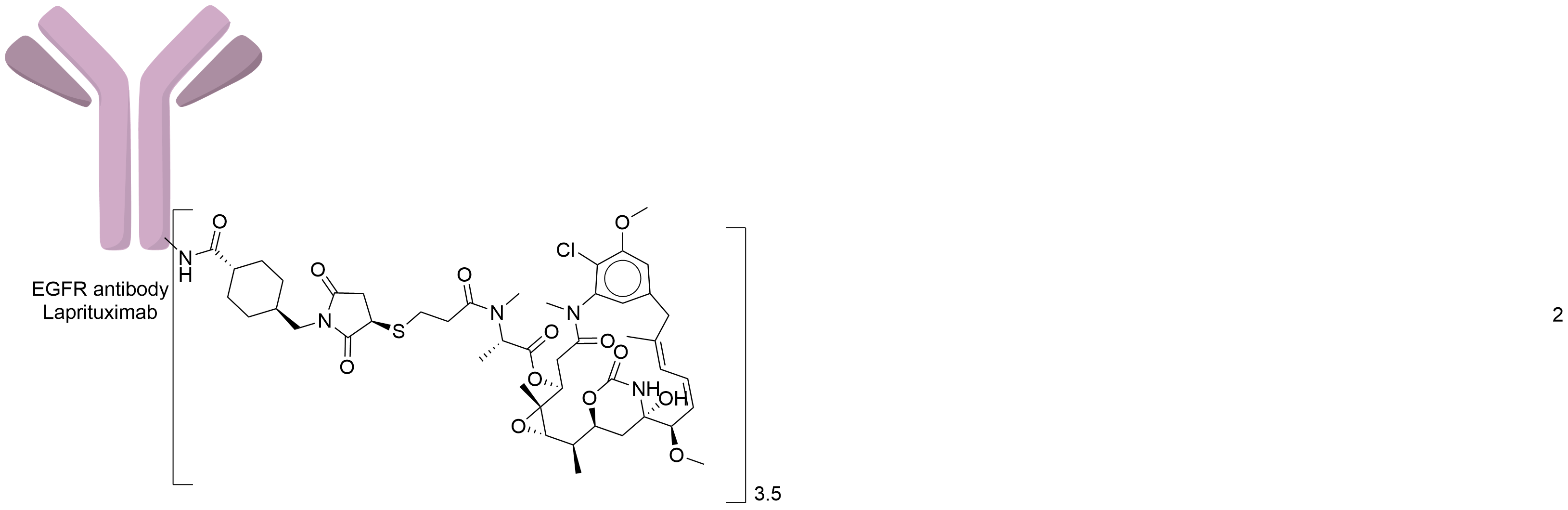
|
|||||
| Antibody Name |
Laprituximab
|
Antibody Info | ||||
| Antigen Name |
Epidermal growth factor receptor (EGFR)
|
Antigen Info | ||||
| Payload Name |
DM1
|
Payload Info | ||||
| Payload Target |
Microtubule (MT)
|
Target Info | ||||
| Linker Name |
Succinimidyl-4-(N-maleimidomethyl)cyclohexane-1-carboxylate (SMCC)
|
Linker Info | ||||
| Conjugate Type |
Random Lysines
|
|||||
| Combination Type |
emtansine
|
|||||
2027 Update
The disease landscape of This ADC
2027 Update
The clinical trial pipelines of This ADC
General Information of The Activity Data Related to This ADC
Identified from the Human Clinical Data
Discovered Using Cell Line-derived Xenograft Model
Revealed Based on the Cell Line Data
| Standard Type | Value | Units | Cell Line | Disease Model |
|---|---|---|---|---|
| Half Maximal Inhibitory Concentration (IC50) |
0.25
|
nM
|
HNSCC cells
|
Head and neck squamous cell carcinoma
|
Full List of Activity Data of This Antibody-drug Conjugate
Identified from the Human Clinical Data
| Experiment 1 Reporting the Activity Date of This ADC | [1] | ||||
| Patients Enrolled |
Eligibility requires EGFR-positive solid tumor patients (≥18 years) with progressed/refractory disease, adequate organ function, and contraception adherence. Exclusions involve concurrent anticancer therapy, symptomatic brain metastases, uncontrolled comorbidities, high-risk skin conditions, or prior severe EGFR-therapy rash. Active HIV/hepatitis or pregnancy also disqualifies participants.
Click to Show/Hide
|
||||
| Administration Dosage |
.
|
||||
| Related Clinical Trial | |||||
| NCT Number | NCT01963715 | Clinical Status | PHASE1 | ||
| Clinical Description | A Phase 1, Multi-center, Open-label Study of IMGN289 Administered Intravenously in Adult Patients With EGFR-positive Solid Tumors | ||||
| Primary Endpoint |
The study evaluates dose-limiting toxicities in participants over 2 years, focusing on safety and tolerability metrics as primary endpoints.
|
||||
| Other Endpoint |
Secondary endpoints include monitoring adverse events, pharmacokinetic parameters (plasma concentration AUC, Cmax of IMGN289), immunogenicity (HAHA/HADA), and preliminary anti-tumor activity via RECIST 1.1 criteria over 2 years.
|
||||
| Experiment 2 Reporting the Activity Date of This ADC | [2] | ||||
| Related Clinical Trial | |||||
| NCT Number | NCT01963715 | Clinical Status | Phase 1 | ||
| Clinical Description | A phase 1, multi-center, open-label study of IMGN289 administered intravenously in adult patients with EGFR-positive solid tumors. | ||||
Discovered Using Cell Line-derived Xenograft Model
| Experiment 1 Reporting the Activity Date of This ADC | [3] | ||||
| Efficacy Data | Tumor Growth Inhibition value (TGI) | 58.30% | High EGFR expression (EGFR+++/++) | ||
| Method Description |
The cytotoxic activity of IMGN289 was evaluated against a panel of SCCHN cell lines in vitro. Immunodeficient mice bearing established subcutaneous xenograft tumors were treated with a single intravenous injection of IMGN289 at 1,2.5 or 5.0 mg/kg (based on antibody concentration). IMGN289 dose was 5 mg/kg administered as a single injection.
|
||||
| In Vivo Model | Head and neck squamous cell carcinomas CDX model | ||||
| In Vitro Model | Hypopharyngeal squamous cell carcinoma | FaDu cells | CVCL_1218 | ||
| Experiment 2 Reporting the Activity Date of This ADC | [3] | ||||
| Efficacy Data | Tumor Growth Inhibition value (TGI) | 83.30% | High EGFR expression (EGFR+++/++) | ||
| Method Description |
The cytotoxic activity of IMGN289 was evaluated against a panel of SCCHN cell lines in vitro. Immunodeficient mice bearing established subcutaneous xenograft tumors were treated with a single intravenous injection of IMGN289 at 1,2.5 or 5.0 mg/kg (based on antibody concentration). IMGN289 dose was 5 mg/kg administered as a single injection.
|
||||
| In Vivo Model | Head and neck squamous cell carcinomas CDX model | ||||
| In Vitro Model | Oral cavity squamous cell carcinoma | HSC-2 cells | CVCL_1287 | ||
| Experiment 3 Reporting the Activity Date of This ADC | [3] | ||||
| Efficacy Data | Minimal Effective Dose (MED) | 1 mg/kg | High EGFR expression (EGFR+++/++) | ||
| Method Description |
The cytotoxic activity of IMGN289 was evaluated against a panel of SCCHN cell lines in vitro. Immunodeficient mice bearing established subcutaneous xenograft tumors were treated with a single intravenous injection of IMGN289 at 1,2.5 or 5.0 mg/kg (based on antibody concentration).
|
||||
| In Vivo Model | Head and neck squamous cell carcinomas CDX model | ||||
| In Vitro Model | Hypopharyngeal squamous cell carcinoma | FaDu cells | CVCL_1218 | ||
| Experiment 4 Reporting the Activity Date of This ADC | [3] | ||||
| Efficacy Data | Minimal Effective Dose (MED) | 2.5 mg/kg | High EGFR expression (EGFR+++/++) | ||
| Method Description |
The cytotoxic activity of IMGN289 was evaluated against a panel of SCCHN cell lines in vitro. Immunodeficient mice bearing established subcutaneous xenograft tumors were treated with a single intravenous injection of IMGN289 at 1,2.5 or 5.0 mg/kg (based on antibody concentration).
|
||||
| In Vivo Model | Head and neck squamous cell carcinomas CDX model | ||||
| In Vitro Model | Oral cavity squamous cell carcinoma | HSC-2 cells | CVCL_1287 | ||
Revealed Based on the Cell Line Data
| Experiment 1 Reporting the Activity Date of This ADC | [4] | ||||
| Efficacy Data | Half Maximal Inhibitory Concentration (IC50) | 0.25 nM | High EGFR expression (EGFR+++/++) | ||
| Method Description |
Effects of IMGN289 on clonogenicity and proliferation were tested in HNSCC cell lines with varying cetuximab and gefitinib sensitivities.
|
||||
| In Vitro Model | Head and neck squamous cell carcinoma | HNSCC cells | Homo sapiens | ||
References