
Linker Information
General Information of This Linker (ID: LIN0ECMCR)
| Name |
Mc-Gly-Gly-Phe-Gly
|
|||||
|---|---|---|---|---|---|---|
| Linker Type |
Cathepsin-cleavable linker
|
|||||
| Antibody-Linker Relation |
Cleavable
|
|||||
| Structure |
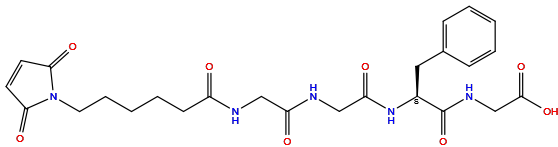
|
|||||
| Formula |
C25H31N5O8
|
|||||
| Isosmiles |
C1=CC=C(C=C1)C[C@@H](C(=O)NCC(=O)O)NC(=O)CNC(=O)CNC(=O)CCCCCN2C(=O)C=CC2=O
|
|||||
| PubChem CID | ||||||
| InChI |
InChI=1S/C25H31N5O8/c31-19(9-5-2-6-12-30-22(34)10-11-23(30)35)26-14-20(32)27-15-21(33)29-18(25(38)28-16-24(36)37)13-17-7-3-1-4-8-17/h1,3-4,7-8,10-11,18H,2,5-6,9,12-16H2,(H,26,31)(H,27,32)(H,28,38)(H,29,33)(H,36,37)/t18-/m0/s1
|
|||||
| InChIKey |
DWPLKZYCOGLRPC-SFHVURJKSA-N
|
|||||
| IUPAC Name |
2-[[(2S)-2-[[2-[[2-[6-(2,5-dioxopyrrol-1-yl)hexanoylamino]acetyl]amino]acetyl]amino]-3-phenylpropanoyl]amino]acetic acid
|
|||||
| Pharmaceutical Properties |
Molecule Weight
|
529.5
|
Polar area
|
191
|
||
|
Complexity
|
911
|
xlogp Value
|
-0.6
|
|||
|
Heavy Count
|
38
|
Rot Bonds
|
16
|
|||
|
Hbond acc
|
8
|
Hbond Donor
|
5
|
|||
Each Antibody-drug Conjugate Related to This Linker
Full Information of The Activity Data of The ADC(s) Related to This Linker
Trastuzumab rezetecan [Approved in 2025]
Identified from the Human Clinical Data
| Experiment 1 Reporting the Activity Date of This ADC | [1] | ||||
| Efficacy Data | Objective Response Rate (ORR) |
38.20%
|
|||
| Patients Enrolled |
Eligible patients must have advanced/metastatic gastric/GEJ adenocarcinoma or colorectal cancer (refractory to standard therapy) with ≥1 measurable lesion (RECIST 1.1), ECOG 0-1, life expectancy ≥3 months, and adequate organ function. Exclusions: unresolved Grade >1 toxicities, prior HER2-ADC exposure, symptomatic CNS/meningeal metastases, or active infections requiring systemic treatment.
Click to Show/Hide
|
||||
| Administration Dosage |
There are six pre-defined dose regimens . Subjects will be enrolled with an initial dose
|
||||
| Related Clinical Trial | |||||
| NCT Number | NCT04513223 | Clinical Status | PHASE1 | ||
| Clinical Description |
Safety, Tolerability, Pharmacokinetics, and Antitumour Activity of SHR-A1811, in Patients With HER2-expressing Advanced Gastric or Gastroesophageal Junction Adenocarcinoma and Colorectal Cancer: a Phase 1 Study
|
||||
| Primary Endpoint |
The primary endpoints include assessment of dose-limiting toxicities (DLT) and determination of the recommended Phase 2 dose (RP2D) during the first treatment cycle (Days 1-21).
|
||||
| Experiment 2 Reporting the Activity Date of This ADC | [2] | ||||
| Efficacy Data | Objective Response Rate (ORR) |
41.90%
|
|||
| Patients Enrolled |
Eligible patients (ECOG 0-1, HER2-altered advanced NSCLC post-platinum failure) require ≥1 measurable lesion (RECIST v1.1). Key exclusions: unresolved Grade >1 toxicity (CTCAE v5.0), prior HER2 ADC treatment, symptomatic CNS/meningeal metastases, or active systemic infection.
|
||||
| Administration Dosage |
SHR-A1811 was administered intravenously every 3 weeks (Q3W) until discontinuation treatment
|
||||
| Related Clinical Trial | |||||
| NCT Number | NCT04818333 | Clinical Status | PHASE1|||PHASE2 | ||
| Clinical Description |
Phase I/II Clinical Study of the Safety, Tolerability, Pharmacokinetics, and Efficacy of SHR-A1811 for Injection in Subjects With Advanced Non-small Cell Lung Cancer Who Have HER2 Expression , Amplification, or Mutation
|
||||
| Primary Endpoint |
Phase 1 evaluates safety/tolerability of SHR-A1811 through incidence/severity of AEs (CTCAE v5.0; monitored Day1-90 post-last dose, ~3 years), MTD determination (DLTs in first 21-day cycle), and RP2D selection (based on safety/PK/efficacy over 12 months). Phase 2 primary endpoint is ORR (RECIST v1.1, IRC-assessed, tumor imaging q6w→q12w post-54w until progression/new therapy/death, ~3 years).
Click to Show/Hide
|
||||
| Other Endpoint |
Phase 1 PK analysis includes Tmax, Cmax, AUC0-t (~3 years); immunogenicity (ADA/NAb assessed pre-dose C1D1-C8D1→q3 cycles). Phase 2 secondary endpoints: IRC/investigator-assessed PFS, ORR, DOR, DCR (RECIST v1.1, ~3 years); OS (~5 years post-last enrollment).
|
||||
| Experiment 3 Reporting the Activity Date of This ADC | [3] | ||||
| Efficacy Data | Objective Response Rate (ORR) |
45.90%
|
|||
| Patients Enrolled |
Eligible patients must have HER2-positive advanced/metastatic solid tumors refractory to standard therapy, ECOG 0-1, LVEF ≥ 50%, and adequate organ function. Exclusions include significant lung disease, bleeding/thrombotic disorders, and pregnancy or lactation during the study.
|
||||
| Administration Dosage |
Patients (pts) with advanced, unresectable, or metastatic HER2-expressing/mutated STs that were refractory or intolerant to standard therapies were treated with SHR-A1811 at 1.0-8.0 mg/kg Q3W (IV).
|
||||
| Related Clinical Trial | |||||
| NCT Number | NCT04446260 | Clinical Status | PHASE1 | ||
| Clinical Description |
A Phase 1 Multi-Country, Multi-Center, Open-Label Study to Evaluate the Safety, Tolerability, Pharmacokinetics and Efficacy of SHR-A1811 in HER2 Expressing or Mutated Advanced Malignant Solid Tumor Subjects
|
||||
| Primary Endpoint |
The study monitors the incidence and severity of adverse events (AEs) from Day 1 to 90 days after the last dose, including frequency and seriousness of treatment-emergent adverse events (TEAEs).
|
||||
| Other Endpoint |
Pharmacokinetic (PK) parameters such as Tmax, Cmax, and AUC0-t of SHR-A1811 are evaluated over an average of 1 year. Immunogenicity assessments include anti-drug antibodies and neutralizing antibodies. Tumor response is measured per RECIST 1.1 until progression or death, up to 30 months.
|
||||
| Experiment 4 Reporting the Activity Date of This ADC | [4] | ||||
| Efficacy Data | Objective Response Rate (ORR) |
56.1
50 63.6 % |
|||
| Patients Enrolled |
Eligible participants (signed ICF, ECOG 0-1, life expectancy ≥12 weeks) must have measurable advanced/recurrent cervical, ovarian, or endometrial cancer. Exclusions: untreated CNS metastases, prior topoisomerase I inhibitor ADC treatment (e.g., DS-8201a), uncontrolled cardiovascular disease, active autoimmune/HBV/HCV infections, recent severe infections (28 days), or active tuberculosis (1 year).
Click to Show/Hide
|
||||
| Administration Dosage |
Pts received SHR-A1811 at 4.8 or 6.4 mg/kg (Q3W, IV). The primary endpoint was ORR per RECIST v1.1.
|
||||
| Related Clinical Trial | |||||
| NCT Number | NCT05896020 | Clinical Status | PHASE2 | ||
| Clinical Description |
Open, Multicenter Phase II Clinical Study of SHR-A1811 for Injection in the Treatment of Gynaecological Malignancies
|
||||
| Primary Endpoint |
The primary endpoint is objective response rate (ORR) assessed over a 12-month timeframe as per RECIST v1.1 criteria.
|
||||
| Other Endpoint |
Secondary endpoints include progression-free survival (PFS), disease control rate (DCR), duration of response (DOR), overall survival (OS) (all 12-month assessment), and incidence/severity of adverse events (AEs) tracked from Day 1 to 90 days post-last dose.
|
||||
| Experiment 5 Reporting the Activity Date of This ADC | [5] | ||||
| Efficacy Data | Objective Response Rate (ORR) |
66.70%
|
|||
| Patients Enrolled |
Eligible patients (women 18-75 years, ECOG 0-1) require histologically confirmed HER2+ breast cancer, measurable lesions (RECIST v1.1), and adequate organ function. Key exclusions: active CNS metastases (unless treated), uncontrolled effusions, recent antitumor therapy (≤4 weeks), autoimmune/cardiovascular diseases, or unresolved toxicity (>CTCAE Gr1). Hepatitis B/C carriers with viral loads >2000 IU/mL or cirrhosis are excluded.
Click to Show/Hide
|
||||
| Administration Dosage |
SHR-A1811:Lyophilized powder injection, 100mg / bottle, intravenous drip
|
||||
| Related Clinical Trial | |||||
| NCT Number | NCT05353361 | Clinical Status | PHASE2 | ||
| Clinical Description |
A Phase Ib/II Multicenter, Open-Label Clinical Trial of SHR-A1811 Injection in Combination With Pyrotinib or Pertuzumab or Adebrelimab or Paclitaxel for Injection (Albumin Bound) in Breast Cancer
|
||||
| Primary Endpoint |
The Phase I dose-escalation trial evaluates SHR-A1811 safety (DLTs in first 21 days; AEs/SAEs monitored until 40-90 days post-treatment). Phase II assesses ORR (primary endpoint) in HER2+ breast cancer patients at 2 years post-enrollment, with tumor response per RECIST v1.1.
|
||||
| Other Endpoint |
Pharmacokinetics (Cmin/Cmax/AUC of SHR-A1811, pyrotinib, and adebrelimab) and immunogenicity (anti-drug antibodies) are secondary endpoints in both phases (tracked for ~2 years). Efficacy metrics include ORR, DoR, PFS (up to 3 years), and Phase II's event-free survival rate (EFSR). Safety monitoring extends to 90 days post-treatment.
|
||||
| Experiment 6 Reporting the Activity Date of This ADC | [6] | ||||
| Efficacy Data | Objective Response Rate (ORR) |
81.50%
|
|||
| Patients Enrolled |
Eligible patients aged 18-70 have untreated T2-T3/N0-3/M0, HR+/HER2-low (Ki-67 >14%) invasive breast cancer (ECOG 0-1) and normal organ function. Exclusions: metastatic/inflammatory disease, prior anticancer therapy (excluding cured non-breast malignancies), recent major surgery, severe comorbidities (cardiopulmonary/immunodeficiency), drug allergies, or conditions impairing treatment adherence. WOCBP must use contraception.
Click to Show/Hide
|
||||
| Administration Dosage |
SHR-A1811 is administered intravenously at a dose of 6.4 mg/kg once every three weeks for a total of eight cycles.
|
||||
| Related Clinical Trial | |||||
| NCT Number | NCT05911958 | Clinical Status | PHASE2 | ||
| Clinical Description |
Phase II Study of SHR-A1811 as Neoadjuvant Treatment for Patients With HR-Positive, Low HER2 Expression Breast Cancer
|
||||
| Primary Endpoint |
The study evaluates ORR per RECIST v1.1 during 24 weeks of neoadjuvant treatment and assesses safety via AE incidence/severity (CTCAE 5.0) from consent through 28 days post-last dose.
|
||||
| Other Endpoint |
Key endpoints include residual cancer burden (RCB) and pathological complete response (pCR: ypT0/is ypN0) at surgery, with long-term outcomes tracked over 5 years (EFS from randomization; DFS from surgery) for recurrence/metastasis/death events.
|
||||
| Experiment 7 Reporting the Activity Date of This ADC | [7] | ||||
| Efficacy Data | Objective Response Rate (ORR) |
84.4
72.7 % |
|||
| Patients Enrolled |
Eligible participants are females ≥18 with HER2+/HER2-low advanced breast cancer and measurable untreated intracranial lesions (RANO-BM). Key criteria: no prior cranial radiation/local therapy (unless post-surgery, unirradiated), ≥2 weeks since last systemic treatment, life expectancy ≥6 months, and adequate organ function. Exclusions: leptomeningeal disease, urgent CNS intervention needed, prior DS-8201a/exatecan-ADC use, recent antitumor therapy (≤2 weeks for most, ≤1 week for endocrine), other malignancies (except cured CIS/skin cancers), or uncontrolled comorbidities per investigator judgement.
Click to Show/Hide
|
||||
| Administration Dosage |
Between March 31, 2023, and November 3, 2023, 25 patients with HER2+ BCBM were enrolled in Arm 1, and they received SHR-A1811 at a dosage of 6.4mg/kg q3w.
|
||||
| Related Clinical Trial | |||||
| NCT Number | NCT05769010 | Clinical Status | PHASE2 | ||
| Clinical Description |
A Prospective, Open-label Explorative Study of SHR-A1811 in HER2-expression Advanced Breast Cancer with Brain Metastases
|
||||
| Primary Endpoint |
The primary endpoint is CNS-ORR, assessed by investigators per RANO-BM criteria at 2 months, defined as the percentage of participants achieving CNS response.
|
||||
| Other Endpoint |
Secondary endpoints include ORR (CR/PR per RECIST 1.1 at 2 months), PFS (time to progression/death up to 1.5 years), and safety (adverse events incidence over 1.5 years).
|
||||
| Experiment 8 Reporting the Activity Date of This ADC | [8] | ||||
| Efficacy Data | Objective Response Rate (ORR) |
85.7
30 % |
|||
| Patients Enrolled |
Eligible patients (18-75 years, ECOG 0-1, life expectancy ≥12 weeks) must have histologically confirmed locally advanced/metastatic salivary gland carcinoma: Arm 1 (HER2-altered), Arm 2 (AR-positive), Arm 3 (HER2/AR-negative), or Arm 4 (low HER2 expression), with ≥1 measurable lesion (RECIST v1.1). Key exclusions: active malignancies (5 years), recent antitumor therapy (28 days prior, or <5 half-lives), uncontrolled cardiac conditions (NYHA ≥II, LVEF <50%, QTc >450ms♂/470ms♀), uncontrolled hypertension, gastrointestinal absorption issues (Arm 2), bleeding risks, or abnormal coagulation (INR/aPTT >1.5×ULN). Organ function thresholds: HB ≥90g/L, ANC ≥1.5×10⁹/L, PLT ≥80×109/L, bilirubin ≤1.5×ULN, ALT/AST ≤2.5×ULN (≤5×ULN if liver mets), Cr ≤1×ULN.
Click to Show/Hide
|
||||
| Administration Dosage |
Patients with advanced SGC were stratified into four arms based on genetic subtypes. This analysis focuses on Arm 1 (HER2 overexpression: IHC 3+ or IHC 2+/ISH+) and Arm 4 (HER2-low: IHC 1+ or IHC 2+/ISH-). In Arm 1, patients received SHR-A1811 at 4.8 mg/kg IV on Day 1 of a 21-day cycle. In Arm 4, patients received 4.8 mg/kg or 5.6 mg/kg (if tolerated).
Click to Show/Hide
|
||||
| Related Clinical Trial | |||||
| NCT Number | NCT05924256 | Clinical Status | PHASE2 | ||
| Clinical Description |
A Phase II Study of Advanced Salivary Gland Carcinoma Based on Molecular Typing
|
||||
| Primary Endpoint |
The primary endpoint is objective response rate (ORR) assessed every 2 cycles (21-day cycles for Arms 1/3/4, 28-day for Arm 2) per RECIST 1.0 criteria (confirmed CR/PR).
|
||||
| Other Endpoint |
Key secondary endpoints include disease control rate (DCR: CR/PR/SD per RECIST 1.0, same assessment schedule), progression-free survival (PFS: time to progression/death, RECIST v1.1, up to 2 years), overall survival (OS: time to death, up to 2 years), and adverse events (hematologic/non-hematologic per CTCAE 5.0, monitored from consent to 30 days post-last cycle).
Click to Show/Hide
|
||||
| Experiment 9 Reporting the Activity Date of This ADC | [9] | ||||
| Efficacy Data | Objective Response Rate (ORR) |
89.70%
|
|||
| Patients Enrolled |
Eligible patients (females aged 18-75) have treatment-naive HER2+ stage II-III breast cancer (ECOG 0-1). Exclusions: prior antitumor therapy, bilateral/Stage IV disease, malignancies in 5 years (exceptions: cured CIS/skin cancer), drug absorption issues, recent trial participation, significant organ dysfunction (cardiac/pulmonary/liver), or drug allergies.
Click to Show/Hide
|
||||
| Administration Dosage |
Eligible women aged 18-75 with newly diagnosed stage II-III, untreated HER2+ BC received SHR-A1811 Q3W and daily pyrotinib for six cycles. Initial treatment was SHR-A1811 at 4.8 mg/kg and pyrotinib at 240 mg/day (Cohort A). Dose adjustments followed the 3+3 principle: If tolerated, SHR-A1811 could escalate to 5.6 mg/kg, maintaining pyrotinib (Cohort B). For intolerance or investigator discretion, adjustments included SHR-A1811 at 4.8 mg/kg with pyrotinib at 160 mg/day (Cohort C), or SHR-A1811 at 4.0 mg/kg with pyrotinib at 240 mg/day (Cohort D).
Click to Show/Hide
|
||||
| Related Clinical Trial | |||||
| NCT Number | NCT05635487 | Clinical Status | PHASE2 | ||
| Clinical Description |
A Phase II Study of SHR-A1811 Monotherapy or Combined With Pyrotinib Maleate as Neoadjuvant Treatment in HER2-positive Breast Cancer Patients
|
||||
| Primary Endpoint |
The primary endpoint is total pathological complete response (tpCR: ypT0-is/ypN0), evaluated at surgery following neoadjuvant therapy.
|
||||
| Other Endpoint |
Secondary endpoints include breast pCR (bpCR: ypT0-is), RCB, BORR during neoadjuvant treatment (18 weeks), OS/DFS/EFS (5-year follow-up), and HRQOL (assessed via EORTC QLQ-C30 and QLQ-BR23).
|
||||
| Experiment 10 Reporting the Activity Date of This ADC | [1] | ||||
| Efficacy Data | Disease control rate (DCR) |
83.60%
|
|||
| Patients Enrolled |
Eligible patients must have advanced/metastatic gastric/GEJ adenocarcinoma or colorectal cancer (refractory to standard therapy) with ≥1 measurable lesion (RECIST 1.1), ECOG 0-1, life expectancy ≥3 months, and adequate organ function. Exclusions: unresolved Grade >1 toxicities, prior HER2-ADC exposure, symptomatic CNS/meningeal metastases, or active infections requiring systemic treatment.
Click to Show/Hide
|
||||
| Administration Dosage |
There are six pre-defined dose regimens . Subjects will be enrolled with an initial dose
|
||||
| Related Clinical Trial | |||||
| NCT Number | NCT04513223 | Clinical Status | PHASE1 | ||
| Clinical Description |
Safety, Tolerability, Pharmacokinetics, and Antitumour Activity of SHR-A1811, in Patients With HER2-expressing Advanced Gastric or Gastroesophageal Junction Adenocarcinoma and Colorectal Cancer: a Phase 1 Study
|
||||
| Primary Endpoint |
The primary endpoints include assessment of dose-limiting toxicities (DLT) and determination of the recommended Phase 2 dose (RP2D) during the first treatment cycle (Days 1-21).
|
||||
| Experiment 11 Reporting the Activity Date of This ADC | [3] | ||||
| Efficacy Data | Disease control rate (DCR) |
88.20%
|
|||
| Patients Enrolled |
Eligible patients must have HER2-positive advanced/metastatic solid tumors refractory to standard therapy, ECOG 0-1, LVEF ≥ 50%, and adequate organ function. Exclusions include significant lung disease, bleeding/thrombotic disorders, and pregnancy or lactation during the study.
|
||||
| Administration Dosage |
Patients (pts) with advanced, unresectable, or metastatic HER2-expressing/mutated STs that were refractory or intolerant to standard therapies were treated with SHR-A1811 at 1.0-8.0 mg/kg Q3W (IV).
|
||||
| Related Clinical Trial | |||||
| NCT Number | NCT04446260 | Clinical Status | PHASE1 | ||
| Clinical Description |
A Phase 1 Multi-Country, Multi-Center, Open-Label Study to Evaluate the Safety, Tolerability, Pharmacokinetics and Efficacy of SHR-A1811 in HER2 Expressing or Mutated Advanced Malignant Solid Tumor Subjects
|
||||
| Primary Endpoint |
The study monitors the incidence and severity of adverse events (AEs) from Day 1 to 90 days after the last dose, including frequency and seriousness of treatment-emergent adverse events (TEAEs).
|
||||
| Other Endpoint |
Pharmacokinetic (PK) parameters such as Tmax, Cmax, and AUC0-t of SHR-A1811 are evaluated over an average of 1 year. Immunogenicity assessments include anti-drug antibodies and neutralizing antibodies. Tumor response is measured per RECIST 1.1 until progression or death, up to 30 months.
|
||||
| Experiment 12 Reporting the Activity Date of This ADC | [2] | ||||
| Efficacy Data | Disease control rate (DCR) |
95.30%
|
|||
| Patients Enrolled |
Eligible patients (ECOG 0-1, HER2-altered advanced NSCLC post-platinum failure) require ≥1 measurable lesion (RECIST v1.1). Key exclusions: unresolved Grade >1 toxicity (CTCAE v5.0), prior HER2 ADC treatment, symptomatic CNS/meningeal metastases, or active systemic infection.
|
||||
| Administration Dosage |
SHR-A1811 was administered intravenously every 3 weeks (Q3W) until discontinuation treatment
|
||||
| Related Clinical Trial | |||||
| NCT Number | NCT04818333 | Clinical Status | PHASE1|||PHASE2 | ||
| Clinical Description |
Phase I/II Clinical Study of the Safety, Tolerability, Pharmacokinetics, and Efficacy of SHR-A1811 for Injection in Subjects With Advanced Non-small Cell Lung Cancer Who Have HER2 Expression , Amplification, or Mutation
|
||||
| Primary Endpoint |
Phase 1 evaluates safety/tolerability of SHR-A1811 through incidence/severity of AEs (CTCAE v5.0; monitored Day1-90 post-last dose, ~3 years), MTD determination (DLTs in first 21-day cycle), and RP2D selection (based on safety/PK/efficacy over 12 months). Phase 2 primary endpoint is ORR (RECIST v1.1, IRC-assessed, tumor imaging q6w→q12w post-54w until progression/new therapy/death, ~3 years).
Click to Show/Hide
|
||||
| Other Endpoint |
Phase 1 PK analysis includes Tmax, Cmax, AUC0-t (~3 years); immunogenicity (ADA/NAb assessed pre-dose C1D1-C8D1→q3 cycles). Phase 2 secondary endpoints: IRC/investigator-assessed PFS, ORR, DOR, DCR (RECIST v1.1, ~3 years); OS (~5 years post-last enrollment).
|
||||
| Experiment 13 Reporting the Activity Date of This ADC | [8] | ||||
| Efficacy Data | Disease control rate (DCR) |
100%
|
|||
| Patients Enrolled |
Eligible patients (18-75 years, ECOG 0-1, life expectancy ≥12 weeks) must have histologically confirmed locally advanced/metastatic salivary gland carcinoma: Arm 1 (HER2-altered), Arm 2 (AR-positive), Arm 3 (HER2/AR-negative), or Arm 4 (low HER2 expression), with ≥1 measurable lesion (RECIST v1.1). Key exclusions: active malignancies (5 years), recent antitumor therapy (28 days prior, or <5 half-lives), uncontrolled cardiac conditions (NYHA ≥II, LVEF <50%, QTc >450ms♂/470ms♀), uncontrolled hypertension, gastrointestinal absorption issues (Arm 2), bleeding risks, or abnormal coagulation (INR/aPTT >1.5×ULN). Organ function thresholds: HB ≥90g/L, ANC ≥1.5×10⁹/L, PLT ≥80×109/L, bilirubin ≤1.5×ULN, ALT/AST ≤2.5×ULN (≤5×ULN if liver mets), Cr ≤1×ULN.
Click to Show/Hide
|
||||
| Administration Dosage |
Patients with advanced SGC were stratified into four arms based on genetic subtypes. This analysis focuses on Arm 1 (HER2 overexpression: IHC 3+ or IHC 2+/ISH+) and Arm 4 (HER2-low: IHC 1+ or IHC 2+/ISH-). In Arm 1, patients received SHR-A1811 at 4.8 mg/kg IV on Day 1 of a 21-day cycle. In Arm 4, patients received 4.8 mg/kg or 5.6 mg/kg (if tolerated).
Click to Show/Hide
|
||||
| Related Clinical Trial | |||||
| NCT Number | NCT05924256 | Clinical Status | PHASE2 | ||
| Clinical Description |
A Phase II Study of Advanced Salivary Gland Carcinoma Based on Molecular Typing
|
||||
| Primary Endpoint |
The primary endpoint is objective response rate (ORR) assessed every 2 cycles (21-day cycles for Arms 1/3/4, 28-day for Arm 2) per RECIST 1.0 criteria (confirmed CR/PR).
|
||||
| Other Endpoint |
Key secondary endpoints include disease control rate (DCR: CR/PR/SD per RECIST 1.0, same assessment schedule), progression-free survival (PFS: time to progression/death, RECIST v1.1, up to 2 years), overall survival (OS: time to death, up to 2 years), and adverse events (hematologic/non-hematologic per CTCAE 5.0, monitored from consent to 30 days post-last cycle).
Click to Show/Hide
|
||||
| Experiment 14 Reporting the Activity Date of This ADC | [33] | ||||
| Patients Enrolled |
Exclusion criteria include prior chemotherapy/radiotherapy, NYHA class II+ heart disease, severe infections, drug allergies, other malignancies (except cervical/non-melanoma skin cancer) in the past 5 years, pregnancy/lactation without contraception, participation in other trials within 30 days, or investigator-deemed unsuitability.
|
||||
| Administration Dosage |
SHR-A1811 was administered at a dose of 4.8 mg/kg intravenously (i.v.) every 3 weeks for eight cycles with or without an irreversible dual pan-ErbB receptor TKI, pyrotinib 240 mg orally once daily.
|
||||
| Related Clinical Trial | |||||
| NCT Number | NCT05582499 | Clinical Status | PHASE2 | ||
| Clinical Description |
Fudan University Shanghai Cancer Center Breast Cancer Precision Platform Series Study- Neoadjuvant Therapy (FASCINATE-N)
|
||||
| Primary Endpoint |
This study evaluates the pathological complete response rate (pCR) as the primary endpoint within 24 weeks, while secondary endpoints include three-year invasive disease-free survival (iDFS), overall response rate (ORR), adverse effects using CTCAE v4.0, gene expression profiling via RNA-seq, and peripheral blood mononuclear cell (PBMC) counts measured by flow cytometry throughout the treatment period.
Click to Show/Hide
|
||||
| Other Endpoint |
Eligible participants must have histologically confirmed stage II-III invasive breast cancer (T2N0-1/T3N0 for stage II; T2N2/T3N1-2 for stage III), aged 18-70, ECOG 0-1, with confirmed ER/PR/HER2 status, LVEF ≥55%, and proper subtyping (SNF or triple-negative based on AR/CD8/FOXC1). Acceptable organ function is required (HB≥90g/L, ANC≥1500/uL, platelets≥75K/uL, bilirubin≤1.5xULN, AST/ALT≤3xULN, creatinine clearance>50mL/min). Fertile women must use contraceptives during and 3 months post-study.
Click to Show/Hide
|
||||
| Experiment 15 Reporting the Activity Date of This ADC | [34] | ||||
| Patients Enrolled |
Eligible patients must have unresectable/metastatic HER2+ breast cancer (prior trastuzumab + taxane treatment), ECOG 0-1, measurable disease (RECIST v1.1), and adequate organ function. Exclusions: uncontrolled effusions, recent antitumor therapy (≤4 weeks for chemo/immunotherapy, ≤2 weeks for endocrine), active autoimmune/cardiac disease (NYHA ≥II), HIV/HBV/HCV infection, unresolved toxicity (>CTCAE Gr1), or severe allergies to monoclonal antibodies. WOCBP must use contraception for 7 months post-treatment.
Click to Show/Hide
|
||||
| Related Clinical Trial | |||||
| NCT Number | NCT05424835 | Clinical Status | PHASE3 | ||
| Clinical Description |
A Phase III, Multicenter, Randomized, Open-Label, Parallel Controlled Study of SHR-A1811 Versus Pyrotinib in Combination With Capecitabine for HER2-Positive, Unresectable and/or Metastatic Breast Cancer Subjects Previously Treated With Trastuzumab and Taxane
|
||||
| Primary Endpoint |
The primary endpoint is PFS (assessed by BIRC) evaluated from 6 weeks post-first dose until disease progression or death (approximately 2 years) in HER2+ metastatic breast cancer patients.
|
||||
| Experiment 16 Reporting the Activity Date of This ADC | [35] | ||||
| Patients Enrolled |
Inclusion requires HER2-low BC patients (18-75y, ECOG 0-1) with measurable lesions and adequate organ function. Key exclusions: active CNS metastases, uncontrolled effusions, recent major surgery, ILD/pneumonitis, significant comorbidities, unresolved prior toxicity (>CTCAE Gr1), or recent malignancies (exceptions: skin/CIS/thyroid cancers).
|
||||
| Administration Dosage |
SHR-A1811:Lyophilized powder injection, 100mg / bottle, intravenous drip
|
||||
| Related Clinical Trial | |||||
| NCT Number | NCT05792410 | Clinical Status | PHASE1|||PHASE2 | ||
| Clinical Description |
An Open, Multicenter Phase Ib/II Clinical Study of SHR-A1811 Combined With Dalpiciclib, Fulvestrant, Bevacizumab or Letrozole/Anastrozole in Patients With HER2 Low Advanced or Metastatic Breast Cancer.
|
||||
| Primary Endpoint |
The primary endpoints for Phase I include DLT assessment (cycle 1: 28d for SHR-A1811+fulvestrant, 21d for other combos), AE incidence/severity, and ORR evaluation during efficacy expansion, with follow-up up to 24 months.
|
||||
| Other Endpoint |
Secondary measures comprise SHR-A1811/dalpiciclib PK profiles, ADA/NAb detection rates, DoR, and PFS, all monitored over 24 months. Safety and immunogenicity data span from treatment initiation through study completion.
|
||||
| Experiment 17 Reporting the Activity Date of This ADC | [36] | ||||
| Patients Enrolled |
Eligible patients have HR+/HER2-low (IHC 1+ or 2+/ISH-) metastatic breast cancer with 0-1 prior chemotherapy lines in the metastatic setting, measurable lesions, and adequate organ function. Key exclusions: active CNS metastases (unless stable treated), HIV/autoimmune disease, ILD/pneumonitis history, significant CVD, active HBV/HCV infection, or prior malignancies (except low-risk) within 5 years.
Click to Show/Hide
|
||||
| Related Clinical Trial | |||||
| NCT Number | NCT05814354 | Clinical Status | PHASE3 | ||
| Clinical Description |
A Randomized, Open, Parallel-controlled, Multicenter Phase III Trial of SHR-A1811 Versus Investigator Chemotherapy in HER2-low Expressing Recurrent/Metastatic Breast Cancer
|
||||
| Primary Endpoint |
The primary endpoint is PFS assessed by BIRC within approximately 2 years of follow-up.
|
||||
| Other Endpoint |
Secondary endpoints include OS (time to death up to 3 years), ORR (CR/PR rate within ~2 years), DoR (response duration until progression/death), and CBR (CR/PR/SD rate per RECIST 1.1 over ~2 years).
|
||||
| Experiment 18 Reporting the Activity Date of This ADC | [37] | ||||
| Patients Enrolled |
Eligible patients have ECOG 0-1, HER2 IHC 0 advanced/metastatic breast cancer (never HER2+), measurable lesions (RECIST 1.1), and progression after ≥1 chemotherapy line (HR+ tumors require prior endocrine therapy). Exclusions: prior anti-HER2 therapy, recent treatments (surgery/RT/systemic therapies within 4w; endocrine therapy within 2w), active CNS metastasis, immunosuppression (>10mg/day prednisone), uncontrolled comorbidities, HIV/HBV/HCV infection, or other malignancies (except cured skin/CIS) within 5 years.
Click to Show/Hide
|
||||
| Related Clinical Trial | |||||
| NCT Number | NCT05824325 | Clinical Status | PHASE1|||PHASE2 | ||
| Clinical Description |
Different Targeted Antibody-drug Conjugates for HER2 Ultra-low or no Expression Advanced Breast Cancer: a Phase Ib/II Study(GALAXY)
|
||||
| Primary Endpoint |
Phase 1 focuses on AE incidence (graded per CTCAE v5.0) over 24 months, while Phase 2 evaluates ORR (CR/PR rate per RECIST 1.1 by investigator) until progression (~24 months).
|
||||
| Other Endpoint |
Secondary endpoints include investigator-assessed PFS/OS (time to progression/death), DoR/DCR (response duration and control rate), CBR (CR/PR/SD≥24w), safety (AEs graded per CTCAE v5.0), and exploratory HER2-PET analysis, all monitored over 24 months.
|
||||
| Experiment 19 Reporting the Activity Date of This ADC | [38] | ||||
| Patients Enrolled |
Eligible are women aged 18-75 with HER2-low metastatic breast cancer (ECOG 0-1), measurable lesions, and ≥12-week life expectancy. Exclusions: recent treatments/procedures (within 4 weeks), other cancers (last 5 years), significant comorbidities (cardiac/hepatic diseases), drug allergies, or conditions affecting absorption. WOCBP must use contraception.
Click to Show/Hide
|
||||
| Related Clinical Trial | |||||
| NCT Number | NCT05845138 | Clinical Status | PHASE1|||PHASE2 | ||
| Clinical Description |
An Open-Label, Multi-center Phase Ib/II Study of SHR-A1811 Combined With Capecitabine in Treatment of Unresectable or Metastatic Breast Cancer With Low HER2 Expression.
|
||||
| Primary Endpoint |
The Phase I dose exploration focuses on DLT assessment within 21 days of first dose and tracks AE/SAE incidence from Day 1 to 40 days post-last dose, while Phase II evaluates ORR one year post-final enrollment.
|
||||
| Other Endpoint |
Efficacy measures include DoR and PFS (assessed one year post-final enrollment), with Phase I also monitoring ORR during this period. Both phases document AE/SAE incidence from Day 1 to 40 days after the last treatment administration.
|
||||
| Experiment 20 Reporting the Activity Date of This ADC | [39] | ||||
| Patients Enrolled |
Eligible female patients (18-75 years) have HER2+ (IHC3+/ISH+) unresectable/metastatic breast cancer (ECOG 0-1, ≥12-week life expectancy, measurable lesions per RECIST v1.1, adequate organ function). Exclusions: recent malignancies (past 5 years), untreated CNS metastases, early recurrence (<12 months post- (neo)adjuvant therapy), uncontrolled effusions, recent anti-tumor treatments (4 weeks prior), immunodeficiency, severe cardiovascular/interstitial lung disease, unresolved toxicity (>Grade 1), bleeding disorders, active hepatitis/cirrhosis, or other clinically significant comorbidities.
Click to Show/Hide
|
||||
| Related Clinical Trial | |||||
| NCT Number | NCT06057610 | Clinical Status | PHASE3 | ||
| Clinical Description |
A Phase III Multicenter, Randomized, Open-label, Active-Controlled Study of SHR-A1811 With or Without Pertuzumab Versus Trastuzumab, Pertuzumab and Docetaxel in HER2-Positive Recurrent or Metastatic Breast Cancer
|
||||
| Primary Endpoint |
The primary efficacy endpoint is blinded independent central review-assessed PFS, measured from first dose until disease progression or death (up to 3 years).
|
||||
| Other Endpoint |
Secondary endpoints include investigator-assessed PFS (3 years), OS (6 years), ORR and DoR (3 years), plus AE/SAE incidence/severity tracked from Day 1 until 40-90 days post-last dose.
|
||||
| Experiment 21 Reporting the Activity Date of This ADC | [40] | ||||
| Patients Enrolled |
Eligible participants are women (18-75 years) with HER2+ invasive breast cancer (pre-neoadjuvant stage T1-4/N0-3/M0, excluding T1N0) and residual disease post-surgery/neoadjuvant therapy (≥9 weeks taxane + trastuzumab). Exclusions: metastatic/recurrent disease, prior HER2-ADC exposure, high anthracycline doses (>240mg/m2 doxorubicin or >480mg/m2 epirubicin), significant cardiovascular/respiratory disorders, hepatitis/liver cirrhosis, or conditions increasing study risk. HR status and ECOG 0-1 are required.
Click to Show/Hide
|
||||
| Administration Dosage |
Lyophilized powder injection, 100mg / bottle, intravenous drip
|
||||
| Related Clinical Trial | |||||
| NCT Number | NCT06126640 | Clinical Status | PHASE3 | ||
| Clinical Description |
A Phase III, Multicenter, Randomized, Open-Label, Active-Controlled Study of SHR-A1811 Versus Trastuzumab Emtansine (T-DM1) in HER2-Positive Primary Breast Cancer Participants With Residual Invasive Disease Following Neoadjuvant Therapy
|
||||
| Primary Endpoint |
The primary endpoint is invasive disease-free survival (IDFS), assessed from randomization until disease progression or approximately 77 months post-dose, evaluating long-term recurrence risk in HER2+ breast cancer patients.
|
||||
| Other Endpoint |
Secondary endpoints include DFS, OS, and distant recurrence-free interval (DRFI), all tracked over extended periods (77-101 months post-dose), with safety assessed via AE incidence during the same timeframe, ensuring comprehensive monitoring of treatment efficacy and tolerability.
|
||||
| Experiment 22 Reporting the Activity Date of This ADC | [41] | ||||
| Patients Enrolled |
Eligible females (18-75 years, ECOG 0-1) have confirmed metastatic/locally advanced breast cancer (ER+/HER2± or TNBC) with measurable lesions (RECIST v1.1) and organ function. Exclusions: uncontrolled brain metastases, active lung/cardiovascular diseases, recent immunosuppression, unresolved treatment toxicity (>Grade 1), active infections/hepatitis, prior malignancies (5 years), autoimmune/immunodeficiency disorders, or severe allergies to study drugs.
Click to Show/Hide
|
||||
| Related Clinical Trial | |||||
| NCT Number | NCT06222879 | Clinical Status | PHASE1|||PHASE2 | ||
| Clinical Description |
A Multi-center, Open-label Phase Ib/II Clinical Study on the Safety, Tolerability, Pharmacokinetics and Efficacy of HRS-8080 or SHR-A2009 Combined With Anti-tumor Therapy in Patients With Unresectable or Metastatic Breast Cancer
|
||||
| Primary Endpoint |
The Phase 1 study evaluates dose-limiting toxicity (DLT), maximum tolerated dose (MTD), and recommended Phase 2 dose (RP2D) within the first 21-day cycle, with safety monitored via AE/SAE incidence (CTCAE v5.0) and efficacy assessed by ORR over 12 months.
|
||||
| Other Endpoint |
Immunogenicity (ADA/Nab levels for SHR-A1811, SHR-A2009, and adebrelimab) and efficacy (ORR, BOR, DoR, DCR, CBR, PFS) are tracked over 12 months in both Phase 1 and 2, alongside safety (AE/SAE incidence) to ensure comprehensive therapeutic assessment.
|
||||
| Experiment 23 Reporting the Activity Date of This ADC | [42] | ||||
| Patients Enrolled |
Eligible patients are treatment-naive women aged 18-75 with HR+/HER2-low stage II-III breast cancer, ECOG 0-1, and adequate organ function. Exclusions include prior anti-tumor therapy, stage IV disease, concurrent malignancies, significant comorbidities (cardiovascular, lung, liver, or psychiatric disorders), and participation in other trials within 4 weeks.
Click to Show/Hide
|
||||
| Related Clinical Trial | |||||
| NCT Number | NCT06340230 | Clinical Status | PHASE2 | ||
| Clinical Description |
A Phase II Study of SHR-A1811 Alone or in Combination With Adebrelimab as Neoadjuvant Treatment in HR Positive/HER2 Low Breast Cancer
|
||||
| Primary Endpoint |
The primary endpoint is total pathological complete response (tpCR: ypT0-is/ypN0) assessed at the time of surgery, measuring the absence of invasive cancer in the breast and lymph nodes.
|
||||
| Other Endpoint |
Secondary endpoints include breast pathological complete response (bpCR: ypT0-is), residual cancer burden (RCB), best overall response rate (BORR) during neoadjuvant treatment, and long-term survival outcomes (OS, DFS, EFS) over 5 years. Health-related quality of life (HRQOL) is evaluated using EORTC QLQ-C30 and QLQ-BR23 during the 18-week neoadjuvant phase.
Click to Show/Hide
|
||||
| Experiment 24 Reporting the Activity Date of This ADC | [43] | ||||
| Patients Enrolled |
Eligible patients were ≥18 years with HER2+ breast cancer and measurable untreated intracranial lesions (RANO-BM criteria), ≥2 weeks post-systemic therapy, and adequate organ function. Exclusions included prior DS-8201a/ADC therapy, recent trial participation, severe comorbidities (lung disease, uncontrolled hypertension/diabetes), or other safety risks per investigator judgment.
Click to Show/Hide
|
||||
| Related Clinical Trial | |||||
| NCT Number | NCT06361979 | Clinical Status | PHASE2 | ||
| Clinical Description |
A Single-arm, Exploratory Clinical Study of SHR-A1811 Combined With Bevacizumab in the Treatment of HER2-positive Breast Cancer With Brain Metastases
|
||||
| Primary Endpoint |
The primary endpoint was CNS-ORR, defined as the percentage of participants achieving CNS response per RANO-BM criteria, assessed over up to 2 years.
|
||||
| Other Endpoint |
Secondary outcomes included PFS (time to progression or death), ORR (percentage with CR/PR per RECIST 1.1), and AE incidence (proportion with adverse events), all evaluated over up to 2 years.
|
||||
| Experiment 25 Reporting the Activity Date of This ADC | [44] | ||||
| Patients Enrolled |
Key inclusion lab criteria: ANC ≥1.5×10⁹/L, PLT ≥70×109/L, HGB ≥90g/L, ALT/AST ≤3×ULN, and LVEF ≥50%. Exclusions also cover interstitial lung disease, ≥4 ADC toxicity, allergies to study drugs, and other factors deemed by investigators to compromise safety or data integrity.
|
||||
| Administration Dosage |
Assess the efficacy and safety of the SHR-A1811 in combination with Adebrelimab regimen in HER2 low-expressing metastatic breast cancer SHR-A1811 : 6.4mg/kg , q3w,d1, ivgtt Adebrelimab : 1200mg, q3w,d1, ivgtt
|
||||
| Related Clinical Trial | |||||
| NCT Number | NCT06411457 | Clinical Status | PHASE2 | ||
| Clinical Description |
Single-arm, Multi-center Phase II Clinical Study of SHR-A1811 in Combination With Adebrelimab for the Treatment of HER2 Low-expressing Metastatic Breast Cancer
|
||||
| Primary Endpoint |
The primary endpoint is Overall Response Rate (ORR), assessed every 6 weeks from randomization until first documented progression or death, whichever occurs first, up to 3 years. Secondary endpoints include 3-month Progression-Free Survival (PFS) rate, PFS assessed similarly up to 3 years, Clinical Benefit Rate (CBR), and safety endpoints (incidence of AEs, SAEs, and irAEs).
Click to Show/Hide
|
||||
| Other Endpoint |
Eligible participants must be ≥18 years old with ER/PgR ≤10% and low HER2 expression, advanced breast cancer, prior taxane/anthracycline therapy, RECIST 1.1 measurable lesions, ECOG PS 0-1, and adequate organ function. Exclusions include active CNS metastases, prior anti-HER2 ADC treatment, active autoimmune disease, immunosuppressant use, other malignancies, severe ADC-related toxicities, uncontrolled cardiac conditions, active infections, live vaccine receipt within 4 weeks, or psychiatric/substance abuse issues.
Click to Show/Hide
|
||||
| Experiment 26 Reporting the Activity Date of This ADC | [45] | ||||
| Patients Enrolled |
Additional exclusions: interstitial lung disease, uncontrolled cardiovascular conditions, live vaccines within 4 weeks, pregnancy/breastfeeding, or factors compromising study integrity per investigator judgment. Required baseline assessments include ctDNA sampling and negative pregnancy tests for childbearing potential participants.
|
||||
| Related Clinical Trial | |||||
| NCT Number | NCT06433609 | Clinical Status | PHASE2 | ||
| Clinical Description |
A Phase II Study of Antibody-Drug Conjugates (ADCs) Combined With Adebrelimab in HER2-negative Advanced Breast Cancer
|
||||
| Primary Endpoint |
The primary endpoint is Objective Response Rate (ORR) by investigator assessment, defined as the percentage of evaluable patients achieving CR or PR per RECIST v1.1, measured from randomization until first progression or death, up to 3.5 years. Secondary endpoints include Disease Control Rate (DCR: CR/PR/SD), Clinical Benefit Rate (CBR: CR/PR/SD≥24 weeks), Duration of Response (DoR), Progression-Free Survival (PFS), Overall Survival (OS), and safety (AE incidence).
Click to Show/Hide
|
||||
| Other Endpoint |
Eligible patients are females aged 18-75 with HER2-negative advanced breast cancer, ECOG PS 0-1, prior 1-2 lines of systemic therapy (CDK4/6 inhibitor required if HR-positive), ≥1 measurable lesion per RECIST v1.1, stable brain metastases if present, no prior PD- (L)1 inhibitors, and adequate organ function. Exclusion criteria include active/uncontrolled brain metastases, prior anti-HER2/TROP-2 therapy, unresolved third-space fluid, recent antitumor treatments, active autoimmune/immunodeficiency disorders, HBV/HCV infection, immunosuppressant use, second malignancies, or hypersensitivity to study drugs.
Click to Show/Hide
|
||||
| Experiment 27 Reporting the Activity Date of This ADC | [46] | ||||
| Patients Enrolled |
Additional exclusions: systemic immunomodulators within 4 weeks, immunosuppressants (excluding some corticosteroids), allergies to study drugs, concurrent clinical trials, live vaccines within 30 days, transplants, recent childbirth/breastfeeding, substance abuse, or other conditions increasing study risks per investigator judgment.
|
||||
| Related Clinical Trial | |||||
| NCT Number | NCT06592625 | Clinical Status | PHASE2 | ||
| Clinical Description |
A Multicenter, Single-arm, Phase 2 Study of Neoadjuvant SHR-A1811 Plus Adebrelimab Injection for Early-stage or Locally Advanced HR Negative or Low Expression/HER2 Low Expression Breast Cancer
|
||||
| Primary Endpoint |
Primary endpoints include investigator-assessed tpCR at around 18 weeks post-first dose (post-surgery), ORR pre-surgery, Ki-67 index changes post-surgery, and AEs/SAEs per NCI-CTCAE v5.0 from informed consent until 40-90 days post-treatment.
|
||||
| Other Endpoint |
Eligible patients are female, aged 18-75, ECOG 0-1, with stage II/III HR-negative/low HER2+ breast cancer (tumor >2 cm), adequate organ function, and contraception compliance. Exclusions include metastatic/inflammatory breast cancer, prior malignancy (except certain carcinomas), interstitial lung disease, severe CVD, uncontrolled infections, bleeding disorders, or recent anticancer therapies.
Click to Show/Hide
|
||||
| Experiment 28 Reporting the Activity Date of This ADC | [47] | ||||
| Patients Enrolled |
Additional exclusions include recent chemo/radiotherapy (within 3 weeks), uncontrolled effusions, unresolved grade ≥1 toxicities (excluding alopecia), steroid use (>10mg/day prednisone-equivalent), or conditions deemed high-risk by investigators. Fertile females must use contraception during and for 3 months post-treatment. All participants must provide informed consent and comply with follow-up.
Click to Show/Hide
|
||||
| Related Clinical Trial | |||||
| NCT Number | NCT06649331 | Clinical Status | PHASE2 | ||
| Clinical Description |
Platform Study of ADC Rechallenge in ADC-treated Metastatic Breast Cancer:A Prospective, Open-label, Multicenter, Phase II Trial
|
||||
| Primary Endpoint |
The primary efficacy endpoints include ORR (complete/partial response per RECIST 1.1), PFS (time to progression/death), CBR (CR/PR/SD ≥24 weeks), DOR (time from response to progression), OS (time to death up to 5 years), and treatment-related toxicity rate (AEs per CTCAEv5), all measured over a 36-month period except OS.
|
||||
| Other Endpoint |
Eligible patients are ≥18 with locally advanced/metastatic breast cancer, prior ADC exposure, measurable disease, and adequate organ function (HB ≥90 g/L, ANC ≥1.5x10^9/L, ALT/AST ≤3-5×ULN, LVEF ≥50%). Key exclusions: uncontrolled CNS metastases, significant heart disease, active HBV/HCV/HIV, recent immunosuppressants, autoimmune diseases, major surgery within 3 weeks, pregnancy/lactation, or other malignancies (except non-melanoma skin/cervical carcinoma in situ).
Click to Show/Hide
|
||||
| Experiment 29 Reporting the Activity Date of This ADC | [48] | ||||
| Patients Enrolled |
Eligible patients require ECOG 0-1, adequate organ function (e.g., ANC ≥1.5×10⁹/L, Hgb ≥9.0 g/dL, LVEF ≥50%), and exclusion criteria include untreated CNS metastases, significant cardiac conditions, hypersensitivity to SHR-A1811 components, or gastrointestinal issues impairing drug absorption.
|
||||
| Related Clinical Trial | |||||
| NCT Number | NCT06710990 | Clinical Status | PHASE1 | ||
| Clinical Description |
A Multicenter, Open-label, Fixed-sequence Study to Evaluate Drug-drug Interaction of Ritonavir and Itraconazole on the Pharmacokinetics of SHR-A1811 in Subjects With HER2-expressing Advanced Breast Cancer
|
||||
| Primary Endpoint |
The study evaluates pharmacokinetic parameters including Cmax and AUC0-16d for SHR-A1811 and its payload, measured during Cycle 2 and Cycle 3 (each lasting 21 days).
|
||||
| Other Endpoint |
Additional secondary endpoints include Tmax, t1/2, AUCinf, CL, Vss, and safety assessments (adverse event incidence/severity), tracked from screening until ~3 months post-treatment.
|
||||
| Experiment 30 Reporting the Activity Date of This ADC | [49] | ||||
| Patients Enrolled |
Additional exclusions involve recent anticoagulant use, active malignancies (exceptions: cured cervical/skin cancers), immunodeficiency, uncontrolled HBV/HCV/syphilis, pregnancy/lactation, impaired drug absorption, or investigator-deemed ineligibility. The study prioritizes safety, requiring QTc ≤450/470 msec (M/F) and no allergy to study drugs.
|
||||
| Administration Dosage |
In phase Ib, enrolled subjects will received SHR-A1811 combined with pyrotinib at different doses to confirm RP2D and evaluate the safety and tolerance. In phase II, enrolled subjects will received SHR-A1811 combined with pyrotinib and bevacizumab to evaluate the efficacy and safety.
|
||||
| Related Clinical Trial | |||||
| NCT Number | NCT06718933 | Clinical Status | PHASE1|||PHASE2 | ||
| Clinical Description |
A Prospective, Single-arm, Exploratory, Phase Ib/II Study of SHR-A1811 Combined with Pyrotinib and Bevacizumab in Advanced Breast Cancer with Brain Metastasis.
|
||||
| Primary Endpoint |
The phase Ib study determines the RP2D based on MTD and subject tolerance, evaluated from first enrollment until Cycle 6 completion, disease progression, or AE-related discontinuation. The phase II primary endpoint is CNS-ORR per RANO-BM, assessed every 6 weeks as the proportion of patients achieving CR/PR.
|
||||
| Other Endpoint |
Key inclusion criteria include age >18, ECOG PS 0-2, life expectancy ≥3 months, measurable brain metastases (no prior radiotherapy), stable mannitol/hormone use, adequate organ function, and recovery from prior treatment toxicities (≤G1). Exclusions cover leptomeningeal/cystic metastases, uncontrolled third-space fluid, emergent CNS complications, recent radiotherapy/chemotherapy, unresolved lung disease, bleeding risks, active infections, and significant cardiac/HTN conditions.
Click to Show/Hide
|
||||
| Experiment 31 Reporting the Activity Date of This ADC | [50] | ||||
| Patients Enrolled |
Eligible patients are females aged 18-75 with ECOG 0-2, locally advanced/metastatic breast cancer, no prior systemic therapy, and adequate organ function. Exclusions include uncontrolled diabetes, active infections, prior malignancies (except cured cases), severe comorbidities, pregnancy, or conditions compromising study adherence per investigator judgment.
Click to Show/Hide
|
||||
| Related Clinical Trial | |||||
| NCT Number | NCT06788197 | Clinical Status | PHASE1|||PHASE2 | ||
| Clinical Description |
A Phase Ib/II Study of SHR-A1811 and Fulvestrant in Combination With or Without HS-10352 in Locally Advanced or Metastatic Breast Cancer Patients Who Progressed After Adjuvant Therapy
|
||||
| Primary Endpoint |
The study evaluates the Objective Response Rate (ORR) per RECIST v1.1 in the SHR-A1811+fulvestrant and HS-10352 (Phase II) groups over approximately 4 years, defining ORR as the proportion of patients with complete or partial response. Additionally, the Recommended Phase 2 Dose (RP2D) for HS-10352 (Phase Ib) is assessed within a 28-day cycle.
|
||||
| Other Endpoint |
Safety and efficacy endpoints include adverse event incidence/severity (CTCAE v5.0), ORR (HS-10352 Phase Ib), Progression-Free Survival (PFS), Overall Survival (OS), Clinical Benefit Rate (CR+PR+SD≥24 weeks), and Duration of Response (DOR) across both treatment groups (Phase Ib/II) over 4 years.
|
||||
| Experiment 32 Reporting the Activity Date of This ADC | [51] | ||||
| Patients Enrolled |
Eligible participants (age 18-75, ECOG 0-1) must have advanced pancreatic cancer with measurable lesions; exclusions include active infections, untreated CNS metastases, uncontrolled comorbidities, recent major surgery, or immunodeficiencies (e.g., HIV, active hepatitis B/C). High pancreatitis risk, recent immunotherapies, or unresolved treatment toxicity also disqualify participation per investigator assessment.
Click to Show/Hide
|
||||
| Related Clinical Trial | |||||
| NCT Number | NCT06547736 | Clinical Status | PHASE2 | ||
| Clinical Description |
A Single-center, Open-label, Exploratory Platform Research on Precision Therapy of Advanced Pancreatic Cancer
|
||||
| Primary Endpoint |
The study assesses the Recommended Phase II Dose (RP2D) based on safety and efficacy data from dose escalation stages over approximately 12 months, alongside Objective Response Rate (ORR) evaluated per RECIST v1.1 during the same timeframe.
|
||||
| Other Endpoint |
Secondary endpoints include Disease Control Rate (DCR), Duration of Response (DOR), Progression-Free Survival (PFS), and Overall Survival (OS), all evaluated over a 12-month period. Safety is monitored via adverse events (AEs) graded by NCI-CTCAE v5.0 from first drug administration until 90 days post-last ADC dose.
|
||||
| Experiment 33 Reporting the Activity Date of This ADC | [52] | ||||
| Patients Enrolled |
Eligible patients are HR+/HER2- advanced breast cancer females (≥18 years) with prior CDK4/6 inhibitor exposure, measurable lesions, and adequate organ function. Exclusions include recent anticancer therapies (except bisphosphonates), uncontrolled CNS/heart disease, persistent toxicities (≥Grade 1), major surgery within 3 weeks, pregnancy, or other malignancies (except cured non-melanoma skin/cervical cancers) in 5 years.
Click to Show/Hide
|
||||
| Related Clinical Trial | |||||
| NCT Number | NCT05594095 | Clinical Status | PHASE2 | ||
| Clinical Description |
Precision Platform Study of HR+/ HER2-advanced Breast Cancer Based on SNF Typing (A Prospective, Open-label, Multi-center, Phase II Platform Study)
|
||||
| Primary Endpoint |
The primary endpoint is Overall Response Rate (ORR), defined as the proportion of patients achieving complete or partial remission per RECIST 1.1 criteria, assessed from randomization until disease progression or death over a 3-year study period.
|
||||
| Other Endpoint |
Secondary endpoints include Clinical Benefit Rate (CBR: CR+PR+SD lasting ≥24 weeks), Progression-Free Survival (PFS), Overall Survival (OS), safety monitoring via CTCAE v5.0 for 1 year, and exploratory biomarker analysis using tumor/blood/fecal samples to investigate treatment-disease correlations.
|
||||
| Experiment 34 Reporting the Activity Date of This ADC | [53] | ||||
| Patients Enrolled |
Eligible participants are females aged 18-75 with adequate organ function and ≥12-week life expectancy; exclusions involve active autoimmune/cardiovascular diseases, recent thromboembolic events, gastrointestinal obstruction, immunocompromised status, or other investigator-determined risks to trial integrity.
|
||||
| Related Clinical Trial | |||||
| NCT Number | NCT06859775 | Clinical Status | PHASE1|||PHASE2 | ||
| Clinical Description |
Open-label, Multicenter Phase Ib/II Clinical Study of Injectable SHR-A1811 in Combination Regimens for the Treatment of Recurrent or Metastatic Cervical Cancer
|
||||
| Primary Endpoint |
The primary endpoints include Grade ≥3 treatment-related adverse events (TRAEs) and serious adverse events (SAEs) over 3 years, alongside objective response rate (ORR) evaluating tumor shrinkage per RECIST criteria.
|
||||
| Other Endpoint |
Secondary outcomes comprise duration of response (DOR), disease control rate (DCR), progression-free survival (PFS), and overall survival (OS), all measured over a 3-year follow-up period.
|
||||
| Experiment 35 Reporting the Activity Date of This ADC | [54] | ||||
| Patients Enrolled |
Eligible patients (18-75 years, ECOG 0-1) must have unresectable/metastatic biliary tract cancer, ≥1 measurable lesion, adequate organ function, and HBV-DNA <500 IU/mL if HBV+. Exclusions cover recent anticancer therapies (<4 weeks), CNS metastases, severe comorbidities (cardiac/hepatic/pancreatic disorders, uncontrolled effusions), active infections, or thromboembolic events within 6 months.
Click to Show/Hide
|
||||
| Related Clinical Trial | |||||
| NCT Number | NCT06413745 | Clinical Status | PHASE2 | ||
| Clinical Description |
A Phase II Clinical Study of SHR-A1811 in Patients With HER2-expressing/Amplified, Locally Advanced, Unresectable or Metastatic Biliary Tract Cancer (BTC) Who Have Previously Failed First or Second-line Systemic Therapy
|
||||
| Primary Endpoint |
The primary endpoint is Objective Response Rate (ORR) assessed by Independent Review Committee (IRC) using RECIST v1.1 criteria over approximately one year.
|
||||
| Other Endpoint |
Secondary endpoints include Duration of Response (DoR), Disease Control Rate (DCR), Progression-Free Survival (PFS) evaluated by IRC and researchers (RECIST v1.1, ~1 year), plus Overall Survival (OS, ~2 years) and safety measures (AEs/SAEs, ~1 year).
|
||||
| Experiment 36 Reporting the Activity Date of This ADC | [55] | ||||
| Patients Enrolled |
Eligible patients (18-75 years, ECOG 0-1) must have newly diagnosed locally advanced/metastatic biliary tract cancer with ≥1 measurable lesion and adequate organ function. Key exclusions: concurrent malignancies, recent local therapy (<4 weeks), biliary obstruction, active autoimmune/interstitial lung diseases, uncontrolled HBV, or severe cardiovascular conditions.
Click to Show/Hide
|
||||
| Related Clinical Trial | |||||
| NCT Number | NCT06778031 | Clinical Status | PHASE2 | ||
| Clinical Description |
An Open, Multicenter Phase II Clinical Study of SHR-A1811 in the Treatment of HER2-positive Locally Advanced or Metastatic Biliary Tract Cancer
|
||||
| Primary Endpoint |
The primary endpoint is investigator-assessed Objective Response Rate (ORR) for the SHR-A1811 combination therapy, evaluated during screening through study completion over an average of 3 years per RECIST v1.1 criteria.
|
||||
| Other Endpoint |
Secondary outcomes include investigator-assessed DoR, DCR, PFS, and OS for the SHR-A1811 combination (3-year average), alongside adverse events (AEs) monitoring throughout the study period.
|
||||
| Experiment 37 Reporting the Activity Date of This ADC | [56] | ||||
| Patients Enrolled |
Eligible patients must have RAS/RAF wild-type metastatic colorectal cancer (post-oxaliplatin/5-FU/irinotecan ± anti-PD-1/PD-L1 failure for DMMR/MSI-H), ≥1 measurable lesion (RECIST 1.1), ECOG 0-1, and adequate organ function. Exclusions: active infections (HBV DNA ≥500 IU/mL, HCV+), uncontrolled effusions, recent major surgery/immunosuppressants (>10 mg prednisone/day), CNS metastases, or other malignancies within 5 years (excl. non-melanoma skin/cervical carcinoma in situ).
Click to Show/Hide
|
||||
| Administration Dosage |
SHR-A1811 (4.8 mg/kg) was administered intravenously on the first day of each cycle, once every 3 weeks (Q3W)
|
||||
| Related Clinical Trial | |||||
| NCT Number | NCT06199973 | Clinical Status | PHASE3 | ||
| Clinical Description |
Injection of SHR-A1811 Versus Physician Choiced Treatment in Patients With Advanced Colorectal Cancer Who Had Failed to Respond to Oxaliplatin, 5-fu, and Irinotecan
|
||||
| Primary Endpoint |
The primary endpoint is Independent Review Committee (IRC)-assessed Progression-Free Survival (PFS), evaluated every 6 weeks for up to 3 years.
|
||||
| Other Endpoint |
Secondary endpoints include safety (adverse events monitored per cycle, 21-28 days) and investigator-assessed efficacy measures: PFS, Objective Response Rate (ORR), Duration of Response (DoR), and Overall Survival (OS), all tracked every 6 weeks over 3 years.
|
||||
| Experiment 38 Reporting the Activity Date of This ADC | [57] | ||||
| Patients Enrolled |
Eligible participants (18-75 years, ECOG 0-1, life expectancy >3 months) must have histologically confirmed unresectable/metastatic gastric/GEJ adenocarcinoma (Cohorts A/B) with ≥1 measurable lesion (RECIST 1.1) and adequate organ function (ANC ≥1.5×10⁹/L, PLT ≥100×109/L, LVEF ≥50%, etc.). Exclusions: untreated/active CNS metastases, uncontrolled effusions, prior topoisomerase I inhibitor ADC therapy (e.g., DS-8201), immunosuppressants (>10 mg/day prednisone within 14 days), unresolved Grade >1 toxicities (excluding alopecia), active HBV/HCV infection, severe cardiovascular disease, or uncontrolled infections (IV antibiotics within 2 weeks).
Click to Show/Hide
|
||||
| Administration Dosage |
SHR-A1811 injection will be administered by intravenous infusion. And apatinib will be administered orally.
|
||||
| Related Clinical Trial | |||||
| NCT Number | NCT06666166 | Clinical Status | PHASE2 | ||
| Clinical Description |
Exploratory Clinical Study of SHR-A1811 Combined with Apatinib in the Treatment of Advanced Gastric or Gastroesophageal Junction Adenocarcinoma and Colorectal Cancer
|
||||
| Primary Endpoint |
The primary endpoint is Objective Response Rate (ORR), assessed from baseline up to 6 months, to evaluate antitumor efficacy.
|
||||
| Other Endpoint |
Secondary endpoints include Duration of Response (DOR) and Overall Survival (OS) (baseline up to 12 months), Disease Control Rate (DCR) and Progression-Free Survival (PFS) (baseline up to 6 months), and incidence of Treatment-Emergent Adverse Events (from first dose to 28 days post-last dose) to assess safety and tolerability.
|
||||
| Experiment 39 Reporting the Activity Date of This ADC | [58] | ||||
| Patients Enrolled |
Eligible patients (18-75 years, ECOG 0-1, HER2+, life expectancy ≥3 months) must have locally advanced/metastatic gastric/GEJ adenocarcinoma-Phase Ib: prior treatment failure/intolerance; Phase II: treatment-naïve. Exclusions: uncontrolled effusions, recent major surgery (4 weeks), active autoimmunity, interstitial pneumonia, recent severe infection (4 weeks), tuberculosis (1 year), cardiovascular risks, or recent GI perforation/fistula (6 months).
Click to Show/Hide
|
||||
| Related Clinical Trial | |||||
| NCT Number | NCT05671822 | Clinical Status | PHASE2 | ||
| Clinical Description |
A Phase Ib/II Study of SHR-A1811 Combinations in Patients With Advanced/Metastatic HER2 Expression Gastric /Gastroesophageal Junction Adenocarcinoma
|
||||
| Primary Endpoint |
The Phase Ib study evaluates safety through DLT rates, AEs, and SAEs (assessed over 24 months post-consent), while Phase II primarily measures ORR (average 12-month follow-up).
|
||||
| Other Endpoint |
Secondary endpoints include ORR, DOR, PFS (all Phase Ib: 12-18 months), OS (Phase Ib: 30 months); Phase II assesses DOR/PFS (18 months), OS (30 months), and AEs/SAEs (24 months post-consent). Safety remains a cross-phase priority.
|
||||
| Experiment 40 Reporting the Activity Date of This ADC | [59] | ||||
| Patients Enrolled |
Eligible patients (18-75 years, ECOG 0-1) must have metastatic NSCLC, measurable lesions, organ function adequacy, and failed standard therapy. Exclusions involve active CNS metastases, recent antitumor therapies, uncontrolled comorbidities, autoimmune/cardiac diseases, infections, pregnancy, or conditions affecting drug absorption/compliance per investigator judgment. Tissue samples are mandatory.
Click to Show/Hide
|
||||
| Related Clinical Trial | |||||
| NCT Number | NCT05482568 | Clinical Status | PHASE1|||PHASE2 | ||
| Clinical Description |
Phase IB/II Clinical Study of the Safety, Tolerability, Pharmacokinetics, and Efficacy of Injectable SHR-A1811 in Combination With Pyrotinib or SHR-1316 in Subjects With Advanced Non-small Cell Lung Cancer With HER2
|
||||
| Primary Endpoint |
The Phase I (dose exploration phase) primary endpoints include DLT (assessed 21 days post-first administration), AE, and SAE incidence/severity (both tracked for two years post-last enrollment). The Phase II (efficacy expansion stage) primary endpoint is objective response rate (evaluated over two years post-last enrollment).
|
||||
| Other Endpoint |
Phase I/II secondary endpoints comprise immunogenicity markers (toxin-binding/total/neutralizing antibodies for SHR-A1811/SHR-1316), pharmacokinetic parameters (free toxin SHR169265, pyrotinib, SHR-1316 plasma concentrations), and efficacy outcomes (ORR, DoR, PFS). All assessments span two years post-last enrollment.
|
||||
| Experiment 41 Reporting the Activity Date of This ADC | [60] | ||||
| Patients Enrolled |
Eligible patients (18-75 years, ECOG 0-1) must have HER2-mutated advanced/metastatic NSCLC without prior systemic treatment, measurable lesions (RECIST 1.1), and adequate organ function. Exclusions include mixed histology, additional driver mutations (with approved targeted drugs), untreated CNS metastases, uncontrolled pain, concurrent malignancies, interstitial pneumonia, autoimmune/cardiovascular diseases, or active hepatitis B/C.
Click to Show/Hide
|
||||
| Administration Dosage |
Drug: SHR-A1811 administered intravenously every 3 weeks (Q3W)
|
||||
| Related Clinical Trial | |||||
| NCT Number | NCT06430437 | Clinical Status | PHASE3 | ||
| Clinical Description |
A Randomized, Open-Label, Multicenter Phase III Study of SHR-A1811 for First-Line Treatment in Subjects With HER2-Mutated Advanced or Metastatic Non-Small Cell Lung Cancer
|
||||
| Primary Endpoint |
The primary endpoint is progression-free survival (PFS) assessed by blinded independent central review (BICR) per RECIST 1.1, measured from randomization until progression (evaluation period up to 2 years).
|
||||
| Other Endpoint |
Secondary endpoints include overall survival (OS) (until death, up to 3 years), investigator-assessed PFS (up to 2 years per RECIST 1.1), and incidence/severity of AEs/SAEs (graded by CTCAE v5.0, tracked until 90 days post-last dose, up to 3 years).
|
||||
| Experiment 42 Reporting the Activity Date of This ADC | [61] | ||||
| Patients Enrolled |
Eligible subjects must provide informed consent, have measurable disease per RECIST v1.1, ECOG 0-1 performance status, and ≥12-week life expectancy. Exclusions comprise active CNS metastases, uncontrolled cardiovascular/autoimmune diseases, active hepatitis B/C, severe infections, and tuberculosis.
|
||||
| Related Clinical Trial | |||||
| NCT Number | NCT06828354 | Clinical Status | PHASE3 | ||
| Clinical Description |
An Open-label, Randomized, Multicenter Phase III Clinical Trial of SHR-A1811 Versus Investigator-selected Chemotherapy for Platinum-resistant Relapsed Epithelial Ovarian, Fallopian Tube, or Primary Peritoneal Cancer
|
||||
| Primary Endpoint |
The primary endpoint is progression-free survival (PFS) evaluated from day 1 of treatment up to 10 months.
|
||||
| Other Endpoint |
Key secondary endpoints include objective response rate (ORR), disease control rate (DCR), duration of response (DOR), overall survival (OS), and response rate (RR) (all assessed from day 1 to 12 months), along with monitoring adverse events (AEs) until 40 days post-last dose.
|
||||
| Experiment 43 Reporting the Activity Date of This ADC | [62] | ||||
| Patients Enrolled |
Eligible participants must provide informed consent, supply tumor tissue for testing, have measurable lesions per RECIST v1.1, an ECOG PS of 0-1, and expected survival ≥12 weeks. Key exclusions involve uncontrolled CNS metastases, symptomatic effusions, interstitial lung disease, poorly managed hypertension, serious infections, immune deficiency, or other factors compromising study integrity.
Click to Show/Hide
|
||||
| Related Clinical Trial | |||||
| NCT Number | NCT06840002 | Clinical Status | PHASE1|||PHASE2 | ||
| Clinical Description |
An Open, Multicenter Phase Ib / II Clinical Study of SHR-A1811 Combined With Chemotherapy for Platinum Sensitive Recurrent Ovarian Cancer
|
||||
| Primary Endpoint |
The study evaluates dose-limited toxicity (DLT) and recommended Phase II dose (RP2D) within 21 days, alongside objective response rate (ORR) assessed every 9 weeks over approximately one year.
|
||||
| Other Endpoint |
Secondary endpoints include duration of response (DoR), disease control rate (DCR), progression-free survival (PFS), and standard response rate (RR), all monitored every 9 weeks for about one year. Overall survival (OS) is tracked for around 3 years post-enrollment, while adverse events (AEs) and serious adverse events (SAEs) are recorded from first dose to 90 days post-treatment.
Click to Show/Hide
|
||||
| Experiment 44 Reporting the Activity Date of This ADC | [63] | ||||
| Patients Enrolled |
Eligible patients must be ≥18 years old with measurable lesions per RECIST 1.1, ECOG 0-1, life expectancy ≥12 weeks, and adequate organ function. Exclusions include untreated brain/meningeal metastases, symptomatic effusions requiring drainage, prior malignancies (within 5 years), uncontrolled cardiovascular/autoimmune diseases, active hepatitis, unresolved treatment-related toxicities (CTCAE >1), and recent GI obstruction/perforation.
Click to Show/Hide
|
||||
| Related Clinical Trial | |||||
| NCT Number | NCT05349409 | Clinical Status | PHASE2 | ||
| Clinical Description |
A Phase Ib/II Clinical Study on the Dosage Exploration and Efficiency Expansion of SHR-A1811 for Injection in Combination With Fluzoparib Capsule in HER2-Expressing Advanced Solid Tumors of Patients
|
||||
| Primary Endpoint |
The study evaluates dose-limiting toxicity (DLT) and determines the recommended Phase II dose (RP2D) of SHR-A1811 combined with Fluzoparib within 21 days. Objective response rate (ORR) is assessed based on RECIST v1.1, measured from treatment initiation to disease progression or alternative therapy, up to 6 months.
|
||||
| Other Endpoint |
Secondary endpoints include duration of response (DoR), disease control rate (DCR), time to recovery (TTR), progression-free survival (PFS), and overall survival (OS) up to 100 months, along with 12-month survival rate. Safety endpoints track AEs/SAEs per CTCAE v5.0 and dose modifications due to toxicity. Pharmacokinetics (PK) parameters (Cmin, C3h, Cmax, AUC0-t) and immunogenicity (ADA, NAb) of SHR-A1811 and Fluzoparib are monitored over defined periods.
Click to Show/Hide
|
||||
| Experiment 45 Reporting the Activity Date of This ADC | [64] | ||||
| Patients Enrolled |
Eligibility requires age 18-75, ECOG 0-1, HER2-positive advanced/metastatic solid tumors, measurable lesions, and adequate organ function. Key exclusions include active CNS/meningeal metastases, prior HER2 ADC/ TKI use, unresolved toxicities >CTCAE G2, active ILD, uncontrolled infections (HBV/HCV/HIV), recent major surgery, allergies to study drugs, pregnancy, or uncontrolled comorbidities (e.g., hypertension, thrombosis risk). Part B1 further excludes G2+ neuropathy or BP102-related bleeding/thrombosis risks.
Click to Show/Hide
|
||||
| Related Clinical Trial | |||||
| NCT Number | NCT06015048 | Clinical Status | PHASE1|||PHASE2 | ||
| Clinical Description |
A Phase 1b/2 Study to Evaluate the Safety, Tolerability and Efficacy of SHR-A1811 Combined With Other Antitumor Therapies in Advanced Solid Tumors.
|
||||
| Primary Endpoint |
Part A (Phase IB) assesses the maximally tolerated dose (MTD), recommended phase 2 dose (RP2D), adverse events (AEs), and objective response rate (ORR) within 11 months. ORR is evaluated per RECIST v1.1 from treatment initiation to disease progression or last dose.
|
||||
| Other Endpoint |
Secondary endpoints include disease control rate (DCR), duration of response (DoR), progression-free survival (PFS), overall survival (OS), and safety (assessed per CTCAE) in both Phase IB and Phase II, with follow-up periods up to 13 months.
|
||||
| Experiment 46 Reporting the Activity Date of This ADC | [79] | ||||
| Efficacy Data | Objective Response Rate (ORR) |
61.60
81.50 55.80 % |
|||
| Patients Enrolled |
Pts were eligible if they had HER2 positive breast cancer (BC), HER2 positive gastric/GEJ carcinoma, HER2 low-expressing BC, HER2-expressing/mutated NSCLC, or other HER2-expressing/mutated solid tumors, and were refractory or intolerant to standard therapy.
|
||||
| Administration Dosage |
SHR-A1811 at doses of 1.00-8.00 mg/kg was given Q3W (IV).
|
||||
| Related Clinical Trial | |||||
| NCT Number | NCT04446260 | Clinical Status | Phase 1 | ||
| Clinical Description |
A phase 1 multi-country, multi-center, open-label study to evaluate the safety, tolerability, pharmacokinetics and efficacy of SHR-A1811 in HER2 expressing or mutated advanced malignant solid tumor subjects.
|
||||
| Experiment 47 Reporting the Activity Date of This ADC | [81] | ||||
| Related Clinical Trial | |||||
| NCT Number | NCT05424835 | Clinical Status | Phase 3 | ||
| Clinical Description |
A phase 3, multicenter, randomized, open-label, parallel controlled study of SHR-A1811 versus pyrotinib in combination with capecitabine for HER2-positive, unresectable and/or metastatic breast cancer subjects previously treated with trastuzumab and taxane.
|
||||
| Experiment 48 Reporting the Activity Date of This ADC | [89] | ||||
| Related Clinical Trial | |||||
| NCT Number | NCT05594095 | Clinical Status | Phase 2 | ||
| Clinical Description |
Precision platform study of HR+/ HER2-advanced breast cancer based on snf typing (a prospective, open-label, multi-center, phase 2 platform study).
|
||||
| Experiment 49 Reporting the Activity Date of This ADC | [90] | ||||
| Related Clinical Trial | |||||
| NCT Number | NCT05749588 | Clinical Status | Phase 2 | ||
| Clinical Description |
Precision platform study of refractory triple-negative breast cancer based on molecular subtyping (a phase 2, open-label, single-center platform study).
|
||||
| Experiment 50 Reporting the Activity Date of This ADC | [91] | ||||
| Related Clinical Trial | |||||
| NCT Number | NCT05769010 | Clinical Status | Phase 2 | ||
| Clinical Description |
A prospective, open-label explorative study of SHR-A1811 in HER2-expression advanced breast cancer with brain metastases.
|
||||
| Experiment 51 Reporting the Activity Date of This ADC | [92] | ||||
| Related Clinical Trial | |||||
| NCT Number | NCT05353361 | Clinical Status | Phase 2 | ||
| Clinical Description |
A phase 1b/2 multicenter, open-label clinical trial of SHR-A1811 injection in combination with pyrotinib or pertuzumab or SHR-1316 or paclitaxel for injection (albumin bound) in HER2-positive breast cancer.
|
||||
| Experiment 52 Reporting the Activity Date of This ADC | [93] | ||||
| Related Clinical Trial | |||||
| NCT Number | NCT05671822 | Clinical Status | Phase 2 | ||
| Clinical Description |
A phase 1b/2 study of SHR-A1811 combinations in patients with advanced/metastatic HER2+ gastric /gastroesophageal junction adenocarcinoma.
|
||||
| Experiment 53 Reporting the Activity Date of This ADC | [94] | ||||
| Related Clinical Trial | |||||
| NCT Number | NCT05635487 | Clinical Status | Phase 2 | ||
| Clinical Description |
A single-arm, phase 2 study of SHR-A1811 combined with pyrotinib maleate as neoadjuvant treatment in HER2-positive breast cancer patients.
|
||||
| Experiment 54 Reporting the Activity Date of This ADC | [95] | ||||
| Related Clinical Trial | |||||
| NCT Number | NCT05349409 | Clinical Status | Phase 2 | ||
| Clinical Description |
A phase 1b/2 clinical study on the dosage exploration and efficiency expansion of SHR-A1811 for injection in combination with fluzoparib capsule in HER2-expressing advanced solid tumors of patients.
|
||||
| Experiment 55 Reporting the Activity Date of This ADC | [102] | ||||
| Related Clinical Trial | |||||
| NCT Number | NCT05582499 | Clinical Status | Phase 1/2 | ||
| Clinical Description |
Fudan university shanghai cancer center breast cancer precision platform series study- neoadjuvant therapy (FASCINATE-N).
|
||||
| Experiment 56 Reporting the Activity Date of This ADC | [103] | ||||
| Related Clinical Trial | |||||
| NCT Number | NCT05482568 | Clinical Status | Phase 1/2 | ||
| Clinical Description |
Phase 1B/2 clinical study of the safety, tolerability, pharmacokinetics, and efficacy of injectable SHR-A1811 in combination with pyrotinib or SHR-1316 in subjects with advanced non-small cell lung cancer with HER2.
|
||||
| Experiment 57 Reporting the Activity Date of This ADC | [104] | ||||
| Related Clinical Trial | |||||
| NCT Number | NCT04818333 | Clinical Status | Phase 1/2 | ||
| Clinical Description |
Phase 1/2 clinical study of the safety, tolerability, pharmacokinetics, and efficacy of SHR-A1811 for injection in subjects with advanced non-small cell lung cancer who have HER2 expression, amplification, or mutation.
|
||||
| Experiment 58 Reporting the Activity Date of This ADC | [106] | ||||
| Related Clinical Trial | |||||
| NCT Number | NCT04513223 | Clinical Status | Phase 1 | ||
| Clinical Description |
Safety, tolerability, pharmacokinetics, and antitumour activity of SHR-A1811, in patients with HER2-expressing advanced gastric or gastroesophageal junction adenocarcinoma and colorectal cancer: a phase 1 study.
|
||||
Revealed Based on the Cell Line Data
| Experiment 1 Reporting the Activity Date of This ADC | [10] | ||||
| Efficacy Data | Half Maximal inhibitory Concentration (lC50) |
0.42 ± 0.10 nM
|
High HER2 expression (HER2+++) | ||
| Method Description |
The cytotoxicity of SHR169265 was evaluated in SK-BR-3 cell lines.
|
||||
| In Vitro Model | Gastric adenocarcinoma | MKN45 cells | CVCL_0434 | ||
| Experiment 2 Reporting the Activity Date of This ADC | [10] | ||||
| Efficacy Data | Half Maximal inhibitory Concentration (lC50) |
0.57 ± 0.15 nM
|
High HER2 expression (HER2+++) | ||
| Method Description |
The cytotoxicity of SHR169265 was evaluated in NCI-N87 cell lines.
|
||||
| In Vitro Model | Gastric adenocarcinoma | MKN45 cells | CVCL_0434 | ||
| Experiment 3 Reporting the Activity Date of This ADC | [10] | ||||
| Efficacy Data | Half Maximal inhibitory Concentration (lC50) |
0.77 ± 0.10 nM
|
High HER2 expression (HER2+++) | ||
| Method Description |
The cytotoxicity of SHR169265 was evaluated in HCC1954 cell lines.
|
||||
| In Vitro Model | Gastric adenocarcinoma | MKN45 cells | CVCL_0434 | ||
| Experiment 4 Reporting the Activity Date of This ADC | [10] | ||||
| Efficacy Data | Half Maximal inhibitory Concentration (lC50) |
11.3 ± 2.7 nM
|
Low HER2expression (HER2+) | ||
| Method Description |
The cytotoxicity of SHR169265 was evaluated in CaPAN-1 cell lines.
|
||||
| In Vitro Model | Gastric adenocarcinoma | MKN45 cells | CVCL_0434 | ||
| Experiment 5 Reporting the Activity Date of This ADC | [10] | ||||
| Efficacy Data | Half Maximal inhibitory Concentration (lC50) |
42.5 ± 7.8 nM
|
Low HER2expression (HER2+) | ||
| Method Description |
The cytotoxicity of SHR169265 was evaluated in MKN45 cell lines.
|
||||
| In Vitro Model | Gastric adenocarcinoma | MKN45 cells | CVCL_0434 | ||
| Experiment 6 Reporting the Activity Date of This ADC | [10] | ||||
| Efficacy Data | Half Maximal inhibitory Concentration (lC50) |
59.1 ± 17.2 nM
|
Low HER2expression (HER2+) | ||
| Method Description |
The cytotoxicity of SHR169265 was evaluated in AGS cell lines.
|
||||
| In Vitro Model | Gastric adenocarcinoma | MKN45 cells | CVCL_0434 | ||
| Experiment 7 Reporting the Activity Date of This ADC | [10] | ||||
| Efficacy Data | Half Maximal inhibitory Concentration (lC50) |
97.3 ± 23.1 nM
|
Negative HER2 expression (HER2-) | ||
| Method Description |
The cytotoxicity of SHR169265 was evaluated in MDA-MB-468 cell lines.
|
||||
| In Vitro Model | Gastric adenocarcinoma | MKN45 cells | CVCL_0434 | ||
| Experiment 8 Reporting the Activity Date of This ADC | [10] | ||||
| Efficacy Data | Half Maximal inhibitory Concentration (lC50) |
132.6 nM
|
Low HER2expression (HER2+) | ||
| Method Description |
The cytotoxicity of SHR169265 was evaluated in SNU-16 cell lines.
|
||||
| In Vitro Model | Gastric adenocarcinoma | MKN45 cells | CVCL_0434 | ||
| Experiment 9 Reporting the Activity Date of This ADC | [10] | ||||
| Efficacy Data | Half Maximal inhibitory Concentration (lC50) |
302.9 ± 87 nM
|
Moderate HER2 expression (HER2++) | ||
| Method Description |
The cytotoxicity of SHR169265 was evaluated in JIMT-1 cell lines.
|
||||
| In Vitro Model | Gastric adenocarcinoma | MKN45 cells | CVCL_0434 | ||
Trastuzumab deruxtecan [Approved in 2019]
Revealed Based on the Cell Line Data
| Experiment 1 Reporting the Activity Date of This ADC | [11] | ||||
| Efficacy Data | Half Maximal inhibitory Concentration (IC50)Human PBMC |
0.0652 nM
|
Positive HER2 expression (HER2 +++/++) | ||
| Method Description |
After sample addition, culture for 6 days. Thaw the CellTiter-Glo® reagent and place the cell culture plate at room temperature to equilibrate for 30 minutes. Then add 50 to each well. Shake and lyse the cell plate in a shaker for 2 minutes, then incubate at room temperature for 10 minutes to stabilize the luminescence signal.
|
||||
| In Vitro Model | Breast adenocarcinoma | SK-BR-3 cells | CVCL_0033 | ||
| Experiment 2 Reporting the Activity Date of This ADC | [11] | ||||
| Efficacy Data | Half Maximal inhibitory Concentration (IC50)Human PBMC |
0.2344 nM
|
High HER2 expression (HER2+++; >300,000 HER2 molecules/cell) | ||
| Method Description |
After sample addition, culture for 6 days. Thaw the CellTiter-Glo® reagent and place the cell culture plate at room temperature to equilibrate for 30 minutes. Then add 50 to each well. Shake and lyse the cell plate in a shaker for 2 minutes, then incubate at room temperature for 10 minutes to stabilize the luminescence signal.
|
||||
| In Vitro Model | Gastric tubular adenocarcinoma | NCI-N87 cells | CVCL_1603 | ||
| Experiment 3 Reporting the Activity Date of This ADC | [11] | ||||
| Efficacy Data | Half Maximal inhibitory Concentration (IC50)Human PBMC | > 100 nM | Positive HER2 expression (HER2 +++/++) | ||
| Method Description |
After sample addition, culture for 6 days. Thaw the CellTiter-Glo® reagent and place the cell culture plate at room temperature to equilibrate for 30 minutes. Then add 50 to each well. Shake and lyse the cell plate in a shaker for 2 minutes, then incubate at room temperature for 10 minutes to stabilize the luminescence signal.
|
||||
| In Vitro Model | Breast ductal carcinoma | JIMT-1 cells | CVCL_2077 | ||
| Experiment 4 Reporting the Activity Date of This ADC | [11] | ||||
| Efficacy Data | Half Maximal inhibitory Concentration (IC50)Human PBMC | > 100 nM | Negative HER2 expression (HER2-) | ||
| Method Description |
After sample addition, culture for 6 days. Thaw the CellTiter-Glo® reagent and place the cell culture plate at room temperature to equilibrate for 30 minutes. Then add 50 to each well. Shake and lyse the cell plate in a shaker for 2 minutes, then incubate at room temperature for 10 minutes to stabilize the luminescence signal.
|
||||
| In Vitro Model | Invasive breast carcinoma | MCF-7 cells | CVCL_0031 | ||
| Experiment 5 Reporting the Activity Date of This ADC | [112] | ||||
| Efficacy Data | Half Maximal Inhibitory Concentration (IC50) |
0.7 ng/mL
|
Moderate HER2 expression (HER2 ++) | ||
| Method Description |
In vitro cytotoxicity of DS-8201 plus PARP inhibitor AZD2281 and ATR inhibitor AZD2281 against a panel of multiple human cancer cell lines. IC50 values were determined by sulforhodamine B assay in cells treated with different concentrations of drugs for 120 h.
|
||||
| In Vitro Model | Breast adenocarcinoma | SK-BR-3 cells | CVCL_0033 | ||
| Experiment 6 Reporting the Activity Date of This ADC | [112] | ||||
| Efficacy Data | Half Maximal Inhibitory Concentration (IC50) |
4.8 ng/mL
|
Moderate HER2 expression (HER2 ++) | ||
| Method Description |
In vitro cytotoxicity of ADCs against a panel of multiple human cancer cell lines. IC50 values were determined by sulforhodamine B assay in cells treated with different concentrations of drugs for 120 h.
|
||||
| In Vitro Model | Breast adenocarcinoma | SK-BR-3 cells | CVCL_0033 | ||
| Experiment 7 Reporting the Activity Date of This ADC | [112] | ||||
| Efficacy Data | Half Maximal Inhibitory Concentration (IC50) |
5.1 ng/mL
|
High HER2 expression (HER2 +++) | ||
| Method Description |
In vitro cytotoxicity of DS-8201 plus PARP inhibitor AZD2281 and ATR inhibitor AZD2281 against a panel of multiple human cancer cell lines. IC50 values were determined by sulforhodamine B assay in cells treated with different concentrations of drugs for 120 h.
|
||||
| In Vitro Model | Breast adenocarcinoma | MDA-MB-453 cells | CVCL_0418 | ||
| Experiment 8 Reporting the Activity Date of This ADC | [112] | ||||
| Efficacy Data | Half Maximal Inhibitory Concentration (IC50) |
5.3 ng/mL
|
Moderate HER2 expression (HER2 ++) | ||
| Method Description |
In vitro cytotoxicity of DS-8201 plus ATR inhibitor AZD2281 against a panel of multiple human cancer cell lines. IC50 values were determined by sulforhodamine B assay in cells treated with different concentrations of drugs for 120 h.
|
||||
| In Vitro Model | Breast adenocarcinoma | SK-BR-3 cells | CVCL_0033 | ||
| Experiment 9 Reporting the Activity Date of This ADC | [112] | ||||
| Efficacy Data | Half Maximal Inhibitory Concentration (IC50) |
6.1 ng/mL
|
High HER2 expression (HER2 +++) | ||
| Method Description |
In vitro cytotoxicity of DS-8201 plus PARP inhibitor AZD2281 against a panel of multiple human cancer cell lines. IC50 values were determined by sulforhodamine B assay in cells treated with different concentrations of drugs for 120 h.
|
||||
| In Vitro Model | Breast adenocarcinoma | MDA-MB-453 cells | CVCL_0418 | ||
| Experiment 10 Reporting the Activity Date of This ADC | [109] | ||||
| Efficacy Data | Half Maximal Inhibitory Concentration (IC50) |
6.7 ng/mL
|
|||
| Method Description |
The inhibitory activity of DS-8201a against cancer cell growth was compared with an anti-HER2 Ab and control IgG-ADC-conjugated with DXd against various human cancer cell lines in vitroThe cells were treated with DS-8201a, anti-HER2 Ab, and control IgG-ADC for 6 days.
|
||||
| In Vitro Model | Breast adenocarcinoma | SK-BR-3 cells | CVCL_0033 | ||
| Experiment 11 Reporting the Activity Date of This ADC | [112] | ||||
| Efficacy Data | Half Maximal Inhibitory Concentration (IC50) |
7.6 ng/mL
|
High HER2 expression (HER2 +++) | ||
| Method Description |
In vitro cytotoxicity of DS-8201 plus PARP inhibitor AZD2281 and ATR inhibitor BAY1895344 against a panel of multiple human cancer cell lines. IC50 values were determined by sulforhodamine B assay in cells treated with different concentrations of drugs for 120 h.
|
||||
| In Vitro Model | Invasive breast carcinoma | BT-474 cells | CVCL_0179 | ||
| Experiment 12 Reporting the Activity Date of This ADC | [112] | ||||
| Efficacy Data | Half Maximal Inhibitory Concentration (IC50) |
7.6 ng/mL
|
Moderate HER2 expression (HER2 ++) | ||
| Method Description |
In vitro cytotoxicity of DS-8201 plus PARP inhibitor BAY1895344 against a panel of multiple human cancer cell lines. IC50 values were determined by sulforhodamine B assay in cells treated with different concentrations of drugs for 120 h.
|
||||
| In Vitro Model | Breast adenocarcinoma | SK-BR-3 cells | CVCL_0033 | ||
| Experiment 13 Reporting the Activity Date of This ADC | [112] | ||||
| Efficacy Data | Half Maximal Inhibitory Concentration (IC50) |
8.1 ng/mL
|
High HER2 expression (HER2 +++) | ||
| Method Description |
In vitro cytotoxicity of DS-8201 plus PARP inhibitor AZD2281 and ATR inhibitor BAY1898344 against a panel of multiple human cancer cell lines. IC50 values were determined by sulforhodamine B assay in cells treated with different concentrations of drugs for 120 h.
|
||||
| In Vitro Model | Gastric tubular adenocarcinoma | NCI-N87 cells | CVCL_1603 | ||
| Experiment 14 Reporting the Activity Date of This ADC | [112] | ||||
| Efficacy Data | Half Maximal Inhibitory Concentration (IC50) |
9 ng/mL
|
High HER2 expression (HER2 +++) | ||
| Method Description |
In vitro cytotoxicity of DS-8201 plus ATR inhibitor BAY1895344 against a panel of multiple human cancer cell lines. IC50 values were determined by sulforhodamine B assay in cells treated with different concentrations of drugs for 120 h.
|
||||
| In Vitro Model | Breast adenocarcinoma | MDA-MB-453 cells | CVCL_0418 | ||
| Experiment 15 Reporting the Activity Date of This ADC | [112] | ||||
| Efficacy Data | Half Maximal Inhibitory Concentration (IC50) |
11.5 ng/mL
|
High HER2 expression (HER2 +++) | ||
| Method Description |
In vitro cytotoxicity of ADCs against a panel of multiple human cancer cell lines. IC50 values were determined by sulforhodamine B assay in cells treated with different concentrations of drugs for 120 h.
|
||||
| In Vitro Model | Breast adenocarcinoma | MDA-MB-453 cells | CVCL_0418 | ||
| Experiment 16 Reporting the Activity Date of This ADC | [112] | ||||
| Efficacy Data | Half Maximal Inhibitory Concentration (IC50) |
15.1 ng/mL
|
Moderate HER2 expression (HER2 ++) | ||
| Method Description |
In vitro cytotoxicity of DS-8201 plus PARP inhibitor AZD2281 and ATR inhibitor BAY1895344 against a panel of multiple human cancer cell lines. IC50 values were determined by sulforhodamine B assay in cells treated with different concentrations of drugs for 120 h.
|
||||
| In Vitro Model | Lung adenocarcinoma | Calu-3 cells | CVCL_0609 | ||
| Experiment 17 Reporting the Activity Date of This ADC | [112] | ||||
| Efficacy Data | Half Maximal Inhibitory Concentration (IC50) |
15.7 ng/mL
|
High HER2 expression (HER2 +++) | ||
| Method Description |
In vitro cytotoxicity of DS-8201 plus PARP inhibitor AZD2281 against a panel of multiple human cancer cell lines. IC50 values were determined by sulforhodamine B assay in cells treated with different concentrations of drugs for 120 h.
|
||||
| In Vitro Model | Gastric tubular adenocarcinoma | NCI-N87 cells | CVCL_1603 | ||
| Experiment 18 Reporting the Activity Date of This ADC | [112] | ||||
| Efficacy Data | Half Maximal Inhibitory Concentration (IC50) |
24.9 ng/mL
|
High HER2 expression (HER2 +++) | ||
| Method Description |
In vitro cytotoxicity of DS-8201 plus ATR inhibitor AZD2281 against a panel of multiple human cancer cell lines. IC50 values were determined by sulforhodamine B assay in cells treated with different concentrations of drugs for 120 h.
|
||||
| In Vitro Model | Gastric tubular adenocarcinoma | NCI-N87 cells | CVCL_1603 | ||
| Experiment 19 Reporting the Activity Date of This ADC | [109] | ||||
| Efficacy Data | Half Maximal Inhibitory Concentration (IC50) |
25.4 ng/mL
|
|||
| Method Description |
The inhibitory activity of DS-8201a against cancer cell growth was compared with an anti-HER2 Ab and control IgG-ADC-conjugated with DXd against various human cancer cell lines in vitroThe cells were treated with DS-8201a, anti-HER2 Ab, and control IgG-ADC for 6 days.
|
||||
| In Vitro Model | Gastric tubular adenocarcinoma | NCI-N87 cells | CVCL_1603 | ||
| Experiment 20 Reporting the Activity Date of This ADC | [109] | ||||
| Efficacy Data | Half Maximal Inhibitory Concentration (IC50) |
26.8 ng/mL
|
|||
| Method Description |
The inhibitory activity of DS-8201a against cancer cell growth was compared with an anti-HER2 Ab and control IgG-ADC-conjugated with DXd against various human cancer cell lines in vitroThe cells were treated with DS-8201a, anti-HER2 Ab, and control IgG-ADC for 6 days.
|
||||
| In Vitro Model | Breast inflammatory carcinoma | KPL-4 cells | CVCL_5310 | ||
| Experiment 21 Reporting the Activity Date of This ADC | [112] | ||||
| Efficacy Data | Half Maximal Inhibitory Concentration (IC50) |
32.7 ng/mL
|
High HER2 expression (HER2 +++) | ||
| Method Description |
In vitro cytotoxicity of ADCs against a panel of multiple human cancer cell lines. IC50 values were determined by sulforhodamine B assay in cells treated with different concentrations of drugs for 120 h.
|
||||
| In Vitro Model | Gastric tubular adenocarcinoma | NCI-N87 cells | CVCL_1603 | ||
| Experiment 22 Reporting the Activity Date of This ADC | [112] | ||||
| Efficacy Data | Half Maximal Inhibitory Concentration (IC50) |
34.8 ng/mL
|
Moderate HER2 expression (HER2 ++) | ||
| Method Description |
In vitro cytotoxicity of DS-8201 plus PARP inhibitor AZD2281 against a panel of multiple human cancer cell lines. IC50 values were determined by sulforhodamine B assay in cells treated with different concentrations of drugs for 120 h.
|
||||
| In Vitro Model | Lung adenocarcinoma | Calu-3 cells | CVCL_0609 | ||
| Experiment 23 Reporting the Activity Date of This ADC | [112] | ||||
| Efficacy Data | Half Maximal Inhibitory Concentration (IC50) |
41.7 ng/mL
|
Moderate HER2 expression (HER2 ++) | ||
| Method Description |
In vitro cytotoxicity of ADCs against a panel of multiple human cancer cell lines. IC50 values were determined by sulforhodamine B assay in cells treated with different concentrations of drugs for 120 h.
|
||||
| In Vitro Model | Lung adenocarcinoma | Calu-3 cells | CVCL_0609 | ||
| Experiment 24 Reporting the Activity Date of This ADC | [112] | ||||
| Efficacy Data | Half Maximal Inhibitory Concentration (IC50) |
41.8 ng/mL
|
Moderate HER2 expression (HER2 ++) | ||
| Method Description |
In vitro cytotoxicity of DS-8201 plus ATR inhibitor AZD2281 against a panel of multiple human cancer cell lines. IC50 values were determined by sulforhodamine B assay in cells treated with different concentrations of drugs for 120 h.
|
||||
| In Vitro Model | Lung adenocarcinoma | Calu-3 cells | CVCL_0609 | ||
| Experiment 25 Reporting the Activity Date of This ADC | [112] | ||||
| Efficacy Data | Half Maximal Inhibitory Concentration (IC50) | > 3000 ng/mL | Negative HER2 expression (HER2 -) | ||
| Method Description |
In vitro cytotoxicity of DS-8201 plus PARP inhibitor AZD2281 and ATR inhibitor AZD2281 against a panel of multiple human cancer cell lines. IC50 values were determined by sulforhodamine B assay in cells treated with different concentrations of drugs for 120 h.
|
||||
| In Vitro Model | Breast adenocarcinoma | MDA-MB-231 cells | CVCL_0062 | ||
| Experiment 26 Reporting the Activity Date of This ADC | [112] | ||||
| Efficacy Data | Half Maximal Inhibitory Concentration (IC50) | > 3000 ng/mL | Negative HER2 expression (HER2 -) | ||
| Method Description |
In vitro cytotoxicity of DS-8201 plus ATR inhibitor AZD2281 against a panel of multiple human cancer cell lines. IC50 values were determined by sulforhodamine B assay in cells treated with different concentrations of drugs for 120 h.
|
||||
| In Vitro Model | Breast adenocarcinoma | MDA-MB-231 cells | CVCL_0062 | ||
| Experiment 27 Reporting the Activity Date of This ADC | [112] | ||||
| Efficacy Data | Half Maximal Inhibitory Concentration (IC50) | > 3000 ng/mL | High HER2 expression (HER2 +++) | ||
| Method Description |
In vitro cytotoxicity of DS-8201 plus ATR inhibitor AZD2281 against a panel of multiple human cancer cell lines. IC50 values were determined by sulforhodamine B assay in cells treated with different concentrations of drugs for 120 h.
|
||||
| In Vitro Model | Invasive breast carcinoma | BT-474 cells | CVCL_0179 | ||
| Experiment 28 Reporting the Activity Date of This ADC | [112] | ||||
| Efficacy Data | Half Maximal Inhibitory Concentration (IC50) | > 3000 ng/mL | Negative HER2 expression (HER2 -) | ||
| Method Description |
In vitro cytotoxicity of DS-8201 plus PARP inhibitor AZD2281 against a panel of multiple human cancer cell lines. IC50 values were determined by sulforhodamine B assay in cells treated with different concentrations of drugs for 120 h.
|
||||
| In Vitro Model | Breast adenocarcinoma | MDA-MB-231 cells | CVCL_0062 | ||
| Experiment 29 Reporting the Activity Date of This ADC | [112] | ||||
| Efficacy Data | Half Maximal Inhibitory Concentration (IC50) | > 3000 ng/mL | High HER2 expression (HER2 +++) | ||
| Method Description |
In vitro cytotoxicity of DS-8201 plus PARP inhibitor AZD2281 against a panel of multiple human cancer cell lines. IC50 values were determined by sulforhodamine B assay in cells treated with different concentrations of drugs for 120 h.
|
||||
| In Vitro Model | Invasive breast carcinoma | BT-474 cells | CVCL_0179 | ||
| Experiment 30 Reporting the Activity Date of This ADC | [112] | ||||
| Efficacy Data | Half Maximal Inhibitory Concentration (IC50) | > 3000 ng/mL | Negative HER2 expression (HER2 -) | ||
| Method Description |
In vitro cytotoxicity of ADCs against a panel of multiple human cancer cell lines. IC50 values were determined by sulforhodamine B assay in cells treated with different concentrations of drugs for 120 h.
|
||||
| In Vitro Model | Breast adenocarcinoma | MDA-MB-231 cells | CVCL_0062 | ||
| Experiment 31 Reporting the Activity Date of This ADC | [112] | ||||
| Efficacy Data | Half Maximal Inhibitory Concentration (IC50) | > 3000 ng/mL | High HER2 expression (HER2 +++) | ||
| Method Description |
In vitro cytotoxicity of ADCs against a panel of multiple human cancer cell lines. IC50 values were determined by sulforhodamine B assay in cells treated with different concentrations of drugs for 120 h.
|
||||
| In Vitro Model | Invasive breast carcinoma | BT-474 cells | CVCL_0179 | ||
| Experiment 32 Reporting the Activity Date of This ADC | [110] | ||||
| Efficacy Data | Half Maximal Inhibitory Concentration (IC50) |
3 ug/mL
|
High HER2 expression (HER2 +++, IHC 3+) | ||
| Method Description |
Viability of NCI-N87 cells as well as of parental HCT116 cells and their derivatives (Mock, H2L and H2H) after incubation with the indicated concentrations of trastuzumab deruxtecan (DS-8201a) or T-DM1 for 144 h.
|
||||
| In Vitro Model | Colon carcinoma | HCT 116-H2H cells (High HER2 expression) | CVCL_0291 | ||
| Experiment 33 Reporting the Activity Date of This ADC | [109] | ||||
| Efficacy Data | Half Maximal Inhibitory Concentration (IC50) | > 10 ug/mL | |||
| Method Description |
The inhibitory activity of DS-8201a against cancer cell growth was compared with an anti-HER2 Ab and control IgG-ADC-conjugated with DXd against various human cancer cell lines in vitroThe cells were treated with DS-8201a, anti-HER2 Ab, and control IgG-ADC for 6 days.
|
||||
| In Vitro Model | Breast adenocarcinoma | MDA-MB-468 cells | CVCL_0419 | ||
| Experiment 34 Reporting the Activity Date of This ADC | [110] | ||||
| Efficacy Data | Half Maximal Inhibitory Concentration (IC50) |
97 ug/mL
|
High HER2 expression (HER2 +++) | ||
| Method Description |
Viability of NCI-N87 cells as well as of parental HCT116 cells and their derivatives (Mock, H2L and H2H) after incubation with the indicated concentrations of trastuzumab deruxtecan (DS-8201a) or T-DM1 for 144 h.
|
||||
| In Vitro Model | Gastric tubular adenocarcinoma | NCI-N87 cells | CVCL_1603 | ||
Identified from the Human Clinical Data
| Experiment 1 Reporting the Activity Date of This ADC | [65] | ||||
| Efficacy Data | Objective Response Rate (ORR) |
52.90
52.30 % |
|||
| Patients Enrolled |
HER2-low metastatic breast cancer who had received one or two previous lines of chemotherapy.
|
||||
| Administration Dosage |
Intravenously every 3 weeks at a dose of 5.40 mg per kilogram of body weight.
|
||||
| Related Clinical Trial | |||||
| NCT Number | NCT03734029 | Clinical Status | Phase 3 | ||
| Clinical Description |
A phase 3, multicenter, randomized, open-label, active controlled trial of DS-8201a, an Anti-HER2-antibody drug conjugate (ADC), versus treatment of physician's choice for HER2-low, unresectable and/or metastatic breast cancer subjects.
|
||||
| Primary Endpoint |
In HR+ cohort, for ENHERTU (N=331), median Progression-Free Survival (mFPS)=10.10 months (95% Cl 9.50-11.50), for Chemotherapy (N=163), median Progression-Free Survival (mFPS)=5.40 months(95% Cl 4.40-7.10), hazard radio=0.51 (95% Cl 0.40-0.64) and p-value<0.0001.
|
||||
| Other Endpoint |
In HR+ cohort, for ENHERTU (N=331), median overall survival (months)=23.90 (95% Cl 20.80-24.80), Confirmed Objective Response Rate=52.90% (95% Cl 47.30-58.40), Complete Response rate=36.00%, Partial Response rate= 49.50%, median Duration of Response (months)=10.70 (95% Cl 8.50-13.70); for Chemotherapy (N=163), median overall survival (months)=17.50 (95% Cl 15.20-24.80), Confirmed Objective Response Rate=16.60% (95% Cl 11.20-23.20), Complete Response rate=0.60%, Partial Response rate= 16.00%, median Duration of Response (months)=6.80 (95% Cl 6.50-9.90). In HR+ and HR- cohort, for ENHERTU (N=373), median Progression-Free Survival (mFPS)=9.90 months (95% Cl 9.00-11.30), median overall survival (months) = 23.40 (95% Cl 20.00-24.80), Confirmed Objective Response Rate = 52.30% (95% Cl 47.10-57.40), Complete Response rate=35.00%, Partial Response rate= 49.10%, median Duration of Response(months)=10.70 (95% Cl 8.50-13.20); for Chemotherapy (N=184), median Progression-Free Survival (mFPS)=5.40 months(95% Cl 4.20-6.80), median overall survival (months)=16.80(95% Cl 14.50-20.00), Confirmed Objective Response Rate=16.30% (95% Cl 11.30-22.50), Complete Response rate=11.00%, Partial Response rate= 15.20%, median Duration of Response(months)=6.80 (95% Cl 6.00-9.90).
Click to Show/Hide
|
||||
| Experiment 2 Reporting the Activity Date of This ADC | [66] | ||||
| Efficacy Data | Objective Response Rate (ORR) |
79.70%
|
|||
| Patients Enrolled |
HER2-positive unresectable or metastatic breast cancer who were previously treated with trastuzumab and a taxane in the advanced or metastatic setting.
|
||||
| Related Clinical Trial | |||||
| NCT Number | NCT03529110 | Clinical Status | Phase 3 | ||
| Clinical Description |
A phase 3, multicenter, randomized, open-label, active-controlled study of DS-8201a (Trastuzumab Deruxtecan), an Anti-HER2 antibody drug conjugate (ADC), versus Ado Trastuzumab Emtansine (T-DM1) for HER2-positive, unresectable and/or metastatic breast cancer subjects previously treated with trastuzumab and taxane.
|
||||
| Primary Endpoint |
The median patient age was 54 years. Approximately 50% of patients were treated with 0-1 prior lines of therapy in the metastatic setting, and 50% were treated with 2 prior treatment regimens. At baseline, 16.50% of patients in the T-DXd group and 14.80% of those in the T-DM1 group had brain metastases. At a median follow-up of 15.90 months, T-DXd significantly improved PFS by 72% compared with T-DM1 across all patient subgroups. Findings were consistent irrespective of hormone receptor status, prior treatment with pertuzumab, number of prior lines of therapy, presence or absence of visceral disease, and presence or absence of brain metastases. The overall response rate (ORR) in the overall study cohort was 79.70% and 34.20% in the T-DXd and T-DM1 groups, respectively, representing an absolute improvement in ORR of 45% with T-DXd Findings were consistent across all patient subgroups, with the absolute improvement in ORR associated with T-DXd relative to T-DM1 ranging from 39% to 52%.
Click to Show/Hide
|
||||
| Experiment 3 Reporting the Activity Date of This ADC | [67] | ||||
| Efficacy Data | Objective Response Rate (ORR) |
79.70%
|
|||
| Patients Enrolled |
HER2-positive metastatic breast cancer previously treated with trastuzumab and a taxane.
|
||||
| Administration Dosage |
Intravenously every 3 weeks at a dose of 5.40 mg per kilogram of body weigh.
|
||||
| Related Clinical Trial | |||||
| NCT Number | NCT03529110 | Clinical Status | Phase 3 | ||
| Clinical Description |
A phase 3, multicenter, randomized, open-label, active-controlled study of DS-8201a (Trastuzumab Deruxtecan), an Anti-HER2 antibody drug conjugate (ADC), versus Ado Trastuzumab Emtansine (T-DM1) for HER2-positive, unresectable and/or metastatic breast cancer subjects previously treated with trastuzumab and taxane.
|
||||
| Primary Endpoint |
For ENHERTU 5.40 mg/kg, Median Progression-Free Survival (mPFS)=not reached (95% Cl 18.5-not estimable); For Ado-trastuzumab emtansine 3.60 mg/kg, Median Progression-Free Survival (mPFS)=6.80months (95% Cl 5.60-8.20), hazard radio=0.28 (95% Cl 0.22-0.37) and p-value<0.0001.
|
||||
| Other Endpoint |
For ENHERTU 5.40 mg/kg, Confirmed Objective Response Rate (ORR)=79.70% (95% Cl 74.30%-84.40%), complete response rate=16.10%, partial response rate=63.60%; For Ado-trastuzumab emtansine 3.60 mg/kg, Confirmed Objective Response Rate (ORR)=34.20% (95% Cl 28.50%-40.30%), complete response rate=8.70%, partial response rate=25.50%.
|
||||
| Experiment 4 Reporting the Activity Date of This ADC | [68] | ||||
| Efficacy Data | Objective Response Rate (ORR) |
43%
|
Positive HER2 expression (HER2+++/++; HER2 MFI=562) | ||
| Patients Enrolled |
HER2-positive gastric or gastroesophageal junction adenocarcinoma that had progressed while they were receiving at least two previous therapies, including trastuzumab.
|
||||
| Administration Dosage |
6.40 mg per kilogram of body weight every 3 weeks.
|
||||
| Related Clinical Trial | |||||
| NCT Number | NCT03329690 | Clinical Status | Phase 2 | ||
| Clinical Description |
A phase 2, multicenter, open-label study of DS-8201a in subjects with HER2-expressing advanced gastric or gastroesophageal junction adenocarcinoma.
|
||||
| Primary Endpoint |
In the trastuzumab deruxtecan group, confirmed objective response rate=43.00% (95% Cl 34.00-52.00%), complete response rate=8.00%, partial response rate=34.00%. In the chemotherapy group, confirmed objective response rate=12.00% (95% Cl 5.00-24.00%), complete response rate=0.00%, partial response rate=12.00%.
|
||||
| Other Endpoint |
In the trastuzumab deruxtecan group (N=119), confirmed disease control rate=86.00% (95% Cl 78.00-91.00%), median Duration of Response (mDOR)=11.30 months (95% Cl 5.60-not estimable), median overall survival (mOS)=12.50 months (95% Cl 9.60-14.30), estimated overall survival was 80.00% at 6 months and 52.00% at 12 months, median progression-free survival (mPFS)=5.60 months (95% CI, 4.30-6.90), estimated progression-free survival=43.00% at 6 months and 30.00% at 12 months In the chemotherapy group (N=56), confirmed disease control rate=62.00% (95% Cl 49.00-75.00%), median Duration of Response (mDOR)=3.90 months (95% Cl 3.0-4.9), median overall survival (mOS)=8.40 months (95% Cl 6.90-10.70), estimated overall survival was 66.00% at 6 months and 29.00% at 12 months, median progression-free survival (mPFS)=3.50 months (95% CI, 2.00-4.30), estimated progression-free survival=21.00% at 6 months and 0.00% at 12 months.
Click to Show/Hide
|
||||
| Experiment 5 Reporting the Activity Date of This ADC | [69] | ||||
| Efficacy Data | Objective Response Rate (ORR) |
45.30%
|
High HER2 expression (HER2 +++) | ||
| Patients Enrolled |
86 patients with metastatic colorectal cancer (mCRC) were enrolled and received at least 1 dose of T-DXd, including 53 patients in cohort A (HER2-positive, immunohistochemistry [IHC] 3+ or IHC 2+/in situ hybridization [ISH]+), 15 patients in cohort B (HER2 IHC 2+/ISH), and 18 patients in cohort C (HER2 IHC 1+).
|
||||
| Administration Dosage |
6.4 mg/kg every 3 weeks
|
||||
| Related Clinical Trial | |||||
| NCT Number | NCT04744831 | Clinical Status | Phase 2 | ||
| Clinical Description |
A phase 2, multicenter, randomized, study of trastuzumab deruxtecan in participants with HER2-overexpressing locally advanced, unresectable or metastatic colorectal cancer (DESTINY-CRC02).
|
||||
| Primary Endpoint |
ORR of 45.30% in cohort A
|
||||
| Other Endpoint |
No responses occurred in cohorts B or C. Median progression-free survival, overall survival, and duration of response were 6.90, 15.50, and 7.00 months, respectively.
|
||||
| Experiment 6 Reporting the Activity Date of This ADC | [70] | ||||
| Efficacy Data | Objective Response Rate (ORR) |
55%
|
Positive HER2 expression (HER2+++/++; HER2 MFI=1016) | ||
| Patients Enrolled |
HER2-overexpressing or HER2-mutant non-small cell lung cancer (NSCLC).
|
||||
| Administration Dosage |
Intravenously every 3 weeks at a dose of 6.40 mg per kilogram of body weight.
|
||||
| Related Clinical Trial | |||||
| NCT Number | NCT03505710 | Clinical Status | Phase 2 | ||
| Clinical Description |
A phase 2, multicenter, open-label, 2-cohort study of Trastuzumab Deruxtecan (DS-8201a), an anti-HER2 antibody drug conjugate (ADC), for HER2-over-expressing or -mutated, unresectable and/or metastatic non small cell lung cancer (NSCLC) (DESTINY-Lung01).
|
||||
| Primary Endpoint |
Confirmed objective response rate=55.00% (95% CI, 44.00%-65.00%), confirmed complete response rate=1.00%, confirmed partial response=54.00%.
|
||||
| Other Endpoint |
Median duration of response (mDOR) = 9.30 months (95% CI, 5.70-14.70), Median progression-free survival (mPFS) = 8.20 months (95% CI, 6.00-11.90), median overall survival=17.80 months (95% CI, 13.80-22.10).
|
||||
| Experiment 7 Reporting the Activity Date of This ADC | [71] | ||||
| Efficacy Data | Objective Response Rate (ORR) |
57.70%
|
Negative HER2 expression (HER2-; HER2 MFI=10) | ||
| Patients Enrolled |
HER2-mutated metastatic non-small cell lung cancer (NSCLC).
|
||||
| Administration Dosage |
6.40 mg/kg administered by intravenous infusion every 3 weeks (Q3W).
|
||||
| Related Clinical Trial | |||||
| NCT Number | NCT04644237 | Clinical Status | Phase 2 | ||
| Clinical Description |
A phase 2, multicenter, randomized study of trastuzumab deruxtecan in subjects with HER2-mutated metastatic non-small cell lung cancer (NSCLC) (DESTINY-LUNG02).
|
||||
| Primary Endpoint |
Confirmed Objective Response Rate=57.70% (95% CI, 43.20-71.30%), Complete Response rate=19.00%, Partial Response=55.80%.
|
||||
| Other Endpoint |
Median Duration of Response (mDOR) = 8.70 months (95% Cl 7.10-not estimable).
|
||||
| Experiment 8 Reporting the Activity Date of This ADC | [72] | ||||
| Efficacy Data | Objective Response Rate (ORR) |
60.90%
|
Positive HER2 expression (HER2+++/++; HER2 MFI=957) | ||
| Patients Enrolled |
Pathologically documented HER2-positive, unresectable or metastatic breast cancer who had received previous treatment with trastuzumab emtansine.
|
||||
| Administration Dosage |
5.4 mg per kilogram administered by intravenous infusion every 3 weeks.
|
||||
| Related Clinical Trial | |||||
| NCT Number | NCT03248492 | Clinical Status | Phase 2 | ||
| Clinical Description |
A phase 2, multicenter, open-label study of DS-8201a, an anti-HER2-antibody drug conjugate (ADC) for HER2-positive, unresectable and/or metastatic breast cancer subjects previously treated with T-DM1 (DESTINY-Breast01).
|
||||
| Primary Endpoint |
Confirmed Objective Response Rate=60.90% (95% CI, 53.40%-68.00%), complete response rate=6.00%, partial response rate= 54.90%.
|
||||
| Other Endpoint |
Disease-control rate was 97.30% (95% CI, 93.80-99.10), Median Duration of Response (months)=14.80 (95% CI, 13.80-16.90), clinical-benefit rate was 76.10% (95% CI, 69.30-82.10), median duration of progression-free survival was 16.40 months (95% CI, 12.70-not reached), estimated overall survival was 93.90% (95% CI, 89.30-96.60) at 6 months and 86.20% (95% CI, 79.80-90.70) at 12 months.
Click to Show/Hide
|
||||
| Experiment 9 Reporting the Activity Date of This ADC | [73] | ||||
| Efficacy Data | Objective Response Rate (ORR) |
73.33%
|
|||
| Patients Enrolled |
HER2-positive breast cancer and newly diagnosed untreated brain metastases or brain metastases progressing after previous local therapy, previous exposure to trastuzumab and pertuzumab and no indication for immediate local therapy.
|
||||
| Administration Dosage |
5.40 mg per kg bodyweight once every 3 weeks intravenously.
|
||||
| Related Clinical Trial | |||||
| NCT Number | NCT04752059 | Clinical Status | Phase 2 | ||
| Clinical Description |
Phase 2 study of trastuzumab-deruxtecan (T-DX; DS-8201a) in HER2-positive breast cancer patients with newly diagnosed or progressing brain metastases.
|
||||
| Primary Endpoint |
In the ITT population (n=15 patients), intracranial response rate by RANO-BM was 73.33% (95% CI 48.10-89.10%) (11/15 patients; 2 patients in complete remission (13.33%); 9 patients in partial remission (60.00%)). In the per protocol population (PP;n=14 patients), the response rate was 78.57% (95% CI 49.20-95.30%) (11/14). Two patients had stable disease for 6 months and one patient had stable disease at first restaging and progressed after four cycles of trastuzumab deruxtecan. Clinical benefit rate was 13/14 (92.86%; 95% CI 66.10-99.80%) in the PP population.
Click to Show/Hide
|
||||
| Other Endpoint |
In patients with extracranial metastases at baseline (n=13), a partial response by RECIST 11 was observed in 5/13 (27.8%; 95% CI 13.9-68.4%) patients, with the remainder having stable disease. None of the patients progressing on trastuzumab deruxtecan had extracranial progression as the first site of progressive disease In patients with measurable extracranial disease at baseline (n=8), a partial remission was observed in 5/8 (62.50%; 95% CI 24.50-91.50%) patients, with the remainder having stable disease.
Click to Show/Hide
|
||||
| Experiment 10 Reporting the Activity Date of This ADC | [77] | ||||
| Efficacy Data | Objective Response Rate (ORR) |
37%
|
Low HER2 expression (HER2 -) | ||
| Patients Enrolled |
54 patients with HER2-low breast cancer
|
||||
| Administration Dosage |
5.4 or 6.4 mg/kg.
|
||||
| Related Clinical Trial | |||||
| NCT Number | NCT02564900 | Clinical Status | Phase 1 | ||
| Clinical Description |
Phase 1, two-part, multicenter, non-randomized, open-label, multiple dose first-in-human study of DS-8201A, in subjects with advanced solid malignant tumors.
|
||||
| Primary Endpoint |
Median duration of response = 10.40 months, median progression free survival (PFS) = 11.10 months, median overall survival = 29.40 months.
|
||||
| Other Endpoint |
Confirmed ORR = 24.00 ; DOR, Median=11.00 months; TTR, months Median=2.80 ;PFS, months Median=8.00.
|
||||
| Experiment 11 Reporting the Activity Date of This ADC | [80] | ||||
| Efficacy Data | Objective Response Rate (ORR) |
54.50
70.00 % |
|||
| Patients Enrolled |
Recurrent uterine carcinosarcoma (UCS) with HER2 immunohistochemistry scores 1+ previously treated with chemotherapy were included.
|
||||
| Administration Dosage |
6.40 or 5.40 mg/kg was administered intravenously once every 3 weeks.
|
||||
Discovered Using Patient-derived Xenograft Model
| Experiment 1 Reporting the Activity Date of This ADC | [109] | ||||
| Efficacy Data | Tumor Growth Inhibition value (TGI) | ≈ 88.90% | High HER2 expression (HER2+++; IHC 3+) | ||
| Method Description |
The antitumor activity of DS-8201a was evaluated in various patient-derived xenograft models with different HER2 expression levels. Each cell suspension or tumor fragment was inoculated subcutaneously into specific pathogen-free female nude mice.The tumor-bearing mice were randomized into treatment and control groups based on the tumor volumes, and dosing was initiated on day 0. In this group, 3 mg/kg or 10 mg/kg DS-8201a was i.v. respectively to the tumor-bearing mice.
Click to Show/Hide
|
||||
| In Vivo Model | Gastric cancer PDX model (PDX: NIBIO G016) | ||||
| Experiment 2 Reporting the Activity Date of This ADC | [109] | ||||
| Efficacy Data | Tumor Growth Inhibition value (TGI) | ≈ 96.30% | Low HER2 expression (HER2+; IHC 1+) | ||
| Method Description |
The antitumor activity of DS-8201a was evaluated in various patient-derived xenograft models with different HER2 expression levels. Each cell suspension or tumor fragment was inoculated subcutaneously into specific pathogen-free female nude mice.The tumor-bearing mice were randomized into treatment and control groups based on the tumor volumes, and dosing was initiated on day 0. In this group, 10 mg/kg DS-8201a was i.v. to the tumor-bearing mice.
Click to Show/Hide
|
||||
| In Vivo Model | Breast cancer PDX model (PDX: ST313) | ||||
| Experiment 3 Reporting the Activity Date of This ADC | [109] | ||||
| Efficacy Data | Tumor Growth Inhibition value (TGI) | ≈ 98.20% | Low HER2 expression (HER2+; IHC 1+) | ||
| Method Description |
The antitumor activity of DS-8201a was evaluated in various patient-derived xenograft models with different HER2 expression levels. Each cell suspension or tumor fragment was inoculated subcutaneously into specific pathogen-free female nude mice.The tumor-bearing mice were randomized into treatment and control groups based on the tumor volumes, and dosing was initiated on day 0. In this group, 10 mg/kg DS-8201a was i.v. to the tumor-bearing mice.
Click to Show/Hide
|
||||
| In Vivo Model | Breast cancer PDX model (PDX: ST565) | ||||
| Experiment 4 Reporting the Activity Date of This ADC | [109] | ||||
| Efficacy Data | Tumor Growth Inhibition value (TGI) | ≈ 98.60% | Moderate HER2 expression (HER2++; IHC 2+) | ||
| Method Description |
The antitumor activity of DS-8201a was evaluated in various patient-derived xenograft models with different HER2 expression levels. Each cell suspension or tumor fragment was inoculated subcutaneously into specific pathogen-free female nude mice.The tumor-bearing mice were randomized into treatment and control groups based on the tumor volumes, and dosing was initiated on day 0. In this group, 10 mg/kg DS-8201a was i.v. to the tumor-bearing mice.
Click to Show/Hide
|
||||
| In Vivo Model | Breast cancer PDX model (PDX: ST225) | ||||
Discovered Using Cell Line-derived Xenograft Model
| Experiment 1 Reporting the Activity Date of This ADC | [110] | ||||
| Efficacy Data | Tumor Growth Inhibition value (TGI) | ≈ 0% | Negative HER2 expression (HER2 -) | ||
| Method Description |
Volume of tumors formed by HCT116-Mock, HCT116-H2L or HCT116-H2H cells in nude mice injected intraperitoneally once every 3 weeks with PBS vehicle or trastuzumab deruxtecan (DS-8201a, 3 mg/kg) beginning at Day 0.
|
||||
| In Vivo Model | HCT116-Mock CDX model | ||||
| In Vitro Model | Colon carcinoma | HCT 116-Mock cells (Negative HER2 expression) | CVCL_0291 | ||
| Experiment 2 Reporting the Activity Date of This ADC | [109] | ||||
| Efficacy Data | Tumor Growth Inhibition value (TGI) | ≈ 13.50% | Low HER2 expression (HER2+) | ||
| Method Description |
The antitumor activity of DS-8201a and trastuzumab were evaluated in various mice xenograft models with different HER2 expression levels; CFPAC-1 (low-expression). Each cell suspension or tumor fragment was inoculated subcutaneously into specific pathogen-free female nude mice.The tumor-bearing mice were randomized into treatment and control groups based on the tumor volumes, and dosing was initiated on day 0. In this group, 1 mg/kg DS-8201a or 10 mg/kg trastuzumab was i.v. to the tumor-bearing mice.
Click to Show/Hide
|
||||
| In Vivo Model | CFPAC-1 cell line xenograft model | ||||
| In Vitro Model | Cystic fibrosis | CFPAC-1 cells | CVCL_1119 | ||
| Experiment 3 Reporting the Activity Date of This ADC | [109] | ||||
| Efficacy Data | Tumor Growth Inhibition value (TGI) | ≈ 17.20% | Negative HER2 expression (HER2-) | ||
| Method Description |
The antitumor activity of DS-8201a was evaluated in various mice xenograft models with different HER2 expression levels; GCIY (negative). Each cell suspension or tumor fragment was inoculated subcutaneously into specific pathogen-free female nude mice.The tumor-bearing mice were randomized into treatment and control groups based on the tumor volumes, and dosing was initiated on day 0. In this group, 10 mg/kg DS-8201a or Anti-HER2 ADC(same drug-linker as DS-8201a and DAR=3.4) was i.v. to the tumor-bearing mice.
Click to Show/Hide
|
||||
| In Vivo Model | GCIY cell line xenograft model | ||||
| In Vitro Model | Gastric adenocarcinoma | GCIY cells | CVCL_1228 | ||
| Experiment 4 Reporting the Activity Date of This ADC | [109] | ||||
| Efficacy Data | Tumor Growth Inhibition value (TGI) | ≈ 28.80% | Positive HER2 expression (HER2+++/++; HER2 MFI=1016) | ||
| Method Description |
The in vivo antitumor activity of DS-8201a was evaluated in a HER2-positive NCI-N87 xenograft model. Each cell suspension or tumor fragment was inoculated subcutaneously into specific pathogen-free female nude mice. The tumor-bearing mice were randomized into treatment and control groups based on the tumor volumes, and dosing was initiated on day 0 In this group, 0.25 mg/kg DS-8201a was iv to the tumor-bearing mice.
Click to Show/Hide
|
||||
| In Vivo Model | HER2-positive NCI-N87 xenograft model | ||||
| In Vitro Model | Gastric tubular adenocarcinoma | NCI-N87 cells | CVCL_1603 | ||
| Experiment 5 Reporting the Activity Date of This ADC | [109] | ||||
| Efficacy Data | Tumor Growth Inhibition value (TGI) | ≈ 58.50% | |||
| Method Description |
The antitumor activity of DS-8201a was evaluated in various mice xenograft models with different HER2 expression levels; JIMT-1 (moderate positive). Each cell suspension or tumor fragment was inoculated subcutaneously into specific pathogen-free female nude mice.The tumor-bearing mice were randomized into treatment and control groups based on the tumor volumes, and dosing was initiated on day 0. In this group, 10 mg/kg DS-8201a or Anti-HER2 ADC(same drug-linker as DS-8201a and DAR=3.4) was i.v. to the tumor-bearing mice.
Click to Show/Hide
|
||||
| In Vivo Model | JIMT-1 cell line xenograft model | ||||
| In Vitro Model | Breast ductal carcinoma | JIMT-1 cells | CVCL_2077 | ||
| Experiment 6 Reporting the Activity Date of This ADC | [109] | ||||
| Efficacy Data | Tumor Growth Inhibition value (TGI) | ≈ 61.60% | Low HER2 expression (HER2+) | ||
| Method Description |
The antitumor activity of DS-8201a was evaluated in various mice xenograft models with different HER2 expression levels; Capan-1 (weak positive). Each cell suspension or tumor fragment was inoculated subcutaneously into specific pathogen-free female nude mice.The tumor-bearing mice were randomized into treatment and control groups based on the tumor volumes, and dosing was initiated on day 0. In this group, 10 mg/kg DS-8201a or Anti-HER2 ADC(same drug-linker as DS-8201a and DAR=3.4) was i.v. to the tumor-bearing mice.
Click to Show/Hide
|
||||
| In Vivo Model | Capan-1 cell line xenograft model | ||||
| In Vitro Model | Pancreatic ductal adenocarcinoma | Capan-1 cells | CVCL_0237 | ||
| Experiment 7 Reporting the Activity Date of This ADC | [109] | ||||
| Efficacy Data | Tumor Growth Inhibition value (TGI) | ≈ 62.50% | Positive HER2 expression (HER2+++/++; HER2 MFI=1016) | ||
| Method Description |
The in vivo antitumor activity of DS-8201a was evaluated in a HER2-positive NCI-N87 xenograft model. Each cell suspension or tumor fragment was inoculated subcutaneously into specific pathogen-free female nude mice. The tumor-bearing mice were randomized into treatment and control groups based on the tumor volumes, and dosing was initiated on day 0 In this group, 0.5 mg/kg DS-8201a was iv to the tumor-bearing mice.
Click to Show/Hide
|
||||
| In Vivo Model | HER2-positive NCI-N87 xenograft model | ||||
| In Vitro Model | Gastric tubular adenocarcinoma | NCI-N87 cells | CVCL_1603 | ||
| Experiment 8 Reporting the Activity Date of This ADC | [110] | ||||
| Efficacy Data | Tumor Growth Inhibition value (TGI) | ≈ 66.70% | Positive HER2 expression (HER2 +++/++) | ||
| Method Description |
Trastuzumab deruxtecan (10 mg/kg, every seven days 2) induces efficient tumor cell killing in cell line-derived models of EMT6-hHER2 cells with HER2 expression with high expression.
|
||||
| In Vivo Model | EMT6 CDX model (Expressing hHER2) | ||||
| In Vitro Model | Mammary gland malignant neoplasms | EMT6 cells (High HER2 expression) | CVCL_1923 | ||
| Experiment 9 Reporting the Activity Date of This ADC | [110] | ||||
| Efficacy Data | Tumor Growth Inhibition value (TGI) | ≈ 68.70% | Low HER2 expression (HER2 +, IHC 1+) | ||
| Method Description |
Volume of tumors formed by HCT116-Mock, HCT116-H2L or HCT116-H2H cells in nude mice injected intraperitoneally once every 3 weeks with PBS vehicle or trastuzumab deruxtecan (DS-8201a, 3 mg/kg) beginning at Day 0.
|
||||
| In Vivo Model | HCT116-H2L CDX model | ||||
| In Vitro Model | Colon carcinoma | HCT 116-H2L cells (Low HER2 expression) | CVCL_0291 | ||
| Experiment 10 Reporting the Activity Date of This ADC | [109] | ||||
| Efficacy Data | Tumor Growth Inhibition value (TGI) | ≈ 86% | Positive HER2 expression (HER2+++/++; HER2 MFI=1016) | ||
| Method Description |
The in vivo antitumor activity of DS-8201a was evaluated in a HER2-positive NCI-N87 xenograft model. Each cell suspension or tumor fragment was inoculated subcutaneously into specific pathogen-free female nude mice.The tumor-bearing mice were randomized into treatment and control groups based on the tumor volumes, and dosing was initiated on day 0. In this group, 1 mg/kg DS-8201a was i.v. to the tumor-bearing mice.
Click to Show/Hide
|
||||
| In Vivo Model | HER2-positive NCI-N87 xenograft model | ||||
| In Vitro Model | Gastric tubular adenocarcinoma | NCI-N87 cells | CVCL_1603 | ||
| Experiment 11 Reporting the Activity Date of This ADC | [109] | ||||
| Efficacy Data | Tumor Growth Inhibition value (TGI) | ≈ 88.30% | Positive HER2 expression (HER2+++/++; HER2 MFI=95.7) | ||
| Method Description |
The antitumor activity of DS-8201a was evaluated in various mice xenograft models with different HER2 expression levels; KPL-4 (strong positive). Each cell suspension or tumor fragment was inoculated subcutaneously into specific pathogen-free female nude mice.The tumor-bearing mice were randomized into treatment and control groups based on the tumor volumes, and dosing was initiated on day 0. In this group, 10 mg/kg DS-8201a or Anti-HER2 ADC(same drug-linker as DS-8201a and DAR=3.4) was i.v. to the tumor-bearing mice.
Click to Show/Hide
|
||||
| In Vivo Model | KPL-4 cell line xenograft model | ||||
| In Vitro Model | Breast inflammatory carcinoma | KPL-4 cells | CVCL_5310 | ||
| Experiment 12 Reporting the Activity Date of This ADC | [110] | ||||
| Efficacy Data | Tumor Growth Inhibition value (TGI) | ≈ 96.10% | High HER2 expression (HER2 +++, IHC 3+) | ||
| Method Description |
Volume of tumors formed by HCT116-Mock, HCT116-H2L or HCT116-H2H cells in nude mice injected intraperitoneally once every 3 weeks with PBS vehicle or trastuzumab deruxtecan (DS-8201a, 3 mg/kg) beginning at Day 0.
|
||||
| In Vivo Model | HCT116-H2H CDX model | ||||
| In Vitro Model | Colon carcinoma | HCT 116-H2H cells (High HER2 expression) | CVCL_0291 | ||
| Experiment 13 Reporting the Activity Date of This ADC | [109] | ||||
| Efficacy Data | Tumor Growth Inhibition value (TGI) | ≈ 97.30% | Positive HER2 expression (HER2+++/++; HER2 MFI=1016) | ||
| Method Description |
The in vivo antitumor activity of DS-8201a was evaluated in a HER2-positive NCI-N87 xenograft model. Each cell suspension or tumor fragment was inoculated subcutaneously into specific pathogen-free female nude mice.The tumor-bearing mice were randomized into treatment and control groups based on the tumor volumes, and dosing was initiated on day 0. In this group, 2 mg/kg DS-8201a was i.v. to the tumor-bearing mice.
Click to Show/Hide
|
||||
| In Vivo Model | HER2-positive NCI-N87 xenograft model | ||||
| In Vitro Model | Gastric tubular adenocarcinoma | NCI-N87 cells | CVCL_1603 | ||
| Experiment 14 Reporting the Activity Date of This ADC | [109] | ||||
| Efficacy Data | Tumor Growth Inhibition value (TGI) | ≈ 99.10% | Positive HER2 expression (HER2+++/++; HER2 MFI=1016) | ||
| Method Description |
The in vivo antitumor activity of DS-8201a was evaluated in a HER2-positive NCI-N87 xenograft model. Each cell suspension or tumor fragment was inoculated subcutaneously into specific pathogen-free female nude mice.The tumor-bearing mice were randomized into treatment and control groups based on the tumor volumes, and dosing was initiated on day 0. In this group, 4 mg/kg DS-8201a was i.v. to the tumor-bearing mice.
Click to Show/Hide
|
||||
| In Vivo Model | HER2-positive NCI-N87 xenograft model | ||||
| In Vitro Model | Gastric tubular adenocarcinoma | NCI-N87 cells | CVCL_1603 | ||
Datopotamab deruxtecan [Approved in 2025]
Identified from the Human Clinical Data
| Experiment 1 Reporting the Activity Date of This ADC | [12] | ||||
| Patients Enrolled |
Eligible participants are ≥18 years with inoperable/metastatic HR+/HER2-negative breast cancer, progressed on 1-2 prior chemotherapy lines, and eligible for ICC options. Key criteria: ECOG PS 0-1, ≥1 measurable lesion (RECIST 1.1), stable brain metastases (if applicable), adequate organ function (hematologic, hepatic, renal, LVEF ≥50%), and washout periods (3 weeks for prior therapies, 4 weeks for radiotherapy). FFPE tumor samples and 12-week life expectancy are required.
Click to Show/Hide
|
||||
| Administration Dosage |
Experimental drug. Provided in 100mg vials. IV infusion.
|
||||
| Related Clinical Trial | |||||
| NCT Number | NCT05104866 | Clinical Status | PHASE3 | ||
| Clinical Description |
A Phase-3, Open-Label, Randomized Study of Dato-DXd Versus Investigator's Choice of Chemotherapy (ICC) in Participants With Inoperable or Metastatic HR-Positive, HER2-Negative Breast Cancer Who Have Been Treated With One or Two Prior Lines of Systemic Chemotherapy (TROPION-Breast01)
|
||||
| Primary Endpoint |
The primary endpoints include Progression-Free Survival (PFS) assessed by BICR per RECIST 1.1 from randomization until progression or death (21-month timeframe), analyzed via hazard ratio for all randomized participants regardless of treatment discontinuation or additional therapies. Overall Survival (OS) is measured from randomization to death (44-month timeframe), with hazard ratio analysis similarly inclusive of all randomized participants.
Click to Show/Hide
|
||||
| Other Endpoint |
Secondary endpoints encompass Objective Response Rate (ORR; confirmed CR/PR per RECIST 1.1), Duration of Response (DoR; time from first response to progression/death), Investigator-assessed PFS, Disease Control Rate (DCR; CR/PR/SD at 12 weeks), Time to First/Second Subsequent Therapy (TFST/TSST), PFS2 (time to second progression/death), and PROs (TTD in pain, physical functioning, GHS/QoL via EORTC QLQ-C30). Pharmacokinetics (Dato-DXd plasma concentrations) and immunogenicity (ADA testing) are also evaluated.
Click to Show/Hide
|
||||
| Experiment 2 Reporting the Activity Date of This ADC | [13] | ||||
| Patients Enrolled |
Eligible participants are ≥18 years with locally recurrent/metastatic TNBC (ER/PR/HER2-negative), no prior metastatic chemotherapy, and ineligible for PD-1/PD-L1 inhibitors. Key criteria: ECOG PS 0-1, ≥1 measurable lesion (RECIST 1.1), stable brain metastases (if applicable), adequate organ function (hematologic, hepatic, renal), and washout periods (3-6 weeks for prior therapies). Required: FFPE tumor sample (≤3 months old), 12-week life expectancy, and contraception compliance. Exclusion: active HBV, recent transfusions/G-CSF, or pregnancy. Informed consent and optional genetic research consent are mandatory.
Click to Show/Hide
|
||||
| Administration Dosage |
Experimental drug. Provided in 100mg vials. IV infusion.
|
||||
| Related Clinical Trial | |||||
| NCT Number | NCT05374512 | Clinical Status | PHASE3 | ||
| Clinical Description |
A Phase 3, Open-label, Randomised Study of Datopotamab Deruxtecan (Dato-DXd) Versus Investigator's Choice of Chemotherapy in Patients Who Are Not Candidates for PD-1/PD-L1 Inhibitor Therapy in First-line Locally Recurrent Inoperable or Metastatic Triple-negative Breast Cancer (TROPION Breast02)
|
||||
| Primary Endpoint |
The primary endpoints include Progression-Free Survival (PFS), defined as time from randomization to BICR-assessed progression per RECIST 1.1 or death (26-month timeframe), analyzed via hazard ratio (HR) for all randomized participants, with censoring for missed visits. Overall Survival (OS) measures time from randomization to death (42-month timeframe), analyzed by HR. Both endpoints include all randomized participants regardless of treatment discontinuation or additional therapies.
Click to Show/Hide
|
||||
| Other Endpoint |
Secondary endpoints include Objective Response Rate (ORR; confirmed CR/PR per RECIST 1.1), Duration of Response (DoR; time from first response to progression/death), Investigator-assessed PFS, Disease Control Rate (DCR; CR/PR/SD at 12 weeks), and Time to Deterioration (TTD) in pain, physical functioning, breast/arm symptoms, and GHS/QoL (EORTC scales). Additional endpoints: Time to First/Second Subsequent Therapy (TFST/TSST), PFS2 (second progression/death), pharmacokinetics (Dato-DXd plasma concentrations), immunogenicity (ADA testing), and safety (AEs per CTCAE v5.0). All analyses use HR or odds ratios and include all randomized participants.
Click to Show/Hide
|
||||
| Experiment 3 Reporting the Activity Date of This ADC | [14] | ||||
| Patients Enrolled |
Eligible participants are ≥18 years with residual invasive TNBC post-neoadjuvant therapy (anthracycline/taxane ± platinum/pembrolizumab), ECOG PS 0-1, and no relapse. Key requirements: FFPE tumor sample from residual disease, LVEF ≥50%, no adjuvant therapy, and adequate organ function. Exclusion: germline BRCA mutations. Radiotherapy must be completed ≤6 weeks pre-randomization (or surgery ≤16 weeks if no radiotherapy).
Click to Show/Hide
|
||||
| Administration Dosage |
Experimental drug. Provided in 100mg vials. IV infusion.
|
||||
| Related Clinical Trial | |||||
| NCT Number | NCT05629585 | Clinical Status | PHASE3 | ||
| Clinical Description |
A Phase 3 Open-label, Randomised Study of Datopotamab Deruxtecan (DatoDXd) With or Without Durvalumab Versus Investigator's Choice of Therapy in Patients With Stage I-III Triple-negative Breast Cancer Who Have Residual Invasive Disease in the Breast and/or Axillary Lymph Nodes at Surgical Resection Following Neoadjuvant Systemic Therapy (TROPION-Breast03)
Click to Show/Hide
|
||||
| Primary Endpoint |
The primary endpoints include Progression-Free Survival (PFS), defined as time from randomization to BICR-assessed progression per RECIST 1.1 or death (26-month timeframe), analyzed via hazard ratio (HR) for all randomized participants, with censoring for missed visits. Overall Survival (OS) measures time from randomization to death (42-month timeframe), analyzed by HR. Both endpoints include all randomized participants regardless of treatment discontinuation or additional therapies.
Click to Show/Hide
|
||||
| Other Endpoint |
Patient-reported outcomes assess time to deterioration (TTD) in physical function (PROMIS SF-8c), GHS/QoL (EORTC IL172), and fatigue (PROMIS SF-7a) over 24-36 months, analyzed via HR and mean score differences. Pharmacokinetics (Dato-DXd plasma concentrations) and immunogenicity (ADA titres) are evaluated at specific cycle timepoints. Safety/tolerability (AEs per CTCAE v5.0) is monitored until 90 days post-treatment. All analyses maintain intent-to-treat principles.
Click to Show/Hide
|
||||
| Experiment 4 Reporting the Activity Date of This ADC | [15] | ||||
| Patients Enrolled |
Eligible participants have PD-L1+ (CPS ≥10) locally recurrent/metastatic TNBC per ASCO-CAP guidelines, ECOG PS 0-1, and measurable disease (RECIST 1.1). Key requirements: FFPE tumor sample (≤3 months old), no prior metastatic therapy (except completed curative treatment ≥6 months prior for recurrent cases), and eligibility for ICC (paclitaxel/nab-paclitaxel/gemcitabine-carboplatin). Adequate organ function and contraception use are mandatory.
Click to Show/Hide
|
||||
| Administration Dosage |
Provided in 100mg vials. IV infusion. Experimental drug.
|
||||
| Related Clinical Trial | |||||
| NCT Number | NCT06103864 | Clinical Status | PHASE3 | ||
| Clinical Description |
A Phase III, Open-label, Randomised Study of Datopotamab Deruxtecan (Dato-DXd) With or Without Durvalumab Compared With Investigator's Choice of Chemotherapy (Paclitaxel, Nab-paclitaxel or Gemcitabine + Carboplatin) in Combination With Pembrolizumab in Patients With PD-L1 Positive Locally Recurrent Inoperable or Metastatic Triple-negative Breast Cancer (TROPION-Breast05)
Click to Show/Hide
|
||||
| Primary Endpoint |
The primary endpoint is Progression-Free Survival (PFS), defined as time from randomization to BICR-assessed progression per RECIST 1.1 or death (33-month timeframe), analyzed via hazard ratio (HR) for all randomized participants. Censoring applies if progression/death follows ≥2 missed visits. Secondary efficacy measures include Overall Survival (OS; 64-month follow-up), Objective Response Rate (ORR), Duration of Response (DoR), and Clinical Benefit Rate at 24 weeks (CBR-24), all assessed per RECIST 1.1 by BICR/investigator.
Click to Show/Hide
|
||||
| Other Endpoint |
Patient-reported outcomes evaluate Time to Deterioration (TTD) in breast/arm symptoms (EORTC IL116), pain (EORTC IL199), physical function (PROMIS SF8c), and GHS/QoL (EORTC IL172). Additional endpoints include Time to First/Second Subsequent Therapy (TFST/TSST), PFS2 (second progression/death), pharmacokinetics (Dato-DXd plasma concentrations), immunogenicity (ADA testing), and safety (AEs). All time-to-event endpoints use HR analysis with follow-up to 64 months.
Click to Show/Hide
|
||||
| Experiment 5 Reporting the Activity Date of This ADC | [16] | ||||
| Patients Enrolled |
Eligible participants are adults (≥18 years) with stage II-III TNBC or HR-low/HER2-negative breast cancer, ECOG PS 0-1, adequate organ function.
|
||||
| Administration Dosage |
Participants receive durvalumab every 3 weeks (Q3W) + Dato-DXd Q3W as neoadjuvant therapy prior to surgery.
|
||||
| Related Clinical Trial | |||||
| NCT Number | NCT06112379 | Clinical Status | PHASE3 | ||
| Clinical Description |
A Phase III, Open-label, Randomised Study of Neoadjuvant Datopotamab Deruxtecan (Dato-DXd) Plus Durvalumab Followed by Adjuvant Durvalumab With or Without Chemotherapy Versus Neoadjuvant Pembrolizumab Plus Chemotherapy Followed by Adjuvant Pembrolizumab With or Without Chemotherapy for the Treatment of Adult Patients With Previously Untreated Triple-Negative or Hormone Receptor-low/HER2-negative Breast Cancer (D926QC00001; TROPION-Breast04)
Click to Show/Hide
|
||||
| Primary Endpoint |
The primary endpoints include pathologic complete response (pCR) rate assessed at definitive surgery (ypT0/Tis ypN0) and event-free survival (EFS) measuring time from randomization to disease progression/recurrence/second primary cancer/death (68-month follow-up), both analyzed via between-arm difference (pCR) or hazard ratio (EFS) for all randomized participants regardless of treatment discontinuation.
Click to Show/Hide
|
||||
| Other Endpoint |
Key secondary endpoints comprise overall survival (OS; 82-month follow-up), distant disease-free survival (DDFS; 68-month follow-up), patient-reported outcomes (breast/arm symptoms, physical function, fatigue, QoL via EORTC/PROMIS scales), pharmacokinetics (Dato-DXd plasma concentrations), immunogenicity (ADA), and safety (AEs per CTCAE v5.0), analyzed through hazard ratios or mean score differences.
Click to Show/Hide
|
||||
| Experiment 6 Reporting the Activity Date of This ADC | [17] | ||||
| Patients Enrolled |
Eligible patients are adults (≥18) with HER2-negative metastatic breast cancer and CNS involvement: Cohorts A/B require measurable brain metastases (≥1cm, RANO-BM) with/without prior therapy; Cohort C requires leptomeningeal disease.
|
||||
| Administration Dosage |
A HER2-directed ADC, 100mg/vial, via intravenous (into the vein) infusion per protocol.
|
||||
| Related Clinical Trial | |||||
| NCT Number | NCT06176261 | Clinical Status | PHASE2 | ||
| Clinical Description |
DATO-BASE: a Phase 2 Trial of DATOpotamab-deruxtecan for Breast Cancer Brain MetAstaSEs
|
||||
| Primary Endpoint |
The primary endpoint is objective response rate (ORR) based on RANO-BM criteria (intracranial lesions) and RECIST v1.1 (systemic lesions), measuring complete/partial response rates over 3 years.
|
||||
| Other Endpoint |
Secondary endpoints include clinical benefit rates at 18/24 weeks (CBR18/CBR24 requiring stable/better extracranial disease with intracranial response), median progression-free/overall survival (PFS/OS per Kaplan-Meier), site of first progression (RANO-BM), and grade 3-5 treatment-related toxicity rates (CTCAE v5).
|
||||
| Experiment 7 Reporting the Activity Date of This ADC | [18] | ||||
| Patients Enrolled |
Eligible patients are adults (≥18) with triple-negative breast cancer (ER/PR <10%, HER2-negative), measurable brain metastases (RANO-BM) not requiring immediate local therapy, KPS ≥70%, and adequate organ function. Prior PD-1/PD-L1 or TROP-2 inhibitors are allowed. Required washout periods: ≥3 weeks for chemotherapy/surgery, ≥4 weeks for chest radiation/antibody therapies.
Click to Show/Hide
|
||||
| Administration Dosage |
Datopotamab-deruxtecan (DS-1062a) 6.0 mg/kg body weight i.v. on day 1 once every three weeks.
|
||||
| Related Clinical Trial | |||||
| NCT Number | NCT05866432 | Clinical Status | PHASE2 | ||
| Clinical Description |
Phase II Study of Datopotamab-Deruxtecan (Dato-DXd; DS-1026a) in Triple-negative Breast Cancer Patients With Newly Diagnosed or Progressing Brain Metastases
|
||||
| Primary Endpoint |
The primary endpoint is intracranial response rate to datopotamab-deruxtecan assessed by RANO-BM criteria over 36 months, measuring tumor response in the central nervous system from treatment initiation until progression, death, or discontinuation.
|
||||
| Other Endpoint |
Secondary endpoints include extracranial response rate (RECIST 1.1), progression-free survival (time to progression/death), overall survival (time to death), and safety profile (hematologic/non-hematologic adverse events and lab parameters), all evaluated over 36 months.
|
||||
| Experiment 8 Reporting the Activity Date of This ADC | [19] | ||||
| Patients Enrolled |
Eligibility requires relapsed/progressed advanced solid tumors with mandatory TROP2 biomarker testing (no minimum threshold), age ≥18, ECOG 0-1, LVEF ≥50%, adequate organ function, and no prior TROP2/deruxtecan ADC therapy. Disease-specific criteria apply for NSCLC, TNBC, HR+/HER2-low breast cancer (prior T-DXd required), SCLC, ovarian, prostate, and other cancers, with contraception mandates and ≥3-month life expectancy. The sub-study assesses oral mucositis/stomatitis via daily patient-reported outcomes.
Click to Show/Hide
|
||||
| Related Clinical Trial | |||||
| NCT Number | NCT03401385 | Clinical Status | PHASE1 | ||
| Clinical Description |
Phase 1, Two-part, Multicenter, Open-label, Multiple Dose, First-in-human Study of DS-1062a in Subjects With Advanced Solid Tumors (TROPION-PanTumor01)
|
||||
| Primary Endpoint |
The primary endpoints include dose-limiting toxicities (DLTs) assessed within the first 8 cycles (21-day cycles), adverse events (AEs) monitored up to 4 years, and Grade ≥2 oral mucositis/stomatitis evaluated at 8 weeks in the sub-study.
|
||||
| Other Endpoint |
Key secondary endpoints focus on pharmacokinetics (PK) parameters such as Cmax, Tmax, AUClast, AUCtau, and Ctrough for DS-1062a, total anti-TROP2 antibody, and MAAA-1181a, measured during the initial 8 treatment cycles.
|
||||
| Experiment 9 Reporting the Activity Date of This ADC | [20] | ||||
| Patients Enrolled |
Eligible participants must be ≥18 years with ECOG 0-1 and measurable disease per RECIST 1.1. Cohort-specific criteria: NSCLC (Stage IIIB-IV, with/without actionable genomic alterations requiring prior targeted therapy) and TNBC (hormone receptor-negative, HER2-negative, ≥2 prior chemotherapy regimens including taxane).
|
||||
| Related Clinical Trial | |||||
| NCT Number | NCT05460273 | Clinical Status | PHASE1|||PHASE2 | ||
| Clinical Description |
Phase 1/2, Multicentre, Open-label, Multiple-cohort Study of Dato-DXd in Chinese Patients With Advanced Non-small-cell Lung Cancer, Triple-negative Breast Cancer, Gastric/Gastroesophageal Junction Cancer, Urothelial Cancer, and Other Solid Tumours (TROPION-PanTumor02)
|
||||
| Primary Endpoint |
The primary endpoint is confirmed objective response rate (ORR) assessed by independent central review (ICR) per RECIST 1.1, measuring the proportion of participants achieving complete or partial response over 36 months.
|
||||
| Other Endpoint |
Secondary endpoints include investigator-assessed ORR, duration of response (DoR), disease control rate (DCR), best overall response (BoR), time to response (TTR), progression-free survival (PFS), overall survival (OS), treatment-emergent adverse events (TEAEs), pharmacokinetics (Tmax, AUC, Cmax), and immunogenicity (ADA detection) over 36 months.
|
||||
| Experiment 10 Reporting the Activity Date of This ADC | [21] | ||||
| Patients Enrolled |
Eligible participants must be ≥18 years with advanced/metastatic malignancy, ECOG 0-1, measurable disease (except prostate cancer bone metastases), adequate organ function, and compliance with contraceptive requirements. Tumor tissue submission and informed consent for genetic research are mandatory.
|
||||
| Administration Dosage |
Intravenous (IV) Antibody drug conjugate
|
||||
| Related Clinical Trial | |||||
| NCT Number | NCT05489211 | Clinical Status | PHASE2 | ||
| Clinical Description |
A Phase II, Multicentre, Open-label, Master Protocol to Evaluate the Efficacy and Safety of Datopotamab Deruxtecan (Dato-DXd) as Monotherapy and in Combination With Anticancer Agents in Patients With Advanced/Metastatic Solid Tumours
|
||||
| Primary Endpoint |
Primary endpoints include objective response rate (ORR) per RECIST 1.1 by investigator assessment, safety profile (adverse events/serious adverse events), and PSA50 response (≥50% PSA reduction) in prostate cancer substudies, all evaluated over approximately 1 year.
|
||||
| Other Endpoint |
Secondary endpoints comprise progression-free survival (PFS), duration of response (DoR), disease control rate (DCR), tumor size changes, pharmacokinetics (Cmax, Tmax, AUC), immunogenicity (ADA), and biomarker analysis (TROP2/MAAA-1181a), with substudy-specific assessments like radiographic PFS and CA-125 response.
|
||||
| Experiment 11 Reporting the Activity Date of This ADC | [22] | ||||
| Patients Enrolled |
Eligible participants must have histologically confirmed non-squamous NSCLC with EGFR mutations (Ex19del/L858R/G719X/S768I/L861Q), progression on prior osimertinib (≤2 prior EGFR TKIs), ≥1 measurable lesion per RECIST v1.1, ECOG 0-1, and adequate organ function.
|
||||
| Administration Dosage |
Dato-DXd will be administered as IV infusion.
|
||||
| Related Clinical Trial | |||||
| NCT Number | NCT06417814 | Clinical Status | PHASE3 | ||
| Clinical Description |
A Phase III, Open-label, Sponsor-blind, Randomized Study of Dato-DXd With or Without Osimertinib Versus Platinum-based Doublet Chemotherapy for Participants With EGFR-mutated Locally Advanced or Metastatic Non-small Cell Lung Cancer Whose Disease Has Progressed on Prior Osimertinib Treatment (TROPION-Lung15)
|
||||
| Primary Endpoint |
The primary endpoint is progression-free survival (PFS) assessed by blinded independent central review (BICR) per RECIST v1.1, measuring time from randomization to disease progression or death over 2.5 years.
|
||||
| Other Endpoint |
Secondary endpoints include overall survival (OS), CNS PFS, objective response rate (ORR), duration of response (DoR), PFS-2, patient-reported outcomes (pulmonary symptoms, physical functioning, QoL), pharmacokinetics (Dato-DXd concentration), and immunogenicity (ADA detection), all evaluated up to 3.5 years.
|
||||
| Experiment 12 Reporting the Activity Date of This ADC | [23] | ||||
| Patients Enrolled |
Eligible participants must have completely resected (R0) Stage I NSCLC (T <4cm, AJCC 8th ed), ctDNA-positive status or high-risk features (VPI, LVI, high-grade histology), ECOG 0-1, and adequate organ function, with no evidence of disease post-surgery.
|
||||
| Administration Dosage |
Participants in the Dato-DXd in combination with rilvegostomig group will receive Dato-DXd and rilvegostomig as intravenous (IV) infusion every 3 weeks (Q3W).
|
||||
| Related Clinical Trial | |||||
| NCT Number | NCT06564844 | Clinical Status | PHASE3 | ||
| Clinical Description |
A Phase III, Randomised, Open-label, Global Study of Adjuvant Datopotamab Deruxtecan (Dato-DXd) in Combination With Rilvegostomig or Rilvegostomig Monotherapy Versus Standard of Care, Following Complete Tumour Resection, in Participants With Stage I Adenocarcinoma Non-small Cell Lung Cancer Who Are ctDNA-positive or Have High-risk Pathological Features (TROPION-Lung12)
Click to Show/Hide
|
||||
| Primary Endpoint |
The primary endpoint is disease-free survival (DFS) assessed by BICR in Stage I adenocarcinoma NSCLC patients (ctDNA-positive or high-risk pathological features) comparing adjuvant Dato-DXd + rilvegostomig versus standard of care (SoC), with hazard ratio (HR) analysis over 10 years.
|
||||
| Other Endpoint |
Secondary endpoints include overall survival (OS), patient-reported outcomes (physical function and GHS/QoL via PROMIS SF PF 8c and EORTC IL172), pharmacokinetics (Dato-DXd, rilvegostomig, and MAAA-1181a concentrations), and immunogenicity (ADA detection), all evaluated up to 90 days post-treatment.
|
||||
| Experiment 13 Reporting the Activity Date of This ADC | [24] | ||||
| Patients Enrolled |
Key inclusion criteria cover histologically confirmed EGFR-mutant adenocarcinoma NSCLC (locally advanced/metastatic), progression on first-line osimertinib, measurable disease per RECIST 1.1, mandatory biopsy feasibility, adequate coagulation parameters (INR/aPTT <1.5×ULN), and ECOG 0-1 status, while permitting prior adjuvant/neoadjuvant therapy if completed >6 months pre-recurrence.
Click to Show/Hide
|
||||
| Administration Dosage |
The patients in this group will receive osimertinib taken in combination with datopotamab deruxtecan.Datopotamab deruxtecan given IV at 4 or 6 mg/kg on Day 1 of every 3-week cycle.
|
||||
| Related Clinical Trial | |||||
| NCT Number | NCT03944772 | Clinical Status | PHASE2 | ||
| Clinical Description |
A Biomarker-directed Phase 2 Platform Study in Patients With Advanced Non-Small Lung Cancer Whose Disease Has Progressed on First-Line Osimertinib Therapy.
|
||||
| Primary Endpoint |
The primary endpoint is objective response rate (ORR) per RECIST 1.1 by investigator assessment, measuring confirmed complete/partial responses with follow-up every 6 weeks (first 24 weeks) then every 9 weeks until progression/treatment cessation (average 3-month timeframe).
|
||||
| Other Endpoint |
Secondary endpoints include ORR assessment using the same methodology and timeframe as the primary endpoint, with identical response criteria and follow-up schedule for disease progression monitoring.
|
||||
| Experiment 14 Reporting the Activity Date of This ADC | [25] | ||||
| Patients Enrolled |
Eligible participants must have histologically confirmed advanced/metastatic NSCLC with documented negative/unknown status for actionable EGFR/ALK alterations (non-squamous) or meeting specific testing criteria (squamous), allowing KRAS mutations or non-actionable genomic variants, with prior therapy limits (≤2 lines for dose escalation; immunotherapy-naive status for expansion cohorts), mandatory biopsy compliance, available archival tissue for biomarker analysis, adequate baseline organ function, and ineligibility for curative resection/chemoradiation.
Click to Show/Hide
|
||||
| Administration Dosage |
Intravenous infusion every 3 weeks (Q3W) on Day 1 of each 21-day cycle (starting datopotamab deruxtecan dose of 4.0 mg/kg)
|
||||
| Related Clinical Trial | |||||
| NCT Number | NCT04526691 | Clinical Status | PHASE1 | ||
| Clinical Description |
Phase 1b, Multicenter, Open-label Study of Datopotamab Deruxtecan (Dato-DXd) in Combination With Pembrolizumab With or Without Platinum Chemotherapy in Subjects With Advanced or Metastatic Non-Small Cell Lung Cancer (TROPION-Lung02)
|
||||
| Primary Endpoint |
The primary endpoint evaluates dose-limiting toxicities (DLTs) during Cycle 1 (Days 1-21) and treatment-emergent adverse events (TEAEs) up to 28 days post-last dose, with monitoring extending approximately 30 months post-treatment initiation.
|
||||
| Other Endpoint |
Secondary endpoints include objective response rate (ORR), duration of response (DoR), progression-free survival (PFS), and overall survival (OS) assessed over ~30 months, alongside pharmacokinetic parameters (Cmax, Tmax, AUC) of Dato-DXd components measured through serial plasma sampling during 21-day treatment cycles, with immunogenicity monitoring for anti-drug antibodies against Dato-DXd and pembrolizumab.
Click to Show/Hide
|
||||
| Experiment 15 Reporting the Activity Date of This ADC | [26] | ||||
| Patients Enrolled |
Eligible participants (≥18 years) must have advanced/metastatic NSCLC without EGFR/ALK alterations (KRAS mutations permitted), with cohort-specific prior therapy requirements (treatment-naïve to ≤2 prior lines), measurable disease per RECIST 1.1, ECOG 0-1, adequate organ function, mandatory biopsy compliance, and PD-L1 testing for Cohorts 5-14 using validated assays.
Click to Show/Hide
|
||||
| Administration Dosage |
Intravenous infusion every 3 weeks (Q3W) on Day 1 of each 21-day cycle (starting datopotamab deruxtecan dose of 4.0 mg/kg)
|
||||
| Related Clinical Trial | |||||
| NCT Number | NCT04612751 | Clinical Status | PHASE1 | ||
| Clinical Description |
A Phase 1b, Multicenter, 2-Part, Open-Label Study of Datopotamab Deruxtecan (Dato-DXd) in Combination With Immunotherapy With or Without Carboplatin in Participants With Advanced or Metastatic Non-Small Cell Lung Cancer (Tropion-Lung04)
|
||||
| Primary Endpoint |
The primary safety endpoints include DLTs assessed during the first 21-day cycle and TEAEs monitored throughout the study period (approximately 60 months), covering comprehensive safety parameters such as SAEs, AESIs, ECOG PS, vital signs, lab tests, ECG/ECHO findings, and ophthalmologic evaluations.
|
||||
| Other Endpoint |
Key efficacy endpoints (ORR, DoR, DCR, PFS, TTR, OS) and PK parameters (Cmax, Tmax, AUC) will be evaluated per RECIST 1.1 at final analysis (~60 months), alongside immunogenicity assessments measuring ADA prevalence/incidence for Dato-DXd, durvalumab, and other investigational agents.
|
||||
| Experiment 16 Reporting the Activity Date of This ADC | [27] | ||||
| Patients Enrolled |
Eligibility requires age ≥18 years, confirmed NSCLC histology, proper documentation of treatment history, compliance with reproductive restrictions (sperm/ova preservation advisories), and signed informed consent, while excluding patients who don't meet these criteria from the Medical Access Program.
|
||||
| Administration Dosage |
6 mg/kg intravenous infusion Q3W (on Day 1 of each 21-day cycle)
|
||||
| Related Clinical Trial | |||||
| NCT Number | NCT06279728 | Clinical Status | N.A. | ||
| Clinical Description |
Medical Access Program for Datopotamab Deruxtecan (Dato-DXd, DS-1062a)
|
||||
| Experiment 17 Reporting the Activity Date of This ADC | [28] | ||||
| Patients Enrolled |
Eligibility requires ≥18 years with histologically confirmed non-squamous NSCLC (symptomatic BM allowed), measurable intracranial disease (≥10mm), ECOG PS≤2, and biomarker-defined subgroups (AGA/non-AGA). Prior therapy mandates include platinum/immunotherapy for non-AGA patients and targeted therapy sequences for AGA patients, with stringent organ function requirements (LVEF≥50%, hematologic/hepatic parameters) and reproductive safeguards (contraception for 4-7 months post-treatment). Archival/metastatic tumor tissue and washout periods for prior treatments are mandatory.
Click to Show/Hide
|
||||
| Administration Dosage |
Dato-DXd, administered as 6 mg/kg intravenous (IV) infusion on day 1 (D1) of each 21-day cycle until unacceptable toxicity, disease progression, patient's consensus withdrawal, death, or discontinuation from the study treatment for any other reason, whichever occurs first.
|
||||
| Related Clinical Trial | |||||
| NCT Number | NCT06676917 | Clinical Status | PHASE2 | ||
| Clinical Description |
A Multicenter, Open-label, Non-comparative, Single-arm, Phase II Trial of Datopotamab Deruxtecan for Non-small Cell Lung Cancer Patients with Active Brain Metastases (The TUXEDO-5 Study)
|
||||
| Primary Endpoint |
The study evaluates intracranial efficacy (ORR-IC per RANO-BM criteria) and extracranial/systemic response (ORR-EC/bicompartmental ORR per RECIST v1.1) over an average 8-month period, alongside comprehensive assessments including PFS, CBR, DCR, TTR, DoR, tumor burden changes, OS, safety (CTCAE v5.0), and patient-reported outcomes (QoL via QLQ-C30/BN20, neurofunction via NANO scale).
Click to Show/Hide
|
||||
| Other Endpoint |
Key secondary endpoints measure treatment impact across disease compartments, with standardized response criteria (RANO-BM for brain lesions, RECIST v1.1 for systemic disease), while capturing longitudinal quality-of-life metrics and neurocognitive function in NSCLC patients with active brain metastases receiving Dato-DXd therapy.
|
||||
| Experiment 18 Reporting the Activity Date of This ADC | [29] | ||||
| Patients Enrolled |
Eligibility requires adults (≥18) with stage IIIB-IV NSCLC harboring actionable mutations (EGFR/ALK/ROS1/NTRK/BRAF/MET/RET), prior platinum/CPI/targeted therapy exposure, measurable disease (RECIST v1.1), ECOG PS 0-1, and mandatory tumor biopsy, excluding KRAS-mutant/EGFR-overexpressed cases without qualifying alterations.
|
||||
| Administration Dosage |
DS-1062a will be administered as an intravenous (IV) infusion once every 3 weeks
|
||||
| Related Clinical Trial | |||||
| NCT Number | NCT04484142 | Clinical Status | PHASE2 | ||
| Clinical Description |
Phase 2, Single-arm, Open-label Study of DS-1062a in Advanced or Metastatic Non-small Cell Lung Cancer With Actionable Genomic Alterations and Progressed On or After Applicable Targeted Therapy and Platinum Based Chemotherapy (TROPION-Lung05)
|
||||
| Primary Endpoint |
The primary endpoint assesses ORR (confirmed CR/PR per RECIST v1.1) via BICR evaluation from baseline until progression/death (up to ~24 months), providing objective tumor response measurement.
|
||||
| Other Endpoint |
Secondary endpoints include efficacy outcomes (DOR, PFS, OS over 24 months), pharmacokinetics (Cmax, Tmax, AUC), and safety monitoring (TEAE incidence), offering comprehensive treatment benefit-risk profiling.
|
||||
| Experiment 19 Reporting the Activity Date of This ADC | [30] | ||||
| Patients Enrolled |
Eligibility requires adults (≥18) with stage IIIB-IV NSCLC (with/without actionable mutations), life expectancy ≥3 months, prior therapy per genomic status (platinum/immunotherapy for non-AGA; targeted therapy sequences for AGA including osimertinib for EGFR+), measurable disease (RECIST v1.1), ECOG PS 0-1, adequate organ function, and reproductive safeguards (contraception for 4-7 months post-treatment), with mandatory tumor tissue submission (fresh or archival within 2 years) for biomarker analysis.
Click to Show/Hide
|
||||
| Administration Dosage |
DS-1062a will be administered as an intravenous (IV) infusion on Day 1 of each 3-week cycle
|
||||
| Related Clinical Trial | |||||
| NCT Number | NCT04656652 | Clinical Status | PHASE3 | ||
| Clinical Description |
Phase 3 Randomized Study of DS-1062a Versus Docetaxel in Previously Treated Advanced or Metastatic Non-Small Cell Lung Cancer (TROPION-LUNG01)
|
||||
| Primary Endpoint |
The primary endpoints evaluate PFS (time to progression/death) and OS (time to death) assessed by BICR per RECIST v1.1 comparing DS-1062a versus docetaxel over ~43 months, providing key efficacy measures for this phase 3 trial.
|
||||
| Other Endpoint |
Secondary endpoints include investigator-assessed PFS, ORR (CR/PR rate), DOR (response duration), DCR (disease control), TTR (response timing), TTD (symptom worsening), safety profiles (TEAEs), pharmacokinetics (Cmax/Tmax/AUC of DS-1062a/anti-TROP2/MAAA-1181a), and immunogenicity (ADA incidence), offering comprehensive therapeutic evaluation across efficacy, safety, and drug exposure parameters.
Click to Show/Hide
|
||||
| Experiment 20 Reporting the Activity Date of This ADC | [31] | ||||
| Patients Enrolled |
Eligible participants must have advanced NSCLC refractory to 1-3 prior lines (including platinum/immunotherapy for non-mutated cases or targeted therapy+platinum for mutated cases), measurable disease (RECIST v1.1), ECOG ≤1, life expectancy ≥3 months, stable treated brain metastases, and adequate organ function, with reproductive safeguards (contraception for 7 months post-treatment).
Click to Show/Hide
|
||||
| Administration Dosage |
All patients included in the study will receive DS-1062a at a dose of 6 mg/kg every 3 weeks until progression or until unacceptable toxicity
|
||||
| Related Clinical Trial | |||||
| NCT Number | NCT04940325 | Clinical Status | PHASE2 | ||
| Clinical Description |
Phase 2, Open Label Study of DS-1062a, an Anti-TROP-2-Antibody-Drug Conjugate (ADC), in Patients With Advanced and/or Unresectable Non-Small Cell Lung Cancer (NSCLC), With Biomarker Analysis to Characterize Response to Therapy
|
||||
| Primary Endpoint |
The primary endpoint measures ORR (confirmed CR/PR) by investigator assessment during treatment (average 4 months), evaluating initial treatment efficacy in advanced NSCLC patients.
|
||||
| Other Endpoint |
Secondary endpoints include DoR/PFS/CBR (assessed over ~39 months), safety monitoring (AEs/TEAEs/SAEs/AESIs), treatment modifications, lab/ECG abnormalities, LVEF changes, and ECOG PS deterioration, providing comprehensive efficacy and safety profiling throughout treatment and follow-up periods.
|
||||
| Experiment 21 Reporting the Activity Date of This ADC | [32] | ||||
| Patients Enrolled |
Eligibility requires adults (≥18) with measurable disease (RECIST v1.1), ECOG PS 0-1, and tumor sample availability, with protocol-specific criteria: Sub-Protocol A for HER2-low metastatic breast cancer (1-2 prior chemotherapy lines), Sub-Protocol B for trastuzumab-refractory gastric/GEJ adenocarcinoma, and Sub-Protocol C for NSCLC (platinum/immunotherapy for non-AGA; targeted therapy sequences for AGA). Key exclusions include prior EZH2 inhibitor use, uncontrolled CNS metastases, active infections, CYP3A inducer use, and prior topoisomerase I/TROP2-targeted therapy exposure.
Click to Show/Hide
|
||||
| Administration Dosage |
One IV infusion Q3W on Day 1 of each 21-day cycle.
|
||||
| Related Clinical Trial | |||||
| NCT Number | NCT06244485 | Clinical Status | PHASE1 | ||
| Clinical Description |
A Phase 1b, Multicenter, Open-Label Study of Valemetostat Tosylate in Combination With DXd ADCs in Subjects With Solid Tumors
|
||||
| Primary Endpoint |
The study evaluates dose-limiting toxicities and treatment-emergent adverse events in Part 1 (dose escalation), while Part 2 (dose expansion) assesses investigator-evaluated ORR (confirmed CR/PR per RECIST v1.1) with tumor assessments every 6-12 weeks for up to 5 years.
|
||||
| Other Endpoint |
Key secondary endpoints include OS (time to death), PFS (time to progression/death), DoR (response duration), safety monitoring, and pharmacokinetics (plasma concentrations of valemetostat and DXd ADCs) across multiple cycles (21-day duration), providing comprehensive efficacy and safety data for up to 5 years.
|
||||
| Experiment 22 Reporting the Activity Date of This ADC | [74] | ||||
| Efficacy Data | Objective Response Rate (ORR) |
24.00
26.00 24.00 39.00 % |
|||
| Patients Enrolled |
Patients were unselected for TROP2 expression and had measurable disease per RECIST version 1.1; patients with stable/treated brain metastases were permitted.
|
||||
| Administration Dosage |
Dato-DXd 4 mg/kg (n=50), 6 mg/kg (n=50), or 8 mg/kg (n=80) intravenously every 3 weeks.
|
||||
| Related Clinical Trial | |||||
| NCT Number | NCT03401385 | Clinical Status | Phase 1/2 | ||
| Clinical Description |
Phase 1, two-part, multicenter, open-label, multiple dose, first-in-human study of DS-1062a in subjects with advanced solid tumors (TROPION-PanTumor01).
|
||||
| Experiment 23 Reporting the Activity Date of This ADC | [75] | ||||
| Efficacy Data | Objective Response Rate (ORR) |
34.00
52.00 % |
|||
| Patients Enrolled |
Unresectable a/mTNBC pts eligible for 1L treatment, regardless of PD-L1/TROP2 status.
|
||||
| Administration Dosage |
Intravenous Dato-DXd 6 mg/kg + durvalumab 1120 mg every 3 weeks.
|
||||
| Related Clinical Trial | |||||
| NCT Number | NCT03742102 | Clinical Status | Phase 1/2 | ||
| Clinical Description |
A phase 1b/2, 2-stage, open-label, multicenter study to determine the efficacy and safety of durvalumab (MEDI4736) + paclitaxel and durvalumab (MEDI4736) in combination with novel oncology therapies with or without paclitaxel for first-line metastatic triple negative breast cancer.
|
||||
| Experiment 24 Reporting the Activity Date of This ADC | [76] | ||||
| Efficacy Data | Objective Response Rate (ORR) |
22%
|
High TROP2 expression (TROP2 +++) | ||
| Patients Enrolled |
Two hundred ten adults with locally advanced/metastatic non-small cell lung cancer (NSCLC).
|
||||
| Administration Dosage |
0.27-10 mg/kg Dato-DXd once every 3 weeks during escalation or 4 mg/kg Dato-DXd once every 3 weeks during expansion.
|
||||
| Related Clinical Trial | |||||
| NCT Number | NCT03401385 | Clinical Status | Phase 1 | ||
| Clinical Description |
Phase 1, two-part, multicenter, open-label, multiple dose, first-in-human study of DS-1062a in subjects with advanced solid tumors (TROPION-PanTumor01).
|
||||
| Experiment 25 Reporting the Activity Date of This ADC | [76] | ||||
| Efficacy Data | Objective Response Rate (ORR) |
23.80%
|
High TROP2 expression (TROP2 +++) | ||
| Patients Enrolled |
Two hundred ten adults with locally advanced/metastatic non-small cell lung cancer (NSCLC).
|
||||
| Administration Dosage |
0.27-10 mg/kg Dato-DXd once every 3 weeks during escalation or 8 mg/kg Dato-DXd once every 3 weeks during expansion.
|
||||
| Related Clinical Trial | |||||
| NCT Number | NCT03401385 | Clinical Status | Phase 1 | ||
| Clinical Description |
Phase 1, two-part, multicenter, open-label, multiple dose, first-in-human study of DS-1062a in subjects with advanced solid tumors (TROPION-PanTumor01).
|
||||
| Experiment 26 Reporting the Activity Date of This ADC | [76] | ||||
| Efficacy Data | Objective Response Rate (ORR) |
26%
|
High TROP2 expression (TROP2 +++) | ||
| Patients Enrolled |
Two hundred ten adults with locally advanced/metastatic non-small cell lung cancer (NSCLC).
|
||||
| Administration Dosage |
0.27-10 mg/kg Dato-DXd once every 3 weeks during escalation or 6 mg/kg Dato-DXd once every 3 weeks during expansion.
|
||||
| Related Clinical Trial | |||||
| NCT Number | NCT03401385 | Clinical Status | Phase 1 | ||
| Clinical Description |
Phase 1, two-part, multicenter, open-label, multiple dose, first-in-human study of DS-1062a in subjects with advanced solid tumors (TROPION-PanTumor01).
|
||||
| Primary Endpoint |
Patients receiving 6 mg/kg (n = 50), median duration on study, including follow-up, and median exposure were 13.30 and 3.50 months, respectively. The most frequent any-grade treatment-emergent adverse events (TEAEs) were nausea (64.00%), stomatitis (60.00%), and alopecia (42.00%).
|
||||
| Experiment 27 Reporting the Activity Date of This ADC | [78] | ||||
| Efficacy Data | Objective Response Rate (ORR) |
50.00
57.00 % |
|||
| Patients Enrolled |
Pts in escalation may have received 2 prior lines of therapy for a non-small cell lung cancer (NSCLC). Pts in expansion were primarily treatment (tx) naive (pts receiving Dato-DXd + pembro may have 1 prior Pt-based tx).
|
||||
| Administration Dosage |
Dato-DXd (4 or 6 mg/kg) + pembro 200 mg Pt-CT (cisplatin 75 mg/m2 or carboplatin AUC 5) every 21 days across 6 cohorts.
|
||||
| Related Clinical Trial | |||||
| NCT Number | NCT04526691 | Clinical Status | Phase 1 | ||
| Clinical Description |
Phase 1b, multicenter, open-label study of datopotamab deruxtecan (Dato-DXd) in combination with pembrolizumab with or without platinum chemotherapy in subjects with advanced or metastatic non-small cell lung cancer (TROPION-Lung02).
|
||||
| Experiment 28 Reporting the Activity Date of This ADC | [82] | ||||
| Related Clinical Trial | |||||
| NCT Number | NCT04656652 | Clinical Status | Phase 3 | ||
| Clinical Description |
Phase 3 randomized study of DS-1062a versus docetaxel in previously treated advanced or metastatic non-small cell lung cancer (TROPION-LUNG01).
|
||||
| Experiment 29 Reporting the Activity Date of This ADC | [83] | ||||
| Related Clinical Trial | |||||
| NCT Number | NCT05629585 | Clinical Status | Phase 3 | ||
| Clinical Description |
A phase 3 open-label, randomised study of datopotamab deruxtecan (DatoDXd) with or without durvalumab versus investigator's choice of therapy in patients with stage i-2i triple-negative breast cancer who have residual invasive disease in the breast and/or axillary lymph nodes at surgical resection following neoadjuvant systemic therapy (TROPION-Breast03).
Click to Show/Hide
|
||||
| Experiment 30 Reporting the Activity Date of This ADC | [84] | ||||
| Patients Enrolled |
Patients with inoperable or metastatic HR+/HER2 breast cancer.
|
||||
| Administration Dosage |
Dato-DXd 6 mg/kg IV Q3W or ICC (eribulin, capecitabine, vinorelbine, or gemcitabine).
|
||||
| Related Clinical Trial | |||||
| NCT Number | NCT05104866 | Clinical Status | Phase 3 | ||
| Clinical Description |
A phase-3, open-label, randomized study of Dato-DXd versus investigator's choice of chemotherapy (ICC) in participants with inoperable or metastatic HR-positive, HER2-negative breast cancer who have been treated with one or two prior lines of systemic chemotherapy (TROPION-Breast01).
|
||||
| Experiment 31 Reporting the Activity Date of This ADC | [85] | ||||
| Related Clinical Trial | |||||
| NCT Number | NCT05374512 | Clinical Status | Phase 3 | ||
| Clinical Description |
A phase 3, open-label, randomised study of datopotamab deruxtecan (Dato-DXd) versus investigator's choice of chemotherapy in patients who are not candidates for PD-1/PD-L1 inhibitor therapy in first-line locally recurrent inoperable or metastatic triple-negative breast cancer (TROPION Breast02).
|
||||
| Experiment 32 Reporting the Activity Date of This ADC | [86] | ||||
| Patients Enrolled |
Advanced non-small cell lung cancer (NSCLC).
|
||||
| Administration Dosage |
Dato-DXd 6 mg/kg plus pembrolizumab 200 mg every 3 weeks (arm 1) and pembrolizumab 200 mg every 3 weeks (arm 2).
|
||||
| Related Clinical Trial | |||||
| NCT Number | NCT05215340 | Clinical Status | Phase 3 | ||
| Clinical Description |
A randomized, open-label, phase 3 trial of Dato-DXd plus pembrolizumab vs pembrolizumab alone in treatment-nave subjects with advanced or metastatic PD-L1 high (TPS 50%) non-small cell lung cancer without actionable genomic alterations (TROPION-Lung08).
|
||||
| Experiment 33 Reporting the Activity Date of This ADC | [87] | ||||
| Related Clinical Trial | |||||
| NCT Number | NCT05687266 | Clinical Status | Phase 3 | ||
| Clinical Description |
A phase 3, randomised, open-label, multicentre, global study of datopotamab deruxtecan (Dato-DXd) in combination with durvalumab and carboplatin versus pembrolizumab in combination with platinum-based chemotherapy for the first-line treatment of patients with locally advanced or metastatic NSCLC without actionable genomic alterations (D926NC00001; AVANZAR).
Click to Show/Hide
|
||||
| Experiment 34 Reporting the Activity Date of This ADC | [88] | ||||
| Patients Enrolled |
Patients with previously untreated, advanced or metastatic non-squamous NSCLC with less than 50% programmed death-ligand (PD-L1) expression (tumor proportion score [TPS] < 50%) and without actionable genomic alterations.
|
||||
| Administration Dosage |
Arm A (datopotamab deruxtecan [6 mg/kg] plus pembrolizumab 200 mg IV plus platinum chemotherapy every three weeks), Arm B (datopotamab deruxtecan [6 mg/kg] plus pembrolizumab 200 mg IV every three weeks), and Arm C (pembrolizumab 200 mg IV plus pemetrexed [500 mg/m2] plus platinum chemotherapy every three weeks).
|
||||
| Related Clinical Trial | |||||
| NCT Number | NCT05555732 | Clinical Status | Phase 3 | ||
| Clinical Description |
A randomized phase 3 study of datopotamab deruxtecan (Dato-DXd) and pembrolizumab with or without platinum chemotherapy in subjects with no prior therapy for advanced or metastatic PD-L1 TPS <50% non-squamous non-small cell lung cancer without actionable genomic alterations (TROPION-Lung07).
|
||||
| Experiment 35 Reporting the Activity Date of This ADC | [96] | ||||
| Related Clinical Trial | |||||
| NCT Number | NCT04940325 | Clinical Status | Phase 2 | ||
| Clinical Description |
Phase 2, open label study of DS-1062a, an anti-TROP-2-antibody-drug conjugate (ADC), in patients with advanced and/or unresectable non-small cell lung cancer (NSCLC), with biomarker analysis to characterize response to therapy.
|
||||
| Experiment 36 Reporting the Activity Date of This ADC | [97] | ||||
| Related Clinical Trial | |||||
| NCT Number | NCT01042379 | Clinical Status | Phase 2 | ||
| Clinical Description |
I-SPY trial (investigation of serial studies to predict your therapeutic response with imaging and molecular analysis 2).
|
||||
| Experiment 37 Reporting the Activity Date of This ADC | [98] | ||||
| Related Clinical Trial | |||||
| NCT Number | NCT03944772 | Clinical Status | Phase 2 | ||
| Clinical Description |
A biomarker-directed phase 2 platform study in patients with advanced non-small lung cancer whose disease has progressed on first-line osimertinib therapy.
|
||||
| Experiment 38 Reporting the Activity Date of This ADC | [99] | ||||
| Related Clinical Trial | |||||
| NCT Number | NCT05061550 | Clinical Status | Phase 2 | ||
| Clinical Description |
A phase 2, open-label, multicentre, randomised study of neoadjuvant and adjuvant treatment in patients with resectable, early-stage (2 to 2IB) non-small cell lung cancer (NeoCOAST-2).
|
||||
| Experiment 39 Reporting the Activity Date of This ADC | [100] | ||||
| Related Clinical Trial | |||||
| NCT Number | NCT04484142 | Clinical Status | Phase 2 | ||
| Clinical Description |
Phase 2, single-arm, open-label study of DS-1062A in advanced or metastatic non-small cell lung cancer with actionable genomic alterations and progressed on or after applicable targeted therapy and platinum based chemotherapy (TROPION-Lung05).
|
||||
| Experiment 40 Reporting the Activity Date of This ADC | [101] | ||||
| Related Clinical Trial | |||||
| NCT Number | NCT05489211 | Clinical Status | Phase 2 | ||
| Clinical Description |
A phase 2, multicentre, open-label, master protocol to evaluate the efficacy and safety of datopotamab deruxtecan (Dato-DXd) as monotherapy and in combination with anticancer agents in patients with advanced/metastatic solid tumours (TROPION-PanTumor03).
|
||||
| Experiment 41 Reporting the Activity Date of This ADC | [105] | ||||
| Related Clinical Trial | |||||
| NCT Number | NCT05460273 | Clinical Status | Phase 1/2 | ||
| Clinical Description |
Phase 1/2, multicentre, open-label, multiple-cohort study of Dato-DXd in Chinese patients with advanced non-small-cell lung cancer, triple-negative breast cancer, gastric/gastroesophageal junction cancer, urothelial cancer, and other solid tumours (TROPION-PanTumor02).
|
||||
| Experiment 42 Reporting the Activity Date of This ADC | [107] | ||||
| Related Clinical Trial | |||||
| NCT Number | NCT04644068 | Clinical Status | Phase 1 | ||
| Clinical Description |
A modular phase 1/2a, open-label, multicentre study to assess the safety, tolerability, pharmacokinetics, pharmacodynamics and preliminary efficacy of ascending doses of AZD5305 as monotherapy and in combination with anti-cancer agents in patients with advanced solid malignancies.
|
||||
| Experiment 43 Reporting the Activity Date of This ADC | [108] | ||||
| Related Clinical Trial | |||||
| NCT Number | NCT04612751 | Clinical Status | Phase 1 | ||
| Clinical Description |
A phase 1b, multicenter, 2-part, open-label study of datopotamab deruxtecan (Dato-DXd) in combination with immunotherapy with or without carboplatin in participants with advanced or metastatic non-small cell lung cancer (Tropion-Lung04).
|
||||
Discovered Using Cell Line-derived Xenograft Model
| Experiment 1 Reporting the Activity Date of This ADC | [111] | ||||
| Efficacy Data | Tumor Growth Inhibition value (TGI) | ≈ 96% | High TROP2 expression (TROP2+++) | ||
| Method Description |
Dato-DXd was intravenously administered at 10 mg/kg to NCI-N87 xenograft model mice. When the tumor volume reached approximately 150-300 mm3,the tumor-bearing mice were assigned to the vehicle control group,the treatment groups and the satellite sampling groups,and Dato-DXd or other test substances were administered intravenously once on day 0.
Click to Show/Hide
|
||||
| In Vivo Model | NCI-N87 cell line xenograft model | ||||
| In Vitro Model | Gastric tubular adenocarcinoma | NCI-N87 cells | CVCL_1603 | ||
Ifinatamab deruxtecan [New Drug Application]
Identified from the Human Clinical Data
| Experiment 1 Reporting the Activity Date of This ADC | [113] | ||||
| Efficacy Data | stable disease (SD) |
49%
|
|||
| Patients Enrolled |
Eligible participants are adults (≥18) with histologically confirmed ES-SCLC, measurable per RECIST 1.1, progressing after ≥1 platinum-based systemic therapy (≥2 cycles). Key exclusions: prior B7-H3/ADC (exatecan-based) therapy, active CNS metastases, uncontrolled cardiovascular/respiratory disease, ILD, unresolved toxicities (>Grade 1), active infections (HBV/HCV/HIV), or immunosuppressive steroid use (>10 mg/day prednisone equivalent). Live vaccines within 30 days or pregnancy also preclude enrollment.
Click to Show/Hide
|
||||
| Administration Dosage |
I-DXd will be administered as an intravenous (IV) infusion on Day 1 of each 21-day cycle (every Q3W), 8/12 mg/kg.
|
||||
| Related Clinical Trial | |||||
| NCT Number | NCT05280470 | Clinical Status | PHASE2 | ||
| Clinical Description |
A Phase 2, Multicenter, Randomized, Open-label Study of Ifinatamab Deruxtecan (I-DXd), a B7-H3 Antibody Drug Conjugate (ADC), in Subjects With Pretreated Extensive-stage Small Cell Lung Cancer (ES-SCLC) (IDeate-Lung01)
|
||||
| Primary Endpoint |
The primary endpoint is Objective Response Rate (ORR) assessed by BICR (36 months), defined as confirmed CR (complete disappearance of lesions) or PR (≥30% reduction in lesion diameters) per RECIST 1.1. Safety is measured via treatment-emergent adverse events (TEAEs) occurring after treatment initiation.
|
||||
| Other Endpoint |
Secondary endpoints include progression-free survival (PFS), duration of response (DoR), overall survival (OS), time to response (TTR), and disease control rate (DCR) assessed up to 36 months by BICR/investigator. Pharmacokinetic evaluations (Cmax, Tmax, Ctrough, AUC, T1/2) track I-DXd, anti-B7-H3 antibody, and MAAA-1181a levels; immunogenicity assesses treatment-emergent antidrug antibodies (ADAs).
Click to Show/Hide
|
||||
| Experiment 2 Reporting the Activity Date of This ADC | [113] | ||||
| Efficacy Data | progressive disease (PD) |
3%
|
|||
| Patients Enrolled |
Eligible participants are adults (≥18) with histologically confirmed ES-SCLC, measurable per RECIST 1.1, progressing after ≥1 platinum-based systemic therapy (≥2 cycles). Key exclusions: prior B7-H3/ADC (exatecan-based) therapy, active CNS metastases, uncontrolled cardiovascular/respiratory disease, ILD, unresolved toxicities (>Grade 1), active infections (HBV/HCV/HIV), or immunosuppressive steroid use (>10 mg/day prednisone equivalent). Live vaccines within 30 days or pregnancy also preclude enrollment.
Click to Show/Hide
|
||||
| Administration Dosage |
I-DXd will be administered as an intravenous (IV) infusion on Day 1 of each 21-day cycle (every Q3W), 8/12 mg/kg.
|
||||
| Related Clinical Trial | |||||
| NCT Number | NCT05280470 | Clinical Status | PHASE2 | ||
| Clinical Description |
A Phase 2, Multicenter, Randomized, Open-label Study of Ifinatamab Deruxtecan (I-DXd), a B7-H3 Antibody Drug Conjugate (ADC), in Subjects With Pretreated Extensive-stage Small Cell Lung Cancer (ES-SCLC) (IDeate-Lung01)
|
||||
| Primary Endpoint |
The primary endpoint is Objective Response Rate (ORR) assessed by BICR (36 months), defined as confirmed CR (complete disappearance of lesions) or PR (≥30% reduction in lesion diameters) per RECIST 1.1. Safety is measured via treatment-emergent adverse events (TEAEs) occurring after treatment initiation.
|
||||
| Other Endpoint |
Secondary endpoints include progression-free survival (PFS), duration of response (DoR), overall survival (OS), time to response (TTR), and disease control rate (DCR) assessed up to 36 months by BICR/investigator. Pharmacokinetic evaluations (Cmax, Tmax, Ctrough, AUC, T1/2) track I-DXd, anti-B7-H3 antibody, and MAAA-1181a levels; immunogenicity assesses treatment-emergent antidrug antibodies (ADAs).
Click to Show/Hide
|
||||
| Experiment 3 Reporting the Activity Date of This ADC | [113] | ||||
| Efficacy Data | Partial Response (PR) |
16%
|
|||
| Patients Enrolled |
Eligible participants are adults (≥18) with histologically confirmed ES-SCLC, measurable per RECIST 1.1, progressing after ≥1 platinum-based systemic therapy (≥2 cycles). Key exclusions: prior B7-H3/ADC (exatecan-based) therapy, active CNS metastases, uncontrolled cardiovascular/respiratory disease, ILD, unresolved toxicities (>Grade 1), active infections (HBV/HCV/HIV), or immunosuppressive steroid use (>10 mg/day prednisone equivalent). Live vaccines within 30 days or pregnancy also preclude enrollment.
Click to Show/Hide
|
||||
| Administration Dosage |
I-DXd will be administered as an intravenous (IV) infusion on Day 1 of each 21-day cycle (every Q3W), 8/12 mg/kg.
|
||||
| Related Clinical Trial | |||||
| NCT Number | NCT05280470 | Clinical Status | PHASE2 | ||
| Clinical Description |
A Phase 2, Multicenter, Randomized, Open-label Study of Ifinatamab Deruxtecan (I-DXd), a B7-H3 Antibody Drug Conjugate (ADC), in Subjects With Pretreated Extensive-stage Small Cell Lung Cancer (ES-SCLC) (IDeate-Lung01)
|
||||
| Primary Endpoint |
The primary endpoint is Objective Response Rate (ORR) assessed by BICR (36 months), defined as confirmed CR (complete disappearance of lesions) or PR (≥30% reduction in lesion diameters) per RECIST 1.1. Safety is measured via treatment-emergent adverse events (TEAEs) occurring after treatment initiation.
|
||||
| Other Endpoint |
Secondary endpoints include progression-free survival (PFS), duration of response (DoR), overall survival (OS), time to response (TTR), and disease control rate (DCR) assessed up to 36 months by BICR/investigator. Pharmacokinetic evaluations (Cmax, Tmax, Ctrough, AUC, T1/2) track I-DXd, anti-B7-H3 antibody, and MAAA-1181a levels; immunogenicity assesses treatment-emergent antidrug antibodies (ADAs).
Click to Show/Hide
|
||||
| Experiment 4 Reporting the Activity Date of This ADC | [113] | ||||
| Efficacy Data | Complete response (CR) |
22%
|
|||
| Patients Enrolled |
Eligible participants are adults (≥18) with histologically confirmed ES-SCLC, measurable per RECIST 1.1, progressing after ≥1 platinum-based systemic therapy (≥2 cycles). Key exclusions: prior B7-H3/ADC (exatecan-based) therapy, active CNS metastases, uncontrolled cardiovascular/respiratory disease, ILD, unresolved toxicities (>Grade 1), active infections (HBV/HCV/HIV), or immunosuppressive steroid use (>10 mg/day prednisone equivalent). Live vaccines within 30 days or pregnancy also preclude enrollment.
Click to Show/Hide
|
||||
| Administration Dosage |
I-DXd will be administered as an intravenous (IV) infusion on Day 1 of each 21-day cycle (every Q3W), 8/12 mg/kg.
|
||||
| Related Clinical Trial | |||||
| NCT Number | NCT05280470 | Clinical Status | PHASE2 | ||
| Clinical Description |
A Phase 2, Multicenter, Randomized, Open-label Study of Ifinatamab Deruxtecan (I-DXd), a B7-H3 Antibody Drug Conjugate (ADC), in Subjects With Pretreated Extensive-stage Small Cell Lung Cancer (ES-SCLC) (IDeate-Lung01)
|
||||
| Primary Endpoint |
The primary endpoint is Objective Response Rate (ORR) assessed by BICR (36 months), defined as confirmed CR (complete disappearance of lesions) or PR (≥30% reduction in lesion diameters) per RECIST 1.1. Safety is measured via treatment-emergent adverse events (TEAEs) occurring after treatment initiation.
|
||||
| Other Endpoint |
Secondary endpoints include progression-free survival (PFS), duration of response (DoR), overall survival (OS), time to response (TTR), and disease control rate (DCR) assessed up to 36 months by BICR/investigator. Pharmacokinetic evaluations (Cmax, Tmax, Ctrough, AUC, T1/2) track I-DXd, anti-B7-H3 antibody, and MAAA-1181a levels; immunogenicity assesses treatment-emergent antidrug antibodies (ADAs).
Click to Show/Hide
|
||||
| Experiment 5 Reporting the Activity Date of This ADC | [146] | ||||
| Patients Enrolled |
Eligibility requires locally advanced/metastatic esophageal SCC (1L setting), controlled HIV/HBV/HCV if applicable. Exclusions: prior systemic therapy for metastatic disease, high-risk tumor invasion (aorta/respiratory tract), uncontrolled effusions, corneal disease, or prior PD- (L)1/CTLA-4 treatment. HIV+ candidates with Kaposi's sarcoma are excluded.
Click to Show/Hide
|
||||
| Related Clinical Trial | |||||
| NCT Number | NCT06780111 | Clinical Status | PHASE1|||PHASE2 | ||
| Clinical Description |
A Phase 1/2 Open-Label, Umbrella Platform Design Study of Investigational Agents in Combination With Pembrolizumab (MK-3475) With or Without Chemotherapy in Participants With 1L Locally Advanced Unresectable/Metastatic Esophageal Cancer: KEYMAKER-U06 Substudy 06E
|
||||
| Primary Endpoint |
Phase IB tracks Dose-Limiting Toxicities (DLTs) including Grade 3/4 hematologic/nonhematologic AEs (e.g., thrombocytopenia, febrile neutropenia) or treatment-related discontinuations (21-day window). Safety endpoints also cover AE incidence (28 months) and intervention discontinuation rates (25 months). Phase II measures ORR (73 months) per RECIST 1.1 via blinded central review.
Click to Show/Hide
|
||||
| Other Endpoint |
Key efficacy outcomes include Duration of Response (DOR), Progression-Free Survival (PFS), Overall Survival (OS) (all up to 73 months), and Disease Control Rate (DCR) with ≥6-month stability. Pharmacokinetics assess I-DXd parameters (Cmax/Tmax, AUC0-last/AUC-tau over 25 months), alongside antidrug antibody (ADA) development rates (73 months).
|
||||
| Experiment 6 Reporting the Activity Date of This ADC | [147] | ||||
| Patients Enrolled |
Eligible participants (≥18 years) require histologically confirmed unresectable/metastatic ESCC, progression post-platinum+ICI therapy (≤1 prior line), ≥1 measurable lesion (RECIST v1.1), and ECOG 0-1. Exclusions: prior B7-H3/topoisomerase inhibitors, adenosquamous subtype, high-risk tumor invasion (aorta/respiratory tract), active brain metastases, recent thromboembolic events (6 months), or clinically significant ILD/pulmonary disease. Chronic steroids (>10 mg/day prednisone-equivalent) are excluded except for inhalers/topicals.
Click to Show/Hide
|
||||
| Administration Dosage |
Participants who are randomized to receive an intravenous infusion of I-DXd 12 mg/kg on Day 1 of every 21-day cycle (Q3W).
|
||||
| Related Clinical Trial | |||||
| NCT Number | NCT06644781 | Clinical Status | PHASE3 | ||
| Clinical Description |
A Phase 3, Multicenter, Randomized, Open-label Study of Ifinatamab Deruxtecan (I-DXd) in Subjects With Pretreated Advanced or Metastatic Esophageal Squamous Cell Carcinoma (ESCC) (IDeate-Esophageal01)
|
||||
| Primary Endpoint |
Primary efficacy endpoints include Overall Survival (OS) and Progression-Free Survival (PFS), both measured from randomization to death or disease progression (up to 54 months) by BICR per RECIST v1.1. Secondary outcomes are Objective Response Rate (ORR), Duration of Response (DoR), and Disease Control Rate (DCR). Patient-reported outcomes assess EORTC QLQ-C30/OES18 changes, while safety tracks TEAEs, AESIs, and ADA incidence over 54 months.
Click to Show/Hide
|
||||
| Other Endpoint |
Pharmacokinetic analysis evaluates Tmax for I-DXd, anti-B7-H3 antibody, and MAAA-1181a through plasma sampling at specific timepoints (Cycle 1-4+ every 2 cycles, 21-day cycles). ADA development and treatment-emergent immunogenicity are monitored longitudinally (up to 54 months).
|
||||
| Experiment 7 Reporting the Activity Date of This ADC | [148] | ||||
| Patients Enrolled |
Eligible participants require histologically confirmed Stage IV squamous NSCLC with progression post anti-PD- (L)1 + platinum therapy. HIV/HBV/HCV-infected patients may enroll with controlled viral loads. Exclusions include small cell histology, uncontrolled cardiovascular/pulmonary disease, active CNS metastases, autoimmune/ILD conditions, dual HBV/HCV infection, transplant history, or recent major surgery complications.
Click to Show/Hide
|
||||
| Related Clinical Trial | |||||
| NCT Number | NCT06780098 | Clinical Status | PHASE2 | ||
| Clinical Description |
KEYMAKER-U01 Substudy 01I: A Phase 2, Randomized, Umbrella Study With Rolling Arms of Investigational Agents in Participants With Previously Treated Stage IV Squamous Non-small Cell Lung Cancer (NSCLC)
|
||||
| Primary Endpoint |
The primary efficacy measure is Objective Response Rate (ORR) evaluated per RECIST 1.1, with CR/PR assessments by both BICR and investigators over 84 months. Safety outcomes track AE incidence (84 months) and treatment discontinuations due to AEs (60 months).
|
||||
| Other Endpoint |
Secondary endpoints include Duration of Response (DOR), Progression-Free Survival (PFS), and Overall Survival (OS) - all assessed up to 84 months. Disease progression criteria follow RECIST 1.1, requiring ≥20% increase (+5mm absolute) in target lesions or new lesions, with BICR evaluation for DOR and PFS.
|
||||
| Experiment 8 Reporting the Activity Date of This ADC | [149] | ||||
| Patients Enrolled |
Eligible participants require histologically confirmed Stage IV NSCLC (non-small cell) with no prior systemic treatment for metastatic disease. Key exclusions: small cell histology, active CNS metastases, uncontrolled autoimmune/infectious conditions, recent major surgery (<3 weeks), prior immunotherapy discontinuation due to severe irAEs, and active HBV/HCV infections unless properly controlled. Screening requirements include tumor tissue submission and completion within specified windows (35 days for Part A, 28 days for Part B).
Click to Show/Hide
|
||||
| Related Clinical Trial | |||||
| NCT Number | NCT04165070 | Clinical Status | PHASE1|||PHASE2 | ||
| Clinical Description |
KEYMAKER-U01 Substudy 01A: A Phase 1/2, Umbrella Study With Rolling Arms of Investigational Agents With Pembrolizumab With or Without Chemotherapy in Treatment-Naive Participants With Stage IV Non-small Cell Lung Cancer (NSCLC)
|
||||
| Primary Endpoint |
The primary efficacy endpoint is Objective Response Rate (ORR) in Part A (24 months) per RECIST 1.1, with CR/PR assessments. Part B safety evaluates AE incidence (27 months), treatment discontinuations due to AEs, and dose-limiting toxicities (DLTs) by CTCAE 5.0 during the first 3 weeks.
|
||||
| Other Endpoint |
Part A assesses Progression-Free Survival (PFS) using RECIST 1.1 (24 months) and AE-related outcomes. Part B includes ORR/DOR per BICR (24 months) along with pharmacokinetic parameters (Cmax/Ctrough) for investigational drugs (I-DXd, HER3-DXd, pembrolizumab) over 2 years.
|
||||
| Experiment 9 Reporting the Activity Date of This ADC | [150] | ||||
| Patients Enrolled |
Eligible participants include Stage IV nonsquamous NSCLC patients (EGFR/ALK/ROS1-negative) with RECIST 1.1-measurable disease, ECOG 0-1, and adequate organ function. Exclusions cover comorbidities like uncontrolled infections, recent radiotherapy, active malignancies, CNS metastases, autoimmune/ILDs, and prior transplant/HIV/Kaposi's sarcoma, ensuring protocol safety alignment.
Click to Show/Hide
|
||||
| Related Clinical Trial | |||||
| NCT Number | NCT06780085 | Clinical Status | PHASE2 | ||
| Clinical Description |
KEYMAKER-U01 Substudy 01H: A Phase 2, Randomized, Umbrella Study With Rolling Arms of Investigational Agents in Participants With Previously Treated Stage IV Nonsquamous Non-small Cell Lung Cancer (NSCLC)
|
||||
| Primary Endpoint |
The study evaluates Objective Response Rate (ORR) per RECIST 1.1 as the primary endpoint, defined by CR or PR. Adverse events (AEs), including discontinuation rates due to AEs, are monitored as secondary safety outcomes over specified timeframes.
|
||||
| Other Endpoint |
Key efficacy measures include Duration of Response (DOR) and Progression-Free Survival (PFS) assessed per RECIST 1.1 via BICR, alongside Overall Survival (OS). DOR spans from initial response to PD or death, while PFS tracks time to PD/death post-randomization, and OS measures survival duration.
|
||||
| Experiment 10 Reporting the Activity Date of This ADC | [151] | ||||
| Patients Enrolled |
Eligible participants must have extensive-stage SCLC post-platinum therapy, archival/fresh tissue availability, and controlled HIV if applicable. Key exclusions cover active infections, uncontrolled cardiovascular/neurologic conditions, prior transplants, untreated brain metastases, recent radiotherapy, immunosuppressive therapy, and malignancies requiring active treatment within 3 years. Specific restrictions apply to Part 1, including recent anticancer therapies and corneal disease.
Click to Show/Hide
|
||||
| Related Clinical Trial | |||||
| NCT Number | NCT06780137 | Clinical Status | PHASE1|||PHASE2 | ||
| Clinical Description |
A Phase 1b/2 Open-Label Clinical Study to Evaluate the Safety and Efficacy of MK-6070 and Ifinatamab Deruxtecan (I-DXd) in Participants With Relapsed/Refractory Extensive-Stage Small Cell Lung Cancer
|
||||
| Primary Endpoint |
The primary safety outcomes include the number of participants experiencing adverse events (AEs), dose-limiting toxicities (DLTs), and discontinuations due to AEs, assessed over 44 months. Efficacy measures include Objective Response Rate (ORR) per RECIST 1.1, evaluating CR or PR rates as determined by investigator assessments.
|
||||
| Other Endpoint |
Secondary endpoints focus on Duration of Response (DOR) and Progression-Free Survival (PFS), defined per RECIST 1.1, alongside pharmacokinetic metrics (Cmax, Tmax, AUCt, t½, steady-state parameters) for gocatamig, I-DXd, anti-B7-H3 antibody, and DXd. Anti-drug antibody (ADA) incidence is also monitored for immunogenicity assessment.
|
||||
| Experiment 11 Reporting the Activity Date of This ADC | [152] | ||||
| Patients Enrolled |
Eligible participants must have DLL3-expressing malignancies: SCLC post-platinum therapy, relapsed/refractory NEPC, or other neuroendocrine tumors failing standard therapy. Key exclusions cover active CNS metastases, uncontrolled effusions, recent cardiovascular events (6 months), active hepatitis/HIV, transplants, immunosuppressive therapy (prednisone >10mg/day), interstitial lung disease, and investigational drug use within 3 weeks/5 half-lives. Autoimmune conditions and unresolved toxicities from prior treatments are prohibited.
Click to Show/Hide
|
||||
| Related Clinical Trial | |||||
| NCT Number | NCT04471727 | Clinical Status | PHASE1|||PHASE2 | ||
| Clinical Description |
A Phase 1/2 Open-label, Multicenter, Dose Escalation and Dose Expansion Study of the Safety, Tolerability, and Pharmacokinetics of HPN328 Monotherapy and HPN328 With Atezolizumab or Ifinatamab Deruxtecan (I-DXd) in Patients With Advanced Cancers Associated With Expression of Delta-like Canonical Notch Ligand 3 (DLL3).
|
||||
| Primary Endpoint |
Safety endpoints include the percentage of participants experiencing adverse events (AEs) and discontinuing due to AEs, graded per NCI CTCAE v5.0 and ASTCT criteria, monitored for up to 4 years. Dose-limiting toxicities (DLTs) following HPN328 treatment (mono/combination) are tracked alongside comprehensive pharmacokinetic parameters (Cmax, Tmax, AUCt/inf, t½, CL, Vss, AC) for gocatamig, atezolizumab, and I-DXd in serum/plasma under single dose and steady state conditions.
Click to Show/Hide
|
||||
| Other Endpoint |
Efficacy outcomes focus on tumor response using RECIST v1.1 (PCWG3-modified for NEPC), including ORR, EC-ORR (extra-cranial), BOR, PFS, EC-PFS, OS, DOR, and EC-DOR - all evaluated over 4 years. Immunogenicity is assessed via anti-drug antibody (ADA) incidence against gocatamig, atezolizumab, and I-DXd at designated timepoints. Response criteria incorporate target lesion measurements (≥30% decrease for PR, ≥20% increase for PD with 5mm threshold) and new lesion appearance.
Click to Show/Hide
|
||||
| Experiment 12 Reporting the Activity Date of This ADC | [153] | ||||
| Patients Enrolled |
Eligible participants must have metastatic prostate adenocarcinoma progressing on ADT with 1-2 prior ARPI therapies (PARPi allowed if indicated), stable ECOG 0-1, and bone therapy stability. Exclusions cover ILD, uncontrolled cardiovascular/metabolic conditions, prior mCRPC taxanes, active CNS metastases, steroids >10mg/day, recent radiotherapy, autoimmune/transplant history, and other malignancies requiring treatment within 3 years.
Click to Show/Hide
|
||||
| Related Clinical Trial | |||||
| NCT Number | NCT06863272 | Clinical Status | PHASE1|||PHASE2 | ||
| Clinical Description |
MK-2400-01A Substudy: A Phase 1/2, Open-label Umbrella Substudy of MK-2400-U01 Master Protocol to Evaluate the Safety and Efficacy of Ifinatamab Deruxtecan-based Treatment Combinations or Ifinatamab Deruxtecan Alone in Participants With Metastatic Castration-resistant Prostate Cancer (mCRPC) (IDeate-Prostate02)
|
||||
| Primary Endpoint |
Primary safety outcomes include DLTs (Grade 4 toxicities, significant Grade 3 events, treatment delays/discontinuations), AEs, and treatment discontinuations due to AEs in both efficacy (54 months) and safety lead-in phases (21 days), with PSA response rate additionally tracked in the efficacy phase. DLT criteria cover hematologic/nonhematologic toxicities, liver injuries, febrile neutropenia, and dose interruptions.
Click to Show/Hide
|
||||
| Other Endpoint |
Key efficacy measures per PCWG-modified RECIST 1.1 include ORR (CR/PR), rPFS (radiological progression/death), OS, DOR (response maintenance), TFST (subsequent therapy initiation), time to PSA progression (≥25% increase + ≥2ng/mL threshold), and TTPP (pain progression per BPI-SF/AQA), all monitored for up to 54 months with Kaplan-Meier analyses.
Click to Show/Hide
|
||||
| Experiment 13 Reporting the Activity Date of This ADC | [154] | ||||
| Patients Enrolled |
Eligible participants must have ECOG 0-1, measurable lesions per RECIST 1.1 (excluding irradiated sites without progression), adequate organ function, and specified advanced/metastatic cancers (e.g., HNSCC, ESCC, NSCLC, SCLC, CRPC). Key exclusions include prior B7-H3/I-DXd treatment, ADC-related toxicities, multiple malignancies (exceptions apply), uncontrolled cardiovascular/pulmonary disease, active infections, and conditions compromising safety or study integrity per investigator assessment. ESCC Cohort 4 requires progression post-platinum/ICI with ≤1 prior line of systemic therapy.
Click to Show/Hide
|
||||
| Administration Dosage |
Participants with advanced solid tumors who received I-DXd IV Q3W monotherapy during dose escalation phase. Enrollment to this phase is currently closed.
|
||||
| Related Clinical Trial | |||||
| NCT Number | NCT04145622 | Clinical Status | PHASE1|||PHASE2 | ||
| Clinical Description |
Phase I/II, Two-Part, Multicenter First-in-Human Study of Ifinatamab Deruxtecan (DS-7300a, I-DXd) in Subjects With Advanced Solid Malignant Tumors (IDeate-PanTumor01)
|
||||
| Primary Endpoint |
The study assesses dose-limiting toxicities (DLTs) during Cycle 1 (Days 1-21) in dose escalation, monitors adverse events (AEs) through 8 treatment cycles (21 days each until progression), and evaluates the antitumor activity of ifinatamab deruxtecan (I-DXd) over the same 8-cycle period.
|
||||
| Other Endpoint |
Pharmacokinetic analyses focus on AUClast, AUCtau, Cmax, Tmax, and Ctrough parameters during 8 treatment cycles (21-day cycles until progression), alongside anti-drug antibody (ADA) incidence tracking over the same timeframe to evaluate immunogenicity and drug exposure dynamics.
|
||||
| Experiment 14 Reporting the Activity Date of This ADC | [155] | ||||
| Patients Enrolled |
Eligibility requires ECOG 0-1, measurable lesions (RECIST v1.1), progression after standard therapy, and tumor-specific criteria (e.g., prior ICI/platinum for HNSCC; ≤3 lines for endometrial cancer; HER2-low status for breast cancer). Key exclusions: prior B7-H3/I-DXd treatment, ADC-related toxicities, untreated brain metastases, inadequate washout periods. Disease-specific mandates include biopsy availability (archival/tfresh), Child-Pugh A for HCC, and targeted therapy for actionable mutations.
Click to Show/Hide
|
||||
| Administration Dosage |
Participants with recurrent or metastatic endometrial cancer who were previously treated with 1 or more systemic therapy who received an intravenous infusion of I-DXd 12 mg/kg.
|
||||
| Related Clinical Trial | |||||
| NCT Number | NCT06330064 | Clinical Status | PHASE2 | ||
| Clinical Description |
A Phase 1B/2 Pan-Tumor, Open-Label Study To Evaluate The Efficacy And Safety Of Ifinatamab Deruxtecan (I-DXd) In Subjects With Recurrent Or Metastatic Solid Tumors (IDeate-PanTumor02)
|
||||
| Primary Endpoint |
The primary efficacy endpoint is Objective Response Rate (ORR) assessed by investigator per RECIST v1.1 (complete/partial response confirmed) until progression/death (up to 57 months). Safety outcomes include dose-limiting toxicities (Grade ≥3 non-disease-related events in Cycle 1) and treatment-emergent adverse events (TEAEs) monitored from consent until 47 days post-treatment, graded via NCI-CTCAE v5.0 in the HCC cohort.
Click to Show/Hide
|
||||
| Other Endpoint |
Secondary endpoints encompass incidence of TEAEs, serious AEs (SAEs), and adverse events of special interest (AESIs) through follow-up, alongside efficacy measures: Duration of Response (DoR), Progression-Free Survival (PFS), Disease Control Rate (DCR), and Overall Survival (OS). Pharmacokinetics (Cmax, Tmax, t1/2, Ctrough, AUC) and immunogenicity (ADA incidence) are evaluated via noncompartmental analysis during 21-day cycles up to 57 months.
Click to Show/Hide
|
||||
| Experiment 15 Reporting the Activity Date of This ADC | [191] | ||||
| Related Clinical Trial | |||||
| NCT Number | NCT05280470 | Clinical Status | Phase 2 | ||
| Clinical Description |
A phase 2, multicenter, randomized, open-label study of DS-7300a, a B7-H3 antibody drug conjugate (ADC), in subjects with pretreated extensive-stage small cell lung cancer (ES-SCLC).
|
||||
| Experiment 16 Reporting the Activity Date of This ADC | [192] | ||||
| Related Clinical Trial | |||||
| NCT Number | NCT04145622 | Clinical Status | Phase 1/2 | ||
| Clinical Description |
Phase 1/2, two-part, multicenter first-in-human study of DS-7300a in subjects with advanced solid malignant tumors.
|
||||
Discovered Using Patient-derived Xenograft Model
| Experiment 1 Reporting the Activity Date of This ADC | [203] | ||||
| Efficacy Data | Tumor Growth Inhibition value (TGI) | ≈ 100% | High CD276 expression (CD276+++) | ||
| Method Description |
PDX studies CTG-2093, CTG-0166, CTG-0820, and CTG-1061 studies were performed by Champions Oncology, Inc. Models were established by inoculating tumor fragments derived from patients with small cell lung cancer (SCLC), nonsmall cell lung cancer (NSCLC), head and neck cancer, and bladder cancer, respectively, which were maintained in host mice, subcutaneously into female Hsd: Athymic Nude-Foxn1nu mice.Group assignment was carried out when the tumor volume reached approximately 100 to 300 mm3. The tumor-bearing mice were treated with DS-7300a or relevant controls intravenously on days 0 and 14.
Click to Show/Hide
|
||||
| In Vivo Model | Small cell lung cancer PDX model (PDX: CTG-2093) | ||||
Revealed Based on the Cell Line Data
| Experiment 1 Reporting the Activity Date of This ADC | [203] | ||||
| Efficacy Data | Half Maximal Inhibitory Concentration (IC50) |
0.36 nM
|
|||
| Method Description |
In vivo The target specificity and species cross-reactivity of DS-7304a were assessed. Its pharmacologic activities were evaluated in several human cancer cell lines in vitro and xenograft mouse models, including patient-derived xenograft (PDX) mouse models.
|
||||
| In Vitro Model | Endometrial adenocarcinoma | MFE-280 cells | CVCL_1405 | ||
| Experiment 2 Reporting the Activity Date of This ADC | [203] | ||||
| Efficacy Data | Half Maximal Inhibitory Concentration (IC50) |
0.37 nM
|
|||
| Method Description |
In vivo The target specificity and species cross-reactivity of DS-7303a were assessed. Its pharmacologic activities were evaluated in several human cancer cell lines in vitro and xenograft mouse models, including patient-derived xenograft (PDX) mouse models.
|
||||
| In Vitro Model | Alveolar rhabdomyosarcoma | Rh41 cells | CVCL_2176 | ||
| Experiment 3 Reporting the Activity Date of This ADC | [203] | ||||
| Efficacy Data | Half Maximal Inhibitory Concentration (IC50) |
0.55 nM
|
|||
| Method Description |
In vivo The target specificity and species cross-reactivity of DS-7302a were assessed. Its pharmacologic activities were evaluated in several human cancer cell lines in vitro and xenograft mouse models, including patient-derived xenograft (PDX) mouse models.
|
||||
| In Vitro Model | T acute lymphoblastic leukemia | CCRF-CEM cells | CVCL_0207 | ||
| Experiment 4 Reporting the Activity Date of This ADC | [203] | ||||
| Method Description |
In vivo The target specificity and species cross-reactivity of DS-7300a were assessed. Its pharmacologic activities were evaluated in several human cancer cell lines in vitro and xenograft mouse models, including patient-derived xenograft (PDX) mouse models.
|
||||
| In Vitro Model | T acute lymphoblastic leukemia | CCRF-CEM cells | CVCL_0207 | ||
Risvutatug rezetecan [Phase 3]
Identified from the Human Clinical Data
| Experiment 1 Reporting the Activity Date of This ADC | [114] | ||||
| Efficacy Data | Progression Free Survival |
5.6 months
|
|||
| Patients Enrolled |
Eligible patients (≥18 years) must have histologically confirmed advanced/metastatic solid tumors refractory to standard therapy, ≥1 measurable lesion (RECIST 1.1), ECOG 0-1, and ≥12-week life expectancy. Key exclusions include prior B7-H3 therapy, recent anticancer treatments (chemotherapy/radiation/monoclonal antibodies within 2-4 weeks), major surgery within 4 weeks, uncontrolled comorbidities, active infections (antibiotics within 2 weeks), pregnancy, or HS-20093 component hypersensitivity. Contraception is mandatory for fertile participants.
Click to Show/Hide
|
||||
| Administration Dosage |
There are seven escalating dose cohorts. Intravenous (IV) administration of HS-20093 Q3W; Participants will continue treatment until the end of the study in the absence of unacceptable toxicities and confirmed disease progression.
|
||||
| Related Clinical Trial | |||||
| NCT Number | NCT05276609 | Clinical Status | PHASE1 | ||
| Clinical Description |
ARTEMIS-001: A Phase 1, Open-label, Multi-center Study to Evaluate Safety, Tolerability, Pharmacokinetics, and Efficacy of Multiple Doses of Intravenous Administration of HS-20093 in Patients With Locally Advanced or Metastatic Solid Tumors Who Have Progressed Following Prior Therapy
|
||||
| Primary Endpoint |
This phase I study consists of two stages: the dose-escalation stage (Ia) aims to determine the maximum tolerated dose (MTD) of intravenous HS-20093 in advanced solid tumor patients within the first 21-day cycle; the dose-expansion stage (Ib) evaluates investigator-assessed objective response rate (ORR) by RECIST 1.1 (confirmed CR/PR requiring ≥4-week interval imaging) from first dose until progression or withdrawal (24-month maximum).
Click to Show/Hide
|
||||
| Other Endpoint |
Primary safety endpoints include AE incidence/severity (CTCAE v5.0) monitored from first dose to 90 days post-treatment. Pharmacokinetic parameters (Cmax, Tmax, T1/2, AUC0-t) and anti-drug antibodies (up to 90 days post-treatment) will be assessed during Cycle 1. Secondary efficacy measures include ORR (dose-escalation), duration of response (DOR), disease control rate (DCR; requiring ≥5-week SD confirmation), progression-free survival (PFS), and overall survival (OS; dose-expansion only), all evaluated per RECIST 1.1 over 24 months.
Click to Show/Hide
|
||||
| Experiment 2 Reporting the Activity Date of This ADC | [114] | ||||
| Efficacy Data | Objective Response Rate (ORR) |
12
18 % |
|||
| Patients Enrolled |
Eligible patients (≥18 years) must have histologically confirmed advanced/metastatic solid tumors refractory to standard therapy, ≥1 measurable lesion (RECIST 1.1), ECOG 0-1, and ≥12-week life expectancy. Key exclusions include prior B7-H3 therapy, recent anticancer treatments (chemotherapy/radiation/monoclonal antibodies within 2-4 weeks), major surgery within 4 weeks, uncontrolled comorbidities, active infections (antibiotics within 2 weeks), pregnancy, or HS-20093 component hypersensitivity. Contraception is mandatory for fertile participants.
Click to Show/Hide
|
||||
| Administration Dosage |
There are seven escalating dose cohorts. Intravenous (IV) administration of HS-20093 Q3W; Participants will continue treatment until the end of the study in the absence of unacceptable toxicities and confirmed disease progression.
|
||||
| Related Clinical Trial | |||||
| NCT Number | NCT05276609 | Clinical Status | PHASE1 | ||
| Clinical Description |
ARTEMIS-001: A Phase 1, Open-label, Multi-center Study to Evaluate Safety, Tolerability, Pharmacokinetics, and Efficacy of Multiple Doses of Intravenous Administration of HS-20093 in Patients With Locally Advanced or Metastatic Solid Tumors Who Have Progressed Following Prior Therapy
|
||||
| Primary Endpoint |
This phase I study consists of two stages: the dose-escalation stage (Ia) aims to determine the maximum tolerated dose (MTD) of intravenous HS-20093 in advanced solid tumor patients within the first 21-day cycle; the dose-expansion stage (Ib) evaluates investigator-assessed objective response rate (ORR) by RECIST 1.1 (confirmed CR/PR requiring ≥4-week interval imaging) from first dose until progression or withdrawal (24-month maximum).
Click to Show/Hide
|
||||
| Other Endpoint |
Primary safety endpoints include AE incidence/severity (CTCAE v5.0) monitored from first dose to 90 days post-treatment. Pharmacokinetic parameters (Cmax, Tmax, T1/2, AUC0-t) and anti-drug antibodies (up to 90 days post-treatment) will be assessed during Cycle 1. Secondary efficacy measures include ORR (dose-escalation), duration of response (DOR), disease control rate (DCR; requiring ≥5-week SD confirmation), progression-free survival (PFS), and overall survival (OS; dose-expansion only), all evaluated per RECIST 1.1 over 24 months.
Click to Show/Hide
|
||||
| Experiment 3 Reporting the Activity Date of This ADC | [115] | ||||
| Efficacy Data | Objective Response Rate (ORR) |
20%
|
|||
| Patients Enrolled |
Eligible patients (≥18 years) must have metastatic sarcomas refractory to first-line therapy, ≥1 measurable lesion (RECIST 1.1), ECOG 0-1, and ≥12-week life expectancy. Key exclusions include prior B7-H3 therapy, recent cancer treatments (chemotherapy/radiotherapy/antibodies within 2-4 weeks), uncontrolled metastases/comorbidities, Grade >2 toxicities (except alopecia/neurotoxicity), active infections (HBV/HCV/HIV), CYP3A4-modifying drugs, or conditions compromising safety. Fertile participants must use contraception; pregnancy is prohibited.
Click to Show/Hide
|
||||
| Administration Dosage |
Participants in cohort 1 will be randomized to receive HS-20093 at 8, 12 mg/kg.
|
||||
| Related Clinical Trial | |||||
| NCT Number | NCT05830123 | Clinical Status | PHASE2 | ||
| Clinical Description |
ARTEMIS-002: A Phase 2, Multicenter, Open-label Study of Intravenous Administration of HS-20093 in Patients With Relapsed or Refractory Osteosarcoma and Other Sarcomas
|
||||
| Primary Endpoint |
The primary efficacy endpoint is investigator-assessed objective response rate (ORR) per RECIST 1.1, defined as the percentage of participants achieving confirmed complete response (CR) or partial response (PR) with ≥4 week confirmation. This will be evaluated from first dose until disease progression or withdrawal over a 24-month period.
|
||||
| Other Endpoint |
Safety assessments include AE incidence/severity (CTCAE v5.0) from first dose through 90 days post-treatment. PK parameters (Cmax, Tmax, T1/2, AUC0-t) will be measured during Cycle 1 (21-day cycle). Immunogenicity will assess anti-drug antibodies up to 90 days post-treatment. Secondary efficacy endpoints include IRC-confirmed ORR, duration of response (DOR), disease control rate (DCR), progression-free survival (PFS), 4-month PFS rate, and overall survival (OS) over 24 months.
Click to Show/Hide
|
||||
| Experiment 4 Reporting the Activity Date of This ADC | [114] | ||||
| Efficacy Data | Disease control rate (DCR) |
20
25 % |
|||
| Patients Enrolled |
Eligible patients (≥18 years) must have histologically confirmed advanced/metastatic solid tumors refractory to standard therapy, ≥1 measurable lesion (RECIST 1.1), ECOG 0-1, and ≥12-week life expectancy. Key exclusions include prior B7-H3 therapy, recent anticancer treatments (chemotherapy/radiation/monoclonal antibodies within 2-4 weeks), major surgery within 4 weeks, uncontrolled comorbidities, active infections (antibiotics within 2 weeks), pregnancy, or HS-20093 component hypersensitivity. Contraception is mandatory for fertile participants.
Click to Show/Hide
|
||||
| Administration Dosage |
There are seven escalating dose cohorts. Intravenous (IV) administration of HS-20093 Q3W; Participants will continue treatment until the end of the study in the absence of unacceptable toxicities and confirmed disease progression.
|
||||
| Related Clinical Trial | |||||
| NCT Number | NCT05276609 | Clinical Status | PHASE1 | ||
| Clinical Description |
ARTEMIS-001: A Phase 1, Open-label, Multi-center Study to Evaluate Safety, Tolerability, Pharmacokinetics, and Efficacy of Multiple Doses of Intravenous Administration of HS-20093 in Patients With Locally Advanced or Metastatic Solid Tumors Who Have Progressed Following Prior Therapy
|
||||
| Primary Endpoint |
This phase I study consists of two stages: the dose-escalation stage (Ia) aims to determine the maximum tolerated dose (MTD) of intravenous HS-20093 in advanced solid tumor patients within the first 21-day cycle; the dose-expansion stage (Ib) evaluates investigator-assessed objective response rate (ORR) by RECIST 1.1 (confirmed CR/PR requiring ≥4-week interval imaging) from first dose until progression or withdrawal (24-month maximum).
Click to Show/Hide
|
||||
| Other Endpoint |
Primary safety endpoints include AE incidence/severity (CTCAE v5.0) monitored from first dose to 90 days post-treatment. Pharmacokinetic parameters (Cmax, Tmax, T1/2, AUC0-t) and anti-drug antibodies (up to 90 days post-treatment) will be assessed during Cycle 1. Secondary efficacy measures include ORR (dose-escalation), duration of response (DOR), disease control rate (DCR; requiring ≥5-week SD confirmation), progression-free survival (PFS), and overall survival (OS; dose-expansion only), all evaluated per RECIST 1.1 over 24 months.
Click to Show/Hide
|
||||
| Experiment 5 Reporting the Activity Date of This ADC | [115] | ||||
| Efficacy Data | Disease control rate (DCR) |
81.8
100 % |
|||
| Patients Enrolled |
Eligible patients (≥18 years) must have metastatic sarcomas refractory to first-line therapy, ≥1 measurable lesion (RECIST 1.1), ECOG 0-1, and ≥12-week life expectancy. Key exclusions include prior B7-H3 therapy, recent cancer treatments (chemotherapy/radiotherapy/antibodies within 2-4 weeks), uncontrolled metastases/comorbidities, Grade >2 toxicities (except alopecia/neurotoxicity), active infections (HBV/HCV/HIV), CYP3A4-modifying drugs, or conditions compromising safety. Fertile participants must use contraception; pregnancy is prohibited.
Click to Show/Hide
|
||||
| Administration Dosage |
Participants in cohort 1 will be randomized to receive HS-20093 at 8, 12 mg/kg.
|
||||
| Related Clinical Trial | |||||
| NCT Number | NCT05830123 | Clinical Status | PHASE2 | ||
| Clinical Description |
ARTEMIS-002: A Phase 2, Multicenter, Open-label Study of Intravenous Administration of HS-20093 in Patients With Relapsed or Refractory Osteosarcoma and Other Sarcomas
|
||||
| Primary Endpoint |
The primary efficacy endpoint is investigator-assessed objective response rate (ORR) per RECIST 1.1, defined as the percentage of participants achieving confirmed complete response (CR) or partial response (PR) with ≥4 week confirmation. This will be evaluated from first dose until disease progression or withdrawal over a 24-month period.
|
||||
| Other Endpoint |
Safety assessments include AE incidence/severity (CTCAE v5.0) from first dose through 90 days post-treatment. PK parameters (Cmax, Tmax, T1/2, AUC0-t) will be measured during Cycle 1 (21-day cycle). Immunogenicity will assess anti-drug antibodies up to 90 days post-treatment. Secondary efficacy endpoints include IRC-confirmed ORR, duration of response (DOR), disease control rate (DCR), progression-free survival (PFS), 4-month PFS rate, and overall survival (OS) over 24 months.
Click to Show/Hide
|
||||
| Experiment 6 Reporting the Activity Date of This ADC | [130] | ||||
| Patients Enrolled |
Key exclusions include untreated CNS metastases, recent major surgery, strong CYP3A4 modulators, QT-prolonging drugs, uncontrolled comorbidities (diabetes, hypertension), or immunosuppressive conditions. Vaccination within 4 weeks or hypersensitivity to HS-20093 components also disqualify participants. Compliance and investigator-assessed safety risks are additional exclusion factors.
Click to Show/Hide
|
||||
| Related Clinical Trial | |||||
| NCT Number | NCT06825624 | Clinical Status | PHASE1 | ||
| Clinical Description |
ARTEMIS-102: a Phase Ib Study of HS-20093 Combination Therapy to Evaluate the Safety, Tolerability, Pharmacokinetics and Efficacy in Patients with Advanced Metastatic Colorectal Cancer
|
||||
| Primary Endpoint |
The MTD of HS-20093 in combination with other anticancer agents is evaluated within 21-28 days post-dose in metastatic colorectal cancer patients. Safety is monitored via AEs/SAEs graded by CTCAE v5.0 over 90 days post-treatment, while efficacy (ORR, DCR, DoR, PFS, OS) is assessed by investigators per RECIST 1.1 for up to 24 months.
|
||||
| Other Endpoint |
Pharmacokinetic parameters (Cmax, Tmax, T1/2, AUC0-t) and immunogenicity (ADA) are analyzed over 24 months. Patients must have measurable lesions (RECIST 1.1), ECOG 0-1, and life expectancy ≥12 weeks. Prior B7-H3/ADC therapy, recent cytotoxic/radiotherapy, uncontrolled metastases, cardiovascular risks, active infections, or unresolved toxicities (>Grade 2) are exclusions.
Click to Show/Hide
|
||||
| Experiment 7 Reporting the Activity Date of This ADC | [131] | ||||
| Patients Enrolled |
Eligible patients (18-75 years) must have histologically confirmed metastatic solid tumors, ≥1 measurable lesion (RECIST v1.1), ECOG 0-1, and life expectancy >12 weeks. Exclusions include prior MET/EGFR-targeted therapy, recent anticancer treatments (cytotoxics/TKIs within 2 weeks; investigational drugs/ADCs within 4 weeks), uncontrolled metastases, cardiovascular diseases, Grade ≥2 unresolved toxicities, or active infections.
Click to Show/Hide
|
||||
| Related Clinical Trial | |||||
| NCT Number | NCT06621563 | Clinical Status | PHASE1 | ||
| Clinical Description |
Safety, Tolerability, Efficacy, Pharmacokinetics Profile and Immunogenicity of HS-20117 in Combination with Other Drugs in Advanced Solid Tumors, a Phase Ib Clinical Trial
|
||||
| Primary Endpoint |
The safety and tolerability of HS-20117 combination therapy are evaluated by monitoring treatment-emergent AEs (graded per NCI CTCAE v5.0) from the first dose to 90 days post-treatment. The MTD/MAD is determined within 21 days, with MTD defined as the highest dose where ≤1/6 patients experience DLT and MAD based on PK/PD, safety, or exposure plateau.
Click to Show/Hide
|
||||
| Other Endpoint |
Efficacy measures include ORR, DCR, DoR, PFS, and OS (assessed via RECIST v1.1 over ~2 years), along with PK parameters (Ctrough, Tmax, AUCtau, Cmax) for HS-20117/HS-20093 and immunogenicity (ADA).
|
||||
| Experiment 8 Reporting the Activity Date of This ADC | [132] | ||||
| Patients Enrolled |
Eligible patients (≥18 years) have recurrent/metastatic HNSCC or solid tumors refractory to standard therapy, ≥1 measurable lesion (RECIST 1.1), ECOG 0-1, and life expectancy ≥12 weeks. Key exclusions include prior B7-H3 therapy, recent anticancer treatments (cytotoxics within 14 days; macromolecular agents within 28 days), uncontrolled metastases, Grade ≥2 toxicities, active infections (HBV/HCV/HIV), cardiovascular risks, or steroid dependence. Vaccination within 4 weeks or HS-20093 hypersensitivity also preclude enrollment.
Click to Show/Hide
|
||||
| Administration Dosage |
Participants in all subjucts will receive HS-20093 at 10mg/kg.
|
||||
| Related Clinical Trial | |||||
| NCT Number | NCT06007729 | Clinical Status | PHASE2 | ||
| Clinical Description |
ARTEMIS-006: A Phase 2 Study to Evaluate Efficacy and Safety of Intravenous Administration of HS-20093 in Patients With Head and Neck Squamous Cell Carcinoma and Other Solid Tumors
|
||||
| Primary Endpoint |
The primary efficacy endpoint is ORR by investigator and IRC assessment per RECIST 1.1 (confirmed CR/PR requiring ≥4-week repeat imaging). Key secondary endpoints include DCR, DoR (time from first response to PD/death), PFS (time to PD/death), and OS (time to death), all assessed over 24 months.
|
||||
| Other Endpoint |
Safety is evaluated via AEs (graded by NCI CTCAE v5.0) until 90 days post-treatment. PK parameters (Cmax, Tmax, T1/2, AUC0-t) are analyzed during Cycle 1 (21-day cycles), and immunogenicity measures ADA incidence. Tumor responses are compared to baseline imaging (Day -28 to -1).
|
||||
| Experiment 9 Reporting the Activity Date of This ADC | [133] | ||||
| Patients Enrolled |
Eligible patients (≥18 years) must have untreated ES-SCLC with ≥1 measurable lesion (RECIST 1.1), ECOG 0-1, and life expectancy ≥12 weeks. Key exclusions include prior B7-H3 therapy, recent radiotherapy/surgery (within 4 weeks), uncontrolled effusions, symptomatic CNS metastases, Grade ≥2 unresolved toxicities, active infections (HBV/HCV/HIV), cardiovascular risks, or concurrent CYP3A4/QT-prolonging drugs. Conditions compromising safety or protocol compliance per investigator judgement also disqualify participants.
Click to Show/Hide
|
||||
| Administration Dosage |
All subjects will receive HS-20093 at 10mg/kg.
|
||||
| Related Clinical Trial | |||||
| NCT Number | NCT06052423 | Clinical Status | PHASE2 | ||
| Clinical Description |
ARTEMIS-007: A Phase 2 Study to Evaluate Efficacy and Safety of HS-20093 in Patients With Extensive Stage Small Cell Lung Cancer
|
||||
| Primary Endpoint |
The primary efficacy endpoint is ORR (confirmed CR/PR requiring ≥4-week confirmation per RECIST 1.1), assessed by investigators over 18 months. Secondary endpoints include DCR (CR+PR+SD), DoR (time from initial response to progression/death), PFS (time to progression/death), and OS (time to death), all evaluated through imaging comparison to baseline tumor burden during the 18-month study period.
Click to Show/Hide
|
||||
| Other Endpoint |
Safety assessments monitor AEs (graded by CTCAE v5.0) until 90 days post-treatment. PK analysis includes Cmax, Tmax, T1/2 and AUC0-t measured during Cycle 1 (21 days), alongside immunogenicity (ADA detection). Objective tumor responses are tracked via serial imaging relative to baseline measurements, with SD requiring ≥5 weeks of stability after treatment initiation.
Click to Show/Hide
|
||||
| Experiment 10 Reporting the Activity Date of This ADC | [134] | ||||
| Patients Enrolled |
Eligible patients (≥18 years) must have confirmed SCLC that progressed after first-line platinum therapy, ≥1 measurable lesion (RECIST 1.1), ECOG 0-1, and >12-week life expectancy. Critical exclusions include: combined SCLC history, ≤30-day chemotherapy-free interval, prior B7-H3/topotecan treatment, untreated brain metastases, unresolved toxicities (>CTCAE grade 1), significant cardiorespiratory diseases, active infections, or conditions compromising protocol compliance. Fertile patients must use contraception, with pregnancy/breastfeeding excluded.
Click to Show/Hide
|
||||
| Administration Dosage |
Participants will receive HS-20093 as an intravenous (IV) infusion at dose of 8.0 mg/kg on Day 1 of each 21-day cycle until a treatment discontinuation criterion is met as specified in the protocol.
|
||||
| Related Clinical Trial | |||||
| NCT Number | NCT06498479 | Clinical Status | PHASE3 | ||
| Clinical Description |
ARTEMIS-008:A Multicenter, Randomized, Open-label, Phase 3 Study of HS-20093 Compared With Topotecan in Subjects With Relapsed Small Cell Lung Cancer After Platinum-based First-line Chemotherapy
|
||||
| Primary Endpoint |
The primary efficacy endpoint is overall survival (OS), measured from randomization to death from any cause over approximately 4.5 years. Key secondary endpoints include confirmed objective response rate (ORR, CR+PR), disease control rate (DCR, CR+PR+SD), duration of response (DoR), and progression-free survival (PFS), all assessed by blinded independent central review and investigators per RECIST v1.1 through the same 4.5-year timeframe.
Click to Show/Hide
|
||||
| Other Endpoint |
Safety evaluations focus on treatment-emergent adverse events (TEAEs) graded by NCI CTCAE v5.0, monitored from first dose through safety follow-up (approximately 4.5 years). Tumor response assessments include: ORR requiring confirmation (CR/PR), DCR (including SD/non-CR/non-PD), DoR (first response until progression/death), and PFS (randomization to progression/death), with imaging conducted at protocol-specified intervals.
Click to Show/Hide
|
||||
| Experiment 11 Reporting the Activity Date of This ADC | [135] | ||||
| Patients Enrolled |
Eligible patients (≥18 years) must have non-progressed limited-stage SCLC after chemoradiotherapy, ECOG 0-1, and >12-week life expectancy. Key exclusions include: mixed histology/extensive-stage disease, progression during CRT, prior B7-H3 therapy, major surgery within 4 weeks, active ILD/pneumonitis, uncontrolled comorbidities (cardiovascular/diabetic/hypertensive disorders), recent thrombosis/serious bleeding/infections, or conditions compromising safety per investigator assessment. Fertility requirements and pregnancy restrictions apply.
Click to Show/Hide
|
||||
| Administration Dosage |
Subjects in experimental arm will be given HS-20093 intravenously at a dose of 8.0 mg/kg every 3 weeks, until disease progression or until other criteria for treatment discontinuation are met.
|
||||
| Related Clinical Trial | |||||
| NCT Number | NCT06526624 | Clinical Status | PHASE3 | ||
| Clinical Description |
ARTEMIS-009: A Phase 3, Randomized, Controlled, Multi-center, Open-label Study of HS-20093 Versus Active Surveillance As Consolidation Therapy After Chemoradiotherapy in Subjects With Limited-Stage Small Cell Lung Cancer
|
||||
| Primary Endpoint |
The primary endpoints assess the efficacy of HS-20093 versus active surveillance, with progression-free survival (PFS) measured from randomization to disease progression or death (whichever occurs first) by Independent Review Committee (IRC) per RECIST v1.1 over approximately 6 years. Overall survival (OS), the second primary endpoint, is defined as time from randomization to death from any cause during the same 6-year period.
Click to Show/Hide
|
||||
| Other Endpoint |
Secondary efficacy assessments include PFS at 12/18 months (PFS12/PFS18), objective response rate (ORR, CR+PR), disease control rate (DCR, CR+PR+SD), and duration of response (DoR) - all evaluated by both IRC and investigators per RECIST v1.1 through 6 years. Additional measures include 24/36-month survival rates (OS24/OS36) and treatment-emergent adverse events (graded by NCI CTCAE v5.0) monitored until 90 days post-treatment.
Click to Show/Hide
|
||||
| Experiment 12 Reporting the Activity Date of This ADC | [128] | ||||
| Patients Enrolled |
Eligible patients (≥18 years) must have advanced solid tumors, ≥1 measurable lesion (RECIST 1.1), ECOG 0-1, and ≥12-week life expectancy. Key exclusions include prior PARPi/B7-H4/B7-H3 therapy, uncontrolled comorbidities (cardiovascular, diabetic, hypertensive), active infections (HBV/HCV/HIV), Grade ≥2 toxicities, pleural/abdominal effusion requiring intervention, brain metastasis, or conditions affecting safety/compliance. Fertile participants must use contraception; pregnancy/breastfeeding is prohibited. Live vaccines within 4 weeks or active autoimmune diseases are exclusionary.
Click to Show/Hide
|
||||
| Related Clinical Trial | |||||
| NCT Number | NCT06769425 | Clinical Status | PHASE1 | ||
| Clinical Description |
A Phase I Study to Evaluate the Safety, Tolerability, Pharmacokinetics and Efficacy of HS-10502 Combination Treatment in Subjects with Advanced Solid Tumors
|
||||
| Primary Endpoint |
The study aims to determine the maximum tolerated dose (MTD) and maximum applicable dose (MAD) of HS-10502 during dose escalation (Stage 1), with MTD defined as the dose where ≥2/2-6 subjects experience dose-limiting toxicities (DLTs) in Cycle 1 (21 days). MAD considers PK exposure plateau, safety risks, and optimal PK-PD target concentration. In Stage 2 (dose expansion), primary efficacy is measured by objective response rate (ORR), assessing confirmed CR/PR per RECIST v1.1 (solid tumors) or RECIST v1.1+PCWG3 (prostate cancer) over ~2 years.
Click to Show/Hide
|
||||
| Other Endpoint |
Safety is evaluated via treatment-emergent adverse events (NCI CTCAE v5.0) from Cycle 1 Day 1 to 28 days post-treatment. PK parameters include Cmax, Tmax, AUC0-t (Cycle 1), and steady-state metrics (Css,max, Tss,max, Css,min, AUCss; Cycle 2). Secondary efficacy endpoints span ORR, disease control rate (DCR: CR+PR+SD≥5 weeks), duration of response (DoR), PFS (all solid tumors except prostate), rPFS (prostate, RECIST v1.1+PCWG3), OS (~4 years), and tumor-specific measures: CA-125 reduction ≥50% (ovarian) and PSA50 response/time to PSA progression (prostate
Click to Show/Hide
|
||||
| Experiment 13 Reporting the Activity Date of This ADC | [136] | ||||
| Patients Enrolled |
Eligible subjects (≥18 years) must have histologically confirmed advanced solid tumors, ≥1 measurable lesion (RECIST 1.1), ECOG 0-1, and ≥12-week life expectancy. Key exclusions: prior B7-H3 therapy, recent chemotherapy/radiotherapy (within 2-4 weeks), untreated metastases/effusions, major surgery within 4 weeks, Grade >2 toxicities, uncontrolled comorbidities (cardiovascular/diabetes/hypertension), active infections (HBV/HCV/HIV), or CYP3A4/CYP2D6-modifying drugs. Fertile participants require contraception; pregnancy/breastfeeding is prohibited. Conditions compromising safety or compliance per investigator judgment are exclusionary.
Click to Show/Hide
|
||||
| Administration Dosage |
Participants will receive HS-20093 at 8 mg/kg,Intravenous (IV) administration of HS-20093 Q3W; Participants will continue treatment until the end of the study in the absence of unacceptable toxicities and confirmed disease progression.
|
||||
| Related Clinical Trial | |||||
| NCT Number | NCT06001255 | Clinical Status | PHASE2 | ||
| Clinical Description |
ARTEMIS-003: A Phase 2, Open-label, Multi-center Study to Evaluate Efficacy, Safety, and Pharmacokinetics, of Intravenous Administration of HS-20093 in Patients With Metastasis Castration Resistant Prostate Cancer and Advanced Solid Tumors Who Have Progressed Following at Least One Prior Therapy
|
||||
| Primary Endpoint |
The primary endpoint is investigator-assessed objective response rate (ORR), with cohort-specific criteria: Cohort 1 (mCRPC) follows RECIST 1.1+PCWG3, requiring confirmed CR/PR (≥4-week repeat), while Cohort 2 (other solid tumors) uses RECIST 1.1 alone. Responses are tracked until disease progression/withdrawal over 24 months.
|
||||
| Other Endpoint |
Safety analysis includes AE incidence/severity (NCI CTCAE v5.0) from first dose to 90 days post-treatment. PK parameters (Cmax, Tmax, T1/2, AUC0-t) are evaluated during Cycle 1 (21-day cycles). Immunogenicity assesses anti-drug antibodies (ADAs) up to 90 days post-treatment. Secondary efficacy measures include IRC-confirmed ORR, duration of response (DoR), disease control rate (DCR: CR+PR+SD≥5 weeks), progression-free survival (PFS), radiographic PFS (rPFS for mCRPC), and overall survival (OS) over 24 months. Prostate cancer cohorts add PSA-specific endpoints: response rate (≥50% decline) and time to PSA progression.
Click to Show/Hide
|
||||
| Experiment 14 Reporting the Activity Date of This ADC | [137] | ||||
| Patients Enrolled |
Eligible patients (≥18 years) must have confirmed metastatic sarcoma (Cohort 1: soft tissue; Cohort 2: osteosarcoma) with ≥1 measurable lesion (RECIST 1.1), ECOG 0-1, and ≥12-week life expectancy. Key exclusions include prior B7-H3/TOP1i treatment (cohort-specific), recent anticancer therapies (chemotherapy/radiotherapy/antibodies within 2-4 weeks), major surgery within 4 weeks, uncontrolled comorbidities, active infections, or pregnancy. Fertile participants must use contraception throughout the study.
Click to Show/Hide
|
||||
| Related Clinical Trial | |||||
| NCT Number | NCT06699576 | Clinical Status | PHASE1 | ||
| Clinical Description |
ARTEMIS-103: a Phase 1b, Open-label, Multi-center Study to Evaluate Safety, Tolerability, Pharmacokinetics and Efficacy of Intravenous Administration of HS-20093 in Combination with Other Anti-cancer Agents in Patients with Bone and Soft Tissue Sarcoma.
|
||||
| Primary Endpoint |
This study primarily aims to establish the maximum tolerated dose (MTD) of HS-20093 in combination therapies for advanced bone and soft tissue sarcomas during the first 21-day treatment cycle.
|
||||
| Other Endpoint |
Key efficacy outcomes include investigator-assessed objective response rate (ORR), disease control rate (DCR), duration of response (DoR), progression-free survival (PFS), and overall survival (OS) over 24 months. Pharmacokinetic parameters (Cmax, Tmax, T1/2, AUC0-t) and anti-drug antibody (ADA) levels will be monitored from first dose through study completion. Confirmed tumor responses require ≥1 repeat imaging (≥4 weeks for CR/PR, ≥5 weeks for SD).
Click to Show/Hide
|
||||
| Experiment 15 Reporting the Activity Date of This ADC | [138] | ||||
| Patients Enrolled |
Eligible patients (≥18 years) must have histologically confirmed advanced/metastatic solid tumors (including esophageal carcinoma) with ≥1 measurable lesion (RECIST 1.1), ECOG 0-1, and >12-week life expectancy. Key exclusions: prior B7-H3 therapy; recent anticancer treatments (chemotherapy/radiation/MAbs within 2-4 weeks); major surgery within 4 weeks; significant esophageal tumor invasion (aorta/trachea); active infections (e.g., hepatitis B/C); pregnancy; or HS-20093 hypersensitivity. Contraception is mandatory.
Click to Show/Hide
|
||||
| Administration Dosage |
Intravenous (IV) infusion of HS-20093 Q3W; Participants will receive continuous treatment until the end of the study in the absence of unacceptable toxicities and confirmed disease progression.
|
||||
| Related Clinical Trial | |||||
| NCT Number | NCT06112704 | Clinical Status | PHASE2 | ||
| Clinical Description |
A Phase 2, Open-label, Multi-center Study to Evaluate the Efficacy, Safety, Pharmacokinetics and Immunogenicity of HS-20093 in Patients with Advanced Esophageal Carcinoma and Other Advanced Solid Tumors (ARTEMIS-005)
|
||||
| Primary Endpoint |
The primary efficacy endpoint is objective response rate (ORR) per RECIST 1.1, defined as the proportion of patients achieving confirmed complete or partial response (CR/PR, requiring ≥4-week confirmation imaging) from first dose until progression or withdrawal (24-month assessment window).
|
||||
| Other Endpoint |
Secondary endpoints include duration of response (DOR), disease control rate (DCR; CR/PR/SD requiring ≥5-week assessment), progression-free survival (PFS), and overall survival (OS). Safety evaluates AE incidence/severity (CTCAE v5.0) from first dose to 90 days post-treatment, while pharmacokinetics and anti-drug antibody (ADA) incidence are monitored from Cycle 1 Day 1 through 90 days post-treatment.
Click to Show/Hide
|
||||
| Experiment 16 Reporting the Activity Date of This ADC | [139] | ||||
| Patients Enrolled |
Eligible patients (≥18 years) must have confirmed advanced/metastatic solid tumors, ECOG 0-1, ≥1 measurable lesion (RECIST 1.1), and ≥12-week life expectancy. Dose escalation includes treatment-refractory cases; dose expansion prioritizes treatment-naïve patients. Exclusions: prior B7-H3 therapy; intolerance to PD-L1 inhibitors/cisplatin/enzalutamide/cetuximab; recent anticancer treatments (chemotherapy/radiation/MAbs/surgery within 2-4 weeks); uncontrolled comorbidities; active infections; or pregnancy. Contraception is mandatory.
Click to Show/Hide
|
||||
| Related Clinical Trial | |||||
| NCT Number | NCT06332170 | Clinical Status | PHASE1 | ||
| Clinical Description |
ARTEMIS-101: A Phase 1, Open-label, Multi-center Study to Evaluate Safety, Tolerability, Pharmacokinetics and Efficacy of Intravenous Administration of HS-20093 in Combination With Other Anti-cancer Agents in Patients With Advanced Solid Tumors
|
||||
| Primary Endpoint |
The primary objective is to determine the maximum tolerated dose (MTD) of combination therapy with HS-20093 and other anticancer agents in patients with advanced solid tumors, evaluated over the initial 21-day cycle.
|
||||
| Other Endpoint |
Key endpoints include safety (AE incidence/severity per CTCAE v5.0 through 90 days post-treatment) and efficacy measures: ORR, DCR, DOR, PFS, and OS per RECIST 1.1 (PCWG3 for prostate cancer). Prostate-specific endpoints include rPFS, TTPP, PSA response rate (≥50% decline), and TFST. Pharmacokinetics (Cmax, Tmax, T1/2, AUC0-t) and ADA incidence are monitored from first dose to study completion (24 months).
Click to Show/Hide
|
||||
| Experiment 17 Reporting the Activity Date of This ADC | [200] | ||||
| Related Clinical Trial | |||||
| NCT Number | NCT05276609 | Clinical Status | Phase 1 | ||
| Clinical Description |
ARTEMIS-001: A phase 1, open-label, multi-center study to evaluate safety, tolerability, pharmacokinetics, and efficacy of multiple doses of intravenous administration of HS-20093 in patients with locally advanced or metastatic solid tumors who have progressed following prior therapy.
|
||||
Notiretatug rezetecan [Phase 3]
Identified from the Human Clinical Data
| Experiment 1 Reporting the Activity Date of This ADC | [116] | ||||
| Efficacy Data | Objective Response Rate (ORR) |
23.30%
|
|||
| Patients Enrolled |
Eligible patients (≥18 years, ECOG 0-1, life expectancy ≥3 months) must have advanced/metastatic solid tumors failing standard therapy with measurable lesions. Exclusions include recent antitumor treatments (within 4 weeks), active CNS metastases, uncontrolled infections (HBV/HCV/HIV), significant comorbidities, or unresolved toxicities (>Grade 1).
Click to Show/Hide
|
||||
| Administration Dosage |
SHR-A2102 was given intravenously. Patients may continue to use SHR-A2102 until disease progression or unacceptable toxicity occurs.
|
||||
| Related Clinical Trial | |||||
| NCT Number | NCT05701709 | Clinical Status | PHASE1 | ||
| Clinical Description |
An Open-Label, Single-Arm, Multi-Center Phase I Clinical Study to Evaluate the Safety, Tolerability, Efficacy and Pharmacokinetics of SHR-A2102 in Patients With Advanced Solid Tumors
|
||||
| Primary Endpoint |
The study assesses adverse events over 24 months (CTCAE v5.0), maximum tolerated dose (MTD) during the first 12 weeks using BOIN design, recommended Phase 2 dose (RP2D) based on toxicity/PK over 24 months, and dose-limiting toxicity (DLT) within 21 days of initial dosing as per protocol criteria.
|
||||
| Other Endpoint |
Pharmacokinetic parameters (Cmax, AUC, T1/2) and immunogenicity (anti-SHR-A2102 ADA) are evaluated over 12 weeks. Efficacy endpoints (ORR, DoR, DCR, PFS, OS) are measured over 24 months per RECIST 1.1.
|
||||
| Experiment 2 Reporting the Activity Date of This ADC | [120] | ||||
| Efficacy Data | Objective Response Rate (ORR) |
38.40%
|
|||
| Patients Enrolled |
Eligible patients (≥18 years, ECOG 0-1, life expectancy ≥3 months) must have advanced/metastatic tumors with measurable lesions and adequate organ function. Exclusions include recent antitumor therapies (within 4 weeks), unresolved toxicities (>Grade 1), active CNS metastases, significant comorbidities, or known drug allergies.
|
||||
| Administration Dosage |
SHR-A2102 was given intravenously at 1, 2, 4, 6, 8 mg/kg on D1 Q3W and 4 mg/kg on D1 and D8 Q3W during dose escalation. 6 and 8 mg/kg were selected for dose and efficacy expansions.
|
||||
| Related Clinical Trial | |||||
| NCT Number | NCT05735275 | Clinical Status | PHASE1 | ||
| Clinical Description |
Safety, Tolerability, Pharmacokinetics, and Efficacy of SHR-A2102, In Subjects With Locally Advanced Or Metastatic Solid Tumor Malignancies: A Phase I Open-Label, One-Arm, Multicenter Study.
|
||||
| Primary Endpoint |
The study evaluates Dose-Limiting Toxicity (DLT) and Maximum Tolerable Dose (MTD) during the first 21-day cycle, followed by a Recommended Phase II Dose (RP2D) determination period extending up to 8 months.
|
||||
| Other Endpoint |
Pharmacokinetic assessments (AUC (TAU), Cmax, Tmax) and immunogenicity (ADA) are conducted until 30 days after the last dose. Efficacy outcomes (ORR, DCR, DoR, PFS, OS) are measured over 24 months per RECIST criteria.
|
||||
| Experiment 3 Reporting the Activity Date of This ADC | [116] | ||||
| Efficacy Data | Disease control rate (DCR) |
76.70%
|
|||
| Patients Enrolled |
Eligible patients (≥18 years, ECOG 0-1, life expectancy ≥3 months) must have advanced/metastatic solid tumors failing standard therapy with measurable lesions. Exclusions include recent antitumor treatments (within 4 weeks), active CNS metastases, uncontrolled infections (HBV/HCV/HIV), significant comorbidities, or unresolved toxicities (>Grade 1).
Click to Show/Hide
|
||||
| Administration Dosage |
SHR-A2102 was given intravenously. Patients may continue to use SHR-A2102 until disease progression or unacceptable toxicity occurs.
|
||||
| Related Clinical Trial | |||||
| NCT Number | NCT05701709 | Clinical Status | PHASE1 | ||
| Clinical Description |
An Open-Label, Single-Arm, Multi-Center Phase I Clinical Study to Evaluate the Safety, Tolerability, Efficacy and Pharmacokinetics of SHR-A2102 in Patients With Advanced Solid Tumors
|
||||
| Primary Endpoint |
The study assesses adverse events over 24 months (CTCAE v5.0), maximum tolerated dose (MTD) during the first 12 weeks using BOIN design, recommended Phase 2 dose (RP2D) based on toxicity/PK over 24 months, and dose-limiting toxicity (DLT) within 21 days of initial dosing as per protocol criteria.
|
||||
| Other Endpoint |
Pharmacokinetic parameters (Cmax, AUC, T1/2) and immunogenicity (anti-SHR-A2102 ADA) are evaluated over 12 weeks. Efficacy endpoints (ORR, DoR, DCR, PFS, OS) are measured over 24 months per RECIST 1.1.
|
||||
| Experiment 4 Reporting the Activity Date of This ADC | [47] | ||||
| Patients Enrolled |
Eligible participants are ≥18 years with locally advanced/recurrent metastatic breast cancer (HR+/HER2- or triple-negative), prior ADC exposure, and measurable disease (RECIST 1.1). Required organ function: HB ≥90 g/L, ANC ≥1.5×10⁹/L, ALT/AST ≤3×ULN (≤5×ULN with liver mets), LVEF ≥50%. Exclusions: uncontrolled CNS metastases, active HBV/HCV/HIV, major surgery/immunotherapy within 3 weeks, third-space effusions, or pregnancy. Prior endocrine therapy (including CDK4/6 inhibitors) requires ≥14-day washout.
Click to Show/Hide
|
||||
| Related Clinical Trial | |||||
| NCT Number | NCT06649331 | Clinical Status | PHASE2 | ||
| Clinical Description |
Platform Study of ADC Rechallenge in ADC-treated Metastatic Breast Cancer:A Prospective, Open-label, Multicenter, Phase II Trial
|
||||
| Primary Endpoint |
This study evaluates the objective response rate (ORR; CR+PR per RECIST 1.1) in participants with measurable disease at screening, with continuous assessment over 36 months of treatment.
|
||||
| Other Endpoint |
Efficacy measures include progression-free survival (PFS; time to progression/death), clinical benefit rate (CBR; CR+PR+SD ≥24 weeks), and duration of response (DOR; sustained until progression/death)-all monitored for 36 months alongside treatment-related toxicity (CTCAE v5.0). Overall survival (OS) is tracked for 5 years, with censoring for surviving participants.
Click to Show/Hide
|
||||
| Experiment 5 Reporting the Activity Date of This ADC | [176] | ||||
| Patients Enrolled |
Eligible participants are female ≥18 years with untreated triple-negative breast cancer (TNBC) confirmed histologically, measurable lesions (RECIST 1.1), and ECOG 0-1. Key exclusions: prior anti-cancer therapy (chemotherapy/immunotherapy), active HBV/HCV, autoimmune/cardiovascular diseases, concurrent malignancies, or pregnancy. Organ function requirements: adequate bone marrow/hepatic reserves. Surgical recovery must be complete if applicable.
Click to Show/Hide
|
||||
| Administration Dosage |
SHR-A2102 is administered intravenously, Adebrelimab is administered intravenously
|
||||
| Related Clinical Trial | |||||
| NCT Number | NCT06819319 | Clinical Status | PHASE2 | ||
| Clinical Description |
A Phase II Study of SHR-A2102 in Combination with Adebrelimab As Neoadjuvant Therapy for Early Triple-Negative Breast Cancer
|
||||
| Primary Endpoint |
The study assesses pathological complete response (pCR; ypT0-is/ypN0) as the primary endpoint, evaluated at the time of definitive surgery.
|
||||
| Other Endpoint |
Secondary endpoints include event-free survival (EFS; 3-10 years), disease-free survival (DFS; 5-10 years), and distant disease-free survival (DDFS; 5-10 years) to evaluate long-term efficacy outcomes.
|
||||
| Experiment 6 Reporting the Activity Date of This ADC | [51] | ||||
| Patients Enrolled |
Eligible participants are 18-75 years, with advanced/metastatic pancreatic cancer (RECIST v1.1 measurable lesions) after standard treatment failure and ECOG 0-1. Exclusions: active CNS metastases, untreated HBV/HCV/HIV, recent major surgery, severe cardiovascular/thromboembolic events, or uncontrolled infections/autoimmune diseases. Key requirements: adequate organ function, negative pregnancy test, and contraception use.
Click to Show/Hide
|
||||
| Related Clinical Trial | |||||
| NCT Number | NCT06547736 | Clinical Status | PHASE2 | ||
| Clinical Description |
A Single-center, Open-label, Exploratory Platform Research on Precision Therapy of Advanced Pancreatic Cancer
|
||||
| Primary Endpoint |
The study determines the recommended Phase II dose (RP2D) based on safety and efficacy during dose escalation, while objective response rate (ORR; RECIST v1.1) is evaluated within 12 months as a primary efficacy measure.
|
||||
| Other Endpoint |
Secondary endpoints include disease control rate (DCR), duration of response (DOR), progression-free survival (PFS), and overall survival (OS)-all assessed over 12 months. Adverse events (AEs; NCI-CTCAE v5.0) are monitored post-treatment for 90 days after the last ADC dose.
|
||||
| Experiment 7 Reporting the Activity Date of This ADC | [52] | ||||
| Patients Enrolled |
Eligible patients are HR+/HER2- advanced breast cancer patients (ER/PR >10%+, HER2 non-amplified) with prior CDK4/6 inhibitor exposure, measurable lesions (RECIST 1.1), and adequate organ function (ANC ≥1.5x10⁹/L, platelets ≥75x109/L, ALT/AST ≤3×ULN, Cr ≤1×ULN). Exclusions: uncontrolled CNS metastases, recent major surgery/chemotherapy (within 3 weeks), active cardiac disease, pregnancy, or other malignancies (past 5 years). Fertile patients must use contraception.
Click to Show/Hide
|
||||
| Related Clinical Trial | |||||
| NCT Number | NCT05594095 | Clinical Status | PHASE2 | ||
| Clinical Description |
Precision Platform Study of HR+/ HER2-advanced Breast Cancer Based on SNF Typing (A Prospective, Open-label, Multi-center, Phase II Platform Study)
|
||||
| Primary Endpoint |
The overall response rate (ORR) is the primary endpoint, defined as the proportion of participants achieving complete or partial remission (RECIST 1.1), evaluated from randomization until disease progression or death (study duration: ~3 years).
|
||||
| Other Endpoint |
Secondary endpoints include clinical benefit rate (CBR; CR+PR+SD lasting ≥24 weeks), progression-free survival (PFS), and overall survival (OS)-all assessed over ~3 years. Safety is monitored via CTCAE v5.0 (1-year follow-up), while translational research analyzes tumor/blood/fecal samples for biomarker discovery and treatment correlation.
|
||||
| Experiment 8 Reporting the Activity Date of This ADC | [177] | ||||
| Patients Enrolled |
Eligible patients are 18-70 years with locally advanced/metastatic esophageal squamous cell carcinoma (RECIST 1.1 measurable lesions), ECOG 0-1, and adequate organ function. Exclusions: uncontrolled CNS metastases, active hepatitis B/C, recent major surgery/radiotherapy (within 4 weeks), gastrointestinal perforation/fistula (≤6 months), or prior topoisomerase I inhibitor ADCs. Fertile subjects must use contraception. Other exclusions: severe cardiovascular disease, thrombosis (≤3 months), unresolved toxicity (>Grade 1), or live vaccines (≤28 days).
Click to Show/Hide
|
||||
| Administration Dosage |
A:SHR-A2102+Adebrelimab B:SHR-A2102+Adebrelimab+Cisplatin SHR-A2102 Administration by intravenous infusion for a cycle of 3 weeks.
|
||||
| Related Clinical Trial | |||||
| NCT Number | NCT06474468 | Clinical Status | PHASE1|||PHASE2 | ||
| Clinical Description |
A Phase IB /II, Multicenter, Open-Label Study of Safety, Tolerability and Efficacy of SHR-A2102 for Injection With Adebrelimab With or Without Other Antitumor Therapy in Advanced or Metastatic Esophageal Cancer
|
||||
| Primary Endpoint |
The recommended Phase II dose (RP2D) will be determined based on safety, PK, and efficacy data during Phase IB (~1 year). Adverse events (AEs; NCI-CTCAE v5.0) and dose-limiting toxicities (DLTs) are monitored from Day 1 to 90 days post-last dose, while ORR (RECIST 1.1) is assessed every 6 weeks (≤48 weeks) and every 9 weeks thereafter, up to 18 months post-enrollment.
Click to Show/Hide
|
||||
| Other Endpoint |
Secondary endpoints include DCR (PR/CR/SD per RECIST 1.1), DOR, PFS, and OS, evaluated every 6/9 weeks up to 18 months. All efficacy measures adhere to RECIST 1.1, with survival tracked from C1D1 until death.
|
||||
| Experiment 9 Reporting the Activity Date of This ADC | [178] | ||||
| Patients Enrolled |
Eligible patients have recurrent/metastatic gynecological malignancies (RECIST 1.1 measurable), ECOG 0-1, and adequate organ function. Exclusions: active brain metastases, prior topoisomerase I inhibitor ADCs, major surgery within 28 days, active HBV/HCV/HIV, pulmonary tuberculosis (≤1 year), or SHR-A2102 hypersensitivity. Fertile females must use effective contraception for ≥7 months post-treatment.
Click to Show/Hide
|
||||
| Related Clinical Trial | |||||
| NCT Number | NCT06654440 | Clinical Status | PHASE2 | ||
| Clinical Description |
An Open-label, Multicenter Phase II Clinical Study of SHR-A2102 for Injection in the Treatment of Advanced Gynaecological Malignancies
|
||||
| Primary Endpoint |
The objective response rate (ORR) will be evaluated by investigators per RECIST 1.1 criteria, with radiological assessments conducted every 6 weeks up to 36 weeks, then every 9 weeks thereafter for approximately 24 months.
|
||||
| Other Endpoint |
Secondary efficacy measures include duration of response (DoR), disease control rate (DCR), time to response (TTR), and progression-free survival (PFS), all assessed via RECIST 1.1 at the same imaging intervals. Overall survival (OS) will be tracked every 60 days for up to 36 months, alongside 12-month survival rate. Safety will monitor AEs (NCI-CTCAE v5.0), while pharmacokinetic (PK) traits (plasma concentrations of SHR-A2102/metabolites) and immunogenicity (ADA/Nab levels) will be analyzed over 24 months.
Click to Show/Hide
|
||||
| Experiment 10 Reporting the Activity Date of This ADC | [179] | ||||
| Patients Enrolled |
Eligible subjects aged 18-70 must consent, provide tumor tissue, have measurable NSCLC (squamous), ECOG 0-1, ≥12-week life expectancy, and adequate organ function. Exclusions include active brain metastases, other malignancies (except certain cured cases), uncontrolled effusions/pain, recent anticancer treatments/radiotherapy/surgery, unresolved toxicities (>CTCAE1), immunosuppressive/autoimmune conditions, severe infections/CVD, hepatitis B/C, TB, bleeding risks, immunodeficiency, pregnancy, mental illness, or other investigator-judged risks.
Click to Show/Hide
|
||||
| Related Clinical Trial | |||||
| NCT Number | NCT06512051 | Clinical Status | PHASE1|||PHASE2 | ||
| Clinical Description |
A Phase IB /II, Multicenter, Open-Label Study of Safety, Tolerability and Efficacy of SHR-A2102 for Injection With Adebrelimab With or Without Other Antitumor Therapy in Advanced or Metastatic Non-small Cell Lung Cancer
|
||||
| Primary Endpoint |
The RP2D will be determined based on safety, PK, and efficacy data from Phase IB over approximately 1 year. AE incidence and severity (including DLTs) will be assessed per NCI-CTCAE v5.0 from Day 1 to 90 days post-last dose. ORR will be evaluated every 6 weeks for 48 weeks, then every 9 weeks for up to 18 months post-enrollment, using RECIST1.1 criteria.
Click to Show/Hide
|
||||
| Other Endpoint |
DCR and DOR will be tracked from C1D1 every 6 weeks (first 48 weeks) then every 9 weeks for 18 months post-enrollment, based on RECIST1.1-defined PR/CR/SD responses. Both investigator-assessed PFS and OS will be monitored from C1D1, with OS tracking death from any cause.
|
||||
| Experiment 11 Reporting the Activity Date of This ADC | [180] | ||||
| Patients Enrolled |
Eligible patients are aged 18-70 with pathologically confirmed unresectable/metastatic NSCLC, at least one measurable lesion per RECIST v1.1, and ECOG PS 0-1. Exclusions include active brain metastases, prior malignancies, uncontrolled effusions, recent antitumor therapy, severe pain, or cardiovascular/cerebrovascular diseases.
|
||||
| Related Clinical Trial | |||||
| NCT Number | NCT06589778 | Clinical Status | PHASE1|||PHASE2 | ||
| Clinical Description |
Safety, Tolerability, and Efficacy of SHR-A2102 in Combination With Adebrelimab, With SHR-8068, in Subjects With Locally Advanced or Metastatic Non-Small Cell Lung Cancer: A Phase IB/II Open-Label, Multicenter Clinical Study
|
||||
| Primary Endpoint |
The study aims to determine the Recommended Phase II Dose (RP2D) within the first 21-day cycle and evaluate the Objective Response Rate (ORR) defined by RECIST v1.1 criteria over 12 months. Safety assessment includes monitoring the incidence and severity of AEs during the 21-day period post-first dose of SHR-A2102, Adebrelimab, or SHR-8068.
|
||||
| Other Endpoint |
Secondary endpoints include Disease Control Rate (DCR) and Duration of Response (DoR), measured from treatment initiation until disease progression or death (up to 12 months). Progression-Free Survival (PFS) and Overall Survival (OS) will also be assessed, with OS tracked for up to 24 months post-treatment initiation.
|
||||
| Experiment 12 Reporting the Activity Date of This ADC | [181] | ||||
| Patients Enrolled |
Eligible patients (≥18 years, ECOG 0-1, life expectancy ≥12 weeks) must have locally advanced/metastatic solid tumors (failed standard therapy for Phase IB, untreated for Phase II) with measurable lesions. Key exclusions include active CNS metastases, prior topoisomerase I inhibitor ADC/PD-1/PD-L1 therapy (Phase II), recent antitumor treatment (within 4 weeks), unresolved toxicities (>Grade 1), active infections (HBV/HCV/TB), autoimmune diseases, or uncontrolled comorbidities. Pregnancy, recent live vaccines, major surgery (within 28 days), or severe allergies to study drugs also preclude participation.
Click to Show/Hide
|
||||
| Administration Dosage |
SHR-A2102 + Adebrelimab injection
|
||||
| Related Clinical Trial | |||||
| NCT Number | NCT06417554 | Clinical Status | PHASE1|||PHASE2 | ||
| Clinical Description |
A Phase IB /II, Multicenter, Open-Label Study of Safety, Tolerability and Efficacy of SHR-A2102 for Injection With or Without Antitumor Therapy in Subjects With Advanced Solid Tumors
|
||||
| Primary Endpoint |
The Recommended Phase 2 Dose (RP2D) will be determined during Phase IB (average 1 year), while adverse events (AEs) will be monitored from Day 1 until 90 days post-treatment. Objective Response Rate (ORR) will be assessed 18 months after the last subject's enrollment.
|
||||
| Other Endpoint |
Efficacy outcomes (DCR, DoR, PFS, OS) will be investigator-assessed over 18 months. Pharmacokinetics (SHR-A2102, free toxin, SHR-1316) and immunogenicity will be evaluated for an average of 2 years until study completion.
|
||||
| Experiment 13 Reporting the Activity Date of This ADC | [182] | ||||
| Patients Enrolled |
Eligible patients (≥18 years, ECOG 0-1) must have histologically confirmed advanced urothelial carcinoma (treatment-experienced for Phase Ib, treatment-naive for Phase II) with measurable lesions. Key exclusions include active CNS metastases, prior TOPO1-ADC treatment, recent anticancer therapy (<4 weeks), unresolved toxicities (>Grade 1), uncontrolled autoimmune diseases, or significant cardiac/pulmonary complications.
Click to Show/Hide
|
||||
| Related Clinical Trial | |||||
| NCT Number | NCT06639347 | Clinical Status | PHASE1|||PHASE2 | ||
| Clinical Description |
An Open Label, Multicenter, Phase Ib/Il Study to Evaluate the Safety, Tolerability, and Efficacy of SHR A2102 in Combination With Other Anti-cancer Agents in Patients With Advanced Urothelial Carcinoma
|
||||
| Primary Endpoint |
This study evaluates SHR-A2102 combined with Adebrelimab and SHR-8068 in advanced urothelial cancer across two phases. Phase I aims to determine the Recommended Phase 2 Dose (RP2D) and assess safety endpoints (AE incidence/severity), with both phases monitoring efficacy (ORR, DCR, DoR, PFS, OS) and pharmacokinetics over approximately 5 years.
|
||||
| Other Endpoint |
Comprehensive evaluation includes pharmacokinetic parameters (SHR-A2102 serum concentrations, free toxin) and immunogenicity (ADA/NAb) in both phases. Phase II additionally tracks safety profiles and efficacy outcomes (ORR, DCR, DoR, PFS, OS) through investigator assessments over the 5-year study duration.
|
||||
| Experiment 14 Reporting the Activity Date of This ADC | [183] | ||||
| Patients Enrolled |
Eligible participants must be aged 18-80 with ECOG 0-1, confirmed advanced/metastatic urothelial carcinoma post-platinum/PD- (L)1 therapy, and measurable lesions per RECIST v1.1. Exclusions involve recent anti-tumor treatments, prior topoisomerase I ADC exposure, uncontrolled CNS metastases, active infections, significant comorbidities, or pregnancy. Organ function and contraception compliance are required.
Click to Show/Hide
|
||||
| Related Clinical Trial | |||||
| NCT Number | NCT06738251 | Clinical Status | PHASE3 | ||
| Clinical Description |
A Randomized, Open-label, Controlled, Multicenter Phase III Clinical Study of SHR-A2102 for Injection Versus Investigator-selected Therapy in Locally Advanced or Metastatic Urothelial Carcinoma Previously Treated With Platinum-Containing Chemotherapy and PD- (L)1 Inhibitors and With or Without ADC
|
||||
| Primary Endpoint |
The study evaluates Progression-free Survival (PFS) and Overall Survival (OS) with time frames of up to approximately 1.5 and 2 years respectively, serving as the primary endpoints.
|
||||
| Other Endpoint |
Secondary endpoints include Objective Response Rate (ORR), Disease Control Rate (DCR), and Duration of Response (DoR), alongside pharmacokinetics (serum concentrations of SHR-A2102 and its toxin) and immunogenicity assessments (ADA, NAb). Safety measures such as incidence and severity of AEs and SAEs are also tracked over approximately 2 years.
|
||||
| Experiment 15 Reporting the Activity Date of This ADC | [196] | ||||
| Related Clinical Trial | |||||
| NCT Number | NCT05701709 | Clinical Status | Phase 1 | ||
| Clinical Description |
An open-label, single-arm, multi-center phase 1 clinical study to evaluate the safety, tolerability, efficacy and pharmacokinetics of SHR-A2102 in patients with advanced solid tumors.
|
||||
| Experiment 16 Reporting the Activity Date of This ADC | [197] | ||||
| Related Clinical Trial | |||||
| NCT Number | NCT05735275 | Clinical Status | Phase 1 | ||
| Clinical Description |
Safety, tolerability, pharmacokinetics, and efficacy of SHR-A2102, in subjects with locally advanced or metastatic solid tumor malignancies: a phase 1 open-label, one-arm, multicenter study.
|
||||
Patritumab deruxtecan [New Drug Application]
Identified from the Human Clinical Data
| Experiment 1 Reporting the Activity Date of This ADC | [117] | ||||
| Efficacy Data | Objective Response Rate (ORR) |
28%
|
|||
| Patients Enrolled |
Eligibility requires locally advanced/metastatic NSCLC (RECIST v1.1 measurable lesions, ECOG 0-1). Dose escalation mandates EGFR TKI resistance (Jackman criteria), while expansion cohorts specify prior therapies (e.g., platinum-based regimens, KRAS-G12C inhibitors in Cohort 5). Exclusions include ILD, uncontrolled CVD, active infections, recent cytotoxic therapy, or contraindications like QT prolongation. Cohort-specific exclusions apply (e.g., EGFR mutations in Cohort 2, leptomeningeal disease in Cohort 4).
Click to Show/Hide
|
||||
| Administration Dosage |
Participants in the Dose Escalation Cohort 1 will receive HER3-DXd intravenously (IV) once every three weeks at 3.2, 4.8, 5.6, 6.4 mg/kg.
|
||||
| Related Clinical Trial | |||||
| NCT Number | NCT03260491 | Clinical Status | PHASE1 | ||
| Clinical Description |
A Multicenter, Open-Label Phase 1 Study of U3-1402 in Subjects With Metastatic or Unresectable Non-small Cell Lung Cancer
|
||||
| Primary Endpoint |
The study evaluates dose-limiting toxicities (DLTs) over 21 days in the dose-escalation phase and adverse event summaries over approximately 36 months. Efficacy measures include ORR (using RECIST v1.1 via BICR) during dose expansion. Pharmacokinetic endpoints-Cmax, AUCinf, and AUC (last)-for HER3-DXd, total anti-HER3, and MAAA-1181a are assessed across cycles with intensive blood sampling (pre-dose to Day 15).
Click to Show/Hide
|
||||
| Other Endpoint |
Secondary outcomes include pharmacokinetics (Cmax, Tmax, AUC[0-21]) during dose escalation and efficacy metrics (ORR, DCR, DOR, TTR, PFS, OS) monitored over ~36 months. Dose expansion tracks similar endpoints over ~60 months, including NSCLC-SAQ symptom severity scores and PRO-CTCAE analyses to assess symptom progression. ADA status and PK parameters are also evaluated in specific cohorts.
Click to Show/Hide
|
||||
| Experiment 2 Reporting the Activity Date of This ADC | [118] | ||||
| Efficacy Data | Objective Response Rate (ORR) |
29.80%
|
|||
| Patients Enrolled |
Exclusion criteria include small cell or mixed histology NSCLC, active interstitial lung disease, uncontrolled respiratory conditions, symptomatic brain/spinal cord metastases, or inadequate washout periods (e.g., <14 days for chemo, <28 days for major surgery). Prior HER3 antibodies, topoisomerase I inhibitors, or ADCs containing such inhibitors are prohibited. Unresolved toxicities (>Grade 1), active secondary malignancies (except certain cured cancers), uncontrolled cardiovascular disease, or active HBV/HCV/HIV infections also exclude participation. Chronic systemic corticosteroids >10 mg prednisone/day or leptomeningeal disease are additional exclusions.
Click to Show/Hide
|
||||
| Administration Dosage |
Patritumab deruxtecan will be dosed at 5.6 mg/kg as an intravenous (IV) infusion administered on Day 1 of each 21-day cycle; Patritumab deruxtecan will be dosed as an intravenous (IV) infusion administered at Cycle 1, 3.2 mg/kg; Cycle 2, 4.8 mg/kg; Cycle 3 and subsequent cycles, 6.4 mg/kg administered on Day 1 of each 21-day cycle.
|
||||
| Related Clinical Trial | |||||
| NCT Number | NCT04619004 | Clinical Status | PHASE2 | ||
| Clinical Description |
HERTHENA-Lung01: A Phase 2 Randomized Open-Label Study of Patritumab Deruxtecan (U3-1402) in Subjects With Previously Treated Metastatic or Locally Advanced EGFR-mutated Non-Small Cell Lung Cancer (NSCLC)
|
||||
| Primary Endpoint |
The primary objective is to assess Objective Response Rate (ORR) by BICR per RECIST v1.1, defined as the proportion of participants achieving confirmed CR (disappearance of all target lesions) or PR (≥30% decrease in sum of diameters) from screening until progression, death, or study discontinuation (up to ~21 months). Secondary endpoints include Duration of Response (time from first confirmed response to progression/death), Progression-Free Survival (time from treatment start to PD/death), ORR by investigator, Disease Control Rate (CR+PR+SD), Time to Tumor Response, and Best Percentage Change in Sum of Diameters of measurable tumors. Overall Survival will track from treatment start to death (up to ~45 months). Safety will be evaluated through Treatment-Emergent AEs, SAEs, and AESIs from baseline to Day 47 post-last dose.
Click to Show/Hide
|
||||
| Other Endpoint |
Eligible participants must be ≥18 years with histologically confirmed advanced/metastatic NSCLC progressing after osimertinib and platinum-based chemotherapy, harboring EGFR exon 19 or L858R mutations, and having ≥1 measurable lesion per RECIST v1.1. Required tumor tissue includes fresh biopsy or archival specimen obtained within 3 months post-progression. ECOG 0-1 and adequate organ function (platelets ≥100K/mm 3, hemoglobin ≥9 g/dL, ANC ≥1500/mm 3, creatinine clearance ≥30 mL/min, and liver function within specified limits) are mandatory.
Click to Show/Hide
|
||||
| Experiment 3 Reporting the Activity Date of This ADC | [156] | ||||
| Patients Enrolled |
Eligible patients must have HER3-positive advanced/metastatic breast cancer, ECOG 0-1, LVEF ≥50%, and measurable disease (RECIST 1.1). Dose expansion requires prior taxane therapy (except TNBC cohort), while TNBC patients need HR-/HER2- status and 1-2 prior lines. Exclusions include prior HER3/ADC treatment (e.g., exatecan-based), severe cardiac/pulmonary disease, or corrected QT prolongation (>450ms males, >470ms females).
Click to Show/Hide
|
||||
| Administration Dosage |
In DE/DF, U3-1402 was administered intravenously (IV) Q2W or Q3W at doses ranging from 1.6 to 8.0 mg/kg. Patients had HER3-expressing advanced/unresectable disease refractory/intolerant to standard treatment or for which no standard treatment was available. In the expansion part, U3-1402 was administered IV Q3W to patients with HER3-high (4.8 or 6.4 mg/kg) or HER3-low (6.4 mg/kg) HR+/HER2- MBC or with HER3-high triple-negative breast cancer (TNBC; 6.4 mg/kg).
Click to Show/Hide
|
||||
| Related Clinical Trial | |||||
| NCT Number | NCT02980341 | Clinical Status | PHASE1|||PHASE2 | ||
| Clinical Description |
Phase 1/2, Multicenter, Open-label, Multiple-Dose First-in-human Study of U3-1402, in Subjects With HER3 Positive Metastatic Breast Cancer
|
||||
| Primary Endpoint |
The primary safety and efficacy endpoints include the incidence of Treatment-emergent Adverse Events (TEAEs) up to 28 days post-last dose and Best Overall Response (CR, PR, or SD per RECIST 1.1) assessed via blinded independent review. ORR is defined as confirmed CR/PR, while SD indicates neither sufficient shrinkage nor progression (≥20% increase).
Click to Show/Hide
|
||||
| Other Endpoint |
Pharmacokinetic parameters (AUC, Cmax, Tmax) for anti-HER3-ac-DXd and total anti-HER3 antibody were evaluated using IC-LC/MS across study phases (Dose Escalation, Finding, Expansion) over multiple cycles (21-day intervals). Data includes serum concentration-time profiles for both ADC and total antibody components.
|
||||
| Experiment 4 Reporting the Activity Date of This ADC | [157] | ||||
| Patients Enrolled |
Clinical assessments span from baseline through treatment and follow-up, evaluating pathological, molecular (CelTIL/HER3/Ki67), and QoL outcomes. Safety monitoring includes AEs, lab abnormalities, and protocol compliance until 30 days post-surgery. The study emphasizes strict eligibility around treatment history and comorbidities to ensure patient suitability for neoadjuvant therapy and surgery.
Click to Show/Hide
|
||||
| Administration Dosage |
HER3-DXd will be administered as Lyo-DP, a sterile lyophilized powder in a dose of 5.6 mg/kg
|
||||
| Related Clinical Trial | |||||
| NCT Number | NCT05569811 | Clinical Status | PHASE2 | ||
| Clinical Description |
A Phase 2 Trial of neoadjuVAnt muLti-agENT Chemotherapy or Patritumab Deruxtecan (HER3-DXd; U3-1402) With or Without endocrINE Therapy for High-risk HR+/HER2- Breast Cancer - VALENTINE Trial
|
||||
| Primary Endpoint |
The primary endpoint is pCRBL rate (ypT0/is ypN0) at surgery, indicating complete absence of invasive carcinoma in the breast and lymph nodes. Secondary endpoints include Residual Cancer Burden (RCB) categories, pCRB (breast-only response), tumor ORR per RECIST v1.1, iDFS at 3/5 years (covering recurrence types), CelTIL score changes, HER3/ERBB3 expression, Ki67 changes, Quality of Life via EORTC-BR45/QLQ-C30, and safety with AE monitoring per NCI CTCAE v5.0.
Click to Show/Hide
|
||||
| Other Endpoint |
Inclusion criteria: Untreated, non-metastatic ER+/PgR+/HER2- breast adenocarcinoma with Ki67≥20% or high genomic risk, ECOG 0-1, chemotherapy/surgery eligibility, tumor sample availability, adequate organ function, and LVEF≥50%. Exclusion criteria: Metastatic/bilateral cancer, prior treatments (chemo/radiation/anti-HER3/topoisomerase inhibitors), excisional biopsy, cardiac/pulmonary diseases, other malignancies (exceptions apply), uncontrolled systemic conditions, infections (HIV/hepatitis), hypersensitivity to drug components, high anthracycline exposure, ILD history, unresolved toxicities (>grade 1), neuropathy, chronic steroids (>10mg prednisone), corneal disease, pregnancy, or hydroxychloroquine use within 14 days.
Click to Show/Hide
|
||||
| Experiment 5 Reporting the Activity Date of This ADC | [158] | ||||
| Patients Enrolled |
Eligible patients must have prior T-DXd progression, HER2+/HER2-low breast cancer, measurable lesions, and adequate organ function. Exclusions include ILD, uncontrolled systemic diseases, active brain metastases, unresolved toxicities, significant cardiovascular disorders, active HBV/HCV, pregnancy, or prior anti-HER3 therapy. Contraception and washout periods per protocol are mandatory.
Click to Show/Hide
|
||||
| Related Clinical Trial | |||||
| NCT Number | NCT06298084 | Clinical Status | PHASE1|||PHASE2 | ||
| Clinical Description |
Phase 1b/2, Multicenter, Open-label, Dose-Expansion Modular Study To Explore the Safety, Tolerability, and Anti-tumor Activity of HER3- DXd Monotherapy and Combinations in Patients With Inoperable Advanced Breast Cancer (ABC) After Progression on T-DXd
|
||||
| Primary Endpoint |
The study evaluates DLTs, safety event frequency/severity, treatment modifications, lab abnormalities (graded by NCI-CTCAE v5.0), and radiographic changes for ILD/pneumonitis in parts 1a/1b over 21 months. For part 2 (51 months), endpoints include ORR, DOR, PFS, and CBR assessed via RECIST v1.1.
|
||||
| Other Endpoint |
For part 1 (45 months), outcomes include ORR, DOR, PFS, CBR, PK/ADA analysis for HER3-DXd and olaparib. For part 2 (39 months), safety metrics (AEs, lab abnormalities, treatment modifications), PK/ADA analysis, and ILD assessments via CT/pulmonologist review are evaluated.
|
||||
| Experiment 6 Reporting the Activity Date of This ADC | [159] | ||||
| Patients Enrolled |
Eligible participants must have HER2+ locally advanced or metastatic breast cancer, meet specific HIV/HBV/HCV and ECOG criteria, and have prior anti-HER2 therapy history (varying by study arm). Exclusion criteria include uncontrolled cardiovascular/pulmonary disease, active infections, prior HER2-targeted TKIs (Arm 3), and certain malignancies or neurological conditions.
Click to Show/Hide
|
||||
| Related Clinical Trial | |||||
| NCT Number | NCT06686394 | Clinical Status | PHASE1|||PHASE2 | ||
| Clinical Description |
HERTHENA-Breast-01: A Phase 1b/2, Multicenter, Open-label, Dose-Finding Study to Evaluate the Safety and Antitumor Activity of Patritumab Deruxtecan in Participants With HER2 Positive Unresectable Locally Advanced Breast Cancer or Metastatic Breast Cancer
|
||||
| Primary Endpoint |
This study evaluates dose-limiting toxicities (DLTs) and adverse events (AEs) associated with the investigational treatment, including the number of participants experiencing DLTs within 21 days, AEs within approximately 13 months, and discontinuations due to AEs within approximately 12 months.
|
||||
| Other Endpoint |
Pharmacokinetic parameters including Cmax, Ctrough, and AUC for patritumab deruxtecan ADC, total patritumab deruxtecan antidrug antibody (ADA), and free payload will be assessed through blood samples collected at designated time points over a period of up to ~24 months.
|
||||
| Experiment 7 Reporting the Activity Date of This ADC | [160] | ||||
| Patients Enrolled |
Eligible participants have locally advanced TNBC/HR-low+/HER2- breast cancer (AJCC stages cT1c-T4/N0-N2), controlled HBV/HCV, ECOG 0-1, and LVEF ≥50%/LLN. Exclusions include prior anti-PD-1/L1/HER3 therapy, active malignancies, CNS metastases, ILD, uncontrolled infections, or cardiovascular/corneal disease. Metastatic (M1) or cN3 disease is excluded.
Click to Show/Hide
|
||||
| Related Clinical Trial | |||||
| NCT Number | NCT06797635 | Clinical Status | PHASE2 | ||
| Clinical Description |
An Open-label Randomized Phase 2 Study to Evaluate Safety and Efficacy of Patritumab Deruxtecan Plus Pembrolizumab Administered Either Before or After Carboplatin/Paclitaxel Plus Pembrolizumab Compared With Pembrolizumab in Combination With Chemotherapy Followed by Surgery and Adjuvant Pembrolizumab for High-Risk Early-Stage Triple-Negative or Hormone Receptor-Low Positive/Human Epidermal Growth Factor Receptor-2 Negative Breast Cancer (HERTHENA-Breast03)
Click to Show/Hide
|
||||
| Primary Endpoint |
Part 1 evaluates safety outcomes including AEs (up to ~43 weeks), DLTs (NCI CTCAE v5.0-defined toxicities within 21 days), and treatment discontinuations due to AEs (up to ~30 weeks). Part 2 assesses pCR (ypT0/Tis ypN0) as primary endpoint (~30 weeks), along with AEs (~103 weeks) and treatment discontinuations (~90 weeks).
|
||||
| Other Endpoint |
Secondary efficacy endpoints in Part 2 include pCR-no DCIS (ypT0 ypN0), EFS (time to progression/recurrence/death, ~100 months), OS (time to death, ~100 months), DPDRFS (time to distant progression/death), and RCB classification (RCB-0 to RCB-3) at surgery (~30 weeks).
|
||||
| Experiment 8 Reporting the Activity Date of This ADC | [161] | ||||
| Patients Enrolled |
Eligible patients are adults (≥18y) with untreated, non-metastatic HR+/HER2- or TNBC (ASCO-CAP criteria), measurable lesions (≥1cm), Ki67≥10%, LVEF≥50%, and adequate organ function. Exclusions include prior HER3/topoisomerase I inhibitor therapy, cardiac/pulmonary disorders, unresolved grade≥2 toxicity, QT prolongation, active infections, or concurrent malignancies (exceptions: cured cancers in past 3 years).
Click to Show/Hide
|
||||
| Related Clinical Trial | |||||
| NCT Number | NCT04610528 | Clinical Status | EARLY_PHASE1 | ||
| Clinical Description |
A Window-of-opportunity Study of U3-1402, a HER3-targeting Antibody-drug Conjugate in Operable Breast Cancer According to ERBB3 Expression
|
||||
| Primary Endpoint |
The study assesses mean CelTIL score changes (scaled 0-100 based on tumor cellularity and TILs) from baseline to Cycle 1 Day 21 post-U3-1402, capturing treatment-induced tumor microenvironment shifts.
|
||||
| Other Endpoint |
Secondary evaluations include CelTIL changes by ERBB3 cohort/HER3 IHC/PAM50 subtype, CCCA (Ki67<2.7%), ERBB3-HER3 biomarker correlation, safety (NCI CTCAE v5.0-graded AEs), and longitudinal HER3 expression changes (baseline to Cycle 1 Day 21 with optional Day 3-7 sampling).
|
||||
| Experiment 9 Reporting the Activity Date of This ADC | [162] | ||||
| Patients Enrolled |
Eligible adults (≥18y) with HER2- (Parts A/B: 1-5 prior chemo lines, endocrine/CDK4/6i-refractory HR+) or HER2+ MBC (Part Z: ≥2 anti-HER2 therapies including trastuzumab deruxtecan) must have measurable disease, ECOG 0-1, and adequate organ function. Key exclusions: prior HER3-targeted therapy, unresolved Grade>1 toxicity (except alopecia), active brain metastases/ILD, LVEF<50%, or severe cardiovascular/pulmonary conditions. HER2+ cohorts prohibit other exatecan ADCs (non-trastuzumab deruxtecan).
Click to Show/Hide
|
||||
| Administration Dosage |
Participants will receive 5.6 mg/kg U3-1402 (Patritumab Deruxtecan) intravenously on day 1 every 3 weeks.
|
||||
| Related Clinical Trial | |||||
| NCT Number | NCT04699630 | Clinical Status | PHASE2 | ||
| Clinical Description |
A Phase II Study of U3-1402 (Patritumab Deruxtecan) in Patients with Metastatic Breast Cancer
|
||||
| Primary Endpoint |
The study evaluates U3-1402 efficacy in HER2-/HER2+ MBC patients through ORR (confirmed CR/PR per RECIST v1.1), PFS-6 (proportion without progression at 6 months), and CBR (CR/PR/SD≥6 months), with tumor assessments every 6-9 weeks up to 33 months. PD is defined as ≥20% target lesion growth, new lesions, or non-target progression.
|
||||
| Other Endpoint |
Safety endpoints include AE incidence (up to 40 days post-treatment), median DOR (time from response to PD/death), median PFS (time to PD/death), and HER2+ subgroup ORR/PFS-6 post-trastuzumab deruxtecan failure, all assessed per RECIST v1.1. Disease progression criteria mirror primary endpoints.
|
||||
| Experiment 10 Reporting the Activity Date of This ADC | [163] | ||||
| Patients Enrolled |
Exclusion criteria include curative-intent resectable disease, interstitial lung disease, uncontrolled systemic illnesses, active brain metastases, inadequate washout periods for prior therapies, cardiovascular risks (QT prolongation, LVEF <50%, recent MI), active HBV/HCV/HIV infections, pregnancy/breastfeeding, hypersensitivity to study drugs, and concurrent experimental treatments. Participants must not have unresolved grade ≥2 toxicities (except alopecia) or other primary malignancies within 3 years (exceptions: cured non-melanoma skin cancer or in-situ lesions). Legal or psychological barriers to protocol compliance also disqualify.
Click to Show/Hide
|
||||
| Administration Dosage |
All participants enrolled in the study will receive U3-1402 at a dose of 5.6 mg/kg every 3 weeks until progression or until unacceptable toxicity
|
||||
| Related Clinical Trial | |||||
| NCT Number | NCT04965766 | Clinical Status | PHASE2 | ||
| Clinical Description |
Phase 2, Open Label Study of Patritumab Deruxtecan (U3-1402), an Anti-HER3-Antibody Drug Conjugate (ADC), in Patients With Advanced Breast Cancer, With Biomarker Analyses to Characterize Response to Therapy
|
||||
| Primary Endpoint |
The primary outcome is the investigator-assessed objective response rate (ORR), defined as the proportion of participants achieving complete response (CR) or partial response (PR), measured over an average of 8 months during treatment. Secondary outcomes include duration of response (DOR), progression-free survival (PFS), and clinical benefit ratio (CBR), all assessed by investigators and central review over up to 42 months. Safety endpoints cover adverse events, lab abnormalities, ECG changes, and quality of life measures via EORTC QLQ-C30 and ECOG performance status. Additional efficacy metrics include overall survival (OS) and central-review ORR.
Click to Show/Hide
|
||||
| Other Endpoint |
Eligible participants are adults with histologically confirmed HER2-negative, hormone receptor-positive (HR+), unresectable locally advanced or metastatic breast cancer who progressed after CDK4/6 inhibitor therapy with endocrine treatment. Key requirements include accessible tumor biopsy sites, measurable lesions, ECOG PS 0-1, life expectancy ≥12 weeks, adequate organ function, and compliance with contraception protocols. Prior treatments may include anthracyclines, taxanes, PI3K/mTOR/AKT inhibitors, or PARP inhibitors, but only one line of chemotherapy for advanced disease is permitted.
Click to Show/Hide
|
||||
| Experiment 11 Reporting the Activity Date of This ADC | [164] | ||||
| Patients Enrolled |
Eligibility requires ≥18y/o patients with advanced/metastatic disease progression after prior therapies (1-3 lines depending on tumor type), ECOG 0-1. Exclusions include HER2+ gastric cancer, active ILD, recent malignancies (except cured carcinomas), prior HER3/TOP1-ADC treatment, and metastatic irinotecan exposure. Tumor tissue confirmation and biomarker status (e.g., HPV, HER2) are mandated per protocol-specific thresholds.
Click to Show/Hide
|
||||
| Administration Dosage |
Participants with locally advanced or metastatic cancer (melanoma, head and neck, gastric cancer, ovarian carcinoma, cervical cancer, endometrial cancer, bladder cancer, esophageal carcinoma, pancreatic carcinoma, and prostate cancer) will receive an intravenous infusion of HER3-DXd monotherapy 5.6 mg/kg every 3 weeks (Q3W).
|
||||
| Related Clinical Trial | |||||
| NCT Number | NCT06172478 | Clinical Status | PHASE2 | ||
| Clinical Description |
HERTHENA-PanTumor01 (U31402-277): A Phase 2, Multicenter, Multicohort, Open-Label, Proof of Concept Study of Patritumab Deruxtecan (HER3-DXd; U3-1402) in Subjects With Locally Advanced or Metastatic Solid Tumors
|
||||
| Primary Endpoint |
This study evaluates HER3-DXd monotherapy efficacy in various cancer cohorts (excluding prostate cancer) with primary endpoints including confirmed objective response rate (ORR) per RECIST v1.1 and PSA reduction ≥50% (prostate cohort only), assessed over 27 months. ORR combines complete (CR) and partial response (PR) rates, while prostate-specific outcomes focus on biochemical markers.
Click to Show/Hide
|
||||
| Other Endpoint |
Safety and efficacy assessments cover all cohorts, tracking treatment-emergent adverse events (graded via NCI-CTCAE v5.0), duration of response (DoR), clinical benefit rate (CR+PR+SD≥183d), and pharmacokinetics (Cmax, Tmax, AUC). The prostate cohort adds PCWG3-based radiographic PFS, time to first skeletal event, and subsequent therapy metrics over 27 months, with intensive PK sampling during cycles 1-8.
Click to Show/Hide
|
||||
| Experiment 12 Reporting the Activity Date of This ADC | [165] | ||||
| Patients Enrolled |
Eligible participants (≥18y/o, ECOG 0-1) must have progressed on ≥2 prior lines including fluoropyrimidine/irinotecan/anti-EGFR/VEGF therapies, with measurable lesions and adequate organ function. Key exclusions: active ILD, uncontrolled cardiovascular disease, untreated CNS metastases, unresolved CTCAE Grade ≥2 toxicities, prior HER3/exatecan-ADC exposure, or HIV/HBV/HCV viremia outside protocol-permitted thresholds. Tumor tissue requirements mandate pretreatment biopsy unless recent archival samples exist.
Click to Show/Hide
|
||||
| Administration Dosage |
U3-1402 will be dosed at 5.6 mg/kg as an intravenous (IV) infusion administered on Day 1 of each 21-day cycle.
|
||||
| Related Clinical Trial | |||||
| NCT Number | NCT04479436 | Clinical Status | PHASE2 | ||
| Clinical Description |
A Multi-Center, Open-Label, Phase 2 Study to Evaluate Safety and Efficacy of U3-1402 in Subjects With Advanced or Metastatic Colorectal Cancer (CRC)
|
||||
| Primary Endpoint |
The study evaluates U3-1402 in advanced/metastatic colorectal cancer, assessing primary endpoints including blinded independent central review (BICR)-confirmed ORR (CR+PR per RECIST v1.1) and investigator-assessed efficacy outcomes (ORR, DoR, DCR) over 27 months, with tumor response metrics capturing both radiographic and clinical progression events.
Click to Show/Hide
|
||||
| Other Endpoint |
Secondary objectives include safety profiling (TEAEs, lab abnormalities), pharmacokinetics (Cmax, Tmax, AUClast), and immunogenicity (ADA incidence), with intensive PK sampling during cycles 1-8. Disease control parameters (PFS by BICR/investigator, OS) and biomarker analyses (HER3 expression) are tracked alongside protocol-defined washout periods for prior therapies.
Click to Show/Hide
|
||||
| Experiment 13 Reporting the Activity Date of This ADC | [166] | ||||
| Patients Enrolled |
Key inclusion criteria involve unresectable/metastatic colorectal cancer, biliary tract cancer (BTC), or hepatocellular carcinoma (HCC), with prior therapy and recovery from treatment side effects. Exclusion criteria cover interstitial lung disease (ILD), severe respiratory compromise, leptomeningeal disease, corneal disease, uncontrolled cardiovascular/cerebrovascular conditions, or active systemic infections, ensuring patient safety in the study.
Click to Show/Hide
|
||||
| Administration Dosage |
Participants receive patritumab deruxtecan intravenous (IV) infusion on Day 1 of each 21-day cycle (every 3 weeks) until disease progression, intolerable toxicity, or investigator decision.
|
||||
| Related Clinical Trial | |||||
| NCT Number | NCT06596694 | Clinical Status | PHASE1|||PHASE2 | ||
| Clinical Description |
A Phase 1/2 Study to Evaluate the Safety and Efficacy of Patritumab Deruxtecan in Gastrointestinal Cancers
|
||||
| Primary Endpoint |
The primary endpoints include Dose-Limiting Toxicity (DLT) evaluated over 21 days in the dose-escalation phase, Adverse Events (AEs) monitored over approximately 45 months, and participants discontinuing treatment due to AEs. Additionally, Objective Response Rate (ORR) per RECIST 1.1 via Blinded Independent Central Review (BICR) will assess Complete Response (CR) or Partial Response (PR) rates. All endpoints aim to evaluate safety and efficacy.
Click to Show/Hide
|
||||
| Other Endpoint |
Secondary endpoints include Duration of Response (DOR) and Progression-Free Survival (PFS) using RECIST 1.1 criteria (assessed by BICR), measuring time to progressive disease (PD) or death. Overall Survival (OS) tracks time from treatment initiation until death. Pharmacokinetic endpoints include maximum plasma concentration (Cmax) and trough concentration (Ctrough) of patritumab deruxtecan, measured at designated time points over ~45 months. These metrics evaluate treatment efficacy and drug exposure.
Click to Show/Hide
|
||||
| Experiment 14 Reporting the Activity Date of This ADC | [149] | ||||
| Patients Enrolled |
Eligibility requires untreated Stage IV NSCLC (squamous/nonsquamous) with archived tumor tissue. Exclusions include prior systemic therapy for metastatic disease, uncontrolled CNS metastases, active autoimmune/immunodeficiency conditions, recent major surgery/radiotherapy (>30Gy to lungs), live vaccines (excluding licensed COVID-19 vaccines), or severe irAEs from prior immunotherapy. GI/liver dysfunction affecting drug absorption and unresolved prior treatment toxicities (>CTCAE Grade 1) also preclude enrollment.
Click to Show/Hide
|
||||
| Related Clinical Trial | |||||
| NCT Number | NCT04165070 | Clinical Status | PHASE1|||PHASE2 | ||
| Clinical Description |
KEYMAKER-U01 Substudy 01A: A Phase 1/2, Umbrella Study With Rolling Arms of Investigational Agents With Pembrolizumab With or Without Chemotherapy in Treatment-Naive Participants With Stage IV Non-small Cell Lung Cancer (NSCLC)
|
||||
| Primary Endpoint |
Part A evaluates ORR (CR or PR per RECIST 1.1) over ~24 months. Part B tracks safety endpoints: AEs (~27 months), discontinuations due to AEs (~24 months), and DLTs (3 weeks). PK metrics (Cmax/Ctrough) for I-DXd, HER3-DXd, and pembrolizumab are measured via plasma/serum sampling up to ~2 years.
|
||||
| Other Endpoint |
Part A assesses PFS (time to PD/death per RECIST 1.1) over ~24 months, alongside AE reporting. Part B measures ORR/DOR via BICR (~24 months) and PK parameters (Cmax/Ctrough) for I-DXd, HER3-DXd, and pembrolizumab through multi-point blood sampling up to ~2 years. Safety and efficacy data are captured across both parts.
|
||||
| Experiment 15 Reporting the Activity Date of This ADC | [167] | ||||
| Patients Enrolled |
Exclusion criteria include small-cell histology, active ILD/pneumonitis, untreated brain metastases, unresolved Grade ≥2 toxicities, uncontrolled cardiovascular disease (QTcF >450 ms, LVEF ≤45%, recent MI), strong CYP3A4 inducers, recent radiation/immunotherapy, prior malignancies (exceptions: non-melanoma skin cancer, curatively treated early-stage tumors), and poorly controlled HIV. Concomitant conditions jeopardizing protocol compliance also exclude participation.
Click to Show/Hide
|
||||
| Administration Dosage |
Pts receive HER3-DXd 1.6, 3.2, 4.8, or 5.6 mg/kg intravenously (IV) every 3 weeks (Q3W) in combination with osimertinib 40 or 80 mg orally (PO) once daily (QD).
|
||||
| Related Clinical Trial | |||||
| NCT Number | NCT04676477 | Clinical Status | PHASE1 | ||
| Clinical Description |
A Phase 1 Open-Label Study of HER3-DXd (Patritumab Deruxtecan; U3-1402) in Combination With Osimertinib in Subjects With Locally Advanced or Metastatic EGFR-mutated Non-Small Cell Lung Cancer (NSCLC)
|
||||
| Primary Endpoint |
The study evaluates dose-limiting toxicities (DLTs), treatment-emergent adverse events (TEAEs), serious adverse events (SAEs), and adverse events of special interest (AESIs) during dose escalation, classified per NCI-CTCAE v5.0. Objective response rate (ORR) is assessed in dose expansion phases, defined as confirmed CR or PR by RECIST v1.1 via blinded independent central review (BICR). Additional endpoints include duration of response (DoR), clinical benefit rate (CBR), disease control rate (DCR), time to response (TTR), progression-free survival (PFS), overall survival (OS), immunogenicity (ADA assessment), and pharmacokinetic parameters (Cmax, Tmax, AUC).
Click to Show/Hide
|
||||
| Other Endpoint |
Key inclusion criteria for dose escalation and second-line expansion include confirmed EGFR exon 19del/L858R mutations, prior osimertinib treatment (≥6 weeks) with progression. First-line expansion requires untreated EGFR-mutant NSCLC eligible for osimertinib. All participants must have measurable disease per RECIST v1.1, adequate organ function, and provide tumor tissue (pre-/on-treatment biopsies for certain cohorts).
Click to Show/Hide
|
||||
| Experiment 16 Reporting the Activity Date of This ADC | [168] | ||||
| Patients Enrolled |
Inclusion criteria require signed consent, age ≥18, confirmed EGFRm NSCLC with progression post EGFR TKI (including osimertinib) and platinum-based chemotherapy, ECOG PS 0-1, adequate organ function, and contraception compliance. For resupply, continued treatment benefit and safety reporting are mandatory. Exclusion criteria include participation in Daiichi Sankyo ADC trials, small cell histology, active/past ILD, severe respiratory compromise, unresolved toxicities (Grade >1), uncontrolled cardiovascular disease, active HBV/HCV/HIV, HER3-DXd hypersensitivity, pregnancy, clinically significant infections, or corneal disease.
Click to Show/Hide
|
||||
| Related Clinical Trial | |||||
| NCT Number | NCT06099639 | Clinical Status | N.A. | ||
| Clinical Description |
Medical Access Program for Patritumab Deruxtecan (HER3 DXd, U3-1402)
|
||||
| Experiment 17 Reporting the Activity Date of This ADC | [169] | ||||
| Patients Enrolled |
Eligible patients must have stage IV NSCLC (squamous/non-squamous), ECOG 0-1, available tumor tissue, and controlled HIV/HBV if applicable. Key exclusions include small cell histology, EGFR/ALK/ROS1 alterations (squamous), active CNS metastases, uncontrolled cardiovascular disease (recent MI, NYHA 3-4 CHF), prior topoisomerase I inhibitors/anti-HER3 ADCs, recent radiotherapy/vaccines, concurrent HBV/HCV, immunosuppressive therapy, or active autoimmune disease/infections requiring treatment. Washout periods for prior therapies and adequate recovery from major surgery are required.
Click to Show/Hide
|
||||
| Administration Dosage |
HER3-Dxd 5.6mg/kg IV infusion.
|
||||
| Related Clinical Trial | |||||
| NCT Number | NCT06731907 | Clinical Status | PHASE2 | ||
| Clinical Description |
KEYMAKER-U01 Substudy 01G: A Phase 2, Umbrella Study With Rolling Arms of Investigational Agents in Combination With Pembrolizumab With or Without Platinum-based Chemotherapy in Treatment-Naïve Participants With Stage IV Non-small Cell Lung Cancer (NSCLC)
|
||||
| Primary Endpoint |
The primary efficacy endpoint is overall response rate (ORR) defined as confirmed complete or partial response per RECIST 1.1 assessed by blinded independent central review (BICR). Safety assessments include monitoring of adverse events (AEs) and treatment discontinuations due to AEs over approximately 2-5 years.
|
||||
| Other Endpoint |
Secondary efficacy endpoints include duration of response (DOR) for responders, progression-free survival (PFS) from randomization to progression/death, and overall survival (OS) from randomization to death, all assessed per RECIST 1.1 by BICR over ~5 years.
|
||||
| Experiment 18 Reporting the Activity Date of This ADC | [170] | ||||
| Patients Enrolled |
Key exclusions include small cell/mixed histology, active ILD, uncontrolled respiratory conditions, symptomatic brain/spinal metastases, prior HER3 antibodies/topoisomerase I ADCs, other systemic therapies beyond EGFR TKIs in metastatic setting, active HBV/HCV/HIV, or secondary malignancies (excluding cured non-melanoma skin/cervical cancers). Chronic steroids >10 mg prednisone/day or leptomeningeal disease are excluded. Cardiovascular instability and clinically significant corneal disease also preclude participation.
Click to Show/Hide
|
||||
| Administration Dosage |
Participants who will be randomized to receive patritumab deruxtecan (HER3-DXd) 5.6 mg/kg q3W.
|
||||
| Related Clinical Trial | |||||
| NCT Number | NCT05338970 | Clinical Status | PHASE3 | ||
| Clinical Description |
A Phase 3, Randomized, Open-label Study of Patritumab Deruxtecan Versus Platinum-based Chemotherapy in Metastatic or Locally Advanced Epidermal Growth Factor Receptor-mutated (EGFRm) Non-small Cell Lung Cancer (NSCLC) After Failure of Epidermal Growth Factor Receptor (EGFR) Tyrosine Kinase Inhibitor (TKI) Therapy (HERTHENA-Lung02)
|
||||
| Primary Endpoint |
The primary endpoint is Progression-Free Survival (PFS) per BICR, measured from randomization to first documented disease progression or death (up to ~49 months). Secondary efficacy outcomes include Overall Survival (OS), PFS by investigator/local practice, Objective Response Rate (CR+PR), Duration of Response (time from first response to progression/death), and Clinical/Disease Control Rates (CR+PR±SD). Intracranial PFS will be assessed by BICR per CNS-RECIST in patients with baseline CNS lesions. Patient-reported outcomes include NSCLC symptom burden (NSCLC-SAQ), QoL (EORTC-QLQ-C30, EQ-5D-5L), and treatment tolerability (PGI scales). Safety will evaluate TEAEs (CTCAE v5.0) and immunogenicity (ADA incidence).
Click to Show/Hide
|
||||
| Other Endpoint |
Eligible patients must be ≥18 years with confirmed metastatic/locally advanced non-squamous EGFR-mutant NSCLC (exon 19del/L858R) progressing after 1-2 prior EGFR TKIs (including 3rd-gen TKI). Prior neoadjuvant/adjuvant therapy is allowed if recurrence occurred >12 months post-treatment. Patients must have ≥1 measurable lesion per RECIST v1.1, ECOG 0-1, and adequate organ function (platelets ≥100K/mm 3, ANC ≥1500/mm 3, Hb ≥9 g/dL, CrCl ≥45 mL/min, liver enzymes ≤3×ULN). Archival/fresh tumor tissue is required.
Click to Show/Hide
|
||||
| Experiment 19 Reporting the Activity Date of This ADC | [171] | ||||
| Patients Enrolled |
Eligible participants include adults (≥18) with locally advanced/metastatic NRG1 fusion-positive solid tumors, measurable lesions per RECIST v1.1, ECOG PS 0-1, and adequate organ function. Key exclusions involve interstitial lung disease, uncontrolled cardiovascular conditions, active hepatitis B/C, unresolved prior toxicities, certain recent treatments, and other active malignancies.
Click to Show/Hide
|
||||
| Administration Dosage |
Patritumab deruxtecan will be administered as an IV infusion Q3W on Day 1 of each 21-day cycle as a fixed dose regimen of 5.6 mg/kg Q3W.
|
||||
| Related Clinical Trial | |||||
| NCT Number | NCT06383884 | Clinical Status | PHASE2 | ||
| Clinical Description |
An Open Label, Phase 2 Basket Study of Patritumab Deruxtecan in Patients with Solid Tumor Harboring an NRG1 Fusion
|
||||
| Primary Endpoint |
The primary endpoint is objective response rate (ORR) assessed per RECIST v1.1 at 12 months post-enrollment.
|
||||
| Other Endpoint |
Secondary endpoints evaluate efficacy and safety up to 30 months, including duration of response (DoR), progression-free survival (PFS), disease-control rate (DCR), tumor size changes (SoD), and overall survival (OS) as per RECIST v1.1 criteria.
|
||||
| Experiment 20 Reporting the Activity Date of This ADC | [190] | ||||
| Efficacy Data | Objective Response Rate (ORR) |
39%
|
|||
| Patients Enrolled |
In dose escalation phase, pts with metastatic or unresectable non-small cell lung cancer (NSCLC) with EGFR activating mutation after disease progression during/after EGFR TKI therapy; In Dose Expansion phase, pts with metastatic or unresectable NSCLC with EGFR activating mutation or squamous or non-squamous NSCLC with disease progression during/after systemic treatment for locally advanced or metastatic disease.
Click to Show/Hide
|
||||
| Administration Dosage |
Dose of 3.20, 4.80, 5.60, 6.40, iv Q3W in Dose Escalation phase; EGFR mutant pts at 5.60 mg/kg IV, Q3W, and EGFR wild-type pts at RDE IV, Q3W, in Dose Expansion phase.
|
||||
| Related Clinical Trial | |||||
| NCT Number | NCT03260491 | Clinical Status | Phase 1 | ||
| Clinical Description |
A multicenter, open-label phase 1 study of U3-1402 in subjects with metastatic or unresectable non-small cell lung cancer.
|
||||
| Primary Endpoint |
The confirmed ORR by blinded independent central review (BICR) was 39.00% [95% confidence interval (CI), 26.00-52.40] in patients who received HER3-DXd at a dose of 5.60 mg/kg i.v. once every 3 weeks. There was 1 complete response (CR) and 21 partial responses (PR); 19 patients had stable disease (SD) as a best response.
|
||||
| Other Endpoint |
At a median follow-up of 10.20 months, median PFS was 8.20 (95% CI, 4.40-8.30) months (16 of 57 patients were ongoing without events), and the median OS was not reached at the time of data cutoff (95% CI, 9.40-NE months; 35 of 57 patients were ongoing without events).
|
||||
Discovered Using Patient-derived Xenograft Model
| Experiment 1 Reporting the Activity Date of This ADC | [202] | ||||
| Efficacy Data | Tumor Growth Inhibition value (TGI) | ≈ 40.30% | Negative HER3 expression (HER3-; IHC H score=1) | ||
| Method Description |
Single-agent efficacy of HER3DXd in EGFR inhibitorresistant models of NSCLC. The dose was ten mg/kg HER3DXd or IgG control, weekly.
|
||||
| In Vivo Model | Non-small cell lung cancer PDX model (PDX: DFCI-306) | ||||
| Experiment 2 Reporting the Activity Date of This ADC | [202] | ||||
| Efficacy Data | Tumor Growth Inhibition value (TGI) | ≈ 78.30% | High HER3 expression (HER3+++; IHC H score=202) | ||
| Method Description |
Single-agent efficacy of HER3DXd in EGFR inhibitorresistant models of NSCLC. The dose was ten mg/kg HER3DXd or IgG control, weekly.
|
||||
| In Vivo Model | Non-small cell lung cancer PDX model (PDX: DFCI-259) | ||||
| Experiment 3 Reporting the Activity Date of This ADC | [202] | ||||
| Efficacy Data | Tumor Growth Inhibition value (TGI) | ≈ 82.20% | Moderate HER3 expression (HER3++; IHC H score=181) | ||
| Method Description |
Single-agent efficacy of HER3DXd in EGFR inhibitorresistant models of NSCLC. The dose was ten mg/kg HER3DXd or IgG control, weekly.
|
||||
| In Vivo Model | Non-small cell lung cancer PDX model (PDX: DFCI-161) | ||||
| Experiment 4 Reporting the Activity Date of This ADC | [202] | ||||
| Efficacy Data | Tumor Growth Inhibition value (TGI) | ≈ 86.20% | High HER3 expression (HER3+++; IHC H score=248) | ||
| Method Description |
Single-agent efficacy of HER3DXd in EGFR inhibitorresistant models of NSCLC. The dose was ten mg/kg HER3DXd or IgG control, weekly.
|
||||
| In Vivo Model | Non-small cell lung cancer PDX model (PDX: DFCI-284) | ||||
Discovered Using Cell Line-derived Xenograft Model
| Experiment 1 Reporting the Activity Date of This ADC | [204] | ||||
| Efficacy Data | Tumor Growth Inhibition value (TGI) | ≈ 78.50% | Positive HER3 expression (HER3 +++/++) | ||
| Method Description |
U3-1402 (30 mg/kg body weight in 200 uL ABS, weekly), ABS (200 L, weekly; vehicle), anti-PD-1 antibody (10 mg/kg body weight in 200 L PBS, twice a week), or a combination of U3-1402 and anti-PD-1 were received intraperitoneal injections.
|
||||
| In Vivo Model | B16-F10 CDX model | ||||
| In Vitro Model | Mouse melanoma | B16-F10 cells | CVCL_0159 | ||
| Experiment 2 Reporting the Activity Date of This ADC | [205] | ||||
| Efficacy Data | Tumor Growth Inhibition value (TGI) | ≈ 95.10% | Positive HER3 expression (HER3+++/++) | ||
| Method Description |
U3-1402 (6 m ug/kg, every seven days x3) induces efficient tumor cell killing in cell line-derived models of breast cancer cell line MDA-MB-453 with HER2 expression with high expression.
|
||||
| In Vivo Model | MDA-MB-453 CDX model | ||||
| In Vitro Model | Breast adenocarcinoma | MDA-MB-453 cells | CVCL_0418 | ||
Garetatug rezetecan [Phase 3]
Identified from the Human Clinical Data
| Experiment 1 Reporting the Activity Date of This ADC | [119] | ||||
| Efficacy Data | Objective Response Rate (ORR) |
36.7
55.6 % |
|||
| Patients Enrolled |
Eligible participants (18-75 years, ECOG 0-1, ≥3-month life expectancy, measurable lesions per RECIST v1.1, advanced solid tumors) exclude those with recent antitumor therapies, brain metastases, major surgeries, significant cardiac disease, or uncontrolled comorbidities as determined by investigators.
|
||||
| Administration Dosage |
During dose escalation, pts received SHR-A1904 at 0.6-8.0 mg/kg (Q3W IV) in an i3+3 design.
|
||||
| Related Clinical Trial | |||||
| NCT Number | NCT04877717 | Clinical Status | PHASE1 | ||
| Clinical Description |
An Open-Label, Single-Arm, Multi-Center Phase I Clinical Study to Evaluate the Safety, Tolerability, Pharmacokinetics, and Efficacy of SHR-A1904 in Patients With Advanced Solid Tumors
|
||||
| Primary Endpoint |
The study will determine the maximum tolerated dose (MTD) of SHR-A1904 over a 1-year period, establishing safety parameters for dose escalation.
|
||||
| Other Endpoint |
Pharmacokinetic assessments including Cmax, Tmax, AUC0-t, ADA formation, and ORR will be monitored throughout the 1-year study duration to evaluate drug exposure and immunogenicity.
|
||||
| Experiment 2 Reporting the Activity Date of This ADC | [184] | ||||
| Patients Enrolled |
Eligible participants (18-75 years, ECOG 0-1, ≥3-month life expectancy, measurable lesions per RECIST v1.1) exclude those with recent antitumor treatments, major surgery, brain metastases, significant cardiac disease, or uncontrolled comorbidities per investigator judgment.
|
||||
| Related Clinical Trial | |||||
| NCT Number | NCT04928625 | Clinical Status | PHASE1 | ||
| Clinical Description |
An Open-Label, Single-Arm, Multi-Center Phase I Clinical Study to Evaluate the Safety, Tolerability, Pharmacokinetics, and Efficacy of SHR-A1904 in Patients With Advanced Pancreatic Cancer
|
||||
| Primary Endpoint |
Phase 1 primary objectives include assessing DLT and MTD of SHR-A1904 within 2 months, followed by RP2D determination over 1 year.
|
||||
| Other Endpoint |
Pharmacokinetic parameters (Cmax, Tmax, AUC0-t), ADA formation, and ORR will be evaluated throughout the 1-year study duration.
|
||||
| Experiment 3 Reporting the Activity Date of This ADC | [51] | ||||
| Patients Enrolled |
Eligible patients (18-75 years, ECOG 0-1, advanced pancreatic cancer with ≥1 measurable lesion, failed standard therapy) require adequate organ function; exclusions cover recent antitumor therapy, active CNS metastases, uncontrolled comorbidities, HIV/HBV/HCV infections, high pancreatitis risk, or major surgery within 28 days.
|
||||
| Administration Dosage |
SHR-A1904 will be administrated per dose level in which the patients are assigned.
|
||||
| Related Clinical Trial | |||||
| NCT Number | NCT06547736 | Clinical Status | PHASE2 | ||
| Clinical Description |
A Single-center, Open-label, Exploratory Platform Research on Precision Therapy of Advanced Pancreatic Cancer
|
||||
| Primary Endpoint |
The RP2D will be determined based on safety and efficacy data from dose escalation phases over approximately 12 months, with ORR assessed per RECIST v1.1 during the same period.
|
||||
| Other Endpoint |
Secondary endpoints include DCR, DOR, PFS (time to progression/death), OS (time to death/lost follow-up) all evaluated per RECIST v1.1 over 12 months, plus AEs monitored via NCI-CTCAE v5.0 from first dose to 90 days post-treatment.
|
||||
| Experiment 4 Reporting the Activity Date of This ADC | [185] | ||||
| Patients Enrolled |
Eligible patients (18-75 years, ECOG 0-1, CLDN18.2+ gastric/GEJ adenocarcinoma) require measurable lesions and adequate organ function; exclusions include recent antitumor therapy, HER2 positivity, unresolved toxicities (>Grade 1), active CNS metastases, or severe cardiovascular/GI complications.
|
||||
| Related Clinical Trial | |||||
| NCT Number | NCT06649292 | Clinical Status | PHASE3 | ||
| Clinical Description |
An Open, Randomized,Positive Control, Multicenter Phase III Clinical Study of SHR A1904 for Injection Compared With Investigator's Choice of Therapy in Claudin18.2 Positive Patients With Second-line Advanced or Metastatic Gastric or Gastroesophageal Junction Adenocarcinoma
|
||||
| Primary Endpoint |
The primary endpoint is overall survival (OS) measured from randomization until death from any cause, with assessment continuing for approximately 2 years.
|
||||
| Other Endpoint |
Secondary endpoints include investigator-assessed PFS (up to 1 year), ORR (CR+PR), DOR (time from first response to progression/death), DCR (CR+PR+SD), and AE/SAE incidence graded by CTCAE v5.0 (monitored until 90 days post-last dose).
|
||||
| Experiment 5 Reporting the Activity Date of This ADC | [186] | ||||
| Patients Enrolled |
Eligible participants (18-75 years, ECOG 0-1, ≥12-week survival, RECIST v1.1 measurable lesions) exclude those with hypersensitivity to HRS-4642, recent surgeries/vaccines, active infections (HIV/hepatitis B/TB), uncontrolled cardiovascular/pancreatic/gastrointestinal conditions, or other high-risk comorbidities per investigator judgment.
|
||||
| Related Clinical Trial | |||||
| NCT Number | NCT06520488 | Clinical Status | PHASE1|||PHASE2 | ||
| Clinical Description |
Phase IB/II Clinical Study of the Safety, Tolerability and Efficacy of HRS-4642 in Combination With Anti-tumor Agents in Subjects With Advanced Solid Tumors
|
||||
| Primary Endpoint |
The IB stage evaluates DLTs and AEs within 28 days post-first dose, while Phase II assesses investigator-evaluated ORR every 6 weeks over approximately 1 year.
|
||||
| Other Endpoint |
Both stages monitor ORR, with Phase II additionally tracking DCR, DoR, PFS, OS (assessed monthly), and AE incidence/severity, all evaluated at 6-week intervals over 1 year.
|
||||
| Experiment 6 Reporting the Activity Date of This ADC | [187] | ||||
| Patients Enrolled |
Eligible subjects must be >18, ECOG 0-1, Claudin 18.2-positive (≥50% 2+/3+ expression), and have adequate organ function; exclusions include recent major surgery, active infections, uncontrolled cardiovascular disease, prior anti-Claudin 18.2 therapy, or unresolved Grade >1 toxicities from prior treatments.
|
||||
| Administration Dosage |
It is a dose-escalation and dose-expansion study of SHR-A1904 in subjects with advanced solid tumors
|
||||
| Related Clinical Trial | |||||
| NCT Number | NCT05277168 | Clinical Status | PHASE1|||PHASE2 | ||
| Clinical Description |
AN OPEN-LABEL, SINGLE-ARM, MULTI-CENTER PHASE I/IIA CLINICAL STUDY TO EVALUATE THE SAFETY, TOLERABILITY, PHARMACOKINETICS, AND EFFICACY OF SHR-A1904 IN SUBJECTS WITH ADVANCED SOLID TUMORS
|
||||
| Primary Endpoint |
The study evaluates dose-limiting toxicity (DLT) and maximum tolerated dose (MTD) within the first 21-day cycle, along with recommended Phase 2 dose (RP2D) based on Phase I results, while adverse events (AEs) and serious adverse events (SAEs) are monitored from informed consent until 90 days post-last dose.
|
||||
| Other Endpoint |
Key efficacy endpoints include objective response rate (ORR), duration of response (DoR), clinical benefit rate (CBR), progression-free survival (PFS), and overall survival (OS), assessed until study completion (~March 2026), with pharmacokinetic parameters (Tmax, Cmax) tracked up to 30 days post-last dose.
|
||||
| Experiment 7 Reporting the Activity Date of This ADC | [188] | ||||
| Patients Enrolled |
Eligible patients (18-75 years, ECOG 0-1, CLDN18.2-positive, measurable lesions) must have adequate organ function; exclusions include recent antitumor therapy, active infections, severe comorbidities (cardiovascular/autoimmune diseases, hepatitis/HIV), unresolved toxicities (>Grade 1), or gastrointestinal complications (e.g., perforation, bleeding).
Click to Show/Hide
|
||||
| Related Clinical Trial | |||||
| NCT Number | NCT06350006 | Clinical Status | PHASE1 | ||
| Clinical Description |
A Phase Ib/III Study of SHR-A1904 Combinations in CLDN18.2-Positive Advanced Solid Tumor
|
||||
| Primary Endpoint |
The study assesses the incidence and severity of AEs over 24 months in Phase 1b, along with evaluating dose-limiting toxicity (DLT), maximal tolerable dose (MTD), and Phase III recommended dose (RP3D), while progression-free survival (PFS) by BICR is tracked for approximately 36 months in Phase 3.
|
||||
| Other Endpoint |
Immunogenicity (ADA, NAb), pharmacokinetics (SHR-A1904 toxin-binding/total antibody), and CLDN18.2 tumor expression are monitored over 24 months in Phase 1b, with overall survival (OS) and AE severity evaluated for around 36 months in Phase 3.
|
||||
| Experiment 8 Reporting the Activity Date of This ADC | [193] | ||||
| Related Clinical Trial | |||||
| NCT Number | NCT05277168 | Clinical Status | Phase 1 | ||
| Clinical Description |
An open-label, single-arm, multi-center phase 1/2a clinical study to evaluate the safety, tolerability, pharmacokinetics, and efficacy of SHR-A1904 in subjects with advanced solid tumors.
|
||||
| Experiment 9 Reporting the Activity Date of This ADC | [194] | ||||
| Related Clinical Trial | |||||
| NCT Number | NCT04928625 | Clinical Status | Phase 1 | ||
| Clinical Description |
An open-label, single-arm, multi-center phase 1 clinical study to evaluate the safety, tolerability, pharmacokinetics, and efficacy of SHR-A1904 in patients with advanced pancreatic cancer.
|
||||
| Experiment 10 Reporting the Activity Date of This ADC | [195] | ||||
| Related Clinical Trial | |||||
| NCT Number | NCT04877717 | Clinical Status | Phase 1 | ||
| Clinical Description |
An open-label, single-arm, multi-center phase 1 clinical study to evaluate the safety, tolerability, pharmacokinetics, and efficacy of SHR-A1904 in patients with advanced solid tumors.
|
||||
Ruzaltatug rezetecan [Phase 3]
Identified from the Human Clinical Data
| Experiment 1 Reporting the Activity Date of This ADC | [121] | ||||
| Efficacy Data | Objective Response Rate (ORR) |
39.10%
|
|||
| Patients Enrolled |
Eligible patients have histologically confirmed advanced/metastatic solid tumors refractory to standard therapy, ≥1 measurable lesion (RECIST v1.1), ECOG 0-1, life expectancy ≥12 weeks, and adequate organ function. Exclusions include active CNS metastases, recent antitumor therapy (≤4 weeks), prior topoisomerase-I ADC treatment, severe CV/cerebrovascular disease, recent infection (≤4 weeks), or unresolved prior treatment toxicities (Grade >1).
Click to Show/Hide
|
||||
| Administration Dosage |
SHR-A2009 was given at doses of 1.5-10.5 mg/kg (Q3W, iv) in an i3+3 dose escalation scheme, followed by cohort expansion at selected doses
|
||||
| Related Clinical Trial | |||||
| NCT Number | NCT05114759 | Clinical Status | PHASE1 | ||
| Clinical Description |
A Phase I, Open-Label, Multicenter Clinical Study to Evaluate the Safety, Tolerability, Pharmacokinetics and Efficacy of SHR-A2009 for Injection in Patients With Advanced Solid Tumors
|
||||
| Primary Endpoint |
The Phase 1 study evaluates MTD/MAD (Days 1-21) and DLTs during the first cycle. RP2D will be determined based on MTD/MAD, PK, and efficacy data (Days 1 to 90 post-last dose). Safety is assessed through AEs/SAEs (CTCAE v5.0) during the same period.
|
||||
| Other Endpoint |
PK parameters include Tmax, Cmax, AUC0-t, and AUC0-∞ (≤6 months), while immunogenicity (ADA) is tracked for ≤9 months. Efficacy measures (ORR, DoR, DCR, PFS; ≤36 months) are assessed per RECIST 1.1 in later phases.
|
||||
| Experiment 2 Reporting the Activity Date of This ADC | [41] | ||||
| Patients Enrolled |
Eligible participants are women (18-75) with metastatic/locally advanced breast cancer (ER+/HER2± or TNBC), ECOG 0-1, measurable lesions per RECIST v1.1, and adequate organ function. Exclusions include active CNS metastases, uncontrolled infections, severe cardiovascular/autoimmune diseases, recent immunosuppression, untreated hepatitis, concurrent malignancies, HIV/organ transplant history, or drug component allergies.
Click to Show/Hide
|
||||
| Related Clinical Trial | |||||
| NCT Number | NCT06222879 | Clinical Status | PHASE1|||PHASE2 | ||
| Clinical Description |
A Multi-center, Open-label Phase Ib/II Clinical Study on the Safety, Tolerability, Pharmacokinetics and Efficacy of HRS-8080 or SHR-A2009 Combined With Anti-tumor Therapy in Patients With Unresectable or Metastatic Breast Cancer
|
||||
| Primary Endpoint |
Phase 1 assesses safety through DLT evaluation (21-day cycle) to establish MTD and RP2D, while monitoring AEs/SAEs (CTCAE v5.0) for 12 months. Phase 2 measures efficacy via ORR over 12 months.
|
||||
| Other Endpoint |
Immunogenicity assessments track ADA/Nab levels for SHR-A1811, SHR-A2009, and adebrelimab in both phases (12 months). Efficacy measures (ORR, BOR, DoR, DCR, CBR, PFS) and safety outcomes are evaluated identically across phases for 12 months.
|
||||
| Experiment 3 Reporting the Activity Date of This ADC | [47] | ||||
| Patients Enrolled |
Eligible participants are adults (≥18) with locally advanced/metastatic breast cancer (any HR status) who received prior ADCs and CDK4/6 inhibitors (HR+), have measurable disease (RECIST 1.1), and adequate organ function. Exclusions include active CNS metastases, uncontrolled HBV/HCV/HIV, recent immunosuppression/therapy (≤3 weeks), severe cardiac disease, autoimmune disorders, or pregnancy. Lab criteria require ANC≥1.5×10^9/L, PLT≥75×10^9/L, and LVEF≥50%.
Click to Show/Hide
|
||||
| Related Clinical Trial | |||||
| NCT Number | NCT06649331 | Clinical Status | PHASE2 | ||
| Clinical Description |
Platform Study of ADC Rechallenge in ADC-treated Metastatic Breast Cancer:A Prospective, Open-label, Multicenter, Phase II Trial
|
||||
| Primary Endpoint |
The primary efficacy endpoint is ORR (≤36 months), defined as complete/partial response per RECIST 1.1 in participants with measurable disease at baseline. Radiographic assessments will determine best overall response.
|
||||
| Other Endpoint |
Secondary endpoints include PFS (time to progression/death, ≤36 months), CBR (CR+PR+SD≥24 weeks), and DoR (time from response to progression/death). OS (≤5 years) tracks survival from randomization. Safety evaluates treatment-related AEs (CTCAE v5.0, ≤36 months).
|
||||
| Experiment 4 Reporting the Activity Date of This ADC | [52] | ||||
| Patients Enrolled |
Eligible participants are women ≥18 with HR+/HER2- locally advanced/metastatic breast cancer (ER/PR>10%, HER2 0-1+/FISH-negative) who failed CDK4/6 inhibitors, have measurable lesions (RECIST 1.1), adequate organ function (ANC≥1.5×10⁹/L, Cr≤1×ULN), and ECOG≤2. Exclusions include active CNS metastases, recent cardiac events (≤6 months), major surgery/therapy (≤3 weeks), pregnancy, or other malignancies (≤5 years). Contraception is required for 3 months post-treatment.
Click to Show/Hide
|
||||
| Related Clinical Trial | |||||
| NCT Number | NCT05594095 | Clinical Status | PHASE2 | ||
| Clinical Description |
Precision Platform Study of HR+/ HER2-advanced Breast Cancer Based on SNF Typing (A Prospective, Open-label, Multi-center, Phase II Platform Study)
|
||||
| Primary Endpoint |
The primary efficacy endpoint is ORR (≤3 years) defined as the proportion of participants achieving complete or partial response based on RECIST 1.1 criteria during the study period until disease progression or death occurs.
|
||||
| Other Endpoint |
Secondary endpoints include CBR (CR+PR+SD≥24 weeks, ≤3 years), PFS (time to progression, RECIST 1.1), OS (time to death, ≤3 years), and CTCAE v5.0 graded AEs (≤1 year). Exploratory biomarker analysis will examine tumor/blood/feces samples for correlations with treatment response.
|
||||
| Experiment 5 Reporting the Activity Date of This ADC | [140] | ||||
| Patients Enrolled |
Eligible patients are adults (18-75) with locally advanced/unresectable or metastatic ESCC who progressed after first-line chemo/immunotherapy (PFS≥3 months if prior IO), have measurable lesions (RECIST 1.1), ECOG 0-1, adequate organ function (ANC≥1.5×10⁹/L, LVEF≥50%), and tissue for biomarker analysis. Key exclusions: active autoimmune disease, uncontrolled infections (HBV/HCV), recent bleeding/thrombosis, CNS metastases, immunosuppressant use (>10mg/day prednisone), pregnancy, or other malignancies (≤5 years). Contraception required for 6 months post-treatment.
Click to Show/Hide
|
||||
| Related Clinical Trial | |||||
| NCT Number | NCT03736863 | Clinical Status | PHASE2 | ||
| Clinical Description |
A Phase II Exploratory Clinical Trial of Multiple Drug Combinations in the Treatment of Advanced Esophageal Squamous Cell Carcinoma
|
||||
| Primary Endpoint |
The primary endpoint is ORR (≤1 year), measured as the proportion of patients achieving confirmed complete or partial response (RECIST 1.1) on two consecutive assessments ≥4 weeks apart.
|
||||
| Other Endpoint |
Secondary endpoints include DCR (CR+PR+SD, ≤1 year), PFS (time to progression/death, ≤2 years), DoR (response duration), TTR (time to first response, ≤1 year), OS (≤2 years), PFS rates (3-/6-month), OS rates (6-/9-/12-month), and safety (AE monitoring, ≤2 years).
|
||||
| Experiment 6 Reporting the Activity Date of This ADC | [141] | ||||
| Patients Enrolled |
Eligible patients (18-75 years) must have metastatic NSCLC (AJCC 8th edition), progressed post standard and ADC therapy, ≥1 measurable lesion per RECIST 1.1, ECOG 0-1, life expectancy ≥12 weeks, adequate organ function, and contraceptive agreement. Exclusions: untreated brain/meningeal metastases, symptomatic malignant effusions, prior systemic therapy, major surgery/radiotherapy (≤4 weeks), second malignancies, active hepatitis/TB, uncontrolled hypertension, unresolved toxicities, severe prior hypersensitivity, or other conditions that may compromise study integrity.
Click to Show/Hide
|
||||
| Related Clinical Trial | |||||
| NCT Number | NCT06465238 | Clinical Status | PHASE2 | ||
| Clinical Description |
A Phase II Study of the Efficacy and Safety of SHR-A1921 or SHR-A2009 in Patients With Previously Treated Advanced NSCLC
|
||||
| Primary Endpoint |
The primary endpoint is ORR (≤12 months), evaluated by investigators per RECIST v1.1 criteria.
|
||||
| Other Endpoint |
Secondary endpoints include PFS (≤12 months), OS (≤24 months), DoR (≤12 months), DCR (≤12 months), TTR (≤12 months), and AEs (severity per CTCAE v5.0, assessed from Day 1 to 90 days post-treatment).
|
||||
| Experiment 7 Reporting the Activity Date of This ADC | [142] | ||||
| Patients Enrolled |
Eligible patients are aged 18-75 with unresectable/metastatic non-squamous NSCLC, prior EGFR-TKI failure, ≥1 measurable lesion (RECIST v1.1), ECOG 0-1, life expectancy ≥12 weeks, and adequate organ function. Exclusions: active CNS metastases, recent antitumor therapy or major surgery (≤4 weeks), other malignancies (≤5 years), interstitial lung disease, severe cardiovascular disorders, active infections (≤4 weeks), recent thrombosis (≤3 months), HIV/hepatitis B/C, or hypersensitivity to study drugs.
Click to Show/Hide
|
||||
| Related Clinical Trial | |||||
| NCT Number | NCT06671379 | Clinical Status | PHASE3 | ||
| Clinical Description |
A Randomized, Open-label, Multicenter, Phase III Study of SHR-A2009 Versus Platinum-based Chemotherapy in EGFR-mutated, Advanced or Metastatic Non-small Cell Lung Cancer After Failure of Epidermal Growth Factor Receptor (EGFR) Tyrosine Kinase Inhibitor (TKI) Therapy
|
||||
| Primary Endpoint |
The primary endpoint is PFS (≤32 months), evaluated by Blinded Independent Central Review (BICR) per RECIST v1.1.
|
||||
| Other Endpoint |
Secondary endpoints include OS (≤32 months), investigator-assessed PFS (≤32 months), BICR/investigator-assessed DoR (≤32 months), DCR (≤32 months), and AE incidence (Day 1 to 40 days post-treatment).
|
||||
| Experiment 8 Reporting the Activity Date of This ADC | [143] | ||||
| Patients Enrolled |
Eligible patients (18-75 years) must have histologically confirmed advanced/metastatic solid tumors, ≥1 measurable lesion (RECIST v1.1), ECOG 0-1, life expectancy ≥12 weeks, and adequate organ function. Exclusions: active CNS metastases, untreated spinal compression, uncontrolled pain/effusions, recent antitumor therapy/radiotherapy/surgery (≤4 weeks), secondary malignancies (≤3 years), interstitial lung disease, severe cardiocerebrovascular conditions, recent bleeding (≤3 months), HIV/hepatitis B/C, drug allergies, substance dependence, or psychiatric/pregnancy-related contraindications.
Click to Show/Hide
|
||||
| Related Clinical Trial | |||||
| NCT Number | NCT06474455 | Clinical Status | PHASE1|||PHASE2 | ||
| Clinical Description |
A Phase IB/II, Open-Label, Multicentre Clinical Study to Evaluate the Safety, Tolerability and Efficacy of SHR-9839 for Injection in Combination With Other Therapies in Patients With Advanced Solid Tumors
|
||||
| Primary Endpoint |
In Phase IB, primary endpoints include DLT incidence (first 21 days post-dose) and AE/SAE/lab abnormality frequency/severity (until safety follow-up completion, ≤24 months), assessed via CTCAE v5.0. Phase II evaluates ORR (until progression, ≤24 months) per RECIST 1.1.
|
||||
| Other Endpoint |
Phase II secondary endpoints monitor AE/SAE/lab abnormalities (ICF signing to safety follow-up end, ≤24 months), with safety assessed per CTCAE v5.0.
|
||||
| Experiment 9 Reporting the Activity Date of This ADC | [144] | ||||
| Patients Enrolled |
Eligible patients must have confirmed metastatic/refractory solid tumors with ≥1 measurable lesion (RECIST 1.1), ECOG 0-1, life expectancy ≥12 weeks, and adequate organ function. Exclusions include active CNS metastases, recent antitumor therapy (≤4 weeks), prior topoisomerase-I ADC use, severe cardiovascular conditions, recent severe infections (≤4 weeks), or unresolved treatment-related toxicities (Grade>1).
Click to Show/Hide
|
||||
| Related Clinical Trial | |||||
| NCT Number | NCT05394818 | Clinical Status | PHASE1 | ||
| Clinical Description |
An Open-label, Phase I Clinical Study to Evaluate the Safety, Tolerability, Pharmacokinetics and Efficacy of SHR-A2009 for Injection in Patients With Advanced Solid Tumors
|
||||
| Primary Endpoint |
Phase I evaluates MTD/MAD and DLT incidence during the initial treatment cycle (Day 1-90 post-last dose). RP2D will be determined based on safety (MTD/MAD), PK, and efficacy data, with AE/SAE monitoring per CTCAE v5.0 for tolerability assessment.
|
||||
| Other Endpoint |
PK analysis includes Tmax, Cmax, AUC0-t, and AUC0-∞ (≤6 months), alongside immunogenicity (ADA, ≤9 months). Efficacy outcomes (ORR, DoR, DCR, PFS; ≤36 months) are evaluated per RECIST 1.1 criteria.
|
||||
| Experiment 10 Reporting the Activity Date of This ADC | [145] | ||||
| Patients Enrolled |
Eligible patients (18-75 years) have confirmed advanced/metastatic NSCLC, ≥1 measurable lesion (RECIST 1.1), ECOG 0-1, and adequate organ function. Exclusions: active CNS metastases, unresolved spinal cord compression, recent antitumor therapy (≤4 weeks), major surgery/trauma (≤4 weeks), untreated autoimmune diseases, severe infections (≤4 weeks), HBV/HIV positivity, or prior severe allergic reactions to monoclonal antibodies or SHR-A2009 components.
Click to Show/Hide
|
||||
| Related Clinical Trial | |||||
| NCT Number | NCT06092268 | Clinical Status | PHASE1|||PHASE2 | ||
| Clinical Description |
A Phase IB/II, Open-Label, Multicentre Clinical Study to Evaluate the Safety, Tolerability and Efficacy of SHR-A2009 for Injection in Combination With Other Therapies in Patients With Advanced Solid Tumors
|
||||
| Primary Endpoint |
The study assesses DLT incidence (Phase IB, first 21 days post-dose) and ORR (Phase II, 2-year follow-up). Safety parameters include AEs and SAEs monitored for 90 days post-treatment in Phase II efficacy expansion.
|
||||
| Other Endpoint |
PK evaluation focuses on SHR-A2009 toxin-binding antibodies, total antibodies, and free toxin over ~2 years, alongside plasma concentration and immunogenicity of SHR-A2009/Adebrelimab. Efficacy metrics (DoR, PFS, ORR) track responses up to 2 years, while OS extends to 3 years in Phase IB.
|
||||
| Experiment 11 Reporting the Activity Date of This ADC | [198] | ||||
| Related Clinical Trial | |||||
| NCT Number | NCT05394818 | Clinical Status | Phase 1 | ||
| Clinical Description |
An open-label, phase 1 clinical study to evaluate the safety, tolerability, pharmacokinetics and efficacy of SHR-A2009 for injection in patients with advanced solid tumors.
|
||||
| Experiment 12 Reporting the Activity Date of This ADC | [199] | ||||
| Related Clinical Trial | |||||
| NCT Number | NCT05114759 | Clinical Status | Phase 1 | ||
| Clinical Description |
A phase 1, open-label, multicenter clinical study to evaluate the safety, tolerability, pharmacokinetics and efficacy of SHR-A2009 for injection in patients with advanced solid tumors.
|
||||
Mocertatug rezetecan [Phase 3]
Identified from the Human Clinical Data
| Experiment 1 Reporting the Activity Date of This ADC | [122] | ||||
| Efficacy Data | Disease control rate (DCR) |
63.60%
|
|||
| Patients Enrolled |
Key inclusion: Adults ≥18 with histologically/cytologically confirmed advanced solid tumors (≥1 RECIST 1.1 measurable lesion: ≥10mm for non-nodal/≥15mm for nodal lesions), ECOG 0-1, life expectancy >12 weeks, contraception compliance, and signed informed consent. Standard treatment must be ineffective/unavailable/intolerable.
|
||||
| Administration Dosage |
HS-20089 for IV infusion of various dose strengths administered in 21 day dosing cycles.
|
||||
| Related Clinical Trial | |||||
| NCT Number | NCT05263479 | Clinical Status | PHASE1 | ||
| Clinical Description |
A Phase I, Open-label, Multicenter Study to Evaluate Safety, Tolerability, Pharmacokinetics, and Efficacy of HS-20089 in Patients With Advanced Solid Tumors
|
||||
| Primary Endpoint |
Primary endpoint is MTD determination of HS-20089 in advanced solid tumor patients within 3 weeks of treatment initiation, with safety monitoring through CTCAE criteria until 90 days post-last dose.
|
||||
| Other Endpoint |
Secondary endpoints include PK profiling (Cmax/t1/2/AUC0-24/AUC0-t/AUC0-∞ post-single dose; Cmax ss in 21-day cycles), immunogenicity (ADA development), and efficacy evaluation (confirmed ORR per RECIST 1.1 with ≥4-week validation, tracked up to 2 years).
|
||||
| Experiment 2 Reporting the Activity Date of This ADC | [126] | ||||
| Patients Enrolled |
Key inclusion: Adults ≥18 with recurrent/metastatic solid tumors (ovarian/endometrial focus), ≥1 measurable lesion (non-CNS/bone-only), mandatory tumor tissue, ECOG 0-1, ≥12-week life expectancy, contraception until 6mo post-treatment, and protocol compliance.
|
||||
| Administration Dosage |
Patients in cohort 1 of phase 2a will be randomly assigned to receive HS-20089 at 4.8 mg/kg or 5.8 mg/kg; Patients in cohort 2/3/4 of phase 2a will receive HS-20089 at 5.8 mg/kg; Patients of phase 2b will receive HS-20089 at recommended dose..
|
||||
| Related Clinical Trial | |||||
| NCT Number | NCT06014190 | Clinical Status | PHASE2 | ||
| Clinical Description |
A Phase 2 Study of HS-20089 for Injection in Patients With Recurrent or Metastatic Ovarian Cancer and Endometrial Cancer
|
||||
| Primary Endpoint |
Primary endpoints include investigator-assessed ORR per RECIST 1.1 (confirmed CR/PR) and GCIG CA-125 criteria for ovarian cancer, with safety monitoring of AEs (CTCAE v5.0) until 90 days post-treatment.
|
||||
| Other Endpoint |
Secondary endpoints cover IRC-confirmed efficacy (ORR/DCR/DoR/PFS/OS), PK parameters (Cmax/Tmax/AUC), ADA development, and ovarian cancer-specific CA-125 response in evaluable patients (baseline ≥2×ULN).
|
||||
| Experiment 3 Reporting the Activity Date of This ADC | [127] | ||||
| Patients Enrolled |
Key inclusion: Women ≥18 with platinum-resistant epithelial ovarian/primary peritoneal/fallopian tube cancer, ≥1 measurable lesion (RECIST 1.1), ECOG 0-1, life expectancy >12 weeks, tumor tissue availability, adequate organ function, and contraception compliance.
|
||||
| Related Clinical Trial | |||||
| NCT Number | NCT06855069 | Clinical Status | PHASE3 | ||
| Clinical Description |
A Multi-center, Randomized, Open-label, Controlled, Phase III Clinical Study Evaluating HS-20089 vs. Investigator's Choice of Chemotherapy in the Treatment of Platinum-resistant Recurrent Epithelial Ovarian Cancer, Fallopian Tube Cancer, or Primary Peritoneal Cancer
|
||||
| Primary Endpoint |
Primary endpoint is BIRC-assessed PFS per RECIST 1.1 from screening to study completion (average 1 year).
|
||||
| Other Endpoint |
Secondary endpoints include OS, investigator/BIRC-assessed ORR/DoR/DCR per RECIST 1.1, and AE monitoring, all evaluated from screening to study completion (average 1 year).
|
||||
| Experiment 4 Reporting the Activity Date of This ADC | [128] | ||||
| Patients Enrolled |
Key inclusion: Adults ≥18 with advanced solid tumors (RECIST 1.1 measurable lesions), ECOG 0-1, life expectancy ≥12 weeks, contraception compliance, negative pregnancy test (HCG-confirmed if needed), and voluntary informed consent.
|
||||
| Related Clinical Trial | |||||
| NCT Number | NCT06769425 | Clinical Status | PHASE1 | ||
| Clinical Description |
A Phase I Study to Evaluate the Safety, Tolerability, Pharmacokinetics and Efficacy of HS-10502 Combination Treatment in Subjects with Advanced Solid Tumors
|
||||
| Primary Endpoint |
Primary endpoints include MTD/MAD determination in dose escalation (Cycle 1, 21 days) and ORR assessment in dose expansion (RECIST v1.1/PCWG3 for prostate cancer, RECIST v1.1+GCIG CA-125 for ovarian cancer) over 2 years.
|
||||
| Other Endpoint |
Secondary endpoints cover safety (CTCAE v5.0), PK parameters (Cmax/Tmax/AUC0-t in Cycle 1; Css,max/Tss,max/Css,min/AUCss in Cycle 2), and efficacy measures (DCR/DoR/PFS/rPFS/OS over 2-4 years) with tumor-specific assessments (CA-50% reduction for ovarian cancer, PSA50/time-to-PSA-progression for prostate cancer).
|
||||
| Experiment 5 Reporting the Activity Date of This ADC | [129] | ||||
| Patients Enrolled |
Key inclusion: Adults ≥18 with histologically-confirmed advanced solid tumors (≥1 RECIST 1.1 measurable non-CNS/bone lesion), mandatory tumor tissue submission, ECOG 0-1, life expectancy ≥12 weeks, contraception compliance, negative pregnancy test (HCG-confirmed if needed), and voluntary informed consent.
|
||||
| Related Clinical Trial | |||||
| NCT Number | NCT06336707 | Clinical Status | PHASE1 | ||
| Clinical Description |
A Phase I Study to Evaluate the Safety, Tolerability, Pharmacokinetics and Efficacy of HS-20089 Combination Treatment in Subjects With Advanced Solid Tumors
|
||||
| Primary Endpoint |
Primary objective is to determine MTD/MAD of HS-20089 combination therapy within 21 days of first dose, with safety monitoring via CTCAE v5.0 until 90 days post-treatment.
|
||||
| Other Endpoint |
Secondary objectives include PK analysis (Cmax/Tmax/AUC0-t/AUC0-∞ in Cycle 1), immunogenicity (ADA detection), and efficacy evaluation (investigator-assessed ORR/DCR/DoR/PFS per RECIST 1.1 and OS, all tracked up to 24 months).
|
||||
| Experiment 6 Reporting the Activity Date of This ADC | [201] | ||||
| Related Clinical Trial | |||||
| NCT Number | NCT05263479 | Clinical Status | Phase 1 | ||
| Clinical Description |
A phase 1, open-label, multicenter study to evaluate safety, tolerability, pharmacokinetics, and efficacy of HS-20089 in patients with advanced solid tumors.
|
||||
SYS6010 [Phase 3]
Identified from the Human Clinical Data
| Experiment 1 Reporting the Activity Date of This ADC | [123] | ||||
| Patients Enrolled |
Patients with EGFR mutant locally advanced or metastatic NSCLC
|
||||
| Related Clinical Trial | |||||
| NCT Number | CTR20243230 | Clinical Status | Phase 3 | ||
| Clinical Description |
A randomized, open, multicenter, phase I/III trial to evaluate the safety and efficacy of SYS6010 in combination with ocitinib in patients with EGFR-mutated locally advanced or metastatic non-small cell lung cancer
|
||||
| Experiment 2 Reporting the Activity Date of This ADC | [124] | ||||
| Patients Enrolled |
Age ≥18 years, Patients with histologically confirmed locally advanced or metastatic solid tumors who have disease progression, intolerance to prior therapy, are ineligible for available therapies, or refuse standard of care therapy in the metastatic setting.In Part A, patients with solid tumors including but not limited to NSCLC (adenocarcinoma and squamous cell carcinoma), breast cancer, KRAS-wild type colorectal cancer, and head & neck cancer based on previous biopsy result.In Part B, Cohort 1 will exclusively include NSCLC patients with documented EGFR mutations based on previous biopsy result and Cohort 2 will be patients with other cancer (s) suggested to have sensitivity to CPO301 in Part A.
Click to Show/Hide
|
||||
| Administration Dosage |
Participants receive escalating doses of CPO301 of 0.6 mg/kg, 1.8mg/kg, 3.6 mg/kg, 4.8 mg/kg, 6.4 mg/kg and 8 mg/kg administered by IVI every 3 weeks (Q3W), with 21 days as a treatment cycle.
|
||||
| Related Clinical Trial | |||||
| NCT Number | NCT05948865 | Clinical Status | PHASE1 | ||
| Clinical Description |
A Phase 1, Multicenter, Single Agent Study to Evaluate the Safety, Tolerability, Pharmacokinetics, and Preliminary Evidence of Antitumor Activity of CPO301, an EGFR-Targeting Antibody-Drug Conjugate, in Adult Patients With Advanced or Metastatic Solid Tumors
|
||||
| Primary Endpoint |
To determine the dose to be used in Part B (RP2D), Safety and tolerability at RP2D of CPO301 as monotherapy.
|
||||
| Other Endpoint |
Pharmacokinetics (PK), Expression of anti-drug antibody (ADA), Efficacy assessment.
|
||||
| Experiment 3 Reporting the Activity Date of This ADC | [125] | ||||
| Patients Enrolled |
This study enrolled patients aged ≥18 years (Phase 1b/Phase 2: breast cancer with no tumor type restriction during combination dose escalation), requiring EGFR-positive tumor tissue per central lab, at least one measurable extracranial lesion (RECIST v1.1; waived during Phase 1b dose escalation), ECOG 0-1, life expectancy ≥3 months, adequate hematologic/renal/hepatic/coagulation function within 7 days pre-treatment, agreement to use contraception until 6 months post-treatment, and signed informed consent.
Click to Show/Hide
|
||||
| Administration Dosage |
SYS6010 injection 3.2 mg/kg or 3.6 mg/kg, intravenous drip, Q2W
|
||||
| Related Clinical Trial | |||||
| NCT Number | NCT06775236 | Clinical Status | PHASE1|||PHASE2 | ||
| Clinical Description |
A Phase 1b/2 Clinical Study to Evaluate the Safety and Efficacy of SYS6010 as a Monotherapy or in Combination With SYH2051 Compared to Investigator's Choice Chemotherapy in Patients With EGFR-Expressing Advanced Unresectable or Metastatic Solid Tumors, Including But Not Limited to Breast Cancer
|
||||
| Primary Endpoint |
Dose-limiting toxicity (DLT) occurrence and incidence, Adverse events (AE) occurrence and incidence, Objective response rate (ORR) per RECIST v1.1.
|
||||
| Other Endpoint |
Disease control rate (DCR) per RECIST 1.1 , Duration of response (DoR) per RECIST 1.1, Progression free survival (PFS) per RECIST 1.1, Overall survival (OS), PK parameters of toxin-bound antibody, Description :total antibody and free toxin (JS-1) after single and continuous administration of SYS6010, PK parameters after single and multiple administrations of SYH2051.
Click to Show/Hide
|
||||
Trastuzumab pamirtecan [New Drug Application]
Identified from the Human Clinical Data
| Experiment 1 Reporting the Activity Date of This ADC | [172] | ||||
| Patients Enrolled |
Eligible participants are adults (≥18) with HR+, HER2-low (IHC 1+ or 2+/ISH-) metastatic breast cancer, disease progression after prior endocrine ± targeted therapy, measurable lesions per RECIST 1.1, ECOG PS 0-1, and adequate organ function. Exclusions include prior HER2 therapy, uncontrolled comorbidities (ILD, cardiovascular disease), unresolved toxicity (>Grade 1), pregnancy, and prior topoisomerase I inhibitor ADCs.
Click to Show/Hide
|
||||
| Administration Dosage |
Enrolled Subjects will be randomized to receive a 8 mg/kg IV dose of DB-1303/BNT323 on Day 1 of each cycle Q3W
|
||||
| Related Clinical Trial | |||||
| NCT Number | NCT06018337 | Clinical Status | PHASE3 | ||
| Clinical Description |
A Phase 3, Randomized, Multi-center, Open-Label Study of DB-1303 Versus Investigator's Choice Chemotherapy in Human Epidermal Growth Factor Receptor 2 (HER2)-Low, Hormone Receptor Positive (HR+) Metastatic Breast Cancer Patients Whose Disease Has Progressed on Endocrine Therapy (ET) (DYNASTY-Breast02)
|
||||
| Primary Endpoint |
The primary endpoint is progression-free survival (PFS) by blinded independent central review (BICR) per RECIST 1.1 in HR+, HER2-low breast cancer patients, assessed over approximately 51 months.
|
||||
| Other Endpoint |
Key secondary endpoints include overall survival (OS), objective response rate (ORR), duration of response (DoR) by BICR and investigator assessment, safety (TEAEs/SAEs per CTCAE v5.0), and patient-reported outcomes (EORTC QLQ-C30/BR45, EQ-5D-5L) tracking QoL changes over 51 months.
|
||||
| Experiment 2 Reporting the Activity Date of This ADC | [173] | ||||
| Patients Enrolled |
Key inclusion criteria: Adults ≥18 with HER2+ metastatic breast cancer previously treated with trastuzumab/taxane, ECOG 0-1, measurable lesions per RECIST 1.1, and life expectancy ≥12 weeks. Exclusion criteria: prior HER2 ADC therapy, interstitial lung disease, drug hypersensitivity, active infections, uncontrolled comorbidities, unresolved toxicity (>Grade 1), or multiple malignancies within 3 years.
Click to Show/Hide
|
||||
| Administration Dosage |
Enrolled patients will receive DB-1303/BNT323 by intravenous (I.V.) infusion
|
||||
| Related Clinical Trial | |||||
| NCT Number | NCT06265428 | Clinical Status | PHASE3 | ||
| Clinical Description |
A Phase III, Multicenter, Open-label, Randomized Study to Compare DB-1303 Versus T-DM1 in Patients With HER2-positive Unresectable/Metastatic Breast Cancer Who Have Been Treated With Trastuzumab and a Taxane (Dynasty-Breast01)
|
||||
| Primary Endpoint |
The primary endpoint is Progression Free Survival (PFS) assessed by Blinded Independent Central Review (BICR) per RECIST 1.1, measured from randomization to the first documented progression or death, with a time frame of up to 24 months.
|
||||
| Other Endpoint |
Secondary endpoints include Overall Survival (OS), PFS by investigator assessment, Objective Response Rate (ORR), Duration of Response (DoR), and PK parameters (Cmax, Tmax). Safety will evaluate adverse events (AEs), PROs (EORTC QLQ-C30, QLQ-BR45, EQ-5D-5L), and immunogenicity (ADA development), all assessed over approximately 24 months.
|
||||
| Experiment 3 Reporting the Activity Date of This ADC | [174] | ||||
| Patients Enrolled |
Key inclusion criteria: females ≥18 with recurrent HER2+ (IHC 1+/2+/3+) endometrial cancer (excluding sarcomas), measurable disease (RECIST 1.1), ECOG 0-2, ≥1 prior platinum line, and life expectancy ≥12 weeks. Exclusion: ineligible for comparator chemo, recent bowel obstruction, uncontrolled comorbidities (including ILD, infection), unresolved toxicity (>Grade 1), allergy to study drugs, prior topoisomerase I inhibitors, or LVEF <55%.
Click to Show/Hide
|
||||
| Related Clinical Trial | |||||
| NCT Number | NCT06340568 | Clinical Status | PHASE3 | ||
| Clinical Description |
A Phase III, Randomized, Multi-site, Open-label Trial of BNT323/DB-1303 Versus Investigator's Choice of Chemotherapy in Previously Treated Patients With HER2- Expressing Recurrent Endometrial Cancer
|
||||
| Primary Endpoint |
The primary endpoint is PFS by BICR in endometrial cancer patients with prior ICI treatment, measured from randomization to tumor progression or death (assessed per RECIST 1.1), with follow-up up to 32 months.
|
||||
| Other Endpoint |
Secondary endpoints include PFS in all HER2-expressing recurrent endometrial cancer patients, OS (up to 55 months), investigator-assessed PFS, ORR (confirmed CR/PR by BICR/investigator), DoR, and safety measures (TEAEs, treatment modifications).
|
||||
| Experiment 4 Reporting the Activity Date of This ADC | [175] | ||||
| Patients Enrolled |
Eligible patients have HER2-positive/expressing (except HER2-null for Cohort 2h) metastatic tumors resistant to standard therapy, measurable lesions (RECIST 1.1), ECOG 0-1, LVEF ≥50%, and adequate organ function. Exclusions: significant cardiac/lung disease, active infections, uncontrolled brain metastases, unresolved toxicity (>Grade 1), or prior malignancies (Part 2). Cohort-specific criteria apply (e.g., prior ICI for endometrial cancer in Group 9).
Click to Show/Hide
|
||||
| Administration Dosage |
Enrolled Subjects will receive a single-dose of DB-1303/BNT323 at Dose Level 1 on Day 1 of each cycle Q3W
|
||||
| Related Clinical Trial | |||||
| NCT Number | NCT05150691 | Clinical Status | PHASE1|||PHASE2 | ||
| Clinical Description |
A Phase 1/2a, Multicenter, Open-Label, First in Human Study to Assess the Safety, Tolerability, Pharmacokinetics, and Preliminary Antitumor Activity of DB-1303/BNT323 in Patients with Advanced/Metastatic Solid Tumors
|
||||
| Primary Endpoint |
The study evaluates safety, efficacy, and pharmacokinetics of DB-1303 in HER2-positive/expressing advanced solid tumors. Primary endpoints include DLTs, AEs/SAEs graded by CTCAE v5.0, MTD/RP2D determination (Phase 1), and ORR by RECIST 1.1 (Phase 2). Special assessments include PK interactions with ritonavir/itraconazole (Cmax/AUC) and treatment-emergent abnormalities (vitals, ECG, labs, LVEF).
Click to Show/Hide
|
||||
| Other Endpoint |
PK parameters (AUC, Cmax, Tmax, T1/2, Ctrough) and immunogenicity (ADA levels) are measured in both phases. Efficacy metrics include DCR, DoR, TTR, PFS, OS (Cohort b). Phase 2 assesses time on therapy, target lesion changes, and ORR (IRC/investigator). Safety monitoring covers SAEs, TEAEs (≥G3), dose modifications, and organ function.
|
||||
| Experiment 5 Reporting the Activity Date of This ADC | [189] | ||||
| Efficacy Data | Objective Response Rate (ORR) |
44.20
50.00 38.50 66.70 50.00 50.00 33.30 % |
|||
| Patients Enrolled |
Pretreated advanced or metastatic solid tumors; Histologically confirmed HER2-positive or HER2- expressing cancers.
|
||||
| Administration Dosage |
2.20 - 12.00 mg/kg Q3W.
|
||||
| Related Clinical Trial | |||||
| NCT Number | NCT05150691 | Clinical Status | Phase 1/2 | ||
| Clinical Description |
A phase 1/2a, multicenter, open-label, non-randomized first in human study to assess the safety, tolerability, pharmacokinetics, and preliminary antitumor activity of DB-1303 in patients with advanced/metastatic solid tumors.
|
||||
Tizetatug rezetecan [Phase 3]
Identified from the Human Clinical Data
| Experiment 1 Reporting the Activity Date of This ADC | [206] | ||||
| Efficacy Data | Progression Free Survival |
7.4 months
|
|||
| Patients Enrolled |
Eligible participants (18-75 years) must have advanced/metastatic malignancies refractory to standard therapy, measurable lesions (RECIST 1.1), ECOG 0-1, adequate organ function, and use contraception. Exclusions involve active CNS metastases, macrovascular invasion, symptomatic effusions, secondary malignancies, immunodeficiency, uncontrolled cardiac/ILD conditions, hepatitis B/C, recent anticoagulation/anti-tumor therapy, unresolved prior toxicities, or hypersensitivity to SHR-A1921 components.
Click to Show/Hide
|
||||
| Administration Dosage |
As of Mar 20, 2024, 46 PROC pts were enrolled (3.0 mg/kg, n=26; 2.0+2.0 mg/kg, n=20).
|
||||
| Related Clinical Trial | |||||
| NCT Number | NCT05154604 | Clinical Status | PHASE1 | ||
| Clinical Description |
A Phase 1 Multi-Center, Open-Label Study to Evaluate the Safety, Tolerability, Pharmacokinetics and Efficacy of SHR-A1921 in Subjects With Advanced Malignant Solid Tumour .
|
||||
| Primary Endpoint |
The primary endpoints include Dose Limited Toxicity (DLT) and Maximum Tolerable Dose (MTD) assessed within the first 21-day cycle, Recommended Phase II Dose (RP2D) determined during dose escalation, and incidence/grading of Adverse Events (AEs) per CTCAE v5.0 throughout the study (average 1 year duration).
|
||||
| Other Endpoint |
Pharmacokinetic parameters (Tmax, Cmax, AUC0-t, AUC0-∞, t1/2, CL, Vss, MRT, Css,max/min, Rac) and Anti-Drug Antibody (ADA) levels for SHR-A1921 and total antibody will be evaluated from screening to end of treatment (average 1 year). Efficacy measures include ORR, DoR, DCR (per RECIST 1.1), PFS, and OS.
|
||||
| Experiment 2 Reporting the Activity Date of This ADC | [206] | ||||
| Efficacy Data | Objective Response Rate (ORR) |
48.80%
|
|||
| Patients Enrolled |
Eligible participants (18-75 years) must have advanced/metastatic malignancies refractory to standard therapy, measurable lesions (RECIST 1.1), ECOG 0-1, adequate organ function, and use contraception. Exclusions involve active CNS metastases, macrovascular invasion, symptomatic effusions, secondary malignancies, immunodeficiency, uncontrolled cardiac/ILD conditions, hepatitis B/C, recent anticoagulation/anti-tumor therapy, unresolved prior toxicities, or hypersensitivity to SHR-A1921 components.
Click to Show/Hide
|
||||
| Administration Dosage |
As of Mar 20, 2024, 46 PROC pts were enrolled (3.0 mg/kg, n=26; 2.0+2.0 mg/kg, n=20).
|
||||
| Related Clinical Trial | |||||
| NCT Number | NCT05154604 | Clinical Status | PHASE1 | ||
| Clinical Description |
A Phase 1 Multi-Center, Open-Label Study to Evaluate the Safety, Tolerability, Pharmacokinetics and Efficacy of SHR-A1921 in Subjects With Advanced Malignant Solid Tumour .
|
||||
| Primary Endpoint |
The primary endpoints include Dose Limited Toxicity (DLT) and Maximum Tolerable Dose (MTD) assessed within the first 21-day cycle, Recommended Phase II Dose (RP2D) determined during dose escalation, and incidence/grading of Adverse Events (AEs) per CTCAE v5.0 throughout the study (average 1 year duration).
|
||||
| Other Endpoint |
Pharmacokinetic parameters (Tmax, Cmax, AUC0-t, AUC0-∞, t1/2, CL, Vss, MRT, Css,max/min, Rac) and Anti-Drug Antibody (ADA) levels for SHR-A1921 and total antibody will be evaluated from screening to end of treatment (average 1 year). Efficacy measures include ORR, DoR, DCR (per RECIST 1.1), PFS, and OS.
|
||||
| Experiment 3 Reporting the Activity Date of This ADC | [206] | ||||
| Efficacy Data | Disease control rate (DCR) |
97.70%
|
|||
| Patients Enrolled |
Eligible participants (18-75 years) must have advanced/metastatic malignancies refractory to standard therapy, measurable lesions (RECIST 1.1), ECOG 0-1, adequate organ function, and use contraception. Exclusions involve active CNS metastases, macrovascular invasion, symptomatic effusions, secondary malignancies, immunodeficiency, uncontrolled cardiac/ILD conditions, hepatitis B/C, recent anticoagulation/anti-tumor therapy, unresolved prior toxicities, or hypersensitivity to SHR-A1921 components.
Click to Show/Hide
|
||||
| Administration Dosage |
As of Mar 20, 2024, 46 PROC pts were enrolled (3.0 mg/kg, n=26; 2.0+2.0 mg/kg, n=20).
|
||||
| Related Clinical Trial | |||||
| NCT Number | NCT05154604 | Clinical Status | PHASE1 | ||
| Clinical Description |
A Phase 1 Multi-Center, Open-Label Study to Evaluate the Safety, Tolerability, Pharmacokinetics and Efficacy of SHR-A1921 in Subjects With Advanced Malignant Solid Tumour .
|
||||
| Primary Endpoint |
The primary endpoints include Dose Limited Toxicity (DLT) and Maximum Tolerable Dose (MTD) assessed within the first 21-day cycle, Recommended Phase II Dose (RP2D) determined during dose escalation, and incidence/grading of Adverse Events (AEs) per CTCAE v5.0 throughout the study (average 1 year duration).
|
||||
| Other Endpoint |
Pharmacokinetic parameters (Tmax, Cmax, AUC0-t, AUC0-∞, t1/2, CL, Vss, MRT, Css,max/min, Rac) and Anti-Drug Antibody (ADA) levels for SHR-A1921 and total antibody will be evaluated from screening to end of treatment (average 1 year). Efficacy measures include ORR, DoR, DCR (per RECIST 1.1), PFS, and OS.
|
||||
| Experiment 4 Reporting the Activity Date of This ADC | [45] | ||||
| Patients Enrolled |
Eligible patients are HER2-negative advanced breast cancer patients (18-75 years, ECOG 0-1) with 1-2 prior systemic therapies, measurable lesions (RECIST v1.1), stable brain metastases allowed, and adequate organ function. Exclusions: active brain metastases needing treatment, prior PD- (L)1/HER2/TROP-2 therapy, uncontrolled infections, significant comorbidities (autoimmune, cardiac, pulmonary), recent live vaccines, or pregnancy.
Click to Show/Hide
|
||||
| Related Clinical Trial | |||||
| NCT Number | NCT06433609 | Clinical Status | PHASE2 | ||
| Clinical Description |
A Phase II Study of Antibody-Drug Conjugates (ADCs) Combined With Adebrelimab in HER2-negative Advanced Breast Cancer
|
||||
| Primary Endpoint |
The primary efficacy endpoint is investigator-assessed ORR (confirmed CR/PR per RECIST v1.1) from randomization until disease progression/death during the 3.5-year follow-up period, evaluating tumor response rates in the study population.
|
||||
| Other Endpoint |
Secondary endpoints include DCR (CR+PR+SD), CBR (CR+PR+SD≥24 weeks), DoR (time from response to progression), PFS (from dose to progression/death), and OS (from dose to death) over 3.5 years. Safety is measured by AE occurrence/discontinuation rates throughout the study duration.
|
||||
| Experiment 5 Reporting the Activity Date of This ADC | [216] | ||||
| Patients Enrolled |
Eligible patients are HR+/HER2-, PD-L1+ advanced/metastatic breast cancer patients (18-75 years, ECOG 0-1) with ≥2 prior endocrine therapies (including CDK4/6i) and ≥1 chemotherapy line, measurable lesions (RECIST v1.1), and life expectancy ≥3 months. Exclusions: untreated/symptomatic CNS metastases (except stable post-treatment cases), prior TROP-2/PD- (L)1/ADC therapy, uncontrolled effusions, active infections, autoimmune/cardiovascular/lung diseases, recent immunosuppressants/live vaccines, or other malignancies within 5 years.
Click to Show/Hide
|
||||
| Related Clinical Trial | |||||
| NCT Number | NCT06470672 | Clinical Status | PHASE2 | ||
| Clinical Description |
A Phase 2 Study of SHR-A1921 Combined Adebrelimab in Endocrine Therapy-failed HR-positive, HER2-negative Advanced Breast Cancer
|
||||
| Primary Endpoint |
The primary endpoint is ORR (confirmed CR/PR per RECIST v1.1), assessed every 6 weeks from baseline for up to 2 years to evaluate tumor response rates.
|
||||
| Other Endpoint |
Secondary endpoints include DCR (CR/PR/SD), DoR (time from response to progression), PFS (time from dose to progression/death), and OS (time from dose to death), all monitored over 2 years. Safety (AE incidence rate) is tracked from informed consent until 3 months post-treatment, including events leading to discontinuation.
|
||||
| Experiment 6 Reporting the Activity Date of This ADC | [47] | ||||
| Patients Enrolled |
Eligible patients are ≥18 years with locally advanced/metastatic breast cancer (any HR status, prior ADC and CDK4/6i if HR+), measurable disease (RECIST 1.1), adequate organ function (hematologic/hepatic/cardiac), ECOG≤2, and life expectancy≥3 months. Exclusions: untreated CNS metastases, uncontrolled effusions/heart disease/HIV/hepatitis B/C, recent immunosuppressants/surgery/radiotherapy, active autoimmune conditions, pregnancy, other malignancies within 5 years, or severe comorbidities per investigator judgment.
Click to Show/Hide
|
||||
| Related Clinical Trial | |||||
| NCT Number | NCT06649331 | Clinical Status | PHASE2 | ||
| Clinical Description |
Platform Study of ADC Rechallenge in ADC-treated Metastatic Breast Cancer:A Prospective, Open-label, Multicenter, Phase II Trial
|
||||
| Primary Endpoint |
The primary efficacy endpoint is ORR, defined as complete or partial response per RECIST 1.1, evaluated in participants with measurable disease over a 36-month observation period to determine treatment response rates.
|
||||
| Other Endpoint |
Secondary endpoints include PFS (time from randomization to progression/death), CBR (CR/PR/SD≥24 weeks), DOR (duration from first response to progression), OS (time from randomization to death over 5 years), and treatment-related toxicity rates (CTCAEv5-graded AEs) monitored for 36 months.
|
||||
| Experiment 7 Reporting the Activity Date of This ADC | [217] | ||||
| Patients Enrolled |
Eligible patients are ≥18 years with HR-/HER2- metastatic breast cancer, ECOG 0-2, MRI-confirmed untreated brain metastases (≥1 cm), stable neurologic symptoms, and adequate organ function (hematologic/hepatic/cardiac). Exclusions: leptomeningeal/cystic metastases, uncontrolled effusions, recent anti-cancer therapies (including bevacizumab/TROP-2 ADC), active HBV/HCV/HIV, severe cardiac/neurologic conditions, pregnancy, or other malignancies within 5 years (except cured non-invasive cancers). Investigators may exclude patients with uncontrolled comorbidities.
Click to Show/Hide
|
||||
| Related Clinical Trial | |||||
| NCT Number | NCT06210438 | Clinical Status | PHASE2 | ||
| Clinical Description |
SHR-A1921 Combined With Bevacizumab in Triple-negative Breast Cancer With Brain Metastases:a Prospective, Single-arm, Single-center Phase II Clinical Study
|
||||
| Primary Endpoint |
The primary endpoint is CNS ORR, defined as the proportion of patients achieving complete or partial response in the central nervous system as per RANO-BM criteria, evaluated from enrollment until CNS progression or death over 24 months.
|
||||
| Other Endpoint |
Secondary endpoints include CNS CBR (CR/PR/SD ≥24 weeks), PFS (time from first dose to progression/death), OS (time from first dose to death), first progression site analysis, and safety (AE incidence per NCI-CTCAE v5.0), all monitored for up to 2 years.
|
||||
| Experiment 8 Reporting the Activity Date of This ADC | [52] | ||||
| Patients Enrolled |
Exclusion criteria include recent radiotherapy/chemotherapy/immunotherapy (except bisphosphonates for bone mets), uncontrolled CNS metastases, significant cardiac disease (e.g., recent MI/CHF), unresolved grade≥1 treatment-related AEs (excluding alopecia), major surgery within 3 weeks, pregnancy/lactation, or other malignancies (except cured non-melanoma skin/CIS cervical cancer) within 5 years.
Click to Show/Hide
|
||||
| Related Clinical Trial | |||||
| NCT Number | NCT05594095 | Clinical Status | PHASE2 | ||
| Clinical Description |
Precision Platform Study of HR+/ HER2-advanced Breast Cancer Based on SNF Typing (A Prospective, Open-label, Multi-center, Phase II Platform Study)
|
||||
| Primary Endpoint |
This study evaluates the overall response rate (ORR), defined as the proportion of participants achieving complete or partial remission (per RECIST 1.1) from randomization to disease progression/death, alongside secondary endpoints including clinical benefit rate (CBR), progression-free survival (PFS), overall survival (OS), CTCAE v5.0-assessed adverse events, and exploratory biomarker analysis in tumor, paracancerous tissues, blood, and fecal samples.
Click to Show/Hide
|
||||
| Other Endpoint |
Eligible participants must be female (≥18 years) with HR+/HER2- locally advanced or recurrent metastatic breast cancer, having previously received CDK4/6 inhibitors. They must have ≥1 measurable lesion (RECIST 1.1), adequate organ function (HB≥90g/L, ANC≥1.5x10^9/L, PLT≥75x10^9/L, ALT/AST≤3xULN [≤5xULN if liver mets], Cr clearance >50mL/min), ECOG≤2, and life expectancy≥3 months. Fertile women must use contraception during and 3 months post-study.
Click to Show/Hide
|
||||
| Experiment 9 Reporting the Activity Date of This ADC | [8] | ||||
| Patients Enrolled |
Exclusions include other active malignancies (except cured localized cancers), recent antitumor therapy (within 28 days; waived if drug half-life ≥5×), uncontrolled cardiac conditions (NYHA≥II, LVEF<50%, QTc>450/470ms), hypertension unmanageable by medication, malabsorption risks (arm 2 only), bleeding risks (active ulcers, INR>1.5×ULN), or uncontrolled coagulopathy (aPTT>1.5×ULN).
Click to Show/Hide
|
||||
| Related Clinical Trial | |||||
| NCT Number | NCT05924256 | Clinical Status | PHASE2 | ||
| Clinical Description |
A Phase II Study of Advanced Salivary Gland Carcinoma Based on Molecular Typing
|
||||
| Primary Endpoint |
This study assesses the objective response rate (ORR) based on RECIST 1.0 criteria and disease control rate (DCR) including complete/partial responses and stable disease, evaluated every 2 cycles (21-day cycles for arms 1,3,4; 28-day for arm 2). Secondary endpoints include median progression-free survival (PFS) and overall survival (OS) tracked over 2 years, plus adverse events (CTCAE 5.0) monitored from consent until 30 days post-treatment.
Click to Show/Hide
|
||||
| Other Endpoint |
Eligible participants (18-75 years) must have histologically confirmed locally advanced/metastatic salivary gland carcinoma, stratified by HER-2/AR status (arms 1-4), ≥1 measurable lesion (RECIST 1.1), ECOG 0-1, and adequate organ function (HB≥90g/L, ANC≥1.5×10⁹/L, PLT≥80×109/L, ALT/AST≤2.5×ULN [≤5×ULN if liver mets], Cr≤1×ULN). Fertile individuals must use contraception during and 8 weeks post-study.
Click to Show/Hide
|
||||
| Experiment 10 Reporting the Activity Date of This ADC | [218] | ||||
| Patients Enrolled |
Eligible participants (18-75 years) must have histologically/cytologically confirmed unresectable locally advanced or metastatic non-small cell lung cancer, ≥1 measurable lesion (RECIST v1.1), ECOG 0-1, and adequate organ function. Key exclusions include untreated CNS/metastasis, uncontrolled symptomatic effusions, active autoimmune/cardiac disease, prior topoisomerase I inhibitors/TROP-2 ADC/anti-PD-1/L1/CTLA-4 therapy, or hypersensitivity to SHR-A1921/Adebrelimab components.
Click to Show/Hide
|
||||
| Related Clinical Trial | |||||
| NCT Number | NCT06434103 | Clinical Status | PHASE1|||PHASE2 | ||
| Clinical Description |
An Open, Multicenter Phase I/II Trial of SHR-A1921 in Combination With Adebrelimab and SHR-8068 With or Without Carboplatin in the Treatment of Advanced NSCLC
|
||||
| Primary Endpoint |
The study evaluates dose-limiting toxicities (DLT) within 21 days post-first dose and objective response rate (ORR) per RECIST v1.1, assessed every 6-9 weeks from treatment initiation for up to 2 years.
|
||||
| Other Endpoint |
Adverse events are monitored from informed consent through the safety follow-up period (up to 2 years), alongside disease control rate (DCR) assessed per RECIST v1.1 at 6-9 week intervals during treatment.
|
||||
| Experiment 11 Reporting the Activity Date of This ADC | [141] | ||||
| Patients Enrolled |
Eligible participants (18-75 years) must have metastatic NSCLC (AJCC/UICC 8th ed.) progressing after standard/antibody-conjugated therapy, ≥1 measurable lesion (RECIST 1.1), ECOG 0-1, life expectancy ≥12 weeks, and adequate organ function, with contraception use mandated. Exclusions include untreated CNS metastases, active effusions, prior thoracic radiotherapy/surgery, secondary malignancies, uncontrolled comorbidities (cardiac/pulmonary/HTN), hepatitis B/C, unresolved treatment toxicity, or hypersensitivity to study drugs (SHR-A1921/A2009), with investigator discretion for other risk factors.
Click to Show/Hide
|
||||
| Related Clinical Trial | |||||
| NCT Number | NCT06465238 | Clinical Status | PHASE2 | ||
| Clinical Description |
A Phase II Study of the Efficacy and Safety of SHR-A1921 or SHR-A2009 in Patients With Previously Treated Advanced NSCLC
|
||||
| Primary Endpoint |
The primary endpoint is overall response rate (ORR) assessed by investigators per RECIST v1.1 over 12 months, alongside progression-free survival (PFS), duration of response (DoR), disease control rate (DCR), and time to response (TTR) evaluated using the same criteria during this period.
|
||||
| Other Endpoint |
Overall survival (OS) is tracked for 24 months from first dose, while adverse events (AEs) are documented from Day 1 until 90 days post-last dose and graded via CTCAE v5.0 for severity analysis.
|
||||
| Experiment 12 Reporting the Activity Date of This ADC | [219] | ||||
| Patients Enrolled |
Exclusions include prior topoisomerase I inhibitors/TROP2 therapy, grade≥3 immune-related AEs, untreated/symptomatic CNS metastases, uncontrolled effusions, recent radiotherapy/chemo/surgery (within 4-6 weeks), other malignancies (5 years), interstitial lung disease, active infections (TB/HBV/HCV), uncontrolled hypertension (≥140/90 mmHg), severe allergies to study drugs, or investigator-judged risks (e.g., substance abuse, psychosocial factors).
Click to Show/Hide
|
||||
| Related Clinical Trial | |||||
| NCT Number | NCT06480136 | Clinical Status | PHASE2 | ||
| Clinical Description |
An Exploratory Clinical Study of SHR-A1921 Combined With Adebrelimab in the Treatment of Advanced NSCLC Who Failed the Previous Standard First-line Treatment
|
||||
| Primary Endpoint |
Objective response rate (ORR), defined as the proportion of patients with tumor shrinkage/disappearance per RECIST v1.1, will be assessed from screening through study completion (average 2 years), alongside progression-free survival (PFS), duration of response (DoR), overall survival (OS), and disease control rate (DCR) for comprehensive efficacy evaluation over the same timeframe.
Click to Show/Hide
|
||||
| Other Endpoint |
Eligibility requires histologically/cytologically confirmed advanced/metastatic NSCLC (IASLC TNM stage IIIb-IV) unsuitable for curative treatment, progression post-immunotherapy/platinum chemo, ≥1 measurable lesion (RECIST v1.1), ECOG 0-1, life expectancy ≥12 weeks, and adequate organ function (ANC≥1.5×10⁹/L, ALT/AST≤3×ULN, LVEF≥50%). Non-squamous patients must lack EGFR/ALK/ROS1 mutations. Contraception is mandatory (6 months post-treatment).
Click to Show/Hide
|
||||
| Experiment 13 Reporting the Activity Date of This ADC | [220] | ||||
| Patients Enrolled |
Key exclusions comprise uncontrolled symptomatic effusions, prior/concurrent malignancies, active hepatitis B/C, interstitial lung disease requiring steroids, recent systemic anti-tumor therapy (within 4 weeks), prior TOP1 inhibitors or TROP-2 ADC treatment, and unresolved CTCAE ≥grade 2 toxicities from earlier therapies.
|
||||
| Related Clinical Trial | |||||
| NCT Number | NCT06211023 | Clinical Status | PHASE2|||PHASE3 | ||
| Clinical Description |
An Open-label, Randomized, Controlled, Phase II/III Study of SHR-A1921 With or Without Carboplatin Verus Investigator's Choice of Platinum-based Doublet Chemotherapy in Patients With Recurrent Epithelial Ovarian Cancer
|
||||
| Primary Endpoint |
The primary efficacy measure is Objective Response Rate (ORR) assessed by investigators per RECIST v1.1 from screening through study completion (average 1 year), accompanied by additional evaluations including Duration of Response (DoR), Disease Control Rate (DCR), and Progression-Free Survival (PFS) using RECIST v1.1, while Overall Survival (OS) and CA-125 Response per GCIG criteria are also analyzed over the same timeframe.
Click to Show/Hide
|
||||
| Other Endpoint |
Eligible participants must have histologically confirmed epithelial ovarian, primary peritoneal, or fallopian tube cancer, provide fresh/archived tumor tissue, possess ≥1 measurable lesion (RECIST v1.1), ECOG 0-1, life expectancy ≥12 weeks, and adequate bone marrow/organ function. Patients must voluntarily consent to enrollment.
|
||||
| Experiment 14 Reporting the Activity Date of This ADC | [221] | ||||
| Patients Enrolled |
Exclusions involve uncontrolled symptomatic effusions, prior/concurrent malignancies, active hepatitis B/C, interstitial lung disease (ILD), uncontrolled cardiac conditions, recent thrombosis/bleeding (≥CTCAE grade 2), gastrointestinal perforation/fistula, intestinal obstruction, severe pre-dose infections, prior TOP1 inhibitor/ADC therapy, unresolved toxicity (≥grade 2), hypersensitivity to SHR-A1921 components, or other investigator-determined contraindications.
Click to Show/Hide
|
||||
| Related Clinical Trial | |||||
| NCT Number | NCT06394492 | Clinical Status | PHASE3 | ||
| Clinical Description |
A Randomized, Open-Label, Controlled, Phase III Study of SHR-A1921 Versus Investigator's Choice of Chemotherapy in Patients With Platinum-Resistant Recurrent Epithelial Ovarian Cancer
|
||||
| Primary Endpoint |
The primary endpoint is Progression-Free Survival (PFS) evaluated by a Blinded Independent Review Committee (BIRC) according to RECIST 1.1 over a 1-year period, supplemented by secondary endpoints including Overall Survival (OS), Objective Response Rate (ORR), Duration of Response (DoR), Disease Control Rate (DCR) assessed by site investigators per RECIST 1.1, alongside Response Rate (RR) by RECIST 1.1/GCIG criteria and CA-125 Response per GCIG criteria, with Adverse Events also monitored throughout the study.
Click to Show/Hide
|
||||
| Other Endpoint |
Eligible participants must be female, aged ≥18, with pathologically confirmed platinum-resistant epithelial ovarian, primary peritoneal, or fallopian tube cancer, provide fresh/archived tumor tissue, have ≥1 measurable lesion (RECIST 1.1), ECOG 0-1, life expectancy ≥12 weeks, adequate organ function, and agree to contraception. Voluntary informed consent is mandatory.
Click to Show/Hide
|
||||
| Experiment 15 Reporting the Activity Date of This ADC | [222] | ||||
| Patients Enrolled |
Eligible participants must provide informed consent, supply adequate tumor tissue samples, and have confirmed advanced solid tumors (recurrent, unresectable, or metastatic) after failing standard therapy, with ECOG 0-1. Exclusion criteria include uncontrolled symptomatic effusions, untreated brain/meningeal metastases, prior malignancies, AIDS, uncontrolled cardiovascular disease (NYHA ≥2), interstitial lung disease, recent hemorrhage (≥grade 2), active hepatitis B, SHR-1921 hypersensitivity, or other investigator-determined interference factors.
Click to Show/Hide
|
||||
| Administration Dosage |
Subject will receive a single dose of SHR-1921 at dose level 1/2/3 on Day of each cycles
|
||||
| Related Clinical Trial | |||||
| NCT Number | NCT05594875 | Clinical Status | PHASE1 | ||
| Clinical Description |
An Open-Label, Multi-Center Phase I Clinical Study on the Safety, Tolerability, Pharmacokinetics, and Clinical Activity of SHR-A1921 for Injection in Subjects With Advanced Solid Tumors
|
||||
| Primary Endpoint |
The safety profile of the study will be assessed through monitoring adverse events (AEs), clinically significant laboratory abnormalities, vital sign variations (including blood pressure and pulse rate), and ECG readings (with emphasis on QT interval abnormalities) over a 1-year timeframe for all enrolled participants.
|
||||
| Other Endpoint |
Pharmacokinetic parameters of SHR-1921 will be evaluated, including maximum plasma concentration (Cmax), area under the curve (AUC 0-∞), time to reach Cmax (Tmax), drug clearance (CL/F), and terminal elimination half-life (t1/2). Additionally, immunogenicity will be assessed by measuring anti-drug antibodies (ADA) in participant blood samples throughout the study period.
Click to Show/Hide
|
||||
| Experiment 16 Reporting the Activity Date of This ADC | [223] | ||||
| Patients Enrolled |
Eligible participants (18-75 years, ECOG 0-1) must have measurable lesions (RECIST v1.1); Phase 1b: advanced solid tumors; Phase II: metastatic NSCLC. Exclusions include untreated brain/meningeal metastases, uncontrolled symptomatic effusions, concurrent malignancies (except certain cured cancers), uncontrolled hypertension, active autoimmune diseases, or tuberculosis. Contraception is required for WOCBP and male partners.
Click to Show/Hide
|
||||
| Related Clinical Trial | |||||
| NCT Number | NCT05765032 | Clinical Status | PHASE1|||PHASE2 | ||
| Clinical Description |
An Open Label, Multicenter, Phase Ib/II Study of SHR-A1921 in Combination With Other Anti-cancer Agents in Patients With Advanced Solid Tumors
|
||||
| Primary Endpoint |
Phase 1b evaluates Dose-Limiting Toxicity (DLT) incidence and determines Recommended Phase II Dose (RP2D) within the first 21-day cycle. Phase II assesses Objective Response Rate (ORR) per RECIST v1.1 until disease progression or death (~1 year).
|
||||
| Other Endpoint |
Efficacy measures include ORR (Phase 1b only), Duration of Response (DoR), Disease Control Rate (DCR), Time to Response (TTR), and Progression-Free Survival (PFS), all per RECIST v1.1 (~1 year follow-up). Overall Survival (OS) is tracked for ~12 months post-final enrollment.
|
||||
| Experiment 17 Reporting the Activity Date of This ADC | [143] | ||||
| Patients Enrolled |
Eligible patients (18-75 years, ECOG 0-1, life expectancy ≥12 weeks) must have histologically confirmed advanced/metastatic solid tumors, ≥1 measurable lesion (RECIST v1.1), and adequate organ function. Exclusions include active CNS metastases, uncontrolled effusions/pain, recent anti-tumor therapy (≤4 weeks), interstitial lung disease, severe cardiovascular conditions, HIV/HBV/HCV positivity, drug allergies, or pregnancy/lactation.
Click to Show/Hide
|
||||
| Related Clinical Trial | |||||
| NCT Number | NCT06474455 | Clinical Status | PHASE1|||PHASE2 | ||
| Clinical Description |
A Phase IB/II, Open-Label, Multicentre Clinical Study to Evaluate the Safety, Tolerability and Efficacy of SHR-9839 for Injection in Combination With Other Therapies in Patients With Advanced Solid Tumors
|
||||
| Primary Endpoint |
Phase IB evaluates incidence of Dose-Limiting Toxicity (DLT) within 21 days post-first dose (up to ~24 months) and monitors adverse events (AEs)/serious AEs (SAEs) per CTCAE v5.0 from consent to safety follow-up. Phase II assesses Objective Response Rate (ORR) per RECIST 1.1 until disease progression (~24 months).
|
||||
| Other Endpoint |
Phase II additionally tracks AE/SAE incidence and severity (CTCAE v5.0) from informed consent through safety follow-up (~24 months), reinforcing safety and tolerability profiling of SHR-A2009.
|
||||
| Experiment 18 Reporting the Activity Date of This ADC | [186] | ||||
| Patients Enrolled |
Eligible participants (18-75 years, ECOG 0-1, expected survival ≥12 weeks) must provide consent and have ≥1 measurable lesion (RECIST v1.1). Exclusions include: uncontrolled psychiatric/medical conditions; HRS-4642 hypersensitivity; recent surgery/trauma (≤28/7 days); live vaccine use (≤28 days); HIV/immunodeficiency; active/past untreated tuberculosis; hepatitis B; pancreatitis; uncontrolled cardiovascular/thrombotic events; or gastrointestinal obstruction (≤6 months).
Click to Show/Hide
|
||||
| Related Clinical Trial | |||||
| NCT Number | NCT06520488 | Clinical Status | PHASE1|||PHASE2 | ||
| Clinical Description |
Phase IB/II Clinical Study of the Safety, Tolerability and Efficacy of HRS-4642 in Combination With Anti-tumor Agents in Subjects With Advanced Solid Tumors
|
||||
| Primary Endpoint |
Phase IB evaluates Dose-Limiting Toxicities (DLTs) within 28 days post-first dose and monitors adverse events (AEs) over ~1 year. Phase II measures investigator-assessed Objective Response Rate (ORR) every 6 weeks for ~1 year.
|
||||
| Other Endpoint |
Phase IB additionally tracks ORR (every 6 weeks, ~1 year). Phase II assesses Disease Control Rate (DCR), Duration of Response (DoR), Progression-Free Survival (PFS), and Overall Survival (OS) every 6 weeks (extended to monthly for OS) plus AE incidence/severity monthly (~1 year).
|
||||
| Experiment 19 Reporting the Activity Date of This ADC | [224] | ||||
| Related Clinical Trial | |||||
| NCT Number | NCT05594875 | Clinical Status | Phase 1 | ||
| Clinical Description |
An open-label, multi-center phase 1 clinical study on the safety, tolerability, pharmacokinetics, and clinical activity of SHR-A1921 for injection in subjects with advanced solid tumors.
|
||||
| Experiment 20 Reporting the Activity Date of This ADC | [225] | ||||
| Related Clinical Trial | |||||
| NCT Number | NCT05154604 | Clinical Status | Phase 1 | ||
| Clinical Description |
A phase 1 multi-center, open-label study to evaluate the safety, tolerability, pharmacokinetics and efficacy of SHR-a1921 in subjects with advanced malignant solid tumour.
|
||||
| Experiment 21 Reporting the Activity Date of This ADC | [226] | ||||
| Related Clinical Trial | |||||
| NCT Number | NCT05765032 | Clinical Status | Phase 1 | ||
| Clinical Description |
An open label, multicenter, phase 1b/2 study of SHR-A1921 in combination with other anti-cancer agents in patients with advanced solid tumors.
|
||||
TQB2102 [Phase 3]
Identified from the Human Clinical Data
| Experiment 1 Reporting the Activity Date of This ADC | [207] | ||||
| Patients Enrolled |
Eligible participants are HER2+ recurrent/metastatic breast cancer patients (18-75 years, ECOG 0-1) with measurable disease (RECIST 1.1), adequate organ function, and progression after prior therapy. Reproductive-age subjects require contraception for 6 months post-study.
|
||||
| Administration Dosage |
Dose: 6.0 mg/kg or 7.5 mg/kg of TQB2102 for injection. Administration: Intravenous infusion, administered every 3 weeks, 21 days as a treatment cycle.
|
||||
| Related Clinical Trial | |||||
| NCT Number | NCT06115902 | Clinical Status | PHASE1 | ||
| Clinical Description |
A Phase 1 Clinical Trial of TQB2102 for Injection in Patients With Human Epidermal Growth Factor Receptor 2 (HER2) -Expressing Relapsed/Metastatic Breast Cancer
|
||||
| Primary Endpoint |
Primary efficacy endpoint is ORR (CR+PR rate) assessed over 10 months, with safety monitoring including AE incidence/severity tracked from consent through 28 days post-treatment or new therapy initiation.
|
||||
| Other Endpoint |
Secondary outcomes include survival metrics (PFS up to 14 months, OS up to 20 months), disease activity measures (DOR/DCR/CBR), and PK/immunogenicity profiles (TQB2102 concentration, ADA development) evaluated through serial sampling across treatment cycles (21-day intervals).
|
||||
| Experiment 2 Reporting the Activity Date of This ADC | [208] | ||||
| Patients Enrolled |
Eligible participants are treatment-naïve HER2+ invasive breast cancer patients (T0-4/N0-3/M0) with ECOG 0-1, adequate organ function, and surgical eligibility post-neoadjuvant therapy. Reproductive-age subjects require contraception for 6 months post-study, confirmed by pregnancy testing.
|
||||
| Administration Dosage |
TQB2102 for injection is a HER2 dual-antibody-drug Conjugate (ADC), 6.0 mg/kg or 7.0 mg/kg.
|
||||
| Related Clinical Trial | |||||
| NCT Number | NCT06198751 | Clinical Status | PHASE2 | ||
| Clinical Description |
A Phase 2, Randomized, Open-label, Multicenter Study to Evaluate the Efficacy and Safety of TQB2102 for Injection for Neoadjuvant Treatment of Breast Cancer With Positive HER2 Expression
|
||||
| Primary Endpoint |
Primary endpoints include pathological response rates (tpCR and bpCR) assessed within 12 months, evaluating complete tumor disappearance in breast tissue and lymph nodes, alongside comprehensive AE monitoring (incidence/severity per NCI CTCAE v5.0) from consent through 28 days post-treatment.
|
||||
| Other Endpoint |
Secondary outcomes measure efficacy via ORR (12 months), long-term survival (EFS/IDFS up to 60 months tracking recurrence and mortality), and immunogenicity (ADA incidence) through multi-cycle testing (21-day intervals) until 90 days post-treatment
|
||||
| Experiment 3 Reporting the Activity Date of This ADC | [209] | ||||
| Patients Enrolled |
Eligible participants are HER2-negative recurrent/metastatic breast cancer patients (18-75 years, ECOG ≤1) with progression after ≥1 line of chemotherapy (or CDK4/6 inhibitors for HR+ cases), measurable lesions (RECIST 1.1), and available tumor samples. Reproductive-age subjects require contraception for 6 months post-study with confirmed negative pregnancy testing.
Click to Show/Hide
|
||||
| Administration Dosage |
7.5mg/kg TQB2102, intravenous infusion, administered every 3 weeks, 21 days as a treatment cycle.
|
||||
| Related Clinical Trial | |||||
| NCT Number | NCT06452706 | Clinical Status | PHASE2 | ||
| Clinical Description |
The Phase II Clinical Trial to Evaluate the Efficacy and Safety of TQB2102 for Injection in Human Epidermal Growth Factor Receptor 2 (HER2) Negative Recurrent/Metastatic Breast Cancer
|
||||
| Primary Endpoint |
Primary efficacy endpoint is ORR (CR+PR rate per RECIST 1.1) assessed over 24 months, with comprehensive safety monitoring including AE incidence tracked for 36 months and ADA development evaluated through multi-cycle testing (21-day intervals) until 30 days post-treatment.
|
||||
| Other Endpoint |
Secondary outcomes include survival metrics (PFS up to 36 months, OS up to 48 months), disease activity measures (duration of remission/DCR/CBR), and biomarker analyses (HER2 expression correlation, ctDNA dynamics) all evaluated within 24 months.
|
||||
| Experiment 4 Reporting the Activity Date of This ADC | [210] | ||||
| Patients Enrolled |
Eligible participants are treatment-compliant adults (18-75 years, ECOG 0-1) with confirmed unresectable HER2-low breast cancer (HR status documented), radiologically proven progression, ≥1 measurable lesion (RECIST 1.1), and adequate organ function.
|
||||
| Administration Dosage |
Administered by intravenous drip, 7.5 mg/kg per dose, 21 days as a treatment cycle.
|
||||
| Related Clinical Trial | |||||
| NCT Number | NCT06561607 | Clinical Status | PHASE3 | ||
| Clinical Description |
A Randomized, Open, Parallel-Controlled Phase III Clinical Trial Evaluating the Efficacy and Safety of TQB2102 for Injection Versus Investigator-Selected Chemotherapy in HER2 Low-Expressing Recurrent/Metastatic Breast Cancer
|
||||
| Primary Endpoint |
The primary endpoint is IRC-assessed PFS (up to 25 months) comparing TQB2102 versus chemotherapy in both HR+/HER2-low and overall HER2-low recurrent/metastatic breast cancer populations.
|
||||
| Other Endpoint |
Secondary endpoints include investigator-assessed efficacy measures (PFS/OS/ORR/DOR/CBR) within 25 months, safety monitoring (AE/SAE incidence, lab abnormalities) for 52 months, PK analysis of TQB2102 components during treatment cycles, and ADA immunogenicity assessment at specified intervals.
|
||||
| Experiment 5 Reporting the Activity Date of This ADC | [211] | ||||
| Patients Enrolled |
Eligible patients (18-75 years, ECOG 0-1) must have signed consent, locally advanced HER2+ solid tumors refractory to standard therapy, ≥1 measurable lesion (RECIST 1.1), adequate organ function, and commitment to contraception for 6 months post-treatment.
|
||||
| Administration Dosage |
intravenous infuse TQB2102 injection every three weeks, 21 days as a treatment cycle. (1.5mg/kg, 3mg/kg, 4.5mg/kg, 6mg/kg, 7.5mg/kg, 9mg/kg)
|
||||
| Related Clinical Trial | |||||
| NCT Number | NCT05735496 | Clinical Status | PHASE1 | ||
| Clinical Description |
A Phase I Study of TQB2102 Injection in Patients With Advanced Cancers
|
||||
| Primary Endpoint |
Primary endpoints include DLT assessment during first 21-day cycle to determine MTD, with comprehensive AE monitoring (incidence/severity per NCI CTCAE v5.0) from first dose until 28 days post-treatment or new therapy initiation.
|
||||
| Other Endpoint |
Secondary outcomes comprise immunogenicity (ADA incidence across treatment cycles), PK parameters (AUC/Cmax/T1/2 for ADC components), and efficacy measures (ORR/DCR/DOR/PFS/OS) evaluated over 2 years per RECIST v1.1 criteria.
|
||||
| Experiment 6 Reporting the Activity Date of This ADC | [212] | ||||
| Patients Enrolled |
Eligible subjects (18-75 years, ECOG 0-1) must have histologically confirmed unresectable/metastatic biliary cancer with ≥1 measurable lesion (RECIST 1.1), adequate organ function, failed prior therapy, and reproductive-age patients must use contraception for 6 months post-study.
|
||||
| Administration Dosage |
Intravenous infusion, administered every 3 weeks, 21 days as a treatment cycle, 6/8 cycles.
|
||||
| Related Clinical Trial | |||||
| NCT Number | NCT06431490 | Clinical Status | PHASE1|||PHASE2 | ||
| Clinical Description |
A Study to Evaluate the Efficacy, Safety, and Immunogenicity of TQB2102 for Injection in the Treatment of HER2-positive Locally Advanced or Metastatic Biliary Tract Cancer
|
||||
| Primary Endpoint |
Primary endpoints include AE/SAE incidence and severity monitoring from informed consent until 28 days post-treatment, along with RP2D determination within 24 weeks.
|
||||
| Other Endpoint |
Secondary efficacy measures (ORR/PFS/DCR/DOR/OS) will be investigator-assessed per RECIST 1.1 over 36 weeks in HER2-positive (IHC 3+ or 2+/ISH+) advanced biliary tract cancer patients.
|
||||
| Experiment 7 Reporting the Activity Date of This ADC | [213] | ||||
| Patients Enrolled |
Eligible patients (18-75 years, ECOG 0-1) must have confirmed HER2+ (IHC 3+ or 2+/ISH+) unresectable/metastatic gastroesophageal adenocarcinoma, ≥1 measurable lesion (RECIST 1.1), adequate organ function, and no prior systemic therapy for metastatic disease (except adjuvant/neoadjuvant completed ≥6 months prior). PD-L1 testing capability and contraception use for 6 months post-treatment are required.
Click to Show/Hide
|
||||
| Administration Dosage |
TQB2102 for injection in combination with benmelstobart every three weeks for a cycle of 21 days
|
||||
| Related Clinical Trial | |||||
| NCT Number | NCT06767800 | Clinical Status | PHASE2 | ||
| Clinical Description |
Phase II Clinical Trial Evaluating the Efficacy and Safety of TQB2102 for Injection in Chemotherapy With Behmosubstituted Monoclonalb/Pembrolizumab ± Capecitabine in Patients With Unresectable, Locally Advanced, Recurrent, or Metastatic HER2-Positive Gastroesophageal Adenocarcinoma
|
||||
| Primary Endpoint |
The primary endpoint is ORR (CR+PR) assessed by both RECIST v1.1 and iRECIST criteria over an average 1-year study period in HER2-positive gastroesophageal adenocarcinoma patients.
|
||||
| Other Endpoint |
Secondary endpoints include PFS (average 3 years), DOR (average 1 year), OS (average 3 years), and AE/SAE incidence (CTCAE v5.0) monitored until 28 days post-treatment.
|
||||
| Experiment 8 Reporting the Activity Date of This ADC | [214] | ||||
| Patients Enrolled |
Eligible subjects are female (≥18 years, ECOG 0-1) with histologically confirmed recurrent/metastatic gynecologic tumors (excluding IHC 0), ≥1 measurable lesion (RECIST 1.1), and premenopausal women must use high-efficacy contraception (failure rate <1%/year) with negative pregnancy testing at screening.
|
||||
| Administration Dosage |
Intravenous infusion, administered every 3 weeks, 21 days as a treatment cycle
|
||||
| Related Clinical Trial | |||||
| NCT Number | NCT06798207 | Clinical Status | PHASE2 | ||
| Clinical Description |
A Phase 2 Clinical Trial of TQB2102 for Injection in the Treatment of Patients With Recurrent/Metastatic Advanced Gynecological Tumors to Evaluate the Safety and Efficacy
|
||||
| Primary Endpoint |
The primary endpoint is ORR (CR+PR rate) evaluated over 12 months in patients with HER2-expressing (IHC 1+/2+/3+) advanced gynecologic tumors who failed prior platinum-based chemotherapy.
|
||||
| Other Endpoint |
Secondary endpoints include DOR/PFS/DCR (12-month assessment), OS (17-month follow-up), AE frequency/severity monitoring from consent to 28 days post-treatment, and ADA incidence at specified treatment cycles (21-day intervals).
|
||||
| Experiment 9 Reporting the Activity Date of This ADC | [215] | ||||
| Patients Enrolled |
Eligible subjects must have histologically confirmed unresectable NSCLC, failed prior therapy, life expectancy ≥3 months, and reproductive-age patients require contraception for 6 months post-study with negative pregnancy testing at screening.
|
||||
| Administration Dosage |
TQB2102 for injection, intravenous infusion, administered every 3 weeks, 21 days as a treatment cycle; Benmelstobart injection, intravenous infusion, administered every 3 weeks, 21 days as a treatment cycle.
|
||||
| Related Clinical Trial | |||||
| NCT Number | NCT06496490 | Clinical Status | PHASE2 | ||
| Clinical Description |
A Phase 2 Clinical Trial of TQB2102 for Injection in Locally Advanced or Metastatic Non-small Cell Lung Cancer With HER2 Gene Abnormality to Evaluate the Efficacy and Safety
|
||||
| Primary Endpoint |
Primary endpoint is ORR (CR+PR rate) assessed over 8 months in treatment-refractory NSCLC patients (18-75 years, ECOG 0-1) with measurable lesions (RECIST 1.1).
|
||||
| Other Endpoint |
Secondary outcomes include DOR/PFS (8-month assessment), OS (18-month follow-up), AE frequency/severity monitoring until 28 days post-treatment, and ADA incidence at treatment cycles (C1D1-C12D1) plus 90-day follow-up.
|
||||
| Experiment 10 Reporting the Activity Date of This ADC | [227] | ||||
| Related Clinical Trial | |||||
| NCT Number | NCT05735496 | Clinical Status | Phase 1 | ||
| Clinical Description |
A phase 1 study of TQB2102 injection in patients with advanced cancers.
|
||||
DB-1311 [Phase 3]
Identified from the Human Clinical Data
| Experiment 1 Reporting the Activity Date of This ADC | [228] | ||||
| Efficacy Data | Objective Response Rate (ORR) |
28.6
45.5 % |
|||
| Patients Enrolled |
Eligible adults (≥18) have advanced solid tumors (measurable per RECIST 1.1/RANO 2.0), ECOG 0-1, LVEF ≥50%, and adequate organ function. Exclusions: prior B7-H3/TOP1-ADC therapy, uncontrolled cardiac/pulmonary conditions (e.g., CHF, ILD), active infections (HBV/HCV exceptions), untreated CNS metastases, or unresolved Grade ≥2 toxicity. Contraception is mandatory (7 months for females, 4 for males). Cohort-specific criteria apply (e.g., SCLC: prior platinum therapy; CRPC: progression per PCWG3).
Click to Show/Hide
|
||||
| Related Clinical Trial | |||||
| NCT Number | NCT05914116 | Clinical Status | PHASE1|||PHASE2 | ||
| Clinical Description |
A Phase 1/2a, Multicenter, Open-Label, First in Human Study to Assess the Safety, Tolerability, Pharmacokinetics, and Preliminary Antitumor Activity of DB-1311 in Subjects With Advanced/Metastatic Solid Tumors
|
||||
| Primary Endpoint |
The Phase 1 study assesses DLTs (first 21 days), MTD/RP2D determination (over 12 months), and safety profile (TEAEs/SAEs per CTCAE v5.0 over ~1 year). Phase 2a evaluates ORR by RECIST 1.1 (non-CRPC/non-GBM), PCWG3 (CRPC bone metastases), or RANO 2.0 (GBM), alongside continued safety monitoring.
|
||||
| Other Endpoint |
Key secondary endpoints include ORR, DOR, DCR, TTR, PFS, OS (tracked for ~1 year), and PSA dynamics in CRPC. PK parameters (AUC, Cmax, Tmax, Ctrough) are analyzed over 8 cycles (21 days/cycle), alongside ADA prevalence/incidence. Tumor response criteria vary by cohort (RECIST 1.1, PCWG3, RANO 2.0).
|
||||
Sacituzumab drozuntecan [Phase 1/2]
Identified from the Human Clinical Data
| Experiment 1 Reporting the Activity Date of This ADC | [229] | ||||
| Efficacy Data | Objective Response Rate (ORR) |
30.40%
|
|||
| Patients Enrolled |
Eligible patients (≥18 years, ECOG 0-1, measurable lesions, LVEF≥50%) must provide tumor samples for biomarker analysis; exclusions include active cardiac/ILD conditions, uncontrolled infections, AIDS-defining HIV illness, or QTcF>470ms.
|
||||
| Administration Dosage |
In Ph1, DB-1305 was planned to be administered from 2 mg/kg to 8 mg/kg (Q3W, iv) in a 3+3 design with accelerated titration for the starting dose; additional pts were enrolled to determine the recommended phase 2 dose (RP2D).
|
||||
| Related Clinical Trial | |||||
| NCT Number | NCT05438329 | Clinical Status | PHASE1|||PHASE2 | ||
| Clinical Description |
A Phase 1/2a, Multicenter, Open-Label, First in Human Study to Assess the Safety, Tolerability, Pharmacokinetics, and Preliminary Antitumor Activity of DB-1305 in Subjects with Advanced/Metastatic Solid Tumors
|
||||
| Primary Endpoint |
Phase 1 evaluates DLTs within 21 days of initial dosing and monitors TEAEs/SAEs up to 30 days post-treatment, determining MTD and RP2D of DB-1305/BNT325 over ~12 months; Phase 2a assesses safety (TEAEs/SAEs) and efficacy (ORR) using RECIST 1.1 until disease progression or ~12 months.
|
||||
| Other Endpoint |
Efficacy measures (ORR, DCR, TTR, PFS, OS) and PK parameters (AUC, Cmax, Tmax, Ctrough) are evaluated over 8 cycles (21-day cycles), with immunogenicity assessed via ADA prevalence/incidence during treatment for both Phase 1 and 2a cohorts.
|
||||
| Experiment 2 Reporting the Activity Date of This ADC | [229] | ||||
| Efficacy Data | Disease control rate (DCR) |
87%
|
|||
| Patients Enrolled |
Eligible patients (≥18 years, ECOG 0-1, measurable lesions, LVEF≥50%) must provide tumor samples for biomarker analysis; exclusions include active cardiac/ILD conditions, uncontrolled infections, AIDS-defining HIV illness, or QTcF>470ms.
|
||||
| Administration Dosage |
In Ph1, DB-1305 was planned to be administered from 2 mg/kg to 8 mg/kg (Q3W, iv) in a 3+3 design with accelerated titration for the starting dose; additional pts were enrolled to determine the recommended phase 2 dose (RP2D).
|
||||
| Related Clinical Trial | |||||
| NCT Number | NCT05438329 | Clinical Status | PHASE1|||PHASE2 | ||
| Clinical Description |
A Phase 1/2a, Multicenter, Open-Label, First in Human Study to Assess the Safety, Tolerability, Pharmacokinetics, and Preliminary Antitumor Activity of DB-1305 in Subjects with Advanced/Metastatic Solid Tumors
|
||||
| Primary Endpoint |
Phase 1 evaluates DLTs within 21 days of initial dosing and monitors TEAEs/SAEs up to 30 days post-treatment, determining MTD and RP2D of DB-1305/BNT325 over ~12 months; Phase 2a assesses safety (TEAEs/SAEs) and efficacy (ORR) using RECIST 1.1 until disease progression or ~12 months.
|
||||
| Other Endpoint |
Efficacy measures (ORR, DCR, TTR, PFS, OS) and PK parameters (AUC, Cmax, Tmax, Ctrough) are evaluated over 8 cycles (21-day cycles), with immunogenicity assessed via ADA prevalence/incidence during treatment for both Phase 1 and 2a cohorts.
|
||||
| Experiment 3 Reporting the Activity Date of This ADC | [232] | ||||
| Related Clinical Trial | |||||
| NCT Number | NCT05438329 | Clinical Status | Phase 1/2 | ||
| Clinical Description |
A phase 1/2a, multicenter, open-label, non-randomized first in human study to assess the safety, tolerability, pharmacokinetics, and preliminary antitumor activity of DB-1305 in subjects with advanced/metastatic solid tumors.
|
||||
DB-1310 [Phase 1/2]
Identified from the Human Clinical Data
| Experiment 1 Reporting the Activity Date of This ADC | [230] | ||||
| Patients Enrolled |
Eligible participants are adults (≥18) with progressing solid tumors after standard therapy, measurable disease per RECIST 1.1, ECOG 0-1, and adequate organ/cardiac function. Key exclusions include prior HER3/topoisomerase I inhibitor ADC therapy (with exceptions), significant cardiac/corneal/pulmonary conditions, active untreated CNS metastases, uncontrolled infections, QTc >470ms, and active hepatitis/HIV. Reproductive requirements mandate contraception for 4-7 months post-treatment.
Click to Show/Hide
|
||||
| Administration Dosage |
DB-1310 is administrated intravenously every 3 weeks as monotherapy, or plus trastuzumab in pts with HER2-positive BC only, until discontinuation criteria are met. The study plans to enroll approximately 95 pts in Phase 1 and 192 in Phase 2a from the United States and China.
|
||||
| Related Clinical Trial | |||||
| NCT Number | NCT05785741 | Clinical Status | PHASE1|||PHASE2 | ||
| Clinical Description |
A Phase 1/2a, Multicenter, Open-Label, First in Human Study to Assess the Safety, Tolerability, Pharmacokinetics, and Preliminary Antitumor Activity of DB-1310 in Subjects With Advanced/Metastatic Solid Tumors
|
||||
| Primary Endpoint |
Phase 1 evaluates safety parameters including dose-limiting toxicities (DLTs) during Cycle 1 and treatment-emergent adverse events (TEAEs)/serious adverse events (SAEs) over approximately 1 year, while determining Maximum Tolerated Dose (MTD) and Recommended Phase 2 Dose (RP2D) of DB-1310. Phase 2a continues monitoring TEAEs/SAEs while assessing efficacy through Objective Response Rate (ORR) per RECIST 1.1 over 1 year.
Click to Show/Hide
|
||||
| Other Endpoint |
Pharmacokinetic assessments (AUC, Cmax, Tmax, T1/2) for DB-1310 components are conducted across both phases within 8 treatment cycles (21 days each). Efficacy evaluations include ORR, duration of response (DOR), disease control rate (DCR), progression-free survival (PFS) and overall survival (OS) per RECIST 1.1, with investigator-assessed tumor responses.
Click to Show/Hide
|
||||
DS-3939 [Phase 1/2]
Identified from the Human Clinical Data
| Experiment 1 Reporting the Activity Date of This ADC | [231] | ||||
| Patients Enrolled |
Eligible patients (ECOG 0-1, LVEF ≥50%, measurable disease) must provide tumor samples for MUC1 analysis; exclusions include prior MUC1 therapy, active CNS metastases, uncontrolled infections (HIV/HBV/HCV), interstitial lung disease, or thromboembolic/autoimmune disorders within 6 months.
|
||||
| Administration Dosage |
One IV infusion Q3W on Day 1 of each 21-day cycle.
|
||||
| Related Clinical Trial | |||||
| NCT Number | NCT05875168 | Clinical Status | PHASE1|||PHASE2 | ||
| Clinical Description |
Phase 1/2, Open-label, Multicenter, First-in-Human Study of DS-3939a in Subjects With Advanced Solid Tumors
|
||||
| Primary Endpoint |
The study assesses dose-limiting toxicities (DLTs) within 3 months and tracks treatment-emergent adverse events (AEs) with objective response rates over ~31 months.
|
||||
| Other Endpoint |
Efficacy is evaluated via objective response rate, disease control rate, duration of response, and survival outcomes (PFS, OS) over ~31 months, alongside pharmacokinetic (AUC, Cmax, Tmax, T1/2) and immunogenicity (anti-drug antibodies) profiling extending up to 47 months, with TA-MUC1 expression analyzed at baseline.
|
||||
SHR-A1912 [Phase 3]
Identified from the Human Clinical Data
| Experiment 1 Reporting the Activity Date of This ADC | [233] | ||||
| Efficacy Data | stable disease (SD) |
7%
|
|||
| Patients Enrolled |
Eligible patients (≥18 yrs) have confirmed relapsed/refractory B-cell lymphoma, ≥1 measurable lesion (nodal >1.5 cm/extranodal >1.0 cm), ECOG 0-1, and life expectancy >12 weeks. Exclusions: recent stem cell/CAR-T therapy (≤12 weeks), major surgery (≤4 weeks), anti-tumor treatment (≤2 weeks), CNS involvement, active HBV/HCV/HIV, uncontrolled infections, or severe cardiovascular disease.
Click to Show/Hide
|
||||
| Administration Dosage |
SHR-A1912, dose escalation and expansion.
|
||||
| Related Clinical Trial | |||||
| NCT Number | NCT05113069 | Clinical Status | PHASE1 | ||
| Clinical Description |
A Phase I Clinical Study to Evaluate the Safety, Tolerability, Pharmacokinetics, and Efficacy of SHR-A1912 for Injection as Monotherapy in Patients With B-cell Lymphoma
|
||||
| Primary Endpoint |
The study evaluates AEs and DLT within the first 21 days after initial dosing to determine MTD and establish RP2D (up to ~2 years). Safety monitoring continues through all treatment cycles.
|
||||
| Other Endpoint |
harmacokinetics (Tmax, Cmax, AUC) of SHR-1912 and ADA formation are assessed within 21 days post-last dose. Efficacy outcomes (CR, ORR, DoR, DCR, PFS) are tracked for ~2 years, with OS extending to ~3 years. AEs are monitored for 12 weeks after treatment cessation.
|
||||
| Experiment 2 Reporting the Activity Date of This ADC | [233] | ||||
| Efficacy Data | progressive disease (PD) |
11%
|
|||
| Patients Enrolled |
Eligible patients (≥18 yrs) have confirmed relapsed/refractory B-cell lymphoma, ≥1 measurable lesion (nodal >1.5 cm/extranodal >1.0 cm), ECOG 0-1, and life expectancy >12 weeks. Exclusions: recent stem cell/CAR-T therapy (≤12 weeks), major surgery (≤4 weeks), anti-tumor treatment (≤2 weeks), CNS involvement, active HBV/HCV/HIV, uncontrolled infections, or severe cardiovascular disease.
Click to Show/Hide
|
||||
| Administration Dosage |
SHR-A1912, dose escalation and expansion.
|
||||
| Related Clinical Trial | |||||
| NCT Number | NCT05113069 | Clinical Status | PHASE1 | ||
| Clinical Description |
A Phase I Clinical Study to Evaluate the Safety, Tolerability, Pharmacokinetics, and Efficacy of SHR-A1912 for Injection as Monotherapy in Patients With B-cell Lymphoma
|
||||
| Primary Endpoint |
The study evaluates AEs and DLT within the first 21 days after initial dosing to determine MTD and establish RP2D (up to ~2 years). Safety monitoring continues through all treatment cycles.
|
||||
| Other Endpoint |
harmacokinetics (Tmax, Cmax, AUC) of SHR-1912 and ADA formation are assessed within 21 days post-last dose. Efficacy outcomes (CR, ORR, DoR, DCR, PFS) are tracked for ~2 years, with OS extending to ~3 years. AEs are monitored for 12 weeks after treatment cessation.
|
||||
| Experiment 3 Reporting the Activity Date of This ADC | [233] | ||||
| Efficacy Data | Partial Response (PR) |
19%
|
|||
| Patients Enrolled |
Eligible patients (≥18 yrs) have confirmed relapsed/refractory B-cell lymphoma, ≥1 measurable lesion (nodal >1.5 cm/extranodal >1.0 cm), ECOG 0-1, and life expectancy >12 weeks. Exclusions: recent stem cell/CAR-T therapy (≤12 weeks), major surgery (≤4 weeks), anti-tumor treatment (≤2 weeks), CNS involvement, active HBV/HCV/HIV, uncontrolled infections, or severe cardiovascular disease.
Click to Show/Hide
|
||||
| Administration Dosage |
SHR-A1912, dose escalation and expansion.
|
||||
| Related Clinical Trial | |||||
| NCT Number | NCT05113069 | Clinical Status | PHASE1 | ||
| Clinical Description |
A Phase I Clinical Study to Evaluate the Safety, Tolerability, Pharmacokinetics, and Efficacy of SHR-A1912 for Injection as Monotherapy in Patients With B-cell Lymphoma
|
||||
| Primary Endpoint |
The study evaluates AEs and DLT within the first 21 days after initial dosing to determine MTD and establish RP2D (up to ~2 years). Safety monitoring continues through all treatment cycles.
|
||||
| Other Endpoint |
harmacokinetics (Tmax, Cmax, AUC) of SHR-1912 and ADA formation are assessed within 21 days post-last dose. Efficacy outcomes (CR, ORR, DoR, DCR, PFS) are tracked for ~2 years, with OS extending to ~3 years. AEs are monitored for 12 weeks after treatment cessation.
|
||||
| Experiment 4 Reporting the Activity Date of This ADC | [233] | ||||
| Efficacy Data | Objective Response Rate (ORR) |
56.10%
|
|||
| Patients Enrolled |
Eligible patients (≥18 yrs) have confirmed relapsed/refractory B-cell lymphoma, ≥1 measurable lesion (nodal >1.5 cm/extranodal >1.0 cm), ECOG 0-1, and life expectancy >12 weeks. Exclusions: recent stem cell/CAR-T therapy (≤12 weeks), major surgery (≤4 weeks), anti-tumor treatment (≤2 weeks), CNS involvement, active HBV/HCV/HIV, uncontrolled infections, or severe cardiovascular disease.
Click to Show/Hide
|
||||
| Administration Dosage |
SHR-A1912, dose escalation and expansion.
|
||||
| Related Clinical Trial | |||||
| NCT Number | NCT05113069 | Clinical Status | PHASE1 | ||
| Clinical Description |
A Phase I Clinical Study to Evaluate the Safety, Tolerability, Pharmacokinetics, and Efficacy of SHR-A1912 for Injection as Monotherapy in Patients With B-cell Lymphoma
|
||||
| Primary Endpoint |
The study evaluates AEs and DLT within the first 21 days after initial dosing to determine MTD and establish RP2D (up to ~2 years). Safety monitoring continues through all treatment cycles.
|
||||
| Other Endpoint |
harmacokinetics (Tmax, Cmax, AUC) of SHR-1912 and ADA formation are assessed within 21 days post-last dose. Efficacy outcomes (CR, ORR, DoR, DCR, PFS) are tracked for ~2 years, with OS extending to ~3 years. AEs are monitored for 12 weeks after treatment cessation.
|
||||
| Experiment 5 Reporting the Activity Date of This ADC | [233] | ||||
| Efficacy Data | Disease control rate (DCR) |
73.20%
|
|||
| Patients Enrolled |
Eligible patients (≥18 yrs) have confirmed relapsed/refractory B-cell lymphoma, ≥1 measurable lesion (nodal >1.5 cm/extranodal >1.0 cm), ECOG 0-1, and life expectancy >12 weeks. Exclusions: recent stem cell/CAR-T therapy (≤12 weeks), major surgery (≤4 weeks), anti-tumor treatment (≤2 weeks), CNS involvement, active HBV/HCV/HIV, uncontrolled infections, or severe cardiovascular disease.
Click to Show/Hide
|
||||
| Administration Dosage |
SHR-A1912, dose escalation and expansion.
|
||||
| Related Clinical Trial | |||||
| NCT Number | NCT05113069 | Clinical Status | PHASE1 | ||
| Clinical Description |
A Phase I Clinical Study to Evaluate the Safety, Tolerability, Pharmacokinetics, and Efficacy of SHR-A1912 for Injection as Monotherapy in Patients With B-cell Lymphoma
|
||||
| Primary Endpoint |
The study evaluates AEs and DLT within the first 21 days after initial dosing to determine MTD and establish RP2D (up to ~2 years). Safety monitoring continues through all treatment cycles.
|
||||
| Other Endpoint |
harmacokinetics (Tmax, Cmax, AUC) of SHR-1912 and ADA formation are assessed within 21 days post-last dose. Efficacy outcomes (CR, ORR, DoR, DCR, PFS) are tracked for ~2 years, with OS extending to ~3 years. AEs are monitored for 12 weeks after treatment cessation.
|
||||
| Experiment 6 Reporting the Activity Date of This ADC | [233] | ||||
| Efficacy Data | Complete response (CR) |
4%
|
|||
| Patients Enrolled |
Eligible patients (≥18 yrs) have confirmed relapsed/refractory B-cell lymphoma, ≥1 measurable lesion (nodal >1.5 cm/extranodal >1.0 cm), ECOG 0-1, and life expectancy >12 weeks. Exclusions: recent stem cell/CAR-T therapy (≤12 weeks), major surgery (≤4 weeks), anti-tumor treatment (≤2 weeks), CNS involvement, active HBV/HCV/HIV, uncontrolled infections, or severe cardiovascular disease.
Click to Show/Hide
|
||||
| Administration Dosage |
SHR-A1912, dose escalation and expansion.
|
||||
| Related Clinical Trial | |||||
| NCT Number | NCT05113069 | Clinical Status | PHASE1 | ||
| Clinical Description |
A Phase I Clinical Study to Evaluate the Safety, Tolerability, Pharmacokinetics, and Efficacy of SHR-A1912 for Injection as Monotherapy in Patients With B-cell Lymphoma
|
||||
| Primary Endpoint |
The study evaluates AEs and DLT within the first 21 days after initial dosing to determine MTD and establish RP2D (up to ~2 years). Safety monitoring continues through all treatment cycles.
|
||||
| Other Endpoint |
harmacokinetics (Tmax, Cmax, AUC) of SHR-1912 and ADA formation are assessed within 21 days post-last dose. Efficacy outcomes (CR, ORR, DoR, DCR, PFS) are tracked for ~2 years, with OS extending to ~3 years. AEs are monitored for 12 weeks after treatment cessation.
|
||||
| Experiment 7 Reporting the Activity Date of This ADC | [234] | ||||
| Patients Enrolled |
Eligible patients (≥18 yrs) include relapsed/refractory or treatment-naive B-cell NHL cases (≥1 measurable lesion: nodal >1.5cm/extranodal >1.0cm), ECOG 0-1, life expectancy >3 months. Exclusions: recent stem cell/CAR-T therapy (≤12 weeks), major surgery (≤4 weeks), active HBV/HCV/HIV, uncontrolled infections, or severe cardiovascular/CNS involvement.
Click to Show/Hide
|
||||
| Related Clinical Trial | |||||
| NCT Number | NCT06104553 | Clinical Status | PHASE1|||PHASE2 | ||
| Clinical Description |
A Phase Ib/II Study of SHR-A1912 Combined With Other Therapies in Patients With B-cell Non-Hodgkin 's Lymphoma
|
||||
| Primary Endpoint |
Phase 1b evaluates RP2D for SHR-A1912 combined with immunochemotherapy (selected within ~12 months) while assessing AEs up to ~24 months. Phase 2 focuses on ORR with ~24-month follow-up, with ongoing safety monitoring.
|
||||
| Other Endpoint |
Both phases measure efficacy (ORR, CRR, DOR, PFS in Phase 1b/2) and pharmacokinetics (toxin-binding/total antibodies, free toxin, ADA) over ~24 months. Safety (AE incidence/severity) and immunogenicity are studied through the follow-up period in both cohorts.
|
||||
| Experiment 8 Reporting the Activity Date of This ADC | [240] | ||||
| Related Clinical Trial | |||||
| NCT Number | NCT05113069 | Clinical Status | Phase 1 | ||
| Clinical Description |
An open-label, single-arm, multicenter, phase 1 study to estimate the safety, tolerability, pharmacokinetics, and efficacy of SHR-A1912 in patients with b-cell lymphoma.
|
||||
SHR-4849 [Phase 2]
Identified from the Human Clinical Data
| Experiment 1 Reporting the Activity Date of This ADC | [235] | ||||
| Patients Enrolled |
Eligible subjects were 18-75 years with advanced solid tumors (measurable per RECIST 1.1), ECOG 0-1, life expectancy ≥3 months, and adequate organ function. Key exclusions: CNS metastasis, recent malignancies (5 years), uncontrolled pain/effusions, severe CVD/interstitial lung disease, active HBV/HCV/HIV, unresolved prior toxicities (CTCAE >Grade 1), recent anticancer therapy/surgery (4 weeks), pregnancy, or drug allergies. Additional exclusions per investigator discretion.
Click to Show/Hide
|
||||
| Related Clinical Trial | |||||
| NCT Number | NCT06443489 | Clinical Status | PHASE1 | ||
| Clinical Description |
A Phase I ,Open-label, Multicenter Clinical Study to Evaluate the Safety, Tolerability , Pharmacokinetics and Efficacy of SHR-4849 in Patients With Advanced Solid Tumors
|
||||
| Primary Endpoint |
The study assessed dose-limiting toxicities (DLTs) during a 21-day observation period post-dosing, along with AEs/SAEs graded per NCI-CTCAE v5.0 monitored for 24 months. The MTD/MAD and RP2D were determined after subjects in escalation/expansion phases completed ≥1 dosing cycle (24-month follow-up).
|
||||
| Other Endpoint |
Efficacy outcomes included ORR (CR+PR), DCR (CR+PR+SD), DoR (time to progression/death), and PFS (treatment-initiation to progression/death)-all per RECIST 1.1 over 24 months-plus OS (30-month follow-up from treatment initiation).
|
||||
SHR-1826 [Phase 2]
Identified from the Human Clinical Data
| Experiment 1 Reporting the Activity Date of This ADC | [236] | ||||
| Patients Enrolled |
Eligible NSCLC patients aged 18-75 with ECOG 0-1, measurable lesions (RECIST v1.1), and adequate organ function must provide tumor tissue. Excluded are those with CNS metastasis, recent major surgery, unresolved toxicities (>CTCAE v5.0 Grade 2), active HBV/HCV, uncontrolled cardiovascular disease, or prior malignancies within 5 years. Pregnancy and inadequate contraception are also exclusionary.
Click to Show/Hide
|
||||
| Related Clinical Trial | |||||
| NCT Number | NCT06754930 | Clinical Status | PHASE1|||PHASE2 | ||
| Clinical Description |
A Multicenter, Open Phase IB/II Clinical Study of Safety, Tolerability, and Efficacy of SHR-1826 in Combination With Other Anti-cancer Treatment in Patients With Non-small Cell Lung Cancer
|
||||
| Primary Endpoint |
The study assesses the Recommended Phase II Dose (RP2D) alongside safety and efficacy through Adverse Events (AEs) and Objective Response Rate (ORR) over an average of 1 year from screening to study completion.
|
||||
| Other Endpoint |
Secondary outcomes include Disease Control Rate (DCR), Duration of Response (DoR), Progression-Free Survival (PFS), and Overall Survival (OS). Pharmacokinetics (blood concentrations of SHR-1826 and free toxin) and immunogenicity (anti-drug antibodies, ADA) will also be evaluated throughout the study, spanning approximately 1 year.
|
||||
| Experiment 2 Reporting the Activity Date of This ADC | [237] | ||||
| Patients Enrolled |
Eligible NSCLC patients must have ECOG 0-1, measurable lesions (RECIST v1.1), adequate organ function, and provide tumor samples. Key exclusions include active CNS metastases, interstitial pneumonitis, recent therapies/infections, unresolved toxicities (>CTCAE v5.0 Grade 1), HIV positivity, or other investigators' safety concerns.
|
||||
| Administration Dosage |
SHR-1826 Administration by intravenous infusion for a cycle of 3 weeks.
|
||||
| Related Clinical Trial | |||||
| NCT Number | NCT06844474 | Clinical Status | PHASE2 | ||
| Clinical Description |
A Phase II, Multicenter, Open-Label Clinical Study to Evaluate the Safety, Tolerability and Efficacy of SHR-1826 for Injection in Patients With NSCLC
|
||||
| Primary Endpoint |
The study primarily evaluates safety (incidence/severity of AEs/SAEs) and efficacy (Overall Response Rate - ORR) over approximately 2 years of treatment duration.
|
||||
| Other Endpoint |
Secondary endpoints include treatment duration effects like Duration of Response (DoR), Disease Control Rate (DCR), Progression-Free Survival (PFS) over ~2 years, with Overall Survival (OS) monitored for up to 5 years post-enrollment.
|
||||
| Experiment 3 Reporting the Activity Date of This ADC | [238] | ||||
| Patients Enrolled |
Eligible patients (18-75 years, ECOG 0-1) must have histologically confirmed advanced/metastatic solid tumors (measurable per RECIST v1.1) and adequate organ function. Key exclusions: active CNS metastases, prior ADC therapy, unresolved AEs (>CTCAE v5.0 Grade 1), uncontrolled infections/cardiovascular diseases, recent major surgery/radiotherapy, or conditions compromising study safety per investigator judgment. Contraception is mandatory.
Click to Show/Hide
|
||||
| Administration Dosage |
dose is calculated based on the subjects' baseline weight.
|
||||
| Related Clinical Trial | |||||
| NCT Number | NCT06094556 | Clinical Status | PHASE1 | ||
| Clinical Description |
A Multicenter, Open Phase I Clinical Study of Safety, Tolerability, Pharmacokinetics, and Efficacy of SHR-1826 for Injection in Patients With Advanced Solid Tumors
|
||||
| Primary Endpoint |
The primary objectives include assessing Dose-Limiting Toxicity (DLT) over 21 days, determining the Maximum Tolerated Dose (MTD) or Maximum-Administered Dose within ~1 year, and establishing the Recommended Phase 2 Dose (RP2D) over ~2 years to evaluate safety and efficacy during dose escalation.
|
||||
| Other Endpoint |
Pharmacokinetic (PK) analysis of SHR-1826 covers Cmax, Tmax, AUC, t1/2, MRT, CL, and Vss over ~2 years alongside immunogenicity (anti-drug antibodies). Preliminary efficacy endpoints include ORR, DoR, DCR, PFS, and OS, all measured over ~2 years.
|
||||
| Experiment 4 Reporting the Activity Date of This ADC | [239] | ||||
| Patients Enrolled |
Eligible patients (18-75 years, ECOG 0-1, advanced solid tumors, measurable lesions per RECIST v1.1) must meet organ function criteria; exclusions include CNS metastasis, prior topoisomerase I inhibitor/EGFR-c-Met therapy, unresolved toxicities >Grade 2, active infections, or uncontrolled comorbidities.
|
||||
| Related Clinical Trial | |||||
| NCT Number | NCT06703177 | Clinical Status | PHASE1|||PHASE2 | ||
| Clinical Description |
Phase IB/II Study of Safety, Tolerability and Efficacy of SHR-1826 for Injection in Combination With Other Antitumor Therapies in Subjects With Solid Tumors
|
||||
| Primary Endpoint |
Phase 1 primary outcomes include RP2D determination, AE assessment, and Phase 2 ORR evaluation, all monitored from screening to study completion (average 1 year).
|
||||
| Other Endpoint |
Phase 1/2 secondary measures encompass ORR, DCR, DoR, PFS, OS, ADA, SHR-1826 blood concentration, free toxin SHR169265 levels, and AE tracking, with consistent timeframes across both phases.
|
||||
DS-6157 [Phase 1 (discontinued)]
Identified from the Human Clinical Data
| Experiment 1 Reporting the Activity Date of This ADC | [241] | ||||
| Patients Enrolled |
Eligible patients were aged ≥18 (≥20 in Japan) with ECOG 0-1 and advanced/metastatic GIST resistant/intolerant to imatinib ± post-IM therapy (cohort-dependent). Key requirements included measurable disease (RECIST v1.1), adequate organ function, LVEF ≥50%, and tumor biopsy consent. Exclusions encompassed unresolved toxicities (NCI CTCAE >Gr 1), active CNS metastases, QTcF >470 ms, ILD, uncontrolled infections, and pregnancy/lactation, among others.
Click to Show/Hide
|
||||
| Administration Dosage |
Participants with advanced gastrointestinal stromal tumor (GIST) who will receive an intravenous infusion of DS-6157a (escalating doses starting at 1.6 mg/kg).
|
||||
| Related Clinical Trial | |||||
| NCT Number | NCT04276415 | Clinical Status | PHASE1 | ||
| Clinical Description |
Phase 1, Multicenter, Open-Label, First-in-Human Study of DS-6157a in Subjects With Advanced Gastrointestinal Stromal Tumor
|
||||
| Primary Endpoint |
The study assessed dose-limiting toxicities (DLTs) during Cycle 1 (21 days), including hematologic (e.g., Gr 4 neutropenia >7 days, Gr ≥3 febrile neutropenia) and non-hematologic (Gr ≥3 TEAEs, excluding certain exceptions). Additionally, TEAEs were evaluated using NCI CTCAE v5.0, and efficacy outcomes (ORR, DCR, DOR, PFS) were monitored for up to 5 years post-treatment per RECIST v1.1.
Click to Show/Hide
|
||||
| Other Endpoint |
Pharmacokinetic analysis evaluated AUClast, AUCtau, Cmax, Tmax, Ctrough, and t1/2 for DS-6157a, total anti-GPR20 antibody, and MAAA-1181a using noncompartmental methods, with blood sampling across multiple 21-day cycles. Immunogenicity (anti-drug antibodies) and efficacy (BOR, PFS) were also assessed, with responses classified based on RECIST v1.1 criteria (CR, PR, SD, PD).
Click to Show/Hide
|
||||
| Experiment 2 Reporting the Activity Date of This ADC | [242] | ||||
| Efficacy Data | Objective Response Rate (ORR) |
2.90%
|
High GPR20 expression (GPR20+++) | ||
| Patients Enrolled |
Histopathologically documented unresectable and/or metastatic gastrointestinal stromal tumor (GIST) following treatment with standard of care, including imatinib.
|
||||
| Administration Dosage |
1.6 mg/kg, 3.2 mg/kg, 4.8 mg/kg, 6.4 mg/kg, and 9.6 mg/kg intravenously on Day 1 of each 21-day cycle.
|
||||
| Related Clinical Trial | |||||
| NCT Number | NCT04276415 | Clinical Status | Phase 1 | ||
| Clinical Description |
Phase 1, multicenter, open-label, first-in-human study of DS-6157a in subjects with advanced gastrointestinal stromal tumor.
|
||||
| Primary Endpoint |
MTD=6.40 mg/kg.
|
||||
| Other Endpoint |
Median PFS=4.20 months (95% CI, 1.60-6.90), Objective response rate=2.86%, comprising 0 complete responses and 1 (2.86%) partial responses.
|
||||
Raludotatug deruxtecan [Phase 2/3]
Identified from the Human Clinical Data
| Experiment 1 Reporting the Activity Date of This ADC | [243] | ||||
| Patients Enrolled |
Eligibility requires unresectable/metastatic gastrointestinal cancers (PDAC, CCA/GBC, colorectal, gastric/GEJ/EAC) with prior therapy and ≥3-month life expectancy; exclusions include active ILD/pneumonitis, uncontrolled cardiovascular disease, progressing malignancies, untreated CNS metastases, autoimmune disease requiring recent treatment, or major surgery complications. HIV+ candidates must have controlled viral loads without Kaposi's sarcoma/Castleman's disease history.
Click to Show/Hide
|
||||
| Related Clinical Trial | |||||
| NCT Number | NCT06864169 | Clinical Status | PHASE2 | ||
| Clinical Description |
A Phase 2 Nonrandomized, Open-label, Multisite Study to Evaluate the Safety and Efficacy of Raludotatug Deruxtecan in Participants With Gastrointestinal Cancers
|
||||
| Primary Endpoint |
The primary efficacy endpoint is objective response rate (ORR) assessed by BICR per RECIST 1.1, defined as confirmed complete response (CR) or partial response (PR) observed in approximately 15 months, with tumor responses requiring ≥30% reduction in target lesions.
|
||||
| Other Endpoint |
Safety assessments include incidence of adverse events (AEs) over 14 months and treatment discontinuations due to AEs within 12 months. Key secondary endpoints are duration of response (DOR), progression-free survival (PFS), and overall survival (OS)-all tracked up to 49 months-with disease progression defined as ≥20% tumor growth plus ≥5 mm absolute increase or new lesions by RECIST 1.1 via BICR.
Click to Show/Hide
|
||||
| Experiment 2 Reporting the Activity Date of This ADC | [244] | ||||
| Patients Enrolled |
Key inclusion criteria: age ≥18, ECOG PS 0-1, preserved LVEF (≥50%), adequate organ function, and contraception compliance. Exclusion criteria: prior CDH6/ADC therapy (exatecan-based), active CNS metastases (unless stable post-treatment), multiple primary malignancies (unless disease-free ≥3 years), significant cardiac history (e.g., MI within 6 months, CHF NYHA II-IV), uncontrolled infections, or active pulmonary diseases. Tumor tissue archival is mandatory.
Click to Show/Hide
|
||||
| Administration Dosage |
Intravenous administration at doses starting at 1.6 mg/kg on Day 1 of Cycle 1
|
||||
| Related Clinical Trial | |||||
| NCT Number | NCT04707248 | Clinical Status | PHASE1 | ||
| Clinical Description |
Phase I, Two-Part, Multi-Center, First-in-Human Study of DS-6000a in Subjects With Advanced Renal Cell Carcinoma and Ovarian Tumors
|
||||
| Primary Endpoint |
The study evaluates dose-limiting toxicities (DLTs) occurring within 21 days in Cycle 1, treatment-emergent adverse events (TEAEs) up to 40 days post-treatment, and objective response rate (ORR) per RECIST v1.1 with assessments spanning up to 52 months. ORR is defined as the proportion of participants achieving complete response (CR) or partial response (PR).
Click to Show/Hide
|
||||
| Other Endpoint |
Pharmacokinetic analyses for R-DXd and metabolites include AUC (21d), AUClast, Cmax, Ctrough, and Tmax across multiple cycles (21-day duration). Efficacy endpoints include ORR (investigator-assessed), duration of response (DoR), disease control rate (DCR), clinical benefit rate (CBR), time to response (TTR), progression-free survival (PFS), and anti-drug antibody (ADA) assessment up to 52 months. DCR and CBR further incorporate stable disease (SD) criteria lasting ≥180 days.
Click to Show/Hide
|
||||
| Experiment 3 Reporting the Activity Date of This ADC | [148] | ||||
| Patients Enrolled |
Eligible participants must have Stage IV squamous NSCLC, prior progression on anti-PD- (L)1 and platinum chemotherapy, controlled HIV/HBV/HCV if applicable, while exclusions involve uncontrolled cardiovascular/pulmonary disease, active infections, CNS metastases, autoimmune disorders requiring recent treatment, concurrent malignancies, prior transplants, or unresolved surgery complications.
Click to Show/Hide
|
||||
| Related Clinical Trial | |||||
| NCT Number | NCT06780098 | Clinical Status | PHASE2 | ||
| Clinical Description |
KEYMAKER-U01 Substudy 01I: A Phase 2, Randomized, Umbrella Study With Rolling Arms of Investigational Agents in Participants With Previously Treated Stage IV Squamous Non-small Cell Lung Cancer (NSCLC)
|
||||
| Primary Endpoint |
The primary objectives include assessing Objective Response Rate (ORR) as the percentage of participants achieving Complete Response (CR) or Partial Response (PR) per RECIST 1.1, evaluated by Blinded Independent Central Review (BICR), along with the reporting of adverse events (AEs) and treatment discontinuations due to AEs over an 84-month timeframe.
Click to Show/Hide
|
||||
| Other Endpoint |
Key secondary endpoints encompass Duration of Response (DOR), defined as the time from first documented CR/PR to progression or death, Progression-Free Survival (PFS) measured from randomization to disease progression or death, and Overall Survival (OS), calculated as the time from randomization to death from any cause, all assessed per RECIST 1.1 by BICR.
Click to Show/Hide
|
||||
| Experiment 4 Reporting the Activity Date of This ADC | [150] | ||||
| Patients Enrolled |
Key inclusion requires Stage IV nonsquamous NSCLC (EGFR-/ALK-/ROS1-) post anti-PDL1/platinum failure with measurable disease, adequate organ function, and controlled infections (HIV/HBV/HCV), while exclusions involve recent radiotherapy, uncontrolled comorbidities, active infections/CNS metastases, immune disorders, transplant history, or unresolved surgical issues, maintaining rigorous patient selection criteria.
Click to Show/Hide
|
||||
| Related Clinical Trial | |||||
| NCT Number | NCT06780085 | Clinical Status | PHASE2 | ||
| Clinical Description |
KEYMAKER-U01 Substudy 01H: A Phase 2, Randomized, Umbrella Study With Rolling Arms of Investigational Agents in Participants With Previously Treated Stage IV Nonsquamous Non-small Cell Lung Cancer (NSCLC)
|
||||
| Primary Endpoint |
The primary outcomes include Objective Response Rate (ORR) assessing CR/PR per RECIST 1.1 via BICR over 60 months, along with AE incidence (over 25 months) and treatment discontinuation due to AEs (over 24 months), focusing on safety and efficacy signals in the study population.
|
||||
| Other Endpoint |
Secondary measures comprise Duration of Response (60 months), Progression-Free Survival (60 months), and Overall Survival (84 months), all evaluated according to RECIST 1.1 criteria with tumor progression defined by ≥20% lesion increase plus ≥5mm absolute growth, using BICR assessment for standardized evaluation.
|
||||
| Experiment 5 Reporting the Activity Date of This ADC | [245] | ||||
| Patients Enrolled |
Eligible participants were adults with platinum-resistant high-grade ovarian, peritoneal, or fallopian tube cancer (1-3 prior lines, including bevacizumab) having measurable lesions and adequate organ function. Key exclusions included active ILD, uncontrolled cardiovascular disease, prior CDH6/exatecan-derivative therapy, HIV/HBV/HCV infections (unless controlled), and pregnancy. Phase 3 participants had to qualify for investigator-choice chemotherapy.
Click to Show/Hide
|
||||
| Related Clinical Trial | |||||
| NCT Number | NCT06161025 | Clinical Status | PHASE2|||PHASE3 | ||
| Clinical Description |
A Phase 2/3, Multicenter, Randomized Study of Raludotatug Deruxtecan (R-DXd), a CDH6-directed Antibody-drug Conjugate, in Subjects With Platinum-resistant, High-grade Ovarian, Primary Peritoneal, or Fallopian Tube Cancer
|
||||
| Primary Endpoint |
The study assessed Objective Response Rate (ORR) via Blinded Independent Central Review (BICR) in Part A (up to 18 months) and Part B (up to 16 months), defined as confirmed Complete or Partial Response per RECIST 1.1. Progression-free Survival (PFS) in Part B (up to 26 months) measured time from randomization to disease progression or death.
|
||||
| Other Endpoint |
Secondary endpoints included ORR via Investigator assessment (up to 30 months), Duration of Response (DoR, up to 40 months), Disease Control Rate (DCR, up to 40 months), Overall Survival (OS, up to 40 months), and safety metrics including Treatment-emergent Adverse Events (TEAEs). Pharmacokinetic parameters (Cmax, Tmax, AUC, t1/2) and immunogenicity (ADA) were analyzed alongside biomarker correlations (CDH6, CA-125) and quality-of-life assessments.
Click to Show/Hide
|
||||
| Experiment 6 Reporting the Activity Date of This ADC | [246] | ||||
| Patients Enrolled |
Eligible participants must be ≥18 years old with measurable disease (RECIST 1.1), ECOG 0-1, and progression post-systemic therapy. Cohort-specific criteria apply (e.g., prior PD-1/VEGF-TKI for ccRCC, ≥1 line for endometrial/cervical cancer). Key exclusions include active brain metastases, recent thromboembolic events, unresolved toxicities (>Grade 1), ILD/pneumonitis history, prior CDH6/exatecan ADC exposure, or uncontrolled infections (HIV/HBV/HCV).
Click to Show/Hide
|
||||
| Related Clinical Trial | |||||
| NCT Number | NCT06660654 | Clinical Status | PHASE2 | ||
| Clinical Description |
REJOICE-PanTumor01: A Phase 2, Multicenter, Open-Label, Pan-Tumor Trial to Evaluate Efficacy and Safety of Raludotatug Deruxtecan (R-DXd) in Participants With Advanced/Metastatic Solid Tumors
|
||||
| Primary Endpoint |
The primary outcomes include Objective Response Rate (ORR) assessed by investigators (excluding ccRCC cohort), defined as the proportion of patients achieving confirmed complete or partial response per RECIST 1.1. For the ccRCC cohort, Disease Control Rate (DCR) is the main endpoint, counting patients with confirmed responses or stable disease lasting ≥5 weeks. Additionally, safety metrics (TEAEs, SAEs, AESIs) across all cohorts will be monitored up to 32 months.
Click to Show/Hide
|
||||
| Other Endpoint |
Secondary endpoints include Progression-Free Survival (PFS), Duration of Response (DoR), and Time to Response (TTR), all evaluated per RECIST 1.1. ORR and DCR are also secondary measures for specific cohorts (ccRCC or non-ccRCC). Pharmacokinetic analysis of R-DXd (Cmax) and anti-drug antibody (ADA) incidence will be assessed periodically up to 32 months.
Click to Show/Hide
|
||||
| Experiment 7 Reporting the Activity Date of This ADC | [247] | ||||
| Efficacy Data | Objective Response Rate (ORR) |
13.30%
|
|||
| Patients Enrolled |
Patients with advanced renal cell carcinoma or ovarian cancer. Patients had received a median of 4 prior systemic therapy.
|
||||
| Administration Dosage |
First dose was 1.60 mg/kg followed by 3.20, 4.80, 6.40, 8.00, and 9.60 mg/kg every 3 weeks.
|
||||
| Related Clinical Trial | |||||
| NCT Number | NCT04707248 | Clinical Status | Phase 1 | ||
| Clinical Description |
Phase 1, two-part, multi-center, first-in-human study of DS-6000A in subjects with advanced renal cell carcinoma and ovarian tumors.
|
||||
H01L02-DXd [Investigative]
Discovered Using Cell Line-derived Xenograft Model
| Experiment 1 Reporting the Activity Date of This ADC | [248] | ||||
| Efficacy Data | Tumor Growth Inhibition value (TGI) | ≈ 0% | Negative CDH6 expression (CDH6-) | ||
| Method Description |
The CDH6-negative human ovarian tumor cell line ES-2 was subcutaneously inoculated at a dose of 1,000,000 cells to the right flank region of each female nude mouse (Day 0). On the day 7 of grouping, the antibody-drug conjugate H01L02-DXd was intravenously administered at doses of 3 mg/kg to thetail of each mouse.
|
||||
| In Vivo Model | ES-2 CDX model | ||||
| In Vitro Model | Ovarian clear cell adenocarcinoma | ES-2 cells | CVCL_3509 | ||
| Experiment 2 Reporting the Activity Date of This ADC | [248] | ||||
| Efficacy Data | Tumor Growth Inhibition value (TGI) | ≈ 0% | Negative CDH6 expression (CDH6-) | ||
| Method Description |
The CDH6-negative human ovarian tumor cell line ES-2 was subcutaneously inoculated at a dose of 1,000,000 cells to the right flank region of each female nude mouse (Day 0). On the day 7 of grouping, the antibody-drug conjugate H01L02-DXd was intravenously administered at doses of 1 mg/kg to thetail of each mouse.
|
||||
| In Vivo Model | ES-2 CDX model | ||||
| In Vitro Model | Ovarian clear cell adenocarcinoma | ES-2 cells | CVCL_3509 | ||
| Experiment 3 Reporting the Activity Date of This ADC | [248] | ||||
| Efficacy Data | Tumor Growth Inhibition value (TGI) | ≈ 41.87% | Positive CDH6 expression (CDH6+++/++) | ||
| Method Description |
The CDH6-positive human renal cell tumor cell line786-O was subcutaneously inoculated at a dose of 5,000,000 cells to the right flank regionof each male SCID mouse (Day 0). On the day 20 of grouping, the anti-body-drug conjugate H01L02-DXd was intravenously administered at doses of 1 mg/kg to thetail of each mouse.
|
||||
| In Vivo Model | 786-O CDX model | ||||
| In Vitro Model | Renal cell carcinoma | 786-O cells | CVCL_1051 | ||
| Experiment 4 Reporting the Activity Date of This ADC | [248] | ||||
| Efficacy Data | Tumor Growth Inhibition value (TGI) | ≈ 75.34% | Positive CDH6 expression (CDH6+++/++) | ||
| Method Description |
The CDH6-positive human renal cell tumor cell line786-O was subcutaneously inoculated at a dose of 5,000,000 cells to the right flank regionof each male SCID mouse (Day 0). On the day 20 of grouping, the anti-body-drug conjugate H01L02-DXd was intravenously administered at doses of 3 mg/kg to thetail of each mouse.
|
||||
| In Vivo Model | 786-O CDX model | ||||
| In Vitro Model | Renal cell carcinoma | 786-O cells | CVCL_1051 | ||
| Experiment 5 Reporting the Activity Date of This ADC | [248] | ||||
| Efficacy Data | Tumor Growth Inhibition value (TGI) | ≈ 79.79% | Positive CDH6 expression (CDH6+++/++) | ||
| Method Description |
The CDH6-positive human ovarian tumor cell line OVCAR-3 was subcutane-ously inoculated at a dose of 10,000,000 cells to the right flank region of each female nude mouse (Day 0). On the day 22 of grouping, theantibody-drug conjugate H01L02-DXd was intravenously administered at doses of 1 mg/kg to the tail of each mouse.
|
||||
| In Vivo Model | OVCAR-3 CDX model | ||||
| In Vitro Model | Ovarian serous adenocarcinoma | OVCAR-3 cells | CVCL_0465 | ||
| Experiment 6 Reporting the Activity Date of This ADC | [248] | ||||
| Efficacy Data | Tumor Growth Inhibition value (TGI) | ≈ 85.25% | Positive CDH6 expression (CDH6+++/++) | ||
| Method Description |
The CDH6-positive human renal cell tumor cell line 786-O was subcutaneously inoculated at a dose of 5,000,000 cells to the right flank regionof each male SCID mouse (Day 0). On the day 18 of grouping, H01L02-DXd was intravenously administered at a dose of 3 mg/kg to the tail of each mouse.
|
||||
| In Vivo Model | 786-O CDX model | ||||
| In Vitro Model | Renal cell carcinoma | 786-O cells | CVCL_1051 | ||
| Experiment 7 Reporting the Activity Date of This ADC | [248] | ||||
| Efficacy Data | Tumor Growth Inhibition value (TGI) | ≈ 88.96% | Positive CDH6 expression (CDH6+++/++) | ||
| Method Description |
The CDH6-positive human ovarian tumor cell line PA-1 was subcutaneously inoculatedat a dose of 8,500,000 cells to the right flank region of eachfemale nude mouse (Day 0). On the day 11 of grouping, the antibody-drug conjugate H01L02-DXd was intravenously administered at doses of 1 mg/kg to the tail of each mouse.
|
||||
| In Vivo Model | PA-1 CDX model | ||||
| In Vitro Model | Ovarian mixed germ cell tumor | PA-1 cells | CVCL_0479 | ||
| Experiment 8 Reporting the Activity Date of This ADC | [248] | ||||
| Efficacy Data | Tumor Growth Inhibition value (TGI) | ≈ 92.76% | Positive CDH6 expression (CDH6+++/++) | ||
| Method Description |
The CDH6-positive human ovarian tumor cell line OVCAR-3 was subcutane-ously inoculated at a dose of 10,000,000 cells to the right flank region of each female nude mouse (Day 0). On the day 22 of grouping, theantibody-drug conjugate H01L02-DXd was intravenously administered at doses of 3 mg/kg to the tail of each mouse.
|
||||
| In Vivo Model | OVCAR-3 CDX model | ||||
| In Vitro Model | Ovarian serous adenocarcinoma | OVCAR-3 cells | CVCL_0465 | ||
| Experiment 9 Reporting the Activity Date of This ADC | [248] | ||||
| Efficacy Data | Tumor Growth Inhibition value (TGI) | ≈ 98.37% | Positive CDH6 expression (CDH6+++/++) | ||
| Method Description |
The CDH6-positive human ovarian tumor cell line PA-1 was subcutaneously inoculatedat a dose of 8,500,000 cells to the right flank region of eachfemale nude mouse (Day 0). On the day 11 of grouping, the antibody-drug conjugate H01L02-DXd was intravenously administered at doses of 3 mg/kg to the tail of each mouse.
|
||||
| In Vivo Model | PA-1 CDX model | ||||
| In Vitro Model | Ovarian mixed germ cell tumor | PA-1 cells | CVCL_0479 | ||
Revealed Based on the Cell Line Data
| Experiment 1 Reporting the Activity Date of This ADC | [248] | ||||
| Efficacy Data | Half Maximal Inhibitory Concentration (IC50) |
0.01-0.10 nM
|
Positive CDH6 expression (CDH6+++/++) | ||
| Method Description |
CDH6-positive human ovarian tumor cell line PA-1 was seeded over a 96-well plate at 2,000 cells/100 L/well in MEM medium supplemented with 10% FBS, and the cells were then cultured overnight. On the next day, each of the 4 humanized hG019-drug conjugates or NOV0712-DM4 was added to the cells.
|
||||
| In Vitro Model | Ovarian mixed germ cell tumor | PA-1 cells | CVCL_0479 | ||
CAC10-DT [Investigative]
Discovered Using Cell Line-derived Xenograft Model
| Experiment 1 Reporting the Activity Date of This ADC | [249] | ||||
| Efficacy Data | Tumor Growth Inhibition value (TGI) | ≈ 0% | Low CD30 expression (CD30+) | ||
| Method Description |
Tumor cells, as suspensions, were implanted subcutaneously in SCID or nude mice. Upon tumor engraftment, mice were randomized to study groups (5 mice per group) when the average tumor volume reached about 100 mm3. The ADC or vehicle controls were dosed once via intraperitoneal injection. The dose of cAC10-DT=3 mg/kg.
|
||||
| In Vivo Model | HD CDX model | ||||
| In Vitro Model | Hodgkin lymphoma | L-428 cells | CVCL_1361 | ||
| Experiment 2 Reporting the Activity Date of This ADC | [249] | ||||
| Efficacy Data | Tumor Growth Inhibition value (TGI) | ≈ 0% | Low CD30 expression (CD30+) | ||
| Method Description |
Tumor cells, as suspensions, were implanted subcutaneously in SCID or nude mice. Upon tumor engraftment, mice were randomized to study groups (5 mice per group) when the average tumor volume reached about 100 mm3. The ADC or vehicle controls were dosed once via intraperitoneal injection. The dose of cAC10-DT=1 mg/kg.
|
||||
| In Vivo Model | HD CDX model | ||||
| In Vitro Model | Hodgkin lymphoma | L-428 cells | CVCL_1361 | ||
| Experiment 3 Reporting the Activity Date of This ADC | [249] | ||||
| Efficacy Data | Tumor Growth Inhibition value (TGI) | ≈ 72% | Positive CD30 expression (CD30+++/++) | ||
| Method Description |
Tumor cells, as suspensions, were implanted subcutaneously in SCID or nude mice. Upon tumor engraftment, mice were randomized to study groups (5 mice per group) when the average tumor volume reached about 100 mm3. The ADC or vehicle controls were dosed once via intraperitoneal injection. The dose of cAC10-DT=3 mg/kg.
|
||||
| In Vivo Model | ALCL CDX model | ||||
| In Vitro Model | ALK-positive anaplastic large cell lymphoma | Karpas-299 cells/Karpas BVR cells | CVCL_1324 | ||
| Experiment 4 Reporting the Activity Date of This ADC | [249] | ||||
| Efficacy Data | Tumor Growth Inhibition value (TGI) | ≈ 90% | Positive CD30 expression (CD30+++/++) | ||
| Method Description |
Tumor cells, as suspensions, were implanted subcutaneously in SCID or nude mice. Upon tumor engraftment, mice were randomized to study groups (5 mice per group) when the average tumor volume reached about 100 mm3. The ADC or vehicle controls were dosed once via intraperitoneal injection. The dose of cAC10-DT=10 mg/kg.
|
||||
| In Vivo Model | ALCL CDX model | ||||
| In Vitro Model | ALK-positive anaplastic large cell lymphoma | Karpas-299 cells/Karpas BVR cells | CVCL_1324 | ||
| Experiment 5 Reporting the Activity Date of This ADC | [249] | ||||
| Efficacy Data | Half Maximal Inhibitory Concentration (IC50) |
7 ng/mL
|
High CD30 expression (CD30+++; 285,000 CD30 molecules/cell) | ||
| Method Description |
Serial dilutions of ADCs in cell culture media were prepared at 4x working concentrations, and 50 uL of each dilution was added to the 96-well plates. Following addition of test articles, cells were incubated for 4 days at 37°C, after which growth inhibition was assessed by the addition of CellTiter-Glo and luminescence was measured on a plate reader.
Click to Show/Hide
|
||||
| In Vitro Model | Precursor T-cell acute lymphoblastic leukemia | ALCL cells | CVCL_A036 | ||
| Experiment 6 Reporting the Activity Date of This ADC | [249] | ||||
| Efficacy Data | Half Maximal Inhibitory Concentration (IC50) |
16 ng/mL
|
High CD30 expression (CD30+++; 180,000 CD30 molecules/cell) | ||
| Method Description |
Serial dilutions of ADCs in cell culture media were prepared at 4x working concentrations, and 50 uL of each dilution was added to the 96-well plates. Following addition of test articles, cells were incubated for 4 days at 37°C, after which growth inhibition was assessed by the addition of CellTiter-Glo and luminescence was measured on a plate reader.
Click to Show/Hide
|
||||
| In Vitro Model | Anaplastic large cell lymphoma | DEL/BVR cells | CVCL_1170 | ||
| Experiment 7 Reporting the Activity Date of This ADC | [249] | ||||
| Efficacy Data | Half Maximal Inhibitory Concentration (IC50) |
26 ng/mL
|
High CD30 expression (CD30+++; 400,000 CD30 molecules/cell) | ||
| Method Description |
Serial dilutions of ADCs in cell culture media were prepared at 4x working concentrations, and 50 uL of each dilution was added to the 96-well plates. Following addition of test articles, cells were incubated for 4 days at 37°C, after which growth inhibition was assessed by the addition of CellTiter-Glo and luminescence was measured on a plate reader.
Click to Show/Hide
|
||||
| In Vitro Model | Hodgkin's disease | L540cy cells | Homo sapiens | ||
| Experiment 8 Reporting the Activity Date of This ADC | [249] | ||||
| Efficacy Data | Half Maximal Inhibitory Concentration (IC50) | > 1000 ng/mL | Low CD30 expression (CD30+; 70,000 CD30 molecules/cell) | ||
| Method Description |
Serial dilutions of ADCs in cell culture media were prepared at 4x working concentrations, and 50 uL of each dilution was added to the 96-well plates. Following addition of test articles, cells were incubated for 4 days at 37°C, after which growth inhibition was assessed by the addition of CellTiter-Glo and luminescence was measured on a plate reader.
Click to Show/Hide
|
||||
| In Vitro Model | Hodgkin lymphoma | L-428 cells | CVCL_1361 | ||
| Experiment 9 Reporting the Activity Date of This ADC | [249] | ||||
| Efficacy Data | Half Maximal Inhibitory Concentration (IC50) | > 1000 ng/mL | High CD30 expression (CD30+++; 320,000 CD30 molecules/cell) | ||
| Method Description |
Serial dilutions of ADCs in cell culture media were prepared at 4x working concentrations, and 50 uL of each dilution was added to the 96-well plates. Following addition of test articles, cells were incubated for 4 days at 37°C, after which growth inhibition was assessed by the addition of CellTiter-Glo and luminescence was measured on a plate reader.
Click to Show/Hide
|
||||
| In Vitro Model | ALK-positive anaplastic large cell lymphoma | Karpas-299 cells | CVCL_1324 | ||
NOV0712-DXd [Investigative]
Discovered Using Cell Line-derived Xenograft Model
| Experiment 1 Reporting the Activity Date of This ADC | [248] | ||||
| Efficacy Data | Tumor Growth Inhibition value (TGI) | ≈ 73.20% | Positive CDH6 expression (CDH6+++/++) | ||
| Method Description |
The CDH6-positive human ovarian tumor cell line PA-1 was subcutaneously inoculatedat a dose of 8,500,000 cells to the right flank region of eachfemale nude mouse (Day 0). On the day 11 of grouping, the antibody-drug conjugate NOV0712-DXd was intravenously administered at doses of 1 mg/kg to the tail of each mouse.
|
||||
| In Vivo Model | PA-1 CDX model | ||||
| In Vitro Model | Ovarian mixed germ cell tumor | PA-1 cells | CVCL_0479 | ||
| Experiment 2 Reporting the Activity Date of This ADC | [248] | ||||
| Efficacy Data | Tumor Growth Inhibition value (TGI) | ≈ 90.12% | Positive CDH6 expression (CDH6+++/++) | ||
| Method Description |
The CDH6-positive human ovarian tumor cell line PA-1 was subcutaneously inoculatedat a dose of 8,500,000 cells to the right flank region of eachfemale nude mouse (Day 0). On the day 11 of grouping, the antibody-drug conjugate NOV0712-DXd was intravenously administered at doses of 3 mg/kg to the tail of each mouse.
|
||||
| In Vivo Model | PA-1 CDX model | ||||
| In Vitro Model | Ovarian mixed germ cell tumor | PA-1 cells | CVCL_0479 | ||
H02L03-DXd [Investigative]
Discovered Using Cell Line-derived Xenograft Model
| Experiment 1 Reporting the Activity Date of This ADC | [248] | ||||
| Efficacy Data | Tumor Growth Inhibition value (TGI) | ≈ 87.59% | Positive CDH6 expression (CDH6+++/++) | ||
| Method Description |
The CDH6-positive human renal cell tumor cell line 786-O was subcutaneously inoculated at a dose of 5,000,000 cells to the right flank regionof each male SCID mouse (Day 0). On the day 18 of grouping, H02L03-DXd was intravenously administered at a dose of 3 mg/kg to the tail of each mouse.
|
||||
| In Vivo Model | 786-O CDX model | ||||
| In Vitro Model | Renal cell carcinoma | 786-O cells | CVCL_1051 | ||
Revealed Based on the Cell Line Data
| Experiment 1 Reporting the Activity Date of This ADC | [248] | ||||
| Efficacy Data | Half Maximal Inhibitory Concentration (IC50) |
0.1 nM
|
Positive CDH6 expression (CDH6+++/++) | ||
| Method Description |
CDH6-positive human ovarian tumor cell line PA-1 was seeded over a 96-well plate at 2,000 cells/100 L/well in MEM medium supplemented with 10% FBS, and the cells were then cultured overnight. On the next day, each of the 4 humanized hG019-drug conjugates or NOV0712-DM4 was added to the cells.
|
||||
| In Vitro Model | Ovarian mixed germ cell tumor | PA-1 cells | CVCL_0479 | ||
H04L02-DXd [Investigative]
Discovered Using Cell Line-derived Xenograft Model
| Experiment 1 Reporting the Activity Date of This ADC | [248] | ||||
| Efficacy Data | Tumor Growth Inhibition value (TGI) | ≈ 88.53% | Positive CDH6 expression (CDH6+++/++) | ||
| Method Description |
The CDH6-positive human renal cell tumor cell line 786-O was subcutaneously inoculated at a dose of 5,000,000 cells to the right flank regionof each male SCID mouse (Day 0). On the day 18 of grouping, H04L02-DXd was intravenously administered at a dose of 3 mg/kg to the tail of each mouse.
|
||||
| In Vivo Model | 786-O CDX model | ||||
| In Vitro Model | Renal cell carcinoma | 786-O cells | CVCL_1051 | ||
Revealed Based on the Cell Line Data
| Experiment 1 Reporting the Activity Date of This ADC | [248] | ||||
| Efficacy Data | Half Maximal Inhibitory Concentration (IC50) |
0.10-1.00 nM
|
Positive CDH6 expression (CDH6+++/++) | ||
| Method Description |
CDH6-positive human ovarian tumor cell line PA-1 was seeded over a 96-well plate at 2,000 cells/100 L/well in MEM medium supplemented with 10% FBS, and the cells were then cultured overnight. On the next day, each of the 4 humanized hG019-drug conjugates or NOV0712-DM4 was added to the cells.
|
||||
| In Vitro Model | Ovarian mixed germ cell tumor | PA-1 cells | CVCL_0479 | ||
H02L02-DXd [Investigative]
Discovered Using Cell Line-derived Xenograft Model
| Experiment 1 Reporting the Activity Date of This ADC | [248] | ||||
| Efficacy Data | Tumor Growth Inhibition value (TGI) | ≈ 92% | Positive CDH6 expression (CDH6+++/++) | ||
| Method Description |
The CDH6-positive human renal cell tumor cell line 786-O was subcutaneously inoculated at a dose of 5,000,000 cells to the right flank regionof each male SCID mouse (Day 0). On the day 18 of grouping, H02L02-DXd was intravenously administered at a dose of 3 mg/kg to the tail of each mouse.
|
||||
| In Vivo Model | 786-O CDX model | ||||
| In Vitro Model | Renal cell carcinoma | 786-O cells | CVCL_1051 | ||
Revealed Based on the Cell Line Data
| Experiment 1 Reporting the Activity Date of This ADC | [248] | ||||
| Efficacy Data | Half Maximal Inhibitory Concentration (IC50) |
0.01-0.10 nM
|
Positive CDH6 expression (CDH6+++/++) | ||
| Method Description |
CDH6-positive human ovarian tumor cell line PA-1 was seeded over a 96-well plate at 2,000 cells/100 L/well in MEM medium supplemented with 10% FBS, and the cells were then cultured overnight. On the next day, each of the 4 humanized hG019-drug conjugates or NOV0712-DM4 was added to the cells.
|
||||
| In Vitro Model | Ovarian mixed germ cell tumor | PA-1 cells | CVCL_0479 | ||
H00-DT [Investigative]
Discovered Using Cell Line-derived Xenograft Model
| Experiment 1 Reporting the Activity Date of This ADC | [249] | ||||
| Efficacy Data | Half Maximal Inhibitory Concentration (IC50) | > 1000 ng/mL | High CD30 expression (CD30+++; 180,000 CD30 molecules/cell) | ||
| Method Description |
Serial dilutions of ADCs in cell culture media were prepared at 4x working concentrations, and 50 uL of each dilution was added to the 96-well plates. Following addition of test articles, cells were incubated for 4 days at 37°C, after which growth inhibition was assessed by the addition of CellTiter-Glo and luminescence was measured on a plate reader.
Click to Show/Hide
|
||||
| In Vitro Model | Anaplastic large cell lymphoma | DEL/BVR cells | CVCL_1170 | ||
| Experiment 2 Reporting the Activity Date of This ADC | [249] | ||||
| Efficacy Data | Half Maximal Inhibitory Concentration (IC50) | > 1000 ng/mL | High CD30 expression (CD30+++; 285,000 CD30 molecules/cell) | ||
| Method Description |
Serial dilutions of ADCs in cell culture media were prepared at 4x working concentrations, and 50 uL of each dilution was added to the 96-well plates. Following addition of test articles, cells were incubated for 4 days at 37°C, after which growth inhibition was assessed by the addition of CellTiter-Glo and luminescence was measured on a plate reader.
Click to Show/Hide
|
||||
| In Vitro Model | Precursor T-cell acute lymphoblastic leukemia | ALCL cells | CVCL_A036 | ||
| Experiment 3 Reporting the Activity Date of This ADC | [249] | ||||
| Efficacy Data | Half Maximal Inhibitory Concentration (IC50) | > 1000 ng/mL | Low CD30 expression (CD30+; 70,000 CD30 molecules/cell) | ||
| Method Description |
Serial dilutions of ADCs in cell culture media were prepared at 4x working concentrations, and 50 uL of each dilution was added to the 96-well plates. Following addition of test articles, cells were incubated for 4 days at 37°C, after which growth inhibition was assessed by the addition of CellTiter-Glo and luminescence was measured on a plate reader.
Click to Show/Hide
|
||||
| In Vitro Model | Hodgkin lymphoma | L-428 cells | CVCL_1361 | ||
| Experiment 4 Reporting the Activity Date of This ADC | [249] | ||||
| Efficacy Data | Half Maximal Inhibitory Concentration (IC50) | > 1000 ng/mL | High CD30 expression (CD30+++; 320,000 CD30 molecules/cell) | ||
| Method Description |
Serial dilutions of ADCs in cell culture media were prepared at 4x working concentrations, and 50 uL of each dilution was added to the 96-well plates. Following addition of test articles, cells were incubated for 4 days at 37°C, after which growth inhibition was assessed by the addition of CellTiter-Glo and luminescence was measured on a plate reader.
Click to Show/Hide
|
||||
| In Vitro Model | ALK-positive anaplastic large cell lymphoma | Karpas-299 cells | CVCL_1324 | ||
| Experiment 5 Reporting the Activity Date of This ADC | [249] | ||||
| Efficacy Data | Half Maximal Inhibitory Concentration (IC50) | > 1000 ng/mL | High CD30 expression (CD30+++; 400,000 CD30 molecules/cell) | ||
| Method Description |
Serial dilutions of ADCs in cell culture media were prepared at 4x working concentrations, and 50 uL of each dilution was added to the 96-well plates. Following addition of test articles, cells were incubated for 4 days at 37°C, after which growth inhibition was assessed by the addition of CellTiter-Glo and luminescence was measured on a plate reader.
Click to Show/Hide
|
||||
| In Vitro Model | Hodgkin's disease | L540cy cells | Homo sapiens | ||
40H3-Deruxtecan [Investigative]
Revealed Based on the Cell Line Data
| Experiment 1 Reporting the Activity Date of This ADC | [250] | ||||
| Efficacy Data | Half Maximal Inhibitory Concentration (IC50) |
9.32 nM
|
High EGFR expression (EGFR+++) | ||
| Method Description |
1 x10⁴ cells per well in a volume of 100 ul were plated in 96-well tissue culture plates. After 24 h, ADCs were added at the indicated concentrations. After 72 h, the medium was removed and the viability was determined using the CellTiter-Glo luminescent cell viability assay kit.
|
||||
| In Vitro Model | Breast adenocarcinoma | MDA-MB-468 cells | CVCL_0419 | ||
| Experiment 2 Reporting the Activity Date of This ADC | [250] | ||||
| Efficacy Data | Half Maximal Inhibitory Concentration (IC50) |
70.36 nM
|
Moderate EGFR expression (EGFR++) | ||
| Method Description |
1 x10⁴ cells per well in a volume of 100 ul were plated in 96-well tissue culture plates. After 24 h, ADCs were added at the indicated concentrations. After 72 h, the medium was removed and the viability was determined using the CellTiter-Glo luminescent cell viability assay kit.
|
||||
| In Vitro Model | Invasive breast carcinoma of no special type | BT-20 cells | CVCL_0178 | ||
| Experiment 3 Reporting the Activity Date of This ADC | [250] | ||||
| Efficacy Data | Half Maximal Inhibitory Concentration (IC50) |
90.21 nM
|
High EGFR expression (EGFR+++) | ||
| Method Description |
1 x10⁴ cells per well in a volume of 100 ul were plated in 96-well tissue culture plates. After 24 h, ADCs were added at the indicated concentrations. After 72 h, the medium was removed and the viability was determined using the CellTiter-Glo luminescent cell viability assay kit.
|
||||
| In Vitro Model | Skin squamous cell carcinoma | A431 cells | CVCL_0037 | ||
| Experiment 4 Reporting the Activity Date of This ADC | [250] | ||||
| Efficacy Data | Half Maximal Inhibitory Concentration (IC50) | > 100 nM | Negative EGFR expression (EGFR-) | ||
| Method Description |
1 x10⁴ cells per well in a volume of 100 ul were plated in 96-well tissue culture plates. After 24 h, ADCs were added at the indicated concentrations. After 72 h, the medium was removed and the viability was determined using the CellTiter-Glo luminescent cell viability assay kit.
|
||||
| In Vitro Model | Breast adenocarcinoma | MDA-MB-231 cells | CVCL_0062 | ||
CN115429893A ADC3 [Investigative]
Discovered Using Cell Line-derived Xenograft Model
| Experiment 1 Reporting the Activity Date of This ADC | [251] | ||||
| Efficacy Data | Tumor Growth lnhibition value (TGl) |
63.07%
|
Positive HER2 expression (HER2+++/++) | ||
| Method Description |
In the SKOV3 xenograft model, the ADCs were administered at 5 mg/kg (once, IV).
|
||||
| In Vivo Model | SKOV3 xenograft model | ||||
| Experiment 2 Reporting the Activity Date of This ADC | [251] | ||||
| Efficacy Data | Tumor Growth lnhibition value (TGl) |
63.07%
|
Positive HER2 expression (HER2+++/++) | ||
| Method Description |
In the SKOV3 xenograft model, the ADCs were administered at 5 mg/kg (once, IV).
|
||||
| In Vivo Model | SKOV3 xenograft model | ||||
DS-1062 [Investigative]
Discovered Using Patient-derived Xenograft Model
| Experiment 1 Reporting the Activity Date of This ADC | [252] | ||||
| Efficacy Data | Tumor Growth lnhibition value (TGl) |
72%
|
Positive TROP2 expression (TROP2+++/++) | ||
| Method Description |
This PDX was obtained in accordance with appropriate consent procedures. This ovarian PDX model was subcutaneously passaged in vivo as fragments from animal to animal in nude mice. When tumors reached approximately 250 mm 3 similar-sized tumors were randomly assigned to treatment groups, DS-1062 was administered as a single dose at 10 mg/kg on day 1. Duration of dosing was 21 days. TGI responses (Day 28 TGI%) was measurede.
Click to Show/Hide
|
||||
| In Vivo Model | CTG-3718 human patient-derived xenograft (PDX) model | ||||
| Experiment 2 Reporting the Activity Date of This ADC | [252] | ||||
| Efficacy Data | Tumor Growth lnhibition value (TGl) |
88%
|
Positive TROP2 expression (TROP2+++/++) | ||
| Method Description |
Female Nude mice (Charles River) aged 5-8 weeks were used, following 7 days acclimatisation before entry into the study. The human patient-derived xenograft (PDX) model, CTG-3303, was established from fragments of freshly resected tumor of a triple negative breast cancer (TNBC) patient whom relapsed on treatment with PARP inhibitor talazoparib. This PDX was obtained in accordance with appropriate consent procedures. This TNBC PDX model was subcutaneously passaged in vivo as fragments from animal to animal in nude mice. When tumors reached approximately 250 mm 3 , similar-sized tumors were randomly assigned to treatment groups. DS-1062 was administered as a single dose at 10 mg/kg on day 1. Duration of dosing schedule was 21 days. TGI responses (Day 46 TGI%) was measurede.
Click to Show/Hide
|
||||
| In Vivo Model | CTG-3303 human patient-derived xenograft (PDX) model | ||||
Discovered Using Cell Line-derived Xenograft Model
| Experiment 1 Reporting the Activity Date of This ADC | [252] | ||||
| Efficacy Data | Tumor Growth lnhibition value (TGl) |
82%
|
Positive TROP2 expression (TROP2+++/++) | ||
| Method Description |
Nude mice (Charles River) aged 5-8 weeks wereused,following 7 days acclimatisation before entry intothe study.5x106 NCI-N87 tumor cells (gastric cancercell line) (1:1 in Matrigel)were implantedsubcutaneously onto the flank of the female Nude mice.When tumors reached approximately 250 mm,similar-sizedtumors were randomly assigned to treatment groups, DS-1062 was administered as a single dose at 10 mg/kg on day 1. Duration of dosing schedule was 21 days.
Click to Show/Hide
|
||||
| In Vivo Model | NCI-N87 Xenograft model | ||||
DB-1418 [Phase 1/2]
Discovered Using Cell Line-derived Xenograft Model
| Experiment 1 Reporting the Activity Date of This ADC | [253] | ||||
| Efficacy Data | Tumor Growth lnhibition value (TGl) |
83%
|
|||
| Method Description |
In the EGFR-dominant CAL-27 model, DB-1418 demonstrated a significant tumor growth inhibition (TGI) of 83% at a dose of 1.9 mg/kg Q3W
|
||||
| In Vivo Model | EGFR-dominant CAL-27 model | ||||
| Experiment 2 Reporting the Activity Date of This ADC | [253] | ||||
| Efficacy Data | Tumor Growth lnhibition value (TGl) |
98%
|
|||
| Method Description |
Notably, in an osimertinib-resistant NSCLC xenograft model with the C797S mutation, DB-1418 induced tumor regression with a TGI of 98% at a dose of 6 mg/kg Q3W.
|
||||
| In Vivo Model | Osimertinib-resistant NSCLC xenograft model with the C797S mutation | ||||
CN115429893A ADC6 [Investigative]
Discovered Using Cell Line-derived Xenograft Model
| Experiment 1 Reporting the Activity Date of This ADC | [251] | ||||
| Efficacy Data | Tumor Growth lnhibition value (TGl) |
91.30%
|
Positive Trop2 expression (Trop2+++/++) | ||
| Method Description |
In the MX-1 xenograft model, the ADCs were administered at 2.5 mg/kg (once, IV).
|
||||
| In Vivo Model | MX-1 xenograft model | ||||
| Experiment 2 Reporting the Activity Date of This ADC | [251] | ||||
| Efficacy Data | Tumor Growth lnhibition value (TGl) |
91.30%
|
Positive Trop2 expression (Trop2+++/++) | ||
| Method Description |
In the MX-1 xenograft model, the ADCs were administered at 2.5 mg/kg (once, IV).
|
||||
| In Vivo Model | MX-1 xenograft model | ||||
| Experiment 3 Reporting the Activity Date of This ADC | [251] | ||||
| Efficacy Data | Tumor Growth lnhibition value (TGl) |
101.70%
|
Positive Trop2 expression (Trop2+++/++) | ||
| Method Description |
In the Capan-1 xenograft model, the ADCs were administered at 5 mg/kg (once, IV).
|
||||
| In Vivo Model | Capan-1 xenograft model | ||||
| Experiment 4 Reporting the Activity Date of This ADC | [251] | ||||
| Efficacy Data | Tumor Growth lnhibition value (TGl) |
101.70%
|
Positive Trop2 expression (Trop2+++/++) | ||
| Method Description |
In the Capan-1 xenograft model, the ADCs were administered at 5 mg/kg (once, IV).
|
||||
| In Vivo Model | Capan-1 xenograft model | ||||
| Experiment 5 Reporting the Activity Date of This ADC | [251] | ||||
| Efficacy Data | Tumor Growth lnhibition value (TGl) |
108.84%
|
Positive Trop2 expression (Trop2+++/++) | ||
| Method Description |
In the MX-1 xenograft model, the ADCs were administered at 5 mg/kg (once, IV).
|
||||
| In Vivo Model | MX-1 xenograft model | ||||
| Experiment 6 Reporting the Activity Date of This ADC | [251] | ||||
| Efficacy Data | Tumor Growth lnhibition value (TGl) |
108.84%
|
Positive Trop2 expression (Trop2+++/++) | ||
| Method Description |
In the MX-1 xenograft model, the ADCs were administered at 5 mg/kg (once, IV).
|
||||
| In Vivo Model | MX-1 xenograft model | ||||
CN113943310A ADC-11 [Investigative]
Revealed Based on the Cell Line Data
| Experiment 1 Reporting the Activity Date of This ADC | [254] | ||||
| Efficacy Data | Half Maximal inhibitory Concentration (lC60) |
9.03 nM
|
Positive HER2 and EGFR expression (HER2 and EGFR+++/++) | ||
| Method Description |
SW620 cells were used as in vitro pharmacodynamic detection systems. An appropriate number of tumor cell lines were inoculated in 96-well plates, incubated in carbon dioxide incubators for 24 hours, and then treated with medicine. The drug was diluted in a medium (the initial concentration of ADC drug was 500nM, the dilution factor was 7 times, there were 8 concentration points, the theoretical coupling ratio (DAR) of toxin and antibody was 8:1, and the actual coupling ratio was roughly 7.5:1, so the initial concentration of toxin was 4.0 uM, 7 times concentration gradient dilution, 8 concentration points). After mixing, it was added into the corresponding cell holes and incubated at 37°C in carbon dioxide incubator for 5 days. After 5 days, 20uL MTS was added to each well (Promega, G3581) reacted for 2 hours, and the absorption value reading at 490nm was taken with an enzyme label. By detecting the activity of dehydrogenase in mitochondria, IC50 was calculated to evaluate the inhibitory effect of ADC drugs on the proliferation of tumor cells.
Click to Show/Hide
|
||||
| In Vitro Model | Colon adenocarcinoma | SW620 cells | CVCL_0547 | ||
| Experiment 2 Reporting the Activity Date of This ADC | [254] | ||||
| Efficacy Data | Half Maximal inhibitory Concentration (lC60) |
11.86 nM
|
Positive HER2 expression (HER2+++/++) | ||
| Method Description |
N87 cells were used as in vitro pharmacodynamic detection systems. An appropriate number of tumor cell lines were inoculated in 96-well plates, incubated in carbon dioxide incubators for 24 hours, and then treated with medicine. The drug was diluted in a medium (the initial concentration of ADC drug was 500nM, the dilution factor was 7 times, there were 8 concentration points, the theoretical coupling ratio (DAR) of toxin and antibody was 8:1, and the actual coupling ratio was roughly 7.5:1, so the initial concentration of toxin was 4.0 uM, 7 times concentration gradient dilution, 8 concentration points). After mixing, it was added into the corresponding cell holes and incubated at 37°C in carbon dioxide incubator for 5 days. After 5 days, 20uL MTS was added to each well (Promega, G3581) reacted for 2 hours, and the absorption value reading at 490nm was taken with an enzyme label. By detecting the activity of dehydrogenase in mitochondria, IC50 was calculated to evaluate the inhibitory effect of ADC drugs on the proliferation of tumor cells.
Click to Show/Hide
|
||||
| In Vitro Model | Gastric tubular adenocarcinoma | N87 cells | CVCL_1603 | ||
| Experiment 3 Reporting the Activity Date of This ADC | [254] | ||||
| Efficacy Data | Half Maximal inhibitory Concentration (lC60) |
13.57 nM
|
Positive HER2 expression (HER2+++/++) | ||
| Method Description |
Fadu cells were used as in vitro pharmacodynamic detection systems. An appropriate number of tumor cell lines were inoculated in 96-well plates, incubated in carbon dioxide incubators for 24 hours, and then treated with medicine. The drug was diluted in a medium (the initial concentration of ADC drug was 500nM, the dilution factor was 7 times, there were 8 concentration points, the theoretical coupling ratio (DAR) of toxin and antibody was 8:1, and the actual coupling ratio was roughly 7.5:1, so the initial concentration of toxin was 4.0 uM, 7 times concentration gradient dilution, 8 concentration points). After mixing, it was added into the corresponding cell holes and incubated at 37°C in carbon dioxide incubator for 5 days. After 5 days, 20uL MTS was added to each well (Promega, G3581) reacted for 2 hours, and the absorption value reading at 490nm was taken with an enzyme label. By detecting the activity of dehydrogenase in mitochondria, IC50 was calculated to evaluate the inhibitory effect of ADC drugs on the proliferation of tumor cells.
Click to Show/Hide
|
||||
| In Vitro Model | Hypopharyngeal squamous cell carcinoma | FaDu cells | CVCL_1218 | ||
| Experiment 4 Reporting the Activity Date of This ADC | [254] | ||||
| Efficacy Data | Half Maximal inhibitory Concentration (lC60) |
35.66 nM
|
Positive HER2 expression (HER2+++/++) | ||
| Method Description |
BXPC-3 cells were used as in vitro pharmacodynamic detection systems. An appropriate number of tumor cell lines were inoculated in 96-well plates, incubated in carbon dioxide incubators for 24 hours, and then treated with medicine. The drug was diluted in a medium (the initial concentration of ADC drug was 500nM, the dilution factor was 7 times, there were 8 concentration points, the theoretical coupling ratio (DAR) of toxin and antibody was 8:1, and the actual coupling ratio was roughly 7.5:1, so the initial concentration of toxin was 4.0 uM, 7 times concentration gradient dilution, 8 concentration points). After mixing, it was added into the corresponding cell holes and incubated at 37°C in carbon dioxide incubator for 5 days. After 5 days, 20uL MTS was added to each well (Promega, G3581) reacted for 2 hours, and the absorption value reading at 490nm was taken with an enzyme label. By detecting the activity of dehydrogenase in mitochondria, IC50 was calculated to evaluate the inhibitory effect of ADC drugs on the proliferation of tumor cells.
Click to Show/Hide
|
||||
| In Vitro Model | Pancreatic ductal adenocarcinoma | BxPC-3 cells | CVCL_0186 | ||
| Experiment 5 Reporting the Activity Date of This ADC | [254] | ||||
| Efficacy Data | Half Maximal inhibitory Concentration (lC60) |
43.81 nM
|
Positive HER2 and EGFR expression (HER2 and EGFR+++/++) | ||
| Method Description |
A431 cells were used as in vitro pharmacodynamic detection systems. An appropriate number of tumor cell lines were inoculated in 96-well plates, incubated in carbon dioxide incubators for 24 hours, and then treated with medicine. The drug was diluted in a medium (the initial concentration of ADC drug was 500nM, the dilution factor was 7 times, there were 8 concentration points, the theoretical coupling ratio (DAR) of toxin and antibody was 8:1, and the actual coupling ratio was roughly 7.5:1, so the initial concentration of toxin was 4.0 uM, 7 times concentration gradient dilution, 8 concentration points). After mixing, it was added into the corresponding cell holes and incubated at 37°C in carbon dioxide incubator for 5 days. After 5 days, 20uL MTS was added to each well (Promega, G3581) reacted for 2 hours, and the absorption value reading at 490nm was taken with an enzyme label. By detecting the activity of dehydrogenase in mitochondria, IC50 was calculated to evaluate the inhibitory effect of ADC drugs on the proliferation of tumor cells.
Click to Show/Hide
|
||||
| In Vitro Model | Skin squamous cell carcinoma | A431 cells | CVCL_0037 | ||
HER-E-46 [Investigative]
Revealed Based on the Cell Line Data
| Experiment 1 Reporting the Activity Date of This ADC | [255] | ||||
| Efficacy Data | Half Maximal inhibitory Concentration (lC50) |
35.06 pM
|
High HER2 expression (HER2 +++) | ||
| Method Description |
A Cell line test on SKBR-3
|
||||
| In Vitro Model | Breast adenocarcinoma | SK-BR-3 cells | CVCL_0033 | ||
HER-E-40 [Investigative]
Revealed Based on the Cell Line Data
| Experiment 1 Reporting the Activity Date of This ADC | [255] | ||||
| Efficacy Data | Half Maximal inhibitory Concentration (lC50) |
36.15 pM
|
High HER2 expression (HER2 +++) | ||
| Method Description |
A Cell line test on SKBR-3
|
||||
| In Vitro Model | Breast adenocarcinoma | SK-BR-3 cells | CVCL_0033 | ||
HER-E-39 [Investigative]
Revealed Based on the Cell Line Data
| Experiment 1 Reporting the Activity Date of This ADC | [255] | ||||
| Efficacy Data | Half Maximal inhibitory Concentration (lC50) |
44.88 pM
|
High HER2 expression (HER2 +++) | ||
| Method Description |
A Cell line test on SKBR-3
|
||||
| In Vitro Model | Breast adenocarcinoma | SK-BR-3 cells | CVCL_0033 | ||
HER-E-37 [Investigative]
Revealed Based on the Cell Line Data
| Experiment 1 Reporting the Activity Date of This ADC | [255] | ||||
| Efficacy Data | Half Maximal inhibitory Concentration (lC50) |
47.82 pM
|
High HER2 expression (HER2 +++) | ||
| Method Description |
A Cell line test on SKBR-3
|
||||
| In Vitro Model | Breast adenocarcinoma | SK-BR-3 cells | CVCL_0033 | ||
38354417 T-DL6 [Investigative]
Revealed Based on the Cell Line Data
| Experiment 1 Reporting the Activity Date of This ADC | [256] | ||||
| Efficacy Data | Half Maximal inhibitory Concentration (lC50) |
0.002 nM
|
High HER2 expression (HER2 +++) | ||
| Method Description |
A total of 30,000 SK-BR-3 (HER2-high) cells were seeded either as monocultures or cocultures in TC-treated 48-well microtiter plates (Greiner Bio-One, catalog no. 667180) and treated with 1.0 or 0.1 nmol/L ADCs diluted in growth medium.
|
||||
| In Vitro Model | Breast adenocarcinoma | SK-BR-3 cells | CVCL_0033 | ||
| Experiment 2 Reporting the Activity Date of This ADC | [256] | ||||
| Efficacy Data | Half Maximal inhibitory Concentration (lC50) | > 30 nM | Negative HER2 expression (HER2-) | ||
| Method Description |
A total of 10,000 MDA-MB-468 (HER2-negative) cells were seeded either as monocultures or cocultures in TC-treated 48-well microtiter plates (Greiner Bio-One, catalog no. 667180) and treated with 1.0 or 0.1 nmol/L ADCs diluted in growth medium.
|
||||
| In Vitro Model | Breast adenocarcinoma | MDA-MB-468 cells | CVCL_0419 | ||
H02L02-ADC [Investigative]
Revealed Based on the Cell Line Data
| Experiment 1 Reporting the Activity Date of This ADC | [257] | ||||
| Efficacy Data | Half Maximal inhibitory Concentration (lC50) |
0.041 nM
|
High Nectin-4 expression (Nectin-4 +++) | ||
| Method Description |
Ab1a ADC was tested in T24 mScarlet clone 5 nectin-4 negative cells ;and with a DAR of 8
|
||||
| In Vitro Model | Bladder carcinoma | T24 mScarlet clone 5 nectin-4 negative cells | CVCL_0554 | ||
H04L02-ADC [Investigative]
Revealed Based on the Cell Line Data
| Experiment 1 Reporting the Activity Date of This ADC | [257] | ||||
| Efficacy Data | Half Maximal inhibitory Concentration (lC50) |
0.047 nM
|
High Nectin-4 expression (Nectin-4 +++) | ||
| Method Description |
Ab3 ADC was tested in T24 mScarlet clone 5 nectin-4 negative cells ;and with a DAR of 8
|
||||
| In Vitro Model | Bladder carcinoma | T24 mScarlet clone 5 nectin-4 negative cells | CVCL_0554 | ||
H01L02-ADC [Investigative]
Revealed Based on the Cell Line Data
| Experiment 1 Reporting the Activity Date of This ADC | [257] | ||||
| Efficacy Data | Half Maximal inhibitory Concentration (lC50) |
0.0572 nM
|
High Nectin-4 expression (Nectin-4 +++) | ||
| Method Description |
Ab1 ADC was tested in T24 mScarlet clone 5 nectin-4 negative cells;and with a DAR of 8
|
||||
| In Vitro Model | Bladder carcinoma | T24 mScarlet clone 5 nectin-4 negative cells | CVCL_0554 | ||
Tra-25-6 [Investigative]
Revealed Based on the Cell Line Data
| Experiment 1 Reporting the Activity Date of This ADC | [258] | ||||
| Efficacy Data | Half Maximal inhibitory Concentration (lC50) |
0.05973 nM
|
Positive HER2 expression (HER2+++/++) | ||
| Method Description |
Cell viability analysis of MDA-MB-453 (HER2+++) cell line, FaDu (HER2+) cell line and MDA-MB-468 (HER2-) cell line in vitro.
|
||||
| In Vitro Model | Breast adenocarcinoma | MDA-MB-453 cells | CVCL_0418 | ||
| Experiment 2 Reporting the Activity Date of This ADC | [258] | ||||
| Efficacy Data | Half Maximal inhibitory Concentration (lC50) |
51.02 nM
|
Low HER2 expression (HER2+) | ||
| Method Description |
Cell viability analysis of MDA-MB-453 (HER2+++) cell line, FaDu (HER2+) cell line and MDA-MB-468 (HER2-) cell line in vitro.
|
||||
| In Vitro Model | Hypopharyngeal squamous cell carcinoma | FaDu cells | CVCL_1218 | ||
| Experiment 3 Reporting the Activity Date of This ADC | [258] | ||||
| Efficacy Data | Half Maximal inhibitory Concentration (lC50) |
174.8 nM
|
Negative HER2 expression (HER2-) | ||
| Method Description |
Cell viability analysis of MDA-MB-453 (HER2+++) cell line, FaDu (HER2+) cell line and MDA-MB-468 (HER2-) cell line in vitro.
|
||||
| In Vitro Model | Breast adenocarcinoma | MDA-MB-468 cells | CVCL_0419 | ||
H02L03-ADC [Investigative]
Revealed Based on the Cell Line Data
| Experiment 1 Reporting the Activity Date of This ADC | [257] | ||||
| Efficacy Data | Half Maximal inhibitory Concentration (lC50) |
0.0627 nM
|
High Nectin-4 expression (Nectin-4 +++) | ||
| Method Description |
Ab2 ADC was tested in T24 mScarlet clone 5 nectin-4 negative cells ;and with a DAR of 8
|
||||
| In Vitro Model | Bladder carcinoma | T24 mScarlet clone 5 nectin-4 negative cells | CVCL_0554 | ||
ICAM-1-Dxd [Investigative]
Revealed Based on the Cell Line Data
| Experiment 1 Reporting the Activity Date of This ADC | [259] | ||||
| Efficacy Data | Half Maximal inhibitory Concentration (lC50) |
0.075 nM
|
Positive ICAM-1 expression (ICAM-1+++/++) | ||
| Method Description |
Cells from triple-negative breast cancer were propagated in slides with 96 chambers, each well containing 5000 cells. The medium was replaced with medium supplemented with nanoparticle Nab PTX, IgG-Dxd, or ICAM-1-Dxd at various concentrations. After 72 h, the toxic effects on the cells were assessed via a CCK-8 test. In brief, the medium containing the pharmaceuticals was discarded, and the cells were carefully rinsed with chilled PBS. The samples were subsequently incubated in a CCK-8 solution maintained at 37 °C for 4 h. The degree to which cell growth was suppressed was determined by comparing the optical density of agent-exposed cells to that of untreated control cells. In addition, extracellular ATP concentrations were quantified via a Beyotime ATP detection kit (S0026).
Click to Show/Hide
|
||||
| In Vitro Model | Mammary carcinoma | 4T1 cells | CVCL_0125 | ||
| Experiment 2 Reporting the Activity Date of This ADC | [259] | ||||
| Efficacy Data | Half Maximal inhibitory Concentration (lC50) |
0.132 nM
|
Positive ICAM-1 expression (ICAM-1+++/++) | ||
| Method Description |
Cells from triple-negative breast cancer were propagated in slides with 96 chambers, each well containing 5000 cells. The medium was replaced with medium supplemented with nanoparticle Nab PTX, IgG-Dxd, or ICAM-1-Dxd at various concentrations. After 72 h, the toxic effects on the cells were assessed via a CCK-8 test. In brief, the medium containing the pharmaceuticals was discarded, and the cells were carefully rinsed with chilled PBS. The samples were subsequently incubated in a CCK-8 solution maintained at 37 °C for 4 h. The degree to which cell growth was suppressed was determined by comparing the optical density of agent-exposed cells to that of untreated control cells. In addition, extracellular ATP concentrations were quantified via a Beyotime ATP detection kit (S0026).
Click to Show/Hide
|
||||
| In Vitro Model | Breast adenocarcinoma | MDA-MB-231 cells | CVCL_0062 | ||
| Experiment 3 Reporting the Activity Date of This ADC | [259] | ||||
| Efficacy Data | Half Maximal inhibitory Concentration (lC50) |
0.141 nM
|
Positive ICAM-1 expression (ICAM-1+++/++) | ||
| Method Description |
Cells from triple-negative breast cancer were propagated in slides with 96 chambers, each well containing 5000 cells. The medium was replaced with medium supplemented with nanoparticle Nab PTX, IgG-Dxd, or ICAM-1-Dxd at various concentrations. After 72 h, the toxic effects on the cells were assessed via a CCK-8 test. In brief, the medium containing the pharmaceuticals was discarded, and the cells were carefully rinsed with chilled PBS. The samples were subsequently incubated in a CCK-8 solution maintained at 37 °C for 4 h. The degree to which cell growth was suppressed was determined by comparing the optical density of agent-exposed cells to that of untreated control cells. In addition, extracellular ATP concentrations were quantified via a Beyotime ATP detection kit (S0026).
Click to Show/Hide
|
||||
| In Vitro Model | Breast ductal carcinoma | BT-549 cells | CVCL_1092 | ||
NEC49-9-A [Investigative]
Revealed Based on the Cell Line Data
| Experiment 1 Reporting the Activity Date of This ADC | [257] | ||||
| Efficacy Data | Half Maximal inhibitory Concentration (lC50) |
0.0798 nM
|
High Nectin-4 expression (Nectin-4 +++) | ||
| Method Description |
Ab4 ADC was tested in T24 mScarlet clone 5 nectin-4 negative cells ;and with a DAR of 8
|
||||
| In Vitro Model | Bladder carcinoma | T24 mScarlet clone 5 nectin-4 negative cells | CVCL_0554 | ||
Tra-25-4 [Investigative]
Revealed Based on the Cell Line Data
| Experiment 1 Reporting the Activity Date of This ADC | [258] | ||||
| Efficacy Data | Half Maximal inhibitory Concentration (lC50) |
0.1192 nM
|
Positive HER2 expression (HER2+++/++) | ||
| Method Description |
Cell viability analysis of MDA-MB-453 (HER2+++) cell line, FaDu (HER2+) cell line and MDA-MB-468 (HER2-) cell line in vitro.
|
||||
| In Vitro Model | Breast adenocarcinoma | MDA-MB-453 cells | CVCL_0418 | ||
| Experiment 2 Reporting the Activity Date of This ADC | [258] | ||||
| Efficacy Data | Half Maximal inhibitory Concentration (lC50) |
34.5 nM
|
Low HER2 expression (HER2+) | ||
| Method Description |
Cell viability analysis of MDA-MB-453 (HER2+++) cell line, FaDu (HER2+) cell line and MDA-MB-468 (HER2-) cell line in vitro.
|
||||
| In Vitro Model | Hypopharyngeal squamous cell carcinoma | FaDu cells | CVCL_1218 | ||
| Experiment 3 Reporting the Activity Date of This ADC | [258] | ||||
| Efficacy Data | Half Maximal inhibitory Concentration (lC50) |
128.8 nM
|
Negative HER2 expression (HER2-) | ||
| Method Description |
Cell viability analysis of MDA-MB-453 (HER2+++) cell line, FaDu (HER2+) cell line and MDA-MB-468 (HER2-) cell line in vitro.
|
||||
| In Vitro Model | Breast adenocarcinoma | MDA-MB-468 cells | CVCL_0419 | ||
hu1084-DXd-DAR8 [Investigative]
Revealed Based on the Cell Line Data
| Experiment 1 Reporting the Activity Date of This ADC | [260] | ||||
| Efficacy Data | Half Maximal inhibitory Concentration (lC50) |
0.54۪.02 nM
|
Moderate TF expression (TF++) | ||
| Method Description |
Pancreatic cancer cell lines HPAF-II, BxPC-3, or PSN-1 were harvested on 96-well plates (Corning) and incubated at 37°C overnight. Payloads and ADCs were applied to each well at various concentrations, and the plates were incubated at 37°C for 6 days (n = 3). Cancer cell viability was measured using CCK-8 (Dojindo).
|
||||
| In Vitro Model | Pancreatic ductal adenocarcinoma | BxPC-3 cells | CVCL_0186 | ||
| Experiment 2 Reporting the Activity Date of This ADC | [260] | ||||
| Efficacy Data | Half Maximal inhibitory Concentration (lC50) |
1.39۪.47 nM
|
High TF expression (TF +++) | ||
| Method Description |
Pancreatic cancer cell lines HPAF-II, BxPC-3, or PSN-1 were harvested on 96-well plates (Corning) and incubated at 37°C overnight. Payloads and ADCs were applied to each well at various concentrations, and the plates were incubated at 37°C for 6 days (n = 3). Cancer cell viability was measured using CCK-8 (Dojindo).
|
||||
| In Vitro Model | Pancreatic ductal adenocarcinoma | HPAF-II cells | CVCL_0313 | ||
| Experiment 3 Reporting the Activity Date of This ADC | [260] | ||||
| Efficacy Data | Half Maximal inhibitory Concentration (lC50) | > 100 nM | Low TF expression (TF+) | ||
| Method Description |
Pancreatic cancer cell lines HPAF-II, BxPC-3, or PSN-1 were harvested on 96-well plates (Corning) and incubated at 37°C overnight. Payloads and ADCs were applied to each well at various concentrations, and the plates were incubated at 37°C for 6 days (n = 3). Cancer cell viability was measured using CCK-8 (Dojindo).
|
||||
| In Vitro Model | Pancreatic adenocarcinoma | PSN-1 cells | CVCL_1644 | ||
hu1084-DXd-DAR3 [Investigative]
Revealed Based on the Cell Line Data
| Experiment 1 Reporting the Activity Date of This ADC | [260] | ||||
| Efficacy Data | Half Maximal inhibitory Concentration (lC50) |
0.55۪.20 nM
|
Moderate TF expression (TF++) | ||
| Method Description |
Pancreatic cancer cell lines HPAF-II, BxPC-3, or PSN-1 were harvested on 96-well plates (Corning) and incubated at 37°C overnight. Payloads and ADCs were applied to each well at various concentrations, and the plates were incubated at 37°C for 6 days (n = 3). Cancer cell viability was measured using CCK-8 (Dojindo).
|
||||
| In Vitro Model | Pancreatic ductal adenocarcinoma | BxPC-3 cells | CVCL_0186 | ||
| Experiment 2 Reporting the Activity Date of This ADC | [260] | ||||
| Efficacy Data | Half Maximal inhibitory Concentration (lC50) |
2.09۪.29 nM
|
High TF expression (TF +++) | ||
| Method Description |
Pancreatic cancer cell lines HPAF-II, BxPC-3, or PSN-1 were harvested on 96-well plates (Corning) and incubated at 37°C overnight. Payloads and ADCs were applied to each well at various concentrations, and the plates were incubated at 37°C for 6 days (n = 3). Cancer cell viability was measured using CCK-8 (Dojindo).
|
||||
| In Vitro Model | Pancreatic ductal adenocarcinoma | HPAF-II cells | CVCL_0313 | ||
| Experiment 3 Reporting the Activity Date of This ADC | [260] | ||||
| Efficacy Data | Half Maximal inhibitory Concentration (lC50) | > 100 nM | Low TF expression (TF+) | ||
| Method Description |
Pancreatic cancer cell lines HPAF-II, BxPC-3, or PSN-1 were harvested on 96-well plates (Corning) and incubated at 37°C overnight. Payloads and ADCs were applied to each well at various concentrations, and the plates were incubated at 37°C for 6 days (n = 3). Cancer cell viability was measured using CCK-8 (Dojindo).
|
||||
| In Vitro Model | Pancreatic adenocarcinoma | PSN-1 cells | CVCL_1644 | ||
38139459 8D302-DXd [Investigative]
Revealed Based on the Cell Line Data
| Experiment 1 Reporting the Activity Date of This ADC | [261] | ||||
| Efficacy Data | Half Maximal inhibitory Concentration (lC50) |
2.05 nM
|
Moderate SORT1 expression (SORT1++) | ||
| Method Description |
The in vitro cell-killing assay was carried out using MDA-MB-231, MCF-7, MCF-10A, and T47D. Cells were plated in 96-well plates (5000 cells/well). After 1 h incubation, ADCs were added in a serial of concentrations with three replicates per concentration. The concentration of ADCs against MDA-MB-231, MCF-7, and MCF-10A ranged from 300 nM to 137 pM, while the range of concentration was from 100 nM to 46 pM for T47D. This was followed by another 72 h of culture. Cell viability was detected using the Cell Counting Kit 8 (APExBIO, Houston, TX, USA).
Click to Show/Hide
|
||||
| In Vitro Model | Invasive breast carcinoma of no special type | T47D cells | CVCL_0553 | ||
| Experiment 2 Reporting the Activity Date of This ADC | [261] | ||||
| Efficacy Data | Half Maximal inhibitory Concentration (lC50) |
24.07 nM
|
Moderate SORT1 expression (SORT1++) | ||
| Method Description |
The in vitro cell-killing assay was carried out using MDA-MB-231, MCF-7, MCF-10A, and T47D. Cells were plated in 96-well plates (5000 cells/well). After 1 h incubation, ADCs were added in a serial of concentrations with three replicates per concentration. The concentration of ADCs against MDA-MB-231, MCF-7, and MCF-10A ranged from 300 nM to 137 pM, while the range of concentration was from 100 nM to 46 pM for T47D. This was followed by another 72 h of culture. Cell viability was detected using the Cell Counting Kit 8 (APExBIO, Houston, TX, USA).
Click to Show/Hide
|
||||
| In Vitro Model | Invasive breast carcinoma | MCF-7 cells | CVCL_0031 | ||
Hu103-32-2-A (1) [Investigative]
Revealed Based on the Cell Line Data
| Experiment 1 Reporting the Activity Date of This ADC | [262] | ||||
| Efficacy Data | Half Maximal inhibitory Concentration (lC50) |
2.374 nM
|
Moderate CEACAM5 expression (CEACAM5++) | ||
| Method Description |
A Cell line test on LS174T
|
||||
| In Vitro Model | Colon adenocarcinoma | LS174T cells | CVCL_1384 | ||
| Experiment 2 Reporting the Activity Date of This ADC | [262] | ||||
| Efficacy Data | Half Maximal inhibitory Concentration (lC50) |
2.998 nM
|
High CEACAM5 expression (CEACAM5 +++) | ||
| Method Description |
A Cell line test on MKN45
|
||||
| In Vitro Model | Gastric adenocarcinoma | MKN45 cells | CVCL_0434 | ||
| Experiment 3 Reporting the Activity Date of This ADC | [262] | ||||
| Efficacy Data | Half Maximal inhibitory Concentration (lC50) |
78.1 nM
|
Negative CEACAM5 expression (CEACAM5-) | ||
| Method Description |
A Cell line test on HCT116
|
||||
| In Vitro Model | Colon carcinoma | HCT116 cells | CVCL_0291 | ||
| Experiment 4 Reporting the Activity Date of This ADC | [262] | ||||
| Efficacy Data | Half Maximal Effective Concentration (EC50) |
1.79 nM
|
High CEACAM5 expression (CEACAM5 +++) | ||
| Method Description |
A Cell line test on MKN45
|
||||
| In Vitro Model | Gastric adenocarcinoma | MKN45 cells | CVCL_0434 | ||
37520726 I1-DXd [Investigative]
Revealed Based on the Cell Line Data
| Experiment 1 Reporting the Activity Date of This ADC | [263] | ||||
| Efficacy Data | Half Maximal inhibitory Concentration (lC50) |
2.48۪.88 nM
|
|||
| Method Description |
Human thyroid cancer cells were seeded in a 96-well plate at a density of 3000 cells per well overnight. The cell culture medium was replaced with the medium containing either chemo drugs (maximum concentration: 117.11 umol/L) or ICAM1-ADCs at serial diluted concentrations (maximum concentration: 0.67 umol/L). After 96h, cell cytotoxicity was determined by using a CCK-8 kit (KeyGEN Biotech, China) following the manufacturer's protocol. The absorbance at 450 nm was measured with an ELISA browser (Bio-Tek EL 800, USA). The experiments were repeated three times.
Click to Show/Hide
|
||||
| In Vitro Model | Differentiated thyroid carcinoma, Thyroid gland papillary carcinoma | IHH4 cells | CVCL_2960 | ||
| Experiment 2 Reporting the Activity Date of This ADC | [263] | ||||
| Efficacy Data | Half Maximal inhibitory Concentration (lC50) |
54.1䔷.4 nM
|
|||
| Method Description |
Human thyroid cancer cells were seeded in a 96-well plate at a density of 3000 cells per well overnight. The cell culture medium was replaced with the medium containing either chemo drugs (maximum concentration: 117.11 umol/L) or ICAM1-ADCs at serial diluted concentrations (maximum concentration: 0.67 umol/L). After 96h, cell cytotoxicity was determined by using a CCK-8 kit (KeyGEN Biotech, China) following the manufacturer's protocol. The absorbance at 450 nm was measured with an ELISA browser (Bio-Tek EL 800, USA). The experiments were repeated three times.
Click to Show/Hide
|
||||
| In Vitro Model | Thyroid carcinoma | BCPAP cells | CVCL_0153 | ||
Hu103-32-2-A (2) [Investigative]
Revealed Based on the Cell Line Data
| Experiment 1 Reporting the Activity Date of This ADC | [262] | ||||
| Efficacy Data | Half Maximal inhibitory Concentration (lC50) |
2.863 nM
|
High CEACAM5 expression (CEACAM5 +++) | ||
| Method Description |
A Cell line test on MKN45
|
||||
| In Vitro Model | Gastric adenocarcinoma | MKN45 cells | CVCL_0434 | ||
| Experiment 2 Reporting the Activity Date of This ADC | [262] | ||||
| Efficacy Data | Half Maximal inhibitory Concentration (lC50) |
3.076 nM
|
Moderate CEACAM5 expression (CEACAM5++) | ||
| Method Description |
A Cell line test on LS174T
|
||||
| In Vitro Model | Colon adenocarcinoma | LS174T cells | CVCL_1384 | ||
| Experiment 3 Reporting the Activity Date of This ADC | [262] | ||||
| Efficacy Data | Half Maximal inhibitory Concentration (lC50) |
83.58 nM
|
Negative CEACAM5 expression (CEACAM5-) | ||
| Method Description |
A Cell line test on HCT116
|
||||
| In Vitro Model | Colon carcinoma | HCT116 cells | CVCL_0291 | ||
Hu67-14-2-A (1) [Investigative]
Revealed Based on the Cell Line Data
| Experiment 1 Reporting the Activity Date of This ADC | [262] | ||||
| Efficacy Data | Half Maximal inhibitory Concentration (lC50) |
3.331 nM
|
High CEACAM5 expression (CEACAM5 +++) | ||
| Method Description |
A Cell line test on MKN45
|
||||
| In Vitro Model | Gastric adenocarcinoma | MKN45 cells | CVCL_0434 | ||
| Experiment 2 Reporting the Activity Date of This ADC | [262] | ||||
| Efficacy Data | Half Maximal inhibitory Concentration (lC50) |
9.236 nM
|
Moderate CEACAM5 expression (CEACAM5++) | ||
| Method Description |
A Cell line test on LS174T
|
||||
| In Vitro Model | Colon adenocarcinoma | LS174T cells | CVCL_1384 | ||
| Experiment 3 Reporting the Activity Date of This ADC | [262] | ||||
| Efficacy Data | Half Maximal inhibitory Concentration (lC50) |
71.83 nM
|
Negative CEACAM5 expression (CEACAM5-) | ||
| Method Description |
A Cell line test on HCT116
|
||||
| In Vitro Model | Colon carcinoma | HCT116 cells | CVCL_0291 | ||
Hu63-13-2-A (1) [Investigative]
Revealed Based on the Cell Line Data
| Experiment 1 Reporting the Activity Date of This ADC | [262] | ||||
| Efficacy Data | Half Maximal inhibitory Concentration (lC50) |
3.933 nM
|
High CEACAM5 expression (CEACAM5 +++) | ||
| Method Description |
A Cell line test on MKN45
|
||||
| In Vitro Model | Gastric adenocarcinoma | MKN45 cells | CVCL_0434 | ||
| Experiment 2 Reporting the Activity Date of This ADC | [262] | ||||
| Efficacy Data | Half Maximal inhibitory Concentration (lC50) |
13.08 nM
|
Moderate CEACAM5 expression (CEACAM5++) | ||
| Method Description |
A Cell line test on LS174T
|
||||
| In Vitro Model | Colon adenocarcinoma | LS174T cells | CVCL_1384 | ||
| Experiment 3 Reporting the Activity Date of This ADC | [262] | ||||
| Efficacy Data | Half Maximal inhibitory Concentration (lC50) |
87.64 nM
|
Negative CEACAM5 expression (CEACAM5-) | ||
| Method Description |
A Cell line test on HCT116
|
||||
| In Vitro Model | Colon carcinoma | HCT116 cells | CVCL_0291 | ||
| Experiment 4 Reporting the Activity Date of This ADC | [262] | ||||
| Efficacy Data | Half Maximal Effective Concentration (EC50) |
2.93 nM
|
High CEACAM5 expression (CEACAM5 +++) | ||
| Method Description |
A Cell line test on HEK293T
|
||||
| In Vitro Model | Normal | HEK293T cells | CVCL_0063 | ||
WBP301088-X2 [Investigative]
Revealed Based on the Cell Line Data
| Experiment 1 Reporting the Activity Date of This ADC | [258] | ||||
| Efficacy Data | Half Maximal inhibitory Concentration (lC50) |
4.8 nM
|
Positive b7h3 expression (b7h3+++/++) | ||
| Method Description |
Anti-B7H3 ADC WBP301088-X2 was incubated with human tumor cells that positively expressed B7H3 for 7 days, and the inhibitory effect thereof on cell proliferation was assessed through a CellTiter-Glo@ chemiluminescence cell viability assay
|
||||
| In Vitro Model | Lung adenocarcinoma | NCI-H1568 cells | CVCL_1476 | ||
| Experiment 2 Reporting the Activity Date of This ADC | [258] | ||||
| Efficacy Data | Half Maximal inhibitory Concentration (lC50) |
11.4 nM
|
Positive b7h3 expression (b7h3+++/++) | ||
| Method Description |
Anti-B7H3 ADC WBP301088-X2 was incubated with human tumor cells that positively expressed B7H3 for 7 days, and the inhibitory effect thereof on cell proliferation was assessed through a CellTiter-Glo@ chemiluminescence cell viability assay
|
||||
| In Vitro Model | Minimally invasive lung adenocarcinoma | NCI-H358 cells | CVCL_1559 | ||
| Experiment 3 Reporting the Activity Date of This ADC | [258] | ||||
| Efficacy Data | Half Maximal inhibitory Concentration (lC50) |
52.3 nM
|
Positive b7h3 expression (b7h3+++/++) | ||
| Method Description |
Anti-B7H3 ADC WBP301088-X2 was incubated with human tumor cells that positively expressed B7H3 for 7 days, and the inhibitory effect thereof on cell proliferation was assessed through a CellTiter-Glo@ chemiluminescence cell viability assay
|
||||
| In Vitro Model | Lung adenocarcinoma | Calu-6 cells | CVCL_0236 | ||
| Experiment 4 Reporting the Activity Date of This ADC | [258] | ||||
| Efficacy Data | Half Maximal inhibitory Concentration (lC50) |
55.5 nM
|
Positive b7h3 expression (b7h3+++/++) | ||
| Method Description |
Anti-B7H3 ADC WBP301088-X2 was incubated with human tumor cells that positively expressed B7H3 for 7 days, and the inhibitory effect thereof on cell proliferation was assessed through a CellTiter-Glo@ chemiluminescence cell viability assay
|
||||
| In Vitro Model | Invasive breast carcinoma | MCF-7 cells | CVCL_0031 | ||
| Experiment 5 Reporting the Activity Date of This ADC | [258] | ||||
| Efficacy Data | Half Maximal inhibitory Concentration (lC50) |
86.5 nM
|
Positive b7h3 expression (b7h3+++/++) | ||
| Method Description |
Anti-B7H3 ADC WBP301088-X2 was incubated with human tumor cells that positively expressed B7H3 for 7 days, and the inhibitory effect thereof on cell proliferation was assessed through a CellTiter-Glo@ chemiluminescence cell viability assay
|
||||
| In Vitro Model | Glioblastoma | U87 MG cells | CVCL_0022 | ||
| Experiment 6 Reporting the Activity Date of This ADC | [258] | ||||
| Efficacy Data | Half Maximal inhibitory Concentration (lC50) |
164.7 nM
|
Positive b7h3 expression (b7h3+++/++) | ||
| Method Description |
Anti-B7H3 ADC WBP301088-X2 was incubated with human tumor cells that positively expressed B7H3 for 7 days, and the inhibitory effect thereof on cell proliferation was assessed through a CellTiter-Glo@ chemiluminescence cell viability assay
|
||||
| In Vitro Model | Amelanotic melanoma | A375 cells | CVCL_0132 | ||
| Experiment 7 Reporting the Activity Date of This ADC | [258] | ||||
| Efficacy Data | Half Maximal inhibitory Concentration (lC50) |
180.8 nM
|
Positive b7h3 expression (b7h3+++/++) | ||
| Method Description |
Anti-B7H3 ADC WBP301088-X2 was incubated with human tumor cells that positively expressed B7H3 for 7 days, and the inhibitory effect thereof on cell proliferation was assessed through a CellTiter-Glo@ chemiluminescence cell viability assay
|
||||
| In Vitro Model | Prostate carcinoma | PC-3 cells | CVCL_0035 | ||
| Experiment 8 Reporting the Activity Date of This ADC | [258] | ||||
| Efficacy Data | Half Maximal inhibitory Concentration (lC50) |
268.8 nM
|
Positive b7h3 expression (b7h3+++/++) | ||
| Method Description |
Anti-B7H3 ADC WBP301088-X2 was incubated with human tumor cells that positively expressed B7H3 for 7 days, and the inhibitory effect thereof on cell proliferation was assessed through a CellTiter-Glo@ chemiluminescence cell viability assay
|
||||
| In Vitro Model | Breast carcinoma | CAL-120 cells | CVCL_1104 | ||
| Experiment 9 Reporting the Activity Date of This ADC | [258] | ||||
| Efficacy Data | Half Maximal inhibitory Concentration (lC50) |
369.3 nM
|
Positive b7h3 expression (b7h3+++/++) | ||
| Method Description |
Anti-B7H3 ADC WBP301088-X2 was incubated with human tumor cells that positively expressed B7H3 for 7 days, and the inhibitory effect thereof on cell proliferation was assessed through a CellTiter-Glo@ chemiluminescence cell viability assay
|
||||
| In Vitro Model | Lung adenocarcinoma | A549 cells | CVCL_0023 | ||
| Experiment 10 Reporting the Activity Date of This ADC | [258] | ||||
| Efficacy Data | Half Maximal inhibitory Concentration (lC50) |
446 nM
|
Positive b7h3 expression (b7h3+++/++) | ||
| Method Description |
Anti-B7H3 ADC WBP301088-X2 was incubated with human tumor cells that positively expressed B7H3 for 7 days, and the inhibitory effect thereof on cell proliferation was assessed through a CellTiter-Glo@ chemiluminescence cell viability assay
|
||||
| In Vitro Model | Colon adenocarcinoma | HT-29 cells | CVCL_0320 | ||
Hu47-14-2-A [Investigative]
Revealed Based on the Cell Line Data
| Experiment 1 Reporting the Activity Date of This ADC | [262] | ||||
| Efficacy Data | Half Maximal inhibitory Concentration (lC50) |
6.58 nM
|
High CEACAM5 expression (CEACAM5 +++) | ||
| Method Description |
A Cell line test on MKN45
|
||||
| In Vitro Model | Gastric adenocarcinoma | MKN45 cells | CVCL_0434 | ||
| Experiment 2 Reporting the Activity Date of This ADC | [262] | ||||
| Efficacy Data | Half Maximal inhibitory Concentration (lC50) |
10.3 nM
|
Moderate CEACAM5 expression (CEACAM5++) | ||
| Method Description |
A Cell line test on LS174T
|
||||
| In Vitro Model | Colon adenocarcinoma | LS174T cells | CVCL_1384 | ||
| Experiment 3 Reporting the Activity Date of This ADC | [262] | ||||
| Efficacy Data | Half Maximal inhibitory Concentration (lC50) |
106.3 nM
|
Negative CEACAM5 expression (CEACAM5-) | ||
| Method Description |
A Cell line test on HCT116
|
||||
| In Vitro Model | Colon carcinoma | HCT116 cells | CVCL_0291 | ||
| Experiment 4 Reporting the Activity Date of This ADC | [262] | ||||
| Efficacy Data | Half Maximal Effective Concentration (EC50) |
4.19 nM
|
High CEACAM5 expression (CEACAM5 +++) | ||
| Method Description |
A Cell line test on MKN45
|
||||
| In Vitro Model | Gastric adenocarcinoma | MKN45 cells | CVCL_0434 | ||
Hu67-14-2-A (2) [Investigative]
Revealed Based on the Cell Line Data
| Experiment 1 Reporting the Activity Date of This ADC | [262] | ||||
| Efficacy Data | Half Maximal inhibitory Concentration (lC50) |
9.388 nM
|
High CEACAM5 expression (CEACAM5 +++) | ||
| Method Description |
A Cell line test on MKN45
|
||||
| In Vitro Model | Gastric adenocarcinoma | MKN45 cells | CVCL_0434 | ||
| Experiment 2 Reporting the Activity Date of This ADC | [262] | ||||
| Efficacy Data | Half Maximal inhibitory Concentration (lC50) |
15.58 nM
|
Moderate CEACAM5 expression (CEACAM5++) | ||
| Method Description |
A Cell line test on LS174T
|
||||
| In Vitro Model | Colon adenocarcinoma | LS174T cells | CVCL_1384 | ||
| Experiment 3 Reporting the Activity Date of This ADC | [262] | ||||
| Efficacy Data | Half Maximal inhibitory Concentration (lC50) |
71.95 nM
|
Negative CEACAM5 expression (CEACAM5-) | ||
| Method Description |
A Cell line test on HCT116
|
||||
| In Vitro Model | Colon carcinoma | HCT116 cells | CVCL_0291 | ||
| Experiment 4 Reporting the Activity Date of This ADC | [262] | ||||
| Efficacy Data | Half Maximal Effective Concentration (EC50) |
1.58 nM
|
High CEACAM5 expression (CEACAM5 +++) | ||
| Method Description |
A Cell line test on MKN45
|
||||
| In Vitro Model | Gastric adenocarcinoma | MKN45 cells | CVCL_0434 | ||
Tras-16b [Investigative]
Revealed Based on the Cell Line Data
| Experiment 1 Reporting the Activity Date of This ADC | [264] | ||||
| Efficacy Data | Half Maximal inhibitory Concentration (lC50) |
19.33 nM
|
High HER2 expression (HER2+++; >300,000 HER2 molecules/cell) | ||
| Method Description |
MDA-MB-468, NCI-N87 and SK-BR-3 were seeded per well in a 96-well plate and grew for 24 h. Then cells were exposed to DXd, exatecan, homocamtothecins or Enhertu and further incubated for 72 h. The cell viability and proliferation behavior were assessed by the MTT assay. For each compound, inhibitory concentration values (IC50, EC50) were determined using the GraphPad Prism 6.0 Software for MDA-MB-468, NCI-N87 and SK-BR-3 cells.
Click to Show/Hide
|
||||
| In Vitro Model | Gastric tubular adenocarcinoma | NCI-N87 cells | CVCL_1603 | ||
Tras-16a [Investigative]
Revealed Based on the Cell Line Data
| Experiment 1 Reporting the Activity Date of This ADC | [264] | ||||
| Efficacy Data | Half Maximal inhibitory Concentration (lC50) |
24.85 nM
|
High HER2 expression (HER2+++; >300,000 HER2 molecules/cell) | ||
| Method Description |
MDA-MB-468, NCI-N87 and SK-BR-3 were seeded per well in a 96-well plate and grew for 24 h. Then cells were exposed to DXd, exatecan, homocamtothecins or Enhertu and further incubated for 72 h. The cell viability and proliferation behavior were assessed by the MTT assay. For each compound, inhibitory concentration values (IC50, EC50) were determined using the GraphPad Prism 6.0 Software for MDA-MB-468, NCI-N87 and SK-BR-3 cells.
Click to Show/Hide
|
||||
| In Vitro Model | Gastric tubular adenocarcinoma | NCI-N87 cells | CVCL_1603 | ||
Hu63-13-2-A (2) [Investigative]
Revealed Based on the Cell Line Data
| Experiment 1 Reporting the Activity Date of This ADC | [262] | ||||
| Efficacy Data | Half Maximal inhibitory Concentration (lC50) |
34.02 nM
|
High CEACAM5 expression (CEACAM5 +++) | ||
| Method Description |
A Cell line test on MKN45
|
||||
| In Vitro Model | Gastric adenocarcinoma | MKN45 cells | CVCL_0434 | ||
| Experiment 2 Reporting the Activity Date of This ADC | [262] | ||||
| Efficacy Data | Half Maximal inhibitory Concentration (lC50) |
34.03 nM
|
Moderate CEACAM5 expression (CEACAM5++) | ||
| Method Description |
A Cell line test on LS174T
|
||||
| In Vitro Model | Colon adenocarcinoma | LS174T cells | CVCL_1384 | ||
| Experiment 3 Reporting the Activity Date of This ADC | [262] | ||||
| Efficacy Data | Half Maximal inhibitory Concentration (lC50) |
165.1 nM
|
Negative CEACAM5 expression (CEACAM5-) | ||
| Method Description |
A Cell line test on HCT116
|
||||
| In Vitro Model | Colon carcinoma | HCT116 cells | CVCL_0291 | ||
Control-DXd-DAR8 [Investigative]
Revealed Based on the Cell Line Data
| Experiment 1 Reporting the Activity Date of This ADC | [260] | ||||
| Efficacy Data | Half Maximal inhibitory Concentration (lC50) | > 100 nM | Moderate TF expression (TF++) | ||
| Method Description |
Pancreatic cancer cell lines HPAF-II, BxPC-3, or PSN-1 were harvested on 96-well plates (Corning) and incubated at 37°C overnight. Payloads and ADCs were applied to each well at various concentrations, and the plates were incubated at 37°C for 6 days (n = 3). Cancer cell viability was measured using CCK-8 (Dojindo).
|
||||
| In Vitro Model | Pancreatic ductal adenocarcinoma | BxPC-3 cells | CVCL_0186 | ||
40285886 7300-Deruxtecan [Investigative]
Revealed Based on the Cell Line Data
| Experiment 1 Reporting the Activity Date of This ADC | [265] | ||||
| Efficacy Data | Half Maximal inhibitory Concentration (lC50) |
124.5 nM
|
|||
| Method Description |
SHP-77 cells were grown in RPMI-1640 medium supplemented with 10% FBS and 1 ug/mL puromycin at 37 °C in a 5% CO2 incubator. SHP-77 cells were dissociated using TrypLETM Express Enzyme (Thermo Fisher Scientific, Waltham, MA, USA) and, after counting, the cells were resuspended in RPMI-1640 medium supplemented with 10% FBS at a density of 3 × 10⁴ cells/mL. The cells were plated in 96-well plates and incubated at 37 °C for 24 h. ADCs and payloads were diluted separately and added to the 96-well cell culture plates containing cells, followed by incubation in a 5% CO2 incubator for 5 days. A multifunctional microplate reader was used, and the absorbance was measured at 450 nm with a reference wavelength of 630 nm. The IC50 values were calculated using GraphPad Prism 10.1.2 software.
Click to Show/Hide
|
||||
| In Vitro Model | Small cell lung carcinoma | SHP-77 cells | CVCL_1693 | ||
IN202417078684A+ADC8 [Investigative]
Revealed Based on the Cell Line Data
| Experiment 1 Reporting the Activity Date of This ADC | [266] | ||||
| Efficacy Data | Half Maximal inhibitory Concentration (lC50) |
1784 ng/ml
|
|||
| Method Description |
The cytotoxicity of ADC against cell lines was evaluated by cell viability test with CellTiter-Glo 2.0 luminescence method.
|
||||
| Experiment 2 Reporting the Activity Date of This ADC | [266] | ||||
| Efficacy Data | Half Maximal inhibitory Concentration (lC50) |
3986 ng/ml
|
|||
| Method Description |
The cytotoxicity of ADC against cell lines was evaluated by cell viability test with CellTiter-Glo 2.0 luminescence method.
|
||||
WO2024181570A1 ADC5 [Investigative]
Revealed Based on the Cell Line Data
| Experiment 1 Reporting the Activity Date of This ADC | [267] | ||||
| Efficacy Data | Half Maximal inhibitory Concentration (lC50) |
2016 ng/mL
|
Negative CD138 expression (CD138-) | ||
| Method Description |
1000 cells/well of Jurkat in 96 well, 37 °C for 5 days.
|
||||
| In Vitro Model | T acute lymphoblastic leukemia | Jurkat cells | CVCL_0065 | ||
| Experiment 2 Reporting the Activity Date of This ADC | [267] | ||||
| Efficacy Data | Half Maximal inhibitory Concentration (lC50) | > 10000 ng/mL | Positive CD138 expression (CD138+++/++) | ||
| Method Description |
1000 cells/well of Capan-1 in 96 well, 37 °C for 5 days.
|
||||
| In Vitro Model | Pancreatic ductal adenocarcinoma | Capan-1 cells | CVCL_0237 | ||
IN202417078684A+ADC7 [Investigative]
Revealed Based on the Cell Line Data
| Experiment 1 Reporting the Activity Date of This ADC | [266] | ||||
| Efficacy Data | Half Maximal inhibitory Concentration (lC50) | > 10000 ng/ml | |||
| Method Description |
The cytotoxicity of ADC against cell lines was evaluated by cell viability test with CellTiter-Glo 2.0 luminescence method.
|
||||
| Experiment 2 Reporting the Activity Date of This ADC | [266] | ||||
| Efficacy Data | Half Maximal inhibitory Concentration (lC50) | > 10000 ng/ml | |||
| Method Description |
The cytotoxicity of ADC against cell lines was evaluated by cell viability test with CellTiter-Glo 2.0 luminescence method.
|
||||
WO2024181570A1 ADC6 [Investigative]
Revealed Based on the Cell Line Data
| Experiment 1 Reporting the Activity Date of This ADC | [267] | ||||
| Efficacy Data | Half Maximal inhibitory Concentration (lC50) | > 10000 ng/mL | Positive CD138 expression (CD138+++/++) | ||
| Method Description |
1000 cells/well of Capan-1 in 96 well, 37 °C for 5 days.
|
||||
| In Vitro Model | Pancreatic ductal adenocarcinoma | Capan-1 cells | CVCL_0237 | ||
| Experiment 2 Reporting the Activity Date of This ADC | [267] | ||||
| Efficacy Data | Half Maximal inhibitory Concentration (lC50) | > 10000 ng/mL | Negative CD138 expression (CD138-) | ||
| Method Description |
1000 cells/well of Jurkat in 96 well, 37 °C for 5 days.
|
||||
| In Vitro Model | T acute lymphoblastic leukemia | Jurkat cells | CVCL_0065 | ||
T-Ed9 [Investigative]
Revealed Based on the Cell Line Data
| Experiment 1 Reporting the Activity Date of This ADC | [268] | ||||
| Efficacy Data | Half Maximal Inhibitory Concentration (IC50) |
0.091 nM
|
|||
| In Vitro Model | Breast adenocarcinoma | MDA-MB-453 cells | CVCL_0418 | ||
| Experiment 2 Reporting the Activity Date of This ADC | [268] | ||||
| Efficacy Data | Half Maximal Inhibitory Concentration (IC50) |
0.331 nM
|
|||
| In Vitro Model | Gastric tubular adenocarcinoma | NCI-N87 cells | CVCL_1603 | ||
SG11202408662TA ADC-C1 [Investigative]
Revealed Based on the Cell Line Data
| Experiment 1 Reporting the Activity Date of This ADC | [269] | ||||
| Efficacy Data | Half Maximal Effective Concentration (EC50) |
0.022 nM
|
High B7H3 expression (B7H3 +++) | ||
| Method Description |
Adding the fresh growth-medium containing the varying concentrations of ADCs, 40ul/well
into H358, H441, H1048 and MDA-MB-487.
|
||||
| In Vitro Model | Minimally invasive lung adenocarcinoma | H358 cells | CVCL_1559 | ||
| Experiment 2 Reporting the Activity Date of This ADC | [269] | ||||
| Efficacy Data | Half Maximal Effective Concentration (EC50) |
0.034 nM
|
Positive B7H3 expression (B7H3+++/++) | ||
| Method Description |
Adding the fresh growth-medium containing the varying concentrations of ADCs, 40ul/well
into H358, H441, H1048 and MDA-MB-487.
|
||||
| In Vitro Model | Lung small cell carcinoma, Small cell lung cancer | H1048 cells | CVCL_1453 | ||
| Experiment 3 Reporting the Activity Date of This ADC | [269] | ||||
| Efficacy Data | Half Maximal Effective Concentration (EC50) |
2.201 nM
|
Positive B7H3 expression (B7H3+++/++) | ||
| Method Description |
Adding the fresh growth-medium containing the varying concentrations of ADCs, 40ul/well
into H358, H441, H1048 and MDA-MB-487.
|
||||
| In Vitro Model | Lung papillary adenocarcinoma | H441 cells | CVCL_1561 | ||
| Experiment 4 Reporting the Activity Date of This ADC | [269] | ||||
| Efficacy Data | Half Maximal Effective Concentration (EC50) | > 100 nM | Negative B7H3 expression (B7H3-) | ||
| Method Description |
Adding the fresh growth-medium containing the varying concentrations of ADCs, 40ul/well
into H358, H441, H1048 and MDA-MB-487.
|
||||
| In Vitro Model | Breast adenocarcinoma | MDA-MB-453 cells | CVCL_0418 | ||
BGA2588 [Investigative]
Revealed Based on the Cell Line Data
| Experiment 1 Reporting the Activity Date of This ADC | [270] | ||||
| Efficacy Data | Half Maximal Effective Concentration (EC50) |
0.22 nM
|
Positive CEA expression (CEA+++/++) | ||
| Method Description |
NCI-H2122 cells were plated at a density of 2000 cells per well and the next day were treated with payload compounds (5x dilution) for 6 days.
|
||||
| In Vitro Model | Lung adenocarcinoma | NCI-H2122 cells | CVCL_1531 | ||
| Experiment 2 Reporting the Activity Date of This ADC | [270] | ||||
| Efficacy Data | Half Maximal Effective Concentration (EC50) |
0.46 nM
|
Positive CEA expression (CEA+++/++) | ||
| Method Description |
MKN45 cells were plated at a density of 5000 cells per well and the next day were treated with payload compounds (5x dilution) for 6 days.
|
||||
| In Vitro Model | Gastric adenocarcinoma | MKN45 cells | CVCL_0434 | ||
| Experiment 3 Reporting the Activity Date of This ADC | [270] | ||||
| Efficacy Data | Half Maximal Effective Concentration (EC50) |
1.12 nM
|
Positive CEA expression (CEA+++/++) | ||
| Method Description |
Ls147T cells were plated at a density of 5000 cells per well and the next day were treated with payload compounds (5x dilution) for 6 days.
|
||||
| In Vitro Model | Colon adenocarcinoma | Ls147T cells | CVCL_1384 | ||
| Experiment 4 Reporting the Activity Date of This ADC | [270] | ||||
| Efficacy Data | Half Maximal Effective Concentration (EC50) | > 100 nM | Negative CEA expression (CEA-) | ||
| Method Description |
MDA-MB-231 cells were plated at a density of 2000 cells per well and the next day were treated with payload compounds (5x dilution) for 6 days.
|
||||
| In Vitro Model | Breast adenocarcinoma | MDA-MB-231 cells | CVCL_0062 | ||
CN119365219A+ADC [Investigative]
Revealed Based on the Cell Line Data
| Experiment 1 Reporting the Activity Date of This ADC | [271] | ||||
| Efficacy Data | Half Maximal Effective Concentration (EC50) |
0.544 nM
|
Positive CD19 expression (CD19+++/++) | ||
| Method Description |
Flow cytometry was used to evaluate the cell surface binding of ADC-1 to different cancer cell lines expressing CD19 endogenously and 293T cells transduced with full-length human CD19.
|
||||
| In Vitro Model | Adult B acute lymphoblastic leukemia | RS4;11 cells | CVCL_0093 | ||
| Experiment 2 Reporting the Activity Date of This ADC | [271] | ||||
| Efficacy Data | Half Maximal Effective Concentration (EC50) |
0.928 nM
|
Positive CD19 expression (CD19+++/++) | ||
| Method Description |
Flow cytometry was used to evaluate the cell surface binding of ADC-1 to different cancer cell lines expressing CD19 endogenously and 293T cells transduced with full-length human CD19.
|
||||
| In Vitro Model | B-lymphoblastic leukemia | SUP-B15 cells | CVCL_0103 | ||
| Experiment 3 Reporting the Activity Date of This ADC | [271] | ||||
| Efficacy Data | Half Maximal Effective Concentration (EC50) |
0.939 nM
|
Positive CD19 expression (CD19+++/++) | ||
| Method Description |
Flow cytometry was used to evaluate the cell surface binding of ADC-1 to different cancer cell lines expressing CD19 endogenously and 293T cells transduced with full-length human CD19.
|
||||
| In Vitro Model | EBV-related Burkitt lymphoma | Raji cells | CVCL_0511 | ||
| Experiment 4 Reporting the Activity Date of This ADC | [271] | ||||
| Efficacy Data | Half Maximal Effective Concentration (EC50) |
1.061 nM
|
Positive CD19 expression (CD19+++/++) | ||
| Method Description |
Flow cytometry was used to evaluate the cell surface binding of ADC-1 to different cancer cell lines expressing CD19 endogenously and 293T cells transduced with full-length human CD19.
|
||||
| In Vitro Model | Diffuse large B-cell lymphoma germinal center B-cell type, Diffuse large B-cell lymphoma | OCI-LY19 cells | CVCL_1878 | ||
CN119317630A ADC-C1 [Investigative]
Revealed Based on the Cell Line Data
| Experiment 1 Reporting the Activity Date of This ADC | [272] | ||||
| Efficacy Data | Half Maximal Effective Concentration (EC50) |
72 nM
|
|||
| Method Description |
Distribute the cell lines H358 (1E3/well), to 3D-96-well plates (Corning: 4520), with 80 ul/well. Incubate overnight at 37°C and 5% CO2. Detect the cell viability of H358, H441, H1048 and MDA-MB-453 cells using 3D reagent (Promega, G9683).
|
||||
| In Vitro Model | Minimally invasive lung adenocarcinoma | H358 cells | CVCL_1559 | ||
| Experiment 2 Reporting the Activity Date of This ADC | [272] | ||||
| Efficacy Data | Half Maximal Effective Concentration (EC50) |
96 nM
|
|||
| Method Description |
Distribute the cell lines H1048 (1E3/well) to 3D-96-well plates (Corning: 4520), with 80 ul/well. Incubate overnight at 37°C and 5% CO2. Detect the cell viability of H358, H441, H1048 and MDA-MB-453 cells using 3D reagent (Promega, G9683).
|
||||
| In Vitro Model | Lung small cell carcinoma, Small cell lung cancer | H1048 cells | CVCL_1453 | ||
| Experiment 3 Reporting the Activity Date of This ADC | [272] | ||||
| Efficacy Data | Half Maximal Effective Concentration (EC50) |
100 nM
|
|||
| Method Description |
Distribute the cell lines H441 (1E3/well) to 3D-96-well plates (Corning: 4520), with 80 ul/well. Incubate overnight at 37°C and 5% CO2. Detect the cell viability of H358, H441, H1048 and MDA-MB-453 cells using 3D reagent (Promega, G9683).
|
||||
| In Vitro Model | Lung papillary adenocarcinoma | H441 cells | CVCL_1561 | ||
References