
Antibody-drug Conjugate Information
General Information of This Antibody-drug Conjugate (ID: DRG0WJKRI)
| ADC Name |
DS-6157
|
|||||
|---|---|---|---|---|---|---|
| Synonyms |
DS-6157; DS-6157a
Click to Show/Hide
|
|||||
| Organization |
Daiichi Sankyo (Originator)
|
|||||
| Drug Status |
Phase 1 (discontinued)
|
|||||
| Drug-to-Antibody Ratio |
8
|
|||||
| Structure |
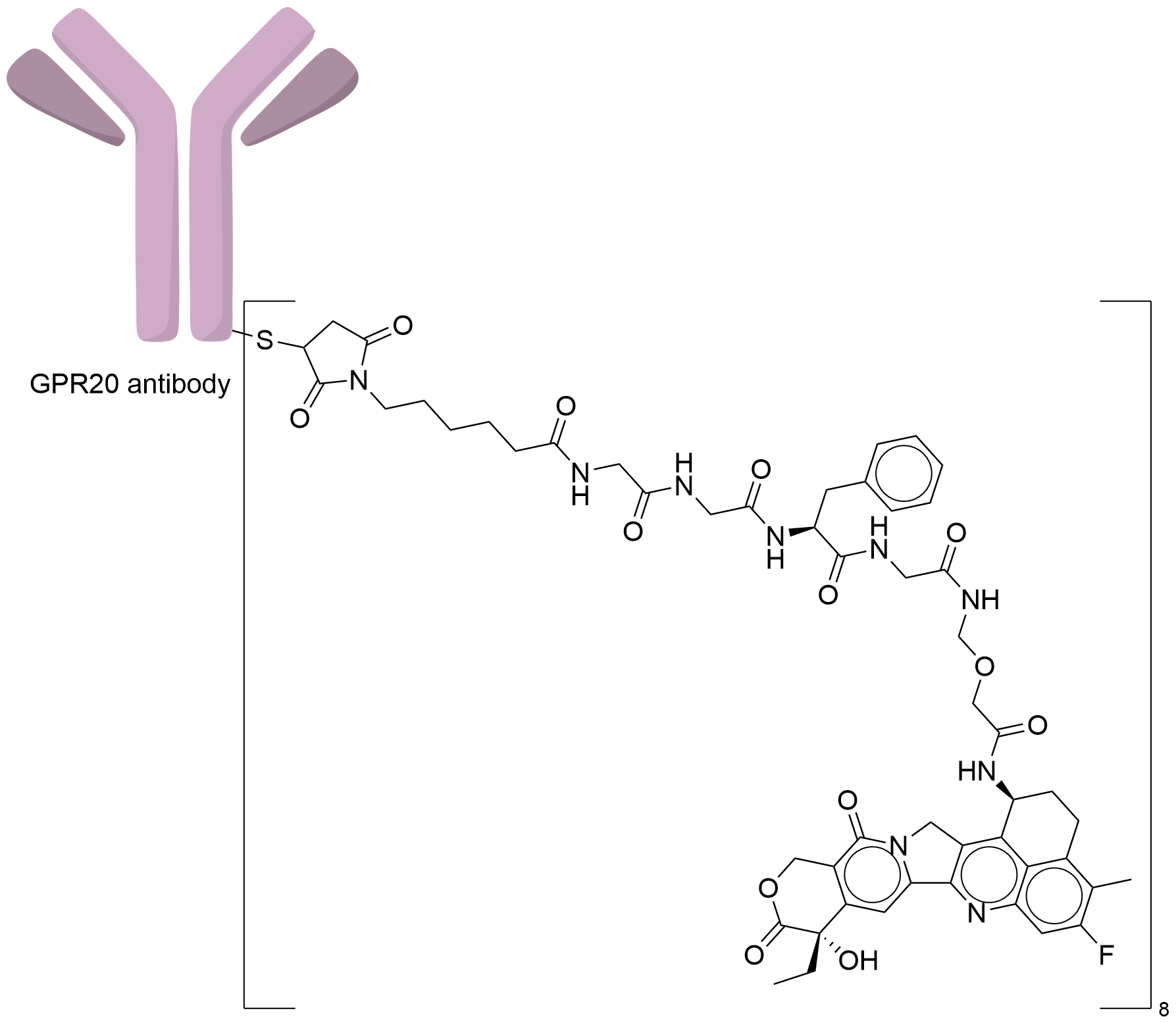
|
|||||
| Antibody Name |
Anti-GPR20 antibody
|
Antibody Info | ||||
| Antigen Name |
G-protein coupled receptor 20 (GPR20)
|
Antigen Info | ||||
| Payload Name |
DXd
|
Payload Info | ||||
| Payload Target |
DNA topoisomerase 1 (TOP1)
|
Target Info | ||||
| Linker Name |
Mc-Gly-Gly-Phe-Gly
|
Linker Info | ||||
| Conjugate Type |
Random Cysteines
|
|||||
| Combination Type |
deruxtecan
|
|||||
2027 Update
The disease landscape of This ADC
2027 Update
The clinical trial pipelines of This ADC
General Information of The Activity Data Related to This ADC
Identified from the Human Clinical Data
Full List of Activity Data of This Antibody-drug Conjugate
Identified from the Human Clinical Data
| Experiment 1 Reporting the Activity Date of This ADC | [1] | ||||
| Patients Enrolled |
Eligible patients were aged ≥18 (≥20 in Japan) with ECOG 0-1 and advanced/metastatic GIST resistant/intolerant to imatinib ± post-IM therapy (cohort-dependent). Key requirements included measurable disease (RECIST v1.1), adequate organ function, LVEF ≥50%, and tumor biopsy consent. Exclusions encompassed unresolved toxicities (NCI CTCAE >Gr 1), active CNS metastases, QTcF >470 ms, ILD, uncontrolled infections, and pregnancy/lactation, among others.
Click to Show/Hide
|
||||
| Administration Dosage |
Participants with advanced gastrointestinal stromal tumor (GIST) who will receive an intravenous infusion of DS-6157a (escalating doses starting at 1.6 mg/kg).
|
||||
| Related Clinical Trial | |||||
| NCT Number | NCT04276415 | Clinical Status | PHASE1 | ||
| Clinical Description | Phase 1, Multicenter, Open-Label, First-in-Human Study of DS-6157a in Subjects With Advanced Gastrointestinal Stromal Tumor | ||||
| Primary Endpoint |
The study assessed dose-limiting toxicities (DLTs) during Cycle 1 (21 days), including hematologic (e.g., Gr 4 neutropenia >7 days, Gr ≥3 febrile neutropenia) and non-hematologic (Gr ≥3 TEAEs, excluding certain exceptions). Additionally, TEAEs were evaluated using NCI CTCAE v5.0, and efficacy outcomes (ORR, DCR, DOR, PFS) were monitored for up to 5 years post-treatment per RECIST v1.1.
Click to Show/Hide
|
||||
| Other Endpoint |
Pharmacokinetic analysis evaluated AUClast, AUCtau, Cmax, Tmax, Ctrough, and t1/2 for DS-6157a, total anti-GPR20 antibody, and MAAA-1181a using noncompartmental methods, with blood sampling across multiple 21-day cycles. Immunogenicity (anti-drug antibodies) and efficacy (BOR, PFS) were also assessed, with responses classified based on RECIST v1.1 criteria (CR, PR, SD, PD).
Click to Show/Hide
|
||||
| Experiment 2 Reporting the Activity Date of This ADC | [2] | ||||
| Efficacy Data | Objective Response Rate (ORR) | 2.90% | High GPR20 expression (GPR20+++) | ||
| Patients Enrolled |
Histopathologically documented unresectable and/or metastatic gastrointestinal stromal tumor (GIST) following treatment with standard of care, including imatinib.
|
||||
| Administration Dosage |
1.6 mg/kg, 3.2 mg/kg, 4.8 mg/kg, 6.4 mg/kg, and 9.6 mg/kg intravenously on Day 1 of each 21-day cycle.
|
||||
| Related Clinical Trial | |||||
| NCT Number | NCT04276415 | Clinical Status | Phase 1 | ||
| Clinical Description | Phase 1, multicenter, open-label, first-in-human study of DS-6157a in subjects with advanced gastrointestinal stromal tumor. | ||||
| Primary Endpoint |
MTD=6.40 mg/kg.
|
||||
| Other Endpoint |
Median PFS=4.20 months (95% CI, 1.60-6.90), Objective response rate=2.86%, comprising 0 complete responses and 1 (2.86%) partial responses.
|
||||
References