
Antibody-drug Conjugate Information
General Information of This Antibody-drug Conjugate (ID: DRG0NNKAQ)
| ADC Name |
Ifinatamab deruxtecan
|
|||||
|---|---|---|---|---|---|---|
| Synonyms |
ifinatamab deruxtecan; DS-7300; DS-7300a; I-DXd; MK-2400
Click to Show/Hide
|
|||||
| Organization |
Daiichi Sankyo (Originator);Merck & Co. (Top20 MNC)
|
|||||
| Drug Status |
New Drug Application
|
|||||
| Drug-to-Antibody Ratio |
4
|
|||||
| Structure |
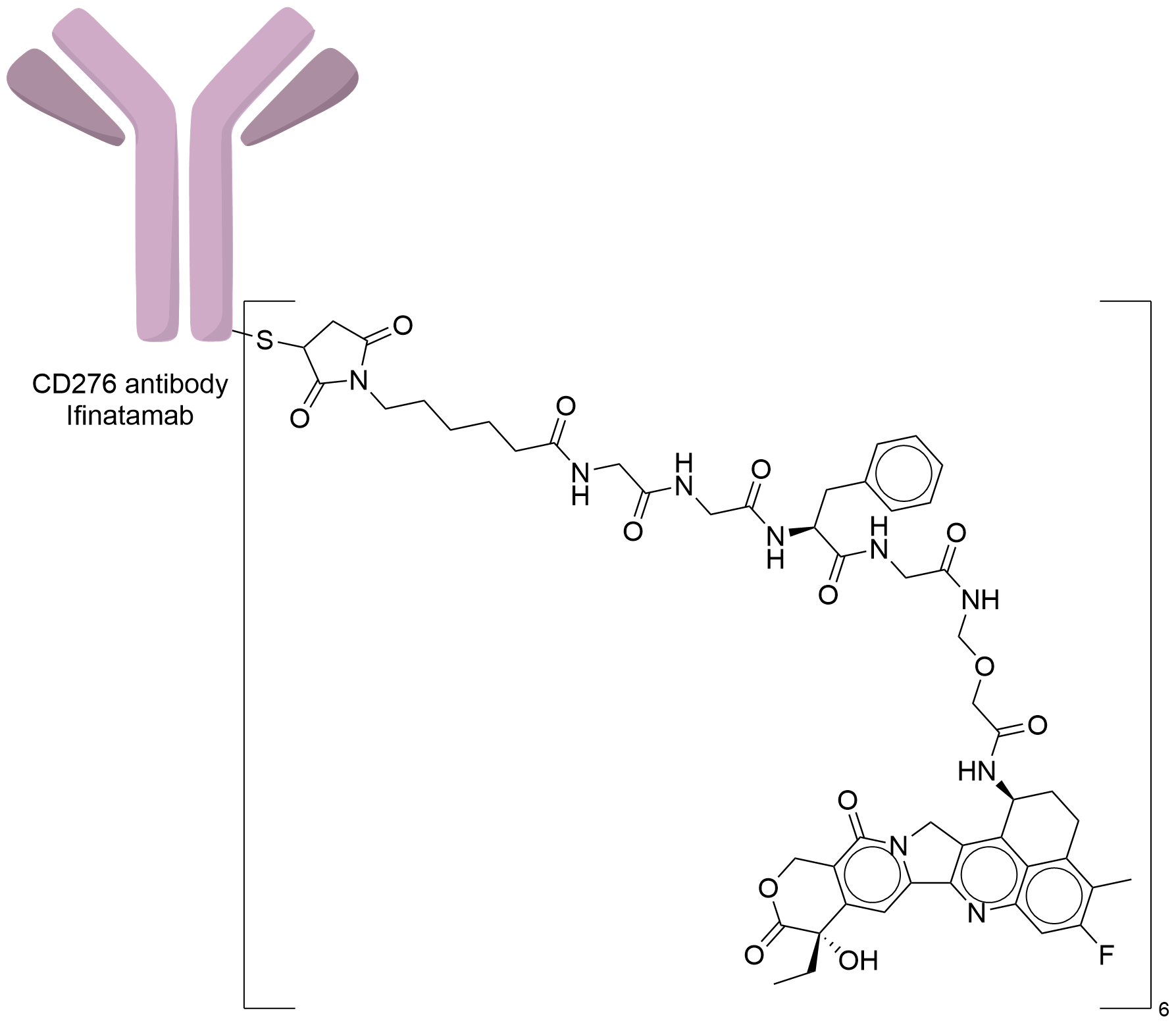
|
|||||
| Antibody Name |
Ifinatamab
|
Antibody Info | ||||
| Antigen Name |
CD276 antigen (CD276)
|
Antigen Info | ||||
| Payload Name |
DXd
|
Payload Info | ||||
| Payload Target |
DNA topoisomerase 1 (TOP1)
|
Target Info | ||||
| Linker Name |
Mc-Gly-Gly-Phe-Gly
|
Linker Info | ||||
| Conjugate Type |
Random Cysteines
|
|||||
| Combination Type |
deruxtecan
|
|||||
2027 Update
The disease landscape of This ADC
2027 Update
The clinical trial pipelines of This ADC
| Disease Name | Phase 1 | Phase 2 | Phase 3 | Approved | ||||||
|---|---|---|---|---|---|---|---|---|---|---|
| Sarcoma | ||||||||||
| Oesophageal cancer | ||||||||||
| Gastroesophageal junction adenocarcinoma | ||||||||||
| Gastric cancer | ||||||||||
| Colorectal cancer | ||||||||||
| Pancreatic cancer | ||||||||||
| Liver cancer | ||||||||||
| Biliary tract cancer | ||||||||||
| Lung cancer |
5 Trials
|
|||||||||
| Melanoma | ||||||||||
| Breast cancer | ||||||||||
| Ovarian cancer | ||||||||||
| Endometrial cancer | ||||||||||
| Cervical cancer | ||||||||||
| Prostate cancer | ||||||||||
| Urothelial cancer | ||||||||||
| Head and neck cancer | ||||||||||
| Unspecific solid tumor |
2027 Update
ADC-specific functional property
Binding Affinity
| Dissocation Constant (Kd) | Binding Target | Description | Reference |
|---|---|---|---|
| 117.6 ng/mL |
Human 4lg B7-H3
|
Binding affinities of DS-7300a to B7-H3 orthologs
|
[1]
|
| 301.6 ng/mL |
Human 2lg B7-H3
|
Binding affinities of DS-7300a to B7-H3 orthologs
|
[1]
|
| 127.6 ng/mL |
Monkey 4lg B7-H3
|
Binding affinities of DS-7300a to B7-H3 orthologs
|
[1]
|
| 396.7 ng/mL |
Monkey 2lg B7-H3
|
Binding affinities of DS-7300a to B7-H3 orthologs
|
[1]
|
Circulating Stability
| Incubation Time | 21days | Release | 5.3% | Reference |
[1]
|
|---|---|---|---|---|---|
| Incubation Medium | human plasma | ||||
| Description |
The release rates of DXd from 100 ug/mL DS-7300a after a 21-day incubation
|
||||
| Incubation Time | 21days | Release | <5% | Reference |
[1]
|
| Incubation Medium | monkey plasma | ||||
| Description |
The release rates of DXd from 100 ug/mL DS-7300a after a 21-day incubation
|
||||
| Incubation Time | 21days | Release | <4% | Reference |
[1]
|
| Incubation Medium | Rat plasma | ||||
| Description |
The release rates of DXd from 100 ug/mL DS-7300a after a 21-day incubation
|
||||
| Incubation Time | 21days | Release | 1.5% | Reference |
[1]
|
| Incubation Medium | mouse plasma | ||||
| Description |
The release rates of DXd from 100 ug/mL DS-7300a after a 21-day incubation
|
||||
| Incubation Time | 21days | Release | <5% | Reference |
[1]
|
| Incubation Medium | human serum | ||||
| Description |
We confirmed the in vitro stability of DS-7300a in human, cynomolgus monkey, rat, and mouse plasma. The release rates of DXd from 100 ug/mL DS-7300a after a 21-day incubation ranged from 1.5% to 5.3% (Fig. 2E), indicating that DS-7300a is stable in plasma in vitro.
Click to Show/Hide
|
||||
| Incubation Time | 21days | Release | <5% | Reference |
[1]
|
| Incubation Medium | cynomolgus monkey serum | ||||
| Description |
We confirmed the in vitro stability of DS-7300a in human, cynomolgus monkey, rat, and mouse plasma. The release rates of DXd from 100 ug/mL DS-7300a after a 21-day incubation ranged from 1.5% to 5.3% (Fig. 2E), indicating that DS-7300a is stable in plasma in vitro.
Click to Show/Hide
|
||||
| Incubation Time | 21days | Release | <5% | Reference |
[1]
|
| Incubation Medium | rat monkey serum | ||||
| Description |
We confirmed the in vitro stability of DS-7300a in human, cynomolgus monkey, rat, and mouse plasma. The release rates of DXd from 100 ug/mL DS-7300a after a 21-day incubation ranged from 1.5% to 5.3% (Fig. 2E), indicating that DS-7300a is stable in plasma in vitro.
Click to Show/Hide
|
||||
| Incubation Time | 21days | Release | <5% | Reference |
[1]
|
| Incubation Medium | mouse serum | ||||
| Description |
We confirmed the in vitro stability of DS-7300a in human, cynomolgus monkey, rat, and mouse plasma. The release rates of DXd from 100 ug/mL DS-7300a after a 21-day incubation ranged from 1.5% to 5.3% (Fig. 2E), indicating that DS-7300a is stable in plasma in vitro.
Click to Show/Hide
|
||||
2027 Update
General Information of The ADMET Data Related to This ADC
Absorption
| Standard Type | Value | Units | Description | Reference |
|---|---|---|---|---|
| Area Under the Concentration-Time Curve (AUC) | 7.64 | day·ug/mL |
PK parameters of 0.3 mg/kg DS-7300a in plasma after single intravenousadministration to monkeys
|
[1] |
| Area Under the Concentration-Time Curve (AUC) | 7.64±0.46 | day·ug/mL |
PK parameters of DS-7300a in plasma after single intravenous administration to monkeys, 0.3 mg/kg, AUCinf.
|
[1] |
| Area Under the Concentration-Time Curve (AUC) | 7.39±0.4 | day·ug/mL |
PK parameters of DS-7300a in plasma after single intravenous administration to monkeys, 0.3 mg/kg, AUC28d.
|
[1] |
| Area Under the Concentration-Time Curve (AUC) | 42±1.6 | day·ug/mL |
PK parameters of DS-7300a in plasma after single intravenous administration to monkeys, 1 mg/kg, AUCinf.
|
[1] |
| Area Under the Concentration-Time Curve (AUC) | 41.1±1.5 | day·ug/mL |
PK parameters of DS-7300a in plasma after single intravenous administration to monkeys, 1 mg/kg, AUC28d.
|
[1] |
| Area Under the Concentration-Time Curve (AUC) | 216±29 | day·ug/mL |
PK parameters of DS-7300a in plasma after single intravenous administration to monkeys, 3 mg/kg, AUCinf.
|
[1] |
| Area Under the Concentration-Time Curve (AUC) | 209±30 | day·ug/mL |
PK parameters of DS-7300a in plasma after single intravenous administration to monkeys, 3 mg/kg, AUC28d.
|
[1] |
| Area Under the Concentration-Time Curve (AUC) | 1140±160 | day·ug/mL |
PK parameters of DS-7300a in plasma after single intravenous administration to monkeys, 10 mg/kg, AUCinf.
|
[1] |
| Area Under the Concentration-Time Curve (AUC) | 1120±140 | day·ug/mL |
PK parameters of DS-7300a in plasma after single intravenous administration to monkeys, 10 mg/kg, AUC28d.
|
[1] |
Distribution
| Standard Type | Value | Units | Description | Reference |
|---|---|---|---|---|
| Volume of Distribution (Vd) | 113 | mL/kg |
PK parameters of 0.3 mg/kg DS-7300a in plasma after single intravenousadministration to monkeys
|
[1] |
| Volume of Distribution (Vd) | 113±2 | mL/kg |
PK parameters of DS-7300a in plasma after single intravenous administration to monkeys, 0.3 mg/kg.
|
[1] |
| Volume of Distribution (Vd) | 94.1±8.9 | mL/kg |
PK parameters of DS-7300a in plasma after single intravenous administration to monkeys, 1 mg/kg.
|
[1] |
| Volume of Distribution (Vd) | 73.1±11.1 | mL/kg |
PK parameters of DS-7300a in plasma after single intravenous administration to monkeys, 3 mg/kg.
|
[1] |
| Volume of Distribution (Vd) | 51.1±6.9 | mL/kg |
PK parameters of DS-7300a in plasma after single intravenous administration to monkeys, 10 mg/kg.
|
[1] |
Excretion
| Standard Type | Value | Units | Description | Reference |
|---|---|---|---|---|
| Elimination Half-Life (t1/2) | 3.24 | days |
PK parameters of 0.3 mg/kg DS-7300a in plasma after single intravenousadministration to monkeys
|
[1] |
| Clearance (CL) | 39.3 | mL/day/kg |
PK parameters of 0.3 mg/kg DS-7300a in plasma after single intravenousadministration to monkeys
|
[1] |
| Clearance (CL) | 39.3±2.4 | mL/day/kg |
PK parameters of DS-7300a in plasma after single intravenous administration to monkeys, 0.3 mg/kg.
|
[1] |
| Elimination Half-Life (t1/2) | 3.24±0.16 | day |
PK parameters of DS-7300a in plasma after single intravenous administration to monkeys, 0.3 mg/kg.
|
[1] |
| Clearance (CL) | 23.8±0.9 | mL/day/kg |
PK parameters of DS-7300a in plasma after single intravenous administration to monkeys, 1 mg/kg.
|
[1] |
| Elimination Half-Life (t1/2) | 5.22±1.11 | day |
PK parameters of DS-7300a in plasma after single intravenous administration to monkeys, 1 mg/kg.
|
[1] |
| Clearance (CL) | 14.1±2 | mL/day/kg |
PK parameters of DS-7300a in plasma after single intravenous administration to monkeys, 3 mg/kg.
|
[1] |
| Elimination Half-Life (t1/2) | 7.89±2.21 | day |
PK parameters of DS-7300a in plasma after single intravenous administration to monkeys, 3 mg/kg.
|
[1] |
| Clearance (CL) | 8.89±1.19 | mL/day/kg |
PK parameters of DS-7300a in plasma after single intravenous administration to monkeys, 10 mg/kg.
|
[1] |
| Elimination Half-Life (t1/2) | 4.81±1.53 | day |
PK parameters of DS-7300a in plasma after single intravenous administration to monkeys, 10 mg/kg.
|
[1] |
General Information of The Activity Data Related to This ADC
Identified from the Human Clinical Data
Discovered Using Patient-derived Xenograft Model
| Standard Type | Value | Units | Animal Model (No. of PDX) |
|---|---|---|---|
| Tumor Growth Inhibition value (TGI) |
≈ 100
|
%
|
Small cell lung cancer PDX model (PDX: CTG-2093)
|
Revealed Based on the Cell Line Data
Full List of Activity Data of This Antibody-drug Conjugate
Identified from the Human Clinical Data
| Experiment 1 Reporting the Activity Date of This ADC | [2] | ||||
| Efficacy Data | stable disease (SD) |
49%
|
|||
| Patients Enrolled |
Eligible participants are adults (≥18) with histologically confirmed ES-SCLC, measurable per RECIST 1.1, progressing after ≥1 platinum-based systemic therapy (≥2 cycles). Key exclusions: prior B7-H3/ADC (exatecan-based) therapy, active CNS metastases, uncontrolled cardiovascular/respiratory disease, ILD, unresolved toxicities (>Grade 1), active infections (HBV/HCV/HIV), or immunosuppressive steroid use (>10 mg/day prednisone equivalent). Live vaccines within 30 days or pregnancy also preclude enrollment.
Click to Show/Hide
|
||||
| Administration Dosage |
I-DXd will be administered as an intravenous (IV) infusion on Day 1 of each 21-day cycle (every Q3W), 8/12 mg/kg.
|
||||
| Related Clinical Trial | |||||
| NCT Number | NCT05280470 | Clinical Status | PHASE2 | ||
| Clinical Description | A Phase 2, Multicenter, Randomized, Open-label Study of Ifinatamab Deruxtecan (I-DXd), a B7-H3 Antibody Drug Conjugate (ADC), in Subjects With Pretreated Extensive-stage Small Cell Lung Cancer (ES-SCLC) (IDeate-Lung01) | ||||
| Primary Endpoint |
The primary endpoint is Objective Response Rate (ORR) assessed by BICR (36 months), defined as confirmed CR (complete disappearance of lesions) or PR (≥30% reduction in lesion diameters) per RECIST 1.1. Safety is measured via treatment-emergent adverse events (TEAEs) occurring after treatment initiation.
|
||||
| Other Endpoint |
Secondary endpoints include progression-free survival (PFS), duration of response (DoR), overall survival (OS), time to response (TTR), and disease control rate (DCR) assessed up to 36 months by BICR/investigator. Pharmacokinetic evaluations (Cmax, Tmax, Ctrough, AUC, T1/2) track I-DXd, anti-B7-H3 antibody, and MAAA-1181a levels; immunogenicity assesses treatment-emergent antidrug antibodies (ADAs).
Click to Show/Hide
|
||||
| Experiment 2 Reporting the Activity Date of This ADC | [2] | ||||
| Efficacy Data | progressive disease (PD) |
3%
|
|||
| Patients Enrolled |
Eligible participants are adults (≥18) with histologically confirmed ES-SCLC, measurable per RECIST 1.1, progressing after ≥1 platinum-based systemic therapy (≥2 cycles). Key exclusions: prior B7-H3/ADC (exatecan-based) therapy, active CNS metastases, uncontrolled cardiovascular/respiratory disease, ILD, unresolved toxicities (>Grade 1), active infections (HBV/HCV/HIV), or immunosuppressive steroid use (>10 mg/day prednisone equivalent). Live vaccines within 30 days or pregnancy also preclude enrollment.
Click to Show/Hide
|
||||
| Administration Dosage |
I-DXd will be administered as an intravenous (IV) infusion on Day 1 of each 21-day cycle (every Q3W), 8/12 mg/kg.
|
||||
| Related Clinical Trial | |||||
| NCT Number | NCT05280470 | Clinical Status | PHASE2 | ||
| Clinical Description | A Phase 2, Multicenter, Randomized, Open-label Study of Ifinatamab Deruxtecan (I-DXd), a B7-H3 Antibody Drug Conjugate (ADC), in Subjects With Pretreated Extensive-stage Small Cell Lung Cancer (ES-SCLC) (IDeate-Lung01) | ||||
| Primary Endpoint |
The primary endpoint is Objective Response Rate (ORR) assessed by BICR (36 months), defined as confirmed CR (complete disappearance of lesions) or PR (≥30% reduction in lesion diameters) per RECIST 1.1. Safety is measured via treatment-emergent adverse events (TEAEs) occurring after treatment initiation.
|
||||
| Other Endpoint |
Secondary endpoints include progression-free survival (PFS), duration of response (DoR), overall survival (OS), time to response (TTR), and disease control rate (DCR) assessed up to 36 months by BICR/investigator. Pharmacokinetic evaluations (Cmax, Tmax, Ctrough, AUC, T1/2) track I-DXd, anti-B7-H3 antibody, and MAAA-1181a levels; immunogenicity assesses treatment-emergent antidrug antibodies (ADAs).
Click to Show/Hide
|
||||
| Experiment 3 Reporting the Activity Date of This ADC | [2] | ||||
| Efficacy Data | Partial Response (PR) |
16%
|
|||
| Patients Enrolled |
Eligible participants are adults (≥18) with histologically confirmed ES-SCLC, measurable per RECIST 1.1, progressing after ≥1 platinum-based systemic therapy (≥2 cycles). Key exclusions: prior B7-H3/ADC (exatecan-based) therapy, active CNS metastases, uncontrolled cardiovascular/respiratory disease, ILD, unresolved toxicities (>Grade 1), active infections (HBV/HCV/HIV), or immunosuppressive steroid use (>10 mg/day prednisone equivalent). Live vaccines within 30 days or pregnancy also preclude enrollment.
Click to Show/Hide
|
||||
| Administration Dosage |
I-DXd will be administered as an intravenous (IV) infusion on Day 1 of each 21-day cycle (every Q3W), 8/12 mg/kg.
|
||||
| Related Clinical Trial | |||||
| NCT Number | NCT05280470 | Clinical Status | PHASE2 | ||
| Clinical Description | A Phase 2, Multicenter, Randomized, Open-label Study of Ifinatamab Deruxtecan (I-DXd), a B7-H3 Antibody Drug Conjugate (ADC), in Subjects With Pretreated Extensive-stage Small Cell Lung Cancer (ES-SCLC) (IDeate-Lung01) | ||||
| Primary Endpoint |
The primary endpoint is Objective Response Rate (ORR) assessed by BICR (36 months), defined as confirmed CR (complete disappearance of lesions) or PR (≥30% reduction in lesion diameters) per RECIST 1.1. Safety is measured via treatment-emergent adverse events (TEAEs) occurring after treatment initiation.
|
||||
| Other Endpoint |
Secondary endpoints include progression-free survival (PFS), duration of response (DoR), overall survival (OS), time to response (TTR), and disease control rate (DCR) assessed up to 36 months by BICR/investigator. Pharmacokinetic evaluations (Cmax, Tmax, Ctrough, AUC, T1/2) track I-DXd, anti-B7-H3 antibody, and MAAA-1181a levels; immunogenicity assesses treatment-emergent antidrug antibodies (ADAs).
Click to Show/Hide
|
||||
| Experiment 4 Reporting the Activity Date of This ADC | [2] | ||||
| Efficacy Data | Complete response (CR) |
22%
|
|||
| Patients Enrolled |
Eligible participants are adults (≥18) with histologically confirmed ES-SCLC, measurable per RECIST 1.1, progressing after ≥1 platinum-based systemic therapy (≥2 cycles). Key exclusions: prior B7-H3/ADC (exatecan-based) therapy, active CNS metastases, uncontrolled cardiovascular/respiratory disease, ILD, unresolved toxicities (>Grade 1), active infections (HBV/HCV/HIV), or immunosuppressive steroid use (>10 mg/day prednisone equivalent). Live vaccines within 30 days or pregnancy also preclude enrollment.
Click to Show/Hide
|
||||
| Administration Dosage |
I-DXd will be administered as an intravenous (IV) infusion on Day 1 of each 21-day cycle (every Q3W), 8/12 mg/kg.
|
||||
| Related Clinical Trial | |||||
| NCT Number | NCT05280470 | Clinical Status | PHASE2 | ||
| Clinical Description | A Phase 2, Multicenter, Randomized, Open-label Study of Ifinatamab Deruxtecan (I-DXd), a B7-H3 Antibody Drug Conjugate (ADC), in Subjects With Pretreated Extensive-stage Small Cell Lung Cancer (ES-SCLC) (IDeate-Lung01) | ||||
| Primary Endpoint |
The primary endpoint is Objective Response Rate (ORR) assessed by BICR (36 months), defined as confirmed CR (complete disappearance of lesions) or PR (≥30% reduction in lesion diameters) per RECIST 1.1. Safety is measured via treatment-emergent adverse events (TEAEs) occurring after treatment initiation.
|
||||
| Other Endpoint |
Secondary endpoints include progression-free survival (PFS), duration of response (DoR), overall survival (OS), time to response (TTR), and disease control rate (DCR) assessed up to 36 months by BICR/investigator. Pharmacokinetic evaluations (Cmax, Tmax, Ctrough, AUC, T1/2) track I-DXd, anti-B7-H3 antibody, and MAAA-1181a levels; immunogenicity assesses treatment-emergent antidrug antibodies (ADAs).
Click to Show/Hide
|
||||
| Experiment 5 Reporting the Activity Date of This ADC | [3] | ||||
| Patients Enrolled |
Eligibility requires locally advanced/metastatic esophageal SCC (1L setting), controlled HIV/HBV/HCV if applicable. Exclusions: prior systemic therapy for metastatic disease, high-risk tumor invasion (aorta/respiratory tract), uncontrolled effusions, corneal disease, or prior PD- (L)1/CTLA-4 treatment. HIV+ candidates with Kaposi's sarcoma are excluded.
Click to Show/Hide
|
||||
| Administration Dosage |
.
|
||||
| Related Clinical Trial | |||||
| NCT Number | NCT06780111 | Clinical Status | PHASE1|||PHASE2 | ||
| Clinical Description | A Phase 1/2 Open-Label, Umbrella Platform Design Study of Investigational Agents in Combination With Pembrolizumab (MK-3475) With or Without Chemotherapy in Participants With 1L Locally Advanced Unresectable/Metastatic Esophageal Cancer: KEYMAKER-U06 Substudy 06E | ||||
| Primary Endpoint |
Phase IB tracks Dose-Limiting Toxicities (DLTs) including Grade 3/4 hematologic/nonhematologic AEs (e.g., thrombocytopenia, febrile neutropenia) or treatment-related discontinuations (21-day window). Safety endpoints also cover AE incidence (28 months) and intervention discontinuation rates (25 months). Phase II measures ORR (73 months) per RECIST 1.1 via blinded central review.
Click to Show/Hide
|
||||
| Other Endpoint |
Key efficacy outcomes include Duration of Response (DOR), Progression-Free Survival (PFS), Overall Survival (OS) (all up to 73 months), and Disease Control Rate (DCR) with ≥6-month stability. Pharmacokinetics assess I-DXd parameters (Cmax/Tmax, AUC0-last/AUC-tau over 25 months), alongside antidrug antibody (ADA) development rates (73 months).
|
||||
| Experiment 6 Reporting the Activity Date of This ADC | [4] | ||||
| Patients Enrolled |
Eligible participants (≥18 years) require histologically confirmed unresectable/metastatic ESCC, progression post-platinum+ICI therapy (≤1 prior line), ≥1 measurable lesion (RECIST v1.1), and ECOG 0-1. Exclusions: prior B7-H3/topoisomerase inhibitors, adenosquamous subtype, high-risk tumor invasion (aorta/respiratory tract), active brain metastases, recent thromboembolic events (6 months), or clinically significant ILD/pulmonary disease. Chronic steroids (>10 mg/day prednisone-equivalent) are excluded except for inhalers/topicals.
Click to Show/Hide
|
||||
| Administration Dosage |
Participants who are randomized to receive an intravenous infusion of I-DXd 12 mg/kg on Day 1 of every 21-day cycle (Q3W).
|
||||
| Related Clinical Trial | |||||
| NCT Number | NCT06644781 | Clinical Status | PHASE3 | ||
| Clinical Description | A Phase 3, Multicenter, Randomized, Open-label Study of Ifinatamab Deruxtecan (I-DXd) in Subjects With Pretreated Advanced or Metastatic Esophageal Squamous Cell Carcinoma (ESCC) (IDeate-Esophageal01) | ||||
| Primary Endpoint |
Primary efficacy endpoints include Overall Survival (OS) and Progression-Free Survival (PFS), both measured from randomization to death or disease progression (up to 54 months) by BICR per RECIST v1.1. Secondary outcomes are Objective Response Rate (ORR), Duration of Response (DoR), and Disease Control Rate (DCR). Patient-reported outcomes assess EORTC QLQ-C30/OES18 changes, while safety tracks TEAEs, AESIs, and ADA incidence over 54 months.
Click to Show/Hide
|
||||
| Other Endpoint |
Pharmacokinetic analysis evaluates Tmax for I-DXd, anti-B7-H3 antibody, and MAAA-1181a through plasma sampling at specific timepoints (Cycle 1-4+ every 2 cycles, 21-day cycles). ADA development and treatment-emergent immunogenicity are monitored longitudinally (up to 54 months).
|
||||
| Experiment 7 Reporting the Activity Date of This ADC | [5] | ||||
| Patients Enrolled |
Eligible participants require histologically confirmed Stage IV squamous NSCLC with progression post anti-PD- (L)1 + platinum therapy. HIV/HBV/HCV-infected patients may enroll with controlled viral loads. Exclusions include small cell histology, uncontrolled cardiovascular/pulmonary disease, active CNS metastases, autoimmune/ILD conditions, dual HBV/HCV infection, transplant history, or recent major surgery complications.
Click to Show/Hide
|
||||
| Administration Dosage |
.
|
||||
| Related Clinical Trial | |||||
| NCT Number | NCT06780098 | Clinical Status | PHASE2 | ||
| Clinical Description | KEYMAKER-U01 Substudy 01I: A Phase 2, Randomized, Umbrella Study With Rolling Arms of Investigational Agents in Participants With Previously Treated Stage IV Squamous Non-small Cell Lung Cancer (NSCLC) | ||||
| Primary Endpoint |
The primary efficacy measure is Objective Response Rate (ORR) evaluated per RECIST 1.1, with CR/PR assessments by both BICR and investigators over 84 months. Safety outcomes track AE incidence (84 months) and treatment discontinuations due to AEs (60 months).
|
||||
| Other Endpoint |
Secondary endpoints include Duration of Response (DOR), Progression-Free Survival (PFS), and Overall Survival (OS) - all assessed up to 84 months. Disease progression criteria follow RECIST 1.1, requiring ≥20% increase (+5mm absolute) in target lesions or new lesions, with BICR evaluation for DOR and PFS.
|
||||
| Experiment 8 Reporting the Activity Date of This ADC | [6] | ||||
| Patients Enrolled |
Eligible participants require histologically confirmed Stage IV NSCLC (non-small cell) with no prior systemic treatment for metastatic disease. Key exclusions: small cell histology, active CNS metastases, uncontrolled autoimmune/infectious conditions, recent major surgery (<3 weeks), prior immunotherapy discontinuation due to severe irAEs, and active HBV/HCV infections unless properly controlled. Screening requirements include tumor tissue submission and completion within specified windows (35 days for Part A, 28 days for Part B).
Click to Show/Hide
|
||||
| Administration Dosage |
.
|
||||
| Related Clinical Trial | |||||
| NCT Number | NCT04165070 | Clinical Status | PHASE1|||PHASE2 | ||
| Clinical Description | KEYMAKER-U01 Substudy 01A: A Phase 1/2, Umbrella Study With Rolling Arms of Investigational Agents With Pembrolizumab With or Without Chemotherapy in Treatment-Naive Participants With Stage IV Non-small Cell Lung Cancer (NSCLC) | ||||
| Primary Endpoint |
The primary efficacy endpoint is Objective Response Rate (ORR) in Part A (24 months) per RECIST 1.1, with CR/PR assessments. Part B safety evaluates AE incidence (27 months), treatment discontinuations due to AEs, and dose-limiting toxicities (DLTs) by CTCAE 5.0 during the first 3 weeks.
|
||||
| Other Endpoint |
Part A assesses Progression-Free Survival (PFS) using RECIST 1.1 (24 months) and AE-related outcomes. Part B includes ORR/DOR per BICR (24 months) along with pharmacokinetic parameters (Cmax/Ctrough) for investigational drugs (I-DXd, HER3-DXd, pembrolizumab) over 2 years.
|
||||
| Experiment 9 Reporting the Activity Date of This ADC | [7] | ||||
| Patients Enrolled |
Eligible participants include Stage IV nonsquamous NSCLC patients (EGFR/ALK/ROS1-negative) with RECIST 1.1-measurable disease, ECOG 0-1, and adequate organ function. Exclusions cover comorbidities like uncontrolled infections, recent radiotherapy, active malignancies, CNS metastases, autoimmune/ILDs, and prior transplant/HIV/Kaposi's sarcoma, ensuring protocol safety alignment.
Click to Show/Hide
|
||||
| Administration Dosage |
.
|
||||
| Related Clinical Trial | |||||
| NCT Number | NCT06780085 | Clinical Status | PHASE2 | ||
| Clinical Description | KEYMAKER-U01 Substudy 01H: A Phase 2, Randomized, Umbrella Study With Rolling Arms of Investigational Agents in Participants With Previously Treated Stage IV Nonsquamous Non-small Cell Lung Cancer (NSCLC) | ||||
| Primary Endpoint |
The study evaluates Objective Response Rate (ORR) per RECIST 1.1 as the primary endpoint, defined by CR or PR. Adverse events (AEs), including discontinuation rates due to AEs, are monitored as secondary safety outcomes over specified timeframes.
|
||||
| Other Endpoint |
Key efficacy measures include Duration of Response (DOR) and Progression-Free Survival (PFS) assessed per RECIST 1.1 via BICR, alongside Overall Survival (OS). DOR spans from initial response to PD or death, while PFS tracks time to PD/death post-randomization, and OS measures survival duration.
|
||||
| Experiment 10 Reporting the Activity Date of This ADC | [8] | ||||
| Patients Enrolled |
Eligible participants must have extensive-stage SCLC post-platinum therapy, archival/fresh tissue availability, and controlled HIV if applicable. Key exclusions cover active infections, uncontrolled cardiovascular/neurologic conditions, prior transplants, untreated brain metastases, recent radiotherapy, immunosuppressive therapy, and malignancies requiring active treatment within 3 years. Specific restrictions apply to Part 1, including recent anticancer therapies and corneal disease.
Click to Show/Hide
|
||||
| Administration Dosage |
.
|
||||
| Related Clinical Trial | |||||
| NCT Number | NCT06780137 | Clinical Status | PHASE1|||PHASE2 | ||
| Clinical Description | A Phase 1b/2 Open-Label Clinical Study to Evaluate the Safety and Efficacy of MK-6070 and Ifinatamab Deruxtecan (I-DXd) in Participants With Relapsed/Refractory Extensive-Stage Small Cell Lung Cancer | ||||
| Primary Endpoint |
The primary safety outcomes include the number of participants experiencing adverse events (AEs), dose-limiting toxicities (DLTs), and discontinuations due to AEs, assessed over 44 months. Efficacy measures include Objective Response Rate (ORR) per RECIST 1.1, evaluating CR or PR rates as determined by investigator assessments.
|
||||
| Other Endpoint |
Secondary endpoints focus on Duration of Response (DOR) and Progression-Free Survival (PFS), defined per RECIST 1.1, alongside pharmacokinetic metrics (Cmax, Tmax, AUCt, t½, steady-state parameters) for gocatamig, I-DXd, anti-B7-H3 antibody, and DXd. Anti-drug antibody (ADA) incidence is also monitored for immunogenicity assessment.
|
||||
| Experiment 11 Reporting the Activity Date of This ADC | [9] | ||||
| Patients Enrolled |
Eligible participants must have DLL3-expressing malignancies: SCLC post-platinum therapy, relapsed/refractory NEPC, or other neuroendocrine tumors failing standard therapy. Key exclusions cover active CNS metastases, uncontrolled effusions, recent cardiovascular events (6 months), active hepatitis/HIV, transplants, immunosuppressive therapy (prednisone >10mg/day), interstitial lung disease, and investigational drug use within 3 weeks/5 half-lives. Autoimmune conditions and unresolved toxicities from prior treatments are prohibited.
Click to Show/Hide
|
||||
| Administration Dosage |
.
|
||||
| Related Clinical Trial | |||||
| NCT Number | NCT04471727 | Clinical Status | PHASE1|||PHASE2 | ||
| Clinical Description | A Phase 1/2 Open-label, Multicenter, Dose Escalation and Dose Expansion Study of the Safety, Tolerability, and Pharmacokinetics of HPN328 Monotherapy and HPN328 With Atezolizumab or Ifinatamab Deruxtecan (I-DXd) in Patients With Advanced Cancers Associated With Expression of Delta-like Canonical Notch Ligand 3 (DLL3). | ||||
| Primary Endpoint |
Safety endpoints include the percentage of participants experiencing adverse events (AEs) and discontinuing due to AEs, graded per NCI CTCAE v5.0 and ASTCT criteria, monitored for up to 4 years. Dose-limiting toxicities (DLTs) following HPN328 treatment (mono/combination) are tracked alongside comprehensive pharmacokinetic parameters (Cmax, Tmax, AUCt/inf, t½, CL, Vss, AC) for gocatamig, atezolizumab, and I-DXd in serum/plasma under single dose and steady state conditions.
Click to Show/Hide
|
||||
| Other Endpoint |
Efficacy outcomes focus on tumor response using RECIST v1.1 (PCWG3-modified for NEPC), including ORR, EC-ORR (extra-cranial), BOR, PFS, EC-PFS, OS, DOR, and EC-DOR - all evaluated over 4 years. Immunogenicity is assessed via anti-drug antibody (ADA) incidence against gocatamig, atezolizumab, and I-DXd at designated timepoints. Response criteria incorporate target lesion measurements (≥30% decrease for PR, ≥20% increase for PD with 5mm threshold) and new lesion appearance.
Click to Show/Hide
|
||||
| Experiment 12 Reporting the Activity Date of This ADC | [10] | ||||
| Patients Enrolled |
Eligible participants must have metastatic prostate adenocarcinoma progressing on ADT with 1-2 prior ARPI therapies (PARPi allowed if indicated), stable ECOG 0-1, and bone therapy stability. Exclusions cover ILD, uncontrolled cardiovascular/metabolic conditions, prior mCRPC taxanes, active CNS metastases, steroids >10mg/day, recent radiotherapy, autoimmune/transplant history, and other malignancies requiring treatment within 3 years.
Click to Show/Hide
|
||||
| Administration Dosage |
.
|
||||
| Related Clinical Trial | |||||
| NCT Number | NCT06863272 | Clinical Status | PHASE1|||PHASE2 | ||
| Clinical Description | MK-2400-01A Substudy: A Phase 1/2, Open-label Umbrella Substudy of MK-2400-U01 Master Protocol to Evaluate the Safety and Efficacy of Ifinatamab Deruxtecan-based Treatment Combinations or Ifinatamab Deruxtecan Alone in Participants With Metastatic Castration-resistant Prostate Cancer (mCRPC) (IDeate-Prostate02) | ||||
| Primary Endpoint |
Primary safety outcomes include DLTs (Grade 4 toxicities, significant Grade 3 events, treatment delays/discontinuations), AEs, and treatment discontinuations due to AEs in both efficacy (54 months) and safety lead-in phases (21 days), with PSA response rate additionally tracked in the efficacy phase. DLT criteria cover hematologic/nonhematologic toxicities, liver injuries, febrile neutropenia, and dose interruptions.
Click to Show/Hide
|
||||
| Other Endpoint |
Key efficacy measures per PCWG-modified RECIST 1.1 include ORR (CR/PR), rPFS (radiological progression/death), OS, DOR (response maintenance), TFST (subsequent therapy initiation), time to PSA progression (≥25% increase + ≥2ng/mL threshold), and TTPP (pain progression per BPI-SF/AQA), all monitored for up to 54 months with Kaplan-Meier analyses.
Click to Show/Hide
|
||||
| Experiment 13 Reporting the Activity Date of This ADC | [11] | ||||
| Patients Enrolled |
Eligible participants must have ECOG 0-1, measurable lesions per RECIST 1.1 (excluding irradiated sites without progression), adequate organ function, and specified advanced/metastatic cancers (e.g., HNSCC, ESCC, NSCLC, SCLC, CRPC). Key exclusions include prior B7-H3/I-DXd treatment, ADC-related toxicities, multiple malignancies (exceptions apply), uncontrolled cardiovascular/pulmonary disease, active infections, and conditions compromising safety or study integrity per investigator assessment. ESCC Cohort 4 requires progression post-platinum/ICI with ≤1 prior line of systemic therapy.
Click to Show/Hide
|
||||
| Administration Dosage |
Participants with advanced solid tumors who received I-DXd IV Q3W monotherapy during dose escalation phase. Enrollment to this phase is currently closed.
|
||||
| Related Clinical Trial | |||||
| NCT Number | NCT04145622 | Clinical Status | PHASE1|||PHASE2 | ||
| Clinical Description | Phase I/II, Two-Part, Multicenter First-in-Human Study of Ifinatamab Deruxtecan (DS-7300a, I-DXd) in Subjects With Advanced Solid Malignant Tumors (IDeate-PanTumor01) | ||||
| Primary Endpoint |
The study assesses dose-limiting toxicities (DLTs) during Cycle 1 (Days 1-21) in dose escalation, monitors adverse events (AEs) through 8 treatment cycles (21 days each until progression), and evaluates the antitumor activity of ifinatamab deruxtecan (I-DXd) over the same 8-cycle period.
|
||||
| Other Endpoint |
Pharmacokinetic analyses focus on AUClast, AUCtau, Cmax, Tmax, and Ctrough parameters during 8 treatment cycles (21-day cycles until progression), alongside anti-drug antibody (ADA) incidence tracking over the same timeframe to evaluate immunogenicity and drug exposure dynamics.
|
||||
| Experiment 14 Reporting the Activity Date of This ADC | [12] | ||||
| Patients Enrolled |
Eligibility requires ECOG 0-1, measurable lesions (RECIST v1.1), progression after standard therapy, and tumor-specific criteria (e.g., prior ICI/platinum for HNSCC; ≤3 lines for endometrial cancer; HER2-low status for breast cancer). Key exclusions: prior B7-H3/I-DXd treatment, ADC-related toxicities, untreated brain metastases, inadequate washout periods. Disease-specific mandates include biopsy availability (archival/tfresh), Child-Pugh A for HCC, and targeted therapy for actionable mutations.
Click to Show/Hide
|
||||
| Administration Dosage |
Participants with recurrent or metastatic endometrial cancer who were previously treated with 1 or more systemic therapy who received an intravenous infusion of I-DXd 12 mg/kg.
|
||||
| Related Clinical Trial | |||||
| NCT Number | NCT06330064 | Clinical Status | PHASE2 | ||
| Clinical Description | A Phase 1B/2 Pan-Tumor, Open-Label Study To Evaluate The Efficacy And Safety Of Ifinatamab Deruxtecan (I-DXd) In Subjects With Recurrent Or Metastatic Solid Tumors (IDeate-PanTumor02) | ||||
| Primary Endpoint |
The primary efficacy endpoint is Objective Response Rate (ORR) assessed by investigator per RECIST v1.1 (complete/partial response confirmed) until progression/death (up to 57 months). Safety outcomes include dose-limiting toxicities (Grade ≥3 non-disease-related events in Cycle 1) and treatment-emergent adverse events (TEAEs) monitored from consent until 47 days post-treatment, graded via NCI-CTCAE v5.0 in the HCC cohort.
Click to Show/Hide
|
||||
| Other Endpoint |
Secondary endpoints encompass incidence of TEAEs, serious AEs (SAEs), and adverse events of special interest (AESIs) through follow-up, alongside efficacy measures: Duration of Response (DoR), Progression-Free Survival (PFS), Disease Control Rate (DCR), and Overall Survival (OS). Pharmacokinetics (Cmax, Tmax, t1/2, Ctrough, AUC) and immunogenicity (ADA incidence) are evaluated via noncompartmental analysis during 21-day cycles up to 57 months.
Click to Show/Hide
|
||||
| Experiment 15 Reporting the Activity Date of This ADC | [13] | ||||
| Related Clinical Trial | |||||
| NCT Number | NCT05280470 | Clinical Status | Phase 2 | ||
| Clinical Description | A phase 2, multicenter, randomized, open-label study of DS-7300a, a B7-H3 antibody drug conjugate (ADC), in subjects with pretreated extensive-stage small cell lung cancer (ES-SCLC). | ||||
| Experiment 16 Reporting the Activity Date of This ADC | [14] | ||||
| Related Clinical Trial | |||||
| NCT Number | NCT04145622 | Clinical Status | Phase 1/2 | ||
| Clinical Description | Phase 1/2, two-part, multicenter first-in-human study of DS-7300a in subjects with advanced solid malignant tumors. | ||||
Discovered Using Patient-derived Xenograft Model
| Experiment 1 Reporting the Activity Date of This ADC | [15] | ||||
| Efficacy Data | Tumor Growth Inhibition value (TGI) | ≈ 100% | High CD276 expression (CD276+++) | ||
| Method Description |
PDX studies CTG-2093, CTG-0166, CTG-0820, and CTG-1061 studies were performed by Champions Oncology, Inc. Models were established by inoculating tumor fragments derived from patients with small cell lung cancer (SCLC), nonsmall cell lung cancer (NSCLC), head and neck cancer, and bladder cancer, respectively, which were maintained in host mice, subcutaneously into female Hsd: Athymic Nude-Foxn1nu mice.Group assignment was carried out when the tumor volume reached approximately 100 to 300 mm3. The tumor-bearing mice were treated with DS-7300a or relevant controls intravenously on days 0 and 14.
Click to Show/Hide
|
||||
| In Vivo Model | Small cell lung cancer PDX model (PDX: CTG-2093) | ||||
Revealed Based on the Cell Line Data
| Experiment 1 Reporting the Activity Date of This ADC | [15] | ||||
| Efficacy Data | Half Maximal Inhibitory Concentration (IC50) |
0.36 nM
|
|||
| Method Description |
In vivo The target specificity and species cross-reactivity of DS-7304a were assessed. Its pharmacologic activities were evaluated in several human cancer cell lines in vitro and xenograft mouse models, including patient-derived xenograft (PDX) mouse models.
|
||||
| In Vitro Model | Endometrial adenocarcinoma | MFE-280 cells | CVCL_1405 | ||
| Experiment 2 Reporting the Activity Date of This ADC | [15] | ||||
| Efficacy Data | Half Maximal Inhibitory Concentration (IC50) |
0.37 nM
|
|||
| Method Description |
In vivo The target specificity and species cross-reactivity of DS-7303a were assessed. Its pharmacologic activities were evaluated in several human cancer cell lines in vitro and xenograft mouse models, including patient-derived xenograft (PDX) mouse models.
|
||||
| In Vitro Model | Alveolar rhabdomyosarcoma | Rh41 cells | CVCL_2176 | ||
| Experiment 3 Reporting the Activity Date of This ADC | [15] | ||||
| Efficacy Data | Half Maximal Inhibitory Concentration (IC50) |
0.55 nM
|
|||
| Method Description |
In vivo The target specificity and species cross-reactivity of DS-7302a were assessed. Its pharmacologic activities were evaluated in several human cancer cell lines in vitro and xenograft mouse models, including patient-derived xenograft (PDX) mouse models.
|
||||
| In Vitro Model | T acute lymphoblastic leukemia | CCRF-CEM cells | CVCL_0207 | ||
| Experiment 4 Reporting the Activity Date of This ADC | [15] | ||||
| Method Description |
In vivo The target specificity and species cross-reactivity of DS-7300a were assessed. Its pharmacologic activities were evaluated in several human cancer cell lines in vitro and xenograft mouse models, including patient-derived xenograft (PDX) mouse models.
|
||||
| In Vitro Model | T acute lymphoblastic leukemia | CCRF-CEM cells | CVCL_0207 | ||
References