
Linker Information
General Information of This Linker (ID: LIN0VZYER)
| Name |
N-succinimidyl 4-(2-pyridyldithio) butanoate (SPDB)
|
|||||
|---|---|---|---|---|---|---|
| Linker Type |
Thiol-sensitive linker
|
|||||
| Antibody-Linker Relation |
Cleavable
|
|||||
| Structure |
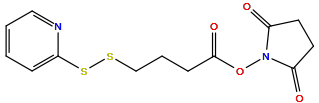
|
|||||
| Formula |
C13H14N2O4S2
|
|||||
| Isosmiles |
C1CC(=O)N(C1=O)OC(=O)CCCSSC2=CC=CC=N2
|
|||||
| PubChem CID | ||||||
| InChI |
InChI=1S/C13H14N2O4S2/c16-11-6-7-12(17)15(11)19-13(18)5-3-9-20-21-10-4-1-2-8-14-10/h1-2,4,8H,3,5-7,9H2
|
|||||
| InChIKey |
JSHOVKSMJRQOGY-UHFFFAOYSA-N
|
|||||
| IUPAC Name |
(2,5-dioxopyrrolidin-1-yl) 4-(pyridin-2-yldisulfanyl)butanoate
|
|||||
| Pharmaceutical Properties |
Molecule Weight
|
326.4
|
Polar area
|
127
|
||
|
Complexity
|
390
|
xlogp Value
|
1
|
|||
|
Heavy Count
|
21
|
Rot Bonds
|
8
|
|||
|
Hbond acc
|
7
|
Hbond Donor
|
0
|
|||
Each Antibody-drug Conjugate Related to This Linker
Full Information of The Activity Data of The ADC(s) Related to This Linker
Indatuximab ravtansine [Phase 1/2 (discontinued)]
Identified from the Human Clinical Data
| Experiment 1 Reporting the Activity Date of This ADC | [1] | ||||
| Efficacy Data | Objective Response Rate (ORR) |
71.7
70.6 % |
|||
| Patients Enrolled |
Eligible relapsed/refractory myeloma patients (≥18 years, ECOG ≤2) must have failed prior therapies (1+ for Len/Dex arm, 2+ for Pom/Dex arm) and comply with REMS programs. Exclusions include recent chemotherapy/radiotherapy (3-6 weeks), active HBV/HCV/HIV, cardiac abnormalities, pregnancy, prior BT062 exposure, or hypersensitivity to biologics. Plasma cell leukemia and recent thromboembolic events (DVT/PE within 3 months) are prohibited.
Click to Show/Hide
|
||||
| Administration Dosage |
BT062 administered intravenously on days 1, 8 and 15 of each 28-day cycle, and lenalidomide or pomalidomide and dexamethasone administered orally to subjects with relapsed or relapsed/refractory MM
|
||||
| Related Clinical Trial | |||||
| NCT Number | NCT01638936 | Clinical Status | PHASE1|||PHASE2 | ||
| Clinical Description |
A Phase I/IIa Multi-dose Escalation Study of BT062 in Combination With Lenalidomide or Pomalidomide and Dexamethasone in Subjects With Relapsed or Relapsed/Refractory Multiple Myeloma
|
||||
| Primary Endpoint |
The study consists of two phases: Phase I (6 months) determines the optimal dose of BT062 combined with lenalidomide/dexamethasone using a standard 3+3 dose escalation design focused on DLTs in cycle 1; Phase IIa (18 months) evaluates treatment response using M-protein and serum free light chain assessments at each 28-day cycle, with supplementary bone marrow/skeletal exams as needed.
Click to Show/Hide
|
||||
| Other Endpoint |
Safety will be monitored for 24 months via adverse events, clinical labs, and vital signs. Pharmacokinetics of BT062 and its metabolite (DM4) will be analyzed, alongside time-to-event endpoints (TTP, PFS, TTNT, DOR, OS). Quantitative toxicities will track treatment-emergent changes in clinical parameters.
|
||||
| Experiment 2 Reporting the Activity Date of This ADC | [2] | ||||
| Patients Enrolled |
Eligible participants must have relapsed/refractory multiple myeloma, prior exposure to immunomodulators/proteasome inhibitors, ECOG ≤2, and adequate organ function. Exclusions include recent chemotherapy/radiotherapy (within 3-6 weeks), active infections (HBV/HCV/HIV), uncontrolled cardiac disease, pregnancy, or concurrent antineoplastic therapies. The study prohibits recent major surgery, investigational agents within 4 weeks, and prior MAb therapy with detectable immune responses (HAHA/HACA/HAMA).
Click to Show/Hide
|
||||
| Administration Dosage |
BT062 single agent dose escalation
|
||||
| Related Clinical Trial | |||||
| NCT Number | NCT00723359 | Clinical Status | PHASE1 | ||
| Clinical Description |
A Phase I Dose Escalation Study to Evaluate Maximum Tolerated Dose (MTD), Pharmacokinetics (PK), and Safety of BT062 in Subjects With Relapsed or Relapsed/Refractory Multiple Myeloma
|
||||
| Primary Endpoint |
The study evaluates dose-limiting toxicities (DLTs) assessed weekly and maximum tolerated dose (MTD) assessed every two months over the study duration for participants with relapsed/refractory multiple myeloma. Safety monitoring focuses on identifying the highest tolerable dose with manageable toxicity profiles.
|
||||
| Other Endpoint |
Weekly assessments include qualitative and quantitative toxicities, pharmacokinetic profiling, and anti-tumor activity evaluated at each treatment cycle initiation. Efficacy is measured through tumor response criteria, while pharmacokinetic data capture drug exposure and metabolic profiles to guide dosing adjustments.
|
||||
| Experiment 3 Reporting the Activity Date of This ADC | [3] | ||||
| Patients Enrolled |
Eligible participants had relapsed/refractory myeloma with prior immunomodulator/proteasome inhibitor exposure, ECOG ≤2, and adequate organ function. Exclusions included recent chemotherapy/radiotherapy (3-6 weeks), active HBV/HCV/HIV, uncontrolled cardiac disease, prior BT062/HAMA/HAHA, or pregnancy. Concomitant antineoplastic therapies and high-dose corticosteroids were prohibited.
Click to Show/Hide
|
||||
| Administration Dosage |
BT062 was to be administered as single-dose IV infusions via a 0.22 um in-line filter preferably in a forearm vein, according to medically accepted procedures on Days 1, 8, and 15 of each 28-day cycle. Alternatively BT062 may have been administered through a central venous line or a peripherally inserted central catheter (PICC). Other administration routes were only to be allowed after approval from Biotest. Each subject was to be monitored carefully for the effects of exposure to BT062. No subject was to have received more than 3 doses of BT062 per 28-day treatment cycle.
Click to Show/Hide
|
||||
| Related Clinical Trial | |||||
| NCT Number | NCT01001442 | Clinical Status | PHASE1|||PHASE2 | ||
| Clinical Description |
A Phase I/IIa Multi-Dose Escalation Study to Evaluate Maximum Tolerated Dose (MTD), Pharmacokinetics (PK), Safety and Efficacy of BT062 in Subjects With Relapsed or Relapsed/Refractory Multiple Myeloma
|
||||
| Primary Endpoint |
The study evaluated dose-limiting toxicities (DLTs) and maximum tolerated dose (MTD) for BT062 in relapsed/refractory multiple myeloma using a 3+3 dose escalation design. DLTs were assessed during the first 28-day cycle, and MTD was defined as the highest dose where <2 of 6 subjects experienced DLTs. Dose escalation stopped if ≥2 DLTs occurred at any level.
Click to Show/Hide
|
||||
| Other Endpoint |
Safety and efficacy assessments included qualitative/quantitative toxicities (TEAEs, SAEs), pharmacokinetic properties (Cmax of BT062 conjugate), and anti-tumor activity. Responses were graded per IMWG criteria (sCR, CR, VGPR, PR, MR, SD), with ORR (MR+PR+VGPR+CR+sCR) and CBR (ORR+SD) as key endpoints. Disease progression metrics (TTP, PFS, OS) tracked M-protein increases (≥25%), new lesions, or hypercalcemia.
Click to Show/Hide
|
||||
| Experiment 4 Reporting the Activity Date of This ADC | [4] | ||||
| Efficacy Data | Objective Response Rate (ORR) |
3.20
5.90 % |
|||
| Patients Enrolled |
Relapsed and/or refractory multiple myeloma (MM) previously treated with an immunomodulatory drug and a proteasome inhibitor.
|
||||
| Administration Dosage |
In the first-in-human study, indatuximab ravtansine (10, 20, 40, 80, 120, 160, 200 mg/m2) was administered to 32 patients on day 1 of each 21-day cycle. The MTD was 160 mg/m2. In the phase I/IIa study, indatuximab ravtansine (40, 50, 65, 80, 100, 120, 140, 160 mg/m2) was administered to 35 patients on days 1, 8, and 15 of each 28-day cycle, and the MTD/recommended phase II dose was 140 mg/m2.
Click to Show/Hide
|
||||
| Related Clinical Trial | |||||
| NCT Number | NCT00723359 | Clinical Status | Phase 1 | ||
| Clinical Description |
A phase 1 dose escalation study to evaluate maximum tolerated dose (MTD), pharmacokinetics (PK), and safety of BT062 in subjects with relapsed or relapsed/refractory multiple myeloma.
|
||||
| Primary Endpoint |
The 160 mg/m2 dose was therefore defined as MTD for the Single-dose Regimen.
|
||||
| Other Endpoint |
Most (88.00%) adverse events were grade 1 or 2, the most common being diarrhea and fatigue. There was rapid clearance of indatuximab ravtansine and no relevant accumulation.
|
||||
| Experiment 5 Reporting the Activity Date of This ADC | [5] | ||||
| Patients Enrolled |
Relapsed or refractory multiple myeloma, and ECOG performance status or Zubrod score of 2 or below.
|
||||
| Administration Dosage |
Intravenously on days 1, 8, and 15 of each 28-day cycle in escalating dose levels of 80 mg/m2, 100 mg/m2, and 120 mg/m2, with lenalidomide (25 mg; days 1 to 21 every 28 days orally) and dexamethasone (20-40 mg; days 1, 8, 15, and 22 every 28 days) (phase 1).
|
||||
| Related Clinical Trial | |||||
| NCT Number | NCT01638936 | Clinical Status | Phase 1 | ||
| Clinical Description |
A phase 1/2a multi-dose escalation study of BT062 in combination with lenalidomide or pomalidomide and dexamethasone in subjects with relapsed or relapsed/refractory multiple myeloma.
|
||||
Discovered Using Patient-derived Xenograft Model
| Experiment 1 Reporting the Activity Date of This ADC | [6] | ||||
| Efficacy Data | Tumor Growth Inhibition value (TGI) | ≈ 0% | Moderate CD138 expression (CD138++) | ||
| Method Description |
The inhibitory activity of indatuximab ravtansine against cancer cell growth was evaluated in various human cancer cell lines in vitro. The cells were treated with 4 mg/kg.
|
||||
| In Vivo Model | Triple-negative breast cancer PDX model (PDX: MAXF1384) | ||||
| Experiment 2 Reporting the Activity Date of This ADC | [6] | ||||
| Efficacy Data | Tumor Growth Inhibition value (TGI) | ≈ 0% | Moderate CD138 expression (CD138++) | ||
| Method Description |
The inhibitory activity of indatuximab ravtansine against cancer cell growth was evaluated in various human cancer cell lines in vitro. The cells were treated with 2 mg/kg.
|
||||
| In Vivo Model | Triple-negative breast cancer PDX model (PDX: MAXF1384) | ||||
| Experiment 3 Reporting the Activity Date of This ADC | [6] | ||||
| Efficacy Data | Tumor Growth Inhibition value (TGI) | ≈ 0% | Moderate CD138 expression (CD138++) | ||
| Method Description |
The inhibitory activity of indatuximab ravtansine against cancer cell growth was evaluated in various human cancer cell lines in vitro. The cells were treated with 1 mg/kg.
|
||||
| In Vivo Model | Triple-negative breast cancer PDX model (PDX: MAXF1384) | ||||
| Experiment 4 Reporting the Activity Date of This ADC | [6] | ||||
| Efficacy Data | Tumor Growth Inhibition value (TGI) | ≈ 25% | High CD138 expression (CD138+++) | ||
| Method Description |
The inhibitory activity of indatuximab ravtansine against cancer cell growth was evaluated in various human cancer cell lines in vitro. The cells were treated with 1 mg/kg.
|
||||
| In Vivo Model | Triple-negative breast cancer PDX model (PDX: MAXF401) | ||||
| Experiment 5 Reporting the Activity Date of This ADC | [6] | ||||
| Efficacy Data | Tumor Growth Inhibition value (TGI) | ≈ 55% | Moderate CD138 expression (CD138++) | ||
| Method Description |
The inhibitory activity of indatuximab ravtansine combination docetaxel against cancer cell growth was evaluated in various human cancer cell lines in vitro. The cells were treated docetaxel with 10 mg/kg and treated indatuximab ravtansine with 2 mg/kg.
|
||||
| In Vivo Model | Triple-negative breast cancer PDX model (PDX: MAXF1384) | ||||
| Experiment 6 Reporting the Activity Date of This ADC | [6] | ||||
| Efficacy Data | Tumor Growth Inhibition value (TGI) | ≈ 55% | High CD138 expression (CD138+++) | ||
| Method Description |
The inhibitory activity of indatuximab ravtansine against cancer cell growth was evaluated in various human cancer cell lines in vitro. The cells were treated with 2 mg/kg.
|
||||
| In Vivo Model | Triple-negative breast cancer PDX model (PDX: MAXF401) | ||||
| Experiment 7 Reporting the Activity Date of This ADC | [6] | ||||
| Efficacy Data | Tumor Growth Inhibition value (TGI) | ≈ 70% | Moderate CD138 expression (CD138++) | ||
| Method Description |
The inhibitory activity of indatuximab ravtansine against cancer cell growth was evaluated in various human cancer cell lines in vitro. The cells were treated with 8mg/kg.
|
||||
| In Vivo Model | Triple-negative breast cancer PDX model (PDX: MAXF1384) | ||||
| Experiment 8 Reporting the Activity Date of This ADC | [6] | ||||
| Efficacy Data | Tumor Growth Inhibition value (TGI) | ≈ 95.50% | High CD138 expression (CD138+++) | ||
| Method Description |
The inhibitory activity of indatuximab ravtansine against cancer cell growth was evaluated in various human cancer cell lines in vitro. The cells were treated with 4 mg/kg.
|
||||
| In Vivo Model | Triple-negative breast cancer PDX model (PDX: MAXF401) | ||||
| Experiment 9 Reporting the Activity Date of This ADC | [6] | ||||
| Efficacy Data | Tumor Growth Inhibition value (TGI) | ≈ 99.80% | High CD138 expression (CD138+++) | ||
| Method Description |
The inhibitory activity of indatuximab ravtansine against cancer cell growth was evaluated in various human cancer cell lines in vitro. The cells were treated with 8mg/kg.
|
||||
| In Vivo Model | Triple-negative breast cancer PDX model (PDX: MAXF401) | ||||
| Experiment 10 Reporting the Activity Date of This ADC | [6] | ||||
| Efficacy Data | Tumor Growth Inhibition value (TGI) | ≈ 100% | High CD138 expression (CD138+++) | ||
| Method Description |
The inhibitory activity of indatuximab ravtansine combination docetaxel against cancer cell growth was evaluated in various human cancer cell lines in vitro. The cells were treated docetaxel with 10 mg/kg and treated indatuximab ravtansine with 2 mg/kg.
|
||||
| In Vivo Model | Triple-negative breast cancer PDX model (PDX: MAXF401) | ||||
Discovered Using Cell Line-derived Xenograft Model
| Experiment 1 Reporting the Activity Date of This ADC | [7] | ||||
| Efficacy Data | Tumor Growth Inhibition value (TGI) | ≈ 38.86% | Moderate CD138 expression (CD138++) | ||
| Method Description |
The inhibitory activity of indatuximab ravtansine combination lenalidomide against cancer cell growth was evaluated in various human cancer cell lines in vitro. The cells were treated with 5.3 mg/kg body weight for 14 days.
|
||||
| In Vivo Model | Multiple myeloma CDX model | ||||
| In Vitro Model | Multiple myeloma | Multiple myeloma cells | Homo sapiens | ||
| Experiment 2 Reporting the Activity Date of This ADC | [7] | ||||
| Efficacy Data | Tumor Growth Inhibition value (TGI) | ≈ 40.42% | High CD138 expression (CD138+++) | ||
| Method Description |
The inhibitory activity of indatuximab ravtansine against cancer cell growth was evaluated in various human cancer cell lines in vitro. The cells were treated with 2 mg/kg/day.
|
||||
| In Vitro Model | Plasma cell myeloma | MMXF L363 cells | Homo sapiens | ||
| Experiment 3 Reporting the Activity Date of This ADC | [7] | ||||
| Efficacy Data | Tumor Growth Inhibition value (TGI) | ≈ 50% | Moderate CD138 expression (CD138++) | ||
| Method Description |
The inhibitory activity of indatuximab ravtansine against cancer cell growth was evaluated in various human cancer cell lines in vitro. The cells were treated with 5.3 mg/kg body weight for 14 days.
|
||||
| In Vivo Model | Multiple myeloma CDX model | ||||
| In Vitro Model | Multiple myeloma | Multiple myeloma cells | Homo sapiens | ||
| Experiment 4 Reporting the Activity Date of This ADC | [7] | ||||
| Efficacy Data | Tumor Growth Inhibition value (TGI) | ≈ 55.69% | Moderate CD138 expression (CD138++) | ||
| Method Description |
The inhibitory activity of indatuximab ravtansine combination lenalidomide against cancer cell growth was evaluated in various human cancer cell lines in vitro. The cells were treated with 10.6 mg/kg body weight for 14 days.
|
||||
| In Vivo Model | Multiple myeloma CDX model | ||||
| In Vitro Model | Multiple myeloma | Multiple myeloma cells | Homo sapiens | ||
| Experiment 5 Reporting the Activity Date of This ADC | [7] | ||||
| Efficacy Data | Tumor Growth Inhibition value (TGI) | ≈ 59.90% | Moderate CD138 expression (CD138++) | ||
| Method Description |
The inhibitory activity of indatuximab ravtansine against cancer cell growth was evaluated in various human cancer cell lines in vitro. The cells were treated with 10.6 mg/kg body weight for 14 days.
|
||||
| In Vivo Model | Multiple myeloma CDX model | ||||
| In Vitro Model | Multiple myeloma | Multiple myeloma cells | Homo sapiens | ||
| Experiment 6 Reporting the Activity Date of This ADC | [7] | ||||
| Efficacy Data | Tumor Growth Inhibition value (TGI) | ≈ 65.34% | Moderate CD138 expression (CD138++) | ||
| Method Description |
The inhibitory activity of indatuximab ravtansine against cancer cell growth was evaluated in various human cancer cell lines in vitro. The cells were treated with 21.2 mg/kg body weight for 14 days.
|
||||
| In Vivo Model | Multiple myeloma CDX model | ||||
| In Vitro Model | Multiple myeloma | Multiple myeloma cells | Homo sapiens | ||
| Experiment 7 Reporting the Activity Date of This ADC | [7] | ||||
| Efficacy Data | Tumor Growth Inhibition value (TGI) | ≈ 77.26% | High CD138 expression (CD138+++) | ||
| Method Description |
The inhibitory activity of indatuximab ravtansine against cancer cell growth was evaluated in various human cancer cell lines in vitro. The cells were treated with 4 mg/kg/day.
|
||||
| In Vitro Model | Plasma cell myeloma | MMXF L363 cells | Homo sapiens | ||
| Experiment 8 Reporting the Activity Date of This ADC | [7] | ||||
| Efficacy Data | Tumor Growth Inhibition value (TGI) | ≈ 77.27% | High CD138 expression (CD138+++) | ||
| Method Description |
The inhibitory activity of indatuximab ravtansine+lenalidomide (Len; 20 mg/kg/day) and dexamethasone (1.25 mg/kg/day) against cancer cell growth was evaluated in various human cancer cell lines in vitro. The cells were treated IR with 2 mg/kg/day.
|
||||
| In Vitro Model | Breast ductal carcinoma | JIMT-1 cells | CVCL_2077 | ||
| Experiment 9 Reporting the Activity Date of This ADC | [7] | ||||
| Efficacy Data | Tumor Growth Inhibition value (TGI) | ≈ 79.20% | Moderate CD138 expression (CD138++) | ||
| Method Description |
The inhibitory activity of indatuximab ravtansine combination lenalidomide against cancer cell growth was evaluated in various human cancer cell lines in vitro. The cells were treated with 21.2 mg/kg body weight for 14 days.
|
||||
| In Vivo Model | Multiple myeloma CDX model | ||||
| In Vitro Model | Multiple myeloma | Multiple myeloma cells | Homo sapiens | ||
| Experiment 10 Reporting the Activity Date of This ADC | [7] | ||||
| Efficacy Data | Tumor Growth Inhibition value (TGI) | ≈ 92.05% | High CD138 expression (CD138+++) | ||
| Method Description |
The inhibitory activity of indatuximab ravtansine+lenalidomide (Len; 20 mg/kg/day) and dexamethasone (1.25 mg/kg/day) against cancer cell growth was evaluated in various human cancer cell lines in vitro. The cells were treated IR with 4 mg/kg/day.
|
||||
| In Vitro Model | Breast ductal carcinoma | JIMT-1 cells | CVCL_2077 | ||
| Experiment 11 Reporting the Activity Date of This ADC | [8] | ||||
| Efficacy Data | Tumor Growth Inhibition value (TGI) | ≈ 96.40% | Positive CD138 expression (CD138 +++/++) | ||
| Method Description |
MOLP-8 cells (1.5x10⁷ cells per mouse) suspended in a 50:50 mixture of serum free media and matrigel were injected subcutaneously in the area under the right shoulder in 100 ul. Nine groups (n=6) were treated with a single intravenous injection of ADCs, each at doses of 250 ug/kg.
|
||||
| In Vivo Model | MOLP-8 CDX model | ||||
| In Vitro Model | Plasma cell myeloma | MOLP-8 cells | CVCL_2124 | ||
Revealed Based on the Cell Line Data
| Experiment 1 Reporting the Activity Date of This ADC | [8] | ||||
| Efficacy Data | Half Maximal Inhibitory Concentration (IC50) |
0.1 nM
|
Positive CD138 expression (CD138 +++/++) | ||
| Method Description |
CD138+ MOLP-8 cells were seeded in flat bottom plates at 3000 cells/well. CD138- BJAB control cells were seeded at 1000 cells/weli. The cells were treated with nBT062-SPDB-DM4nBT062-SPP-DM1 or nBT062-SMCC-DM1 at different concentrations for five days.
|
||||
| In Vitro Model | Plasma cell myeloma | MOLP-8 cells | CVCL_2124 | ||
| Experiment 2 Reporting the Activity Date of This ADC | [8] | ||||
| Efficacy Data | Half Maximal Inhibitory Concentration (IC50) | > 100 nM | Negative CD138 expression (CD138 -) | ||
| Method Description |
CD138+ MOLP-8 cells were seeded in flat bottom plates at 3000 cells/well. CD138- BJAB control cells were seeded at 1000 cells/weli. The cells were treated with nBT062-SPDB-DM4nBT062-SPP-DM1 or nBT062-SMCC-DM1 at different concentrations for five days.
|
||||
| In Vitro Model | Burkitt lymphoma | BJAB cells | CVCL_5711 | ||
Tusamitamab ravtansine [Phase 3 (discontinued)]
Identified from the Human Clinical Data
| Experiment 1 Reporting the Activity Date of This ADC | [9] | ||||
| Efficacy Data | stable disease (SD) |
27.30%
|
|||
| Patients Enrolled |
Key inclusion criteria: metastatic NSQ NSCLC patients (post-platinum/IO) with moderate/negative CEACAM5 expression (IHC 2+ in 1-50% or 1+ tumors) plus CEA ≥100 ng/mL, measurable lesions, ECOG 0-1. Major exclusions: untreated CNS metastases, prior CEACAM5/DM1/DM4 therapy, unresolved grade ≥2 toxicity (except alopecia/vitiligo), corneal disorders, contact lens use, or poor organ function. Reproductive-age participants require contraception.
Click to Show/Hide
|
||||
| Administration Dosage |
Tusamitamab ravtansine dose will be administered on Day 1 via IV infusion and repeated once every 2 weeks. The duration of 1 cycle will be 14 days (1 administration of tusamitamab ravtansine per cycle).
|
||||
| Related Clinical Trial | |||||
| NCT Number | NCT05245071 | Clinical Status | PHASE2 | ||
| Clinical Description |
Open-label, Phase 2 Study, Evaluating the Efficacy and Safety of Tusamitamab Ravtansine in Non-squamous Non-small-cell Lung Cancer (NSQ NSCLC) Participants With Negative or Moderate CEACAM5 Expression Tumors and High Circulating CEA
|
||||
| Primary Endpoint |
The study assesses efficacy through Objective Response Rate (ORR), defined as the percentage of participants achieving confirmed complete response (CR, disappearance of all target lesions and lymph nodes <10mm) or partial response (PR, ≥30% reduction in target lesion sum) per RECIST v1.1, evaluated at baseline and every 8 weeks (±7 days) over approximately 46 weeks.
Click to Show/Hide
|
||||
| Other Endpoint |
Safety analyses include treatment-emergent adverse events (TEAEs/SAEs) recorded from first dose until primary completion (~21 months). Secondary efficacy endpoints - Progression-Free Survival (PFS), Disease Control Rate (DCR), and Duration of Response (DOR) - all follow RECIST v1.1 criteria, with PD requiring ≥20% (minimum 5mm absolute) increase in target lesions or new lesions, assessed every 8 weeks over 46 weeks.
Click to Show/Hide
|
||||
| Experiment 2 Reporting the Activity Date of This ADC | [9] | ||||
| Efficacy Data | Partial Response (PR) |
9.10%
|
|||
| Patients Enrolled |
Key inclusion criteria: metastatic NSQ NSCLC patients (post-platinum/IO) with moderate/negative CEACAM5 expression (IHC 2+ in 1-50% or 1+ tumors) plus CEA ≥100 ng/mL, measurable lesions, ECOG 0-1. Major exclusions: untreated CNS metastases, prior CEACAM5/DM1/DM4 therapy, unresolved grade ≥2 toxicity (except alopecia/vitiligo), corneal disorders, contact lens use, or poor organ function. Reproductive-age participants require contraception.
Click to Show/Hide
|
||||
| Administration Dosage |
Tusamitamab ravtansine dose will be administered on Day 1 via IV infusion and repeated once every 2 weeks. The duration of 1 cycle will be 14 days (1 administration of tusamitamab ravtansine per cycle).
|
||||
| Related Clinical Trial | |||||
| NCT Number | NCT05245071 | Clinical Status | PHASE2 | ||
| Clinical Description |
Open-label, Phase 2 Study, Evaluating the Efficacy and Safety of Tusamitamab Ravtansine in Non-squamous Non-small-cell Lung Cancer (NSQ NSCLC) Participants With Negative or Moderate CEACAM5 Expression Tumors and High Circulating CEA
|
||||
| Primary Endpoint |
The study assesses efficacy through Objective Response Rate (ORR), defined as the percentage of participants achieving confirmed complete response (CR, disappearance of all target lesions and lymph nodes <10mm) or partial response (PR, ≥30% reduction in target lesion sum) per RECIST v1.1, evaluated at baseline and every 8 weeks (±7 days) over approximately 46 weeks.
Click to Show/Hide
|
||||
| Other Endpoint |
Safety analyses include treatment-emergent adverse events (TEAEs/SAEs) recorded from first dose until primary completion (~21 months). Secondary efficacy endpoints - Progression-Free Survival (PFS), Disease Control Rate (DCR), and Duration of Response (DOR) - all follow RECIST v1.1 criteria, with PD requiring ≥20% (minimum 5mm absolute) increase in target lesions or new lesions, assessed every 8 weeks over 46 weeks.
Click to Show/Hide
|
||||
| Experiment 3 Reporting the Activity Date of This ADC | [9] | ||||
| Efficacy Data | Objective Response Rate (ORR) |
9.10%
|
|||
| Patients Enrolled |
Key inclusion criteria: metastatic NSQ NSCLC patients (post-platinum/IO) with moderate/negative CEACAM5 expression (IHC 2+ in 1-50% or 1+ tumors) plus CEA ≥100 ng/mL, measurable lesions, ECOG 0-1. Major exclusions: untreated CNS metastases, prior CEACAM5/DM1/DM4 therapy, unresolved grade ≥2 toxicity (except alopecia/vitiligo), corneal disorders, contact lens use, or poor organ function. Reproductive-age participants require contraception.
Click to Show/Hide
|
||||
| Administration Dosage |
Tusamitamab ravtansine dose will be administered on Day 1 via IV infusion and repeated once every 2 weeks. The duration of 1 cycle will be 14 days (1 administration of tusamitamab ravtansine per cycle).
|
||||
| Related Clinical Trial | |||||
| NCT Number | NCT05245071 | Clinical Status | PHASE2 | ||
| Clinical Description |
Open-label, Phase 2 Study, Evaluating the Efficacy and Safety of Tusamitamab Ravtansine in Non-squamous Non-small-cell Lung Cancer (NSQ NSCLC) Participants With Negative or Moderate CEACAM5 Expression Tumors and High Circulating CEA
|
||||
| Primary Endpoint |
The study assesses efficacy through Objective Response Rate (ORR), defined as the percentage of participants achieving confirmed complete response (CR, disappearance of all target lesions and lymph nodes <10mm) or partial response (PR, ≥30% reduction in target lesion sum) per RECIST v1.1, evaluated at baseline and every 8 weeks (±7 days) over approximately 46 weeks.
Click to Show/Hide
|
||||
| Other Endpoint |
Safety analyses include treatment-emergent adverse events (TEAEs/SAEs) recorded from first dose until primary completion (~21 months). Secondary efficacy endpoints - Progression-Free Survival (PFS), Disease Control Rate (DCR), and Duration of Response (DOR) - all follow RECIST v1.1 criteria, with PD requiring ≥20% (minimum 5mm absolute) increase in target lesions or new lesions, assessed every 8 weeks over 46 weeks.
Click to Show/Hide
|
||||
| Experiment 4 Reporting the Activity Date of This ADC | [10] | ||||
| Efficacy Data | Objective Response Rate (ORR) |
19.40%
|
|||
| Patients Enrolled |
Eligibility required metastatic disease progression post-platinum chemotherapy and PD-1/PD-L1 inhibitors, CEACAM5 expression ≥2+, measurable lesions (RECIST v1.1), and ECOG 0-1. Exclusion criteria included untreated brain metastases, major comorbidities, active infections, uncontrolled hypertension, prior treatments targeting CEACAM5 or maytansinoids, and severe organ dysfunction. Specific Triplet Cohort exclusions included autoimmune diseases, transplant history, interstitial lung disease, or recent live vaccines.
Click to Show/Hide
|
||||
| Administration Dosage |
CARMEN-LC04 is an open-label phase 2 study (NCT04394624) assessing combination tusa rav 100 mg/m2 every 2 weeks (Q2W) + ram 8 mg/kg Q2W in patients with mNSQ NSCLC and high CEACAM5 expression (≥2+ intensity in ≥50% of tumor cells by immunohistochemistry).
|
||||
| Related Clinical Trial | |||||
| NCT Number | NCT04394624 | Clinical Status | PHASE2 | ||
| Clinical Description |
Open-label, Single-arm Trial to Evaluate Antitumor Activity, Safety, and Pharmacokinetics of Tusamitamab Ravtansine (SAR408701) Used in Combination With Ramucirumab or Ramucirumab and Pembrolizumab in Metastatic, Non-squamous, Non Small-cell Lung Cancer (NSQ NSCLC) Patients With CEACAM5-positive Tumors, Previously Treated With Platinum-based Chemotherapy and an Immune Checkpoint Inhibitor
Click to Show/Hide
|
||||
| Primary Endpoint |
The study involves evaluating dose-limiting toxicities (DLTs) in both Doublet (Part 1 and 2) and Triplet Cohorts, including grade 4 neutropenia, thrombocytopenia, non-hematologic AEs, keratopathy, and refractory hypertension. Key efficacy measures include objective response rate (ORR) in the Doublet Cohort (Part 2) and Triplet Cohort, calculated per RECIST v1.1 criteria for solid tumors.
Click to Show/Hide
|
||||
| Other Endpoint |
Safety assessments covered treatment-emergent adverse events (TEAEs), serious adverse events (SAEs), and clinically significant abnormalities in lab parameters, ECG, and urinalysis. Efficacy endpoints in the Doublet Cohort included duration of response (DOR), progression-free survival (PFS), and disease control rate (DCR). Pharmacokinetic parameters such as Cmax, AUC0-14d, and Ctrough were analyzed for tusamitamab ravtansine and ramucirumab. Immunogenicity was assessed via anti-therapeutic antibodies (ATAs).
Click to Show/Hide
|
||||
| Experiment 5 Reporting the Activity Date of This ADC | [11] | ||||
| Efficacy Data | Objective Response Rate (ORR) |
20.3
7.1 % |
|||
| Patients Enrolled |
Participants had advanced CEACAM5+ cancers (CRC/NSCLC/gastric favored; CEA >5ng/mL accepted). Mandatory criteria: measurable disease (expansion phase), archived tumor tissue, and biopsy consent (CRC/gastric cohorts). Exclusions included active CNS metastases, unresolved ocular/cardiac disorders (LVEF<50%), prior CEACAM5/DM1/DM4 therapy, strong CYP3A inhibitor use, or contraindications to ophthalmic medications (glaucoma/hypertension/allergies). Reproductive-age patients required contraception for ≥3 months post-treatment.
Click to Show/Hide
|
||||
| Administration Dosage |
In cohort Q2W-LD, 38 patients were screened for eligibility and 28 patients were enrolled and treated with tusamitamab ravtansine across four LD-DLs ranging from 120 to 170 mg/m2 between March 13, 2017, and February 17, 2020, at study sites in Canada, France, Republic of Korea, and Spain (Table 1). In cohort Q3W, 21 patients were screened for eligibility and 15 patients were enrolled and initiated treatment with tusamitamab ravtansine across four DLs ranging from 120 to 190 mg/m2 between July 15, 2019, and October 20, 2020, at study sites in Canada, France, and Spain (Table 1).
Click to Show/Hide
|
||||
| Related Clinical Trial | |||||
| NCT Number | NCT02187848 | Clinical Status | PHASE1 | ||
| Clinical Description |
A First-in-Human Study for the Evaluation of the Safety, Pharmacokinetics and Antitumor Activity of SAR408701 in Patients With Advanced Solid Tumors
|
||||
| Primary Endpoint |
The study assessed dose-limiting toxicities (DLTs) over 4-week (Q2W) or 3-week (Q3W) cycles alongside tumor response rates per RECIST 1.1 criteria during a 40-month follow-up period.
|
||||
| Other Endpoint |
Key evaluations included safety monitoring (TEAEs over 4 years), pharmacokinetics (Cmax, tmax, AUC0-14d/21d, CL/CLss, Rac over 2 months), immunogenicity (anti-SAR408701 antibodies), and efficacy endpoints (DOR, TTP assessed every 6-8 weeks for 40 months).
|
||||
| Experiment 6 Reporting the Activity Date of This ADC | [12] | ||||
| Efficacy Data | Objective Response Rate (ORR) |
40%
|
|||
| Patients Enrolled |
Eligible participants had advanced/metastatic NSQ NSCLC (no EGFR/BRAF/ALK/ROS mutations), CEACAM5 expression ≥2+, measurable disease (RECIST 1.1), and ECOG 0-1. Exclusions included uncontrolled brain metastases, active infections, autoimmune diseases, prior anti-PD-1/PD-L1 therapy, recent live vaccines, significant allergies, or unresolved toxicities (≥Grade 2). Prior chemotherapy for metastatic disease or CEACAM5-targeted treatments was prohibited.
Click to Show/Hide
|
||||
| Administration Dosage |
Pembrolizumab dose will be administered intravenously prior to intravenous administration of tusamitamab ravtansine dose every 3 weeks.
|
||||
| Related Clinical Trial | |||||
| NCT Number | NCT04524689 | Clinical Status | PHASE2 | ||
| Clinical Description |
Open-label, Phase 2 Study of Tusamitamab Ravtansine (SAR408701) Combined With Pembrolizumab and Tusamitamab Ravtansine (SAR408701) Combined With Pembrolizumab and Platinum-based Chemotherapy With or Without Pemetrexed in Patients With CEACAM5 Positive Expression Advanced/Metastatic Non-squamous Non-small-cell Lung Cancer (NSQ NSCLC)
|
||||
| Primary Endpoint |
Across all cohorts, dose-limiting toxicities (DLTs) included severe hematologic (grade 4 neutropenia, febrile neutropenia, thrombocytopenia) and non-hematologic events (grade 4 AEs, keratopathy) observed during Cycle 1. Efficacy endpoints assessed in Doublet and Quadruplet Cohorts included objective response rate (ORR), defined per RECIST v1.1 as confirmed complete (CR) or partial response (PR), with CR requiring disappearance of target lesions and PR a ≥30% reduction in lesion sum diameters.
Click to Show/Hide
|
||||
| Other Endpoint |
Safety assessments covered treatment-emergent adverse events (TEAEs) and serious AEs (TESAEs). Key efficacy measures included progression-free survival (PFS), disease control rate (DCR), and duration of response (DOR) across cohorts, evaluated via RECIST v1.1 criteria. Pharmacokinetic parameters (Ctrough, Ceoi) were measured for tusamitamab ravtansine, pembrolizumab, pemetrexed, cisplatin, and carboplatin. Immunogenicity was assessed via anti-therapeutic antibodies (ATAs) against tusamitamab ravtansine.
Click to Show/Hide
|
||||
| Experiment 7 Reporting the Activity Date of This ADC | [9] | ||||
| Efficacy Data | Disease control rate (DCR) |
36.40%
|
|||
| Patients Enrolled |
Key inclusion criteria: metastatic NSQ NSCLC patients (post-platinum/IO) with moderate/negative CEACAM5 expression (IHC 2+ in 1-50% or 1+ tumors) plus CEA ≥100 ng/mL, measurable lesions, ECOG 0-1. Major exclusions: untreated CNS metastases, prior CEACAM5/DM1/DM4 therapy, unresolved grade ≥2 toxicity (except alopecia/vitiligo), corneal disorders, contact lens use, or poor organ function. Reproductive-age participants require contraception.
Click to Show/Hide
|
||||
| Administration Dosage |
Tusamitamab ravtansine dose will be administered on Day 1 via IV infusion and repeated once every 2 weeks. The duration of 1 cycle will be 14 days (1 administration of tusamitamab ravtansine per cycle).
|
||||
| Related Clinical Trial | |||||
| NCT Number | NCT05245071 | Clinical Status | PHASE2 | ||
| Clinical Description |
Open-label, Phase 2 Study, Evaluating the Efficacy and Safety of Tusamitamab Ravtansine in Non-squamous Non-small-cell Lung Cancer (NSQ NSCLC) Participants With Negative or Moderate CEACAM5 Expression Tumors and High Circulating CEA
|
||||
| Primary Endpoint |
The study assesses efficacy through Objective Response Rate (ORR), defined as the percentage of participants achieving confirmed complete response (CR, disappearance of all target lesions and lymph nodes <10mm) or partial response (PR, ≥30% reduction in target lesion sum) per RECIST v1.1, evaluated at baseline and every 8 weeks (±7 days) over approximately 46 weeks.
Click to Show/Hide
|
||||
| Other Endpoint |
Safety analyses include treatment-emergent adverse events (TEAEs/SAEs) recorded from first dose until primary completion (~21 months). Secondary efficacy endpoints - Progression-Free Survival (PFS), Disease Control Rate (DCR), and Duration of Response (DOR) - all follow RECIST v1.1 criteria, with PD requiring ≥20% (minimum 5mm absolute) increase in target lesions or new lesions, assessed every 8 weeks over 46 weeks.
Click to Show/Hide
|
||||
| Experiment 8 Reporting the Activity Date of This ADC | [10] | ||||
| Efficacy Data | Disease control rate (DCR) |
83.90%
|
|||
| Patients Enrolled |
Eligibility required metastatic disease progression post-platinum chemotherapy and PD-1/PD-L1 inhibitors, CEACAM5 expression ≥2+, measurable lesions (RECIST v1.1), and ECOG 0-1. Exclusion criteria included untreated brain metastases, major comorbidities, active infections, uncontrolled hypertension, prior treatments targeting CEACAM5 or maytansinoids, and severe organ dysfunction. Specific Triplet Cohort exclusions included autoimmune diseases, transplant history, interstitial lung disease, or recent live vaccines.
Click to Show/Hide
|
||||
| Administration Dosage |
CARMEN-LC04 is an open-label phase 2 study (NCT04394624) assessing combination tusa rav 100 mg/m2 every 2 weeks (Q2W) + ram 8 mg/kg Q2W in patients with mNSQ NSCLC and high CEACAM5 expression (≥2+ intensity in ≥50% of tumor cells by immunohistochemistry).
|
||||
| Related Clinical Trial | |||||
| NCT Number | NCT04394624 | Clinical Status | PHASE2 | ||
| Clinical Description |
Open-label, Single-arm Trial to Evaluate Antitumor Activity, Safety, and Pharmacokinetics of Tusamitamab Ravtansine (SAR408701) Used in Combination With Ramucirumab or Ramucirumab and Pembrolizumab in Metastatic, Non-squamous, Non Small-cell Lung Cancer (NSQ NSCLC) Patients With CEACAM5-positive Tumors, Previously Treated With Platinum-based Chemotherapy and an Immune Checkpoint Inhibitor
Click to Show/Hide
|
||||
| Primary Endpoint |
The study involves evaluating dose-limiting toxicities (DLTs) in both Doublet (Part 1 and 2) and Triplet Cohorts, including grade 4 neutropenia, thrombocytopenia, non-hematologic AEs, keratopathy, and refractory hypertension. Key efficacy measures include objective response rate (ORR) in the Doublet Cohort (Part 2) and Triplet Cohort, calculated per RECIST v1.1 criteria for solid tumors.
Click to Show/Hide
|
||||
| Other Endpoint |
Safety assessments covered treatment-emergent adverse events (TEAEs), serious adverse events (SAEs), and clinically significant abnormalities in lab parameters, ECG, and urinalysis. Efficacy endpoints in the Doublet Cohort included duration of response (DOR), progression-free survival (PFS), and disease control rate (DCR). Pharmacokinetic parameters such as Cmax, AUC0-14d, and Ctrough were analyzed for tusamitamab ravtansine and ramucirumab. Immunogenicity was assessed via anti-therapeutic antibodies (ATAs).
Click to Show/Hide
|
||||
| Experiment 9 Reporting the Activity Date of This ADC | [12] | ||||
| Efficacy Data | Disease control rate (DCR) |
88%
|
|||
| Patients Enrolled |
Eligible participants had advanced/metastatic NSQ NSCLC (no EGFR/BRAF/ALK/ROS mutations), CEACAM5 expression ≥2+, measurable disease (RECIST 1.1), and ECOG 0-1. Exclusions included uncontrolled brain metastases, active infections, autoimmune diseases, prior anti-PD-1/PD-L1 therapy, recent live vaccines, significant allergies, or unresolved toxicities (≥Grade 2). Prior chemotherapy for metastatic disease or CEACAM5-targeted treatments was prohibited.
Click to Show/Hide
|
||||
| Administration Dosage |
Pembrolizumab dose will be administered intravenously prior to intravenous administration of tusamitamab ravtansine dose every 3 weeks.
|
||||
| Related Clinical Trial | |||||
| NCT Number | NCT04524689 | Clinical Status | PHASE2 | ||
| Clinical Description |
Open-label, Phase 2 Study of Tusamitamab Ravtansine (SAR408701) Combined With Pembrolizumab and Tusamitamab Ravtansine (SAR408701) Combined With Pembrolizumab and Platinum-based Chemotherapy With or Without Pemetrexed in Patients With CEACAM5 Positive Expression Advanced/Metastatic Non-squamous Non-small-cell Lung Cancer (NSQ NSCLC)
|
||||
| Primary Endpoint |
Across all cohorts, dose-limiting toxicities (DLTs) included severe hematologic (grade 4 neutropenia, febrile neutropenia, thrombocytopenia) and non-hematologic events (grade 4 AEs, keratopathy) observed during Cycle 1. Efficacy endpoints assessed in Doublet and Quadruplet Cohorts included objective response rate (ORR), defined per RECIST v1.1 as confirmed complete (CR) or partial response (PR), with CR requiring disappearance of target lesions and PR a ≥30% reduction in lesion sum diameters.
Click to Show/Hide
|
||||
| Other Endpoint |
Safety assessments covered treatment-emergent adverse events (TEAEs) and serious AEs (TESAEs). Key efficacy measures included progression-free survival (PFS), disease control rate (DCR), and duration of response (DOR) across cohorts, evaluated via RECIST v1.1 criteria. Pharmacokinetic parameters (Ctrough, Ceoi) were measured for tusamitamab ravtansine, pembrolizumab, pemetrexed, cisplatin, and carboplatin. Immunogenicity was assessed via anti-therapeutic antibodies (ATAs) against tusamitamab ravtansine.
Click to Show/Hide
|
||||
| Experiment 10 Reporting the Activity Date of This ADC | [13] | ||||
| Patients Enrolled |
Eligible participants required ≥18 years, measurable lesions (RECIST v1.1), ECOG 0-1, CEACAM5+ tumors, and metastatic disease. Cohort-specific criteria: mBC (Cohort A) needed 2-4 prior chemotherapy lines; mPAC (Cohorts B/C) required progression after gemcitabine/5-FU regimens (B) or 1st-line fluoropyrimidine (C). Key exclusions: active infections (HIV/hepatitis), untreated brain metastases, unresolved Grade ≥2 toxicities, corneal disorders, prior CEACAM5/DM4 therapy, major surgery <2 weeks, or inadequate organ function. Cohort C additionally excluded prior taxane/gemcitabine exposure.
Click to Show/Hide
|
||||
| Administration Dosage |
tusamitamab ravtansine every 2 weeks administered via intravenous infusion (IV)
|
||||
| Related Clinical Trial | |||||
| NCT Number | NCT04659603 | Clinical Status | PHASE2 | ||
| Clinical Description |
Open-label, Multi-cohort, Phase 2 Trial, Evaluating the Efficacy and Safety of Tusamitamab Ravtansine (SAR408701) Monotherapy and in Combination in Patients With CEACAM5-positive Advanced Solid Tumors
|
||||
| Primary Endpoint |
The primary focus was evaluating Objective Response Rate (ORR) across cohorts (A:26.1w, B:51.6w, C:43.3w), defined as confirmed CR (complete lesion disappearance) or PR (≥30% target lesion reduction) per RECIST v1.1. Dose-limiting toxicities (DLTs) in Cohort C included Grade 4 neutropenia ≥7 days, Grade 3-4 neutropenia with infection, ≥Grade 3 thrombocytopenia with bleeding, Grade 4 non-hematologic AEs, or Grade ≥3 keratopathy during Cycle 1 (28 days).
Click to Show/Hide
|
||||
| Other Endpoint |
Secondary outcomes included TEAEs/TESAEs (up to 150 weeks), lab abnormalities (hematology/chemistry per NCI CTCAE v5.0), PFS (time to progression/death), DCR (CR+PR+SD), DOR (response duration), ATAs against tusamitamab ravtansine, and PK parameters (Cmax, AUC0-14d, CL for tusamitamab/gemcitabine/dFdU in Cohort C during Cycle 1). Assessments spanned treatment exposure periods specific to each cohort.
Click to Show/Hide
|
||||
| Experiment 11 Reporting the Activity Date of This ADC | [14] | ||||
| Patients Enrolled |
Eligible participants had metastatic CRC (CEACAM5+ assumed), NSQ NSCLC (CEACAM5+/high CEA), or GC/GEJ (CEACAM5+), ECOG 0-1. Key exclusions: active brain metastases, unresolved corneal disorders, QTcF >480 msec, significant comorbidities, or prior QT-prolonging drugs unless stabilized pre-study.
|
||||
| Related Clinical Trial | |||||
| NCT Number | NCT05429762 | Clinical Status | PHASE1 | ||
| Clinical Description |
Open-label Study Evaluating the Effect of Tusamitamab Ravtansine on the QTc Interval in Participants With Metastatic Solid Tumors
|
||||
| Primary Endpoint |
The study evaluates the change from baseline in QTcF interval and other ECG parameters (HR, QT, QTcB, QRS, PR) to assess cardiac effects of tusamitamab ravtansine during Cycles 1-2 (each cycle=2 weeks).
|
||||
| Other Endpoint |
Key assessments include PK parameters (Cmax, AUC0-14d) in Cycle 1, safety monitoring (TEAEs/SAEs per NCI CTCAE v5.0 for ~34 weeks), and efficacy outcomes (ORR/DOR per RECIST v1.1 assessed for ~30 weeks).
|
||||
| Experiment 12 Reporting the Activity Date of This ADC | [15] | ||||
| Patients Enrolled |
Eligible patients had CEACAM5+ advanced solid tumors (archival tissue required) with no standard alternatives. Exclusions: ECOG ≥2, active CNS metastases, prior CEACAM5/DM1/DM4 therapy, unresolved corneal disorders, strong CYP3A inhibitor use (unless discontinued ≥2 weeks pre-dose), or inadequate contraception. Reproductive-age participants required contraception for 6 months post-treatment.
Click to Show/Hide
|
||||
| Administration Dosage |
SAR408701 Dose escalation administered as a single agent intravenously, on Day 1 and once every two weeks, to patients with malignant solid tumors
|
||||
| Related Clinical Trial | |||||
| NCT Number | NCT03324113 | Clinical Status | PHASE1 | ||
| Clinical Description |
A Phase I Study to Evaluate Safety and Pharmacokinetics of SAR408701 Administered Intravenously as Monotherapy in Japanese Patients With Advanced Malignant Solid Tumors
|
||||
| Primary Endpoint |
The study evaluates IMP-related dose-limiting toxicities (DLTs) graded per NCI-CTC v4.03 over a 4-week period (3 weeks for q3w dose-escalation), requiring validation by the Study Committee when unrelated to disease progression.
|
||||
| Other Endpoint |
Key assessments include treatment-emergent AEs (over ~9 months) and PK parameters (Cmax, Tmax, AUC for SAR408701/DM4/Me-DM4) analyzed during specific cycles (14-day Q2W or 21-day Q3W dosing). Additional outcomes comprise CEACAM5 plasma levels (PDy effect), RECIST 1.1 tumor responses, and immunogenicity (anti-SAR408701 antibodies) over ~10 months.
|
||||
| Experiment 13 Reporting the Activity Date of This ADC | [16] | ||||
| Patients Enrolled |
Eligible participants had CEACAM5-high metastatic/unresectable gastric/GEJ adenocarcinoma (measurable lesions, ECOG 0-1). Key exclusions: untreated CNS metastases, prior CEACAM5/DM1/DM4 therapy, unresolved corneal disorders, recent thrombotic/hemorrhagic events (within 2-6 months), uncontrolled hypertension, or CYP3A inhibitor use. Reproductive-age participants required contraception (7 months post-treatment for females, 4 for males).
Click to Show/Hide
|
||||
| Administration Dosage |
Participants received ramucirumab 8 milligram/kilogram (mg/kg) via intravenous (IV) infusion followed by tusamitamab ravtansine loading dose at 170 mg/meter square (m^2) via IV infusion on Cycle 1 Day 1 (each cycle was 2 weeks); and then ramucirumab 8 mg/kg via IV infusion followed by tusamitamab ravtansine 100 mg/m^2 via IV infusion at Cycle 2 and every 2 weeks (Q2W) in all subsequent cycles until disease progression, unacceptable adverse event (AE), death, initiation of a new anticancer therapy, or the participant's or investigator's decision to stop the treatment.
Click to Show/Hide
|
||||
| Related Clinical Trial | |||||
| NCT Number | NCT05071053 | Clinical Status | PHASE2 | ||
| Clinical Description |
Open-label Study of Tusamitamab Ravtansine (SAR408701) in Combination With Ramucirumab in Participants Previously Treated for Advanced Gastric or Gastroesophageal Junction (GEJ) Adenocarcinoma With CEACAM5-positive Tumors
|
||||
| Primary Endpoint |
The study assessed dose-limiting toxicities (DLTs) during the first 28 days, defined as grade 4 neutropenia ≥7 days, febrile neutropenia, significant thrombocytopenia with bleeding, grade 4 non-hematologic AEs, or grade ≥3 keratopathy. Objective response rate (ORR) was evaluated per RECIST v1.1 as the percentage of participants achieving complete or partial response based on tumor assessments every 6 weeks.
Click to Show/Hide
|
||||
| Other Endpoint |
Safety outcomes included treatment-emergent AEs (TEAEs/TESAEs) up to 30 days post-treatment (~92 weeks). Efficacy endpoints comprised duration of response (DOR), progression-free survival (PFS), and disease control rate (DCR) assessed via RECIST v1.1. Pharmacokinetic analysis measured Ctrough for tusamitamab ravtansine and ramucirumab, alongside antitherapeutic antibody (ATA) detection against tusamitamab ravtansine.
Click to Show/Hide
|
||||
| Experiment 14 Reporting the Activity Date of This ADC | [17] | ||||
| Patients Enrolled |
Eligible patients (≥18y, ECOG 0-1) have CEACAM5+ (≥2+ in 50% cells) metastatic NSCLC (post-chemo/IO), ER+ breast cancer (hormone-refractory), or gastric cancer (exhausted SOC). Key exclusions: untreated brain metastases, recent thromboembolism (<6mo), CYP3A modulator use, unresolved grade ≥2 toxicity (except alopecia), prior CEACAM5/DM4 therapy, corneal disorders, or contact lens use. Required organ function: ANC ≥1.5x10⁹/L, platelets ≥100x109/L, eGFR ≥50mL/min, and serum albumin ≥25g/L. Reproductive-age participants must use contraception (females: 7 months post-treatment; males: 4 months).
Click to Show/Hide
|
||||
| Administration Dosage |
Tusamitamab ravtansine 100 mg/m2 IV Q2W
|
||||
| Related Clinical Trial | |||||
| NCT Number | NCT05703555 | Clinical Status | PHASE2 | ||
| Clinical Description |
INTRUSION: Unraveling the INTRatUmoral PK/PD relatION for SAR408701
|
||||
| Primary Endpoint |
The study measures intratumoral DM4 and tusamitamab ravtansine concentrations via PK assay on Cycle 2 Day 3 (~5 weeks). Additional pharmacodynamic assessments include CEACAM5 expression changes (IHC), RNA sequencing (DESeq2), tumor microenvironment analysis (quanTIseq/TIL signatures), somatic genomic profiling (WGS), and circulating CEA levels tracked every 8 weeks for up to 2 years. PK parameters (AUCinf, Cmax, Tmax) are evaluated through serial plasma sampling across cycles.
Click to Show/Hide
|
||||
| Other Endpoint |
Safety monitoring records CTCAE v5.0 grade 3-4 AEs during treatment (≤2 years), while efficacy is assessed per RECIST v1.1 for PD/SD/PR/CR every 8 weeks. Systemic PK analysis quantifies tusamitamab ravtansine (clearance, volume), DM4 metabolites (Lys-SPDB-DM4, Me-DM4), and calculates Thalf (ln (2)/Lambda z) using trapezoidal AUC methods from baseline through Cycle 4.
Click to Show/Hide
|
||||
| Experiment 15 Reporting the Activity Date of This ADC | [18] | ||||
| Patients Enrolled |
Eligible participants were ≥18 years with metastatic non-squamous NSCLC progressing after platinum/immunotherapy, CEACAM5 expression ≥2+ in ≥50% tumor cells, measurable lesions, and ECOG 0-1. Exclusions included active brain metastases, other malignancies within 3 years, unresolved toxicities ≥Grade 2, HIV/hepatitis, corneal disorders, prior docetaxel/CEACAM5-targeted therapy, corticosteroid contraindications, or hypersensitivity to study drugs.
Click to Show/Hide
|
||||
| Administration Dosage |
Participants received tusamitamab ravtansine 100 milligrams per square meter (mg/m^2) by intravenous (IV) infusion, once every 2 weeks (Q2W) until objective progressive disease (PD), unacceptable adverse event/toxicity, upon participant's request to stop treatment, or Investigator decision, whichever occurred first (maximum exposure: 147 weeks).
|
||||
| Related Clinical Trial | |||||
| NCT Number | NCT04154956 | Clinical Status | PHASE3 | ||
| Clinical Description |
Randomized, Open-label, Phase 3 Study of SAR408701 Versus Docetaxel in Previously Treated, Metastatic Nonsquamous, Non-small-cell Lung Cancer Patients With CEACAM5-positive Tumors
|
||||
| Primary Endpoint |
The study assessed Progression-free Survival (PFS) as the time from randomization to first documented disease progression (PD) or death per RECIST 1.1 criteria, with PD defined as 20% increase in target lesions (minimum 5mm absolute increase) or new lesions. Overall Survival (OS) was measured from randomization to death from any cause up to 189 weeks.
Click to Show/Hide
|
||||
| Other Endpoint |
Objective Response Rate (ORR) measured the percentage of participants achieving complete (CR) or partial response (PR) per RECIST 1.1, where CR required lesion disappearance and PR required ≥30% decrease in target lesions. Time to Deterioration (TTD) in symptoms and functions was evaluated using EORTC QLQ-LC13/C30 scales, with deterioration defined as ≥10-point worsening. Safety endpoints included treatment-emergent adverse events (TEAEs/TESAEs), lab abnormalities, and Duration of Response (DOR) from first CR/PR to PD/death.
Click to Show/Hide
|
||||
| Experiment 16 Reporting the Activity Date of This ADC | [19] | ||||
| Efficacy Data | Objective Response Rate (ORR) |
40%
|
Low CEACAM5 expression (CEACAM5+; 299,300 sites/cell) | ||
| Patients Enrolled |
Patients with advanced/metastatic nonsquamous non-small cell lung cancer (NSQ NSCLC) with CEACAM5 intensity of 2+ in 1% of tumor cells by immunohistochemistry.
|
||||
| Administration Dosage |
IV Q3W at 150 or 170 mg/m2.
|
||||
| Related Clinical Trial | |||||
| NCT Number | NCT04524689 | Clinical Status | Phase 2 | ||
| Clinical Description |
Open-label, phase 2 study of tusamitamab ravtansine (SAR408701) combined with pembrolizumab and tusamitamab ravtansine (SAR408701) combined with pembrolizumab and platinum-based chemotherapy with or without pemetrexed in patients with CEACAM5 positive expression advanced/metastatic non-squamous non-small-cell lung cancer (nsq NSCLC).
|
||||
| Experiment 17 Reporting the Activity Date of This ADC | [20] | ||||
| Efficacy Data | Objective Response Rate (ORR) |
20.30
7.10 41.70 8.10 % |
Moderate CEACAM5 expression (CEACAM5++; 1,615,700 sites/cell) | ||
| Patients Enrolled |
Enrolled 2 cohorts of patients with IHC CEACAM5 membrane expression at 2+ intensity: in 50% of tumor cells (high expressors, HEs, n = 64); and in 1% to <50% of tumor cells (moderate expressors, MEs, n = 28).
|
||||
| Administration Dosage |
100 mg/m2 IV every 2 weeks.
|
||||
| Related Clinical Trial | |||||
| NCT Number | NCT02187848 | Clinical Status | Phase 1 | ||
| Clinical Description |
A first-in-human study for the evaluation of the safety, pharmacokinetics and antitumor activity of SAR408701 in patients with advanced solid tumors.
|
||||
| Primary Endpoint |
The primary endpoint was the incidence of DLTs occurring during the first two cycles (4 weeks) of study drug administration. DLTs (reversible grade 3 microcystic keratopathy) occurred in three of eight patients treated with tusamitamab ravtansine 12.00 mg/m2 and in two of three patients treated with 15.00 mg/m2. The maximum tolerated dose was identified as 10.00 mg/m2.
Click to Show/Hide
|
||||
| Other Endpoint |
Three patients (9.68%) had objective responses [all confirmed partial responses (PRs) with durations of 2.60, 6.10, and 4.00 months]; 11 patients (35.48%) had stable disease, and 13 patients (41.94%) had progressive disease. Objective responses were achieved in two of six patients (33.33%) at a DL of 10.0 mg/m2, and in one of nine patients (11.11%) at 12.0 mg/m2 with maximum reduction in RECIST target lesions of 32.30%-51.20%.
Click to Show/Hide
|
||||
| Experiment 18 Reporting the Activity Date of This ADC | [21] | ||||
| Related Clinical Trial | |||||
| NCT Number | NCT05703555 | Clinical Status | Phase 2 | ||
| Clinical Description |
Intrusion: unraveling the intratumoral PK/PD relation for SAR408701.
|
||||
| Experiment 19 Reporting the Activity Date of This ADC | [22] | ||||
| Related Clinical Trial | |||||
| NCT Number | NCT04659603 | Clinical Status | Phase 2 | ||
| Clinical Description |
Open-label, multi-cohort, phase 2 trial, evaluating the efficacy and safety of tusamitamab ravtansine (SAR408701) monotherapy and in combination in patients with CEACAM5-positive advanced solid tumors.
|
||||
| Experiment 20 Reporting the Activity Date of This ADC | [23] | ||||
| Related Clinical Trial | |||||
| NCT Number | NCT05071053 | Clinical Status | Phase 2 | ||
| Clinical Description |
Open-label study of tusamitamab ravtansine (SAR408701) in combination with ramucirumab in participants previously treated for advanced gastric or gastroesophageal junction (GEJ) adenocarcinoma with CEACAM5-positive tumors.
|
||||
| Experiment 21 Reporting the Activity Date of This ADC | [24] | ||||
| Related Clinical Trial | |||||
| NCT Number | NCT05245071 | Clinical Status | Phase 2 | ||
| Clinical Description |
Open-label, phase 2 study, evaluating the efficacy and safety of tusamitamab ravtansine in non-squamous non-small-cell lung cancer (nsq NSCLC) participants with negative or moderate CEACAM5 expression tumors and high circulating CEA.
|
||||
| Experiment 22 Reporting the Activity Date of This ADC | [25] | ||||
| Related Clinical Trial | |||||
| NCT Number | NCT03324113 | Clinical Status | Phase 1 | ||
| Clinical Description |
A phase 1 study to evaluate safety and pharmacokinetics of SAR408701 administered intravenously as monotherapy in japanese patients with advanced malignant solid tumors.
|
||||
| Experiment 23 Reporting the Activity Date of This ADC | [26] | ||||
| Related Clinical Trial | |||||
| NCT Number | NCT04154956 | Clinical Status | Phase 1 | ||
| Clinical Description |
Randomized, open-label, phase 3 study of SAR408701 versus docetaxel in previously treated, metastatic nonsquamous, non-small-cell lung cancer patients with CEACAM5-positive tumors.
|
||||
| Experiment 24 Reporting the Activity Date of This ADC | [27] | ||||
| Related Clinical Trial | |||||
| NCT Number | NCT05429762 | Clinical Status | Phase 1 | ||
| Clinical Description |
Open-label study evaluating the effect of tusamitamab ravtansine on the QTC interval in participants with metastatic solid tumors.
|
||||
Discovered Using Patient-derived Xenograft Model
| Experiment 1 Reporting the Activity Date of This ADC | [28] | ||||
| Efficacy Data | Tumor Growth Inhibition value (TGI) |
0%
|
Moderate CEACAM5 expression (CEACAM5++; IHC 2+) | ||
| Method Description |
Tusamitamab ravtansine induces efficient tumor cell killing in PDX models of a lung adenocarcinoma patient with IHC 2+, with a single intravenous administration at 2.5 mg/kg.
|
||||
| In Vivo Model | Lung adenocarcinoma PDX model (PDX: LUN-NIC-014) | ||||
| Experiment 2 Reporting the Activity Date of This ADC | [28] | ||||
| Efficacy Data | Tumor Growth Inhibition value (TGI) |
6.40%
|
High CEACAM5 expression (CEACAM5+++; IHC 3+) | ||
| Method Description |
Tusamitamab ravtansine induces efficient tumor cell killing in PDX models of a colon adenocarcinoma patient with IHC 3+, with a single intravenous administration at 2.5 mg/kg.
|
||||
| In Vivo Model | Colon adenocarcinoma PDX model (PDX: CR-IGR-002C/M) | ||||
| Experiment 3 Reporting the Activity Date of This ADC | [28] | ||||
| Efficacy Data | Tumor Growth Inhibition value (TGI) |
27.10%
|
High CEACAM5 expression (CEACAM5+++; IHC 3+) | ||
| Method Description |
Tusamitamab ravtansine induces efficient tumor cell killing in PDX models of a stomach adenocarcinoma patient with IHC 3+, with a single intravenous administration at 2.5 mg/kg.
|
||||
| In Vivo Model | Stomach adenocarcinoma PDX model (PDX: STO-IND-0007) | ||||
| Experiment 4 Reporting the Activity Date of This ADC | [28] | ||||
| Efficacy Data | Tumor Growth Inhibition value (TGI) |
32.90%
|
High CEACAM5 expression (CEACAM5+++; IHC 3+) | ||
| Method Description |
Tusamitamab ravtansine induces efficient tumor cell killing in PDX models of a colon adenocarcinoma patient with IHC 3+, with a single intravenous administration at 5 mg/kg.
|
||||
| In Vivo Model | Colon adenocarcinoma PDX model (PDX: CR-IGR-002C/M) | ||||
| Experiment 5 Reporting the Activity Date of This ADC | [28] | ||||
| Efficacy Data | Tumor Growth Inhibition value (TGI) |
41.50%
|
High CEACAM5 expression (CEACAM5+++; IHC 3+) | ||
| Method Description |
Tusamitamab ravtansine induces efficient tumor cell killing in PDX models of a stomach adenocarcinoma patient with IHC 3+, with a single intravenous administration at 2.5 mg/kg.
|
||||
| In Vivo Model | Stomach adenocarcinoma PDX model (PDX: SA-STO-0014) | ||||
| Experiment 6 Reporting the Activity Date of This ADC | [28] | ||||
| Efficacy Data | Tumor Growth Inhibition value (TGI) |
55%
|
High CEACAM5 expression (CEACAM5+++; IHC 3+) | ||
| Method Description |
Tusamitamab ravtansine induces efficient tumor cell killing in PDX models of a stomach adenocarcinoma patient with IHC 3+, twice a week with a single intravenous administration at 2.5 mg/kg for a total of 4 weeks.
|
||||
| In Vivo Model | Stomach adenocarcinoma PDX model (PDX: STO-IND-0007) | ||||
| Experiment 7 Reporting the Activity Date of This ADC | [28] | ||||
| Efficacy Data | Tumor Growth Inhibition value (TGI) |
57.20%
|
High CEACAM5 expression (CEACAM5+++; IHC 3+) | ||
| Method Description |
Tusamitamab ravtansine induces efficient tumor cell killing in PDX models of a stomach adenocarcinoma patient with IHC 3+, with a single intravenous administration at 5 mg/kg.
|
||||
| In Vivo Model | Stomach adenocarcinoma PDX model (PDX: SA-STO-0014) | ||||
| Experiment 8 Reporting the Activity Date of This ADC | [28] | ||||
| Efficacy Data | Tumor Growth Inhibition value (TGI) |
60.30%
|
Moderate CEACAM5 expression (CEACAM5++; IHC 2+) | ||
| Method Description |
Tusamitamab ravtansine induces efficient tumor cell killing in PDX models of a lung adenocarcinoma patient with IHC 2+, with a single intravenous administration at 2.5 mg/kg.
|
||||
| In Vivo Model | Lung adenocarcinoma PDX model (PDX: LUN-NIC-0083) | ||||
| Experiment 9 Reporting the Activity Date of This ADC | [28] | ||||
| Efficacy Data | Tumor Growth Inhibition value (TGI) |
63.90%
|
High CEACAM5 expression (CEACAM5+++; IHC 3+) | ||
| Method Description |
Tusamitamab ravtansine induces efficient tumor cell killing in PDX models of a colon adenocarcinoma patient with IHC 3+, with a single intravenous administration at 2.5 mg/kg.
|
||||
| In Vivo Model | Colon adenocarcinoma PDX model (PDX: CR-IGR-0034P) | ||||
| Experiment 10 Reporting the Activity Date of This ADC | [28] | ||||
| Efficacy Data | Tumor Growth Inhibition value (TGI) |
66.20%
|
Moderate CEACAM5 expression (CEACAM5++; IHC 2+) | ||
| Method Description |
Tusamitamab ravtansine induces efficient tumor cell killing in PDX models of a lung adenocarcinoma patient with IHC 2+, with a single intravenous administration at 5 mg/kg.
|
||||
| In Vivo Model | Lung adenocarcinoma PDX model (PDX: LUN-NIC-0083) | ||||
| Experiment 11 Reporting the Activity Date of This ADC | [28] | ||||
| Efficacy Data | Tumor Growth Inhibition value (TGI) |
69.70%
|
High CEACAM5 expression (CEACAM5+++; IHC 3+) | ||
| Method Description |
Tusamitamab ravtansine induces efficient tumor cell killing in PDX models of a stomach adenocarcinoma patient with IHC 3+, with a single intravenous administration at 5 mg/kg.
|
||||
| In Vivo Model | Stomach adenocarcinoma PDX model (PDX: STO-IND-0007) | ||||
| Experiment 12 Reporting the Activity Date of This ADC | [28] | ||||
| Efficacy Data | Tumor Growth Inhibition value (TGI) |
69.80%
|
Moderate CEACAM5 expression (CEACAM5++; IHC 2+) | ||
| Method Description |
Tusamitamab ravtansine induces efficient tumor cell killing in PDX models of a lung adenocarcinoma patient with IHC 2+, with a single intravenous administration at 10 mg/kg.
|
||||
| In Vivo Model | Lung adenocarcinoma PDX model (PDX: LUN-NIC-0083) | ||||
| Experiment 13 Reporting the Activity Date of This ADC | [28] | ||||
| Efficacy Data | Tumor Growth Inhibition value (TGI) |
70.20%
|
High CEACAM5 expression (CEACAM5+++; IHC 3+) | ||
| Method Description |
Tusamitamab ravtansine induces efficient tumor cell killing in PDX models of a stomach adenocarcinoma patient with IHC 3+, with a single intravenous administration at 5 mg/kg.
|
||||
| In Vivo Model | Stomach adenocarcinoma PDX model (PDX: STO-IND-0007) | ||||
| Experiment 14 Reporting the Activity Date of This ADC | [28] | ||||
| Efficacy Data | Tumor Growth Inhibition value (TGI) |
71.80%
|
Moderate CEACAM5 expression (CEACAM5++; IHC 2+) | ||
| Method Description |
Tusamitamab ravtansine induces efficient tumor cell killing in PDX models of a lung adenocarcinoma patient with IHC 2+, with a single intravenous administration at 5 mg/kg.
|
||||
| In Vivo Model | Lung adenocarcinoma PDX model (PDX: LUN-NIC-014) | ||||
| Experiment 15 Reporting the Activity Date of This ADC | [28] | ||||
| Efficacy Data | Tumor Growth Inhibition value (TGI) |
76.50%
|
High CEACAM5 expression (CEACAM5+++; IHC 3+) | ||
| Method Description |
Tusamitamab ravtansine induces efficient tumor cell killing in PDX models of a stomach adenocarcinoma patient with IHC 3+, once a week with a single intravenous administration at 5 mg/kg for a total of 4 weeks.
|
||||
| In Vivo Model | Stomach adenocarcinoma PDX model (PDX: STO-IND-0007) | ||||
| Experiment 16 Reporting the Activity Date of This ADC | [28] | ||||
| Efficacy Data | Tumor Growth Inhibition value (TGI) |
84.70%
|
High CEACAM5 expression (CEACAM5+++; IHC 3+) | ||
| Method Description |
Tusamitamab ravtansine induces efficient tumor cell killing in PDX models of a colon adenocarcinoma patient with IHC 3+, with a single intravenous administration at 5 mg/kg.
|
||||
| In Vivo Model | Colon adenocarcinoma PDX model (PDX: CR-IGR-0034P) | ||||
| Experiment 17 Reporting the Activity Date of This ADC | [28] | ||||
| Efficacy Data | Tumor Growth Inhibition value (TGI) |
90.20%
|
Moderate CEACAM5 expression (CEACAM5++; IHC 2+) | ||
| Method Description |
Tusamitamab ravtansine induces efficient tumor cell killing in PDX models of a lung adenocarcinoma patient with IHC 2+, with a single intravenous administration at 10 mg/kg.
|
||||
| In Vivo Model | Lung adenocarcinoma PDX model (PDX: LUN-NIC-014) | ||||
| Experiment 18 Reporting the Activity Date of This ADC | [28] | ||||
| Efficacy Data | Tumor Growth Inhibition value (TGI) |
90.30%
|
Moderate CEACAM5 expression (CEACAM5++; IHC 2+) | ||
| Method Description |
Tusamitamab ravtansine induces efficient tumor cell killing in PDX models of a lung adenocarcinoma patient with IHC 2+, twice a week with a single intravenous administration at 2.5 mg/kg for a total of 4 weeks.
|
||||
| In Vivo Model | Lung adenocarcinoma PDX model (PDX: LUN-NIC-014) | ||||
| Experiment 19 Reporting the Activity Date of This ADC | [28] | ||||
| Efficacy Data | Tumor Growth Inhibition value (TGI) |
91.40%
|
High CEACAM5 expression (CEACAM5+++; IHC 3+) | ||
| Method Description |
Tusamitamab ravtansine induces efficient tumor cell killing in PDX models of a colon adenocarcinoma patient with IHC 3+, with a single intravenous administration at 10 mg/kg.
|
||||
| In Vivo Model | Colon adenocarcinoma PDX model (PDX: CR-IGR-002C/M) | ||||
| Experiment 20 Reporting the Activity Date of This ADC | [28] | ||||
| Efficacy Data | Tumor Growth Inhibition value (TGI) |
92.40%
|
High CEACAM5 expression (CEACAM5+++; IHC 3+) | ||
| Method Description |
Tusamitamab ravtansine induces efficient tumor cell killing in PDX models of a stomach adenocarcinoma patient with IHC 3+, with a single intravenous administration at 10 mg/kg.
|
||||
| In Vivo Model | Stomach adenocarcinoma PDX model (PDX: STO-IND-0007) | ||||
| Experiment 21 Reporting the Activity Date of This ADC | [28] | ||||
| Efficacy Data | Tumor Growth Inhibition value (TGI) |
92.80%
|
High CEACAM5 expression (CEACAM5+++; IHC 3+) | ||
| Method Description |
Tusamitamab ravtansine induces efficient tumor cell killing in PDX models of a colon adenocarcinoma patient with IHC 3+, with a single intravenous administration at 5 mg/kg.
|
||||
| In Vivo Model | Colon adenocarcinoma PDX model (PDX: CR-IGR-0034P) | ||||
| Experiment 22 Reporting the Activity Date of This ADC | [28] | ||||
| Efficacy Data | Tumor Growth Inhibition value (TGI) |
92.80%
|
High CEACAM5 expression (CEACAM5+++; IHC 3+) | ||
| Method Description |
Tusamitamab ravtansine induces efficient tumor cell killing in PDX models of a colon adenocarcinoma patient with IHC 3+, with a single intravenous administration at 10 mg/kg.
|
||||
| In Vivo Model | Colon adenocarcinoma PDX model (PDX: CR-IGR-0034P) | ||||
| Experiment 23 Reporting the Activity Date of This ADC | [28] | ||||
| Efficacy Data | Tumor Growth Inhibition value (TGI) |
93.30%
|
High CEACAM5 expression (CEACAM5+++; IHC 3+) | ||
| Method Description |
Tusamitamab ravtansine induces efficient tumor cell killing in PDX models of a stomach adenocarcinoma patient with IHC 3+, with a single intravenous administration at 10 mg/kg.
|
||||
| In Vivo Model | Stomach adenocarcinoma PDX model (PDX: SA-STO-0014) | ||||
| Experiment 24 Reporting the Activity Date of This ADC | [28] | ||||
| Efficacy Data | Tumor Growth Inhibition value (TGI) |
93.50%
|
High CEACAM5 expression (CEACAM5+++; IHC 3+) | ||
| Method Description |
Tusamitamab ravtansine induces efficient tumor cell killing in PDX models of a colon adenocarcinoma patient with IHC 3+, with a single intravenous administration at 5 mg/kg.
|
||||
| In Vivo Model | Colon adenocarcinoma PDX model (PDX: CR-IGR-002C/M) | ||||
| Experiment 25 Reporting the Activity Date of This ADC | [28] | ||||
| Efficacy Data | Tumor Growth Inhibition value (TGI) |
97%
|
High CEACAM5 expression (CEACAM5+++; IHC 3+) | ||
| Method Description |
Tusamitamab ravtansine induces efficient tumor cell killing in PDX models of a colon adenocarcinoma patient with IHC 3+, once a week with a single intravenous administration at 5 mg/kg for a total of 4 weeks.
|
||||
| In Vivo Model | Colon adenocarcinoma PDX model (PDX: CR-IGR-0034P) | ||||
| Experiment 26 Reporting the Activity Date of This ADC | [28] | ||||
| Efficacy Data | Tumor Growth Inhibition value (TGI) |
99.40%
|
High CEACAM5 expression (CEACAM5+++; IHC 3+) | ||
| Method Description |
Tusamitamab ravtansine induces efficient tumor cell killing in PDX models of a colon adenocarcinoma patient with IHC 3+, once a week with a single intravenous administration at 5 mg/kg for a total of 4 weeks.
|
||||
| In Vivo Model | Colon adenocarcinoma PDX model (PDX: CR-IGR-002C/M) | ||||
| Experiment 27 Reporting the Activity Date of This ADC | [28] | ||||
| Efficacy Data | Tumor Growth Inhibition value (TGI) |
99.90%
|
High CEACAM5 expression (CEACAM5+++; IHC 3+) | ||
| Method Description |
Tusamitamab ravtansine induces efficient tumor cell killing in PDX models of a colon adenocarcinoma patient with IHC 3+, twice a week with a single intravenous administration at 2.5 mg/kg for a total of 4 weeks.
|
||||
| In Vivo Model | Colon adenocarcinoma PDX model (PDX: CR-IGR-002C/M) | ||||
| Experiment 28 Reporting the Activity Date of This ADC | [28] | ||||
| Efficacy Data | Tumor Growth Inhibition value (TGI) |
100%
|
High CEACAM5 expression (CEACAM5+++; IHC 3+) | ||
| Method Description |
Tusamitamab ravtansine induces efficient tumor cell killing in PDX models of a colon adenocarcinoma patient with IHC 3+, twice a week with a single intravenous administration at 2.5 mg/kg for a total of 4 weeks.
|
||||
| In Vivo Model | Colon adenocarcinoma PDX model (PDX: CR-IGR-0034P) | ||||
Revealed Based on the Cell Line Data
| Experiment 1 Reporting the Activity Date of This ADC | [28] | ||||
| Efficacy Data | Half Maximal Inhibitory Concentration (IC50) |
0.20±0.04 nM
|
Low CEACAM5 expression (CEACAM5+; 498,900 sites/cell) | ||
| Method Description |
The inhibitory activity of SAR408377 against cancer cell growth was evaluated in various human cancer cell lines in vitro. The cells were treated incubated overnight.
|
||||
| In Vitro Model | Pancreatic ductal adenocarcinoma | HPAF-II cells | CVCL_0313 | ||
| Experiment 2 Reporting the Activity Date of This ADC | [28] | ||||
| Efficacy Data | Half Maximal Inhibitory Concentration (IC50) |
0.38±0.07 nM
|
|||
| Method Description |
The inhibitory activity of SAR408377 against cancer cell growth was evaluated in various human cancer cell lines in vitro. The cells were treated incubated overnight.
|
||||
| In Vitro Model | Pancreatic ductal adenocarcinoma | HPAF-II cells | CVCL_0313 | ||
| Experiment 3 Reporting the Activity Date of This ADC | [28] | ||||
| Efficacy Data | Half Maximal Inhibitory Concentration (IC50) |
1.08±0.17 nM
|
|||
| Method Description |
The inhibitory activity of SAR408377 against cancer cell growth was evaluated in various human cancer cell lines in vitro. The cells were treated incubated overnight.
|
||||
| In Vitro Model | Gastric adenocarcinoma | MKN45 cells | CVCL_0434 | ||
Praluzatamab ravtansine [Phase 2 (discontinued)]
Identified from the Human Clinical Data
| Experiment 1 Reporting the Activity Date of This ADC | [29] | ||||
| Patients Enrolled |
Inclusion: (Arm A) HR+/HER2- breast cancer (0-2 prior metastatic chemo); (Arms B/C) CD166+ TNBC (1-3 prior lines; Arm C requires PD-L1+ by FDA test). All: RECIST-measurable disease, ECOG 0-1, adequate labs, contraception. Stable brain mets (≤1 cm/asymptomatic) allowed. Exclusion: Active malignancy (2 years), untreated symptomatic CNS mets, unresolved toxicity (Grade>1), corneal disorders, transplants. Arm C: Autoimmune disease/CPI intolerance, immunosuppressive steroids (>10 mg prednisone), maytansinoid exposure, pregnancy. Exceptions require Medical Monitor approval.
Click to Show/Hide
|
||||
| Administration Dosage |
Intravenous administration of the CX-2009 of 6 mg/kg administered every 3 weeks (Q3W)
|
||||
| Related Clinical Trial | |||||
| NCT Number | NCT04596150 | Clinical Status | PHASE2 | ||
| Clinical Description |
A Phase 2, Open-Label Study to Evaluate the Safety and Antitumor Activity of Praluzatamab Ravtansine (CX-2009) in Advanced HR-Positive/HER2-Negative Breast Cancer and of Praluzatamab Ravtansine as Monotherapy and in Combination With Pacmilimab (CX-072) in Advanced Triple-Negative Breast Cancer (CTMX-2009-002)
|
||||
| Primary Endpoint |
The primary endpoint is Objective Response Rate (ORR) over 30 months, defined as the proportion of patients achieving CR or PR per RECIST v1.1 via Central Radiology Review.
|
||||
| Other Endpoint |
Secondary outcomes include Investigator-assessed PFS (time to progression/death), DoR (time from response to progression), OS (time to death), and Clinical Benefit Rate (responses + stable disease at 16/24 weeks) over 30 months.
|
||||
| Experiment 2 Reporting the Activity Date of This ADC | [30] | ||||
| Patients Enrolled |
Inclusion: Metastatic/locally advanced unresectable tumors with progression post-standard therapy or intolerance; archival/fresh biopsy; ≥18 years. Exclusion: Active corneal disorders, serious infections, autoimmune/cardiac diseases, neurological conditions (e.g., stroke within 6 months, demyelinating disorders), non-healing wounds, monoclonal antibody allergies, warfarin use, or major surgery within 3 months.
Click to Show/Hide
|
||||
| Administration Dosage |
In this phase I multi-part dose-escalation study, pts with advanced solid tumors received CX-2009 0.25-10 mpk IV every 14 or 21 days (Q2W or Q3W). Tumor types were selected based on expected high CD166 expression and MTI sensitivity.
|
||||
| Related Clinical Trial | |||||
| NCT Number | NCT03149549 | Clinical Status | PHASE1|||PHASE2 | ||
| Clinical Description |
A Phase 1-2, Open-Label, Dose-Finding, Proof of Concept, First-in-Human Study to Evaluate the Safety, Tolerability, Pharmacokinetics, and Pharmacodynamics of CX-2009 in Adults With Metastatic or Locally Advanced Unresectable Solid Tumors (PROCLAIM-CX-2009)
|
||||
| Primary Endpoint |
The study evaluates Dose Limiting Toxicity (DLT) occurrence across CX-2009 monotherapy dose levels, captured via NCI CTCAE v4.03 criteria during 21-day (Q3W) or 28-day (Q2W) cycles per protocol-defined DLT thresholds.
|
||||
| Other Endpoint |
Anti-cancer activity is measured by Objective Response Rate (ORR) per RECIST 1.1, requiring confirmed CR/PR on consecutive tumor assessments ≥4 weeks apart. Imaging (CT/MRI) occurs every 8 (±1) weeks until progression, with median follow-up of 18.4 weeks.
|
||||
| Experiment 3 Reporting the Activity Date of This ADC | [31] | ||||
| Efficacy Data | Partial Response (PR) |
9%
|
|||
| Patients Enrolled |
Eastern Cooperative Oncology Group (ECOG) 0, 1, metastatic or locally advanced unresectable solid tumors with progressive disease (PD) after standard treatment or known intolerance to available treatment, based on the predicted prevalence of CD166 expression, were breast cancer, castration-resistant prostate cancer, nonsmall cell lung cancer (NSCLC), epithelial ovarian cancer, head and neck squamous cell cancer (HNSCC), cholangiocarcinoma, and endometrial carcinoma.
Click to Show/Hide
|
||||
| Administration Dosage |
Scalating doses every 3 weeks (0.25-10 mg/kg) or every 2 weeks (4-6 mg/kg), IV.
|
||||
| Related Clinical Trial | |||||
| NCT Number | NCT03149549 | Clinical Status | Phase 1/2 | ||
| Clinical Description |
A phase 1-2, open-label, dose-finding, proof of concept, first-in-human study to evaluate the safety, tolerability, pharmacokinetics, and pharmacodynamics of CX-2009 in adults with metastatic or locally advanced unresectable solid tumors (PROCLAIM-CX-2009).
|
||||
| Primary Endpoint |
Median number of prior therapies was 5. On the basis of tolerability, the RP2D was 7 mg/kg every 3 weeks. Tumor regressions were observed at doses 4 mg/kg.
|
||||
Coltuximab ravtansine [Phase 2 (discontinued)]
Identified from the Human Clinical Data
| Experiment 1 Reporting the Activity Date of This ADC | [32] | ||||
| Efficacy Data | stable disease (SD) |
17.10%
|
|||
| Patients Enrolled |
Eligible patients must have confirmed CD19+ DLBCL (de novo/transformed, >30% expression via recent biopsy) with ≥1 prior rituximab-containing regimen and relapsed/refractory status (post-1L ineligible for transplant or post-2L including ASCT). Exclusions cover primary refractory cases and mediastinal DLBCL. Archived FFPE tissue (≤6 months old) or fresh FNA is mandatory for eligibility assessment.
Click to Show/Hide
|
||||
| Administration Dosage |
All patients will receive SAR3419 until evidence of disease progression, unacceptable toxicity, or other reasons for therapy discontinuation
|
||||
| Related Clinical Trial | |||||
| NCT Number | NCT01472887 | Clinical Status | PHASE2 | ||
| Clinical Description |
An Open Label Non-Randomized Phase 2 Study Evaluating SAR3419, an Anti-CD19 Antibody - Maytansine Conjugate, Administered as Single Agent by Intravenous Infusion to Patients With Relapsed or Refractory CD19+ Diffuse Large B-Cell Lymphoma
|
||||
| Primary Endpoint |
The primary outcome is the number of participants achieving Objective Response Rate, measured at 18 months.
|
||||
| Other Endpoint |
Secondary measures include AE monitoring (up to 1 year), response duration, PFS, and OS (all assessed up to 18 months post-first infusion of the last patient). Key safety and efficacy parameters will be tracked longitudinally during this period.
|
||||
| Experiment 2 Reporting the Activity Date of This ADC | [33] | ||||
| Efficacy Data | stable disease (SD) |
43%
|
|||
| Patients Enrolled |
Eligible participants must have relapsed/refractory CD19+ B-cell NHL (excluding Burkitt's, lymphoblastic, or CLL) with prior standard treatment failure (including post-transplant cases). Exclusions include CNS involvement, non-measurable disease, ECOG >2, life expectancy <3 months, recent chemo/RT (4 weeks), prior radioimmunotherapy (12 weeks), protein anaphylaxis, HIV/HBV/HCV, organ dysfunction, pregnancy, inadequate contraception, or investigator-assessed safety risks.
Click to Show/Hide
|
||||
| Administration Dosage |
The q1w study was extended to treat 25 pts with the optimized schedule for 8 to 12 doses.
|
||||
| Related Clinical Trial | |||||
| NCT Number | NCT00796731 | Clinical Status | PHASE1 | ||
| Clinical Description |
A Dose-escalation, Safety and Pharmacokinetic Study of SAR3419 Administered as a Single Agent by Intravenous Infusion Once Weekly in Patients With Relapsed/Refractory CD19-positive B-cell Non-Hodgkin's Lymphoma (NHL)
|
||||
| Primary Endpoint |
The study will assess the incidence of Dose Limiting Toxicities (DLTs) at each tested dose level, with evaluation conducted within the first 3 weeks of treatment initiation.
|
||||
| Other Endpoint |
Cumulative DLTs will be monitored throughout the entire treatment period, along with adverse events, lab abnormalities, tumor response (CR/PR), response duration, and pharmacokinetic parameters, all tracked for the duration of the study.
|
||||
| Experiment 3 Reporting the Activity Date of This ADC | [32] | ||||
| Efficacy Data | progressive disease (PD) |
39%
|
|||
| Patients Enrolled |
Eligible patients must have confirmed CD19+ DLBCL (de novo/transformed, >30% expression via recent biopsy) with ≥1 prior rituximab-containing regimen and relapsed/refractory status (post-1L ineligible for transplant or post-2L including ASCT). Exclusions cover primary refractory cases and mediastinal DLBCL. Archived FFPE tissue (≤6 months old) or fresh FNA is mandatory for eligibility assessment.
Click to Show/Hide
|
||||
| Administration Dosage |
All patients will receive SAR3419 until evidence of disease progression, unacceptable toxicity, or other reasons for therapy discontinuation
|
||||
| Related Clinical Trial | |||||
| NCT Number | NCT01472887 | Clinical Status | PHASE2 | ||
| Clinical Description |
An Open Label Non-Randomized Phase 2 Study Evaluating SAR3419, an Anti-CD19 Antibody - Maytansine Conjugate, Administered as Single Agent by Intravenous Infusion to Patients With Relapsed or Refractory CD19+ Diffuse Large B-Cell Lymphoma
|
||||
| Primary Endpoint |
The primary outcome is the number of participants achieving Objective Response Rate, measured at 18 months.
|
||||
| Other Endpoint |
Secondary measures include AE monitoring (up to 1 year), response duration, PFS, and OS (all assessed up to 18 months post-first infusion of the last patient). Key safety and efficacy parameters will be tracked longitudinally during this period.
|
||||
| Experiment 4 Reporting the Activity Date of This ADC | [32] | ||||
| Efficacy Data | Partial Response (PR) |
29.30%
|
|||
| Patients Enrolled |
Eligible patients must have confirmed CD19+ DLBCL (de novo/transformed, >30% expression via recent biopsy) with ≥1 prior rituximab-containing regimen and relapsed/refractory status (post-1L ineligible for transplant or post-2L including ASCT). Exclusions cover primary refractory cases and mediastinal DLBCL. Archived FFPE tissue (≤6 months old) or fresh FNA is mandatory for eligibility assessment.
Click to Show/Hide
|
||||
| Administration Dosage |
All patients will receive SAR3419 until evidence of disease progression, unacceptable toxicity, or other reasons for therapy discontinuation
|
||||
| Related Clinical Trial | |||||
| NCT Number | NCT01472887 | Clinical Status | PHASE2 | ||
| Clinical Description |
An Open Label Non-Randomized Phase 2 Study Evaluating SAR3419, an Anti-CD19 Antibody - Maytansine Conjugate, Administered as Single Agent by Intravenous Infusion to Patients With Relapsed or Refractory CD19+ Diffuse Large B-Cell Lymphoma
|
||||
| Primary Endpoint |
The primary outcome is the number of participants achieving Objective Response Rate, measured at 18 months.
|
||||
| Other Endpoint |
Secondary measures include AE monitoring (up to 1 year), response duration, PFS, and OS (all assessed up to 18 months post-first infusion of the last patient). Key safety and efficacy parameters will be tracked longitudinally during this period.
|
||||
| Experiment 5 Reporting the Activity Date of This ADC | [34] | ||||
| Efficacy Data | Objective Response Rate (ORR) |
25.50%
|
|||
| Patients Enrolled |
Eligible patients must have relapsed/refractory B-cell Acute Lymphoblastic Leukemia (including Burkitt's lymphoma), ≤3 prior salvage therapies, and CD19 positivity. Philadelphia-positive patients failing imatinib mesylate are included. No specific exclusion criteria were stated.
|
||||
| Administration Dosage |
A total of 37 patients were enrolled from October 10, 2011 to December 19, 2013. One patient was included but did not receive the study treatment, leaving 36 treated patients in the safety population. Of the 36 patients, 19 were treated in part 1 of the study: 7 at 55 mg/m2; 4 at 70 mg/m2; and 8 at 90 mg/m2. The selected dose was determined as 70 mg/m2 and was used in part 2 of the study. As detailed, the 90-mg/m2 dose was associated with no improvement in ORR and an increased occurrence of AEs. An additional 17 patients were included and treated during part 2 of the study. All patients were expected to receive treatment at 70 mg/m2; however, 2 patients received the reduced dose of 55 mg/m2 owing to infusion-related toxicities.
Click to Show/Hide
|
||||
| Related Clinical Trial | |||||
| NCT Number | NCT01440179 | Clinical Status | PHASE2 | ||
| Clinical Description |
Phase II Two Stage Finding Run-in Study of SAR3419, An Anti-CD19 Antibody-Maytansine Conjugate, Administered as a Single Agent by Intravenous Infusion in Patients With Relapsed or Refractory Acute Lymphoblastic Leukemia
|
||||
| Primary Endpoint |
The study will assess the number of participants achieving an Objective Response Rate (ORR), with evaluations conducted every 4 to 8 weeks.
|
||||
| Other Endpoint |
Safety will be monitored by tracking adverse events over one year, while pharmacokinetic parameters (Cmax, AUC, T1/2, clearance, Vss) will be analyzed for up to 8 months. Minimal Residual Disease (MRD) will also be evaluated every 4 to 8 weeks.
|
||||
| Experiment 6 Reporting the Activity Date of This ADC | [35] | ||||
| Efficacy Data | Objective Response Rate (ORR) |
31.10%
|
|||
| Patients Enrolled |
Eligibility requires a confirmed DLBCL diagnosis with CD19/CD20 positivity and prior rituximab-containing treatment failure. Exclusion criteria include absence of measurable disease (>1.5x1.5 cm lesion on CT) and other safety considerations per investigator assessment.
|
||||
| Administration Dosage |
Patients received four weekly doses of coltuximab ravtansine (55 mg/m2) and rituximab (375 mg/m2) by intravenous infusion from weeks 1-4 followed by 4 biweekly doses on weeks 6, 8, 10 and 12.
|
||||
| Related Clinical Trial | |||||
| NCT Number | NCT01470456 | Clinical Status | PHASE2 | ||
| Clinical Description |
An Open Label, Multicenter Phase II Study of Intravenous SAR3419, an Anti-CD19 Antibody-Maytansine Conjugate, in Combination With Rituximab in Patients With Relapsed or Refractory Diffuse Large B-Cell Lymphomas
|
||||
| Primary Endpoint |
The primary endpoint is the number of participants achieving an Objective Response Rate, assessed at the 18-week mark.
|
||||
| Other Endpoint |
Secondary objectives include monitoring adverse events (up to 6 months), response duration, progression-free survival, and overall survival (all tracked up to 24 months post-first infusion of the last enrolled patient).
|
||||
| Experiment 7 Reporting the Activity Date of This ADC | [32] | ||||
| Efficacy Data | Objective Response Rate (ORR) |
43.90%
|
|||
| Patients Enrolled |
Eligible patients must have confirmed CD19+ DLBCL (de novo/transformed, >30% expression via recent biopsy) with ≥1 prior rituximab-containing regimen and relapsed/refractory status (post-1L ineligible for transplant or post-2L including ASCT). Exclusions cover primary refractory cases and mediastinal DLBCL. Archived FFPE tissue (≤6 months old) or fresh FNA is mandatory for eligibility assessment.
Click to Show/Hide
|
||||
| Administration Dosage |
All patients will receive SAR3419 until evidence of disease progression, unacceptable toxicity, or other reasons for therapy discontinuation
|
||||
| Related Clinical Trial | |||||
| NCT Number | NCT01472887 | Clinical Status | PHASE2 | ||
| Clinical Description |
An Open Label Non-Randomized Phase 2 Study Evaluating SAR3419, an Anti-CD19 Antibody - Maytansine Conjugate, Administered as Single Agent by Intravenous Infusion to Patients With Relapsed or Refractory CD19+ Diffuse Large B-Cell Lymphoma
|
||||
| Primary Endpoint |
The primary outcome is the number of participants achieving Objective Response Rate, measured at 18 months.
|
||||
| Other Endpoint |
Secondary measures include AE monitoring (up to 1 year), response duration, PFS, and OS (all assessed up to 18 months post-first infusion of the last patient). Key safety and efficacy parameters will be tracked longitudinally during this period.
|
||||
| Experiment 8 Reporting the Activity Date of This ADC | [32] | ||||
| Efficacy Data | Complete response (CR) |
14.60%
|
|||
| Patients Enrolled |
Eligible patients must have confirmed CD19+ DLBCL (de novo/transformed, >30% expression via recent biopsy) with ≥1 prior rituximab-containing regimen and relapsed/refractory status (post-1L ineligible for transplant or post-2L including ASCT). Exclusions cover primary refractory cases and mediastinal DLBCL. Archived FFPE tissue (≤6 months old) or fresh FNA is mandatory for eligibility assessment.
Click to Show/Hide
|
||||
| Administration Dosage |
All patients will receive SAR3419 until evidence of disease progression, unacceptable toxicity, or other reasons for therapy discontinuation
|
||||
| Related Clinical Trial | |||||
| NCT Number | NCT01472887 | Clinical Status | PHASE2 | ||
| Clinical Description |
An Open Label Non-Randomized Phase 2 Study Evaluating SAR3419, an Anti-CD19 Antibody - Maytansine Conjugate, Administered as Single Agent by Intravenous Infusion to Patients With Relapsed or Refractory CD19+ Diffuse Large B-Cell Lymphoma
|
||||
| Primary Endpoint |
The primary outcome is the number of participants achieving Objective Response Rate, measured at 18 months.
|
||||
| Other Endpoint |
Secondary measures include AE monitoring (up to 1 year), response duration, PFS, and OS (all assessed up to 18 months post-first infusion of the last patient). Key safety and efficacy parameters will be tracked longitudinally during this period.
|
||||
| Experiment 9 Reporting the Activity Date of This ADC | [47] | ||||
| Patients Enrolled |
Eligible participants must have relapsed/refractory CD19+ non-Hodgkin's B-cell lymphoma (excluding Burkitt's, lymphoblastic, or CLL) with ECOG 0-2. Exclusions include recent chemotherapy/radiotherapy (4 weeks), prior radioimmunotherapy (12 weeks), protein/maytansinoid intolerance, organ dysfunction, pregnancy, or inadequate contraception. Investigator-assessed high-risk comorbidities also preclude participation.
Click to Show/Hide
|
||||
| Related Clinical Trial | |||||
| NCT Number | NCT00549185 | Clinical Status | PHASE1 | ||
| Clinical Description |
An Open-label Multi-dose-escalation, Safety and Pharmacokinetic Study of SAR3419 Administered as a Single Agent by Intravenous Infusion Every 3 Weeks in Patients With Relapsed/Refractory B-cell Non-Hodgkin's Lymphoma (NHL)
|
||||
| Primary Endpoint |
The study evaluates Dose Limiting Toxicities (DLTs) across tested dose levels throughout the entire study period.
|
||||
| Other Endpoint |
Tumor response (complete/partial/stable disease) will be assessed per Cheson criteria alongside response duration, while adverse events will be monitored continuously during the study.
|
||||
SAR566658 [Phase 2 (discontinued)]
Identified from the Human Clinical Data
| Experiment 1 Reporting the Activity Date of This ADC | [36] | ||||
| Patients Enrolled |
Eligibility: Metastatic TNBC patients (≥18y, ECOG<2) with CA6-positive disease and 1-3 prior chemotherapy lines (must include anthracycline/taxane). Exclusions: active CNS metastases, prior maytansinoid/eribulin therapy, Grade ≥2 neuropathy, corneal disorders, CYP3A4 inhibitor use, or contraindications to ocular prophylaxis. Contraception required during/6 months post-treatment.
Click to Show/Hide
|
||||
| Administration Dosage |
Participants received SAR566658 90 milligram per square meter (mg/m^2) as intravenous infusion on Day 1 and Day 8 of each 21-day treatment cycle (maximum number of cycles received was 3).
|
||||
| Related Clinical Trial | |||||
| NCT Number | NCT02984683 | Clinical Status | PHASE2 | ||
| Clinical Description |
Open-label Phase 2 Study Evaluating Efficacy and Safety of SAR566658 Treatment in Patients With CA6 Positive Metastatic Triple Negative Breast Cancer
|
||||
| Primary Endpoint |
Primary endpoints include IMP-related safety findings (Grade ≥3 eye disorders/peripheral neuropathy or Grade ≥4 TEAEs per NCI CTCAE v4.03) during Cycle 1-2 (21-day cycles) and objective response rate (CR+PR per RECIST 1.1) assessed every 6 weeks until progression.
|
||||
| Other Endpoint |
Secondary outcomes comprise disease control rate (CR+PR+SD≥3 months), duration of response, PFS, TTP, treatment-emergent AEs/SAEs up to 30 days post-treatment, keratopathies incidence (with prophylactic ocular measures), and anti-drug antibody development over 3 treatment cycles.
|
||||
| Experiment 2 Reporting the Activity Date of This ADC | [37] | ||||
| Patients Enrolled |
Eligibility: CA6-positive solid tumor patients (≥15% tumor cell staining) without standard therapy options. Exclusions: ECOG≥2, organ dysfunction, unresolved toxicities (Grade>1), recent antitumor therapy (<3 weeks washout), pulmonary/cardiac comorbidities, corneal disorders, CYP3A inhibitor use, or midazolam contraindications (for specific cohort). Contraception required.
Click to Show/Hide
|
||||
| Administration Dosage |
SAR566658 will be administered by intravenous (IV) infusion according to three different schedules
|
||||
| Related Clinical Trial | |||||
| NCT Number | NCT01156870 | Clinical Status | PHASE1 | ||
| Clinical Description |
Dose Escalation, Safety and Pharmacokinetic, First in Man Study, of SAR566658 Administered as a Single Agent by Intravenous Infusion in Adult Patients With CA6-Positive and Refractory Solid Tumors
|
||||
| Primary Endpoint |
Primary objectives include dose escalation to determine MTD of SAR566658 (3-week cycles) and evaluation of preliminary antitumor activity (assessed every 6 weeks), along with CYP3A enzyme interaction assessment using midazolam probe at Days 1 and 4.
|
||||
| Other Endpoint |
Secondary endpoints comprise comprehensive safety monitoring (NCI-CTCAE v4.03), PK profiling, immunogenicity assessment, antitumor response evaluation, CYP3A activity analysis (up to Cycle 2), and alternative dosing schedule safety (up to 2 years).
|
||||
| Experiment 3 Reporting the Activity Date of This ADC | [60] | ||||
| Related Clinical Trial | |||||
| NCT Number | NCT02984683 | Clinical Status | Phase 1 | ||
| Clinical Description |
Open-label phase 2 study evaluating efficacy and safety of SAR566658 treatment in patients with CA6 positive metastatic triple negative breast cancer.
|
||||
| Experiment 4 Reporting the Activity Date of This ADC | [61] | ||||
| Related Clinical Trial | |||||
| NCT Number | NCT01156870 | Clinical Status | Phase 1 | ||
| Clinical Description |
Dose escalation, safety and pharmacokinetic, first in man study, of SAR566658 administered as a single agent by intravenous infusion in adult patients with CA6-positive and refractory solid tumors.
|
||||
Anetumab ravtansine [Phase 2 (discontinued)]
Identified from the Human Clinical Data
| Experiment 1 Reporting the Activity Date of This ADC | [38] | ||||
| Patients Enrolled |
Eligible patients: platinum-resistant/refractory high-grade ovarian/fallopian tube/primary peritoneal cancer (GCIC criteria; measurable disease required for Phase 2); ECOG ≤2; adequate hematologic/organ function; MSLN-positive (≥30% tumor cells with 2+ staining) for Phase 2 only. Key exclusions: recent chemotherapy/radiotherapy (≤4 weeks); strong CYP3A4 modulators; uncontrolled comorbidities (HTN, cardiovascular/CNS events, infections); pregnancy; prior bevacizumab/weekly paclitaxel in platinum-resistant setting. Brain metastases allowed if stable ≥4 weeks post-radiation without steroids.
Click to Show/Hide
|
||||
| Administration Dosage |
Patients receive anetumab ravtansine IV over 1 hour on days 1, 8, 15, and 22 and bevacizumab over 30-90 minutes IV on days 1 and 15. Cycles repeat every 28 days in the absence of disease progression or unacceptable toxicity.
|
||||
| Related Clinical Trial | |||||
| NCT Number | NCT03587311 | Clinical Status | PHASE2 | ||
| Clinical Description |
A Randomized Phase 2 Study of Bevacizumab and Either Weekly Anetumab Ravtansine or Weekly Paclitaxel in Platinum-Resistant or Platinum Refractory Ovarian Cancer
|
||||
| Primary Endpoint |
PFS will be evaluated over 1 year using Kaplan-Meier methodology and compared between groups with a log-rank test, including median, 6-month estimates with 95% CIs, and corresponding survival plots.
|
||||
| Other Endpoint |
Tumor response (RECIST) will undergo a single final analysis at 1 year with two-sided testing (alpha=0.05) and 95% CIs for outcome measures.
|
||||
| Experiment 2 Reporting the Activity Date of This ADC | [39] | ||||
| Patients Enrolled |
Inclusion: Unresectable/metastatic pancreatic cancer (1-2 prior chemo lines; 2+/3+ mesothelin expression in ≥30% tumor cells), ECOG 0-1, adequate organ function. Exclusion: Prior mesothelin-targeted therapy, significant cardiac/ocular/CNS conditions, active infections (HIV/HBV/HCV), recent major surgery, unresolved toxicity >Grade 1, or pregnancy. Brain metastases allowed if stable >6 months post-therapy with negative imaging.
Click to Show/Hide
|
||||
| Administration Dosage |
Patients will receive anetumab ravtansine IV infusion at a dose of 6.5 mg/kg (recommended Phase II dose) on Day 1 of a 21-day cycle
|
||||
| Related Clinical Trial | |||||
| NCT Number | NCT03023722 | Clinical Status | PHASE2 | ||
| Clinical Description |
An Open-label, Phase II Study of Intravenous Anetumab Ravtansine (BAY 94-9343), an Anti-mesothelin Antibody Drug Conjugate, in Pretreated Mesothelin-expressing Advanced Pancreatic Cancer
|
||||
| Primary Endpoint |
Response rate will be evaluated per RECIST 1.1 via contrast-enhanced CT/MRI (chest/abdomen/pelvis) with baseline prescreening scans and subsequent assessments every 6 weeks (initial 6 months), then every 9 weeks (year 2), and 12 weeks thereafter until progression/study end (up to 3 years).
|
||||
| Other Endpoint |
Time to progression (TTP) measures duration from treatment start to RECIST progression/death, with censoring for other discontinuations. Drug toxicity will be graded per NCI-CTCAE v4.03, capturing all adverse events during the 3-year follow-up.
|
||||
| Experiment 3 Reporting the Activity Date of This ADC | [40] | ||||
| Patients Enrolled |
Inclusion: Metastatic/unresectable pancreatic adenocarcinoma (mesothelin-positive; ≥5% tumor cells for escalation, ≥30% 2+/3+ for expansion), ≥1 prior systemic therapy, ECOG 0-1, measurable disease, accessible lesions for biopsies, adequate organ function. Exclusion: Active CNS metastases/uncontrolled infections; recent major surgery/live vaccines; unresolved CTCAE ≥G2 toxicities (except alopecia/G2 neuropathy); autoimmune/inflammatory diseases (exceptions: stable hypothyroidism/vitiligo); strong CYP3A4 modulators; pregnancy/HIV-HBV-HCV (unless controlled); prior organ transplants. Corneal disorders may exclude per ophthalmologist assessment.
Click to Show/Hide
|
||||
| Related Clinical Trial | |||||
| NCT Number | NCT03816358 | Clinical Status | PHASE1 | ||
| Clinical Description |
A Phase I Study of Anetumab Ravtansine in Combination With Either Anti-PD-1 Antibody, or Anti-CTLA4 and Anti-PD-1 Antibodies or Anti-PD-1 Antibody and Gemcitabine in Mesothelin-Positive Advanced Pancreatic Adenocarcinoma
|
||||
| Primary Endpoint |
The maximum tolerated dose (MTD) will be determined during the 30-37 day post-treatment period using a standard 3+3 dose escalation design.
|
||||
| Other Endpoint |
Biomarker analysis (up to 100 days post-treatment) will explore CD8 changes pre- and post-treatment, utilizing paired T-tests and mixed models. Associations between biomarkers (baseline/dynamics) and clinical outcomes (PFS, toxicity, response) will be analyzed via Cox/logistic regression, with potential multiplicity adjustments (Pocock method).
|
||||
| Experiment 4 Reporting the Activity Date of This ADC | [41] | ||||
| Patients Enrolled |
Inclusion: Japanese patients (≥20 years) with ECOG 0-1, life expectancy ≥12 weeks, advanced solid tumors (refractory/no standard therapy), measurable disease (RECIST 1.1), and adequate organ function. Exclusion: Recent anticancer therapy (<2 weeks), significant cardiac disease (CHF NYHA III/IV, recent MI/unstable angina, QTc >470 ms, LVEF <50%, uncontrolled hypertension), active HIV/HBV/HCV, LQTS history, or clinically significant eye disorders.
Click to Show/Hide
|
||||
| Administration Dosage |
Cohort 1: 4.5 mg/kg of BAY 94-9343 at Q3W dose regimen. Cohort 2: 6.5 mg/kg of BAY 94-9343 at Q3W dose regimen.
|
||||
| Related Clinical Trial | |||||
| NCT Number | NCT02485119 | Clinical Status | PHASE1 | ||
| Clinical Description |
An Open Label, Phase I Study to Evaluate the Safety, Tolerability and Pharmacokinetics of BAY94-9343 Given by Intravenous Infusion Every 3 Weeks (Q3W) in Japanese Subjects With Advanced Malignancies
|
||||
| Primary Endpoint |
The study will assess treatment-emergent adverse events (TEAEs) graded by NCI CTCAE v4.03 over 9 weeks. Pharmacokinetic parameters (Cmax, AUC, tmax) for BAY94-9343, its total antibody compound, DM4, and metabolite DM4-Me will be measured across cycles (1-6) at multiple timepoints, including dose-normalized values (Cmax/D, AUC/D) and body-weight-adjusted metrics (Cmax,norm, AUCnorm) to evaluate drug exposure.
Click to Show/Hide
|
||||
| Other Endpoint |
Efficacy will be evaluated via RECIST criteria over 9 weeks, alongside mesothelin expression via IHC in tumor tissue and soluble mesothelin plasma levels. Immunogenicity will be monitored through anti-BAY94-9343 antibody counts.
|
||||
| Experiment 5 Reporting the Activity Date of This ADC | [42] | ||||
| Patients Enrolled |
Inclusion: Adults with unresectable, mesothelin-positive (≥10% tumor cells, 2+/3+ intensity) lung adenocarcinoma (stage IIIB/IV), prior platinum/immunotherapy, ECOG ≤2, measurable disease (RECIST), and adequate organ function. Exclusion: Concurrent cancers, uncontrolled CVD (NYHA III/IV CHF, recent MI/stroke, QTc >480 ms), active HBV/HCV/HIV, unresolved CTCAE >1 toxicity (except alopecia/anemia), recent major surgery/radiotherapy to target lesions, strong CYP3A4 modulators, or prior anetumab ravtansine exposure. Corneal disorders may disqualify per investigator assessment.
Click to Show/Hide
|
||||
| Administration Dosage |
Administered intravenously (IV) every 3 weeks
|
||||
| Related Clinical Trial | |||||
| NCT Number | NCT02839681 | Clinical Status | PHASE2 | ||
| Clinical Description |
Phase II Trial With Safety Run-in of the Anti-Mesothelin Antibody Drug Conjugate Anetumab Ravtansine for Mesothelin Expressing Lung Adenocarcinoma
|
||||
| Primary Endpoint |
The Recommended Phase 2 Dose (RP2D) will be determined as the highest dose with ≤1 dose-limiting toxicity (DLT), defined as treatment-emergent adverse events (TEAEs) like prolonged grade 4 neutropenia during Cycle 1. Efficacy endpoints include the proportion of subjects achieving partial/complete response (≥30% reduction/disappearance of target lesions per RECIST), assessed at 6 weeks.
Click to Show/Hide
|
||||
| Other Endpoint |
Key secondary outcomes include progression-free survival (time to progression/death; RECIST-defined as ≥20% lesion growth + ≥5mm absolute increase), duration of response (time from CR/PR to progression), and overall survival (time to death from any cause). Safety will be monitored via CTCAE v4.0-graded serious/non-serious adverse events during the safety run-in phase (2 months).
Click to Show/Hide
|
||||
| Experiment 6 Reporting the Activity Date of This ADC | [43] | ||||
| Patients Enrolled |
Inclusion: Advanced/metastatic NSCLC patients (Phase I: no standard therapy; Phase II: ≥1 prior platinum regimen) with mesothelin expression (≥30% tumor cells, Ventana IHC 2+/3+), ECOG 0-1, measurable disease (Phase II), and adequate organ function. Exclusion: Prior anti-PD-1/PD-L1 therapy (except anti-CTLA-4 with specific criteria), CNS metastases (unless asymptomatic/stable), uncontrolled CVD (NYHA III/IV CHF, recent angina/MI), active infections, autoimmune diseases (exceptions for stable conditions), recent major surgery/radiotherapy, or corneal disorders. Pregnant women and those with untreated HBV/HCV or severe immunosuppression are excluded.
Click to Show/Hide
|
||||
| Administration Dosage |
Participants receive anetumab ravtansine IV over 60 minutes and atezolizumab IV over 30-60 minutes on day 1. Courses repeat every 21 days in the absence of disease progression or unacceptable toxicity.
|
||||
| Related Clinical Trial | |||||
| NCT Number | NCT03455556 | Clinical Status | PHASE1 | ||
| Clinical Description |
Phase I/II Study of the Human Anti-Mesothelin Antibody Drug Conjugate Anetumab Ravtansine (AR), Combined With the PD-L1 Inhibitor Atezolizumab in Non-Small Cell Lung Cancer
|
||||
| Primary Endpoint |
The Phase I portion aims to determine the Maximum Tolerated Dose (MTD) of anetumab ravtansine combined with atezolizumab, defined as the highest dose level where ≤1 out of 6 patients experience dose-limiting toxicities (DLTs) within 21 days. In Phase II, efficacy will be assessed via the confirmed response rate (CR/PR on two consecutive scans ≥4 weeks apart), analyzed using exact binomial 95% CIs.
Click to Show/Hide
|
||||
| Other Endpoint |
Phase I will evaluate clinical activity (CR, PR, SD, PD via descriptive statistics) and adverse event incidence (CTCAE v4.0 graded) over 21 days post-treatment. Phase II endpoints include overall survival (time to death, Kaplan-Meier estimation up to 2 years), progression-free survival (time to progression/death; 1- and 2-year rates reported), and safety monitoring.
Click to Show/Hide
|
||||
| Experiment 7 Reporting the Activity Date of This ADC | [44] | ||||
| Patients Enrolled |
Inclusion: Malignant pleural mesothelioma patients (post-platinum therapy, mesothelin-positive [≥30% tumor cells], measurable disease per RECIST/mRECIST) with ECOG <2, adequate organ function, and contraception compliance. Exclusion: Active brain metastases, recent anti-PD-1/PD-L1 therapy, unresolved CTCAE >1 toxicity (except neuropathy/alopecia), CYP3A4 modulators, pregnancy, HIV/HBV/HCV (unless controlled), corneal epitheliopathy, or interstitial lung disease. Prior transfusions/G-CSF within 4 weeks or live vaccines within 30 days are prohibited.
Click to Show/Hide
|
||||
| Related Clinical Trial | |||||
| NCT Number | NCT03126630 | Clinical Status | PHASE1|||PHASE2 | ||
| Clinical Description |
Phase 1 Safety Run-In and Phase 2 Randomized Clinical Trial of Anetumab Ravtansine and Pembrolizumab (MK-3475) Compared to Pembrolizumab Alone for Mesothelin-Positive Malignant Pleural Mesothelioma
|
||||
| Primary Endpoint |
The Phase II portion will evaluate confirmed tumor response rate (CR + PR per RECIST 1.1) over 2 years, comparing treatment arms via one-sided z-test (alpha=0.10). The Phase I component will determine the Recommended Phase 2 Dose (RP2D) of anetumab ravtansine combined with pembrolizumab, assessing toxicity in all treated patients (DLT evaluability excludes non-toxicity-related discontinuations).
Click to Show/Hide
|
||||
| Other Endpoint |
Key Phase II endpoints include duration of response (Kaplan-Meier estimation from treatment start, log-rank test for arm comparison), overall survival (death from any cause, Kaplan-Meier/log-rank), and progression-free survival (time to progression/death per RECIST 1.1). Pharmacodynamic analyses will correlate megakaryocyte potentiating factor levels with response (Wilcoxon/Jonckheere-Terpstra tests) and explore mononuclear phagocyte system biomarkers (linear regression). Adverse events will be tracked via PRO-CTCAE over 2 years.
Click to Show/Hide
|
||||
| Experiment 8 Reporting the Activity Date of This ADC | [45] | ||||
| Patients Enrolled |
Inclusion Criteria: Mesothelin-overexpressing, unresectable/advanced MPM post-1st-line platinum/pemetrexed, measurable disease, ECOG 0-1, adequate organ function, LVEF ≥50%. Exclusion Criteria: >1 prior therapy, active eye/corneal disorders, CNS metastases, bleeding diathesis, CTCAE Grade >2 infections, or significant cardiac conditions.
|
||||
| Administration Dosage |
Starting dose: 6.5 mg/kg administered as IV infusion over 1 h every 3 weeks until disease progression or treatment withdrawal for any reason. Dose reductions are permitted.
|
||||
| Related Clinical Trial | |||||
| NCT Number | NCT02610140 | Clinical Status | PHASE2 | ||
| Clinical Description |
A Randomized, Open-label, Active-controlled, Phase II Study of Intravenous Anetumab Ravtansine (BAY 94-9343) or Vinorelbine in Patients With Advanced or Metastatic Malignant Pleural Mesothelioma Overexpressing Mesothelin and Progressed on First Line Platinum/Pemetrexed-based Chemotherapy
|
||||
| Primary Endpoint |
The study assessed Progression-Free Survival (PFS) as the time from randomization to disease progression (per mRECIST) or death, with follow-up until ~117 PFS events occurred (data cutoff: May-2017). Only descriptive overall survival (OS) analysis was repeated in later follow-ups.
|
||||
| Other Endpoint |
Key efficacy endpoints included OS (time to death; log-rank test), Objective Response Rate (ORR, CR+PR per mRECIST), Disease Control Rate (DCR, CR+PR+SD), Duration of Response (DOR), and Durable Response Rate (DRR, response ≥180 days). Symptom improvement (MDASI-MPM) and pain metrics (TTWP, improvement rates) were tracked. Treatment-emergent adverse events (TEAEs) and fatal outcomes were analyzed through Jul-2019.
Click to Show/Hide
|
||||
| Experiment 9 Reporting the Activity Date of This ADC | [46] | ||||
| Patients Enrolled |
Inclusion Criteria: Adults (≥18) with unresectable epithelial mesothelioma or nonsquamous NSCLC (chemotherapy-naive or pretreated, though NSCLC subjects must have received FDA-approved therapies first) and measurable disease (RECIST 1.1/mRECIST), ECOG 0-1, life expectancy ≥12 weeks, and adequate organ function. Exclusion Criteria: Prior/distinct cancers (unless cured >3 years prior), bleeding disorders (CTCAE ≥G2), active CNS metastases, uncontrolled cardiovascular disease (NYHA III/IV), hypertension (≥160/100 mmHg), biliary obstruction, organ transplantation, drug hypersensitivity, active HBV/HCV/HIV, serious infections (CTCAE ≥G2), recent anticancer therapies/radiotherapy (within 4 weeks), or anticoagulation started within 2 weeks pre-treatment.
Click to Show/Hide
|
||||
| Administration Dosage |
Investigating the combination of anetumab ravtansine (BAY 94-9343) with Pemetrexed (500 mg/m2) and Cisplatin (75 mg/m2) in Part 1 (dose escalation cohorts) and Part 2 (two MTD expansion cohorts).
|
||||
| Related Clinical Trial | |||||
| NCT Number | NCT02639091 | Clinical Status | PHASE1 | ||
| Clinical Description |
An Open Label Phase Ib Dose Escalation Study to Evaluate the Safety, Tolerability, Pharmacokinetics, Immunogenicity and Maximum Tolerated Dose of Anetumab Ravtansine in Combination With Pemetrexed 500 mg/m2 and Cisplatin 75 mg/m2 in Subjects With Mesothelin-expressing Predominantly Epithelial Mesothelioma or Nonsquamous Non-small-cell Lung Cancer
|
||||
| Primary Endpoint |
The study aimed to determine the maximum tolerated dose (MTD) of oral anetumab ravtansine combined with IV pemetrexed and cisplatin, defined as the highest dose where ≤1 of 6 subjects experienced dose-limiting toxicity (DLT). Safety and tolerability were assessed through adverse events (AEs) and serious AEs (SAEs) over 2 years.
|
||||
| Other Endpoint |
Pharmacokinetics included plasma concentrations of anetumab ravtansine (sampled at multiple timepoints), pemetrexed (Cycle 1 Days 1-3), and cisplatin (Cycle 1 Days 1-3). Tumor response was evaluated per mRECIST (every 8 weeks initially, then every 12 weeks). Anti-drug antibodies were monitored periodically (Day 1 of Cycles 1, 3, 6, etc.).
|
||||
| Experiment 10 Reporting the Activity Date of This ADC | [50] | ||||
| Efficacy Data | Objective Response Rate (ORR) |
9.60%
|
Moderate MSLN expresion (MSLN++; 135,000-480,000 CD48 molecules/cell) | ||
| Patients Enrolled |
Unresectable locally advanced or metastatic malignant pleural mesothelioma, an Eastern Cooperative Oncology Group performance status of 0-1, and who had progressed on first-line platinum-pemetrexed chemotherapy with or without bevacizumab.
|
||||
| Administration Dosage |
Anetumab ravtansine (6.50 mg/kg once every 3 weeks) via intravenous infusion for 1 h on day 1 of each 21-day cycle, or vinorelbine (30 mg/m2 once every week) via intravenous injection for 610 min.
|
||||
| Related Clinical Trial | |||||
| NCT Number | NCT02610140 | Clinical Status | Phase 2 | ||
| Clinical Description |
A randomized, open-label, active-controlled, phase 2 study of intravenous anetumab ravtansine (BAY 94-9343) or vinorelbine in patients with advanced or metastatic malignant pleural mesothelioma overexpressing mesothelin and progressed on first line platinum/pemetrexed-based chemotherapy.
|
||||
| Primary Endpoint |
For 6.50 mg/kg anetumab ravtansine,median progression-free survival 4.30 months [95% CI 41.00-52.00].
|
||||
| Experiment 11 Reporting the Activity Date of This ADC | [51] | ||||
| Efficacy Data | Objective Response Rate (ORR) |
27.70
42.10 % |
High MSLN expresion (MSLN+++; 19,998 MSLN molecules/cell) | ||
| Patients Enrolled |
Predominantly epithelial (>50% of tumor component) platinum-resistant recurrent ovarian, fallopian tube, or primary peritoneal cancer.
|
||||
| Administration Dosage |
Anetumab ravtansine (5.50 or 6.50 mg/kg) and pegylated liposomal doxorubicin (30 mg/m2) were administered intravenously every 3 weeks to 65 patients with platinum-resistant epithelial ovarian cancer.
|
||||
| Related Clinical Trial | |||||
| NCT Number | NCT02751918 | Clinical Status | Phase 1b | ||
| Clinical Description |
An open-label phase 1b dose escalation study to evaluate the safety, tolerability, pharmacokinetics, immunogenicity and maximum tolerated dose of anetumab ravtansine in combination with pegylated liposomal doxorubicin 30 mg/m<sup>2</sup> given every 3 weeks in subjects with mesothelin-expressing platinum-resistant recurrent ovarian, fallopian tube or primary peritoneal cancer.
Click to Show/Hide
|
||||
| Primary Endpoint |
The maximum tolerated dose of anetumab ravtansine in combination was 6.50 mg/kg administered every 3 weeks. No patient experienced a dose-limiting toxicity at either dose in the dose escalation cohort.
|
||||
| Other Endpoint |
In all treated patients, ORR=27.70% (95% CI 17.30% to 40.20%), including one complete (1.50%) and 17 partial responses (26.20%). Mdor=7.60 months (95% CI 3.30 to 10.20), mPFS=5.0 months (95% CI 3.20 to 6.00). In high mesothelin expression patients (N=19), who received 3 prior lines of systemic therapy, ORR=42.10% (95% CI 20.30% to 66.50%), mDOR=8.30 months (95% CI 4.10 to 12.00), mFPS=8.50 months (95% CI 4.00 to 11.40).
Click to Show/Hide
|
||||
| Experiment 12 Reporting the Activity Date of This ADC | [52] | ||||
| Efficacy Data | Objective Response Rate (ORR) |
31%
|
Moderate MSLN expresion (MSLN++; 1105 MSLN molecules/cell) | ||
| Patients Enrolled |
Advanced, metastatic, or recurrent solid tumors refractory to standard therapy.
|
||||
| Administration Dosage |
0.15, 0.30, 0.60, 1.20, 2.40, 3.60, 4.50, 5.50, 6.50, and 7.50 mg/kg once every 3 weeks.
|
||||
| Related Clinical Trial | |||||
| NCT Number | NCT01439152 | Clinical Status | Phase 1 | ||
| Clinical Description |
An open label phase 1 dose escalation study to evaluate the safety, tolerability, pharmacokinetics, pharmacodynamics, and maximum tolerated dose of the anti-mesothelin antibody drug conjugate BAY94-9343 in subjects with advanced solid tumors.
|
||||
| Experiment 13 Reporting the Activity Date of This ADC | [54] | ||||
| Related Clinical Trial | |||||
| NCT Number | NCT02610140 | Clinical Status | Phase 2 | ||
| Clinical Description |
A randomized, open-label, active-controlled, phase 2 study of intravenous anetumab ravtansine (BAY 94-9343) or vinorelbine in patients with advanced or metastatic malignant pleural mesothelioma overexpressing mesothelin and progressed on first line platinum/pemetrexed-based chemotherapy.
|
||||
| Experiment 14 Reporting the Activity Date of This ADC | [55] | ||||
| Related Clinical Trial | |||||
| NCT Number | NCT03587311 | Clinical Status | Phase 2 | ||
| Clinical Description |
A randomized phase 2 study of bevacizumab and either weekly anetumab ravtansine or weekly paclitaxel in platinum-resistant or platinum refractory ovarian cancer.
|
||||
| Experiment 15 Reporting the Activity Date of This ADC | [56] | ||||
| Related Clinical Trial | |||||
| NCT Number | NCT02839681 | Clinical Status | Phase 2 | ||
| Clinical Description |
Phase 2 trial with safety run-in of the anti-mesothelin antibody drug conjugate anetumab ravtansine for mesothelin expressing lung adenocarcinoma.
|
||||
| Experiment 16 Reporting the Activity Date of This ADC | [57] | ||||
| Related Clinical Trial | |||||
| NCT Number | NCT03023722 | Clinical Status | Phase 2 | ||
| Clinical Description |
An open-label, phase 2 study of intravenous anetumab ravtansine (BAY 94-9343), an anti-mesothelin antibody drug conjugate, in pretreated mesothelin-expressing advanced pancreatic cancer.
|
||||
| Experiment 17 Reporting the Activity Date of This ADC | [58] | ||||
| Related Clinical Trial | |||||
| NCT Number | NCT03926143 | Clinical Status | Phase 2 | ||
| Clinical Description |
An open-label, multicenter rollover study to provide continued treatment with anetumab ravtansine for participants with solid tumors who were enrolled in previous bayer-sponsored studies.
|
||||
| Experiment 18 Reporting the Activity Date of This ADC | [59] | ||||
| Related Clinical Trial | |||||
| NCT Number | NCT03126630 | Clinical Status | Phase 1/2 | ||
| Clinical Description |
Phase 1 safety run-in and phase 2 randomized clinical trial of anetumab ravtansine and pembrolizumab (MK-3475) compared to pembrolizumab alone for mesothelin-positive malignant pleural mesothelioma.
|
||||
| Experiment 19 Reporting the Activity Date of This ADC | [64] | ||||
| Related Clinical Trial | |||||
| NCT Number | NCT02485119 | Clinical Status | Phase 1 | ||
| Clinical Description |
An open label, phase 1 study to evaluate the safety, tolerability and pharmacokinetics of BAY94-9343 given by intravenous infusion every 3 weeks (Q3W) in Japanese subjects with advanced malignancies.
|
||||
| Experiment 20 Reporting the Activity Date of This ADC | [65] | ||||
| Related Clinical Trial | |||||
| NCT Number | NCT03816358 | Clinical Status | Phase 1 | ||
| Clinical Description |
A phase 1 study of anetumab ravtansine in combination with either anti-PD-1 antibody, or anti-CTLA4 and anti-PD-1 antibodies or anti-PD-1 antibody and gemcitabine in mesothelin-positive advanced pancreatic adenocarcinoma.
|
||||
| Experiment 21 Reporting the Activity Date of This ADC | [66] | ||||
| Related Clinical Trial | |||||
| NCT Number | NCT02639091 | Clinical Status | Phase 1 | ||
| Clinical Description |
An open label phase 1b dose escalation study to evaluate the safety, tolerability, pharmacokinetics, immunogenicity and maximum tolerated dose of anetumab ravtansine in combination with pemetrexed 500 mg/m<sup>2</sup> and cisplatin 75 mg/m<sup>2</sup> in subjects with mesothelin-expressing predominantly epithelial mesothelioma or nonsquamous non-small-cell lung cancer.
Click to Show/Hide
|
||||
| Experiment 22 Reporting the Activity Date of This ADC | [67] | ||||
| Patients Enrolled |
Unresectable locally advanced or metastatic recurrent or relapsing disease.
|
||||
| Administration Dosage |
Mesothelin-positive patients with selected adenocarcinomas (NSCLC, triple negative breast, gastric including gastroesophageal junction) and thymic carcinoma will receive anetumab ravtansine as monotherapy at 6.50 mg/kg IV on a 21-day cycle. Patients with cholangiocarcinoma will receive anetumab ravtansine in combination with cisplatin (25 mg/m2 IV day 1 and 8 on a 21-day cycle for up to 6 cycles) and patients with pancreatic adenocarcinoma will receive anetumab ravtansine in combination with gemcitabine (1000 mg/m2 IV day 1 and 8 on a 21-day cycle).
Click to Show/Hide
|
||||
| Related Clinical Trial | |||||
| NCT Number | NCT03102320 | Clinical Status | Phase 1 | ||
| Clinical Description |
Phase 1b multi-indication study of anetumab ravtansine (BAY94-9343) in patients with mesothelin expressing advanced or recurrent malignancies.
|
||||
| Experiment 23 Reporting the Activity Date of This ADC | [68] | ||||
| Related Clinical Trial | |||||
| NCT Number | NCT02824042 | Clinical Status | Phase 1 | ||
| Clinical Description |
An open label, phase 1 study to assess the effect of itraconazole (CYP3A4 and P-gp Inhibitor) on the pharmacokinetics of anetumab ravtansine and to assess the ECG Effects, safety and immunogenicity of anetumab ravtansine given as a single agent and together with itraconazole in subjects with mesothelin-expressing advanced solid cancers.
|
||||
| Experiment 24 Reporting the Activity Date of This ADC | [69] | ||||
| Related Clinical Trial | |||||
| NCT Number | NCT03455556 | Clinical Status | Phase 1 | ||
| Clinical Description |
Phase 1/2 study of the human anti-mesothelin antibody drug conjugate anetumab ravtansine (AR), combined with the PD-L1 inhibitor atezolizumab in non-small cell lung cancer.
|
||||
| Experiment 25 Reporting the Activity Date of This ADC | [70] | ||||
| Related Clinical Trial | |||||
| NCT Number | NCT02696642 | Clinical Status | Phase 1 | ||
| Clinical Description |
An open label phase 1 study to evaluate the safety, tolerability, pharmacokinetics and immunogenicity of anetumab ravtansine in subjects with mesothelin-expressing advanced solid cancers and different stages of concurrent hepatic or renal impairment.
|
||||
| Experiment 26 Reporting the Activity Date of This ADC | [71] | ||||
| Related Clinical Trial | |||||
| NCT Number | NCT02751918 | Clinical Status | Phase 1 | ||
| Clinical Description |
An open-label phase 1b dose escalation study to evaluate the safety, tolerability, pharmacokinetics, immunogenicity and maximum tolerated dose of anetumab ravtansine in combination with pegylated liposomal doxorubicin 30 mg/m<sup>2</sup> given every 3 weeks in subjects with mesothelin-expressing platinum-resistant recurrent ovarian, fallopian tube or primary peritoneal cancer.
Click to Show/Hide
|
||||
Discovered Using Patient-derived Xenograft Model
| Experiment 1 Reporting the Activity Date of This ADC | [72] | ||||
| Efficacy Data | Tumor Growth Inhibition value (TGI) | ≈ 0% | Moderate Mesothelin expression (MSLN++; IHC 2+) | ||
| Method Description |
The in vivo antitumor activity of Anetumab ravtansine was evaluated in a Mesothelin positive xenograft tumor models. Mice were subcutaneously inoculated with 5x10⁶ MSLN positive T1889 cells mixed with Matrigel. Treatment then began, and the experiments ran for a total of 4 weeks. The first treatment cohort of 32 mice consisted of vehicle control, isotype ADC control, and 15 mg/kg ARav, dosed at Q7D via intraperitoneal injection. A second treatment cohort of 30 mice occurred with groups consisting of vehicle control (Q14D), 7.5 mg/kg ARav (Q14D) monotherapy, 7.5 mg/kg ARav (Q14D) and 4 mg/kg cisplatin (Q7D) combination therapy, and 4 mg/kg cisplatin (Q7D) monotherapy. A third treatment cohort of 32 mice occurred with groups consisting of vehicle control (Q14D), 3.75 mg/kg ARav (Q14D) monotherapy, 3.75 mg/kg ARav (Q14D) and 4 mg/kg cisplatin (Q7D) combination therapy, and 4 mg/kg cisplatin (Q7D) monotherapy.
Click to Show/Hide
|
||||
| In Vivo Model | Mesothelin-expressing uterine carcinosarcoma PDX model (PDX: T1889) | ||||
| Experiment 2 Reporting the Activity Date of This ADC | [73] | ||||
| Efficacy Data | Tumor Growth Inhibition value (TGI) |
0%
|
Moderate Mesothelin expression (MSLN++; IHC 2+) | ||
| Method Description |
The in vivo antitumor activity of Anetumab ravtansine was evaluated in a Mesothelin positive xenograft tumor models. Mice were subcutaneously inoculated with 5x10⁶ MSLN positive T1889 cells mixed with Matrigel. Treatment then began, and the experiments ran for a total of 4 weeks. The first treatment cohort of 32 mice consisted of vehicle control, isotype ADC control, and 15 mg/kg ARav, dosed at Q7D via intraperitoneal injection. A second treatment cohort of 30 mice occurred with groups consisting of vehicle control (Q14D), 7.5 mg/kg ARav (Q14D) monotherapy, 7.5 mg/kg ARav (Q14D) and 4 mg/kg cisplatin (Q7D) combination therapy, and 4 mg/kg cisplatin (Q7D) monotherapy. A third treatment cohort of 32 mice occurred with groups consisting of vehicle control (Q14D), 3.75 mg/kg ARav (Q14D) monotherapy, 3.75 mg/kg ARav (Q14D) and 4 mg/kg cisplatin (Q7D) combination therapy, and 4 mg/kg cisplatin (Q7D) monotherapy.
Click to Show/Hide
|
||||
| In Vivo Model | Mesothelin-expressing uterine carcinosarcoma PDX model (PDX: Cx-03) | ||||
| Experiment 3 Reporting the Activity Date of This ADC | [73] | ||||
| Efficacy Data | Tumor Growth Inhibition value (TGI) |
0%
|
High Mesothelin expression (MSLN+++; IHC 3+) | ||
| Method Description |
The in vivo antitumor activity of Anetumab ravtansine was evaluated in a Mesothelin positive xenograft tumor models. Mice were subcutaneously inoculated with 5x10⁶ MSLN positive T1889 cells mixed with Matrigel. Treatment then began, and the experiments ran for a total of 4 weeks. The first treatment cohort of 32 mice consisted of vehicle control, isotype ADC control, and 15 mg/kg ARav, dosed at Q7D via intraperitoneal injection. A second treatment cohort of 30 mice occurred with groups consisting of vehicle control (Q14D), 7.5 mg/kg ARav (Q14D) monotherapy, 7.5 mg/kg ARav (Q14D) and 4 mg/kg cisplatin (Q7D) combination therapy, and 4 mg/kg cisplatin (Q7D) monotherapy. A third treatment cohort of 32 mice occurred with groups consisting of vehicle control (Q14D), 3.75 mg/kg ARav (Q14D) monotherapy, 3.75 mg/kg ARav (Q14D) and 4 mg/kg cisplatin (Q7D) combination therapy, and 4 mg/kg cisplatin (Q7D) monotherapy.
Click to Show/Hide
|
||||
| In Vivo Model | Mesothelin-expressing cervical squamous cell carcinoma PDX model (PDX: Caski) | ||||
| Experiment 4 Reporting the Activity Date of This ADC | [74] | ||||
| Efficacy Data | Tumor Growth Inhibition value (TGI) | ≈ 16.70% | High Mesothelin expression (MSLN+++; IHC 3+) | ||
| Method Description |
For subcutaneous tumor models,female NMRI nu/nu mice (18-25 g,7-10 weeks) from Taconic M&B were implanted on day 0 with either 3 x10⁶ MIA PaCa-2/vector,3 x106 MIA PaCa-2/meso,1 x106 HT-29/vector,1 x106 HT-29/meso,3 x106 OVCAR-3,or 3 x10⁶ NCI-H226 cells suspended in 0.1 mL 50% Matrigel. Patient-derived pancreatic (PAXF736) model was performed at Oncotest GmbH and ovarian (OVCAR6719) and mesothelioma (Meso7212) models at EPO Berlin-Buch GmbH. 0.03 mg/kg , 0.05 mg/kg , 0.2 mg/kg Anetumab ravtansine was i.v. to the tumor-bearing mice.
Click to Show/Hide
|
||||
| In Vivo Model | Mesothelin-expressing mesothelioma PDX model (PDX: NCI-H226) | ||||
| Experiment 5 Reporting the Activity Date of This ADC | [73] | ||||
| Efficacy Data | Tumor Growth Inhibition value (TGI) |
25%
|
High Mesothelin expression (MSLN+++; IHC 3+) | ||
| Method Description |
The in vivo antitumor activity of Anetumab ravtansine was evaluated in a Mesothelin positive xenograft tumor models. Mice were subcutaneously inoculated with 5x10⁶ MSLN positive T1889 cells mixed with Matrigel. Treatment then began, and the experiments ran for a total of 4 weeks. The first treatment cohort of 32 mice consisted of vehicle control, isotype ADC control, and 15 mg/kg ARav, dosed at Q7D via intraperitoneal injection. A second treatment cohort of 30 mice occurred with groups consisting of vehicle control (Q14D), 7.5 mg/kg ARav (Q14D) monotherapy, 7.5 mg/kg ARav (Q14D) and 4 mg/kg cisplatin (Q7D) combination therapy, and 4 mg/kg cisplatin (Q7D) monotherapy. A third treatment cohort of 32 mice occurred with groups consisting of vehicle control (Q14D), 3.75 mg/kg ARav (Q14D) monotherapy, 3.75 mg/kg ARav (Q14D) and 4 mg/kg cisplatin (Q7D) combination therapy, and 4 mg/kg cisplatin (Q7D) monotherapy.
Click to Show/Hide
|
||||
| In Vivo Model | Mesothelin-expressing uterine carcinosarcoma PDX model (PDX: Cx-03) | ||||
| Experiment 6 Reporting the Activity Date of This ADC | [75] | ||||
| Efficacy Data | Tumor Growth Inhibition value (TGI) |
27%
|
Positive Mesothelin expression (MSLN+++/++) | ||
| Method Description |
The in vivo antitumor activity of Anetumab ravtansine was evaluated in a Mesothelin positive ovarian cancer cell line- and patient-derived xenograft models. For the OVCAR-3 and OVCAR-8 xenograft models,tumor cells in Matrigel were inoculated subcutaneously to the right lower flank region of female nude/nude mice. In the monotherapy experiments,anetumab ravtansine was administered intravenously (i.v.) at 2.5 mg/kg three times every third day (Q3Dx3). For the in vivo combination studies with pegylated liposomal doxorubicin (PLD) or copanlisib in OVCAR-8 xenografts,anetumab ravtansine was administered i.v. at 2.5 mg/kg on days 1,4,7,28,32 and 35,or on days 1,4,28 and 35,respectively. For the in vivo combination studies in OVCAR-3 xenografts,anetumab ravtansine was administered i.v. at 2.5 mg/kg on days 1,4,43 and 46. For the Ov6668 xenografts,anetumab ravtansine was administered i.v. at 3.75 mg/kg on day 1 and at 15 mg/kg on days 16,30,43,57 and 71. For the ST081 xenografts,anetumab ravtansine was administered i.v. at 3.75 mg/kg every second week (Q2W). PLD was administered i.v. at 4 mg/kg on days 1,7,28 and 35 (OVCAR-8 xenografts),on days 1 and 30 (Ov6668 xenografts) or on days 0 and 7 (ST081 xenografts). Carboplatin was administered i.v. at 80 mg/kg QWx2. Copanlisib was administered at 10 mg/kg,2 days on/5 days off,i.v.,starting on day 2. Bevacizumab was administered intraperitoneally (i.p.) at 0.3 mg/kg,every fifth day (Q5D).
Click to Show/Hide
|
||||
| In Vivo Model | Mesothelin-expressing serous papillary carcinoma PDX model (PDX: ST206B) | ||||
| Experiment 7 Reporting the Activity Date of This ADC | [74] | ||||
| Efficacy Data | Tumor Growth Inhibition value (TGI) | ≈ 35.10% | High Mesothelin expression (MSLN+++; IHC 3+) | ||
| Method Description |
For subcutaneous tumor models,female NMRI nu/nu mice (18-25 g, 7-10 weeks) from Taconic M&B were implanted on day 0 with either 3x10⁶ MIA PaCa-2/vector,3x106 MIA PaCa-2/meso, 1x10⁶ HT-29/vector, 1x10⁶ HT-29/meso ,3x106 OVCAR-3, or 3x10⁶ NCI-H226 cells suspended in 0.1 mL 50% Matrigel. Patient-derived pancreatic (PAXF736) model was performed at Oncotest GmbH and ovarian (OVCAR6719) and mesothelioma (Meso7212) models at EPO Berlin-Buch GmbH. 0.01 mg/kg , 0.05 mg/kg , 0.2 mg/kg Anetumab ravtansine was i.v. to the tumor-bearing mice.
Click to Show/Hide
|
||||
| In Vivo Model | Mesothelin-expressing pancreatic carcinoma PDX model (PDX: MIA PaCa-2/meso) | ||||
| Experiment 8 Reporting the Activity Date of This ADC | [75] | ||||
| Efficacy Data | Tumor Growth Inhibition value (TGI) |
42%
|
Positive Mesothelin expression (MSLN+++/++) | ||
| Method Description |
The in vivo antitumor activity of Anetumab ravtansine was evaluated in a Mesothelin positive ovarian cancer cell line- and patient-derived xenograft models. For the OVCAR-3 and OVCAR-8 xenograft models,tumor cells in Matrigel were inoculated subcutaneously to the right lower flank region of female nude/nude mice. In the monotherapy experiments,anetumab ravtansine was administered intravenously (i.v.) at 2.5 mg/kg three times every third day (Q3Dx3). For the in vivo combination studies with pegylated liposomal doxorubicin (PLD) or copanlisib in OVCAR-8 xenografts,anetumab ravtansine was administered i.v. at 2.5 mg/kg on days 1,4,7,28,32 and 35,or on days 1,4,28 and 35,respectively. For the in vivo combination studies in OVCAR-3 xenografts,anetumab ravtansine was administered i.v. at 2.5 mg/kg on days 1,4,43 and 46. For the Ov6668 xenografts,anetumab ravtansine was administered i.v. at 3.75 mg/kg on day 1 and at 15 mg/kg on days 16,30,43,57 and 71. For the ST081 xenografts,anetumab ravtansine was administered i.v. at 3.75 mg/kg every second week (Q2W). PLD was administered i.v. at 4 mg/kg on days 1,7,28 and 35 (OVCAR-8 xenografts),on days 1 and 30 (Ov6668 xenografts) or on days 0 and 7 (ST081 xenografts). Carboplatin was administered i.v. at 80 mg/kg QWx2. Copanlisib was administered at 10 mg/kg,2 days on/5 days off,i.v.,starting on day 2. Bevacizumab was administered intraperitoneally (i.p.) at 0.3 mg/kg,every fifth day (Q5D).
Click to Show/Hide
|
||||
| In Vivo Model | Mesothelin-expressing high-grade serous ovarian cancer PDX model (PDX: OVCAR-8) | ||||
| Experiment 9 Reporting the Activity Date of This ADC | [75] | ||||
| Efficacy Data | Tumor Growth Inhibition value (TGI) |
42%
|
Positive Mesothelin expression (MSLN+++/++) | ||
| Method Description |
The in vivo antitumor activity of Anetumab ravtansine was evaluated in a Mesothelin positive ovarian cancer cell line- and patient-derived xenograft models. For the OVCAR-3 and OVCAR-8 xenograft models,tumor cells in Matrigel were inoculated subcutaneously to the right lower flank region of female nude/nude mice. In the monotherapy experiments,anetumab ravtansine was administered intravenously (i.v.) at 2.5 mg/kg three times every third day (Q3Dx3). For the in vivo combination studies with pegylated liposomal doxorubicin (PLD) or copanlisib in OVCAR-8 xenografts,anetumab ravtansine was administered i.v. at 2.5 mg/kg on days 1,4,7,28,32 and 35,or on days 1,4,28 and 35,respectively. For the in vivo combination studies in OVCAR-3 xenografts,anetumab ravtansine was administered i.v. at 2.5 mg/kg on days 1,4,43 and 46. For the Ov6668 xenografts,anetumab ravtansine was administered i.v. at 3.75 mg/kg on day 1 and at 15 mg/kg on days 16,30,43,57 and 71. For the ST081 xenografts,anetumab ravtansine was administered i.v. at 3.75 mg/kg every second week (Q2W). PLD was administered i.v. at 4 mg/kg on days 1,7,28 and 35 (OVCAR-8 xenografts),on days 1 and 30 (Ov6668 xenografts) or on days 0 and 7 (ST081 xenografts). Carboplatin was administered i.v. at 80 mg/kg QWx2. Copanlisib was administered at 10 mg/kg,2 days on/5 days off,i.v.,starting on day 2. Bevacizumab was administered intraperitoneally (i.p.) at 0.3 mg/kg,every fifth day (Q5D).
Click to Show/Hide
|
||||
| In Vivo Model | Mesothelin-expressing high-grade serous ovarian cancer PDX model (PDX: OVCAR-8) | ||||
| Experiment 10 Reporting the Activity Date of This ADC | [75] | ||||
| Efficacy Data | Tumor Growth Inhibition value (TGI) |
49%
|
Moderate MSLN expression (MSLN++) | ||
| Method Description |
The in vivo antitumor activity of Anetumab ravtansine was evaluated in a Mesothelin positive ovarian cancer cell line- and patient-derived xenograft models. For the OVCAR-3 and OVCAR-8 xenograft models,tumor cells in Matrigel were inoculated subcutaneously to the right lower flank region of female nude/nude mice. In the monotherapy experiments,anetumab ravtansine was administered intravenously (i.v.) at 2.5 mg/kg three times every third day (Q3Dx3). For the in vivo combination studies with pegylated liposomal doxorubicin (PLD) or copanlisib in OVCAR-8 xenografts,anetumab ravtansine was administered i.v. at 2.5 mg/kg on days 1,4,7,28,32 and 35,or on days 1,4,28 and 35,respectively. For the in vivo combination studies in OVCAR-3 xenografts,anetumab ravtansine was administered i.v. at 2.5 mg/kg on days 1,4,43 and 46. For the Ov6668 xenografts,anetumab ravtansine was administered i.v. at 3.75 mg/kg on day 1 and at 15 mg/kg on days 16,30,43,57 and 71. For the ST081 xenografts,anetumab ravtansine was administered i.v. at 3.75 mg/kg every second week (Q2W). PLD was administered i.v. at 4 mg/kg on days 1,7,28 and 35 (OVCAR-8 xenografts),on days 1 and 30 (Ov6668 xenografts) or on days 0 and 7 (ST081 xenografts). Carboplatin was administered i.v. at 80 mg/kg QWx2. Copanlisib was administered at 10 mg/kg,2 days on/5 days off,i.v.,starting on day 2. Bevacizumab was administered intraperitoneally (i.p.) at 0.3 mg/kg,every fifth day (Q5D).
Click to Show/Hide
|
||||
| In Vivo Model | Mesothelin-expressing high-grade serous ovarian cancer PDX model (PDX: ST081) | ||||
| Experiment 11 Reporting the Activity Date of This ADC | [72] | ||||
| Efficacy Data | Tumor Growth Inhibition value (TGI) | ≈ 52.50% | High Mesothelin expression (MSLN+++; IHC 3+) | ||
| Method Description |
The in vivo antitumor activity of Anetumab ravtansine was evaluated in a Mesothelin positive xenograft tumor models. Mice were subcutaneously inoculated with 5x10⁶ MSLN positive T1889 cells mixed with Matrigel. Treatment then began, and the experiments ran for a total of 4 weeks. The first treatment cohort of 32 mice consisted of vehicle control, isotype ADC control, and 15 mg/kg ARav, dosed at Q7D via intraperitoneal injection. A second treatment cohort of 30 mice occurred with groups consisting of vehicle control (Q14D), 7.5 mg/kg ARav (Q14D) monotherapy, 7.5 mg/kg ARav (Q14D) and 4 mg/kg cisplatin (Q7D) combination therapy, and 4 mg/kg cisplatin (Q7D) monotherapy. A third treatment cohort of 32 mice occurred with groups consisting of vehicle control (Q14D), 3.75 mg/kg ARav (Q14D) monotherapy, 3.75 mg/kg ARav (Q14D) and 4 mg/kg cisplatin (Q7D) combination therapy, and 4 mg/kg cisplatin (Q7D) monotherapy.
Click to Show/Hide
|
||||
| In Vivo Model | Mesothelin-expressing uterine carcinosarcoma PDX model (PDX: T1889) | ||||
| Experiment 12 Reporting the Activity Date of This ADC | [75] | ||||
| Efficacy Data | Tumor Growth Inhibition value (TGI) |
54%
|
Positive Mesothelin expression (MSLN+++/++) | ||
| Method Description |
The in vivo antitumor activity of Anetumab ravtansine was evaluated in a Mesothelin positive ovarian cancer cell line- and patient-derived xenograft models. For the OVCAR-3 and OVCAR-8 xenograft models,tumor cells in Matrigel were inoculated subcutaneously to the right lower flank region of female nude/nude mice. In the monotherapy experiments,anetumab ravtansine was administered intravenously (i.v.) at 2.5 mg/kg three times every third day (Q3Dx3). For the in vivo combination studies with pegylated liposomal doxorubicin (PLD) or copanlisib in OVCAR-8 xenografts,anetumab ravtansine was administered i.v. at 2.5 mg/kg on days 1,4,7,28,32 and 35,or on days 1,4,28 and 35,respectively. For the in vivo combination studies in OVCAR-3 xenografts,anetumab ravtansine was administered i.v. at 2.5 mg/kg on days 1,4,43 and 46. For the Ov6668 xenografts,anetumab ravtansine was administered i.v. at 3.75 mg/kg on day 1 and at 15 mg/kg on days 16,30,43,57 and 71. For the ST081 xenografts,anetumab ravtansine was administered i.v. at 3.75 mg/kg every second week (Q2W). PLD was administered i.v. at 4 mg/kg on days 1,7,28 and 35 (OVCAR-8 xenografts),on days 1 and 30 (Ov6668 xenografts) or on days 0 and 7 (ST081 xenografts). Carboplatin was administered i.v. at 80 mg/kg QWx2. Copanlisib was administered at 10 mg/kg,2 days on/5 days off,i.v.,starting on day 2. Bevacizumab was administered intraperitoneally (i.p.) at 0.3 mg/kg,every fifth day (Q5D).
Click to Show/Hide
|
||||
| In Vivo Model | Mesothelin-expressing high-grade serous ovarian cancer PDX model (PDX: OVCAR-8) | ||||
| Experiment 13 Reporting the Activity Date of This ADC | [73] | ||||
| Efficacy Data | Tumor Growth Inhibition value (TGI) |
57.10%
|
High Mesothelin expression (MSLN+++; IHC 3+) | ||
| Method Description |
The in vivo antitumor activity of Anetumab ravtansine was evaluated in a Mesothelin positive xenograft tumor models. Mice were subcutaneously inoculated with 5x10⁶ MSLN positive T1889 cells mixed with Matrigel. Treatment then began, and the experiments ran for a total of 4 weeks. The first treatment cohort of 32 mice consisted of vehicle control, isotype ADC control, and 15 mg/kg ARav, dosed at Q7D via intraperitoneal injection. A second treatment cohort of 30 mice occurred with groups consisting of vehicle control (Q14D), 7.5 mg/kg ARav (Q14D) monotherapy, 7.5 mg/kg ARav (Q14D) and 4 mg/kg cisplatin (Q7D) combination therapy, and 4 mg/kg cisplatin (Q7D) monotherapy. A third treatment cohort of 32 mice occurred with groups consisting of vehicle control (Q14D), 3.75 mg/kg ARav (Q14D) monotherapy, 3.75 mg/kg ARav (Q14D) and 4 mg/kg cisplatin (Q7D) combination therapy, and 4 mg/kg cisplatin (Q7D) monotherapy.
Click to Show/Hide
|
||||
| In Vivo Model | Mesothelin-expressing uterine carcinosarcoma PDX model (PDX: Cx-03) | ||||
| Experiment 14 Reporting the Activity Date of This ADC | [72] | ||||
| Efficacy Data | Tumor Growth Inhibition value (TGI) | ≈ 63.10% | High Mesothelin expression (MSLN+++; IHC 3+) | ||
| Method Description |
The in vivo antitumor activity of Anetumab ravtansine was evaluated in a Mesothelin positive xenograft tumor models. Mice were subcutaneously inoculated with 5x10⁶ MSLN positive T1889 cells mixed with Matrigel. Treatment then began, and the experiments ran for a total of 4 weeks. The first treatment cohort of 32 mice consisted of vehicle control, isotype ADC control, and 15 mg/kg ARav, dosed at Q7D via intraperitoneal injection. A second treatment cohort of 30 mice occurred with groups consisting of vehicle control (Q14D), 7.5 mg/kg ARav (Q14D) monotherapy, 7.5 mg/kg ARav (Q14D) and 4 mg/kg cisplatin (Q7D) combination therapy, and 4 mg/kg cisplatin (Q7D) monotherapy. A third treatment cohort of 32 mice occurred with groups consisting of vehicle control (Q14D), 3.75 mg/kg ARav (Q14D) monotherapy, 3.75 mg/kg ARav (Q14D) and 4 mg/kg cisplatin (Q7D) combination therapy, and 4 mg/kg cisplatin (Q7D) monotherapy.
Click to Show/Hide
|
||||
| In Vivo Model | Mesothelin-expressing uterine carcinosarcoma PDX model (PDX: T1889) | ||||
| Experiment 15 Reporting the Activity Date of This ADC | [75] | ||||
| Efficacy Data | Tumor Growth Inhibition value (TGI) |
64%
|
Positive Mesothelin expression (MSLN+++/++) | ||
| Method Description |
The in vivo antitumor activity of Anetumab ravtansine was evaluated in a Mesothelin positive ovarian cancer cell line- and patient-derived xenograft models. For the OVCAR-3 and OVCAR-8 xenograft models,tumor cells in Matrigel were inoculated subcutaneously to the right lower flank region of female nude/nude mice. In the monotherapy experiments,anetumab ravtansine was administered intravenously (i.v.) at 2.5 mg/kg three times every third day (Q3Dx3). For the in vivo combination studies with pegylated liposomal doxorubicin (PLD) or copanlisib in OVCAR-8 xenografts,anetumab ravtansine was administered i.v. at 2.5 mg/kg on days 1,4,7,28,32 and 35,or on days 1,4,28 and 35,respectively. For the in vivo combination studies in OVCAR-3 xenografts,anetumab ravtansine was administered i.v. at 2.5 mg/kg on days 1,4,43 and 46. For the Ov6668 xenografts,anetumab ravtansine was administered i.v. at 3.75 mg/kg on day 1 and at 15 mg/kg on days 16,30,43,57 and 71. For the ST081 xenografts,anetumab ravtansine was administered i.v. at 3.75 mg/kg every second week (Q2W). PLD was administered i.v. at 4 mg/kg on days 1,7,28 and 35 (OVCAR-8 xenografts),on days 1 and 30 (Ov6668 xenografts) or on days 0 and 7 (ST081 xenografts). Carboplatin was administered i.v. at 80 mg/kg QWx2. Copanlisib was administered at 10 mg/kg,2 days on/5 days off,i.v.,starting on day 2. Bevacizumab was administered intraperitoneally (i.p.) at 0.3 mg/kg,every fifth day (Q5D).
Click to Show/Hide
|
||||
| In Vivo Model | Mesothelin-expressing ovarian cancer PDX model (PDX: Ov6668) | ||||
| Experiment 16 Reporting the Activity Date of This ADC | [75] | ||||
| Efficacy Data | Tumor Growth Inhibition value (TGI) |
64%
|
Moderate MSLN expression (MSLN++) | ||
| Method Description |
The in vivo antitumor activity of Anetumab ravtansine was evaluated in a Mesothelin positive ovarian cancer cell line- and patient-derived xenograft models. For the OVCAR-3 and OVCAR-8 xenograft models,tumor cells in Matrigel were inoculated subcutaneously to the right lower flank region of female nude/nude mice. In the monotherapy experiments,anetumab ravtansine was administered intravenously (i.v.) at 2.5 mg/kg three times every third day (Q3Dx3). For the in vivo combination studies with pegylated liposomal doxorubicin (PLD) or copanlisib in OVCAR-8 xenografts,anetumab ravtansine was administered i.v. at 2.5 mg/kg on days 1,4,7,28,32 and 35,or on days 1,4,28 and 35,respectively. For the in vivo combination studies in OVCAR-3 xenografts,anetumab ravtansine was administered i.v. at 2.5 mg/kg on days 1,4,43 and 46. For the Ov6668 xenografts,anetumab ravtansine was administered i.v. at 3.75 mg/kg on day 1 and at 15 mg/kg on days 16,30,43,57 and 71. For the ST081 xenografts,anetumab ravtansine was administered i.v. at 3.75 mg/kg every second week (Q2W). PLD was administered i.v. at 4 mg/kg on days 1,7,28 and 35 (OVCAR-8 xenografts),on days 1 and 30 (Ov6668 xenografts) or on days 0 and 7 (ST081 xenografts). Carboplatin was administered i.v. at 80 mg/kg QWx2. Copanlisib was administered at 10 mg/kg,2 days on/5 days off,i.v.,starting on day 2. Bevacizumab was administered intraperitoneally (i.p.) at 0.3 mg/kg,every fifth day (Q5D).
Click to Show/Hide
|
||||
| In Vivo Model | Mesothelin-expressing high-grade serous papillary carcinoma PDX model (PDX: ST409) | ||||
| Experiment 17 Reporting the Activity Date of This ADC | [74] | ||||
| Efficacy Data | Tumor Growth Inhibition value (TGI) | ≈ 64.30% | Low Mesothelin expression (MSLN+; IHC 1+) | ||
| Method Description |
For subcutaneous tumor models,female NMRI nu/nu mice (18-25 g,7-10 weeks) from Taconic M&B were implanted on day 0 with either 3 x10⁶ MIA PaCa-2/vector,3 x106 MIA PaCa-2/meso,1 x106 HT-29/vector,1 x106 HT-29/meso,3 x106 OVCAR-3,or 3 x10⁶ NCI-H226 cells suspended in 0.1 mL 50% Matrigel. Patient-derived pancreatic (PAXF736) model was performed at Oncotest GmbH and ovarian (OVCAR6719) and mesothelioma (Meso7212) models at EPO Berlin-Buch GmbH. 0.05 mg/kg , 0.2 mg/kg Anetumab ravtansine was i.v. to the tumor-bearing mice.
Click to Show/Hide
|
||||
| In Vivo Model | Mesothelin-expressing colon carcinoma model PDX model (PDX: HT-29/meso) | ||||
| Experiment 18 Reporting the Activity Date of This ADC | [75] | ||||
| Efficacy Data | Tumor Growth Inhibition value (TGI) |
65%
|
Positive Mesothelin expression (MSLN+++/++) | ||
| Method Description |
The in vivo antitumor activity of Anetumab ravtansine was evaluated in a Mesothelin positive ovarian cancer cell line- and patient-derived xenograft models. For the OVCAR-3 and OVCAR-8 xenograft models,tumor cells in Matrigel were inoculated subcutaneously to the right lower flank region of female nude/nude mice. In the monotherapy experiments,anetumab ravtansine was administered intravenously (i.v.) at 2.5 mg/kg three times every third day (Q3Dx3). For the in vivo combination studies with pegylated liposomal doxorubicin (PLD) or copanlisib in OVCAR-8 xenografts,anetumab ravtansine was administered i.v. at 2.5 mg/kg on days 1,4,7,28,32 and 35,or on days 1,4,28 and 35,respectively. For the in vivo combination studies in OVCAR-3 xenografts,anetumab ravtansine was administered i.v. at 2.5 mg/kg on days 1,4,43 and 46. For the Ov6668 xenografts,anetumab ravtansine was administered i.v. at 3.75 mg/kg on day 1 and at 15 mg/kg on days 16,30,43,57 and 71. For the ST081 xenografts,anetumab ravtansine was administered i.v. at 3.75 mg/kg every second week (Q2W). PLD was administered i.v. at 4 mg/kg on days 1,7,28 and 35 (OVCAR-8 xenografts),on days 1 and 30 (Ov6668 xenografts) or on days 0 and 7 (ST081 xenografts). Carboplatin was administered i.v. at 80 mg/kg QWx2. Copanlisib was administered at 10 mg/kg,2 days on/5 days off,i.v.,starting on day 2. Bevacizumab was administered intraperitoneally (i.p.) at 0.3 mg/kg,every fifth day (Q5D).
Click to Show/Hide
|
||||
| In Vivo Model | Mesothelin-expressing high-grade serous ovarian cancer PDX model (PDX: OVCAR-8) | ||||
| Experiment 19 Reporting the Activity Date of This ADC | [74] | ||||
| Efficacy Data | Tumor Growth Inhibition value (TGI) | ≈ 66.70% | Low Mesothelin expression (MSLN+; IHC 1+) | ||
| Method Description |
For subcutaneous tumor models,female NMRI nu/nu mice (18-25 g,7-10 weeks) from Taconic M&B were implanted on day 0 with either 3 x10⁶ MIA PaCa-2/vector,3 x106 MIA PaCa-2/meso,1 x106 HT-29/vector,1 x106 HT-29/meso,3 x106 OVCAR-3,or 3 x10⁶ NCI-H226 cells suspended in 0.1 mL 50% Matrigel. Patient-derived pancreatic (PAXF736) model was performed at Oncotest GmbH and ovarian (OVCAR6719) and mesothelioma (Meso7212) models at EPO Berlin-Buch GmbH. 0.03 mg/kg , 0.05 mg/kg , 0.2 mg/kg Anetumab ravtansine was i.v. to the tumor-bearing mice.
Click to Show/Hide
|
||||
| In Vivo Model | Mesothelin-expressing mesothelioma PDX model (PDX: NCI-H226) | ||||
| Experiment 20 Reporting the Activity Date of This ADC | [75] | ||||
| Efficacy Data | Tumor Growth Inhibition value (TGI) |
73%
|
Positive Mesothelin expression (MSLN+++/++) | ||
| Method Description |
The in vivo antitumor activity of Anetumab ravtansine was evaluated in a Mesothelin positive ovarian cancer cell line- and patient-derived xenograft models. For the OVCAR-3 and OVCAR-8 xenograft models,tumor cells in Matrigel were inoculated subcutaneously to the right lower flank region of female nude/nude mice. In the monotherapy experiments,anetumab ravtansine was administered intravenously (i.v.) at 2.5 mg/kg three times every third day (Q3Dx3). For the in vivo combination studies with pegylated liposomal doxorubicin (PLD) or copanlisib in OVCAR-8 xenografts,anetumab ravtansine was administered i.v. at 2.5 mg/kg on days 1,4,7,28,32 and 35,or on days 1,4,28 and 35,respectively. For the in vivo combination studies in OVCAR-3 xenografts,anetumab ravtansine was administered i.v. at 2.5 mg/kg on days 1,4,43 and 46. For the Ov6668 xenografts,anetumab ravtansine was administered i.v. at 3.75 mg/kg on day 1 and at 15 mg/kg on days 16,30,43,57 and 71. For the ST081 xenografts,anetumab ravtansine was administered i.v. at 3.75 mg/kg every second week (Q2W). PLD was administered i.v. at 4 mg/kg on days 1,7,28 and 35 (OVCAR-8 xenografts),on days 1 and 30 (Ov6668 xenografts) or on days 0 and 7 (ST081 xenografts). Carboplatin was administered i.v. at 80 mg/kg QWx2. Copanlisib was administered at 10 mg/kg,2 days on/5 days off,i.v.,starting on day 2. Bevacizumab was administered intraperitoneally (i.p.) at 0.3 mg/kg,every fifth day (Q5D).
Click to Show/Hide
|
||||
| In Vivo Model | Mesothelin-expressing ovarian cancer PDX model (PDX: Ov6668) | ||||
| Experiment 21 Reporting the Activity Date of This ADC | [75] | ||||
| Efficacy Data | Tumor Growth Inhibition value (TGI) |
74%
|
Positive Mesothelin expression (MSLN+++/++) | ||
| Method Description |
The in vivo antitumor activity of Anetumab ravtansine was evaluated in a Mesothelin positive ovarian cancer cell line- and patient-derived xenograft models. For the OVCAR-3 and OVCAR-8 xenograft models,tumor cells in Matrigel were inoculated subcutaneously to the right lower flank region of female nude/nude mice. In the monotherapy experiments,anetumab ravtansine was administered intravenously (i.v.) at 2.5 mg/kg three times every third day (Q3Dx3). For the in vivo combination studies with pegylated liposomal doxorubicin (PLD) or copanlisib in OVCAR-8 xenografts,anetumab ravtansine was administered i.v. at 2.5 mg/kg on days 1,4,7,28,32 and 35,or on days 1,4,28 and 35,respectively. For the in vivo combination studies in OVCAR-3 xenografts,anetumab ravtansine was administered i.v. at 2.5 mg/kg on days 1,4,43 and 46. For the Ov6668 xenografts,anetumab ravtansine was administered i.v. at 3.75 mg/kg on day 1 and at 15 mg/kg on days 16,30,43,57 and 71. For the ST081 xenografts,anetumab ravtansine was administered i.v. at 3.75 mg/kg every second week (Q2W). PLD was administered i.v. at 4 mg/kg on days 1,7,28 and 35 (OVCAR-8 xenografts),on days 1 and 30 (Ov6668 xenografts) or on days 0 and 7 (ST081 xenografts). Carboplatin was administered i.v. at 80 mg/kg QWx2. Copanlisib was administered at 10 mg/kg,2 days on/5 days off,i.v.,starting on day 2. Bevacizumab was administered intraperitoneally (i.p.) at 0.3 mg/kg,every fifth day (Q5D).
Click to Show/Hide
|
||||
| In Vivo Model | Mesothelin-expressing high-grade serous ovarian cancer PDX model (PDX: ST081) | ||||
| Experiment 22 Reporting the Activity Date of This ADC | [75] | ||||
| Efficacy Data | Tumor Growth Inhibition value (TGI) |
75%
|
Positive Mesothelin expression (MSLN+++/++) | ||
| Method Description |
The in vivo antitumor activity of Anetumab ravtansine was evaluated in a Mesothelin positive ovarian cancer cell line- and patient-derived xenograft models. For the OVCAR-3 and OVCAR-8 xenograft models,tumor cells in Matrigel were inoculated subcutaneously to the right lower flank region of female nude/nude mice. In the monotherapy experiments,anetumab ravtansine was administered intravenously (i.v.) at 2.5 mg/kg three times every third day (Q3Dx3). For the in vivo combination studies with pegylated liposomal doxorubicin (PLD) or copanlisib in OVCAR-8 xenografts,anetumab ravtansine was administered i.v. at 2.5 mg/kg on days 1,4,7,28,32 and 35,or on days 1,4,28 and 35,respectively. For the in vivo combination studies in OVCAR-3 xenografts,anetumab ravtansine was administered i.v. at 2.5 mg/kg on days 1,4,43 and 46. For the Ov6668 xenografts,anetumab ravtansine was administered i.v. at 3.75 mg/kg on day 1 and at 15 mg/kg on days 16,30,43,57 and 71. For the ST081 xenografts,anetumab ravtansine was administered i.v. at 3.75 mg/kg every second week (Q2W). PLD was administered i.v. at 4 mg/kg on days 1,7,28 and 35 (OVCAR-8 xenografts),on days 1 and 30 (Ov6668 xenografts) or on days 0 and 7 (ST081 xenografts). Carboplatin was administered i.v. at 80 mg/kg QWx2. Copanlisib was administered at 10 mg/kg,2 days on/5 days off,i.v.,starting on day 2. Bevacizumab was administered intraperitoneally (i.p.) at 0.3 mg/kg,every fifth day (Q5D).
Click to Show/Hide
|
||||
| In Vivo Model | Mesothelin-expressing serous papillary carcinoma PDX model (PDX: ST467) | ||||
| Experiment 23 Reporting the Activity Date of This ADC | [75] | ||||
| Efficacy Data | Tumor Growth Inhibition value (TGI) |
83%
|
Negative Mesothelin expression (MSLN-) | ||
| Method Description |
The in vivo antitumor activity of Anetumab ravtansine was evaluated in a Mesothelin positive ovarian cancer cell line- and patient-derived xenograft models. For the OVCAR-3 and OVCAR-8 xenograft models,tumor cells in Matrigel were inoculated subcutaneously to the right lower flank region of female nude/nude mice. In the monotherapy experiments,anetumab ravtansine was administered intravenously (i.v.) at 2.5 mg/kg three times every third day (Q3Dx3). For the in vivo combination studies with pegylated liposomal doxorubicin (PLD) or copanlisib in OVCAR-8 xenografts,anetumab ravtansine was administered i.v. at 2.5 mg/kg on days 1,4,7,28,32 and 35,or on days 1,4,28 and 35,respectively. For the in vivo combination studies in OVCAR-3 xenografts,anetumab ravtansine was administered i.v. at 2.5 mg/kg on days 1,4,43 and 46. For the Ov6668 xenografts,anetumab ravtansine was administered i.v. at 3.75 mg/kg on day 1 and at 15 mg/kg on days 16,30,43,57 and 71. For the ST081 xenografts,anetumab ravtansine was administered i.v. at 3.75 mg/kg every second week (Q2W). PLD was administered i.v. at 4 mg/kg on days 1,7,28 and 35 (OVCAR-8 xenografts),on days 1 and 30 (Ov6668 xenografts) or on days 0 and 7 (ST081 xenografts). Carboplatin was administered i.v. at 80 mg/kg QWx2. Copanlisib was administered at 10 mg/kg,2 days on/5 days off,i.v.,starting on day 2. Bevacizumab was administered intraperitoneally (i.p.) at 0.3 mg/kg,every fifth day (Q5D).
Click to Show/Hide
|
||||
| In Vivo Model | Mesothelin-expressing ovarian cancer PDX model (PDX: Ov6668) | ||||
| Experiment 24 Reporting the Activity Date of This ADC | [75] | ||||
| Efficacy Data | Tumor Growth Inhibition value (TGI) |
83%
|
Positive Mesothelin expression (MSLN+++/++) | ||
| Method Description |
The in vivo antitumor activity of Anetumab ravtansine was evaluated in a Mesothelin positive ovarian cancer cell line- and patient-derived xenograft models. For the OVCAR-3 and OVCAR-8 xenograft models,tumor cells in Matrigel were inoculated subcutaneously to the right lower flank region of female nude/nude mice. In the monotherapy experiments,anetumab ravtansine was administered intravenously (i.v.) at 2.5 mg/kg three times every third day (Q3Dx3). For the in vivo combination studies with pegylated liposomal doxorubicin (PLD) or copanlisib in OVCAR-8 xenografts,anetumab ravtansine was administered i.v. at 2.5 mg/kg on days 1,4,7,28,32 and 35,or on days 1,4,28 and 35,respectively. For the in vivo combination studies in OVCAR-3 xenografts,anetumab ravtansine was administered i.v. at 2.5 mg/kg on days 1,4,43 and 46. For the Ov6668 xenografts,anetumab ravtansine was administered i.v. at 3.75 mg/kg on day 1 and at 15 mg/kg on days 16,30,43,57 and 71. For the ST081 xenografts,anetumab ravtansine was administered i.v. at 3.75 mg/kg every second week (Q2W). PLD was administered i.v. at 4 mg/kg on days 1,7,28 and 35 (OVCAR-8 xenografts),on days 1 and 30 (Ov6668 xenografts) or on days 0 and 7 (ST081 xenografts). Carboplatin was administered i.v. at 80 mg/kg QWx2. Copanlisib was administered at 10 mg/kg,2 days on/5 days off,i.v.,starting on day 2. Bevacizumab was administered intraperitoneally (i.p.) at 0.3 mg/kg,every fifth day (Q5D).
Click to Show/Hide
|
||||
| In Vivo Model | Mesothelin-expressing high-grade serous ovarian cancer PDX model (PDX: OVCAR-3) | ||||
| Experiment 25 Reporting the Activity Date of This ADC | [74] | ||||
| Efficacy Data | Tumor Growth Inhibition value (TGI) | ≈ 83.30% | Low Mesothelin expression (MSLN+; IHC 1+) | ||
| Method Description |
For subcutaneous tumor models,female NMRI nu/nu mice (18-25 g,7-10 weeks) from Taconic M&B were implanted on day 0 with either 3x10⁶ MIA PaCa-2/vector, 3x10⁶ MIA PaCa-2/meso,1x106 HT-29/vector, 1x10⁶ HT-29/meso, 3x10⁶ OVCAR-3, or 3x10⁶ NCI-H226 cells suspended in 0.1 mL 50% Matrigel. Patient-derived pancreatic (PAXF736) model was performed at Oncotest GmbH and ovarian (OVCAR6719) and mesothelioma (Meso7212) models at EPO Berlin-Buch GmbH. BAY 94-9343 administered at 0.05 mg/kg, 0.2 mg/kg (corresponding to 14.3 mg/kg ADC; Q3Dx3).
Click to Show/Hide
|
||||
| In Vivo Model | Ovarian cancer PDX model (PDX: OVCAR6719) | ||||
| Experiment 26 Reporting the Activity Date of This ADC | [72] | ||||
| Efficacy Data | Tumor Growth Inhibition value (TGI) | ≈ 83.90% | Low Mesothelin expression (MSLN+; IHC 1+) | ||
| Method Description |
The in vivo antitumor activity of Anetumab ravtansine was evaluated in a Mesothelin positive xenograft tumor models. Mice were subcutaneously inoculated with 5x10⁶ MSLN positive T1889 cells mixed with Matrigel. Treatment then began, and the experiments ran for a total of 4 weeks. The first treatment cohort of 32 mice consisted of vehicle control, isotype ADC control, and 15 mg/kg ARav, dosed at Q7D via intraperitoneal injection. A second treatment cohort of 30 mice occurred with groups consisting of vehicle control (Q14D), 7.5 mg/kg ARav (Q14D) monotherapy, 7.5 mg/kg ARav (Q14D) and 4 mg/kg cisplatin (Q7D) combination therapy, and 4 mg/kg cisplatin (Q7D) monotherapy. A third treatment cohort of 32 mice occurred with groups consisting of vehicle control (Q14D), 3.75 mg/kg ARav (Q14D) monotherapy, 3.75 mg/kg ARav (Q14D) and 4 mg/kg cisplatin (Q7D) combination therapy, and 4 mg/kg cisplatin (Q7D) monotherapy.
Click to Show/Hide
|
||||
| In Vivo Model | Mesothelin-expressing uterine carcinosarcoma PDX model (PDX: T1889) | ||||
| Experiment 27 Reporting the Activity Date of This ADC | [75] | ||||
| Efficacy Data | Tumor Growth Inhibition value (TGI) |
85%
|
Negative Mesothelin expression (MSLN-) | ||
| Method Description |
The in vivo antitumor activity of Anetumab ravtansine was evaluated in a Mesothelin positive ovarian cancer cell line- and patient-derived xenograft models. For the OVCAR-3 and OVCAR-8 xenograft models,tumor cells in Matrigel were inoculated subcutaneously to the right lower flank region of female nude/nude mice. In the monotherapy experiments,anetumab ravtansine was administered intravenously (i.v.) at 2.5 mg/kg three times every third day (Q3Dx3). For the in vivo combination studies with pegylated liposomal doxorubicin (PLD) or copanlisib in OVCAR-8 xenografts,anetumab ravtansine was administered i.v. at 2.5 mg/kg on days 1,4,7,28,32 and 35,or on days 1,4,28 and 35,respectively. For the in vivo combination studies in OVCAR-3 xenografts,anetumab ravtansine was administered i.v. at 2.5 mg/kg on days 1,4,43 and 46. For the Ov6668 xenografts,anetumab ravtansine was administered i.v. at 3.75 mg/kg on day 1 and at 15 mg/kg on days 16,30,43,57 and 71. For the ST081 xenografts,anetumab ravtansine was administered i.v. at 3.75 mg/kg every second week (Q2W). PLD was administered i.v. at 4 mg/kg on days 1,7,28 and 35 (OVCAR-8 xenografts),on days 1 and 30 (Ov6668 xenografts) or on days 0 and 7 (ST081 xenografts). Carboplatin was administered i.v. at 80 mg/kg QWx2. Copanlisib was administered at 10 mg/kg,2 days on/5 days off,i.v.,starting on day 2. Bevacizumab was administered intraperitoneally (i.p.) at 0.3 mg/kg,every fifth day (Q5D).
Click to Show/Hide
|
||||
| In Vivo Model | Mesothelin-expressing high-grade serous ovarian cancer PDX model (PDX: ST081) | ||||
| Experiment 28 Reporting the Activity Date of This ADC | [75] | ||||
| Efficacy Data | Tumor Growth Inhibition value (TGI) |
90%
|
Positive Mesothelin expression (MSLN+++/++) | ||
| Method Description |
The in vivo antitumor activity of Anetumab ravtansine was evaluated in a Mesothelin positive ovarian cancer cell line- and patient-derived xenograft models. For the OVCAR-3 and OVCAR-8 xenograft models,tumor cells in Matrigel were inoculated subcutaneously to the right lower flank region of female nude/nude mice. In the monotherapy experiments,anetumab ravtansine was administered intravenously (i.v.) at 2.5 mg/kg three times every third day (Q3Dx3). For the in vivo combination studies with pegylated liposomal doxorubicin (PLD) or copanlisib in OVCAR-8 xenografts,anetumab ravtansine was administered i.v. at 2.5 mg/kg on days 1,4,7,28,32 and 35,or on days 1,4,28 and 35,respectively. For the in vivo combination studies in OVCAR-3 xenografts,anetumab ravtansine was administered i.v. at 2.5 mg/kg on days 1,4,43 and 46. For the Ov6668 xenografts,anetumab ravtansine was administered i.v. at 3.75 mg/kg on day 1 and at 15 mg/kg on days 16,30,43,57 and 71. For the ST081 xenografts,anetumab ravtansine was administered i.v. at 3.75 mg/kg every second week (Q2W). PLD was administered i.v. at 4 mg/kg on days 1,7,28 and 35 (OVCAR-8 xenografts),on days 1 and 30 (Ov6668 xenografts) or on days 0 and 7 (ST081 xenografts). Carboplatin was administered i.v. at 80 mg/kg QWx2. Copanlisib was administered at 10 mg/kg,2 days on/5 days off,i.v.,starting on day 2. Bevacizumab was administered intraperitoneally (i.p.) at 0.3 mg/kg,every fifth day (Q5D).
Click to Show/Hide
|
||||
| In Vivo Model | Mesothelin-expressing ovarian cancer PDX model (PDX: OVCAR-3) | ||||
| Experiment 29 Reporting the Activity Date of This ADC | [74] | ||||
| Efficacy Data | Tumor Growth Inhibition value (TGI) | ≈ 90% | Low Mesothelin expression (MSLN+; IHC 1+) | ||
| Method Description |
For subcutaneous tumor models,female NMRI nu/nu mice (18-25 g,7-10 weeks) from Taconic M&B were implanted on day 0 with either 3x10⁶ MIA PaCa-2/vector, 3x10⁶ MIA PaCa-2/meso,1x106 HT-29/vector, 1x10⁶ HT-29/meso, 3x10⁶ OVCAR-3, or 3x10⁶ NCI-H226 cells suspended in 0.1 mL 50% Matrigel. Patient-derived pancreatic (PAXF736) model was performed at Oncotest GmbH and ovarian (OVCAR6719) and mesothelioma (Meso7212) models at EPO Berlin-Buch GmbH. BAY 94-9343 administered at 0.05 mg/kg, 0.2 mg/kg (corresponding to 14.3 mg/kg ADC; Q3Dx3).
Click to Show/Hide
|
||||
| In Vivo Model | Mesothelin-expressing pancreatic tumor PDX model (PDX: PAXF736) | ||||
| Experiment 30 Reporting the Activity Date of This ADC | [74] | ||||
| Efficacy Data | Tumor Growth Inhibition value (TGI) | ≈ 90.40% | Low MSLN expresion (MSLN+; 900 MSLN molecules/cell) | ||
| Method Description |
For subcutaneous tumor models,female NMRI nu/nu mice (18-25 g,7-10 weeks) from Taconic M&B were implanted on day 0 with either 3 x10⁶ MIA PaCa-2/vector,3 x106 MIA PaCa-2/meso,1 x106 HT-29/vector,1 x106 HT-29/meso,3 x106 OVCAR-3,or 3 x10⁶ NCI-H226 cells suspended in 0.1 mL 50% Matrigel. Patient-derived pancreatic (PAXF736) model was performed at Oncotest GmbH and ovarian (OVCAR6719) and mesothelioma (Meso7212) models at EPO Berlin-Buch GmbH. 0.05 mg/kg , 0.2 mg/kg Anetumab ravtansine was i.v. to the tumor-bearing mice.
Click to Show/Hide
|
||||
| In Vivo Model | Mesothelin-expressing ovarian cancer PDX model (PDX: OVCAR-36) | ||||
| Experiment 31 Reporting the Activity Date of This ADC | [74] | ||||
| Efficacy Data | Tumor Growth Inhibition value (TGI) | ≈ 90.60% | High MSLN expresion (MSLN+++; 41,887 MSLN molecules/cell) | ||
| Method Description |
For subcutaneous tumor models,female NMRI nu/nu mice (18-25 g,7-10 weeks) from Taconic M&B were implanted on day 0 with either 3 x10⁶ MIA PaCa-2/vector,3 x106 MIA PaCa-2/meso,1 x106 HT-29/vector,1 x106 HT-29/meso,3 x106 OVCAR-3,or 3 x10⁶ NCI-H226 cells suspended in 0.1 mL 50% Matrigel. Patient-derived pancreatic (PAXF736) model was performed at Oncotest GmbH and ovarian (OVCAR6719) and mesothelioma (Meso7212) models at EPO Berlin-Buch GmbH. 0.03 mg/kg , 0.05 mg/kg , 0.2 mg/kg Anetumab ravtansine was i.v. to the tumor-bearing mice.
Click to Show/Hide
|
||||
| In Vivo Model | Mesothelin-expressing mesothelioma PDX model (PDX: NCI-H226) | ||||
| Experiment 32 Reporting the Activity Date of This ADC | [74] | ||||
| Efficacy Data | Tumor Growth Inhibition value (TGI) | ≈ 93.20% | Moderate MSLN expresion (MSLN++; 1,260 MSLN molecules/cell) | ||
| Method Description |
For subcutaneous tumor models,female NMRI nu/nu mice (18-25 g,7-10 weeks) from Taconic M&B were implanted on day 0 with either 3 x10⁶ MIA PaCa-2/vector,3 x106 MIA PaCa-2/meso,1 x106 HT-29/vector,1 x106 HT-29/meso,3 x106 OVCAR-3,or 3 x10⁶ NCI-H226 cells suspended in 0.1 mL 50% Matrigel. Patient-derived pancreatic (PAXF736) model was performed at Oncotest GmbH and ovarian (OVCAR6719) and mesothelioma (Meso7212) models at EPO Berlin-Buch GmbH. 0.01 mg/kg , 0.05 mg/kg , 0.2 mg/kg Anetumab ravtansine was i.v. to the tumor-bearing mice.
Click to Show/Hide
|
||||
| In Vivo Model | Mesothelin-expressing ovarian cancer PDX model (PDX: OVCAR-36) | ||||
| Experiment 33 Reporting the Activity Date of This ADC | [72] | ||||
| Efficacy Data | Tumor Growth Inhibition value (TGI) | ≈ 94.70% | High MSLN expresion (MSLN+++; 53,497 MSLN molecules/cell) | ||
| Method Description |
The in vivo antitumor activity of Anetumab ravtansine was evaluated in a Mesothelin positive xenograft tumor models. Mice were subcutaneously inoculated with 5x10⁶ MSLN positive T1889 cells mixed with Matrigel. Treatment then began, and the experiments ran for a total of 4 weeks. The first treatment cohort of 32 mice consisted of vehicle control, isotype ADC control, and 15 mg/kg ARav, dosed at Q7D via intraperitoneal injection. A second treatment cohort of 30 mice occurred with groups consisting of vehicle control (Q14D), 7.5 mg/kg ARav (Q14D) monotherapy, 7.5 mg/kg ARav (Q14D) and 4 mg/kg cisplatin (Q7D) combination therapy, and 4 mg/kg cisplatin (Q7D) monotherapy. A third treatment cohort of 32 mice occurred with groups consisting of vehicle control (Q14D), 3.75 mg/kg ARav (Q14D) monotherapy, 3.75 mg/kg ARav (Q14D) and 4 mg/kg cisplatin (Q7D) combination therapy, and 4 mg/kg cisplatin (Q7D) monotherapy.
Click to Show/Hide
|
||||
| In Vivo Model | Mesothelin-expressing uterine carcinosarcoma PDX model (PDX: T1889) | ||||
| Experiment 34 Reporting the Activity Date of This ADC | [75] | ||||
| Efficacy Data | Tumor Growth Inhibition value (TGI) |
96%
|
Moderate Mesothelin expression (MSLN++; IHC 2+) | ||
| Method Description |
The in vivo antitumor activity of Anetumab ravtansine was evaluated in a Mesothelin positive ovarian cancer cell line- and patient-derived xenograft models. For the OVCAR-3 and OVCAR-8 xenograft models,tumor cells in Matrigel were inoculated subcutaneously to the right lower flank region of female nude/nude mice. In the monotherapy experiments,anetumab ravtansine was administered intravenously (i.v.) at 2.5 mg/kg three times every third day (Q3Dx3). For the in vivo combination studies with pegylated liposomal doxorubicin (PLD) or copanlisib in OVCAR-8 xenografts,anetumab ravtansine was administered i.v. at 2.5 mg/kg on days 1,4,7,28,32 and 35,or on days 1,4,28 and 35,respectively. For the in vivo combination studies in OVCAR-3 xenografts,anetumab ravtansine was administered i.v. at 2.5 mg/kg on days 1,4,43 and 46. For the Ov6668 xenografts,anetumab ravtansine was administered i.v. at 3.75 mg/kg on day 1 and at 15 mg/kg on days 16,30,43,57 and 71. For the ST081 xenografts,anetumab ravtansine was administered i.v. at 3.75 mg/kg every second week (Q2W). PLD was administered i.v. at 4 mg/kg on days 1,7,28 and 35 (OVCAR-8 xenografts),on days 1 and 30 (Ov6668 xenografts) or on days 0 and 7 (ST081 xenografts). Carboplatin was administered i.v. at 80 mg/kg QWx2. Copanlisib was administered at 10 mg/kg,2 days on/5 days off,i.v.,starting on day 2. Bevacizumab was administered intraperitoneally (i.p.) at 0.3 mg/kg,every fifth day (Q5D).
Click to Show/Hide
|
||||
| In Vivo Model | Mesothelin-expressing ovarian cancer PDX model (PDX: OVCAR-3) | ||||
| Experiment 35 Reporting the Activity Date of This ADC | [75] | ||||
| Efficacy Data | Tumor Growth Inhibition value (TGI) |
96%
|
Moderate Mesothelin expression (MSLN++; IHC 2+) | ||
| Method Description |
The in vivo antitumor activity of Anetumab ravtansine was evaluated in a Mesothelin positive ovarian cancer cell line- and patient-derived xenograft models. For the OVCAR-3 and OVCAR-8 xenograft models,tumor cells in Matrigel were inoculated subcutaneously to the right lower flank region of female nude/nude mice. In the monotherapy experiments,anetumab ravtansine was administered intravenously (i.v.) at 2.5 mg/kg three times every third day (Q3Dx3). For the in vivo combination studies with pegylated liposomal doxorubicin (PLD) or copanlisib in OVCAR-8 xenografts,anetumab ravtansine was administered i.v. at 2.5 mg/kg on days 1,4,7,28,32 and 35,or on days 1,4,28 and 35,respectively. For the in vivo combination studies in OVCAR-3 xenografts,anetumab ravtansine was administered i.v. at 2.5 mg/kg on days 1,4,43 and 46. For the Ov6668 xenografts,anetumab ravtansine was administered i.v. at 3.75 mg/kg on day 1 and at 15 mg/kg on days 16,30,43,57 and 71. For the ST081 xenografts,anetumab ravtansine was administered i.v. at 3.75 mg/kg every second week (Q2W). PLD was administered i.v. at 4 mg/kg on days 1,7,28 and 35 (OVCAR-8 xenografts),on days 1 and 30 (Ov6668 xenografts) or on days 0 and 7 (ST081 xenografts). Carboplatin was administered i.v. at 80 mg/kg QWx2. Copanlisib was administered at 10 mg/kg,2 days on/5 days off,i.v.,starting on day 2. Bevacizumab was administered intraperitoneally (i.p.) at 0.3 mg/kg,every fifth day (Q5D).
Click to Show/Hide
|
||||
| In Vivo Model | Mesothelin-expressing high-grade serous papillary carcinoma PDX model (PDX: ST270) | ||||
| Experiment 36 Reporting the Activity Date of This ADC | [75] | ||||
| Efficacy Data | Tumor Growth Inhibition value (TGI) |
100%
|
High Mesothelin expression (MSLN+++; IHC 3+) | ||
| Method Description |
The in vivo antitumor activity of Anetumab ravtansine was evaluated in a Mesothelin positive ovarian cancer cell line- and patient-derived xenograft models. For the OVCAR-3 and OVCAR-8 xenograft models,tumor cells in Matrigel were inoculated subcutaneously to the right lower flank region of female nude/nude mice. In the monotherapy experiments,anetumab ravtansine was administered intravenously (i.v.) at 2.5 mg/kg three times every third day (Q3Dx3). For the in vivo combination studies with pegylated liposomal doxorubicin (PLD) or copanlisib in OVCAR-8 xenografts,anetumab ravtansine was administered i.v. at 2.5 mg/kg on days 1,4,7,28,32 and 35,or on days 1,4,28 and 35,respectively. For the in vivo combination studies in OVCAR-3 xenografts,anetumab ravtansine was administered i.v. at 2.5 mg/kg on days 1,4,43 and 46. For the Ov6668 xenografts,anetumab ravtansine was administered i.v. at 3.75 mg/kg on day 1 and at 15 mg/kg on days 16,30,43,57 and 71. For the ST081 xenografts,anetumab ravtansine was administered i.v. at 3.75 mg/kg every second week (Q2W). PLD was administered i.v. at 4 mg/kg on days 1,7,28 and 35 (OVCAR-8 xenografts),on days 1 and 30 (Ov6668 xenografts) or on days 0 and 7 (ST081 xenografts). Carboplatin was administered i.v. at 80 mg/kg QWx2. Copanlisib was administered at 10 mg/kg,2 days on/5 days off,i.v.,starting on day 2. Bevacizumab was administered intraperitoneally (i.p.) at 0.3 mg/kg,every fifth day (Q5D).
Click to Show/Hide
|
||||
| In Vivo Model | Mesothelin-expressing high-grade ovarian cancer PDX model (PDX: ST103) | ||||
| Experiment 37 Reporting the Activity Date of This ADC | [75] | ||||
| Efficacy Data | Tumor Growth Inhibition value (TGI) |
100%
|
Moderate Mesothelin expression (MSLN++; IHC 2+) | ||
| Method Description |
The in vivo antitumor activity of Anetumab ravtansine was evaluated in a Mesothelin positive ovarian cancer cell line- and patient-derived xenograft models. For the OVCAR-3 and OVCAR-8 xenograft models,tumor cells in Matrigel were inoculated subcutaneously to the right lower flank region of female nude/nude mice. In the monotherapy experiments,anetumab ravtansine was administered intravenously (i.v.) at 2.5 mg/kg three times every third day (Q3Dx3). For the in vivo combination studies with pegylated liposomal doxorubicin (PLD) or copanlisib in OVCAR-8 xenografts,anetumab ravtansine was administered i.v. at 2.5 mg/kg on days 1,4,7,28,32 and 35,or on days 1,4,28 and 35,respectively. For the in vivo combination studies in OVCAR-3 xenografts,anetumab ravtansine was administered i.v. at 2.5 mg/kg on days 1,4,43 and 46. For the Ov6668 xenografts,anetumab ravtansine was administered i.v. at 3.75 mg/kg on day 1 and at 15 mg/kg on days 16,30,43,57 and 71. For the ST081 xenografts,anetumab ravtansine was administered i.v. at 3.75 mg/kg every second week (Q2W). PLD was administered i.v. at 4 mg/kg on days 1,7,28 and 35 (OVCAR-8 xenografts),on days 1 and 30 (Ov6668 xenografts) or on days 0 and 7 (ST081 xenografts). Carboplatin was administered i.v. at 80 mg/kg QWx2. Copanlisib was administered at 10 mg/kg,2 days on/5 days off,i.v.,starting on day 2. Bevacizumab was administered intraperitoneally (i.p.) at 0.3 mg/kg,every fifth day (Q5D).
Click to Show/Hide
|
||||
| In Vivo Model | Mesothelin-expressing high-grade serous ovarian cancer PDX model (PDX: ST081) | ||||
| Experiment 38 Reporting the Activity Date of This ADC | [74] | ||||
| Efficacy Data | Tumor Growth Inhibition value (TGI) | ≈ 100% | High Mesothelin expression (MSLN+++; IHC 3+) | ||
| Method Description |
For subcutaneous tumor models,female NMRI nu/nu mice (18-25 g, 7-10 weeks) from Taconic M&B were implanted on day 0 with either 3 x10⁶ MIA PaCa-2/vector,3 x106 MIA PaCa-2/meso,1 x106 HT-29/vector,1 x106 HT-29/meso,3 x106 OVCAR-3,or 3 x10⁶ NCI-H226 cells suspended in 0.1 mL 50% Matrigel. Patient-derived pancreatic (PAXF736) model was performed at Oncotest GmbH and ovarian (OVCAR6719) and mesothelioma (Meso7212) models at EPO Berlin-Buch GmbH. BAY 94-9343 administered at 0.05 mg/kg,0.2 mg/kg (corresponding to 14.3 mg/kg ADC; Q3Dx3).
Click to Show/Hide
|
||||
| In Vivo Model | Mesothelin-expressing mesothelioma model PDX model (PDX: Meso7212) | ||||
| Experiment 39 Reporting the Activity Date of This ADC | [74] | ||||
| Efficacy Data | Tumor Growth Inhibition value (TGI) | ≈ 100% | High Mesothelin expression (MSLN+++; IHC 3+) | ||
| Method Description |
For subcutaneous tumor models,female NMRI nu/nu mice (18-25 g, 7-10 weeks) from Taconic M&B were implanted on day 0 with either 3 x10⁶ MIA PaCa-2/vector,3 x106 MIA PaCa-2/meso,1 x106 HT-29/vector,1 x106 HT-29/meso,3 x106 OVCAR-3,or 3 x10⁶ NCI-H226 cells suspended in 0.1 mL 50% Matrigel. Patient-derived pancreatic (PAXF736) model was performed at Oncotest GmbH and ovarian (OVCAR6719) and mesothelioma (Meso7212) models at EPO Berlin-Buch GmbH. BAY 94-9343 administered at 0.05 mg/kg,0.2 mg/kg (corresponding to 14.3 mg/kg ADC; Q3Dx3).
Click to Show/Hide
|
||||
| In Vivo Model | Mesothelin-expressing mesothelioma model PDX model (PDX: Meso7212) | ||||
| Experiment 40 Reporting the Activity Date of This ADC | [74] | ||||
| Efficacy Data | Tumor Growth Inhibition value (TGI) | ≈ 100% | Moderate Mesothelin expression (MSLN++; IHC 2+) | ||
| Method Description |
For subcutaneous tumor models,female NMRI nu/nu mice (18-25 g, 7-10 weeks) from Taconic M&B were implanted on day 0 with either 3 x10⁶ MIA PaCa-2/vector,3 x106 MIA PaCa-2/meso,1 x106 HT-29/vector,1 x106 HT-29/meso,3 x106 OVCAR-3,or 3 x10⁶ NCI-H226 cells suspended in 0.1 mL 50% Matrigel. Patient-derived pancreatic (PAXF736) model was performed at Oncotest GmbH and ovarian (OVCAR6719) and mesothelioma (Meso7212) models at EPO Berlin-Buch GmbH. BAY 94-9343 administered at 0.05 mg/kg,0.2 mg/kg (corresponding to 14.3 mg/kg ADC; Q3Dx3).
Click to Show/Hide
|
||||
| In Vivo Model | Ovarian cancer PDX model (PDX: OVCAR6719) | ||||
| Experiment 41 Reporting the Activity Date of This ADC | [74] | ||||
| Efficacy Data | Tumor Growth Inhibition value (TGI) | ≈ 100% | High Mesothelin expression (MSLN+++; IHC 3+) | ||
| Method Description |
For subcutaneous tumor models,female NMRI nu/nu mice (18-25 g, 7-10 weeks) from Taconic M&B were implanted on day 0 with either 3 x10⁶ MIA PaCa-2/vector,3 x106 MIA PaCa-2/meso,1 x106 HT-29/vector,1 x106 HT-29/meso,3 x106 OVCAR-3,or 3 x10⁶ NCI-H226 cells suspended in 0.1 mL 50% Matrigel. Patient-derived pancreatic (PAXF736) model was performed at Oncotest GmbH and ovarian (OVCAR6719) and mesothelioma (Meso7212) models at EPO Berlin-Buch GmbH. 0.01 mg/kg , 0.05 mg/kg , 0.2 mg/kg Anetumab ravtansine was i.v. to the tumor-bearing mice.
Click to Show/Hide
|
||||
| In Vivo Model | Mesothelin-expressing colon carcinoma model PDX model (PDX: HT-29/meso) | ||||
| Experiment 42 Reporting the Activity Date of This ADC | [74] | ||||
| Efficacy Data | Tumor Growth Inhibition value (TGI) | ≈ 100% | Moderate Mesothelin expression (MSLN++; IHC 2+) | ||
| Method Description |
For subcutaneous tumor models,female NMRI nu/nu mice (18-25 g, 7-10 weeks) from Taconic M&B were implanted on day 0 with either 3 x10⁶ MIA PaCa-2/vector,3 x106 MIA PaCa-2/meso,1 x106 HT-29/vector,1 x106 HT-29/meso,3 x106 OVCAR-3,or 3 x10⁶ NCI-H226 cells suspended in 0.1 mL 50% Matrigel. Patient-derived pancreatic (PAXF736) model was performed at Oncotest GmbH and ovarian (OVCAR6719) and mesothelioma (Meso7212) models at EPO Berlin-Buch GmbH. 0.01 mg/kg , 0.05 mg/kg , 0.2 mg/kg Anetumab ravtansine was i.v. to the tumor-bearing mice.
Click to Show/Hide
|
||||
| In Vivo Model | Mesothelin-expressing pancreatic carcinoma PDX model (PDX: MIA PaCa-2/meso) | ||||
| Experiment 43 Reporting the Activity Date of This ADC | [74] | ||||
| Efficacy Data | Tumor Growth Inhibition value (TGI) | ≈ 100% | Moderate Mesothelin expression (MSLN++; IHC 2+) | ||
| Method Description |
For subcutaneous tumor models,female NMRI nu/nu mice (18-25 g, 7-10 weeks) from Taconic M&B were implanted on day 0 with either 3 x10⁶ MIA PaCa-2/vector,3 x106 MIA PaCa-2/meso,1 x106 HT-29/vector,1 x106 HT-29/meso,3 x106 OVCAR-3,or 3 x10⁶ NCI-H226 cells suspended in 0.1 mL 50% Matrigel. Patient-derived pancreatic (PAXF736) model was performed at Oncotest GmbH and ovarian (OVCAR6719) and mesothelioma (Meso7212) models at EPO Berlin-Buch GmbH. 0.01 mg/kg , 0.05 mg/kg , 0.2 mg/kg Anetumab ravtansine was i.v. to the tumor-bearing mice.
Click to Show/Hide
|
||||
| In Vivo Model | Mesothelin-expressing pancreatic carcinoma PDX model (PDX: MIA PaCa-2/meso) | ||||
Discovered Using Cell Line-derived Xenograft Model
| Experiment 1 Reporting the Activity Date of This ADC | [76] | ||||
| Efficacy Data | Tumor Growth Inhibition value (TGI) |
25%
|
High MSLN expression (MSLN+++) | ||
| Method Description |
The in vivo antitumor activity of Anetumab ravtansine was evaluated in a Mesothelin positive xenograft tumor models. Four groups of mice,each consisting of 58 animals was set up and vital Hela cells were inoculated in a dose of 110e5 cells in 100 l by subcutaneous injection in the left inner flank on day 0. Animals in the treatment groups received 2 mg/kg,5 mg/kg,and 10 mg/kg anetumab ravtansine in 200 l injection buffer twice weekly by i.p. injection. Animals in the control group received injection buffer only.
Click to Show/Hide
|
||||
| In Vivo Model | Mesothelin-expressing hela CDX model | ||||
| In Vitro Model | Endocervical adenocarcinoma | HeLa cells | CVCL_0030 | ||
| Experiment 2 Reporting the Activity Date of This ADC | [73] | ||||
| Efficacy Data | Tumor Growth Inhibition value (TGI) |
25%
|
High MSLN expression (MSLN+++) | ||
| Method Description |
The in vivo antitumor activity of Anetumab ravtansine was evaluated in a Mesothelin positive xenograft tumor models. Mice were subcutaneously inoculated with 5x10⁶ MSLN positive T1889 cells mixed with Matrigel. Treatment then began, and the experiments ran for a total of 4 weeks. The first treatment cohort of 32 mice consisted of vehicle control, isotype ADC control, and 15 mg/kg ARav, dosed at Q7D via intraperitoneal injection. A second treatment cohort of 30 mice occurred with groups consisting of vehicle control (Q14D), 7.5 mg/kg ARav (Q14D) monotherapy, 7.5 mg/kg ARav (Q14D) and 4 mg/kg cisplatin (Q7D) combination therapy, and 4 mg/kg cisplatin (Q7D) monotherapy. A third treatment cohort of 32 mice occurred with groups consisting of vehicle control (Q14D), 3.75 mg/kg ARav (Q14D) monotherapy, 3.75 mg/kg ARav (Q14D) and 4 mg/kg cisplatin (Q7D) combination therapy, and 4 mg/kg cisplatin (Q7D) monotherapy.
Click to Show/Hide
|
||||
| In Vivo Model | Mesothelin-expressing cervical squamous cell carcinoma hela CDX model | ||||
| In Vitro Model | Endocervical adenocarcinoma | HeLa cells | CVCL_0030 | ||
| Experiment 3 Reporting the Activity Date of This ADC | [73] | ||||
| Efficacy Data | Tumor Growth Inhibition value (TGI) |
50%
|
High MSLN expression (MSLN+++) | ||
| Method Description |
The in vivo antitumor activity of Anetumab ravtansine was evaluated in a Mesothelin positive xenograft tumor models. Mice were subcutaneously inoculated with 5x10⁶ MSLN positive T1889 cells mixed with Matrigel. Treatment then began, and the experiments ran for a total of 4 weeks. The first treatment cohort of 32 mice consisted of vehicle control, isotype ADC control, and 15 mg/kg ARav, dosed at Q7D via intraperitoneal injection. A second treatment cohort of 30 mice occurred with groups consisting of vehicle control (Q14D), 7.5 mg/kg ARav (Q14D) monotherapy, 7.5 mg/kg ARav (Q14D) and 4 mg/kg cisplatin (Q7D) combination therapy, and 4 mg/kg cisplatin (Q7D) monotherapy. A third treatment cohort of 32 mice occurred with groups consisting of vehicle control (Q14D), 3.75 mg/kg ARav (Q14D) monotherapy, 3.75 mg/kg ARav (Q14D) and 4 mg/kg cisplatin (Q7D) combination therapy, and 4 mg/kg cisplatin (Q7D) monotherapy.
Click to Show/Hide
|
||||
| In Vivo Model | Mesothelin-expressing cervical squamous cell carcinoma hela CDX model | ||||
| In Vitro Model | Endocervical adenocarcinoma | HeLa cells | CVCL_0030 | ||
| Experiment 4 Reporting the Activity Date of This ADC | [76] | ||||
| Efficacy Data | Tumor Growth Inhibition value (TGI) |
75%
|
Negative MSLN expression (MSLN-) | ||
| Method Description |
The in vivo antitumor activity of Anetumab ravtansine was evaluated in a Mesothelin positive xenograft tumor models. Four groups of mice,each consisting of 58 animals was set up and vital Hela cells were inoculated in a dose of 110e5 cells in 100 l by subcutaneous injection in the left inner flank on day 0. Animals in the treatment groups received 2 mg/kg,5 mg/kg,and 10 mg/kg anetumab ravtansine in 200 l injection buffer twice weekly by i.p. injection. Animals in the control group received injection buffer only.
Click to Show/Hide
|
||||
| In Vivo Model | Mesothelin-expressing hela CDX model | ||||
| In Vitro Model | Endocervical adenocarcinoma | HeLa cells | CVCL_0030 | ||
| Experiment 5 Reporting the Activity Date of This ADC | [73] | ||||
| Efficacy Data | Tumor Growth Inhibition value (TGI) |
85.70%
|
Moderate MSLN expression (MSLN++) | ||
| Method Description |
The in vivo antitumor activity of Anetumab ravtansine was evaluated in a Mesothelin positive xenograft tumor models. Mice were subcutaneously inoculated with 5x10⁶ MSLN positive T1889 cells mixed with Matrigel. Treatment then began, and the experiments ran for a total of 4 weeks. The first treatment cohort of 32 mice consisted of vehicle control, isotype ADC control, and 15 mg/kg ARav, dosed at Q7D via intraperitoneal injection. A second treatment cohort of 30 mice occurred with groups consisting of vehicle control (Q14D), 7.5 mg/kg ARav (Q14D) monotherapy, 7.5 mg/kg ARav (Q14D) and 4 mg/kg cisplatin (Q7D) combination therapy, and 4 mg/kg cisplatin (Q7D) monotherapy. A third treatment cohort of 32 mice occurred with groups consisting of vehicle control (Q14D), 3.75 mg/kg ARav (Q14D) monotherapy, 3.75 mg/kg ARav (Q14D) and 4 mg/kg cisplatin (Q7D) combination therapy, and 4 mg/kg cisplatin (Q7D) monotherapy.
Click to Show/Hide
|
||||
| In Vivo Model | Mesothelin-expressing cervical squamous cell carcinoma hela CDX model | ||||
| In Vitro Model | Endocervical adenocarcinoma | HeLa cells | CVCL_0030 | ||
| Experiment 6 Reporting the Activity Date of This ADC | [76] | ||||
| Efficacy Data | Tumor Growth Inhibition value (TGI) |
88%
|
Positive Mesothelin expression (MSLN+++/++) | ||
| Method Description |
The in vivo antitumor activity of Anetumab ravtansine was evaluated in a Mesothelin positive xenograft tumor models. Four groups of mice,each consisting of 58 animals was set up and vital Hela cells were inoculated in a dose of 110e5 cells in 100 l by subcutaneous injection in the left inner flank on day 0. Animals in the treatment groups received 2 mg/kg,5 mg/kg,and 10 mg/kg anetumab ravtansine in 200 l injection buffer twice weekly by i.p. injection. Animals in the control group received injection buffer only.
Click to Show/Hide
|
||||
| In Vivo Model | Mesothelin-expressing hela CDX model | ||||
| In Vitro Model | Endocervical adenocarcinoma | HeLa cells | CVCL_0030 | ||
Revealed Based on the Cell Line Data
| Experiment 1 Reporting the Activity Date of This ADC | [74] | ||||
| Efficacy Data | Half Maximal Inhibitory Concentration (IC50) |
1 nM
|
|||
| Method Description |
The inhibitory activity of BAY 94-9343 against cancer cell growth was evaluated in various human cancer cell lines in vitro.
|
||||
| In Vitro Model | Pancreatic ductal adenocarcinoma | MIA PaCa-2 cells | CVCL_0428 | ||
| Experiment 2 Reporting the Activity Date of This ADC | [74] | ||||
| Efficacy Data | Half Maximal Inhibitory Concentration (IC50) |
1.05 nM
|
|||
| Method Description |
The inhibitory activity of BAY 94-9343 against cancer cell growth was evaluated in various human cancer cell lines in vitro.
|
||||
| In Vitro Model | Colon adenocarcinoma | HT-29 cells | CVCL_0320 | ||
| Experiment 3 Reporting the Activity Date of This ADC | [74] | ||||
| Efficacy Data | Half Maximal Inhibitory Concentration (IC50) |
1.59 nM
|
|||
| Method Description |
The inhibitory activity of BAY 94-9343 against cancer cell growth was evaluated in various human cancer cell lines in vitro.
|
||||
| In Vitro Model | Ovarian serous adenocarcinoma | OVCAR-3 cells | CVCL_0465 | ||
| Experiment 4 Reporting the Activity Date of This ADC | [74] | ||||
| Efficacy Data | Half Maximal Inhibitory Concentration (IC50) |
1.59 nM
|
|||
| Method Description |
The inhibitory activity of BAY 94-9343 against cancer cell growth was evaluated in various human cancer cell lines in vitro.
|
||||
| In Vitro Model | Pancreatic ductal adenocarcinoma | MIA PaCa-2 cells (MSLN expression) | CVCL_0428 | ||
| Experiment 5 Reporting the Activity Date of This ADC | [75] | ||||
| Efficacy Data | Half Maximal Inhibitory Concentration (IC50) |
4.1 nM
|
|||
| Method Description |
The inhibitory activity of anetumab ravtansine against cancer cell growth was evaluated in various human cancer cell lines in vitro.
|
||||
| In Vitro Model | Ovarian serous cystadenocarcinoma | SK-OV-3 cells | CVCL_0532 | ||
| Experiment 6 Reporting the Activity Date of This ADC | [74] | ||||
| Efficacy Data | Half Maximal Inhibitory Concentration (IC50) |
5.72 nM
|
|||
| Method Description |
The inhibitory activity of BAY 94-9343 against cancer cell growth was evaluated in various human cancer cell lines in vitro.
|
||||
| In Vitro Model | Pleural epithelioid mesothelioma | NCI-H226 cells | CVCL_1544 | ||
| Experiment 7 Reporting the Activity Date of This ADC | [75] | ||||
| Efficacy Data | Half Maximal Inhibitory Concentration (IC50) |
5.9 nM
|
Low MSLN expresion (MSLN+; 952 MSLN molecules/cell) | ||
| Method Description |
The inhibitory activity of anetumab ravtansine against cancer cell growth was evaluated in various human cancer cell lines in vitro.
|
||||
| In Vitro Model | Ovarian adenocarcinoma | BG1 cells | CVCL_6570 | ||
| Experiment 8 Reporting the Activity Date of This ADC | [74] | ||||
| Efficacy Data | Half Maximal Inhibitory Concentration (IC50) |
7.15 nM
|
|||
| Method Description |
The inhibitory activity of BAY 94-9343 against cancer cell growth was evaluated in various human cancer cell lines in vitro.
|
||||
| In Vitro Model | Colon adenocarcinoma | HT-29 cells (MSLN expression) | CVCL_0320 | ||
| Experiment 9 Reporting the Activity Date of This ADC | [75] | ||||
| Efficacy Data | Half Maximal Inhibitory Concentration (IC50) |
10.9 nM
|
|||
| Method Description |
The inhibitory activity of anetumab ravtansine against cancer cell growth was evaluated in various human cancer cell lines in vitro.
|
||||
| In Vitro Model | Ovarian serous adenocarcinoma | OVCAR-3 cells | CVCL_0465 | ||
| Experiment 10 Reporting the Activity Date of This ADC | [75] | ||||
| Efficacy Data | Half Maximal Inhibitory Concentration (IC50) |
11.9 nM
|
Moderate MSLN expresion (MSLN++; 3,875 MSLN molecules/cell) | ||
| Method Description |
The inhibitory activity of anetumab ravtansine against cancer cell growth was evaluated in various human cancer cell lines in vitro.
|
||||
| In Vitro Model | Ovarian serous adenocarcinoma | OVCAR-5 cells | CVCL_1628 | ||
| Experiment 11 Reporting the Activity Date of This ADC | [75] | ||||
| Efficacy Data | Half Maximal Inhibitory Concentration (IC50) |
15.4 nM
|
|||
| Method Description |
The inhibitory activity of anetumab ravtansine against cancer cell growth was evaluated in various human cancer cell lines in vitro.
|
||||
| In Vitro Model | Pancreatic ductal adenocarcinoma | HPAF-II cells | CVCL_0313 | ||
| Experiment 12 Reporting the Activity Date of This ADC | [75] | ||||
| Efficacy Data | Half Maximal Inhibitory Concentration (IC50) |
20.7 nM
|
|||
| Method Description |
The inhibitory activity of anetumab ravtansine against cancer cell growth was evaluated in various human cancer cell lines in vitro.
|
||||
| In Vitro Model | Ovarian endometrioid adenocarcinoma | A2780 cells | CVCL_0134 | ||
| Experiment 13 Reporting the Activity Date of This ADC | [75] | ||||
| Efficacy Data | Half Maximal Inhibitory Concentration (IC50) |
20.8 nM
|
|||
| Method Description |
The inhibitory activity of anetumab ravtansine against cancer cell growth was evaluated in various human cancer cell lines in vitro.
|
||||
| In Vitro Model | Ovarian serous cystadenocarcinoma | EFO-21 cells | CVCL_0029 | ||
| Experiment 14 Reporting the Activity Date of This ADC | [75] | ||||
| Efficacy Data | Half Maximal Inhibitory Concentration (IC50) |
32.5 nM
|
Moderate MSLN expresion (MSLN++; 9,648 MSLN molecules/cell) | ||
| Method Description |
The inhibitory activity of anetumab ravtansine against cancer cell growth was evaluated in various human cancer cell lines in vitro.
|
||||
| In Vitro Model | High grade ovarian serous adenocarcinoma | OVCAR-8 cells | CVCL_1629 | ||
| Experiment 15 Reporting the Activity Date of This ADC | [75] | ||||
| Efficacy Data | Half Maximal Inhibitory Concentration (IC50) |
41.9 nM
|
|||
| Method Description |
The inhibitory activity of anetumab ravtansine against cancer cell growth was evaluated in various human cancer cell lines in vitro.
|
||||
| In Vitro Model | Ovarian endometrioid adenocarcinoma | IGROV-1 cells | CVCL_1304 | ||
| Experiment 16 Reporting the Activity Date of This ADC | [75] | ||||
| Efficacy Data | Half Maximal Inhibitory Concentration (IC50) |
42.4 nM
|
|||
| Method Description |
The inhibitory activity of anetumab ravtansine against cancer cell growth was evaluated in various human cancer cell lines in vitro.
|
||||
| In Vitro Model | High grade ovarian serous adenocarcinoma | NCI-ADR-RES cells | CVCL_1452 | ||
Cantuzumab ravtansine [Phase 2 (discontinued)]
Identified from the Human Clinical Data
| Experiment 1 Reporting the Activity Date of This ADC | [48] | ||||
| Patients Enrolled |
Eligible patients must have histologically confirmed, CanAg-positive (≥75% tumor cells with 2+/3+ staining) non-colorectal/pancreatic solid tumors that are inoperable/metastatic and refractory to standard therapy, excluding those with leptomeningeal or progressive brain disease. Key requirements include ECOG 0-2, adequate organ function (ANC ≥1,500/mm 3, platelets ≥100,000/mm 3, creatinine ≤1.5 mg/dL), no active infections, and ≥4-week washout from prior therapies. Strict exclusion criteria address comorbidities, concurrent malignancies, and treatment-related restrictions to ensure patient safety.
Click to Show/Hide
|
||||
| Administration Dosage |
Thirty patients were treated with huC242-DM4, receiving a single intravenous (IV) infusion once every three weeks. Cohorts of 3 patients initially were enrolled on each dose level. Patients have received huC242-DM4 at 18, 36, 60, 90, 126, 168, 223, and 297 mg/m2.
|
||||
| Related Clinical Trial | |||||
| NCT Number | NCT00352131 | Clinical Status | PHASE1 | ||
| Clinical Description |
A Phase I Study to Assess the Safety and Pharmacokinetics of huC242-DM4 Administered as a Single Intravenous Infusion Once Every Three Weeks to Subjects With Solid Tumors
|
||||
| Primary Endpoint |
The primary study objectives focus on assessing dose-limiting toxicities and determining the maximum tolerated dose of the investigational agent, with both measures being evaluated throughout the trial duration.
|
||||
| Other Endpoint |
Secondary endpoints involve comprehensive evaluation of toxicity profiles, pharmacokinetic properties, and antitumor activity, all monitored continuously during the trial period to assess treatment safety and preliminary efficacy.
|
||||
| Experiment 2 Reporting the Activity Date of This ADC | [49] | ||||
| Patients Enrolled |
ligibility requires histologically confirmed metastatic/locally advanced gastric/GEJ adenocarcinoma (AJCC IIIA-IV) with CanAg-positive expression, ECOG PS<1, one prior chemotherapy line failure, measurable disease per RECIST, and adequate organ function (ANC>1,500/mm 3, platelets>100,000/mm 3, creatinine≤1.5xULN). Key exclusions include active infections, grade≥2 neuropathy, CNS metastases, recent malignancies (<2yrs disease-free except non-melanoma skin/cervical CIS/prostate cancer), concurrent anticancer therapies, and significant comorbidities (uncontrolled diabetes, recent MI, heart failure). Reproductive-age patients require negative pregnancy testing and contraception compliance.
Click to Show/Hide
|
||||
| Administration Dosage |
dose of 126 mg/m2 or 168 mg/m2 given as IV once every 3 weeks
|
||||
| Related Clinical Trial | |||||
| NCT Number | NCT00620607 | Clinical Status | PHASE2 | ||
| Clinical Description |
A Phase II, Open Label, Multiple Center Study of huC242-DM4 Given as an Intravenous Infusion Once Every Three Weeks to Patients With Metastatic Gastric or Gastroesophageal Junction Carcinomas
|
||||
| Primary Endpoint |
The primary endpoint of the study is assessment of objective response rate, with evaluation conducted annually throughout the trial period to determine treatment efficacy.
|
||||
| Other Endpoint |
Secondary endpoints include duration of response, progression-free survival, safety/tolerability profile, pharmacokinetic analysis, and tumor FDG uptake effects-all monitored continuously during the study to characterize treatment durability, safety, pharmacologic properties, and metabolic impact.
|
||||
| Experiment 3 Reporting the Activity Date of This ADC | [53] | ||||
| Related Clinical Trial | |||||
| NCT Number | NCT00620607 | Clinical Status | Phase 2 | ||
| Clinical Description |
A phase 2, open label, multiple center study of HUC242-DM4 given as an intravenous infusion once every three weeks to patients with metastatic gastric or gastroesophageal junction carcinomas.
|
||||
| Experiment 4 Reporting the Activity Date of This ADC | [62] | ||||
| Patients Enrolled |
Metastatic or inoperable colorectal, pancreatic, and other CanAg-expressing tumors who have failed standard therapy (about 95% of pts. had received = 4 prior chemotherapy regimens).
|
||||
| Administration Dosage |
A single intravenous (IV) infusion once every three weeks, 18, 36, 60, 90, 126, 168, 223, and 297 mg/m2.
|
||||
| Related Clinical Trial | |||||
| NCT Number | NCT00352131 | Clinical Status | Phase 1 | ||
| Clinical Description |
A phase 1 study to assess the safety and pharmacokinetics of huC242-DM4 administered as a single intravenous infusion once every three weeks to subjects with solid tumors.
|
||||
| Primary Endpoint |
HuC242-DM4 was well tolerated at the 168 mg/m2 dose level. The MTD is not yet defined.
|
||||
| Other Endpoint |
No clinically significant myelosuppression and no formation of antibody to humanized antibody (HAHA) or drug (HADA).
|
||||
| Experiment 5 Reporting the Activity Date of This ADC | [63] | ||||
| Related Clinical Trial | |||||
| NCT Number | NCT00352131 | Clinical Status | Phase 1 | ||
| Clinical Description |
A phase 1 study to assess the safety and pharmacokinetics of huC242-DM4 administered as a single intravenous infusion once every three weeks to subjects with solid tumors.
|
||||
Discovered Using Cell Line-derived Xenograft Model
| Experiment 1 Reporting the Activity Date of This ADC | [8] | ||||
| Efficacy Data | Tumor Growth Inhibition value (TGI) | ≈ 48.85% | Positive CD138 expression (CD138 +++/++) | ||
| Method Description |
MOLP-8 cells (1.5x10⁷ cells per mouse) suspended in a 50:50 mixture of serum free media and matrigel were injected subcutaneously in the area under the right shoulder in 100 ul. Nine groups (n=6) were treated with a single intravenous injection of ADCs, each at doses of 250 ug/kg.
|
||||
| In Vivo Model | MOLP-8 CDX model | ||||
| In Vitro Model | Plasma cell myeloma | MOLP-8 cells | CVCL_2124 | ||
MEN-1309 [Phase 1]
Identified from the Human Clinical Data
| Experiment 1 Reporting the Activity Date of This ADC | [77] | ||||
| Patients Enrolled |
Inclusion criteria require patients ≥18 years with ECOG PS 0-1 and histologically confirmed recurrent/metastatic Adenoid Cystic Carcinoma (AdCC) of head/neck/trachea, demonstrating RECIST 1.1-defined progression within 6 months prior to screening. Participants must have measurable disease and adequate organ function (ANC ≥2.0×10⁹/L, platelets ≥100×109/L, Hb ≥9.0 g/dL without transfusions, WBC ≥2000/mm 3, AST/ALT ≤2.5×ULN [≤5×ULN with liver metastases], creatinine <1.5×ULN, bilirubin ≤1.5×ULN [<3.0 mg/dL for Gilbert's], normal potassium). Contraception requirements include: WOCBP must use highly effective contraception (failure rate <1%/year) from consent until 4 months post-treatment; males must use condoms/spermicide (with partner contraception) or refrain from semen donation during same period. All participants must have insurance coverage and provide informed consent.
Click to Show/Hide
|
||||
| Administration Dosage |
OBT076, administration at 3mg/kg, (IV ≥ 3h infusion) on Day 1 every 21 days (3-week cycle) until disease progression, unacceptable toxicity, intercurrent conditions that preclude continuation of treatment or patient refusal whichever comes first.
|
||||
| Related Clinical Trial | |||||
| NCT Number | NCT05930951 | Clinical Status | PHASE1 | ||
| Clinical Description |
A Phase Ib Study of OBT076 or OBT076 Followed by Balstilimab in Patients with Recurrent or Metastatic (R/M) Adenoid Cystic Carcinoma (AdCC) of the Head and Neck (H&N)
|
||||
| Primary Endpoint |
The primary endpoint is Objective Response Rate (ORR) assessed by investigators using RECIST 1.1 criteria, evaluated through study completion (average 1 year).
|
||||
| Experiment 2 Reporting the Activity Date of This ADC | [78] | ||||
| Patients Enrolled |
Eligibility requires ≥18yo with metastatic CD205+ solid tumors (ECOG 0-1, measurable disease per RECIST v1.1). Breast cancer specifics: HR+ (≥2 prior endocrine therapies), HER2- (ASCO-CAP criteria), or TNBC (≥1 prior metastatic chemo). All subjects require adequate organ function, ≤5 prior chemo lines (if 3-5 lines, last dose ≥12 weeks pre-C1D1), and contraception compliance (negative pregnancy test, barrier methods, no breastfeeding/sperm donation for 4 months post-treatment).
Click to Show/Hide
|
||||
| Administration Dosage |
Intravenous (IV) infusion of OBT076 every 3 weeks.
|
||||
| Related Clinical Trial | |||||
| NCT Number | NCT04064359 | Clinical Status | PHASE1 | ||
| Clinical Description |
A Phase I, Open-label, Dose Finding Study to Assess the Safety, Tolerability, PK, and Preliminary Efficacy of OBT076, a CD205-directed ADC, in Recurrent and/or Metastatic CD205+ Solid Tumors
|
||||
| Primary Endpoint |
Primary endpoints include 1-year incidence of AEs (NCI CTCAE v5 grades 1-5) and dose-limiting toxicities (DLTs, grades 3-4 per NCI CTCAE v5 with duration exceptions).
|
||||
| Other Endpoint |
Secondary endpoints assess 2-year efficacy (CBR, ORR, DoR, PFS, OS via RECIST v1.1/Kaplan-Meier) and 1-year PK parameters (AUC, Cmax, Tmax, T1/2, CL, Vd) of OBT076 with full statistical reporting (N, mean, SD, CV%, median, min/max).
|
||||
| Experiment 3 Reporting the Activity Date of This ADC | [79] | ||||
| Related Clinical Trial | |||||
| NCT Number | NCT04064359 | Clinical Status | Phase 1 | ||
| Clinical Description |
A phase 1, open-label, dose finding study to assess the safety, tolerability, PK, and preliminary efficacy of OBT076, a CD205-directed ADC, in recurrent and/or metastatic CD205+ solid tumors.
|
||||
| Experiment 4 Reporting the Activity Date of This ADC | [79] | ||||
| Related Clinical Trial | |||||
| NCT Number | NCT03403725 | Clinical Status | Phase 1 | ||
| Clinical Description |
Open-label, multicenter, phase 1 dose escalation study of MEN1309, a CD205 antibody-drug conjugate,in patients with CD205-positive metastatic solid tumors and non-Hodgkin lymphoma.
|
||||
Discovered Using Patient-derived Xenograft Model
| Experiment 1 Reporting the Activity Date of This ADC | [80] | ||||
| Efficacy Data | Tumor Growth Inhibition value (TGI) | ≈ 0% | High CD205 expression (CD205+++; IHC 3+) | ||
| Method Description |
To test the in vivo efficacy of MEN1309/OBT076,different xenograft and PDX models were selected on the basis of the IHC analysis for CD205 staining in various tumor types. Efficacy of MEN1309/OBT076,administered with a q21dx3,1.25 mg/kg schedule,was determined by assessing the inhibition of tumor growth at the nadir of tumor volume in treated versus control mice and assessing mRECIST criteria adapted to the mouse from human RECIST. Mice were euthanized when tumors reached 2, 000 mm 3 or when the study endpoint was reached.
Click to Show/Hide
|
||||
| In Vivo Model | Pancreas cancer PDX model (PDX: AspC1) | ||||
| Experiment 2 Reporting the Activity Date of This ADC | [80] | ||||
| Efficacy Data | Tumor Growth Inhibition value (TGI) | ≈ 11.20% | High CD205 expression (CD205+++; IHC 3+) | ||
| Method Description |
To test the in vivo efficacy of MEN1309/OBT076,different xenograft and PDX models were selected on the basis of the IHC analysis for CD205 staining in various tumor types. Efficacy of MEN1309/OBT076,administered with a q21dx3,2.5 mg/kg schedule,was determined by assessing the inhibition of tumor growth at the nadir of tumor volume in treated versus control mice and assessing mRECIST criteria adapted to the mouse from human RECIST. Mice were euthanized when tumors reached 2, 000 mm 3 or when the study endpoint was reached.
Click to Show/Hide
|
||||
| In Vivo Model | Pancreas cancer PDX model (PDX: AspC1) | ||||
| Experiment 3 Reporting the Activity Date of This ADC | [80] | ||||
| Efficacy Data | Tumor Growth Inhibition value (TGI) | ≈ 14.50% | Negative CD205 expression (CD205-; IHC 0) | ||
| Method Description |
To test the in vivo efficacy of MEN1309/OBT076,different xenograft and PDX models were selected on the basis of the IHC analysis for CD205 staining in various tumor types. Efficacy of MEN1309/OBT076,administered with a q21dx3,3.5 mg/kg schedule,was determined by assessing the inhibition of tumor growth at the nadir of tumor volume in treated versus control mice and assessing mRECIST criteria adapted to the mouse from human RECIST. Mice were euthanized when tumors reached 2, 000 mm 3 or when the study endpoint was reached.
Click to Show/Hide
|
||||
| In Vivo Model | Pancreas cancer PDX model (PDX: AspC1) | ||||
| Experiment 4 Reporting the Activity Date of This ADC | [80] | ||||
| Efficacy Data | Tumor Growth Inhibition value (TGI) | ≈ 16.50% | Negative CD205 expression (CD205-; IHC 0) | ||
| Method Description |
To test the in vivo efficacy of MEN1309/OBT076,different xenograft and PDX models were selected on the basis of the IHC analysis for CD205 staining in various tumor types. Efficacy of MEN1309/OBT076,administered with a q21dx3,5 mg/kg schedule,was determined by assessing the inhibition of tumor growth at the nadir of tumor volume in treated versus control mice and assessing mRECIST criteria adapted to the mouse from human RECIST. Mice were euthanized when tumors reached 2, 000 mm 3 or when the study endpoint was reached.
Click to Show/Hide
|
||||
| In Vivo Model | Pancreas cancer PDX model (PDX: AspC1) | ||||
| Experiment 5 Reporting the Activity Date of This ADC | [80] | ||||
| Efficacy Data | Tumor Growth Inhibition value (TGI) | ≈ 20.50% | Negative CD205 expression (CD205-; IHC 0) | ||
| Method Description |
To test the in vivo efficacy of MEN1309/OBT076,different xenograft and PDX models were selected on the basis of the IHC analysis for CD205 staining in various tumor types. Efficacy of MEN1309/OBT076,administered with a q21dx3,1.25 mg/kg schedule,was determined by assessing the inhibition of tumor growth at the nadir of tumor volume in treated versus control mice and assessing mRECIST criteria adapted to the mouse from human RECIST. Mice were euthanized when tumors reached 2, 000 mm 3 or when the study endpoint was reached.
Click to Show/Hide
|
||||
| In Vivo Model | Pancreas cancer PDX model (PDX: HPAFII) | ||||
| Experiment 6 Reporting the Activity Date of This ADC | [80] | ||||
| Efficacy Data | Tumor Growth Inhibition value (TGI) | ≈ 37.80% | Negative CD205 expression (CD205-; IHC 0) | ||
| Method Description |
To test the in vivo efficacy of MEN1309/OBT076,different xenograft and PDX models were selected on the basis of the IHC analysis for CD205 staining in various tumor types. Efficacy of MEN1309/OBT076,administered with a q21dx3,5 mg/kg schedule,was determined by assessing the inhibition of tumor growth at the nadir of tumor volume in treated versus control mice and assessing mRECIST criteria adapted to the mouse from human RECIST. Mice were euthanized when tumors reached 2, 000 mm 3 or when the study endpoint was reached.
Click to Show/Hide
|
||||
| In Vivo Model | Triple-negative breast cancer PDX model (PDX: PDX-22) | ||||
| Experiment 7 Reporting the Activity Date of This ADC | [80] | ||||
| Efficacy Data | Tumor Growth Inhibition value (TGI) | ≈ 38.70% | High CD205 expression (CD205+++; IHC 3+) | ||
| Method Description |
To test the in vivo efficacy of MEN1309/OBT076,different xenograft and PDX models were selected on the basis of the IHC analysis for CD205 staining in various tumor types. Efficacy of MEN1309/OBT076,administered with a q21dx3,5 mg/kg schedule,was determined by assessing the inhibition of tumor growth at the nadir of tumor volume in treated versus control mice and assessing mRECIST criteria adapted to the mouse from human RECIST. Mice were euthanized when tumors reached 2, 000 mm 3 or when the study endpoint was reached.
Click to Show/Hide
|
||||
| In Vivo Model | Bladder cancer PDX model (PDX: PDX-CTG-1652) | ||||
| Experiment 8 Reporting the Activity Date of This ADC | [80] | ||||
| Efficacy Data | Tumor Growth Inhibition value (TGI) | ≈ 49.30% | Low CD205 expression (CD205+; IHC 1+) | ||
| Method Description |
To test the in vivo efficacy of MEN1309/OBT076,different xenograft and PDX models were selected on the basis of the IHC analysis for CD205 staining in various tumor types. Efficacy of MEN1309/OBT076,administered with a q21dx3,5 mg/kg schedule,was determined by assessing the inhibition of tumor growth at the nadir of tumor volume in treated versus control mice and assessing mRECIST criteria adapted to the mouse from human RECIST. Mice were euthanized when tumors reached 2, 000 mm 3 or when the study endpoint was reached.
Click to Show/Hide
|
||||
| In Vivo Model | Bladder cancer PDX model (PDX: PDX-CTG-1388) | ||||
| Experiment 9 Reporting the Activity Date of This ADC | [80] | ||||
| Efficacy Data | Tumor Growth Inhibition value (TGI) | ≈ 50% | Moderate CD205 expression (CD205++; IHC 2+) | ||
| Method Description |
To test the in vivo efficacy of MEN1309/OBT076,different xenograft and PDX models were selected on the basis of the IHC analysis for CD205 staining in various tumor types. Efficacy of MEN1309/OBT076,administered with a q21dx3,5 mg/kg schedule,was determined by assessing the inhibition of tumor growth at the nadir of tumor volume in treated versus control mice and assessing mRECIST criteria adapted to the mouse from human RECIST. Mice were euthanized when tumors reached 2, 000 mm 3 or when the study endpoint was reached.
Click to Show/Hide
|
||||
| In Vivo Model | Pancreas cancer PDX model (PDX: PDX-21) | ||||
| Experiment 10 Reporting the Activity Date of This ADC | [80] | ||||
| Efficacy Data | Tumor Growth Inhibition value (TGI) | ≈ 60.20% | Moderate CD205 expression (CD205++; IHC 2+) | ||
| Method Description |
To test the in vivo efficacy of MEN1309/OBT076,different xenograft and PDX models were selected on the basis of the IHC analysis for CD205 staining in various tumor types. Efficacy of MEN1309/OBT076,administered with a q21dx3,2.5 mg/kg schedule,was determined by assessing the inhibition of tumor growth at the nadir of tumor volume in treated versus control mice and assessing mRECIST criteria adapted to the mouse from human RECIST. Mice were euthanized when tumors reached 2, 000 mm 3 or when the study endpoint was reached.
Click to Show/Hide
|
||||
| In Vivo Model | Pancreas cancer PDX model (PDX: HPAFII) | ||||
| Experiment 11 Reporting the Activity Date of This ADC | [80] | ||||
| Efficacy Data | Tumor Growth Inhibition value (TGI) | ≈ 70.60% | Low CD205 expression (CD205+; IHC 1+) | ||
| Method Description |
To test the in vivo efficacy of MEN1309/OBT076,different xenograft and PDX models were selected on the basis of the IHC analysis for CD205 staining in various tumor types. Efficacy of MEN1309/OBT076,administered with a q21dx3,5 mg/kg schedule,was determined by assessing the inhibition of tumor growth at the nadir of tumor volume in treated versus control mice and assessing mRECIST criteria adapted to the mouse from human RECIST. Mice were euthanized when tumors reached 2, 000 mm 3 or when the study endpoint was reached.
Click to Show/Hide
|
||||
| In Vivo Model | Pancreatic cancer PDX model (PDX: PDX-P6P) | ||||
| Experiment 12 Reporting the Activity Date of This ADC | [80] | ||||
| Efficacy Data | Tumor Growth Inhibition value (TGI) | ≈ 94.60% | High CD205 expression (CD205+++; IHC 3+) | ||
| Method Description |
To test the in vivo efficacy of MEN1309/OBT076,different xenograft and PDX models were selected on the basis of the IHC analysis for CD205 staining in various tumor types. Efficacy of MEN1309/OBT076,administered with a q21dx3,5 mg/kg schedule,was determined by assessing the inhibition of tumor growth at the nadir of tumor volume in treated versus control mice and assessing mRECIST criteria adapted to the mouse from human RECIST. Mice were euthanized when tumors reached 2, 000 mm 3 or when the study endpoint was reached.
Click to Show/Hide
|
||||
| In Vivo Model | Pancreas cancer PDX model (PDX: HPAFII) | ||||
| Experiment 13 Reporting the Activity Date of This ADC | [80] | ||||
| Efficacy Data | Tumor Growth Inhibition value (TGI) | ≈ 95.40% | High CD205 expression (CD205+++; IHC 3+) | ||
| Method Description |
To test the in vivo efficacy of MEN1309/OBT076,different xenograft and PDX models were selected on the basis of the IHC analysis for CD205 staining in various tumor types. Efficacy of MEN1309/OBT076,administered with a q21dx3,5 mg/kg schedule,was determined by assessing the inhibition of tumor growth at the nadir of tumor volume in treated versus control mice and assessing mRECIST criteria adapted to the mouse from human RECIST. Mice were euthanized when tumors reached 2, 000 mm 3 or when the study endpoint was reached.
Click to Show/Hide
|
||||
| In Vivo Model | Triple-negative breast cancer PDX model (PDX: PDX-347) | ||||
| Experiment 14 Reporting the Activity Date of This ADC | [80] | ||||
| Efficacy Data | Tumor Growth Inhibition value (TGI) | ≈ 98.90% | High CD205 expression (CD205+++; IHC 3+) | ||
| Method Description |
To test the in vivo efficacy of MEN1309/OBT076,different xenograft and PDX models were selected on the basis of the IHC analysis for CD205 staining in various tumor types. Efficacy of MEN1309/OBT076,administered with a q21dx3,10 mg/kg schedule,was determined by assessing the inhibition of tumor growth at the nadir of tumor volume in treated versus control mice and assessing mRECIST criteria adapted to the mouse from human RECIST. Mice were euthanized when tumors reached 2, 000 mm 3 or when the study endpoint was reached.
Click to Show/Hide
|
||||
| In Vivo Model | Pancreas cancer PDX model (PDX: HPAFII) | ||||
Discovered Using Cell Line-derived Xenograft Model
| Experiment 1 Reporting the Activity Date of This ADC | [80] | ||||
| Efficacy Data | Tumor Growth Inhibition value (TGI) | ≈ 22.70% | Moderate CD205 expression (CD205++; IHC 2+) | ||
| Method Description |
To test the in vivo efficacy of MEN1309/OBT076,different xenograft and PDX models were selected on the basis of the IHC analysis for CD205 staining in various tumor types. Efficacy of MEN1309/OBT076,administered with a q21dx3,1.25 mg/kg schedule,was determined by assessing the inhibition of tumor growth at the nadir of tumor volume in treated versus control mice and assessing mRECIST criteria adapted to the mouse from human RECIST. Mice were euthanized when tumors reached 2, 000 mm 3 or when the study endpoint was reached.
Click to Show/Hide
|
||||
| In Vivo Model | Triple-negative breast cancer HCC70 CDX model | ||||
| In Vitro Model | Breast ductal carcinoma | HCC70 cells | CVCL_1270 | ||
| Experiment 2 Reporting the Activity Date of This ADC | [80] | ||||
| Efficacy Data | Tumor Growth Inhibition value (TGI) | ≈ 45.60% | Moderate CD205 expression (CD205++) | ||
| Method Description |
To test the in vivo efficacy of MEN1309/OBT076,different xenograft and PDX models were selected on the basis of the IHC analysis for CD205 staining in various tumor types. Efficacy of MEN1309/OBT076,administered with a q21dx3,1.25 mg/kg schedule,was determined by assessing the inhibition of tumor growth at the nadir of tumor volume in treated versus control mice and assessing mRECIST criteria adapted to the mouse from human RECIST. Mice were euthanized when tumors reached 2, 000 mm 3 or when the study endpoint was reached.
Click to Show/Hide
|
||||
| In Vivo Model | Urinary bladder cancer SW780 model | ||||
| In Vitro Model | Bladder carcinoma | SW780 cells | CVCL_1728 | ||
| Experiment 3 Reporting the Activity Date of This ADC | [80] | ||||
| Efficacy Data | Tumor Growth Inhibition value (TGI) | ≈ 63.70% | Low CD205 expression (CD205+; IHC 1+) | ||
| Method Description |
To test the in vivo efficacy of MEN1309/OBT076,different xenograft and PDX models were selected on the basis of the IHC analysis for CD205 staining in various tumor types. Efficacy of MEN1309/OBT076,administered with a q21dx3,1.25 mg/kg schedule,was determined by assessing the inhibition of tumor growth at the nadir of tumor volume in treated versus control mice and assessing mRECIST criteria adapted to the mouse from human RECIST. Mice were euthanized when tumors reached 2, 000 mm 3 or when the study endpoint was reached.
Click to Show/Hide
|
||||
| In Vivo Model | Triple-negative breast cancer HCC1806 CDX model | ||||
| In Vitro Model | Breast squamous cell carcinoma | HCC1806 cells | CVCL_1258 | ||
| Experiment 4 Reporting the Activity Date of This ADC | [80] | ||||
| Efficacy Data | Tumor Growth Inhibition value (TGI) | ≈ 72.30% | High CD205 expression (CD205+++) | ||
| Method Description |
To test the in vivo efficacy of MEN1309/OBT076,different xenograft and PDX models were selected on the basis of the IHC analysis for CD205 staining in various tumor types. Efficacy of MEN1309/OBT076,administered with a q21dx3,2.5 mg/kg schedule,was determined by assessing the inhibition of tumor growth at the nadir of tumor volume in treated versus control mice and assessing mRECIST criteria adapted to the mouse from human RECIST. Mice were euthanized when tumors reached 2, 000 mm 3 or when the study endpoint was reached.
Click to Show/Hide
|
||||
| In Vivo Model | Urinary bladder cancer SW780 model | ||||
| In Vitro Model | Bladder carcinoma | SW780 cells | CVCL_1728 | ||
| Experiment 5 Reporting the Activity Date of This ADC | [80] | ||||
| Efficacy Data | Tumor Growth Inhibition value (TGI) | ≈ 74% | Low CD205 expression (CD205+; IHC 1+) | ||
| Method Description |
The antitumor activity of the ADCs was then evaluated in solid and hematologic mouse xenograft models. A total of 5x10⁶-2x10⁷ cells with or without Matrigel, were injected subcutaneously into the flanks of mice. The treatments were started when average tumor volume reached 88-300 mm3. Animals were randomly assigned into groups (6 mice/group), and treated with MEN1309/OBT076 intravenously with a single dose, 5 mg/kg.
Click to Show/Hide
|
||||
| In Vivo Model | Pancreas cancer CDX model | ||||
| In Vitro Model | Pancreatic cancer | Pancreatic cancer cells | Homo sapiens | ||
| Experiment 6 Reporting the Activity Date of This ADC | [80] | ||||
| Efficacy Data | Tumor Growth Inhibition value (TGI) | ≈ 79.90% | Low CD205 expression (CD205+; IHC 1+) | ||
| Method Description |
To test the in vivo efficacy of MEN1309/OBT076,different xenograft and PDX models were selected on the basis of the IHC analysis for CD205 staining in various tumor types. Efficacy of MEN1309/OBT076,administered with a q21dx3,2.5 mg/kg schedule,was determined by assessing the inhibition of tumor growth at the nadir of tumor volume in treated versus control mice and assessing mRECIST criteria adapted to the mouse from human RECIST. Mice were euthanized when tumors reached 2, 000 mm 3 or when the study endpoint was reached.
Click to Show/Hide
|
||||
| In Vivo Model | Triple-negative breast cancer HCC1806 CDX model | ||||
| In Vitro Model | Breast squamous cell carcinoma | HCC1806 cells | CVCL_1258 | ||
| Experiment 7 Reporting the Activity Date of This ADC | [80] | ||||
| Efficacy Data | Tumor Growth Inhibition value (TGI) | ≈ 87% | Low CD205 expression (CD205+; IHC 1+) | ||
| Method Description |
To test the in vivo efficacy of MEN1309/OBT076,different xenograft and PDX models were selected on the basis of the IHC analysis for CD205 staining in various tumor types. Efficacy of MEN1309/OBT076,administered with a q21dx3,3.5 mg/kg schedule,was determined by assessing the inhibition of tumor growth at the nadir of tumor volume in treated versus control mice and assessing mRECIST criteria adapted to the mouse from human RECIST. Mice were euthanized when tumors reached 2, 000 mm 3 or when the study endpoint was reached.
Click to Show/Hide
|
||||
| In Vivo Model | Triple-negative breast cancer HCC1806 CDX model | ||||
| In Vitro Model | Breast squamous cell carcinoma | HCC1806 cells | CVCL_1258 | ||
| Experiment 8 Reporting the Activity Date of This ADC | [80] | ||||
| Efficacy Data | Tumor Growth Inhibition value (TGI) | ≈ 96.50% | Moderate CD205 expression (CD205++; IHC 2+) | ||
| Method Description |
To test the in vivo efficacy of MEN1309/OBT076,different xenograft and PDX models were selected on the basis of the IHC analysis for CD205 staining in various tumor types. Efficacy of MEN1309/OBT076,administered with a q21dx3,5 mg/kg schedule,was determined by assessing the inhibition of tumor growth at the nadir of tumor volume in treated versus control mice and assessing mRECIST criteria adapted to the mouse from human RECIST. Mice were euthanized when tumors reached 2, 000 mm 3 or when the study endpoint was reached.
Click to Show/Hide
|
||||
| In Vivo Model | Urinary bladder cancer SW780 model | ||||
| In Vitro Model | Bladder carcinoma | SW780 cells | CVCL_1728 | ||
| Experiment 9 Reporting the Activity Date of This ADC | [80] | ||||
| Efficacy Data | Tumor Growth Inhibition value (TGI) | ≈ 97.80% | Moderate CD205 expression (CD205++; IHC 2+) | ||
| Method Description |
To test the in vivo efficacy of MEN1309/OBT076,different xenograft and PDX models were selected on the basis of the IHC analysis for CD205 staining in various tumor types. Efficacy of MEN1309/OBT076,administered with a q21dx3,3.5 mg/kg schedule,was determined by assessing the inhibition of tumor growth at the nadir of tumor volume in treated versus control mice and assessing mRECIST criteria adapted to the mouse from human RECIST. Mice were euthanized when tumors reached 2, 000 mm 3 or when the study endpoint was reached.
Click to Show/Hide
|
||||
| In Vivo Model | Triple-negative breast cancer HCC70 CDX model | ||||
| In Vitro Model | Breast ductal carcinoma | HCC70 cells | CVCL_1270 | ||
| Experiment 10 Reporting the Activity Date of This ADC | [80] | ||||
| Efficacy Data | Tumor Growth Inhibition value (TGI) | ≈ 99.20% | Low CD205 expression (CD205+; IHC 1+) | ||
| Method Description |
To test the in vivo efficacy of MEN1309/OBT076,different xenograft and PDX models were selected on the basis of the IHC analysis for CD205 staining in various tumor types. Efficacy of MEN1309/OBT076,administered with a q21dx3,2.5 mg/kg schedule,was determined by assessing the inhibition of tumor growth at the nadir of tumor volume in treated versus control mice and assessing mRECIST criteria adapted to the mouse from human RECIST. Mice were euthanized when tumors reached 2, 000 mm 3 or when the study endpoint was reached.
Click to Show/Hide
|
||||
| In Vivo Model | Triple-negative breast cancer HCC70 CDX model | ||||
| In Vitro Model | Breast ductal carcinoma | HCC70 cells | CVCL_1270 | ||
| Experiment 11 Reporting the Activity Date of This ADC | [80] | ||||
| Efficacy Data | Tumor Growth Inhibition value (TGI) | ≈ 99.50% | Low CD205 expression (CD205+; IHC 1+) | ||
| Method Description |
The antitumor activity of the ADCs was then evaluated in solid and hematologic mouse xenograft models. A total of 5x10⁶-2x10⁷ cells with or without Matrigel, were injected subcutaneously into the flanks of mice. The treatments were started when average tumor volume reached 88-300 mm3. Animals were randomly assigned into groups (6 mice/group), and treated with MEN1309/OBT076 intravenously once weekly for 2 consecutive weeks, 5 mg/kg.
Click to Show/Hide
|
||||
| In Vivo Model | Diffuse Large B-Cell Lymphoma CDX model | ||||
| In Vitro Model | EBV-related Burkitt lymphoma | Raji cells | CVCL_0511 | ||
| Experiment 12 Reporting the Activity Date of This ADC | [80] | ||||
| Efficacy Data | Tumor Growth Inhibition value (TGI) | ≈ 99.60% | Low CD205 expression (CD205+; IHC 1+) | ||
| Method Description |
To test the in vivo efficacy of MEN1309/OBT076,different xenograft and PDX models were selected on the basis of the IHC analysis for CD205 staining in various tumor types. Efficacy of MEN1309/OBT076,administered with a q21dx3,5 mg/kg schedule,was determined by assessing the inhibition of tumor growth at the nadir of tumor volume in treated versus control mice and assessing mRECIST criteria adapted to the mouse from human RECIST. Mice were euthanized when tumors reached 2, 000 mm 3 or when the study endpoint was reached.
Click to Show/Hide
|
||||
| In Vivo Model | Triple-negative breast cancer HCC1806 CDX model | ||||
| In Vitro Model | Breast squamous cell carcinoma | HCC1806 cells | CVCL_1258 | ||
| Experiment 13 Reporting the Activity Date of This ADC | [80] | ||||
| Efficacy Data | Tumor Growth Inhibition value (TGI) | ≈ 99.70% | Low CD205 expression (CD205+; IHC 1+) | ||
| Method Description |
To test the in vivo efficacy of MEN1309/OBT076,different xenograft and PDX models were selected on the basis of the IHC analysis for CD205 staining in various tumor types. Efficacy of MEN1309/OBT076,administered with a q21dx3,5 mg/kg schedule,was determined by assessing the inhibition of tumor growth at the nadir of tumor volume in treated versus control mice and assessing mRECIST criteria adapted to the mouse from human RECIST. Mice were euthanized when tumors reached 2, 000 mm 3 or when the study endpoint was reached.
Click to Show/Hide
|
||||
| In Vivo Model | Triple-negative breast cancer HCC70 CDX model | ||||
| In Vitro Model | Breast ductal carcinoma | HCC70 cells | CVCL_1270 | ||
| Experiment 14 Reporting the Activity Date of This ADC | [80] | ||||
| Efficacy Data | Tumor Growth Inhibition value (TGI) | ≈ 99.80% | Moderate CD205 expression (CD205++; IHC 2+) | ||
| Method Description |
To test the in vivo efficacy of MEN1309/OBT076,different xenograft and PDX models were selected on the basis of the IHC analysis for CD205 staining in various tumor types. Efficacy of MEN1309/OBT076,administered with a q21dx3,10 mg/kg schedule,was determined by assessing the inhibition of tumor growth at the nadir of tumor volume in treated versus control mice and assessing mRECIST criteria adapted to the mouse from human RECIST. Mice were euthanized when tumors reached 2, 000 mm 3 or when the study endpoint was reached.
Click to Show/Hide
|
||||
| In Vivo Model | Urinary bladder cancer SW780 model | ||||
| In Vitro Model | Bladder carcinoma | SW780 cells | CVCL_1728 | ||
Revealed Based on the Cell Line Data
| Experiment 1 Reporting the Activity Date of This ADC | [81] | ||||
| Efficacy Data | Half Maximal Inhibitory Concentration (IC50) |
100 pM
|
High CD205 expression (CD205+++; IHC 3+) | ||
| Method Description |
The inhibitory activity of MEN-1309 against cancer cell growth against 42 B-cell lymphoma cell lines in vitro. The cells were treated with MEN-1309 for 50 days.
|
||||
| In Vitro Model | Mantle cell lymphoma | Mantle cell lymphoma cells | Homo sapiens | ||
| Experiment 2 Reporting the Activity Date of This ADC | [81] | ||||
| Efficacy Data | Half Maximal Inhibitory Concentration (IC50) |
110 pM
|
High CD205 expression (CD205+++; IHC 3+) | ||
| Method Description |
The inhibitory activity of MEN-1309 against cancer cell growth against 42 B-cell lymphoma cell lines in vitro. The cells were treated with MEN-1309 for 50 days.
|
||||
| In Vitro Model | Marginal zone lymphoma | Marginal zone lymphoma cells | Homo sapiens | ||
| Experiment 3 Reporting the Activity Date of This ADC | [81] | ||||
| Efficacy Data | Half Maximal Inhibitory Concentration (IC50) |
200 pM
|
High CD205 expression (CD205+++; IHC 3+) | ||
| Method Description |
The inhibitory activity of MEN-1309 against cancer cell growth against 42 B-cell lymphoma cell lines in vitro. The cells were treated with MEN-1309 for 50 days.
|
||||
| In Vitro Model | Diffuse large B-cell lymphoma | Diffuse large B-cell lymphoma cells | Homo sapiens | ||
| Experiment 4 Reporting the Activity Date of This ADC | [81] | ||||
| Efficacy Data | Half Maximal Inhibitory Concentration (IC50) |
300 pM
|
Moderate CD205 expression (CD205++; IHC 2+) | ||
| Method Description |
The inhibitory activity of MEN-1309 against cancer cell growth against 42 B-cell lymphoma cell lines in vitro. The cells were treated with MEN-1309 for 50 days.
|
||||
| In Vitro Model | Pancreatic ductal adenocarcinoma | HPAF-II cells | CVCL_0313 | ||
| Experiment 5 Reporting the Activity Date of This ADC | [81] | ||||
| Efficacy Data | Half Maximal Inhibitory Concentration (IC50) |
310 pM
|
Low CD205 expression (CD205+; IHC 1+) | ||
| Method Description |
The inhibitory activity of MEN-1309 against cancer cell growth against 42 B-cell lymphoma cell lines in vitro. The cells were treated with MEN-1309 for 50 days.
|
||||
| In Vitro Model | B-cell chronic lymphocytic leukemia | PCL12 cells | CVCL_2H32 | ||
| Experiment 6 Reporting the Activity Date of This ADC | [80] | ||||
| Efficacy Data | Half Maximal Effective Concentration (EC50) |
0.1 nM
|
High CD205 expression (CD205+++; IHC 3+) | ||
| Method Description |
The expression of the CD205 antigen was evaluated in a panel of human pancreas,bladder,colon cancer,and TNBC cell lines. Tumor cells were incubated with MEN1309/OBT076 for 72 hours at 37°C.
|
||||
| In Vitro Model | Pancreatic ductal adenocarcinoma | HPAF-II cells | CVCL_0313 | ||
| Experiment 7 Reporting the Activity Date of This ADC | [80] | ||||
| Efficacy Data | Half Maximal Effective Concentration (EC50) |
0.26 nM
|
Low CD205 expression (CD205+; IHC 1+) | ||
| Method Description |
The expression of the CD205 antigen was evaluated in a panel of human pancreas,bladder,colon cancer,and TNBC cell lines. Tumor cells were incubated with MEN1309/OBT076 for 72 hours at 37°C.
|
||||
| In Vitro Model | Bladder carcinoma | SW780 cells | CVCL_1728 | ||
| Experiment 8 Reporting the Activity Date of This ADC | [80] | ||||
| Efficacy Data | Half Maximal Effective Concentration (EC50) |
0.37 nM
|
|||
| Method Description |
The expression of the CD205 antigen was evaluated in a panel of human pancreas,bladder,colon cancer,and TNBC cell lines. Tumor cells were incubated with MEN1309/OBT076 for 72 hours at 37°C.
|
||||
| In Vitro Model | Breast adenocarcinoma | MDA-MB-468 cells | CVCL_0419 | ||
| Experiment 9 Reporting the Activity Date of This ADC | [80] | ||||
| Efficacy Data | Half Maximal Effective Concentration (EC50) |
0.4 nM
|
Negative CD205 expression (CD205-; IHC 0) | ||
| Method Description |
The expression of the CD205 antigen was evaluated in a panel of human pancreas,bladder,colon cancer,and TNBC cell lines. Tumor cells were incubated with MEN1309/OBT076 for 72 hours at 37°C.
|
||||
| In Vitro Model | Colon cancer | HT29 cells | CVCL_A8EZ | ||
| Experiment 10 Reporting the Activity Date of This ADC | [80] | ||||
| Efficacy Data | Half Maximal Effective Concentration (EC50) |
0.43 nM
|
Moderate CD205 expression (CD205++; IHC 2+) | ||
| Method Description |
The expression of the CD205 antigen was evaluated in a panel of human pancreas,bladder,colon cancer,and TNBC cell lines. Tumor cells were incubated with MEN1309/OBT076 for 72 hours at 37°C.
|
||||
| In Vitro Model | Pancreatic ductal adenocarcinoma | BxPC-3 cells | CVCL_0186 | ||
| Experiment 11 Reporting the Activity Date of This ADC | [80] | ||||
| Efficacy Data | Half Maximal Effective Concentration (EC50) |
0.71 nM
|
Moderate CD205 expression (CD205++; IHC 2+) | ||
| Method Description |
The expression of the CD205 antigen was evaluated in a panel of human pancreas,bladder,colon cancer,and TNBC cell lines. Tumor cells were incubated with MEN1309/OBT076 for 72 hours at 37°C.
|
||||
| In Vitro Model | Breast ductal carcinoma | HCC70 cells | CVCL_1270 | ||
| Experiment 12 Reporting the Activity Date of This ADC | [80] | ||||
| Efficacy Data | Half Maximal Effective Concentration (EC50) |
0.81 nM
|
Negative CD205 expression (CD205-; IHC 0) | ||
| Method Description |
The expression of the CD205 antigen was evaluated in a panel of human pancreas,bladder,colon cancer,and TNBC cell lines. Tumor cells were incubated with MEN1309/OBT076 for 72 hours at 37°C.
|
||||
| In Vitro Model | Breast squamous cell carcinoma | HCC1806 cells | CVCL_1258 | ||
| Experiment 13 Reporting the Activity Date of This ADC | [80] | ||||
| Efficacy Data | Half Maximal Effective Concentration (EC50) |
0.82 nM
|
|||
| Method Description |
The expression of the CD205 antigen was evaluated in a panel of human pancreas,bladder,colon cancer,and TNBC cell lines. Tumor cells were incubated with MEN1309/OBT076 for 72 hours at 37°C.
|
||||
| In Vitro Model | Breast adenocarcinoma | MDA-MB-468 cells | CVCL_0419 | ||
| Experiment 14 Reporting the Activity Date of This ADC | [80] | ||||
| Efficacy Data | Half Maximal Effective Concentration (EC50) |
1.32 nM
|
Low CD205 expression (CD205+; IHC 1+) | ||
| Method Description |
The expression of the CD205 antigen was evaluated in a panel of human pancreas,bladder,colon cancer,and TNBC cell lines. Tumor cells were incubated with MEN1309/OBT076 for 72 hours at 37°C.
|
||||
| In Vitro Model | Pancreatic adenocarcinoma | SU.86.86 cells | CVCL_3881 | ||
| Experiment 15 Reporting the Activity Date of This ADC | [80] | ||||
| Efficacy Data | Half Maximal Effective Concentration (EC50) |
14.2 nM
|
|||
| Method Description |
The expression of the CD205 antigen was evaluated in a panel of human pancreas,bladder,colon cancer,and TNBC cell lines. Tumor cells were incubated with MEN1309/OBT076 for 72 hours at 37°C.
|
||||
| In Vitro Model | Invasive breast carcinoma | MCF-7 cells | CVCL_0031 | ||
| Experiment 16 Reporting the Activity Date of This ADC | [80] | ||||
| Efficacy Data | Half Maximal Effective Concentration (EC50) |
22.66 nM
|
Negative CD205 expression (CD205-; IHC 0) | ||
| Method Description |
The expression of the CD205 antigen was evaluated in a panel of human pancreas,bladder,colon cancer,and TNBC cell lines. Tumor cells were incubated with MEN1309/OBT076 for 72 hours at 37°C.
|
||||
| In Vitro Model | Pancreatic ductal adenocarcinoma | AsPC-1 cells | CVCL_0152 | ||
| Experiment 17 Reporting the Activity Date of This ADC | [80] | ||||
| Efficacy Data | Half Maximal Effective Concentration (EC50) |
36.23 nM
|
High CD205 expression (CD205+++; IHC 3+) | ||
| Method Description |
The expression of the CD205 antigen was evaluated in a panel of human pancreas,bladder,colon cancer,and TNBC cell lines. Tumor cells were incubated with MEN1309/OBT076 for 72 hours at 37°C.
|
||||
| In Vitro Model | Recurrent bladder carcinoma | HT-1197 cells | CVCL_1291 | ||
AVE9633 [Phase 1 (discontinued)]
Identified from the Human Clinical Data
| Experiment 1 Reporting the Activity Date of This ADC | [82] | ||||
| Patients Enrolled |
Inclusion: CD33+ relapsed/refractory AML patients (no curative options) with ECOG 0-2. Exclusion: Recent gemtuzumab ozogamicin/allogenic transplant (≤6 months), anticancer therapy ≤3 weeks (hydroxyurea/leukophoresis allowed), prior AVE9633 exposure, organ dysfunction, comorbidities affecting safety, pregnancy/lactation, or inadequate contraception.
Click to Show/Hide
|
||||
| Administration Dosage |
AVE9633 was administered at increasing doses using three treatment schedules, as outlined in Table 1. In the initial trial (so-called "Day 1 study") 22 patients received 15 to 260 mg/m2 on day 1 of a 21-day cycle. Following the completion of the first dose levels, two other trials were initiated; 20 patients received 30 to 150 mg/m2 on day 1 and day 8 of a 28-day cycle (Day 1/8 study) and 12 patients received 30 to 90 mg/m2 on day 1, day 4 and day 7 of a 28-day cycle (Day 1/4/7 study).
Click to Show/Hide
|
||||
| Related Clinical Trial | |||||
| NCT Number | NCT00543972 | Clinical Status | PHASE1 | ||
| Clinical Description |
An Open Label, Dose-Escalation Safety and Pharmacokinetic Study of AVE9633 Administered as a Single Agent by Intravenous Infusion on Day 1, Day 4 and Day 7 of a 4-Week Cycle in Patients With Relapsed or Refractory CD33-Positive Acute Myeloid Leukemia (AML)
|
||||
| Primary Endpoint |
The primary outcome is incidence of Dose Limiting Toxicities (DLTs) across tested dose levels during the study period.
|
||||
| Other Endpoint |
Efficacy endpoints include Complete Remission (CR), CR with incomplete platelet recovery (CRp), Partial Remission (PR) rates, time to/duration of CR, and peripheral blast clearance. Safety is assessed through Adverse Events (AEs).
|
||||
SAR428926 [Phase 1 (discontinued)]
Identified from the Human Clinical Data
| Experiment 1 Reporting the Activity Date of This ADC | [83] | ||||
| Patients Enrolled |
Eligibility requires advanced solid tumors without standard options, with HER2- cancers (escalation) or SAR428926-target-antigen+ tumors (expansion, including TNBC/prostate/CRC/ovarian/NSCLC). Measurable lesions (RECIST v1.1) and biopsy-accessible lesions (expansion, NSCLC exempt) are mandatory. Exclusions cover prior DM1/DM4-ADC therapy, active HBV/HCV/HIV, corneal/neuropathy/cardiac issues (LVEF<50%), CYP3A inhibitor use, contact lens dependence, inadequate organ function, and contraindications to ocular medications (e.g., glaucoma). Reproductive-age participants must comply with pregnancy prevention protocols.
Click to Show/Hide
|
||||
| Related Clinical Trial | |||||
| NCT Number | NCT02575781 | Clinical Status | PHASE1 | ||
| Clinical Description |
A First-in-human Phase 1 Dose Escalation Study of SAR428926 in Patients With Advanced Solid Tumors
|
||||
| Primary Endpoint |
The safety evaluation focuses on dose-limiting adverse events (4-week window, escalation cohort) and corneal AE impact (8-week window). Efficacy in the expansion cohort involves RECIST v1.1-assessed ORR with bimonthly tumor imaging until progression or 36 months maximum duration.
|
||||
| Other Endpoint |
Long-term AE monitoring spans 3 years, alongside PK assessments (Cmax, tmax, Ctrough, AUC0-14, CL, and accumulation ratios) at 2-month intervals. Corneal event documentation (12 weeks) includes preventive measure analysis, while preliminary tumor response (escalation, 2 months) supplements RECIST v1.1 tracking.
|
||||
| Experiment 2 Reporting the Activity Date of This ADC | [86] | ||||
| Related Clinical Trial | |||||
| NCT Number | NCT02575781 | Clinical Status | Phase 1 | ||
| Clinical Description |
A first-in-human phase 1 dose escalation study of SAR428926 in patients with advanced solid tumors.
|
||||
IMGN388 [Phase 1 (discontinued)]
Identified from the Human Clinical Data
| Experiment 1 Reporting the Activity Date of This ADC | [84] | ||||
| Patients Enrolled |
Eligible patients must be ≥18 years with histologically confirmed metastatic/unresectable alphav integrin-positive tumors (melanoma, breast, lung, or ovarian cancer in expansion phase, confirmed by IHC) and measurable disease. Key requirements include ECOG ≤2, adequate organ function (ANC ≥1500/mm 3, platelets ≥100K/mm 3, hepatic/renal parameters ≤1.5-2.5×ULN), and contraception use. Exclusions cover active CNS metastases, grade ≥1 residual toxicity, recent anticancer therapy (<4 weeks), uncontrolled infections, NYHA class III/IV cardiac disease, HIV/Hepatitis coinfection, pregnancy, or conditions compromising safety per investigator judgment. Patients will undergo scheduled safety and survival follow-ups post-treatment.
Click to Show/Hide
|
||||
| Administration Dosage |
26 patients received a total of 52 cycles of IMGN388 at doses ranging from 5 to 80 mg/m2.
|
||||
| Related Clinical Trial | |||||
| NCT Number | NCT00721669 | Clinical Status | PHASE1 | ||
| Clinical Description |
A Phase I Dose-Escalation Study of IMGN388 in Patients With Solid Tumors
|
||||
| Primary Endpoint |
The study evaluates safety and pharmacokinetics of the investigational agent during the treatment period, focusing on identifying adverse events, dose tolerability, and drug metabolism characteristics.
|
||||
| Other Endpoint |
Key secondary assessments include pharmacodynamic effects, immunogenicity potential, and tumor response evaluation (e.g., objective response rate, disease control) in patients with advanced solid tumors during the study timeframe.
|
||||
| Experiment 2 Reporting the Activity Date of This ADC | [87] | ||||
| Related Clinical Trial | |||||
| NCT Number | NCT00721669 | Clinical Status | Phase 1 | ||
| Clinical Description |
A phase 1 dose-escalation study of IMGN388 in patients with solid tumors.
|
||||
| Primary Endpoint |
Five patients (breast,prostate,neuroendocrine,and 2 NSCLC) treated at doses 45 mg/m2 have acheived stable disease for 4 cycles.
|
||||
| Experiment 3 Reporting the Activity Date of This ADC | [88] | ||||
| Patients Enrolled |
Advanced solid tumors.
|
||||
| Administration Dosage |
Doses ranging from 5 to 80 mg/m2, every 3 weeks, IV.
|
||||
| Related Clinical Trial | |||||
| NCT Number | NCT00721669 | Clinical Status | Phase 1 | ||
| Clinical Description |
A phase 1 dose-escalation study of IMGN388 in patients with solid tumors.
|
||||
| Primary Endpoint |
No evidence of activity was observed at the lowest doses (45 mg/m2) evaluated.
|
||||
| Other Endpoint |
No evidence of human anti-human antibody formation (data available for doses up to 60 mg/m2.
|
||||
BIIB015 [Phase 1 (discontinued)]
Identified from the Human Clinical Data
| Experiment 1 Reporting the Activity Date of This ADC | [85] | ||||
| Patients Enrolled |
Eligible patients must be ≥18 years, have relapsed/refractory solid tumors with no standard options, and ECOG ≤2. Exclusions include ocular diseases, significant cardiovascular conditions (NYHA Grade II+ CHF, recent MI), Grade 2+ neuropathy, CNS metastases, and prior maytansine-based therapy.
|
||||
| Administration Dosage |
IV infusion once every 3 weeks until disease progression or unacceptable toxicity
|
||||
| Related Clinical Trial | |||||
| NCT Number | NCT00674947 | Clinical Status | PHASE1 | ||
| Clinical Description |
A Phase I Study of BIIB015, a Humanized, IgG1, DM4-Conjugated, Anti-Cripto, Monoclonal Antibody, for the Treatment of Subjects With Relapsed or Refractory Solid Tumors
|
||||
| Primary Endpoint |
The study aims to assess safety and determine the maximum-tolerated dose (MTD) of the investigational therapy, with ongoing monitoring throughout the trial duration.
|
||||
| Other Endpoint |
Key secondary objectives include evaluating pharmacokinetics (PK) and clinical activity, with continuous data collection to characterize drug behavior and therapeutic potential.
|
||||
| Experiment 2 Reporting the Activity Date of This ADC | [89] | ||||
| Related Clinical Trial | |||||
| NCT Number | NCT00674947 | Clinical Status | Phase 1 | ||
| Clinical Description |
A phase 1 study of B2B015, a humanized, IgG1, DM4-conjugated, anti-cripto, monoclonal antibody, for the treatment of subjects with relapsed or refractory solid tumors.
|
||||
Discovered Using Cell Line-derived Xenograft Model
| Experiment 1 Reporting the Activity Date of This ADC | [90] | ||||
| Efficacy Data | Tumor Growth Inhibition value (TGI) | ≈ 53.40% | High TDGF1 expression (TDGF1+++) | ||
| Method Description |
NCCIT cells were inoculated into 8-week old male athymic nude mice. MDA-MB-231 cells were inoculated into 7-week old female CB17 SCID mice. Calu-6,human non-small cell lung cancer cells (ATCC) were maintained in MEM Earless BSS/NEAA/10%FBS media without antibiotics and inoculated subcutaneously (SC) into the right flank of 9-week old female athymic nude mice. For the CT-3 tumour model,primary human colon tumour tissue was serially transplanted in vivo to establish a SC xenograft model. Cryopreserved tumour fragments were thawed and serially passaged SC in female SCID beige mice at 810 weeks old for two to five generations prior to implantation for studies.
Click to Show/Hide
|
||||
| In Vivo Model | MDA-MB-231 xenograft model | ||||
| In Vitro Model | Breast adenocarcinoma | MDA-MB-231 cells | CVCL_0062 | ||
Bispecific nBT062-natalizumab-DM4 [Investigative]
Discovered Using Patient-derived Xenograft Model
| Experiment 1 Reporting the Activity Date of This ADC | [91] | ||||
| Efficacy Data | Tumor Growth Inhibition value (TGI) | ≈ 51.60% | Positive CD138 expression (CD138+++/++) | ||
| Method Description |
Bispecific nBT062-natalizumab-DM4 (4 mg/kg/week for three injections in total) induces efficient tumor cell killing in models of MAXF1322 mammary carcinoma cells with CD138 expression with high expression.
|
||||
| In Vivo Model | Breast cancer PDX model (PDX: MAXF 1322) | ||||
Revealed Based on the Cell Line Data
| Experiment 1 Reporting the Activity Date of This ADC | [91] | ||||
| Efficacy Data | Half Maximal Inhibitory Concentration (IC50) |
0.46 nM
|
Positive CD138 expression (CD138+++/++) | ||
| Method Description |
WT nBT062-DM4, stable nBT062-DM4, half nBT062-DM4 or bispecific nBT062-natalizumab-DM4 were added to the cells. Cells were incubated and after 5 days the viability was determined using the WST-1 cell proliferation assay.
|
||||
| In Vitro Model | Plasma cell myeloma | NCI-H929 cells | CVCL_1600 | ||
Anti-DOG1-DM4-ADC [Investigative]
Discovered Using Patient-derived Xenograft Model
| Experiment 1 Reporting the Activity Date of This ADC | [92] | ||||
| Efficacy Data | Tumor Growth Inhibition value (TGI) | ≈ 95.42% | Positive DOG1 expression (DOG1 +++/++) | ||
| Method Description |
5 mg/kg anti-DOG1 ADC and control (PBS) were administered Q3Dx3 via tail vein injection to mice once every three days for a total of three doses.
|
||||
| In Vivo Model | Gastrointestinal stromal tumor (GIST) PDX model | ||||
| Experiment 2 Reporting the Activity Date of This ADC | [92] | ||||
| Efficacy Data | Tumor Growth Inhibition value (TGI) | ≈ 99.90% | Positive DOG1 expression (DOG1 +++/++) | ||
| Method Description |
10 mg/kg anti-DOG1 ADC and control (PBS) were administered Q3Dx3 via tail vein injection to mice once every three days for a total of three doses.
|
||||
| In Vivo Model | Gastrointestinal stromal tumor (GIST) PDX model | ||||
Discovered Using Cell Line-derived Xenograft Model
| Experiment 1 Reporting the Activity Date of This ADC | [92] | ||||
| Efficacy Data | Tumor Growth Inhibition value (TGI) | ≈ 69.69% | Positive DOG1 expression (DOG1 +++/++) | ||
| Method Description |
Nude mice were used to establish cell line derived xenograft (CDX) models. After tumor inoculation, the tumor bearing mice were intravenously injected with naked anti-DOG1 antibody or a 5 mg/kg Q3Dx3 dose of the anti-DOG1 ADC.
|
||||
| In Vivo Model | Kyse-410 CDX model | ||||
| In Vitro Model | Esophageal squamous cell carcinoma | KYSE-410 cells | CVCL_1352 | ||
| Experiment 2 Reporting the Activity Date of This ADC | [92] | ||||
| Efficacy Data | Tumor Growth Inhibition value (TGI) | ≈ 83.30% | Positive DOG1 expression (DOG1 +++/++) | ||
| Method Description |
Nude mice were used to establish cell line derived xenograft (CDX) models. After tumor inoculation, the tumor bearing mice were intravenously injected with naked anti-DOG1 antibody or a 5 mg/kg Q3Dx3 dose of the anti-DOG1 ADC.
|
||||
| In Vivo Model | HepG2 CDX model | ||||
| In Vitro Model | Hepatoblastoma | Hep-G2 cells | CVCL_0027 | ||
| Experiment 3 Reporting the Activity Date of This ADC | [92] | ||||
| Efficacy Data | Tumor Growth Inhibition value (TGI) | ≈ 89.32% | Positive DOG1 expression (DOG1 +++/++) | ||
| Method Description |
Nude mice were used to establish cell line derived xenograft (CDX) models. After tumor inoculation, the tumor bearing mice were intravenously injected with naked anti-DOG1 antibody or a 5 mg/kg Q3Dx3 dose of the anti-DOG1 ADC.
|
||||
| In Vivo Model | HT-29 CDX model | ||||
| In Vitro Model | Colon adenocarcinoma | HT-29 cells | CVCL_0320 | ||
| Experiment 4 Reporting the Activity Date of This ADC | [92] | ||||
| Efficacy Data | Tumor Growth Inhibition value (TGI) | ≈ 92.04% | Positive DOG1 expression (DOG1 +++/++) | ||
| Method Description |
Nude mice were used to establish cell line derived xenograft (CDX) models. After tumor inoculation, the tumor bearing mice were intravenously injected with naked anti-DOG1 antibody or a 10 mg/kg Q3Dx3 dose of the anti-DOG1 ADC.
|
||||
| In Vivo Model | HepG2 CDX model | ||||
| In Vitro Model | Hepatoblastoma | Hep-G2 cells | CVCL_0027 | ||
| Experiment 5 Reporting the Activity Date of This ADC | [92] | ||||
| Efficacy Data | Tumor Growth Inhibition value (TGI) | ≈ 92.11% | Positive DOG1 expression (DOG1 +++/++) | ||
| Method Description |
Nude mice were used to establish cell line derived xenograft (CDX) models. After tumor inoculation, the tumor bearing mice were intravenously injected with naked anti-DOG1 antibody or a 5 mg/kg Q3Dx3 dose of the anti-DOG1 ADC.
|
||||
| In Vivo Model | MGC-803 CDX model | ||||
| In Vitro Model | Gastric cancer | MGC-803 cells | CVCL_5334 | ||
| Experiment 6 Reporting the Activity Date of This ADC | [92] | ||||
| Efficacy Data | Tumor Growth Inhibition value (TGI) | ≈ 95.53% | Positive DOG1 expression (DOG1 +++/++) | ||
| Method Description |
Nude mice were used to establish cell line derived xenograft (CDX) models. After tumor inoculation, the tumor bearing mice were intravenously injected with naked anti-DOG1 antibody or a 10 mg/kg Q3Dx3 dose of the anti-DOG1 ADC.
|
||||
| In Vivo Model | Kyse-410 CDX model | ||||
| In Vitro Model | Esophageal squamous cell carcinoma | KYSE-410 cells | CVCL_1352 | ||
| Experiment 7 Reporting the Activity Date of This ADC | [92] | ||||
| Efficacy Data | Tumor Growth Inhibition value (TGI) | ≈ 96.24% | Positive DOG1 expression (DOG1 +++/++) | ||
| Method Description |
Nude mice were used to establish cell line derived xenograft (CDX) models. After tumor inoculation, the tumor bearing mice were intravenously injected with naked anti-DOG1 antibody or a 10 mg/kg Q3Dx3 dose of the anti-DOG1 ADC.
|
||||
| In Vivo Model | MGC-803 CDX model | ||||
| In Vitro Model | Gastric cancer | MGC-803 cells | CVCL_5334 | ||
| Experiment 8 Reporting the Activity Date of This ADC | [92] | ||||
| Efficacy Data | Tumor Growth Inhibition value (TGI) | ≈ 98.67% | Positive DOG1 expression (DOG1 +++/++) | ||
| Method Description |
Nude mice were used to establish cell line derived xenograft (CDX) models. After tumor inoculation, the tumor bearing mice were intravenously injected with naked anti-DOG1 antibody or a 10 mg/kg Q3Dx3 dose of the anti-DOG1 ADC.
|
||||
| In Vivo Model | HT-29 CDX model | ||||
| In Vitro Model | Colon adenocarcinoma | HT-29 cells | CVCL_0320 | ||
Revealed Based on the Cell Line Data
| Experiment 1 Reporting the Activity Date of This ADC | [92] | ||||
| Efficacy Data | Half Maximal Inhibitory Concentration (IC50) |
8.37 nM
|
Positive DOG1 expression (DOG1 +++/++) | ||
| Method Description |
Cancer cells were treated with anti-DOG1-DM4-ADC or naked anti-DOG1 antibody (as control) at different concentrations for 72 hours.Viable cell counts were determined with RTCA assays and the IC 50 values were calculated.
|
||||
| In Vitro Model | Gastrointestinal stromal tumor | GIST882 cells | CVCL_7044 | ||
| Experiment 2 Reporting the Activity Date of This ADC | [92] | ||||
| Efficacy Data | Half Maximal Inhibitory Concentration (IC50) |
8.87 nM
|
Positive DOG1 expression (DOG1 +++/++) | ||
| Method Description |
Cancer cells were treated with anti-DOG1-DM4-ADC or naked anti-DOG1 antibody (as control) at different concentrations for 72 hours.Viable cell counts were determined with RTCA assays and the IC 50 values were calculated.
|
||||
| In Vitro Model | Gastrointestinal stromal tumor | GIST882 cells (Imatinib resistant) | CVCL_7044 | ||
| Experiment 3 Reporting the Activity Date of This ADC | [92] | ||||
| Efficacy Data | Half Maximal Inhibitory Concentration (IC50) |
9.91 nM
|
Positive DOG1 expression (DOG1 +++/++) | ||
| Method Description |
Cancer cells were treated with anti-DOG1-DM4-ADC or naked anti-DOG1 antibody (as control) at different concentrations for 72 hours.Viable cell counts were determined with RTCA assays and the IC 50 values were calculated.
|
||||
| In Vitro Model | Colon adenocarcinoma | HT-29 cells | CVCL_0320 | ||
| Experiment 4 Reporting the Activity Date of This ADC | [92] | ||||
| Efficacy Data | Half Maximal Inhibitory Concentration (IC50) |
12.11 nM
|
Positive DOG1 expression (DOG1 +++/++) | ||
| Method Description |
Cancer cells were treated with anti-DOG1-DM4-ADC or naked anti-DOG1 antibody (as control) at different concentrations for 72 hours.Viable cell counts were determined with RTCA assays and the IC 50 values were calculated.
|
||||
| In Vitro Model | Esophageal squamous cell carcinoma | KYSE-410 cells | CVCL_1352 | ||
| Experiment 5 Reporting the Activity Date of This ADC | [92] | ||||
| Efficacy Data | Half Maximal Inhibitory Concentration (IC50) |
17.92 nM
|
Positive DOG1 expression (DOG1 +++/++) | ||
| Method Description |
Cancer cells were treated with anti-DOG1-DM4-ADC or naked anti-DOG1 antibody (as control) at different concentrations for 72 hours.Viable cell counts were determined with RTCA assays and the IC 50 values were calculated.
|
||||
| In Vitro Model | Gastric cancer | MGC-803 cells | CVCL_5334 | ||
| Experiment 6 Reporting the Activity Date of This ADC | [92] | ||||
| Efficacy Data | Half Maximal Inhibitory Concentration (IC50) |
24.56 nM
|
Positive DOG1 expression (DOG1 +++/++) | ||
| Method Description |
Cancer cells were treated with anti-DOG1-DM4-ADC or naked anti-DOG1 antibody (as control) at different concentrations for 72 hours.Viable cell counts were determined with RTCA assays and the IC 50 values were calculated.
|
||||
| In Vitro Model | Hepatoblastoma | Hep-G2 cells | CVCL_0027 | ||
| Experiment 7 Reporting the Activity Date of This ADC | [92] | ||||
| Efficacy Data | Half Maximal Inhibitory Concentration (IC50) |
33.19 nM
|
Positive DOG1 expression (DOG1 +++/++) | ||
| Method Description |
Cancer cells were treated with anti-DOG1-DM4-ADC or naked anti-DOG1 antibody (as control) at different concentrations for 72 hours.Viable cell counts were determined with RTCA assays and the IC 50 values were calculated.
|
||||
| In Vitro Model | Adult hepatocellular carcinoma | HCCLM3 cells | CVCL_6832 | ||
| Experiment 8 Reporting the Activity Date of This ADC | [92] | ||||
| Efficacy Data | Half Maximal Inhibitory Concentration (IC50) |
39.99 nM
|
Positive DOG1 expression (DOG1 +++/++) | ||
| Method Description |
Cancer cells were treated with anti-DOG1-DM4-ADC or naked anti-DOG1 antibody (as control) at different concentrations for 72 hours.Viable cell counts were determined with RTCA assays and the IC 50 values were calculated.
|
||||
| In Vitro Model | Colon carcinoma | HCT 116 cells | CVCL_0291 | ||
| Experiment 9 Reporting the Activity Date of This ADC | [92] | ||||
| Efficacy Data | Half Maximal Inhibitory Concentration (IC50) | > 200 nM | Negative DOG1 expression (DOG1 -) | ||
| Method Description |
Cancer cells were treated with anti-DOG1-DM4-ADC or naked anti-DOG1 antibody (as control) at different concentrations for 72 hours.Viable cell counts were determined with RTCA assays and the IC 50 values were calculated.
|
||||
| In Vitro Model | Colon adenocarcinoma | LoVo cells | CVCL_0399 | ||
Stable nBT062-DM4 [Investigative]
Discovered Using Patient-derived Xenograft Model
| Experiment 1 Reporting the Activity Date of This ADC | [91] | ||||
| Efficacy Data | Tumor Growth Inhibition value (TGI) | ≈ 100% | Positive CD138 expression (CD138+++/++) | ||
| Method Description |
Stable nBT062-DM4 (4 mg/kg/week for three injections in total) induces efficient tumor cell killing in models of MAXF1322 mammary carcinoma cells with CD138 expression with high expression.
|
||||
| In Vivo Model | Breast cancer PDX model (PDX: MAXF 1322) | ||||
Revealed Based on the Cell Line Data
| Experiment 1 Reporting the Activity Date of This ADC | [91] | ||||
| Efficacy Data | Half Maximal Inhibitory Concentration (IC50) |
0.14 nM
|
Positive CD138 expression (CD138+++/++) | ||
| Method Description |
WT nBT062-DM4, stable nBT062-DM4, half nBT062-DM4 or bispecific nBT062-natalizumab-DM4 were added to the cells. Cells were incubated and after 5 days the viability was determined using the WST-1 cell proliferation assay.
|
||||
| In Vitro Model | Plasma cell myeloma | NCI-H929 cells | CVCL_1600 | ||
Half nBT062-DM4 [Investigative]
Discovered Using Patient-derived Xenograft Model
| Experiment 1 Reporting the Activity Date of This ADC | [91] | ||||
| Efficacy Data | Tumor Growth Inhibition value (TGI) | ≈ 100% | Positive CD138 expression (CD138+++/++) | ||
| Method Description |
Half nBT062-DM4 (4 mg/kg/week for three injections in total) induces efficient tumor cell killing in models of MAXF1322 mammary carcinoma cells with CD138 expression with high expression.
|
||||
| In Vivo Model | Breast cancer PDX model (PDX: MAXF 1322) | ||||
Revealed Based on the Cell Line Data
| Experiment 1 Reporting the Activity Date of This ADC | [91] | ||||
| Efficacy Data | Half Maximal Inhibitory Concentration (IC50) |
0.09 nM
|
Positive CD138 expression (CD138+++/++) | ||
| Method Description |
WT nBT062-DM4, stable nBT062-DM4, half nBT062-DM4 or bispecific nBT062-natalizumab-DM4 were added to the cells. Cells were incubated and after 5 days the viability was determined using the WST-1 cell proliferation assay.
|
||||
| In Vitro Model | Plasma cell myeloma | NCI-H929 cells | CVCL_1600 | ||
Wild type nBT062-DM4 [Investigative]
Discovered Using Patient-derived Xenograft Model
| Experiment 1 Reporting the Activity Date of This ADC | [91] | ||||
| Efficacy Data | Tumor Growth Inhibition value (TGI) | ≈ 100% | Positive CD138 expression (CD138+++/++) | ||
| Method Description |
Wild type nBT062-DM4 (4 mg/kg/week for three injections in total) induces efficient tumor cell killing in models of MAXF1322 mammary carcinoma cells with CD138 expression with high expression.
|
||||
| In Vivo Model | Breast cancer PDX model (PDX: MAXF 1322) | ||||
Revealed Based on the Cell Line Data
| Experiment 1 Reporting the Activity Date of This ADC | [91] | ||||
| Efficacy Data | Half Maximal Inhibitory Concentration (IC50) |
0.1 nM
|
Positive CD138 expression (CD138+++/++) | ||
| Method Description |
WT nBT062-DM4, stable nBT062-DM4, half nBT062-DM4 or bispecific nBT062-natalizumab-DM4 were added to the cells. Cells were incubated and after 5 days the viability was determined using the WST-1 cell proliferation assay.
|
||||
| In Vitro Model | Plasma cell myeloma | NCI-H929 cells | CVCL_1600 | ||
Trastuzumab-Gelonin [Investigative]
Discovered Using Cell Line-derived Xenograft Model
| Experiment 1 Reporting the Activity Date of This ADC | [93] | ||||
| Efficacy Data | Tumor Growth Inhibition value (TGI) | ≈ 13.34% | High HER2 expression (HER2+++) | ||
| Method Description |
The inhibitory activity of trastuzumab-gelonin against cancer cell growth was evaluated in various human cancer cell lines in vivo. The cells were treated with 2.5 mg/kg.
|
||||
| In Vivo Model | Gastric cancer CDX model | ||||
| In Vitro Model | Gastric cancer | Gastric cancer cells | Homo sapiens | ||
| Experiment 2 Reporting the Activity Date of This ADC | [93] | ||||
| Efficacy Data | Tumor Growth Inhibition value (TGI) | ≈ 50.57% | High HER2 expression (HER2+++) | ||
| Method Description |
The inhibitory activity of trastuzumab-gelonin+LE8 against cancer cell growth was evaluated in various human cancer cell lines in vivo. The cells were treated with 2.5 mg/kg.
|
||||
| In Vivo Model | Gastric cancer CDX model | ||||
| In Vitro Model | Gastric cancer | Gastric cancer cells | Homo sapiens | ||
| Experiment 3 Reporting the Activity Date of This ADC | [93] | ||||
| Efficacy Data | Tumor Growth Inhibition value (TGI) | ≈ 59.79% | High HER2 expression (HER2+++) | ||
| Method Description |
The inhibitory activity of trastuzumab-gelonin+1HE against cancer cell growth was evaluated in various human cancer cell lines in vivo. The cells were treated with 2.5 mg/kg.
|
||||
| In Vivo Model | Gastric cancer CDX model | ||||
| In Vitro Model | Gastric cancer | Gastric cancer cells | Homo sapiens | ||
Revealed Based on the Cell Line Data
| Experiment 1 Reporting the Activity Date of This ADC | [93] | ||||
| Efficacy Data | Half Maximal Inhibitory Concentration (IC50) |
0.22±0.08 nM
|
High HER2 expression (HER2+++) | ||
| Method Description |
The inhibitory activity of trastuzumab-gelonin against cancer cell growth was evaluated in various human cancer cell lines in vitro.
|
||||
| In Vitro Model | Gastric tubular adenocarcinoma | NCI-N87 cells | CVCL_1603 | ||
| Experiment 2 Reporting the Activity Date of This ADC | [93] | ||||
| Efficacy Data | Half Maximal Inhibitory Concentration (IC50) |
555.00±69.60 nM
|
High HER2 expression (HER2+++) | ||
| Method Description |
The inhibitory activity of unconjugated rGel against cancer cell growth was evaluated in various human cancer cell lines in vitro.
|
||||
| In Vitro Model | Gastric tubular adenocarcinoma | NCI-N87 cells | CVCL_1603 | ||
HuIgG1-SPDB-DM4 [Investigative]
Discovered Using Cell Line-derived Xenograft Model
| Experiment 1 Reporting the Activity Date of This ADC | [94] | ||||
| Efficacy Data | Tumor Growth Inhibition value (TGI) |
30%
|
High FOLR1 expression (FOLR1+++; 4,500,000 FOLR1 molecules/cell) | ||
| Method Description |
Animals with established tumors of about 130 mm3 were treated with intravenous single injection of the M9346A-DM conjugates at 50 mg/kg, equivalent to 82 g conjugated maytansinoid per kg The conjugates were injected on day 4 after cell inoculation.
|
||||
| In Vivo Model | FRalpha-positive KB CDX model | ||||
| In Vitro Model | Human papillomavirus-related endocervical adenocarcinoma | KB cells | CVCL_0372 | ||
Anti-KIT 9P3-SPDB-DM4 [Investigative]
Discovered Using Cell Line-derived Xenograft Model
| Experiment 1 Reporting the Activity Date of This ADC | [95] | ||||
| Efficacy Data | Tumor Growth Inhibition value (TGI) | ≈ 31.88% | Positive KIT expression (KIT+++/++) | ||
| Method Description |
Female SCID-beige mice were implanted subcutaneously with Kasumi-1 cells. Mice were enrolled in the study 15 days post implantation withaverage tumor volume of about 120 mm3. All treated groups received a single intravenous dose of 2 mg/kg. After being randomly assigned to groups (n = 8/group), mice were administered a single i.v.dose of TBS (5 ml/kg) or ADC (1 mg/kg).
Click to Show/Hide
|
||||
| In Vivo Model | Kasumi-1 CDX model | ||||
| In Vitro Model | Myeloid leukemia with maturation | Kasumi-1 cells | CVCL_0589 | ||
| Experiment 2 Reporting the Activity Date of This ADC | [95] | ||||
| Efficacy Data | Tumor Growth Inhibition value (TGI) | ≈ 91.94% | Positive KIT expression (KIT+++/++) | ||
| Method Description |
Female SCID-beige mice were implanted subcutaneously with Kasumi-1 cells. Mice were enrolled in the study 15 days post implantation withaverage tumor volume of about 120 mm3. All treated groups received a single intravenous dose of 2 mg/kg. After being randomly assigned to groups (n = 8/group), mice were administered a single i.v.dose of TBS (5 ml/kg) or ADC (10 mg/kg).
Click to Show/Hide
|
||||
| In Vivo Model | HMC-1 CDX model | ||||
| In Vitro Model | Mast cell leukemia | HMC-1 cells | CVCL_0003 | ||
| Experiment 3 Reporting the Activity Date of This ADC | [95] | ||||
| Efficacy Data | Tumor Growth Inhibition value (TGI) | ≈ 93% | Positive KIT expression (KIT+++/++) | ||
| Method Description |
Female SCID-beige mice were implanted subcutaneously with 10,000,000 cells. The total injection volume containingcells in suspension was 200 ul. Mice were enrolled in the study 15 days post implantation withaverage tumor volume of about 120 mm3. All treated groups received a single intravenous dose of2 mg/kg. After being randomly assigned to groups (n = 8/group), mice were administered a single i.v.dose of TBS (5 ml/kg) or ADC (2.5 mg/kg).
Click to Show/Hide
|
||||
| In Vivo Model | GIST-T1 CDX model | ||||
| In Vitro Model | Gastrointestinal stromal tumor | GIST-T1 cells | CVCL_4976 | ||
| Experiment 4 Reporting the Activity Date of This ADC | [95] | ||||
| Efficacy Data | Tumor Growth Inhibition value (TGI) | ≈ 97% | Positive KIT expression (KIT+++/++) | ||
| Method Description |
Female SCID-beige mice were implanted subcutaneously with 10,000,000 cells. The total injection volume containingcells in suspension was 200 ul. Mice were enrolled in the study 15 days post implantation withaverage tumor volume of about 120 mm3. All treated groups received a single intravenous dose of2 mg/kg. After being randomly assigned to groups (n = 8/group), mice were administered a single i.v.dose of TBS (5 ml/kg) or ADC (5 mg/kg).
Click to Show/Hide
|
||||
| In Vivo Model | GIST430 CDX model | ||||
| In Vitro Model | Gastrointestinal stromal tumor | GIST430 cells | CVCL_7040 | ||
| Experiment 5 Reporting the Activity Date of This ADC | [95] | ||||
| Efficacy Data | Tumor Growth Inhibition value (TGI) | ≈ 98.09% | Positive KIT expression (KIT+++/++) | ||
| Method Description |
Female SCID-beige mice were implanted subcutaneously with Kasumi-1 cells. Mice were enrolled in the study 15 days post implantation withaverage tumor volume of about 120 mm3. All treated groups received a single intravenous dose of 2 mg/kg. After being randomly assigned to groups (n = 8/group), mice were administered a single i.v.dose of TBS (5 ml/kg) or ADC (5 mg/kg).
Click to Show/Hide
|
||||
| In Vivo Model | Kasumi-1 CDX model | ||||
| In Vitro Model | Myeloid leukemia with maturation | Kasumi-1 cells | CVCL_0589 | ||
| Experiment 6 Reporting the Activity Date of This ADC | [95] | ||||
| Efficacy Data | Tumor Growth Inhibition value (TGI) | ≈ 100% | Positive KIT expression (KIT+++/++) | ||
| Method Description |
Female SCID-beige mice were implanted subcutaneously with 10,000,000 cells. The total injection volume containingcells in suspension was 200 ul. Mice were enrolled in the study 15 days post implantation withaverage tumor volume of about 120 mm3. All treated groups received a single intravenous dose of2 mg/kg. After being randomly assigned to groups (n = 8/group), mice were administered a single i.v.dose of TBS (5 ml/kg) or ADC (5 mg/kg).
Click to Show/Hide
|
||||
| In Vivo Model | GIST-T1 CDX model | ||||
| In Vitro Model | Gastrointestinal stromal tumor | GIST-T1 cells | CVCL_4976 | ||
Revealed Based on the Cell Line Data
| Experiment 1 Reporting the Activity Date of This ADC | [95] | ||||
| Efficacy Data | Max inhibition rate (MIR) |
65%
|
Positive KIT expression (KIT+++/++) | ||
| Method Description |
Cells were cultured in a tissue culture incubator at 37°C with 5% CO2 in culture medium. On the day of the assay, cells were washed twice with PBS, prior to being treated with 0.1% trypsin-EDTA for 5 min and resuspended in the recommended culture medium. Cells were then counted and seeded in 96 well plates at densities of 2,000-10,000 cells/well in 100 ul of cell culture medium.
Click to Show/Hide
|
||||
| In Vitro Model | Gastrointestinal stromal tumor | GIST430 cells | CVCL_7040 | ||
| Experiment 2 Reporting the Activity Date of This ADC | [95] | ||||
| Efficacy Data | Max inhibition rate (MIR) |
75%
|
Positive KIT expression (KIT+++/++) | ||
| Method Description |
Cells were cultured in a tissue culture incubator at 37°C with 5% CO2 in culture medium. On the day of the assay, cells were washed twice with PBS, prior to being treated with 0.1% trypsin-EDTA for 5 min and resuspended in the recommended culture medium. Cells were then counted and seeded in 96 well plates at densities of 2,000-10,000 cells/well in 100 ul of cell culture medium.
Click to Show/Hide
|
||||
| In Vitro Model | Gastrointestinal stromal tumor | GIST-T1 cells | CVCL_4976 | ||
| Experiment 3 Reporting the Activity Date of This ADC | [95] | ||||
| Efficacy Data | Max inhibition rate (MIR) |
84%
|
Positive KIT expression (KIT+++/++) | ||
| Method Description |
Cells were cultured in a tissue culture incubator at 37°C with 5% CO2 in culture medium. On the day of the assay, cells were washed twice with PBS, prior to being treated with 0.1% trypsin-EDTA for 5 min and resuspended in the recommended culture medium. Cells were then counted and seeded in 96 well plates at densities of 2,000-10,000 cells/well in 100 ul of cell culture medium.
Click to Show/Hide
|
||||
| In Vitro Model | Lung small cell carcinoma | NCI-H889 cells | CVCL_1598 | ||
| Experiment 4 Reporting the Activity Date of This ADC | [95] | ||||
| Efficacy Data | Max inhibition rate (MIR) |
88%
|
Positive KIT expression (KIT+++/++) | ||
| Method Description |
Cells were cultured in a tissue culture incubator at 37°C with 5% CO2 in culture medium. On the day of the assay, cells were washed twice with PBS, prior to being treated with 0.1% trypsin-EDTA for 5 min and resuspended in the recommended culture medium. Cells were then counted and seeded in 96 well plates at densities of 2,000-10,000 cells/well in 100 ul of cell culture medium.
Click to Show/Hide
|
||||
| In Vitro Model | Lung small cell carcinoma | NCI-H1930 cells | CVCL_1507 | ||
| Experiment 5 Reporting the Activity Date of This ADC | [95] | ||||
| Efficacy Data | Max inhibition rate (MIR) |
92%
|
Positive KIT expression (KIT+++/++) | ||
| Method Description |
Cells were cultured in a tissue culture incubator at 37°C with 5% CO2 in culture medium. On the day of the assay, cells were washed twice with PBS, prior to being treated with 0.1% trypsin-EDTA for 5 min and resuspended in the recommended culture medium. Cells were then counted and seeded in 96 well plates at densities of 2,000-10,000 cells/well in 100 ul of cell culture medium.
Click to Show/Hide
|
||||
| In Vitro Model | Acute megakaryoblastic leukemia | CMK-11-5 cells | CVCL_0217 | ||
| Experiment 6 Reporting the Activity Date of This ADC | [95] | ||||
| Efficacy Data | Max inhibition rate (MIR) |
94%
|
Positive KIT expression (KIT+++/++) | ||
| Method Description |
Cells were cultured in a tissue culture incubator at 37°C with 5% CO2 in culture medium. On the day of the assay, cells were washed twice with PBS, prior to being treated with 0.1% trypsin-EDTA for 5 min and resuspended in the recommended culture medium. Cells were then counted and seeded in 96 well plates at densities of 2,000-10,000 cells/well in 100 ul of cell culture medium.
Click to Show/Hide
|
||||
| In Vitro Model | Acute myeloid leukemia | Kasumi-6 cells | CVCL_0614 | ||
| Experiment 7 Reporting the Activity Date of This ADC | [95] | ||||
| Efficacy Data | Max inhibition rate (MIR) |
94%
|
Positive KIT expression (KIT+++/++) | ||
| Method Description |
Cells were cultured in a tissue culture incubator at 37°C with 5% CO2 in culture medium. On the day of the assay, cells were washed twice with PBS, prior to being treated with 0.1% trypsin-EDTA for 5 min and resuspended in the recommended culture medium. Cells were then counted and seeded in 96 well plates at densities of 2,000-10,000 cells/well in 100 ul of cell culture medium.
Click to Show/Hide
|
||||
| In Vitro Model | Erythroleukemia | HEL 92.1.7 cells | CVCL_2481 | ||
| Experiment 8 Reporting the Activity Date of This ADC | [95] | ||||
| Efficacy Data | Max inhibition rate (MIR) |
98%
|
Positive KIT expression (KIT+++/++) | ||
| Method Description |
Cells were cultured in a tissue culture incubator at 37°C with 5% CO2 in culture medium. On the day of the assay, cells were washed twice with PBS, prior to being treated with 0.1% trypsin-EDTA for 5 min and resuspended in the recommended culture medium. Cells were then counted and seeded in 96 well plates at densities of 2,000-10,000 cells/well in 100 ul of cell culture medium.
Click to Show/Hide
|
||||
| In Vitro Model | Lung small cell carcinoma | NCI-H526 cells | CVCL_1569 | ||
| Experiment 9 Reporting the Activity Date of This ADC | [95] | ||||
| Efficacy Data | Max inhibition rate (MIR) |
99%
|
Positive KIT expression (KIT+++/++) | ||
| Method Description |
Cells were cultured in a tissue culture incubator at 37°C with 5% CO2 in culture medium. On the day of the assay, cells were washed twice with PBS, prior to being treated with 0.1% trypsin-EDTA for 5 min and resuspended in the recommended culture medium. Cells were then counted and seeded in 96 well plates at densities of 2,000-10,000 cells/well in 100 ul of cell culture medium.
Click to Show/Hide
|
||||
| In Vitro Model | Adult acute myeloid leukemia | SKNO-1 cells | CVCL_2196 | ||
| Experiment 10 Reporting the Activity Date of This ADC | [95] | ||||
| Efficacy Data | Max inhibition rate (MIR) |
99%
|
Positive KIT expression (KIT+++/++) | ||
| Method Description |
Cells were cultured in a tissue culture incubator at 37°C with 5% CO2 in culture medium. On the day of the assay, cells were washed twice with PBS, prior to being treated with 0.1% trypsin-EDTA for 5 min and resuspended in the recommended culture medium. Cells were then counted and seeded in 96 well plates at densities of 2,000-10,000 cells/well in 100 ul of cell culture medium.
Click to Show/Hide
|
||||
| In Vitro Model | Acute megakaryoblastic leukemia | M-07e cells | CVCL_2106 | ||
| Experiment 11 Reporting the Activity Date of This ADC | [95] | ||||
| Efficacy Data | Max inhibition rate (MIR) |
100%
|
Positive KIT expression (KIT+++/++) | ||
| Method Description |
Cells were cultured in a tissue culture incubator at 37°C with 5% CO2 in culture medium. On the day of the assay, cells were washed twice with PBS, prior to being treated with 0.1% trypsin-EDTA for 5 min and resuspended in the recommended culture medium. Cells were then counted and seeded in 96 well plates at densities of 2,000-10,000 cells/well in 100 ul of cell culture medium.
Click to Show/Hide
|
||||
| In Vitro Model | Lung small cell carcinoma | NCI-H1048 cells | CVCL_1453 | ||
| Experiment 12 Reporting the Activity Date of This ADC | [95] | ||||
| Efficacy Data | Max inhibition rate (MIR) |
100%
|
Positive KIT expression (KIT+++/++) | ||
| Method Description |
Cells were cultured in a tissue culture incubator at 37°C with 5% CO2 in culture medium. On the day of the assay, cells were washed twice with PBS, prior to being treated with 0.1% trypsin-EDTA for 5 min and resuspended in the recommended culture medium. Cells were then counted and seeded in 96 well plates at densities of 2,000-10,000 cells/well in 100 ul of cell culture medium.
Click to Show/Hide
|
||||
| In Vitro Model | Essential thrombocythemia | UKE-1 cells | CVCL_0104 | ||
| Experiment 13 Reporting the Activity Date of This ADC | [95] | ||||
| Efficacy Data | Max inhibition rate (MIR) |
100%
|
Positive KIT expression (KIT+++/++) | ||
| Method Description |
Cells were cultured in a tissue culture incubator at 37°C with 5% CO2 in culture medium. On the day of the assay, cells were washed twice with PBS, prior to being treated with 0.1% trypsin-EDTA for 5 min and resuspended in the recommended culture medium. Cells were then counted and seeded in 96 well plates at densities of 2,000-10,000 cells/well in 100 ul of cell culture medium.
Click to Show/Hide
|
||||
| In Vitro Model | Acute myeloid leukemia | OCI-M1 cells | CVCL_2149 | ||
| Experiment 14 Reporting the Activity Date of This ADC | [95] | ||||
| Efficacy Data | Max inhibition rate (MIR) |
100%
|
Positive KIT expression (KIT+++/++) | ||
| Method Description |
Cells were cultured in a tissue culture incubator at 37°C with 5% CO2 in culture medium. On the day of the assay, cells were washed twice with PBS, prior to being treated with 0.1% trypsin-EDTA for 5 min and resuspended in the recommended culture medium. Cells were then counted and seeded in 96 well plates at densities of 2,000-10,000 cells/well in 100 ul of cell culture medium.
Click to Show/Hide
|
||||
| In Vitro Model | Myeloid leukemia with maturation | Kasumi-1 cells | CVCL_0589 | ||
| Experiment 15 Reporting the Activity Date of This ADC | [95] | ||||
| Efficacy Data | Half Maximum Growth Inhibitory Concentration (GI50) |
0.05 nM
|
Positive KIT expression (KIT+++/++) | ||
| Method Description |
Cells were cultured in a tissue culture incubator at 37°C with 5% CO2 in culture medium. On the day of the assay, cells were washed twice with PBS, prior to being treated with 0.1% trypsin-EDTA for 5 min and resuspended in the recommended culture medium. Cells were then counted and seeded in 96 well plates at densities of 2,000-10,000 cells/well in 100 ul of cell culture medium.
Click to Show/Hide
|
||||
| In Vitro Model | Gastrointestinal stromal tumor | GIST-T1 cells | CVCL_4976 | ||
| Experiment 16 Reporting the Activity Date of This ADC | [95] | ||||
| Efficacy Data | Half Maximum Growth Inhibitory Concentration (GI50) |
0.07 nM
|
Positive KIT expression (KIT+++/++) | ||
| Method Description |
Cells were cultured in a tissue culture incubator at 37°C with 5% CO2 in culture medium. On the day of the assay, cells were washed twice with PBS, prior to being treated with 0.1% trypsin-EDTA for 5 min and resuspended in the recommended culture medium. Cells were then counted and seeded in 96 well plates at densities of 2,000-10,000 cells/well in 100 ul of cell culture medium.
Click to Show/Hide
|
||||
| In Vitro Model | Acute megakaryoblastic leukemia | CMK-11-5 cells | CVCL_0217 | ||
| Experiment 17 Reporting the Activity Date of This ADC | [95] | ||||
| Efficacy Data | Half Maximum Growth Inhibitory Concentration (GI50) |
0.11 nM
|
Positive KIT expression (KIT+++/++) | ||
| Method Description |
Cells were cultured in a tissue culture incubator at 37°C with 5% CO2 in culture medium. On the day of the assay, cells were washed twice with PBS, prior to being treated with 0.1% trypsin-EDTA for 5 min and resuspended in the recommended culture medium. Cells were then counted and seeded in 96 well plates at densities of 2,000-10,000 cells/well in 100 ul of cell culture medium.
Click to Show/Hide
|
||||
| In Vitro Model | Acute megakaryoblastic leukemia | M-07e cells | CVCL_2106 | ||
| Experiment 18 Reporting the Activity Date of This ADC | [95] | ||||
| Efficacy Data | Half Maximum Growth Inhibitory Concentration (GI50) |
0.13 nM
|
Positive KIT expression (KIT+++/++) | ||
| Method Description |
Cells were cultured in a tissue culture incubator at 37°C with 5% CO2 in culture medium. On the day of the assay, cells were washed twice with PBS, prior to being treated with 0.1% trypsin-EDTA for 5 min and resuspended in the recommended culture medium. Cells were then counted and seeded in 96 well plates at densities of 2,000-10,000 cells/well in 100 ul of cell culture medium.
Click to Show/Hide
|
||||
| In Vitro Model | Acute myeloid leukemia | OCI-M1 cells | CVCL_2149 | ||
| Experiment 19 Reporting the Activity Date of This ADC | [95] | ||||
| Efficacy Data | Half Maximum Growth Inhibitory Concentration (GI50) |
0.17 nM
|
Positive KIT expression (KIT+++/++) | ||
| Method Description |
Cells were cultured in a tissue culture incubator at 37°C with 5% CO2 in culture medium. On the day of the assay, cells were washed twice with PBS, prior to being treated with 0.1% trypsin-EDTA for 5 min and resuspended in the recommended culture medium. Cells were then counted and seeded in 96 well plates at densities of 2,000-10,000 cells/well in 100 ul of cell culture medium.
Click to Show/Hide
|
||||
| In Vitro Model | Lung small cell carcinoma | NCI-H526 cells | CVCL_1569 | ||
| Experiment 20 Reporting the Activity Date of This ADC | [95] | ||||
| Efficacy Data | Half Maximum Growth Inhibitory Concentration (GI50) |
0.17 nM
|
Positive KIT expression (KIT+++/++) | ||
| Method Description |
Cells were cultured in a tissue culture incubator at 37°C with 5% CO2 in culture medium. On the day of the assay, cells were washed twice with PBS, prior to being treated with 0.1% trypsin-EDTA for 5 min and resuspended in the recommended culture medium. Cells were then counted and seeded in 96 well plates at densities of 2,000-10,000 cells/well in 100 ul of cell culture medium.
Click to Show/Hide
|
||||
| In Vitro Model | Gastrointestinal stromal tumor | GIST430 cells | CVCL_7040 | ||
| Experiment 21 Reporting the Activity Date of This ADC | [95] | ||||
| Efficacy Data | Half Maximum Growth Inhibitory Concentration (GI50) |
0.3 nM
|
Positive KIT expression (KIT+++/++) | ||
| Method Description |
Cells were cultured in a tissue culture incubator at 37°C with 5% CO2 in culture medium. On the day of the assay, cells were washed twice with PBS, prior to being treated with 0.1% trypsin-EDTA for 5 min and resuspended in the recommended culture medium. Cells were then counted and seeded in 96 well plates at densities of 2,000-10,000 cells/well in 100 ul of cell culture medium.
Click to Show/Hide
|
||||
| In Vitro Model | Lung small cell carcinoma | NCI-H1930 cells | CVCL_1507 | ||
| Experiment 22 Reporting the Activity Date of This ADC | [95] | ||||
| Efficacy Data | Half Maximum Growth Inhibitory Concentration (GI50) |
0.83 nM
|
Positive KIT expression (KIT+++/++) | ||
| Method Description |
Cells were cultured in a tissue culture incubator at 37°C with 5% CO2 in culture medium. On the day of the assay, cells were washed twice with PBS, prior to being treated with 0.1% trypsin-EDTA for 5 min and resuspended in the recommended culture medium. Cells were then counted and seeded in 96 well plates at densities of 2,000-10,000 cells/well in 100 ul of cell culture medium.
Click to Show/Hide
|
||||
| In Vitro Model | Myeloid leukemia with maturation | Kasumi-1 cells | CVCL_0589 | ||
| Experiment 23 Reporting the Activity Date of This ADC | [95] | ||||
| Efficacy Data | Half Maximum Growth Inhibitory Concentration (GI50) |
0.91 nM
|
Positive KIT expression (KIT+++/++) | ||
| Method Description |
Cells were cultured in a tissue culture incubator at 37°C with 5% CO2 in culture medium. On the day of the assay, cells were washed twice with PBS, prior to being treated with 0.1% trypsin-EDTA for 5 min and resuspended in the recommended culture medium. Cells were then counted and seeded in 96 well plates at densities of 2,000-10,000 cells/well in 100 ul of cell culture medium.
Click to Show/Hide
|
||||
| In Vitro Model | Acute myeloid leukemia | Kasumi-6 cells | CVCL_0614 | ||
| Experiment 24 Reporting the Activity Date of This ADC | [95] | ||||
| Efficacy Data | Half Maximum Growth Inhibitory Concentration (GI50) |
1.26 nM
|
Positive KIT expression (KIT+++/++) | ||
| Method Description |
Cells were cultured in a tissue culture incubator at 37°C with 5% CO2 in culture medium. On the day of the assay, cells were washed twice with PBS, prior to being treated with 0.1% trypsin-EDTA for 5 min and resuspended in the recommended culture medium. Cells were then counted and seeded in 96 well plates at densities of 2,000-10,000 cells/well in 100 ul of cell culture medium.
Click to Show/Hide
|
||||
| In Vitro Model | Erythroleukemia | HEL 92.1.7 cells | CVCL_2481 | ||
| Experiment 25 Reporting the Activity Date of This ADC | [95] | ||||
| Efficacy Data | Half Maximum Growth Inhibitory Concentration (GI50) |
1.47 nM
|
Positive KIT expression (KIT+++/++) | ||
| Method Description |
Cells were cultured in a tissue culture incubator at 37°C with 5% CO2 in culture medium. On the day of the assay, cells were washed twice with PBS, prior to being treated with 0.1% trypsin-EDTA for 5 min and resuspended in the recommended culture medium. Cells were then counted and seeded in 96 well plates at densities of 2,000-10,000 cells/well in 100 ul of cell culture medium.
Click to Show/Hide
|
||||
| In Vitro Model | Lung small cell carcinoma | NCI-H889 cells | CVCL_1598 | ||
| Experiment 26 Reporting the Activity Date of This ADC | [95] | ||||
| Efficacy Data | Half Maximum Growth Inhibitory Concentration (GI50) |
1.6 nM
|
Positive KIT expression (KIT+++/++) | ||
| Method Description |
Cells were cultured in a tissue culture incubator at 37°C with 5% CO2 in culture medium. On the day of the assay, cells were washed twice with PBS, prior to being treated with 0.1% trypsin-EDTA for 5 min and resuspended in the recommended culture medium. Cells were then counted and seeded in 96 well plates at densities of 2,000-10,000 cells/well in 100 ul of cell culture medium.
Click to Show/Hide
|
||||
| In Vitro Model | Adult acute myeloid leukemia | SKNO-1 cells | CVCL_2196 | ||
| Experiment 27 Reporting the Activity Date of This ADC | [95] | ||||
| Efficacy Data | Half Maximum Growth Inhibitory Concentration (GI50) |
2.77 nM
|
Positive KIT expression (KIT+++/++) | ||
| Method Description |
Cells were cultured in a tissue culture incubator at 37°C with 5% CO2 in culture medium. On the day of the assay, cells were washed twice with PBS, prior to being treated with 0.1% trypsin-EDTA for 5 min and resuspended in the recommended culture medium. Cells were then counted and seeded in 96 well plates at densities of 2,000-10,000 cells/well in 100 ul of cell culture medium.
Click to Show/Hide
|
||||
| In Vitro Model | Lung small cell carcinoma | NCI-H1048 cells | CVCL_1453 | ||
| Experiment 28 Reporting the Activity Date of This ADC | [95] | ||||
| Efficacy Data | Half Maximum Growth Inhibitory Concentration (GI50) |
5.6 nM
|
Positive KIT expression (KIT+++/++) | ||
| Method Description |
Cells were cultured in a tissue culture incubator at 37°C with 5% CO2 in culture medium. On the day of the assay, cells were washed twice with PBS, prior to being treated with 0.1% trypsin-EDTA for 5 min and resuspended in the recommended culture medium. Cells were then counted and seeded in 96 well plates at densities of 2,000-10,000 cells/well in 100 ul of cell culture medium.
Click to Show/Hide
|
||||
| In Vitro Model | Essential thrombocythemia | UKE-1 cells | CVCL_0104 | ||
CDH6-SPDB-DM4 [Investigative]
Discovered Using Cell Line-derived Xenograft Model
| Experiment 1 Reporting the Activity Date of This ADC | [96] | ||||
| Efficacy Data | Tumor Growth Inhibition value (TGI) | ≈ 45% | High CDH6 expression (CDH6+++) | ||
| Method Description |
CDH6-SPDB-DM4 induces efficient tumor cell killing in cell PDX models with CDH6 expression.
|
||||
| In Vivo Model | Ovarian cancer CDX model | ||||
| In Vitro Model | Ovarian cancer | Ovarian cancer cells | Homo sapiens | ||
| Experiment 2 Reporting the Activity Date of This ADC | [96] | ||||
| Efficacy Data | Tumor Growth Inhibition value (TGI) | ≈ 50% | High CDH6 expression (CDH6+++) | ||
| Method Description |
CDH6-SPDB-DM4 induces efficient tumor cell killing in cell PDX models with CDH6 expression.
|
||||
| In Vivo Model | Ovarian cancer CDX model | ||||
| In Vitro Model | Ovarian cancer | Ovarian cancer cells | Homo sapiens | ||
| Experiment 3 Reporting the Activity Date of This ADC | [96] | ||||
| Efficacy Data | Tumor Growth Inhibition value (TGI) | ≈ 100% | High CDH6 expression (CDH6+++) | ||
| Method Description |
CDH6-SPDB-DM4 induces efficient tumor cell killing in cell PDX models with CDH6 expression.
|
||||
| In Vivo Model | Ovarian cancer CDX model | ||||
| In Vitro Model | Ovarian serous adenocarcinoma | OVCAR-3 cells | CVCL_0465 | ||
BT062-SPDB-DM4 [Investigative]
Discovered Using Cell Line-derived Xenograft Model
| Experiment 1 Reporting the Activity Date of This ADC | [97] | ||||
| Efficacy Data | Tumor Growth Inhibition value (TGI) | ≈ 56.56% | |||
| Method Description |
The inhibitory activity of nBT062-SPDB-DM4 against cancer cell growth was evaluated in various human cancer cell lines in vitro. The cells were treated with 100g/kg.
|
||||
| In Vivo Model | SCID-hu MM model | ||||
| In Vitro Model | Plasma cell myeloma | MOLP-8 cells | CVCL_2124 | ||
| Experiment 2 Reporting the Activity Date of This ADC | [97] | ||||
| Efficacy Data | Tumor Growth Inhibition value (TGI) | ≈ 87.92% | |||
| Method Description |
The inhibitory activity of nBT062-SPDB-DM4 against cancer cell growth was evaluated in various human cancer cell lines in vitro. The cells were treated with 250g/kg.
|
||||
| In Vivo Model | SCID-hu MM model | ||||
| In Vitro Model | Plasma cell myeloma | MOLP-8 cells | CVCL_2124 | ||
| Experiment 3 Reporting the Activity Date of This ADC | [97] | ||||
| Efficacy Data | Tumor Growth Inhibition value (TGI) | ≈ 95% | |||
| Method Description |
The inhibitory activity of nBT062-SPDB-DM4 against cancer cell growth was evaluated in various human cancer cell lines in vitro. The cells were treated with 450g/kg.
|
||||
| In Vivo Model | SCID-hu MM model | ||||
| In Vitro Model | Plasma cell myeloma | MOLP-8 cells | CVCL_2124 | ||
Mirvetuximab-SPDB-DM4 [Investigative]
Discovered Using Cell Line-derived Xenograft Model
| Experiment 1 Reporting the Activity Date of This ADC | [94] | ||||
| Efficacy Data | Tumor Growth Inhibition value (TGI) |
83%
|
High FOLR1 expression (FOLR1+++; 1,300,000 FOLR1 molecules/cell) | ||
| Method Description |
Animals with established tumors of about 130 mm3 were treated with intravenous single injection of the M9346A-DM conjugates at 25 02 mg/kg, equivalent to 51 3 g conjugated maytansinoid per kg The conjugates were injected on day 7 after cell inoculation.
|
||||
| In Vivo Model | Ovarian carcinoma Igrov-1 CDX model | ||||
| In Vitro Model | Ovarian endometrioid adenocarcinoma | IGROV-1 cells | CVCL_1304 | ||
| Experiment 2 Reporting the Activity Date of This ADC | [94] | ||||
| Efficacy Data | Tumor Growth Inhibition value (TGI) |
92.22%
|
High FOLR1 expression (FOLR1+++; 4,500,000 FOLR1 molecules/cell) | ||
| Method Description |
Animals with established tumors of about 130 mm3 were treated with intravenous single injection of the M9346A-DM conjugates at 25 02 mg/kg, equivalent to 51 3 g conjugated maytansinoid per kg The conjugates were injected on day 20 after cell inoculation.
|
||||
| In Vivo Model | FRalpha-positive KB CDX model | ||||
| In Vitro Model | Human papillomavirus-related endocervical adenocarcinoma | KB cells | CVCL_0372 | ||
Revealed Based on the Cell Line Data
| Experiment 1 Reporting the Activity Date of This ADC | [94] | ||||
| Efficacy Data | Half Maximal Inhibitory Concentration (IC50) |
0.07±0.02 nM
|
High FOLR1 expression (FOLR1+++; 1,300,000 FOLR1 molecules/cell) | ||
| Method Description |
Dilutions of conjugates or unconjugated maytansinoid in the appropriate culture medium were added to wells of 96-well flat-bottomed plates containing 1 x10³ cells per well The plates were incubated at 37°C, 6% CO2 for either 5 days (continuos exposure) or for 4 hours followed by 5-day incubation in conjugate-free medium (short exposure). Cell viability was determined by the WST-8 assay in accordance with the manufacturer's protocol, and IC50 were generated using a sigmoidal dose-response (variable slope) nonlinear regression curve fit.
Click to Show/Hide
|
||||
| In Vitro Model | Ovarian endometrioid adenocarcinoma | IGROV-1 cells | CVCL_1304 | ||
| Experiment 2 Reporting the Activity Date of This ADC | [94] | ||||
| Efficacy Data | Half Maximal Inhibitory Concentration (IC50) |
0.08±0.01 nM
|
High FOLR1 expression (FOLR1+++; 4,500,000 FOLR1 molecules/cell) | ||
| Method Description |
Dilutions of conjugates or unconjugated maytansinoid in the appropriate culture medium were added to wells of 96-well flat-bottomed plates containing 1 x10³ cells per well The plates were incubated at 37°C, 6% CO2 for either 5 days (continuos exposure) or for 4 hours followed by 5-day incubation in conjugate-free medium (short exposure). Cell viability was determined by the WST-8 assay in accordance with the manufacturer's protocol, and IC50 were generated using a sigmoidal dose-response (variable slope) nonlinear regression curve fit.
Click to Show/Hide
|
||||
| In Vitro Model | Human papillomavirus-related endocervical adenocarcinoma | KB cells | CVCL_0372 | ||
| Experiment 3 Reporting the Activity Date of This ADC | [94] | ||||
| Efficacy Data | Half Maximal Inhibitory Concentration (IC50) |
0.11±0.08 nM
|
Moderate FOLR1 expression (FOLR1++; 290,000 FOLR1 molecules/cell) | ||
| Method Description |
Dilutions of conjugates or unconjugated maytansinoid in the appropriate culture medium were added to wells of 96-well flat-bottomed plates containing 1 x10³ cells per well The plates were incubated at 37°C, 6% CO2 for either 5 days (continuos exposure) or for 4 hours followed by 5-day incubation in conjugate-free medium (short exposure). Cell viability was determined by the WST-8 assay in accordance with the manufacturer's protocol, and IC50 were generated using a sigmoidal dose-response (variable slope) nonlinear regression curve fit.
Click to Show/Hide
|
||||
| In Vitro Model | Gestational choriocarcinoma | JEG-3 cells | CVCL_0363 | ||
HuMov19-SPDB-DM4 [Investigative]
Discovered Using Cell Line-derived Xenograft Model
| Experiment 1 Reporting the Activity Date of This ADC | [98] | ||||
| Efficacy Data | Tumor Growth Inhibition value (TGI) | ≈ 95.72% | Positive FOLR1 expression (FOLR1 +++/++) | ||
| Method Description |
Mice were randomized by body weight into treatment groups and reated either singly (SPDB conjugates) on day 3 post cell inoculation, or three times weekly on days 3, 10, and 17 post KB cell inoculation with 5 mg/kg of a conjugate.
|
||||
| In Vivo Model | KB CDX model | ||||
| In Vitro Model | Human papillomavirus-related endocervical adenocarcinoma | KB cells | CVCL_0372 | ||
| Experiment 2 Reporting the Activity Date of This ADC | [98] | ||||
| Efficacy Data | Tumor Growth Inhibition value (TGI) | ≈ 96.08% | Positive FOLR1 expression (FOLR1 +++/++) | ||
| Method Description |
Conjugates of the exemplary anti-FOLR1 antibodies were tested using an established xenograft model of KB cells implanted subcutaneous into SCID mice. Mice were randomized by body weight into treatment groups and treated once on day 6 post cell inoculation with 2.5 mg/kg of one of the conjugates listed above or with PBS only.
|
||||
| In Vivo Model | KB CDX model | ||||
| In Vitro Model | Human papillomavirus-related endocervical adenocarcinoma | KB cells | CVCL_0372 | ||
| Experiment 3 Reporting the Activity Date of This ADC | [98] | ||||
| Efficacy Data | Tumor Growth Inhibition value (TGI) | ≈ 100% | Positive FOLR1 expression (FOLR1 +++/++) | ||
| Method Description |
Conjugates of the exemplary anti-FOLR1 antibodies were tested using an established xenograft model of KB cells implanted subcutaneous into SCID mice. Mice were randomized by body weight into treatment groups and treated once on day 6 post cell inoculation with 5 mg/kg of one of the conjugates listed above or with PBS only.
|
||||
| In Vivo Model | KB CDX model | ||||
| In Vitro Model | Human papillomavirus-related endocervical adenocarcinoma | KB cells | CVCL_0372 | ||
| Experiment 4 Reporting the Activity Date of This ADC | [98] | ||||
| Efficacy Data | Half Maximal Inhibitory Concentration (IC50) |
0.1 nM
|
Positive FOLR1 expression (FOLR1 +++/++) | ||
| Method Description |
Conjugate in various concentrations was added to FOLR1-expressing cells in a 96 well plate at 1,000 cells per well in 100 pL in complete RPMI medium.
|
||||
| In Vitro Model | Ovarian endometrioid adenocarcinoma | IGROV-1 cells | CVCL_1304 | ||
| Experiment 5 Reporting the Activity Date of This ADC | [98] | ||||
| Efficacy Data | Half Maximal Inhibitory Concentration (IC50) |
0.1 nM
|
Positive FOLR1 expression (FOLR1 +++/++) | ||
| Method Description |
Conjugate in various concentrations was added to FOLR1-expressing cells in a 96 well plate at 1,000 cells per well in 100 pL in complete RPMI medium.
|
||||
| In Vitro Model | Human papillomavirus-related endocervical adenocarcinoma | KB cells | CVCL_0372 | ||
| Experiment 6 Reporting the Activity Date of This ADC | [98] | ||||
| Efficacy Data | Half Maximal Inhibitory Concentration (IC50) |
0.2 nM
|
Moderate FOLR1 expression (FOLR1 ++) | ||
| Method Description |
Conjugate in various concentrations was added to FOLR1-expressing cells in a 96 well plate at 1,000 cells per well in 100 pL in complete RPMI medium.
|
||||
| In Vitro Model | Gestational choriocarcinoma | JEG-3 cells | CVCL_0363 | ||
Anti-FGFR2 mAb-12433 SPDB-DM4 [Investigative]
Discovered Using Cell Line-derived Xenograft Model
| Experiment 1 Reporting the Activity Date of This ADC | [99] | ||||
| Efficacy Data | Tumor Growth Inhibition value (TGI) | ≈ 100% | Positive FGFR2 expression (FGFR2+++/++) | ||
| Method Description |
The total injection volume containing cells in suspension was 200 ul. Mice were enrolled in the first study eight days post implantation with average tumor volume of 233 mm3. After being randomly assigned to one of nine groups (n =8/group), mice were administered PBS or a single 5 mg/kg intravenous (i.v,) injection of one antibody drug conjugates.
Click to Show/Hide
|
||||
| In Vivo Model | SNU-16 CDX model | ||||
| In Vitro Model | Gastric adenocarcinoma | SNU-16 cells | CVCL_0076 | ||
Revealed Based on the Cell Line Data
| Experiment 1 Reporting the Activity Date of This ADC | [99] | ||||
| Efficacy Data | Half Maximal Inhibitory Concentration (IC50) |
0.8 nM
|
Positive FGFR2 expression (FGFR2+++/++) | ||
| Method Description |
Cells were counted and seeded in 96 well plates at densities of 2600-3600 cells/well in 100 ul of cell culture medium, A duplicate plate was generated for a day 0 measurement and all plates were incubated in a tissue culture incubator at 37°C with 5% CO2 overnight. Following this incubation, 50 ul/well of Cell titer Glo reagent was added to the day 0 plates, which were then shaken gently for 10 min and the resulting luminescence intensity was measured.
Click to Show/Hide
|
||||
| In Vitro Model | Gastric adenocarcinoma | SNU-16 cells | CVCL_0076 | ||
M9346A-SPDB-DM4 [Investigative]
Discovered Using Cell Line-derived Xenograft Model
| Experiment 1 Reporting the Activity Date of This ADC | [98] | ||||
| Efficacy Data | Tumor Growth Inhibition value (TGI) | ≈ 100% | Positive FOLR1 expression (FOLR1 +++/++) | ||
| Method Description |
Conjugates of the exemplary anti-FOLR1 antibodies were tested using an established xenograft model of OVCAR-3 cells implanted subcutaneous into SCID mice. Mice were randomized by body weight into treatment groups and treated once post cell inoculation with 5 mg/kg of one of the conjugates listed above or with PBS only.
|
||||
| In Vivo Model | OVCAR-3 CDX model | ||||
| In Vitro Model | Ovarian serous adenocarcinoma | OVCAR-3 cells | CVCL_0465 | ||
HuDS6v1.01-DM4 [Investigative]
Discovered Using Cell Line-derived Xenograft Model
| Experiment 1 Reporting the Activity Date of This ADC | [100] | ||||
| Efficacy Data | Tumor Growth Inhibition value (TGI) | ≈ 100% | Positive CA6 expression (CA6 +++/++) | ||
| Method Description |
The in vivo activity of huDS6v1.01-DM4 was tested onthe HPAC pancreatic model.HPAC cells were inoculated on Day 0, and immunoconjugate treatments were given on day13 (20 ug/kg). PBS control animals were euthanized once tumor vol-umes exceeded 1000 mm3.
|
||||
| In Vivo Model | HPAC CDX model | ||||
| In Vitro Model | Pancreatic adenocarcinoma | HPAC cells | CVCL_3517 | ||
Revealed Based on the Cell Line Data
| Experiment 1 Reporting the Activity Date of This ADC | [100] | ||||
| Efficacy Data | Half Maximal Inhibitory Concentration (IC50) | < 10 nM | Positive CA6 expression (CA6 +++/++) | ||
| Method Description |
In the MTT assay, cells were seeded in 96-well plates ata density of 1000-5000 cells/well. The cells were plated with serial dilutions of huDS6v1.01-DM4 immunoconjugate in 200 pl of culture media. The cells and antibody/conjugate mixtures were then incubated for 2-7 d, at which time cellviability was assessed by an MTT assay.
|
||||
| In Vitro Model | Human papillomavirus-related endocervical adenocarcinoma | KB cells | CVCL_0372 | ||
Anti-FGFR2/4 mAb-12425 SPDB-DM4 [Investigative]
Revealed Based on the Cell Line Data
| Experiment 1 Reporting the Activity Date of This ADC | [99] | ||||
| Efficacy Data | Half Maximal Inhibitory Concentration (IC50) |
0.04 nM
|
Positive FGFR2 expression (FGFR2+++/++) | ||
| Method Description |
Cells were counted and seeded in 96 well plates at densities of 2600-3600 cells/well in 100 ul of cell culture medium, A duplicate plate was generated for a day 0 measurement and all plates were incubated in a tissue culture incubator at 37°C with 5% CO2 overnight. Following this incubation, 50 ul/well of Cell titer Glo reagent was added to the day 0 plates, which were then shaken gently for 10 min and the resulting luminescence intensity was measured.
Click to Show/Hide
|
||||
| In Vitro Model | Gastric adenocarcinoma | SNU-16 cells | CVCL_0076 | ||
Anti-FGFR2/4 mAb-12422 SPDB-DM4 [Investigative]
Revealed Based on the Cell Line Data
| Experiment 1 Reporting the Activity Date of This ADC | [99] | ||||
| Efficacy Data | Half Maximal Inhibitory Concentration (IC50) |
0.07 nM
|
Positive FGFR2 expression (FGFR2+++/++) | ||
| Method Description |
Cells were counted and seeded in 96 well plates at densities of 2600-3600 cells/well in 100 ul of cell culture medium, A duplicate plate was generated for a day 0 measurement and all plates were incubated in a tissue culture incubator at 37°C with 5% CO2 overnight. Following this incubation, 50 ul/well of Cell titer Glo reagent was added to the day 0 plates, which were then shaken gently for 10 min and the resulting luminescence intensity was measured.
Click to Show/Hide
|
||||
| In Vitro Model | Gastric adenocarcinoma | SNU-16 cells | CVCL_0076 | ||
2-DG/aV-siCPT1C [Investigative]
Revealed Based on the Cell Line Data
| Experiment 1 Reporting the Activity Date of This ADC | [101] | ||||
| Efficacy Data | Half Maximal Inhibitory Concentration (IC50) |
1.1 ug/mL
|
Positive VEGFR2 expression (VEGFR2 +++/++) | ||
| Method Description |
The Cell Counting Kit-8 (CCK8) method was used to detect the effect of nanocapsules on cell viability. The cultured U87 and HA1800 cells were placed in a 96-well plate at a density of 5 x 10³ cells/well. After 24 h of culture, PBS, 2-DG/aV-siCPT1C NC were added.
|
||||
| In Vitro Model | Glioblastoma | U-87MG cells | CVCL_0022 | ||
CNTO95-SPDB-DM4 [Investigative]
Revealed Based on the Cell Line Data
| Experiment 1 Reporting the Activity Date of This ADC | [102] | ||||
| Efficacy Data | Half Maximal Effective Concentration (EC50) |
0.24 ug/mL
|
Positive ITGAV expression (ITGAV +++/++) | ||
| Method Description |
Cells were seeded into white 96-well tissue culture plates (5000 cells/well)in culture medium and incubated for 16 hrs. Serial dilutions of immunoconjugates were added toeach appropraite wells (0-20 ug/ml). Tissue culture plates were incubated at 37°C for 96 hrs.
|
||||
| In Vitro Model | Colon cancer | HT29 cells | CVCL_A8EZ | ||
| Experiment 2 Reporting the Activity Date of This ADC | [102] | ||||
| Efficacy Data | Half Maximal Effective Concentration (EC50) |
0.3 ug/mL
|
Positive ITGAV expression (ITGAV +++/++) | ||
| Method Description |
Cells were seeded into white 96-well tissue culture plates (5000 cells/well)in culture medium and incubated for 16 hrs. Serial dilutions of immunoconjugates were added toeach appropraite wells (0-20 ug/ml). Tissue culture plates were incubated at 37°C for 96 hrs.
|
||||
| In Vitro Model | Lung adenocarcinoma | A-549 cells | CVCL_0023 | ||
| Experiment 3 Reporting the Activity Date of This ADC | [102] | ||||
| Efficacy Data | Half Maximal Effective Concentration (EC50) |
0.21 mg/mL
|
Positive ITGAV expression (ITGAV +++/++) | ||
| Method Description |
Cells were harvested, rinsedsuspended in serum free DMEM, and sequentially incubated for 60 minutes on ice with serialdiluted CNTO 95,CNTO 364, CNTO 365 and CNTO 366 and FITC-labeled anti-humanantibody (10 mg/ml).
|
||||
| In Vitro Model | Colon cancer | HT29 cells | CVCL_A8EZ | ||
| Experiment 4 Reporting the Activity Date of This ADC | [102] | ||||
| Efficacy Data | Half Maximal Effective Concentration (EC50) |
0.27 mg/mL
|
Positive ITGAV expression (ITGAV +++/++) | ||
| Method Description |
Cells were harvested, rinsedsuspended in serum free DMEM, and sequentially incubated for 60 minutes on ice with serialdiluted CNTO 95,CNTO 364, CNTO 365 and CNTO 366 and FITC-labeled anti-humanantibody (10 mg/ml).
|
||||
| In Vitro Model | Ovarian endometrioid adenocarcinoma | A2780 cells | CVCL_0134 | ||
| Experiment 5 Reporting the Activity Date of This ADC | [102] | ||||
| Efficacy Data | Half Maximal Effective Concentration (EC50) |
0.34 mg/mL
|
Positive ITGAV expression (ITGAV +++/++) | ||
| Method Description |
Cells were harvested, rinsedsuspended in serum free DMEM, and sequentially incubated for 60 minutes on ice with serialdiluted CNTO 95,CNTO 364, CNTO 365 and CNTO 366 and FITC-labeled anti-humanantibody (10 mg/ml).
|
||||
| In Vitro Model | Lung adenocarcinoma | A-549 cells | CVCL_0023 | ||
References