
Antibody-drug Conjugate Information
General Information of This Antibody-drug Conjugate (ID: DRG0QTTWI)
| ADC Name |
Praluzatamab ravtansine
|
|||||
|---|---|---|---|---|---|---|
| Synonyms |
CX-2009; praluzatamab ravtansine
Click to Show/Hide
|
|||||
| Organization |
CytomX Therapeutics (Originator);ImmunoGen (Top20 MNC)
|
|||||
| Drug Status |
Phase 2 (discontinued)
|
|||||
| Drug-to-Antibody Ratio |
3.5
|
|||||
| Structure |
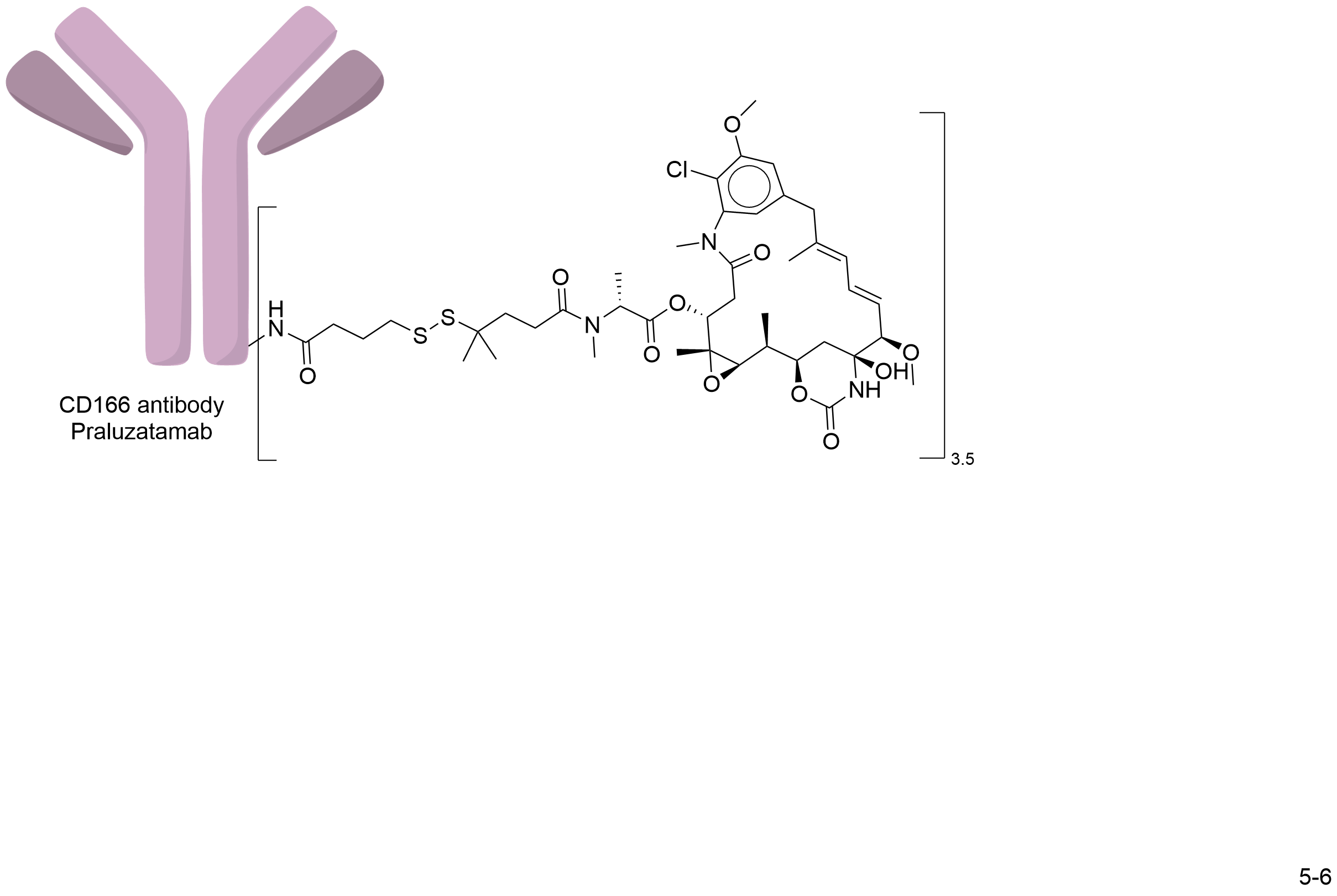
|
|||||
| Antibody Name |
Praluzatamab
|
Antibody Info | ||||
| Antigen Name |
CD166 antigen (ALCAM)
|
Antigen Info | ||||
| Payload Name |
DM4
|
Payload Info | ||||
| Payload Target |
Microtubule (MT)
|
Target Info | ||||
| Linker Name |
N-succinimidyl 4-(2-pyridyldithio) butanoate (SPDB)
|
Linker Info | ||||
| Conjugate Type |
Random Lysines
|
|||||
| Combination Type |
ravtansine
|
|||||
2027 Update
The disease landscape of This ADC
2027 Update
The clinical trial pipelines of This ADC
| Disease Name | Phase 1 | Phase 2 | Phase 3 | Approved |
|---|---|---|---|---|
| Lung cancer | ||||
| Breast cancer | ||||
| Ovarian cancer | ||||
| Head and neck cancer |
2027 Update
ADC-specific functional property
Binding Affinity
| Dissocation Constant (Kd) | Binding Target | Description | Reference |
|---|---|---|---|
| 25.15 nM |
CD166
|
Whereas the unmasked ADC counterpart CX-1031 and the parental antibody CX-090 bind with subnanomolar affinity to human CD166 protein with apparent Kd (Kapp) of 0.81 nM and 0.35 nM, respectively (Figure 2A), both CX-2009 and CX-191 showed a 29-fold (Kapp = 25.15 nM) and a 31-fold (Kapp = 9.96 nM) decrease in affinity compared to the corresponding CX-1031 (ADC) and CX-090 (mAb), respectively, consistent with masking of antigen binding by the prodomain
Click to Show/Hide
|
[1]
|
General Information of The Activity Data Related to This ADC
Identified from the Human Clinical Data
Full List of Activity Data of This Antibody-drug Conjugate
Identified from the Human Clinical Data
| Experiment 1 Reporting the Activity Date of This ADC | [2] | ||||
| Patients Enrolled |
Inclusion: (Arm A) HR+/HER2- breast cancer (0-2 prior metastatic chemo); (Arms B/C) CD166+ TNBC (1-3 prior lines; Arm C requires PD-L1+ by FDA test). All: RECIST-measurable disease, ECOG 0-1, adequate labs, contraception. Stable brain mets (≤1 cm/asymptomatic) allowed. Exclusion: Active malignancy (2 years), untreated symptomatic CNS mets, unresolved toxicity (Grade>1), corneal disorders, transplants. Arm C: Autoimmune disease/CPI intolerance, immunosuppressive steroids (>10 mg prednisone), maytansinoid exposure, pregnancy. Exceptions require Medical Monitor approval.
Click to Show/Hide
|
||||
| Administration Dosage |
Intravenous administration of the CX-2009 of 6 mg/kg administered every 3 weeks (Q3W)
|
||||
| Related Clinical Trial | |||||
| NCT Number | NCT04596150 | Clinical Status | PHASE2 | ||
| Clinical Description | A Phase 2, Open-Label Study to Evaluate the Safety and Antitumor Activity of Praluzatamab Ravtansine (CX-2009) in Advanced HR-Positive/HER2-Negative Breast Cancer and of Praluzatamab Ravtansine as Monotherapy and in Combination With Pacmilimab (CX-072) in Advanced Triple-Negative Breast Cancer (CTMX-2009-002) | ||||
| Primary Endpoint |
The primary endpoint is Objective Response Rate (ORR) over 30 months, defined as the proportion of patients achieving CR or PR per RECIST v1.1 via Central Radiology Review.
|
||||
| Other Endpoint |
Secondary outcomes include Investigator-assessed PFS (time to progression/death), DoR (time from response to progression), OS (time to death), and Clinical Benefit Rate (responses + stable disease at 16/24 weeks) over 30 months.
|
||||
| Experiment 2 Reporting the Activity Date of This ADC | [3] | ||||
| Patients Enrolled |
Inclusion: Metastatic/locally advanced unresectable tumors with progression post-standard therapy or intolerance; archival/fresh biopsy; ≥18 years. Exclusion: Active corneal disorders, serious infections, autoimmune/cardiac diseases, neurological conditions (e.g., stroke within 6 months, demyelinating disorders), non-healing wounds, monoclonal antibody allergies, warfarin use, or major surgery within 3 months.
Click to Show/Hide
|
||||
| Administration Dosage |
In this phase I multi-part dose-escalation study, pts with advanced solid tumors received CX-2009 0.25-10 mpk IV every 14 or 21 days (Q2W or Q3W). Tumor types were selected based on expected high CD166 expression and MTI sensitivity.
|
||||
| Related Clinical Trial | |||||
| NCT Number | NCT03149549 | Clinical Status | PHASE1|||PHASE2 | ||
| Clinical Description | A Phase 1-2, Open-Label, Dose-Finding, Proof of Concept, First-in-Human Study to Evaluate the Safety, Tolerability, Pharmacokinetics, and Pharmacodynamics of CX-2009 in Adults With Metastatic or Locally Advanced Unresectable Solid Tumors (PROCLAIM-CX-2009) | ||||
| Primary Endpoint |
The study evaluates Dose Limiting Toxicity (DLT) occurrence across CX-2009 monotherapy dose levels, captured via NCI CTCAE v4.03 criteria during 21-day (Q3W) or 28-day (Q2W) cycles per protocol-defined DLT thresholds.
|
||||
| Other Endpoint |
Anti-cancer activity is measured by Objective Response Rate (ORR) per RECIST 1.1, requiring confirmed CR/PR on consecutive tumor assessments ≥4 weeks apart. Imaging (CT/MRI) occurs every 8 (±1) weeks until progression, with median follow-up of 18.4 weeks.
|
||||
| Experiment 3 Reporting the Activity Date of This ADC | [4] | ||||
| Efficacy Data | Partial Response (PR) |
9%
|
|||
| Patients Enrolled |
Eastern Cooperative Oncology Group (ECOG) 0, 1, metastatic or locally advanced unresectable solid tumors with progressive disease (PD) after standard treatment or known intolerance to available treatment, based on the predicted prevalence of CD166 expression, were breast cancer, castration-resistant prostate cancer, nonsmall cell lung cancer (NSCLC), epithelial ovarian cancer, head and neck squamous cell cancer (HNSCC), cholangiocarcinoma, and endometrial carcinoma.
Click to Show/Hide
|
||||
| Administration Dosage |
Scalating doses every 3 weeks (0.25-10 mg/kg) or every 2 weeks (4-6 mg/kg), IV.
|
||||
| Related Clinical Trial | |||||
| NCT Number | NCT03149549 | Clinical Status | Phase 1/2 | ||
| Clinical Description | A phase 1-2, open-label, dose-finding, proof of concept, first-in-human study to evaluate the safety, tolerability, pharmacokinetics, and pharmacodynamics of CX-2009 in adults with metastatic or locally advanced unresectable solid tumors (PROCLAIM-CX-2009). | ||||
| Primary Endpoint |
Median number of prior therapies was 5. On the basis of tolerability, the RP2D was 7 mg/kg every 3 weeks. Tumor regressions were observed at doses 4 mg/kg.
|
||||
References