
Antibody-drug Conjugate Information
General Information of This Antibody-drug Conjugate (ID: DRG0EPHMC)
| ADC Name |
Anetumab ravtansine
|
|||||
|---|---|---|---|---|---|---|
| Synonyms |
anetumab ravtansine; BAY 94-9343; BAY94-9343
Click to Show/Hide
|
|||||
| Organization |
Bayer (Top20 MNC) (Originator);ImmunoGen (Top20 MNC);MorphoSys (Top20 MNC)
|
|||||
| Drug Status |
Phase 2 (discontinued)
|
|||||
| Drug-to-Antibody Ratio |
3.2
|
|||||
| Structure |
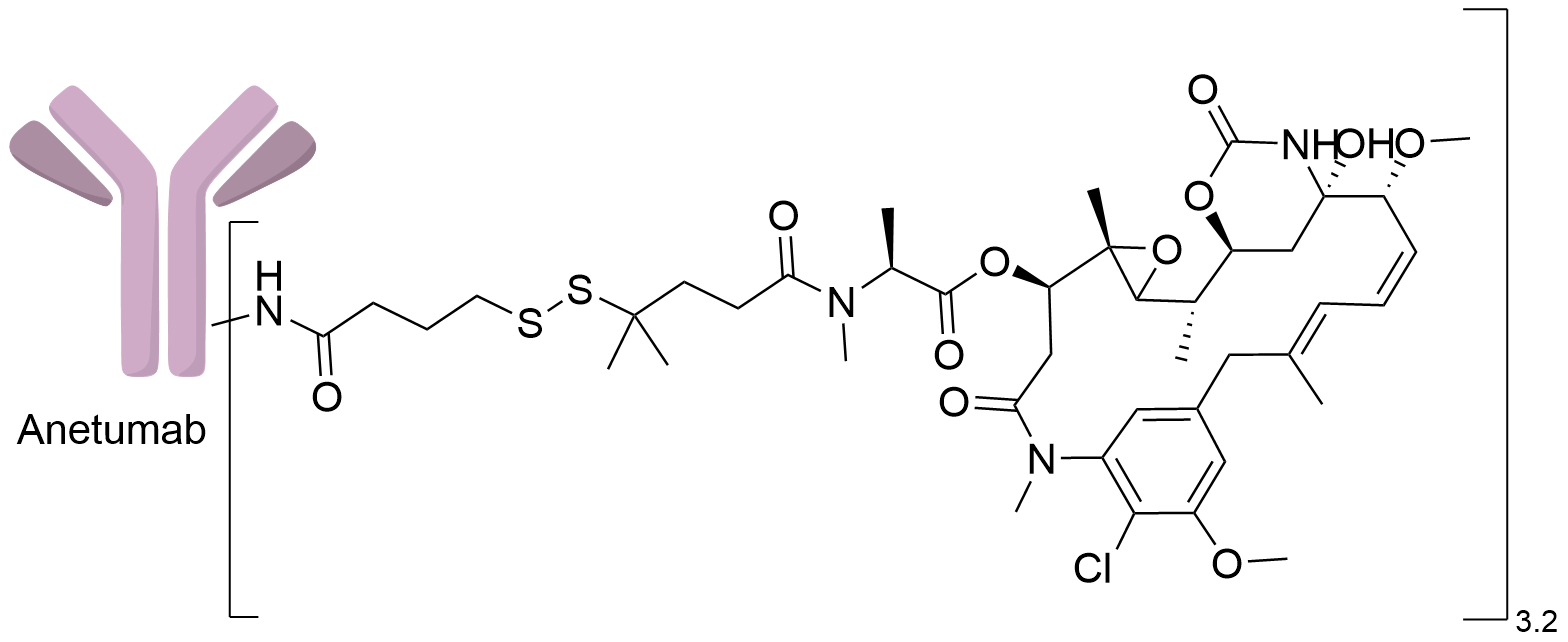
|
|||||
| Antibody Name |
Anetumab
|
Antibody Info | ||||
| Antigen Name |
Mesothelin (MSLN)
|
Antigen Info | ||||
| Payload Name |
DM4
|
Payload Info | ||||
| Payload Target |
Microtubule (MT)
|
Target Info | ||||
| Linker Name |
N-succinimidyl 4-(2-pyridyldithio) butanoate (SPDB)
|
Linker Info | ||||
| Conjugate Type |
Random Lysines
|
|||||
| Combination Type |
ravtansine
|
|||||
| Special Approval(s) |
Orphan drug (EMA)
|
|||||
2027 Update
The disease landscape of This ADC
2027 Update
The clinical trial pipelines of This ADC
| Disease Name | Phase 1 | Phase 2 | Phase 3 | Approved |
|---|---|---|---|---|
| Gastroesophageal junction adenocarcinoma | ||||
| Gastric cancer | ||||
| Pancreatic cancer | ||||
| Biliary tract cancer | ||||
| Lung cancer | ||||
| Pleura mesothelioma | ||||
| Thymus cancer | ||||
| Peritoneal cancer | ||||
| Breast cancer | ||||
| Ovarian cancer | ||||
| Fallopian tube cancer | ||||
| Unspecific solid tumor |
2027 Update
ADC-specific functional property
Binding Affinity
| Dissocation Constant (Kd) | Binding Target | Description | Reference |
|---|---|---|---|
| 15 nM |
MSLN
|
The resulting ADC bound to human recombinant mesothelin with high affinity (Kd = 15nM).
|
[1]
|
General Information of The Activity Data Related to This ADC
Identified from the Human Clinical Data
Discovered Using Patient-derived Xenograft Model
Discovered Using Cell Line-derived Xenograft Model
Revealed Based on the Cell Line Data
Full List of Activity Data of This Antibody-drug Conjugate
Identified from the Human Clinical Data
| Experiment 1 Reporting the Activity Date of This ADC | [2] | ||||
| Patients Enrolled |
Eligible patients: platinum-resistant/refractory high-grade ovarian/fallopian tube/primary peritoneal cancer (GCIC criteria; measurable disease required for Phase 2); ECOG ≤2; adequate hematologic/organ function; MSLN-positive (≥30% tumor cells with 2+ staining) for Phase 2 only. Key exclusions: recent chemotherapy/radiotherapy (≤4 weeks); strong CYP3A4 modulators; uncontrolled comorbidities (HTN, cardiovascular/CNS events, infections); pregnancy; prior bevacizumab/weekly paclitaxel in platinum-resistant setting. Brain metastases allowed if stable ≥4 weeks post-radiation without steroids.
Click to Show/Hide
|
||||
| Administration Dosage |
Patients receive anetumab ravtansine IV over 1 hour on days 1, 8, 15, and 22 and bevacizumab over 30-90 minutes IV on days 1 and 15. Cycles repeat every 28 days in the absence of disease progression or unacceptable toxicity.
|
||||
| Related Clinical Trial | |||||
| NCT Number | NCT03587311 | Clinical Status | PHASE2 | ||
| Clinical Description | A Randomized Phase 2 Study of Bevacizumab and Either Weekly Anetumab Ravtansine or Weekly Paclitaxel in Platinum-Resistant or Platinum Refractory Ovarian Cancer | ||||
| Primary Endpoint |
PFS will be evaluated over 1 year using Kaplan-Meier methodology and compared between groups with a log-rank test, including median, 6-month estimates with 95% CIs, and corresponding survival plots.
|
||||
| Other Endpoint |
Tumor response (RECIST) will undergo a single final analysis at 1 year with two-sided testing (alpha=0.05) and 95% CIs for outcome measures.
|
||||
| Experiment 2 Reporting the Activity Date of This ADC | [3] | ||||
| Patients Enrolled |
Inclusion: Unresectable/metastatic pancreatic cancer (1-2 prior chemo lines; 2+/3+ mesothelin expression in ≥30% tumor cells), ECOG 0-1, adequate organ function. Exclusion: Prior mesothelin-targeted therapy, significant cardiac/ocular/CNS conditions, active infections (HIV/HBV/HCV), recent major surgery, unresolved toxicity >Grade 1, or pregnancy. Brain metastases allowed if stable >6 months post-therapy with negative imaging.
Click to Show/Hide
|
||||
| Administration Dosage |
Patients will receive anetumab ravtansine IV infusion at a dose of 6.5 mg/kg (recommended Phase II dose) on Day 1 of a 21-day cycle
|
||||
| Related Clinical Trial | |||||
| NCT Number | NCT03023722 | Clinical Status | PHASE2 | ||
| Clinical Description | An Open-label, Phase II Study of Intravenous Anetumab Ravtansine (BAY 94-9343), an Anti-mesothelin Antibody Drug Conjugate, in Pretreated Mesothelin-expressing Advanced Pancreatic Cancer | ||||
| Primary Endpoint |
Response rate will be evaluated per RECIST 1.1 via contrast-enhanced CT/MRI (chest/abdomen/pelvis) with baseline prescreening scans and subsequent assessments every 6 weeks (initial 6 months), then every 9 weeks (year 2), and 12 weeks thereafter until progression/study end (up to 3 years).
|
||||
| Other Endpoint |
Time to progression (TTP) measures duration from treatment start to RECIST progression/death, with censoring for other discontinuations. Drug toxicity will be graded per NCI-CTCAE v4.03, capturing all adverse events during the 3-year follow-up.
|
||||
| Experiment 3 Reporting the Activity Date of This ADC | [4] | ||||
| Patients Enrolled |
Inclusion: Metastatic/unresectable pancreatic adenocarcinoma (mesothelin-positive; ≥5% tumor cells for escalation, ≥30% 2+/3+ for expansion), ≥1 prior systemic therapy, ECOG 0-1, measurable disease, accessible lesions for biopsies, adequate organ function. Exclusion: Active CNS metastases/uncontrolled infections; recent major surgery/live vaccines; unresolved CTCAE ≥G2 toxicities (except alopecia/G2 neuropathy); autoimmune/inflammatory diseases (exceptions: stable hypothyroidism/vitiligo); strong CYP3A4 modulators; pregnancy/HIV-HBV-HCV (unless controlled); prior organ transplants. Corneal disorders may exclude per ophthalmologist assessment.
Click to Show/Hide
|
||||
| Administration Dosage |
.
|
||||
| Related Clinical Trial | |||||
| NCT Number | NCT03816358 | Clinical Status | PHASE1 | ||
| Clinical Description | A Phase I Study of Anetumab Ravtansine in Combination With Either Anti-PD-1 Antibody, or Anti-CTLA4 and Anti-PD-1 Antibodies or Anti-PD-1 Antibody and Gemcitabine in Mesothelin-Positive Advanced Pancreatic Adenocarcinoma | ||||
| Primary Endpoint |
The maximum tolerated dose (MTD) will be determined during the 30-37 day post-treatment period using a standard 3+3 dose escalation design.
|
||||
| Other Endpoint |
Biomarker analysis (up to 100 days post-treatment) will explore CD8 changes pre- and post-treatment, utilizing paired T-tests and mixed models. Associations between biomarkers (baseline/dynamics) and clinical outcomes (PFS, toxicity, response) will be analyzed via Cox/logistic regression, with potential multiplicity adjustments (Pocock method).
|
||||
| Experiment 4 Reporting the Activity Date of This ADC | [5] | ||||
| Patients Enrolled |
Inclusion: Japanese patients (≥20 years) with ECOG 0-1, life expectancy ≥12 weeks, advanced solid tumors (refractory/no standard therapy), measurable disease (RECIST 1.1), and adequate organ function. Exclusion: Recent anticancer therapy (<2 weeks), significant cardiac disease (CHF NYHA III/IV, recent MI/unstable angina, QTc >470 ms, LVEF <50%, uncontrolled hypertension), active HIV/HBV/HCV, LQTS history, or clinically significant eye disorders.
Click to Show/Hide
|
||||
| Administration Dosage |
Cohort 1: 4.5 mg/kg of BAY 94-9343 at Q3W dose regimen. Cohort 2: 6.5 mg/kg of BAY 94-9343 at Q3W dose regimen.
|
||||
| Related Clinical Trial | |||||
| NCT Number | NCT02485119 | Clinical Status | PHASE1 | ||
| Clinical Description | An Open Label, Phase I Study to Evaluate the Safety, Tolerability and Pharmacokinetics of BAY94-9343 Given by Intravenous Infusion Every 3 Weeks (Q3W) in Japanese Subjects With Advanced Malignancies | ||||
| Primary Endpoint |
The study will assess treatment-emergent adverse events (TEAEs) graded by NCI CTCAE v4.03 over 9 weeks. Pharmacokinetic parameters (Cmax, AUC, tmax) for BAY94-9343, its total antibody compound, DM4, and metabolite DM4-Me will be measured across cycles (1-6) at multiple timepoints, including dose-normalized values (Cmax/D, AUC/D) and body-weight-adjusted metrics (Cmax,norm, AUCnorm) to evaluate drug exposure.
Click to Show/Hide
|
||||
| Other Endpoint |
Efficacy will be evaluated via RECIST criteria over 9 weeks, alongside mesothelin expression via IHC in tumor tissue and soluble mesothelin plasma levels. Immunogenicity will be monitored through anti-BAY94-9343 antibody counts.
|
||||
| Experiment 5 Reporting the Activity Date of This ADC | [6] | ||||
| Patients Enrolled |
Inclusion: Adults with unresectable, mesothelin-positive (≥10% tumor cells, 2+/3+ intensity) lung adenocarcinoma (stage IIIB/IV), prior platinum/immunotherapy, ECOG ≤2, measurable disease (RECIST), and adequate organ function. Exclusion: Concurrent cancers, uncontrolled CVD (NYHA III/IV CHF, recent MI/stroke, QTc >480 ms), active HBV/HCV/HIV, unresolved CTCAE >1 toxicity (except alopecia/anemia), recent major surgery/radiotherapy to target lesions, strong CYP3A4 modulators, or prior anetumab ravtansine exposure. Corneal disorders may disqualify per investigator assessment.
Click to Show/Hide
|
||||
| Administration Dosage |
Administered intravenously (IV) every 3 weeks
|
||||
| Related Clinical Trial | |||||
| NCT Number | NCT02839681 | Clinical Status | PHASE2 | ||
| Clinical Description | Phase II Trial With Safety Run-in of the Anti-Mesothelin Antibody Drug Conjugate Anetumab Ravtansine for Mesothelin Expressing Lung Adenocarcinoma | ||||
| Primary Endpoint |
The Recommended Phase 2 Dose (RP2D) will be determined as the highest dose with ≤1 dose-limiting toxicity (DLT), defined as treatment-emergent adverse events (TEAEs) like prolonged grade 4 neutropenia during Cycle 1. Efficacy endpoints include the proportion of subjects achieving partial/complete response (≥30% reduction/disappearance of target lesions per RECIST), assessed at 6 weeks.
Click to Show/Hide
|
||||
| Other Endpoint |
Key secondary outcomes include progression-free survival (time to progression/death; RECIST-defined as ≥20% lesion growth + ≥5mm absolute increase), duration of response (time from CR/PR to progression), and overall survival (time to death from any cause). Safety will be monitored via CTCAE v4.0-graded serious/non-serious adverse events during the safety run-in phase (2 months).
Click to Show/Hide
|
||||
| Experiment 6 Reporting the Activity Date of This ADC | [7] | ||||
| Patients Enrolled |
Inclusion: Advanced/metastatic NSCLC patients (Phase I: no standard therapy; Phase II: ≥1 prior platinum regimen) with mesothelin expression (≥30% tumor cells, Ventana IHC 2+/3+), ECOG 0-1, measurable disease (Phase II), and adequate organ function. Exclusion: Prior anti-PD-1/PD-L1 therapy (except anti-CTLA-4 with specific criteria), CNS metastases (unless asymptomatic/stable), uncontrolled CVD (NYHA III/IV CHF, recent angina/MI), active infections, autoimmune diseases (exceptions for stable conditions), recent major surgery/radiotherapy, or corneal disorders. Pregnant women and those with untreated HBV/HCV or severe immunosuppression are excluded.
Click to Show/Hide
|
||||
| Administration Dosage |
Participants receive anetumab ravtansine IV over 60 minutes and atezolizumab IV over 30-60 minutes on day 1. Courses repeat every 21 days in the absence of disease progression or unacceptable toxicity.
|
||||
| Related Clinical Trial | |||||
| NCT Number | NCT03455556 | Clinical Status | PHASE1 | ||
| Clinical Description | Phase I/II Study of the Human Anti-Mesothelin Antibody Drug Conjugate Anetumab Ravtansine (AR), Combined With the PD-L1 Inhibitor Atezolizumab in Non-Small Cell Lung Cancer | ||||
| Primary Endpoint |
The Phase I portion aims to determine the Maximum Tolerated Dose (MTD) of anetumab ravtansine combined with atezolizumab, defined as the highest dose level where ≤1 out of 6 patients experience dose-limiting toxicities (DLTs) within 21 days. In Phase II, efficacy will be assessed via the confirmed response rate (CR/PR on two consecutive scans ≥4 weeks apart), analyzed using exact binomial 95% CIs.
Click to Show/Hide
|
||||
| Other Endpoint |
Phase I will evaluate clinical activity (CR, PR, SD, PD via descriptive statistics) and adverse event incidence (CTCAE v4.0 graded) over 21 days post-treatment. Phase II endpoints include overall survival (time to death, Kaplan-Meier estimation up to 2 years), progression-free survival (time to progression/death; 1- and 2-year rates reported), and safety monitoring.
Click to Show/Hide
|
||||
| Experiment 7 Reporting the Activity Date of This ADC | [8] | ||||
| Patients Enrolled |
Inclusion: Malignant pleural mesothelioma patients (post-platinum therapy, mesothelin-positive [≥30% tumor cells], measurable disease per RECIST/mRECIST) with ECOG <2, adequate organ function, and contraception compliance. Exclusion: Active brain metastases, recent anti-PD-1/PD-L1 therapy, unresolved CTCAE >1 toxicity (except neuropathy/alopecia), CYP3A4 modulators, pregnancy, HIV/HBV/HCV (unless controlled), corneal epitheliopathy, or interstitial lung disease. Prior transfusions/G-CSF within 4 weeks or live vaccines within 30 days are prohibited.
Click to Show/Hide
|
||||
| Administration Dosage |
.
|
||||
| Related Clinical Trial | |||||
| NCT Number | NCT03126630 | Clinical Status | PHASE1|||PHASE2 | ||
| Clinical Description | Phase 1 Safety Run-In and Phase 2 Randomized Clinical Trial of Anetumab Ravtansine and Pembrolizumab (MK-3475) Compared to Pembrolizumab Alone for Mesothelin-Positive Malignant Pleural Mesothelioma | ||||
| Primary Endpoint |
The Phase II portion will evaluate confirmed tumor response rate (CR + PR per RECIST 1.1) over 2 years, comparing treatment arms via one-sided z-test (alpha=0.10). The Phase I component will determine the Recommended Phase 2 Dose (RP2D) of anetumab ravtansine combined with pembrolizumab, assessing toxicity in all treated patients (DLT evaluability excludes non-toxicity-related discontinuations).
Click to Show/Hide
|
||||
| Other Endpoint |
Key Phase II endpoints include duration of response (Kaplan-Meier estimation from treatment start, log-rank test for arm comparison), overall survival (death from any cause, Kaplan-Meier/log-rank), and progression-free survival (time to progression/death per RECIST 1.1). Pharmacodynamic analyses will correlate megakaryocyte potentiating factor levels with response (Wilcoxon/Jonckheere-Terpstra tests) and explore mononuclear phagocyte system biomarkers (linear regression). Adverse events will be tracked via PRO-CTCAE over 2 years.
Click to Show/Hide
|
||||
| Experiment 8 Reporting the Activity Date of This ADC | [9] | ||||
| Patients Enrolled |
Inclusion Criteria: Mesothelin-overexpressing, unresectable/advanced MPM post-1st-line platinum/pemetrexed, measurable disease, ECOG 0-1, adequate organ function, LVEF ≥50%. Exclusion Criteria: >1 prior therapy, active eye/corneal disorders, CNS metastases, bleeding diathesis, CTCAE Grade >2 infections, or significant cardiac conditions.
|
||||
| Administration Dosage |
Starting dose: 6.5 mg/kg administered as IV infusion over 1 h every 3 weeks until disease progression or treatment withdrawal for any reason. Dose reductions are permitted.
|
||||
| Related Clinical Trial | |||||
| NCT Number | NCT02610140 | Clinical Status | PHASE2 | ||
| Clinical Description | A Randomized, Open-label, Active-controlled, Phase II Study of Intravenous Anetumab Ravtansine (BAY 94-9343) or Vinorelbine in Patients With Advanced or Metastatic Malignant Pleural Mesothelioma Overexpressing Mesothelin and Progressed on First Line Platinum/Pemetrexed-based Chemotherapy | ||||
| Primary Endpoint |
The study assessed Progression-Free Survival (PFS) as the time from randomization to disease progression (per mRECIST) or death, with follow-up until ~117 PFS events occurred (data cutoff: May-2017). Only descriptive overall survival (OS) analysis was repeated in later follow-ups.
|
||||
| Other Endpoint |
Key efficacy endpoints included OS (time to death; log-rank test), Objective Response Rate (ORR, CR+PR per mRECIST), Disease Control Rate (DCR, CR+PR+SD), Duration of Response (DOR), and Durable Response Rate (DRR, response ≥180 days). Symptom improvement (MDASI-MPM) and pain metrics (TTWP, improvement rates) were tracked. Treatment-emergent adverse events (TEAEs) and fatal outcomes were analyzed through Jul-2019.
Click to Show/Hide
|
||||
| Experiment 9 Reporting the Activity Date of This ADC | [10] | ||||
| Patients Enrolled |
Inclusion Criteria: Adults (≥18) with unresectable epithelial mesothelioma or nonsquamous NSCLC (chemotherapy-naive or pretreated, though NSCLC subjects must have received FDA-approved therapies first) and measurable disease (RECIST 1.1/mRECIST), ECOG 0-1, life expectancy ≥12 weeks, and adequate organ function. Exclusion Criteria: Prior/distinct cancers (unless cured >3 years prior), bleeding disorders (CTCAE ≥G2), active CNS metastases, uncontrolled cardiovascular disease (NYHA III/IV), hypertension (≥160/100 mmHg), biliary obstruction, organ transplantation, drug hypersensitivity, active HBV/HCV/HIV, serious infections (CTCAE ≥G2), recent anticancer therapies/radiotherapy (within 4 weeks), or anticoagulation started within 2 weeks pre-treatment.
Click to Show/Hide
|
||||
| Administration Dosage |
Investigating the combination of anetumab ravtansine (BAY 94-9343) with Pemetrexed (500 mg/m2) and Cisplatin (75 mg/m2) in Part 1 (dose escalation cohorts) and Part 2 (two MTD expansion cohorts).
|
||||
| Related Clinical Trial | |||||
| NCT Number | NCT02639091 | Clinical Status | PHASE1 | ||
| Clinical Description | An Open Label Phase Ib Dose Escalation Study to Evaluate the Safety, Tolerability, Pharmacokinetics, Immunogenicity and Maximum Tolerated Dose of Anetumab Ravtansine in Combination With Pemetrexed 500 mg/m2 and Cisplatin 75 mg/m2 in Subjects With Mesothelin-expressing Predominantly Epithelial Mesothelioma or Nonsquamous Non-small-cell Lung Cancer | ||||
| Primary Endpoint |
The study aimed to determine the maximum tolerated dose (MTD) of oral anetumab ravtansine combined with IV pemetrexed and cisplatin, defined as the highest dose where ≤1 of 6 subjects experienced dose-limiting toxicity (DLT). Safety and tolerability were assessed through adverse events (AEs) and serious AEs (SAEs) over 2 years.
|
||||
| Other Endpoint |
Pharmacokinetics included plasma concentrations of anetumab ravtansine (sampled at multiple timepoints), pemetrexed (Cycle 1 Days 1-3), and cisplatin (Cycle 1 Days 1-3). Tumor response was evaluated per mRECIST (every 8 weeks initially, then every 12 weeks). Anti-drug antibodies were monitored periodically (Day 1 of Cycles 1, 3, 6, etc.).
|
||||
| Experiment 10 Reporting the Activity Date of This ADC | [11] | ||||
| Efficacy Data | Objective Response Rate (ORR) | 9.60% | Moderate MSLN expresion (MSLN++; 135,000-480,000 CD48 molecules/cell) | ||
| Patients Enrolled |
Unresectable locally advanced or metastatic malignant pleural mesothelioma, an Eastern Cooperative Oncology Group performance status of 0-1, and who had progressed on first-line platinum-pemetrexed chemotherapy with or without bevacizumab.
|
||||
| Administration Dosage |
Anetumab ravtansine (6.50 mg/kg once every 3 weeks) via intravenous infusion for 1 h on day 1 of each 21-day cycle, or vinorelbine (30 mg/m2 once every week) via intravenous injection for 610 min.
|
||||
| Related Clinical Trial | |||||
| NCT Number | NCT02610140 | Clinical Status | Phase 2 | ||
| Clinical Description | A randomized, open-label, active-controlled, phase 2 study of intravenous anetumab ravtansine (BAY 94-9343) or vinorelbine in patients with advanced or metastatic malignant pleural mesothelioma overexpressing mesothelin and progressed on first line platinum/pemetrexed-based chemotherapy. | ||||
| Primary Endpoint |
For 6.50 mg/kg anetumab ravtansine,median progression-free survival 4.30 months [95% CI 41.00-52.00].
|
||||
| Experiment 11 Reporting the Activity Date of This ADC | [12] | ||||
| Efficacy Data | Objective Response Rate (ORR) | 27.70, 42.10 % | High MSLN expresion (MSLN+++; 19,998 MSLN molecules/cell) | ||
| Patients Enrolled |
Predominantly epithelial (>50% of tumor component) platinum-resistant recurrent ovarian, fallopian tube, or primary peritoneal cancer.
|
||||
| Administration Dosage |
Anetumab ravtansine (5.50 or 6.50 mg/kg) and pegylated liposomal doxorubicin (30 mg/m2) were administered intravenously every 3 weeks to 65 patients with platinum-resistant epithelial ovarian cancer.
|
||||
| Related Clinical Trial | |||||
| NCT Number | NCT02751918 | Clinical Status | Phase 1b | ||
| Clinical Description | An open-label phase 1b dose escalation study to evaluate the safety, tolerability, pharmacokinetics, immunogenicity and maximum tolerated dose of anetumab ravtansine in combination with pegylated liposomal doxorubicin 30 mg/m2 given every 3 weeks in subjects with mesothelin-expressing platinum-resistant recurrent ovarian, fallopian tube or primary peritoneal cancer. | ||||
| Primary Endpoint |
The maximum tolerated dose of anetumab ravtansine in combination was 6.50 mg/kg administered every 3 weeks. No patient experienced a dose-limiting toxicity at either dose in the dose escalation cohort.
|
||||
| Other Endpoint |
In all treated patients, ORR=27.70% (95% CI 17.30% to 40.20%), including one complete (1.50%) and 17 partial responses (26.20%). Mdor=7.60 months (95% CI 3.30 to 10.20), mPFS=5.0 months (95% CI 3.20 to 6.00). In high mesothelin expression patients (N=19), who received 3 prior lines of systemic therapy, ORR=42.10% (95% CI 20.30% to 66.50%), mDOR=8.30 months (95% CI 4.10 to 12.00), mFPS=8.50 months (95% CI 4.00 to 11.40).
Click to Show/Hide
|
||||
| Experiment 12 Reporting the Activity Date of This ADC | [13] | ||||
| Efficacy Data | Objective Response Rate (ORR) | 31% | Moderate MSLN expresion (MSLN++; 1105 MSLN molecules/cell) | ||
| Patients Enrolled |
Advanced, metastatic, or recurrent solid tumors refractory to standard therapy.
|
||||
| Administration Dosage |
0.15, 0.30, 0.60, 1.20, 2.40, 3.60, 4.50, 5.50, 6.50, and 7.50 mg/kg once every 3 weeks.
|
||||
| Related Clinical Trial | |||||
| NCT Number | NCT01439152 | Clinical Status | Phase 1 | ||
| Clinical Description | An open label phase 1 dose escalation study to evaluate the safety, tolerability, pharmacokinetics, pharmacodynamics, and maximum tolerated dose of the anti-mesothelin antibody drug conjugate BAY94-9343 in subjects with advanced solid tumors. | ||||
| Experiment 13 Reporting the Activity Date of This ADC | [14] | ||||
| Related Clinical Trial | |||||
| NCT Number | NCT02610140 | Clinical Status | Phase 2 | ||
| Clinical Description | A randomized, open-label, active-controlled, phase 2 study of intravenous anetumab ravtansine (BAY 94-9343) or vinorelbine in patients with advanced or metastatic malignant pleural mesothelioma overexpressing mesothelin and progressed on first line platinum/pemetrexed-based chemotherapy. | ||||
| Experiment 14 Reporting the Activity Date of This ADC | [15] | ||||
| Related Clinical Trial | |||||
| NCT Number | NCT03587311 | Clinical Status | Phase 2 | ||
| Clinical Description | A randomized phase 2 study of bevacizumab and either weekly anetumab ravtansine or weekly paclitaxel in platinum-resistant or platinum refractory ovarian cancer. | ||||
| Experiment 15 Reporting the Activity Date of This ADC | [16] | ||||
| Related Clinical Trial | |||||
| NCT Number | NCT02839681 | Clinical Status | Phase 2 | ||
| Clinical Description | Phase 2 trial with safety run-in of the anti-mesothelin antibody drug conjugate anetumab ravtansine for mesothelin expressing lung adenocarcinoma. | ||||
| Experiment 16 Reporting the Activity Date of This ADC | [17] | ||||
| Related Clinical Trial | |||||
| NCT Number | NCT03023722 | Clinical Status | Phase 2 | ||
| Clinical Description | An open-label, phase 2 study of intravenous anetumab ravtansine (BAY 94-9343), an anti-mesothelin antibody drug conjugate, in pretreated mesothelin-expressing advanced pancreatic cancer. | ||||
| Experiment 17 Reporting the Activity Date of This ADC | [18] | ||||
| Related Clinical Trial | |||||
| NCT Number | NCT03926143 | Clinical Status | Phase 2 | ||
| Clinical Description | An open-label, multicenter rollover study to provide continued treatment with anetumab ravtansine for participants with solid tumors who were enrolled in previous bayer-sponsored studies. | ||||
| Experiment 18 Reporting the Activity Date of This ADC | [19] | ||||
| Related Clinical Trial | |||||
| NCT Number | NCT03126630 | Clinical Status | Phase 1/2 | ||
| Clinical Description | Phase 1 safety run-in and phase 2 randomized clinical trial of anetumab ravtansine and pembrolizumab (MK-3475) compared to pembrolizumab alone for mesothelin-positive malignant pleural mesothelioma. | ||||
| Experiment 19 Reporting the Activity Date of This ADC | [20] | ||||
| Related Clinical Trial | |||||
| NCT Number | NCT02485119 | Clinical Status | Phase 1 | ||
| Clinical Description | An open label, phase 1 study to evaluate the safety, tolerability and pharmacokinetics of BAY94-9343 given by intravenous infusion every 3 weeks (Q3W) in Japanese subjects with advanced malignancies. | ||||
| Experiment 20 Reporting the Activity Date of This ADC | [21] | ||||
| Related Clinical Trial | |||||
| NCT Number | NCT03816358 | Clinical Status | Phase 1 | ||
| Clinical Description | A phase 1 study of anetumab ravtansine in combination with either anti-PD-1 antibody, or anti-CTLA4 and anti-PD-1 antibodies or anti-PD-1 antibody and gemcitabine in mesothelin-positive advanced pancreatic adenocarcinoma. | ||||
| Experiment 21 Reporting the Activity Date of This ADC | [22] | ||||
| Related Clinical Trial | |||||
| NCT Number | NCT02639091 | Clinical Status | Phase 1 | ||
| Clinical Description | An open label phase 1b dose escalation study to evaluate the safety, tolerability, pharmacokinetics, immunogenicity and maximum tolerated dose of anetumab ravtansine in combination with pemetrexed 500 mg/m2 and cisplatin 75 mg/m2 in subjects with mesothelin-expressing predominantly epithelial mesothelioma or nonsquamous non-small-cell lung cancer. | ||||
| Experiment 22 Reporting the Activity Date of This ADC | [23] | ||||
| Patients Enrolled |
Unresectable locally advanced or metastatic recurrent or relapsing disease.
|
||||
| Administration Dosage |
Mesothelin-positive patients with selected adenocarcinomas (NSCLC, triple negative breast, gastric including gastroesophageal junction) and thymic carcinoma will receive anetumab ravtansine as monotherapy at 6.50 mg/kg IV on a 21-day cycle. Patients with cholangiocarcinoma will receive anetumab ravtansine in combination with cisplatin (25 mg/m2 IV day 1 and 8 on a 21-day cycle for up to 6 cycles) and patients with pancreatic adenocarcinoma will receive anetumab ravtansine in combination with gemcitabine (1000 mg/m2 IV day 1 and 8 on a 21-day cycle).
Click to Show/Hide
|
||||
| Related Clinical Trial | |||||
| NCT Number | NCT03102320 | Clinical Status | Phase 1 | ||
| Clinical Description | Phase 1b multi-indication study of anetumab ravtansine (BAY94-9343) in patients with mesothelin expressing advanced or recurrent malignancies. | ||||
| Experiment 23 Reporting the Activity Date of This ADC | [24] | ||||
| Related Clinical Trial | |||||
| NCT Number | NCT02824042 | Clinical Status | Phase 1 | ||
| Clinical Description | An open label, phase 1 study to assess the effect of itraconazole (CYP3A4 and P-gp Inhibitor) on the pharmacokinetics of anetumab ravtansine and to assess the ECG Effects, safety and immunogenicity of anetumab ravtansine given as a single agent and together with itraconazole in subjects with mesothelin-expressing advanced solid cancers. | ||||
| Experiment 24 Reporting the Activity Date of This ADC | [25] | ||||
| Related Clinical Trial | |||||
| NCT Number | NCT03455556 | Clinical Status | Phase 1 | ||
| Clinical Description | Phase 1/2 study of the human anti-mesothelin antibody drug conjugate anetumab ravtansine (AR), combined with the PD-L1 inhibitor atezolizumab in non-small cell lung cancer. | ||||
| Experiment 25 Reporting the Activity Date of This ADC | [26] | ||||
| Related Clinical Trial | |||||
| NCT Number | NCT02696642 | Clinical Status | Phase 1 | ||
| Clinical Description | An open label phase 1 study to evaluate the safety, tolerability, pharmacokinetics and immunogenicity of anetumab ravtansine in subjects with mesothelin-expressing advanced solid cancers and different stages of concurrent hepatic or renal impairment. | ||||
| Experiment 26 Reporting the Activity Date of This ADC | [27] | ||||
| Related Clinical Trial | |||||
| NCT Number | NCT02751918 | Clinical Status | Phase 1 | ||
| Clinical Description | An open-label phase 1b dose escalation study to evaluate the safety, tolerability, pharmacokinetics, immunogenicity and maximum tolerated dose of anetumab ravtansine in combination with pegylated liposomal doxorubicin 30 mg/m2 given every 3 weeks in subjects with mesothelin-expressing platinum-resistant recurrent ovarian, fallopian tube or primary peritoneal cancer. | ||||
Discovered Using Patient-derived Xenograft Model
| Experiment 1 Reporting the Activity Date of This ADC | [28] | ||||
| Efficacy Data | Tumor Growth Inhibition value (TGI) | ≈ 0% | Moderate Mesothelin expression (MSLN++; IHC 2+) | ||
| Method Description |
The in vivo antitumor activity of Anetumab ravtansine was evaluated in a Mesothelin positive xenograft tumor models. Mice were subcutaneously inoculated with 5x10⁶ MSLN positive T1889 cells mixed with Matrigel. Treatment then began, and the experiments ran for a total of 4 weeks. The first treatment cohort of 32 mice consisted of vehicle control, isotype ADC control, and 15 mg/kg ARav, dosed at Q7D via intraperitoneal injection. A second treatment cohort of 30 mice occurred with groups consisting of vehicle control (Q14D), 7.5 mg/kg ARav (Q14D) monotherapy, 7.5 mg/kg ARav (Q14D) and 4 mg/kg cisplatin (Q7D) combination therapy, and 4 mg/kg cisplatin (Q7D) monotherapy. A third treatment cohort of 32 mice occurred with groups consisting of vehicle control (Q14D), 3.75 mg/kg ARav (Q14D) monotherapy, 3.75 mg/kg ARav (Q14D) and 4 mg/kg cisplatin (Q7D) combination therapy, and 4 mg/kg cisplatin (Q7D) monotherapy.
Click to Show/Hide
|
||||
| In Vivo Model | Mesothelin-expressing uterine carcinosarcoma PDX model (PDX: T1889) | ||||
| Experiment 2 Reporting the Activity Date of This ADC | [29] | ||||
| Efficacy Data | Tumor Growth Inhibition value (TGI) | 0% | Moderate Mesothelin expression (MSLN++; IHC 2+) | ||
| Method Description |
The in vivo antitumor activity of Anetumab ravtansine was evaluated in a Mesothelin positive xenograft tumor models. Mice were subcutaneously inoculated with 5x10⁶ MSLN positive T1889 cells mixed with Matrigel. Treatment then began, and the experiments ran for a total of 4 weeks. The first treatment cohort of 32 mice consisted of vehicle control, isotype ADC control, and 15 mg/kg ARav, dosed at Q7D via intraperitoneal injection. A second treatment cohort of 30 mice occurred with groups consisting of vehicle control (Q14D), 7.5 mg/kg ARav (Q14D) monotherapy, 7.5 mg/kg ARav (Q14D) and 4 mg/kg cisplatin (Q7D) combination therapy, and 4 mg/kg cisplatin (Q7D) monotherapy. A third treatment cohort of 32 mice occurred with groups consisting of vehicle control (Q14D), 3.75 mg/kg ARav (Q14D) monotherapy, 3.75 mg/kg ARav (Q14D) and 4 mg/kg cisplatin (Q7D) combination therapy, and 4 mg/kg cisplatin (Q7D) monotherapy.
Click to Show/Hide
|
||||
| In Vivo Model | Mesothelin-expressing uterine carcinosarcoma PDX model (PDX: Cx-03) | ||||
| Experiment 3 Reporting the Activity Date of This ADC | [29] | ||||
| Efficacy Data | Tumor Growth Inhibition value (TGI) | 0% | High Mesothelin expression (MSLN+++; IHC 3+) | ||
| Method Description |
The in vivo antitumor activity of Anetumab ravtansine was evaluated in a Mesothelin positive xenograft tumor models. Mice were subcutaneously inoculated with 5x10⁶ MSLN positive T1889 cells mixed with Matrigel. Treatment then began, and the experiments ran for a total of 4 weeks. The first treatment cohort of 32 mice consisted of vehicle control, isotype ADC control, and 15 mg/kg ARav, dosed at Q7D via intraperitoneal injection. A second treatment cohort of 30 mice occurred with groups consisting of vehicle control (Q14D), 7.5 mg/kg ARav (Q14D) monotherapy, 7.5 mg/kg ARav (Q14D) and 4 mg/kg cisplatin (Q7D) combination therapy, and 4 mg/kg cisplatin (Q7D) monotherapy. A third treatment cohort of 32 mice occurred with groups consisting of vehicle control (Q14D), 3.75 mg/kg ARav (Q14D) monotherapy, 3.75 mg/kg ARav (Q14D) and 4 mg/kg cisplatin (Q7D) combination therapy, and 4 mg/kg cisplatin (Q7D) monotherapy.
Click to Show/Hide
|
||||
| In Vivo Model | Mesothelin-expressing cervical squamous cell carcinoma PDX model (PDX: Caski) | ||||
| Experiment 4 Reporting the Activity Date of This ADC | [30] | ||||
| Efficacy Data | Tumor Growth Inhibition value (TGI) | ≈ 16.70% | High Mesothelin expression (MSLN+++; IHC 3+) | ||
| Method Description |
For subcutaneous tumor models,female NMRI nu/nu mice (18-25 g,7-10 weeks) from Taconic M&B were implanted on day 0 with either 3 x10⁶ MIA PaCa-2/vector,3 x106 MIA PaCa-2/meso,1 x106 HT-29/vector,1 x106 HT-29/meso,3 x106 OVCAR-3,or 3 x10⁶ NCI-H226 cells suspended in 0.1 mL 50% Matrigel. Patient-derived pancreatic (PAXF736) model was performed at Oncotest GmbH and ovarian (OVCAR6719) and mesothelioma (Meso7212) models at EPO Berlin-Buch GmbH. 0.03 mg/kg , 0.05 mg/kg , 0.2 mg/kg Anetumab ravtansine was i.v. to the tumor-bearing mice.
Click to Show/Hide
|
||||
| In Vivo Model | Mesothelin-expressing mesothelioma PDX model (PDX: NCI-H226) | ||||
| Experiment 5 Reporting the Activity Date of This ADC | [29] | ||||
| Efficacy Data | Tumor Growth Inhibition value (TGI) | 25% | High Mesothelin expression (MSLN+++; IHC 3+) | ||
| Method Description |
The in vivo antitumor activity of Anetumab ravtansine was evaluated in a Mesothelin positive xenograft tumor models. Mice were subcutaneously inoculated with 5x10⁶ MSLN positive T1889 cells mixed with Matrigel. Treatment then began, and the experiments ran for a total of 4 weeks. The first treatment cohort of 32 mice consisted of vehicle control, isotype ADC control, and 15 mg/kg ARav, dosed at Q7D via intraperitoneal injection. A second treatment cohort of 30 mice occurred with groups consisting of vehicle control (Q14D), 7.5 mg/kg ARav (Q14D) monotherapy, 7.5 mg/kg ARav (Q14D) and 4 mg/kg cisplatin (Q7D) combination therapy, and 4 mg/kg cisplatin (Q7D) monotherapy. A third treatment cohort of 32 mice occurred with groups consisting of vehicle control (Q14D), 3.75 mg/kg ARav (Q14D) monotherapy, 3.75 mg/kg ARav (Q14D) and 4 mg/kg cisplatin (Q7D) combination therapy, and 4 mg/kg cisplatin (Q7D) monotherapy.
Click to Show/Hide
|
||||
| In Vivo Model | Mesothelin-expressing uterine carcinosarcoma PDX model (PDX: Cx-03) | ||||
| Experiment 6 Reporting the Activity Date of This ADC | [31] | ||||
| Efficacy Data | Tumor Growth Inhibition value (TGI) | 27% | Positive Mesothelin expression (MSLN+++/++) | ||
| Method Description |
The in vivo antitumor activity of Anetumab ravtansine was evaluated in a Mesothelin positive ovarian cancer cell line- and patient-derived xenograft models. For the OVCAR-3 and OVCAR-8 xenograft models,tumor cells in Matrigel were inoculated subcutaneously to the right lower flank region of female nude/nude mice. In the monotherapy experiments,anetumab ravtansine was administered intravenously (i.v.) at 2.5 mg/kg three times every third day (Q3Dx3). For the in vivo combination studies with pegylated liposomal doxorubicin (PLD) or copanlisib in OVCAR-8 xenografts,anetumab ravtansine was administered i.v. at 2.5 mg/kg on days 1,4,7,28,32 and 35,or on days 1,4,28 and 35,respectively. For the in vivo combination studies in OVCAR-3 xenografts,anetumab ravtansine was administered i.v. at 2.5 mg/kg on days 1,4,43 and 46. For the Ov6668 xenografts,anetumab ravtansine was administered i.v. at 3.75 mg/kg on day 1 and at 15 mg/kg on days 16,30,43,57 and 71. For the ST081 xenografts,anetumab ravtansine was administered i.v. at 3.75 mg/kg every second week (Q2W). PLD was administered i.v. at 4 mg/kg on days 1,7,28 and 35 (OVCAR-8 xenografts),on days 1 and 30 (Ov6668 xenografts) or on days 0 and 7 (ST081 xenografts). Carboplatin was administered i.v. at 80 mg/kg QWx2. Copanlisib was administered at 10 mg/kg,2 days on/5 days off,i.v.,starting on day 2. Bevacizumab was administered intraperitoneally (i.p.) at 0.3 mg/kg,every fifth day (Q5D).
Click to Show/Hide
|
||||
| In Vivo Model | Mesothelin-expressing serous papillary carcinoma PDX model (PDX: ST206B) | ||||
| Experiment 7 Reporting the Activity Date of This ADC | [30] | ||||
| Efficacy Data | Tumor Growth Inhibition value (TGI) | ≈ 35.10% | High Mesothelin expression (MSLN+++; IHC 3+) | ||
| Method Description |
For subcutaneous tumor models,female NMRI nu/nu mice (18-25 g, 7-10 weeks) from Taconic M&B were implanted on day 0 with either 3x10⁶ MIA PaCa-2/vector,3x106 MIA PaCa-2/meso, 1x10⁶ HT-29/vector, 1x10⁶ HT-29/meso ,3x106 OVCAR-3, or 3x10⁶ NCI-H226 cells suspended in 0.1 mL 50% Matrigel. Patient-derived pancreatic (PAXF736) model was performed at Oncotest GmbH and ovarian (OVCAR6719) and mesothelioma (Meso7212) models at EPO Berlin-Buch GmbH. 0.01 mg/kg , 0.05 mg/kg , 0.2 mg/kg Anetumab ravtansine was i.v. to the tumor-bearing mice.
Click to Show/Hide
|
||||
| In Vivo Model | Mesothelin-expressing pancreatic carcinoma PDX model (PDX: MIA PaCa-2/meso) | ||||
| Experiment 8 Reporting the Activity Date of This ADC | [31] | ||||
| Efficacy Data | Tumor Growth Inhibition value (TGI) | 42% | Positive Mesothelin expression (MSLN+++/++) | ||
| Method Description |
The in vivo antitumor activity of Anetumab ravtansine was evaluated in a Mesothelin positive ovarian cancer cell line- and patient-derived xenograft models. For the OVCAR-3 and OVCAR-8 xenograft models,tumor cells in Matrigel were inoculated subcutaneously to the right lower flank region of female nude/nude mice. In the monotherapy experiments,anetumab ravtansine was administered intravenously (i.v.) at 2.5 mg/kg three times every third day (Q3Dx3). For the in vivo combination studies with pegylated liposomal doxorubicin (PLD) or copanlisib in OVCAR-8 xenografts,anetumab ravtansine was administered i.v. at 2.5 mg/kg on days 1,4,7,28,32 and 35,or on days 1,4,28 and 35,respectively. For the in vivo combination studies in OVCAR-3 xenografts,anetumab ravtansine was administered i.v. at 2.5 mg/kg on days 1,4,43 and 46. For the Ov6668 xenografts,anetumab ravtansine was administered i.v. at 3.75 mg/kg on day 1 and at 15 mg/kg on days 16,30,43,57 and 71. For the ST081 xenografts,anetumab ravtansine was administered i.v. at 3.75 mg/kg every second week (Q2W). PLD was administered i.v. at 4 mg/kg on days 1,7,28 and 35 (OVCAR-8 xenografts),on days 1 and 30 (Ov6668 xenografts) or on days 0 and 7 (ST081 xenografts). Carboplatin was administered i.v. at 80 mg/kg QWx2. Copanlisib was administered at 10 mg/kg,2 days on/5 days off,i.v.,starting on day 2. Bevacizumab was administered intraperitoneally (i.p.) at 0.3 mg/kg,every fifth day (Q5D).
Click to Show/Hide
|
||||
| In Vivo Model | Mesothelin-expressing high-grade serous ovarian cancer PDX model (PDX: OVCAR-8) | ||||
| Experiment 9 Reporting the Activity Date of This ADC | [31] | ||||
| Efficacy Data | Tumor Growth Inhibition value (TGI) | 42% | Positive Mesothelin expression (MSLN+++/++) | ||
| Method Description |
The in vivo antitumor activity of Anetumab ravtansine was evaluated in a Mesothelin positive ovarian cancer cell line- and patient-derived xenograft models. For the OVCAR-3 and OVCAR-8 xenograft models,tumor cells in Matrigel were inoculated subcutaneously to the right lower flank region of female nude/nude mice. In the monotherapy experiments,anetumab ravtansine was administered intravenously (i.v.) at 2.5 mg/kg three times every third day (Q3Dx3). For the in vivo combination studies with pegylated liposomal doxorubicin (PLD) or copanlisib in OVCAR-8 xenografts,anetumab ravtansine was administered i.v. at 2.5 mg/kg on days 1,4,7,28,32 and 35,or on days 1,4,28 and 35,respectively. For the in vivo combination studies in OVCAR-3 xenografts,anetumab ravtansine was administered i.v. at 2.5 mg/kg on days 1,4,43 and 46. For the Ov6668 xenografts,anetumab ravtansine was administered i.v. at 3.75 mg/kg on day 1 and at 15 mg/kg on days 16,30,43,57 and 71. For the ST081 xenografts,anetumab ravtansine was administered i.v. at 3.75 mg/kg every second week (Q2W). PLD was administered i.v. at 4 mg/kg on days 1,7,28 and 35 (OVCAR-8 xenografts),on days 1 and 30 (Ov6668 xenografts) or on days 0 and 7 (ST081 xenografts). Carboplatin was administered i.v. at 80 mg/kg QWx2. Copanlisib was administered at 10 mg/kg,2 days on/5 days off,i.v.,starting on day 2. Bevacizumab was administered intraperitoneally (i.p.) at 0.3 mg/kg,every fifth day (Q5D).
Click to Show/Hide
|
||||
| In Vivo Model | Mesothelin-expressing high-grade serous ovarian cancer PDX model (PDX: OVCAR-8) | ||||
| Experiment 10 Reporting the Activity Date of This ADC | [31] | ||||
| Efficacy Data | Tumor Growth Inhibition value (TGI) | 49% | Moderate MSLN expression (MSLN++) | ||
| Method Description |
The in vivo antitumor activity of Anetumab ravtansine was evaluated in a Mesothelin positive ovarian cancer cell line- and patient-derived xenograft models. For the OVCAR-3 and OVCAR-8 xenograft models,tumor cells in Matrigel were inoculated subcutaneously to the right lower flank region of female nude/nude mice. In the monotherapy experiments,anetumab ravtansine was administered intravenously (i.v.) at 2.5 mg/kg three times every third day (Q3Dx3). For the in vivo combination studies with pegylated liposomal doxorubicin (PLD) or copanlisib in OVCAR-8 xenografts,anetumab ravtansine was administered i.v. at 2.5 mg/kg on days 1,4,7,28,32 and 35,or on days 1,4,28 and 35,respectively. For the in vivo combination studies in OVCAR-3 xenografts,anetumab ravtansine was administered i.v. at 2.5 mg/kg on days 1,4,43 and 46. For the Ov6668 xenografts,anetumab ravtansine was administered i.v. at 3.75 mg/kg on day 1 and at 15 mg/kg on days 16,30,43,57 and 71. For the ST081 xenografts,anetumab ravtansine was administered i.v. at 3.75 mg/kg every second week (Q2W). PLD was administered i.v. at 4 mg/kg on days 1,7,28 and 35 (OVCAR-8 xenografts),on days 1 and 30 (Ov6668 xenografts) or on days 0 and 7 (ST081 xenografts). Carboplatin was administered i.v. at 80 mg/kg QWx2. Copanlisib was administered at 10 mg/kg,2 days on/5 days off,i.v.,starting on day 2. Bevacizumab was administered intraperitoneally (i.p.) at 0.3 mg/kg,every fifth day (Q5D).
Click to Show/Hide
|
||||
| In Vivo Model | Mesothelin-expressing high-grade serous ovarian cancer PDX model (PDX: ST081) | ||||
| Experiment 11 Reporting the Activity Date of This ADC | [28] | ||||
| Efficacy Data | Tumor Growth Inhibition value (TGI) | ≈ 52.50% | High Mesothelin expression (MSLN+++; IHC 3+) | ||
| Method Description |
The in vivo antitumor activity of Anetumab ravtansine was evaluated in a Mesothelin positive xenograft tumor models. Mice were subcutaneously inoculated with 5x10⁶ MSLN positive T1889 cells mixed with Matrigel. Treatment then began, and the experiments ran for a total of 4 weeks. The first treatment cohort of 32 mice consisted of vehicle control, isotype ADC control, and 15 mg/kg ARav, dosed at Q7D via intraperitoneal injection. A second treatment cohort of 30 mice occurred with groups consisting of vehicle control (Q14D), 7.5 mg/kg ARav (Q14D) monotherapy, 7.5 mg/kg ARav (Q14D) and 4 mg/kg cisplatin (Q7D) combination therapy, and 4 mg/kg cisplatin (Q7D) monotherapy. A third treatment cohort of 32 mice occurred with groups consisting of vehicle control (Q14D), 3.75 mg/kg ARav (Q14D) monotherapy, 3.75 mg/kg ARav (Q14D) and 4 mg/kg cisplatin (Q7D) combination therapy, and 4 mg/kg cisplatin (Q7D) monotherapy.
Click to Show/Hide
|
||||
| In Vivo Model | Mesothelin-expressing uterine carcinosarcoma PDX model (PDX: T1889) | ||||
| Experiment 12 Reporting the Activity Date of This ADC | [31] | ||||
| Efficacy Data | Tumor Growth Inhibition value (TGI) | 54% | Positive Mesothelin expression (MSLN+++/++) | ||
| Method Description |
The in vivo antitumor activity of Anetumab ravtansine was evaluated in a Mesothelin positive ovarian cancer cell line- and patient-derived xenograft models. For the OVCAR-3 and OVCAR-8 xenograft models,tumor cells in Matrigel were inoculated subcutaneously to the right lower flank region of female nude/nude mice. In the monotherapy experiments,anetumab ravtansine was administered intravenously (i.v.) at 2.5 mg/kg three times every third day (Q3Dx3). For the in vivo combination studies with pegylated liposomal doxorubicin (PLD) or copanlisib in OVCAR-8 xenografts,anetumab ravtansine was administered i.v. at 2.5 mg/kg on days 1,4,7,28,32 and 35,or on days 1,4,28 and 35,respectively. For the in vivo combination studies in OVCAR-3 xenografts,anetumab ravtansine was administered i.v. at 2.5 mg/kg on days 1,4,43 and 46. For the Ov6668 xenografts,anetumab ravtansine was administered i.v. at 3.75 mg/kg on day 1 and at 15 mg/kg on days 16,30,43,57 and 71. For the ST081 xenografts,anetumab ravtansine was administered i.v. at 3.75 mg/kg every second week (Q2W). PLD was administered i.v. at 4 mg/kg on days 1,7,28 and 35 (OVCAR-8 xenografts),on days 1 and 30 (Ov6668 xenografts) or on days 0 and 7 (ST081 xenografts). Carboplatin was administered i.v. at 80 mg/kg QWx2. Copanlisib was administered at 10 mg/kg,2 days on/5 days off,i.v.,starting on day 2. Bevacizumab was administered intraperitoneally (i.p.) at 0.3 mg/kg,every fifth day (Q5D).
Click to Show/Hide
|
||||
| In Vivo Model | Mesothelin-expressing high-grade serous ovarian cancer PDX model (PDX: OVCAR-8) | ||||
| Experiment 13 Reporting the Activity Date of This ADC | [29] | ||||
| Efficacy Data | Tumor Growth Inhibition value (TGI) | 57.10% | High Mesothelin expression (MSLN+++; IHC 3+) | ||
| Method Description |
The in vivo antitumor activity of Anetumab ravtansine was evaluated in a Mesothelin positive xenograft tumor models. Mice were subcutaneously inoculated with 5x10⁶ MSLN positive T1889 cells mixed with Matrigel. Treatment then began, and the experiments ran for a total of 4 weeks. The first treatment cohort of 32 mice consisted of vehicle control, isotype ADC control, and 15 mg/kg ARav, dosed at Q7D via intraperitoneal injection. A second treatment cohort of 30 mice occurred with groups consisting of vehicle control (Q14D), 7.5 mg/kg ARav (Q14D) monotherapy, 7.5 mg/kg ARav (Q14D) and 4 mg/kg cisplatin (Q7D) combination therapy, and 4 mg/kg cisplatin (Q7D) monotherapy. A third treatment cohort of 32 mice occurred with groups consisting of vehicle control (Q14D), 3.75 mg/kg ARav (Q14D) monotherapy, 3.75 mg/kg ARav (Q14D) and 4 mg/kg cisplatin (Q7D) combination therapy, and 4 mg/kg cisplatin (Q7D) monotherapy.
Click to Show/Hide
|
||||
| In Vivo Model | Mesothelin-expressing uterine carcinosarcoma PDX model (PDX: Cx-03) | ||||
| Experiment 14 Reporting the Activity Date of This ADC | [28] | ||||
| Efficacy Data | Tumor Growth Inhibition value (TGI) | ≈ 63.10% | High Mesothelin expression (MSLN+++; IHC 3+) | ||
| Method Description |
The in vivo antitumor activity of Anetumab ravtansine was evaluated in a Mesothelin positive xenograft tumor models. Mice were subcutaneously inoculated with 5x10⁶ MSLN positive T1889 cells mixed with Matrigel. Treatment then began, and the experiments ran for a total of 4 weeks. The first treatment cohort of 32 mice consisted of vehicle control, isotype ADC control, and 15 mg/kg ARav, dosed at Q7D via intraperitoneal injection. A second treatment cohort of 30 mice occurred with groups consisting of vehicle control (Q14D), 7.5 mg/kg ARav (Q14D) monotherapy, 7.5 mg/kg ARav (Q14D) and 4 mg/kg cisplatin (Q7D) combination therapy, and 4 mg/kg cisplatin (Q7D) monotherapy. A third treatment cohort of 32 mice occurred with groups consisting of vehicle control (Q14D), 3.75 mg/kg ARav (Q14D) monotherapy, 3.75 mg/kg ARav (Q14D) and 4 mg/kg cisplatin (Q7D) combination therapy, and 4 mg/kg cisplatin (Q7D) monotherapy.
Click to Show/Hide
|
||||
| In Vivo Model | Mesothelin-expressing uterine carcinosarcoma PDX model (PDX: T1889) | ||||
| Experiment 15 Reporting the Activity Date of This ADC | [31] | ||||
| Efficacy Data | Tumor Growth Inhibition value (TGI) | 64% | Positive Mesothelin expression (MSLN+++/++) | ||
| Method Description |
The in vivo antitumor activity of Anetumab ravtansine was evaluated in a Mesothelin positive ovarian cancer cell line- and patient-derived xenograft models. For the OVCAR-3 and OVCAR-8 xenograft models,tumor cells in Matrigel were inoculated subcutaneously to the right lower flank region of female nude/nude mice. In the monotherapy experiments,anetumab ravtansine was administered intravenously (i.v.) at 2.5 mg/kg three times every third day (Q3Dx3). For the in vivo combination studies with pegylated liposomal doxorubicin (PLD) or copanlisib in OVCAR-8 xenografts,anetumab ravtansine was administered i.v. at 2.5 mg/kg on days 1,4,7,28,32 and 35,or on days 1,4,28 and 35,respectively. For the in vivo combination studies in OVCAR-3 xenografts,anetumab ravtansine was administered i.v. at 2.5 mg/kg on days 1,4,43 and 46. For the Ov6668 xenografts,anetumab ravtansine was administered i.v. at 3.75 mg/kg on day 1 and at 15 mg/kg on days 16,30,43,57 and 71. For the ST081 xenografts,anetumab ravtansine was administered i.v. at 3.75 mg/kg every second week (Q2W). PLD was administered i.v. at 4 mg/kg on days 1,7,28 and 35 (OVCAR-8 xenografts),on days 1 and 30 (Ov6668 xenografts) or on days 0 and 7 (ST081 xenografts). Carboplatin was administered i.v. at 80 mg/kg QWx2. Copanlisib was administered at 10 mg/kg,2 days on/5 days off,i.v.,starting on day 2. Bevacizumab was administered intraperitoneally (i.p.) at 0.3 mg/kg,every fifth day (Q5D).
Click to Show/Hide
|
||||
| In Vivo Model | Mesothelin-expressing ovarian cancer PDX model (PDX: Ov6668) | ||||
| Experiment 16 Reporting the Activity Date of This ADC | [31] | ||||
| Efficacy Data | Tumor Growth Inhibition value (TGI) | 64% | Moderate MSLN expression (MSLN++) | ||
| Method Description |
The in vivo antitumor activity of Anetumab ravtansine was evaluated in a Mesothelin positive ovarian cancer cell line- and patient-derived xenograft models. For the OVCAR-3 and OVCAR-8 xenograft models,tumor cells in Matrigel were inoculated subcutaneously to the right lower flank region of female nude/nude mice. In the monotherapy experiments,anetumab ravtansine was administered intravenously (i.v.) at 2.5 mg/kg three times every third day (Q3Dx3). For the in vivo combination studies with pegylated liposomal doxorubicin (PLD) or copanlisib in OVCAR-8 xenografts,anetumab ravtansine was administered i.v. at 2.5 mg/kg on days 1,4,7,28,32 and 35,or on days 1,4,28 and 35,respectively. For the in vivo combination studies in OVCAR-3 xenografts,anetumab ravtansine was administered i.v. at 2.5 mg/kg on days 1,4,43 and 46. For the Ov6668 xenografts,anetumab ravtansine was administered i.v. at 3.75 mg/kg on day 1 and at 15 mg/kg on days 16,30,43,57 and 71. For the ST081 xenografts,anetumab ravtansine was administered i.v. at 3.75 mg/kg every second week (Q2W). PLD was administered i.v. at 4 mg/kg on days 1,7,28 and 35 (OVCAR-8 xenografts),on days 1 and 30 (Ov6668 xenografts) or on days 0 and 7 (ST081 xenografts). Carboplatin was administered i.v. at 80 mg/kg QWx2. Copanlisib was administered at 10 mg/kg,2 days on/5 days off,i.v.,starting on day 2. Bevacizumab was administered intraperitoneally (i.p.) at 0.3 mg/kg,every fifth day (Q5D).
Click to Show/Hide
|
||||
| In Vivo Model | Mesothelin-expressing high-grade serous papillary carcinoma PDX model (PDX: ST409) | ||||
| Experiment 17 Reporting the Activity Date of This ADC | [30] | ||||
| Efficacy Data | Tumor Growth Inhibition value (TGI) | ≈ 64.30% | Low Mesothelin expression (MSLN+; IHC 1+) | ||
| Method Description |
For subcutaneous tumor models,female NMRI nu/nu mice (18-25 g,7-10 weeks) from Taconic M&B were implanted on day 0 with either 3 x10⁶ MIA PaCa-2/vector,3 x106 MIA PaCa-2/meso,1 x106 HT-29/vector,1 x106 HT-29/meso,3 x106 OVCAR-3,or 3 x10⁶ NCI-H226 cells suspended in 0.1 mL 50% Matrigel. Patient-derived pancreatic (PAXF736) model was performed at Oncotest GmbH and ovarian (OVCAR6719) and mesothelioma (Meso7212) models at EPO Berlin-Buch GmbH. 0.05 mg/kg , 0.2 mg/kg Anetumab ravtansine was i.v. to the tumor-bearing mice.
Click to Show/Hide
|
||||
| In Vivo Model | Mesothelin-expressing colon carcinoma model PDX model (PDX: HT-29/meso) | ||||
| Experiment 18 Reporting the Activity Date of This ADC | [31] | ||||
| Efficacy Data | Tumor Growth Inhibition value (TGI) | 65% | Positive Mesothelin expression (MSLN+++/++) | ||
| Method Description |
The in vivo antitumor activity of Anetumab ravtansine was evaluated in a Mesothelin positive ovarian cancer cell line- and patient-derived xenograft models. For the OVCAR-3 and OVCAR-8 xenograft models,tumor cells in Matrigel were inoculated subcutaneously to the right lower flank region of female nude/nude mice. In the monotherapy experiments,anetumab ravtansine was administered intravenously (i.v.) at 2.5 mg/kg three times every third day (Q3Dx3). For the in vivo combination studies with pegylated liposomal doxorubicin (PLD) or copanlisib in OVCAR-8 xenografts,anetumab ravtansine was administered i.v. at 2.5 mg/kg on days 1,4,7,28,32 and 35,or on days 1,4,28 and 35,respectively. For the in vivo combination studies in OVCAR-3 xenografts,anetumab ravtansine was administered i.v. at 2.5 mg/kg on days 1,4,43 and 46. For the Ov6668 xenografts,anetumab ravtansine was administered i.v. at 3.75 mg/kg on day 1 and at 15 mg/kg on days 16,30,43,57 and 71. For the ST081 xenografts,anetumab ravtansine was administered i.v. at 3.75 mg/kg every second week (Q2W). PLD was administered i.v. at 4 mg/kg on days 1,7,28 and 35 (OVCAR-8 xenografts),on days 1 and 30 (Ov6668 xenografts) or on days 0 and 7 (ST081 xenografts). Carboplatin was administered i.v. at 80 mg/kg QWx2. Copanlisib was administered at 10 mg/kg,2 days on/5 days off,i.v.,starting on day 2. Bevacizumab was administered intraperitoneally (i.p.) at 0.3 mg/kg,every fifth day (Q5D).
Click to Show/Hide
|
||||
| In Vivo Model | Mesothelin-expressing high-grade serous ovarian cancer PDX model (PDX: OVCAR-8) | ||||
| Experiment 19 Reporting the Activity Date of This ADC | [30] | ||||
| Efficacy Data | Tumor Growth Inhibition value (TGI) | ≈ 66.70% | Low Mesothelin expression (MSLN+; IHC 1+) | ||
| Method Description |
For subcutaneous tumor models,female NMRI nu/nu mice (18-25 g,7-10 weeks) from Taconic M&B were implanted on day 0 with either 3 x10⁶ MIA PaCa-2/vector,3 x106 MIA PaCa-2/meso,1 x106 HT-29/vector,1 x106 HT-29/meso,3 x106 OVCAR-3,or 3 x10⁶ NCI-H226 cells suspended in 0.1 mL 50% Matrigel. Patient-derived pancreatic (PAXF736) model was performed at Oncotest GmbH and ovarian (OVCAR6719) and mesothelioma (Meso7212) models at EPO Berlin-Buch GmbH. 0.03 mg/kg , 0.05 mg/kg , 0.2 mg/kg Anetumab ravtansine was i.v. to the tumor-bearing mice.
Click to Show/Hide
|
||||
| In Vivo Model | Mesothelin-expressing mesothelioma PDX model (PDX: NCI-H226) | ||||
| Experiment 20 Reporting the Activity Date of This ADC | [31] | ||||
| Efficacy Data | Tumor Growth Inhibition value (TGI) | 73% | Positive Mesothelin expression (MSLN+++/++) | ||
| Method Description |
The in vivo antitumor activity of Anetumab ravtansine was evaluated in a Mesothelin positive ovarian cancer cell line- and patient-derived xenograft models. For the OVCAR-3 and OVCAR-8 xenograft models,tumor cells in Matrigel were inoculated subcutaneously to the right lower flank region of female nude/nude mice. In the monotherapy experiments,anetumab ravtansine was administered intravenously (i.v.) at 2.5 mg/kg three times every third day (Q3Dx3). For the in vivo combination studies with pegylated liposomal doxorubicin (PLD) or copanlisib in OVCAR-8 xenografts,anetumab ravtansine was administered i.v. at 2.5 mg/kg on days 1,4,7,28,32 and 35,or on days 1,4,28 and 35,respectively. For the in vivo combination studies in OVCAR-3 xenografts,anetumab ravtansine was administered i.v. at 2.5 mg/kg on days 1,4,43 and 46. For the Ov6668 xenografts,anetumab ravtansine was administered i.v. at 3.75 mg/kg on day 1 and at 15 mg/kg on days 16,30,43,57 and 71. For the ST081 xenografts,anetumab ravtansine was administered i.v. at 3.75 mg/kg every second week (Q2W). PLD was administered i.v. at 4 mg/kg on days 1,7,28 and 35 (OVCAR-8 xenografts),on days 1 and 30 (Ov6668 xenografts) or on days 0 and 7 (ST081 xenografts). Carboplatin was administered i.v. at 80 mg/kg QWx2. Copanlisib was administered at 10 mg/kg,2 days on/5 days off,i.v.,starting on day 2. Bevacizumab was administered intraperitoneally (i.p.) at 0.3 mg/kg,every fifth day (Q5D).
Click to Show/Hide
|
||||
| In Vivo Model | Mesothelin-expressing ovarian cancer PDX model (PDX: Ov6668) | ||||
| Experiment 21 Reporting the Activity Date of This ADC | [31] | ||||
| Efficacy Data | Tumor Growth Inhibition value (TGI) | 74% | Positive Mesothelin expression (MSLN+++/++) | ||
| Method Description |
The in vivo antitumor activity of Anetumab ravtansine was evaluated in a Mesothelin positive ovarian cancer cell line- and patient-derived xenograft models. For the OVCAR-3 and OVCAR-8 xenograft models,tumor cells in Matrigel were inoculated subcutaneously to the right lower flank region of female nude/nude mice. In the monotherapy experiments,anetumab ravtansine was administered intravenously (i.v.) at 2.5 mg/kg three times every third day (Q3Dx3). For the in vivo combination studies with pegylated liposomal doxorubicin (PLD) or copanlisib in OVCAR-8 xenografts,anetumab ravtansine was administered i.v. at 2.5 mg/kg on days 1,4,7,28,32 and 35,or on days 1,4,28 and 35,respectively. For the in vivo combination studies in OVCAR-3 xenografts,anetumab ravtansine was administered i.v. at 2.5 mg/kg on days 1,4,43 and 46. For the Ov6668 xenografts,anetumab ravtansine was administered i.v. at 3.75 mg/kg on day 1 and at 15 mg/kg on days 16,30,43,57 and 71. For the ST081 xenografts,anetumab ravtansine was administered i.v. at 3.75 mg/kg every second week (Q2W). PLD was administered i.v. at 4 mg/kg on days 1,7,28 and 35 (OVCAR-8 xenografts),on days 1 and 30 (Ov6668 xenografts) or on days 0 and 7 (ST081 xenografts). Carboplatin was administered i.v. at 80 mg/kg QWx2. Copanlisib was administered at 10 mg/kg,2 days on/5 days off,i.v.,starting on day 2. Bevacizumab was administered intraperitoneally (i.p.) at 0.3 mg/kg,every fifth day (Q5D).
Click to Show/Hide
|
||||
| In Vivo Model | Mesothelin-expressing high-grade serous ovarian cancer PDX model (PDX: ST081) | ||||
| Experiment 22 Reporting the Activity Date of This ADC | [31] | ||||
| Efficacy Data | Tumor Growth Inhibition value (TGI) | 75% | Positive Mesothelin expression (MSLN+++/++) | ||
| Method Description |
The in vivo antitumor activity of Anetumab ravtansine was evaluated in a Mesothelin positive ovarian cancer cell line- and patient-derived xenograft models. For the OVCAR-3 and OVCAR-8 xenograft models,tumor cells in Matrigel were inoculated subcutaneously to the right lower flank region of female nude/nude mice. In the monotherapy experiments,anetumab ravtansine was administered intravenously (i.v.) at 2.5 mg/kg three times every third day (Q3Dx3). For the in vivo combination studies with pegylated liposomal doxorubicin (PLD) or copanlisib in OVCAR-8 xenografts,anetumab ravtansine was administered i.v. at 2.5 mg/kg on days 1,4,7,28,32 and 35,or on days 1,4,28 and 35,respectively. For the in vivo combination studies in OVCAR-3 xenografts,anetumab ravtansine was administered i.v. at 2.5 mg/kg on days 1,4,43 and 46. For the Ov6668 xenografts,anetumab ravtansine was administered i.v. at 3.75 mg/kg on day 1 and at 15 mg/kg on days 16,30,43,57 and 71. For the ST081 xenografts,anetumab ravtansine was administered i.v. at 3.75 mg/kg every second week (Q2W). PLD was administered i.v. at 4 mg/kg on days 1,7,28 and 35 (OVCAR-8 xenografts),on days 1 and 30 (Ov6668 xenografts) or on days 0 and 7 (ST081 xenografts). Carboplatin was administered i.v. at 80 mg/kg QWx2. Copanlisib was administered at 10 mg/kg,2 days on/5 days off,i.v.,starting on day 2. Bevacizumab was administered intraperitoneally (i.p.) at 0.3 mg/kg,every fifth day (Q5D).
Click to Show/Hide
|
||||
| In Vivo Model | Mesothelin-expressing serous papillary carcinoma PDX model (PDX: ST467) | ||||
| Experiment 23 Reporting the Activity Date of This ADC | [31] | ||||
| Efficacy Data | Tumor Growth Inhibition value (TGI) | 83% | Negative Mesothelin expression (MSLN-) | ||
| Method Description |
The in vivo antitumor activity of Anetumab ravtansine was evaluated in a Mesothelin positive ovarian cancer cell line- and patient-derived xenograft models. For the OVCAR-3 and OVCAR-8 xenograft models,tumor cells in Matrigel were inoculated subcutaneously to the right lower flank region of female nude/nude mice. In the monotherapy experiments,anetumab ravtansine was administered intravenously (i.v.) at 2.5 mg/kg three times every third day (Q3Dx3). For the in vivo combination studies with pegylated liposomal doxorubicin (PLD) or copanlisib in OVCAR-8 xenografts,anetumab ravtansine was administered i.v. at 2.5 mg/kg on days 1,4,7,28,32 and 35,or on days 1,4,28 and 35,respectively. For the in vivo combination studies in OVCAR-3 xenografts,anetumab ravtansine was administered i.v. at 2.5 mg/kg on days 1,4,43 and 46. For the Ov6668 xenografts,anetumab ravtansine was administered i.v. at 3.75 mg/kg on day 1 and at 15 mg/kg on days 16,30,43,57 and 71. For the ST081 xenografts,anetumab ravtansine was administered i.v. at 3.75 mg/kg every second week (Q2W). PLD was administered i.v. at 4 mg/kg on days 1,7,28 and 35 (OVCAR-8 xenografts),on days 1 and 30 (Ov6668 xenografts) or on days 0 and 7 (ST081 xenografts). Carboplatin was administered i.v. at 80 mg/kg QWx2. Copanlisib was administered at 10 mg/kg,2 days on/5 days off,i.v.,starting on day 2. Bevacizumab was administered intraperitoneally (i.p.) at 0.3 mg/kg,every fifth day (Q5D).
Click to Show/Hide
|
||||
| In Vivo Model | Mesothelin-expressing ovarian cancer PDX model (PDX: Ov6668) | ||||
| Experiment 24 Reporting the Activity Date of This ADC | [31] | ||||
| Efficacy Data | Tumor Growth Inhibition value (TGI) | 83% | Positive Mesothelin expression (MSLN+++/++) | ||
| Method Description |
The in vivo antitumor activity of Anetumab ravtansine was evaluated in a Mesothelin positive ovarian cancer cell line- and patient-derived xenograft models. For the OVCAR-3 and OVCAR-8 xenograft models,tumor cells in Matrigel were inoculated subcutaneously to the right lower flank region of female nude/nude mice. In the monotherapy experiments,anetumab ravtansine was administered intravenously (i.v.) at 2.5 mg/kg three times every third day (Q3Dx3). For the in vivo combination studies with pegylated liposomal doxorubicin (PLD) or copanlisib in OVCAR-8 xenografts,anetumab ravtansine was administered i.v. at 2.5 mg/kg on days 1,4,7,28,32 and 35,or on days 1,4,28 and 35,respectively. For the in vivo combination studies in OVCAR-3 xenografts,anetumab ravtansine was administered i.v. at 2.5 mg/kg on days 1,4,43 and 46. For the Ov6668 xenografts,anetumab ravtansine was administered i.v. at 3.75 mg/kg on day 1 and at 15 mg/kg on days 16,30,43,57 and 71. For the ST081 xenografts,anetumab ravtansine was administered i.v. at 3.75 mg/kg every second week (Q2W). PLD was administered i.v. at 4 mg/kg on days 1,7,28 and 35 (OVCAR-8 xenografts),on days 1 and 30 (Ov6668 xenografts) or on days 0 and 7 (ST081 xenografts). Carboplatin was administered i.v. at 80 mg/kg QWx2. Copanlisib was administered at 10 mg/kg,2 days on/5 days off,i.v.,starting on day 2. Bevacizumab was administered intraperitoneally (i.p.) at 0.3 mg/kg,every fifth day (Q5D).
Click to Show/Hide
|
||||
| In Vivo Model | Mesothelin-expressing high-grade serous ovarian cancer PDX model (PDX: OVCAR-3) | ||||
| Experiment 25 Reporting the Activity Date of This ADC | [30] | ||||
| Efficacy Data | Tumor Growth Inhibition value (TGI) | ≈ 83.30% | Low Mesothelin expression (MSLN+; IHC 1+) | ||
| Method Description |
For subcutaneous tumor models,female NMRI nu/nu mice (18-25 g,7-10 weeks) from Taconic M&B were implanted on day 0 with either 3x10⁶ MIA PaCa-2/vector, 3x10⁶ MIA PaCa-2/meso,1x106 HT-29/vector, 1x10⁶ HT-29/meso, 3x10⁶ OVCAR-3, or 3x10⁶ NCI-H226 cells suspended in 0.1 mL 50% Matrigel. Patient-derived pancreatic (PAXF736) model was performed at Oncotest GmbH and ovarian (OVCAR6719) and mesothelioma (Meso7212) models at EPO Berlin-Buch GmbH. BAY 94-9343 administered at 0.05 mg/kg, 0.2 mg/kg (corresponding to 14.3 mg/kg ADC; Q3Dx3).
Click to Show/Hide
|
||||
| In Vivo Model | Ovarian cancer PDX model (PDX: OVCAR6719) | ||||
| Experiment 26 Reporting the Activity Date of This ADC | [28] | ||||
| Efficacy Data | Tumor Growth Inhibition value (TGI) | ≈ 83.90% | Low Mesothelin expression (MSLN+; IHC 1+) | ||
| Method Description |
The in vivo antitumor activity of Anetumab ravtansine was evaluated in a Mesothelin positive xenograft tumor models. Mice were subcutaneously inoculated with 5x10⁶ MSLN positive T1889 cells mixed with Matrigel. Treatment then began, and the experiments ran for a total of 4 weeks. The first treatment cohort of 32 mice consisted of vehicle control, isotype ADC control, and 15 mg/kg ARav, dosed at Q7D via intraperitoneal injection. A second treatment cohort of 30 mice occurred with groups consisting of vehicle control (Q14D), 7.5 mg/kg ARav (Q14D) monotherapy, 7.5 mg/kg ARav (Q14D) and 4 mg/kg cisplatin (Q7D) combination therapy, and 4 mg/kg cisplatin (Q7D) monotherapy. A third treatment cohort of 32 mice occurred with groups consisting of vehicle control (Q14D), 3.75 mg/kg ARav (Q14D) monotherapy, 3.75 mg/kg ARav (Q14D) and 4 mg/kg cisplatin (Q7D) combination therapy, and 4 mg/kg cisplatin (Q7D) monotherapy.
Click to Show/Hide
|
||||
| In Vivo Model | Mesothelin-expressing uterine carcinosarcoma PDX model (PDX: T1889) | ||||
| Experiment 27 Reporting the Activity Date of This ADC | [31] | ||||
| Efficacy Data | Tumor Growth Inhibition value (TGI) | 85% | Negative Mesothelin expression (MSLN-) | ||
| Method Description |
The in vivo antitumor activity of Anetumab ravtansine was evaluated in a Mesothelin positive ovarian cancer cell line- and patient-derived xenograft models. For the OVCAR-3 and OVCAR-8 xenograft models,tumor cells in Matrigel were inoculated subcutaneously to the right lower flank region of female nude/nude mice. In the monotherapy experiments,anetumab ravtansine was administered intravenously (i.v.) at 2.5 mg/kg three times every third day (Q3Dx3). For the in vivo combination studies with pegylated liposomal doxorubicin (PLD) or copanlisib in OVCAR-8 xenografts,anetumab ravtansine was administered i.v. at 2.5 mg/kg on days 1,4,7,28,32 and 35,or on days 1,4,28 and 35,respectively. For the in vivo combination studies in OVCAR-3 xenografts,anetumab ravtansine was administered i.v. at 2.5 mg/kg on days 1,4,43 and 46. For the Ov6668 xenografts,anetumab ravtansine was administered i.v. at 3.75 mg/kg on day 1 and at 15 mg/kg on days 16,30,43,57 and 71. For the ST081 xenografts,anetumab ravtansine was administered i.v. at 3.75 mg/kg every second week (Q2W). PLD was administered i.v. at 4 mg/kg on days 1,7,28 and 35 (OVCAR-8 xenografts),on days 1 and 30 (Ov6668 xenografts) or on days 0 and 7 (ST081 xenografts). Carboplatin was administered i.v. at 80 mg/kg QWx2. Copanlisib was administered at 10 mg/kg,2 days on/5 days off,i.v.,starting on day 2. Bevacizumab was administered intraperitoneally (i.p.) at 0.3 mg/kg,every fifth day (Q5D).
Click to Show/Hide
|
||||
| In Vivo Model | Mesothelin-expressing high-grade serous ovarian cancer PDX model (PDX: ST081) | ||||
| Experiment 28 Reporting the Activity Date of This ADC | [31] | ||||
| Efficacy Data | Tumor Growth Inhibition value (TGI) | 90% | Positive Mesothelin expression (MSLN+++/++) | ||
| Method Description |
The in vivo antitumor activity of Anetumab ravtansine was evaluated in a Mesothelin positive ovarian cancer cell line- and patient-derived xenograft models. For the OVCAR-3 and OVCAR-8 xenograft models,tumor cells in Matrigel were inoculated subcutaneously to the right lower flank region of female nude/nude mice. In the monotherapy experiments,anetumab ravtansine was administered intravenously (i.v.) at 2.5 mg/kg three times every third day (Q3Dx3). For the in vivo combination studies with pegylated liposomal doxorubicin (PLD) or copanlisib in OVCAR-8 xenografts,anetumab ravtansine was administered i.v. at 2.5 mg/kg on days 1,4,7,28,32 and 35,or on days 1,4,28 and 35,respectively. For the in vivo combination studies in OVCAR-3 xenografts,anetumab ravtansine was administered i.v. at 2.5 mg/kg on days 1,4,43 and 46. For the Ov6668 xenografts,anetumab ravtansine was administered i.v. at 3.75 mg/kg on day 1 and at 15 mg/kg on days 16,30,43,57 and 71. For the ST081 xenografts,anetumab ravtansine was administered i.v. at 3.75 mg/kg every second week (Q2W). PLD was administered i.v. at 4 mg/kg on days 1,7,28 and 35 (OVCAR-8 xenografts),on days 1 and 30 (Ov6668 xenografts) or on days 0 and 7 (ST081 xenografts). Carboplatin was administered i.v. at 80 mg/kg QWx2. Copanlisib was administered at 10 mg/kg,2 days on/5 days off,i.v.,starting on day 2. Bevacizumab was administered intraperitoneally (i.p.) at 0.3 mg/kg,every fifth day (Q5D).
Click to Show/Hide
|
||||
| In Vivo Model | Mesothelin-expressing ovarian cancer PDX model (PDX: OVCAR-3) | ||||
| Experiment 29 Reporting the Activity Date of This ADC | [30] | ||||
| Efficacy Data | Tumor Growth Inhibition value (TGI) | ≈ 90% | Low Mesothelin expression (MSLN+; IHC 1+) | ||
| Method Description |
For subcutaneous tumor models,female NMRI nu/nu mice (18-25 g,7-10 weeks) from Taconic M&B were implanted on day 0 with either 3x10⁶ MIA PaCa-2/vector, 3x10⁶ MIA PaCa-2/meso,1x106 HT-29/vector, 1x10⁶ HT-29/meso, 3x10⁶ OVCAR-3, or 3x10⁶ NCI-H226 cells suspended in 0.1 mL 50% Matrigel. Patient-derived pancreatic (PAXF736) model was performed at Oncotest GmbH and ovarian (OVCAR6719) and mesothelioma (Meso7212) models at EPO Berlin-Buch GmbH. BAY 94-9343 administered at 0.05 mg/kg, 0.2 mg/kg (corresponding to 14.3 mg/kg ADC; Q3Dx3).
Click to Show/Hide
|
||||
| In Vivo Model | Mesothelin-expressing pancreatic tumor PDX model (PDX: PAXF736) | ||||
| Experiment 30 Reporting the Activity Date of This ADC | [30] | ||||
| Efficacy Data | Tumor Growth Inhibition value (TGI) | ≈ 90.40% | Low MSLN expresion (MSLN+; 900 MSLN molecules/cell) | ||
| Method Description |
For subcutaneous tumor models,female NMRI nu/nu mice (18-25 g,7-10 weeks) from Taconic M&B were implanted on day 0 with either 3 x10⁶ MIA PaCa-2/vector,3 x106 MIA PaCa-2/meso,1 x106 HT-29/vector,1 x106 HT-29/meso,3 x106 OVCAR-3,or 3 x10⁶ NCI-H226 cells suspended in 0.1 mL 50% Matrigel. Patient-derived pancreatic (PAXF736) model was performed at Oncotest GmbH and ovarian (OVCAR6719) and mesothelioma (Meso7212) models at EPO Berlin-Buch GmbH. 0.05 mg/kg , 0.2 mg/kg Anetumab ravtansine was i.v. to the tumor-bearing mice.
Click to Show/Hide
|
||||
| In Vivo Model | Mesothelin-expressing ovarian cancer PDX model (PDX: OVCAR-36) | ||||
| Experiment 31 Reporting the Activity Date of This ADC | [30] | ||||
| Efficacy Data | Tumor Growth Inhibition value (TGI) | ≈ 90.60% | High MSLN expresion (MSLN+++; 41,887 MSLN molecules/cell) | ||
| Method Description |
For subcutaneous tumor models,female NMRI nu/nu mice (18-25 g,7-10 weeks) from Taconic M&B were implanted on day 0 with either 3 x10⁶ MIA PaCa-2/vector,3 x106 MIA PaCa-2/meso,1 x106 HT-29/vector,1 x106 HT-29/meso,3 x106 OVCAR-3,or 3 x10⁶ NCI-H226 cells suspended in 0.1 mL 50% Matrigel. Patient-derived pancreatic (PAXF736) model was performed at Oncotest GmbH and ovarian (OVCAR6719) and mesothelioma (Meso7212) models at EPO Berlin-Buch GmbH. 0.03 mg/kg , 0.05 mg/kg , 0.2 mg/kg Anetumab ravtansine was i.v. to the tumor-bearing mice.
Click to Show/Hide
|
||||
| In Vivo Model | Mesothelin-expressing mesothelioma PDX model (PDX: NCI-H226) | ||||
| Experiment 32 Reporting the Activity Date of This ADC | [30] | ||||
| Efficacy Data | Tumor Growth Inhibition value (TGI) | ≈ 93.20% | Moderate MSLN expresion (MSLN++; 1,260 MSLN molecules/cell) | ||
| Method Description |
For subcutaneous tumor models,female NMRI nu/nu mice (18-25 g,7-10 weeks) from Taconic M&B were implanted on day 0 with either 3 x10⁶ MIA PaCa-2/vector,3 x106 MIA PaCa-2/meso,1 x106 HT-29/vector,1 x106 HT-29/meso,3 x106 OVCAR-3,or 3 x10⁶ NCI-H226 cells suspended in 0.1 mL 50% Matrigel. Patient-derived pancreatic (PAXF736) model was performed at Oncotest GmbH and ovarian (OVCAR6719) and mesothelioma (Meso7212) models at EPO Berlin-Buch GmbH. 0.01 mg/kg , 0.05 mg/kg , 0.2 mg/kg Anetumab ravtansine was i.v. to the tumor-bearing mice.
Click to Show/Hide
|
||||
| In Vivo Model | Mesothelin-expressing ovarian cancer PDX model (PDX: OVCAR-36) | ||||
| Experiment 33 Reporting the Activity Date of This ADC | [28] | ||||
| Efficacy Data | Tumor Growth Inhibition value (TGI) | ≈ 94.70% | High MSLN expresion (MSLN+++; 53,497 MSLN molecules/cell) | ||
| Method Description |
The in vivo antitumor activity of Anetumab ravtansine was evaluated in a Mesothelin positive xenograft tumor models. Mice were subcutaneously inoculated with 5x10⁶ MSLN positive T1889 cells mixed with Matrigel. Treatment then began, and the experiments ran for a total of 4 weeks. The first treatment cohort of 32 mice consisted of vehicle control, isotype ADC control, and 15 mg/kg ARav, dosed at Q7D via intraperitoneal injection. A second treatment cohort of 30 mice occurred with groups consisting of vehicle control (Q14D), 7.5 mg/kg ARav (Q14D) monotherapy, 7.5 mg/kg ARav (Q14D) and 4 mg/kg cisplatin (Q7D) combination therapy, and 4 mg/kg cisplatin (Q7D) monotherapy. A third treatment cohort of 32 mice occurred with groups consisting of vehicle control (Q14D), 3.75 mg/kg ARav (Q14D) monotherapy, 3.75 mg/kg ARav (Q14D) and 4 mg/kg cisplatin (Q7D) combination therapy, and 4 mg/kg cisplatin (Q7D) monotherapy.
Click to Show/Hide
|
||||
| In Vivo Model | Mesothelin-expressing uterine carcinosarcoma PDX model (PDX: T1889) | ||||
| Experiment 34 Reporting the Activity Date of This ADC | [31] | ||||
| Efficacy Data | Tumor Growth Inhibition value (TGI) | 96% | Moderate Mesothelin expression (MSLN++; IHC 2+) | ||
| Method Description |
The in vivo antitumor activity of Anetumab ravtansine was evaluated in a Mesothelin positive ovarian cancer cell line- and patient-derived xenograft models. For the OVCAR-3 and OVCAR-8 xenograft models,tumor cells in Matrigel were inoculated subcutaneously to the right lower flank region of female nude/nude mice. In the monotherapy experiments,anetumab ravtansine was administered intravenously (i.v.) at 2.5 mg/kg three times every third day (Q3Dx3). For the in vivo combination studies with pegylated liposomal doxorubicin (PLD) or copanlisib in OVCAR-8 xenografts,anetumab ravtansine was administered i.v. at 2.5 mg/kg on days 1,4,7,28,32 and 35,or on days 1,4,28 and 35,respectively. For the in vivo combination studies in OVCAR-3 xenografts,anetumab ravtansine was administered i.v. at 2.5 mg/kg on days 1,4,43 and 46. For the Ov6668 xenografts,anetumab ravtansine was administered i.v. at 3.75 mg/kg on day 1 and at 15 mg/kg on days 16,30,43,57 and 71. For the ST081 xenografts,anetumab ravtansine was administered i.v. at 3.75 mg/kg every second week (Q2W). PLD was administered i.v. at 4 mg/kg on days 1,7,28 and 35 (OVCAR-8 xenografts),on days 1 and 30 (Ov6668 xenografts) or on days 0 and 7 (ST081 xenografts). Carboplatin was administered i.v. at 80 mg/kg QWx2. Copanlisib was administered at 10 mg/kg,2 days on/5 days off,i.v.,starting on day 2. Bevacizumab was administered intraperitoneally (i.p.) at 0.3 mg/kg,every fifth day (Q5D).
Click to Show/Hide
|
||||
| In Vivo Model | Mesothelin-expressing ovarian cancer PDX model (PDX: OVCAR-3) | ||||
| Experiment 35 Reporting the Activity Date of This ADC | [31] | ||||
| Efficacy Data | Tumor Growth Inhibition value (TGI) | 96% | Moderate Mesothelin expression (MSLN++; IHC 2+) | ||
| Method Description |
The in vivo antitumor activity of Anetumab ravtansine was evaluated in a Mesothelin positive ovarian cancer cell line- and patient-derived xenograft models. For the OVCAR-3 and OVCAR-8 xenograft models,tumor cells in Matrigel were inoculated subcutaneously to the right lower flank region of female nude/nude mice. In the monotherapy experiments,anetumab ravtansine was administered intravenously (i.v.) at 2.5 mg/kg three times every third day (Q3Dx3). For the in vivo combination studies with pegylated liposomal doxorubicin (PLD) or copanlisib in OVCAR-8 xenografts,anetumab ravtansine was administered i.v. at 2.5 mg/kg on days 1,4,7,28,32 and 35,or on days 1,4,28 and 35,respectively. For the in vivo combination studies in OVCAR-3 xenografts,anetumab ravtansine was administered i.v. at 2.5 mg/kg on days 1,4,43 and 46. For the Ov6668 xenografts,anetumab ravtansine was administered i.v. at 3.75 mg/kg on day 1 and at 15 mg/kg on days 16,30,43,57 and 71. For the ST081 xenografts,anetumab ravtansine was administered i.v. at 3.75 mg/kg every second week (Q2W). PLD was administered i.v. at 4 mg/kg on days 1,7,28 and 35 (OVCAR-8 xenografts),on days 1 and 30 (Ov6668 xenografts) or on days 0 and 7 (ST081 xenografts). Carboplatin was administered i.v. at 80 mg/kg QWx2. Copanlisib was administered at 10 mg/kg,2 days on/5 days off,i.v.,starting on day 2. Bevacizumab was administered intraperitoneally (i.p.) at 0.3 mg/kg,every fifth day (Q5D).
Click to Show/Hide
|
||||
| In Vivo Model | Mesothelin-expressing high-grade serous papillary carcinoma PDX model (PDX: ST270) | ||||
| Experiment 36 Reporting the Activity Date of This ADC | [31] | ||||
| Efficacy Data | Tumor Growth Inhibition value (TGI) | 100% | High Mesothelin expression (MSLN+++; IHC 3+) | ||
| Method Description |
The in vivo antitumor activity of Anetumab ravtansine was evaluated in a Mesothelin positive ovarian cancer cell line- and patient-derived xenograft models. For the OVCAR-3 and OVCAR-8 xenograft models,tumor cells in Matrigel were inoculated subcutaneously to the right lower flank region of female nude/nude mice. In the monotherapy experiments,anetumab ravtansine was administered intravenously (i.v.) at 2.5 mg/kg three times every third day (Q3Dx3). For the in vivo combination studies with pegylated liposomal doxorubicin (PLD) or copanlisib in OVCAR-8 xenografts,anetumab ravtansine was administered i.v. at 2.5 mg/kg on days 1,4,7,28,32 and 35,or on days 1,4,28 and 35,respectively. For the in vivo combination studies in OVCAR-3 xenografts,anetumab ravtansine was administered i.v. at 2.5 mg/kg on days 1,4,43 and 46. For the Ov6668 xenografts,anetumab ravtansine was administered i.v. at 3.75 mg/kg on day 1 and at 15 mg/kg on days 16,30,43,57 and 71. For the ST081 xenografts,anetumab ravtansine was administered i.v. at 3.75 mg/kg every second week (Q2W). PLD was administered i.v. at 4 mg/kg on days 1,7,28 and 35 (OVCAR-8 xenografts),on days 1 and 30 (Ov6668 xenografts) or on days 0 and 7 (ST081 xenografts). Carboplatin was administered i.v. at 80 mg/kg QWx2. Copanlisib was administered at 10 mg/kg,2 days on/5 days off,i.v.,starting on day 2. Bevacizumab was administered intraperitoneally (i.p.) at 0.3 mg/kg,every fifth day (Q5D).
Click to Show/Hide
|
||||
| In Vivo Model | Mesothelin-expressing high-grade ovarian cancer PDX model (PDX: ST103) | ||||
| Experiment 37 Reporting the Activity Date of This ADC | [31] | ||||
| Efficacy Data | Tumor Growth Inhibition value (TGI) | 100% | Moderate Mesothelin expression (MSLN++; IHC 2+) | ||
| Method Description |
The in vivo antitumor activity of Anetumab ravtansine was evaluated in a Mesothelin positive ovarian cancer cell line- and patient-derived xenograft models. For the OVCAR-3 and OVCAR-8 xenograft models,tumor cells in Matrigel were inoculated subcutaneously to the right lower flank region of female nude/nude mice. In the monotherapy experiments,anetumab ravtansine was administered intravenously (i.v.) at 2.5 mg/kg three times every third day (Q3Dx3). For the in vivo combination studies with pegylated liposomal doxorubicin (PLD) or copanlisib in OVCAR-8 xenografts,anetumab ravtansine was administered i.v. at 2.5 mg/kg on days 1,4,7,28,32 and 35,or on days 1,4,28 and 35,respectively. For the in vivo combination studies in OVCAR-3 xenografts,anetumab ravtansine was administered i.v. at 2.5 mg/kg on days 1,4,43 and 46. For the Ov6668 xenografts,anetumab ravtansine was administered i.v. at 3.75 mg/kg on day 1 and at 15 mg/kg on days 16,30,43,57 and 71. For the ST081 xenografts,anetumab ravtansine was administered i.v. at 3.75 mg/kg every second week (Q2W). PLD was administered i.v. at 4 mg/kg on days 1,7,28 and 35 (OVCAR-8 xenografts),on days 1 and 30 (Ov6668 xenografts) or on days 0 and 7 (ST081 xenografts). Carboplatin was administered i.v. at 80 mg/kg QWx2. Copanlisib was administered at 10 mg/kg,2 days on/5 days off,i.v.,starting on day 2. Bevacizumab was administered intraperitoneally (i.p.) at 0.3 mg/kg,every fifth day (Q5D).
Click to Show/Hide
|
||||
| In Vivo Model | Mesothelin-expressing high-grade serous ovarian cancer PDX model (PDX: ST081) | ||||
| Experiment 38 Reporting the Activity Date of This ADC | [30] | ||||
| Efficacy Data | Tumor Growth Inhibition value (TGI) | ≈ 100% | High Mesothelin expression (MSLN+++; IHC 3+) | ||
| Method Description |
For subcutaneous tumor models,female NMRI nu/nu mice (18-25 g, 7-10 weeks) from Taconic M&B were implanted on day 0 with either 3 x10⁶ MIA PaCa-2/vector,3 x106 MIA PaCa-2/meso,1 x106 HT-29/vector,1 x106 HT-29/meso,3 x106 OVCAR-3,or 3 x10⁶ NCI-H226 cells suspended in 0.1 mL 50% Matrigel. Patient-derived pancreatic (PAXF736) model was performed at Oncotest GmbH and ovarian (OVCAR6719) and mesothelioma (Meso7212) models at EPO Berlin-Buch GmbH. BAY 94-9343 administered at 0.05 mg/kg,0.2 mg/kg (corresponding to 14.3 mg/kg ADC; Q3Dx3).
Click to Show/Hide
|
||||
| In Vivo Model | Mesothelin-expressing mesothelioma model PDX model (PDX: Meso7212) | ||||
| Experiment 39 Reporting the Activity Date of This ADC | [30] | ||||
| Efficacy Data | Tumor Growth Inhibition value (TGI) | ≈ 100% | High Mesothelin expression (MSLN+++; IHC 3+) | ||
| Method Description |
For subcutaneous tumor models,female NMRI nu/nu mice (18-25 g, 7-10 weeks) from Taconic M&B were implanted on day 0 with either 3 x10⁶ MIA PaCa-2/vector,3 x106 MIA PaCa-2/meso,1 x106 HT-29/vector,1 x106 HT-29/meso,3 x106 OVCAR-3,or 3 x10⁶ NCI-H226 cells suspended in 0.1 mL 50% Matrigel. Patient-derived pancreatic (PAXF736) model was performed at Oncotest GmbH and ovarian (OVCAR6719) and mesothelioma (Meso7212) models at EPO Berlin-Buch GmbH. BAY 94-9343 administered at 0.05 mg/kg,0.2 mg/kg (corresponding to 14.3 mg/kg ADC; Q3Dx3).
Click to Show/Hide
|
||||
| In Vivo Model | Mesothelin-expressing mesothelioma model PDX model (PDX: Meso7212) | ||||
| Experiment 40 Reporting the Activity Date of This ADC | [30] | ||||
| Efficacy Data | Tumor Growth Inhibition value (TGI) | ≈ 100% | Moderate Mesothelin expression (MSLN++; IHC 2+) | ||
| Method Description |
For subcutaneous tumor models,female NMRI nu/nu mice (18-25 g, 7-10 weeks) from Taconic M&B were implanted on day 0 with either 3 x10⁶ MIA PaCa-2/vector,3 x106 MIA PaCa-2/meso,1 x106 HT-29/vector,1 x106 HT-29/meso,3 x106 OVCAR-3,or 3 x10⁶ NCI-H226 cells suspended in 0.1 mL 50% Matrigel. Patient-derived pancreatic (PAXF736) model was performed at Oncotest GmbH and ovarian (OVCAR6719) and mesothelioma (Meso7212) models at EPO Berlin-Buch GmbH. BAY 94-9343 administered at 0.05 mg/kg,0.2 mg/kg (corresponding to 14.3 mg/kg ADC; Q3Dx3).
Click to Show/Hide
|
||||
| In Vivo Model | Ovarian cancer PDX model (PDX: OVCAR6719) | ||||
| Experiment 41 Reporting the Activity Date of This ADC | [30] | ||||
| Efficacy Data | Tumor Growth Inhibition value (TGI) | ≈ 100% | High Mesothelin expression (MSLN+++; IHC 3+) | ||
| Method Description |
For subcutaneous tumor models,female NMRI nu/nu mice (18-25 g, 7-10 weeks) from Taconic M&B were implanted on day 0 with either 3 x10⁶ MIA PaCa-2/vector,3 x106 MIA PaCa-2/meso,1 x106 HT-29/vector,1 x106 HT-29/meso,3 x106 OVCAR-3,or 3 x10⁶ NCI-H226 cells suspended in 0.1 mL 50% Matrigel. Patient-derived pancreatic (PAXF736) model was performed at Oncotest GmbH and ovarian (OVCAR6719) and mesothelioma (Meso7212) models at EPO Berlin-Buch GmbH. 0.01 mg/kg , 0.05 mg/kg , 0.2 mg/kg Anetumab ravtansine was i.v. to the tumor-bearing mice.
Click to Show/Hide
|
||||
| In Vivo Model | Mesothelin-expressing colon carcinoma model PDX model (PDX: HT-29/meso) | ||||
| Experiment 42 Reporting the Activity Date of This ADC | [30] | ||||
| Efficacy Data | Tumor Growth Inhibition value (TGI) | ≈ 100% | Moderate Mesothelin expression (MSLN++; IHC 2+) | ||
| Method Description |
For subcutaneous tumor models,female NMRI nu/nu mice (18-25 g, 7-10 weeks) from Taconic M&B were implanted on day 0 with either 3 x10⁶ MIA PaCa-2/vector,3 x106 MIA PaCa-2/meso,1 x106 HT-29/vector,1 x106 HT-29/meso,3 x106 OVCAR-3,or 3 x10⁶ NCI-H226 cells suspended in 0.1 mL 50% Matrigel. Patient-derived pancreatic (PAXF736) model was performed at Oncotest GmbH and ovarian (OVCAR6719) and mesothelioma (Meso7212) models at EPO Berlin-Buch GmbH. 0.01 mg/kg , 0.05 mg/kg , 0.2 mg/kg Anetumab ravtansine was i.v. to the tumor-bearing mice.
Click to Show/Hide
|
||||
| In Vivo Model | Mesothelin-expressing pancreatic carcinoma PDX model (PDX: MIA PaCa-2/meso) | ||||
| Experiment 43 Reporting the Activity Date of This ADC | [30] | ||||
| Efficacy Data | Tumor Growth Inhibition value (TGI) | ≈ 100% | Moderate Mesothelin expression (MSLN++; IHC 2+) | ||
| Method Description |
For subcutaneous tumor models,female NMRI nu/nu mice (18-25 g, 7-10 weeks) from Taconic M&B were implanted on day 0 with either 3 x10⁶ MIA PaCa-2/vector,3 x106 MIA PaCa-2/meso,1 x106 HT-29/vector,1 x106 HT-29/meso,3 x106 OVCAR-3,or 3 x10⁶ NCI-H226 cells suspended in 0.1 mL 50% Matrigel. Patient-derived pancreatic (PAXF736) model was performed at Oncotest GmbH and ovarian (OVCAR6719) and mesothelioma (Meso7212) models at EPO Berlin-Buch GmbH. 0.01 mg/kg , 0.05 mg/kg , 0.2 mg/kg Anetumab ravtansine was i.v. to the tumor-bearing mice.
Click to Show/Hide
|
||||
| In Vivo Model | Mesothelin-expressing pancreatic carcinoma PDX model (PDX: MIA PaCa-2/meso) | ||||
Discovered Using Cell Line-derived Xenograft Model
| Experiment 1 Reporting the Activity Date of This ADC | [32] | ||||
| Efficacy Data | Tumor Growth Inhibition value (TGI) | 25% | High MSLN expression (MSLN+++) | ||
| Method Description |
The in vivo antitumor activity of Anetumab ravtansine was evaluated in a Mesothelin positive xenograft tumor models. Four groups of mice,each consisting of 58 animals was set up and vital Hela cells were inoculated in a dose of 110e5 cells in 100 l by subcutaneous injection in the left inner flank on day 0. Animals in the treatment groups received 2 mg/kg,5 mg/kg,and 10 mg/kg anetumab ravtansine in 200 l injection buffer twice weekly by i.p. injection. Animals in the control group received injection buffer only.
Click to Show/Hide
|
||||
| In Vivo Model | Mesothelin-expressing hela CDX model | ||||
| In Vitro Model | Endocervical adenocarcinoma | HeLa cells | CVCL_0030 | ||
| Experiment 2 Reporting the Activity Date of This ADC | [29] | ||||
| Efficacy Data | Tumor Growth Inhibition value (TGI) | 25% | High MSLN expression (MSLN+++) | ||
| Method Description |
The in vivo antitumor activity of Anetumab ravtansine was evaluated in a Mesothelin positive xenograft tumor models. Mice were subcutaneously inoculated with 5x10⁶ MSLN positive T1889 cells mixed with Matrigel. Treatment then began, and the experiments ran for a total of 4 weeks. The first treatment cohort of 32 mice consisted of vehicle control, isotype ADC control, and 15 mg/kg ARav, dosed at Q7D via intraperitoneal injection. A second treatment cohort of 30 mice occurred with groups consisting of vehicle control (Q14D), 7.5 mg/kg ARav (Q14D) monotherapy, 7.5 mg/kg ARav (Q14D) and 4 mg/kg cisplatin (Q7D) combination therapy, and 4 mg/kg cisplatin (Q7D) monotherapy. A third treatment cohort of 32 mice occurred with groups consisting of vehicle control (Q14D), 3.75 mg/kg ARav (Q14D) monotherapy, 3.75 mg/kg ARav (Q14D) and 4 mg/kg cisplatin (Q7D) combination therapy, and 4 mg/kg cisplatin (Q7D) monotherapy.
Click to Show/Hide
|
||||
| In Vivo Model | Mesothelin-expressing cervical squamous cell carcinoma hela CDX model | ||||
| In Vitro Model | Endocervical adenocarcinoma | HeLa cells | CVCL_0030 | ||
| Experiment 3 Reporting the Activity Date of This ADC | [29] | ||||
| Efficacy Data | Tumor Growth Inhibition value (TGI) | 50% | High MSLN expression (MSLN+++) | ||
| Method Description |
The in vivo antitumor activity of Anetumab ravtansine was evaluated in a Mesothelin positive xenograft tumor models. Mice were subcutaneously inoculated with 5x10⁶ MSLN positive T1889 cells mixed with Matrigel. Treatment then began, and the experiments ran for a total of 4 weeks. The first treatment cohort of 32 mice consisted of vehicle control, isotype ADC control, and 15 mg/kg ARav, dosed at Q7D via intraperitoneal injection. A second treatment cohort of 30 mice occurred with groups consisting of vehicle control (Q14D), 7.5 mg/kg ARav (Q14D) monotherapy, 7.5 mg/kg ARav (Q14D) and 4 mg/kg cisplatin (Q7D) combination therapy, and 4 mg/kg cisplatin (Q7D) monotherapy. A third treatment cohort of 32 mice occurred with groups consisting of vehicle control (Q14D), 3.75 mg/kg ARav (Q14D) monotherapy, 3.75 mg/kg ARav (Q14D) and 4 mg/kg cisplatin (Q7D) combination therapy, and 4 mg/kg cisplatin (Q7D) monotherapy.
Click to Show/Hide
|
||||
| In Vivo Model | Mesothelin-expressing cervical squamous cell carcinoma hela CDX model | ||||
| In Vitro Model | Endocervical adenocarcinoma | HeLa cells | CVCL_0030 | ||
| Experiment 4 Reporting the Activity Date of This ADC | [32] | ||||
| Efficacy Data | Tumor Growth Inhibition value (TGI) | 75% | Negative MSLN expression (MSLN-) | ||
| Method Description |
The in vivo antitumor activity of Anetumab ravtansine was evaluated in a Mesothelin positive xenograft tumor models. Four groups of mice,each consisting of 58 animals was set up and vital Hela cells were inoculated in a dose of 110e5 cells in 100 l by subcutaneous injection in the left inner flank on day 0. Animals in the treatment groups received 2 mg/kg,5 mg/kg,and 10 mg/kg anetumab ravtansine in 200 l injection buffer twice weekly by i.p. injection. Animals in the control group received injection buffer only.
Click to Show/Hide
|
||||
| In Vivo Model | Mesothelin-expressing hela CDX model | ||||
| In Vitro Model | Endocervical adenocarcinoma | HeLa cells | CVCL_0030 | ||
| Experiment 5 Reporting the Activity Date of This ADC | [29] | ||||
| Efficacy Data | Tumor Growth Inhibition value (TGI) | 85.70% | Moderate MSLN expression (MSLN++) | ||
| Method Description |
The in vivo antitumor activity of Anetumab ravtansine was evaluated in a Mesothelin positive xenograft tumor models. Mice were subcutaneously inoculated with 5x10⁶ MSLN positive T1889 cells mixed with Matrigel. Treatment then began, and the experiments ran for a total of 4 weeks. The first treatment cohort of 32 mice consisted of vehicle control, isotype ADC control, and 15 mg/kg ARav, dosed at Q7D via intraperitoneal injection. A second treatment cohort of 30 mice occurred with groups consisting of vehicle control (Q14D), 7.5 mg/kg ARav (Q14D) monotherapy, 7.5 mg/kg ARav (Q14D) and 4 mg/kg cisplatin (Q7D) combination therapy, and 4 mg/kg cisplatin (Q7D) monotherapy. A third treatment cohort of 32 mice occurred with groups consisting of vehicle control (Q14D), 3.75 mg/kg ARav (Q14D) monotherapy, 3.75 mg/kg ARav (Q14D) and 4 mg/kg cisplatin (Q7D) combination therapy, and 4 mg/kg cisplatin (Q7D) monotherapy.
Click to Show/Hide
|
||||
| In Vivo Model | Mesothelin-expressing cervical squamous cell carcinoma hela CDX model | ||||
| In Vitro Model | Endocervical adenocarcinoma | HeLa cells | CVCL_0030 | ||
| Experiment 6 Reporting the Activity Date of This ADC | [32] | ||||
| Efficacy Data | Tumor Growth Inhibition value (TGI) | 88% | Positive Mesothelin expression (MSLN+++/++) | ||
| Method Description |
The in vivo antitumor activity of Anetumab ravtansine was evaluated in a Mesothelin positive xenograft tumor models. Four groups of mice,each consisting of 58 animals was set up and vital Hela cells were inoculated in a dose of 110e5 cells in 100 l by subcutaneous injection in the left inner flank on day 0. Animals in the treatment groups received 2 mg/kg,5 mg/kg,and 10 mg/kg anetumab ravtansine in 200 l injection buffer twice weekly by i.p. injection. Animals in the control group received injection buffer only.
Click to Show/Hide
|
||||
| In Vivo Model | Mesothelin-expressing hela CDX model | ||||
| In Vitro Model | Endocervical adenocarcinoma | HeLa cells | CVCL_0030 | ||
Revealed Based on the Cell Line Data
| Experiment 1 Reporting the Activity Date of This ADC | [30] | ||||
| Efficacy Data | Half Maximal Inhibitory Concentration (IC50) |
1 nM
|
|||
| Method Description |
The inhibitory activity of BAY 94-9343 against cancer cell growth was evaluated in various human cancer cell lines in vitro.
|
||||
| In Vitro Model | Pancreatic ductal adenocarcinoma | MIA PaCa-2 cells | CVCL_0428 | ||
| Experiment 2 Reporting the Activity Date of This ADC | [30] | ||||
| Efficacy Data | Half Maximal Inhibitory Concentration (IC50) |
1.05 nM
|
|||
| Method Description |
The inhibitory activity of BAY 94-9343 against cancer cell growth was evaluated in various human cancer cell lines in vitro.
|
||||
| In Vitro Model | Colon adenocarcinoma | HT-29 cells | CVCL_0320 | ||
| Experiment 3 Reporting the Activity Date of This ADC | [30] | ||||
| Efficacy Data | Half Maximal Inhibitory Concentration (IC50) |
1.59 nM
|
|||
| Method Description |
The inhibitory activity of BAY 94-9343 against cancer cell growth was evaluated in various human cancer cell lines in vitro.
|
||||
| In Vitro Model | Ovarian serous adenocarcinoma | OVCAR-3 cells | CVCL_0465 | ||
| Experiment 4 Reporting the Activity Date of This ADC | [30] | ||||
| Efficacy Data | Half Maximal Inhibitory Concentration (IC50) |
1.59 nM
|
|||
| Method Description |
The inhibitory activity of BAY 94-9343 against cancer cell growth was evaluated in various human cancer cell lines in vitro.
|
||||
| In Vitro Model | Pancreatic ductal adenocarcinoma | MIA PaCa-2 cells (MSLN expression) | CVCL_0428 | ||
| Experiment 5 Reporting the Activity Date of This ADC | [31] | ||||
| Efficacy Data | Half Maximal Inhibitory Concentration (IC50) |
4.1 nM
|
|||
| Method Description |
The inhibitory activity of anetumab ravtansine against cancer cell growth was evaluated in various human cancer cell lines in vitro.
|
||||
| In Vitro Model | Ovarian serous cystadenocarcinoma | SK-OV-3 cells | CVCL_0532 | ||
| Experiment 6 Reporting the Activity Date of This ADC | [30] | ||||
| Efficacy Data | Half Maximal Inhibitory Concentration (IC50) |
5.72 nM
|
|||
| Method Description |
The inhibitory activity of BAY 94-9343 against cancer cell growth was evaluated in various human cancer cell lines in vitro.
|
||||
| In Vitro Model | Pleural epithelioid mesothelioma | NCI-H226 cells | CVCL_1544 | ||
| Experiment 7 Reporting the Activity Date of This ADC | [31] | ||||
| Efficacy Data | Half Maximal Inhibitory Concentration (IC50) | 5.9 nM | Low MSLN expresion (MSLN+; 952 MSLN molecules/cell) | ||
| Method Description |
The inhibitory activity of anetumab ravtansine against cancer cell growth was evaluated in various human cancer cell lines in vitro.
|
||||
| In Vitro Model | Ovarian adenocarcinoma | BG1 cells | CVCL_6570 | ||
| Experiment 8 Reporting the Activity Date of This ADC | [30] | ||||
| Efficacy Data | Half Maximal Inhibitory Concentration (IC50) |
7.15 nM
|
|||
| Method Description |
The inhibitory activity of BAY 94-9343 against cancer cell growth was evaluated in various human cancer cell lines in vitro.
|
||||
| In Vitro Model | Colon adenocarcinoma | HT-29 cells (MSLN expression) | CVCL_0320 | ||
| Experiment 9 Reporting the Activity Date of This ADC | [31] | ||||
| Efficacy Data | Half Maximal Inhibitory Concentration (IC50) |
10.9 nM
|
|||
| Method Description |
The inhibitory activity of anetumab ravtansine against cancer cell growth was evaluated in various human cancer cell lines in vitro.
|
||||
| In Vitro Model | Ovarian serous adenocarcinoma | OVCAR-3 cells | CVCL_0465 | ||
| Experiment 10 Reporting the Activity Date of This ADC | [31] | ||||
| Efficacy Data | Half Maximal Inhibitory Concentration (IC50) | 11.9 nM | Moderate MSLN expresion (MSLN++; 3,875 MSLN molecules/cell) | ||
| Method Description |
The inhibitory activity of anetumab ravtansine against cancer cell growth was evaluated in various human cancer cell lines in vitro.
|
||||
| In Vitro Model | Ovarian serous adenocarcinoma | OVCAR-5 cells | CVCL_1628 | ||
| Experiment 11 Reporting the Activity Date of This ADC | [31] | ||||
| Efficacy Data | Half Maximal Inhibitory Concentration (IC50) |
15.4 nM
|
|||
| Method Description |
The inhibitory activity of anetumab ravtansine against cancer cell growth was evaluated in various human cancer cell lines in vitro.
|
||||
| In Vitro Model | Pancreatic ductal adenocarcinoma | HPAF-II cells | CVCL_0313 | ||
| Experiment 12 Reporting the Activity Date of This ADC | [31] | ||||
| Efficacy Data | Half Maximal Inhibitory Concentration (IC50) |
20.7 nM
|
|||
| Method Description |
The inhibitory activity of anetumab ravtansine against cancer cell growth was evaluated in various human cancer cell lines in vitro.
|
||||
| In Vitro Model | Ovarian endometrioid adenocarcinoma | A2780 cells | CVCL_0134 | ||
| Experiment 13 Reporting the Activity Date of This ADC | [31] | ||||
| Efficacy Data | Half Maximal Inhibitory Concentration (IC50) |
20.8 nM
|
|||
| Method Description |
The inhibitory activity of anetumab ravtansine against cancer cell growth was evaluated in various human cancer cell lines in vitro.
|
||||
| In Vitro Model | Ovarian serous cystadenocarcinoma | EFO-21 cells | CVCL_0029 | ||
| Experiment 14 Reporting the Activity Date of This ADC | [31] | ||||
| Efficacy Data | Half Maximal Inhibitory Concentration (IC50) | 32.5 nM | Moderate MSLN expresion (MSLN++; 9,648 MSLN molecules/cell) | ||
| Method Description |
The inhibitory activity of anetumab ravtansine against cancer cell growth was evaluated in various human cancer cell lines in vitro.
|
||||
| In Vitro Model | High grade ovarian serous adenocarcinoma | OVCAR-8 cells | CVCL_1629 | ||
| Experiment 15 Reporting the Activity Date of This ADC | [31] | ||||
| Efficacy Data | Half Maximal Inhibitory Concentration (IC50) |
41.9 nM
|
|||
| Method Description |
The inhibitory activity of anetumab ravtansine against cancer cell growth was evaluated in various human cancer cell lines in vitro.
|
||||
| In Vitro Model | Ovarian endometrioid adenocarcinoma | IGROV-1 cells | CVCL_1304 | ||
| Experiment 16 Reporting the Activity Date of This ADC | [31] | ||||
| Efficacy Data | Half Maximal Inhibitory Concentration (IC50) |
42.4 nM
|
|||
| Method Description |
The inhibitory activity of anetumab ravtansine against cancer cell growth was evaluated in various human cancer cell lines in vitro.
|
||||
| In Vitro Model | High grade ovarian serous adenocarcinoma | NCI-ADR-RES cells | CVCL_1452 | ||
References