
Antibody-drug Conjugate Information
General Information of This Antibody-drug Conjugate (ID: DRG0QJUWT)
| ADC Name |
AGS62P1
|
|||||
|---|---|---|---|---|---|---|
| Synonyms |
AGS62P1; ASP1235
Click to Show/Hide
|
|||||
| Organization |
Ambrx (Top20 MNC) (Originator);Agensys (Top20 MNC)
|
|||||
| Drug Status |
Phase 1 (discontinued)
|
|||||
| Drug-to-Antibody Ratio |
2
|
|||||
| Structure |
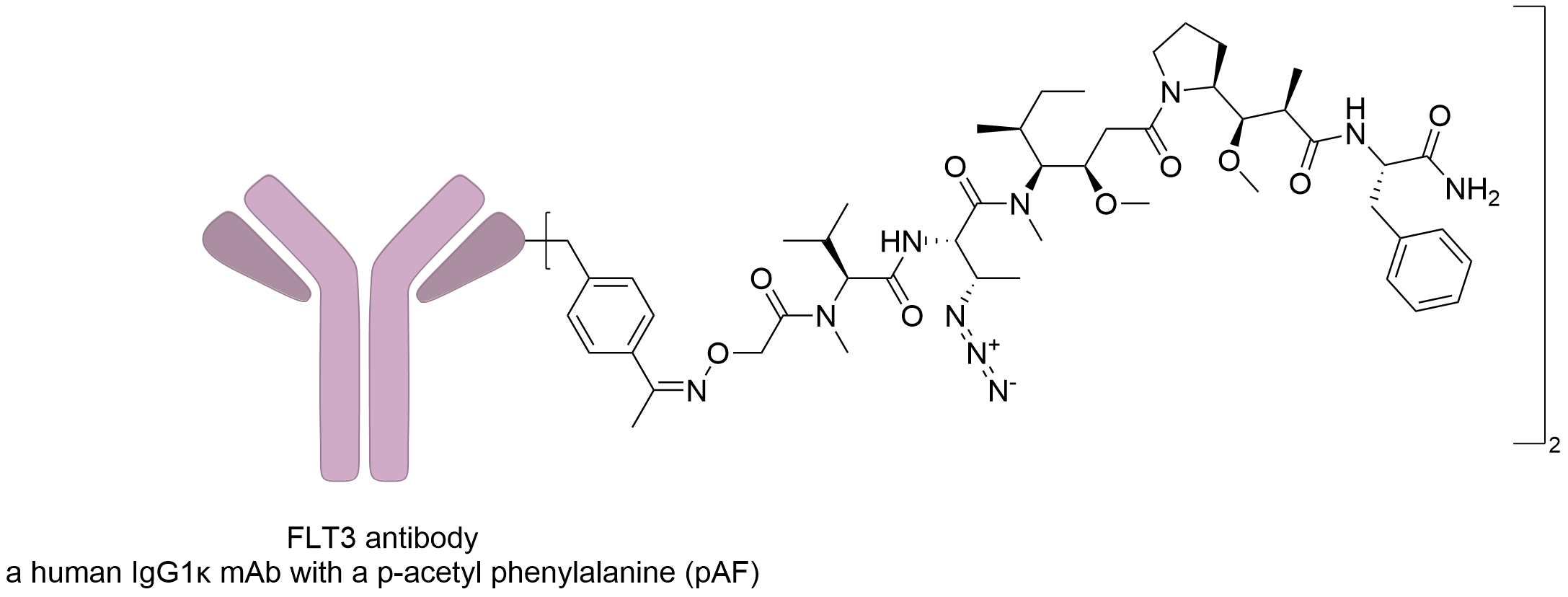
|
|||||
| Antibody Name |
Anti-FLT3 IgG1κ mAb
|
Antibody Info | ||||
| Antigen Name |
Receptor-type tyrosine-protein kinase FLT3 (FLT3)
|
Antigen Info | ||||
| Payload Name |
AGD-0182
|
Payload Info | ||||
| Payload Target |
Microtubule (MT)
|
Target Info | ||||
| Linker Name |
Alkoxyamine linker
|
Linker Info | ||||
| Conjugate Type |
Non-natural Amino Acids
|
|||||
| Combination Type |
AGL-0182-30
|
|||||
2027 Update
The disease landscape of This ADC
2027 Update
The clinical trial pipelines of This ADC
| Indication | Phase 1 | Phase 2 | Phase 3 | Approved | ||
|---|---|---|---|---|---|---|
| Acute myeloid leukaemia |
1 Trials
|
General Information of The Activity Data Related to This ADC
Identified from the Human Clinical Data
Discovered Using Cell Line-derived Xenograft Model
Revealed Based on the Cell Line Data
| Standard Type | Value | Units | Cell Line | Disease Model |
|---|---|---|---|---|
| Half Maximal Inhibitory Concentration (IC50) |
0.20-12.00
|
nM
|
Acute myeloid leukemia cells
|
Acute myeloid leukemia
|
Full List of Activity Data of This Antibody-drug Conjugate
Identified from the Human Clinical Data
| Experiment 1 Reporting the Activity Date of This ADC | [1] | ||||
| Efficacy Data | Partial Response (PR) |
19%
|
|||
| Patients Enrolled |
Eligible subjects have relapsed/refractory AML (≤3 prior lines), ECOG ≤2, adequate organ function, and contraception compliance. Exclusions include APL, neuropathy ≥G2, active infections, GVHD on steroids >10mg/day, significant cardiac/ocular conditions, or drug component hypersensitivity.
|
||||
| Administration Dosage |
The study was designed to evaluate 3 different dosing schedules of ASP1235 administered as 30-minute IV infusions. In dosing schedule A, patients received 1 dose of ASP1235 administered once every 3 weeks (Q3W) of a 21-day cycle. In dosing schedule B, patients would have received 1 dose of ASP1235 every other week of a 28-day cycle. No patients were treated on schedule B. In dosing schedule C, patients were to receive 1 fractionated dose weekly for the first 3 weeks of a 28-day cycle. A fractionated dose was the selected schedule A dose divided into 3 weekly doses in schedule C. Dose escalation in dosing schedule A was initially performed using an accelerated titration design with 1 patient per dose cohort until a grade ≥ 2 adverse event (AE) occurred (Supplemental Fig. S1). There were 6 dose cohorts in the schedule A Q3W dosing schedule (cohort 1, 0.8 mg/kg; cohort 2, 1.6 mg/kg; cohort 3, 3.2 mg/kg; cohort 4, 4.8 mg/kg; cohort 5, 6.0 mg/kg; cohort 6, 7.5 mg/kg). Two additional cohorts were added based on specific circumstances: cohort -1 (de-escalation cohort if the starting dose from cohort 1 was not tolerated) and cohort 6b (an additional cohort was evaluated to assess the 7.5-mg/kg dose level with the implementation of the protocol-required prophylactic eye regimen). The initial dose in dosing schedule B or C would be calculated based on the pharmacokinetic and safety data in dosing schedule A. After completion of Q3W dosing in schedule A, the data review team recommended once-weekly dosing (dosing schedule C) which followed a 3 + 3 design; the starting dose was 7.5 mg/kg split (fractionated) into 3 doses of 2.5 mg/kg per week for the first 3 weeks of a 4-week cycle.
Click to Show/Hide
|
||||
| Related Clinical Trial | |||||
| NCT Number | NCT02864290 | Clinical Status | PHASE1 | ||
| Clinical Description | A Phase 1 Study Evaluating Safety, Tolerability, and Pharmacokinetics of Escalating Doses of ASP1235 (AGS62P1) Given as Monotherapy in Subjects With Acute Myeloid Leukemia (AML) | ||||
| Primary Endpoint |
The study evaluates adverse events (AEs) using NCI CTCAE v4.03 over 30 months, focusing on incidence and severity.
|
||||
| Other Endpoint |
Key outcomes include ADA formation against AGS62P and ASP1235, with multiple response and pharmacokinetic measures over 30-46 months, covering CR, CRc, MLFS, Cmax, Tmax, AUC, t1/2, CL, and Vss across dose escalation and expansion phases.
|
||||
| Experiment 2 Reporting the Activity Date of This ADC | [1] | ||||
| Efficacy Data | Complete response (CR) |
7%
|
|||
| Patients Enrolled |
Eligible subjects have relapsed/refractory AML (≤3 prior lines), ECOG ≤2, adequate organ function, and contraception compliance. Exclusions include APL, neuropathy ≥G2, active infections, GVHD on steroids >10mg/day, significant cardiac/ocular conditions, or drug component hypersensitivity.
|
||||
| Administration Dosage |
The study was designed to evaluate 3 different dosing schedules of ASP1235 administered as 30-minute IV infusions. In dosing schedule A, patients received 1 dose of ASP1235 administered once every 3 weeks (Q3W) of a 21-day cycle. In dosing schedule B, patients would have received 1 dose of ASP1235 every other week of a 28-day cycle. No patients were treated on schedule B. In dosing schedule C, patients were to receive 1 fractionated dose weekly for the first 3 weeks of a 28-day cycle. A fractionated dose was the selected schedule A dose divided into 3 weekly doses in schedule C. Dose escalation in dosing schedule A was initially performed using an accelerated titration design with 1 patient per dose cohort until a grade ≥ 2 adverse event (AE) occurred (Supplemental Fig. S1). There were 6 dose cohorts in the schedule A Q3W dosing schedule (cohort 1, 0.8 mg/kg; cohort 2, 1.6 mg/kg; cohort 3, 3.2 mg/kg; cohort 4, 4.8 mg/kg; cohort 5, 6.0 mg/kg; cohort 6, 7.5 mg/kg). Two additional cohorts were added based on specific circumstances: cohort -1 (de-escalation cohort if the starting dose from cohort 1 was not tolerated) and cohort 6b (an additional cohort was evaluated to assess the 7.5-mg/kg dose level with the implementation of the protocol-required prophylactic eye regimen). The initial dose in dosing schedule B or C would be calculated based on the pharmacokinetic and safety data in dosing schedule A. After completion of Q3W dosing in schedule A, the data review team recommended once-weekly dosing (dosing schedule C) which followed a 3 + 3 design; the starting dose was 7.5 mg/kg split (fractionated) into 3 doses of 2.5 mg/kg per week for the first 3 weeks of a 4-week cycle.
Click to Show/Hide
|
||||
| Related Clinical Trial | |||||
| NCT Number | NCT02864290 | Clinical Status | PHASE1 | ||
| Clinical Description | A Phase 1 Study Evaluating Safety, Tolerability, and Pharmacokinetics of Escalating Doses of ASP1235 (AGS62P1) Given as Monotherapy in Subjects With Acute Myeloid Leukemia (AML) | ||||
| Primary Endpoint |
The study evaluates adverse events (AEs) using NCI CTCAE v4.03 over 30 months, focusing on incidence and severity.
|
||||
| Other Endpoint |
Key outcomes include ADA formation against AGS62P and ASP1235, with multiple response and pharmacokinetic measures over 30-46 months, covering CR, CRc, MLFS, Cmax, Tmax, AUC, t1/2, CL, and Vss across dose escalation and expansion phases.
|
||||
Discovered Using Cell Line-derived Xenograft Model
| Experiment 1 Reporting the Activity Date of This ADC | [2] | ||||
| Efficacy Data | Tumor Growth Inhibition value (TGI) | 27% | Positive FLT3 Expression (FLT3+++/++) | ||
| Method Description |
The in vivo antitumor activity of ASP1235 was evaluated in a FLT3 positive THP-1 xenograft model. THP-1 cells were subcutaneously inoculated in the right frank of mice at 5 x10⁶ cells/head. The vehicle of each drug is shown as follows: ASP1235 (20 mM Histidine/L-Histidine-HCl, 5.5% trehalose dihydrate, 0.01% Polysorbate 20, pH6.0), venetoclax (60% phosal 50PG, 30% PEG400, 10% ethanol), azacitidine (PBS). ASP1235 was intravenously administrated to each mouse once per week. One day before ASP1235 treatment, each mouse received intraperitoneal injection of 20 mg/kg of nonspecific human IgG1 antibody. Venetoclax was orally administered daily at 100 mg/kg. Azacitidine was intravenously injected at 3 mg/kg for five consecutive days in the first week of treatment.
Click to Show/Hide
|
||||
| In Vivo Model | FLT3-expressing THP-1 xenograft model | ||||
| In Vitro Model | Childhood acute monocytic leukemia | THP-1 cells | CVCL_0006 | ||
| Experiment 2 Reporting the Activity Date of This ADC | [2] | ||||
| Efficacy Data | Tumor Growth Inhibition value (TGI) | 35.10% | Positive FLT3 Expression (FLT3+++/++) | ||
| Method Description |
The in vivo antitumor activity of ASP1235 was evaluated in a FLT3 positive THP-1 xenograft model. THP-1 cells were subcutaneously inoculated in the right frank of mice at 5 x10⁶ cells/head. The vehicle of each drug is shown as follows: ASP1235 (20 mM Histidine/L-Histidine-HCl, 5.5% trehalose dihydrate, 0.01% Polysorbate 20, pH6.0), venetoclax (60% phosal 50PG, 30% PEG400, 10% ethanol), azacitidine (PBS). ASP1235 was intravenously administrated to each mouse once per week. One day before ASP1235 treatment, each mouse received intraperitoneal injection of 20 mg/kg of nonspecific human IgG1 antibody. Venetoclax was orally administered daily at 100 mg/kg. Azacitidine was intravenously injected at 3 mg/kg for five consecutive days in the first week of treatment.
Click to Show/Hide
|
||||
| In Vivo Model | FLT3-expressing THP-1 xenograft model | ||||
| In Vitro Model | Childhood acute monocytic leukemia | THP-1 cells | CVCL_0006 | ||
| Experiment 3 Reporting the Activity Date of This ADC | [2] | ||||
| Efficacy Data | Tumor Growth Inhibition value (TGI) | 38% | Positive FLT3 Expression (FLT3+++/++) | ||
| Method Description |
The in vivo antitumor activity of ASP1235 was evaluated in a FLT3 positive THP-1 xenograft model. THP-1 cells were subcutaneously inoculated in the right frank of mice at 5 x10⁶ cells/head. The vehicle of each drug is shown as follows: ASP1235 (20 mM Histidine/L-Histidine-HCl, 5.5% trehalose dihydrate, 0.01% Polysorbate 20, pH6.0), venetoclax (60% phosal 50PG, 30% PEG400, 10% ethanol), azacitidine (PBS). ASP1235 was intravenously administrated to each mouse once per week. One day before ASP1235 treatment, each mouse received intraperitoneal injection of 20 mg/kg of nonspecific human IgG1 antibody. Venetoclax was orally administered daily at 100 mg/kg. Azacitidine was intravenously injected at 3 mg/kg for five consecutive days in the first week of treatment.
Click to Show/Hide
|
||||
| In Vivo Model | FLT3-expressing THP-1 xenograft model | ||||
| In Vitro Model | Childhood acute monocytic leukemia | THP-1 cells | CVCL_0006 | ||
| Experiment 4 Reporting the Activity Date of This ADC | [2] | ||||
| Efficacy Data | Tumor Growth Inhibition value (TGI) | 84% | Positive FLT3 Expression (FLT3+++/++) | ||
| Method Description |
The in vivo antitumor activity of ASP1235 was evaluated in a FLT3 positive THP-1 xenograft model. THP-1 cells were subcutaneously inoculated in the right frank of mice at 5 x10⁶ cells/head. The vehicle of each drug is shown as follows: ASP1235 (20 mM Histidine/L-Histidine-HCl, 5.5% trehalose dihydrate, 0.01% Polysorbate 20, pH6.0), venetoclax (60% phosal 50PG, 30% PEG400, 10% ethanol), azacitidine (PBS). ASP1235 was intravenously administrated to each mouse once per week. One day before ASP1235 treatment, each mouse received intraperitoneal injection of 20 mg/kg of nonspecific human IgG1 antibody. Venetoclax was orally administered daily at 100 mg/kg. Azacitidine was intravenously injected at 3 mg/kg for five consecutive days in the first week of treatment.
Click to Show/Hide
|
||||
| In Vivo Model | FLT3-expressing THP-1 xenograft model | ||||
| In Vitro Model | Childhood acute monocytic leukemia | THP-1 cells | CVCL_0006 | ||
Revealed Based on the Cell Line Data
| Experiment 1 Reporting the Activity Date of This ADC | [3] | ||||
| Efficacy Data | Half Maximal Inhibitory Concentration (IC50) | 0.20-12.00 nM | Positive FLT3 Expression (FLT3+++/++) | ||
| Method Description |
The cytotoxic activity of AGS-62P1 was evaluated against a panel of AmL cell lines in vitro.
|
||||
| In Vitro Model | Acute myeloid leukemia | Acute myeloid leukemia cells | Homo sapiens | ||
References