
Payload Information
General Information of This Payload (ID: PAY0CNXJS)
| Name |
Auristatin 0101 (Aur0101)
|
|||||
|---|---|---|---|---|---|---|
| Target | Microtubule (MT) | |||||
| Structure |
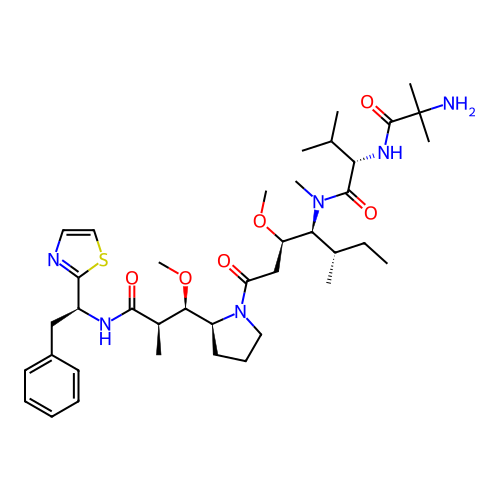
|
|||||
|
|
||||||
Each Antibody-drug Conjugate Related to This Payload
Full Information of The Activity Data of The ADC(s) Related to This Payload
Micvotabart pelidotin [Phase 1/2]
Identified from the Human Clinical Data
| Experiment 1 Reporting the Activity Date of This ADC | [1] | ||||
| Patients Enrolled |
Inclusion criteria require confirmed advanced solid tumors across multiple indications (NSCLC, breast cancers, HNSCC, etc.), age ≥18, ECOG 0-1, measurable disease by RECIST v1.1, adequate organ function (hematologic/hepatic/renal), and QTcF <470 msec. Exclusions include active CNS metastases, uncontrolled CV disease, unresolved toxicity (>Grade 1), prior EDB+FN therapy, high-risk infections (HBV/HCV/HIV), recent anticancer therapy (28 days), and visual/corneal impairments. Safety monitoring continues in Part 2 (AEs up to 2 years).
Click to Show/Hide
|
||||
| Related Clinical Trial | |||||
| NCT Number | NCT05720117 | Phase Status | PHASE1 | ||
| Clinical Description |
A First-in-Human, Open-label, Multicenter, Phase 1 Clinical Study to Evaluate the Safety, Tolerability, Pharmacokinetics, Pharmacodynamics, and Preliminary Efficacy of PYX-201 in Participants With Advanced Solid Tumors
|
||||
| Primary Endpoint |
This segment covers safety assessments for Part 1, including Dose-Limiting Toxicities (DLTs) defined by protocol-specific criteria occurring within the first 21 days of treatment, and adverse events (AEs) monitored for approximately 3 years with grading based on NCI-CTCAE v5.0. It also introduces Objective Response Rate (ORR) in Part 2 as a key efficacy endpoint evaluated up to 2 years.
Click to Show/Hide
|
||||
| Other Endpoint |
This section details pharmacokinetic parameters (Cmax, Tmax, CL, AUC0-t, AUCtau, AUC0-inf, t½) for PYX-201 components in Part 1, measured over 2 years, alongside clinical response metrics (ORR, DOR, PFS, DCR, TTR, OS) with follow-up to 3 years. Part 2 data includes efficacy endpoints (DOR, CBR, mPFS, DCR, TTR, mOS) and drug concentration measures (Cmax, Tmax, trough levels), extending observation to approximately 4 years for survival outcomes.
Click to Show/Hide
|
||||
| Experiment 2 Reporting the Activity Date of This ADC | [2] | ||||
| Patients Enrolled |
Inclusion criteria require advanced solid tumors (HNSCC, TNBC, HR+/HER2- BC, GC, cervical cancer), age ≥18, ECOG PS 0-1, measurable disease per RECIST v1.1, life expectancy >3 months, and adequate organ function. Exclusion criteria include active CNS metastases, uncontrolled infections (HBV/HCV/HIV), unresolved prior toxicities (>Grade 1), autoimmune disease, prior PD-1/L1 inhibitors, and severe hypersensitivity to study drugs or excipients. Strict eligibility ensures patient safety and measurable efficacy assessment.
Click to Show/Hide
|
||||
| Administration Dosage |
Experimental: Part 1: Dose Escalation, Participants will receive escalating doses of PYX-201 to evaluate the safety, tolerability, and preliminary efficacy of PYX-201 in combination with pembrolizumab.Experimental: Part 2: Dose Expansion, Part 2 dose-expansion cohorts will be opened based on emerging data to further inform the safety, tolerability, and preliminary efficacy determinations as defined.
Click to Show/Hide
|
||||
| Related Clinical Trial | |||||
| NCT Number | NCT06795412 | Phase Status | PHASE1|||PHASE2 | ||
| Clinical Description |
A Phase 1/2, Open-label, Global, Multicenter, Dose-Escalation and Dose-Expansion Study to Evaluate the Safety, Tolerability, Pharmacokinetics, Pharmacodynamics, and Preliminary Efficacy of PYX-201 in Combination With Pembrolizumab in Participants With Advanced Solid Tumors
|
||||
| Primary Endpoint |
This section focuses on safety parameters in the clinical trial, tracking Dose-Limiting Toxicities (DLTs) during the first 21 days of treatment. It also monitors adverse events (AEs) for approximately 2 years, including clinically significant changes in laboratory parameters, vital signs, and ECG measurements to evaluate treatment tolerability.
|
||||
| Other Endpoint |
This segment outlines efficacy and pharmacokinetic assessments, evaluating Objective Response Rate (ORR), Duration of Response (DOR), Disease Control Rate (DCR), Time to Response, and Clinical Benefit Rate (CBR) over ~2 years. Pharmacokinetic analysis includes Cmax, Tmax, Clearance (CL), AUC (0-t, tau, and 0-inf), half-life (t½) for ADC, total antibody, and free payload, along with immunogenicity assessment via anti-drug antibodies.
Click to Show/Hide
|
||||
| Experiment 3 Reporting the Activity Date of This ADC | [3] | ||||
| Related Clinical Trial | |||||
| NCT Number | NCT05720117 | Phase Status | Phase 1 | ||
| Clinical Description |
A first-in-human, open-label, multicenter, phase 1 clinical study to evaluate the safety, tolerability, pharmacokinetics, pharmacodynamics, and preliminary efficacy of PYX-201 in participants with advanced solid tumors.
|
||||
Cofetuzumab pelidotin [Phase 1 (discontinued)]
Identified from the Human Clinical Data
| Experiment 1 Reporting the Activity Date of This ADC | [4] | ||||
| Efficacy Data | Objective Response Rate (ORR) |
30%
|
|||
| Patients Enrolled |
Inclusion criteria for Q3W: advanced/metastatic solid tumors refractory to standard therapy, ECOG PS 0-1, adequate organ function; Part 2 targeted ovarian cancer (OVCA), TNBC, and NSCLC. Q2W included platinum-resistant OVCA (≤2 prior lines) or recurrent NSCLC (≤3 prior lines), ECOG PS 0-2. Exclusions: non-epithelial OVCA, active CNS metastases, unresolved bowel obstruction, recent anticancer therapy (4 weeks), or active infections. Both regimens excluded patients with significant comorbidities (uncontrolled infections, recent major surgery/radiation).
Click to Show/Hide
|
||||
| Administration Dosage |
Investigational drug infused over 60 minutes once every 21 days, Investigational drug infused over 60 minutes once every 14 days (28 day cycle).
|
||||
| Related Clinical Trial | |||||
| NCT Number | NCT02222922 | Phase Status | PHASE1 | ||
| Clinical Description |
A FIRST-IN-HUMAN PHASE 1, DOSE ESCALATION, SAFETY AND PHARMACOKINETIC STUDY OF PF-06647020 IN ADULT PATIENTS WITH ADVANCED SOLID TUMORS
|
||||
| Primary Endpoint |
This section details safety assessments for PF-06647020 across Q3W (every 3 weeks) and Q2W (every 2 weeks) regimens, monitoring dose-limiting toxicities (DLTs) during initial treatment cycles (21 days for Q3W, 28 days for Q2W) including hematologic (Grade 4 neutropenia, febrile neutropenia), hepatic (Grade ≥3 bilirubin/transaminases), and non-hematologic toxicities. Treatment-emergent adverse events (AEs), graded per NCI CTCAE v4.03, were tracked for up to 32 months (Q3W) or 19 months (Q2W), with lab abnormalities (hematology, chemistry, urinalysis, coagulation) analyzed for shifts from baseline to Grade ≥3.
Click to Show/Hide
|
||||
| Other Endpoint |
Pharmacokinetic (PK) parameters (AUCtau, Cmax, CL, Vss, t1/2, Rac, Tmax, AUClast, AUCinf) were evaluated for PF-06647020, its metabolites (PF-06380101, hu6M024 mAb), and dose-normalized values in DDI sub-studies under Q3W (504-hour tau) and Q2W (336-hour tau) regimens. Efficacy endpoints included objective response rate (ORR), duration of response (DOR), disease control rate (DCR), time to progression (TTP), and progression-free survival (PFS), assessed per RECIST v1.1 via tumor imaging every 6-8 weeks. Immunogenicity (anti-drug antibodies [ADA]/neutralizing antibodies [NAb]) was monitored for ~31 months (Q3W) or 18 months (Q2W).
Click to Show/Hide
|
||||
| Experiment 2 Reporting the Activity Date of This ADC | [8] | ||||
| Patients Enrolled |
Inclusion criteria require histologically confirmed PTK7-expressing NSCLC, progression after platinum-based therapy +/- targeted agents (≤2 prior lines [≤3 if targeted]), ECOG 0-1, measurable disease, and adequate organ function. Exclusions include active CNS metastases (unless treated/asymptomatic for ≥2 weeks), unresolved Grade ≥2 toxicity (except alopecia/anaemia), significant comorbidities, recent anticancer therapy (within 28 days, except palliative RT ≤10 fractions), or herbal therapies within 7 days.
Click to Show/Hide
|
||||
| Administration Dosage |
Participants will receive 2.8mg/kg of cofetuzumab pelidotin by IV every 3 weeks
|
||||
| Related Clinical Trial | |||||
| NCT Number | NCT04189614 | Phase Status | PHASE1 | ||
| Clinical Description |
A Phase 1b Efficacy and Safety Study of Cofetuzumab Pelidotin (ABBV-647, a PTK7-Targeting Antibody Drug Conjugate) in Subjects With PTK7-Expressing, Recurrent Non-Small Cell Lung Cancer
|
||||
| Primary Endpoint |
The primary efficacy endpoint is Objective Response Rate (ORR), measured up to 3 years, defined as the percentage of participants achieving confirmed complete response (CR) or partial response (PR) per RECIST v1.1.
|
||||
| Other Endpoint |
Secondary endpoints include Duration of Response (DOR) (time from initial response to progression/death), Progression-Free Survival (PFS) (time from first dose to progression/death), and Overall Survival (OS) (time from first dose to death from any cause), all assessed over ~3 years.
|
||||
| Experiment 3 Reporting the Activity Date of This ADC | [9] | ||||
| Efficacy Data | Partial Response (PR) |
16.67%
|
|||
| Patients Enrolled |
Metastatic TNBC or ER low (ER and PgR <5%, HER2 negative) breast cancer, and had received at least one prior chemotherapy for metastatic disease.
|
||||
| Administration Dosage |
Gedatolisib 110 mg weekly + cofetuzumab pelidotin 1.4 mg/kg every 3 weeks, 180 mg + 1.4 mg/kg, and 180 mg + 2.8 mg/kg.
|
||||
| Related Clinical Trial | |||||
| NCT Number | NCT03243331 | Phase Status | Phase 1 | ||
| Clinical Description |
An initial safety study of gedatolisib plus PTK7-ADC for metastatic triple-negative breast cancer.
|
||||
| Primary Endpoint |
A total of 18 pts were enrolled in three dose cohorts: gedatolisib 110 mg weekly cofetuzumab pelidotin 1.40 mg/kg every 3 weeks (n=4), 180 mg, 1.40 mg/kg (n=3), and 180 mg, 2.80 mg/kg (n=11). Nausea, anorexia, fatigue, and mucositis were common but rarely reached grade 3 severity. Myelosuppression was uncommon. ORR was 16.67% (3/18). An additional 3 pts had stable disease (of these 2 had stable disease for>18 weeks); CB18 was 27.80%. Median PFS was 2.00 months (95% confidence interval for PFS: 1.20-6.20). Pts with clinical benefit were enriched with genomic alterations in the PI3K and PTK7 pathways.
Click to Show/Hide
|
||||
| Experiment 4 Reporting the Activity Date of This ADC | [12] | ||||
| Efficacy Data | Objective Response Rate (ORR) |
27.00
16.00 21.00 26.00 33.00 % |
|||
| Patients Enrolled |
Locally advanced or metastatic solid tumors resistant to standard therapy or with no available standard therapy, and Eastern Cooperative Oncology Group (ECOG) performance status 0 or 1.
|
||||
| Administration Dosage |
Intravenously every 3 weeks at 0.20-3.70 mg/kg or every 2 weeks at 2.10-3.20 mg/kg.
|
||||
| Related Clinical Trial | |||||
| NCT Number | NCT02222922 | Phase Status | Phase 1 | ||
| Clinical Description |
A first-in-human phase 1, dose escalation, safety and pharmacokinetic study of PF-06647020 in adult patients with advanced solid tumors.
|
||||
| Primary Endpoint |
The most common, treatment-related adverse events for PF-06647020 administered every 3 weeks were nausea, alopecia,fatigue, headache, neutropenia, and vomiting (45%); 25% of patients had grade 3 neutropenia. Two patients experienced doselimiting toxicities (grade 3 headache and fatigue) at the highest every 3 weeks dose evaluated. The recommended phase II dose was 2.80 mg/kg every 3 weeks. The overall safety profile observed with PF-06647020 administered every 2 weeks was similar to that of the every 3 weeks regimen. Systemic exposure for the ADC and total antibody generally increased in a dose-proportional manner. Antitumor activity was observed in treated patients with overall objective response rates of 27.00% in ovarian cancer (n=63), 19% in NSCLC (n=31), and 21% in TNBC (n=29).
Click to Show/Hide
|
||||
| Experiment 5 Reporting the Activity Date of This ADC | [14] | ||||
| Related Clinical Trial | |||||
| NCT Number | NCT04189614 | Phase Status | Phase 1 | ||
| Clinical Description |
A phase 1b efficacy and safety study of cofetuzumab pelidotin (ABBV-647, a PTK7-targeting antibody drug conjugate) in subjects with PTK7-expressing, recurrent non-small cell lung cancer.
|
||||
PF-06804103 [Phase 1 (discontinued)]
Identified from the Human Clinical Data
| Experiment 1 Reporting the Activity Date of This ADC | [5] | ||||
| Efficacy Data | Objective Response Rate (ORR) |
52.40%
|
|||
| Patients Enrolled |
Inclusion criteria cover HER2+/- breast/gastric cancer (Part 1A/B, Part 2A/B) resistant to standard therapy, with PS 0-1 and adequate organ function. Exclusions include CNS metastases, anthracycline overdose, Grade 3+ antibody hypersensitivity, active infections, LVEF <50%, or interstitial lung disease. Eligibility is tailored by study part, emphasizing safety and biomarker relevance.
Click to Show/Hide
|
||||
| Administration Dosage |
This multi-center, open-label, first-in-patient, phase I study (NCT03284723) has two parts: dose escalation (Part 1) and dose expansion (Part 2). In Part 1, groups of adult patients (pts) with HER2+ BC or HER2+ GC, who are resistant or intolerant to standard therapy or for which no standard therapy is available, received PF-06804103 intravenously once every 21 days (Q3W); dosage was escalated per cohort. Primary objectives were to evaluate the safety and tolerability of PF-06804103, characterize its dose-limiting toxicities (DLTs), and determine the recommended phase 2 dose.
Click to Show/Hide
|
||||
| Related Clinical Trial | |||||
| NCT Number | NCT03284723 | Phase Status | PHASE1 | ||
| Clinical Description |
A Phase 1 Dose Escalation Study Evaluating the Safety and Tolerability of PF-06804103 in Patients With Human Epidermal Growth Factor Receptor 2 (HER2) Positive and Negative Solid Tumors
|
||||
| Primary Endpoint |
This section outlines Dose-Limiting Toxicities (DLTs) observed in Part 1A (21-day cycle) and Part 1B (28-day cycle) during the first treatment cycle, categorizing them into hematologic (Grade 4 neutropenia >7 days, febrile neutropenia, thrombocytopenia with bleeding) and non-hematologic (Grade ≥3 toxicities, treatment delays, liver abnormalities). It also details Treatment-Emergent Adverse Events (TEAEs) and Serious Adverse Events (SAEs), including definitions and timeframes (up to 89.3 weeks for Part 1A, 53.7 weeks for Part 1B). Laboratory abnormalities (hematology, chemistry, urinalysis) and vital sign criteria are summarized, along with response metrics (Objective Response, Duration of Response, PFS, TTP) in Part 2, all assessed per RECIST v1.1.
Click to Show/Hide
|
||||
| Other Endpoint |
This segment focuses on clinical outcomes in Part 1 (Objective Response, DR, PFS, TTP) with assessment intervals every 6 (Part 1A) or 8 weeks (Part 1B). Immunogenicity (anti-drug antibodies) and HER2 tumor analysis are included. Pharmacokinetic parameters (Cmax, t1/2, AUCinf, AUCtau, CL, Vss, Rac) for PF-06804103 ADC, total antibody, and unconjugated payload (PF-06380101) are detailed, with data from Part 1A/B (sparse sampling excluded Part 2A). Key metrics like terminal half-life, clearance, and volume of distribution are calculated per dosing intervals (504h for Part 1A, 336h for Part 1B).
Click to Show/Hide
|
||||
Discovered Using Cell Line-derived Xenograft Model
| Experiment 1 Reporting the Activity Date of This ADC | [15] | ||||
| Efficacy Data | Tumor Growth Inhibition value (TGI) |
100%
|
Moderate HER2 expression (HER2++) | ||
| Method Description |
In cell line xenograft (CLX) studies, nude mice were injected subcutaneously in the flank with suspensions of 10 x106 BT474 cells, in 50% Matrigel (BD Biosciences). Mice were randomized into study groups when tumors reached approximately 150-300 mm3. Either PBS (Gibco, catalog no., 14190-144, as vehicle), PF-06804103, or PT-DM1 at different doses was administered intravenously starting on day 0 for a total of four doses, 4 days apart (four times every 4 days).
Click to Show/Hide
|
||||
| In Vitro Model | Invasive breast carcinoma | BT474-M1 cells | CVCL_0179 | ||
| Experiment 2 Reporting the Activity Date of This ADC | [15] | ||||
| Efficacy Data | Tumor Growth Inhibition value (TGI) |
100%
|
High HER2 expression (HER2+++) | ||
| Method Description |
In cell line xenograft (CLX) studies, nude mice were injected subcutaneously in the flank with suspensions of 1 x10⁶ NCI-N87, in 50% Matrigel (BD Biosciences). Mice were randomized into study groups when tumors reached approximately 150-300 mm3. Either PBS (Gibco, catalog no., 14190-144, as vehicle), PF-06804103, or PT-DM1 at different doses was administered intravenously starting on day 0 for a total of four doses, 4 days apart (four times every 4 days).
Click to Show/Hide
|
||||
| In Vitro Model | Gastric tubular adenocarcinoma | NCI-N87 cells | CVCL_1603 | ||
PF-06664178 [Phase 1 (discontinued)]
Identified from the Human Clinical Data
| Experiment 1 Reporting the Activity Date of This ADC | [6] | ||||
| Patients Enrolled |
Eligible patients had advanced/metastatic solid tumors refractory to standard therapy (Part 2 required NSCLC/ovarian/breast cancer with target expression), ECOG 0-1, and adequate organ function, excluding those with active CNS metastases, recent anticancer therapies, or uncontrolled infections.
|
||||
| Administration Dosage |
Part 1 - PF-06664178 will be administered intravenously every 21 days in cohorts of 2 or more patients starting at a dose of 0.15 mg/kg. Increases in dose will continue until MTD is determined.Part 2 - patients with select tumor types (Non Small Cell Lung Cancer ovarian cancer, and breast cancer ) will be treated at the MTD selected in Part 1.
|
||||
| Related Clinical Trial | |||||
| NCT Number | NCT02122146 | Phase Status | PHASE1 | ||
| Clinical Description |
A Phase 1, Dose Escalation Study Of Pf-06664178 In Patients With Locally Advanced Or Metastatic Solid Tumors
|
||||
| Primary Endpoint |
The study assesses first-cycle dose-limiting toxicities (DLTs) to determine MTD, along with treatment-emergent adverse events (TEAEs) and laboratory abnormalities (hematology, chemistry, coagulation, urinalysis) monitored at multiple timepoints during cycles 1-4 and follow-up.
|
||||
| Other Endpoint |
Key outcomes include tumor response per RECIST 1.1, immunogenicity (anti-PF-06664178 antibodies), pharmacokinetics (Cmax, AUCtau, CL, Vss, halflife for PF-06664178, total antibody, and unconjugated payload), Trop-2 expression levels, and drug accumulation ratios across all study parts.
|
||||
| Experiment 2 Reporting the Activity Date of This ADC | [10] | ||||
| Efficacy Data | Objective Response Rate (ORR) |
0%
|
|||
| Patients Enrolled |
Advanced solid tumors resistant to standard therapy, or for which no other therapy was available, and at least one measurable lesion defined by Response Evaluation Criteria in Solid Tumors (RECIST version 1.1).
|
||||
| Administration Dosage |
Once every 21 days as an intravenous infusion over approximately 60 min, doses starting from 0.15 mg/kg to 6.14 mg/kg.
|
||||
| Related Clinical Trial | |||||
| NCT Number | NCT02122146 | Phase Status | Phase 1 | ||
| Clinical Description |
A phase 1, dose escalation study of Pf-06664178 in patients with locally advanced or metastatic solid tumors.
|
||||
| Primary Endpoint |
In the 29 response-evaluable patients,the best overall response observed was limited to stable disease (SD) in 11 patients(37.90%) with PR or CR.
|
||||
| Other Endpoint |
Doses explored ranged from 0.15 mg/kg to 4.80 mg/kg. Doses of 3.60 mg/kg,4.20 mg/kg and 4.80 mg/kg were considered intolerable due to DLTs. MTD and RP2D were not determined.
|
||||
PF-06650808 [Phase 1 (discontinued)]
Identified from the Human Clinical Data
| Experiment 1 Reporting the Activity Date of This ADC | [7] | ||||
| Patients Enrolled |
Inclusion requires advanced/metastatic solid tumors resistant to standard therapy or TNBC with Notch3 expression, measurable lesions, and organ function. Exclusion includes recent surgery/radiation (4 weeks), symptomatic brain metastases needing steroids, or prior same-mechanism treatment.
|
||||
| Administration Dosage |
Dose Escalation Phase [Part 1] - PF-06650808 will be administered at doses starting at 0.2 mg/kg. Increases in dose will continue until MTD is determined.Dose Expansion Phase [Part 2] - Patients will be treated at the MTD or Recommended Phase 2 dose selected in Part 1.
|
||||
| Related Clinical Trial | |||||
| NCT Number | NCT02129205 | Phase Status | PHASE1 | ||
| Clinical Description |
A PHASE 1 DOSE ESCALATION STUDY EVALUATING THE SAFETY AND TOLERABILITY OF PF-06650808 IN PATIENTS WITH ADVANCED SOLID TUMORS
|
||||
| Primary Endpoint |
This section defines Dose-limiting Toxicities (DLT) assessed during Part 1 over 21 days, categorized into hematologic (Grade 4 neutropenia >7 days, febrile neutropenia, thrombocytopenia with bleeding) and non-hematologic (Grade ≥3 toxicities, treatment delays >2 weeks). It also outlines Objective Response criteria (complete/partial response) based on RECIST v1.1 for Part 1 and 2, covering target/non-target lesion assessments every 6 weeks until progression or 3 years.
Click to Show/Hide
|
||||
| Other Endpoint |
This segment details Treatment-Emergent Adverse Events (TEAEs) over 3 years, including serious AEs (death, hospitalization, disability), lab abnormalities (hematology, chemistry, urinalysis), and vital signs criteria (BP, pulse rate). Pharmacokinetic parameters (Cmax, Tmax, AUCtau, CL, Vss, t1/2) for ADC components are provided, along with anti-drug antibody (ADA) testing and survival metrics (PFS, OS) for Part 2.
Click to Show/Hide
|
||||
| Experiment 2 Reporting the Activity Date of This ADC | [11] | ||||
| Efficacy Data | Objective Response Rate (ORR) |
9.68
16.67 21.43 % |
|||
| Patients Enrolled |
Locally advanced/metastatic solid tumors resistant to standard therapy or with no available standard therapy; Eastern Cooperative Oncology Group (ECOG) performance score (PS) 01; a life expectancy 12 weeks; and adequate bone marrow, hepatic, and renal function.
|
||||
| Administration Dosage |
Intravenously every 3 weeks (Q3W) starting at a dose of 0.20 mg/kg to be escalated up to 6.40 mg/kg, following the modified continual reassessment method (mCRM).
|
||||
| Related Clinical Trial | |||||
| NCT Number | NCT02129205 | Phase Status | Phase 1 | ||
| Clinical Description |
A phase 1 dose escalation study evaluating the safety and tolerability of PF-06650808 In patients with advanced solid tumors.
|
||||
| Primary Endpoint |
OrR=9.68% for all response-evaluable patients (N=3/31), ORR=16.67% for patients with breast cancer (N=3/18), ORR=21.43% for patients with ER+ breast cancer (N=3/14). Five patients with advanced BC achieved PR as best overall response (BOR): 2 at 2.0 mg/kg, 1 at 2.4 mg/kg, and 2 at 3.6 mg/kg.
|
||||
| Other Endpoint |
The maximum tolerated dose (MTD) was estimated to be 2.40 mg/kg.
|
||||
| Experiment 3 Reporting the Activity Date of This ADC | [13] | ||||
| Related Clinical Trial | |||||
| NCT Number | NCT02129205 | Phase Status | Phase 1 | ||
| Clinical Description |
A phase 1 dose escalation study evaluating the safety and tolerability of PF-06650808 in patients with advanced solid tumors.
|
||||
References