
Payload Information
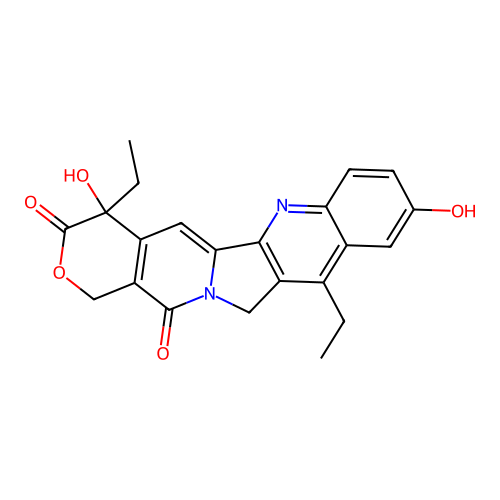
General Information of This Payload (ID: PAY0BKPAH)
| Name |
SN-38
|
|||||
|---|---|---|---|---|---|---|
| Target | DNA topoisomerase 1 (TOP1) | |||||
| Structure |
|
|||||
|
|
||||||
Each Antibody-drug Conjugate Related to This Payload
Full Information of The Activity Data of The ADC(s) Related to This Payload
Sacituzumab govitecan [Approved in 2020]
Identified from the Human Clinical Data
| Experiment 1 Reporting the Activity Date of This ADC | [1] | ||||
| Efficacy Data | Objective Response Rate (ORR) |
21%
|
|||
| Patients Enrolled |
Patients had histologically locally confirmed measurable HR+/HER2 MBC and 2-4 prior systemic chemotherapy regimens for metastatic disease. (Neo)adjuvant therapy for early-stage disease qualified as one of the required prior chemotherapy regimens if the development of unresectable, locally advanced, or metastatic disease occurred within 12 months of therapy (early relapse). Patients must have previously received at least one taxane, at least one anticancer hormonal treatment, and at least one CDK4/6i.
Click to Show/Hide
|
||||
| Administration Dosage |
10 mg/kg intravenously once weekly on day 1 and day 8 every 21 days.
|
||||
| Related Clinical Trial | |||||
| NCT Number | NCT03901339 | Phase Status | Phase 3 | ||
| Clinical Description |
Phase 3 study of sacituzumab govitecan (IMMU-132) versus treatment of physician's choice (tpc) in subjects with hormonal receptor-positive (hr+) human epidermal growth factor receptor 2 (HER2) negative metastatic breast cancer (MBC) who have failed at least two prior chemotherapy regimens.
|
||||
| Primary Endpoint |
PFS=5.50 months.
|
||||
| Other Endpoint |
OS=13.90 months.
|
||||
| Experiment 2 Reporting the Activity Date of This ADC | [2] | ||||
| Efficacy Data | Objective Response Rate (ORR) |
31.43%
|
|||
| Patients Enrolled |
Patients had metastatic triple-negative breast cancer (mTNBC) that had progressed following 2 prior standard chemotherapy regimens (no upper limit) for unresectable, locally advanced, or metastatic disease, and included a taxane (any setting). Per protocol, patients were also eligible after only one prior regimen in the metastatic setting if their disease recurred within 12 months of completing (neo)adjuvant therapy.
Click to Show/Hide
|
||||
| Administration Dosage |
10 mg/kg on days 1 and 8 of 21-day cycles; until progression, unacceptable toxicity, study withdrawal, or death.
|
||||
| Related Clinical Trial | |||||
| NCT Number | NCT02574455 | Phase Status | Phase 3 | ||
| Clinical Description |
Analysis of patients without and with an initial triple-negative breast cancer diagnosis in the phase 3 randomized ASCENT study of sacituzumab govitecan in metastatic triple-negative breast cancer.
|
||||
| Primary Endpoint |
PFS=4.60 months for patients without TNBC at initial diagnosis PFS=5.70 months for patients with TNBC at initial diagnosis.
|
||||
| Other Endpoint |
ORR=31.43%.
|
||||
| Experiment 3 Reporting the Activity Date of This ADC | [3] | ||||
| Efficacy Data | Objective Response Rate (ORR) |
35%
|
|||
| Patients Enrolled |
Patients with metastatic triple-negative breast cancer that was relapsed or refractory to two or more previous standard chemotherapy regimens (no upper limit) for unresectable, locally advanced or metastatic disease; previous therapy had to include a taxane (for any indication). Patients had to have triple-negative breast cancer according to standard American Society of Clinical OncologyCollege of American Pathologists criteria.
Click to Show/Hide
|
||||
| Administration Dosage |
Sacituzumab govitecan at a dose of 10 mg per kilogram of body weight intravenously on days 1 and 8 of each 21-day cycle.
|
||||
| Related Clinical Trial | |||||
| NCT Number | NCT02574455 | Phase Status | Phase 3 | ||
| Clinical Description |
An international, multi-center, open-label, randomized, phase 3 trial of sacituzumab govitecan versus treatment of physician choice in patients with metastatic triple-negative breast cancer who received at least two prior treatments.
|
||||
| Primary Endpoint |
Progression-free survival=5.60 months,(95% CI, 4.30-6.30) with sacituzumab govitecan and 1.70 months (95% CI,1.50 to 2.60) with chemotherapy (hazard ratio for disease progression or death, 0.41; 95% CI, 0.32-0.52).
|
||||
| Other Endpoint |
The percentage of patients with an objective response was 35.00% with sacituzumab govitecan and 5.00% with chemotherapy.
|
||||
| Experiment 4 Reporting the Activity Date of This ADC | [4] | ||||
| Efficacy Data | Objective Response Rate (ORR) |
38.80%
|
High TROP2 expression (TROP2+++) | ||
| Patients Enrolled |
Histologically or cytologically confirmed metastatic triple negative breast cancer (mTNBC); refractory or relapsing after 2 prior standard chemotherapy for unresectable, locally advanced, or metastatic disease, including a taxane (any setting).
|
||||
| Administration Dosage |
10 mg/kg intravenously on Days 1 and 8 of each 21-day treatment cycle.
|
||||
| Related Clinical Trial | |||||
| NCT Number | NCT04454437 | Phase Status | Phase 2 | ||
| Clinical Description |
A phase IIb, single arm, multicenter trial of sacituzumab govitecan in chinese patients with metastatic triple-negative breast cancer who received at least two prior treatments.
|
||||
| Primary Endpoint |
Objective response rate=38.80% (95% CI 28.06-50.30), clinical benefit rate=43.80% (95% CI 32.68-55.30).
|
||||
| Other Endpoint |
Median PFS=5.55 months (95% CI 4.14-N/A).
|
||||
| Experiment 5 Reporting the Activity Date of This ADC | [5] | ||||
| Efficacy Data | Objective Response Rate (ORR) |
14%
|
|||
| Patients Enrolled |
Patients 18 years of age with mSCLC who had relapsed or were refractory to at least one prior standard line of therapy for metastatic disease, and with measurable tumors by CT, were enrolled. They were required to have Eastern Cooperative Oncology Group (ECOG) performance status of 0 or 1, adequate bone marrow, hepatic and renal function, and other eligibility as described in the phase I trial (25). Previous therapy had to be completed at least 2 weeks before enrollment.
Click to Show/Hide
|
||||
| Administration Dosage |
Either 8 or 10 mg/kg i.v. on days 1 and 8 of 21-day cycles.
|
||||
| Related Clinical Trial | |||||
| NCT Number | NCT01631552 | Phase Status | Phase 1 | ||
| Clinical Description |
A phase 1/2 study of IMMU-132 (hRS7-SN38 antibody drug conjugate) in patients with epithelial cancer.
|
||||
| Primary Endpoint |
OrR=14.00% (17.00% for 10 mg/kg group).
|
||||
| Other Endpoint |
The median response duration=5.70 months; the clinical benefit rate (CBR>4 months), 34.00%; median PFS=3.70 months; median OS=7.50 months.
|
||||
| Experiment 6 Reporting the Activity Date of This ADC | [6] | ||||
| Efficacy Data | Objective Response Rate (ORR) |
17.70
22.20 9.10 % |
|||
| Patients Enrolled |
Patients were >18 years of age with metastatic cancer [cervical, clear-cell renal, CRC, epithelial ovarian, endometrial, esophageal, gastric, hepatocellular, CRPC, pancreatic ductal adenocarcinoma, squamous cell head and neck, thyroid, urothelial (UC) cancer; glioblastoma multiforme; mTNBC or non-mTNBC; and SCLC or NSCLC] who had relapsed after or were refractory to at least one prior standard therapeutic regimen.
Click to Show/Hide
|
||||
| Administration Dosage |
Intravenous 8, 10, 12, or 18 mg/kg on days 1 and 8 of 21-day cycles until disease progression or unacceptable toxicity.
|
||||
| Related Clinical Trial | |||||
| NCT Number | NCT01631552 | Phase Status | Phase 1 | ||
| Clinical Description |
A phase 1/2 study of IMMU-132 (hRS7-SN38 antibody drug conjugate) in patients with epithelial cancer.
|
||||
| Primary Endpoint |
Safety and pharmacokinetic parameters with investigator-evaluated objective response rate.
|
||||
| Other Endpoint |
Efficacy endpoints included: ORR, which included both confirmed partial response (PR) and complete response (CR).
|
||||
| Experiment 7 Reporting the Activity Date of This ADC | [7] | ||||
| Efficacy Data | Objective Response Rate (ORR) |
19%
|
|||
| Patients Enrolled |
Patients 18 years with mNSCLC who had measurable disease and progressed after at least one line of therapy for stage IV disease were enrolled. Requirements included Eastern Cooperative Oncology Group performance status 0 or 1, adequate bone marrow and hepatic and renal function, and other eligibility criteria as described in the phase I trial. Prior systemic therapy had to be completed at least 4 weeks before enrollment.
Click to Show/Hide
|
||||
| Administration Dosage |
Doses of 8 or 10 mg/kg were given on days 1 and 8 of 21-day cycles; intravenously.
|
||||
| Related Clinical Trial | |||||
| NCT Number | NCT01631552 | Phase Status | Phase 1 | ||
| Clinical Description |
A phase 1/2 study of IMMU-132 (hRS7-SN38 antibody drug conjugate) in patients with epithelial cancer.
|
||||
| Primary Endpoint |
Safety and objective response rate (ORR).
|
||||
| Other Endpoint |
Progression-free survival and overall survival.
|
||||
| Experiment 8 Reporting the Activity Date of This ADC | [8] | ||||
| Efficacy Data | Objective Response Rate (ORR) |
30%
|
|||
| Patients Enrolled |
Patients 18 years of age who had mTNBC refractory to or relapsed after at least one standard line of therapy since diagnosis and measurable disease by computed tomography scan (or magnetic resonance imaging). patients had an Eastern Cooperative Oncology Group performance status of 0 or 1, adequate bone marrow, hepatic and renal function, and prior toxicities at study entry of grade 1 by National Cancer Institute Common Terminology Criteria for Adverse Events (NCI-CTCAE) version 4.03. Patients with brain metastasis were excluded, unless treated and without progression, and were not receiving high-dose corticosteroids for at least 4 weeks.
Click to Show/Hide
|
||||
| Administration Dosage |
10 mg/kg starting dose on days 1 and 8 of 21-day repeated cycles; intravenously; eight cycles.
|
||||
| Related Clinical Trial | |||||
| NCT Number | NCT01631552 | Phase Status | Phase 1 | ||
| Clinical Description |
A phase 1/2 study of IMMU-132 (hRS7-SN38 antibody drug conjugate) in patients with epithelial cancer.
|
||||
| Primary Endpoint |
Safety and objective response rate.
|
||||
| Other Endpoint |
Progression-free survival and overall survival.
|
||||
| Experiment 9 Reporting the Activity Date of This ADC | [9] | ||||
| Efficacy Data | Objective Response Rate (ORR) |
33.30%
|
|||
| Patients Enrolled |
Metastatic triple-negative breast cancer.
|
||||
| Administration Dosage |
10 mg per kilogram intravenously on days 1 and 8 of each 21-day cycle until disease progression or unacceptable toxic effects.
|
||||
| Related Clinical Trial | |||||
| NCT Number | NCT01631552 | Phase Status | Phase 1 | ||
| Clinical Description |
A phase 1/2 study of IMMU-132 (hRS7-SN38 antibody drug conjugate) in patients with epithelial cancer.
|
||||
| Primary Endpoint |
Objective response rate=33.3% (95% confidence interval [CI].
|
||||
| Other Endpoint |
The median duration of response=7.70 months (95% CI, 4.90 to 10.08),clinical benefit rate = 45.40%.
|
||||
| Experiment 10 Reporting the Activity Date of This ADC | [10] | ||||
| Related Clinical Trial | |||||
| NCT Number | NCT01631552 | Phase Status | Phase 1 | ||
| Clinical Description |
A phase 1/2 study of IMMU-132 (hRS7-SN38 antibody drug conjugate) in patients with epithelial cancer.
|
||||
Discovered Using Patient-derived Xenograft Model
| Experiment 1 Reporting the Activity Date of This ADC | [11] | ||||
| Efficacy Data | Half Maximal Inhibitory Concentration (IC50) |
2.14 nM
|
|||
| Method Description |
Antibody-dependent cell cytotoxicity (ADCC) against Trop-2-positive and Trop-2-negative EC cell lines was measured in vitro,compared to control ADC (P = 0.014 and P = 0.005).
|
||||
| In Vivo Model | Endometrioma PDX model (PDX: END(K)265) | ||||
Revealed Based on the Cell Line Data
| Experiment 1 Reporting the Activity Date of This ADC | [12] | ||||
| Efficacy Data | Half Maximal Inhibitory Concentration (IC50) |
0.18-0.26 nM
|
|||
| Method Description |
Two Trop-2 positive (CVX-8, ADX-3), and one Trop-2 negative (ADX-2) cell lines were used. A cell line with a strong Trop-2 expression (CVX-8) was used to test in vivo antitumor activity in xenografts models,in vitro experiments.
|
||||
| In Vitro Model | Primary cervical cancer | Primary cervical cancer cells | Homo sapiens | ||
| Experiment 2 Reporting the Activity Date of This ADC | [13] | ||||
| Efficacy Data | Half Maximal Inhibitory Concentration (IC50) |
0.6 nM
|
|||
| Method Description |
The inhibitory activity of sacituzumab govitecan govitecan against USC with heterogeneous Trop-2 expression was tested by admixing ARK2 USC cells (i.e., high Trop-2 expression) compared to control ADC (p< 0.05),in vitro.
|
||||
| In Vitro Model | Endometrial serous adenocarcinoma | USPC-ARK-2 cells | CVCL_IV73 | ||
| Experiment 3 Reporting the Activity Date of This ADC | [14] | ||||
| Efficacy Data | Half Maximal Inhibitory Concentration (IC50) |
1.02 nM
|
|||
| Method Description |
The hRS7 conjugates of the two SN-38 derivatives,using 0.4 mg or 0.2 mg/kg SN-38 twice weekly* 4 weeks,were equivalent in drug substitution (~6),cell binding (Kd =1.2 nmol/L), cytotoxicity (IC50=2.2 nmol/L), and serum stability in vitro (t/1/2= 20hours).
|
||||
| In Vitro Model | Colon adenocarcinoma | COLO 205 cells | CVCL_0218 | ||
| Experiment 4 Reporting the Activity Date of This ADC | [14] | ||||
| Efficacy Data | Half Maximal Inhibitory Concentration (IC50) |
1.44 nM
|
|||
| Method Description |
The hRS7 conjugates of the two SN-38 derivatives,using 0.4 mg or 0.2 mg/kg SN-38 twice weekly* 4 weeks,were equivalent in drug substitution (~6),cell binding (Kd =1.2 nmol/L), cytotoxicity (IC50=2.2 nmol/L), and serum stability in vitro (t/1/2= 20hours).
|
||||
| In Vitro Model | Pancreatic ductal adenocarcinoma | BxPC-3 cells | CVCL_0186 | ||
| Experiment 5 Reporting the Activity Date of This ADC | [14] | ||||
| Efficacy Data | Half Maximal Inhibitory Concentration (IC50) |
1.86 nM
|
|||
| Method Description |
The hRS7 conjugates of the two SN-38 derivatives,using 0.4 mg or 0.2 mg/kg SN-38 twice weekly* 4 weeks,were equivalent in drug substitution (~6),cell binding (Kd =1.2 nmol/L), cytotoxicity (IC50=2.2 nmol/L), and serum stability in vitro (t/1/2= 20hours).
|
||||
| In Vitro Model | Prostate carcinoma | PC-3 cells | CVCL_0035 | ||
| Experiment 6 Reporting the Activity Date of This ADC | [14] | ||||
| Efficacy Data | Half Maximal Inhibitory Concentration (IC50) |
3.5 nM
|
|||
| Method Description |
The hRS7 conjugates of the two SN-38 derivatives,using 0.4 mg or 0.2 mg/kg SN-38 twice weekly* 4 weeks,were equivalent in drug substitution (~6),cell binding (Kd =1.2 nmol/L), cytotoxicity (IC50=2.2 nmol/L), and serum stability in vitro (t/1/2= 20hours).
|
||||
| In Vitro Model | Pancreatic ductal adenocarcinoma | Capan-1 cells | CVCL_0237 | ||
| Experiment 7 Reporting the Activity Date of This ADC | [15] | ||||
| Efficacy Data | Half Maximal Inhibitory Concentration (IC50) |
3.9 nM
|
|||
| Method Description |
The inhibitory activity of sacituzumab govitecan govitecan against USC with heterogeneous Trop-2 expression was tested by admixing ARK2 USC cells (i.e., high Trop-2 expression) compared to control ADC (p< 0.05),in vitro.
|
||||
| In Vitro Model | Endometrial serous adenocarcinoma | USPC-ARK-2 cells | CVCL_IV73 | ||
| Experiment 8 Reporting the Activity Date of This ADC | [14] | ||||
| Efficacy Data | Half Maximal Inhibitory Concentration (IC50) |
7.19 nM
|
|||
| Method Description |
The hRS7 conjugates of the two SN-38 derivatives,using 0.4 mg or 0.2 mg/kg SN-38 twice weekly* 4 weeks,were equivalent in drug substitution (~6),cell binding (Kd =1.2 nmol/L), cytotoxicity (IC50=2.2 nmol/L), and serum stability in vitro (t/1/2= 20hours).
|
||||
| In Vitro Model | Lung adenocarcinoma | Calu-3 cells | CVCL_0609 | ||
| Experiment 9 Reporting the Activity Date of This ADC | [14] | ||||
| Efficacy Data | Half Maximal Inhibitory Concentration (IC50) |
8.61 nM
|
|||
| Method Description |
The hRS7 conjugates of the two SN-38 derivatives,using 0.4 mg or 0.2 mg/kg SN-38 twice weekly* 4 weeks,were equivalent in drug substitution (~6),cell binding (Kd =1.2 nmol/L), cytotoxicity (IC50=2.2 nmol/L), and serum stability in vitro (t/1/2= 20hours).
|
||||
| In Vitro Model | Lung squamous cell carcinoma | SK-MES-1 cells | CVCL_0630 | ||
ESG401 [Phase 3]
Identified from the Human Clinical Data
| Experiment 1 Reporting the Activity Date of This ADC | [16] | ||||
| Efficacy Data | Objective Response Rate (ORR) |
34.20%
|
|||
| Patients Enrolled |
Eligibility requires confirmed advanced/metastatic solid tumors, ECOG 0-1, life expectancy ≥12 weeks, and adequate organ function, excluding recent cancer therapy, unresolved toxicities (>Grade 1), major surgery, active infections, uncontrolled comorbidities (CNS, cardiovascular, hepatic, GI), HIV/hepatitis B/C, drug hypersensitivity, or pregnancy risk. Exclusions also cover conditions jeopardizing protocol compliance.
Click to Show/Hide
|
||||
| Administration Dosage |
The initial dose-escalation study design included 6 dose levels ranging from 2 mg/kg to 20 mg/kg administered every 3 weeks (Q3 weeks), with a total of 17 subjects enrolled.
|
||||
| Related Clinical Trial | |||||
| NCT Number | NCT04892342 | Phase Status | PHASE1|||PHASE2 | ||
| Clinical Description |
An Open-Label, Multiple Dose, Dose Escalation and Cohort Expansion Phase I/II Study to Investigate the Safety, Tolerability, Pharmacokinetics and Antitumor Activities of ESG401 in Subjects With Locally Advanced/Metastatic Solid Tumors
|
||||
| Primary Endpoint |
The study evaluates treatment-emergent adverse events (TEAEs) and serious adverse events (SAEs) graded by CTCAE v5.0, occurring from first dose until 30 days post-treatment. Key efficacy measures include Objective Response Rate (ORR) by Independent Central Review (ICR) using RECIST 1.1 criteria, with CR/PR definitions for tumor assessment, analyzed in the TNBC Target Population during phase 2 over 49 months.
Click to Show/Hide
|
||||
| Other Endpoint |
Pharmacokinetic parameters (Cmax, AUC0-inf) and immunogenicity (ADA incidence) are assessed over 49 months. Additional efficacy endpoints include ORR and Progression-Free Survival (PFS) by local assessment, along with Overall Survival (OS), measured from the first dose in both phase 1 and phase 2.
|
||||
| Experiment 2 Reporting the Activity Date of This ADC | [16] | ||||
| Efficacy Data | Disease control rate (DCR) |
65.80%
|
|||
| Patients Enrolled |
Eligibility requires confirmed advanced/metastatic solid tumors, ECOG 0-1, life expectancy ≥12 weeks, and adequate organ function, excluding recent cancer therapy, unresolved toxicities (>Grade 1), major surgery, active infections, uncontrolled comorbidities (CNS, cardiovascular, hepatic, GI), HIV/hepatitis B/C, drug hypersensitivity, or pregnancy risk. Exclusions also cover conditions jeopardizing protocol compliance.
Click to Show/Hide
|
||||
| Administration Dosage |
The initial dose-escalation study design included 6 dose levels ranging from 2 mg/kg to 20 mg/kg administered every 3 weeks (Q3 weeks), with a total of 17 subjects enrolled.
|
||||
| Related Clinical Trial | |||||
| NCT Number | NCT04892342 | Phase Status | PHASE1|||PHASE2 | ||
| Clinical Description |
An Open-Label, Multiple Dose, Dose Escalation and Cohort Expansion Phase I/II Study to Investigate the Safety, Tolerability, Pharmacokinetics and Antitumor Activities of ESG401 in Subjects With Locally Advanced/Metastatic Solid Tumors
|
||||
| Primary Endpoint |
The study evaluates treatment-emergent adverse events (TEAEs) and serious adverse events (SAEs) graded by CTCAE v5.0, occurring from first dose until 30 days post-treatment. Key efficacy measures include Objective Response Rate (ORR) by Independent Central Review (ICR) using RECIST 1.1 criteria, with CR/PR definitions for tumor assessment, analyzed in the TNBC Target Population during phase 2 over 49 months.
Click to Show/Hide
|
||||
| Other Endpoint |
Pharmacokinetic parameters (Cmax, AUC0-inf) and immunogenicity (ADA incidence) are assessed over 49 months. Additional efficacy endpoints include ORR and Progression-Free Survival (PFS) by local assessment, along with Overall Survival (OS), measured from the first dose in both phase 1 and phase 2.
|
||||
| Experiment 3 Reporting the Activity Date of This ADC | [19] | ||||
| Patients Enrolled |
The study emphasized safety (monitoring AEs/SAEs), efficacy (PFS, OS, ORR, CBR, DoR), and pharmacokinetics (clearance, volume of distribution) over 24 months, with stringent enrollment criteria targeting refractory HR+/HER2- breast cancer patients while excluding those with significant prior treatments, comorbidities, or pregnancy/lactation.
|
||||
| Administration Dosage |
IV infusion on day 1, 8 and15 of each 28 day cycle
|
||||
| Related Clinical Trial | |||||
| NCT Number | NCT06383767 | Phase Status | PHASE3 | ||
| Clinical Description |
A Open-label, Randomized, Multicenter Phase III Study of ESG401 Versus Investigator's Choice Chemotherapy in Patients With Locally Advanced or Metastatic HR+/HER2- Breast Cancer Who Had Failed at Least One Line of Chemotherapy
|
||||
| Primary Endpoint |
The primary endpoint was progression-free survival (PFS) assessed by IRC and investigators per RECIST 1.1, measuring time from randomization to PD or death over 24 months. Key secondary endpoints included overall survival (OS), objective response rate (ORR), clinical benefit rate (CBR), and duration of response (DoR), all evaluated over 24 months using RECIST 1.1 criteria. Quality of life was assessed via NCC-BC-A scale, while safety covered AEs, SAEs (CTCAE 5.0), pharmacokinetic parameters (clearance, volume of distribution), and ADA incidence.
Click to Show/Hide
|
||||
| Other Endpoint |
Eligible patients were adults (≥18 years) with HR+/HER2- breast cancer failing ≥1 line of chemotherapy, measurable lesions per RECIST 1.1, ECOG 0-1, and adequate organ function. Key exclusions included recent anti-cancer therapies (within 4 weeks), unresolved toxicities (>Grade 1), major surgery within 4 weeks, prior topoisomerase I/TROP2 inhibitors, untreated CNS metastases, active infections, uncontrolled comorbidities (cardiovascular, GI, HIV, hepatitis B/C), or hypersensitivity to irinotecan/excipients.
Click to Show/Hide
|
||||
| Experiment 4 Reporting the Activity Date of This ADC | [20] | ||||
| Patients Enrolled |
Key inclusion criteria include adults ≥18 years with histologically confirmed TNBC (metastatic or relapsed), no prior systemic therapy for advanced disease, PD-L1-negative or PD-L1-positive post-relapse, measurable lesions, ECOG 0-1, and adequate organ function. Exclusion criteria cover recent investigational drugs, prior topoisomerase I/TROP2 therapy, severe comorbidities (CNS metastases, cardiovascular disease, uncontrolled infections, gastrointestinal disorders), drug hypersensitivity, and pregnancy/lactation.
Click to Show/Hide
|
||||
| Administration Dosage |
IV infusion on day 1, 8 and15 of each 28 day cycle
|
||||
| Related Clinical Trial | |||||
| NCT Number | NCT06732323 | Phase Status | PHASE3 | ||
| Clinical Description |
A Randomized, Open-label, Phase III Study of ESG401 Versus Investigator's Choice Chemotherapy as First-line Treatment in Patients With Unresectable Recurrent or Metastatic Triple-Negative Breast Cancer
|
||||
| Primary Endpoint |
The primary endpoints include Progression-Free Survival (PFS) assessed by Blinded Independent Central Review (BICR) and Overall Survival (OS). PFS is defined as the time from randomization to disease progression per RECIST 1.1 or death, while OS measures time from randomization to any-cause death, with follow-up periods of approximately 28 and 41 months, respectively.
Click to Show/Hide
|
||||
| Other Endpoint |
Secondary endpoints encompass investigator-assessed PFS, Objective Response Rate (ORR), Disease Control Rate (DCR), Duration of Response (DoR), and Time to Response (TTR) evaluated by both BICR and investigator. Additional assessments include Quality of Life via NCC-BC-A scale, safety analysis for AEs/SAEs, pharmacokinetic parameters (clearance, volume of distribution), and immunogenicity measurement (anti-drug antibodies), with evaluations spanning approximately 28 months.
Click to Show/Hide
|
||||
| Experiment 5 Reporting the Activity Date of This ADC | [21] | ||||
| Patients Enrolled |
Eligible patients require histopathologically confirmed salivary gland carcinoma with specific biomarker testing, good ECOG status (0-1), measurable lesions per RECIST 1.1, and adequate organ function. Exclusions include treatment allergies, recent major surgery/vaccination, active infections, major cardiovascular diseases, uncontrolled comorbidities, or pregnancy/breastfeeding.
Click to Show/Hide
|
||||
| Related Clinical Trial | |||||
| NCT Number | NCT06145308 | Phase Status | PHASE2 | ||
| Clinical Description |
Cancer Hospital, Chinese Academy of Medical Sciences/National Cancer Center of China
|
||||
| Primary Endpoint |
The study evaluates ORR in patients with advanced salivary gland cancer at the end of Cycle 3 (14 days per cycle) for neoadjuvant/translational therapy and salvage therapy in cases of rapid progression where surgery is not tolerated or refused.
|
||||
| Other Endpoint |
Key secondary endpoints include MPR rate, R0 resection rate, facial nerve protection rate post-surgery, 3-year DFS for surgical patients, 2-year PFS for rescue therapy recipients, and 5-year OS for all participants.
|
||||
| Experiment 6 Reporting the Activity Date of This ADC | [22] | ||||
| Efficacy Data | Objective Response Rate (ORR) |
36.40%
|
|||
| Patients Enrolled |
Patients (pts) aged 18 years with locally advanced/metastatic solid tumors refractory to/relapsed.
|
||||
| Administration Dosage |
Treated with 1 dose of ESG401 during escalation at doses of 2-20 mg/kg once Q3W (Regimen A), or 12-16 mg/kg D1,8,15 in a 4-week cycle (Regimen B).
|
||||
| Related Clinical Trial | |||||
| NCT Number | NCT04892342 | Phase Status | Phase 1/2 | ||
| Clinical Description |
An open-label, multiple dose, dose escalation and cohort expansion phase 1/2 study to investigate the safety, tolerability, pharmacokinetics and antitumor activities of ESG401 in Subjects with locally advanced/metastatic solid tumors.
|
||||
FDA018 [Phase 3]
Identified from the Human Clinical Data
| Experiment 1 Reporting the Activity Date of This ADC | [17] | ||||
| Patients Enrolled |
Key eligibility: Adults with taxane-pretreated TNBC (ER/PR<1%, HER2-negative) eligible for ICC chemotherapy (ECOG 0-1, measurable lesions per RECIST 1.1). Exclusions: active CNS metastases, prior TROP-2/topoisomerase I inhibitors, HIV/HBV/HCV positivity, recent anti-tumor treatments (4 weeks), major surgery (4 weeks), or pregnancy. Requires adequate organ function and tumor tissue availability.
Click to Show/Hide
|
||||
| Administration Dosage |
Subjects will receive FDA018-ADC 10 mg/kg of body weight via intravenous (IV) infusion on Day1 and 8 of a 21-day cycle in follow-up period until disease progression, unacceptable toxicity or death.
|
||||
| Related Clinical Trial | |||||
| NCT Number | NCT06519370 | Phase Status | PHASE3 | ||
| Clinical Description |
A Phase 3, Open-label, Randomised Study of FDA018-ADC Versus Investigator's Choice of Chemotherapy in Patients Who Recurred During or After Taxane Therapy in Locally Advanced or Metastatic Triple-negative Breast Cancer
|
||||
| Primary Endpoint |
Primary endpoints assess PFS (time from randomization to progression per RECIST 1.1 by BICR or death) and OS (time to death from any cause) over 24 months in TNBC patients.
|
||||
| Other Endpoint |
Secondary objectives include investigator-assessed PFS, ORR (confirmed CR/PR rates), DoR (response duration), DCR (CR+PR+SD rates), treatment-emergent AEs (CTCAE v5.0 graded), and immunogenicity (ADA presence) for FDA018-ADC, all evaluated over 24 months.
|
||||
| Experiment 2 Reporting the Activity Date of This ADC | [18] | ||||
| Patients Enrolled |
Key eligibility: Adults (18-75) with advanced solid tumors (TNBC/UC/NSCLC/SCLC/etc.) refractory to standard therapy (ECOG 0-1, measurable disease per RECIST 1.1). Exclusions: prior Trop-2 therapy, irinotecan hypersensitivity, uncontrolled comorbidities (cardiac/respiratory/diabetes), active infections (HBV/HCV/HIV), recent anti-tumor treatments (4 weeks), major surgery (4 weeks), or pregnancy. Requires adequate organ function and tumor tissue availability.
Click to Show/Hide
|
||||
| Administration Dosage |
FDA018-ADC will be administered via IV infusion on Day 1, 15 and 22 of a 35-Day cycle (Cycle 1) and on Day 1, 15 and 22 of a 35-Day cycle (Cycle 1) and on Day 1 and 8 of a 21-day cycle (Cycle 2 ~ Cycle 5) in dose escalation phase, and on Day 1 and 8 of a 21-day cycle (Cycle 1 ~ Cycle 6) in dose expansion phase, and Day 1 and 8 of a 21-day cycle in follow-up period until disease progression, unacceptable toxicity or death.
Click to Show/Hide
|
||||
| Related Clinical Trial | |||||
| NCT Number | NCT05174637 | Phase Status | PHASE1 | ||
| Clinical Description |
A PhaseIStudy to Evaluate the Safety, Tolerability, Pharmacokinetics and Efficacy of FDA018-ADC in Patients with Advanced Solid Tumors
|
||||
| Primary Endpoint |
Primary objectives evaluate dose-limiting toxicity (DLT) per NCI CTCAE v5.0 and determine maximum tolerated dose (MTD) within 35 days post-first dose, where MTD is defined as the highest dose level below which ≥2/3-6 patients experience DLTs attributable to FDA018.
|
||||
| Other Endpoint |
Secondary endpoints assess pharmacokinetics (Tmax, t1/2, Cmax, AUC for Total Antibody/SN-38 metabolites/FDA018-ADC over 17 weeks), immunogenicity (ADA detection via ELISA up to 60 months), and efficacy (ORR, PFS, DOR, OS per RECIST 1.1 over 60 months).
|
||||
| Experiment 3 Reporting the Activity Date of This ADC | [23] | ||||
| Related Clinical Trial | |||||
| NCT Number | NCT05174637 | Phase Status | Phase 1 | ||
| Clinical Description |
A phase study to evaluate the safety, tolerability, pharmacokinetics and efficacy of FDA018-ADC in patients with advanced solid tumors.
|
||||
Labetuzumab govitecan [Phase 2 (discontinued)]
Identified from the Human Clinical Data
| Experiment 1 Reporting the Activity Date of This ADC | [24] | ||||
| Patients Enrolled |
Eligible participants must have metastatic colorectal adenocarcinoma (prior irinotecan-treated, ECOG 0-1, CEA >5 ng/mL, measurable disease) with adequate organ function. Exclusions include pregnancy, active CNS metastases, bulky disease (>10 cm), HIV/HBV/HCV positivity, significant cardiac/respiratory disease, or concurrent conditions impairing study compliance. Prior malignancies require ≥3-year disease-free interval (exceptions: non-melanoma skin/cervical cancers).
Click to Show/Hide
|
||||
| Related Clinical Trial | |||||
| NCT Number | NCT01605318 | Phase Status | PHASE1|||PHASE2 | ||
| Clinical Description |
A Phase I/II Study of Once or Twice Weekly IMMU-130 (hMN-14-SN38, Antibody-Drug Conjugate) in Patients With Colorectal Cancer
|
||||
| Primary Endpoint |
The study assesses the percentage of participants experiencing adverse events (AEs), serious AEs (SAEs), and laboratory abnormalities from the first dose until approximately 2 years post-treatment or disease progression.
|
||||
| Other Endpoint |
Key efficacy parameters include duration of response (DOR; time from PR/CR to PD/death), progression-free survival (PFS; treatment start to PD/death), time to progression (TTP), overall survival (OS; treatment start to death), and time-to-treatment failure (TTF). CEA serum level changes are monitored longitudinally.
|
||||
| Experiment 2 Reporting the Activity Date of This ADC | [25] | ||||
| Patients Enrolled |
Eligible patients must have metastatic colorectal adenocarcinoma (prior treatment failure, ECOG 0-1, CEA >5 ng/mL, measurable disease) and adequate organ function. Exclusions include pregnancy, active CNS metastases (unless stable post-treatment), CEA >1000 ng/mL (pre-MTD), grade 3 anorexia/vomiting, uncontrolled autoimmune disease (except stable conditions), HIV/HBV/HCV positivity, recent cardiac/respiratory events, or other conditions impairing study compliance. Prior malignancies require ≥3-year disease-free interval (exceptions: non-melanoma skin/cervical cancers).
Click to Show/Hide
|
||||
| Administration Dosage |
IMMU-130 will be administered intravenously every 2 weeks for up to 6 months or longer.
|
||||
| Related Clinical Trial | |||||
| NCT Number | NCT01270698 | Phase Status | PHASE1 | ||
| Clinical Description |
A Phase I Study of IMMU-130 (hMN-14-SN38 Antibody Drug Conjugate) in Patients With Colorectal Cancer.
|
||||
| Primary Endpoint |
The primary focus is on evaluating the safety profile of IMMU-130 across different dose levels, with adverse events and overall toxicity monitored during 6 months of treatment and up to 5 years of follow-up.
|
||||
| Other Endpoint |
Secondary objectives include assessing pharmacokinetics, immunogenicity, and preliminary efficacy, with CT scans performed every 8-12 weeks during treatment, every 6 months in the 2nd year, and annually up to 5 years thereafter.
|
||||
| Experiment 3 Reporting the Activity Date of This ADC | [26] | ||||
| Patients Enrolled |
Eligible patients include adults ≥18 with histologically confirmed metastatic colorectal adenocarcinoma, prior irinotecan treatment, ECOG 0-1, adequate organ function, and measurable disease. Exclusions cover pregnancy, uncontrolled comorbidities, active infections, recent malignancies, and conditions interfering with study compliance per investigator judgment.
Click to Show/Hide
|
||||
| Administration Dosage |
This is a Phase II, open-label study of IMMU-130 administered every 14 days for a period of 24 weeks to patients with metastatic colorectal cancer who have been previously treated with at least one prior irinotecan-containing regimen.
|
||||
| Related Clinical Trial | |||||
| NCT Number | NCT01915472 | Phase Status | PHASE2 | ||
| Clinical Description |
A Phase II Study of IMMU 130 (hMN-14-SN38 Antibody Drug Conjugate) in Patients With Metastatic Colorectal Cancer
|
||||
| Primary Endpoint |
Safety is evaluated across 6 months of treatment and up to 5 years post-treatment, focusing on adverse events and toxicity levels with different doses of IMMU-130.
|
||||
| Other Endpoint |
Secondary objectives include analyzing pharmacokinetics and immunogenicity, along with preliminary efficacy assessment via CT scans, measured every 8 weeks during treatment and every 3-6 months during follow-up for up to 5 years.
|
||||
| Experiment 4 Reporting the Activity Date of This ADC | [27] | ||||
| Patients Enrolled |
Relapsed or refractory metastatic colorectal cancer (mCRC) who had received at least one prior irinotecan-containing regimen.
|
||||
| Administration Dosage |
Once weekly at 8 and 10 mg/kg, or two times per week at 4 and 6 mg/km on weeks 1 and 2 of 3-week repeated cycles, intravenous.
|
||||
| Related Clinical Trial | |||||
| NCT Number | NCT01605318 | Phase Status | Phase 1 | ||
| Clinical Description |
A phase 1/2 study of once or twice weekly IMMU-130 (hMN-14-SN38, antibody-drug conjugate) in patients with colorectal cancer.
|
||||
| Primary Endpoint |
The median PFS for all 86 patients was 3.60 months (95% CI,2.00 months to 4.00 months), with 16.8% (14 of 86) remaining progression free for at least 6 months, including three patients who maintained this status for at least 1 year. The median OS was 6.90 months (95% CI, 5.70 months to 7.80 months), with 24.41% (21 of 86) surviving for at least 1 year, including three patients who survived at least 2 years (one for 3 years).
Click to Show/Hide
|
||||
| Other Endpoint |
In the regorafenib subset (n = 23), the median PFS and OS were 3.90 and 6.70 months, respectively.
|
||||
Revealed Based on the Cell Line Data
| Experiment 1 Reporting the Activity Date of This ADC | [28] | ||||
| Efficacy Data | Half Maximal Inhibitory Concentration (IC50) |
1.23 nM
|
|||
| Method Description |
The inhibitory activity of IMMU-130 against cancer cell growth was evaluated in various human cancer cell lines in vitro. The cells were treated 4 days.
|
||||
| In Vitro Model | Prostate carcinoma | 22RV1 cells | CVCL_1045 | ||
| Experiment 2 Reporting the Activity Date of This ADC | [28] | ||||
| Efficacy Data | Half Maximal Inhibitory Concentration (IC50) |
4.04 nM
|
|||
| Method Description |
The inhibitory activity of IMMU-130 against cancer cell growth was evaluated in various human cancer cell lines in vitro. The cells were treated 4 days.
|
||||
| In Vitro Model | Prostate carcinoma | DU145 cells | CVCL_0105 | ||
| Experiment 3 Reporting the Activity Date of This ADC | [28] | ||||
| Efficacy Data | Half Maximal Inhibitory Concentration (IC50) |
140 nM
|
|||
| Method Description |
The inhibitory activity of IMMU-130 against cancer cell growth was evaluated in various human cancer cell lines in vitro. The cells were treated 4 days.
|
||||
| In Vitro Model | Prostate cancer | MSKCC EF1 cells | Homo sapiens | ||
| Experiment 4 Reporting the Activity Date of This ADC | [28] | ||||
| Efficacy Data | Half Maximal Inhibitory Concentration (IC50) |
3.32 uM
|
|||
| Method Description |
The inhibitory activity of IMMU-130 against cancer cell growth was evaluated in various human cancer cell lines in vitro. The cells were treated 4 days.
|
||||
| In Vitro Model | Prostate small cell carcinoma | NCI-H660 cells | CVCL_1576 | ||
References