
Antibody-drug Conjugate Information
General Information of This Antibody-drug Conjugate (ID: DRG0OVAOS)
| ADC Name |
Denintuzumab mafodotin
|
|||||
|---|---|---|---|---|---|---|
| Synonyms |
denintuzumab mafodotin; SGN-CD19A; anti-CD19-MC-MMAF
Click to Show/Hide
|
|||||
| Organization |
Seagen (Top20 MNC) (Originator)
|
|||||
| Drug Status |
Phase 2 (discontinued)
|
|||||
| Drug-to-Antibody Ratio |
4
|
|||||
| Structure |
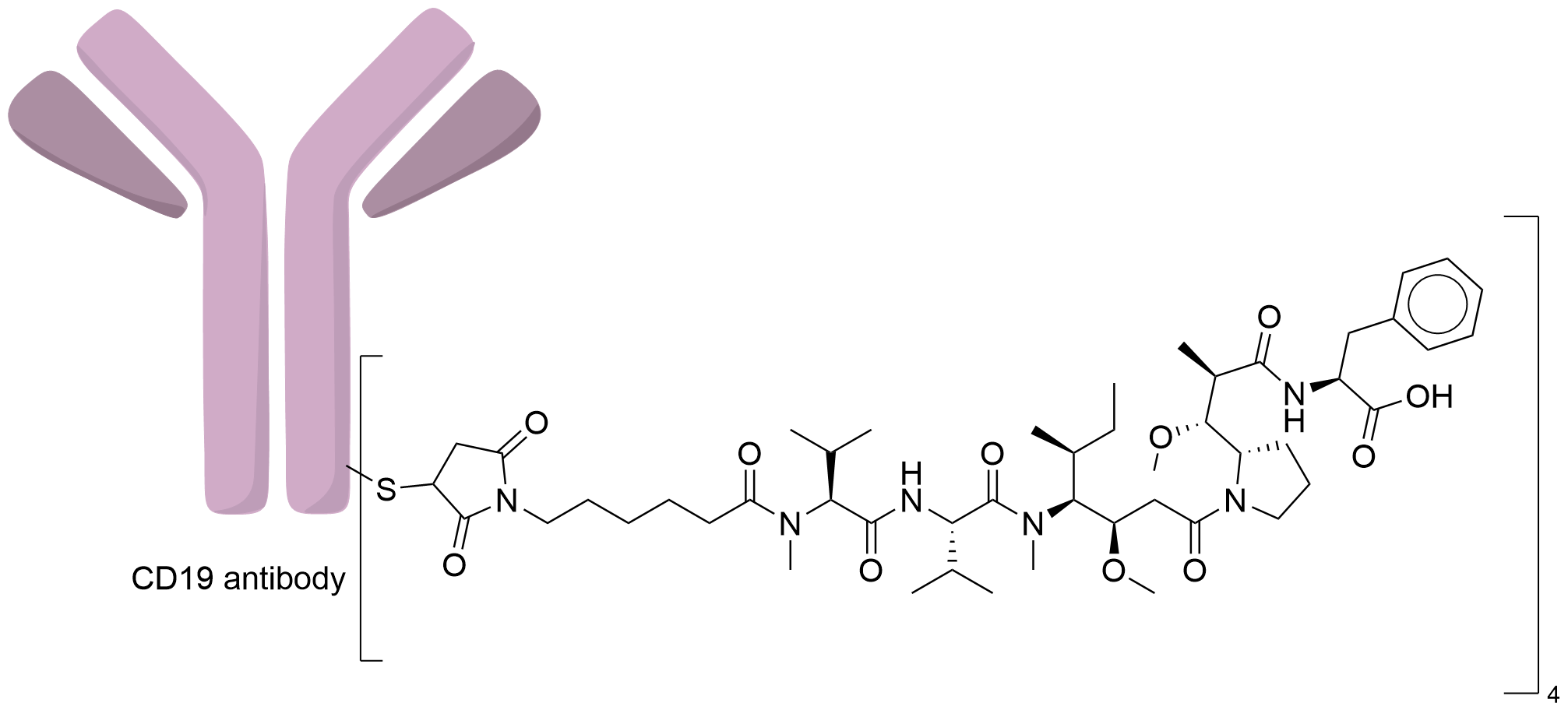
|
|||||
| Antibody Name |
Denintuzumab
|
Antibody Info | ||||
| Antigen Name |
B-lymphocyte antigen CD19 (CD19)
|
Antigen Info | ||||
| Payload Name |
Monomethyl auristatin F
|
Payload Info | ||||
| Payload Target |
Microtubule (MT)
|
Target Info | ||||
| Linker Name |
Maleimido-caproyl
|
Linker Info | ||||
| Conjugate Type |
Random Cysteines
|
|||||
| Combination Type |
mafodotin
|
|||||
2027 Update
The disease landscape of This ADC
2027 Update
The clinical trial pipelines of This ADC
| Disease Name | Phase 1 | Phase 2 | Phase 3 | Approved |
|---|---|---|---|---|
| Follicular lymphoma | ||||
| Unspecific non-hodgkin lymphoma | ||||
| Diffuse large B-cell lymphoma | ||||
| Mantle cell lymphoma | ||||
| Acute lymphoblastic leukemia |
General Information of The Activity Data Related to This ADC
Identified from the Human Clinical Data
Full List of Activity Data of This Antibody-drug Conjugate
Identified from the Human Clinical Data
| Experiment 1 Reporting the Activity Date of This ADC | [1] | ||||
| Efficacy Data | Partial Response (PR) |
3%
|
|||
| Patients Enrolled |
Eligible patients must be relapsed/refractory to prior therapies with disease confirmation (B-ALL, Burkitt's or B-lymphoblastic lymphoma) and measurable disease, excluding recent transplant recipients (<60 days) or those with active GVHD/immunosuppression.
|
||||
| Administration Dosage |
SGN-CD19A (IV) once (Day 1) or twice (Days 1 and 8) every 21 days; dose range: 0.3-6 mg/kg
|
||||
| Related Clinical Trial | |||||
| NCT Number | NCT01786096 | Clinical Status | PHASE1 | ||
| Clinical Description | A Phase 1, Open-Label, Dose-Escalation Study of SGN-CD19A in Patients With B-Lineage Acute Lymphoblastic Leukemia and Highly Aggressive Lymphomas | ||||
| Primary Endpoint |
The study evaluates adverse events and laboratory abnormalities occurring within 1 month post last dose as primary safety endpoints.
|
||||
| Other Endpoint |
Key secondary endpoints include objective response per modified AML or lymphoma criteria, duration of response (expected 3 months), overall survival (expected 6 months), pharmacokinetics of SGN-CD19A measured at specific timepoints, and immunogenicity assessed through antitherapeutic antibodies.
|
||||
| Experiment 2 Reporting the Activity Date of This ADC | [2] | ||||
| Efficacy Data | Objective Response Rate (ORR) |
33%
|
|||
| Patients Enrolled |
Patients eligible for enrollment must have confirmed B-cell malignancies (e.g., MCL, DLBCL, Burkitt lymphoma) and be relapsed/refractory post at least 1 prior therapy (intensive salvage required for DLBCL/Grade 3 FL), with ECOG 0-1 and measurable disease, excluding those with prior allogeneic SCT.
|
||||
| Administration Dosage |
Denintuzumab mafodotin was administered IV every 3 weeks (q3wk; 0.5-6 mg/kg) for dose escalation and every 6 weeks (q6wk; 3 mg/kg) in a subsequent expansion cohort.
|
||||
| Related Clinical Trial | |||||
| NCT Number | NCT01786135 | Clinical Status | PHASE1 | ||
| Clinical Description | A Phase 1, Open-Label, Dose-Escalation Study of SGN-CD19A in Patients With Relapsed or Refractory B-Lineage Non-Hodgkin Lymphoma | ||||
| Primary Endpoint |
The primary endpoints assess safety, including adverse events and laboratory abnormalities within 1 month post last dose.
|
||||
| Other Endpoint |
Secondary objectives focus on efficacy outcomes, including objective response per Cheson 2007 (assessed at ~6 weeks post last dose), duration of response (~6 months), overall survival (~1 year), pharmacokinetics of SGN-CD19A, and immunogenicity (antitherapeutic antibodies).
|
||||
| Experiment 3 Reporting the Activity Date of This ADC | [3] | ||||
| Patients Enrolled |
Secondary outcomes include adverse events (AEs) and lab abnormalities graded by NCI CTCAE v4.03, Objective Response Rate (ORR), duration of Complete Response (CR) and Objective Response (OR) up to 27.9 months, Progression-Free Survival (PFS) and Overall Survival (OS) tracked up to 30 months, alongside PBSC mobilization success and autologous stem cell transplant (ASCT) rates post-treatment.
Click to Show/Hide
|
||||
| Administration Dosage |
.
|
||||
| Related Clinical Trial | |||||
| NCT Number | NCT02592876 | Clinical Status | PHASE2 | ||
| Clinical Description | A Randomized, Open-Label Phase 2 Study of Denintuzumab Mafodotin (SGN-CD19A) Plus Rituximab, Ifosfamide, Carboplatin, and Etoposide (19A+RICE) Chemotherapy vs. RICE in the Treatment of Patients With Relapsed or Refractory Diffuse Large B-Cell Lymphoma (DLBCL) Who Are Candidates for Autologous Stem Cell Transplant | ||||
| Primary Endpoint |
The primary endpoint is the Complete Remission Rate assessed via PET and CT scans (or CT alone) over 4 months, measuring the number of patients achieving complete metabolic or radiologic responses as evaluated by an independent review facility.
|
||||
| Other Endpoint |
Secondary outcomes include adverse events (AEs) and lab abnormalities graded by NCI CTCAE v4.03, Objective Response Rate (ORR), duration of Complete Response (CR) and Objective Response (OR) up to 27.9 months, Progression-Free Survival (PFS) and Overall Survival (OS) tracked up to 30 months, alongside PBSC mobilization success and autologous stem cell transplant (ASCT) rates post-treatment.
Click to Show/Hide
|
||||
| Experiment 4 Reporting the Activity Date of This ADC | [4] | ||||
| Patients Enrolled |
Eligible patients had untreated systemic DLBCL (de novo or transformed) or Grade 3b FL with high-intermediate/high-risk disease, measurable FDG-avid lesions, ECOG ≤2, and adequate baseline labs. Exclusions included prior lymphoma treatment, untreated CNS involvement, active cancers not in 3-year remission, PML history, or significant ocular conditions.
Click to Show/Hide
|
||||
| Administration Dosage |
SGN-CD19A at 3 mg/kg will be administered every 6 weeks via intravenous (IV) infusion, up to a maximum of three (3) doses, on Day 1 of Cycles 1, 3, and 5 of 21-day cycles
|
||||
| Related Clinical Trial | |||||
| NCT Number | NCT02855359 | Clinical Status | PHASE2 | ||
| Clinical Description | An Open Label Phase 2 Study of Denintuzumab Mafodotin (SGN-CD19A) in Combination With RCHOP (Rituximab, Cyclophosphamide, Doxorubicin, Vincristine, and Prednisone) or RCHP (Rituximab, Cyclophosphamide, Doxorubicin, and Prednisone) Compared With RCHOP Alone as Frontline Therapy in Patients With Diffuse Large B-cell Lymphoma (DLBCL) or Follicular Lymphoma (FL) Grade 3b | ||||
| Primary Endpoint |
The study did not advance to Part B, so the Complete Response Rate (CR) was not assessed. Adverse events and laboratory abnormalities (Grade 1+) were recorded in Part A only, with safety data collected over 54.7 weeks and lab assessments up to 183 days.
|
||||
| Other Endpoint |
As the study did not proceed to Part B, none of the efficacy endpoints (Event-Free Survival, Progression-Free Survival, Overall Survival, Objective Response Rate, or Duration of Response) were evaluated, with no comparative data between study arms available.
|
||||
References