
Antibody-drug Conjugate Information
General Information of This Antibody-drug Conjugate (ID: DRG0KJHHN)
| ADC Name |
IMGN779
|
|||||
|---|---|---|---|---|---|---|
| Synonyms |
IMGN779
Click to Show/Hide
|
|||||
| Organization |
ImmunoGen (Top20 MNC) (Originator)
|
|||||
| Drug Status |
Phase 1 (discontinued)
|
|||||
| Drug-to-Antibody Ratio |
3
|
|||||
| Structure |
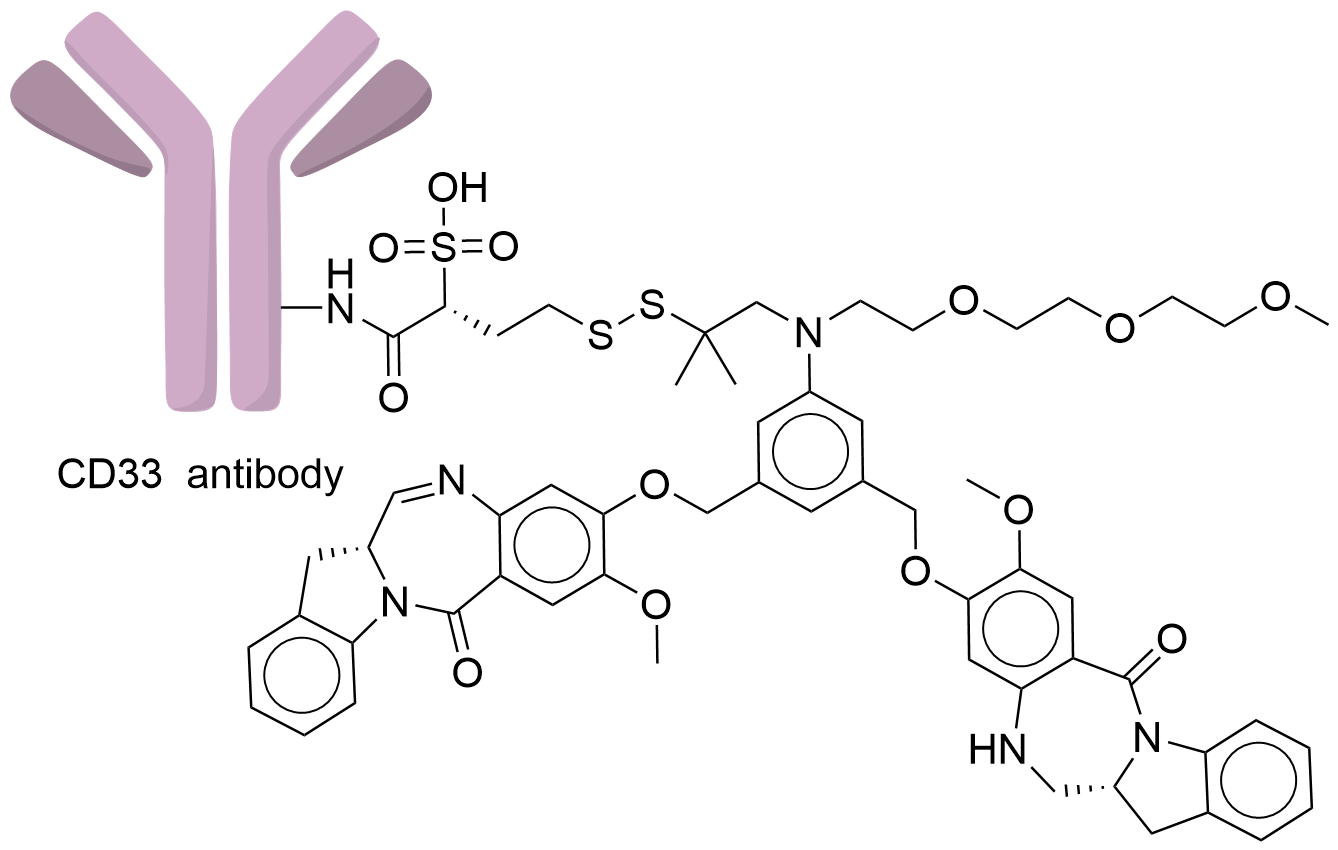
|
|||||
| Antibody Name |
Z4681A
|
Antibody Info | ||||
| Antigen Name |
Myeloid cell surface antigen CD33 (CD33)
|
Antigen Info | ||||
| Payload Name |
DGN462
|
Payload Info | ||||
| Payload Target |
Human deoxyribonucleic acid (hDNA)
|
Target Info | ||||
| Linker Name |
Sulfo-SPDB
|
Linker Info | ||||
| Conjugate Type |
Random Lysines
|
|||||
2027 Update
The disease landscape of This ADC
2027 Update
The clinical trial pipelines of This ADC
General Information of The Activity Data Related to This ADC
Identified from the Human Clinical Data
Discovered Using Cell Line-derived Xenograft Model
Full List of Activity Data of This Antibody-drug Conjugate
Identified from the Human Clinical Data
| Experiment 1 Reporting the Activity Date of This ADC | [1] | ||||
| Patients Enrolled |
Eligible patients must have relapsed/refractory AML (dose escalation) or be unsuitable for induction therapy (expansion), excluding those with acute promyelocytic leukemia, active CNS involvement, prior IMGN779 exposure, or recent anticancer therapy (within 14 days/five half-lives), as well as pregnant/breastfeeding women. Hydroxyurea or leukapheresis is permitted for hyperleukocytosis control.
Click to Show/Hide
|
||||
| Administration Dosage |
.
|
||||
| Related Clinical Trial | |||||
| NCT Number | NCT02674763 | Clinical Status | PHASE1 | ||
| Clinical Description | A Phase 1, Multi-center, Open-label Study of IMGN779 Administered Intravenously in Adult Patients With Relapsed/Refractory CD33-positive Acute Myeloid Leukemia | ||||
| Primary Endpoint |
The primary objective is to determine the maximum tolerated dose (MTD) of IMGN779 in patients with relapsed or refractory acute myeloid leukemia (AML) over a 28-day period during the dose escalation phase.
|
||||
| Other Endpoint |
Secondary endpoints include evaluating treatment-emergent adverse events, objective response rate (ORR), pharmacokinetic parameters (Cmax, AUC, t½), and immunogenicity (anti-drug antibodies) over a 12-month observation period to assess safety, efficacy, and drug exposure characteristics.
|
||||
Discovered Using Cell Line-derived Xenograft Model
| Experiment 1 Reporting the Activity Date of This ADC | [2] | ||||
| Efficacy Data | Tumor Growth Inhibition value (TGI) | ≈ 100% | Positive CD33 expression (CD33+++/++) | ||
| Method Description |
IMGN779 (0.5 mg/kg, a single dose) induces efficient tumor cell killing in cell line-derived models of MV4-11 cells with CD33 expression with high expression.
|
||||
| In Vivo Model | MV4-11 CDX model | ||||
| In Vitro Model | Childhood acute monocytic leukemia | MV4-11 cells | CVCL_0064 | ||
| Experiment 2 Reporting the Activity Date of This ADC | [2] | ||||
| Efficacy Data | Tumor Growth Inhibition value (TGI) | ≈ 100% | Positive CD33 expression (CD33+++/++) | ||
| Method Description |
EOL-1 tumor-bearing mice received a single intravenous bolus administration of vehicle, IMGN779, or Ab-DGN462, with each conjugate molecule dosed at approximately 1.5 mg/kg ADC by antibody concentration (i.e., 10 or 30 ug/kg linked IGN).
|
||||
| In Vivo Model | EOL-1 CDX model | ||||
| In Vitro Model | Chronic eosinophilic leukemia | EoL-1 cells | CVCL_0258 | ||
References