
Antibody-drug Conjugate Information
General Information of This Antibody-drug Conjugate (ID: DRG0COMTY)
| ADC Name |
Telisotuzumab vedotin
|
|||||
|---|---|---|---|---|---|---|
| Synonyms |
telisotuzumab vedotin; ABBV-399; Teliso-V; telisotuzumab vedotin-tllv; Emrelis
Click to Show/Hide
|
|||||
| Organization |
AbbVie (Top20 MNC) (Originator)
|
|||||
| Drug Status |
Approved in 2025
|
|||||
| Drug-to-Antibody Ratio |
3.1
|
|||||
| Structure |
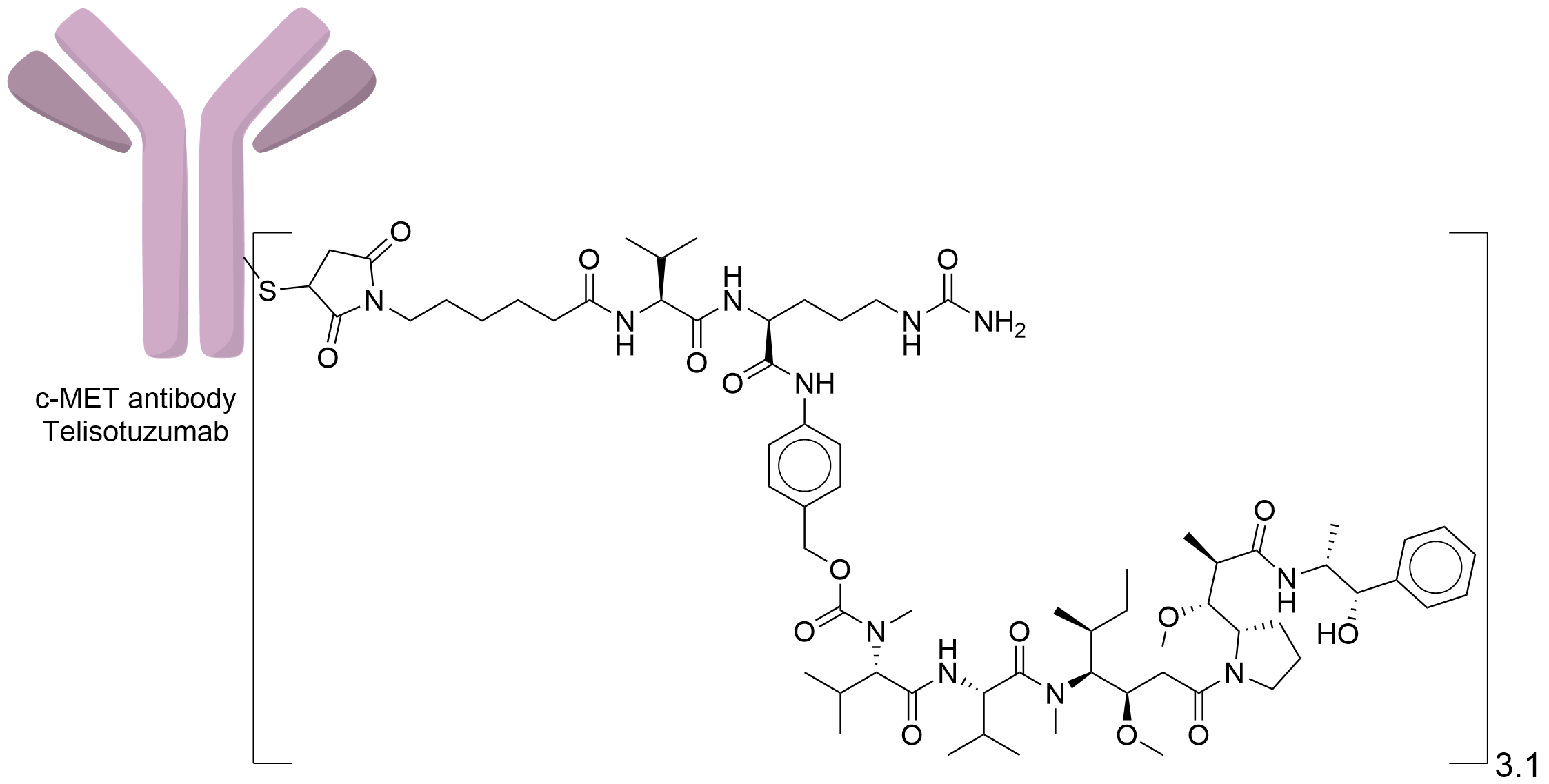
|
|||||
| Antibody Name |
Telisotuzumab
|
Antibody Info | ||||
| Antigen Name |
Hepatocyte growth factor receptor (MET)
|
Antigen Info | ||||
| Payload Name |
Monomethyl auristatin E
|
Payload Info | ||||
| Payload Target |
Microtubule (MT)
|
Target Info | ||||
| Linker Name |
Mc-Val-Cit-PABC
|
Linker Info | ||||
| Conjugate Type |
Random Cysteines
|
|||||
| Combination Type |
vedotin
|
|||||
| Special Approval(s) |
Breakthrough therapy (FDA)
|
|||||
2027 Update
The disease landscape of This ADC
2027 Update
The clinical trial pipelines of This ADC
| Indication | Phase 1 | Phase 2 | Phase 3 | Approved | |||||||
|---|---|---|---|---|---|---|---|---|---|---|---|
| Unspecific solid tumor |
2 Trials
|
||||||||||
| Lung cancer |
4 Trials
|
1 Trials
|
|
2027 Update
General Information of The ADMET Data Related to This ADC
Absorption
| Standard Type | Value | Units | Description | Reference |
|---|---|---|---|---|
| Maximum Observed Concentration (Cmax) | 57 | ug/mL |
Preliminary Pharmacokinetic Parameters (Geometric Mean [%CV]) for Teliso-V Conjugate Following 2.7-mg/kg Q3W Dose in Combination With Erlotinib.
|
[1] |
| Time to Maximum Concentration (Tmax) | 1 | h |
Preliminary Pharmacokinetic Parameters (Geometric Mean [%CV]) for Teliso-V Conjugate Following 2.7-mg/kg Q3W Dose in Combination With Erlotinib.
|
[1] |
| Area Under the Concentration-Time Curve (AUC) | 4048 | ug·h/mL |
Preliminary Pharmacokinetic Parameters (Geometric Mean [%CV]) for Teliso-V Conjugate Following 2.7-mg/kg Q3W Dose in Combination With Erlotinib, AUCinf.
|
[1] |
| Time to Maximum Concentration (Tmax) | 1 | h |
Summary of teliso-v pharmacokinetics, Cycle 1, 2.4 mg/kg, n=3.
|
[2] |
| Maximum Observed Concentration (Cmax) | 55.5 | ug/mL |
Summary of teliso-v pharmacokinetics, Cycle 1, 2.4 mg/kg, n=3.
|
[2] |
| Area Under the Concentration-Time Curve (AUC) | 4437 | ug·h/mL |
Summary of teliso-v pharmacokinetics, Cycle 1, 2.4 mg/kg, n=3, AUCinf.
|
[2] |
| Time to Maximum Concentration (Tmax) | 1 | h |
Summary of teliso-v pharmacokinetics, Cycle 1, 2.7 mg/kg, n=6.
|
[2] |
| Maximum Observed Concentration (Cmax) | 63 | ug/mL |
Summary of teliso-v pharmacokinetics, Cycle 1, 2.7 mg/kg, n=6.
|
[2] |
| Area Under the Concentration-Time Curve (AUC) | 5202 | ug·h/mL |
Summary of teliso-v pharmacokinetics, Cycle 1, 2.7 mg/kg, n=6, AUCinf.
|
[2] |
| Time to Maximum Concentration (Tmax) | 1 | h |
Preliminary Teliso-V conjugate PK parameters following Q2W Teliso-V infusion in cycle 1, 1.6 mg/kg.
|
[3] |
| Maximum Observed Concentration (Cmax) | 23.1 | ug/mL |
Preliminary Teliso-V conjugate PK parameters following Q2W Teliso-V infusion in cycle 1, 1.6 mg/kg.
|
[3] |
| Area Under the Concentration-Time Curve (AUC) | 1510 | ug·h/mL |
Preliminary Teliso-V conjugate PK parameters following Q2W Teliso-V infusion in cycle 1, 1.6 mg/kg, AUCtau.
|
[3] |
| Time to Maximum Concentration (Tmax) | 1 | h |
Preliminary Teliso-V conjugate PK parameters following Q2W Teliso-V infusion in cycle 1, 1.9 mg/kg.
|
[3] |
| Maximum Observed Concentration (Cmax) | 29.6 | ug/mL |
Preliminary Teliso-V conjugate PK parameters following Q2W Teliso-V infusion in cycle 1, 1.9 mg/kg.
|
[3] |
| Area Under the Concentration-Time Curve (AUC) | 1950 | ug·h/mL |
Preliminary Teliso-V conjugate PK parameters following Q2W Teliso-V infusion in cycle 1, 1.9 mg/kg, AUCtau.
|
[3] |
| Maximum Observed Concentration (Cmax) | 29 | ug/mL |
The maximum concentration (Cmax) of telisotuzumab vedotin occurs at the end of intravenous infusion and is approximately 29 ug/mL.
|
[4] |
| Maximum Observed Concentration (Cmax) | 2.2 | ng/mL |
The maximum concentration of unconjugated MMAE occurs approximately 5 days after administration and is approximately 2.2 ng/mL.
|
[4] |
| Area Under the Concentration-Time Curve (AUC) | 2130 | ug·h/mL |
The AUC0-tau of telisotuzumab vedotin and MMAE are 2130 ug·h/mL and 405 ng·h/mL, respectively.
|
[4] |
Distribution
| Standard Type | Value | Units | Description | Reference |
|---|---|---|---|---|
| Volume of Distribution (Vd) | 3.4 | L |
The volume of distribution of telisotuzumab vedotin is 3.4 liters.
|
[4] |
Metabolism
| Standard Type | Value | Units | Description | Reference |
|---|---|---|---|---|
| Undisclosed | Undisclosed | Undisclosed |
Telisotuzumab vedotin metabolism has not been studied in humans. The antibody component is likely broken down to smaller peptides and amino acids, while the drug component is metabolized primarily by CYP3A4.
Click to Show/Hide
|
[4] |
Excretion
| Standard Type | Value | Units | Description | Reference |
|---|---|---|---|---|
| Elimination Half-Life (t1/2) | 4.18 | day |
Summary of teliso-v pharmacokinetics, Cycle 1, 2.4 mg/kg, n=3.
|
[2] |
| Elimination Half-Life (t1/2) | 2.91 | day |
Summary of teliso-v pharmacokinetics, Cycle 1, 2.7 mg/kg, n=6.
|
[2] |
| Elimination Half-Life (t1/2) | 2.68 | day |
Preliminary Teliso-V conjugate PK parameters following Q2W Teliso-V infusion in cycle 1, 1.6 mg/kg.
|
[3] |
| Elimination Half-Life (t1/2) | 2.88 | day |
Preliminary Teliso-V conjugate PK parameters following Q2W Teliso-V infusion in cycle 1, 1.9 mg/kg.
|
[3] |
| Elimination Half-Life (t1/2) | 3 | day |
The elimination half-life of telisotuzumab vedotin is approximately 3 days, and the elimination half-life of MMAE is approximately 4 days.
|
[4] |
| Clearance (CL) | 1.3 | L/day |
The estimated clearance of telisotuzumab vedotin is 1.3 liters/day
|
[4] |
| Clearance (CL) | 76 | L/day |
The estimated clearance of unconjugated MMAE is 76 liters/day
|
[4] |
General Information of The Activity Data Related to This ADC
Identified from the Human Clinical Data
Full List of Activity Data of This Antibody-drug Conjugate
Identified from the Human Clinical Data
| Experiment 1 Reporting the Activity Date of This ADC | [1] | ||||
| Efficacy Data | Progression Free Survival |
5.9 months
|
|||
| Patients Enrolled |
Eligibility requires c-Met+ SCCA with no prior immune checkpoint inhibitor (anti-PD-1/PD-L1/CTLA-4) or autoimmune disease (exceptions: vitiligo, stable endocrine disorders). Exclusions: active HBV/HIV, chronic HCV, interstitial lung disease, NYHA Class III/IV cardiac conditions, recent corticosteroids (>10mg prednisone/day), or allergies to nivolumab/ipilimumab. Cardiac dysfunction (CHF/MI within 6 months) mandates cardiology evaluation. PRO questionnaires (English) are mandatory pre-registration.
Click to Show/Hide
|
||||
| Administration Dosage |
ABBV-399 (Process II), 2.7 mg/kg IV over 30 minutes, Day 1, Every 21 days
|
||||
| Related Clinical Trial | |||||
| NCT Number | NCT03574753 | Clinical Status | PHASE2 | ||
| Clinical Description | A Phase II Study of ABBV-399 in Patients With C-Met Positive Stage IV or Recurrent Squamous Cell Lung Cancer (LUNG-MAP SUB-STUDY) | ||||
| Primary Endpoint |
Primary efficacy outcomes include overall response rate (ORR; confirmed/unconfirmed CR/PR per RECIST 1.1) in c-Met+ lung squamous cell carcinoma (SCCA) patients. Safety metrics focus on Grade 3-5 drug-related adverse events (CTCAE v4.0/5.0) during treatment and 3-year follow-up.
|
||||
| Other Endpoint |
Secondary endpoints evaluate immunotherapy-exposed/relapsed c-Met+ SCCA: investigator-assessed progression-free survival (IA-PFS; time to progression/symptomatic deterioration/death), overall survival (OS; time to death), and ORR per RECIST 1.1 over 3 years. Duration of response (DoR; time from initial response to progression/death) is also measured.
Click to Show/Hide
|
||||
| Experiment 2 Reporting the Activity Date of This ADC | [1] | ||||
| Efficacy Data | Objective Response Rate (ORR) |
32.1
52.6 % |
|||
| Patients Enrolled |
Eligibility requires c-Met+ SCCA with no prior immune checkpoint inhibitor (anti-PD-1/PD-L1/CTLA-4) or autoimmune disease (exceptions: vitiligo, stable endocrine disorders). Exclusions: active HBV/HIV, chronic HCV, interstitial lung disease, NYHA Class III/IV cardiac conditions, recent corticosteroids (>10mg prednisone/day), or allergies to nivolumab/ipilimumab. Cardiac dysfunction (CHF/MI within 6 months) mandates cardiology evaluation. PRO questionnaires (English) are mandatory pre-registration.
Click to Show/Hide
|
||||
| Administration Dosage |
ABBV-399 (Process II), 2.7 mg/kg IV over 30 minutes, Day 1, Every 21 days
|
||||
| Related Clinical Trial | |||||
| NCT Number | NCT03574753 | Clinical Status | PHASE2 | ||
| Clinical Description | A Phase II Study of ABBV-399 in Patients With C-Met Positive Stage IV or Recurrent Squamous Cell Lung Cancer (LUNG-MAP SUB-STUDY) | ||||
| Primary Endpoint |
Primary efficacy outcomes include overall response rate (ORR; confirmed/unconfirmed CR/PR per RECIST 1.1) in c-Met+ lung squamous cell carcinoma (SCCA) patients. Safety metrics focus on Grade 3-5 drug-related adverse events (CTCAE v4.0/5.0) during treatment and 3-year follow-up.
|
||||
| Other Endpoint |
Secondary endpoints evaluate immunotherapy-exposed/relapsed c-Met+ SCCA: investigator-assessed progression-free survival (IA-PFS; time to progression/symptomatic deterioration/death), overall survival (OS; time to death), and ORR per RECIST 1.1 over 3 years. Duration of response (DoR; time from initial response to progression/death) is also measured.
Click to Show/Hide
|
||||
| Experiment 3 Reporting the Activity Date of This ADC | [5] | ||||
| Efficacy Data | Objective Response Rate (ORR) |
36.50%
|
|||
| Patients Enrolled |
Eligible participants must have c-Met+ locally advanced/metastatic non-squamous EGFR-wildtype NSCLC (≤2 prior systemic therapies including ≤1 cytotoxic chemotherapy line) with ECOG 0-1. Exclusions include recent lung radiation (<6 months), adenosquamous histology, ILD/pneumonitis history (no evidence on screening imaging for Ireland sites), active infections (HIV/HBV/HCV - specific to France/CZ sites), and unresolved Grade≥2 toxicities (except alopecia/anemia). Stable CNS metastases post-definitive therapy are permitted.
Click to Show/Hide
|
||||
| Administration Dosage |
Telisotuzumab vedotin administered via intravenous (IV) infusion every 14 days.
|
||||
| Related Clinical Trial | |||||
| NCT Number | NCT03539536 | Clinical Status | PHASE2 | ||
| Clinical Description | Phase 2, Open-Label Safety and Efficacy Study of Telisotuzumab Vedotin (ABBV-399) in Subjects With Previously Treated c-Met+ Non-Small Cell Lung Cancer | ||||
| Primary Endpoint |
Key efficacy endpoints include overall response rate (ORR; confirmed CR/PR per RECIST v1.1) and adverse events assessment in the alternate dose cohort over approximately 3 years.
|
||||
| Other Endpoint |
Additional efficacy measures comprise duration of response (DoR; time from initial response to progression/death), disease control rate (DCR; CR+PR+SD≥12 weeks), progression-free survival (PFS; time from first dose to progression/death), and overall survival (OS; time from first dose to death) - all assessed over approximately 3 years.
|
||||
| Experiment 4 Reporting the Activity Date of This ADC | [6] | ||||
| Efficacy Data | Disease control rate (DCR) |
76.90%
|
|||
| Patients Enrolled |
Eligible patients have advanced NSCLC (ECOG 0-2) with measurable disease and adequate organ function. Exclusions: recent lung radiation (<6 months), uncontrolled CNS metastases, ILD/pneumonitis history, unresolved Grade≥2 toxicities, major surgery within 21 days, or active COVID-19. Combination-specific exclusions apply (e.g., QTc>470ms for osimertinib arm; autoimmune disease/immunosuppressants for nivolumab arm).
Click to Show/Hide
|
||||
| Administration Dosage |
.
|
||||
| Related Clinical Trial | |||||
| NCT Number | NCT02099058 | Clinical Status | PHASE1 | ||
| Clinical Description | A Multicenter, Phase 1/1b, Open-Label, Dose-Escalation Study of ABBV-399, an Antibody Drug Conjugate, in Subjects With Advanced Solid Tumors | ||||
| Primary Endpoint |
Primary outcomes assess safety (adverse events over 24 months) and pharmacokinetics of ABBV-399 (monotherapy/combination with osimertinib/erlotinib/nivolumab) including recommended Phase 2 dose (RPTD), AUC (0-t), Cmax, Tmax, and terminal half-life.
|
||||
| Other Endpoint |
Efficacy endpoints include objective response rate (ORR; CR/PR per RECIST 1.1), progression-free survival (PFS; time from first dose to progression/death), and duration of response (DoR; time from initial response to progression) over 24 months.
|
||||
| Experiment 5 Reporting the Activity Date of This ADC | [7] | ||||
| Patients Enrolled |
Eligible participants must have c-Met-overexpressing non-squamous NSCLC (confirmed by AbbVie's IHC assay), actionable gene alterations (if applicable), measurable disease (RECIST v1.1), ECOG 0-1, and ≤1 prior cytotoxic chemotherapy line in advanced/metastatic setting. Exclusions include untreated CNS metastases, prior c-Met/EGFR-targeted therapy, docetaxel exposure, idiopathic pulmonary fibrosis, unresolved Grade ≥2 toxicities (except alopecia/anemia), major surgery within 21 days, or protocol-specified comorbidities. Stable brain metastases post-treatment are allowed if asymptomatic and off steroids (≤10mg prednisone/day).
Click to Show/Hide
|
||||
| Administration Dosage |
Participants will receive telisotuzumab vedotin every 2 weeks until meeting study drug discontinuation criteria.
|
||||
| Related Clinical Trial | |||||
| NCT Number | NCT04928846 | Clinical Status | PHASE3 | ||
| Clinical Description | A Phase 3 Open-Label, Randomized, Controlled, Global Study of Telisotuzumab Vedotin (ABBV-399) Versus Docetaxel in Subjects With Previously Treated c-Met Overexpressing, EGFR Wildtype, Locally Advanced/Metastatic Non-Squamous Non-Small Cell Lung Cancer | ||||
| Primary Endpoint |
Efficacy evaluation includes progression-free survival (PFS) and overall survival (OS) assessed up to 39 months via Blinded Independent Central Review (BICR) and investigator assessment, with PFS defined as time from randomization to radiographic progression (RECIST v1.1) or death, and OS as time to death from any cause.
|
||||
| Other Endpoint |
Additional efficacy measures comprise objective response rate (ORR) and duration of response (DoR) per BICR (up to 58.25 months), alongside quality-of-life changes (EORTC QLQ-C30) over 12 weeks, assessing physical function and global health status on a 0-100 scale where higher scores indicate better functioning/quality of life or worse symptom burden.
Click to Show/Hide
|
||||
| Experiment 6 Reporting the Activity Date of This ADC | [8] | ||||
| Patients Enrolled |
Eligible participants must have MET-amplified non-squamous NSCLC (central lab-confirmed), measurable disease (RECIST v1.1), ECOG 0-1, and prior adjuvant/neoadjuvant therapy completed ≥6 months pre-enrollment. Exclusions include actionable EGFR/ALK/ROS1/BRAF alterations, prior metastatic NSCLC systemic therapy (except ≤1 chemotherapy cycle), unresolved Grade ≥2 toxicities (excluding alopecia/anemia), major surgery within 21 days, or protocol-specified comorbidities (e.g., active pneumonitis). Stable CNS metastases post-treatment are permitted.
Click to Show/Hide
|
||||
| Administration Dosage |
Participants will receive telisotuzumab vedotin every 2 weeks until meeting study drug discontinuation criteria.
|
||||
| Related Clinical Trial | |||||
| NCT Number | NCT05513703 | Clinical Status | PHASE2 | ||
| Clinical Description | Phase 2, Open-Label Study in Subjects With Previously Untreated MET Amplified Locally Advanced/Metastatic Non-Squamous Non-Small Cell Lung Cancer (NSCLC) | ||||
| Primary Endpoint |
Efficacy outcomes include objective response rate (ORR) per Independent Central Review (ICR) up to 1 year, defined as confirmed complete (CR) or partial response (PR) by RECIST v1.1, alongside duration of response (DoR), disease control rate (DCR), progression-free survival (PFS), and overall survival (OS) up to 2 years.
|
||||
| Other Endpoint |
Patient-reported outcomes assess time to deterioration in cough, pain, dyspnea, and physical function (EORTC QLQ-LC13/QLQ-C30) and quality-of-life changes (EORTC QLQ-C30 Global Health Status) over 1 year, scored 0-100 (higher scores indicate better function/QoL or worse symptoms).
|
||||
| Experiment 7 Reporting the Activity Date of This ADC | [9] | ||||
| Patients Enrolled |
Eligible participants must have EGFR-mutated (del19/L858R ±T790M), c-Met-overexpressing non-squamous NSCLC (IHC-confirmed), ECOG 0-1, measurable disease (RECIST v1.1), and progression on prior third-generation EGFR TKI (e.g., osimertinib). Exclusions include actionable ALK/ROS1/BRAF alterations, prior metastatic chemotherapy (except limited platinum pre-TKI), unresolved Grade ≥2 toxicities (excluding alopecia/anemia), major surgery within 21 days, active pneumonitis, or protocol-specified comorbidities (e.g., uncontrolled infections, ≥Grade 2 edema/neuropathy). Stable CNS metastases post-definitive therapy are permitted if asymptomatic for ≥4 weeks.
Click to Show/Hide
|
||||
| Administration Dosage |
Participants will receive telisotuzumab vedotin every 2 weeks in combination with osimertinib, until disease progression or unacceptable toxicity.
|
||||
| Related Clinical Trial | |||||
| NCT Number | NCT06093503 | Clinical Status | PHASE3 | ||
| Clinical Description | Phase 3, Open-Label, Randomized, Controlled, Global Study of Telisotuzumab Vedotin (ABBV-399) Combined With Osimertinib vs Platinum-Based Chemotherapy in Subjects With c-Met Overexpressing (OE) EGFR Mutant, Locally Advanced/Metastatic Non-Squamous NSCLC After a First Progression on Prior Third Generation EGFR TKi Treatment | ||||
| Primary Endpoint |
The study evaluates progression-free survival (PFS) both in participants without CNS metastases and in the overall population, defined as time from randomization to radiographic progression (RECIST v1.1) or death. Overall response (OR) and duration of response (DoR) are similarly assessed, with OR defined as confirmed complete (CR) or partial response (PR), and DoR measuring time from response to progression or death.
Click to Show/Hide
|
||||
| Other Endpoint |
Secondary outcomes include overall survival (OS) and changes in physical functioning/quality of life using EORTC QLQ-C30 and QLQ-LC13 scales (0-100), where higher scores indicate better function/QoL or worse symptoms. Adverse events (AEs) are monitored up to 41 months, with causality assessed by investigators.
|
||||
| Experiment 8 Reporting the Activity Date of This ADC | [10] | ||||
| Patients Enrolled |
Eligible participants must have c-Met-overexpressing NSCLC (IHC-confirmed), ECOG 0-1, measurable disease (RECIST v1.1), and ≤1 prior cytotoxic chemotherapy line. Exclusions include actionable EGFR mutations, prior c-Met-targeted ADCs/docetaxel, active pneumonitis, unresolved Grade≥2 toxicities (excluding alopecia/anemia), major surgery within 21 days, or protocol-specified comorbidities (e.g., ≥Grade 2 edema/neuropathy, uncontrolled infections). Stable CNS metastases post-therapy are permitted if asymptomatic.
Click to Show/Hide
|
||||
| Administration Dosage |
Participants will receive telisotuzumab vedotin dose A/B, as part of the 3 year study duration.
|
||||
| Related Clinical Trial | |||||
| NCT Number | NCT06568939 | Clinical Status | PHASE2 | ||
| Clinical Description | A Phase 2, Open-Label, Randomized, Global Study of Two Telisotuzumab Vedotin Regimens in Subjects With Previously Treated c-Met Overexpressing, EGFR Wildtype, Locally Advanced/Metastatic Non-Squamous Non-Small Cell Lung Cancer | ||||
| Primary Endpoint |
Safety endpoints include treatment-emergent adverse events (AEs) (any-grade/Grade≥2), specifically interstitial lung disease (ILD), peripheral neuropathy, and ocular surface disorders (corneal epitheliopathy) over 3 years, along with AEs leading to treatment discontinuation or Grade 5 (fatal) events. Efficacy measures include objective response (OR: CR/PR per RECIST v1.1) and duration of response (DoR) assessed by blinded independent central review (BICR).
Click to Show/Hide
|
||||
| Other Endpoint |
Pharmacokinetic analyses measure telisotuzumab vedotin conjugate (serum) and MMAE payload (plasma) concentrations over 26 weeks, alongside antidrug antibody (ADA/nADA) incidence. Patient-reported outcomes assess treatment tolerability via PRO-CTCAE (0-4 scale) and FACT-G GP5 item. Secondary endpoints include PFS (time to progression/death) and OS (time to death) over 3 years.
Click to Show/Hide
|
||||
| Experiment 9 Reporting the Activity Date of This ADC | [11] | ||||
| Patients Enrolled |
The participant must not be eligible for a telisotuzumab vedotin clinical trial.
|
||||
| Administration Dosage |
.
|
||||
| Related Clinical Trial | |||||
| NCT Number | NCT04830202 | Clinical Status | N.A. | ||
| Clinical Description | Expanded Access to Telisotuzumab Vedotin | ||||
| Experiment 10 Reporting the Activity Date of This ADC | [12] | ||||
| Patients Enrolled |
Eligible participants must have histologically confirmed advanced solid tumors (ECOG 0-2) with measurable disease, archived tumor tissue, and adequate organ function. Exclusions: prior anticancer therapy within 21 days (7 days for herbal), uncontrolled brain metastases (eligible post-definitive therapy if asymptomatic without steroids/anticonvulsants for ≥2 weeks), unresolved Grade≥2 toxicities (except alopecia/anemia), or major surgery within 21 days.
Click to Show/Hide
|
||||
| Administration Dosage |
ABBV-399 via intravenous administration at escalating dose levels.
|
||||
| Related Clinical Trial | |||||
| NCT Number | NCT03311477 | Clinical Status | PHASE1 | ||
| Clinical Description | A Phase I Study to Evaluate the Safety and Pharmacokinetics of ABBV-399 in Japanese Subjects With Advanced Solid Tumors | ||||
| Primary Endpoint |
Pharmacokinetic parameters include AUC (0-t), Cmax, Tmax, and terminal elimination half-life (t1/2), measured over 24 months. Dose determination evaluates Maximum Tolerated Dose (MTD) or Maximum Administered Dose (MAD) as the highest dose with <33% dose-limiting toxicities in the first 21 days.
|
||||
| Other Endpoint |
Efficacy outcomes measured over 24 months are Progression-Free Survival (PFS; time from first dose to progression/death), Objective Response Rate (ORR; confirmed CR/PR by RECIST 1.1), and Duration of Response (DOR; initial response to progression/death).
|
||||
| Experiment 11 Reporting the Activity Date of This ADC | [13] | ||||
| Patients Enrolled |
Eligible participants must have confirmed advanced/metastatic NSQ NSCLC, available FFPE tissue collected since 2019, and prior consent for biomarker research. Exclusions: pre-2019 specimens, inadequate tissue volume/quality (e.g., <4-5um thickness), and adenosquamous/sarcomatous histologies.
|
||||
| Administration Dosage |
.
|
||||
| Related Clinical Trial | |||||
| NCT Number | NCT06068842 | Clinical Status | N.A. | ||
| Clinical Description | International Real-World Study of MET Overexpression in Patients With Non-Small Cell Lung Cancer | ||||
| Primary Endpoint |
MET protein overexpression status (either positive [≥25% tumor cells with 3+ staining] or high-positive [≥50% tumor cells with 3+ staining]) will be assessed via local IHC testing over 15 months.
|
||||
| Experiment 12 Reporting the Activity Date of This ADC | [14] | ||||
| Efficacy Data | Objective Response Rate (ORR) |
7.40%
|
|||
| Patients Enrolled |
Advanced non-small cell lung cancer (NSCLC).
|
||||
| Administration Dosage |
Teliso-V Q2W (1.60, 1.90, or 2.20 mg/kg, intravenous) with nivolumab (3 mg/kg, or 240 mg, or per locally approved label, intravenously).
|
||||
| Related Clinical Trial | |||||
| NCT Number | NCT02099058 | Clinical Status | Phase 1 | ||
| Clinical Description | A multicenter, phase 1/1b, open-label, dose-escalation study of ABBV-399, an antibody drug conjugate, in subjects with advanced solid tumors. | ||||
| Primary Endpoint |
Most patients (97.30%, n=36) experienced one or more TEAE, with 23 (62.16%) reporting TEAEs grades 3 or higher. TEAEs considered possibly related to Teliso-V were reported in 78.38% (n=29) of patients; 32.43% (n=12) were grade greater than or equal to 3.
|
||||
| Other Endpoint |
Combination therapy with Teliso-V plus nivolumab was well tolerated in patients with c-Met-+NSCLC with limited antitumor activity. The ORR was 7.40% (95% CI: 0.90-24.30), with two patients (PD-L1+, n =1; PD-L1-, n=1) having a confirmed PR.Overall, 66.67% of patients (16 of 24) had evidence of tumor size reduction; three (12.5%) reported a greater than 30% reduction in target lesion. The overall median PFS (95% CI) was 7.20 months (3.30-8.90); 7.20 months(1.50-not reached [NR]) for PD-L1 patients, 4.50 months(1.50-NR) for PD-L1- patients, and NR (2.00-NR) for PD-L1-unk patients. The objective response rate was 7.40%, with two patients having a confirmed partial response. Overall median progression-free survival was 7.20 months.
Click to Show/Hide
|
||||
| Experiment 13 Reporting the Activity Date of This ADC | [15] | ||||
| Efficacy Data | Objective Response Rate (ORR) |
23.00
28.00 18.00 18.00 31.00 6.00 43.00 % |
|||
| Patients Enrolled |
Non-small cell lung cancer (NSCLC) and c-Met H-score 150 (c-Met+) or MET amplification/exon 14 skipping mutations.
|
||||
| Administration Dosage |
Intravenously once every 3 weeks (0.15-3.30 mg/kg) or once every 2 weeks (1.60-2.20 mg/kg).
|
||||
| Related Clinical Trial | |||||
| NCT Number | NCT02099058 | Clinical Status | Phase 1 | ||
| Clinical Description | A multicenter, phase 1/1b, open-label, dose-escalation study of ABBV-399, an antibody drug conjugate, in subjects with advanced solid tumors. | ||||
| Primary Endpoint |
Four objective responses (ORR = 26.70%; 95% CI, 7.80-55.10) were observed in this subgroup, 3 in once every 2 weeks (ORR = 43.00%; 95% CI, 9.90-81.60), and 1 in once every 3 weeks (ORR = 13.00%; 95% CI, 0.30-52.70).
|
||||
| Other Endpoint |
The median PFS in once every 2 weeks cohorts was 8.00 months (range, 1.20-9.10) and the median treatment duration was 19.60 weeks (range, 0.10-60.10).
|
||||
| Experiment 14 Reporting the Activity Date of This ADC | [16] | ||||
| Efficacy Data | Objective Response Rate (ORR) |
30.55
32.10 52.60 % |
|||
| Patients Enrolled |
Advanced non-small cell lung cancer (measurable per Response Evaluation Criteria in Solid Tumors v1.1) not amenable to resection or other approved therapies until disease progression, death, or withdrawal of consent.
|
||||
| Administration Dosage |
Teliso-V (2.70 mg/kg once every 21 days) plus erlotinib (150 mg once daily) until disease progression, death, or withdrawal of consent.
|
||||
| Related Clinical Trial | |||||
| NCT Number | NCT02099058 | Clinical Status | Phase 1 | ||
| Clinical Description | A multicenter, phase 1/1b, open-label, dose-escalation study of ABBV-399, an antibody drug conjugate, in subjects with advanced solid tumors. | ||||
| Primary Endpoint |
OrR for all efficacy-evaluable patients was 30.55% (11/36; 95% CI, 16.30 to 48.10), and DCR was 86.11% (31/36; 95% CI, 70.5 to 95.3). Median PFS for all efficacy-evaluable patients was 5.90 months (95% CI, 2.80 to not reached [NR]).
|
||||
| Other Endpoint |
For EGFR-M+ patients (n = 28), ORR was 32.14% (9/28; 95% CI, 15.90 to 52.40), with one CR (3.57%) and eight PR (28.57%). DCR was 85.71% (24/28; 95% CI, 67.30 to 96.00) and median PFS was 5.90 months (95% CI, 2.80 to NR). Median PFS was 3.70 months (95% CI, 1.40 to NR) for T790M+ patients, compared with 6.80 months (95% CI, 4.30 to NR) for non-T790M+ patients. Of EGFR-M+ patients, those who were c-Met high (n = 15) had an ORR of 52.60%. Median PFS was 6.80 months for non-T790M+ and for those whose T790M status was unknown, versus 3.70 months for T790M+.
Click to Show/Hide
|
||||
| Experiment 15 Reporting the Activity Date of This ADC | [16] | ||||
| Efficacy Data | Objective Response Rate (ORR) |
30.60
32.18 52.60 % |
|||
| Patients Enrolled |
Advanced non-small cell lung cancer (measurable per Response Evaluation Criteria in Solid Tumors v1.1) not amenable to resection or other approved therapies until disease progression, death, or withdrawal of consent.
|
||||
| Administration Dosage |
Teliso-V (2.70 mg/kg once every 21 days) plus erlotinib (150 mg once daily) until disease progression, death, or withdrawal of consent.
|
||||
| Related Clinical Trial | |||||
| NCT Number | NCT02099058 | Clinical Status | Phase 1 | ||
| Clinical Description | A multicenter, phase 1/1b, open-label, dose-escalation study of ABBV-399, an antibody drug conjugate, in subjects with advanced solid tumors. | ||||
| Primary Endpoint |
Median PFS=5.90 months (95% CI, 2.80 to not reached). ORR for EGFR-M+ patients = 32.18% (n=28). EGFR-M+ patients ORR = 52.60%.
|
||||
| Other Endpoint |
Median PFS=6.80 months for non-T790M+.
|
||||
| Experiment 16 Reporting the Activity Date of This ADC | [17] | ||||
| Efficacy Data | Objective Response Rate (ORR) |
71.70
70.60 % |
|||
| Patients Enrolled |
Relapsed or refractory multiple myeloma, and ECOG performance status or Zubrod score of 2 or below, received indatuximab ravtansine with lenalidomide and dexamethasone (indatuximab ravtansine plus lenalidomide) had failure of at least one previous therapy.
|
||||
| Administration Dosage |
Intravenously on days 1, 8, and 15 of each 28-day cycle in dose of 100 mg/m2 plus lenalidomide or pomalidomide and dexamethasone.
|
||||
| Related Clinical Trial | |||||
| NCT Number | NCT01638936 | Clinical Status | Phase 1 | ||
| Clinical Description | A phase 1/2a multi-dose escalation study of BT062 in combination with lenalidomide or pomalidomide and dexamethasone in subjects with relapsed or relapsed/refractory multiple myeloma. | ||||
| Experiment 17 Reporting the Activity Date of This ADC | [18] | ||||
| Efficacy Data | Objective Response Rate (ORR) |
75%
|
|||
| Patients Enrolled |
MA advanced GEC.
|
||||
| Administration Dosage |
15 mg/kg IV, once every 3 weeks.
|
||||
| Related Clinical Trial | |||||
| NCT Number | NCT01472016 | Clinical Status | Phase 1 | ||
| Clinical Description | A multi-center, phase 1/1b, open-label, dose escalation study of ABT-700, a monoclonal antibody in subjects with advanced solid tumors. | ||||
| Primary Endpoint |
Among these patients, three achieved a partial response and one had progressive disease as best response (ORR=75.00%). The duration of disease control in responders ranged from 18-27 weeks and the median duration of response was 16.10 weeks. The median progression- free survival in MET-amplified patients was 17.90 weeks.
|
||||
| Experiment 18 Reporting the Activity Date of This ADC | [19] | ||||
| Related Clinical Trial | |||||
| NCT Number | NCT01915472 | Clinical Status | Phase 2 | ||
| Clinical Description | A phase 2 study of IMMU 130 (hmn-14-SN38 antibody drug conjugate) in patients with metastatic colorectal cancer. | ||||
| Experiment 19 Reporting the Activity Date of This ADC | [20] | ||||
| Related Clinical Trial | |||||
| NCT Number | NCT01001442 | Clinical Status | Phase 1/2 | ||
| Clinical Description | A phase 1/2a multi-dose escalation study to evaluate maximum tolerated dose (MTD), pharmacokinetics (PK), safety and efficacy of BT062 in subjects with relapsed or relapsed/refractory multiple myeloma. | ||||
| Experiment 20 Reporting the Activity Date of This ADC | [21] | ||||
| Related Clinical Trial | |||||
| NCT Number | NCT01270698 | Clinical Status | Phase 1 | ||
| Clinical Description | A phase 1 study of IMMU-130 (hmn-14-SN38 antibody drug conjugate) in patients with colorectal cancer. | ||||
| Experiment 21 Reporting the Activity Date of This ADC | [22] | ||||
| Related Clinical Trial | |||||
| NCT Number | NCT01605318 | Clinical Status | Phase 1 | ||
| Clinical Description | A phase 1/2 study of once or twice weekly IMMU-130 (hMN-14-SN38, antibody-drug conjugate) in patients with colorectal cancer. | ||||
| Experiment 22 Reporting the Activity Date of This ADC | [23] | ||||
| Related Clinical Trial | |||||
| NCT Number | NCT00723359 | Clinical Status | Phase 1 | ||
| Clinical Description | A phase 1 dose escalation study to evaluate maximum tolerated dose (MTD), pharmacokinetics (PK), and safety of BT062 in subjects with relapsed or relapsed/refractory multiple myeloma. | ||||
| Experiment 23 Reporting the Activity Date of This ADC | [24] | ||||
| Patients Enrolled |
Nonsmall-cell lung cancer (NSCLC) with c-Metoverexpressing tumors (c-Met positive; immunohistochemistry membrane H-score 150).
|
||||
| Administration Dosage |
Teliso-V was administered by intravenous (IV) infusion to groups of three to six patients who were enrolled in eight-dose cohorts for dosing at 0.15 to 3.30 mg/kg on day 1, once every 21 days, or until disease progression or unacceptable toxicity.
|
||||
| Related Clinical Trial | |||||
| NCT Number | NCT02099058 | Clinical Status | Phase 1 | ||
| Clinical Description | A multicenter, phase 1/1b, open-label, dose-escalation study of ABBV-399, an antibody drug conjugate, in subjects with advanced solid tumors. | ||||
| Primary Endpoint |
No formal MTD was identified.
|
||||
References