
Linker Information
General Information of This Linker (ID: LIN0PSMBH)
| Name |
T1000
|
|||||
|---|---|---|---|---|---|---|
| Linker Type |
Unclear
|
|||||
| Antibody-Linker Relation |
Cleavable
|
|||||
| Structure |
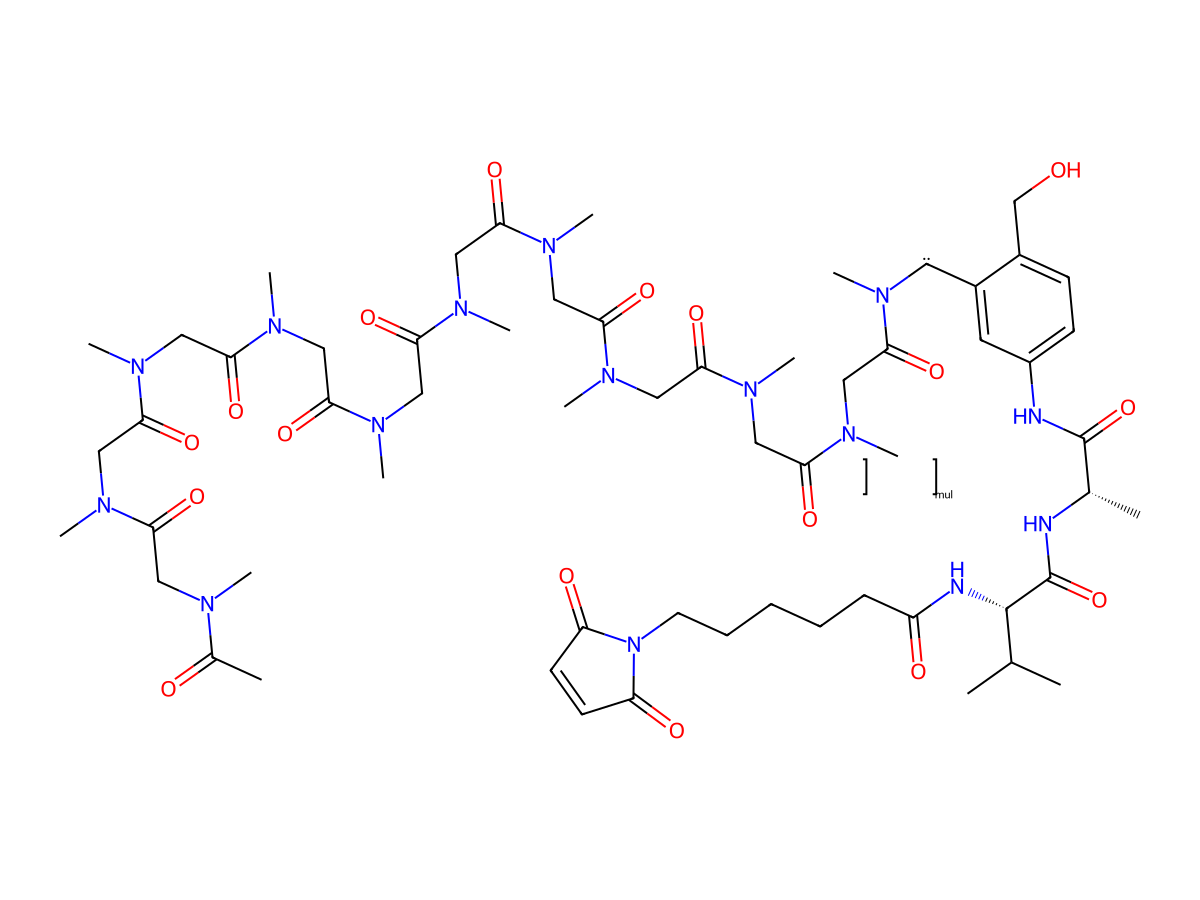
|
|||||
| Formula |
C59H89N15O17
|
|||||
| Isosmiles |
O=C([C@@H](NC([C@H](C(C)C)NC(CCCCCN1C(C=CC1=O)=O)=O)=O)C)NC2=CC=C(CO)C([C]N(C(CN(C(CN(C(CN(C(CN(C(CN(C(CN(C(CN(C(CN(C(CN(C(CN(C)C(C)=O)=O)C)=O)C)=O)C)=O)C)=O)C)=O)C)=O)C)=O)C)=O)C)=O)C)=C2
|
|||||
| InChI |
InChI=1S/C59H89N15O17/c1-38(2)57(62-44(77)19-17-16-18-24-74-45(78)22-23-46(74)79)59(91)60-39(3)58(90)61-43-21-20-41(37-75)42(25-43)26-64(6)48(81)28-66(8)50(83)30-68(10)52(85)32-70(12)54(87)34-72(14)56(89)36-73(15)55(88)35-71(13)53(86)33-69(11)51(84)31-67(9)49(82)29-65(7)47(80)27-63(5)40(4)76/h20-23,25,38-39,57,75H,16-19,24,27-37H2,1-15H3,(H,60,91)(H,61,90)(H,62,77)/t39-,57-/m0/s1
|
|||||
| InChIKey |
VFYQXIBMZPWZRQ-FAKAEVCMSA-N
|
|||||
| Pharmaceutical Properties |
Molecule Weight
|
1280.449
|
Polar area
|
368.32
|
||
|
Complexity
|
2784.193407
|
xlogp Value
|
-4.30251
|
|||
|
Heavy Count
|
91
|
Rot Bonds
|
35
|
|||
|
Hbond acc
|
17
|
Hbond Donor
|
4
|
|||
Each Antibody-drug Conjugate Related to This Linker
Full Information of The Activity Data of The ADC(s) Related to This Linker
Rinatabart sesutecan [Phase 3]
Identified from the Human Clinical Data
| Experiment 1 Reporting the Activity Date of This ADC | [1] | ||||
| Patients Enrolled |
Inclusion: Part A/B-metastatic/unresectable solid tumors (ovarian/NSCLC/breast cancers, mesothelioma) refractory to prior therapy; Part C-BRCA-tested, platinum-resistant ovarian cancer (1-3 prior lines, FRalpha+ must have received mirvetuximab soravtansine); Part D-platinum-sensitive/refractory ovarian cancer (cohort-specific prior therapies); Part F-endometrial cancer (1-3 prior lines, post-PD-[L]1 inhibitor). Exclusions: ILD/pneumonitis, strong CYP3A inhibitors (dose escalation), prior topoisomerase-1 inhibitor ADCs.
Click to Show/Hide
|
||||
| Related Clinical Trial | |||||
| NCT Number | NCT05579366 | Clinical Status | PHASE1|||PHASE2 | ||
| Clinical Description |
Phase 1/2 Study of Rina-S in Patients With Locally Advanced and/or Metastatic Solid Tumors
|
||||
| Primary Endpoint |
In Parts A, B, and D, safety assessments include incidence, severity, and seriousness of treatment-emergent adverse events (TEAEs) and dose-limiting toxicities (DLTs) evaluated through the end of treatment (up to ~1 year). DLTs are specifically analyzed at the end of Cycle 1 (21-day cycles). Parts C and F report objective response rate (ORR) via blinded independent central review (BICR) per RECIST v1.1.
Click to Show/Hide
|
||||
| Other Endpoint |
Efficacy measures include best overall response (BOR), ORR, disease control rate (DCR), progression-free survival (PFS), overall survival (OS), and duration of response (DOR). Pharmacokinetic parameters (Cmax, AUC, Tmax, Ctrough, t1/2) of Rina-S are assessed. Parts C and D evaluate CA-125 response using GCIG criteria, and Parts C and F assess adverse events (CTCAE v5.0).
Click to Show/Hide
|
||||
| Experiment 2 Reporting the Activity Date of This ADC | [2] | ||||
| Patients Enrolled |
Exclusions: prior topoisomerase-1 inhibitor ADCs; primary platinum-refractory disease (progression ≤91 days post-1st-line platinum); active malignancy within 3 years (exceptions: low-risk cancers); active CNS metastases (unless stable ≥4 weeks post-treatment); symptomatic GI obstruction/ascites requiring frequent paracentesis. Other protocol-specific criteria may apply.
Click to Show/Hide
|
||||
| Related Clinical Trial | |||||
| NCT Number | NCT06619236 | Clinical Status | PHASE3 | ||
| Clinical Description |
A Phase 3 Randomized, Open-label Study of Rinatabart Sesutecan (Rina-S) Versus Treatment of Investigator's Choice (IC) in Patients With Platinum Resistant Ovarian Cancer
|
||||
| Primary Endpoint |
The primary efficacy endpoints include progression-free survival (PFS), defined as time from randomization to first progression or death per RECIST v1.1, and overall survival (OS), measured from randomization to death from any cause. Secondary endpoints include objective response rate (ORR), duration of response (DOR), CA-125 response per GCIG criteria (≥50% reduction), PFS2 (time to second progression/death), and quality of life assessments via EORTC-QLQ-C30 (GHS/QoL score changes and time to deterioration [TTD]). Safety will be monitored through TEAEs, lab abnormalities, and ECG/QTc changes (Holter monitoring during Cycle 1).
Click to Show/Hide
|
||||
| Other Endpoint |
Inclusion criteria: histologically confirmed high-grade serous/endometrioid ovarian, peritoneal, or fallopian tube cancer (regardless of FRalpha status) with 1-4 prior lines. Must have received platinum chemo, bevacizumab (if standard), and PARP inhibitors (if BRCA-mutated and eligible); prior mirvetuximab soravtansine required if FRalpha+ (unless contraindicated). Platinum-resistant disease defined as progression 91-183 days post-platinum (1st line) or ≤183 days (2nd-4th lines).
Click to Show/Hide
|
||||
| Experiment 3 Reporting the Activity Date of This ADC | [3] | ||||
| Related Clinical Trial | |||||
| NCT Number | NCT05579366 | Clinical Status | Phase 1/2 | ||
| Clinical Description |
Phase 1/2 study of PRO1184 in patients with locally advanced and/or metastatic solid tumors.
|
||||
PRO-1286 [Phase 1/2 (discontinued)]
Identified from the Human Clinical Data
| Experiment 1 Reporting the Activity Date of This ADC | [4] | ||||
| Patients Enrolled |
Key inclusion criteria: age ≥18; ECOG 0-1; measurable advanced solid tumors (RECIST 1.1); refractory to standard therapies; adequate organ function; willingness to provide tumor samples.
|
||||
| Related Clinical Trial | |||||
| NCT Number | NCT06685068 | Clinical Status | PHASE1|||PHASE2 | ||
| Clinical Description |
A Phase 1/2 Study of GEN1286 in Patients With Advanced Solid Tumors
|
||||
| Primary Endpoint |
Primary endpoints include AE incidence (NCI-CTCAE v5.0) over 3 years 9 months and DLTs during first cycle (21 days) for GEN1286 safety evaluation.
|
||||
| Other Endpoint |
Secondary endpoints comprise efficacy measures (ORR, DCR, PFS, DOR per RECIST 1.1) and PK parameters (AUC, Cmax, Tmax, t1/2, CL, Vz, Ctrough of antibody-conjugated exatecan components) over 2 years 9 months, plus ADA assessment.
|
||||
AMT-253 [Phase 1/2]
Identified from the Human Clinical Data
| Experiment 1 Reporting the Activity Date of This ADC | [5] | ||||
| Patients Enrolled |
Eligible patients aged 18-70 with histopathologically confirmed melanoma, non-small cell lung cancer (squamous), or head/neck squamous cell carcinoma must meet specific criteria including target protein expression, adequate venous access, and proper blood/liver/kidney function; exclusion factors cover active infections, prior CAR-T therapy, immunosuppressant use, severe systemic/autoimmune diseases, pregnancy, allergies, or prior organ transplants.
Click to Show/Hide
|
||||
| Related Clinical Trial | |||||
| NCT Number | NCT05117138 | Clinical Status | PHASE1|||PHASE2 | ||
| Clinical Description |
Safety and Efficacy of Chimeric Antigen Receptor T Lymphocytes for Patients With Intermediate and Advanced Tumors
|
||||
| Primary Endpoint |
Primary endpoints include incidence of adverse events, overall response rate (ORR), and one-year recurrence rate, all evaluated over a 24-week timeframe.
|
||||
| Other Endpoint |
Secondary endpoints comprise progression-free survival (PFS) and relapse-free survival (RFS), also measured within a 24-week period.
|
||||
| Experiment 2 Reporting the Activity Date of This ADC | [6] | ||||
| Patients Enrolled |
Eligibility requires signed ICF, advanced solid tumors, progression after prior therapy, measurable lesions, ECOG 0-1, ≥3 month life expectancy, adequate organ function, and contraceptive use. Exclusions include prior target therapy, CNS metastases, severe skin disorders, unresolved toxicities (>Grade 1), recent treatments/surgeries, cardiac issues, thromboembolic events, active infections, or recent live vaccines.
Click to Show/Hide
|
||||
| Administration Dosage |
Administered intravenously
|
||||
| Related Clinical Trial | |||||
| NCT Number | NCT06209580 | Clinical Status | PHASE1|||PHASE2 | ||
| Clinical Description |
Phase I/II Study of AMT-253 in Patients With Unresectable or Metastatic Malignant Melanoma and Other Advanced Solid Tumors
|
||||
| Primary Endpoint |
The study assesses DLTs (21 days post-dose), AEs/SAEs (24 months) including type, incidence and severity, and ORR per RECIST 1.1.
|
||||
| Other Endpoint |
Pharmacokinetic metrics over 24 months include Cmax, Tmax, AUC, t1/2 of ADC components, and ADA quantification.
|
||||
| Experiment 3 Reporting the Activity Date of This ADC | [7] | ||||
| Patients Enrolled |
Eligible patients must be ≥18 years, with progressive disease after systemic therapy, measurable lesions per RECIST v1.1, ECOG 0-1, adequate organ function, and life expectancy ≥3 months. Key exclusions include CNS metastasis, active infections, significant cardiac/autoimmune diseases, recent major surgery/radiotherapy, unresolved toxicities >Grade 1, pregnancy, or prior malignancies within 5 years (unless inclusion-related). Contraception and tumor tissue availability are required.
Click to Show/Hide
|
||||
| Administration Dosage |
Administered intravenously
|
||||
| Related Clinical Trial | |||||
| NCT Number | NCT05906862 | Clinical Status | PHASE1 | ||
| Clinical Description |
First-in-Human, Phase 1 Study of AMT-253, in Patients With Advanced Solid Tumors
|
||||
| Primary Endpoint |
The study focuses on determining the Recommended Phase 2 Dose (RP2D) and Maximum Tolerated Dose (MTD) based on dose-limiting toxicities (DLTs) and other data over 24 months. Safety and tolerability will be assessed using Common Terminology Criteria for Adverse Events v5.0 to evaluate adverse event types, incidence, and severity.
|
||||
| Other Endpoint |
Key efficacy endpoints include Overall Response Rate (ORR) and Disease Control Rate (DCR) per RECIST v1.1, along with Progression-free Survival (PFS). Pharmacokinetic profiling will assess Cmax, AUC, terminal half-life (t1/2), and Tmax of AMT-253, while immunogenicity will be evaluated via anti-drug antibody (ADA) concentrations, all measured over 24 months.
Click to Show/Hide
|
||||
PRO1160 [Phase 1/2 (discontinued)]
Identified from the Human Clinical Data
| Experiment 1 Reporting the Activity Date of This ADC | [8] | ||||
| Patients Enrolled |
Eligible patients must have confirmed metastatic/unresectable RCC, NPC, or NHL (stage III/IV), be refractory to prior therapies, have ECOG 0-1, and measurable disease. Exclusions include previous anti-CD70 therapy, active CNS metastases (unless treated/stable), uncontrolled infections, HBV/HCV/HIV positivity, or recent strong CYP3A inhibitor use (dose escalation only).
Click to Show/Hide
|
||||
| Administration Dosage |
PRO1160 monotherapy in escalating doses in Part A and at the recommended phase 2 dose in Part B
|
||||
| Related Clinical Trial | |||||
| NCT Number | NCT05721222 | Clinical Status | PHASE1|||PHASE2 | ||
| Clinical Description |
Phase 1/2 Study of PRO1160 in Patients With Renal Cell Carcinoma (RCC), Nasopharyngeal Carcinoma (NPC), or Non-Hodgkin Lymphoma (NHL)
|
||||
| Primary Endpoint |
Safety will be evaluated by assessing treatment-emergent adverse events (frequency, severity, and seriousness) and dose-limiting toxicities throughout the treatment period up to approximately 1 year.
|
||||
| Other Endpoint |
Efficacy measurements include objective response rate, disease control rate (assessed by RECIST v1.1 for solid tumors or Lugano 2014 for NHL), progression-free survival (analyzed up to 18 months), and duration of response (tracked until disease progression/withdrawal). Pharmacokinetic analysis will determine PRO1160's peak plasma concentration (Cmax).
Click to Show/Hide
|
||||
| Experiment 2 Reporting the Activity Date of This ADC | [9] | ||||
| Related Clinical Trial | |||||
| NCT Number | NCT05721222 | Clinical Status | Phase 1/2 | ||
| Clinical Description |
Phase 1/2 study of PRO1160 in patients with renal cell carcinoma (RCC), nasopharyngeal carcinoma (NPC), or non-Hodgkin lymphoma (NHL).
|
||||
AMT-707 [Phase 1]
Identified from the Human Clinical Data
| Experiment 1 Reporting the Activity Date of This ADC | [10] | ||||
| Patients Enrolled |
Eligible patients (≥18 years) with advanced solid tumors after prior therapy provide informed consent, have measurable disease (RECIST 1.1), ECOG 0-1, and adequate organ function (ANC ≥1.5x10⁹/L, platelets ≥100x109/L, hemoglobin ≥9.0g/dL, CrCl ≥45mL/min, LVEF ≥50%). Exclusion criteria: prior TOP1-ADC treatment, active brain metastases, unresolved Grade >1 toxicities, recent systemic therapy/radiation/surgery, significant cardiac/liver disease, infections (HIV/HBV/HCV under control allowed), pregnancy, or concurrent clinical trials.
Click to Show/Hide
|
||||
| Related Clinical Trial | |||||
| NCT Number | NCT06234423 | Clinical Status | PHASE1 | ||
| Clinical Description |
A Phase 1, First-in-Human Study of CUSP06, a Cadherin-6 (CDH6)-directed Antibody-Drug Conjugate, in Patients with Platinum-Refractory/Resistant Ovarian Cancer and Other Advanced Solid Tumors
|
||||
| Primary Endpoint |
Phase 1a and 1b evaluate the safety and tolerability of CUSP06 over 36 months, recording adverse events (AEs), serious adverse events (SAEs), dose interruptions, and reductions per NCI CTCAE v5.0, while Phase 1a determines the recommended dose for expansion (RDE) within 15 months. In Phase 1b, preliminary efficacy is assessed via RECIST 1.1, measuring the overall response rate (ORR) over 16 months, defined as confirmed partial (PR) or complete responses (CR).
Click to Show/Hide
|
||||
| Other Endpoint |
CUSP06's pharmacokinetics (PK) are evaluated, including maximum concentration (Cmax), time to Cmax (Tmax), area under the curve (AUC), and terminal half-life (t1/2) over 36 months. Efficacy metrics include RECIST 1.1-defined ORR (18 months), disease control rate (DCR), clinical benefit rate (CBR), duration of response (DoR), time to progression (TTP), progression-free survival (PFS), overall survival (OS), and PRROC patients' CA-125 reduction ≥50% (36 months). Immunogenicity is also assessed via antidrug antibodies (ADAs).
Click to Show/Hide
|
||||
AMT-676 [Phase 2]
Identified from the Human Clinical Data
| Experiment 1 Reporting the Activity Date of This ADC | [11] | ||||
| Patients Enrolled |
Eligible patients must have unresectable advanced solid tumors (e.g., colorectal, gastric, or pancreatic cancers), ECOG 0-1, and adequate organ function. Key exclusions include prior ADC/targeted therapy, CNS metastasis, active infections, severe cardiac/respiratory conditions, recent major surgery/radiation, pregnancy, or concurrent investigational treatment.
Click to Show/Hide
|
||||
| Administration Dosage |
Participants will receive AMT-676 administered intravenously. Participants will be observed for first instance of dose limiting toxicities (DLT).
|
||||
| Related Clinical Trial | |||||
| NCT Number | NCT06400485 | Clinical Status | EARLY_PHASE1 | ||
| Clinical Description |
First-in-Human, Phase 1 Study of AMT-676 in Patients With Advanced Solid Tumors
|
||||
| Primary Endpoint |
The study focuses on determining the Recommended Phase 2 Dose (RP2D) and Maximum Tolerated Dose (MTD) based on dose-limiting toxicities (DLTs) and safety profiles, with assessments within 30 days post-dosing. Adverse events will also be evaluated using CTCAE v5.0 for severity and incidence.
|
||||
| Other Endpoint |
Pharmacokinetic parameters such as Cmax, Tmax, AUC, and t1/2 of AMT-676 will be measured within 30 days post-dosing. Immunogenicity will be assessed via anti-drug antibody (ADA) levels, while efficacy endpoints include ORR (CR/PR), DCR (CR/PR/SD), and PFS per RECIST v1.1.
|
||||
References