
Antibody-drug Conjugate Information
General Information of This Antibody-drug Conjugate (ID: DRG0PULZQ)
| ADC Name |
Tambotatug pelitecan
|
|||||
|---|---|---|---|---|---|---|
| Synonyms |
tambotatug pelitecan; YL201
Click to Show/Hide
|
|||||
| Organization |
MediLink Therapeutics (Originator);Roche (Top20 MNC)
|
|||||
| Drug Status |
New Drug Application
|
|||||
| Drug-to-Antibody Ratio |
8
|
|||||
| Structure |
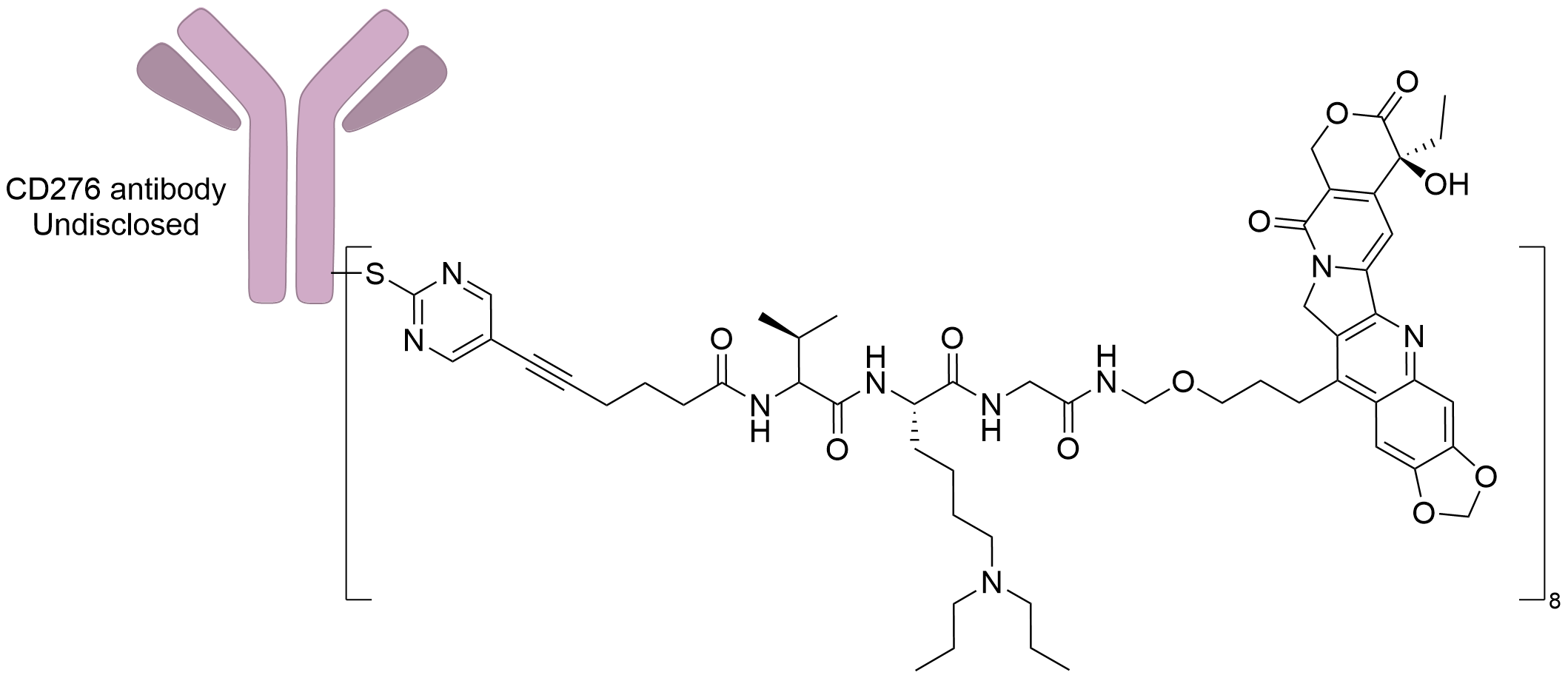
|
|||||
| Antibody Name |
Tambotatug
|
Antibody Info | ||||
| Antigen Name |
CD276 antigen (CD276)
|
Antigen Info | ||||
| Payload Name |
YL0010014
|
Payload Info | ||||
| Payload Target |
DNA topoisomerase 1 (TOP1)
|
Target Info | ||||
| Linker Name |
VK*G-NHCH2-O linker
|
Linker Info | ||||
| Conjugate Type |
Random Cysteines
|
|||||
| Combination Type |
pelitecan
|
|||||
2027 Update
The disease landscape of This ADC
2027 Update
The clinical trial pipelines of This ADC
| Indication | Phase 1 | Phase 2 | Phase 3 | Approved | ||||
|---|---|---|---|---|---|---|---|---|
| Unspecific solid tumor |
2 Trials
|
|||||||
| Nasopharyngeal cancer |
2 Trials
|
|||||||
| Oesophageal cancer |
1 Trials
|
|||||||
| Lung cancer |
1 Trials
|
1 Trials
|
||||||
| Prostate cancer |
2 Trials
|
General Information of The Activity Data Related to This ADC
Identified from the Human Clinical Data
Full List of Activity Data of This Antibody-drug Conjugate
Identified from the Human Clinical Data
| Experiment 1 Reporting the Activity Date of This ADC | [1] | ||||
| Patients Enrolled |
Key inclusion criteria: adults (18-75 years) with ECOG 0-1, recurrent/metastatic NPC, prior PD- (L)1 and chemotherapy failure, measurable lesions, and adequate organ function. Major exclusions: recent malignancies (exceptions apply), prior B7-H3/ADC/CAR-T therapy, inadequate washout, active infections, uncontrolled diseases, CNS metastases (unless stable), pregnancy, or conditions affecting compliance.
Click to Show/Hide
|
||||
| Administration Dosage |
YL201 will be administered intravenously on Day 1 of each 3-week cycle at RP3D dose level.
|
||||
| Related Clinical Trial | |||||
| NCT Number | NCT06629597 | Clinical Status | PHASE3 | ||
| Clinical Description | A Randomized, Controlled, Multicenter Phase III Clinical Study of YL201 Versus Investigator's Choice of Chemotherapy in Subjects with Recurrent or Metastatic Nasopharyngeal Carcinoma Who Have Failed Prior PD- (L)1 Inhibitor and At Least Two Lines of Chemotherapy | ||||
| Primary Endpoint |
The study aims to evaluate the efficacy of YL201 versus investigator-selected chemotherapy in recurrent or metastatic nasopharyngeal carcinoma, focusing on ORR (assessed by BICR using RECIST v1.1) and OS within 36 months. ORR measures the proportion of subjects achieving CR or PR, while OS tracks time from randomization to death from any cause.
|
||||
| Other Endpoint |
Secondary endpoints include ORR assessed by investigators, PFS (time to PD or death), DOR (duration of response), DCR (CR/PR/SD rate), and TTR (time to response), all evaluated within 36 months. Safety is assessed via adverse events (NCI CTCAE v5.0), PK parameters (AUC, Cmax, Ctrough, CL, Vd, t½), ADA incidence, and B7H3 expression correlation with efficacy.
Click to Show/Hide
|
||||
| Experiment 2 Reporting the Activity Date of This ADC | [2] | ||||
| Patients Enrolled |
Eligible patients (18-75 years, ECOG 0-1) must have confirmed relapsed SCLC progressing after platinum therapy, measurable lesions (RECIST 1.1), and adequate organ function. Key exclusions: recent malignancies (exceptions for cured cancers), prior B7-H3/ADC/CAR-T therapy, CNS metastases (unless stable), uncontrolled infections/conditions, active HBV/HCV, unresolved treatment toxicity, pregnancy, or factors compromising study compliance.
Click to Show/Hide
|
||||
| Administration Dosage |
Patients will be treated with YL201 intravenous (IV) infusion once every 3 weeks (Q3W) as a cycle at RP3D dose level.
|
||||
| Related Clinical Trial | |||||
| NCT Number | NCT06612151 | Clinical Status | PHASE3 | ||
| Clinical Description | A Multicenter, Randomized, Controlled, Open-label, Phase III Study to Compare the Efficacy and Safety of YL201 Versus Topotecan Hydrochloride in Subjects with Relapsed Small Cell Lung Cancer | ||||
| Primary Endpoint |
The primary objective is to compare overall survival (OS) between YL201 and topotecan hydrochloride in relapsed small-cell lung cancer (SCLC) patients, measured from randomization until death from any cause during the 36-month study period.
|
||||
| Other Endpoint |
Secondary endpoints include investigator-assessed PFS (time to progression/death), ORR (CR/PR rate), DOR (duration of response), TTR (time to initial response), and DCR (CR/PR/SD rate). Safety assessment covers adverse events (NCI CTCAE v5.0), PK parameters (AUC, Cmax, Ctrough, CL, Vd, t½), ADA incidence, and tumor B7H3 expression correlation with efficacy, all evaluated over 36 months.
Click to Show/Hide
|
||||
| Experiment 3 Reporting the Activity Date of This ADC | [3] | ||||
| Patients Enrolled |
Exclusion criteria include prior B7H3-targeted therapy, concurrent interventional studies, topoisomerase I inhibitor/ADC treatment, insufficient washout periods, major surgery/transplants, prolonged glucocorticoid use (>28 days), recent live vaccines, pathological fracture risks, CNS metastases, uncontrolled urinary/cardiovascular/pulmonary conditions, Gilbert's syndrome, significant effusions, recent GI perforation/fistula or active ulcers, severe infections, HIV/HBV/HCV co-infections, other malignancies affecting survival, unresolved prior toxicity, or hypersensitivity to drug components.
Click to Show/Hide
|
||||
| Administration Dosage |
Patients will be treated with YL201 intravenous (IV) infusion once every 3 weeks on Day 1 or twice every 3 weeks on Day 1 and Day 8 during a 3-week (21-day) cycle.
|
||||
| Related Clinical Trial | |||||
| NCT Number | NCT06241846 | Clinical Status | PHASE2 | ||
| Clinical Description | A Multicenter, Open-Label, Phase II Study to Evaluate the Safety, Efficacy, and Pharmacokinetics of YL201 in Patients With Metastatic Castration-Resistant Prostate Cancer | ||||
| Primary Endpoint |
The study evaluates YL201's efficacy in mCRPC patients through primary endpoints: Objective Response Rate (ORR) by RECIST1.1/PCWG3, radiographic Progression-Free Survival (rPFS), and recommended dose determination. Secondary endpoints include Disease Control Rate (DCR), Duration of Response (DoR), Time to Response (TTR), and PSA-related metrics along with safety, pharmacokinetics, and biomarker analysis, all assessed over approximately 36 months.
Click to Show/Hide
|
||||
| Other Endpoint |
Inclusion criteria require signed informed consent, age ≥18 years, confirmed prostate adenocarcinoma with mCRPC diagnosis per specified criteria (castrate testosterone <50 ng/dL, PSA or imaging progression), prior novel hormone therapy, ≤2 chemotherapy lines, BRCA1/2-mutated patients with prior PARP inhibitor exposure if applicable, measurable metastatic lesions, and tumor tissue for B7H3 IHC testing. Additional requirements: ECOG PS 0-1, adequate organ function (Hb≥90g/L, ANC≥1.5×10⁹/L, PLT≥100×109/L, liver/kidney thresholds), effective contraception, and ≥6-month life expectancy. Patients must comply with protocol procedures.
Click to Show/Hide
|
||||
| Experiment 4 Reporting the Activity Date of This ADC | [4] | ||||
| Patients Enrolled |
Inclusion criteria: Signed ICF, age ≥18, ECOG PS 0-1, adequate organ function, effective contraception, and life expectancy ≥3 months. Part 1 requires evaluable lesions (RECIST 1.1); Part 2 mandates measurable lesions and tumor samples for analysis. Exclusion criteria: Prior topoisomerase I inhibitor/ADC intolerance, concurrent interventional trials, recent anticancer therapies/surgeries, uncontrolled infections, active HBV/HCV/HIV, unresolved toxicity (NCI CTCAE >Grade 1), hypersensitivity to mAbs, breastfeeding/pregnancy, or conditions impairing compliance. Part 2 excludes multiple malignancies within 3 years (exceptions: cured non-melanoma skin/in situ cancers).
Click to Show/Hide
|
||||
| Administration Dosage |
Patients will be treated with YL201 intravenous (IV) infusion once every 3 weeks (Q3W) as a cycle.
|
||||
| Related Clinical Trial | |||||
| NCT Number | NCT05434234 | Clinical Status | PHASE1 | ||
| Clinical Description | A Phase 1, Multicenter, Nonrandomized, Open-Label, First-in-Human Study to Evaluate the Safety, Tolerability, Pharmacokinetics, and Efficacy of YL201 in Patients with Advanced Solid Tumors | ||||
| Primary Endpoint |
The study focuses on evaluating dose-limiting toxicities (DLTs) in Part 1 (Cycle 1, 21 days) and adverse events (AEs) in Part 2, assessing type, frequency, severity, and relationship to YL201 over ~36 months. Primary efficacy measures include PSA response rate (≥50% reduction) in prostate cancer patients and objective response rate (ORR, per RECIST 1.1) in non-prostate solid tumors.
Click to Show/Hide
|
||||
| Other Endpoint |
Part 1 assesses AEs and pharmacokinetics (AUC, Cmax, Ctrough, CL, Vd, t1/2) alongside immunogenicity (anti-YL201 antibodies). Efficacy metrics for prostate cancer include PSA-PFS (PCWG3), rPFS (RECIST 1.1/PCWG3), and failure-free survival (FFS). For other solid tumors, ORR, disease control rate (DCR), duration of response (DoR), time to response (TTR), PFS, and overall survival (OS) are evaluated, all over ~36 months.
Click to Show/Hide
|
||||
| Experiment 5 Reporting the Activity Date of This ADC | [5] | ||||
| Patients Enrolled |
Inclusion criteria: Patients aged 18-75 with confirmed NSCLC, SCLC, NPC, ESCC, mCRPC, HNSCC, sarcoma, PDAC, HCC, or BTC, measurable lesions per RECIST 1.1, ECOG PS 0-1, acceptable contraception compliance, and life expectancy ≥3 months. Exclusion: Prior B7H3 or topoisomerase 1 inhibitor treatment, concurrent clinical trials, recent major surgery, uncontrolled infections (HIV, HBV, HCV), active brain/spinal metastasis, immunosuppressive drug use, third-space effusions, unresolved toxicity, pregnancy, or conditions impairing protocol compliance.
Click to Show/Hide
|
||||
| Administration Dosage |
Patients will be treated with YL201 intravenous (IV) infusion once every 3 weeks (Q3W) as a cycle; and at dose levels of 1.0 mg/kg and 1.2 mg/kg administered on Days 1 and 8 of each Q3W treatment cycle.
|
||||
| Related Clinical Trial | |||||
| NCT Number | NCT06057922 | Clinical Status | PHASE1|||PHASE2 | ||
| Clinical Description | A Multicenter, Open-Label, Phase 1/2 Study to Evaluate the Safety, Efficacy, and Pharmacokinetics of YL201 in Patients With Selected Advanced Solid Tumors | ||||
| Primary Endpoint |
This study evaluates adverse events (AEs) by type, frequency, severity, timing, seriousness, and relationship to treatment over 36 months. It assesses objective response rate (ORR) using RECIST 1.1 for solid tumors, defined as the proportion of patients achieving complete (CR) or partial response (PR). For prostate cancer patients, it measures PSA response rate, defined as ≥50% decrease from baseline.
Click to Show/Hide
|
||||
| Other Endpoint |
The study characterizes pharmacokinetic (PK) parameters including AUC, Cmax, Ctrough, CL, Vd, and t1/2, and assesses anti-YL201 antibody incidence over 36 months. Secondary endpoints include disease control rate (DCR), duration of response (DoR), time to response (TTR), progression-free survival (PFS), overall survival (OS), and prostate cancer-specific measures like rPFS, time to PSA progression (TTPP), PSA duration of response (PDoR), and best PSA response.
Click to Show/Hide
|
||||
| Experiment 6 Reporting the Activity Date of This ADC | [6] | ||||
| Patients Enrolled |
Eligible patients must have advanced solid tumors (e.g., NPC, SCLC, NSCLC), measurable lesions (RECIST 1.1), ECOG PS 0-1, adequate organ function, and life expectancy ≥3 months, while adhering to contraception requirements. Exclusions include prior B7H3/topoisomerase 1 inhibitor/anti-PD- (L)1 therapies, unresolved treatment toxicity, recent major surgery, uncontrolled infections (HIV/HBV/HCV), active autoimmune/systemic diseases, third-space effusions, brain/spinal metastases, or pregnancy/breastfeeding.
Click to Show/Hide
|
||||
| Administration Dosage |
YL201 (High dose, medium dose and low dose; Q3W) in Combination with Serplulimab (4.5mg/kg; Q3W) with or without Platinum (70 mg/m2; Q3W)-based Chemotherapy.
|
||||
| Related Clinical Trial | |||||
| NCT Number | NCT06394414 | Clinical Status | PHASE1 | ||
| Clinical Description | A Phase 1, Multicenter, Open-label Study to Evaluate the Safety, Efficacy, and Pharmacokinetics of YL201 in Combination with Serplulimab with or Without Platinum-based Chemotherapy in Selected Subjects with Advanced Solid Tumors | ||||
| Primary Endpoint |
This study evaluates adverse events (AEs) in advanced solid tumors treated with YL201 combined with serplulimab, with or without platinum-based chemotherapy, over 36 months. Key objectives include determining the maximum tolerated dose (MTD), recommended expansion dose (RED), and recommended Phase 2 dose (RP2D), as well as assessing efficacy via objective response rate (ORR).
Click to Show/Hide
|
||||
| Other Endpoint |
The pharmacokinetics (PK) of YL201 combination therapy will be evaluated, including parameters such as AUC, Cmax, Ctrough, CL, Vd, and t1/2. Additionally, efficacy measures including depth of response (DpR), disease control rate (DCR), duration of response (DoR), time to response (TTR), progression-free survival (PFS), and overall survival (OS) will be assessed per RECIST 1.1. Immunogenicity (anti-YL201 antibodies) and tumor biomarker expression (B7H3, PD-L1) will also be analyzed.
Click to Show/Hide
|
||||
References