
Antibody-drug Conjugate Information
General Information of This Antibody-drug Conjugate (ID: DRG0IMAKZ)
| ADC Name |
Mecbotamab vedotin
|
|||||
|---|---|---|---|---|---|---|
| Synonyms |
mecbotamab vedotin; BA3011; CAB-AXL-ADC; HTBA3011; Mec-V
Click to Show/Hide
|
|||||
| Organization |
BioAtla (Originator);Curexsys Biotech
|
|||||
| Drug Status |
Phase 2
|
|||||
| Drug-to-Antibody Ratio |
4
|
|||||
| Structure |
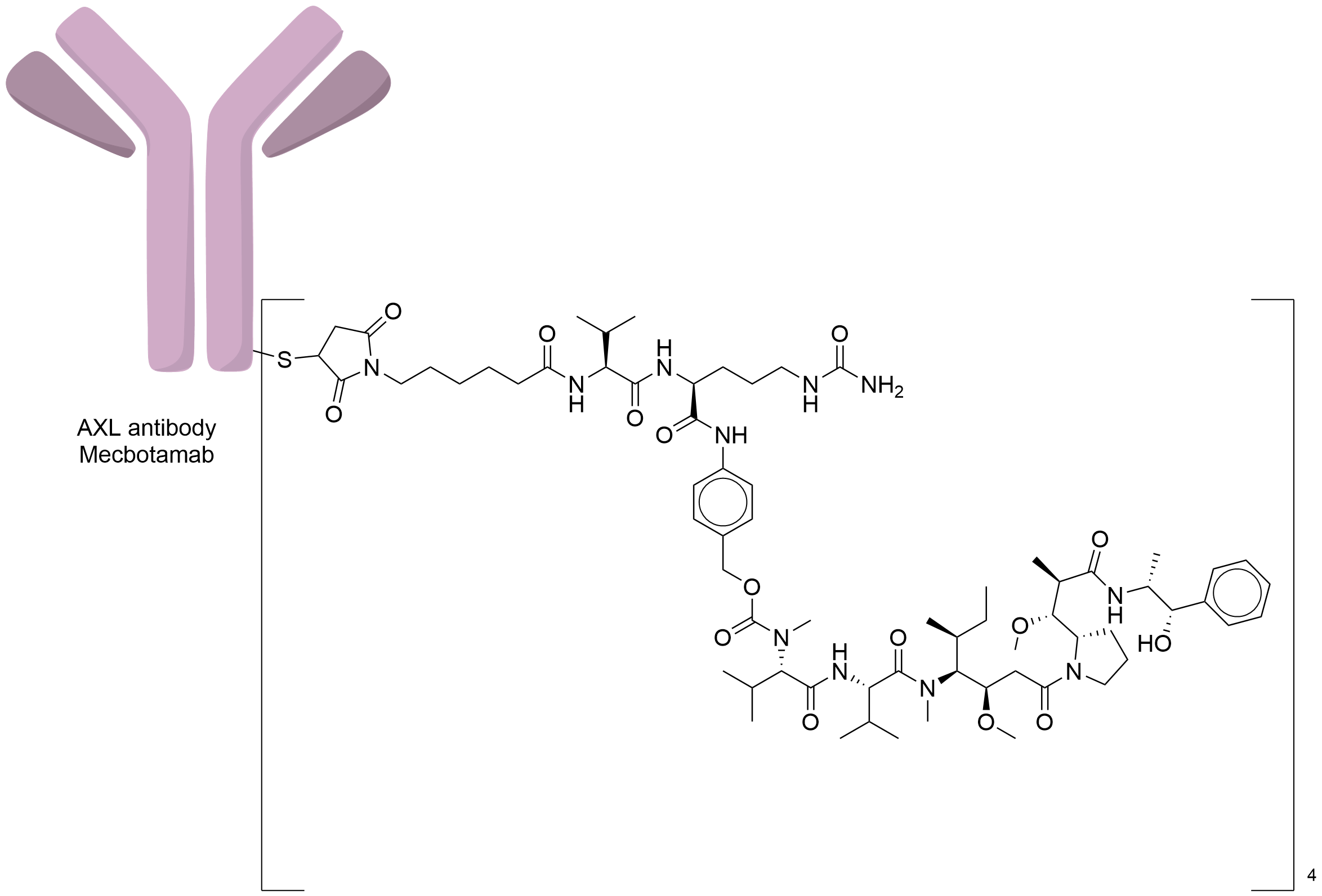
|
|||||
| Antibody Name |
Mecbotamab
|
Antibody Info | ||||
| Antigen Name |
Tyrosine-protein kinase receptor UFO (AXL)
|
Antigen Info | ||||
| Payload Name |
Monomethyl auristatin E
|
Payload Info | ||||
| Payload Target |
Microtubule (MT)
|
Target Info | ||||
| Linker Name |
Mc-Val-Cit-PABC
|
Linker Info | ||||
| Conjugate Type |
Random Cysteines
|
|||||
| Combination Type |
vedotin
|
|||||
2027 Update
The disease landscape of This ADC
2027 Update
The clinical trial pipelines of This ADC
| Indication | Phase 1 | Phase 2 | Phase 3 | Approved | ||
|---|---|---|---|---|---|---|
| Sarcoma |
1 Trials
|
|||||
| Lung cancer |
1 Trials
|
2027 Update
ADC-specific functional property
Binding Affinity
| Dissocation Constant (Kd) | Binding Target | Description | Reference |
|---|---|---|---|
| 4.78 ng/mL |
Human AXL
|
BA3011 showed strong binding to human AXL at pH 6.0 with an EC50 of 4.78 ng/ml.
|
[1]
|
2027 Update
General Information of The ADMET Data Related to This ADC
Absorption
| Standard Type | Value | Units | Description | Reference |
|---|---|---|---|---|
| Maximum Observed Concentration (Cmax) | 24 | ug/mL |
Single-dose intravenous in cynomolgus monkeys, 1 mg/kg.
|
[1] |
| Area Under the Concentration-Time Curve (AUC) | 443 | ug·h/mL |
Single-dose intravenous in cynomolgus monkeys, 1 mg/kg, AUCtau.
|
[1] |
| Maximum Observed Concentration (Cmax) | 70 | ug/mL |
Single-dose intravenous in cynomolgus monkeys, 3 mg/kg.
|
[1] |
| Area Under the Concentration-Time Curve (AUC) | 1825 | ug·h/mL |
Single-dose intravenous in cynomolgus monkeys, 3 mg/kg, AUCtau.
|
[1] |
| Maximum Observed Concentration (Cmax) | 241 | ug/mL |
Single-dose intravenous in cynomolgus monkeys, 10 mg/kg.
|
[1] |
| Area Under the Concentration-Time Curve (AUC) | 7120 | ug·h/mL |
Single-dose intravenous in cynomolgus monkeys, 10 mg/kg, AUCtau.
|
[1] |
| Maximum Observed Concentration (Cmax) | 20 | ug/mL |
Repeat-dose intravenous in cynomolgus monkeys, 1mg/kg, Day 1.
|
[1] |
| Area Under the Concentration-Time Curve (AUC) | 381 | ug·h/mL |
Repeat-dose intravenous in cynomolgus monkeys, 1mg/kg, AUCtau, Day 1.
|
[1] |
| Maximum Observed Concentration (Cmax) | 122 | ug/mL |
Repeat-dose intravenous in cynomolgus monkeys, 5 mg/kg, Day 1.
|
[1] |
| Area Under the Concentration-Time Curve (AUC) | 2920 | ug·h/mL |
Repeat-dose intravenous in cynomolgus monkeys, 5 mg/kg, AUCtau, Day 1.
|
[1] |
| Maximum Observed Concentration (Cmax) | 242 | ug/mL |
Repeat-dose intravenous in cynomolgus monkeys, 10 mg/kg, Day 1.
|
[1] |
| Area Under the Concentration-Time Curve (AUC) | 6710 | ug·h/mL |
Repeat-dose intravenous in cynomolgus monkeys, 10 mg/kg, AUCtau, Day 1.
|
[1] |
| Maximum Observed Concentration (Cmax) | 19 | ug/mL |
Repeat-dose intravenous in cynomolgus monkeys, 1mg/kg, Day 22.
|
[1] |
| Area Under the Concentration-Time Curve (AUC) | 379 | ug·h/mL |
Repeat-dose intravenous in cynomolgus monkeys, 1mg/kg, AUCtau, Day 22.
|
[1] |
| Maximum Observed Concentration (Cmax) | 103 | ug/mL |
Repeat-dose intravenous in cynomolgus monkeys, 5 mg/kg, Day 22.
|
[1] |
| Area Under the Concentration-Time Curve (AUC) | 2330 | ug·h/mL |
Repeat-dose intravenous in cynomolgus monkeys, 5 mg/kg, AUCtau, Day 22.
|
[1] |
| Maximum Observed Concentration (Cmax) | 186 | ug/mL |
Repeat-dose intravenous in cynomolgus monkeys, 10 mg/kg, Day 22.
|
[1] |
| Area Under the Concentration-Time Curve (AUC) | 4780 | ug·h/mL |
Repeat-dose intravenous in cynomolgus monkeys, 10 mg/kg, AUCtau, Day 22.
|
[1] |
Excretion
| Standard Type | Value | Units | Description | Reference |
|---|---|---|---|---|
| Elimination Half-Life (t1/2) | 16 | h |
Single-dose intravenous in cynomolgus monkeys, 1 mg/kg.
|
[1] |
| Elimination Half-Life (t1/2) | 38 | h |
Single-dose intravenous in cynomolgus monkeys, 3 mg/kg.
|
[1] |
| Elimination Half-Life (t1/2) | 46 | h |
Single-dose intravenous in cynomolgus monkeys, 10 mg/kg.
|
[1] |
| Elimination Half-Life (t1/2) | 17 | h |
Repeat-dose intravenous in cynomolgus monkeys, 1mg/kg, Day 1.
|
[1] |
| Elimination Half-Life (t1/2) | 37 | h |
Repeat-dose intravenous in cynomolgus monkeys, 5 mg/kg, Day 1.
|
[1] |
| Elimination Half-Life (t1/2) | 43 | h |
Repeat-dose intravenous in cynomolgus monkeys, 10 mg/kg, Day 1.
|
[1] |
| Elimination Half-Life (t1/2) | 19 | h |
Repeat-dose intravenous in cynomolgus monkeys, 1mg/kg, Day 22.
|
[1] |
| Elimination Half-Life (t1/2) | 38 | h |
Repeat-dose intravenous in cynomolgus monkeys, 5 mg/kg, Day 22.
|
[1] |
| Elimination Half-Life (t1/2) | 48 | h |
Repeat-dose intravenous in cynomolgus monkeys, 10 mg/kg, Day 22.
|
[1] |
General Information of The Activity Data Related to This ADC
Identified from the Human Clinical Data
Full List of Activity Data of This Antibody-drug Conjugate
Identified from the Human Clinical Data
| Experiment 1 Reporting the Activity Date of This ADC | [2] | ||||
| Efficacy Data | Disease control rate (DCR) |
41.10%
|
|||
| Patients Enrolled |
Eligible patients (≥12 years for Phase 2) require measurable disease, adequate organ function, ECOG 0-1, and ≥3-month life expectancy; exclusions include uncontrolled CNS metastases, severe allergies, recent major surgery, prior auristatin therapy, active HIV/HBV/HCV, pregnancy/lactation, or clinically significant cardiac disease.
|
||||
| Administration Dosage |
This phase 2 part 1 open-label study evaluated BA3011 in adult and adolescent patients (pts) with AXL-expressing (tumor membrane percent score ≥50%) advanced refractory sarcoma who received either BA3011 monotherapy 1.8 mg/kg every 2 weeks (Q2W) or BA3011 1.8 mg/kg Q2W + nivolumab
|
||||
| Related Clinical Trial | |||||
| NCT Number | NCT03425279 | Clinical Status | PHASE1|||PHASE2 | ||
| Clinical Description | A Phase 1/2 Dose Escalation and Dose Expansion Study of Mecbotamab Vedotin (BA3011) Alone and in Combination with Nivolumab in Adult and Adolescent Patients 12 Years and Older with Advanced Solid Tumors | ||||
| Primary Endpoint |
The study evaluates safety metrics including dose-limiting toxicity (DLT), maximum tolerated dose (MTD), and adverse events (AEs) over 24 months in Phase 1, while Phase 2 additionally assesses confirmed objective response rate (ORR) per RECIST v1.1 as the primary efficacy endpoint.
|
||||
| Other Endpoint |
Pharmacokinetic analysis (ADC, total antibody, MMAE levels, Cmax, AUC), immunogenicity (ADA development), and clinical response assessments (ORR, DOR, PFS, BOR, DCR, TTR, OS, tumor size change) are tracked over 24 months across both phases to characterize drug behavior and therapeutic impact.
|
||||
| Experiment 2 Reporting the Activity Date of This ADC | [3] | ||||
| Patients Enrolled |
Key inclusion criteria require measurable disease, age ≥18 years, adequate organ function, ECOG 0-1, and ≥3-month life expectancy. Major exclusions include significant cardiac disease, uncontrolled CNS metastasis, prior auristatin therapy, severe allergies, recent major surgery, active infections (HIV/HBV/HCV), and pregnancy/breastfeeding.
|
||||
| Administration Dosage |
In this phase II, multicenter, open-label study, we evaluated patients (pts) with advanced, treatment-refractory metastatic NSCLC. Eligible pts whose NSCLC tumors expressed AXL were treated on days 1 and 8 of a 3-week cycle or every other week with 1.8 mg/kg Mec-V±nivolumab.
|
||||
| Related Clinical Trial | |||||
| NCT Number | NCT04681131 | Clinical Status | PHASE2 | ||
| Clinical Description | A Phase 2 Study of BA3011 Alone and in Combination with PD-1 Inhibitor in Adult Patients with Metastatic Non-small Cell Lung Cancer (NSCLC) Who Had Prior Disease Progression on a PD-1/L-1 Inhibitor, EGFR, or ALK Inhibitor. | ||||
| Primary Endpoint |
The primary endpoints include confirmed objective response rate (ORR) per RECIST v1.1 and incidence of adverse events (AEs) or serious adverse events (SAEs) as assessed by CTCAE v4.03/v5, both evaluated over a 24-month period.
|
||||
| Other Endpoint |
Secondary endpoints assessed over 24 months comprise duration of response (DOR), progression-free survival (PFS), best overall response (BOR), disease control rate (DCR), time to response (TTR), overall survival (OS), and percent change from baseline in target lesion sum of diameters.
|
||||
| Experiment 3 Reporting the Activity Date of This ADC | [4] | ||||
| Patients Enrolled |
Eligible participants are women ≥18 with confirmed platinum-resistant high-grade serous ovarian/fallopian tube/peritoneal cancer showing measurable disease and adequate organ function, while excluding those with severe comorbidities, uncontrolled CNS metastases, recent major surgery, active infections, pregnancy, or high-risk autoimmune conditions over 3 years prior to treatment.
Click to Show/Hide
|
||||
| Administration Dosage |
.
|
||||
| Related Clinical Trial | |||||
| NCT Number | NCT04918186 | Clinical Status | PHASE2 | ||
| Clinical Description | An Immunotherapy Platform Study in Platinum Resistant High Grade Serous Ovarian Cancer | ||||
| Primary Endpoint |
The study evaluates objective response rate (ORR) via RECIST 1.1 over 36 months to identify effective immunotherapy combinations for platinum-resistant high-grade serous ovarian cancer in preparation for randomized trials.
|
||||
| Other Endpoint |
Secondary endpoints include ORR assessment, progression-free and overall survival using RECIST/iRECIST criteria, and adverse event monitoring over 36 months to evaluate immunotherapy regimen efficacy and safety.
|
||||
| Experiment 4 Reporting the Activity Date of This ADC | [5] | ||||
| Related Clinical Trial | |||||
| NCT Number | NCT04681131 | Clinical Status | Phase 2 | ||
| Clinical Description | A phase 2 study of BA3011 alone and in combination with PD-1 inhibitor in adult patients with metastatic non-small cell lung cancer (NSCLC) who had prior disease progression on a PD-1/L-1 inhibitor. | ||||
| Experiment 5 Reporting the Activity Date of This ADC | [6] | ||||
| Related Clinical Trial | |||||
| NCT Number | NCT03425279 | Clinical Status | Phase 1 | ||
| Clinical Description | A phase 1/ 2 safety and efficacy dose escalation/dose expansion study of a CAB-AXL-ADC, alone and in combination with a PD-1 inhibitor in adult patients with advanced solid tumors (phase 1) and adult and adolescent patients with advanced, refractory sarcoma (phase 2). | ||||
References