
Antibody-drug Conjugate Information
General Information of This Antibody-drug Conjugate (ID: DRG0ANLTL)
| ADC Name |
anti TRBC1-SG3249
|
|||||
|---|---|---|---|---|---|---|
| Synonyms |
anti TRBC1-SG3249
Click to Show/Hide
|
|||||
| Organization |
The Johns Hopkins University School of Medicine.; Howard Hughes Medical Institute.; Johns Hopkins University.; Genentech.; Merck and Co.
|
|||||
| Drug Status |
Investigative
|
|||||
| Drug-to-Antibody Ratio |
2.4- 2.6
|
|||||
| Structure |
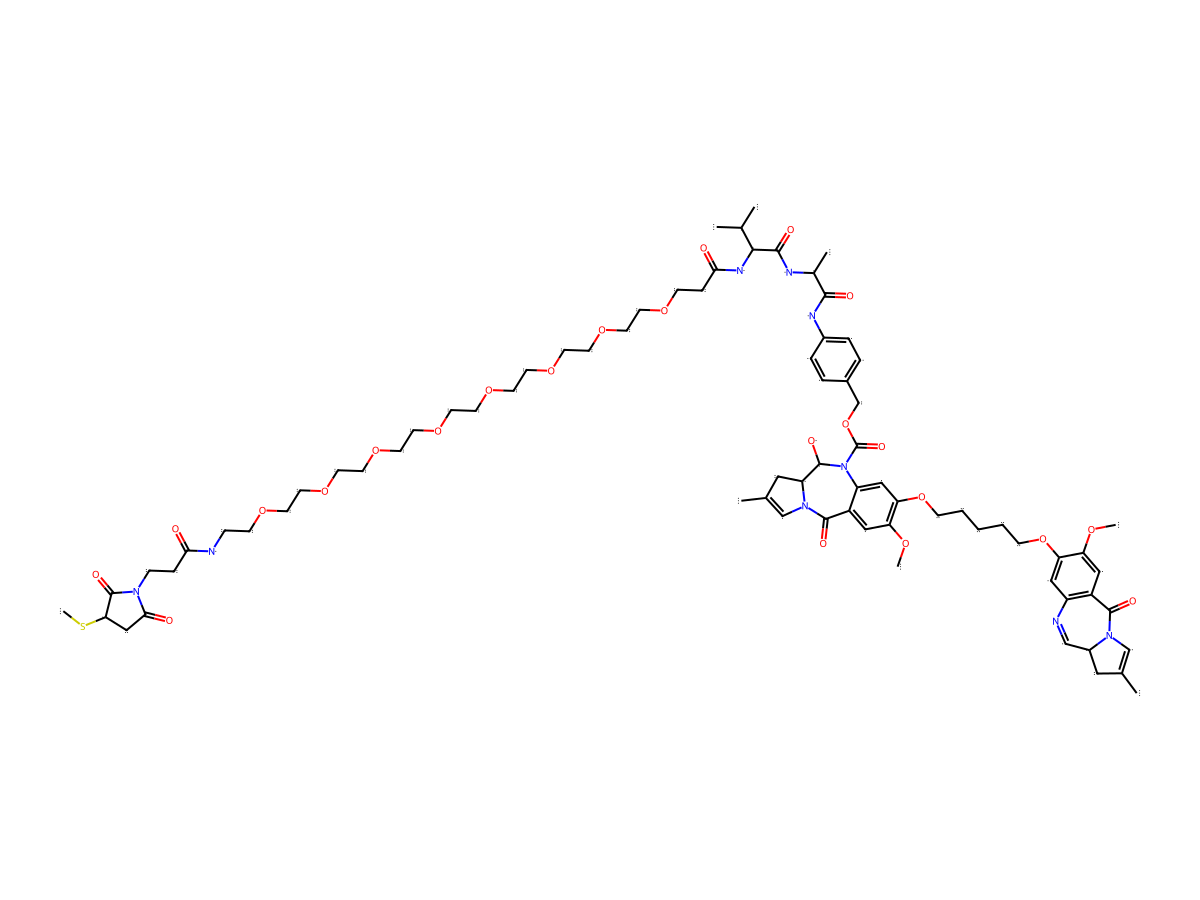
|
|||||
| Antibody Name |
Undisclosed
|
|||||
| Antigen Name |
T cell receptor beta-chain constant region 1 (TRBC1)
|
Antigen Info | ||||
| Payload Name |
SG3199
|
Payload Info | ||||
| Payload Target |
Human Deoxyribonucleic acid (hDNA)
|
Target Info | ||||
| Linker Name |
CL2A
|
Linker Info | ||||
| Conjugate Type |
Random conjugation through reduced inter-chain cysteines.
|
|||||
| Combination Type |
SG3249
|
|||||
General Information of The Activity Data Related to This ADC
Full List of Activity Data of This Antibody-drug Conjugate
Revealed Based on the Cell Line Data
| Experiment 1 Reporting the Activity Date of This ADC | [1] | ||||
| Efficacy Data | Half Maximal inhibitory Concentration (lC50) | 4.3 ng/mL | Positive TRBC1 expression (TRBC1+++/++) | ||
| Method Description |
A total of 1 × 10⁴ T cell cancer cells or the normal human T cells was suspended in 200 ul of RPMI-1640 medium supplemented with 10% FBS and 1% penicillin-streptomycin in 96-well flat-bottom tissue culture-treated plates. The following drugs were resuspended in DMSO solution to make a 10 mM stock solution; exatecan mesylate (MedChemExpress HY-13631A), DM1 (MedChemExpress HY-19792), SN38 (MedChemExpress HY-13704), MMAE (MedChemExpress HY-15162), SG3199 (MedChemExpress HY-101161). The drugs were added to the target cells at the concentrations specified in the text for 5 days at 37 °C. For luciferase-expressing cells, cell viability was assayed using the ONE-Glo luciferase assay (E6110, Promega) according to the manufacturer's instructions. Luminescence data were collected using the Synergy H1 microplate reader and analysed with the Biotek Gen5 software. Viability was calculated as the ratio of the luminescence signal to the no antibody or control antibody condition: (antibody well luminescence)/ (no antibody or control antibody well luminescence).
Click to Show/Hide
|
||||
| In Vitro Model | Sezary syndrome | H9 cells | CVCL_1240 | ||
| Experiment 2 Reporting the Activity Date of This ADC | [1] | ||||
| Efficacy Data | Half Maximal inhibitory Concentration (lC50) | 7.6 ng/mL | Positive TRBC1 expression (TRBC1+++/++) | ||
| Method Description |
A total of 1 × 10⁴ T cell cancer cells or the normal human T cells was suspended in 200 ul of RPMI-1640 medium supplemented with 10% FBS and 1% penicillin-streptomycin in 96-well flat-bottom tissue culture-treated plates. The following drugs were resuspended in DMSO solution to make a 10 mM stock solution; exatecan mesylate (MedChemExpress HY-13631A), DM1 (MedChemExpress HY-19792), SN38 (MedChemExpress HY-13704), MMAE (MedChemExpress HY-15162), SG3199 (MedChemExpress HY-101161). The drugs were added to the target cells at the concentrations specified in the text for 5 days at 37 °C. For luciferase-expressing cells, cell viability was assayed using the ONE-Glo luciferase assay (E6110, Promega) according to the manufacturer's instructions. Luminescence data were collected using the Synergy H1 microplate reader and analysed with the Biotek Gen5 software. Viability was calculated as the ratio of the luminescence signal to the no antibody or control antibody condition: (antibody well luminescence)/ (no antibody or control antibody well luminescence).
Click to Show/Hide
|
||||
| In Vitro Model | T acute lymphoblastic leukemia | Jurkat cells | CVCL_0065 | ||