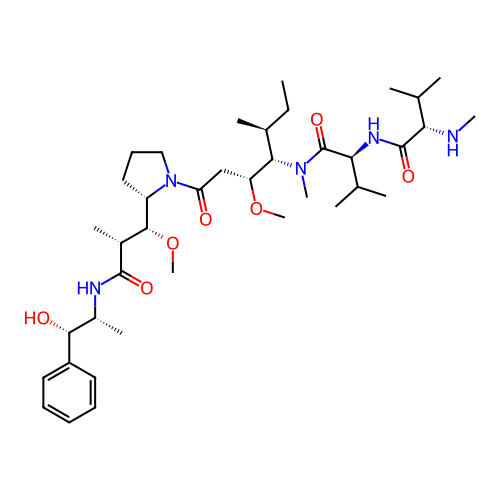
General Information of This Payload
Payload ID
PAY0NLPCS
Name
MMAE
Target Microtubule (MT)
Structure
Each Antibody-drug Conjugate Related to This Payload
Full Information of The Activity Data of The ADC(s) Related to This Payload
Trastuzumab vedotin [Phase 3]
Identified from the Human Clinical Data
Click To Hide/Show 27 Activity Data Related to This Level
Experiment 1 Reporting the Activity Date of This ADC [1]
Efficacy Data Objective Response Rate (ORR)
34.70%
Patients Enrolled
Advanced/metastatic HER2-low expressing breast cancer that failed standard therapies.
Administration Dosage
MRG002 was administered intravenously once every 3 weeks at the dose of 2.60 mg/kg, until disease progression or unacceptable toxicity which ever occurred first.
Related Clinical Trial
NCT Number NCT04742153  Phase Status Phase 2
Clinical Description
A multicenter, non-randomized, open-label phase 2 clinical study to evaluate the efficacy and safety of MRG002 in the treatment of patients with HER2-low locally advanced or metastatic breast cancer (BC).
Experiment 2 Reporting the Activity Date of This ADC [2]
Efficacy Data Objective Response Rate (ORR)
65%
Patients Enrolled
Histologically HER2-positive (IHC 2+ or 3+) UC pts confirmed by a central-laboratory, ECOG PS 0-1, prior received 1 standard treatment.
Administration Dosage
Receive MRG002 at a dose of 2.60 mg/kg or 2.20 mg/kg administered by intravenous infusion every 3 weeks.
Related Clinical Trial
NCT Number NCT04839510  Phase Status Phase 2
Clinical Description
An open-label, single-arm, multi-center, phase 2 clinical study of MRG002 in the treatment of patients with HER2-positive unresectable locally advanced or metastatic urothelium cancer.
Experiment 3 Reporting the Activity Date of This ADC [3]
Related Clinical Trial
NCT Number NCT05754853  Phase Status Phase 3
Clinical Description
An open-label, randomized, multi-center, phase 3 clinical study of MRG002 versus investigator's choice of chemotherapy in the treatment of patients with HER2-positive unresectable locally advanced or metastatic urothelial cancer previously treated with platinum-based chemotherapy and PD-1/PD-L1 inhibitors.
Experiment 4 Reporting the Activity Date of This ADC [4]
Related Clinical Trial
NCT Number NCT04924699  Phase Status Phase 2/3
Clinical Description
A study of MRG002 in the treatment of patients with HER2-positive unresectable locally advanced or metastatic breast cancer.
Experiment 5 Reporting the Activity Date of This ADC [5]
Related Clinical Trial
NCT Number NCT05141786  Phase Status Phase 2
Clinical Description
An open-label, multi-center, non-randomized phase 2 clinical study to evaluate the efficacy and safety of MRG002 in patients With HER2-mutated unresectable/metastatic non-small cell lung cancer (NSCLC).
Experiment 6 Reporting the Activity Date of This ADC [6]
Related Clinical Trial
NCT Number NCT04837508  Phase Status Phase 2
Clinical Description
An open-label, single-arm, multi-center, phase 2 clinical study of MRG002 in the treatment of patients with HER2-positive unresectable, locally advanced or metastatic biliary tract cancer.
Experiment 7 Reporting the Activity Date of This ADC [7]
Related Clinical Trial
NCT Number NCT05141747  Phase Status Phase 2
Clinical Description
An open-label, multi-center, phase 2 clinical study to evaluate the safety, efficacy and pharmacokinetics of MRG002 in patients with HER2-positive/HER2-low locally advanced or metastatic gastric/ gastroesophageal junction cancer.
Experiment 8 Reporting the Activity Date of This ADC [8]
Related Clinical Trial
NCT Number NCT05263869  Phase Status Phase 2
Clinical Description
An open-label, multi-center, single-arm phase 2 clinical study to evaluate the efficacy and safety of MRG002 in advanced HER-2 positive breast cancer patients previously treated with trastuzumab and TKIs (Magic-009).
Experiment 9 Reporting the Activity Date of This ADC [9]
Related Clinical Trial
NCT Number NCT04492488  Phase Status Phase 1/2
Clinical Description
An open-label, multi-center phase 1/2 dose escalation and expansion study to assess the safety, efficacy and pharmacokinetics of MRG002 in patients with HER2-positive advanced solid tumors and locally advanced or metastatic gastric/gastroesophageal junction (GEJ) cancer.
Experiment 10 Reporting the Activity Date of This ADC [10]
Related Clinical Trial
NCT Number NCT05338957  Phase Status Phase 1/2
Clinical Description
An open-label, multi-center, phase 1/2 dose escalation and expansion study to evaluate the safety, tolerability, pharmacokinetics and preliminary efficacy of MRG002 in combination with HX008 in patients with HER2-expressed advanced malignant solid tumors.
Experiment 11 Reporting the Activity Date of This ADC [12]
Related Clinical Trial
NCT Number NCT04941339  Phase Status Phase 1
Clinical Description
A phase 1, open-label, multi-center, first in human, dose escalation and expansion study to assess the safety, tolerability, efficacy and pharmacokinetics of MRG002 in patients with HER2 positive advanced solid tumors.
Experiment 12 Reporting the Activity Date of This ADC [14]
Efficacy Data Progression Free Survival
5.5 months
Patients Enrolled
Eligible patients (18-75 years) must have HER2-positive (IHC 3+/2+) metastatic urothelial cancer with ≥1 measurable lesion (RECIST v1.1), ECOG 0-1, and adequate organ function, following ≥1 prior chemotherapy failure. Key exclusions include active infections, CNS metastasis, uncontrolled systemic/autoimmune diseases, recent immunotherapy (≤4 weeks), pregnancy, or investigator-deemed ineligibility. LVEF must be ≥50%, with prior treatment toxicities resolved to ≤Grade 1.

   Click to Show/Hide
Administration Dosage
MRG002 will be administrated by an IV infusion of 2.6 mg/kg on Day 1 of every 3 weeks (21-day cycle).
Related Clinical Trial
NCT Number NCT04839510  Phase Status PHASE2
Clinical Description
An Open-label, Single-arm, Multi-center, Phase II Clinical Study of MRG002 in the Treatment of Patients With HER2-positive Unresectable Locally Advanced or Metastatic Urothelium Cancer
Primary Endpoint
The primary efficacy endpoint is the Objective Response Rate (ORR) assessed by Independent Review Committee (IRC) per RECIST v1.1 criteria, measuring complete and partial responses over 12 months from baseline.
Other Endpoint
Secondary endpoints include investigator-assessed ORR, Duration of Response (DoR), Time to Response (TTR), Disease Control Rate (DCR), Progression-Free Survival (PFS), and Overall Survival (OS), all evaluated over 12 months. Safety assessments involve adverse event monitoring (30 days post-treatment), pharmacokinetic concentration-time analysis, and anti-drug antibody (ADA) incidence among all treated patients.

   Click to Show/Hide
Experiment 13 Reporting the Activity Date of This ADC [15]
Efficacy Data Objective Response Rate (ORR)
37.5
39.5 %
Patients Enrolled
Inclusion: HER2-low metastatic breast cancer (≥1 prior systemic therapy), ECOG 0-1, measurable disease (RECIST 1.1), LVEF≥50%, adequate organ function. Exclusion: Active CNS metastases, uncontrolled infections (HBV/HCV/HIV), severe cardiac/autoimmune diseases, recent thromboembolism (≤3 months), pregnancy/lactation, or prior grade≥3 hypersensitivity to trastuzumab components.

   Click to Show/Hide
Administration Dosage
MRG002 will be administrated via intravenous infusion of 2.6 mg/kg once on Day 1 of every 3 weeks (21-day cycle).
Related Clinical Trial
NCT Number NCT04742153  Phase Status PHASE2
Clinical Description
A Multicenter, Non-randomized, Open-label Phase II Clinical Study to Evaluate the Efficacy and Safety of MRG002 in the Treatment of Patients With HER2-low Locally Advanced or Metastatic Breast Cancer (BC)
Primary Endpoint
Objective Response Rate (ORR) by Independent Review Committee (IRC) is defined as CR+PR per RECIST v1.1, assessed from baseline to 12 months. Safety data (AEs/SAEs by NCI-CTCAE v5.0), PK analysis (MRG002 concentration-time curve), and immunogenicity (anti-drug antibody incidence) are collected during treatment and follow-up.
Other Endpoint
Efficacy endpoints include ORR by investigator, PFS (baseline to progression/death), 6/12-month PFSR, TTR, DoR, DCR (CR+PR+SD), and OS (baseline to death), all evaluated per RECIST v1.1 over 12 months.
Experiment 14 Reporting the Activity Date of This ADC [14]
Efficacy Data Objective Response Rate (ORR)
65%
Patients Enrolled
Eligible patients (18-75 years) must have HER2-positive (IHC 3+/2+) metastatic urothelial cancer with ≥1 measurable lesion (RECIST v1.1), ECOG 0-1, and adequate organ function, following ≥1 prior chemotherapy failure. Key exclusions include active infections, CNS metastasis, uncontrolled systemic/autoimmune diseases, recent immunotherapy (≤4 weeks), pregnancy, or investigator-deemed ineligibility. LVEF must be ≥50%, with prior treatment toxicities resolved to ≤Grade 1.

   Click to Show/Hide
Administration Dosage
MRG002 will be administrated by an IV infusion of 2.6 mg/kg on Day 1 of every 3 weeks (21-day cycle).
Related Clinical Trial
NCT Number NCT04839510  Phase Status PHASE2
Clinical Description
An Open-label, Single-arm, Multi-center, Phase II Clinical Study of MRG002 in the Treatment of Patients With HER2-positive Unresectable Locally Advanced or Metastatic Urothelium Cancer
Primary Endpoint
The primary efficacy endpoint is the Objective Response Rate (ORR) assessed by Independent Review Committee (IRC) per RECIST v1.1 criteria, measuring complete and partial responses over 12 months from baseline.
Other Endpoint
Secondary endpoints include investigator-assessed ORR, Duration of Response (DoR), Time to Response (TTR), Disease Control Rate (DCR), Progression-Free Survival (PFS), and Overall Survival (OS), all evaluated over 12 months. Safety assessments involve adverse event monitoring (30 days post-treatment), pharmacokinetic concentration-time analysis, and anti-drug antibody (ADA) incidence among all treated patients.

   Click to Show/Hide
Experiment 15 Reporting the Activity Date of This ADC [15]
Efficacy Data Disease control rate (DCR)
62.5
76.3 %
Patients Enrolled
Inclusion: HER2-low metastatic breast cancer (≥1 prior systemic therapy), ECOG 0-1, measurable disease (RECIST 1.1), LVEF≥50%, adequate organ function. Exclusion: Active CNS metastases, uncontrolled infections (HBV/HCV/HIV), severe cardiac/autoimmune diseases, recent thromboembolism (≤3 months), pregnancy/lactation, or prior grade≥3 hypersensitivity to trastuzumab components.

   Click to Show/Hide
Administration Dosage
MRG002 will be administrated via intravenous infusion of 2.6 mg/kg once on Day 1 of every 3 weeks (21-day cycle).
Related Clinical Trial
NCT Number NCT04742153  Phase Status PHASE2
Clinical Description
A Multicenter, Non-randomized, Open-label Phase II Clinical Study to Evaluate the Efficacy and Safety of MRG002 in the Treatment of Patients With HER2-low Locally Advanced or Metastatic Breast Cancer (BC)
Primary Endpoint
Objective Response Rate (ORR) by Independent Review Committee (IRC) is defined as CR+PR per RECIST v1.1, assessed from baseline to 12 months. Safety data (AEs/SAEs by NCI-CTCAE v5.0), PK analysis (MRG002 concentration-time curve), and immunogenicity (anti-drug antibody incidence) are collected during treatment and follow-up.
Other Endpoint
Efficacy endpoints include ORR by investigator, PFS (baseline to progression/death), 6/12-month PFSR, TTR, DoR, DCR (CR+PR+SD), and OS (baseline to death), all evaluated per RECIST v1.1 over 12 months.
Experiment 16 Reporting the Activity Date of This ADC [14]
Efficacy Data Disease control rate (DCR)
91%
Patients Enrolled
Eligible patients (18-75 years) must have HER2-positive (IHC 3+/2+) metastatic urothelial cancer with ≥1 measurable lesion (RECIST v1.1), ECOG 0-1, and adequate organ function, following ≥1 prior chemotherapy failure. Key exclusions include active infections, CNS metastasis, uncontrolled systemic/autoimmune diseases, recent immunotherapy (≤4 weeks), pregnancy, or investigator-deemed ineligibility. LVEF must be ≥50%, with prior treatment toxicities resolved to ≤Grade 1.

   Click to Show/Hide
Administration Dosage
MRG002 will be administrated by an IV infusion of 2.6 mg/kg on Day 1 of every 3 weeks (21-day cycle).
Related Clinical Trial
NCT Number NCT04839510  Phase Status PHASE2
Clinical Description
An Open-label, Single-arm, Multi-center, Phase II Clinical Study of MRG002 in the Treatment of Patients With HER2-positive Unresectable Locally Advanced or Metastatic Urothelium Cancer
Primary Endpoint
The primary efficacy endpoint is the Objective Response Rate (ORR) assessed by Independent Review Committee (IRC) per RECIST v1.1 criteria, measuring complete and partial responses over 12 months from baseline.
Other Endpoint
Secondary endpoints include investigator-assessed ORR, Duration of Response (DoR), Time to Response (TTR), Disease Control Rate (DCR), Progression-Free Survival (PFS), and Overall Survival (OS), all evaluated over 12 months. Safety assessments involve adverse event monitoring (30 days post-treatment), pharmacokinetic concentration-time analysis, and anti-drug antibody (ADA) incidence among all treated patients.

   Click to Show/Hide
Experiment 17 Reporting the Activity Date of This ADC [14]
Efficacy Data Complete response (CR)
9%
Patients Enrolled
Eligible patients (18-75 years) must have HER2-positive (IHC 3+/2+) metastatic urothelial cancer with ≥1 measurable lesion (RECIST v1.1), ECOG 0-1, and adequate organ function, following ≥1 prior chemotherapy failure. Key exclusions include active infections, CNS metastasis, uncontrolled systemic/autoimmune diseases, recent immunotherapy (≤4 weeks), pregnancy, or investigator-deemed ineligibility. LVEF must be ≥50%, with prior treatment toxicities resolved to ≤Grade 1.

   Click to Show/Hide
Administration Dosage
MRG002 will be administrated by an IV infusion of 2.6 mg/kg on Day 1 of every 3 weeks (21-day cycle).
Related Clinical Trial
NCT Number NCT04839510  Phase Status PHASE2
Clinical Description
An Open-label, Single-arm, Multi-center, Phase II Clinical Study of MRG002 in the Treatment of Patients With HER2-positive Unresectable Locally Advanced or Metastatic Urothelium Cancer
Primary Endpoint
The primary efficacy endpoint is the Objective Response Rate (ORR) assessed by Independent Review Committee (IRC) per RECIST v1.1 criteria, measuring complete and partial responses over 12 months from baseline.
Other Endpoint
Secondary endpoints include investigator-assessed ORR, Duration of Response (DoR), Time to Response (TTR), Disease Control Rate (DCR), Progression-Free Survival (PFS), and Overall Survival (OS), all evaluated over 12 months. Safety assessments involve adverse event monitoring (30 days post-treatment), pharmacokinetic concentration-time analysis, and anti-drug antibody (ADA) incidence among all treated patients.

   Click to Show/Hide
Experiment 18 Reporting the Activity Date of This ADC [16]
Patients Enrolled
Inclusion: HER2-positive breast cancer (unresectable/metastatic), prior anti-HER2 therapy failure (Phase II: trastuzumab/TKI/ADC-resistant; Phase III: 1-2 prior lines excluding ADCs), measurable disease (RECIST 1.1), ECOG 0-1, adequate organ function. Exclusion: Active CNS metastases, uncontrolled infections (HBV/HCV/HIV), severe cardiac/pulmonary diseases, prior hypersensitivity to trastuzumab components, recent major surgery/radiotherapy (<4 weeks), Child-Pugh B/C cirrhosis, or >Grade 1 neuropathy. Contraception required for reproductive-age participants.

   Click to Show/Hide
Administration Dosage
MRG002 will be administrated via intravenous infusion of 2.6 mg/kg once on Day 1 of every 3 weeks (21-day cycle).
Related Clinical Trial
NCT Number NCT04924699  Phase Status PHASE2|||PHASE3
Clinical Description
A Study of MRG002 in the Treatment of Patients With HER2-positive Unresectable Locally Advanced or Metastatic Breast Cancer
Primary Endpoint
Progression-Free Survival (PFS) as assessed by Independent Review Committee (IRC) is the primary efficacy endpoint, defined as time from treatment initiation to disease progression or death (per RECIST v1.1) over 36 months. Secondary objectives include pharmacokinetic analysis (drug concentration-time curve) and immunogenicity assessment (anti-drug antibody incidence).

   Click to Show/Hide
Other Endpoint
Key secondary endpoints include Objective Response Rate (ORR=CR+PR), Duration of Response (DoR), Disease Control Rate (DCR=CR+PR+SD) per RECIST v1.1, investigator-assessed PFS, Overall Survival (OS), and safety monitoring (AEs tracked until 30 days post-treatment). All efficacy measures are evaluated over a 36-month period.
Experiment 19 Reporting the Activity Date of This ADC [17]
Patients Enrolled
Inclusion criteria: HER2-positive breast cancer patients (18-75 years) with liver metastasis (confirmed by central lab), measurable lesions (RECIST v1.1), ECOG 0-1, life expectancy ≥12 weeks, and adequate organ function. Exclusion criteria: Prior ADC treatment, CNS metastasis, severe neuropathy (≥Grade 2), uncontrolled infections/systemic diseases (e.g., cardiac, hepatic cirrhosis with single metastasis ≥10 cm), active autoimmune disease requiring immunosuppressants, or prior hypersensitivity to trastuzumab components. Effective contraception is mandatory for participants of childbearing potential.

   Click to Show/Hide
Administration Dosage
MRG002 will be administrated via intravenous infusion of 2.6 mg/kg once on Day 1 of every 3 weeks (21-day cycle).
Related Clinical Trial
NCT Number NCT05263869  Phase Status PHASE2
Clinical Description
An Open-label, Multi-center, Single-arm Phase II Clinical Study to Evaluate the Efficacy and Safety of MRG002 in Advanced HER-2 Positive Breast Cancer Patients Previously Treated With Trastuzumab and TKIs (Magic-009)
Primary Endpoint
The primary endpoint is Objective Response Rate (ORR) by Independent Review Committee (IRC), defined as the proportion of patients achieving complete response (CR) or partial response (PR) per RECIST v1.1 criteria, evaluated over 12 months from baseline.
Other Endpoint
Secondary efficacy endpoints include investigator-assessed ORR, Duration of Response (DoR), Clinical Benefit Rate (CBR=CR+PR+SD≥6 months), Time to Response (TTR), Disease Control Rate (DCR=CR+PR+SD), Progression-Free Survival (PFS), and Overall Survival (OS). Safety assessments (AEs) and pharmacokinetics (drug concentration-time curve) are monitored during treatment and post-treatment follow-up, with immunogenicity analyzed via anti-drug antibody (ADA) incidence.

   Click to Show/Hide
Experiment 20 Reporting the Activity Date of This ADC [18]
Patients Enrolled
Inclusion criteria: HER2-positive (IHC 2+/3+) carcinoma of unknown primary origin (squamous/adenocarcinoma) patients (≥18 years) with ≥1 prior systemic therapy line, measurable disease (RECIST 1.1), ECOG 0-1, LVEF≥50%, and adequate organ function. Exclusion criteria: Active/uncontrolled metastases (CNS/third-space effusions), severe cardiac/infectious diseases (HBV/HCV/HIV), autoimmune disorders requiring immunosuppressants, allergy to MRG002 components, pregnancy/lactation, or other investigator-assessed ineligibility. Contraception is mandatory during and 6 months post-treatment.

   Click to Show/Hide
Administration Dosage
Pucotenlimab 200mg iv d1, Q3W MRG002 2.2mg/kg d1, Q3W
Related Clinical Trial
NCT Number NCT06869174  Phase Status PHASE2
Clinical Description
A Phase II Clinical Trial to Evaluate the Efficacy and Safety of Pucotenlimab in Combination with MRG002 in Treating HER2-positive Cancer of Unknown Primary
Primary Endpoint
The primary endpoint is overall response rate (ORR), defined as the percentage of participants achieving complete response (CR) or partial response (PR) per RECIST 1.1 criteria, as assessed by investigators, with evaluation spanning from enrollment until first documented response (up to 12 months).
Experiment 21 Reporting the Activity Date of This ADC [19]
Patients Enrolled
Inclusion criteria: HER2-positive (IHC 3+ or 2+) biliary tract cancer patients (18-75 years) with unresectable/metastatic disease, ≥1 prior therapy failure, measurable lesions (RECIST v1.1), ECOG 0-1, LVEF≥50%, and adequate organ function. Exclusion criteria: Severe allergies to MRG002 components, active infections (HBV/HCV/HIV), CNS metastasis, uncontrolled effusions requiring drainage, autoimmune diseases, decompensated cirrhosis, or pregnancy/lactation. Contraception is mandatory during and 6 months post-treatment.

   Click to Show/Hide
Administration Dosage
MRG002 will be administrated by an IV infusion of 2.6 mg/kg on Day 1 of every 3 weeks (21-day cycle).
Related Clinical Trial
NCT Number NCT04837508  Phase Status PHASE2
Clinical Description
An Open-label, Single-arm, Multi-center, Phase II Clinical Study of MRG002 in the Treatment of Patients With HER2-positive Unresectable, Locally Advanced or Metastatic Biliary Tract Cancer
Primary Endpoint
The primary endpoint is objective response rate (ORR) assessed by Independent Review Committee (IRC), defined as the percentage of patients achieving complete response (CR) or partial response (PR) based on RECIST v1.1 criteria, evaluated from baseline until study completion (up to 12 months).
Other Endpoint
Secondary endpoints include investigator-assessed ORR, duration of response (DOR), time to response (TTR), disease control rate (DCR), progression-free survival (PFS), and overall survival (OS). Safety is monitored via adverse events (AEs) up to 30 days post-treatment. Pharmacokinetic (PK) parameters, including concentration-time curve, and immunogenicity (anti-drug antibody, ADA) incidence are analyzed.

   Click to Show/Hide
Experiment 22 Reporting the Activity Date of This ADC [20]
Patients Enrolled
Inclusion criteria: HER2-positive (IHC 3+ or IHC 2+/ISH+) or low HER2 (IHC 1+ or IHC 2+/ISH-) gastric/GEJ cancer patients (≥18 years) with progression after platinum/fluoropyrimidine ± anti-HER2 therapy, measurable disease (RECIST v1.1), ECOG 0-1, and adequate organ function. Exclusion criteria: Prior HER2-ADC exposure, untreated CNS metastases, severe cardiac/pulmonary disease, active infections (HBV/HCV/HIV/syphilis), recent major surgery, or uncontrolled comorbidities. Contraception is required during and 180 days post-treatment.

   Click to Show/Hide
Administration Dosage
MRG002 will be administrated by an IV infusion of 2.6 mg/kg on Day 1 of every 3 weeks (21-day cycle).
Related Clinical Trial
NCT Number NCT05141747  Phase Status PHASE2
Clinical Description
An Open-label, Multi-center, Phase II Clinical Study to Evaluate the Safety, Efficacy and Pharmacokinetics of MRG002 in Patients With HER2-positive/HER2-low Locally Advanced or Metastatic Gastric/ Gastroesophageal Junction Cancer.
Primary Endpoint
The primary endpoints are objective response rate (ORR) per RECIST v1.1 and adverse events (AEs). ORR is defined as the percentage of patients achieving complete or partial response, evaluated over 24 months, while AEs are monitored for 45 days post-treatment.
Other Endpoint
Secondary endpoints include progression-free survival (PFS), overall survival (OS), duration of response (DOR), and disease control rate (DCR), all assessed over 24 months. Pharmacokinetic (PK) analysis tracks drug concentration over time, and immunogenicity measures anti-drug antibody (ADA) incidence up to 30 days post-treatment.
Experiment 23 Reporting the Activity Date of This ADC [21]
Patients Enrolled
Inclusion criteria: HER2-positive metastatic/unresectable cancer patients (≥18 years) with prior standard therapy failure, measurable disease (RECIST v1.1), ECOG 0-1, adequate organ function, and available tumor tissue. Exclusion criteria: Unresolved Grade >1 toxicities from prior treatments, untreated CNS metastases, recent major surgery, severe cardiac/pulmonary conditions, active infections (HBV/HCV/HIV), uncontrolled comorbidities, or hypersensitivity to MRG002 components. Pregnancy and strong CYP3A4 inhibitor use are prohibited.

   Click to Show/Hide
Administration Dosage
Phase I Dose Escalation: MRG002 will be administrated by an IV infusion of escalating doses (starting dose of 2.2 mg/kg, followed by 2.6 mg/kg) on Day 1 of every 3 weeks (21-day cycle).
Related Clinical Trial
NCT Number NCT04492488  Phase Status PHASE1|||PHASE2
Clinical Description
An Open-Label, Multi-center Phase I/II Dose Escalation and Expansion Study to Assess the Safety, Efficacy and Pharmacokinetics of MRG002 in Patients with HER2-Positive Advanced Solid Tumors and Locally Advanced or Metastatic Gastric/Gastroesophageal Junction (GEJ) Cancer
Primary Endpoint
The primary objectives include determining the Maximum Tolerated Dose (MTD) by assessing dose-limiting toxicities (DLT) during the first 21-day cycle and establishing the Recommended Phase II Dose (RP2D) for MRG002. Key efficacy measures include Objective Response Rate (ORR) assessed by Independent Central Review (ICR) per RECIST v1.1 over 24 months, alongside comprehensive safety evaluations of adverse events (AEs) coded via MedDRA until 45 days post-treatment.

   Click to Show/Hide
Other Endpoint
Secondary efficacy endpoints (Duration of Response [DoR], Disease Control Rate [DCR], Progression-Free Survival [PFS]) will undergo sensitivity analyses based on investigator assessments. Pharmacokinetic (PK) parameters (Cmax, AUClast) for MRG002, total antibody (TAb), and Monomethyl Auristatin E (MMAE) will be derived from serial blood samples, with immunogenicity monitored via anti-drug antibody (ADA) incidence throughout the study.

   Click to Show/Hide
Experiment 24 Reporting the Activity Date of This ADC [22]
Patients Enrolled
The study excludes patients with small-cell/mixed lung cancer, uncontrolled comorbidities (hypertension, bleeding disorders), autoimmune/active infections, or live vaccinations within 30 days. Other disqualifiers include interstitial lung disease, pleural effusions requiring frequent drainage, or conditions compromising safety/study integrity per investigator judgment. Strict contraception (120 days post-treatment) and avoidance of immunotherapies/systemic steroids are mandated.

   Click to Show/Hide
Administration Dosage
MRG002 will be administrated via intravenous infusion of 2.6 mg/kg once on Day 1 of every 3 weeks (21-day cycle).
Related Clinical Trial
NCT Number NCT05141786  Phase Status PHASE2
Clinical Description
An Open-label, Multi-center, Non-randomized Phase II Clinical Study to Evaluate the Efficacy and Safety of MRG002 in Patients With HER2-mutated Unresectable/Metastatic Non-small Cell Lung Cancer (NSCLC).
Primary Endpoint
ORR assessed by Independent Review Committee (IRC) is the primary efficacy endpoint, defined as the proportion of subjects achieving CR or PR per RECIST v1.1 over 12 months. Secondary assessments include investigator-evaluated ORR, DCR (CR+PR+SD), DOR, PFS, and OS, all measured over 12 months. Safety monitoring tracks AEs until 45 days post-treatment, while PK analysis evaluates drug concentration-time curves and immunogenicity (ADA incidence) up to 30 days post-treatment.

   Click to Show/Hide
Other Endpoint
NSCLC patients with HER2 mutations (aged 18-75, life expectancy ≥3 months) who failed prior SOC therapy are eligible if they have measurable disease (RECIST v1.1), ECOG 0-1, and adequate organ function. Key exclusions: prior HER2-ADC/antibody treatment, active CNS metastases, uncontrolled infections (HBV/HCV/HIV), severe cardiac/pulmonary conditions, recent major surgery/immunotherapy, or concurrent strong CYP3A4 modifiers. Pregnancy and inadequate contraception are prohibited.

   Click to Show/Hide
Experiment 25 Reporting the Activity Date of This ADC [23]
Patients Enrolled
Eligibility requires HER2-positive solid tumor patients (18-75 years, ECOG 0-1) with progressed/refractory disease, ≥1 measurable lesion (RECIST 1.1), and adequate organ function. Exclusions: recent antitumor therapy (≤3 weeks), uncontrolled comorbidities (cardiac/pulmonary/GI), active infections (HBV/HCV/HIV), major surgery (≤4 months), or corticosteroid use (≤4 weeks). Pregnancy, inadequate contraception, or investigator-deemed ineligibility also preclude participation.

   Click to Show/Hide
Administration Dosage
All patients in Phase Ia (dose escalation) and Phase Ib (dose expansion) will be administrated MRG002 on Day 1 of every 3 weeks (21-day cycle).
Related Clinical Trial
NCT Number NCT04941339  Phase Status PHASE1
Clinical Description
A Phase I, Open-label, Multi-center, First in Human, Dose Escalation and Expansion Study to Assess the Safety, Tolerability, Efficacy and Pharmacokinetics of MRG002 in Patients With HER2 Positive Advanced Solid Tumors
Primary Endpoint
The study aims to determine the Maximum Tolerated Dose (MTD) of MRG002, defined as the highest dose where ≤1/6 patients experience dose-limiting toxicities (DLT) during the first 28-day cycle. The Recommended Phase II Dose (RP2D) will be established based on comprehensive safety, efficacy, and PK assessments over 6 months. Adverse events (AEs) will be monitored from baseline through 49 days post-treatment, capturing all treatment-related reactions.

   Click to Show/Hide
Other Endpoint
Key efficacy measures include Objective Response Rate (ORR) per RECIST v1.1, Duration of Response (DoR), and Progression-Free Survival (PFS), all evaluated over 6 months. Pharmacokinetic parameters (Cmax, Tmax, t1/2, AUClast) will be analyzed from baseline to 21 days post-treatment, alongside immunogenicity assessments (ADA positivity rate).
Experiment 26 Reporting the Activity Date of This ADC [24]
Patients Enrolled
Eligible patients (18-75 years) must have HER2-positive advanced solid tumors with measurable lesions (RECIST v1.1), ECOG 0-1, and adequate organ function. Key exclusions include prior ADC/immunotherapy (≤60 days), steroid use (≤14 days), active infections, CNS metastases, significant cardiorespiratory disease, or pregnancy. Anthracycline exposure is capped at ≤450 mg/m2 doxorubicin equivalent. Investigators may exclude patients deemed unsuitable for study participation.

   Click to Show/Hide
Administration Dosage
Experimental: MRG002+HX008, MRG002 will be administrated via intravenous infusion at 1.8,,2.2, or 2.6 mg/kg , (if appropriate) once on Day 1 of every 3 weeks (21-day cycle), up to 24 months.HX008 will be administrated via intravenous infusion at 3 mg/kg once on Day 1 of every 3 weeks (21-day- cycle), up to 24 months.
Related Clinical Trial
NCT Number NCT05338957  Phase Status PHASE1|||PHASE2
Clinical Description
An Open-label, Multi-center, Phase I/II Dose Escalation and Expansion Study to Evaluate the Safety, Tolerability, Pharmacokinetics and Preliminary Efficacy of MRG002 in Combination With HX008 in Patients With HER2-expressed Advanced Malignant Solid Tumors.
Primary Endpoint
The study will evaluate dose-limiting toxicities (DLTs) occurring within 28 days post-first dose to establish the safety profile of MRG002. Adverse events will be monitored from consent until 90 days after treatment completion, with all potential drug-related reactions recorded. The Recommended Phase II Dose (RP2D) will be determined based on 24-month safety, efficacy, and pharmacokinetic data.

   Click to Show/Hide
Other Endpoint
Efficacy outcomes include Objective Response Rate (ORR), Duration of Response (DOR), Disease Control Rate (DCR), Progression-Free Survival (PFS), Time to Response (TTR), and Overall Survival (OS), all measured over 24 months. Pharmacokinetic profiling will examine concentration-time curves, while immunogenicity will assess anti-drug antibody (ADA) incidence - both monitored up to 90 days post-treatment.

   Click to Show/Hide
Experiment 27 Reporting the Activity Date of This ADC [25]
Patients Enrolled
Eligible patients (18-75 years) must have platinum/PD- (L)1-refractory, HER2-positive (IHC 3+/2+) metastatic urothelial carcinoma with measurable lesions (RECIST v1.1), ECOG 0-1, and adequate organ function. Exclusions involve prior ADC/taxane therapy (≤4 weeks), uncontrolled effusions/CNS metastasis, active infections, severe comorbidities, autoimmune diseases requiring immunosuppression, or investigator-deemed risks. Prior treatment toxicities must resolve to ≤Grade 1 (excluding alopecia/asymptomatic lab abnormalities).

   Click to Show/Hide
Administration Dosage
MRG002 will be administrated by an IV infusion of 2.2 mg/kg on Day 1 of every 3 weeks (21-day cycle).
Related Clinical Trial
NCT Number NCT05754853  Phase Status PHASE3
Clinical Description
An Open-label, Randomized, Multi-center, Phase III Clinical Study of MRG002 Versus Investigator's Choice of Chemotherapy in the Treatment of Patients With HER2-positive Unresectable Locally Advanced or Metastatic Urothelial Cancer Previously Treated With Platinum-based Chemotherapy and PD-1/PD-L1 Inhibitors
Primary Endpoint
The primary endpoints include Overall Survival (OS) and Independent Review Committee-assessed Progression-Free Survival (PFS), both measured from randomization to death or progression over 36 months.
Other Endpoint
Secondary efficacy measures comprise ORR, DoR, DCR, CBR (responses lasting ≥6 months), and investigator-assessed PFS, along with TTR-all evaluated for 36 months. Safety assessments track AEs (30 days post-treatment), PK concentration-time curves (7 days post-discontinuation), and immunogenicity (ADA/NAb incidence and titers).
Discovered Using Patient-derived Xenograft Model
Click To Hide/Show 16 Activity Data Related to This Level
Experiment 1 Reporting the Activity Date of This ADC [13]
Efficacy Data Tumor Growth Inhibition value (TGI)
0%
Moderate HER2 expression (HER2++; IHC 2+)
In Vivo Model HER2-positive gastric cancer PDX model (PDX: STO#151)
Experiment 2 Reporting the Activity Date of This ADC [13]
Efficacy Data Tumor Growth Inhibition value (TGI)
10%
Low HER2 expression (HER2+; IHC 1+)
In Vivo Model HER2-positive gastric cancer PDX model (PDX: STO#395)
Experiment 3 Reporting the Activity Date of This ADC [13]
Efficacy Data Tumor Growth Inhibition value (TGI)
17%
High HER2 expression (HER2+++; IHC 3+)
In Vivo Model HER2-positive breast cancer PDX model (PDX: BC#239)
Experiment 4 Reporting the Activity Date of This ADC [13]
Efficacy Data Tumor Growth Inhibition value (TGI)
19%
Moderate HER2 expression (HER2++; IHC 2+)
In Vivo Model HER2-positive gastric cancer PDX model (PDX: STO#053)
Experiment 5 Reporting the Activity Date of This ADC [13]
Efficacy Data Tumor Growth Inhibition value (TGI)
41%
Moderate HER2 expression (HER2++; IHC 2+)
In Vivo Model HER2-positive gastric cancer PDX model (PDX: STO#240)
Experiment 6 Reporting the Activity Date of This ADC [13]
Efficacy Data Tumor Growth Inhibition value (TGI) ≈ 55.10% High HER2 expression (HER2+++; IHC 3+)
In Vivo Model HER2-positive breast cancer PDX model (PDX: BC#046)
Experiment 7 Reporting the Activity Date of This ADC [13]
Efficacy Data Tumor Growth Inhibition value (TGI) ≈ 70% Moderate HER2 expression (HER2++; IHC 2+)
In Vivo Model HER2-positive gastric cancer PDX model (PDX: STO#179)
Experiment 8 Reporting the Activity Date of This ADC [13]
Efficacy Data Tumor Growth Inhibition value (TGI) ≈ 70.40% High HER2 expression (HER2+++; IHC 3+)
In Vivo Model HER2-positive gastric cancer PDX model (PDX: STO#410)
Experiment 9 Reporting the Activity Date of This ADC [13]
Efficacy Data Tumor Growth Inhibition value (TGI) ≈ 78.90%
In Vivo Model HER2-positive gastric cancer PDX model (PDX: STO#410)
Experiment 10 Reporting the Activity Date of This ADC [13]
Efficacy Data Tumor Growth Inhibition value (TGI)
84%
In Vivo Model HER2-positive gastric cancer PDX model (PDX: STO#410)
Experiment 11 Reporting the Activity Date of This ADC [13]
Efficacy Data Tumor Growth Inhibition value (TGI) ≈ 87.90%
In Vivo Model HER2-positive breast cancer PDX model (PDX: BC#197)
Experiment 12 Reporting the Activity Date of This ADC [13]
Efficacy Data Tumor Growth Inhibition value (TGI)
90%
In Vivo Model HER2-positive gastric cancer PDX model (PDX: STO#069)
Experiment 13 Reporting the Activity Date of This ADC [13]
Efficacy Data Tumor Growth Inhibition value (TGI) ≈ 94%
In Vivo Model HER2-positive breast cancer PDX model (PDX: BC#046)
Experiment 14 Reporting the Activity Date of This ADC [13]
Efficacy Data Tumor Growth Inhibition value (TGI) ≈ 96.10%
In Vivo Model HER2-positive gastric cancer PDX model (PDX: STO#179)
Experiment 15 Reporting the Activity Date of This ADC [13]
Efficacy Data Tumor Growth Inhibition value (TGI) ≈ 100% Low HER2 expression (HER2+; IHC 1+)
In Vivo Model HER2-positive gastric cancer PDX model (PDX: STO#410)
Experiment 16 Reporting the Activity Date of This ADC [13]
Efficacy Data Tumor Growth Inhibition value (TGI) ≈ 100% High HER2 expression (HER2+++; IHC 3+)
In Vivo Model HER2-positive breast cancer PDX model (PDX: BC#197)
Discovered Using Cell Line-derived Xenograft Model
Click To Hide/Show 6 Activity Data Related to This Level
Experiment 1 Reporting the Activity Date of This ADC [13]
Efficacy Data Tumor Growth Inhibition value (TGI) ≈ 60.70% Moderate HER2 expression (HER2++)
In Vivo Model HER2-positive gastric cancer NCI-N87 CDX model
In Vitro Model Gastric tubular adenocarcinoma NCI-N87 cells CVCL_1603
Experiment 2 Reporting the Activity Date of This ADC [13]
Efficacy Data Tumor Growth Inhibition value (TGI) ≈ 66.20% High HER2 expression (HER2+++)
Method Description
MRG-002 induces efficient tumor cell killing in PDX models of breast cancer or gastric cancer tissues with HER2 expression,administered with vehicle,MRG002,HX008 or MRG002 + HX008 combo intravenously.
In Vivo Model HER2-positive breast cancer BT-474 CDX model
In Vitro Model Invasive breast carcinoma BT-474 cells CVCL_0179
Experiment 3 Reporting the Activity Date of This ADC [13]
Efficacy Data Tumor Growth Inhibition value (TGI) ≈ 90% High HER2 expression (HER2+++)
In Vivo Model HER2-positive gastric cancer NCI-N87 CDX model
In Vitro Model Gastric tubular adenocarcinoma NCI-N87 cells CVCL_1603
Experiment 4 Reporting the Activity Date of This ADC [13]
Efficacy Data Tumor Growth Inhibition value (TGI) ≈ 90% High HER2 expression (HER2+++)
In Vivo Model HER2-positive gastric cancer NCI-N87 CDX model
In Vitro Model Gastric tubular adenocarcinoma NCI-N87 cells CVCL_1603
Experiment 5 Reporting the Activity Date of This ADC [13]
Efficacy Data Tumor Growth Inhibition value (TGI) ≈ 90% Moderate HER2 expression (HER2++; IHC 2+)
In Vivo Model HER2-positive breast cancer BT-474 CDX model
In Vitro Model Invasive breast carcinoma BT-474 cells CVCL_0179
Experiment 6 Reporting the Activity Date of This ADC [13]
Efficacy Data Tumor Growth Inhibition value (TGI) ≈ 90% Moderate HER2 expression (HER2++; IHC 2+)
In Vivo Model HER2-positive breast cancer BT-474 CDX model
In Vitro Model Invasive breast carcinoma BT-474 cells CVCL_0179
Revealed Based on the Cell Line Data
Click To Hide/Show 4 Activity Data Related to This Level
Experiment 1 Reporting the Activity Date of This ADC [13]
Efficacy Data Half Maximal Inhibitory Concentration (IC50)
0.01 nM
Method Description
The inhibitory activity of MRG-002 against cancer cell growth was evaluated in various human cancer cell lines in vitro. The cells were treated with MRG-002 for 96±2 hrs.
In Vitro Model Breast adenocarcinoma SK-BR-3 cells CVCL_0033
Experiment 2 Reporting the Activity Date of This ADC [13]
Efficacy Data Half Maximal Inhibitory Concentration (IC50)
0.04 nM
Method Description
The inhibitory activity of MRG-002 against cancer cell growth was evaluated in various human cancer cell lines in vitro. The cells were treated with MRG-002 for 96±2 hrs.
In Vitro Model Invasive breast carcinoma BT-474 cells CVCL_0179
Experiment 3 Reporting the Activity Date of This ADC [13]
Efficacy Data Half Maximal Inhibitory Concentration (IC50)
0.15 nM
Method Description
The inhibitory activity of MRG-002 against cancer cell growth was evaluated in various human cancer cell lines in vitro. The cells were treated with MRG-002 for 96±2 hrs.
In Vitro Model Gastric tubular adenocarcinoma NCI-N87 cells CVCL_1603
Experiment 4 Reporting the Activity Date of This ADC [13]
Efficacy Data Half Maximal Inhibitory Concentration (IC50)
0.4 nM
Method Description
The inhibitory activity of MRG-002 against cancer cell growth was evaluated in various human cancer cell lines in vitro. The cells were treated with MRG-002 for 96±2 hrs.
In Vitro Model Breast adenocarcinoma MDA-MB-453 cells CVCL_0418
Elatatug vedotin [Phase 1 (discontinued)]
Identified from the Human Clinical Data
Click To Hide/Show 2 Activity Data Related to This Level
Experiment 1 Reporting the Activity Date of This ADC [11]
Related Clinical Trial
NCT Number NCT05156866  Phase Status Phase 1
Clinical Description
A phase 1, first in human, dose-escalation study of TORL-2-307-ADC in participants with advanced cancer.
Experiment 2 Reporting the Activity Date of This ADC [26]
Patients Enrolled
Eligible patients had advanced solid tumors (RECIST v1.1 measurable), ECOG 0-1, and adequate organ function. Exclusions included: unresolved toxicities (>Grade 1); recent anticancer therapy (14 days small molecule/28 days biologic); active brain metastases; uncontrolled comorbidities; cardiac disease; MDS/AML history; secondary malignancies (except curatively treated skin/DClS/low-risk prostate cancer); pregnancy/breastfeeding.

   Click to Show/Hide
Related Clinical Trial
NCT Number NCT05156866  Phase Status PHASE1
Clinical Description
A Phase 1, First in Human, Dose-Escalation Study of TORL-2-307-ADC in Participants With Advanced Cancer
Primary Endpoint
Safety assessments included AE/SAE incidence (NCI-CTCAE v5.0 graded) over 2 years, with MTD determined as the highest dose causing <33% DLTs among 6 evaluable participants in cycle 1 (28 days). RP2D derived from MTD, safety, and PK data.
Other Endpoint
Efficacy measures (ORR/DOR/PFS/TTR) followed RECIST 1.1 over 2 years, with 1-/2-year OS rates tracked. PK profiles (Cmax/Cmin/Tmax/t1/2/AUC/Vz/CL/Rac) for TORL-2-307-ADC were analyzed at steady state (63 days) and single-dose (21 days). ADA positivity was monitored.
Brentuximab vedotin [Approved in 2011]
Identified from the Human Clinical Data
Click To Hide/Show 51 Activity Data Related to This Level
Experiment 1 Reporting the Activity Date of This ADC [27]
Efficacy Data Two-year Progression-Free Survival (PFS)
97.30 (BV-AVD group); 92.60 (ABVD group) %
Patients Enrolled
34 patients with previously untreated classical Hodgkin lymphoma (cHL).
Administration Dosage
After 2 cycles of Brentuximab vedotin, doxorubicin, dacarbazine combination therapy.
Related Clinical Trial
NCT Number NCT02505269  Phase Status Phase 2
Clinical Description
Brentuximab vedotin plus ad in non-bulky limited stage Hodgkin lymphoma.
Primary Endpoint
For patients with high total metabolic tumor volume, the 2-year PFS rate was 90.90% and 70.70% in the BV-AVD and ABVD arms, respectively. 82.30% in the BV-AVD arm were PET-negative compared with 75.40% in the ABVD arm.
Experiment 2 Reporting the Activity Date of This ADC [30]
Efficacy Data Objective Response Rate (ORR)
59%
Patients Enrolled
Eastern Cooperative Oncology Group performance status 2 with previously untreated CD30-positive PTCL (CD30 detected in 10% of neoplastic cells by local review.
Administration Dosage
Patients were treated with six or eight 21-day cycles of either brentuximab vedotin, cyclophosphamide, doxorubicin, prednisone (A+CHP) or cyclophosphamide, doxorubicin, vincristine, prednisone (CHOP).
Related Clinical Trial
NCT Number NCT01777152  Phase Status Phase 3
Clinical Description
A randomized, double-blind, placebo-controlled, phase 3 study of brentuximab vedotin and CHP (A+CHP) versus CHOP in the frontline treatment of patients with CD30-positive mature T-cell lymphomas.
Primary Endpoint
The median PFS = 62.30 months (95% CI: 42.00 months to not evaluable) for A+CHP. The median PFS = 23.80 months (95% CI: 13.60-60.80 months) for CHOP.
Other Endpoint
5-year overall survival (OS) rates = 70.10% (95% CI: 63.30% to 75.90%) with A+CHP VS 61.00% (95% CI: 54.00% to 67.30%) with CHOP (hazard ratio = 0.72; 95% CI: 0.53-0.99), The PFS HR = 0.55 (95% CI: 0.39-0.79; P = 0.0009) in the subset of patients with sALCL, and the estimated 5-year PFS = 60.60% (95% CI: 49.50% to 69.90%) for A+CHP,the estimated 5-year PFS= 48.40% (95% CI: 39.60% to 56.70%) for CHOP The ORR with first subsequent therapy on the A+CHP arm = 42.00% (27.00% CR) VS The ORR with first subsequent therapy = 42.00% (19.00% CR) in the CHOP armCR=72.57% (82/113) in the A+CHP arm were in CR at EOT, and = 30.49% (25/82) underwent consolidative SCT.

   Click to Show/Hide
Experiment 3 Reporting the Activity Date of This ADC [31]
Efficacy Data Objective Response Rate (ORR)
60%
Positive CD30 expression (CD30+++/++)
Patients Enrolled
Relapsed or progressive Hodgkin lymphoma (HL).
Administration Dosage
1.8 mg/kg IV once every 3 weeks for up to 16 cycles.
Related Clinical Trial
NCT Number NCT01100502  Phase Status Phase 3
Clinical Description
A phase 3 study of brentuximab vedotin (SGN-35) in patients at high risk of residual Hodgkin lymphoma following stem cell transplant (the AETHERA trial).
Primary Endpoint
Objective response rate=60.00% (including 4 complete responses, 2 partial responses, 1 stable disease, 1 progressive disease, and 2 unknown).
Other Endpoint
5-year PFS=59.00% (95% CI 51.00-66.00).
Experiment 4 Reporting the Activity Date of This ADC [32]
Efficacy Data Objective Response Rate (ORR)
60.13%
Patients Enrolled
Elapsed or refractory classical Hodgkin lymphoma with measurable disease and an Eastern Cooperative Oncology Group performance status of 0 or 1 who were ineligible for or had relapsed after autologous haematopoietic stem-cell transplantation (HSCT).
Administration Dosage
1.80 mg/kg intravenously every 3 weeks.
Related Clinical Trial
NCT Number NCT02684292  Phase Status Phase 3
Clinical Description
A phase 3, randomized, open-label, clinical trial to compare pembrolizumab with brentuximab vedotin in subjects with relapsed or refractory classical hodgkin lymphoma.
Primary Endpoint
Median progression-free survival = 13.20 months (95% CI 10.90-19.40) for pembrolizumab vs median progression-free survival = 8.30 months (5.70-8.80) for brentuximab vedotin (hazard ratio 0.65 [95% CI 0.48-0.88].; p=0.0027).
Other Endpoint
Objective responses (by investigator review) were recorded in 103 (68.21% [95% CI 60.1-75.5]) of 151 patients in the pembrolizumab group (40 [26.48%] complete responses and 63 [41.72%] partial responses), and in 92 (60.13% [51.9-67.9]) of 153 patients in the brentuximab vedotin group (36 [23.53%] complete responses and 56 [36.60%] partial responses).

   Click to Show/Hide
Experiment 5 Reporting the Activity Date of This ADC [34]
Efficacy Data Objective Response Rate (ORR)
0%
Positive CD30 expression (CD30+++/++)
Patients Enrolled
Histologically confirmed diagnoses of advSM (ASM, SM-AHN, or MCL).
Administration Dosage
1.8 mg/kg IV every 3 weeks up to 8 cycles.
Related Clinical Trial
NCT Number NCT01807598  Phase Status Phase 2
Clinical Description
Brentuximab vedotin in treating patients with advanced systemic mastocytosis or mast cell leukemia.
Primary Endpoint
Objective response rate=0.00%.
Other Endpoint
Median progression-free survival=210 days (95% CI 77-343 days).
Experiment 6 Reporting the Activity Date of This ADC [35]
Efficacy Data Objective Response Rate (ORR)
8%
Positive CD30 expression (CD30+++/++)
Patients Enrolled
CD30-expressing nonlymphomatous cancer, not have been treated with chemotherapy, radiotherapy, biologics.
Administration Dosage
1.8 or 2.4 mg/kg BV once every three weeks.
Related Clinical Trial
NCT Number NCT01461538  Phase Status Phase 2
Clinical Description
Brentuximab vedotin in patients with CD30-positive nonlymphomatous malignancies.
Primary Endpoint
Objective response rate= 8.00% (95% CI 1.10, 28.00).
Other Endpoint
Median progression-free survival=2.10 months (95% CI 1.20- 2.80).
Experiment 7 Reporting the Activity Date of This ADC [36]
Efficacy Data Objective Response Rate (ORR)
13.33%
Negative Lewis Y expression (Lewis Y-); Positive CD30 expression (CD30+++/++)
Patients Enrolled
Relapsed/refractory CD30+ primary mediastinal large B-cell lymphoma (PmLBCL).
Administration Dosage
1.80 mg per kg as a single IV infusion on day 1 of each 21-day cycle.
Related Clinical Trial
NCT Number NCT02423291  Phase Status Phase 2
Clinical Description
A phase 2 study of SGN-35 (Brentuximab Vedotin) of patients with relapsed or refractory primary mediastinal large B-cell lymphoma (PmLBCL).
Primary Endpoint
The ORR was 13.33% (2/15): 2 patients PR, 1 patient SD, and the remaining 12 patients PD.
Experiment 8 Reporting the Activity Date of This ADC [38]
Efficacy Data Objective Response Rate (ORR)
36.40%
Negative Lewis Y expression (Lewis Y-); Positive CD30 expression (CD30+++/++)
Patients Enrolled
Any subtype of histologically confirmed high-CD30expressing non Hodgkin lymphoma (NHL), except anaplastic large-cell lymphoma (ALCL). High CD30 expression was defined as membranous CD30 expression in 30% of tumor cells detectable by visual assessment of routine immunohistochemistry staining using the anti-CD30 antibody on biopsy at the time of diagnosis or relapse. (2) A bidimensionally measurable lesion 1.5 cm in the greatest transverse diameter. (3) Age 20-75 years and an Eastern Cooperative Oncology Group performance status of 2. (4) Adequate bone marrow and organ function. (5) No history of another active cancer within the previous 5 years except basal cell carcinoma. Note that patients who had relapsed after autologous stem cell transplantation (SCT) were considered eligible. Exclusion criteria were: undergoing allogeneic SCT; active infection, human immunodeficiency virus infection, or hepatitis B or C; and lymphomatous involvement of the central nervous system. The 30% cutoff was established by consensus during an investigation initiation meeting of the pathologists from each of the study sites after they reviewed various cutoff values for positive and strong positive of CD30 expression across various subtypes of NHL.

   Click to Show/Hide
Administration Dosage
Intravenously at 1.80 mg/kg every 3 weeks and the primary endpoint was > 40% disease control rate.
Related Clinical Trial
NCT Number NCT02280785  Phase Status Phase 2
Clinical Description
A phase 2 study of brentuximab vedotin for relapsed/refractory CD30-positive non-Hodgkin lymphomas other than anaplastic large cell lymphoma.
Primary Endpoint
For 1.80 mg/kg BV intravenously, the overall disease control rate was 48.48% (16/33).
Other Endpoint
For 1.80 mg/kg BV intravenously, the median PFS and OS 1.90 months and 6.10 months.
Experiment 9 Reporting the Activity Date of This ADC [39]
Efficacy Data Objective Response Rate (ORR)
41.18
54.00 %
Patients Enrolled
Relapsed/refractory CD30+ non-Hodgkin lymphomas; at least 1 prior systemic therapy, measurable disease, age 12 years, and Eastern Cooperative Oncology Group (ECOG) performance status of 2.
Administration Dosage
1.80 mg/kg was administered every 3 weeks until progression or unacceptable toxicity.
Related Clinical Trial
NCT Number NCT01421667  Phase Status Phase 2
Clinical Description
A phase 2 study of brentuximab vedotin in relapsed or refractory non-hodgkin lymphoma (NHL).
Primary Endpoint
In 34 evaluable patients, ORR was 41.18% (8 CRs, 6 PRs,and ORR was 54.00% in AITL (5 CRs, 2 PRs) with median PFS of 6.70 months thus far.
Other Endpoint
Median baseline sCD30 for patients with AITL and PTCL-NOS was 1214 ng/mL (range, 108-9473 ng/mL) and 840 ng/mL, respectively. Median duration of response for all patients was 7.60 months (range, 1.30-14.10 months), 5.50 months for AITL patients,and 7.60 months (range, 1.40-10.11 months) for PTCL-NOS patients.
Experiment 10 Reporting the Activity Date of This ADC [41]
Efficacy Data Objective Response Rate (ORR)
48%
Positive CD30 expression (CD30+++/++; FACS analysis = 495)
Patients Enrolled
EBV-positive and CD30- positive non-Hodgkin lymphomas with various levels of CD30 in the relapsed or refractory setting.
Administration Dosage
1.80 mg/kg brentuximab vedotin intravenously every 3 weeks for up to 16 cycles or until disease progression.
Related Clinical Trial
NCT Number NCT02388490  Phase Status Phase 2
Clinical Description
A phase 2 study of brentuximab vedotin in patients with relapsed or refractory EBV-and CD30-positive lymphomas.
Primary Endpoint
For 1.80 mg/kg BV intravenously, the ORR was 48.00% (90% CI: 31.00%-64.00%).
Other Endpoint
For 1.80 mg/kg BV intravenously, Median Progression-Free Survival (mPFS)= 6.20 months (95% CI: 2.90-13.60), overall survival(mOS)=15.70 months (95% CI: 6.10-not reached).
Experiment 11 Reporting the Activity Date of This ADC [43]
Efficacy Data Objective Response Rate (ORR)
52.94%
Positive CD30 expression (CD30+++/++; FACS analysis = 116)
Patients Enrolled
Elderly patients with relapsed/refractory Hodgkin lymphoma (R/R HL).
Administration Dosage
1.80 mg/kg administered as a single outpatient intravenous infusion on Day 1 of each 21-day treatment cycle, for a maximum of 16 cycles.
Related Clinical Trial
NCT Number NCT02227433  Phase Status Phase 2
Clinical Description
A phase 2 study of brentuximab vedotin (BV) in the treatment of elderly Hodgkin lymphoma (HL) patients at first relapse or with primary refractory disease.
Primary Endpoint
The efficacy of single agent BV was measured by overall objective response rate (ORR, sum of CR and partial response [PR] rates),Best response was reached at fourth cycle of BV therapy. ORR was 52.94% (9 of 17 patients) with a CR rate of 23.5% (4 of 17 patients).
Other Endpoint
Secondary endpoints were CR rate, disease free survival (DFS), 1-year PFS, 1-year OS and safety and tolerability of BV. With a median follow-up of 24.90 months, median PFS was 8.80 months and median OS was 21.70 months.
Experiment 12 Reporting the Activity Date of This ADC [45]
Efficacy Data Objective Response Rate (ORR)
67.86
60.00
87.50 %
Patients Enrolled
Patients who previously experienced a CR or PR with brentuximab vedotin, discontinued treatment while in remission, and subsequently experienced disease progression or relapse. Patients who received an allogeneic stem cell transplant (SCT) were eligible if they were >100 days from transplant and had no evidence of cytomegalovirus by polymerase chain reaction.

   Click to Show/Hide
Administration Dosage
1.80 mg/kg intravenously approximately every 3 weeks over 30 minutes as an outpatient infusion.
Related Clinical Trial
NCT Number NCT00947856  Phase Status Phase 2
Clinical Description
Treatment with SGN-35 in patients with CD30-positive hematologic malignancies who have previously participated in an SGN-35 study.
Primary Endpoint
The ORR for HL and systemic ALCL retreatment patients was 67.86% (95% CI; 47.60-84.10),with a CR rate of 39.29% (95% CI; 21.50-59.40). The ORR was 60.00% (30.00% CR) for HL patients and 87.50% (62.50% CR) for systemic ALCL patients. The majority of patients (81.00%) who received brentuximab vedotin retreatment experienced reduction in measurable tumor volume.

   Click to Show/Hide
Other Endpoint
The objective response rate = 60.00% (30.00% CR) in HL patients and 87.50% (62.50% CR) in systemic ALCL patients.
Experiment 13 Reporting the Activity Date of This ADC [46]
Efficacy Data Objective Response Rate (ORR)
71%
Patients Enrolled
Relapsed or refractory Hodgkin lymphoma (HL) after auto-stem cell transplant.
Administration Dosage
1.80 mg/kg IV once every 3 weeks over 30 minutes on an outpatient basis for up to 16 infusions.
Related Clinical Trial
NCT Number NCT00848926  Phase Status Phase 2
Clinical Description
A pivotal study of SGN-35 in treatment of patients with relapsed or refractory hodgkin lymphoma (HL).
Primary Endpoint
OrR = 72.00% (33.00% CR, 38.00% PR).
Other Endpoint
The estimated median DOR of PR in the 73 patients= 11.20 months (95% CI: 7.70, 18.70), The median DOR of CR in the 34 patients = not been reached (95% CI: 20.50 months, ). The estimated median OS for all patients was 40.50 months (95% CI: 28.70, ). The estimated 3-year OS for the 34 patients with a CR to brentuximab vedotin was 73.00% (95% CI: 57%, 88%). The estimated median PFS for all patients was 9.30 months (95% CI: 7.10, 12.20). Three-year PFS was estimated at 58.00% (95% CI: 41.00%, 76.00%) for the 34 CR patients.

   Click to Show/Hide
Experiment 14 Reporting the Activity Date of This ADC [47]
Efficacy Data Objective Response Rate (ORR)
75%
Patients Enrolled
Relapsed or refractory Hodgkin lymphoma (HL) after high-dose chemotherapy and auto-stem cell transplant, histologically documented CD30-positive Hodgkin's Reed-Sternberg cells by central pathology review.
Administration Dosage
1.80 mg/kg by intravenous infusion every 3 weeks; received a maximum of 16 cycle.
Related Clinical Trial
NCT Number NCT00848926  Phase Status Phase 2
Clinical Description
A pivotal study of SGN-35 in treatment of patients with relapsed or refractory hodgkin lymphoma (HL).
Primary Endpoint
Tumor reductions were observed in 94% of patients. The ORR was 75.00% (95% CI, 64.90% to 82.60%); 34% of all patients achieved a CR (95% CI, 25.20% to 44.40%), and the overall disease control rate (CR + partial remission + stable disease) was 96% (95% CI, 90.30% to 98.90%). The median time to objective response was 5.70 weeks (range, 5.10 to 56 weeks),and the median time to CR was 12 weeks (range, 5.10 to 56 weeks).

   Click to Show/Hide
Other Endpoint
For patients who had an objective response,the median duration of response was 6.70 months (95% CI,3.60 to 14.80 months). The median duration of response for patients who achieved a CR was 20.50 months (95% CI,10.80 months to not estimable).
Experiment 15 Reporting the Activity Date of This ADC [48]
Efficacy Data Objective Response Rate (ORR)
86%
Patients Enrolled
Relapsed or refractory systemic anaplastic large cell lymphoma (ALCL) after treatment failure of at least one prior therapy with curative intent, the most common being a combination of cyclophosphamide, doxorubicin, vincristine, and prednisone.
Administration Dosage
1.80 mg/kg was administered intravenously once every 3 weeks over 30 minutes on an outpatient basis for up to 16 total doses.
Related Clinical Trial
NCT Number NCT00866047  Phase Status Phase 2
Clinical Description
A phase 2 study of SGN-35 in treatment of patients with relapsed or refractory systemic anaplastic large cell lymphoma (ALCL).
Primary Endpoint
The ORR per independent review was 86.00% (95% CI,74.60% to 93.90%); 57% of patients achieved CR (95% CI, 43.20% to 69.80%), and 29.00% achieved partial remission. Tumor reductions were observed in 97.00% of patients.
Other Endpoint
The estimated median PFS time per independent review was 13.30 months (95% CI,6.90 months to NE); in the subset of patients who achieved a CR,the median PFS was 14.60 months. Per investigator assessment,the median PFS with brentuximab vedotin was 14.30 months (95% CI,9.10 months to NE). The median OS had not yet been reached. The estimated 12-month survival rate was 70.00%.

   Click to Show/Hide
Experiment 16 Reporting the Activity Date of This ADC [49]
Efficacy Data Objective Response Rate (ORR)
92.31%
Patients Enrolled
Patients were aged 60 years with classical HL (ie, patients with nodular lymphocyte predominant HL [NLPHL] were excluded). Patients were treatment nave and were either ineligible for frontline conventional combination treatment of HL (eg, ABVD or bleomycin, etoposide, doxorubicin, cyclophosphamide, vincristine, procarbazine, and prednisone [BEACOPP]) in the investigators judgment or had declined the available chemotherapy options after being informed of the potential benefits and risks.

   Click to Show/Hide
Administration Dosage
1.80 mg/kg of IV brentuximab vedotin every 3 weeks for up to 16 doses.
Related Clinical Trial
NCT Number NCT01716806  Phase Status Phase 2
Clinical Description
A phase 2 open-label study of brentuximab vedotin in front-line therapy of Hodgkin lymphoma (HL) an dCD30-expressing peripheral t-cell lymphoma (PTCL) in older patients or patients with significant comorbidities ineligible for standard chemotherapy.
Primary Endpoint
The ORR among the 26 efficacy-evaluable patients was 92.31% (n=24, 95% CI 74.90-99.10). The median duration of objective response was 9.10 months (range 2.80-20.90 months) for all responder.
Other Endpoint
The CR among the 26 efficacy-evaluable patients was 73.08% (n=19, 95% CI 52.20-88.40), The median PFS was 10.50 months (range 2.61-22.31 months) for all efficacy evaluable patients and 11.80 months (range 4.10-22.31months) for CR.
Experiment 17 Reporting the Activity Date of This ADC [50]
Efficacy Data Objective Response Rate (ORR)
100%
High CD30 expression (CD30+++)
Patients Enrolled
35 patients with R/R Hodgkin lymphoma (HL).
Administration Dosage
Any time before on-protocol consolidation (nivolumab + BV; BV + bendamustine).
Related Clinical Trial
NCT Number NCT02927769  Phase Status Phase 2
Clinical Description
Risk-based, response-adapted, phase II open-label trial of nivolumab + brentuximab vedotin (N + BV) for children, adolescents, and young adults with relapsed/refractory (R/R) CD30 + classic hodgkin lymphoma (cHL) after failure of first-line therapy, followed by brentuximab + bendamustine (BV + B) for participants with a suboptimal response (checkmate 744: checkpoint pathway and nivolumab clinical trial evaluation)

   Click to Show/Hide
Experiment 18 Reporting the Activity Date of This ADC [51]
Efficacy Data Objective Response Rate (ORR)
100%
Positive CD30 expression (CD30 +++/++)
Patients Enrolled
Patients with previously untreated, early-stage unfavorable Hodgkin lymphoma.
Administration Dosage
Patients were randomly assigned (2:1) to four cycles of BV-AVD or standard doxorubicin, bleomycin, vincristine, and dacarbazine (ABVD), followed by 30 Gy involved node radiotherapy.
Related Clinical Trial
NCT Number NCT02292979  Phase Status Phase 2
Clinical Description
Brentuximab vedotin associated with chemotherapy in untreated patients with stage I/II unfavourable hodgkin lymphoma. a randomized phase ii lysa-fil-eortc intergroup study.
Primary Endpoint
CRR was 94.12% (32/34).
Other Endpoint
ORR was 100.00% (34/34).
Experiment 19 Reporting the Activity Date of This ADC [52]
Efficacy Data Objective Response Rate (ORR)
100%
Patients Enrolled
Had treatment-naive classical HL (excluding nodular lymphocyte predominant HL), fluorodeoxyglucose positron emission tomography (PET)-avid disease, bidimensional measurable disease of >=1.5 cm in the greatest transverse diameter, and an ECOG performance status of <=3 and were ineligible for or declined standard frontline chemotherapies (eg, ABVD or bleomycin, etoposide, Adriamycin, cyclophosphamide, Oncovin, procarbazine, and prednisone).

   Click to Show/Hide
Administration Dosage
1.80 mg/kg BV and 375 mg/m2 DTIC for up to 12 cycles, and 20 more patients received 1.80 mg/kg BV plus 90 or 70 mg/m2 bendamustine for up to 6 cycles (dose reduced due to toxicity).
Related Clinical Trial
NCT Number NCT01716806  Phase Status Phase 2
Clinical Description
A phase 2 open-label study of brentuximab vedotin in front-line therapy of hodgkin lymphoma (HL) an dCD30-expressing peripheral t-cell lymphoma (PTCL) in older patients or patients with significant comorbidities ineligible for standard chemotherapy.
Primary Endpoint
For efficacy-evaluable patients treated with BV plus DTIC (n = 21), the ORR was 100.00%. For efficacy-evaluable patients treated with BV plus bendamustine (n = 17), the ORR was also 100.00%.
Other Endpoint
For efficacy-evaluable patients treated with BV plus DTIC (n = 21), the CR rate was 62.00%. At the time of this analysis, the median observation time from first dose was 21.60 months (range, 14.80 to 29.00 months), and median PFS was 17.90 months (range, 4.20 to 29.00 months). For efficacy-evaluable patients treated with BV plus bendamustine (n = 17), the CR was also 88.00%. Out of 7 patients (57.00%) with B symptoms at baseline had resolution. The median observation time from first dose was 10.80 months (range, 2.90 to 18.20 months). Neither the median PFS (range, 2.90 to 18.00 months) nor the median OS (range, 2.90 to 18.20 months) was reached at the time of this analysis.

   Click to Show/Hide
Experiment 20 Reporting the Activity Date of This ADC [59]
Efficacy Data Objective Response Rate (ORR)
60.71
78.38 %
Patients Enrolled
Relapsed/refractory CD30+ biopsy proven Hodgkin lymphoma (HL) or anaplastic large cell lymphoma (ALCL) and an ECOG Performance Status 2.
Administration Dosage
Bv was escalated from 1.20 mg/kg Day 1, and B from 70 mg/m2 Days 1 and 2 every 21 days until the MTD or recommended phase 2 dose (RP2D) was reached;Bv escalating to a dose of 1.80 mg/kg and B was escalated to 90 mg/m2.
Related Clinical Trial
NCT Number NCT01657331  Phase Status Phase 1/2
Clinical Description
A phase 1/2 clinical trial of the combination of brentuximab vedotin and bendamustine in patients with relapsed or refractory hodgkin lymphoma or anaplastic large cell lymphoma.
Primary Endpoint
The MTD was not reached, based on the fact there was no maximum administrable dose identified. The RP2D was Bv at 1.80 mg/kg and B at 9.00 mg/kg. Only 1 of 11 patients qualified as a DLT (Grade 4 neutropenia) at the RP2D.
Other Endpoint
17 of 28 (ORR 60.71%, 95% CI 41.00-79.00) of patients achieved a response in the Phase 1, with 5 of 28 (17.86%) being CR. In the Phase 2, 29 of 37 (ORR 78.38%, 95% CI 62.00-91.00) patients responded, with 16 of 37 (43.24%) attaining a CR.
Experiment 21 Reporting the Activity Date of This ADC [69]
Efficacy Data Objective Response Rate (ORR)
50%
Positive CD30 expression (CD30+++/++; FACS analysis = 102)
Patients Enrolled
Patients had relapsed or refractory, histologically confirmed CD30-positive hematologic cancers. Patients with Hodgkin's lymphoma had received systemic chemotherapy either as induction therapy for advanced-stage disease or salvage therapy after initial radiotherapy for early-stage disease and had previously undergone autologous stem cell transplant (ASCT).

   Click to Show/Hide
Administration Dosage
Intravenously at doses of 0.10 to 3.60 mg per kilogram of body weight every 3 weeks (one cycle).
Related Clinical Trial
NCT Number NCT00430846  Phase Status Phase 1
Clinical Description
A phase 1 dose escalation study of SGN-35 in patients with relapsed/refractory CD30-positive hematologic malignancies.
Primary Endpoint
Safety profile of brentuximab vedotin =1.80 mg/kg.
Other Endpoint
Secondary objectives were to determine pharmacokinetic measures for the antibody-drug conjugate and MMAE, evaluate immunogenicity, and assess antitumor response.The median time to maximum concentration occurred immediately after infusion for the antibody-drug conjugate and approximately 2 to 3 days after infusion for MMAE. Steady-state pharmacokinetics for both the antibody-drug conjugate and MMAE occurred by approximately 21 days,consistent with the half-life estimates of 4 to 6 days and 3 to 4 days, respectively.

   Click to Show/Hide
Experiment 22 Reporting the Activity Date of This ADC [72]
Efficacy Data Objective Response Rate (ORR)
73.00
70.00 %
Patients Enrolled
R/R PMBL; had an Eastern Cooperative Oncology Group performance status of 0 to 1, had a CD30 expression level of 1% or greater in the tumor or tumor-infiltrating lymphocytes by local immunohistochemistry, and had 1 or more measurable sites of disease according to the Lugano 2014 classification.
Administration Dosage
Received nivolumab (240 mg intravenously) and BV (1.80 mg/kg intravenously) every 3 weeks until disease progression or unacceptable toxicity.
Related Clinical Trial
NCT Number NCT02581631  Phase Status Phase 1
Clinical Description
A phase 1/ 2 study to evaluate the safety and preliminary efficacy of nivolumab in combination with brentuximab vedotin in subjects with relapsed refractory non hodgkin lymphomas with CD30 expression (checkmate 436: CHECK point pathway and nivolumab clinical trial evaluation 436).
Primary Endpoint
For nivolumab (240 mg intravenously) and BV (1.8 mg/kg intravenously), ORR(95% CI) was 73.00% (54.00% to 88.00%), with a 37.00% complete remission rate per investigator, and ORR of 70.00% (51.00% to 85.00%), with a 43.00% complete metabolic response rate per independent review.
Other Endpoint
For nivolumab (240 mg intravenously) and BV (1.80 mg/kg intravenously), the 6-month PFS rate was 63.50% (95% CI, 42.50 to 78.60), and the 6-month OS rate was 86.30% (95% CI, 67.50 to 94.60). Median PFS and median OS were not reached.
Experiment 23 Reporting the Activity Date of This ADC [75]
Efficacy Data Objective Response Rate (ORR)
81.97
83.33 %
Patients Enrolled
Refractory Hodgkin lymphoma (defined as not achieving a CR to frontline therapy or progression within 3 months of CR), or Hodgkin lymphoma that had relapsed (defined as progression 3 months after CR to frontline therapy).
Administration Dosage
Received BV (1.80 mg/kg IV, 30-minute infusion) and Nivo (3.00 mg/kg IV, 60-minute infusion) in 3-week cycles for up to 12 weeks (4 cycles). During the first cycle, BV was administered on day 1 and Nivo on day 8. During cycles 2 to 4, BV and Nivo were administered on day 1, with Nivo given at least 30 minutes after BV.
Related Clinical Trial
NCT Number NCT02572167  Phase Status Phase 1
Clinical Description
A phase 1/2 study evaluating brentuximab vedotin in combination with nivolumab in patients with relapsed or refractory Hodgkin lymphoma after failure of frontline therapy.
Primary Endpoint
Response rates and Deauville 5-point score for all treated patients (n = 61) and efficacy-evaluable patients (n = 60) are presented. The CR rate among all treated patients was 61.00% (95% CI,47.00%-73.00%). Among efficacy-evaluable patients,the CR rate was 62.00% (95% CI,48.00%-74.00%).
Other Endpoint
Response rates and Deauville 5-point score for all treated patients (n = 61) and efficacy-evaluable patients (n = 60) are presented. The ORR rate among all treated patients was 81.97% (95% CI, 70.00%-91.00%). Among efficacy-evaluable patients, the ORR rate was 83.33% (95% CI,72.00%-92.00%).
Experiment 24 Reporting the Activity Date of This ADC [76]
Efficacy Data Objective Response Rate (ORR)
85%
Patients Enrolled
Biopsy-proven primary refractory (ie, not achieving a CR or progression <3 months after CR) or relapsed Hodgkin lymphoma (HL; progression 3 months after CR).
Administration Dosage
Received up to 4 cycles of BV 1.80 mg/kg every 3 weeks IV over 30 minutes followed by Nivo 3.00 mg/kg IV over 60 minutes. In parts 1/2 (staggered dosing), BV was administered on day 1 and Nivo on day 8 of cycle 1, with both agents administered on day 1 during cycles 2 to 4. During part 2, the protocol was amended to mandate prophylactic treatment with steroids (hydrocortisone 100 mg or equivalent) and antihistamines (diphenhydramine 25-50 mg or equivalent) at day 1 of each cycle beginning at cycle 2. Patients in part 3 (same-day dosing) received both BV and Nivo on day 1 of all cycles, based on the interim efficacy and safety results in parts 1 and 2 of this study and encouraging results with same-day dosing of both agents in the Eastern Cooperative Oncology Group and the American College of Radiology Imaging Network (ECOG-ACRIN) study E4412.

   Click to Show/Hide
Related Clinical Trial
NCT Number NCT02572167  Phase Status Phase 1
Clinical Description
A phase 1/2 study evaluating brentuximab vedotin in combination with nivolumab in patients with relapsed or refractory Hodgkin lymphoma after failure of frontline therapy.
Primary Endpoint
The objective response rate (ORR; N=91) = 85.00%, with 67.00% achieving a complete response (CR); progression-free survival (PFS) rate at 3 years = 77.00% (95% CI, 65.00% to 86.00%) and 91.00% (95% CI, 79.00% to 96.00%) for patients undergoing ASCT directly after study treatment.
Other Endpoint
OS= 93.00% (95% CI, 85.00% to 97.00%) at 3 years.
Experiment 25 Reporting the Activity Date of This ADC [77]
Efficacy Data Objective Response Rate (ORR)
100%
Positive CD30 expression (CD30+++/++)
Patients Enrolled
CD30 peripheral T-cell lymphoma.
Administration Dosage
1.8 mg/kg IV once every 3 weeks for 6 cycles.
Related Clinical Trial
NCT Number NCT01309789  Phase Status Phase 1
Clinical Description
A phase 1 study of brentuximab vedotin given sequentially and combined with multi-agent chemotherapy for CD30-positive mature T-cell and NK-cell neoplasms.
Primary Endpoint
Objective response rate=100.00%.
Other Endpoint
5-year PFS= 52.00%; OS=80.00%
Experiment 26 Reporting the Activity Date of This ADC [78]
Efficacy Data Objective Response Rate (ORR)
73.00
86.00 %
Patients Enrolled
Hodgkin lymphoma who had relapsed after autologous stem cell transplant (ASCT); systemic anaplastic large-cell lymphoma (sALCL) who had previously been treated with curative intent.
Administration Dosage
1.80 mg/kg, i.v., once every 21 days; a maximum of 16 cycles.
Experiment 27 Reporting the Activity Date of This ADC [79]
Efficacy Data Objective Response Rate (ORR)
58.54%
Patients Enrolled
Relapsed or refractory, histologically confirmed CD30-positive hematologic malignancies with bi-dimensional measurable disease of at least 1.5 cm by radiographic evaluation. Patients with Hodgkin lymphoma had received systemic chemotherapy as induction therapy for advanced-stage disease or salvage therapy after initial radiotherapy for early-stage disease and had previously undergone autologous stem cell transplantation (ASCT) unless they were ineligible for or had declined treatment. Patients with other CD30-positive malignancies had previously failed or were refractory to front-line chemotherapy. Patients who had transformed to systemic anaplastic large cell lymphoma (ALCL) were eligible.

   Click to Show/Hide
Administration Dosage
Intravenously on Days 1, 8, and 15, of each 28-day cycle at doses ranging from 0.40 to 1.40 mg/kg.
Experiment 28 Reporting the Activity Date of This ADC [80]
Efficacy Data Complete Remission (CR)
35%
Patients Enrolled
Histologically confirmed rel/ref de novo or transformed diffuse large B-cell lymphoma (DLBCL) after at least 1 prior therapy, Eastern Cooperative Oncology Group (ECOG) performance status 2, and adequate organ function as defined in supplemental Methods.
Administration Dosage
The treatment cycle was 21 days with intravenous BV administered on day 1 and Len administered on days 1 to 21 for a maximum of 16 cycles, the maximum tolerated dose of the combination was 1.20 mg/kg BV with 20 mg/d Len.
Related Clinical Trial
NCT Number NCT04404283  Phase Status Phase 3
Clinical Description
A randomized, double-blind, placebo-controlled, active-comparator, multicenter, phase 3 study of brentuximab vedotin or placebo in combination with lenalidomide and rituximab in subjects with relapsed or refractory diffuse large B-cell lymphoma (DLBCL).
Primary Endpoint
The maximum tolerated dose of the combination was 1.20 mg/kg BV with 20 mg/d lenalidomide.
Other Endpoint
The overall response rate was 57.00% (95% CI, 39.60-72.50), complete response rate, 35.00% (95% CI, 20.70-52.60); median duration of response, 13.10 months; median progression-free survival, 10.20 months (95% CI, 5.50-13.70); and median overall survival, 14.30 months (95% CI, 10.20-35.60).
Experiment 29 Reporting the Activity Date of This ADC [81]
Efficacy Data Complete Remission (CR)
61.54%
Patients Enrolled
Previously untreated, histologically confirmed stage III/IV classical Hodgkin lymphoma (cHL).
Administration Dosage
A+AVD (brentuximab vedotin, 1.20 mg/kg of bodyweight, doxorubicin 25 mg/m2 of body surface area, vinblastine 6 mg/m2, and dacarbazine 375 mg/m2) or ABVD (doxorubicin 25 mg/m2, bleomycin 10 U/m2, vinblastine 6 mg/m2, and dacarbazine 375 mg/m2) intravenously on days 1 and 15 of each 28-day cycle for up to six cycles.

   Click to Show/Hide
Related Clinical Trial
NCT Number NCT01712490  Phase Status Phase 3
Clinical Description
A randomized, open-label, phase 3 trial of A+AVD versus ABVD as frontline therapy in patients with advanced classical hodgkin lymphoma.
Primary Endpoint
For 1.20 mg/kg BV intravenously, the 3-year PFS rates=83.10% (95% CI, 79.90-85.90) in the A+AVD arm.
Other Endpoint
For 1.20 mg/kg BV intravenously, complete resolution(CR)=61.54% of (272/442) in the A+AVD arm.
Experiment 30 Reporting the Activity Date of This ADC [82]
Efficacy Data Complete Remission (CR)
71.33%
Patients Enrolled
Previously untreated patients (18 years with an Eastern Cooperative Oncology Group performance status of 2) with stage III or IV classical Hodgkin lymphoma.
Administration Dosage
A+AVD (brentuximab vedotin, 1.20 mg/kg of bodyweight, doxorubicin 25 mg/m2 of body surface area, vinblastine 6 mg/m2, and dacarbazine 375 mg/m2) or ABVD (doxorubicin 25 mg/m2, bleomycin 10 U/m2, vinblastine 6 mg/m2, and dacarbazine 375 mg/m2) intravenously on days 1 and 15 of each 28-day cycle for up to six cycles.

   Click to Show/Hide
Related Clinical Trial
NCT Number NCT01712490  Phase Status Phase 3
Clinical Description
A randomized, open-label, phase 3 trial of A+AVD versus ABVD as frontline therapy in patients with advanced classical hodgkin lymphoma.
Primary Endpoint
For 1.20 mg/kg BV intravenously, 5-year PFS rates=82.20% (95% CI 79.00-85.00) with A+AVD.
Other Endpoint
For 1.20 mg/kg BV intravenously, complete resolution(CR)=71.33% of (31.6/44.3) of patients with peripheral neuropathy in the A+AVD arm. Peripheral neuropathy occurred in 443 (66.91%) of 662 patients in the A+AVD group.
Experiment 31 Reporting the Activity Date of This ADC [83]
Efficacy Data Complete Remission (CR)
12%
Patients Enrolled
Part (A) relapsed/refractory CD30-expressing mature T-cell and B-cell non-Hodgkin lymphomas (NHL), including DLBCL; Part (B) brentuximab vedotin plus rituximab in relapsed/refractory CD30-expressing DLBCL; and Part (C) single-agent brentuximab vedotin in relapsed/refractory CD30u DLBCL.
Administration Dosage
1.80 mg/kg was administered IV every 21 days.
Related Clinical Trial
NCT Number NCT01421667  Phase Status Phase 2
Clinical Description
A phase 2 study of brentuximab vedotin in relapsed or refractory non-hodgkin lymphoma (NHL).
Primary Endpoint
ORR=31.00%, median duration=4.70 months (range 0.50-11.60) for 16 patients enrolled on Part C.
Other Endpoint
Six patients had CR (12.00%) with a median duration of 11.60 months (range,1.40+ - 11.60) and median PFS of 15.60 months (range,3.8+ - 15.6). Overall median PFS was 1.4 months (range, 0.40- 15.60). Median overall survival (OS) was 7.50 months (range, 0.7-18.6).
Experiment 32 Reporting the Activity Date of This ADC [84]
Efficacy Data Complete Remission (CR)
35.41%
Patients Enrolled
A clinical and histologically confirmed diagnosis of CD30+ LyP, CD30+ pc-anaplastic large-cell lymphoma (ALCL), or myelofibrosis (MF). Eastern Cooperative Oncology Group performance status of 2 and adequate bone marrow and organ function were required.
Administration Dosage
Intravenously at 1.80 mg/kg every 21 days for a maximum of eight doses.
Related Clinical Trial
NCT Number NCT01352520  Phase Status Phase 2
Clinical Description
Phase 2 trial of brentuximab vedotin (SGN-35) at dose of 1.80 mg/kg IV every 3 weeks in patients with CD30-positive lymphoproliferative disorders (cutaneous anaplastic large T-cell lymphoma (ALCL), mycosis fungoides, and extensive lymphomatoid papulosis (LyP).
Primary Endpoint
Os rate=72.92% (95% CI, 60.00% to 86.00%; 35 of 48 patients), CR raate=35.41% (95% CI, 22.00% to 49.00%; 17 of 48 patients). Fifteen (53.57%; 95% CI, 31% to 59%) of 28 patients with MF responded, independent of CD30 expression.
Other Endpoint
In patients with MF/Szary syndrome, the overall response rate was 50.00% (five of 10 patients) in patients with low CD30 expression (< 10%), 58.33% (seven of 12 patients) in patients with medium expression (10% to 50%), and 50.00% (three of six patients) in patients with high expression (50%).
Experiment 33 Reporting the Activity Date of This ADC [85]
Efficacy Data Complete Remission (CR)
43%
Patients Enrolled
Patients over 10 years of age with biopsy-proven cHL that had relapsed or was primary refractory (lack of CR or PD within 3months of upfront therapy) after standard initial therapy were eligible.
Administration Dosage
1.80 mg/kg intravenously every 3 weeks for two cycles.
Related Clinical Trial
NCT Number NCT01393717  Phase Status Phase 2
Clinical Description
A phase 2 study of brentuximab vedotin as salvage therapy for hodgkin lymphoma prior to autologous hematopoietic stem cell transplantation.
Primary Endpoint
The 2-year PFS among patients in CR at the time of AHCT (n=37) was 71% compared with 54% in patients not in CR (p=0.12). The 2-year PFS in patients who proceeded to AHCT directly after receiving BV alone was 77%.
Other Endpoint
Of 56 evaluable patients treated across cohorts, the overall response rate (ORR) to second-line BV was 75.00% with 43.00% CR.
Experiment 34 Reporting the Activity Date of This ADC [86]
Efficacy Data Complete Remission (CR)
58%
Patients Enrolled
LyP and were also required to have scarring, more than 10 lesions, or active lesions on the face, hands, or feet.
Administration Dosage
Intravenous brentuximab vedotin 1.80 mg/kg infused over 30 minutes every 21 days.
Related Clinical Trial
NCT Number NCT01352520  Phase Status Phase 2
Clinical Description
Phase 2 trial of brentuximab vedotin (SGN-35) at dose of 1.80 mg/kg IV every 3 weeks in patients with CD30-positive lymphoproliferative disorders (cutaneous anaplastic large T-cell lymphoma (ALCL), mycosis fungoides, and extensive lymphomatoid papulosis (LyP).
Primary Endpoint
The overall response rate was 100% and at 4 months was 80% (8 of 10 patients).
Experiment 35 Reporting the Activity Date of This ADC [87]
Efficacy Data Complete Remission (CR)
14.70%
Patients Enrolled
Steroid-refractory acute graft-versus-host disease (SR-aGVHD).
Administration Dosage
The study included weekly dosing for 3 weeks followed by maintenance dosing every 3 weeks for an 4 additional doses. A standard 3+3 dose-escalation cohort (0.60 mg/kg, 0.90 mg/kg, and 1.20 mg/kg) was planned to define the maximum tolerated dose (MTD). After treating the first 6 patients, the study was revised to dosing every 2 weeks for 4 doses only for safety purposes, and to enroll cohorts of 5 patients at each dose level (0.60 mg/kg, 0.80 mg/kg, 1.00 mg/kg, and 1.20 mg/kg).

   Click to Show/Hide
Related Clinical Trial
NCT Number NCT01940796  Phase Status Phase 1
Clinical Description
Phase 1 trial of brentuximab vedotin for refractory chronic graft-vs.-host disease (GVHD).
Primary Endpoint
The MTD was defined at 0.80 mg/kg with one DLT observed (sepsis).
Other Endpoint
At day 28, the overall response rate was 38.20% with 5 complete responses (CR, 14.70%) and 8 very good partial responses (VGPR, 23.50%).Overall survival was 41.00% (95% CI, 25.00%-57.00%) at 6 months and 38.00% (95% CI, 22.00%-54.00%) at 12 months.
Experiment 36 Reporting the Activity Date of This ADC [88]
Efficacy Data Complete Remission (CR)
35%
Patients Enrolled
Relapsed or refractory diffuse large B-cell lymphoma (DLBCL); have previously received at least two lines of therapy, including rituximab and an anthracycline; patients had either had a relapse after or were ineligible for autologous transplantation.
Administration Dosage
1.20 mg/kg intravenously (IV) on Day 1 of every 21 day cycle.
Related Clinical Trial
NCT Number NCT02086604  Phase Status Phase 1
Clinical Description
A phase 1 trial of brentuximab vedotin in combination with lenalidomide in relapsed or refractory diffuse large B-cell lymphoma.
Primary Endpoint
Most patients required granulocyte colony-stimulating factor support because of neutropenia. The overall response rate was 57.00% (95% CI, 39.60-72.50), complete response rate, 35.00% (95% CI, 20.70-52.60); median duration of response, 13.10 months; median progression-free survival, 10.20 months (95% CI, 5.50-13.70); and median overall survival, 14.30 months (95% CI, 10.20-35.60). Response rates were highest in patients with CD301 DLBCL (73.00%), but they did not differ according to cell of origin (P=5.96).

   Click to Show/Hide
Experiment 37 Reporting the Activity Date of This ADC [90]
Efficacy Data Complete Remission (CR)
66.67%
Patients Enrolled
Primary refractory Hodgkin Lymphoma or early relapse. Eligibility criteria included age 30 years; no prior Brentuximab vedotin exposure; and relapse <1 year from completion of initial therapy.
Administration Dosage
Each 21-day cycle consisted of intravenous day 1 at 1.40 mg/kg or 1.80 mg/kg.
Related Clinical Trial
NCT Number NCT01780662  Phase Status Phase 1
Clinical Description
A phase 1/2 study of brentuximab vedotin (SGN35) in combination with gemcitabine for pediatric and young adult patients with relapsed or refractory Hodgkin lymphoma.
Primary Endpoint
For four of the 13 patients with stable disease or partial response,all target lesions were Deauville score 3 on central review,and would thus be considered CRs by response criteria published after AHOD1221 opened. By these criteria,the complete response rate observed on AHOD1221 was 28 of 42 patients (66.67%; 95% CI, 51.00-80.00%).
Experiment 38 Reporting the Activity Date of This ADC [91]
Efficacy Data Complete Remission (CR)
74%
Patients Enrolled
First relapse or primary refractory classic Hodgkin lymphoma (CHL) after one prior line of therapy.
Administration Dosage
Days 1 and 8 at either 1.20 or 1.50 mg/kg IV (capped at 150 mg) with standard dosing of ICE on days 13 for two cycles.
Related Clinical Trial
NCT Number NCT02227199  Phase Status Phase 1
Clinical Description
A phase 1/2 trial of brentuximab vedotin (BV), ifosfamide (I), carboplatin (C), and etoposide (E) for patients with relapsed or refractory Hodgkin lymphoma (BV-ICE).
Primary Endpoint
Rp2D=BV 1.50 mg/kg IV CR=74.00%.
Other Endpoint
ORR=91.00%.
Experiment 39 Reporting the Activity Date of This ADC [92]
Efficacy Data Complete Remission (CR)
86%
Patients Enrolled
CD30+ primary mediastinal large B-cell lymphoma (PMBCL), diffuse large B-cell lymphoma (DLBCL), or gray zone lymphoma (GZL). Patients with any stage, measurable disease, and an Eastern Cooperative Oncology Group Performance Status of 3 or less were eligible. The diagnostic biopsy had to demonstrate at least 1% or higher expression of CD30 on the lymphoma B cells by immunohistochemistry and was assessed independently by two pathologists. Patients with active central nervous system involvement and uncontrolled systemic infections were excluded.

   Click to Show/Hide
Administration Dosage
Six cycles of BV (1.80 mg/kg, maximum dose of 180 mg) administered with the R-CHOP regimen without vincristine, including: rituximab 375 mg/m2, cyclophosphamide 750 mg/m2, and doxorubicin 50 mg/m2 on day 1 and prednisone 100 mg (or equivalent) daily on days 1 through 5 of each 21-day cycle. For cycle 1, rituximab was split into two doses (100 mg/m2 on day 1 and 275 mg/m2 on day 2) to reduce risks of an infusion reaction to rituximab.

   Click to Show/Hide
Related Clinical Trial
NCT Number NCT01994850  Phase Status Phase 1
Clinical Description
A phase 1/2 study of brentuximab vedotin in combination with multi-agent chemotherapy as front-line treatment in patients with CD30 positive primary mediastinal large B-cell, diffuse large B-cell, and grey zone lymphomas.
Primary Endpoint
For Brentuximab vedotin dose of 1.80 mg/kg, the overall response rate was 100.00% (95%CI: 88.00-100.00) with 86.00% (95% CI: 68.00-96.00) of patients achieving complete response at the end of systemic treatment.
Other Endpoint
For Brentuximab vedotin dose of 1.80 mg/kg, the 2-year PFS and overall survival rates were 85.00% (95%CI: 66.00-94.00) and 100.00%, respectively.
Experiment 40 Reporting the Activity Date of This ADC [93]
Efficacy Data Complete Remission (CR)
95.45
96.00 %
Patients Enrolled
Newly diagnosed, treatment-naive, CD30-positive patients with Hodgkin's lymphoma who had histologically confirmed stage IIA bulky disease or stage IIB-IV disease and an Eastern Cooperative Oncology Group performance status of two or less.
Administration Dosage
0.60, 0.90, or 1.20 mg/kg brentuximab vedotin by intravenous infusion every 2 weeks with either ABVD (25 mg/m(2) doxorubicin, 10 units/m(2) bleomycin, 6 mg/m(2) vinblastine, and 375 mg/m(2) dacarbazine) or AVD (ABVD modified regimen without the inclusion of bleomycin) for up to six cycles.
Related Clinical Trial
NCT Number NCT01060904  Phase Status Phase 1
Clinical Description
A phase 1 dose-escalation safety study of brentuximab vedotin in combination with multi-agent chemotherapy as frontline therapy in patients with Hodgkin lymphoma.
Primary Endpoint
The MTD of brentuximab vedotin 1.20 mg/kg ; CR of brentuximab vedotin + ABVD = 95.45%(21/22); CR of brentuximab vedotin + AVD = 96.00%(24 /25 ).
Other Endpoint
Maximum tolerated dose was not exceeded at 1.20 mg/kg of brentuximab vedotin combined with either ABVD or AVD.
Experiment 41 Reporting the Activity Date of This ADC [95]
Efficacy Data Complete Remission (CR)
60%
Patients Enrolled
Had prior solid organ or hematopoietic stem cell transplantation, received immunosuppressive therapy for a nonmalignant condition, and/or had an aggressive EBV+lymphoid malignancy.
Administration Dosage
Induction therapy consisted of R 375 mg/m2 given on days 1, 8, 15, 22, and BV 1.20 mg/kg given on days 1, 8, 15, followed by restaging as assessed by CT imaging. MT consisted of BV 1.8 mg/kg every 3 weeks and R 375 mg/m2 every 6 weeks for up to one year of total therapy.
Experiment 42 Reporting the Activity Date of This ADC [97]
Patients Enrolled
Patients aged 18 years with previously treated CD30-expressing myelofibrosis (MF) or classic anaplastic large-cell lymphoma (after at least 1 prior systemic therapy or prior radiotherapy) were enrolled; CD30 positivity was defined as 10% of target lymphoid cells exhibiting a membrane, cytoplasmic, and/or Golgi staining pattern for CD30. An Eastern Cooperative Oncology Group performance status of 0 to 2 was required.

   Click to Show/Hide
Administration Dosage
Brentuximab vedotin (1.80 mg/kg IV every 3 weeks, for up to 16 cycles) or physicians choice (methotrexate, 5-50 mg orally once weekly or bexarotene 300 mg/m2 [target dose] orally once daily, for up to 48 weeks).
Related Clinical Trial
NCT Number NCT01578499  Phase Status Phase 3
Clinical Description
A previously treated, recurrent or metastatic cervical cancer (SGN-35) versus physician's choice (methotrexate or bexarotene) in patients with CD30-positive cutaneous T-cell lymphoma.
Primary Endpoint
For 1.80 mg/kg BV intravenously, objective responses lasting 4 months (ORR4) was 54.70%; the ORR per IRF was 65.60%.
Other Endpoint
For 1.80 mg/kg BV intravenously, the CR rate was 17.20%; median PFS 16.70 (95% CI, 0.25-0.58); 3-year estimates of OS was 64.40% (95% CI, 0.42-1.32); time to next treatment (TTNT) was 14.20 (95% CI, 0.17-0.42).
Experiment 43 Reporting the Activity Date of This ADC [98]
Patients Enrolled
Advanced classic Hodgkins lymphoma (Ann Arbor stage III or IV, as determined on a 4-point scale, with higher stages indicating more widespread disease),17 according to the World Health Organization classification system. Patients who had not been previously treated with systemic chemotherapy or radiotherapy were eligible. Patients were required to have an Eastern Cooperative Oncology Group performance status of 0, 1, or 2 (on a scale of 0 to 5, with higher scores indicating greater disability).

   Click to Show/Hide
Administration Dosage
A+AVD (1.20 mg of brentuximab vedotin per kilogram of body weight, 25 mg of doxorubicin per square meter of body-surface area, 6 mg of vinblastine per square meter, and 375 mg of dacarbazine per square meter) or ABVD (25 mg of doxorubicin per square meter, 10 units of bleomycin per square meter, 6 mg of vinblastine per square meter, and 375 mg of dacarbazine per square meter) intravenously on days 1 and 15 of each 28-day cycle for up to 6 cycles.

   Click to Show/Hide
Related Clinical Trial
NCT Number NCT01712490  Phase Status Phase 3
Clinical Description
A randomized, open-label, phase 3 trial of A+AVD versus ABVD as frontline therapy in patients with advanced classical Hodgkin lymphoma.
Primary Endpoint
After a median follow-up of 24.90 months (range, 0 to 49.30), the rate of the primary end point of independently determined modified progression-free survival was significantly higher in the A+AVD group than in the ABVD group (2-year modified progression-free survival rate, 82.10% [95% confidence interval {CI}, 78.70 to 85.00] vs. 77.20% [95% CI, 73.70 to 80.40]; hazard ratio for progression, death, or modified progression, 0.77 [95% CI, 0.60 to 0.98]; P = 0.03), corresponding to a 23.00% risk reduction.

   Click to Show/Hide
Other Endpoint
The interim 2-year overall survival rate for the A+AVD group was 96.60% (95% CI,94.80 to 97.70) and that for the ABVD group was 94.90% (95% CI,92.90 to 96.40),which corresponded to a reduction in the risk of death of 28.00% in favor of the A+AVD regimen (hazard ratio,0.72; 95% CI,0.44 to 1.17; P = 0.19).
Experiment 44 Reporting the Activity Date of This ADC [99]
Patients Enrolled
CD30-positive mycosis fungoides or primary cutaneous anaplastic large-cell lymphoma who had been previously treated.
Administration Dosage
Interactive voice and web response system to receive intravenous brentuximab vedotin 1.80 mg/kg once every 3 weeks, for up to 16 3-week cycles.
Related Clinical Trial
NCT Number NCT01578499  Phase Status Phase 3
Clinical Description
A randomized, open-label, phase 3 trial of brentuximab vedotin (SGN-35) versus physician's choice (methotrexate or bexarotene) in patients with CD30-positive cutaneous T-cell lymphoma.
Primary Endpoint
At a median follow-up of 22.90 months (95% CI 18.40-26.10), the proportion of patients achieving an objective global response lasting at least 4 months was 56.25% (36 of 64 patients) with brentuximab vedotin versus 12.50% (8/64) with physicians choice, resulting in a between-group difference of 43.80% (95% CI 29.10-58.40).
Other Endpoint
Median progression-free survival per EMA criteria was 16.70 months in the brentuximab vedotin group versus 3.50 months in the physicians choice group (HR 0.270, 95% CI 0.169-0.430).
Experiment 45 Reporting the Activity Date of This ADC [100]
Patients Enrolled
Previously untreated Hodgkins lymphoma of stage IIB with bulk tumor or stage IIIB, IVA, or IVB.
Administration Dosage
Brentuximab vedotin (at a dose of 1.80 mg per kilogram) plus doxorubicin, vincristine, etoposide, prednisone, and cyclophosphamide or the standard bleomycin-containing chemotherapy regimen was administered every 21 days.
Related Clinical Trial
NCT Number NCT02166463  Phase Status Phase 3
Clinical Description
A randomized phase 3 study of brentuximab vedotin (SGN-35) for newly diagnosed high-risk classical hodgkin lymphoma (cHL) in children and young adults.
Primary Endpoint
At a median follow-up of 42.10 months (range, 0.10 to 80.90), the 3-year event-free survival was 92.10% (95% confidence interval [CI],88.40 to 94.70) in the brentuximab vedotin group.
Other Endpoint
Overall survival at 3 years was 99.30% (95% CI,97.30 to 99.80) in the brentuximab vedotin group.
Experiment 46 Reporting the Activity Date of This ADC [101]
Patients Enrolled
III or IV Hodgkins lymphoma.
Administration Dosage
1.20 mg of brentuximab vedotin per kilogram of body weight, 25 mg of doxorubicin per square meter of body-surface area, 6 mg of vinblastine per square meter, and 375 mg of dacarbazine per square meter; intravenously on days 1 and 15 of each 28-day cycle for up to six cycles.
Related Clinical Trial
NCT Number NCT01712490  Phase Status Phase 3
Clinical Description
A randomized, open-label, phase 3 trial of A+AVD Versus ABVD as frontline therapy in patients with advanced classical hodgkin lymphoma.
Primary Endpoint
The analysis of overall survival significantly favored A+AVD over ABVD (95% CI,0.40-0.88).The 6-year overall survival estimates were 93.90% (95% CI,91.60 to 95.50) in the A+AVD group and 89.40% (95% CI,86.60 to 91.70) in the ABVD group.
Other Endpoint
The median follow-up in the overall survival analysis was 73.00 months (95% CI,72.30 to 73.60; range,0.0 to 100.6). A total of 39 deaths occurred in the A+AVD group and 64 in the ABVD group.
Experiment 47 Reporting the Activity Date of This ADC [103]
Patients Enrolled
46 patients with classic Hodgkin lymphoma, unsuitable for standard chemotherapy because of a cardiac ejection fraction of less than 50%, pulmonary diffusion capacity of less than 80%, or a creatinine clearance of 30 mL/min or more but less than 60 mL/minrequired to have an Eastern Cooperative Oncology Group (ECOG) performance status of 0-2.
Administration Dosage
Brentuximab vedotin (1.8 mg/kg, dose cap at 180 mg) and nivolumab (3 mg/kg) intravenously every 21 days for 8 cycles.
Related Clinical Trial
NCT Number NCT02758717  Phase Status Phase 2
Clinical Description
Phase II, multi-center trial of nivolumab and brentuximab vedotin in patients with untreated Hodgkin lymphoma over the age of 60 years or unable to receive standard adriamycin, bleomycin, vinblastine, and dacarbazine (ABVD) chemotherapy.
Primary Endpoint
The overall response, defined as a partial metabolic response or complete metabolic response at the end of 8 cycles of treatment
Other Endpoint
The complete metabolic response rate, safety and tolerability of the regimen in this population, duration of response, progression-free survival, and overall survival.
Experiment 48 Reporting the Activity Date of This ADC [105]
Patients Enrolled
Metastatic non-seminomatous germ cell tumor (GCT) with the exception of pure teratoma who progressed after first-line cisplatin-based chemotherapy and after at least one salvage regimen.
Administration Dosage
1.80 mg/kg IV every 3 weeks until disease progression or intolerable toxicities.
Related Clinical Trial
NCT Number NCT01461538  Phase Status Phase 2
Clinical Description
A phase 2, open-label study of brentuximab vedotin in patients with CD30-positive nonlymphomatous malignancies.
Primary Endpoint
For 1.80 mg/kg BV intravenously, Median PFS in the CD30 positive cohort was 1.20 months (95% CI: 0.90-2.10) and in the CD30 negative cohort was 1.40 months (95% CI: 0.00-2.10). Median OS in the CD30 positive cohort was 2.50 months (95% CI: 1.10-12.90) and in the CD30 negative cohort was 5.90 months (95% CI: 1.60-8.20).
Experiment 49 Reporting the Activity Date of This ADC [106]
Patients Enrolled
Histologically proven anaplastic lymphoma kinase (ALK)+ anaplastic large-cell lymphoma (ALCL) and were younger than 22 years of age at diagnosis.
Administration Dosage
Brentuximab vedotin was administered on day 1 of each of the 6 cycles for a total of 6 doses. The starting dose of brentuximab vedotin was 1.80 mg/kg (maximum dose, 180 mg) given IV over 30 minutes on day 1 of each cycle prior to all other chemotherapy. Dose reductions to 1.20 mg/kg (maximum dose, 120 mg), followed by 0.80 mg/kg (maximum dose, 80 mg), were mandated for certain toxicities.

   Click to Show/Hide
Related Clinical Trial
NCT Number NCT01979536  Phase Status Phase 2
Clinical Description
A randomized phase 2 trial of brentuximab vedotin (SGN35, NSC# 749710), or crizotinib (NSC#749005, commercially labeled) in combination with chemotherapy for newly diagnosed patients with anaplastic large cell lymphoma (ALCL).
Primary Endpoint
For 1.80 mg/kg BV intravenously, the complete response rate (complete response + complete response, unconfirmed) was 62.12% for patients who underwent evaluation after cycle 2 (41/66 patients) and 96.88% after cycle 6 (62/64 patients).
Other Endpoint
For 1.80 mg/kg BV intravenously, The 2-year event-free survival (EFS)=79.10% (95%CI, 67.20-87.10). The 2-year overall survival (OS)=97.00% (95% CI, 88.10-99.20).
Experiment 50 Reporting the Activity Date of This ADC [107]
Patients Enrolled
High-risk relapsed or refractory classic Hodgkin lymphoma, had an ECOG performance status of 0-2, and had adequate organ and bone marrow function.
Administration Dosage
Enrolled patients received brentuximab vedotin (1.8 mg/kg) intravenously starting 30-60 days after autologous HSCT on day 1 of each 21-day cycle for up to 8 cycles.
Related Clinical Trial
NCT Number NCT03057795  Phase Status Phase 2
Clinical Description
A phase 2 study of nivolumab and brentuximab vedotin consolidation after autologous stem cell transplantation in patients with high-risk classical hodgkin lymphoma.
Primary Endpoint
The 18-month progression-free survival in all 59 patients was 94% (95% CI 84-98).
Other Endpoint
The 24-month overall survival was 98.00% (95% CI 88.00-100.00). The 24-month progression-free survival according to the number of risk factors was 94.00% (95% CI 67.00-99.00) in patients with one risk factor (n=21),96.00% (73.00-99.00) in patients with two risk factors (n=24), and 85.00% (51.00-96.00) in patients with three or more risk factors (n=14). The 24-month cumulative incidence of relapse and progression was 5.70% (95% CI 1.50-14.00); the 24-month cumulative incidence of non-relapse mortality was 1.80% (0.14-8.40).

   Click to Show/Hide
Experiment 51 Reporting the Activity Date of This ADC [109]
Related Clinical Trial
NCT Number NCT02686346  Phase Status Phase 1/2
Clinical Description
Phase 1/2 feasibility study of brentuximab vedotin in refractory/relapsed hodgkin lymphoma patients who are treated by chemotherapy (ICE) in second line and eligible for autologous transplantation.
Discovered Using Cell Line-derived Xenograft Model
Click To Hide/Show 20 Activity Data Related to This Level
Experiment 1 Reporting the Activity Date of This ADC [118]
Efficacy Data Tumor Growth Inhibition value (TGI)
0%
Positive CD30 expression (CD30+++/++)
Method Description
3 mg conjugate/kg/inj.
In Vivo Model L2987 cell line xenograft model
In Vitro Model Lung adenocarcinoma L2987 cells CVCL_H586
Experiment 2 Reporting the Activity Date of This ADC [120]
Efficacy Data Tumor Growth Inhibition value (TGI) ≈ 28.40% Positive CD30 expression (CD30+++/++)
Method Description
The inhibitory activity of all possible combination Brentuximab Vedotin with TGR-1202 (PI3K- inhibitor) against cancer cell growth was evaluated in the HL xenograft model. Six- to eight-week-old NOD/SCID mice (20 to 25 g) were xenografted with L-540 (2.5x10⁶ cells/mouse) and KM-H2 (2.0x10⁶ cells/mouse) cells by inoculation into the left flank. When the tumor volume reached approximately 100 mg, the mice were randomly assigned to receive TGR-1202 (150 mg/kg/5 day/3 wks, PO) and/or BV (0.5 mg/kg/q4d/2 weeks, IP).

   Click to Show/Hide
In Vivo Model L-540 cell line xenograft model
In Vitro Model Hodgkin lymphoma L-540 cells CVCL_1362
Experiment 3 Reporting the Activity Date of This ADC [120]
Efficacy Data Tumor Growth Inhibition value (TGI) ≈ 31.50% Positive CD30 expression (CD30+++/++)
Method Description
The inhibitory activity of all possible combination Brentuximab Vedotin with TGR-1202 (PI3K- inhibitor) against cancer cell growth was evaluated in the HL xenograft model. Six- to eight-week-old NOD/SCID mice (20 to 25 g) were xenografted with L-540 (2.5x10⁶ cells/mouse) and KM-H2 (2.0x10⁶ cells/mouse) cells by inoculation into the left flank. When the tumor volume reached approximately 100 mg, the mice were randomly assigned to receive TGR-1202 (150 mg/kg/5 day/3 wks, PO) and/or BV (0.5 mg/kg/q4d/2 weeks, IP).

   Click to Show/Hide
In Vivo Model KM-H2 cell line xenograft model
In Vitro Model Hodgkin lymphoma KM-H2 cells CVCL_1330
Experiment 4 Reporting the Activity Date of This ADC [120]
Efficacy Data Tumor Growth Inhibition value (TGI) ≈ 51.70% Positive CD30 expression (CD30+++/++)
Method Description
The inhibitory activity of all possible combination Brentuximab Vedotin with TGR-1202 (PI3K- inhibitor) against cancer cell growth was evaluated in the HL xenograft model. Six- to eight-week-old NOD/SCID mice (20 to 25 g) were xenografted with L-540 (2.5x10⁶ cells/mouse) and KM-H2 (2.0x10⁶ cells/mouse) cells by inoculation into the left flank. When the tumor volume reached approximately 100 mg, the mice were randomly assigned to receive TGR-1202 (150 mg/kg/5 day/3 wks, PO) and/or BV (0.5 mg/kg/q4d/2 weeks, IP).

   Click to Show/Hide
In Vivo Model KM-H2 cell line xenograft model
In Vitro Model Hodgkin lymphoma KM-H2 cells CVCL_1330
Experiment 5 Reporting the Activity Date of This ADC [120]
Efficacy Data Tumor Growth Inhibition value (TGI) ≈ 53.40% Positive CD30 expression (CD30+++/++)
Method Description
The inhibitory activity of all possible combination Brentuximab Vedotin with TGR-1202 (PI3K- inhibitor) against cancer cell growth was evaluated in the HL xenograft model. Six- to eight-week-old NOD/SCID mice (20 to 25 g) were xenografted with L-540 (2.5x10⁶ cells/mouse) and KM-H2 (2.0x10⁶ cells/mouse) cells by inoculation into the left flank. When the tumor volume reached approximately 100 mg, the mice were randomly assigned to receive TGR-1202 (150 mg/kg/5 day/3 wks, PO) and/or BV (0.5 mg/kg/q4d/2 weeks, IP).

   Click to Show/Hide
In Vivo Model KM-H2 cell line xenograft model
In Vitro Model Hodgkin lymphoma KM-H2 cells CVCL_1330
Experiment 6 Reporting the Activity Date of This ADC [120]
Efficacy Data Tumor Growth Inhibition value (TGI) ≈ 65.80% Positive CD30 expression (CD30+++/++)
Method Description
The inhibitory activity of all possible combination Brentuximab Vedotin with TGR-1202 (PI3K- inhibitor) against cancer cell growth was evaluated in the HL xenograft model. Six- to eight-week-old NOD/SCID mice (20 to 25 g) were xenografted with L-540 (2.5x10⁶ cells/mouse) and KM-H2 (2.0x10⁶ cells/mouse) cells by inoculation into the left flank. When the tumor volume reached approximately 100 mg, the mice were randomly assigned to receive TGR-1202 (150 mg/kg/5 day/3 wks, PO) and/or BV (0.5 mg/kg/q4d/2 weeks, IP).

   Click to Show/Hide
In Vivo Model L-540 cell line xenograft model
In Vitro Model Hodgkin lymphoma L-540 cells CVCL_1362
Experiment 7 Reporting the Activity Date of This ADC [120]
Efficacy Data Tumor Growth Inhibition value (TGI) ≈ 74.70% Positive CD30 expression (CD30+++/++)
Method Description
The inhibitory activity of all possible combination Brentuximab Vedotin with TGR-1202 (PI3K- inhibitor) against cancer cell growth was evaluated in the HL xenograft model. Six- to eight-week-old NOD/SCID mice (20 to 25 g) were xenografted with L-540 (2.5x10⁶ cells/mouse) and KM-H2 (2.0x10⁶ cells/mouse) cells by inoculation into the left flank. When the tumor volume reached approximately 100 mg, the mice were randomly assigned to receive TGR-1202 (150 mg/kg/5 day/3 wks, PO) and/or BV (0.5 mg/kg/q4d/2 weeks, IP).

   Click to Show/Hide
In Vivo Model KM-H2 cell line xenograft model
In Vitro Model Hodgkin lymphoma KM-H2 cells CVCL_1330
Experiment 8 Reporting the Activity Date of This ADC [121]
Efficacy Data Tumor Growth Inhibition value (TGI) ≈ 78.80% Positive CD30 expression (CD30+++/++)
Method Description
The inhibitory activity of all possible combination regimens of ruxolitinib and BV against cancer cell growth was evaluated in the HDLM-2 xenograft mouse model of human HL. Mice of the ruxolitinib group received ruxolitinib at a dose of 50 mg/kg per day by s.c. inserted osmotic minipumps for 2 wk. Mice of the BV group received BV at 4 mg/kg by i.v. injection every 4 d for three injections. Mice of the combination group received a combination of ruxolitinb with BV at the same doses and dosing schedules as those in the ruxolitinib and BV groups.

   Click to Show/Hide
In Vivo Model HDLM-2 cell line xenograft model
In Vitro Model Hodgkin lymphoma HDLM-2 cells CVCL_0009
Experiment 9 Reporting the Activity Date of This ADC [121]
Efficacy Data Tumor Growth Inhibition value (TGI) ≈ 87.30% High CD30 expression (CD30+++)
Method Description
The inhibitory activity of all possible combination regimens of ruxolitinib, Navitoclax, and BV against cancer cell growth was evaluated in the HDLM-2 xenograft mouse model of human HL. The xenograft tumor model of human HL HDLM-2 was established by s.c. injection of 2x10⁷ HDLM-2 cells into the right flank of female, 8-wk-old, NOD/SCID mice.

   Click to Show/Hide
In Vivo Model HDLM-2 cell line xenograft model
In Vitro Model Hodgkin lymphoma HDLM-2 cells CVCL_0009
Experiment 10 Reporting the Activity Date of This ADC [121]
Efficacy Data Tumor Growth Inhibition value (TGI) ≈ 92% Moderate CD30 expression (CD30++)
Method Description
The inhibitory activity of all possible combination regimens of ruxolitinib, Navitoclax, and BV against cancer cell growth was evaluated in the HDLM-2 xenograft mouse model of human HL. The xenograft tumor model of human HL HDLM-2 was established by s.c. injection of 2x10⁷ HDLM-2 cells into the right flank of female, 8-wk-old, NOD/SCID mice.

   Click to Show/Hide
In Vivo Model HDLM-2 cell line xenograft model
In Vitro Model Hodgkin lymphoma HDLM-2 cells CVCL_0009
Experiment 11 Reporting the Activity Date of This ADC [121]
Efficacy Data Tumor Growth Inhibition value (TGI) ≈ 94.70% Negative CD30 expression (CD30-)
Method Description
The inhibitory activity of all possible combination regimens of ruxolitinib, Navitoclax, and BV against cancer cell growth was evaluated in the HDLM-2 xenograft mouse model of human HL. The xenograft tumor model of human HL HDLM-2 was established by s.c. injection of 2x10⁷ HDLM-2 cells into the right flank of female, 8-wk-old, NOD/SCID mice.

   Click to Show/Hide
In Vivo Model HDLM-2 cell line xenograft model
In Vitro Model Hodgkin lymphoma HDLM-2 cells CVCL_0009
Experiment 12 Reporting the Activity Date of This ADC [118]
Efficacy Data Tumor Growth Inhibition value (TGI)
96.83%
Positive CD30 expression (CD30+++/++)
Method Description
1 mg conjugate/kg/inj.
In Vivo Model Karpas 299 ALCL cell line xenograft model
In Vitro Model ALK-positive anaplastic large cell lymphoma Karpas-299 cells CVCL_1324
Experiment 13 Reporting the Activity Date of This ADC [118]
Efficacy Data Tumor Growth Inhibition value (TGI)
99.20%
Positive CD30 expression (CD30+++/++)
Method Description
0.5 mg/kg/in.
In Vivo Model Karpas 299 ALCL cell line xenograft model
In Vitro Model ALK-positive anaplastic large cell lymphoma Karpas-299 cells CVCL_1324
Experiment 14 Reporting the Activity Date of This ADC [121]
Efficacy Data Tumor Growth Inhibition value (TGI) ≈ 99.80% High CD30 expression (CD30+++)
Method Description
The inhibitory activity of all possible combination regimens of ruxolitinib and BV against cancer cell growth was evaluated in the HDLM-2 xenograft mouse model of human HL. Mice of the ruxolitinib group received ruxolitinib at a dose of 50 mg/kg per day by s.c. inserted osmotic minipumps for 2 wk. Mice of the BV group received BV at 4 mg/kg by i.v. injection every 4 d for three injections. Mice of the combination group received a combination of ruxolitinb with BV at the same doses and dosing schedules as those in the ruxolitinib and BV groups.

   Click to Show/Hide
In Vivo Model HDLM-2 cell line xenograft model
In Vitro Model Hodgkin lymphoma HDLM-2 cells CVCL_0009
Experiment 15 Reporting the Activity Date of This ADC [121]
Efficacy Data Tumor Growth Inhibition value (TGI) ≈ 99.90% High CD30 expression (CD30+++)
Method Description
The inhibitory activity of all possible combination regimens of ruxolitinib, Navitoclax, and BV against cancer cell growth was evaluated in the HDLM-2 xenograft mouse model of human HL. The xenograft tumor model of human HL HDLM-2 was established by s.c. injection of 2x10⁷ HDLM-2 cells into the right flank of female, 8-wk-old, NOD/SCID mice.

   Click to Show/Hide
In Vivo Model HDLM-2 cell line xenograft model
In Vitro Model Hodgkin lymphoma HDLM-2 cells CVCL_0009
Experiment 16 Reporting the Activity Date of This ADC [123]
Efficacy Data Tumor Growth Delay (TGD)
40 Day
High CD30 expression (CD30+++)
Method Description
SCID mice were implanted with L540cy HL cells in the right flank. Groups of mice (9-10/group) were untreated or received SGN-35 (1 mg/kg, q4dx3, i.p.) and/or ABVD [Adriamycin (0.75 mg/kg, q4dx3, i.v.), Bleomycin (6u/kg, q4dx3, i.p.), Vinblastine (0.01 mg/kg, q4dx3, i.p.) and Dacarbazine (15 mg/kg, q3dx4, i.p.)] when tumour size averaged approximately 300 mm3.

   Click to Show/Hide
In Vivo Model L540cy cell line xenograft model
In Vitro Model Hodgkin's disease L540cy cells Homo sapiens
Experiment 17 Reporting the Activity Date of This ADC [123]
Efficacy Data Tumor Growth Delay (TGD)
62 Day
High CD30 expression (CD30+++/++)
Method Description
SCID mice were implanted with L540cy HL cells in the right flank. Groups of mice (9-10/group) were untreated or received SGN-35 (1 mg/kg, q4dx3, i.p.) and/or ABVD [Adriamycin (0.75 mg/kg, q4dx3, i.v.), Bleomycin (6u/kg, q4dx3, i.p.), Vinblastine (0.01 mg/kg, q4dx3, i.p.) and Dacarbazine (15 mg/kg, q3dx4, i.p.)] when tumour size averaged approximately 300 mm3.

   Click to Show/Hide
In Vivo Model L540cy cell line xenograft model
In Vitro Model Hodgkin's disease L540cy cells Homo sapiens
Experiment 18 Reporting the Activity Date of This ADC [123]
Efficacy Data Tumor Growth Delay (TGD)
63 Day
High CD30 expression (CD30+++)
Method Description
SCID mice were implanted with L540cy HL cells in the right flank. Groups of mice (9-10/group) were untreated or received SGN-35 (1 mg/kg, q4dx3, i.p.) and/or ABVD [Adriamycin (0.75 mg/kg, q4dx3, i.v.), Bleomycin (6u/kg, q4dx3, i.p.), Vinblastine (0.01 mg/kg, q4dx3, i.p.) and Dacarbazine (15 mg/kg, q3dx4, i.p.)] when tumour size averaged approximately 100 mm3.

   Click to Show/Hide
In Vivo Model L540cy cell line xenograft model
In Vitro Model Hodgkin's disease L540cy cells Homo sapiens
Experiment 19 Reporting the Activity Date of This ADC [123]
Efficacy Data Tumor Growth Delay (TGD) > 80 Day Negative Lewis Y expression (Lewis Y-); Positive CD30 expression (CD30+++/++)
Method Description
SCID mice were implanted with L540cy HL cells in the right flank. Groups of mice (9-10/group) were untreated or received SGN-35 (1 mg/kg, q4dx3, i.p.) and/or ABVD [Adriamycin (0.75 mg/kg, q4dx3, i.v.), Bleomycin (6u/kg, q4dx3, i.p.), Vinblastine (0.01 mg/kg, q4dx3, i.p.) and Dacarbazine (15 mg/kg, q3dx4, i.p.)] when tumour size averaged approximately 100 mm3.

   Click to Show/Hide
In Vivo Model L540cy cell line xenograft model
In Vitro Model Hodgkin's disease L540cy cells Homo sapiens
Experiment 20 Reporting the Activity Date of This ADC [124]
Efficacy Data Half Maximal Inhibitory Concentration (IC50)
2.5 ng/mL
Method Description
The inhibitory activity of cAC10 vcMMAE against cancer cell growth was compared with other anti-CD30 mAbs against the growth of a variety of HD and ALCL cell lines in vitro. For localized, subcutaneous disease models of ALCL and HD,5x106 Karpas 299 or 2x10⁷ L540cy cells, respectively, were implanted into the right flanks of C.B.-17/IcrHsd-SCID mice (Harlan, Indianapolis, IN).Therapy with cAC10-vcMMAE or controls was initiated when the tumor size in each group of 5 animals averaged approximately 100 mm3.Treatment consisted of intravenous injections every fourth day for 4 injections (q4d x 4).

   Click to Show/Hide
In Vitro Model ALK-positive anaplastic large cell lymphoma Karpas-299 cells CVCL_1324
Revealed Based on the Cell Line Data
Click To Hide/Show 12 Activity Data Related to This Level
Experiment 1 Reporting the Activity Date of This ADC [126]
Efficacy Data Half Maximal Inhibitory Concentration (IC50)
1.9 pM
Method Description
The inhibitory activity of Brentuximab vedotin against cancer cell growth was evaluated in various human cancer cell lines in vitro.
In Vitro Model ALK-positive anaplastic large cell lymphoma Karpas-299 cells CVCL_1324
Experiment 2 Reporting the Activity Date of This ADC [126]
Efficacy Data Half Maximal Inhibitory Concentration (IC50)
6.7 pM
Method Description
The inhibitory activity of Brentuximab vedotin against cancer cell growth was evaluated in various human cancer cell lines in vitro.
In Vitro Model Hodgkin lymphoma L-540 cells CVCL_1362
Experiment 3 Reporting the Activity Date of This ADC [126]
Efficacy Data Half Maximal Inhibitory Concentration (IC50)
14.2 pM
Method Description
The inhibitory activity of Brentuximab vedotin against cancer cell growth was evaluated in various human cancer cell lines in vitro.
In Vitro Model Adult acute myeloid leukemia HL-60 cells CVCL_0002
Experiment 4 Reporting the Activity Date of This ADC [126]
Efficacy Data Half Maximal Inhibitory Concentration (IC50)
14.5 pM
Method Description
The inhibitory activity of Brentuximab vedotin against cancer cell growth was evaluated in various human cancer cell lines in vitro.
In Vitro Model Anaplastic large cell lymphoma SU-DHL-1 cells CVCL_0538
Experiment 5 Reporting the Activity Date of This ADC [127]
Efficacy Data Half Maximal Inhibitory Concentration (IC50)
4.5 ng/mL
Method Description
The inhibitory activity of the mAb-Val-Cit-MMAE conjugates exhibited greater in vitrospecificity and lower in vivo toxicity was compared with corresponding hydrazone conjugatescorresponding hydrazone conjugates on H3396 cells.The cytotoxic effects of the conjugates on H3396 cells (cBR96 Ag+,cAC10 Ag-) were determined using both pulsed (2 h) and long-term(97 h) drug exposure assays.

   Click to Show/Hide
In Vitro Model ALK-positive anaplastic large cell lymphoma Karpas-299 cells CVCL_1324
Experiment 6 Reporting the Activity Date of This ADC [117]
Efficacy Data Half Maximal Inhibitory Concentration (IC50)
6 ng/mL
Method Description
The inhibitory activity of the mAb-Val-Cit-MMAE conjugates exhibited greater in vitrospecificity and lower in vivo toxicity was compared with corresponding hydrazone conjugatescorresponding hydrazone conjugates on H3396 cells.The cytotoxic effects of the conjugates on H3396 cells (cBR96 Ag+,cAC10 Ag-) were determined using both pulsed (2 h) and long-term(97 h) drug exposure assays.

   Click to Show/Hide
In Vitro Model Adult acute myeloid leukemia CESS cells CVCL_0209
Experiment 7 Reporting the Activity Date of This ADC [117]
Efficacy Data Half Maximal Inhibitory Concentration (IC50)
63 ng/mL
Method Description
The inhibitory activity of the mAb-Val-Cit-MMAE conjugates exhibited greater in vitrospecificity and lower in vivo toxicity was compared with corresponding hydrazone conjugatescorresponding hydrazone conjugates on H3396 cells.The cytotoxic effects of the conjugates on H3396 cells (cBR96 Ag+,cAC10 Ag-) were determined using both pulsed (2 h) and long-term(97 h) drug exposure assays.

   Click to Show/Hide
In Vitro Model Hodgkin's disease L540cy cells Homo sapiens
Experiment 8 Reporting the Activity Date of This ADC [117]
Efficacy Data Half Maximal Inhibitory Concentration (IC50)
90 ng/mL
Method Description
The inhibitory activity of the mAb-Val-Cit-MMAE conjugates exhibited greater in vitrospecificity and lower in vivo toxicity was compared with corresponding hydrazone conjugatescorresponding hydrazone conjugates on H3396 cells.The cytotoxic effects of the conjugates on H3396 cells (cBR96 Ag+,cAC10 Ag-) were determined using both pulsed (2 h) and long-term(97 h) drug exposure assays.

   Click to Show/Hide
In Vitro Model Hodgkin lymphoma KM-H2 cells CVCL_1330
Experiment 9 Reporting the Activity Date of This ADC [129]
Efficacy Data Half Maximal Inhibitory Concentration (IC50)
219.5 ng/mL
Method Description
The inhibitory activity of Brentuximab Vedotin against cancer cell growth was evaluated in CD30positive GCT27 cell line in vitro. The cells were treated with 250 ng/mL ADC for 96 hours.
In Vitro Model Testicular teratoma GCT 27 cells CVCL_A344
Experiment 10 Reporting the Activity Date of This ADC [129]
Efficacy Data Half Maximal Inhibitory Concentration (IC50)
1013 ng/mL
Method Description
The inhibitory activity of Brentuximab Vedotin against cancer cell growth was evaluated in CD30negative JAR cell line in vitro. The cells were treated with 1000 ng/mL ADC for 96 hours.
In Vitro Model Gestational choriocarcinoma JAR cells CVCL_0360
Experiment 11 Reporting the Activity Date of This ADC [129]
Efficacy Data Half Maximal Inhibitory Concentration (IC50)
1400.8 ng/mL
Method Description
The inhibitory activity of Brentuximab Vedotin against cancer cell growth was evaluated in moderate expression NCCIT cell line in vitro. The cells were treated with 500 ng/mL ADC for 96 hours.
In Vitro Model Testicular embryonal carcinoma NCC-IT cells CVCL_1451
Experiment 12 Reporting the Activity Date of This ADC [130]
Efficacy Data Half Maximal Inhibitory Concentration (IC50)
3300.00
1.30
9.90 ng/mL
ng/mL
ng/mL
Method Description
The antitumor activity of SGN-35 was prepared with 14C-labeled MMAE. Intracellular ADC activation on CD30+ and negative cell lines was determined using a combination of radiometric and liquid chromatograhpy/mass spectrometry-based assays. The bystander activity of SGN-35 was determined using mixed tumor cell cultures consisting of CD30+ and CD30 lines.

   Click to Show/Hide
In Vitro Model ALK-positive anaplastic large cell lymphoma Karpas-299 cells CVCL_1324
Diffuse large B-cell lymphoma WSU-NHL cells CVCL_1793
Hodgkin's disease L540cy cells Homo sapiens
Tisotumab vedotin [Approved in 2021]
Identified from the Human Clinical Data
Click To Hide/Show 11 Activity Data Related to This Level
Experiment 1 Reporting the Activity Date of This ADC [28]
Efficacy Data Partial Response (PR)
40%
Moderate Tissue factor expression (TF++; IHC H-score=155)
Patients Enrolled
Ovary Cancer; Cervix Cancer; Endometrium Cancer; Bladder Cancer; Prostate Cancer; Esophagus Cancer; Lung Cancer, Nonsmall Cell; Squamous Cell Carcinoma of the Head and Neck.
Administration Dosage
Once every 3 weeks intravenous (IV).
Related Clinical Trial
NCT Number NCT03245736  Phase Status Phase 2
Clinical Description
A multi-center, open-label trial investigating the efficacy and safety of continued treatment with tisotumab vedotin in patients with solid tumors known to express tissue factor.
Primary Endpoint
Number of participants who experienced a treatment emergent adverse event (TEAE): 5/5 Participants (100%).
Other Endpoint
Partial Response Rate=2/5 (40.00%), Stable Disease Rate=2/5(40.00%), Progressive Disease Rate=1/5 (20.00%), Increased Cancer Antigen (CA 125) Levels Rate=1/2 (50.00%).
Experiment 2 Reporting the Activity Date of This ADC [37]
Efficacy Data Objective Response Rate (ORR)
24%
High Tissue factor expression (TF+++; IHC H-score=250)
Patients Enrolled
Recurrent or metastatic squamous cell, adenocarcinoma, or adenosquamous cervical cancer; disease progression on or after doublet chemotherapy with bevacizumab (if eligible by local standards); who had received two or fewer previous systemic regimens for recurrent or metastatic disease; had measurable disease based on Response Evaluation Criteria in Solid Tumors (RECIST; version 11); and had an Eastern Cooperative Oncology Group performance status of 0 or 1.

   Click to Show/Hide
Administration Dosage
20 mg/kg (up to a maximum of 200 mg) intravenously once every 3 weeks.
Related Clinical Trial
NCT Number NCT03438396  Phase Status Phase 2
Clinical Description
A Single arm, multicenter, international trial of tisotumab vedotin (HuMax-TF-ADC) in previously treated, recurrent or metastatic cervical cancer.
Primary Endpoint
Objective response rate=24.00% (95% CI 16.00%-33.00%), comprising 7 (7.00%) complete responses and 17 (17.00%) partial responses, Disease Control Rate (DCR)=72.00%.
Other Endpoint
Median duration of response=8.30 months, 62.00% (95% CI 3.70-8.00) of patients > 6months,median progression-free survival = 4.20 months (95% Cl 3.00-4.40), median overall survival = 12.10 months (95% Cl, 9.60-13.90).
Experiment 3 Reporting the Activity Date of This ADC [53]
Efficacy Data Objective Response Rate (ORR)
38.24%
Low Tissue factor expression (TF+; <7,000 TF molecules/cell)
Patients Enrolled
Recurrent/metastatic cervical cancer (r/mCC).
Administration Dosage
20 mg/kg + pembro 200 mg IV Q3W.
Related Clinical Trial
NCT Number NCT03786081  Phase Status Phase 1b/2
Clinical Description
A phase 1b/2 open-label trial of tisotumab vedotin (HuMax-TF-ADC) monotherapy and in combination with other agents in subjects with recurrent or stage IVB cervical cancer.
Primary Endpoint
In the second- or third-line group,objective response rate=38.24% (95% Cl 22.00-56.00), comprising 2 (5.88%) complete responses and 11 (32.35%) partial responses.
Other Endpoint
In the second- or third-line group,median duration of response was 13.80 months, median progression-free survival was 5.60 months.
Experiment 4 Reporting the Activity Date of This ADC [53]
Efficacy Data Objective Response Rate (ORR)
54.55%
High Tissue factor expression (TF+++; >300,000 TF molecules/cell)
Patients Enrolled
Recurrent/metastatic cervical cancer (r/mCC).
Administration Dosage
20 mg/kg + carbo AUC 5 IV every 3 weeks (Q3W).
Related Clinical Trial
NCT Number NCT03786081  Phase Status Phase 1b/2
Clinical Description
A phase 1b/2 open-label trial of tisotumab vedotin (HuMax-TF-ADC) monotherapy and in combination with other agents in subjects with recurrent or stage IVB cervical cancer.
Primary Endpoint
In the first-line treatment group, objective response rate= 54.55%, comprising 4 (12.12%) complete responses and 14 (42.42%) partial responses.
Other Endpoint
In the first-line treatment group, median duration of response=83 months,median progression-free survival was 95 months.
Experiment 5 Reporting the Activity Date of This ADC [56]
Efficacy Data Objective Response Rate (ORR)
15.65
26.67
26.47
7.14
13.33
13.33
13.89 %
Low Tissue factor expression (TF+; <15,000 TF molecules/cell)
Patients Enrolled
Relapsed, advanced, or metastatic cancer of the ovary, cervix, endometrium, bladder, prostate, oesophagus, squamous cell carcinoma of the head and neck or non-small-cell lung cancer; an Eastern Cooperative Oncology Group performance status of 0-1; and had relapsed after or were not eligible to receive the available standard of care.
Administration Dosage
0.3 and 2.2 mg/kg intravenously once every 3 weeks in a traditional 3+3 design.
Related Clinical Trial
NCT Number NCT02001623  Phase Status Phase 1/2
Clinical Description
First-in-human, dose-escalating safety study of tissue factor specific antibody drug conjugate tisotumab vedotin (HuMax TF ADC) in patients with locally advanced and/or metastatic solid tumors known to express tissue factor.
Primary Endpoint
OrR of all patients=15.65% (23/147, 95% Cl 10.20-22.00), ORR of Bladder cancer=26.67% (4/15, 95% Cl 7.80-55.10), ORR of Cervical cancer=26.47% (9/34, 95% Cl 12.90-44.40), ORR of Endometrial cancer=7.14% (1/14, 95% Cl 0.20-33.90), ORR of Oesophageal cancer=13.33% (2/15, 95% Cl 1.70-40.50), ORR of NSCLC=13.33% (2/15, 95% Cl 1.70-40.50), ORR of Ovarian cancer=13.89% (5/36, 95% Cl 4.70-29.50).

   Click to Show/Hide
Experiment 6 Reporting the Activity Date of This ADC [57]
Efficacy Data Objective Response Rate (ORR)
24%
High Tissue factor expression (TF+++; IHC H-score=250)
Patients Enrolled
Cervical cancer.
Administration Dosage
20 mg/kg every 3 weeks.
Related Clinical Trial
NCT Number NCT02001623  Phase Status Phase 1/2
Clinical Description
First-in-human, dose-escalating safety study of tissue factor specific antibody drug conjugate tisotumab vedotin (HuMax TF ADC) in patients with locally advanced and/or metastatic solid tumors known to express tissue factor.
Primary Endpoint
Objective response rate=24.00% (95% Cl 13.00%-37.00%).
Other Endpoint
Median duration of response was 4.20 months (range: 1.00-9.70 months), comprising four patients responding for > 8 months Six-month progression-free survival was 29.00% (95% CI 17.00-43.00).
Experiment 7 Reporting the Activity Date of This ADC [58]
Efficacy Data Objective Response Rate (ORR)
29.41%
Positive Tissue factor expression (TF+++/++; 380,000 TF receptor copy number)
Patients Enrolled
Recurrent/metastatic cervical cancer (r/mCC).
Administration Dosage
15 or 20 mg/kg once every 3 weeks.
Related Clinical Trial
NCT Number NCT03913741  Phase Status Phase 1/2
Clinical Description
Open label phase 1/2 trial of tisotumab vedotin in japanese subjects with advanced solid malignancies.
Primary Endpoint
OrR (CR+PR)=29.41% (95% Cl, 10.30-56.00), Disease Control Rate (DCR)=70.60% (95% Cl 44.00-89.70), CR=0/17 (0%), PR=5/17 (29.41%), SD=7/17 (41.17%), PD=2/17 (11.76%).
Other Endpoint
Median TTR=12 months (range, 11-27 months), median DOR=7.10 months (range, 3.10 months to not reached), median OS=11.4 months (95% Cl 6.2 -not reached) Kaplan-Meier estimates showed that the percentages of patients with an OS 6 months and 12 months were 81.60% (95% CI, 53.00-93.70) and 25.70% (95% CI, 16.00-63.90), respectively.
Experiment 8 Reporting the Activity Date of This ADC [28]
Related Clinical Trial
NCT Number NCT04697628  Phase Status Phase 3
Clinical Description
A randomized, open-label, phase 3 trial of tisotumab vedotin vs investigator's choice chemotherapy in second- or third-line recurrent or metastatic cervical cancer.
Experiment 9 Reporting the Activity Date of This ADC [28]
Related Clinical Trial
NCT Number NCT03485209  Phase Status Phase 2
Clinical Description
Open label phase 2 study of tisotumab vedotin for locally advanced or metastatic disease in solid tumors.
Experiment 10 Reporting the Activity Date of This ADC [28]
Related Clinical Trial
NCT Number NCT03657043  Phase Status Phase 2
Clinical Description
Open label phase 2 study of tisotumab vedotin for patients with platinum-resistant ovarian cancer with a safety run-in of a dose-dense regimen.
Experiment 11 Reporting the Activity Date of This ADC [28]
Related Clinical Trial
NCT Number NCT02552121  Phase Status Phase 1/2
Clinical Description
Dose-escalating and cohort expansion safety trial of tissue factor specific antibody drug conjugate tisotumab vedotin (HuMax-TF-ADC) in patients with locally advanced and/or metastatic solid tumors known to express tissue factor.
Discovered Using Patient-derived Xenograft Model
Click To Hide/Show 3 Activity Data Related to This Level
Experiment 1 Reporting the Activity Date of This ADC [117]
Efficacy Data Tumor Growth Inhibition value (TGI)
72%
High Tissue factor expression (TF+++; >300,000 TF molecules/cell)
Method Description
TF-positive patient-derived xenograft (PDX) models were performed in athymic nude mice to evaluate the efficacy of the ADCs in vivo. Study animals were implanted unilaterally on the left flank with tumor fragments. Animals were randomized and treated as indicated in the figures. Animals were removed from study and euthanized once tumor size reached 1,200 mm3 or skin ulceration was evident. In addition, the MTV curve for the treatment group in question was no longer shown once an animal was removed from study due to size TGI and statistical analyses were conducted in the same manner as for the CDX studies. The CR and PR response definitions were as follows for the PDX studies: a PR responder had a MTV 30% of MTV at day 1 for two consecutive measurements; a CR responder had an undetectable MTV for two consecutive measurement IHC analisys: Formalin-fixed paraffin-embedded (FFPE) tissues were sectioned at 4-m thickness and mounted onto positive-charged glass slides The tissue sections were stained with the anti-TF antibody HTF-1 ADC treatment started on day 1 after animals with a tumor size of approximately 190 mm3 The model dosed weekly at 25 mg/kg for 3 weeks.

   Click to Show/Hide
In Vivo Model Patient-derived xenograft (PDX) ovarian carcinomamodel
Experiment 2 Reporting the Activity Date of This ADC [117]
Efficacy Data Tumor Growth Inhibition value (TGI)
100%
Positive Tissue factor expression (TF+++/++; 570,000 TF receptor copy number)
Method Description
TF-positive patient-derived xenograft (PDX) models were performed in athymic nude mice to evaluate the efficacy of the ADCs in vivo. Study animals were implanted unilaterally on the left flank with tumor fragments. Animals were randomized and treated as indicated in the figures. Animals were removed from study and euthanized once tumor size reached 1,200 mm3 or skin ulceration was evident. In addition, the MTV curve for the treatment group in question was no longer shown once an animal was removed from study due to size TGI and statistical analyses were conducted in the same manner as for the CDX studies. The CR and PR response definitions were as follows for the PDX studies: a PR responder had a MTV 30% of MTV at day 1 for two consecutive measurements; a CR responder had an undetectable MTV for two consecutive measurement IHC analisys: Formalin-fixed paraffin-embedded (FFPE) tissues were sectioned at 4-m thickness and mounted onto positive-charged glass slides The tissue sections were stained with the anti-TF antibody HTF-1 ADC treatment started on day 1 after animals with a tumor size of approximately 140 mm3 The model dosed weekly at 4 mg/kg for 3 weeks.

   Click to Show/Hide
In Vivo Model Patient-derived gastric adenocarcinoma xenograft (PDX) model
Experiment 3 Reporting the Activity Date of This ADC [117]
Efficacy Data Tumor Growth Inhibition value (TGI)
100%
Low Tissue factor expression (TF+; <15,000 TF molecules/cell)
Method Description
TF-positive patient-derived xenograft (PDX) models were performed in athymic nude mice to evaluate the efficacy of the ADCs in vivo. Study animals were implanted unilaterally on the left flank with tumor fragments. Animals were randomized and treated as indicated in the figures. Animals were removed from study and euthanized once tumor size reached 1,200 mm3 or skin ulceration was evident. In addition, the MTV curve for the treatment group in question was no longer shown once an animal was removed from study due to size TGI and statistical analyses were conducted in the same manner as for the CDX studies. The CR and PR response definitions were as follows for the PDX studies: a PR responder had a MTV 30% of MTV at day 1 for two consecutive measurements; a CR responder had an undetectable MTV for two consecutive measurement IHC analisys: Formalin-fixed paraffin-embedded (FFPE) tissues were sectioned at 4-m thickness and mounted onto positive-charged glass slides The tissue sections were stained with the anti-TF antibody HTF-1 ADC treatment started on day 1 after animals with a tumor size of approximately 210 mm3 The model dosed weekly at 5 mg/kg for 2 weeks.

   Click to Show/Hide
In Vivo Model Patient-derived head and neck carcinoma xenograft (PDX) model
Discovered Using Cell Line-derived Xenograft Model
Click To Hide/Show 4 Activity Data Related to This Level
Experiment 1 Reporting the Activity Date of This ADC [117]
Efficacy Data Tumor Growth Inhibition value (TGI)
71.40%
High Tissue factor expression (TF+++; >300,000 TF molecules/cell)
Method Description
Cell line-derived xenograft models were established in female SCID mice by subcutaneous injection of 5x10⁶ (A431) tumor cells, and treatment with 3 mg/kg TF-ADCs (four injections in 2 weeks) was initiated at day 11 after tumor inoculationDetermined tumor volume after the experiment.
In Vivo Model A431 cell line xenograft model
In Vitro Model Skin squamous cell carcinoma A431 cells CVCL_0037
Experiment 2 Reporting the Activity Date of This ADC [117]
Efficacy Data Tumor Growth Inhibition value (TGI)
76.60%
Low FOLR1 expression (FOLR1+)
Method Description
Cell line-derived xenograft models were established in female SCID mice by subcutaneous injection of 05x106 (HCT-116) tumor cells, and treatment with 3 mg/kg TF-ADCs (four injections in 2 weeks) was initiated at day 7 after tumor inoculationDetermined tumor volume after the experiment.
In Vivo Model HCT-116 cell line xenograft model
In Vitro Model Colon carcinoma HCT 116 cells CVCL_0291
Experiment 3 Reporting the Activity Date of This ADC [117]
Efficacy Data Tumor Growth Inhibition value (TGI)
100%
Low FOLR1 expression (FOLR1+)
Method Description
Cell line-derived xenograft models were established in female SCID mice by subcutaneous injection of 2-10 x106 (HPAF-II) tumor cells, and treatment with 3 mg/kg TF-ADCs (four injections in 2 weeks) was initiated at day 13 after tumor inoculationDetermined tumor volume after the experiment.
In Vivo Model HPAF-II cell line xenograft model
In Vitro Model Pancreatic ductal adenocarcinoma HPAF-II cells CVCL_0313
Experiment 4 Reporting the Activity Date of This ADC [122]
Efficacy Data Tumor Growth Inhibition value (TGI)
100%
Low FOLR1 expression (FOLR1+)
Method Description
Cell line-derived xenograft (CDX) models The A431 epidermoid carcinoma and the HPAF-II pancreatic carcinoma cell lines were implanted subcutaneously in the flank of athymic nude mice Animals were removed from study and euthanized once tumor size reached 1200 mm3 or skin ulceration was evident ADC was dosed weekly at 5 mg/kg for 3 weeks.
In Vivo Model HPAF-II xenograft model
In Vitro Model Pancreatic ductal adenocarcinoma HPAF-II cells CVCL_0313
Revealed Based on the Cell Line Data
Click To Hide/Show 7 Activity Data Related to This Level
Experiment 1 Reporting the Activity Date of This ADC [122]
Efficacy Data Half Maximal Inhibitory Concentration (IC50)
5 nM
Method Description
To evaluate ADC cytotoxicity, cells were plated in 384-well plates Anti-TF antibodies conjugated to MC-vc-PAB-MMAE were serially diluted as shown Plates were incubated for 3 days, followed by lysis in CTG assay reagent For each ADC, the IC50 and its associated 95% confidence interval (95% CI) were calculated Titrations of the TF-specific ADCs were added to A431 cells, with a 72-hour incubationThis treatment resulted in efficacious cell killing.

   Click to Show/Hide
In Vitro Model Erythroleukemia HEL 92.1.7 cells (Multidrug resistance) CVCL_2481
Experiment 2 Reporting the Activity Date of This ADC [131]
Efficacy Data Half Maximal Effective Concentration (EC50)
14 nM
Method Description
A431 cells were pre-incubated for 30 min without or with 50 nM of FVIIa prior to the addition of an anti-TF ADC (Tisotumab Vedotin-tftv) titration After a 4 h incubation at 37°C, the FVIIa and ADC were washed out and the cells were cultured for another 68 h before cell viability assessment.
In Vitro Model Skin squamous cell carcinoma A431 cells CVCL_0037
Experiment 3 Reporting the Activity Date of This ADC [131]
Efficacy Data Half Maximal Effective Concentration (EC50)
14 nM
Method Description
To evaluate ADC cytotoxicity, cells were plated in 384-well plates Anti-TF antibodies conjugated to MC-vc-PAB-MMAE were serially diluted as shown Plates were incubated for 3 days, followed by lysis in CTG assay reagent For each ADC, the IC50 and its associated 95% confidence interval (95% CI) were calculated Titrations of the TF-specific ADCs were added to A431 cells, with a 4-hour incubation followed by removal of excess ADC and culture for another 68 hours This treatment resulted in efficacious cell killing.

   Click to Show/Hide
In Vitro Model Skin squamous cell carcinoma A431 cells CVCL_0037
Experiment 4 Reporting the Activity Date of This ADC [131]
Efficacy Data Half Maximal Effective Concentration (EC50)
14 nM
Method Description
Cytotoxicity assay in vitroCells were seeded in 96-well plates (2,500-5,000 cells/well) and incubated for 6 hours (37°C), before adding ADCs After 3 to 5 days (37°C), the viability of the culture was assessed Staurosporine ( 10 ug/mL) was used a positive control (100% cell death) and untreated cells were used as a negative control.
In Vitro Model Skin squamous cell carcinoma A431 cells CVCL_0037
Experiment 5 Reporting the Activity Date of This ADC [117]
Efficacy Data Half Maximal Effective Concentration (EC50)
411 ng/mL
Method Description
Cytotoxicity assay in vitroCells were seeded in 96-well plates (2,500-5,000 cells/well) and incubated for 6 hours (37°C), before adding ADCs After 3 to 5 days (37°C), the viability of the culture was assessed Staurosporine ( 10 ug/mL) was used a positive control (100% cell death) and untreated cells were used as a negative control.
In Vitro Model Pancreatic ductal adenocarcinoma HPAF-II cells CVCL_0313
Experiment 6 Reporting the Activity Date of This ADC [117]
Efficacy Data Half Maximal Effective Concentration (EC50) > 10 ug/mL
Method Description
Cytotoxicity assay in vitroCells were seeded in 96-well plates (2,500-5,000 cells/well) and incubated for 6 hours (37°C), before adding ADCs After 3 to 5 days (37°C), the viability of the culture was assessed Staurosporine ( 10 ug/mL) was used a positive control (100% cell death) and untreated cells were used as a negative control.
In Vitro Model Colon carcinoma HCT 116 cells CVCL_0291
Experiment 7 Reporting the Activity Date of This ADC [117]
Efficacy Data Half Maximal Effective Concentration (EC50) > 10 mg/mL
Method Description
Cytotoxicity assay in vitroCells were seeded in 96-well plates (2,500-5,000 cells/well) and incubated for 6 hours (37°C), before adding ADCs After 3 to 5 days (37°C), the viability of the culture was assessed Staurosporine ( 10 ug/mL) was used a positive control (100% cell death) and untreated cells were used as a negative control.
In Vitro Model Ovarian clear cell adenocarcinoma TOV-21G cells CVCL_3613
Disitamab vedotin [Approved in 2021]
Identified from the Human Clinical Data
Click To Hide/Show 5 Activity Data Related to This Level
Experiment 1 Reporting the Activity Date of This ADC [29]
Efficacy Data Objective Response Rate (ORR)
24.80%
High HER2 expression (HER2+++; IHC 3+)
Patients Enrolled
Locally advanced or metastatic gastric cancer with HER2-overexpression.
Administration Dosage
2.50 mg/kg IV every 2 weeks.
Related Clinical Trial
NCT Number NCT04714190  Phase Status Phase 3
Clinical Description
Randomized, controlled, multicenter phase 1/2 clinical study evaluating the efficacy and safety of RC48-ADC for the treatment of locally advanced or metastatic gastric cancer with HER2-overexpression.
Primary Endpoint
The ORR was 24.80% (95% confidence interval [CI]: 17.50%-33.30%).
Other Endpoint
The median PFS and OS were 4.10 months (95% CI: 3.70-4.90 months) and 7.90 months (95% CI: 6.70-9.90 months), respectively. The most frequently reported adverse events were decreased white blood cell count (53.60%), asthenia (53.60%), hair loss (53.60%), decreased neutrophil count (52.00%), anemia (49.60%), and increased aspartate aminotransferase level (43.20%). Serious adverse events (SAEs) occurred in 45 (36.00%) patients, and RC48-related SAEs were mainly decreased neutrophil count (3.20%). Seven patients had adverse events that led to death were not RC48-related.

   Click to Show/Hide
Experiment 2 Reporting the Activity Date of This ADC [29]
Efficacy Data Objective Response Rate (ORR)
24.80%
High HER2 expression (HER2+++; IHC 3+)
Patients Enrolled
HER2overexpressing (IHC 2+ or 3+), locally advanced or metastatic gastric or gastroesophageal junction cancer who were under at least secondline therapy.
Administration Dosage
2.50 mg/kg alone by intravenous infusion during 30-90 min (60 min is recommended) every two weeks.
Related Clinical Trial
NCT Number NCT03556345  Phase Status Phase 2
Clinical Description
A multicenter, open label single arm, phase 2 study to evaluate the effect and safety of recombinant humanized anti-HER2 monoclonal antibody-mmae conjugate for injection in HER2 overexpressing local advanced or metastatic gastric cancer.
Primary Endpoint
The ORR was 24.80% (95% confidence interval [CI]: 17.50%-33.30%).
Experiment 3 Reporting the Activity Date of This ADC [62]
Efficacy Data Objective Response Rate (ORR)
21.05
35.71
20.00
13.64
15.00 %
Patients Enrolled
Patients with incurable, locally advanced or metastatic solid cancers were eligible for inclusion if their tumors showed HER2 protein overexpression by IHC (3+or 2+), regardless of whether FISH was positive or negative.
Administration Dosage
0.10 mg/kg, 0.50 mg/kg, 1.00 mg/kg, 1.50 mg/kg, 2.00 mg/kg, 2.50 mg/kg, 3.00 mg/kg, 3.50 mg/kg, and 4.00 mg/kg; Q3W; dose expansion proceeded at the dose of 2.00 mg/kg Q2W.
Related Clinical Trial
NCT Number NCT02881190  Phase Status Phase 1
Clinical Description
A tolerance, safety and pharmacokinetic ascending dose phase 1 study of RC48-ADC administered intravenously to subjects with HER2-positive malignant in advanced malignant solid tumors.
Primary Endpoint
The MTD was unavailable due to termination of 3.0 mg/kg cohort; 2.5 mg/kg Q2W was declared the RP2D.
Other Endpoint
ORR and DCR were 21.05% (12/57) and 49.12% (28/57). Notably, patients who were HER2 IHC2+/FISH- responded similarly to those who were IHC2+/FISH+and IHC3+, with ORRs of 35.71% (5/14), 20.00% (2/10), and 13.64% (3/22), respectively. In patients who were pretreated with HER2-targeted drugs, RC48 also showed promising efcacy, with ORR of 15.00% (3/20) and DCR of 45.00% (9/20).

   Click to Show/Hide
Experiment 4 Reporting the Activity Date of This ADC [70]
Efficacy Data Objective Response Rate (ORR)
51.20%
Patients Enrolled
Advanced or metastatic urothelial cancer.
Related Clinical Trial
NCT Number NCT04264936  Phase Status Phase 1
Clinical Description
A open-label, single-arm, phase 1b/2 study of RC48-ADC and JS001 to evaluate the safety and pharmacokinetics of subjects with locally advanced or metastatic urothelial cancer.
Primary Endpoint
The overall confirmed ORR as assessed by the BIRC was 51.20% (95% CI: 35.50%, 66.70%).
Other Endpoint
For RC48-ADC at 2.00 mg/kg, The median PFS and OS were 6.90 months (95% CI: 5.60, 8.90) and 13.90 months (95% CI: 9.10, NE), respectively.
Experiment 5 Reporting the Activity Date of This ADC [74]
Efficacy Data Objective Response Rate (ORR)
80.00
75.00
100.00
77.80
66.70
50.00
97.10
50.00 %
Patients Enrolled
HER2-positive and even negative patients (pts) with metastatic urothelial carcinoma (mUC).
Administration Dosage
1.50 or 2.00 mg/kg RC48-ADC + 3 mg/kg toripalimab with the traditional 3+3 escalation design. In the expansion cohort, patients received the recommended dose of RC48-ADC + toripalimab every 2 weeks. The primary endpoints were safety/tolerability and recommended RC48-ADC dose.
Related Clinical Trial
NCT Number NCT04264936  Phase Status Phase 1
Clinical Description
A open-label, single-arm, phase 1b/2 study of RC48-ADC and JS001 to evaluate the safety and pharmacokinetics of subjects with locally advanced or metastatic urothelial cancer.
Primary Endpoint
At data cutoff, confirmed investigator-assessed ORR=75.00% (95%CI: 50.90-91.30), including 15.00% CRs; DCR=95.00% (95%CI: 75.10-99.90).
Other Endpoint
The ORR for 1L previously untreated mUC pts was 80.00%. The ORR for pts with liver mets was 75.00%. The ORR was 100.00% for pts with HER2 (3+), 77.80% for HER2 (2+), 66.70% for HER2 (1+), and 50.00% for HER2 (0) respectively. The ORR was 97.10% in pts with PD-L1 CPS1 and 50.00% in CPS < 1.
Discovered Using Patient-derived Xenograft Model
Click To Hide/Show 9 Activity Data Related to This Level
Experiment 1 Reporting the Activity Date of This ADC [116]
Efficacy Data Tumor Growth Inhibition value (TGI) ≈ 61.20% Moderate HER2 expression (HER2++)
Method Description
The inhibitory activity of RC48 against cancer cell growth was evaluated in various human cancer cell lines in vitro. The cells were treated with RC48 for 22 days.
In Vivo Model Gastric cancer PDX model (PDX: Model6)
Experiment 2 Reporting the Activity Date of This ADC [116]
Efficacy Data Tumor Growth Inhibition value (TGI) ≈ 64.50% High HER2 expression (HER2+++)
Method Description
The inhibitory activity of RC48 against cancer cell growth was evaluated in various human cancer cell lines in vitro. The cells were treated with RC48 for 22 days.
In Vivo Model Gastric cancer PDX model (PDX: Model8)
Experiment 3 Reporting the Activity Date of This ADC [116]
Efficacy Data Tumor Growth Inhibition value (TGI) ≈ 70.80% High HER2 expression (HER2+++)
Method Description
The inhibitory activity of RC48 against cancer cell growth was evaluated in various human cancer cell lines in vitro. The cells were treated with RC48 for 22 days.
In Vivo Model Gastric cancer PDX model (PDX: Model9)
Experiment 4 Reporting the Activity Date of This ADC [116]
Efficacy Data Tumor Growth Inhibition value (TGI) ≈ 81.80% High HER2 expression (HER2+++)
Method Description
The inhibitory activity of RC48 against cancer cell growth was evaluated in various human cancer cell lines in vitro. The cells were treated with RC48 for 22 days.
In Vivo Model Gastric cancer PDX model (PDX: Model3)
Experiment 5 Reporting the Activity Date of This ADC [116]
Efficacy Data Tumor Growth Inhibition value (TGI) ≈ 89.60% High HER2 expression (HER2+++)
Method Description
The inhibitory activity of RC48 against cancer cell growth was evaluated in various human cancer cell lines in vitro. The cells were treated with RC48 for 22 days.
In Vivo Model Gastric cancer PDX model (PDX: Model5)
Experiment 6 Reporting the Activity Date of This ADC [116]
Efficacy Data Tumor Growth Inhibition value (TGI) ≈ 94% High HER2 expression (HER2+++; IHC 3+)
Method Description
The inhibitory activity of RC48 against cancer cell growth was evaluated in various human cancer cell lines in vitro. The cells were treated with RC48 for 22 days.
In Vivo Model Gastric cancer PDX model (PDX: Model7)
Experiment 7 Reporting the Activity Date of This ADC [116]
Efficacy Data Tumor Growth Inhibition value (TGI) ≈ 100% Moderate HER2 expression (HER2++)
Method Description
The inhibitory activity of RC48 against cancer cell growth was evaluated in various human cancer cell lines in vitro. The cells were treated with RC48 for 22 days.
In Vivo Model Gastric cancer PDX model (PDX: Model4)
Experiment 8 Reporting the Activity Date of This ADC [116]
Efficacy Data Tumor Growth Inhibition value (TGI) ≈ 100% High HER2 expression (HER2+++)
Method Description
The inhibitory activity of RC48 against cancer cell growth was evaluated in various human cancer cell lines in vitro. The cells were treated with RC48 for 22 days.
In Vivo Model Gastric cancer PDX model (PDX: Model2)
Experiment 9 Reporting the Activity Date of This ADC [116]
Efficacy Data Tumor Growth Inhibition value (TGI) ≈ 100% High HER2 expression (HER2+++)
Method Description
The inhibitory activity of RC48 against cancer cell growth was evaluated in various human cancer cell lines in vitro. The cells were treated with RC48 for 22 days.
In Vivo Model Gastric cancer PDX model (PDX: Model1)
Discovered Using Cell Line-derived Xenograft Model
Click To Hide/Show 5 Activity Data Related to This Level
Experiment 1 Reporting the Activity Date of This ADC [125]
Efficacy Data Half Maximal Inhibitory Concentration (IC50)
90 ng/mL
Low HER2 expression (HER2+; IHC 1+)
Method Description
The inhibitory activity of RC48 against cancer cell growth was evaluated in various human cancer cell lines in vitro. The cells were treated with PBS, ADC (5 mg/kg), PD-1 antibody (10 mg/kg), or their combination (ADC+PD-1 antibody or ADC+PD-L1 antibody) for 10 days.
In Vivo Model Triple-negative breast cancer cell line E0771-hHER2 xenograft model
In Vitro Model Mammary gland malignant neoplasms EO771 cells CVCL_GR23
Experiment 2 Reporting the Activity Date of This ADC [116]
Efficacy Data Half Maximal Inhibitory Concentration (IC50)
0.8 ug/mL
High HER2 expression (HER2+++)
Method Description
The inhibitory activity of RC48 against cancer cell growth was evaluated in various human cancer cell lines in vitro. The cells were treated with RC48 for 72 h.
In Vitro Model Gastric tubular adenocarcinoma NCI-N87 cells CVCL_1603
Experiment 3 Reporting the Activity Date of This ADC [116]
Efficacy Data Half Maximal Inhibitory Concentration (IC50)
1.3 ug/mL
High HER2 expression (HER2+++; IHC 3+)
Method Description
The inhibitory activity of RC48 against cancer cell growth was evaluated in various human cancer cell lines in vitro. The cells were treated with RC48 for 72 h.
In Vitro Model Gastric tubular adenocarcinoma SNU-216 cells CVCL_3946
Experiment 4 Reporting the Activity Date of This ADC [116]
Efficacy Data Half Maximal Inhibitory Concentration (IC50)
3.8 ug/mL
Moderate HER2 expression (HER2++; IHC 2+)
Method Description
The inhibitory activity of RC48 against cancer cell growth was evaluated in various human cancer cell lines in vitro. The cells were treated with RC48 for 72 h.
In Vitro Model Gastric signet ring cell adenocarcinoma NUGC-4 cells CVCL_3082
Experiment 5 Reporting the Activity Date of This ADC [116]
Efficacy Data Half Maximal Inhibitory Concentration (IC50)
52.4 ug/mL
Moderate HER2 expression (HER2++; IHC 2+)
Method Description
The inhibitory activity of RC48 against cancer cell growth was evaluated in various human cancer cell lines in vitro. The cells were treated with RC48 for 72 h.
In Vitro Model Gastric carcinoma HGC-27 cells CVCL_1279
Revealed Based on the Cell Line Data
Click To Hide/Show 3 Activity Data Related to This Level
Experiment 1 Reporting the Activity Date of This ADC [128]
Efficacy Data Half Maximal Inhibitory Concentration (IC50)
4.91 ng/mL
High HER2 expression (HER2+++)
Method Description
To test the anti-tumor effect of single drug, SK-BR-3, NCI-N87 and SK-OV-3 cells were selected for viability analysis following 72 h incubation with or without RC48ADC which was dispersed in a concentration gradient.
In Vitro Model Breast adenocarcinoma SK-BR-3 cells CVCL_0033
Experiment 2 Reporting the Activity Date of This ADC [128]
Efficacy Data Half Maximal Inhibitory Concentration (IC50)
11.28 ng/mL
High HER2 expression (HER2+++)
Method Description
To test the anti-tumor effect of single drug, SK-BR-3, NCI-N87 and SK-OV-3 cells were selected for viability analysis following 72 h incubation with or without RC48ADC which was dispersed in a concentration gradient.
In Vitro Model Ovarian serous cystadenocarcinoma SK-OV-3 cells CVCL_0532
Experiment 3 Reporting the Activity Date of This ADC [128]
Efficacy Data Half Maximal Inhibitory Concentration (IC50)
14.54 ng/mL
High HER2 expression (HER2+++)
Method Description
To test the anti-tumor effect of single drug, SK-BR-3, NCI-N87 and SK-OV-3 cells were selected for viability analysis following 72 h incubation with or without RC48ADC which was dispersed in a concentration gradient.
In Vitro Model Gastric tubular adenocarcinoma NCI-N87 cells CVCL_1603
Enfortumab vedotin [Approved in 2019]
Identified from the Human Clinical Data
Click To Hide/Show 6 Activity Data Related to This Level
Experiment 1 Reporting the Activity Date of This ADC [33]
Efficacy Data Objective Response Rate (ORR)
73.30%
Patients Enrolled
Histologically documented locally advanced/metastatic urothelial carcinoma (la/mUC) (including squamous differentiation and mixed cell types), an Eastern Cooperative Oncology Group performance status score of 0 or 1 (on a 5-point scale; higher scores indicate greater disability), and an investigator-assessed life expectancy of 3 or more months.
Administration Dosage
1.25 mg/kg once daily on days 1 and 8 intravenously once daily in 3-week cycles.
Related Clinical Trial
NCT Number NCT04223856  Phase Status Phase 3
Clinical Description
An open-label, randomized, controlled phase 3 study of enfortumab vedotin in combination with pembrolizumab versus chemotherapy alone in previously untreated locally advanced or metastatic urothelial cancer.
Primary Endpoint
Safety: Seven patients (15.60%) experienced a serious TRAE, with no serious TRAE occurring more than once. TRAEs led to dose reductions in 14 (31.10%) patients and discontinuations in 11 (24.40%) patients and were not mutually exclusive. Peripheral sensory neuropathy was the most common TRAE leading to either dose reduction (six patients, 13.30%) or treatment discontinuation (four patients, 8.90%). No patients discontinued therapy because of a skin reaction or hyperglycemia. One patient (2.20%) died because of a TRAE (multiple organ dysfunction syndrome).

   Click to Show/Hide
Other Endpoint
The confirmed objective response rate after a median of nine cycles was 73.30% with a complete response rate of 15.60%. The median DOR and median OS were 25.60 months and 26.10 months, respectively.
Experiment 2 Reporting the Activity Date of This ADC [40]
Efficacy Data Objective Response Rate (ORR)
44%
High Nectin-4 expression (NECTIN4+++)
Patients Enrolled
Locally advanced or metastatic urothelial carcinoma who were previously treated with platinum chemotherapy and antiPD-1/L1 therapy.
Administration Dosage
1.25 mg/kg (intravenously on days 1, 8, and 15 of every 28-day cycle).
Related Clinical Trial
NCT Number NCT03219333  Phase Status Phase 2
Clinical Description
A single-arm, open-label, multicenter study of enfortumab vedotin (ASG-22CE) for Treatment of patients with locally advanced or metastatic urothelial cancer who previously received immune checkpoint inhibitor (CPI) Therapy.
Primary Endpoint
Confirmed objective response rate was 44.00% (95% CI, 35.10% to 53.20%), including 12.00% complete responses.
Other Endpoint
Median duration of response was 7.60 months (range, 0.95 to 11.30 months).
Experiment 3 Reporting the Activity Date of This ADC [42]
Efficacy Data Objective Response Rate (ORR)
51.68%
High Nectin-4 expression (NECTIN4+++)
Patients Enrolled
Locally advanced or metastatic urothelial carcinoma previously treated with PD-1 or PD-L1 inhibitors; an Eastern Cooperative Oncology Group performance status score of 2 or less who were considered ineligible for cisplatin at enrolment and who had not received platinum-containing chemotherapy in the locally advanced or metastatic setting.
Administration Dosage
Intravenously at a dose of 1.25 mg/kg on days 1, 8, and 15 of every 28-day cycle.
Related Clinical Trial
NCT Number NCT03219333  Phase Status Phase 2
Clinical Description
A single-arm, open-label, multicenter study of enfortumab vedotin (ASG-22CE) for treatment of patients with locally advanced or metastatic urothelial cancer who previously received immune checkpoint inhibitor (CPI) therapy.
Primary Endpoint
The confirmed objective response rate was 51.68% (46 of 89 patients; 95% CI 41.00-62.00), with 18 (20.22%) of 89 patients achieving a complete response and 28 (31.46%) achieving a partial response.
Other Endpoint
Duration of response, progression-free survival, objective response rate, overall survival, safety, and tolerability, plasma or serum pharmacokinetic parameters of enfortumab vedotin, MMAE, and total antibody, and incidence of antitherapeutic antibody to enfortumab vedotin.
Experiment 4 Reporting the Activity Date of This ADC [65]
Efficacy Data Objective Response Rate (ORR)
35.30%
Moderate Nectin-4 expression (NECTIN4++)
Patients Enrolled
Histologically confirmed, locally advanced or metastatic transitional cell carcinoma of the urothelium (ie, cancer of the bladder, renal pelvis, ureter, or urethra), or UC with squamous differentiation or mixed cell types and an Eastern Cooperative Oncology Group (ECOG) performance status of 0 or 1.
Administration Dosage
1.00 mg/kg (Arm A) or 1.25 mg/kg (Arm B) on Days 1, 8, and 15 of each 28-day cycle.
Related Clinical Trial
NCT Number NCT03070990  Phase Status Phase 1
Clinical Description
An open-label, randomized, phase 1 safety and pharmacokinetic study of enfortumab vedotin (ASG-22CE) in Japanese patients with locally advanced or metastatic urothelial carcinoma.
Primary Endpoint
Safety/tolerability of EV, EV PK profile.
Experiment 5 Reporting the Activity Date of This ADC [68]
Efficacy Data Objective Response Rate (ORR)
43%
High Nectin-4 expression (NECTIN4+++)
Patients Enrolled
Nectin-4positive solid tumors, including mUC, who progressed on 1 prior chemotherapy regimen or who were ineligible for cisplatin chemotherapy.
Administration Dosage
Weight-based doses (0.50, 0.75, 1.00, and 1.25 mg/kg) through 30-minute infusion on days 1, 8, and 15 of a 28-day cycle.
Related Clinical Trial
NCT Number NCT02091999  Phase Status Phase 1
Clinical Description
A phase 1 study of the safety and pharmacokinetics of escalating doses of ASG-22CE given as monotherapy in subjects with metastatic urothelial cancer and other malignant solid tumors that express nectin-4.
Primary Endpoint
The determination of safety/tolerability, recommended phase II dose (RP2D), and pharmacokinetic (PK) profile of EV.
Other Endpoint
Antitumor activity,including confirmed investigator-assessed ORR (RECIST version 1.1), duration of response (DoR), progression-free survival (PFS), and overall survival (OS).
Experiment 6 Reporting the Activity Date of This ADC [102]
Patients Enrolled
Histologically or cytologically confirmed urothelial carcinoma (including differentiation in squamous cells or in multiple cell types), radiologically documented metastatic or unresectable locally advanced disease at baseline, and an Eastern Cooperative Oncology Group (ECOG) performance-status score of 0 or 1 (scores range from 0 to 4, with higher scores indicating greater disability).

   Click to Show/Hide
Administration Dosage
Intravenous infusion over 30 minutes on days 1, 8, and 15 of a 28-day cycle.
Related Clinical Trial
NCT Number NCT03474107  Phase Status Phase 3
Clinical Description
An open-label, randomized phase 3 study to evaluate enfortumab vedotin vs chemotherapy in subjects with previously treated locally advanced or metastatic urothelial cancer (EV-301).
Primary Endpoint
Overall survival was prolonged with enfortumab vedotin compared with chemotherapy (HR=0.70 [95% CI: 0.56-0.89];.
Other Endpoint
Median overall survival: 12.88 vs 8.97 months, respectively). Progression-free survival was also longer in the enfortumab vedotin group compared with the chemotherapy group (HR=0.62 [95% CI: 0.51-0.75]; P<0.00001; median progression-free survival: 5.55 vs 3.71 months, respectively).
Discovered Using Patient-derived Xenograft Model
Click To Hide/Show 9 Activity Data Related to This Level
Experiment 1 Reporting the Activity Date of This ADC [115]
Efficacy Data Tumor Growth Inhibition value (TGI) ≈ 30.80% High Nectin-4 expression (NECTIN4+++)
Method Description
AGS-22M6E induces efficient tumor cell killing in PDX models of a bladder cancer cell with Nectin-4 high expression, dosed every 4 days at 0.4 mg/kg for 5 times.
In Vivo Model Bladder cancer PDX model (PDX: AG-B1)
Experiment 2 Reporting the Activity Date of This ADC [115]
Efficacy Data Tumor Growth Inhibition value (TGI) ≈ 33.90% Moderate Nectin-4 expression (NECTIN4++)
Method Description
AGS-22M6E induces efficient tumor cell killing in PDX models of a pancreatic cancer cell with Nectin-4 moderate expression, dosed every 4 days at 1 mg/kg for 6 times.
In Vivo Model Pancreatic cancer PDX model (PDX: AG-Panc4)
Experiment 3 Reporting the Activity Date of This ADC [115]
Efficacy Data Tumor Growth Inhibition value (TGI) ≈ 45% High Nectin-4 expression (NECTIN4+++)
Method Description
AGS-22M6E induces efficient tumor cell killing in PDX models of a breast cancer cell with Nectin-4 high expression, dosed every 4 days at 1 mg/kg for 6 times.
In Vivo Model Breast cancer PDX model (PDX: AG-Br7)
Experiment 4 Reporting the Activity Date of This ADC [115]
Efficacy Data Tumor Growth Inhibition value (TGI) ≈ 68.80% Moderate Nectin-4 expression (NECTIN4++)
Method Description
AGS-22M6E induces efficient tumor cell killing in PDX models of a pancreatic cancer cell with Nectin-4 moderate expression, dosed every 4 days at 3 mg/kg for 6 times.
In Vivo Model Pancreatic cancer PDX model (PDX: AG-Panc4)
Experiment 5 Reporting the Activity Date of This ADC [115]
Efficacy Data Tumor Growth Inhibition value (TGI) ≈ 80.70% High Nectin-4 expression (NECTIN4+++)
Method Description
AGS-22M6E induces efficient tumor cell killing in PDX models of a bladder cancer cell with Nectin-4 high expression, dosed every 4 days at 0.8 mg/kg for 5 times.
In Vivo Model Bladder cancer PDX model (PDX: AG-B1)
Experiment 6 Reporting the Activity Date of This ADC [115]
Efficacy Data Tumor Growth Inhibition value (TGI) ≈ 93.80% High Nectin-4 expression (NECTIN4+++)
Method Description
AGS-22M6E induces efficient tumor cell killing in PDX models of a breast cancer cell with Nectin-4 high expression, dosed every 4 days at 3 mg/kg for 6 times.
In Vivo Model Breast cancer PDX model (PDX: AG-Br7)
Experiment 7 Reporting the Activity Date of This ADC [115]
Efficacy Data Tumor Growth Inhibition value (TGI) ≈ 97.60% High Nectin-4 expression (NECTIN4+++)
Method Description
AGS-22M6E induces efficient tumor cell killing in orthotopic PDX models of a breast cancer cell with Nectin-4 high expression, established in mammary fat pads of SCID mice, dosed single 10 mg/kg.
In Vivo Model Breast cancer orthotopic PDX model (PDX: AG-Br7)
Experiment 8 Reporting the Activity Date of This ADC [115]
Efficacy Data Tumor Growth Inhibition value (TGI) ≈ 97.70% High Nectin-4 expression (NECTIN4+++)
Method Description
AGS-22M6E induces efficient tumor cell killing in orthotopic PDX models of a breast cancer cell with Nectin-4 high expression, established in mammary fat pads of SCID mice, dosed twice 5 mg/kg.
In Vivo Model Breast cancer orthotopic PDX model (PDX: AG-Br7)
Experiment 9 Reporting the Activity Date of This ADC [115]
Efficacy Data Tumor Growth Inhibition value (TGI) ≈ 98.70% High Nectin-4 expression (NECTIN4+++)
Method Description
AGS-22M6E induces efficient tumor cell killing in PDX models of a bladder cancer cell with Nectin-4 high expression, single 4 mg/kg dose.
In Vivo Model Bladder cancer PDX model (PDX: AG-B1)
Discovered Using Cell Line-derived Xenograft Model
Click To Hide/Show 2 Activity Data Related to This Level
Experiment 1 Reporting the Activity Date of This ADC [115]
Efficacy Data Tumor Growth Inhibition value (TGI) ≈ 26% High Nectin-4 expression (NECTIN4+++)
Method Description
AGS-22M6E induces efficient tumor cell killing in PDX models of a lung adenocarcinoma cell with Nectin-4 high expression, dosed every 4 days at 1 mg/kg for 5 times.
In Vivo Model NCI-H322M CDX model
In Vitro Model Minimally invasive lung adenocarcinoma NCI-H322M cells CVCL_1557
Experiment 2 Reporting the Activity Date of This ADC [115]
Efficacy Data Tumor Growth Inhibition value (TGI) ≈ 83.60% High Nectin-4 expression (NECTIN4+++)
Method Description
AGS-22M6E induces efficient tumor cell killing in PDX models of a lung adenocarcinoma cell with Nectin-4 high expression, dosed every 4 days at 3 mg/kg for 5 times.
In Vivo Model NCI-H322M CDX model
In Vitro Model Minimally invasive lung adenocarcinoma NCI-H322M cells CVCL_1557
Revealed Based on the Cell Line Data
Click To Hide/Show 4 Activity Data Related to This Level
Experiment 1 Reporting the Activity Date of This ADC [115]
Efficacy Data Half Maximal Inhibitory Concentration (IC50)
1.2 ng/mL
Method Description
The inhibitory activity of AGS-22M6, AGS-22M6E ADC, and an isotype control ADC were added to various cancer cell lines in vitro and cell viability was measured after 5 days.
In Vitro Model Prostate carcinoma PC-3 cells CVCL_0035
Experiment 2 Reporting the Activity Date of This ADC [115]
Efficacy Data Half Maximal Inhibitory Concentration (IC50)
3.4 ng/mL
Method Description
The inhibitory activity of AGS-22M6, AGS-22M6E ADC, and an isotype control ADC were added to various cancer cell lines in vitro and cell viability was measured after 5 days.
In Vitro Model Prostate carcinoma PC-3 cells CVCL_0035
Experiment 3 Reporting the Activity Date of This ADC [115]
Efficacy Data Half Maximal Inhibitory Concentration (IC50)
4.7 ng/mL
Method Description
The inhibitory activity of AGS-22M6, AGS-22M6E ADC, and an isotype control ADC were added to various cancer cell lines in vitro and cell viability was measured after 5 days.
In Vitro Model Prostate carcinoma PC-3 cells CVCL_0035
Experiment 4 Reporting the Activity Date of This ADC [115]
Efficacy Data Half Maximal Inhibitory Concentration (IC50)
37.8 ng/mL
Method Description
The inhibitory activity of AGS-22M6, AGS-22M6E ADC, and an isotype control ADC were added to various cancer cell lines in vitro and cell viability was measured after 5 days.
In Vitro Model Invasive breast carcinoma T-47D cells CVCL_0553
Polatuzumab vedotin [Approved in 2019]
Identified from the Human Clinical Data
Click To Hide/Show 9 Activity Data Related to This Level
Experiment 1 Reporting the Activity Date of This ADC [44]
Efficacy Data Objective Response Rate (ORR)
54%
Patients Enrolled
Relapsed or refractory diffuse large B-cell lymphoma or relapsed or refractory grade 13a follicular lymphoma.
Administration Dosage
Either rituximab (375 mg/m2) followed by pina (2.4 mg/kg) every 21 days, or rituximab (375 mg/m2) followed by pola (2.4 mg/kg) every 21 days until disease progression or unacceptable toxicity up to 1 year.
Related Clinical Trial
NCT Number NCT01691898  Phase Status Phase 2
Clinical Description
A randomized, open-label, multicenter, phase 2 trial evaluating the safety and activity of pinatuzumab vedotin (DCDT2980S) in combination with rituximab or polatuzumab vedotin (DCDS4501A) in combination with rituximab and a non-randomized phase 1b/2 evaluation of polatuzumab vedotin in combination with obinutuzumab in patients with relapsed or refractory B-cell non-Hodgkin's lymphoma.

   Click to Show/Hide
Primary Endpoint
Among patients with refractory diffuse large B-cell lymphoma, complete responses and median overall survival compares favourably with immunochemotherapy regimens reported in the SCHOLAR-1 study, in which 7.00% of patients achieved a complete response and a median overall survival of 6.30 months was observed.
Experiment 2 Reporting the Activity Date of This ADC [54]
Efficacy Data Objective Response Rate (ORR)
41.50%
Patients Enrolled
Patients aged 18 years were eligible if they had histologically confirmed R/R DLBCL (excluding transformed follicular lymphoma), received 1 prior line of therapy, had an Eastern Cooperative Oncology Group performance status of 0 to 2, and were considered transplant ineligible by the treating physician or experienced treatment failure with prior autologous SCT.

   Click to Show/Hide
Administration Dosage
Bendamustine 90 mg/m2 intravenously (IV) on days 2 and 3 of cycle 1, and days 1 and 2 of subsequent cycles, plus rituximab IV (375 mg/m2 on day 1 of each cycle); polatuzumab vedotin received 1.80 mg/kg IV on day 2 of cycle 1, and day 1 of subsequent cycles; up to six 21-day cycles.
Related Clinical Trial
NCT Number NCT02257567  Phase Status Phase 1b/2
Clinical Description
A phase 1b/2 study evaluating the safety, tolerability and anti-tumor activity of polatuzumab vedotin in combination with rituximab (R) or obinutuzumab (G) plus bendamustine (B) in relapsed or refractory follicular or diffuse large B-cell lymphoma.
Primary Endpoint
With an additional 27 months of follow-up in the randomized pola + BR arm was 62.50% vs 25.00%; best CR rate was 52.50% vs 22.50%.
Other Endpoint
The median IRC-assessed PFS (95% CI) was 9.20 months (6.00-13.90) with pola + BR vs 3.70 months (2.10-4.50) with BR (HR, 0.39; 95% CI, 0.23-0.66); median investigator-assessed PFS was 7.50 vs 2.00 months (HR, 0.33; 95% CI, 0.20-0.56) with pola + BR and BR, respectively. Median OS (95% CI) was 12.40 months (9.00-32.00) vs 4.70 months (3.70-8.30) with pola + BR vs BR (HR, 0.42; 95% CI, 0.24-0.72). The 24-month OS probability was 38% (95% CI, 22.50-53.90) with pola + BR vs 17.0% (3.60-30.40) with BR. The 24-month PFS probability was 28.40% (95% CI, 13.9-43.0) with pola + BR vs 9.10% (95% CI, 0.00-18.90) with BR.The median DOR was 9.50 months (95% CI, 7.90-12.10) by IRC assessment and 8.70 months (95% CI, 5.90-12.10) by investigator assessment. The median IRC-assessed PFS was 6.6 months (95% CI, 5.10-9.20). Median OS was 12.50 months (95% CI, 8.20-23.10); the 12-month OS probability was 50.20% (95% CI, 40.40-60.10).

   Click to Show/Hide
Experiment 3 Reporting the Activity Date of This ADC [55]
Efficacy Data Objective Response Rate (ORR)
76.09%
Patients Enrolled
CD20-positive relapsed or refractory follicular lymphoma (excluding grade 3b) and Eastern Cooperative Oncology Group performance status of 2 or less who had previously received anti-CD20-containing chemotherapy were eligible for inclusion.
Administration Dosage
Six 28-day cycles of induction treatment with intravenous obinutuzumab 1000 mg (all cohorts), and intravenous polatuzumab vedotin and oral lenalidomide (Celgene, Summit, NJ, USA) in the following doses: 14 mg/kg polatuzumab vedotin and 10 mg lenalidomide (cohort 1); 18 mg/kg polatuzumab vedotin and 10 mg lenalidomide (cohort 2); 14 mg/kg polatuzumab vedotin and 15 mg lenalidomide (cohort 3); 18 mg/kg polatuzumab vedotin and 15 mg lenalidomide (cohort 4); 14 mg/kg polatuzumab vedotin and 20 mg lenalidomide (cohort 5); and 18 mg/kg polatuzumab vedotin and 20 mg lenalidomide (cohort 6). Polatuzumab vedotin was administered on day 1, lenalidomide on days 1-21, and obinutuzumab on days 1, 8, and 15 of cycle one and day 1 of cycles two to six of each 28-day cycle.

   Click to Show/Hide
Related Clinical Trial
NCT Number NCT02600897  Phase Status Phase 1b/2
Clinical Description
A phase 1b/2 study evaluating the safety and efficacy of obinutuzumab in combination with polatuzumab vedotin and lenalidomide in patients with relapsed or refractory follicular lymphoma and rituximab in combination with polatuzumab vedotin and lenalidomide in patients with relapsed or refractory diffuse large B-cell lymphoma.
Primary Endpoint
According to the Independent Review Committeeassessment, 29 (63.04%) of 46 patients (90% CI 50.00-75.00) had acomplete response and 35 (76.09%) patients (90% CI 64.00-86.00) had an objective response, per Modified Lugano 2014 criteria. Independent Review Committee assessment showed that 33 (71.74%) patients (90% CI59.00-82.00) had a complete metabolic response at the end ofinduction per Modified Lugano 2014 criteria.

   Click to Show/Hide
Other Endpoint
At data cut-off (median follow-up 26.70 months [IQR 22.20-31.30]),median progression-free survival had not been reached. As determined by the investigator, theprogression-free survival was 86.00% (95% CI 75.00-96.00) at 12 months and 67.00% (95% CI 51.00-83.00) at 24 months, and 11 (23.91%) of 46 patients had an event reported at the time of this analysis.

   Click to Show/Hide
Experiment 4 Reporting the Activity Date of This ADC [60]
Efficacy Data Objective Response Rate (ORR)
33.00
57.00
25.00 %
Patients Enrolled
R/R follicular lymphoma (FL); R/R diffuse large B-cell lymphoma (DLBCL).
Administration Dosage
FL patients received up to six 21-day cycles of obinutuzumab (1000 mg intravenously [IV], Day [D]1, D8, D15 of Cycle [C]1, and D1 of C26) and atezolizumab (1200 mg IV, D1 of C26) plus pola (1.40 or 1.80 mg/kg IV, D1 of C16). Subsequently, patients entered an expansion phase and received obinutuzumab and atezolizumab (same doses) plus pola at the RP2D (1.8 mg/kg). Patients who achieved at least stable disease at the end of induction (EOI; 68 weeks after D1C6) proceeded to obinutuzumab maintenance (1000 mg every 2 months) and atezolizumab (840 mg, D1 and D2 every month) for up to 2 years, or until progressive disease (PD). Unlike the FL cohort, the first seven DLBCL patients entered a safety run-in; once safety criteria were met, the cohort was expanded. All DLBCL patients received up to six 21-day cycles of rituximab (375 mg/m2 IV, D1 of C16), atezolizumab (1200 mg, D1 of C26), and pola (1.80 mg/kg, D1 of C16). Patients with at least a partial response (PR) at EOI (68 weeks after D1 of C6) received rituximab consolidation (375 mg/m2, D1 every 2 months) and atezolizumab (840 mg, D1 and D2 every month) for up to 8 months, or until PD.

   Click to Show/Hide
Related Clinical Trial
NCT Number NCT02729896  Phase Status Phase 1b
Clinical Description
A phase 1b/2 study evaluating the safety and efficacy of obinutuzumab in combination with atezolizumab plus polatuzumab vedotin in patients with relapsed or refractory follicular lymphoma and rituximab in combination with atezolizumab plus polatuzumab vedotin in patients with relapsed or refractory diffuse large B-cell lymphoma.
Primary Endpoint
At EOI, CR rates in FL patients treated with G-atezo-pola at pola doses of 1.40 mg/kg (N=3) and 1.80 mg/kg (N=7) were 33.00% and 14.00% , respectively. In DLBCL patients who received R-atezo-pola, the CR rate at EOI was 13.00%.
Other Endpoint
At EOI, ORR rates in FL patients treated with G-atezo-pola at pola doses of 1.40 mg/kg (N=3) and 1.80 mg/kg (N=7) were 33.00% and 57.00% , respectively. In DLBCL patients who received R-atezo-pola, the ORR rate at EOI was 25.00%.
Experiment 5 Reporting the Activity Date of This ADC [67]
Efficacy Data Objective Response Rate (ORR)
42.86%
Patients Enrolled
Elapsed/refractory (R/R) diffuse large B-cell lymphoma (DLBCL) who received 1 prior line of therapy and were ineligible for autologous stem cell transplantation (ASCT) or experienced treatment failure with prior ASCT.
Administration Dosage
Pola 1.80 mg/kg intravenously (IV) on day 2 of cycle 1 and day 1 of subsequent cycles; bendamustine 90 mg/m2IV on days 2 and 3 of cycle 1 and then days 1 and 2 of subsequent cycles; rituximab 375 mg/m2IV on day 1 of each cycle. Three weeks of treatment was regarded as one cycle, and patients received up to six cycles of treatment.

   Click to Show/Hide
Related Clinical Trial
NCT Number NCT02257567  Phase Status Phase 1
Clinical Description
A phase 1b/2 study evaluating the safety, tolerability and anti-tumor activity of polatuzumab vedotin in combination with rituximab (R) or obinutuzumab (G) plus bendamustine (B) in relapsed or refractory follicular or diffuse large B-cell lymphoma.
Primary Endpoint
2 patients (34.30%, 95% CI 19.1-52.2) achieved CR.
Other Endpoint
Seven of 12 patients who achieved CR completed six cycles of treatment. Fifteen patients (42.86%, 95% CI 26.30-60.70) achieved an overall response (12 patients CR; 3 patients PR). At a median followup of 5.40 months, median DOR, PFS, and EFS were 6.60 months, 5.20 months, and 5.10 months, respectively. Twentythree patients (65.71%) were alive, and median OS was not reached (95% CI 8.40-not evaluable [NE]).

   Click to Show/Hide
Experiment 6 Reporting the Activity Date of This ADC [89]
Efficacy Data Complete Remission (CR)
57.60
23.50 %
Patients Enrolled
R/R follicular lymphoma (FL) and R/R diffuse large B-cell lymphoma (DLBCL); the majority had an Eastern Cooperative Oncology Group performance score of 0 or 1.
Administration Dosage
Dose escalation FL cohorts (3 + 3 design); Dose escalation DLBCL cohorts (3 + 3 design); polatuzumab vedotin 1.80 mg/kg and venetoclax 800 mg.
Related Clinical Trial
NCT Number NCT02611323  Phase Status Phase 1
Clinical Description
A phase 1b/2 study evaluating the safety and efficacy of obinutuzumab in combination with polatuzumab vedotin and venetoclax in patients with relapsed or refractory follicular lymphoma and rituximab in combination with polatuzumab vedotin and venetoclax in patients with relapsed or refractory diffuse large B-cell lymphoma.
Primary Endpoint
The overall response rate (ORR) for patients with FL was 75.80%, with 57.60% of patients achieving a complete response (CR). All patients in FL cohort 6 treated at the identified RP2D dose combination achieved CR at EOI. The ORR observed for patients with DLBCL was 29.40%; 23.50% achieved CR. Similar trends were seen in the DLBCL cohorts, with higher response rates in patients treated at the RP2D (37.5% vs. 22.2%).

   Click to Show/Hide
Experiment 7 Reporting the Activity Date of This ADC [94]
Efficacy Data Complete Remission (CR)
50.00
40.00
17.50 %
Patients Enrolled
Patients aged 18 years were eligible if they had biopsy-confirmed R/R DLBCL (excluding transformed lymphoma) after 1 prior line of therapy, an Eastern Cooperative Oncology Group (ECOG) performance status of 0-2, grade 1 peripheral neuropathy (PN), and were considered transplantation ineligible by the treating physician or experienced treatment failure with prior ASCT. Double- and triple-hit lymphomas were not excluded.

   Click to Show/Hide
Administration Dosage
1.80 mg/kg IV on day 2 of cycle 1 and day 1 of subsequent cycles. Patients were treated for up to six 21-day cycles.
Related Clinical Trial
NCT Number NCT01287741  Phase Status Phase Ib/II
Clinical Description
A phase Ib/II, multicenter, open-label randomized trial comparing the efficacy of GA101 (RO5072759) in combination with CHOP (G-CHOP) versus rituximab and CHOP (R-CHOP) in previously untreated patients with CD20-positive diffuse large B-cell lymphoma (DLBCL).
Primary Endpoint
In the phase Ib pola-BR arm, EOT IRC-assessed CR rate was 50.00% (3/6), with all 3 patients remaining in remission at a median follow-up of 37.60 months (DOR, > 28.90 to 38.20 months).
Other Endpoint
After a median follow-up of 22.3 months, PFS, OS, and DOR were significantly improved with pola-BR versus BR. Consistent benefit in risk reduction was seen for IRC- and INV-assessed PFS (IRC: HR, 0.36; 95% CI, 0.21-0.63; INV: HR, 0.34; 95% CI 0.20-0.57) and for DOR (IRC: HR, 0.47; 95% CI, 0.19-1.14; INV: HR,0.44, 95% CI 0.20-0.95).
Experiment 8 Reporting the Activity Date of This ADC [96]
Patients Enrolled
CD20-positive diffuse large B-cell lymphoma (DLBCL), had not received previous treatment for lymphoma, had an Eastern Cooperative Oncology Group performance status score of 0 to 2 (on a 5-point scale, with higher numbers indicating greater disability), had a baseline International Prognostic Index (IPI) score between 2 and 5 (on a 5-level prognostic scale, with higher numbers indicating a poorer prognosis), and had adequate hematologic, renal, hepatic, and cardiac function, regardless of the cell of origin or the presence of rearrangements in MYC, BCL2, BCL6, or a combination of these.

   Click to Show/Hide
Administration Dosage
Eight 21-day cycles of treatment were planned. During the first six cycles, patients received either pola-R-CHP or R-CHOP. On day 1 of each cycle, patients received either intravenous polatuzumab vedotin at a dose of 1.80 mg per kilogram of body weight and a placebo matching intravenous vincristine (pola-R-CHP group) or a placebo matching polatuzumab vedotin and intravenous vincristine at a dose of 1.40 mg per square meter of body-surface area (maximum of 2 mg) (R-CHOP group), plus intravenous doses of rituximab (375 mg per square meter), cyclophosphamide (750 mg per square meter), and doxorubicin (50 mg per square meter). All the patients also received oral prednisone at a dose of 100 mg once daily on days 1 through 5 of each of the first six cycles. During cycles 7 and 8, patients in both groups received rituximab monotherapy at a dose of 375 mg per square meter.

   Click to Show/Hide
Related Clinical Trial
NCT Number NCT03274492  Phase Status Phase 3
Clinical Description
A phase 3, multicenter, randomized, double-blind, placebo-controlled trial comparing the efficacy and safety of polatuzumab vedotin in combination with rituximab and CHP (R-CHP) versus rituximab and CHOP (R-CHOP) in previously untreated patients with diffuse large B-cell lymphoma.
Primary Endpoint
For the pola-R-CHP group, 2 years FPS=76.70% (95% CI, 72.70-80.80). For the R-CHOP group, 2 years FPS=70.20% (95% CI, 65.80-74.60).
Other Endpoint
The relative risk of events was lower in the pola-R-CHP group than in the R-CHOP group (2-year event-free survival, 75.60% [95% CI, 71.50 to 79.70] and 69.40% [95% CI, 65.00 to 73.80%], respectively.
Experiment 9 Reporting the Activity Date of This ADC [114]
Patients Enrolled
Non Hodgkin lymphoma (NHL) or chronic lymphocytic leukemia (CLL) expected to express CD79B (confirmation of CD79B expression was not required) and for whom no suitable therapy of curative intent or higher priority existed from 13 centres.
Administration Dosage
0.124 mg/kg every 21 days.
Related Clinical Trial
NCT Number NCT01290549  Phase Status Phase 1
Clinical Description
An open-label, multicenter, phase 1 trial of the safety and pharmacokinetics of escalating doses of DCDS4501A in patients with relapsed or refractory B-cell non-Hodgkins lymphoma and chronic lymphocytic leukemia and DCDS4501A in combination with rituximab in patients with relapsed or refractory B-cell non-Hodgkins lymphoma.
Primary Endpoint
Polatuzumab vedotin has an acceptable safety and tolerability profile in patients with NHL but not in those with CLL. Among 45 patients with NHL treated at the recommended phase 2 dose of single-agent polatuzumab vedotin, median progressionfree survival was 5.70 months (95% CI 3.00-7.90) and median duration of response was 6.2 months (95% CI 3.3-14.1). In patients with diffuse large B-cell lymphoma treated at the recommended phase 2 dose of single-agent polatuzumab, median progression-free survival was 5.00 months (95% CI 2.30-6.80) and median duration of response was 5.20 months (95% CI 2.40-13.10).

   Click to Show/Hide
Discovered Using Cell Line-derived Xenograft Model
Click To Hide/Show 12 Activity Data Related to This Level
Experiment 1 Reporting the Activity Date of This ADC [119]
Efficacy Data Tumor Growth Inhibition value (TGI) ≈ 1.60% High CD22 expression (CD22+++)
Method Description
Cells were inoculated subcutaneously into the flanks of female CB17 ICR severe combined immunodeficient (SCID) mice. When mean tumor size reached desired volume,the mice were divided into groups of 7 to 9 mice with the same mean tumor size and dosed intravenously via the tail vein with ADCs or antibodies. Rituximab was dosed at 30 mg/kg intraperitoneally (i.p.). Polatuzumab vedotin was administered as a single injection at 1 mg/kg.

   Click to Show/Hide
In Vivo Model B-cell lymphoma CDX model
In Vitro Model Diffuse large B-cell lymphoma WSU-DLCL2 cells CVCL_1902
Experiment 2 Reporting the Activity Date of This ADC [119]
Efficacy Data Tumor Growth Inhibition value (TGI) ≈ 5.40% High CD22 expression (CD22+++)
Method Description
Cells were inoculated subcutaneously into the flanks of female CB17 ICR severe combined immunodeficient (SCID) mice. When mean tumor size reached desired volume,the mice were divided into groups of 7 to 9 mice with the same mean tumor size and dosed intravenously via the tail vein with ADCs or antibodies. Rituximab was dosed at 30 mg/kg intraperitoneally (i.p.). Polatuzumab vedotin was administered as a single injection at 2 mg/kg.

   Click to Show/Hide
In Vivo Model B-cell lymphoma CDX model
In Vitro Model Diffuse large B-cell lymphoma WSU-DLCL2 cells CVCL_1902
Experiment 3 Reporting the Activity Date of This ADC [119]
Efficacy Data Tumor Growth Inhibition value (TGI) ≈ 6.60% Moderate CD22 expression (CD22++)
Method Description
Cells were inoculated subcutaneously into the flanks of female CB17 ICR severe combined immunodeficient (SCID) mice. When mean tumor size reached desired volume,the mice were divided into groups of 7 to 9 mice with the same mean tumor size and dosed intravenously via the tail vein with ADCs or antibodies. Rituximab was dosed at 30 mg/kg intraperitoneally (i.p.). Polatuzumab vedotin was administered as a single injection at 0.1 mg/kg.

   Click to Show/Hide
In Vivo Model B-cell lymphoma CDX model
In Vitro Model Burkitt lymphoma BJAB cells CVCL_5711
Experiment 4 Reporting the Activity Date of This ADC [119]
Efficacy Data Tumor Growth Inhibition value (TGI) ≈ 37.10% High CD22 expression (CD22+++)
Method Description
Cells were inoculated subcutaneously into the flanks of female CB17 ICR severe combined immunodeficient (SCID) mice. When mean tumor size reached desired volume,the mice were divided into groups of 7 to 9 mice with the same mean tumor size and dosed intravenously via the tail vein with ADCs or antibodies. Rituximab was dosed at 30 mg/kg intraperitoneally (i.p.). Polatuzumab vedotin was administered as a single injection at 4 mg/kg.

   Click to Show/Hide
In Vivo Model B-cell lymphoma CDX model
In Vitro Model Diffuse large B-cell lymphoma WSU-DLCL2 cells CVCL_1902
Experiment 5 Reporting the Activity Date of This ADC [119]
Efficacy Data Tumor Growth Inhibition value (TGI) ≈ 61.20% Moderate CD22 expression (CD22++)
Method Description
Cells were inoculated subcutaneously into the flanks of female CB17 ICR severe combined immunodeficient (SCID) mice. When mean tumor size reached desired volume,the mice were divided into groups of 7 to 9 mice with the same mean tumor size and dosed intravenously via the tail vein with ADCs or antibodies. Rituximab was dosed at 30 mg/kg intraperitoneally (i.p.). Polatuzumab vedotin was administered as a single injection at 0.5 mg/kg.

   Click to Show/Hide
In Vivo Model B-cell lymphoma CDX model
In Vitro Model Burkitt lymphoma BJAB cells CVCL_5711
Experiment 6 Reporting the Activity Date of This ADC [119]
Efficacy Data Tumor Growth Inhibition value (TGI) ≈ 82.90% High CD22 expression (CD22+++)
Method Description
Cells were inoculated subcutaneously into the flanks of female CB17 ICR severe combined immunodeficient (SCID) mice. When mean tumor size reached desired volume,the mice were divided into groups of 7 to 9 mice with the same mean tumor size and dosed intravenously via the tail vein with ADCs or antibodies. Rituximab was dosed at 30 mg/kg intraperitoneally (i.p.). Polatuzumab vedotin was administered as a single injection at 8 mg/kg.

   Click to Show/Hide
In Vivo Model B-cell lymphoma CDX model
In Vitro Model Diffuse large B-cell lymphoma WSU-DLCL2 cells CVCL_1902
Experiment 7 Reporting the Activity Date of This ADC [119]
Efficacy Data Tumor Growth Inhibition value (TGI) ≈ 86.30% Moderate CD22 expression (CD22++)
Method Description
Cells were inoculated subcutaneously into the flanks of female CB17 ICR severe combined immunodeficient (SCID) mice. When mean tumor size reached desired volume,the mice were divided into groups of 7 to 9 mice with the same mean tumor size and dosed intravenously via the tail vein with ADCs or antibodies. Rituximab was dosed at 30 mg/kg intraperitoneally (i.p.). Polatuzumab vedotin was administered as a single injection at 1 mg/kg.

   Click to Show/Hide
In Vivo Model B-cell lymphoma CDX model
In Vitro Model Burkitt lymphoma BJAB cells CVCL_5711
Experiment 8 Reporting the Activity Date of This ADC [119]
Efficacy Data Tumor Growth Inhibition value (TGI) ≈ 94.90% High CD22 expression (CD22+++)
Method Description
Cells were inoculated subcutaneously into the flanks of female CB17 ICR severe combined immunodeficient (SCID) mice. When mean tumor size reached desired volume,the mice were divided into groups of 7 to 9 mice with the same mean tumor size and dosed intravenously via the tail vein with ADCs or antibodies. Rituximab was dosed at 30 mg/kg intraperitoneally (i.p.). Polatuzumab vedotin was administered as a single injection at 12 mg/kg.

   Click to Show/Hide
In Vivo Model B-cell lymphoma CDX model
In Vitro Model Diffuse large B-cell lymphoma WSU-DLCL2 cells CVCL_1902
Experiment 9 Reporting the Activity Date of This ADC [119]
Efficacy Data Tumor Growth Inhibition value (TGI) ≈ 97.10% Moderate CD22 expression (CD22++)
Method Description
Cells were inoculated subcutaneously into the flanks of female CB17 ICR severe combined immunodeficient (SCID) mice. When mean tumor size reached desired volume,the mice were divided into groups of 7 to 9 mice with the same mean tumor size and dosed intravenously via the tail vein with ADCs or antibodies. Rituximab was dosed at 30 mg/kg intraperitoneally (i.p.). Polatuzumab vedotin was administered as a single injection at 1.5 mg/kg.

   Click to Show/Hide
In Vivo Model B-cell lymphoma CDX model
In Vitro Model Burkitt lymphoma BJAB cells CVCL_5711
Experiment 10 Reporting the Activity Date of This ADC [119]
Efficacy Data Tumor Growth Inhibition value (TGI) ≈ 97.90% High CD22 expression (CD22+++)
Method Description
Cells were inoculated subcutaneously into the flanks of female CB17 ICR severe combined immunodeficient (SCID) mice. When mean tumor size reached desired volume,the mice were divided into groups of 7 to 9 mice with the same mean tumor size and dosed intravenously via the tail vein with ADCs or antibodies. Rituximab was dosed at 30 mg/kg intraperitoneally (i.p.). Polatuzumab vedotin was administered as a single injection at 16 mg/kg.

   Click to Show/Hide
In Vivo Model B-cell lymphoma CDX model
In Vitro Model Diffuse large B-cell lymphoma WSU-DLCL2 cells CVCL_1902
Experiment 11 Reporting the Activity Date of This ADC [119]
Efficacy Data Tumor Growth Inhibition value (TGI) ≈ 100% Moderate CD22 expression (CD22++)
Method Description
Cells were inoculated subcutaneously into the flanks of female CB17 ICR severe combined immunodeficient (SCID) mice. When mean tumor size reached desired volume,the mice were divided into groups of 7 to 9 mice with the same mean tumor size and dosed intravenously via the tail vein with ADCs or antibodies. Rituximab was dosed at 30 mg/kg intraperitoneally (i.p.). Polatuzumab vedotin was administered as a single injection at 4 mg/kg.

   Click to Show/Hide
In Vivo Model B-cell lymphoma CDX model
In Vitro Model Burkitt lymphoma BJAB cells CVCL_5711
Experiment 12 Reporting the Activity Date of This ADC [119]
Efficacy Data Tumor Growth Inhibition value (TGI) ≈ 100% Moderate CD22 expression (CD22++)
Method Description
Cells were inoculated subcutaneously into the flanks of female CB17 ICR severe combined immunodeficient (SCID) mice. When mean tumor size reached desired volume,the mice were divided into groups of 7 to 9 mice with the same mean tumor size and dosed intravenously via the tail vein with ADCs or antibodies. Rituximab was dosed at 30 mg/kg intraperitoneally (i.p.). Polatuzumab vedotin was administered as a single injection at 2 mg/kg.

   Click to Show/Hide
In Vivo Model B-cell lymphoma CDX model
In Vitro Model Burkitt lymphoma BJAB cells CVCL_5711
Telisotuzumab vedotin [Approved in 2025]
Identified from the Human Clinical Data
Click To Hide/Show 23 Activity Data Related to This Level
Experiment 1 Reporting the Activity Date of This ADC [61]
Efficacy Data Objective Response Rate (ORR)
7.40%
Patients Enrolled
Advanced non-small cell lung cancer (NSCLC).
Administration Dosage
Teliso-V Q2W (1.60, 1.90, or 2.20 mg/kg, intravenous) with nivolumab (3 mg/kg, or 240 mg, or per locally approved label, intravenously).
Related Clinical Trial
NCT Number NCT02099058  Phase Status Phase 1
Clinical Description
A multicenter, phase 1/1b, open-label, dose-escalation study of ABBV-399, an antibody drug conjugate, in subjects with advanced solid tumors.
Primary Endpoint
Most patients (97.30%, n=36) experienced one or more TEAE, with 23 (62.16%) reporting TEAEs grades 3 or higher. TEAEs considered possibly related to Teliso-V were reported in 78.38% (n=29) of patients; 32.43% (n=12) were grade greater than or equal to 3.
Other Endpoint
Combination therapy with Teliso-V plus nivolumab was well tolerated in patients with c-Met-+NSCLC with limited antitumor activity. The ORR was 7.40% (95% CI: 0.90-24.30), with two patients (PD-L1+, n =1; PD-L1-, n=1) having a confirmed PR.Overall, 66.67% of patients (16 of 24) had evidence of tumor size reduction; three (12.5%) reported a greater than 30% reduction in target lesion. The overall median PFS (95% CI) was 7.20 months (3.30-8.90); 7.20 months(1.50-not reached [NR]) for PD-L1 patients, 4.50 months(1.50-NR) for PD-L1- patients, and NR (2.00-NR) for PD-L1-unk patients. The objective response rate was 7.40%, with two patients having a confirmed partial response. Overall median progression-free survival was 7.20 months.

   Click to Show/Hide
Experiment 2 Reporting the Activity Date of This ADC [63]
Efficacy Data Objective Response Rate (ORR)
23.00
28.00
18.00
18.00
31.00
6.00
43.00 %
Patients Enrolled
Non-small cell lung cancer (NSCLC) and c-Met H-score 150 (c-Met+) or MET amplification/exon 14 skipping mutations.
Administration Dosage
Intravenously once every 3 weeks (0.15-3.30 mg/kg) or once every 2 weeks (1.60-2.20 mg/kg).
Related Clinical Trial
NCT Number NCT02099058  Phase Status Phase 1
Clinical Description
A multicenter, phase 1/1b, open-label, dose-escalation study of ABBV-399, an antibody drug conjugate, in subjects with advanced solid tumors.
Primary Endpoint
Four objective responses (ORR = 26.70%; 95% CI, 7.80-55.10) were observed in this subgroup, 3 in once every 2 weeks (ORR = 43.00%; 95% CI, 9.90-81.60), and 1 in once every 3 weeks (ORR = 13.00%; 95% CI, 0.30-52.70).
Other Endpoint
The median PFS in once every 2 weeks cohorts was 8.00 months (range, 1.20-9.10) and the median treatment duration was 19.60 weeks (range, 0.10-60.10).
Experiment 3 Reporting the Activity Date of This ADC [64]
Efficacy Data Objective Response Rate (ORR)
30.55
32.10
52.60 %
Patients Enrolled
Advanced non-small cell lung cancer (measurable per Response Evaluation Criteria in Solid Tumors v1.1) not amenable to resection or other approved therapies until disease progression, death, or withdrawal of consent.
Administration Dosage
Teliso-V (2.70 mg/kg once every 21 days) plus erlotinib (150 mg once daily) until disease progression, death, or withdrawal of consent.
Related Clinical Trial
NCT Number NCT02099058  Phase Status Phase 1
Clinical Description
A multicenter, phase 1/1b, open-label, dose-escalation study of ABBV-399, an antibody drug conjugate, in subjects with advanced solid tumors.
Primary Endpoint
OrR for all efficacy-evaluable patients was 30.55% (11/36; 95% CI, 16.30 to 48.10), and DCR was 86.11% (31/36; 95% CI, 70.5 to 95.3). Median PFS for all efficacy-evaluable patients was 5.90 months (95% CI, 2.80 to not reached [NR]).
Other Endpoint
For EGFR-M+ patients (n = 28), ORR was 32.14% (9/28; 95% CI, 15.90 to 52.40), with one CR (3.57%) and eight PR (28.57%). DCR was 85.71% (24/28; 95% CI, 67.30 to 96.00) and median PFS was 5.90 months (95% CI, 2.80 to NR). Median PFS was 3.70 months (95% CI, 1.40 to NR) for T790M+ patients, compared with 6.80 months (95% CI, 4.30 to NR) for non-T790M+ patients. Of EGFR-M+ patients, those who were c-Met high (n = 15) had an ORR of 52.60%. Median PFS was 6.80 months for non-T790M+ and for those whose T790M status was unknown, versus 3.70 months for T790M+.

   Click to Show/Hide
Experiment 4 Reporting the Activity Date of This ADC [64]
Efficacy Data Objective Response Rate (ORR)
30.60
32.18
52.60 %
Patients Enrolled
Advanced non-small cell lung cancer (measurable per Response Evaluation Criteria in Solid Tumors v1.1) not amenable to resection or other approved therapies until disease progression, death, or withdrawal of consent.
Administration Dosage
Teliso-V (2.70 mg/kg once every 21 days) plus erlotinib (150 mg once daily) until disease progression, death, or withdrawal of consent.
Related Clinical Trial
NCT Number NCT02099058  Phase Status Phase 1
Clinical Description
A multicenter, phase 1/1b, open-label, dose-escalation study of ABBV-399, an antibody drug conjugate, in subjects with advanced solid tumors.
Primary Endpoint
Median PFS=5.90 months (95% CI, 2.80 to not reached). ORR for EGFR-M+ patients = 32.18% (n=28). EGFR-M+ patients ORR = 52.60%.
Other Endpoint
Median PFS=6.80 months for non-T790M+.
Experiment 5 Reporting the Activity Date of This ADC [71]
Efficacy Data Objective Response Rate (ORR)
71.70
70.60 %
Patients Enrolled
Relapsed or refractory multiple myeloma, and ECOG performance status or Zubrod score of 2 or below, received indatuximab ravtansine with lenalidomide and dexamethasone (indatuximab ravtansine plus lenalidomide) had failure of at least one previous therapy.
Administration Dosage
Intravenously on days 1, 8, and 15 of each 28-day cycle in dose of 100 mg/m2 plus lenalidomide or pomalidomide and dexamethasone.
Related Clinical Trial
NCT Number NCT01638936  Phase Status Phase 1
Clinical Description
A phase 1/2a multi-dose escalation study of BT062 in combination with lenalidomide or pomalidomide and dexamethasone in subjects with relapsed or relapsed/refractory multiple myeloma.
Experiment 6 Reporting the Activity Date of This ADC [73]
Efficacy Data Objective Response Rate (ORR)
75%
Patients Enrolled
MA advanced GEC.
Administration Dosage
15 mg/kg IV, once every 3 weeks.
Related Clinical Trial
NCT Number NCT01472016  Phase Status Phase 1
Clinical Description
A multi-center, phase 1/1b, open-label, dose escalation study of ABT-700, a monoclonal antibody in subjects with advanced solid tumors.
Primary Endpoint
Among these patients, three achieved a partial response and one had progressive disease as best response (ORR=75.00%). The duration of disease control in responders ranged from 18-27 weeks and the median duration of response was 16.10 weeks. The median progression- free survival in MET-amplified patients was 17.90 weeks.
Experiment 7 Reporting the Activity Date of This ADC [104]
Related Clinical Trial
NCT Number NCT01915472  Phase Status Phase 2
Clinical Description
A phase 2 study of IMMU 130 (hmn-14-SN38 antibody drug conjugate) in patients with metastatic colorectal cancer.
Experiment 8 Reporting the Activity Date of This ADC [108]
Related Clinical Trial
NCT Number NCT01001442  Phase Status Phase 1/2
Clinical Description
A phase 1/2a multi-dose escalation study to evaluate maximum tolerated dose (MTD), pharmacokinetics (PK), safety and efficacy of BT062 in subjects with relapsed or relapsed/refractory multiple myeloma.
Experiment 9 Reporting the Activity Date of This ADC [110]
Related Clinical Trial
NCT Number NCT01270698  Phase Status Phase 1
Clinical Description
A phase 1 study of IMMU-130 (hmn-14-SN38 antibody drug conjugate) in patients with colorectal cancer.
Experiment 10 Reporting the Activity Date of This ADC [111]
Related Clinical Trial
NCT Number NCT01605318  Phase Status Phase 1
Clinical Description
A phase 1/2 study of once or twice weekly IMMU-130 (hMN-14-SN38, antibody-drug conjugate) in patients with colorectal cancer.
Experiment 11 Reporting the Activity Date of This ADC [112]
Related Clinical Trial
NCT Number NCT00723359  Phase Status Phase 1
Clinical Description
A phase 1 dose escalation study to evaluate maximum tolerated dose (MTD), pharmacokinetics (PK), and safety of BT062 in subjects with relapsed or relapsed/refractory multiple myeloma.
Experiment 12 Reporting the Activity Date of This ADC [113]
Patients Enrolled
Nonsmall-cell lung cancer (NSCLC) with c-Metoverexpressing tumors (c-Met positive; immunohistochemistry membrane H-score 150).
Administration Dosage
Teliso-V was administered by intravenous (IV) infusion to groups of three to six patients who were enrolled in eight-dose cohorts for dosing at 0.15 to 3.30 mg/kg on day 1, once every 21 days, or until disease progression or unacceptable toxicity.
Related Clinical Trial
NCT Number NCT02099058  Phase Status Phase 1
Clinical Description
A multicenter, phase 1/1b, open-label, dose-escalation study of ABBV-399, an antibody drug conjugate, in subjects with advanced solid tumors.
Primary Endpoint
No formal MTD was identified.
Experiment 13 Reporting the Activity Date of This ADC [133]
Efficacy Data Progression Free Survival
5.9 months
Patients Enrolled
Eligibility requires c-Met+ SCCA with no prior immune checkpoint inhibitor (anti-PD-1/PD-L1/CTLA-4) or autoimmune disease (exceptions: vitiligo, stable endocrine disorders). Exclusions: active HBV/HIV, chronic HCV, interstitial lung disease, NYHA Class III/IV cardiac conditions, recent corticosteroids (>10mg prednisone/day), or allergies to nivolumab/ipilimumab. Cardiac dysfunction (CHF/MI within 6 months) mandates cardiology evaluation. PRO questionnaires (English) are mandatory pre-registration.

   Click to Show/Hide
Administration Dosage
ABBV-399 (Process II), 2.7 mg/kg IV over 30 minutes, Day 1, Every 21 days
Related Clinical Trial
NCT Number NCT03574753  Phase Status PHASE2
Clinical Description
A Phase II Study of ABBV-399 in Patients With C-Met Positive Stage IV or Recurrent Squamous Cell Lung Cancer (LUNG-MAP SUB-STUDY)
Primary Endpoint
Primary efficacy outcomes include overall response rate (ORR; confirmed/unconfirmed CR/PR per RECIST 1.1) in c-Met+ lung squamous cell carcinoma (SCCA) patients. Safety metrics focus on Grade 3-5 drug-related adverse events (CTCAE v4.0/5.0) during treatment and 3-year follow-up.
Other Endpoint
Secondary endpoints evaluate immunotherapy-exposed/relapsed c-Met+ SCCA: investigator-assessed progression-free survival (IA-PFS; time to progression/symptomatic deterioration/death), overall survival (OS; time to death), and ORR per RECIST 1.1 over 3 years. Duration of response (DoR; time from initial response to progression/death) is also measured.

   Click to Show/Hide
Experiment 14 Reporting the Activity Date of This ADC [133]
Efficacy Data Objective Response Rate (ORR)
32.1
52.6 %
Patients Enrolled
Eligibility requires c-Met+ SCCA with no prior immune checkpoint inhibitor (anti-PD-1/PD-L1/CTLA-4) or autoimmune disease (exceptions: vitiligo, stable endocrine disorders). Exclusions: active HBV/HIV, chronic HCV, interstitial lung disease, NYHA Class III/IV cardiac conditions, recent corticosteroids (>10mg prednisone/day), or allergies to nivolumab/ipilimumab. Cardiac dysfunction (CHF/MI within 6 months) mandates cardiology evaluation. PRO questionnaires (English) are mandatory pre-registration.

   Click to Show/Hide
Administration Dosage
ABBV-399 (Process II), 2.7 mg/kg IV over 30 minutes, Day 1, Every 21 days
Related Clinical Trial
NCT Number NCT03574753  Phase Status PHASE2
Clinical Description
A Phase II Study of ABBV-399 in Patients With C-Met Positive Stage IV or Recurrent Squamous Cell Lung Cancer (LUNG-MAP SUB-STUDY)
Primary Endpoint
Primary efficacy outcomes include overall response rate (ORR; confirmed/unconfirmed CR/PR per RECIST 1.1) in c-Met+ lung squamous cell carcinoma (SCCA) patients. Safety metrics focus on Grade 3-5 drug-related adverse events (CTCAE v4.0/5.0) during treatment and 3-year follow-up.
Other Endpoint
Secondary endpoints evaluate immunotherapy-exposed/relapsed c-Met+ SCCA: investigator-assessed progression-free survival (IA-PFS; time to progression/symptomatic deterioration/death), overall survival (OS; time to death), and ORR per RECIST 1.1 over 3 years. Duration of response (DoR; time from initial response to progression/death) is also measured.

   Click to Show/Hide
Experiment 15 Reporting the Activity Date of This ADC [136]
Efficacy Data Objective Response Rate (ORR)
36.50%
Patients Enrolled
Eligible participants must have c-Met+ locally advanced/metastatic non-squamous EGFR-wildtype NSCLC (≤2 prior systemic therapies including ≤1 cytotoxic chemotherapy line) with ECOG 0-1. Exclusions include recent lung radiation (<6 months), adenosquamous histology, ILD/pneumonitis history (no evidence on screening imaging for Ireland sites), active infections (HIV/HBV/HCV - specific to France/CZ sites), and unresolved Grade≥2 toxicities (except alopecia/anemia). Stable CNS metastases post-definitive therapy are permitted.

   Click to Show/Hide
Administration Dosage
Telisotuzumab vedotin administered via intravenous (IV) infusion every 14 days.
Related Clinical Trial
NCT Number NCT03539536  Phase Status PHASE2
Clinical Description
Phase 2, Open-Label Safety and Efficacy Study of Telisotuzumab Vedotin (ABBV-399) in Subjects With Previously Treated c-Met+ Non-Small Cell Lung Cancer
Primary Endpoint
Key efficacy endpoints include overall response rate (ORR; confirmed CR/PR per RECIST v1.1) and adverse events assessment in the alternate dose cohort over approximately 3 years.
Other Endpoint
Additional efficacy measures comprise duration of response (DoR; time from initial response to progression/death), disease control rate (DCR; CR+PR+SD≥12 weeks), progression-free survival (PFS; time from first dose to progression/death), and overall survival (OS; time from first dose to death) - all assessed over approximately 3 years.
Experiment 16 Reporting the Activity Date of This ADC [138]
Efficacy Data Disease control rate (DCR)
76.90%
Patients Enrolled
Eligible patients have advanced NSCLC (ECOG 0-2) with measurable disease and adequate organ function. Exclusions: recent lung radiation (<6 months), uncontrolled CNS metastases, ILD/pneumonitis history, unresolved Grade≥2 toxicities, major surgery within 21 days, or active COVID-19. Combination-specific exclusions apply (e.g., QTc>470ms for osimertinib arm; autoimmune disease/immunosuppressants for nivolumab arm).

   Click to Show/Hide
Related Clinical Trial
NCT Number NCT02099058  Phase Status PHASE1
Clinical Description
A Multicenter, Phase 1/1b, Open-Label, Dose-Escalation Study of ABBV-399, an Antibody Drug Conjugate, in Subjects With Advanced Solid Tumors
Primary Endpoint
Primary outcomes assess safety (adverse events over 24 months) and pharmacokinetics of ABBV-399 (monotherapy/combination with osimertinib/erlotinib/nivolumab) including recommended Phase 2 dose (RPTD), AUC (0-t), Cmax, Tmax, and terminal half-life.
Other Endpoint
Efficacy endpoints include objective response rate (ORR; CR/PR per RECIST 1.1), progression-free survival (PFS; time from first dose to progression/death), and duration of response (DoR; time from initial response to progression) over 24 months.
Experiment 17 Reporting the Activity Date of This ADC [139]
Patients Enrolled
Eligible participants must have c-Met-overexpressing non-squamous NSCLC (confirmed by AbbVie's IHC assay), actionable gene alterations (if applicable), measurable disease (RECIST v1.1), ECOG 0-1, and ≤1 prior cytotoxic chemotherapy line in advanced/metastatic setting. Exclusions include untreated CNS metastases, prior c-Met/EGFR-targeted therapy, docetaxel exposure, idiopathic pulmonary fibrosis, unresolved Grade ≥2 toxicities (except alopecia/anemia), major surgery within 21 days, or protocol-specified comorbidities. Stable brain metastases post-treatment are allowed if asymptomatic and off steroids (≤10mg prednisone/day).

   Click to Show/Hide
Administration Dosage
Participants will receive telisotuzumab vedotin every 2 weeks until meeting study drug discontinuation criteria.
Related Clinical Trial
NCT Number NCT04928846  Phase Status PHASE3
Clinical Description
A Phase 3 Open-Label, Randomized, Controlled, Global Study of Telisotuzumab Vedotin (ABBV-399) Versus Docetaxel in Subjects With Previously Treated c-Met Overexpressing, EGFR Wildtype, Locally Advanced/Metastatic Non-Squamous Non-Small Cell Lung Cancer
Primary Endpoint
Efficacy evaluation includes progression-free survival (PFS) and overall survival (OS) assessed up to 39 months via Blinded Independent Central Review (BICR) and investigator assessment, with PFS defined as time from randomization to radiographic progression (RECIST v1.1) or death, and OS as time to death from any cause.
Other Endpoint
Additional efficacy measures comprise objective response rate (ORR) and duration of response (DoR) per BICR (up to 58.25 months), alongside quality-of-life changes (EORTC QLQ-C30) over 12 weeks, assessing physical function and global health status on a 0-100 scale where higher scores indicate better functioning/quality of life or worse symptom burden.

   Click to Show/Hide
Experiment 18 Reporting the Activity Date of This ADC [140]
Patients Enrolled
Eligible participants must have MET-amplified non-squamous NSCLC (central lab-confirmed), measurable disease (RECIST v1.1), ECOG 0-1, and prior adjuvant/neoadjuvant therapy completed ≥6 months pre-enrollment. Exclusions include actionable EGFR/ALK/ROS1/BRAF alterations, prior metastatic NSCLC systemic therapy (except ≤1 chemotherapy cycle), unresolved Grade ≥2 toxicities (excluding alopecia/anemia), major surgery within 21 days, or protocol-specified comorbidities (e.g., active pneumonitis). Stable CNS metastases post-treatment are permitted.

   Click to Show/Hide
Administration Dosage
Participants will receive telisotuzumab vedotin every 2 weeks until meeting study drug discontinuation criteria.
Related Clinical Trial
NCT Number NCT05513703  Phase Status PHASE2
Clinical Description
Phase 2, Open-Label Study in Subjects With Previously Untreated MET Amplified Locally Advanced/Metastatic Non-Squamous Non-Small Cell Lung Cancer (NSCLC)
Primary Endpoint
Efficacy outcomes include objective response rate (ORR) per Independent Central Review (ICR) up to 1 year, defined as confirmed complete (CR) or partial response (PR) by RECIST v1.1, alongside duration of response (DoR), disease control rate (DCR), progression-free survival (PFS), and overall survival (OS) up to 2 years.
Other Endpoint
Patient-reported outcomes assess time to deterioration in cough, pain, dyspnea, and physical function (EORTC QLQ-LC13/QLQ-C30) and quality-of-life changes (EORTC QLQ-C30 Global Health Status) over 1 year, scored 0-100 (higher scores indicate better function/QoL or worse symptoms).
Experiment 19 Reporting the Activity Date of This ADC [141]
Patients Enrolled
Eligible participants must have EGFR-mutated (del19/L858R ±T790M), c-Met-overexpressing non-squamous NSCLC (IHC-confirmed), ECOG 0-1, measurable disease (RECIST v1.1), and progression on prior third-generation EGFR TKI (e.g., osimertinib). Exclusions include actionable ALK/ROS1/BRAF alterations, prior metastatic chemotherapy (except limited platinum pre-TKI), unresolved Grade ≥2 toxicities (excluding alopecia/anemia), major surgery within 21 days, active pneumonitis, or protocol-specified comorbidities (e.g., uncontrolled infections, ≥Grade 2 edema/neuropathy). Stable CNS metastases post-definitive therapy are permitted if asymptomatic for ≥4 weeks.

   Click to Show/Hide
Administration Dosage
Participants will receive telisotuzumab vedotin every 2 weeks in combination with osimertinib, until disease progression or unacceptable toxicity.
Related Clinical Trial
NCT Number NCT06093503  Phase Status PHASE3
Clinical Description
Phase 3, Open-Label, Randomized, Controlled, Global Study of Telisotuzumab Vedotin (ABBV-399) Combined With Osimertinib vs Platinum-Based Chemotherapy in Subjects With c-Met Overexpressing (OE) EGFR Mutant, Locally Advanced/Metastatic Non-Squamous NSCLC After a First Progression on Prior Third Generation EGFR TKi Treatment
Primary Endpoint
The study evaluates progression-free survival (PFS) both in participants without CNS metastases and in the overall population, defined as time from randomization to radiographic progression (RECIST v1.1) or death. Overall response (OR) and duration of response (DoR) are similarly assessed, with OR defined as confirmed complete (CR) or partial response (PR), and DoR measuring time from response to progression or death.

   Click to Show/Hide
Other Endpoint
Secondary outcomes include overall survival (OS) and changes in physical functioning/quality of life using EORTC QLQ-C30 and QLQ-LC13 scales (0-100), where higher scores indicate better function/QoL or worse symptoms. Adverse events (AEs) are monitored up to 41 months, with causality assessed by investigators.
Experiment 20 Reporting the Activity Date of This ADC [142]
Patients Enrolled
Eligible participants must have c-Met-overexpressing NSCLC (IHC-confirmed), ECOG 0-1, measurable disease (RECIST v1.1), and ≤1 prior cytotoxic chemotherapy line. Exclusions include actionable EGFR mutations, prior c-Met-targeted ADCs/docetaxel, active pneumonitis, unresolved Grade≥2 toxicities (excluding alopecia/anemia), major surgery within 21 days, or protocol-specified comorbidities (e.g., ≥Grade 2 edema/neuropathy, uncontrolled infections). Stable CNS metastases post-therapy are permitted if asymptomatic.

   Click to Show/Hide
Administration Dosage
Participants will receive telisotuzumab vedotin dose A/B, as part of the 3 year study duration.
Related Clinical Trial
NCT Number NCT06568939  Phase Status PHASE2
Clinical Description
A Phase 2, Open-Label, Randomized, Global Study of Two Telisotuzumab Vedotin Regimens in Subjects With Previously Treated c-Met Overexpressing, EGFR Wildtype, Locally Advanced/Metastatic Non-Squamous Non-Small Cell Lung Cancer
Primary Endpoint
Safety endpoints include treatment-emergent adverse events (AEs) (any-grade/Grade≥2), specifically interstitial lung disease (ILD), peripheral neuropathy, and ocular surface disorders (corneal epitheliopathy) over 3 years, along with AEs leading to treatment discontinuation or Grade 5 (fatal) events. Efficacy measures include objective response (OR: CR/PR per RECIST v1.1) and duration of response (DoR) assessed by blinded independent central review (BICR).

   Click to Show/Hide
Other Endpoint
Pharmacokinetic analyses measure telisotuzumab vedotin conjugate (serum) and MMAE payload (plasma) concentrations over 26 weeks, alongside antidrug antibody (ADA/nADA) incidence. Patient-reported outcomes assess treatment tolerability via PRO-CTCAE (0-4 scale) and FACT-G GP5 item. Secondary endpoints include PFS (time to progression/death) and OS (time to death) over 3 years.

   Click to Show/Hide
Experiment 21 Reporting the Activity Date of This ADC [143]
Patients Enrolled
The participant must not be eligible for a telisotuzumab vedotin clinical trial.
Related Clinical Trial
NCT Number NCT04830202  Phase Status N.A.
Clinical Description
Expanded Access to Telisotuzumab Vedotin
Experiment 22 Reporting the Activity Date of This ADC [144]
Patients Enrolled
Eligible participants must have histologically confirmed advanced solid tumors (ECOG 0-2) with measurable disease, archived tumor tissue, and adequate organ function. Exclusions: prior anticancer therapy within 21 days (7 days for herbal), uncontrolled brain metastases (eligible post-definitive therapy if asymptomatic without steroids/anticonvulsants for ≥2 weeks), unresolved Grade≥2 toxicities (except alopecia/anemia), or major surgery within 21 days.

   Click to Show/Hide
Administration Dosage
ABBV-399 via intravenous administration at escalating dose levels.
Related Clinical Trial
NCT Number NCT03311477  Phase Status PHASE1
Clinical Description
A Phase I Study to Evaluate the Safety and Pharmacokinetics of ABBV-399 in Japanese Subjects With Advanced Solid Tumors
Primary Endpoint
Pharmacokinetic parameters include AUC (0-t), Cmax, Tmax, and terminal elimination half-life (t1/2), measured over 24 months. Dose determination evaluates Maximum Tolerated Dose (MTD) or Maximum Administered Dose (MAD) as the highest dose with <33% dose-limiting toxicities in the first 21 days.
Other Endpoint
Efficacy outcomes measured over 24 months are Progression-Free Survival (PFS; time from first dose to progression/death), Objective Response Rate (ORR; confirmed CR/PR by RECIST 1.1), and Duration of Response (DOR; initial response to progression/death).
Experiment 23 Reporting the Activity Date of This ADC [145]
Patients Enrolled
Eligible participants must have confirmed advanced/metastatic NSQ NSCLC, available FFPE tissue collected since 2019, and prior consent for biomarker research. Exclusions: pre-2019 specimens, inadequate tissue volume/quality (e.g., <4-5um thickness), and adenosquamous/sarcomatous histologies.
Related Clinical Trial
NCT Number NCT06068842  Phase Status N.A.
Clinical Description
International Real-World Study of MET Overexpression in Patients With Non-Small Cell Lung Cancer
Primary Endpoint
MET protein overexpression status (either positive [≥25% tumor cells with 3+ staining] or high-positive [≥50% tumor cells with 3+ staining]) will be assessed via local IHC testing over 15 months.
Becotatug vedotin [Approved in 2025]
Identified from the Human Clinical Data
Click To Hide/Show 18 Activity Data Related to This Level
Experiment 1 Reporting the Activity Date of This ADC [66]
Efficacy Data Objective Response Rate (ORR)
40.00
44.00
0.00 %
Patients Enrolled
Patients with advanced or metastatic solid tumors who had failed outcomes from or were not able to receive standard treatment were enrolled in phase 1a without EGFR prescreening. Phase 1b recruited EGFR-positive patients with refractory advanced squamous cell carcinomas of the head and neck (SCCHN), nasopharyngeal carcinoma (NPC), and colorectal cancer (CRC).

   Click to Show/Hide
Administration Dosage
An intravenous dose of 0.10 to 2.50 mg/kg of MRG003 was administered every 3 weeks during phase 1a. During phase 1b, patients were administered the recommended dose identified in phase 1a.
Related Clinical Trial
NCT Number NCT04868344  Phase Status Phase 1
Clinical Description
An open-label, dose-finding, phase 1 study in solid tumors.
Primary Endpoint
The MRG003 recommended dose was 2.50 mg/kg.
Other Endpoint
The objective response rates for SCCHN, NPC, and CRC were 40.00%, 44.00%, and 0.00%, and the disease control rates were 100.00%, 89.00%, and 25.00%, respectively. The median DOR of all patients was 5.60 months (SCCHN: DOR, 5.60 months; 95% CI,2.80-5.60; NPC: not estimable). The median PFS of all patients was 2.80 months (95% CI,1.20-4.10 months), and the PFS of SCCHN, NPC, and CRC was 2.80 (95% CI,0.60-6.80) months, 4.00 (95% CI, 1.20-not reached) months, and 1.20 (95% CI, 0.50-2.80) months, respectively. SCCHN cohort reached the median OS as of the data cutoff date, which was 11.80 (95% CI, 3.40-11.80) months.

   Click to Show/Hide
Experiment 2 Reporting the Activity Date of This ADC [132]
Efficacy Data Progression Free Survival
4.2 months
Patients Enrolled
Eligible patients (≥18 years) have platinum/anti-PD-1-refractory recurrent/metastatic head and neck squamous cell carcinoma with measurable lesions (RECIST v1.1), ECOG 0-1, and adequate organ function (LVEF≥50%). Excluded are those with ≥4 prior systemic therapies, active CNS metastasis, uncontrolled cardiovascular/bleeding disorders, HBV/HCV/HIV, interstitial lung disease, or recent live vaccines (30 days). Prior anti-tumor therapies within specified washout periods (chemotherapy 3 weeks, targeted therapy 2 weeks, immunotherapy 4 weeks) are prohibited. Strict contraception and negative pregnancy tests are required. The study prioritizes patient safety with rigorous exclusion criteria for comorbidities.

   Click to Show/Hide
Administration Dosage
On the first day of every 3 weeks, MRG003 will be administered via intravenous infusion at 2.0 mg/kg calculated based on the actual body weight
Related Clinical Trial
NCT Number NCT04868162  Phase Status PHASE2
Clinical Description
An Open-Label, Single Arm, Multi-Center Phase II Clinical Study to Evaluate the Efficacy and Safety of MRG003 in Patients With Recurrent or Metastatic Squamous Cell Carcinoma of Head and Neck.
Primary Endpoint
The primary endpoint is IRC-assessed ORR (complete/partial responses per RECIST v1.1) evaluated over 24 months, with safety monitoring through AEs (45 days post-treatment) regardless of causality.
Other Endpoint
Secondary endpoints include investigator-assessed ORR, PFS/PFSR, DoR, DCR, and OS (24 months), alongside PK parameters (Cmax/AUClast for MRG003, total antibody, and MMAE over 30 days) and ADA immunogenicity incidence. Comprehensive efficacy and pharmacokinetic profiles are evaluated.
Experiment 3 Reporting the Activity Date of This ADC [134]
Efficacy Data Progression Free Survival
7.3 months
Patients Enrolled
Eligible patients (18-75 years) have platinum/PD- (L)1-refractory metastatic nasopharyngeal carcinoma (Part A: ≥1 prior line; Part B: ≥2 prior lines including platinum, gemcitabine/taxanes) with measurable lesions (RECIST v1.1), ECOG 0-1, and adequate organ function (LVEF≥50%). Exclusions: grade≥2 neuropathy, active CNS metastases, recent anti-tumor therapy (chemotherapy/targeted therapy within 3 weeks; immunotherapy/radiotherapy within 4 weeks), uncontrolled comorbidities (cardiac, hypertension, diabetes, HBV/HCV/HIV), ILD, or strong CYP3A4 modulators. Strict contraception and negative pregnancy tests (72 hours) are required.

   Click to Show/Hide
Administration Dosage
Part A: On the first day of every 3 weeks, MRG003 will be administered via intravenous infusion at 2.0 mg/kg or 2.3 mg/kg calculated based on the actual body weight.Part B: On the first day of every 3 weeks, MRG003 will be administered via intravenous infusion at 2.3 mg/kg calculated based on the actual body weight.
Related Clinical Trial
NCT Number NCT05126719  Phase Status PHASE2
Clinical Description
An Open-Label, Multi-Center Phase II Clinical Study to Evaluate the Efficacy and Safety of MRG003 in Patients With Recurrent Metastatic Nasopharyngeal Carcinoma
Primary Endpoint
The primary endpoint is IRC-assessed ORR (complete/partial responses per RECIST v1.1), evaluated from baseline until disease progression, intolerable toxicity, withdrawal, or study discontinuation (up to 24 months), with comprehensive efficacy assessment.
Other Endpoint
Secondary endpoints include investigator-assessed ORR, PFS (time to progression/death), DoR (response duration), DCR (CR/PR/SD rates), and OS (time to death), along with PK parameters (Cmax/AUClast for MRG003, total antibody, and MMAE over 30 days) and ADA immunogenicity incidence, all tracked until progression/discontinuation (24 months). Safety monitoring covers AEs (30 days post-treatment) and SAEs (45 days).

   Click to Show/Hide
Experiment 4 Reporting the Activity Date of This ADC [135]
Efficacy Data Partial Response (PR)
5
21 %
Patients Enrolled
Eligible patients (18-75 years, ECOG 0-1) include Phase Ia (advanced solid tumors) and Phase Ib (EGFR+ colorectal, HNSCC, or nasopharyngeal cancer) with measurable lesions (RECIST v1.1) and adequate organ function. Exclusions: CNS metastasis, prior malignancies (exceptions apply), uncontrolled systemic/hepatic/cardiac diseases, active HIV, recent anti-tumor therapies/surgeries, high-risk ophthalmic/skin conditions, or pregnancy/breastfeeding. Contraception is mandatory for participants of childbearing potential.

   Click to Show/Hide
Administration Dosage
Phase Ia: MRG003 will be administrated by an IV infusion of escalating doses (0.1, 0.3, 0.6, 1.0, 2.0, 2.5, 3.0 mg/kg) on Day 1 of every 3 weeks (Q3W); Phase Ib: MRG003 will be administrated by an IV infusion of MTD/RP2D.
Related Clinical Trial
NCT Number NCT04868344  Phase Status PHASE1
Clinical Description
An Open-Label, Dose-Finding, Phase I Study in Solid Tumors.
Primary Endpoint
Phase Ia assesses Dose-Limiting Toxicity (DLT) during the first 21-day cycle, while Phase Ib evaluates Objective Response Rate (ORR) per RECIST v1.1 (CR+PR) over 24 weeks.
Other Endpoint
Pharmacokinetic parameters (Cmax, AUClast) for MRG003, total antibody, and MMAE are analyzed through blood samples with descriptive statistics. Immunogenicity is monitored via anti-drug antibody (ADA) assessments. Phase Ib additionally tracks PFS, DoR, and OS over 24 weeks. Safety includes AE/SAE incidence per NCI-CTCAE v5.0 until 30 days post-treatment.

   Click to Show/Hide
Experiment 5 Reporting the Activity Date of This ADC [135]
Efficacy Data Partial Response (PR)
23
31 %
Patients Enrolled
Eligible patients (18-75 years, ECOG 0-1) include Phase Ia (advanced solid tumors) and Phase Ib (EGFR+ colorectal, HNSCC, or nasopharyngeal cancer) with measurable lesions (RECIST v1.1) and adequate organ function. Exclusions: CNS metastasis, prior malignancies (exceptions apply), uncontrolled systemic/hepatic/cardiac diseases, active HIV, recent anti-tumor therapies/surgeries, high-risk ophthalmic/skin conditions, or pregnancy/breastfeeding. Contraception is mandatory for participants of childbearing potential.

   Click to Show/Hide
Administration Dosage
Phase Ia: MRG003 will be administrated by an IV infusion of escalating doses (0.1, 0.3, 0.6, 1.0, 2.0, 2.5, 3.0 mg/kg) on Day 1 of every 3 weeks (Q3W); Phase Ib: MRG003 will be administrated by an IV infusion of MTD/RP2D.
Related Clinical Trial
NCT Number NCT04868344  Phase Status PHASE1
Clinical Description
An Open-Label, Dose-Finding, Phase I Study in Solid Tumors.
Primary Endpoint
Phase Ia assesses Dose-Limiting Toxicity (DLT) during the first 21-day cycle, while Phase Ib evaluates Objective Response Rate (ORR) per RECIST v1.1 (CR+PR) over 24 weeks.
Other Endpoint
Pharmacokinetic parameters (Cmax, AUClast) for MRG003, total antibody, and MMAE are analyzed through blood samples with descriptive statistics. Immunogenicity is monitored via anti-drug antibody (ADA) assessments. Phase Ib additionally tracks PFS, DoR, and OS over 24 weeks. Safety includes AE/SAE incidence per NCI-CTCAE v5.0 until 30 days post-treatment.

   Click to Show/Hide
Experiment 6 Reporting the Activity Date of This ADC [132]
Efficacy Data Objective Response Rate (ORR)
30.60%
Patients Enrolled
Eligible patients (≥18 years) have platinum/anti-PD-1-refractory recurrent/metastatic head and neck squamous cell carcinoma with measurable lesions (RECIST v1.1), ECOG 0-1, and adequate organ function (LVEF≥50%). Excluded are those with ≥4 prior systemic therapies, active CNS metastasis, uncontrolled cardiovascular/bleeding disorders, HBV/HCV/HIV, interstitial lung disease, or recent live vaccines (30 days). Prior anti-tumor therapies within specified washout periods (chemotherapy 3 weeks, targeted therapy 2 weeks, immunotherapy 4 weeks) are prohibited. Strict contraception and negative pregnancy tests are required. The study prioritizes patient safety with rigorous exclusion criteria for comorbidities.

   Click to Show/Hide
Administration Dosage
On the first day of every 3 weeks, MRG003 will be administered via intravenous infusion at 2.0 mg/kg calculated based on the actual body weight
Related Clinical Trial
NCT Number NCT04868162  Phase Status PHASE2
Clinical Description
An Open-Label, Single Arm, Multi-Center Phase II Clinical Study to Evaluate the Efficacy and Safety of MRG003 in Patients With Recurrent or Metastatic Squamous Cell Carcinoma of Head and Neck.
Primary Endpoint
The primary endpoint is IRC-assessed ORR (complete/partial responses per RECIST v1.1) evaluated over 24 months, with safety monitoring through AEs (45 days post-treatment) regardless of causality.
Other Endpoint
Secondary endpoints include investigator-assessed ORR, PFS/PFSR, DoR, DCR, and OS (24 months), alongside PK parameters (Cmax/AUClast for MRG003, total antibody, and MMAE over 30 days) and ADA immunogenicity incidence. Comprehensive efficacy and pharmacokinetic profiles are evaluated.
Experiment 7 Reporting the Activity Date of This ADC [134]
Efficacy Data Objective Response Rate (ORR)
39.3. 55.2 %
Patients Enrolled
Eligible patients (18-75 years) have platinum/PD- (L)1-refractory metastatic nasopharyngeal carcinoma (Part A: ≥1 prior line; Part B: ≥2 prior lines including platinum, gemcitabine/taxanes) with measurable lesions (RECIST v1.1), ECOG 0-1, and adequate organ function (LVEF≥50%). Exclusions: grade≥2 neuropathy, active CNS metastases, recent anti-tumor therapy (chemotherapy/targeted therapy within 3 weeks; immunotherapy/radiotherapy within 4 weeks), uncontrolled comorbidities (cardiac, hypertension, diabetes, HBV/HCV/HIV), ILD, or strong CYP3A4 modulators. Strict contraception and negative pregnancy tests (72 hours) are required.

   Click to Show/Hide
Administration Dosage
Part A: On the first day of every 3 weeks, MRG003 will be administered via intravenous infusion at 2.0 mg/kg or 2.3 mg/kg calculated based on the actual body weight.Part B: On the first day of every 3 weeks, MRG003 will be administered via intravenous infusion at 2.3 mg/kg calculated based on the actual body weight.
Related Clinical Trial
NCT Number NCT05126719  Phase Status PHASE2
Clinical Description
An Open-Label, Multi-Center Phase II Clinical Study to Evaluate the Efficacy and Safety of MRG003 in Patients With Recurrent Metastatic Nasopharyngeal Carcinoma
Primary Endpoint
The primary endpoint is IRC-assessed ORR (complete/partial responses per RECIST v1.1), evaluated from baseline until disease progression, intolerable toxicity, withdrawal, or study discontinuation (up to 24 months), with comprehensive efficacy assessment.
Other Endpoint
Secondary endpoints include investigator-assessed ORR, PFS (time to progression/death), DoR (response duration), DCR (CR/PR/SD rates), and OS (time to death), along with PK parameters (Cmax/AUClast for MRG003, total antibody, and MMAE over 30 days) and ADA immunogenicity incidence, all tracked until progression/discontinuation (24 months). Safety monitoring covers AEs (30 days post-treatment) and SAEs (45 days).

   Click to Show/Hide
Experiment 8 Reporting the Activity Date of This ADC [135]
Efficacy Data Objective Response Rate (ORR)
40
44
0 %
Patients Enrolled
Eligible patients (18-75 years, ECOG 0-1) include Phase Ia (advanced solid tumors) and Phase Ib (EGFR+ colorectal, HNSCC, or nasopharyngeal cancer) with measurable lesions (RECIST v1.1) and adequate organ function. Exclusions: CNS metastasis, prior malignancies (exceptions apply), uncontrolled systemic/hepatic/cardiac diseases, active HIV, recent anti-tumor therapies/surgeries, high-risk ophthalmic/skin conditions, or pregnancy/breastfeeding. Contraception is mandatory for participants of childbearing potential.

   Click to Show/Hide
Administration Dosage
Phase Ia: MRG003 will be administrated by an IV infusion of escalating doses (0.1, 0.3, 0.6, 1.0, 2.0, 2.5, 3.0 mg/kg) on Day 1 of every 3 weeks (Q3W); Phase Ib: MRG003 will be administrated by an IV infusion of MTD/RP2D.
Related Clinical Trial
NCT Number NCT04868344  Phase Status PHASE1
Clinical Description
An Open-Label, Dose-Finding, Phase I Study in Solid Tumors.
Primary Endpoint
Phase Ia assesses Dose-Limiting Toxicity (DLT) during the first 21-day cycle, while Phase Ib evaluates Objective Response Rate (ORR) per RECIST v1.1 (CR+PR) over 24 weeks.
Other Endpoint
Pharmacokinetic parameters (Cmax, AUClast) for MRG003, total antibody, and MMAE are analyzed through blood samples with descriptive statistics. Immunogenicity is monitored via anti-drug antibody (ADA) assessments. Phase Ib additionally tracks PFS, DoR, and OS over 24 weeks. Safety includes AE/SAE incidence per NCI-CTCAE v5.0 until 30 days post-treatment.

   Click to Show/Hide
Experiment 9 Reporting the Activity Date of This ADC [137]
Efficacy Data Objective Response Rate (ORR)
63%
Patients Enrolled
Eligible patients (18-75 years, BMI≥17, ECOG 0-1) must have EGFR+ advanced solid tumors (NSCLC, SCCHN, NPC) with measurable lesions (RECIST v1.1), adequate organ function, and life expectancy ≥12 weeks. Exclusions: CNS metastasis, prior MMAE/MMAF ADC treatment, Grade ≥2 neuropathy, uncontrolled systemic/liver/cardiac diseases, active infections (HBV/HCV/HIV), interstitial lung disease, recent major surgery/transplants, pregnancy/breastfeeding, or investigator-assessed ineligibility. Contraception is mandatory for participants of childbearing potential.

   Click to Show/Hide
Administration Dosage
Experimental: MRG003+HX008, MRG003 will be administrated via intravenous infusion at 1.5, 2.0 mg/kg (MTD=2.5 mg/kg) once on Day 1 of every 3 weeks (21-day cycle). HX008 will be administrated via intravenous infusion at 3 mg/kg once on Day 1 of every 3 weeks (21-day cycle).
Related Clinical Trial
NCT Number NCT05688605  Phase Status PHASE1|||PHASE2
Clinical Description
An Open-label, Multi-center, Phase I/II Dose Escalation and Expansion Study to Evaluate the Safety, Tolerability, Pharmacokinetics and Efficacy of MRG003 in Combination With HX008 in Patients With EGFR-positive Advanced Solid Tumors
Primary Endpoint
The study identifies Maximum Tolerated Dose (MTD) within 21 days of the last patient's first dose in the MTD group, defined as the highest dose with <33% DLT occurrence. The Recommended Phase II Dose (RP2D) is determined based on safety, efficacy, and PK data over 12 months. Objective Response Rate (ORR) is evaluated per RECIST v1.1, measuring the proportion of patients achieving complete response (CR) or partial response (PR).

   Click to Show/Hide
Other Endpoint
Secondary outcomes include Duration of Response (DOR), Disease Control Rate (DCR), Progression-Free Survival (PFS), and Overall Survival (OS), all tracked over 12 months. Immunogenicity is assessed via anti-drug antibody (ADA) incidence up to 90 days post-treatment. Safety monitoring covers Adverse Events (AEs) until 30 days and Serious Adverse Events (SAEs) until 90 days post-treatment. PK analysis includes drug concentration-time profiles.

   Click to Show/Hide
Experiment 10 Reporting the Activity Date of This ADC [134]
Efficacy Data Disease control rate (DCR)
71.4
86.2 %
Patients Enrolled
Eligible patients (18-75 years) have platinum/PD- (L)1-refractory metastatic nasopharyngeal carcinoma (Part A: ≥1 prior line; Part B: ≥2 prior lines including platinum, gemcitabine/taxanes) with measurable lesions (RECIST v1.1), ECOG 0-1, and adequate organ function (LVEF≥50%). Exclusions: grade≥2 neuropathy, active CNS metastases, recent anti-tumor therapy (chemotherapy/targeted therapy within 3 weeks; immunotherapy/radiotherapy within 4 weeks), uncontrolled comorbidities (cardiac, hypertension, diabetes, HBV/HCV/HIV), ILD, or strong CYP3A4 modulators. Strict contraception and negative pregnancy tests (72 hours) are required.

   Click to Show/Hide
Administration Dosage
Part A: On the first day of every 3 weeks, MRG003 will be administered via intravenous infusion at 2.0 mg/kg or 2.3 mg/kg calculated based on the actual body weight.Part B: On the first day of every 3 weeks, MRG003 will be administered via intravenous infusion at 2.3 mg/kg calculated based on the actual body weight.
Related Clinical Trial
NCT Number NCT05126719  Phase Status PHASE2
Clinical Description
An Open-Label, Multi-Center Phase II Clinical Study to Evaluate the Efficacy and Safety of MRG003 in Patients With Recurrent Metastatic Nasopharyngeal Carcinoma
Primary Endpoint
The primary endpoint is IRC-assessed ORR (complete/partial responses per RECIST v1.1), evaluated from baseline until disease progression, intolerable toxicity, withdrawal, or study discontinuation (up to 24 months), with comprehensive efficacy assessment.
Other Endpoint
Secondary endpoints include investigator-assessed ORR, PFS (time to progression/death), DoR (response duration), DCR (CR/PR/SD rates), and OS (time to death), along with PK parameters (Cmax/AUClast for MRG003, total antibody, and MMAE over 30 days) and ADA immunogenicity incidence, all tracked until progression/discontinuation (24 months). Safety monitoring covers AEs (30 days post-treatment) and SAEs (45 days).

   Click to Show/Hide
Experiment 11 Reporting the Activity Date of This ADC [137]
Efficacy Data Disease control rate (DCR)
88.90%
Patients Enrolled
Eligible patients (18-75 years, BMI≥17, ECOG 0-1) must have EGFR+ advanced solid tumors (NSCLC, SCCHN, NPC) with measurable lesions (RECIST v1.1), adequate organ function, and life expectancy ≥12 weeks. Exclusions: CNS metastasis, prior MMAE/MMAF ADC treatment, Grade ≥2 neuropathy, uncontrolled systemic/liver/cardiac diseases, active infections (HBV/HCV/HIV), interstitial lung disease, recent major surgery/transplants, pregnancy/breastfeeding, or investigator-assessed ineligibility. Contraception is mandatory for participants of childbearing potential.

   Click to Show/Hide
Administration Dosage
Experimental: MRG003+HX008, MRG003 will be administrated via intravenous infusion at 1.5, 2.0 mg/kg (MTD=2.5 mg/kg) once on Day 1 of every 3 weeks (21-day cycle). HX008 will be administrated via intravenous infusion at 3 mg/kg once on Day 1 of every 3 weeks (21-day cycle).
Related Clinical Trial
NCT Number NCT05688605  Phase Status PHASE1|||PHASE2
Clinical Description
An Open-label, Multi-center, Phase I/II Dose Escalation and Expansion Study to Evaluate the Safety, Tolerability, Pharmacokinetics and Efficacy of MRG003 in Combination With HX008 in Patients With EGFR-positive Advanced Solid Tumors
Primary Endpoint
The study identifies Maximum Tolerated Dose (MTD) within 21 days of the last patient's first dose in the MTD group, defined as the highest dose with <33% DLT occurrence. The Recommended Phase II Dose (RP2D) is determined based on safety, efficacy, and PK data over 12 months. Objective Response Rate (ORR) is evaluated per RECIST v1.1, measuring the proportion of patients achieving complete response (CR) or partial response (PR).

   Click to Show/Hide
Other Endpoint
Secondary outcomes include Duration of Response (DOR), Disease Control Rate (DCR), Progression-Free Survival (PFS), and Overall Survival (OS), all tracked over 12 months. Immunogenicity is assessed via anti-drug antibody (ADA) incidence up to 90 days post-treatment. Safety monitoring covers Adverse Events (AEs) until 30 days and Serious Adverse Events (SAEs) until 90 days post-treatment. PK analysis includes drug concentration-time profiles.

   Click to Show/Hide
Experiment 12 Reporting the Activity Date of This ADC [135]
Efficacy Data Disease control rate (DCR)
100
89
25 %
Patients Enrolled
Eligible patients (18-75 years, ECOG 0-1) include Phase Ia (advanced solid tumors) and Phase Ib (EGFR+ colorectal, HNSCC, or nasopharyngeal cancer) with measurable lesions (RECIST v1.1) and adequate organ function. Exclusions: CNS metastasis, prior malignancies (exceptions apply), uncontrolled systemic/hepatic/cardiac diseases, active HIV, recent anti-tumor therapies/surgeries, high-risk ophthalmic/skin conditions, or pregnancy/breastfeeding. Contraception is mandatory for participants of childbearing potential.

   Click to Show/Hide
Administration Dosage
Phase Ia: MRG003 will be administrated by an IV infusion of escalating doses (0.1, 0.3, 0.6, 1.0, 2.0, 2.5, 3.0 mg/kg) on Day 1 of every 3 weeks (Q3W); Phase Ib: MRG003 will be administrated by an IV infusion of MTD/RP2D.
Related Clinical Trial
NCT Number NCT04868344  Phase Status PHASE1
Clinical Description
An Open-Label, Dose-Finding, Phase I Study in Solid Tumors.
Primary Endpoint
Phase Ia assesses Dose-Limiting Toxicity (DLT) during the first 21-day cycle, while Phase Ib evaluates Objective Response Rate (ORR) per RECIST v1.1 (CR+PR) over 24 weeks.
Other Endpoint
Pharmacokinetic parameters (Cmax, AUClast) for MRG003, total antibody, and MMAE are analyzed through blood samples with descriptive statistics. Immunogenicity is monitored via anti-drug antibody (ADA) assessments. Phase Ib additionally tracks PFS, DoR, and OS over 24 weeks. Safety includes AE/SAE incidence per NCI-CTCAE v5.0 until 30 days post-treatment.

   Click to Show/Hide
Experiment 13 Reporting the Activity Date of This ADC [146]
Patients Enrolled
Eligible patients (18-75 years) had EGFR-positive, unresectable/metastatic biliary tract cancer refractory to ≥1 prior therapy, with measurable lesions (RECIST v1.1), ECOG 0-1, and adequate organ function. Key exclusions included biliary obstruction, uncontrolled effusions/CNS metastasis, active infections, severe ocular/skin/pulmonary diseases, autoimmune disorders requiring immunosuppression, or prior anti-tumor therapy within 4 weeks. Treatment-related toxicities (except alopecia/asymptomatic labs) had to resolve to ≤Grade 1 (CTCAE v5.0). Pregnancy and decompensated cirrhosis (Child-Pugh B/C) were exclusionary.

   Click to Show/Hide
Administration Dosage
MRG003 will be administrated via IV infusion at 2.0 mg/kg on Day 1 of every 3 weeks (21-day cycle).
Related Clinical Trial
NCT Number NCT04838964  Phase Status PHASE2
Clinical Description
An Open-label, Single-arm, Multi-center, Phase II Clinical Study of MRG003 in the Treatment of Patients With EGFR-positive Unresectable, Locally Advanced or Metastatic Biliary Tract Cancer
Primary Endpoint
The primary endpoint was IRC-assessed Objective Response Rate (ORR) per RECIST v1.1, evaluating complete and partial responses over 12 months from baseline.
Other Endpoint
Secondary efficacy endpoints included investigator-assessed ORR, Duration of Response (DoR), Time to Response (TTR), Disease Control Rate (DCR), Progression-Free Survival (PFS), and Overall Survival (OS). Safety assessments covered adverse events (30 days post-treatment), pharmacokinetic analysis of MRG003 (concentration-time curves), and incidence of anti-drug antibodies (ADA) in treated patients.

   Click to Show/Hide
Experiment 14 Reporting the Activity Date of This ADC [147]
Patients Enrolled
Eligible patients (18-75 years) have EGFR+/HER2- locally advanced/metastatic gastric adenocarcinoma with measurable lesions (RECIST v1.1), ECOG 0-1, adequate organ function (LVEF≥50%), and negative pregnancy tests. Exclusions: prior EGFR-targeted therapy hypersensitivity (4 weeks), active CNS metastasis, uncontrolled effusions/hemorrhage, severe infections (HBV/HCV/HIV), interstitial lung disease, Child-Pugh B/C cirrhosis, live vaccines (30 days), or grade≥2 peripheral neuropathy (CTCAE v5.0). Systemic anti-tumor therapy within 4 weeks or CYP3A4 modifiers prohibited.

   Click to Show/Hide
Administration Dosage
On the first day of every 3 weeks, MRG003 will be administered via intravenous infusion at 2.0 mg/kg calculated based on the actual body weight
Related Clinical Trial
NCT Number NCT05188209  Phase Status PHASE2
Clinical Description
A Phase II Clinical Study to Evaluate the Efficacy and Safety of MRG003 in EGFR-Positive, HER2-Negative Advanced Gastric Cancer.
Primary Endpoint
The primary endpoints are IRC-assessed ORR (complete/partial responses per RECIST v1.1) over 24 months and adverse events monitoring (30 days for AEs, 45 days for SAEs post-treatment) regardless of causality.
Other Endpoint
Key secondary endpoints include investigator-assessed ORR, PFS, DoR, DCR, and OS over 24 months. Pharmacokinetic analysis evaluates Cmax/AUClast for MRG003, total antibody, and MMAE (30 days post-treatment), alongside ADA immunogenicity rates.
Experiment 15 Reporting the Activity Date of This ADC [148]
Patients Enrolled
Eligible patients (18-75 years) must have PD-1/platinum-refractory metastatic head and neck squamous cell carcinoma (≤2 prior lines), measurable lesions (RECIST v1.1), ECOG 0-1, and adequate organ function (LVEF≥50%). Exclusions: grade≥2 neuropathy, active CNS metastases, recent anti-tumor therapy (chemotherapy within 3 weeks; immunotherapy within 4 weeks), uncontrolled comorbidities (cardiac, hypertension, diabetes, HBV/HCV/HIV), recent major surgery, or effusions requiring monthly drainage. Strict contraception and pregnancy testing are mandatory.

   Click to Show/Hide
Administration Dosage
MRG003 will be administrated via intravenous infusion at 2.3 mg/kg once on Day 1 of every 3 weeks (21-day cycle).
Related Clinical Trial
NCT Number NCT05751512  Phase Status PHASE3
Clinical Description
A Randomized, Open-Label, Multicenter, Phase III Study to Evaluate MRG003 vs Cetuximab/Methotrexate as Second/Third Line of Treatment in Patient With Recurrent or Metastatic Squamous Cell Carcinoma of the Head and Neck (RM-SCCHN)
Primary Endpoint
The primary endpoint is Overall Survival (OS), defined as the time from treatment initiation to death from any cause, measured over 24 months.
Other Endpoint
Secondary endpoints include Progression-Free Survival (PFS), Objective Response Rate (ORR), Disease Control Rate (DCR), Duration of Response (DOR), Treatment-Related Adverse Events (TRAEs), general Adverse Events (AEs), Serious Adverse Events (SAEs) with 30-90-day monitoring, and Quality of Life (QOL) assessments per RECIST v1.1, all tracked over 24 months.

   Click to Show/Hide
Experiment 16 Reporting the Activity Date of This ADC [149]
Patients Enrolled
Eligible patients (18-75 years) must have CDKN2A-deficient, PD-1/platinum-refractory recurrent/metastatic HNSCC (≤2 prior lines), measurable lesions by RECIST v1.1, ECOG 0-1, and adequate organ function. Key exclusions: active CNS metastases, recent anti-cancer therapies (chemotherapy <3 weeks, immunotherapy <4 weeks), uncontrolled comorbidities (cardiac, HBV/HCV, HIV), uncontrolled effusions, or grade≥2 neuropathy. Pregnancy testing and contraception are mandatory.

   Click to Show/Hide
Administration Dosage
MRG003, intravenous infusion, D1, once every 3 weeks; Dalpicicilip, taking orally, D1-21, once every 4 weeks, maintain use until progression or emergence of intolerable toxicity.
Related Clinical Trial
NCT Number NCT06509997  Phase Status PHASE2
Clinical Description
MRG003 Combined With Dalpicicilip Posterior Line in the Treatment of Recurrent/Metastatic CDKN2A Gene Variant Head and Neck Squamous Cell Carcinoma: A Phase II Clinical Trial
Primary Endpoint
The co-primary endpoints are Objective Response Rate (ORR) assessed by RECIST v1.1 and Safety/Tolerability measured by treatment-related adverse events (CTCAE v5.0), both evaluated approximately 9-10 weeks after treatment initiation.
Other Endpoint
Secondary endpoints include Overall Survival (OS) over 2 years, Progression-Free Survival (PFS) and Duration of Response (DOR) monitored for 1-2 years, and Disease Control Rate (DCR) assessed at 2 years.
Experiment 17 Reporting the Activity Date of This ADC [150]
Patients Enrolled
Eligible patients (18-70 years, ECOG 0-1) must have untreated, surgically resectable EGFR+ HNSCC (Stage III-IVB non-oropharyngeal or Stage II-III HPV+ oropharyngeal cancer). Key exclusions: prior HNSCC treatment, active infections (HBV/HCV/HIV), grade≥2 neuropathy, recent major surgery/immunotherapy, uncontrolled cardiovascular disease, autoimmune disorders requiring immunosuppressants, or history of interstitial lung disease/allogeneic transplants. Adequate organ function and contraception are required.

   Click to Show/Hide
Related Clinical Trial
NCT Number NCT06530914  Phase Status PHASE2
Clinical Description
A Phase II Study of MRG003 Injection Combined With Pucotenlimab Injection &plusmn; Cisplatin Injection in the Neoadjuvant Treatment Locally Advanced EGFR-positive Head and Neck Squamous Cell Carcinoma
Primary Endpoint
The primary endpoint is pathological complete response (pCR) rate, evaluated post-surgery at approximately 9-10 weeks after treatment initiation.
Other Endpoint
Secondary endpoints include 1-year Event-Free Survival (EFS), Objective Response Rate (ORR) at 9-10 weeks, 2-year Overall Survival (OS), safety profiles (AE/SAE/irAE incidence per CTCAE v5.0), surgical outcomes (90-day AE/SAE rates, delays), and proportion of patients achieving clinical stage reduction after neoadjuvant therapy.
Experiment 18 Reporting the Activity Date of This ADC [151]
Patients Enrolled
Eligible patients (≥18 years, ECOG 0-1) must have EGFR+ advanced NSCLC (post ≥2 prior therapies) with measurable lesions (RECIST v1.1), adequate organ function, and controlled AEs (≤Grade 1 per CTCAE v5.0). Key exclusions: untreated CNS metastasis, active infections (HBV/HCV/HIV), severe cardiac/pulmonary disease (ILD, COPD), unresolved effusions, ongoing immunosuppressive therapy, prior EGFR-related eye/skin toxicities, or allogeneic transplants. Contraception is mandatory for patients of childbearing potential. Investigators may exclude patients with conditions compromising safety or compliance.

   Click to Show/Hide
Administration Dosage
On the first day of every 3 weeks, MRG003 will be administered via intravenous infusion at 2.0 mg/kg calculated based on the actual body weight
Related Clinical Trial
NCT Number NCT04838548  Phase Status PHASE2
Clinical Description
An Open-Label, Multi-Cohort, Multi-center, Non-Randomized, Phase II Clinical Study to Evaluate the Efficacy and Safety of MRG003 in Patients With EGFR-Positive Advanced Non-Small Cell Lung Cancer
Primary Endpoint
The primary endpoint is Objective Response Rate (ORR) assessed per RECIST v1.1, defined as the proportion of patients achieving complete response (CR) or partial response (PR), evaluated from baseline to study completion (up to 12 months).
Other Endpoint
Secondary endpoints include Progression-Free Survival (PFS), Duration of Response (DoR), Time to Response (TTR), Disease Control Rate (DCR) (CR+PR+SD), and Overall Survival (OS), all measured over 12 months. Safety assessments involve monitoring Adverse Events (AEs) from baseline until 60 days post-treatment, including reactions, side effects, or any clinical trial events, regardless of drug-related causality.

   Click to Show/Hide
Sonesitatug vedotin [Phase 3]
Identified from the Human Clinical Data
Click To Hide/Show 3 Activity Data Related to This Level
Experiment 1 Reporting the Activity Date of This ADC [152]
Efficacy Data Objective Response Rate (ORR)
75%
Patients Enrolled
Patients with advanced malignant tumors.
Administration Dosage
Day 1 in 3-week (Q3W) cycle 3.40 mg/kg.
Related Clinical Trial
NCT Number NCT04805307  Phase Status Phase 1
Clinical Description
An open-label, phase 1, dose escalation and dose expansion study to evaluate the safety, tolerability, pharmacokinetics and antitumor activities of CMG901 in subjects with advanced unresectable or metastatic solid tumor.
Experiment 2 Reporting the Activity Date of This ADC [165]
Efficacy Data Objective Response Rate (ORR)
29%
Patients Enrolled
Eligibility requires ECOG 0-1, advanced solid tumors (Part A: measurable/evaluable; Part B: confirmed Claudin 18.2+ lesions). Key exclusions: recent anticancer therapies (<28 days), active infections/CNS metastases, neuropathy ≥Grade 2, uncontrolled effusions, HBV/HCV viremia, or QTc >480msec. Contraception is mandated for reproductive-age participants.

   Click to Show/Hide
Administration Dosage
CMG901 will be administered intravenously (IV) on Day 1 of every 21-day cycle. Individual subjects may continue study treatment until confirmed Progressive Disease (PD), unacceptable toxicity, initiation of new anti-tumor therapy, withdrawal from the study, or death, whichever occurs first.
Related Clinical Trial
NCT Number NCT04805307  Phase Status PHASE1
Clinical Description
An Open-Label, Phase 1, Dose Escalation and Dose Expansion Study to Evaluate the Safety, Tolerability, Pharmacokinetics and Antitumor Activities of CMG901 in Subjects With Advanced Unresectable or Metastatic Solid Tumor
Primary Endpoint
Part A evaluates safety endpoints including AE incidence, lab abnormalities (30 days post-treatment), and MTD determination (21-day DLT window). Part B focuses on preliminary efficacy (ORR per RECIST v1.1) and RP2D establishment for Claudin 18.2+ advanced solid tumors over 24 months.
Other Endpoint
Comprehensive PK analysis covers AUC (0-last/tau/inf), Cmax, Tmax, clearance, and volume parameters through 24 months, alongside immunogenicity (anti-CMG901 antibodies). Secondary endpoints include DCR, DoR, PFS, OS, and Claudin 18.2 expression correlation, with Part B adding NCI CTCAE v5.0 safety monitoring.
Experiment 3 Reporting the Activity Date of This ADC [181]
Patients Enrolled
Eligible participants (≥18yo, ECOG 0-1) required CLDN18.2+ lesions (RECIST v1.1), adequate organ function (>35kg). Substudies targeted specific cancers: GC/GEJC (≤2 prior lines), PDAC (treatment-naïve metastatic), biliary tract (1-2 prior lines). Key exclusions: active GI bleeding, ascites, ILD history, CNS metastases, prior MMAE-ADC/CLDN18.2 therapy (except antibodies), QTc risks (Substudy 1), UGT1A1/CYP3A4 interactions (Substudy 2), or biliary obstruction (Substudy 3).

   Click to Show/Hide
Administration Dosage
Substudy 1 is recruiting patients with human epidermal growth factor receptor 2 (HER2)-negative, CLDN18.2-expressing G/GEJ cancer with ≤2 prior lines of therapy for unresectable or metastatic disease, who are randomized 1:1 to receive AZD0901 1.8 or 2.2 mg/kg intravenous (IV) every 3 weeks (Q3W).
Related Clinical Trial
NCT Number NCT06219941  Phase Status PHASE2
Clinical Description
A Phase II, Open-label, Multi-centre Study to Evaluate Safety, Tolerability, Efficacy, PK, and Immunogenicity of AZD0901 as Monotherapy and in Combination With Anti-cancer Agents in Participants With Advanced Solid Tumours Expressing Claudin 18.2 (CLARITY-PanTumour01)
Primary Endpoint
Safety monitoring included AEs/SAEs, lab/vital sign changes, DLTs (30 days post-treatment; AE follow-up for 90 days). Primary objective assessed AZD0901's safety (monotherapy/combination) in CLDN18.2+ advanced/metastatic solid tumors, analyzing discontinuation rates and tolerability.
Other Endpoint
Efficacy measures included ORR (RECIST v1.1), OS, PFS (both ~2 years), DoR, DCR (11-week landmark), and tumor shrinkage percentage. PK analysis covered serum concentrations (AZD0901/MMAE) and parameters (AUC/Cmax/tmax) until 90 days post-treatment, alongside immunogenicity (ADA) and biomarker correlations (tissue-based RNA/DNA/proteins) during early treatment.

   Click to Show/Hide
Trastuzumab envedotin [Phase 3]
Identified from the Human Clinical Data
Click To Hide/Show 14 Activity Data Related to This Level
Experiment 1 Reporting the Activity Date of This ADC [153]
Related Clinical Trial
NCT Number NCT04826107  Phase Status Phase 2
Clinical Description
An open-label, multicentre, phase 2 study of DP303c injection in patients with unresectable locally advanced, recurrent or metastatic gastric cancer with HER2 expression.
Experiment 2 Reporting the Activity Date of This ADC [154]
Related Clinical Trial
NCT Number NCT04828616  Phase Status Phase 2
Clinical Description
An open-label, multicentre, phase 2 study of DP303c injection in patients with HER2-expressing advanced ovarian cancer.
Experiment 3 Reporting the Activity Date of This ADC [155]
Related Clinical Trial
NCT Number NCT05334810  Phase Status Phase 2
Clinical Description
A multi-center, open-lable, single-arm phase 2 study to evaluate the efficacy and safety of DP303c in patients with HER2-positive unresectable locally advanced, relapsed, or metastatic breast cancer.
Experiment 4 Reporting the Activity Date of This ADC [158]
Related Clinical Trial
NCT Number NCT04146610  Phase Status Phase 1
Clinical Description
A phase 1a, multicenter, open and dose-increasing study of DP303c to evaluate the safety , pharmacokinetics, immunogenicity and antitumor activity of subjects with HER2-positive advanced solid tumors.
Experiment 5 Reporting the Activity Date of This ADC [160]
Efficacy Data Tumor-associated calcium signal transducer 2 (TACSTD2) . . .
Patients Enrolled
Eligibility requires age ≥18 with ECOG 0-1, HER2+ advanced solid tumors, prior anti-HER2 therapy, and adequate organ function. Key exclusions: LVEF<40%, grade ≥3 neuropathy, active hepatitis/HIV, recent CYP3A modulators (14 days), anthracycline overexposure, or uncontrolled CNS metastases. Contraception mandated for 6 months post-treatment.
Administration Dosage
DP303c injection, 3.0 mg/kg, every 3 weeks.
Related Clinical Trial
NCT Number NCT05810103  Phase Status PHASE1
Clinical Description
A Multi-center, Single-arm, Phase I Study of DP303c in Patients With HER2-positive Advanced Solid Tumors
Primary Endpoint
Primary pharmacokinetic endpoints include Cmax, AUC0-last, AUC0-inf, and Tmax of the investigational drug measured during multiple dosing cycles (21-day cycles) in patients with HER2-positive advanced solid tumors.
Other Endpoint
Secondary endpoints assess safety (AE incidence over 12 months), efficacy (ORR, DCR, DoR over 12 months), and immunogenicity (ADA/Nab incidence measured during treatment cycles) in this phase I clinical trial.
Experiment 6 Reporting the Activity Date of This ADC [161]
Efficacy Data Progression Free Survival
4.44 months
Patients Enrolled
Inclusion: HER2+ (IHC2+/ISH+ or IHC3+) advanced solid tumor patients aged 18-75 with ECOG 0-1, adequate organ function, measurable disease. Exclusion: Active CNS metastases, LVEF<40%, ≥Grade 2 neuropathy, uncontrolled cardiac/electrolyte disorders, active hepatitis/HIV, recent CYP3A modulators (14 days), or anthracycline exposure ≥360mg/m2 doxorubicin equivalent. Contraception required for 12 weeks post-treatment.

   Click to Show/Hide
Related Clinical Trial
NCT Number NCT04146610  Phase Status PHASE1
Clinical Description
A Phase Ia, Multicenter, Open and Dose-increasing Study of DP303c to Evaluate the Safety , Pharmacokinetics, Immunogenicity and Antitumor Activity of Subjects With HER2-Positive Advanced Solid Tumors
Primary Endpoint
Primary endpoint is MTD determination of DP303c during the first 21-day cycle, defined as the highest dose where <2/6 patients experience DLT in advanced HER2+ solid tumors.
Other Endpoint
Secondary endpoints include PK parameters (Cmax, Tmax, AUC over 2 years), preliminary efficacy (ORR, DoR), and immunogenicity (ADA incidence) in this Phase I study.
Experiment 7 Reporting the Activity Date of This ADC [161]
Efficacy Data Objective Response Rate (ORR)
42.90%
Patients Enrolled
Inclusion: HER2+ (IHC2+/ISH+ or IHC3+) advanced solid tumor patients aged 18-75 with ECOG 0-1, adequate organ function, measurable disease. Exclusion: Active CNS metastases, LVEF<40%, ≥Grade 2 neuropathy, uncontrolled cardiac/electrolyte disorders, active hepatitis/HIV, recent CYP3A modulators (14 days), or anthracycline exposure ≥360mg/m2 doxorubicin equivalent. Contraception required for 12 weeks post-treatment.

   Click to Show/Hide
Related Clinical Trial
NCT Number NCT04146610  Phase Status PHASE1
Clinical Description
A Phase Ia, Multicenter, Open and Dose-increasing Study of DP303c to Evaluate the Safety , Pharmacokinetics, Immunogenicity and Antitumor Activity of Subjects With HER2-Positive Advanced Solid Tumors
Primary Endpoint
Primary endpoint is MTD determination of DP303c during the first 21-day cycle, defined as the highest dose where <2/6 patients experience DLT in advanced HER2+ solid tumors.
Other Endpoint
Secondary endpoints include PK parameters (Cmax, Tmax, AUC over 2 years), preliminary efficacy (ORR, DoR), and immunogenicity (ADA incidence) in this Phase I study.
Experiment 8 Reporting the Activity Date of This ADC [161]
Efficacy Data Disease control rate (DCR)
68.10%
Patients Enrolled
Inclusion: HER2+ (IHC2+/ISH+ or IHC3+) advanced solid tumor patients aged 18-75 with ECOG 0-1, adequate organ function, measurable disease. Exclusion: Active CNS metastases, LVEF<40%, ≥Grade 2 neuropathy, uncontrolled cardiac/electrolyte disorders, active hepatitis/HIV, recent CYP3A modulators (14 days), or anthracycline exposure ≥360mg/m2 doxorubicin equivalent. Contraception required for 12 weeks post-treatment.

   Click to Show/Hide
Related Clinical Trial
NCT Number NCT04146610  Phase Status PHASE1
Clinical Description
A Phase Ia, Multicenter, Open and Dose-increasing Study of DP303c to Evaluate the Safety , Pharmacokinetics, Immunogenicity and Antitumor Activity of Subjects With HER2-Positive Advanced Solid Tumors
Primary Endpoint
Primary endpoint is MTD determination of DP303c during the first 21-day cycle, defined as the highest dose where <2/6 patients experience DLT in advanced HER2+ solid tumors.
Other Endpoint
Secondary endpoints include PK parameters (Cmax, Tmax, AUC over 2 years), preliminary efficacy (ORR, DoR), and immunogenicity (ADA incidence) in this Phase I study.
Experiment 9 Reporting the Activity Date of This ADC [173]
Patients Enrolled
Inclusion: HER2+ breast cancer patients (IHC 3+ or IHC 2+/ISH+) aged 18-75 with ≥2 prior anti-HER2 lines (including trastuzumab), measurable disease, ECOG 0-1, LVEF≥50%, and adequate organ function. Exclusion: Prior DP303c treatment, active CNS metastases, LVEF<40% history, uncontrolled comorbidities, recent anticancer therapies (4w chemo/2w endocrine), active infections (HBV/HCV), or CYP3A modulator use within 14 days. Contraception required for 6 months post-treatment.

   Click to Show/Hide
Administration Dosage
DP303c injection, 3.0 mg/kg, every 3 weeks.
Related Clinical Trial
NCT Number NCT05334810  Phase Status PHASE2
Clinical Description
A Multi-center, Open-lable, Single-arm Phase II Study to Evaluate the Efficacy and Safety of DP303c in Patients With HER2-positive Unresectable Locally Advanced, Relapsed, or Metastatic Breast Cancer
Primary Endpoint
Primary endpoint is ORR assessed by IRC per RECIST v1.1 with tumor evaluations every 6 weeks from baseline.
Other Endpoint
Secondary endpoints include DOR and PFS measured at 6-week intervals from baseline until progression.
Experiment 10 Reporting the Activity Date of This ADC [174]
Patients Enrolled
Inclusion: HER2+ breast cancer patients (IHC 3+/ISH+) aged ≥18 with ≥2 prior systemic therapies, measurable disease, ECOG 0-1, adequate organ function. Exclusion: Pregnancy, recent anticancer treatments (28d systemic/14d TCM therapy), active CNS metastases, LVEF<40%, severe comorbidities (cardiopulmonary/neuropathic/ocular), active infections (HBV/HCV/HIV), or CYP3A modulator use. Contraception required during study participation.

   Click to Show/Hide
Administration Dosage
Eligible patients will be treated with trastuzumab IV on day 1 and oral capecitabine twice daily on days 1-14 every 3 weeks, or patients will be treated with trastuzumab IV on day 1 and vinorelbine IV over on days 1 and 8 every 3 weeks.
Related Clinical Trial
NCT Number NCT05901935  Phase Status PHASE3
Clinical Description
A Multicentre, Randomized, Open-label, Controlled Phase III Clinical Study to Evaluate the Efficacy and Safety of DP303cversus Trastuzumab Combined With Vinorelbine/Capecitabine in of HER2-positive Advanced Breast Cancer
Primary Endpoint
Primary endpoint is PFS assessed by BIRC per RECIST v1.1 with follow-up up to 5 years.
Other Endpoint
Secondary endpoints include investigator-assessed PFS, OS, ORR, DoR (all evaluated per RECIST v1.1 over 5 years), and AE incidence/severity monitoring throughout the study period.
Experiment 11 Reporting the Activity Date of This ADC [175]
Patients Enrolled
Inclusion: HER2+ (IHC3+/ISH+) breast cancer patients ≥18 years with prior trastuzumab/taxane treatment, ECOG 0-2, adequate organ function. Exclusion: Prior HER2-ADC therapy, active CNS metastases, uncontrolled effusions, Grade≥2 neuropathy, recent anticancer therapies (4w immunotherapy/2w chemotherapy), ocular/cardiopulmonary comorbidities, or active infections requiring IV treatment.

   Click to Show/Hide
Administration Dosage
DP303c injection, 3.0 mg/kg, Q3W.
Related Clinical Trial
NCT Number NCT06313086  Phase Status PHASE3
Clinical Description
A Multicentre, Randomized, Open-label, Controlled Phase III Clinical Study to Evaluate the Efficacy and Safety of DP303c Versus Trastuzumab Emtansine in Patients With HER2-positive Advanced Breast Cancer
Primary Endpoint
Primary endpoint is BIRC-assessed PFS per RECIST v1.1 with 4-year follow-up in HER2+ advanced/metastatic breast cancer patients.
Other Endpoint
Secondary endpoints include investigator-assessed PFS, OS, ORR, DoR (all per RECIST v1.1) and AE monitoring over 4 years, evaluating both efficacy and safety outcomes.
Experiment 12 Reporting the Activity Date of This ADC [176]
Patients Enrolled
Eligibility requires age 18-75 with progressed gastric cancer after 1-2 prior therapies (including platinum/fluorouracil), measurable lesions, and organ function adequacy. Key exclusions: trastuzumab intolerance, uncontrolled effusions, active CNS metastases, ≥Grade 2 neuropathy, recent CYP3A4/UGT1A1 modulator use, or significant ocular/cardiovascular comorbidities.

   Click to Show/Hide
Administration Dosage
DP303c injection, dose level 1, intravenous drip, Q3W + simmitinib tablets, dose level 1, oral, QD, taken for 3 weeks, discontinued for 1 week, Q4W
Related Clinical Trial
NCT Number NCT06577376  Phase Status PHASE1|||PHASE2
Clinical Description
A Multicenter, Open-label Phase I/II Clinical Study to Evaluate the Safety and Efficacy of Simmitinib or Irinotecan Liposomes Combined With DP303c Injection in the Treatment of HER2 Expressing Gastric Adenocarcinoma or Gastroesophageal Junction Adenocarcinoma
Primary Endpoint
Primary endpoints include DLT occurrence/incidence, AE/SAE monitoring, and ORR per RECIST 1.1 assessed over 36 months in HER2-positive (IHC 1+/2+/3+) gastric/GEJ adenocarcinoma patients.
Other Endpoint
Secondary outcomes comprise efficacy measures (DCR, DoR, PFS, OS) and pharmacokinetic evaluations (DP303c/simmitinib concentrations, ADA incidence, HER2 expression) tracked for 36 months.
Experiment 13 Reporting the Activity Date of This ADC [177]
Patients Enrolled
Inclusion: Age 18-75 with histologically confirmed advanced gastric cancer, ECOG 0-1, adequate organ function, measurable lesions (RECIST v1.1), and progression after platinum/taxane-based therapy (HER2-positive cohorts require prior trastuzumab). Exclusion: Active CNS metastases, uncontrolled effusions, ≥Grade 2 neuropathy, cardiac dysfunction (LVEF<50%), recent CYP3A4 modulators, or prior HER2-ADC therapy. Contraception required for 6 months post-treatment.

   Click to Show/Hide
Administration Dosage
Patients with HER2-positive advanced or metastatic gastric cancer after receiving 1st-line treatment will be treated with DP303c injection at 2.0 mg/kg,2.5 mg/kg or 3.0 mg/kg every 3 weeks to determine the recommended dose.
Related Clinical Trial
NCT Number NCT04826107  Phase Status PHASE2
Clinical Description
An Open-label, Multicentre, Phase II Study of DP303c Injection in Patients With Unresectable Locally Advanced, Recurrent or Metastatic Gastric Cancer With HER2 Expression
Primary Endpoint
Primary endpoint is ORR (CR+PR rate) assessed over 2.5 years in HER2-positive/low-expression gastric/GEJ adenocarcinoma patients with progression after ≥1 prior therapy.
Other Endpoint
Secondary endpoints include PFS, OS, DCR, DoR (all measured over 2.5 years) and AE/SAE monitoring, evaluating both efficacy and safety outcomes in this multicenter trial.
Experiment 14 Reporting the Activity Date of This ADC [178]
Patients Enrolled
Inclusion: Women aged 18-75 with ECOG 0-2, measurable lesions (RECIST v1.1), adequate organ function, and HER2 IHC 1+/2+/3+ status. Exclusion: Active CNS metastases, ≥Grade 2 neuropathy, LVEF<50%, uncontrolled effusions, recent CYP3A4 modulators (28 days), prior HER2-ADC therapy, or anthracycline exposure >500mg/m2 doxorubicin equivalent. Contraception required for 6 months post-treatment.

   Click to Show/Hide
Administration Dosage
Part1:Patients with HER2-expressing advanced ovarian cancer will be treated with DP303c injection at 2.0 mg/kg or 3.0 mg/kg every 3 weeks (Q3W) to determine the recommended phase 2 dose (RP2D).Part2a:Patients with HER2-overexpressing advanced ovarian cancer will be treated with DP303c injection at RP2D.Part2b:Patients with HER2-lowexpressing advanced ovarian cancer will be treated with DP303c injection at RP2D.

   Click to Show/Hide
Related Clinical Trial
NCT Number NCT04828616  Phase Status PHASE2
Clinical Description
An Open-label, Multicentre, Phase II Study of DP303c Injection in Patients With HER2-expressing Advanced Ovarian Cancer
Primary Endpoint
Primary endpoint is ORR (CR+PR rate) assessed over 3 years in HER2-positive/low-expressing ovarian/tubal/peritoneal cancer patients with prior platinum therapy.
Other Endpoint
Secondary endpoints include PFS, OS, DoR (3-year follow-up), AE/SAE monitoring (NCI-CTCAE v5.0), PK parameters (Cmax/Tmax/AUC of DP303c), and ADA incidence in this phase I/II study.
Discovered Using Cell Line-derived Xenograft Model
Click To Hide/Show 34 Activity Data Related to This Level
Experiment 1 Reporting the Activity Date of This ADC [159]
Efficacy Data Tumor Growth Inhibition value (TGI) ≈ 7.60% Moderate HER2 expression (HER2++)
Method Description
DP001 (10 mg/kg).
In Vivo Model JIMT -1 cell line xenograft model
In Vitro Model Breast ductal carcinoma JIMT-1 cells CVCL_2077
Experiment 2 Reporting the Activity Date of This ADC [159]
Efficacy Data Tumor Growth Inhibition value (TGI) ≈ 16.20% Moderate HER2 expression (HER2++)
Method Description
T-DM1 (10 mg/kg).
In Vivo Model JIMT -1 cell line xenograft model
In Vitro Model Breast ductal carcinoma JIMT-1 cells CVCL_2077
Experiment 3 Reporting the Activity Date of This ADC [159]
Efficacy Data Tumor Growth Inhibition value (TGI) ≈ 28.47% High HER2 expression (HER2+++/++)
Method Description
DP001 (10 mg/kg).
In Vivo Model SK-OV-3 cell line xenograft model
In Vitro Model Ovarian serous cystadenocarcinoma SK-OV-3 cells CVCL_0532
Experiment 4 Reporting the Activity Date of This ADC [159]
Efficacy Data Tumor Growth Inhibition value (TGI) ≈ 33.60% High HER2 expression (HER2+++/++)
Method Description
DP001 (10 mg/kg).
In Vivo Model NCI-N87 xenograft model
In Vitro Model Gastric tubular adenocarcinoma NCI-N87 cells CVCL_1603
Experiment 5 Reporting the Activity Date of This ADC [159]
Efficacy Data Tumor Growth Inhibition value (TGI) ≈ 39% Moderate HER2 expression (HER2++)
Method Description
DP303c (0.3 mg/kg).
In Vivo Model JIMT -1 cell line xenograft model
In Vitro Model Breast ductal carcinoma JIMT-1 cells CVCL_2077
Experiment 6 Reporting the Activity Date of This ADC [159]
Efficacy Data Tumor Growth Inhibition value (TGI) ≈ 45.26% High HER2 expression (HER2+++/++)
Method Description
DP303c (1 mg/kg).
In Vivo Model SK-OV-3 cell line xenograft model
In Vitro Model Ovarian serous cystadenocarcinoma SK-OV-3 cells CVCL_0532
Experiment 7 Reporting the Activity Date of This ADC [159]
Efficacy Data Tumor Growth Inhibition value (TGI) ≈ 54.40% Moderate HER2 expression (HER2++)
Method Description
Pathogen-free female nude mice were injected subcutaneously with each cell suspension. According to tumor volumes,the mice were randomly divided in two groups: treatment and control groups. Each drug was given to the animals intravenously. The dosing frequency was once a week (qw), qw 2 or qw 3.DP303c induced obvious tumor growth inhibition at a single dose of 0.1 mg/kg.

   Click to Show/Hide
In Vitro Model Breast ductal carcinoma JIMT-1 cells CVCL_2077
Experiment 8 Reporting the Activity Date of This ADC [159]
Efficacy Data Tumor Growth Inhibition value (TGI) ≈ 82.10% High HER2 expression (HER2+++)
Method Description
Pathogen-free female nude mice were injected subcutaneously with each cell suspension. According to tumor volumes,the mice were randomly divided in two groups: treatment and control groups. Each drug was given to the animals intravenously. The dosing frequency was once a week (qw), qw 2 or qw 3.DP303c induced obvious tumor growth inhibition at a single dose of 1 mg/kg.

   Click to Show/Hide
In Vitro Model Breast adenocarcinoma SK-BR-3 cells CVCL_0033
Experiment 9 Reporting the Activity Date of This ADC [159]
Efficacy Data Tumor Growth Inhibition value (TGI) ≈ 83.94% High HER2 expression (HER2+++/++)
Method Description
DP303c (3 mg/kg).
In Vivo Model SK-OV-3 cell line xenograft model
In Vitro Model Ovarian serous cystadenocarcinoma SK-OV-3 cells CVCL_0532
Experiment 10 Reporting the Activity Date of This ADC [159]
Efficacy Data Tumor Growth Inhibition value (TGI) ≈ 90.48% High HER2 expression (HER2+++/++)
Method Description
DP001 (15 mg/kg).
In Vivo Model HCC1954 cell line xenograft model
In Vitro Model Breast ductal carcinoma HCC1954 cells CVCL_1259
Experiment 11 Reporting the Activity Date of This ADC [159]
Efficacy Data Tumor Growth Inhibition value (TGI) ≈ 91.60% High HER2 expression (HER2+++/++)
Method Description
T-DM1 (10 mg/kg).
In Vivo Model NCI-N87 xenograft model
In Vitro Model Gastric tubular adenocarcinoma NCI-N87 cells CVCL_1603
Experiment 12 Reporting the Activity Date of This ADC [159]
Efficacy Data Tumor Growth Inhibition value (TGI) ≈ 94% High HER2 expression (HER2+++/++)
Method Description
DP303c (10 mg/kg).
In Vivo Model NCI-N87 xenograft model
In Vitro Model Gastric tubular adenocarcinoma NCI-N87 cells CVCL_1603
Experiment 13 Reporting the Activity Date of This ADC [159]
Efficacy Data Tumor Growth Inhibition value (TGI) ≈ 94% High HER2 expression (HER2+++/++)
Method Description
DP303c (5 mg/kg).
In Vivo Model NCI-N87 xenograft model
In Vitro Model Gastric tubular adenocarcinoma NCI-N87 cells CVCL_1603
Experiment 14 Reporting the Activity Date of This ADC [159]
Efficacy Data Tumor Growth Inhibition value (TGI) ≈ 94% High HER2 expression (HER2+++/++)
Method Description
DP303c (2.5 mg/kg).
In Vivo Model NCI-N87 xenograft model
In Vitro Model Gastric tubular adenocarcinoma NCI-N87 cells CVCL_1603
Experiment 15 Reporting the Activity Date of This ADC [159]
Efficacy Data Tumor Growth Inhibition value (TGI) ≈ 94.10% High HER2 expression (HER2+++)
Method Description
Pathogen-free female nude mice were injected subcutaneously with each cell suspension. According to tumor volumes,the mice were randomly divided in two groups: treatment and control groups. Each drug was given to the animals intravenously. The dosing frequency was once a week (qw), qw 2 or qw 3.DP303c induced obvious tumor growth inhibition at a single dose of 3 mg/kg.

   Click to Show/Hide
In Vitro Model Breast adenocarcinoma SK-BR-3 cells CVCL_0033
Experiment 16 Reporting the Activity Date of This ADC [159]
Efficacy Data Tumor Growth Inhibition value (TGI) ≈ 94.16% High HER2 expression (HER2+++/++)
Method Description
T-DM1 (10 mg/kg).
In Vivo Model SK-OV-3 cell line xenograft model
In Vitro Model Ovarian serous cystadenocarcinoma SK-OV-3 cells CVCL_0532
Experiment 17 Reporting the Activity Date of This ADC [159]
Efficacy Data Tumor Growth Inhibition value (TGI) ≈ 94.30% High HER2 expression (HER2+++/++)
Method Description
T-DM1 (15 mg/kg).
In Vivo Model HCC1954 cell line xenograft model
In Vitro Model Breast ductal carcinoma HCC1954 cells CVCL_1259
Experiment 18 Reporting the Activity Date of This ADC [159]
Efficacy Data Tumor Growth Inhibition value (TGI) ≈ 97% High HER2 expression (HER2+++/++)
Method Description
DP303c (3 mg/kg).
In Vivo Model HCC1954 cell line xenograft model
In Vitro Model Breast ductal carcinoma HCC1954 cells CVCL_1259
Experiment 19 Reporting the Activity Date of This ADC [159]
Efficacy Data Tumor Growth Inhibition value (TGI) ≈ 97% High HER2 expression (HER2+++/++)
Method Description
DP303c (10 mg/kg).
In Vivo Model HCC1954 cell line xenograft model
In Vitro Model Breast ductal carcinoma HCC1954 cells CVCL_1259
Experiment 20 Reporting the Activity Date of This ADC [159]
Efficacy Data Tumor Growth Inhibition value (TGI) ≈ 97% High HER2 expression (HER2+++/++)
Method Description
DP303c (15 mg/kg).
In Vivo Model HCC1954 cell line xenograft model
In Vitro Model Breast ductal carcinoma HCC1954 cells CVCL_1259
Experiment 21 Reporting the Activity Date of This ADC [159]
Efficacy Data Tumor Growth Inhibition value (TGI) ≈ 97.10% High HER2 expression (HER2+++)
Method Description
Pathogen-free female nude mice were injected subcutaneously with each cell suspension. According to tumor volumes,the mice were randomly divided in two groups: treatment and control groups. Each drug was given to the animals intravenously. The dosing frequency was once a week (qw), qw 2 or qw 3.DP303c induced obvious tumor growth inhibition at a single dose of 3 mg/kg.

   Click to Show/Hide
In Vitro Model Breast ductal carcinoma HCC1954 cells CVCL_1259
Experiment 22 Reporting the Activity Date of This ADC [159]
Efficacy Data Tumor Growth Inhibition value (TGI) ≈ 97.50% High HER2 expression (HER2+++)
Method Description
Pathogen-free female nude mice were injected subcutaneously with each cell suspension. According to tumor volumes,the mice were randomly divided in two groups: treatment and control groups. Each drug was given to the animals intravenously. The dosing frequency was once a week (qw), qw 2 or qw 3.DP303c induced obvious tumor growth inhibition at a single dose of 10 mg/kg.

   Click to Show/Hide
In Vitro Model Breast ductal carcinoma HCC1954 cells CVCL_1259
Experiment 23 Reporting the Activity Date of This ADC [159]
Efficacy Data Tumor Growth Inhibition value (TGI) ≈ 97.50% High HER2 expression (HER2+++)
Method Description
Pathogen-free female nude mice were injected subcutaneously with each cell suspension. According to tumor volumes,the mice were randomly divided in two groups: treatment and control groups. Each drug was given to the animals intravenously. The dosing frequency was once a week (qw), qw 2 or qw 3.DP303c induced obvious tumor growth inhibition at a single dose of 2.5 mg/kg.

   Click to Show/Hide
In Vitro Model Gastric tubular adenocarcinoma NCI-N87 cells CVCL_1603
Experiment 24 Reporting the Activity Date of This ADC [159]
Efficacy Data Tumor Growth Inhibition value (TGI) ≈ 97.80% Moderate HER2 expression (HER2++)
Method Description
Pathogen-free female nude mice were injected subcutaneously with each cell suspension. According to tumor volumes,the mice were randomly divided in two groups: treatment and control groups. Each drug was given to the animals intravenously. The dosing frequency was once a week (qw), qw 2 or qw 3.DP303c induced obvious tumor growth inhibition at a single dose of 1 mg/kg.

   Click to Show/Hide
In Vitro Model Breast ductal carcinoma JIMT-1 cells CVCL_2077
Experiment 25 Reporting the Activity Date of This ADC [159]
Efficacy Data Tumor Growth Inhibition value (TGI) ≈ 97.80% High HER2 expression (HER2+++)
Method Description
Pathogen-free female nude mice were injected subcutaneously with each cell suspension. According to tumor volumes,the mice were randomly divided in two groups: treatment and control groups. Each drug was given to the animals intravenously. The dosing frequency was once a week (qw), qw 2 or qw 3.DP303c induced obvious tumor growth inhibition at a single dose of 10 mg/kg.

   Click to Show/Hide
In Vitro Model Breast adenocarcinoma SK-BR-3 cells CVCL_0033
Experiment 26 Reporting the Activity Date of This ADC [159]
Efficacy Data Tumor Growth Inhibition value (TGI) ≈ 97.80% High HER2 expression (HER2+++)
Method Description
Pathogen-free female nude mice were injected subcutaneously with each cell suspension. According to tumor volumes,the mice were randomly divided in two groups: treatment and control groups. Each drug was given to the animals intravenously. The dosing frequency was once a week (qw), qw 2 or qw 3.DP303c induced obvious tumor growth inhibition at a single dose of 5 mg/kg.

   Click to Show/Hide
In Vitro Model Gastric tubular adenocarcinoma NCI-N87 cells CVCL_1603
Experiment 27 Reporting the Activity Date of This ADC [159]
Efficacy Data Tumor Growth Inhibition value (TGI) ≈ 98.50% High HER2 expression (HER2+++)
Method Description
Pathogen-free female nude mice were injected subcutaneously with each cell suspension. According to tumor volumes,the mice were randomly divided in two groups: treatment and control groups. Each drug was given to the animals intravenously. The dosing frequency was once a week (qw), qw 2 or qw 3.DP303c induced obvious tumor growth inhibition at a single dose of 10 mg/kg.

   Click to Show/Hide
In Vitro Model Gastric tubular adenocarcinoma NCI-N87 cells CVCL_1603
Experiment 28 Reporting the Activity Date of This ADC [159]
Efficacy Data Tumor Growth Inhibition value (TGI) ≈ 98.54% High HER2 expression (HER2+++/++)
Method Description
DP303c (10 mg/kg).
In Vivo Model SK-OV-3 cell line xenograft model
In Vitro Model Ovarian serous cystadenocarcinoma SK-OV-3 cells CVCL_0532
Experiment 29 Reporting the Activity Date of This ADC [159]
Efficacy Data Tumor Growth Inhibition value (TGI) ≈ 98.80% Moderate HER2 expression (HER2++)
Method Description
Pathogen-free female nude mice were injected subcutaneously with each cell suspension. According to tumor volumes,the mice were randomly divided in two groups: treatment and control groups. Each drug was given to the animals intravenously. The dosing frequency was once a week (qw), qw 2 or qw 3.DP303c induced obvious tumor growth inhibition at a single dose of 3 mg/kg.

   Click to Show/Hide
In Vitro Model Breast ductal carcinoma JIMT-1 cells CVCL_2077
Experiment 30 Reporting the Activity Date of This ADC [159]
Efficacy Data Tumor Growth Inhibition value (TGI) ≈ 99.10% High HER2 expression (HER2+++)
Method Description
Pathogen-free female nude mice were injected subcutaneously with each cell suspension. According to tumor volumes,the mice were randomly divided in two groups: treatment and control groups. Each drug was given to the animals intravenously. The dosing frequency was once a week (qw), qw 2 or qw 3.DP303c induced obvious tumor growth inhibition at a single dose of 15 mg/kg.

   Click to Show/Hide
In Vitro Model Breast ductal carcinoma HCC1954 cells CVCL_1259
Experiment 31 Reporting the Activity Date of This ADC [159]
Efficacy Data Tumor Growth Inhibition value (TGI) ≈ 99.90% Moderate HER2 expression (HER2++)
Method Description
Pathogen-free female nude mice were injected subcutaneously with each cell suspension. According to tumor volumes,the mice were randomly divided in two groups: treatment and control groups. Each drug was given to the animals intravenously. The dosing frequency was once a week (qw), qw 2 or qw 3.DP303c induced obvious tumor growth inhibition at a single dose of 10 mg/kg.

   Click to Show/Hide
In Vitro Model Breast ductal carcinoma JIMT-1 cells CVCL_2077
Experiment 32 Reporting the Activity Date of This ADC [159]
Efficacy Data Tumor Growth Inhibition value (TGI) ≈ 100% Moderate HER2 expression (HER2++)
Method Description
DP303c (10 mg/kg).
In Vivo Model JIMT -1 cell line xenograft model
In Vitro Model Breast ductal carcinoma JIMT-1 cells CVCL_2077
Experiment 33 Reporting the Activity Date of This ADC [159]
Efficacy Data Tumor Growth Inhibition value (TGI) ≈ 100% Moderate HER2 expression (HER2++)
Method Description
DP303c (3 mg/kg).
In Vivo Model JIMT -1 cell line xenograft model
In Vitro Model Breast ductal carcinoma JIMT-1 cells CVCL_2077
Experiment 34 Reporting the Activity Date of This ADC [159]
Efficacy Data Tumor Growth Inhibition value (TGI) ≈ 100% Moderate HER2 expression (HER2++)
Method Description
DP303c (1 mg/kg).
In Vivo Model JIMT -1 cell line xenograft model
In Vitro Model Breast ductal carcinoma JIMT-1 cells CVCL_2077
Revealed Based on the Cell Line Data
Click To Hide/Show 14 Activity Data Related to This Level
Experiment 1 Reporting the Activity Date of This ADC [159]
Efficacy Data Half Maximal Inhibitory Concentration (IC50)
0.07 nM
Moderate HER2 expression (HER2++; HER2 MFI=157,231)
Method Description
Comparison of in vitro Activity Between DP303c and T -DM1 in Variable HER2 Cell Lines.
In Vitro Model Breast adenocarcinoma SK-BR-3 cells CVCL_0033
Experiment 2 Reporting the Activity Date of This ADC [159]
Efficacy Data Half Maximal Inhibitory Concentration (IC50)
0.07 nM
High HER2 expression (HER2+++)
Method Description
To obtain a single-cell suspension, the cells were harvested and resuspended. The cell density was adjusted to 1 x10⁵ cells/mL and seeded in a 96-well cell culture plate at 100 uL/well (1 x10⁴ cells/well). DP303c labeled with DyLight 488 was added into the 96-well plate with a final concentration of 2 ug/mL.
In Vitro Model Breast adenocarcinoma SK-BR-3 cells CVCL_0033
Experiment 3 Reporting the Activity Date of This ADC [159]
Efficacy Data Half Maximal Inhibitory Concentration (IC50)
0.08 nM
High HER2 expression (HER2+++; HER2 MFI=987,353)
Method Description
Comparison of in vitro Activity Between DP303c and T -DM1 in Variable HER2 Cell Lines.
In Vitro Model Invasive breast carcinoma BT-474 cells CVCL_0179
Experiment 4 Reporting the Activity Date of This ADC [159]
Efficacy Data Half Maximal Inhibitory Concentration (IC50)
0.08 nM
Negative HER2 expression (HER2-; HER2 MFI=256)
Method Description
To obtain a single-cell suspension, the cells were harvested and resuspended. The cell density was adjusted to 1x10⁵ cells/mL and seeded in a 96-well cell culture plate at 100 uL/well (1 x10⁴ cells/well). DP303c labeled with DyLight 488 was added into the 96-well plate with a final concentration of 2 ug/mL.
In Vitro Model Invasive breast carcinoma BT-474 cells CVCL_0179
Experiment 5 Reporting the Activity Date of This ADC [159]
Efficacy Data Half Maximal Inhibitory Concentration (IC50)
0.15 nM
High HER2 expression (HER2+++)
Method Description
Comparison of in vitro Activity Between DP303c and T -DM1 in Variable HER2 Cell Lines.
In Vitro Model Breast ductal carcinoma HCC1954 cells CVCL_1259
Experiment 6 Reporting the Activity Date of This ADC [159]
Efficacy Data Half Maximal Inhibitory Concentration (IC50)
0.15 nM
High HER2 expression (HER2+++)
Method Description
To obtain a single-cell suspension, the cells were harvested and resuspended. The cell density was adjusted to 1 x10⁵ cells/mL and seeded in a 96-well cell culture plate at 100 uL/well (1 x10⁴ cells/well). DP303c labeled with DyLight 488 was added into the 96-well plate with a final concentration of 2 ug/mL.
In Vitro Model Breast ductal carcinoma HCC1954 cells CVCL_1259
Experiment 7 Reporting the Activity Date of This ADC [159]
Efficacy Data Half Maximal Inhibitory Concentration (IC50)
0.22 nM
Negative HER2 expression (HER2-)
Method Description
Comparison of in vitro Activity Between DP303c and T -DM1 in Variable HER2 Cell Lines.
In Vitro Model Ovarian serous cystadenocarcinoma SK-OV-3 cells CVCL_0532
Experiment 8 Reporting the Activity Date of This ADC [159]
Efficacy Data Half Maximal Inhibitory Concentration (IC50)
0.22 nM
High HER2 expression (HER2+++)
Method Description
To obtain a single-cell suspension, the cells were harvested and resuspended. The cell density was adjusted to 1 x10⁵ cells/mL and seeded in a 96-well cell culture plate at 100 uL/well (1 x10⁴ cells/well). DP303c labeled with DyLight 488 was added into the 96-well plate with a final concentration of 2 ug/mL.
In Vitro Model Ovarian serous cystadenocarcinoma SK-OV-3 cells CVCL_0532
Experiment 9 Reporting the Activity Date of This ADC [159]
Efficacy Data Half Maximal Inhibitory Concentration (IC50)
0.23 nM
High HER2 expression (HER2+++; HER2 MFI=804,573)
Method Description
Comparison of in vitro Activity Between DP303c and T -DM1 in Variable HER2 Cell Lines.
In Vitro Model Gastric tubular adenocarcinoma NCI-N87 cells CVCL_1603
Experiment 10 Reporting the Activity Date of This ADC [159]
Efficacy Data Half Maximal Inhibitory Concentration (IC50)
0.23 nM
High HER2 expression (HER2+++; HER2 MFI=892,333)
Method Description
To obtain a single-cell suspension, the cells were harvested and resuspended. The cell density was adjusted to 1 x10⁵ cells/mL and seeded in a 96-well cell culture plate at 100 uL/well (1 x10⁴ cells/well). DP303c labeled with DyLight 488 was added into the 96-well plate with a final concentration of 2 ug/mL.
In Vitro Model Gastric tubular adenocarcinoma NCI-N87 cells CVCL_1603
Experiment 11 Reporting the Activity Date of This ADC [159]
Efficacy Data Half Maximal Inhibitory Concentration (IC50)
3.39 nM
High HER2 expression (HER2+++)
Method Description
Comparison of in vitro Activity Between DP303c and T -DM1 in Variable HER2 Cell Lines.
In Vitro Model Breast ductal carcinoma JIMT-1 cells CVCL_2077
Experiment 12 Reporting the Activity Date of This ADC [159]
Efficacy Data Half Maximal Inhibitory Concentration (IC50)
3.39 nM
Moderate HER2 expression (HER2++)
Method Description
To obtain a single-cell suspension, the cells were harvested and resuspended. The cell density was adjusted to 1x10⁵ cells/mL and seeded in a 96-well cell culture plate at 100 uL/well (1x10⁴ cells/well). DP303c labeled with DyLight 488 was added into the 96-well plate with a final concentration of 2 ug/mL.
In Vitro Model Breast ductal carcinoma JIMT-1 cells CVCL_2077
Experiment 13 Reporting the Activity Date of This ADC [159]
Efficacy Data Half Maximal Inhibitory Concentration (IC50) > 50 nM High HER2 expression (HER2+++; HER2 MFI=1,106,494)
Method Description
To obtain a single-cell suspension, the cells were harvested and resuspended. The cell density was adjusted to 1x10⁵ cells/mL and seeded in a 96-well cell culture plate at 100 uL/well (1x10⁴ cells/well). DP303c labeled with DyLight 488 was added into the 96-well plate with a final concentration of 2 ug/mL.
In Vitro Model Breast adenocarcinoma MDA-MB-468 cells CVCL_0419
Experiment 14 Reporting the Activity Date of This ADC [159]
Efficacy Data Half Maximal Inhibitory Concentration (IC50) > 1000 nM High HER2 expression (HER2+++; HER2 MFI=765,629)
Method Description
Comparison of in vitro Activity Between DP303c and T -DM1 in Variable HER2 Cell Lines.
In Vitro Model Breast adenocarcinoma MDA-MB-468 cells CVCL_0419
Sigvotatug vedotin [Phase 3]
Identified from the Human Clinical Data
Click To Hide/Show 4 Activity Data Related to This Level
Experiment 1 Reporting the Activity Date of This ADC [156]
Patients Enrolled
Patients with metastatic or unresectable solid tumors.
Administration Dosage
30 patients in Q1W (0.80, 1.00, and 1.20 mg/kg); 18 patients in 2Q3W (1.20 or 1.25 mg/kg).
Related Clinical Trial
NCT Number NCT04389632  Phase Status Phase 1/2
Clinical Description
A phase 1 study of SGN-B6A in advanced solid tumors.
Experiment 2 Reporting the Activity Date of This ADC [163]
Efficacy Data Objective Response Rate (ORR)
19.5
32.5 %
Patients Enrolled
Eligible participants must have metastatic/unresectable solid tumors (e.g., NSCLC, HNSCC, HER2-negative breast cancer) and meet cohort-specific requirements: Part A (refractory to standard therapies), Part B (prior platinum/PD-1 therapy), Part C/D (treatment-naïve for advanced disease where applicable). Key exclusions: active CNS metastases (exceptions for stable, treated cases), prior MMAE/integrin beta-6 therapy, Grade ≥2 neuropathy (Grade ≥1 for cisplatin/carboplatin cohorts), unresolved ILD/pneumonitis, or DLCO <50%.

   Click to Show/Hide
Administration Dosage
Eligible pts had no therapeutic options (Part A) or had received platinum-based and anti-PD- (L)1 therapy unless contraindicated (Part B) and were dosed with the SV expansion regimens on D1 and D8 in a 21-day cycle (2Q3W; 1.2/1.25 mg/kg total body weight [TBW]) or D1 and D15 in a 28-day cycle (2Q4W; 1.5 mg/kg TBW, 1.8 mg/kg adjusted ideal body weight [AiBW]).

   Click to Show/Hide
Related Clinical Trial
NCT Number NCT04389632  Phase Status PHASE1
Clinical Description
A Phase 1 Study of SGN-B6A in Advanced Solid Tumors
Primary Endpoint
Safety endpoints include the number of participants experiencing adverse events (AEs), laboratory abnormalities, and dose-limiting toxicities (DLTs), assessed up to 3 years, with AE monitoring extended to 90 days post-pembrolizumab for relevant cohorts.
Other Endpoint
Efficacy measures consist of confirmed objective response rate (ORR), duration of response (DOR), progression-free survival (PFS), and overall survival (OS), all per RECIST v1.1. Pharmacokinetic (PK) parameters-AUC, Cmax, Tmax, Ctrough, and t1/2-as well as antidrug antibodies (ADAs), will be evaluated up to 3 years post-treatment.
Experiment 3 Reporting the Activity Date of This ADC [179]
Patients Enrolled
Eligible patients must have specific advanced solid tumors (NSCLC, HNSCC, ESCC, GAC/EAC/GEJ) refractory to standard therapies, adequate organ function, and ECOG 0-1. Key exclusions include recent malignancies, pulmonary complications ≥Grade 3, active CNS metastases, prior MMAE treatment, and recent anticancer therapies/herbals with defined washout periods.

   Click to Show/Hide
Administration Dosage
sigvotatug vedotin monotherapy 1.8 mg/kg adjusted ideal body weight intravenous administration on Days 1 and 15 of a 28-day cycle.
Related Clinical Trial
NCT Number NCT06549816  Phase Status PHASE1
Clinical Description
An Open-label, Phase 1 Study to Investigate the Safety and Pharmacokinetics of SGN-B6A in Chinese Subjects With Advanced Solid Tumors
Primary Endpoint
Primary endpoints include AE assessment over 3 years, lab abnormalities tracking within 30-37 days post-treatment, and DLT monitoring during the initial 28-day period following sigvotatug vedotin administration.
Other Endpoint
Pharmacokinetic parameters (AUC, Cmax, Tmax, t1/2, Ctrough) for both ac-MMAE and MMAE will be evaluated following single and multiple doses of SGN-B6A across two treatment cycles (28 days each), along with antidrug antibody detection up to 37 days post-treatment.
Experiment 4 Reporting the Activity Date of This ADC [180]
Patients Enrolled
Eligible patients must have unresectable/metastatic non-squamous NSCLC (Stage IIIB-IV per AJCC v8), measurable disease (RECIST v1.1), and progression after platinum/PD- (L)1 therapy (or AGA-targeted therapy if applicable). Key exclusions include life expectancy <3 months, prior taxanes/MMAE exposure in metastatic setting, unresolved Grade ≥2 neuropathy, uncontrolled ILD (steroid-dependent or DLCO <50%), active CNS metastases (unless stable for ≥4 weeks post-treatment with steroids ≤10mg/day), and recent anticancer therapy (<21 days before C1D1).

   Click to Show/Hide
Administration Dosage
Given into the vein (IV; intravenously) on Day 1 and 15 of a 28-day cycle
Related Clinical Trial
NCT Number NCT06012435  Phase Status PHASE3
Clinical Description
A Randomized, Phase 3, Open-label Study to Evaluate Sigvotatug Vedotin Compared With Docetaxel in Adult Participants With Previously Treated Non-small Cell Lung Cancer (Be6A Lung-01)
Primary Endpoint
The primary efficacy endpoints include OS (time from randomization to death) and PFS per RECIST v1.1 (time to disease progression or death) comparing sigvotatug vedotin versus docetaxel in both the overall population and IB6-high subgroup over 5 years.
Other Endpoint
Secondary endpoints include ORR per RECIST v1.1 (confirmed CR/PR rates by BICR and investigator assessment), DOR (time from response to progression/death), AEs within 30 days post-treatment, and quality-of-life metrics (EORTC QLQ-C30 and QLQ-LC13) assessing global health status, physical/role functioning, and symptom scales (dyspnea, cough, chest pain), along with TTD for key PROs over 5 years of follow-up.

   Click to Show/Hide
Fetrastobart vedotin [Phase 3]
Identified from the Human Clinical Data
Click To Hide/Show 2 Activity Data Related to This Level
Experiment 1 Reporting the Activity Date of This ADC [157]
Related Clinical Trial
NCT Number NCT05208762  Phase Status Phase 1
Clinical Description
A phase 1 study of SGN-PDL1V in advanced solid tumors.
Experiment 2 Reporting the Activity Date of This ADC [164]
Efficacy Data Objective Response Rate (ORR)
27.30%
Patients Enrolled
Key exclusions were active CNS metastases (except stable treated ones 4 weeks prior), prior anti-PD-L1 within 5 half-lives, MMAE-containing agent exposure, or ≥Grade 2 neuropathy per NCI CTCAE v5.0. Stratification occurred by tumor type (Parts A-E) and PD-L1 status.
Administration Dosage
In dose escalation, pts received doses of SGN-PDL1V from 0.5-1.75 mg/kg on days 1, and 8 of every 21-day cycle using adjusted ideal body weight. The primary objectives of this study are safety/tolerability and pharmacokinetics with antitumor activity as a secondary objective.
Related Clinical Trial
NCT Number NCT05208762  Phase Status PHASE1
Clinical Description
A Phase 1 Study of SGN-PDL1V in Advanced Solid Tumors
Primary Endpoint
Safety evaluations included AE monitoring for up to 3 years, with specific focus on DLTs during the first treatment cycle, laboratory abnormalities, and immunogenicity (ADA incidence). PK parameters (AUC, Cmax, Ctrough) were assessed until last treatment plus 30-37 days.
Other Endpoint
Efficacy outcomes measured confirmed ORR, DOR, PFS, and OS per RECIST v1.1 over ~3 years across multiple solid tumors (NSCLC, HNSCC, TNBC, etc.), requiring PD-L1 expression (TPS/CPS ≥1 or <1) and prior therapy failure/refusal.
Tecotabart vedotin [Phase 3]
Identified from the Human Clinical Data
Click To Hide/Show 10 Activity Data Related to This Level
Experiment 1 Reporting the Activity Date of This ADC [162]
Efficacy Data Progression Free Survival
7.16 months
Patients Enrolled
Key inclusion criteria: fully informed consent; age 18-80; ECOG 0-1; life expectancy ≥3 months; histologically/cytologically confirmed CLDN18.2-positive advanced solid tumors (IHC by central lab) refractory to standard therapy; ≥1 evaluable (Phase I) or measurable (Phase II) lesion per RECIST v1.1; adequate organ/marrow function; ability to comply with study requirements.

   Click to Show/Hide
Administration Dosage
LM-302 Dose Escalation. 6 dose levels were pre-defined, and the initial accelerated titration followed by the i3+3 design was adopted during phase I.
Related Clinical Trial
NCT Number NCT05161390  Phase Status PHASE1|||PHASE2
Clinical Description
A Phase I/II , Open, Multicentre, Dose-escalation and Expansion Clinical Study to Evaluate the Safety, Tolerability, Pharmacokinetics, Immunogenicity and Antitumour Activity of LM-302 in Patients With CLDN18.2 Positive Advanced Solid Tumours
Primary Endpoint
Primary safety endpoints include dose-limiting toxicity (DLT) assessment during Cycle 1 (21-day cycle), adverse events/serious adverse events monitoring per NCI CTCAE v5.0 from ICF signing until 28 days post-EOT, with determination of both recommended Phase II dose (RP2D) and maximum tolerated dose (MTD) within 21 days post-first dose.
Other Endpoint
Pharmacokinetic analysis focuses on area under plasma concentration curve (AUC) for LM-302 through completion of cycle 5 (each cycle lasting 21 days) to evaluate drug exposure changes over time.
Experiment 2 Reporting the Activity Date of This ADC [162]
Efficacy Data Objective Response Rate (ORR)
30.60%
Patients Enrolled
Key inclusion criteria: fully informed consent; age 18-80; ECOG 0-1; life expectancy ≥3 months; histologically/cytologically confirmed CLDN18.2-positive advanced solid tumors (IHC by central lab) refractory to standard therapy; ≥1 evaluable (Phase I) or measurable (Phase II) lesion per RECIST v1.1; adequate organ/marrow function; ability to comply with study requirements.

   Click to Show/Hide
Administration Dosage
LM-302 Dose Escalation. 6 dose levels were pre-defined, and the initial accelerated titration followed by the i3+3 design was adopted during phase I.
Related Clinical Trial
NCT Number NCT05161390  Phase Status PHASE1|||PHASE2
Clinical Description
A Phase I/II , Open, Multicentre, Dose-escalation and Expansion Clinical Study to Evaluate the Safety, Tolerability, Pharmacokinetics, Immunogenicity and Antitumour Activity of LM-302 in Patients With CLDN18.2 Positive Advanced Solid Tumours
Primary Endpoint
Primary safety endpoints include dose-limiting toxicity (DLT) assessment during Cycle 1 (21-day cycle), adverse events/serious adverse events monitoring per NCI CTCAE v5.0 from ICF signing until 28 days post-EOT, with determination of both recommended Phase II dose (RP2D) and maximum tolerated dose (MTD) within 21 days post-first dose.
Other Endpoint
Pharmacokinetic analysis focuses on area under plasma concentration curve (AUC) for LM-302 through completion of cycle 5 (each cycle lasting 21 days) to evaluate drug exposure changes over time.
Experiment 3 Reporting the Activity Date of This ADC [162]
Efficacy Data Disease control rate (DCR)
75%
Patients Enrolled
Key inclusion criteria: fully informed consent; age 18-80; ECOG 0-1; life expectancy ≥3 months; histologically/cytologically confirmed CLDN18.2-positive advanced solid tumors (IHC by central lab) refractory to standard therapy; ≥1 evaluable (Phase I) or measurable (Phase II) lesion per RECIST v1.1; adequate organ/marrow function; ability to comply with study requirements.

   Click to Show/Hide
Administration Dosage
LM-302 Dose Escalation. 6 dose levels were pre-defined, and the initial accelerated titration followed by the i3+3 design was adopted during phase I.
Related Clinical Trial
NCT Number NCT05161390  Phase Status PHASE1|||PHASE2
Clinical Description
A Phase I/II , Open, Multicentre, Dose-escalation and Expansion Clinical Study to Evaluate the Safety, Tolerability, Pharmacokinetics, Immunogenicity and Antitumour Activity of LM-302 in Patients With CLDN18.2 Positive Advanced Solid Tumours
Primary Endpoint
Primary safety endpoints include dose-limiting toxicity (DLT) assessment during Cycle 1 (21-day cycle), adverse events/serious adverse events monitoring per NCI CTCAE v5.0 from ICF signing until 28 days post-EOT, with determination of both recommended Phase II dose (RP2D) and maximum tolerated dose (MTD) within 21 days post-first dose.
Other Endpoint
Pharmacokinetic analysis focuses on area under plasma concentration curve (AUC) for LM-302 through completion of cycle 5 (each cycle lasting 21 days) to evaluate drug exposure changes over time.
Experiment 4 Reporting the Activity Date of This ADC [166]
Patients Enrolled
Eligible subjects must be CLDN18.2-positive GI cancer patients (18-80yo, ECOG 0-1, life expectancy ≥3 months) with ≥1 measurable lesion (RECIST v1.1) and adequate organ function, having provided informed consent prior to study procedures.
Administration Dosage
LM-302 (recombinant humanized anti-CLDN18.2 monoclonal antibody, MMAE conjugate), Toripalimab (recombinant humanized anti-PD1 monoclonal antibody)
Related Clinical Trial
NCT Number NCT05934331  Phase Status PHASE2
Clinical Description
A Phase II, Open-Label, Multicenter Study Evaluating the Efficacy, Safety, and Tolerability of LM-302 Combined With Toripalimab in CLDN18.2 Positive Patients Advanced Gastro-Intestinal Cancer
Primary Endpoint
Primary endpoint evaluates PFS per RECIST v1.1 criteria within 6 weeks post-first dose.
Other Endpoint
Secondary endpoints assess ORR, DOR, DCR (CR+PR+SD), and OS during the same 6-week evaluation period.
Experiment 5 Reporting the Activity Date of This ADC [167]
Patients Enrolled
Eligible patients must have unresectable/metastatic BTC (histologically confirmed) with prior treatment failure (chemotherapy+PD1/PD-L1), measurable lesions (outside prior local therapy areas if applicable), ECOG≤2, life expectancy>3 months, and adequate organ function (Cr≤1.5×ULN/GFR≥60mL/min, bilirubin≤1.5×ULN, ALT/AST≤2.5×ULN, ANC>1500/mcl, Plts>75,000/mcl). Phase II requires Claudin18.2-positivity (≥40% IHC by dual-pathologist confirmation). HBV/HCV patients eligible with viral control (HBV<2000 IU/ml with antiviral therapy; HCV treated/completed therapy with stable LFTs).

   Click to Show/Hide
Administration Dosage
Each cycle of the first phase was defined as cardonilizumab (6mg/kg,Q2W) combined with different concentrations of 1.6mg/kg or 1.8mg/kg LM-302 (Q2W), 14 days as a course of treatment, and the combined dose (RP2D) of LM-302 during combination therapy was determined according to the 3+3 design.
Related Clinical Trial
NCT Number NCT05994001  Phase Status PHASE1|||PHASE2
Clinical Description
Two Stage, Multi-center Trial of Candonilimab in Combination With LM-302 for Treatment of Patients With Claudin 18.2 Positive-advanced Biliary Tract Cancer After Failure of Standard of Chemotherapy and PD1/PD-L1 Antibody
Primary Endpoint
Primary endpoints include ORR (RECIST 1.1) in Claudin18.2-positive patients receiving cardonilizumab+LM302 (Phase II) and treatment-emergent AE incidence in advanced BTC patients across LM-302 dose levels (Phase I), both evaluated over 24 months. Secondary efficacy endpoints assess DOR, DCR, and OS during the 24-month study period.
Other Endpoint
Secondary efficacy endpoints assess DOR, DCR, and OS during the 24-month study period.
Experiment 6 Reporting the Activity Date of This ADC [168]
Patients Enrolled
Eligible patients are CLDN18.2-positive, HER2-negative G/GEJ adenocarcinoma patients (18-80yo, ECOG 0-1) with ≥1 measurable lesion (RECIST 1.1) who failed ≥2 systemic therapies (including adjuvant therapy relapsed within 6 months). Required: adequate organ function (hematologic/hepatic/renal/coagulation), life expectancy ≥12 weeks, and informed consent.

   Click to Show/Hide
Administration Dosage
LM-302 intravenous-injection every 2 weeks on Day 1 of each 14-day cycle
Related Clinical Trial
NCT Number NCT06351020  Phase Status PHASE3
Clinical Description
A Phase III, Open-Label, Multi Center, Randomized Study of LM-302 Versus Treatment of Physician's Choice (TPC) in Patients With CLDN18.2-Positive, Locally Advanced or Metastatic Gastric (GC) and Gastroesophageal Junction (GEJ) Adenocarcinoma.
Primary Endpoint
Primary endpoints assess OS (time from randomization to death) and PFS (time to radiographic progression/death) over 42 months, both based on investigator assessment.
Other Endpoint
Secondary endpoints include ORR (CR+PR per RECIST 1.1), DoR (response duration to progression/death), DCR (CR+PR+SD≥6 weeks), AEs/SAEs (NCI-CTCAE v5.0), immunogenicity (ADA detection), and PK evaluations (Cmax/AUC/trough for LM-302, total antibody, and MMAE using PopPK modeling) across the 42-month study period.
Experiment 7 Reporting the Activity Date of This ADC [169]
Patients Enrolled
Eligible participants are CLDN18.2-positive (IHC≥10%) gastric/GEJ adenocarcinoma patients (≥18yo, ECOG≤1) with unresectable/metastatic disease, ≥1 measurable lesion (RECIST 1.1), and life expectancy >3 months. Key requirements: prior adjuvant therapy completed ≥6 months pre-progression (oxaliplatin toxicity resolved to CTCAE v5.0 grade 1), adequate organ function (Cr≤1.5×ULN/GFR≥60mL/min, bilirubin≤1.5×ULN, AST/ALT≤2.5×ULN [≤5×ULN if liver mets], ANC≥1.5×10⁹/L, PLT≥100×109/L), and signed informed consent

   Click to Show/Hide
Administration Dosage
1.8mg/kg ivgtt d1, q2w; Canonilimab: 6mg/kg ivgtt d1, q2w; Capecitabine: 1000mg/m^2 po bid d1-10, q2w.
Related Clinical Trial
NCT Number NCT06587425  Phase Status PHASE2
Clinical Description
A Phase II Study Evaluating the Efficacy and Safety of LM-302 in Combination With Candonilimab and Capecitabine for First-Line Treatment in Patients With Unresectable Advanced, Recurrent, or Metastatic CLDN18.2-Positive Gastric or Gastroesophageal Junction Adenocarcinoma
Primary Endpoint
Primary endpoints evaluate DLTs (Cycle 1 toxicities related to LM302) and PFS (time from randomization to progression/death) over a 42-month period, with investigator-assessed radiographic confirmation.
Other Endpoint
Secondary endpoints include OS (time to death from any cause), ORR (CR+PR per RECIST 1.1), DoR (response duration until progression/death), DCR (CR+PR+SD≥6 weeks), and AE/SAE monitoring (NCI-CTCAE v5.0) through treatment completion plus 40 days follow-up.
Experiment 8 Reporting the Activity Date of This ADC [170]
Patients Enrolled
Eligible patients must have histologically confirmed HER2-negative gastric adenocarcinoma with intact primary/metastatic lesions, laparoscopy-confirmed peritoneal metastases without obstruction, Claudin 18.2 positivity (≥25% expression in ≥50% tumor cells in ≥70% cases), age ≥18 years, ECOG ≤1, life expectancy >3 months, adequate bone marrow/hepatic/renal function, and provided written informed consent.

   Click to Show/Hide
Administration Dosage
LM-302 2.0mg/kg intravenous (IV) infusion on day 1, paclitaxel 20 mg/m2 intraperitoneal infusion on Days 1 and 8 plus oral S-1 80 mg/m2 for 14 consecutive days every 3 weeks.
Related Clinical Trial
NCT Number NCT06519591  Phase Status PHASE2
Clinical Description
Systemic Application of Cadonilimab, LM-302, and S-1 Combined With Intraperitoneal Infusion of Paclitaxel for the Treatment of Claudin 18.2-positive Gastric Cancer With Peritoneal Metastasis
Primary Endpoint
Primary endpoint evaluates 1-year survival rate at 12 months post-treatment.
Other Endpoint
Secondary endpoints assess treatment-related adverse events over 24 months, 3-year overall survival (OS) at 36 months, and 3-year progression-free survival (PFS) at 36 months.
Experiment 9 Reporting the Activity Date of This ADC [171]
Patients Enrolled
Eligibility requires signed informed consent, age ≥18, ECOG 0-1, life expectancy ≥3 months; Phase Ia accepts advanced solid tumors (gastric/GEJ, pancreatic, biliary, colorectal, ovarian, esophageal) regardless of CLDN18.2 status, while Phase Ib requires CLDN18.2+ tumors (IHC 1±3+ in ≥10% tumor cells, with ≥3 subjects having 2±3+ in ≥40% cells); All subjects need adequate organ function (PLT≥90×109/L, ANC≥1.5×10⁹/L, Hb≥9g/dL, bilirubin≤1.5×ULN, AST/ALT≤2.5×ULN, Cr≤1.5×ULN or CrCl≥50mL/min, LVEF≥50%, QTcF≤480ms) and measurable disease (RECIST v1.1).

   Click to Show/Hide
Administration Dosage
Arm1:LM302 0.2 mg/kg i.v., QW×3 weeks group; Arm2:LM302 0.4 mg/kg i.v., QW×3 weeks group; Arm3:LM302 0.8 mg/kg i.v., QW×3 weeks group; Arm4:LM302 1.6 mg/kg i.v., QW×3 weeks group; Arm5:LM302 2.4 mg/kg i.v., QW×3 weeks group; Arm6:LM302 2.8 mg/kg i.v., QW×3 weeks group;
Related Clinical Trial
NCT Number NCT05001516  Phase Status PHASE1
Clinical Description
A Phase I, First-in-Human, Open-Label, Dose Escalation and Expansion Study of TPX4589 in Patients With Claudin (CLDN)18.2-Positive Advanced Solid Tumors
Primary Endpoint
Primary endpoints include dose-limiting toxicity (DLT) assessment during Cycle 1 (21-day cycle) and comprehensive safety evaluation through AE/SAE monitoring (NCI CTCAE v5.0) for 1 year post-dose, with vital signs (temperature, pulse, blood pressure), physical exams (weight), lab tests (hematology, biochemistry, urinalysis, coagulation), and ECG parameters (RR, QT, QRS intervals) being systematically tracked.

   Click to Show/Hide
Other Endpoint
Pharmacokinetic analysis includes AUCtau, Vss, Cmax, Cmin, Tmax, CL, T1/2 and dose proportionality assessments through intensive blood sampling over 1 year, along with efficacy evaluations (ORR, DOR, DCR, PFS per RECIST v1.1) and immunogenicity testing (ADA) at specified cycles.
Experiment 10 Reporting the Activity Date of This ADC [172]
Patients Enrolled
Key inclusion criteria: signed ICF; age ≥18; ECOG 0-1; life expectancy ≥3 months; histologically confirmed advanced solid tumors refractory to standard therapy.
Administration Dosage
LM-302 monotherapy dose escalation (part Ia). Accelerated titration combined with traditional 3+3 design will be used for monotherapy dose escalation (part Ia).
Related Clinical Trial
NCT Number NCT05188664  Phase Status PHASE1|||PHASE2
Clinical Description
A Phase I/II, Open-Label, Multiple Centre Clinical Study to Evaluate the Safety, Tolerability, Pharmacokinetics, Immunogenicity and Preliminary Efficacy of LM- 302 in Combination With Toripalimab in Patients With Advanced Solid Tumors
Primary Endpoint
Primary objectives include DLT assessment during Cycle 1 (21-day cycle) to evaluate safety of LM-302 combined with toripalimab in advanced solid tumors, along with determination of RP2D and OBD within 6 months, and MTD within 21 days post-dose. (No secondary endpoints specified).
FOR46 [Phase 2]
Identified from the Human Clinical Data
Click To Hide/Show 7 Activity Data Related to This Level
Experiment 1 Reporting the Activity Date of This ADC [182]
Efficacy Data Partial Response (PR)
22.20%
Patients Enrolled
Metastatic castration-resistant prostate cancer (CRPC).
Administration Dosage
Intravenous FOR46 on day 1 of every 21-day cycle. Dose levels ranged from 0.10 mg/kg. the starting dose level, to 3.00 mg/kg. The trial established 2.70 mg/kg to be the maximum tolerated dose (MTD) and the recommended phase 2 dose (RP2D) of the agent.
Related Clinical Trial
NCT Number NCT03575819  Phase Status Phase 1
Clinical Description
A phase 1 study of FOR46 administered every 21 days in patients with metastatic castration-resistant prostate cancer (mCRPC).
Primary Endpoint
MtD and phase 1b dose=2.70 mg/kg.
Other Endpoint
18 pts had measurable lesions; 8 of 18 (44.44%) had tumor regression, with 4 (22.22%) confirmed partial responses (PR). The median duration of response is > 14 wks (range 9 -31+ weeks).
Experiment 2 Reporting the Activity Date of This ADC [194]
Related Clinical Trial
NCT Number NCT05011188  Phase Status Phase 1/2
Clinical Description
A phase 1b/2 study of FOR46 in combination with enzalutamide in patients with metastatic castration resistant prostate cancer.
Experiment 3 Reporting the Activity Date of This ADC [196]
Related Clinical Trial
NCT Number NCT03650491  Phase Status Phase 1
Clinical Description
A phase 1 study of FOR46 administered every 21 days in patients with relapsed or refractory multiple myeloma (RRMM).
Experiment 4 Reporting the Activity Date of This ADC [200]
Efficacy Data Objective Response Rate (ORR)
20%
Patients Enrolled
Inclusion: Men ≥18 with histologically confirmed mCRPC (progressing post-ARSI therapy), castrate testosterone (<50 ng/dL), ECOG 0-1, adequate organ function, and willingness for biopsy (dose expansion). Exclusion: Persistent toxicity (Grade≥2 neuropathy), prior mCRPC chemotherapy (hormone-sensitive >6 months prior allowed), recent therapy/surgery (≤28 days), uncontrolled comorbidities (cardio/pulmonary/CNS metastases), active HIV/HepB/C, or CYP3A4 modulators. Dose escalation excludes episodic atrial fibrillation history.

   Click to Show/Hide
Administration Dosage
FOR46 is an intravenously (IV) administered antibody-drug conjugate (ADC) directed against CD46
Related Clinical Trial
NCT Number NCT03575819  Phase Status PHASE1
Clinical Description
A Phase 1 Study of FOR46 Administered Every 21 Days in Patients With Metastatic Castration-Resistant Prostate Cancer (mCRPC)
Primary Endpoint
Safety assessments include toxicity evaluation (type, incidence, severity, relatedness) and dose-limiting toxicities (DLTs) through 1-month post-treatment, along with disease response (≥50% PSA decline and objective response per RECIST criteria) assessed over 12 months.
Other Endpoint
Pharmacokinetics focus on FOR46 plasma concentration (Cmax, AUC, half-life), antidrug antibody levels, and median radiographic progression-free survival (rPFS) at 12 months per PCWG3 criteria, monitored for 1 month post-dosing.
Experiment 5 Reporting the Activity Date of This ADC [204]
Patients Enrolled
Inclusion: RRMM patients (≥18 years) refractory/intolerant to PI, IMiD, and CD38 therapy; ECOG 0-1; adequate organ function; contraception compliance. Exclusion: Persistent toxicity (Grade≥2 neuropathy), recent therapy/transplant/surgery (12-28 days), uncontrolled comorbidities (cardio/pulmonary/infectious), CYP3A4 modulators, warfarin use, atrial fibrillation history, or prior MMAE/MMAF ADC exposure. Breastfeeding excluded.

   Click to Show/Hide
Administration Dosage
FOR46 is an intravenously (IV) administered antibody-drug conjugate (ADC) directed against CD46
Related Clinical Trial
NCT Number NCT03650491  Phase Status PHASE1
Clinical Description
A Phase I Study of FOR46 Administered Every 21 Days in Patients With Relapsed or Refractory Multiple Myeloma (RRMM)
Primary Endpoint
Safety evaluation includes monitoring treatment-related adverse events by NCI CTCAE v5.0 and dose-limiting toxicities through 1-month post-treatment. Efficacy is measured by overall response rate (≥PR/CR/stringent CR/MRD negativity) at 6 months.
Other Endpoint
Pharmacokinetic analysis assesses FOR46 plasma concentration (Cmax, AUC, elimination half-life), antidrug antibody levels up to 1 month post-treatment, and treatment response (duration, progression-free survival, time to progression) via IMWG criteria over 6 months.
Experiment 6 Reporting the Activity Date of This ADC [205]
Patients Enrolled
Inclusion: Histologically confirmed prostate adenocarcinoma (excluding small cell/neuroendocrine) with mCRPC progression post-ARSI (abiraterone/enzalutamide/apalutamide/darolutamide); castrate testosterone (<50 ng/dL); ≥1 measurable metastasis; adequate organ function. Biopsy (fresh/archival ≤1 year) required for CD46 IHC. Exclusion: Prior CD46-targeted therapy, non-adenocarcinoma histology, >1 prior ARSI, recent anticancer therapy/radiation (≤28 days), actionable mutations (unless treated/progressed), prior chemotherapy (except 1 taxane in castration-sensitive setting >12 months prior), hypersensitivity to FG-3246/antibodies, malignancy (≤5 years, excluding treated skin cancers), or strong CYP3A4 modulators.

   Click to Show/Hide
Administration Dosage
FG-3246 will be administered per schedule specified in the arm description.
Related Clinical Trial
NCT Number NCT06842498  Phase Status PHASE2
Clinical Description
A Phase 2 Dose Optimization Trial Evaluating a CD46-Targeted Antibody-Drug Conjugate (FG-3246) in Patients With Metastatic Castration-Resistant Prostate Cancer
Primary Endpoint
The study evaluates radiographic progression-free survival (rPFS) per RECIST v1.1 and PCWG3 criteria until progression (up to ~31 months), along with treatment-emergent adverse events (TEAEs) and pharmacokinetic parameters (Cmax of FG-3246, CD46 antibody, and free MMAE) across 21-day cycles. Safety monitoring continues until 28 days after the last dose.

   Click to Show/Hide
Other Endpoint
Efficacy assessments include 6- and 12-month rPFS rates, confirmed ORR, duration of response (DoR), PSA50/90 response rates, composite response (CRR), PSA-PFS, disease control (DCR), clinical benefit (CBR), time to symptomatic skeletal events (SSRE), and overall survival (OS) up to ~31 months. Immunogenicity (ADA/NAb development) is also tracked throughout treatment and post-dosing.

   Click to Show/Hide
Experiment 7 Reporting the Activity Date of This ADC [206]
Patients Enrolled
Inclusion: Men ≥18 with mCRPC (progressed post-ARSIs, no prior mCRPC taxane, PSA≥2 ng/mL or measurable disease), castrate testosterone (<50 ng/dL), ECOG≤1, adequate organ function, and biopsy/PET imaging (expansion phase). Exclusion: Prior CD46 therapy, recent radiation/systemic therapy (<14 days), small-cell histology, uncontrolled cardiac/pulmonary/CNS conditions, CYP3A4 inhibitors, or active infections.

   Click to Show/Hide
Administration Dosage
A 3+3 dose escalation design was utilized with a starting dose of FOR46 of 1.8 mg/kg adjusted body weight (ABW) in combination with enza 160 mg/day. Dose escalation was explored with and without prophylactic granulocyte colony-stimulating factor (G-CSF) support.
Related Clinical Trial
NCT Number NCT05011188  Phase Status PHASE1|||PHASE2
Clinical Description
A Phase 1b/2 Study of FOR46 in Combination With Enzalutamide in Patients With Metastatic Castration Resistant Prostate Cancer
Primary Endpoint
The Phase 1b trial evaluates the maximum tolerated dose (MTD) of FOR46 over 3 weeks by dose-escalation with cohorts of 3+3/6 patients-dose-limiting toxicities (DLTs, per CTCAE v5.0) determine escalation (stopped if ≥2/3-6 patients experience DLTs). Phase 2 assesses composite response rate (CRR; ≥50% PSA decline + RECIST 1.1 response) over 2 years with 95% CIs.

   Click to Show/Hide
Other Endpoint
Efficacy endpoints include PSA50 (≥50% PSA decline), ORR (RECIST 1.1), duration of response, time to PSA progression, rPFS (PCWG3), and median overall survival (Kaplan-Meier, 2-year follow-up). Safety tracks AE frequency/severity (CTCAE v5.0).
Zilovertamab vedotin [Phase 3]
Identified from the Human Clinical Data
Click To Hide/Show 18 Activity Data Related to This Level
Experiment 1 Reporting the Activity Date of This ADC [183]
Efficacy Data Objective Response Rate (ORR)
30%
Patients Enrolled
Patients with diffuse large B-cell lymphoma (DLBCL), PET-positive disease, and ECOG PS of 0-2. Pts must have received 2 prior lines of therapy.
Administration Dosage
2.50 mg/kg IV Q3W.
Related Clinical Trial
NCT Number NCT05144841  Phase Status Phase 2
Clinical Description
A phase 2 open-label clinical study to evaluate the efficacy and safety of zilovertamab vedotin (MK-2140) in participants with relapsed or refractory diffuse large B-cell lymphoma (waveline-004).
Experiment 2 Reporting the Activity Date of This ADC [187]
Efficacy Data Objective Response Rate (ORR)
47.00
60.00 %
Patients Enrolled
Patients with tumor histologies of mantle cell lymphoma (MCL), chronic lymphocytic leukemia, diffuse large B-cell lymphoma (DLBCL). Patients had received a median of four previous drug and/or cellular therapies.
Administration Dosage
2.50 mg/kg every 3 week.
Related Clinical Trial
NCT Number NCT03833180  Phase Status Phase 1
Clinical Description
A phase 1 dose-escalation and cohort-expansion study of VLS-101 in subjects with hematological malignancies (waveline-001).
Experiment 3 Reporting the Activity Date of This ADC [188]
Patients Enrolled
Patients with diffuse large B-cell lymphoma (DLBCL) after 1 line of prior therapy (cohort A) or 2 lines of prior therapy (cohort B).
Administration Dosage
ZV (1.50, 1.75, 2.00, 2.25, and 2.50 mg/kg) with gemcitabine-oxaliplatin + rituximab (R-GemOx).
Related Clinical Trial
NCT Number NCT05139017  Phase Status Phase 2/3
Clinical Description
A phase 2/3 multicenter, open-label, randomized, active-control study of zilovertamab vedotin (MK-2140) in combination with standard of care in participants with relapsed or refractory diffuse large B-cell lymphoma (waveline-003).
Experiment 4 Reporting the Activity Date of This ADC [190]
Patients Enrolled
Patients with mantle cell lymphoma (MCL), Richter's transformation (RT), chronic lymphocytic leukemia (CLL), or follicular lymphoma (FL), relapsed or refractory (R/R) disease, ECOG performance status of 0 to 2.
Administration Dosage
ZV 2.0 to 2.50 mg/kg IV Q3W.
Related Clinical Trial
NCT Number NCT05458297  Phase Status Phase 2
Clinical Description
A multicenter, open-label, phase 2 basket study to evaluate the safety and efficacy of MK-2140 as a monotherapy and in combination in participants with aggressive and indolent B-cell malignancies.
Experiment 5 Reporting the Activity Date of This ADC [191]
Patients Enrolled
Patients with previously untreated histologically confirmed diffuse large B-cell lymphoma (DLBCL), PET-positive and ECOG PS of 0 or 1.
Administration Dosage
ZV was 1.75 mg/kg (modified to 1.50, 2.00, 2.25, or 2.50 mg/kg) administered as an intravenous infusion every 3 weeks (Q3W) in combination with R-CHP.
Related Clinical Trial
NCT Number NCT05406401  Phase Status Phase 2
Clinical Description
A multicenter, open-label, phase 2 dose escalation and confirmation, and efficacy expansion study of zilovertamab vedotin (MK-2140) in combination with r-chp in participants with DLBCL (waveline).
Experiment 6 Reporting the Activity Date of This ADC [193]
Patients Enrolled
Patients with locally advanced or metastatic urothelial carcinoma (mUC) whose disease is resistant to treatment with programmed cell death-1/ligand 1 (PD-1/L1) inhibitors.
Related Clinical Trial
NCT Number NCT05562830  Phase Status Phase 1/2
Clinical Description
A phase 1/2 open-label rolling-arm umbrella platform study of investigational agents with or without pembrolizumab in participants with PD-1/L1 refractory locally advanced or metastatic urothelial carcinoma (keymaker-u04): substudy 04a.
Experiment 7 Reporting the Activity Date of This ADC [195]
Related Clinical Trial
NCT Number NCT04504916  Phase Status Phase 1
Clinical Description
A phase 2 study of VLS-101 in patients with solid tumors.
Experiment 8 Reporting the Activity Date of This ADC [199]
Efficacy Data Partial Response (PR)
32%
Patients Enrolled
Key eligibility requires relapsed/refractory B-cell malignancies (MCL post ≥2 therapies including BTKi+CAR-T; FL/CLL post ≥2 lines) with histologic confirmation (WHO 2016). Exclusions encompass active CVD, Grade >1 neuropathy, prior solid organ transplant, uncontrolled infections (HBV/HCV/HIV), recent anticancer therapy (within 2-4 weeks), CNS lymphoma, or corticosteroid use >30mg prednisone equivalent. HBV+ candidates require antiviral therapy with undetectable viral load.

   Click to Show/Hide
Administration Dosage
Participants will receive either zilovertamab vedotin IV infusion Dose 1/2 every 3 weeks (Q3W) until disease progression or discontinuation.
Related Clinical Trial
NCT Number NCT05458297  Phase Status PHASE2
Clinical Description
A Multicenter, Open-label, Phase 2 Basket Study to Evaluate the Safety and Efficacy of MK-2140 as a Monotherapy and in Combination in Participants With Aggressive and Indolent B-cell Malignancies (waveLINE-006)
Primary Endpoint
Safety outcomes include AE rates (up to 57 months) across cohorts (MCL-C, FL-D, CLL), treatment discontinuations due to AEs, and DLTs in MCL-C (per CTCAE v5.0). Efficacy measures feature ORR by disease type - MCL-A/RT/FL-D&E via Lugano criteria (BICR), MCL-C via Lugano (investigator), and CLL via iwCLL criteria.
Other Endpoint
Secondary endpoints assess DOR by Lugano criteria (BICR for MCL-A/RT/FL-D&E; investigator for MCL-C) and iwCLL (CLL), tracking time from response to progression/death. Additional safety data includes AE incidence and treatment discontinuations in MCL-A/RT/FL-E cohorts over ~57 months.
Experiment 9 Reporting the Activity Date of This ADC [202]
Efficacy Data Objective Response Rate (ORR)
30%
Patients Enrolled
Eligible patients must have rrDLBCL failing ≥2 prior therapies (including alkylator/anthracycline/anti-CD20) and be post-CAR-T failure or ineligible, with ECOG 0-2 and adequate organ function. Exclusions: PMBCL, solid organ transplants, active cardiovascular/liver disease, neuropathy (>Grade 1), transformed DLBCL, GVHD, recent anticancer therapies/vaccines, uncontrolled infections, HIV/HBV/HCV, or CNS involvement. Prednisone >30mg/day or live vaccines within 30 days are prohibited.

   Click to Show/Hide
Administration Dosage
Participants will receive treatment with zilovertamab vedotin 2.5 mg/kg via intravenous (IV) infusion on Day 1 of each 21-day cycle (every 3 weeks (Q3W)) until documented disease progression or any other discontinuation criterion is met.
Related Clinical Trial
NCT Number NCT05144841  Phase Status PHASE2
Clinical Description
A Phase 2 Open-label Clinical Study to Evaluate the Efficacy and Safety of Zilovertamab Vedotin (MK-2140) in Participants With Relapsed or Refractory Diffuse Large B-Cell Lymphoma (waveLINE-004)
Primary Endpoint
The objective response rate (ORR) is defined as the percentage of participants achieving complete response (CR) or partial response (PR) per Lugano 2014 criteria, assessed by blinded independent central review (BICR), in relapsed/refractory DLBCL patients treated with zilovertamab vedotin Q3W. CR requires full radiologic resolution, while PR necessitates ≥50% reduction in tumor burden across target lesions.

   Click to Show/Hide
Other Endpoint
Duration of response (DOR) measures time from first CR/PR to disease progression/death. Safety evaluations include adverse event (AE) incidence and treatment discontinuations due to AEs over 50 months, with AEs defined as any treatment-associated medical occurrences regardless of causality.
Experiment 10 Reporting the Activity Date of This ADC [199]
Efficacy Data Objective Response Rate (ORR)
64%
Patients Enrolled
Key eligibility requires relapsed/refractory B-cell malignancies (MCL post ≥2 therapies including BTKi+CAR-T; FL/CLL post ≥2 lines) with histologic confirmation (WHO 2016). Exclusions encompass active CVD, Grade >1 neuropathy, prior solid organ transplant, uncontrolled infections (HBV/HCV/HIV), recent anticancer therapy (within 2-4 weeks), CNS lymphoma, or corticosteroid use >30mg prednisone equivalent. HBV+ candidates require antiviral therapy with undetectable viral load.

   Click to Show/Hide
Administration Dosage
Participants will receive either zilovertamab vedotin IV infusion Dose 1/2 every 3 weeks (Q3W) until disease progression or discontinuation.
Related Clinical Trial
NCT Number NCT05458297  Phase Status PHASE2
Clinical Description
A Multicenter, Open-label, Phase 2 Basket Study to Evaluate the Safety and Efficacy of MK-2140 as a Monotherapy and in Combination in Participants With Aggressive and Indolent B-cell Malignancies (waveLINE-006)
Primary Endpoint
Safety outcomes include AE rates (up to 57 months) across cohorts (MCL-C, FL-D, CLL), treatment discontinuations due to AEs, and DLTs in MCL-C (per CTCAE v5.0). Efficacy measures feature ORR by disease type - MCL-A/RT/FL-D&E via Lugano criteria (BICR), MCL-C via Lugano (investigator), and CLL via iwCLL criteria.
Other Endpoint
Secondary endpoints assess DOR by Lugano criteria (BICR for MCL-A/RT/FL-D&E; investigator for MCL-C) and iwCLL (CLL), tracking time from response to progression/death. Additional safety data includes AE incidence and treatment discontinuations in MCL-A/RT/FL-E cohorts over ~57 months.
Experiment 11 Reporting the Activity Date of This ADC [199]
Efficacy Data Complete response (CR)
32%
Patients Enrolled
Key eligibility requires relapsed/refractory B-cell malignancies (MCL post ≥2 therapies including BTKi+CAR-T; FL/CLL post ≥2 lines) with histologic confirmation (WHO 2016). Exclusions encompass active CVD, Grade >1 neuropathy, prior solid organ transplant, uncontrolled infections (HBV/HCV/HIV), recent anticancer therapy (within 2-4 weeks), CNS lymphoma, or corticosteroid use >30mg prednisone equivalent. HBV+ candidates require antiviral therapy with undetectable viral load.

   Click to Show/Hide
Administration Dosage
Participants will receive either zilovertamab vedotin IV infusion Dose 1/2 every 3 weeks (Q3W) until disease progression or discontinuation.
Related Clinical Trial
NCT Number NCT05458297  Phase Status PHASE2
Clinical Description
A Multicenter, Open-label, Phase 2 Basket Study to Evaluate the Safety and Efficacy of MK-2140 as a Monotherapy and in Combination in Participants With Aggressive and Indolent B-cell Malignancies (waveLINE-006)
Primary Endpoint
Safety outcomes include AE rates (up to 57 months) across cohorts (MCL-C, FL-D, CLL), treatment discontinuations due to AEs, and DLTs in MCL-C (per CTCAE v5.0). Efficacy measures feature ORR by disease type - MCL-A/RT/FL-D&E via Lugano criteria (BICR), MCL-C via Lugano (investigator), and CLL via iwCLL criteria.
Other Endpoint
Secondary endpoints assess DOR by Lugano criteria (BICR for MCL-A/RT/FL-D&E; investigator for MCL-C) and iwCLL (CLL), tracking time from response to progression/death. Additional safety data includes AE incidence and treatment discontinuations in MCL-A/RT/FL-E cohorts over ~57 months.
Experiment 12 Reporting the Activity Date of This ADC [221]
Patients Enrolled
Eligible patients (≥18 years, ECOG 0-2) must have relapsed/refractory CLL/SLL, NHL (MCL/FL/DLBCL/etc.), ALL, or AML with measurable disease and adequate organ function. Key exclusions include CNS malignancy, uncontrolled infections, Grade >1 neuropathy, recent major surgery, strong CYP3A4 modulators, HSCT/CAR-T candidates, prior ROR1-targeted therapy, or concurrent corticosteroids >30mg prednisone equivalent. Baseline tumor tissue and resolution of prior therapy toxicities (≤Grade 1) are required.

   Click to Show/Hide
Administration Dosage
Participants will be administered escalating doses of zilovertamab vedotin at 0.50, 1.00, 1.50, 2.25, 2.50, 2.75, and 3.00 mg/kg IV on Day 1 of repeated 21-day cycles (Q1/3W); Participants will be administered escalating doses of zilovertamab vedotin at 0.75, 1.00, 1.25, 1.50, 1.75, 2.00, and 2.25 mg/kg IV on Day 1 and 8 of repeated 21-day cycles (Q2/3W); Participants will be administered escalating doses of zilovertamab vedotin at 0.75, 1.00, 1.25, 1.50, 1.75, 2.00, and 2.25 mg/kg IV on Day 1, 8, and 15 of repeated 21-day cycles (Q3/4W).

   Click to Show/Hide
Related Clinical Trial
NCT Number NCT03833180  Phase Status PHASE1
Clinical Description
A Phase 1 Dose-Escalation and Cohort-Expansion Study of VLS-101 in Subjects With Hematological Malignancies (waveLINE-001)
Primary Endpoint
The primary objectives focus on determining the MTD of zilovertamab vedotin (highest dose with ≤17% DLT rate in Cycle 1) and establishing the RDR considering safety, PK/PD, and efficacy data during the initial 21-day cycle.
Other Endpoint
Key safety assessments include TEAEs, SAEs, AESIs (Grade ≥3 infusion reactions, TLS, peripheral neuropathy), treatment discontinuations, and DLTs over ~3.5 years. Pharmacokinetic parameters (Cmax, Tmax, AUC, Vd, CL, t½) for zilovertamab vedotin, UC-961 antibody, and MMAE will be evaluated across treatment cycles (up to ~3.5 years), alongside immunogenicity (anti-drug antibodies) and efficacy measures (OR, CRMRD-, tumor dimension changes, TTR, DOR, PFS, TTF, OS) in hematologic malignancies.

   Click to Show/Hide
Experiment 13 Reporting the Activity Date of This ADC [222]
Patients Enrolled
Eligibility requires untreated, PET-positive DLBCL (Lugano 4-5) confirmed by BICR, ECOG 0-1. Exclusions encompass transformed lymphoma, organ transplant history, active CVD (recent MI/stroke, NYHA ≥II), Grade >1 neuropathy, prior radiotherapy (<28 days), corticosteroids >30mg prednisone daily, strong CYP3A4 modulators (<7 days), active infections (HBV/HCV/HIV), CNS involvement, or second malignancies (<2 years remission except certain skin cancers).

   Click to Show/Hide
Administration Dosage
Approximately 60 patients will be enrolled (part 1, n = 45; part 2, n = 15). Part 1 will use a modified toxicity probability interval design to establish the RP2D of ZV when administered with R-CHP. The starting dose of ZV will be 1.75 mg/kg (modified to 1.5, 2.0, 2.25, or 2.5 mg/kg) administered as an intravenous infusion every 3 weeks (Q3W) in combination with R-CHP.

   Click to Show/Hide
Related Clinical Trial
NCT Number NCT05406401  Phase Status PHASE2
Clinical Description
A Multicenter, Open-label, Phase 2 Dose Escalation and Confirmation, and Efficacy Expansion Study of Zilovertamab Vedotin (MK-2140) in Combination With R-CHP in Participants With DLBCL (waveLINE)
Primary Endpoint
Safety assessments focus on DLTs per CTCAE v5.0 during Cycle 1 (21 days), overall AE incidence (up to 8 months), and treatment discontinuations due to AEs (up to 5.5 months). Efficacy measures include CRR and ORR per Lugano criteria (investigator-assessed via CT/MRI/PET imaging and clinical findings) with reporting through ~60 months.
Other Endpoint
Key efficacy analysis evaluates DOR (time from first CR/PR to progression/death) per Lugano criteria (investigator-assessed via imaging/clinical evaluation) over ~60 months, alongside ORR reporting (CR+PR rates) for the same period.
Experiment 14 Reporting the Activity Date of This ADC [223]
Patients Enrolled
Eligibility requires histologically confirmed DLBCL (Lugano-measurable, ECOG 0-2) with relapsed/refractory status post ≥1 prior therapy (including ASCT/CAR-T failure). Exclusions: transformed DLBCL, organ transplant history, active CVD/GVHD, Grade >1 neuropathy, second malignancy (<2 years remission), recent anticancer therapy/radiotherapy (4 weeks), CNS involvement, active infections (HIV/HCV), or uncontrolled psychiatric/substance disorders. Prior CNS disease requires confirmed remission.

   Click to Show/Hide
Administration Dosage
Approximately 420 patients will be enrolled in the study (cohort A, n = 230; cohort B, n = 190). In the part 1 dose confirmation phase, 30 patients from cohort A will receive ZV (at increasing doses: 1.5, 1.75, 2.0, 2.25, and 2.5 mg/kg; starting at 1.75 mg/kg) plus gemcitabine-oxaliplatin + rituximab (R-GemOx) to establish the recommended phase 2 dose using the mTPI design.

   Click to Show/Hide
Related Clinical Trial
NCT Number NCT05139017  Phase Status PHASE2|||PHASE3
Clinical Description
A Phase 2/3 Multicenter, Open-label, Randomized, Active-Control Study of Zilovertamab Vedotin (MK-2140) in Combination With Standard of Care in Participants With Relapsed or Refractory Diffuse Large B-Cell Lymphoma (waveLINE-003)
Primary Endpoint
Safety analysis includes dose-limiting toxicities (DLTs) in Part 1 (6 weeks, per CTCAE v5.0), overall AE incidence (68 months), and treatment discontinuations due to AEs (68 months). Key efficacy endpoints are overall survival (OS, 35 months) and progression-free survival (PFS, 26 months) - both assessed from randomization to disease progression (Lugano/BICR) or death.

   Click to Show/Hide
Other Endpoint
Response evaluation comprises objective response rate (ORR, 26 months) measuring CR+PR rates per Lugano criteria (BICR-assessed) and duration of response (DOR, 26 months) tracking time from initial response to progression/death.
Experiment 15 Reporting the Activity Date of This ADC [224]
Patients Enrolled
Eligible patients have untreated PET-positive DLBCL (Lugano 4-5), ECOG 0-2, and adequate cardiac/organ function; HIV/HBV/HCV control is required if applicable. Exclusions: transformed DLBCL, PMBCL, Stage I disease, active CVD/neuropathy (>Grade 1), CNS involvement, uncontrolled infections/autoimmunity, or concurrent malignancies within 2 years. Live vaccines and allogeneic transplants are prohibited.

   Click to Show/Hide
Related Clinical Trial
NCT Number NCT06717347  Phase Status PHASE3
Clinical Description
A Randomized, Open-Label, Multicenter, Phase 3 Study of Zilovertamab Vedotin (MK-2140) in Combination With R-CHP Versus R-CHOP in Participants With Previously Untreated Diffuse Large B-Cell Lymphoma (DLBCL) (waveLINE-010)
Primary Endpoint
Primary endpoints include PFS (50 months, time from randomization to progression/death per Lugano/BICR) and CR at EOT (32 months, BICR-assessed complete response excluding early discontinuations). Secondary efficacy measures comprise OS (74 months), EFS (74 months, covering progression/recurrence/second malignancy/death), and DurCR (74 months, sustained CR until progression/death).

   Click to Show/Hide
Other Endpoint
Safety assessments track AE incidence (9 months) and treatment discontinuations due to AEs (6 months). HRQoL is evaluated via FACT-Lym (Week 25 vs. baseline), measuring physical, emotional, functional, and lymphoma-specific domains (0-168 scale, higher=better), alongside neurotoxicity using FACT/GOG-NTX (0-44 scale for sensory/motor symptoms).
Experiment 16 Reporting the Activity Date of This ADC [225]
Patients Enrolled
Eligible patients must have confirmed B-ALL, DLBCL/Burkitt lymphoma, neuroblastoma, or Ewing sarcoma per WHO/histologic criteria. Exclusions: solid organ transplants, active cardiovascular disease (e.g., arrhythmias, cirrhosis), neuropathy (>Grade 1), Down syndrome, GVHD, HIV/HBV/HCV, or recent cytotoxic/CYP3A4-modulating therapies. Prohibited: live vaccines (30 days prior), chronic steroids (>10mg prednisone/day), unresolved post-surgical complications, or concurrent malignancies requiring treatment. Prior radiotherapy/systemic therapy requires washout (4 weeks).

   Click to Show/Hide
Administration Dosage
Participants receive escalating doses of zilovertamab vedotin via intravenous (IV) infusion on Day 1 of each 21-day cycle (every 3 weeks).
Related Clinical Trial
NCT Number NCT06395103  Phase Status PHASE1|||PHASE2
Clinical Description
LIGHTBEAM-U01 Substudy 01A: A Phase 1/2 Substudy to Evaluate the Safety and Efficacy of Zilovertamab Vedotin in Pediatric and Young Adult Participants With Hematologic Malignancies or Solid Tumors
Primary Endpoint
The primary objectives assess safety and efficacy in pediatric patients (aged 1-18 years). Part 1 evaluates dose-limiting toxicities (DLTs) within 42 days and tracks adverse events (AEs), treatment discontinuations, and dose modifications over 60 months. Efficacy endpoints include objective response rates (ORR) per disease-specific criteria: CR/CRi for B-ALL (Ponte-di-Legno) and CR/PR for DLBCL/Burkitt lymphoma (IPNHL), neuroblastoma (INRC), and Ewing sarcoma (RECIST 1.1). Key secondary measures include duration of response (DOR) and rates of subsequent SCT or CAR-T therapy.

   Click to Show/Hide
Other Endpoint
Pharmacokinetic analyses measure exposure (AUC), peak/trough concentrations (Cmax/Ctrough), and half-life (t1/2) for total antibody, ADC, and MMAE across cycles (21-day intervals) over 60 months. Immunogenicity is assessed via antidrug antibody (ADA) incidence. Part 2 monitors AE-related outcomes (incidence, discontinuations, dose modifications) alongside efficacy metrics. Treatment impact is further characterized by post-therapy SCT/CAR-T utilization rates.

   Click to Show/Hide
Experiment 17 Reporting the Activity Date of This ADC [226]
Patients Enrolled
Participants were required to provide tumor tissue, demonstrate negative or controlled HIV/hepatitis status, complete prior therapies, and adhere to contraception protocols, with stringent monitoring of pharmacokinetic profiles across specified timepoints in 21-day cycles.
Administration Dosage
Participants will receive intravenous (IV) zilovertamab vedotin 2.5 mg/kg on Day 1 of each repeated 21-day cycle (Q1/3W) or 1.75 mg/kg on Day 1 and Day 8 of each 21-day cycle (Q2/3W). Treatment will continue until progressive disease or discontinuation
Related Clinical Trial
NCT Number NCT04504916  Phase Status PHASE2
Clinical Description
A Phase 2 Study of VLS-101 in Patients With Solid Tumors
Primary Endpoint
Efficacy endpoints included Objective Response Rate (ORR) assessed by both Blinded Independent Central Review (BICR) and investigators per RECIST v1.1, with key measures like Time to Response (TTR), Duration of Response (DOR), Progression-Free Survival (PFS), Time to Treatment Failure (TTF), and Overall Survival (OS) tracked over ~30 months. Safety assessments involved monitoring Adverse Events (AEs), treatment discontinuations due to AEs, and pharmacokinetic parameters (Cmax, AUC) for zilovertamab vedotin, total antibody, and MMAE under Q1/3W and Q2/3W dosing schedules.

   Click to Show/Hide
Other Endpoint
The study enrolled patients with metastatic solid tumors (TNBC, HER2-negative breast cancer, NSCLC, gastric, pancreatic, or platinum-resistant ovarian cancer) who progressed after prior therapy, had measurable disease, and adequate organ function. Key exclusions included Grade >1 neuropathy, CNS malignancies, other major cancers, uncontrolled infections, cardiovascular disease, liver cirrhosis, pregnancy, recent major surgery, MMAE intolerance, or concurrent trial participation.

   Click to Show/Hide
Experiment 18 Reporting the Activity Date of This ADC [226]
Patients Enrolled
Eligible participants had histologically confirmed locally advanced/unresectable or metastatic urothelial cancer (mUC), refractory to PD-1/L1 therapy, with available tumor biopsy for biomarker analysis. Key exclusions included other active malignancies, recent systemic therapy (within 4 weeks), active infections requiring treatment, recent live vaccines (within 30 days), and HIV/hepatitis B/C infections.

   Click to Show/Hide
Administration Dosage
Participants will receive zilovertamab vedotin 2mg/kg administered on Day 1 and Day 8 of each 3 week cycle (Q3W) until documented disease progression or any other discontinuation criterion is met.
Related Clinical Trial
NCT Number NCT05562830  Phase Status PHASE1|||PHASE2
Clinical Description
A Phase 1/2 Open-Label Rolling-Arm Umbrella Platform Study of Investigational Agents With or Without Pembrolizumab in Participants With PD-1/L1 Refractory Locally Advanced or Metastatic Urothelial Carcinoma (KEYMAKER-U04): Substudy 04A
Primary Endpoint
The safety and efficacy endpoints involved tracking adverse events (AEs) over ~5 years, including discontinuation rates due to AEs, while efficacy was assessed via Objective Response Rate (ORR) using RECIST 1.1 criteria (CR: disappearance of all target lesions; PR: ≥30% decrease in sum of lesion diameters) over ~2 years, with results reviewed by Blinded Independent Central Review (BICR).

   Click to Show/Hide
Other Endpoint
Duration of Response (DOR) was evaluated over ~2 years, measuring the time from first confirmed CR/PR (per RECIST 1.1) until progressive disease (PD: ≥20% increase in lesion diameters with ≥5 mm absolute growth or new lesions) or death, with assessments confirmed by BICR.
Discovered Using Patient-derived Xenograft Model
Click To Hide/Show 8 Activity Data Related to This Level
Experiment 1 Reporting the Activity Date of This ADC [197]
Efficacy Data Tumor Growth Inhibition value (TGI) ≈ 0% Negative ROR1 expression (ROR1-)
Method Description
VLS-101 induces efficient tumor cell killing in cell line-derived models of IP867/17 and RS1316 cells with UC-961 expression with high expression. After palpable tumors were evident (tumor volume of 0.2 cm3),animals were randomly assigned to vehicle,VLS 101 5 mg/kg.
In Vivo Model Richter syndrome PDX model (PDX: RS9737)
Experiment 2 Reporting the Activity Date of This ADC [197]
Efficacy Data Tumor Growth Inhibition value (TGI) ≈ 0% Negative ROR1 expression (ROR1-)
Method Description
VLS-101 induces efficient tumor cell killing in cell line-derived models of IP867/17 and RS1316 cells with UC-961 expression with high expression. After palpable tumors were evident (tumor volume of 0.2 cm3),animals were randomly assigned to vehicle,VLS 101 2.5 mg/kg.
In Vivo Model Richter syndrome PDX model (PDX: RS9737)
Experiment 3 Reporting the Activity Date of This ADC [197]
Efficacy Data Tumor Growth Inhibition value (TGI) ≈ 88.80% High ROR1 expression (ROR1+++)
Method Description
VLS-101 induces efficient tumor cell killing in cell line-derived models of IP867/17 and RS1316 cells with UC-961 expression with high expression. After palpable tumors were evident (tumor volume of 0.2 cm3),animals were randomly assigned to vehicle,VLS 101 2.5 mg/kg.
In Vivo Model Richter syndrome PDX model (PDX: IP867/17)
Experiment 4 Reporting the Activity Date of This ADC [197]
Efficacy Data Tumor Growth Inhibition value (TGI) ≈ 90.90% Moderate ROR1 expression (ROR1++)
Method Description
VLS-101 induces efficient tumor cell killing in cell line-derived models of IP867/17 and RS1316 cells with UC-961 expression with high expression. After palpable tumors were evident (tumor volume of 0.2 cm3),animals were randomly assigned to vehicle,VLS 101 2.5 mg/kg.
In Vivo Model Richter syndrome PDX model (PDX: RS9737)
Experiment 5 Reporting the Activity Date of This ADC [197]
Efficacy Data Tumor Growth Inhibition value (TGI) ≈ 100% Moderate ROR1 expression (ROR1++)
Method Description
VLS-101 induces efficient tumor cell killing in cell line-derived models of IP867/17 and RS1316 cells with UC-961 expression with high expression. After palpable tumors were evident (tumor volume of 0.2 cm3),animals were randomly assigned to vehicle,VLS 101 5 mg/kg.
In Vivo Model Richter syndrome PDX model (PDX: RS9737)
Experiment 6 Reporting the Activity Date of This ADC [197]
Efficacy Data Tumor Growth Inhibition value (TGI) ≈ 100% High ROR1 expression (ROR1+++)
Method Description
VLS-101 induces efficient tumor cell killing in cell line-derived models of IP867/17 and RS1316 cells with UC-961 expression with high expression. After palpable tumors were evident (tumor volume of 0.2 cm3),animals were randomly assigned to vehicle,VLS 101 5 mg/kg.
In Vivo Model Richter syndrome PDX model (PDX: RS9737)
Experiment 7 Reporting the Activity Date of This ADC [197]
Efficacy Data Tumor Growth Inhibition value (TGI) ≈ 100% High ROR1 expression (ROR1+++)
Method Description
VLS-101 induces efficient tumor cell killing in cell line-derived models of IP867/17 and RS1316 cells with UC-961 expression with high expression. After palpable tumors were evident (tumor volume of 0.2 cm3),animals were randomly assigned to vehicle,VLS 101 2.5 mg/kg.
In Vivo Model Richter syndrome PDX model (PDX: RS9737)
Experiment 8 Reporting the Activity Date of This ADC [197]
Efficacy Data Tumor Growth Inhibition value (TGI) ≈ 100% High ROR1 expression (ROR1+++)
Method Description
VLS-101 induces efficient tumor cell killing in cell line-derived models of IP867/17 and RS1316 cells with UC-961 expression with high expression. After palpable tumors were evident (tumor volume of 0.2 cm3),animals were randomly assigned to vehicle,VLS 101 5 mg/kg.
In Vivo Model Richter syndrome PDX model (PDX: IP867/17)
Ladiratuzumab vedotin [Phase 2 (discontinued)]
Identified from the Human Clinical Data
Click To Hide/Show 8 Activity Data Related to This Level
Experiment 1 Reporting the Activity Date of This ADC [184]
Efficacy Data Objective Response Rate (ORR)
35%
Patients Enrolled
Unresectable locally advanced or metastatic triple-negative breast cancer (mTNBC). Patients must have measureable disease per RECIST v1.1, an ECOG score of 0 or 1, and no prior cytotoxic or anti-PD-L1 treatment for advanced disease.
Administration Dosage
LV 2.50 mg/kg + pembrolizumab 200 mg intravenously every three weeks.
Related Clinical Trial
NCT Number NCT03310957  Phase Status Phase 1/2
Clinical Description
Single arm, open label phase 1b/2 study of SGN-LIV1A in combination with pembrolizumab for first-line treatment of patients with unresectable locally-advanced or metastatic triple-negative breast cancer.
Experiment 2 Reporting the Activity Date of This ADC [186]
Efficacy Data Objective Response Rate (ORR)
32%
Patients Enrolled
Women with LIV-1-positive, unresectable, locally advanced or metastatic breast cancer (LA/MBC).
Administration Dosage
Received a median of 3 cycles (range, 112) of SGN-LIV1A at doses of 0.50-2.80 mg/kg.
Related Clinical Trial
NCT Number NCT01969643  Phase Status Phase 1
Clinical Description
A phase 1, open-label, dose-escalation study to evaluate the safety and tolerability of SGN-LIV1A in patients with metastatic breast cancer.
Experiment 3 Reporting the Activity Date of This ADC [192]
Related Clinical Trial
NCT Number NCT04032704  Phase Status Phase 2
Clinical Description
Open-label phase 2 study of ladiratuzumab vedotin (LV) for unresectable locally advanced or metastatic solid tumors.
Experiment 4 Reporting the Activity Date of This ADC [201]
Efficacy Data Objective Response Rate (ORR)
28%
Patients Enrolled
Eligible patients require pathologically confirmed, incurable LA/MBC (subtype-specific criteria for Parts A-F), measurable disease, ECOG 0-1, and adequate organ function; exclusions encompass severe neuropathy (≥Grade 2), untreated CNS metastases, prior LV/MMAE therapy, and trastuzumab hypersensitivity (combination arm). Tumor PD-L1/CPS and LIV-1 expression are mandated for specific cohorts.

   Click to Show/Hide
Administration Dosage
SGNLVA-001 (NCT01969643) is an ongoing, multi-part, open label study investigating the safety and efficacy of LV in patients with metastatic breast cancer (mBC). Part E evaluated LV q1w in escalation and expansion starting at LV 1.0 mg/kg q1w. Patients with first (1L) or second line (2L) endocrine therapy refractory hormone receptor-positive (HR+)/HER2-negative (HER2-) mBC or 2L mTNBC were enrolled. Tumor assessments occurred every 6 weeks per RECIST v1.1.

   Click to Show/Hide
Related Clinical Trial
NCT Number NCT01969643  Phase Status PHASE1
Clinical Description
A Phase 1, Open-Label, Dose-Escalation Study to Evaluate the Safety and Tolerability of SGN-LIV1A in Patients With Metastatic Breast Cancer
Primary Endpoint
Safety assessments include monitoring adverse events (AEs), laboratory abnormalities, and dose-limiting toxicities (DLTs) throughout treatment and up to 1 month post-treatment (approx. 2 years) using descriptive statistics to evaluate tolerability.
Other Endpoint
Pharmacodynamic measures (blood concentrations of LV/metabolites, anti-drug antibodies) and efficacy endpoints (ORR per RECIST v1.1, DOR, PFS, OS, PFS ratio to prior therapy) will be tracked for up to 3-8 years to assess pharmacokinetics, immunogenicity, and clinical response durability.
Experiment 5 Reporting the Activity Date of This ADC [217]
Patients Enrolled
Eligible patients must have untreated metastatic/locally-advanced TNBC (PD-L1 CPS<10 for Part D), measurable lesions (≥10mm tumor/≥15mm lymph node), ECOG 0-1, and adequate organ function. Key exclusions: prior immuno-oncology therapy, Grade≥2 neuropathy, active CNS metastases (unless treated/stable for ≥4 weeks without steroids), recent radiotherapy (<2 weeks), active autoimmune disease/interstitial lung disease, or steroid-requiring pneumonitis.

   Click to Show/Hide
Administration Dosage
Patients will receive LV at 1.5 mg/kg on Days 1 and 8 plus pembrolizumab 200 mg on Day 1 Q3W.
Related Clinical Trial
NCT Number NCT03310957  Phase Status PHASE1|||PHASE2
Clinical Description
Single Arm, Open Label Phase 1b/2 Study of SGN-LIV1A in Combination With Pembrolizumab for First-Line Treatment of Patients With Unresectable Locally-Advanced or Metastatic Triple-Negative Breast Cancer
Primary Endpoint
The primary efficacy and safety assessments include confirmed objective response rate (ORR) per RECIST v1.1 evaluated up to 18 weeks post-treatment (~1 year), alongside monitoring of adverse events, laboratory abnormalities, and dose-limiting toxicities throughout treatment and up to 1 month post-treatment (~10 months).
Other Endpoint
Secondary endpoints assessing long-term clinical outcomes include duration of response (DOR), disease control rate (DCR), progression-free survival (PFS), and overall survival (OS), all evaluated per RECIST v1.1 and tracked for up to 2.5 years post-treatment to determine therapeutic durability and survival benefits.
Experiment 6 Reporting the Activity Date of This ADC [218]
Patients Enrolled
Eligible patients must have metastatic/inoperable locally advanced breast cancer (RECIST v1.1 measurable disease), ECOG 0-1, life expectancy ≥3 months, and adequate organ function. Key exclusions: prior immune checkpoint therapies (anti-PD-1/PD-L1/CTLA-4), active/uncontrolled CNS metastases, autoimmune/immunodeficiency disorders, severe infections, significant cardiovascular disease, recent immunosuppressants, or pregnancy/breastfeeding. Tumor biopsy/biomarker testing is mandatory.

   Click to Show/Hide
Related Clinical Trial
NCT Number NCT03424005  Phase Status PHASE1|||PHASE2
Clinical Description
A Phase Ib/II, Open-Label, Multicenter, Randomized Umbrella Study Evaluating The Efficacy And Safety Of Multiple Treatment Combinations In Patients With Metastatic Breast Cancer (Morpheus-panBC)
Primary Endpoint
Primary efficacy is assessed via Objective Response Rate (ORR) evaluated from baseline until disease progression or loss of clinical benefit (up to ~10 years), alongside long-term monitoring of adverse events throughout the study duration.
Other Endpoint
Secondary endpoints include Progression-Free Survival (PFS), Disease Control Rate (DCR), Overall Survival (OS) at 12/18 months and overall study duration (up to ~10 years), Duration of Response (DOR), and safety profiles-all per RECIST v1.1-to evaluate treatment durability, disease stabilization, and survival outcomes.
Experiment 7 Reporting the Activity Date of This ADC [219]
Patients Enrolled
Eligible patients must have newly diagnosed invasive breast cancer (Stage II-III or T4/Nany/M0; tumor ≥2.5cm) without prior chemo/radiation. Key requirements: ECOG 0-1, adequate organ function, MRI compatibility, and biomarker-evaluable tumor (MammaPrint High or ER-/HER2+). Exclusions: metastatic disease, severe cardiac conditions, active infections, or prior investigational drug use within 30 days. Baseline biopsies and serial imaging are mandatory.

   Click to Show/Hide
Related Clinical Trial
NCT Number NCT01042379  Phase Status PHASE2
Clinical Description
I-SPY Trial (Investigation of Serial Studies to Predict Your Therapeutic Response With Imaging And moLecular Analysis 2)
Primary Endpoint
The primary objective is to evaluate if adding experimental agents to standard neoadjuvant chemotherapy improves pathologic complete response (pCR) rates, stratified by biomarker signatures, with assessments conducted post-surgery following up to 36 weeks of treatment.
Other Endpoint
Secondary goals include developing predictive/prognostic models using biomarkers (from blood/tissue collected at baseline, mid-treatment, and pre/post-surgery) for pCR and residual cancer burden (RCB), while also analyzing 3/5-year relapse-free and overall survival rates. Safety profiles (AEs/SAEs) and treatment response via MRI volumetric changes (at 4 timepoints) will be monitored throughout the study.

   Click to Show/Hide
Experiment 8 Reporting the Activity Date of This ADC [220]
Patients Enrolled
Eligible participants had measurable disease (RECIST v1.1), ECOG 0-1, and progression after prior therapy. Cohort-specific requirements: SCLC (1 prior platinum-based chemo), NSCLC (squamous/nonsquamous; EGFR/ALK/ROS wild-type; 1 prior chemo + anti-PD (L)1), HNSCC (platinum-refractory), esophageal/gastric (HER2-treated if applicable), CRPC (no prior chemo in mCRPC), and melanoma (anti-PD (L)1-refractory, BRAF-treated if mutated). Key exclusions: active CNS metastases, Grade ≥2 neuropathy, interstitial lung disease, or concurrent malignancy within 3 years.

   Click to Show/Hide
Administration Dosage
SGNLVA-005 (NCT04032704) is an open-label, phase 2 study evaluating LV monotherapy in patients with 8 different advanced solid tumors in two parts (administered as a 30 minute intravenous infusion [IV]: Part A LV 2.5 mg/kg IV every 3 weeks [up to n = 72 total]; Part B LV 1.0 or 1.25 mg/kg every 1 week [up to n = 252 total]).
Related Clinical Trial
NCT Number NCT04032704  Phase Status PHASE2
Clinical Description
Open-Label Phase 2 Study of Ladiratuzumab Vedotin (LV) for Unresectable Locally Advanced or Metastatic Solid Tumors
Primary Endpoint
The primary efficacy endpoint was Objective Response Rate (ORR) per RECIST v1.1, defined as confirmed complete (disappearance of all target lesions) or partial response (≥30% decrease in lesion diameters) in Part A (up to 8.3 months follow-up) and Part B (up to 34.7 months). For prostate cancer (Cohort 7), PSA response (≥50% reduction confirmed ≥3 weeks apart) was additionally assessed per PCWG3 criteria with a maximum follow-up of 13.5 months.

   Click to Show/Hide
Other Endpoint
Safety profiles-including treatment-emergent adverse events (TEAEs), serious AEs (≥Grade 3), and treatment-related AEs-were monitored up to 37.5 months. Secondary endpoints included Disease Control Rate (DCR: CR/PR/SD), Duration of Response (DOR), Progression-Free Survival (PFS), and Overall Survival (OS), all evaluated per RECIST v1.1. Pharmacokinetics (AUC21/AUC7, Cmax) for ladiratuzumab vedotin (ADC, TAB, MMAE) and antidrug antibody (ATA) incidence were also analyzed.

   Click to Show/Hide
Revealed Based on the Cell Line Data
Click To Hide/Show 1 Activity Data Related to This Level
Experiment 1 Reporting the Activity Date of This ADC [198]
Efficacy Data Half Maximal Effective Concentration (EC50)
6.3 ng/mL
Method Description
The inhibitory activity of SGN-LIV1A against cancer cell growth was evaluated in various human cancer cell lines in vitro. The cells were treated 5 days.
In Vitro Model Invasive breast carcinoma MCF-7 cells CVCL_0031
MRG001 [Phase 2 (discontinued)]
Identified from the Human Clinical Data
Click To Hide/Show 6 Activity Data Related to This Level
Experiment 1 Reporting the Activity Date of This ADC [185]
Efficacy Data Objective Response Rate (ORR)
23.81
33.33
66.70 %
Patients Enrolled
CD20-positive relapsed or refractory (R/R) B-cell non Hodgkin lymphoma (NHL).
Administration Dosage
Six dose levels ranging from 0.15 to 2.50 mg/kg, intravenously once every 3 weeks (Q3W) for a maximum of 6 treatment cycles.
Related Clinical Trial
NCT Number NCT05155839  Phase Status Phase 1
Clinical Description
An open-label, multicenter, first-in-human, phase 1 dose-escalation and expansion clinical study to assess the safety, tolerability, pharmacokinetics and preliminary efficacy of MRG001 in patients with CD20-positive relapsed or refractory B-cell non-Hodgkin lymphoma (NHL).
Primary Endpoint
Rp2D=1.80 mg/kg.
Other Endpoint
Among 21 pts who had at least one tumor assessment, ORR=23.81% , PR rate=19.05% (N=4),CR rate=4.76% (N=1).
Experiment 2 Reporting the Activity Date of This ADC [189]
Related Clinical Trial
NCT Number NCT05844527  Phase Status Phase 2
Clinical Description
Safety and efficacy of MRG-001 in wound healing in pre-abdominoplasty surgical excisions and scar appearance in subjects undergoing abdominoplasty.
Experiment 3 Reporting the Activity Date of This ADC [211]
Patients Enrolled
Eligible patients (18-80 years) had relapsed/refractory B-cell NHL post-anti-CD20 therapy, ≥1 measurable lesion (Lugano 2014), ECOG 0-1, adequate organ function, and resolved prior toxicities (≤Grade 1). Exclusions: active HBV/HCV/HIV infection, uncontrolled infections/cardiovascular/pulmonary diseases, recent CAR-T/transplant/vaccines, concomitant CYP3A4 modulators, pregnancy/lactation, or conditions increasing study risk per investigator judgment. Phase Ia/Ib had specific hepatitis criteria.

   Click to Show/Hide
Administration Dosage
All patients in Phase Ia (dose escalation) and Phase Ib (dose expansion) will be administrated MRG001 on Day 1 of every 3 weeks (21-day cycle).
Related Clinical Trial
NCT Number NCT05155839  Phase Status PHASE1
Clinical Description
An Open-label, Multicenter, First-in-human, Phase I Dose-escalation and Expansion Clinical Study to Assess the Safety, Tolerability, Pharmacokinetics and Preliminary Efficacy of MRG001 in Patients With CD20-positive Relapsed or Refractory B-cell Non-Hodgkin Lymphoma (NHL)
Primary Endpoint
This study evaluates safety and dosing through adverse events (AEs) recorded from baseline to 90 days post-treatment, maximum tolerated dose (MTD) defined by ≤1/6 patients experiencing dose-limiting toxicities (DLTs) in Cycle 1, and the establishment of a recommended Phase II dose (RP2D) for MRG001.
Other Endpoint
Secondary assessments include pharmacokinetics (concentration-time curves), immunogenicity (ADA positivity), and efficacy measures: objective response rate (ORR), duration of response (DoR), disease control rate (DCR), progression-free survival (PFS), and overall survival (OS)-tracked for up to 15 months from baseline.
Experiment 4 Reporting the Activity Date of This ADC [212]
Patients Enrolled
Eligible adults (≥21 years) with recent-onset jaundice and heavy alcohol use (≥40g/day females, ≥60g/day males) must meet AH biochemical criteria (bilirubin >3mg/dL, AST 50-400 IU/L, MELD 21-30). Exclusions: concurrent liver diseases (viral/autoimmune), active infections, uncontrolled GI bleeding, severe organ dysfunction (EF <20%, platelets <30K/mm 3, hepatic encephalopathy ≥3), malignancies (<5 years), HIV/TB co-infection, transplant recipients, or hypersensitivity to MRG-001 components. Women must use contraception.

   Click to Show/Hide
Related Clinical Trial
NCT Number NCT06307522  Phase Status PHASE2
Clinical Description
An Open-Label, Dose-Escalation Study to Assess the Safety, Pharmacokinetics and Pharmacodynamics of MRG-001 in Patients With Alcoholic Hepatitis
Primary Endpoint
The study evaluates MRG-001's safety and tolerability in alcoholic hepatitis (AH) patients by monitoring treatment-emergent adverse events (TEAEs) over 28 days, with SUSAR reporting as a key safety measure.
Other Endpoint
Pharmacokinetic analysis focuses on MRG-001's PK profile (trough levels of plerixafor/tacrolimus), while pharmacodynamic effects are assessed via flow cytometry to track CD34+ stem cell mobilization vs. baseline during the 28-day period.
Experiment 5 Reporting the Activity Date of This ADC [213]
Patients Enrolled
Eligible patients (18-75 years) must have ALS (El Escorial criteria, symptom onset ≤48 months), ≥50% predicted vital capacity, and stable/no use of riluzole/edaravone/Relyvrio. Exclusions: organ dysfunction (e.g., EF <20%, platelets <30K/mm 3, CrCl <50 mL/min), active cancer (exceptions apply), psychiatric/cognitive impairment, prior ALS gene therapy, HIV, transplants, immunosuppressants (except steroids), pregnancy, or MRG-001 hypersensitivity.

   Click to Show/Hide
Administration Dosage
MRG-001 will be subcutaneously administered at 0.01 mL/kg 3 times per week every other day for two weeks per month (Day 0, 2, 4, 7, 9, 11). This cycle will be repeated 3 months in total.
Related Clinical Trial
NCT Number NCT06315608  Phase Status PHASE2
Clinical Description
An Open-Label, Proof of Concept Study to Assess the Safety, Pharmacokinetics and Pharmacodynamics of MRG-001 in Patients With Amyotrophic Lateral Sclerosis
Primary Endpoint
The study evaluates the safety of MRG-001 in ALS patients over a 3-month period by monitoring treatment-emergent adverse events, with absence of serious adverse events (SAEs) as the primary safety endpoint.
Other Endpoint
Key secondary endpoints include stem cell mobilization (CD34+ count change at 24h), regulatory T-cell response (FOXP3+ count change at 24h), and disease progression (ALSFRS-R score at 0/1/2/3 months-higher scores indicate better function; positive/negative changes reflect reversal/worsening of ALS).
Experiment 6 Reporting the Activity Date of This ADC [214]
Patients Enrolled
Eligible participants (18-55 years) are healthy non-smokers (BMI 25-35) undergoing elective abdominoplasty. Exclusions: recent investigational drug use, diabetes (HbA1C >5.7%), prior abdominal procedures, poor wound healing, collagen disorders, immunomodulatory therapy, pregnancy/breastfeeding, substance abuse, MRG-001 hypersensitivity, or situations compromising protocol adherence. Female participants must use contraception.

   Click to Show/Hide
Administration Dosage
MRG-001 will be administered subcutaneously at 0.01 mL/kg bodyweight 3 times per week for 3 weeks.
Related Clinical Trial
NCT Number NCT05844527  Phase Status PHASE2
Clinical Description
Safety and Efficacy of MRG-001 in Wound Healing and Scar Appearance in Pre-Abdominoplasty Surgical Excisions
Primary Endpoint
The study assesses the preliminary effectiveness of MRG-001 on scar tensile strength, comparing Newton force measurements between MRG-001 and saline treatments during Weeks -6 to 0.
Other Endpoint
Safety, pharmacokinetics (Cmax, trough levels, clearance, t½), and pharmacodynamics (stem/immune cell presence in blood/tissue) of MRG-001 are evaluated versus placebo. Additional endpoints include time to wound re-epithelization (photographic assessment), scar appearance (modified POSAS), VAS pain scores, infection rates, and histological analysis of CD133+/CD34+/FOXP3+/macrophage cell populations in scars (Weeks -6 to 0).

   Click to Show/Hide
Ozuriftamab vedotin [Phase 2]
Identified from the Human Clinical Data
Click To Hide/Show 3 Activity Data Related to This Level
Experiment 1 Reporting the Activity Date of This ADC [203]
Efficacy Data Objective Response Rate (ORR)
32%
Patients Enrolled
Eligibility covers stage III-IV SCCHN (oropharynx/larynx, excluding nasopharynx) in neoadjuvant/recurrent/metastatic settings; requires ECOG 0-1, measurable disease, and adequate organ function. Exclusions: prior PD-1/L1/CTLA-4 therapy (unless second-line), Grade≥3 mAb allergies, active HIV/HBV/HCV, or pregnancy.
Related Clinical Trial
NCT Number NCT05271604  Phase Status PHASE2
Clinical Description
A Phase 2 Open-Label Study of Ozuriftamab Vedotin (BA3021) in Patients with Recurrent or Metastatic Squamous Cell Carcinoma of the Head and Neck
Primary Endpoint
The efficacy endpoint includes confirmed ORR per RECIST v1.1 over 24 months, alongside AE/SAE incidence graded by CTCAE v5.
Other Endpoint
Additional efficacy measures assess DOR, PFS, BOR, DCR (CR/PR/SD≥12w), TTR, OS, and CR rate-all evaluated for up to 24 months.
Experiment 2 Reporting the Activity Date of This ADC [215]
Patients Enrolled
Eligible patients have advanced/metastatic solid tumors (NSCLC/TNBC/STS preferred) refractory to SOC, measurable disease, ECOG 0-1, and adequate organ function; exclusions include active CNS metastases, prior auristatin therapy, Grade≥3 mAb allergies, HIV/HBV/HCV, or pregnancy within 4 weeks of surgery.
Related Clinical Trial
NCT Number NCT03504488  Phase Status PHASE1|||PHASE2
Clinical Description
A Phase 1/2 Safety and Efficacy Dose Escalation / Dose Expansion Study of a CAB-ROR2-ADC, Alone and in Combination With a PD-1 Inhibitor, in Patients With Advanced Solid Tumors (Ph1) and Melanoma and NSCLC Patients (Ph2)
Primary Endpoint
Phase 1 assesses DLTs, MTD, and AE/SAE frequency/severity over 24 months; Phase 2 evaluates confirmed ORR (CR/PR rate).
Other Endpoint
Phase 1 tracks PK profiles (ADC/MMAE plasma levels, Cmax, AUC), immunogenicity (ADA development), and efficacy (ORR, DOR, PFS, BOR, DCR, TTR, OS, tumor size change) across 24 months; Phase 2 expands efficacy endpoints.
Experiment 3 Reporting the Activity Date of This ADC [216]
Patients Enrolled
Eligible participants are women aged ≥18 with platinum-resistant high-grade serous ovarian, fallopian tube, or peritoneal cancer, confirmed histologically, with measurable disease per RECIST 1.1, amenable to biopsies, and adequate organ function. Exclusion criteria include uncontrolled comorbidities, prior malignancies affecting safety assessment, active infections, severe autoimmune disorders, CNS metastases requiring steroids, pregnancy, and recent live vaccines.

   Click to Show/Hide
Related Clinical Trial
NCT Number NCT04918186  Phase Status PHASE2
Clinical Description
An Immunotherapy Platform Study in Platinum Resistant High Grade Serous Ovarian Cancer
Primary Endpoint
The primary objective is to assess the objective response rate (ORR) by investigator evaluation using RECIST 1.1 criteria over 36 months, aiming to identify effective immunotherapy combinations for high-grade serous ovarian cancer for future randomized trials.
Other Endpoint
Key secondary endpoints include evaluating ORR via RECIST 1.1, progression-free survival (PFS) and overall survival (OS) by RECIST 1.1 and iRECIST, as well as monitoring adverse event frequency and severity over 36 months.
RC108 [Phase 2 (discontinued)]
Identified from the Human Clinical Data
Click To Hide/Show 4 Activity Data Related to This Level
Experiment 1 Reporting the Activity Date of This ADC [207]
Patients Enrolled
The study emphasizes rigorous safety (QTc monitoring, pregnancy prevention) and biomarker-driven enrollment (c-Met positivity), targeting refractory digestive cancers with comprehensive efficacy-safety profiling over 24 months (OS up to 5 years).
Related Clinical Trial
NCT Number NCT05628857  Phase Status PHASE2
Clinical Description
A Study to Evaluate the Efficacy, Safety and Pharmacokinetics of RC108 for Injection in the Treatment of Patients With c-Met-positiveAdvanced Digestive System Malignant Tumor
Primary Endpoint
Efficacy endpoints include ORR (CR+PR) and DOR per RECIST 1.1 along with disease control metrics (DCR, TTP, PFS) over 24 months. Safety assessments track AEs, while pharmacokinetics (AUC, Cmax, Tmax, half-life) are monitored throughout the treatment period.
Other Endpoint
Eligible participants (18-75 years) require c-Met-positive advanced/metastatic digestive system malignancies, ECOG 0-1, adequate organ function, and measurable lesions per RECIST 1.1. Key exclusions involve uncontrolled effusions, unresolved Grade ≥2 toxicities, recent oncology treatments/surgeries, active infections (HIV/HBV/HCV), or CNS metastases.

   Click to Show/Hide
Experiment 2 Reporting the Activity Date of This ADC [208]
Patients Enrolled
Exclusions: uncontrolled effusions, active infections (HBV/HCV/HIV), recent oncology treatments (≤4 weeks), untreated brain metastases (treated/stable≥3 months allowed), prior HGF/MET/PD-1/L1 inhibitors (Cohort-specific), QTc>450ms, ILD, or other malignancies within 5 years.
Related Clinical Trial
NCT Number NCT05821933  Phase Status PHASE1|||PHASE2
Clinical Description
An Open Single-arm Study to Evaluate the Safety, Tolerability, Efficacy of RC108 in Combination With Furmonertinib and Toripalimab in Patients With Advanced EGFR-mutated NSCLC Ib/II Study
Primary Endpoint
This study evaluates RC108 combined with Furmonertinib ± Toripalimab in advanced NSCLC patients with EGFR mutations (exon 19 del/L858R/T790M/etc.) and MET overexpression (IHC 1+/2+/3+), measuring efficacy (ORR, DCR, PFS, DOR up to 24 months), safety (DLTs/MTD in 21-day cycles), and PK parameters.
Other Endpoint
Key inclusion: Age 18-75, ECOG 0-1, adequate organ function (ANC≥1.5×10⁹/L, platelets≥100×109/L, LVEF≥50%), EGFR-TKI progression history, measurable lesions (RECIST 1.1), and MET/PD-L1 testing. Pregnancy prevention required.
Experiment 3 Reporting the Activity Date of This ADC [209]
Patients Enrolled
Eligible participants (18-70 years) must have c-Met-positive advanced solid tumors, ECOG 0-1, measurable lesions, and adequate organ function (ANC≥1.5×10⁹/L, platelets≥100×109/L, LVEF≥50%). Exclusions: uncontrolled effusions, active infections (HBV/HCV/HIV), CNS metastases, prior anticancer therapy within 4 weeks, or unresolved CTCAE Grade ≥2 toxicity (excluding alopecia). Contraception is mandated.

   Click to Show/Hide
Administration Dosage
Participants will be allocated to one of the following dose groups: 0.1, 0.3, 0.9, 1.5, 2.0, 2.5, and 3.0mg/kg, and receive a treatment of RC108-ADC followed by 21 days of dose limited toxicity (DLT) observation period.
Related Clinical Trial
NCT Number NCT04617314  Phase Status PHASE1
Clinical Description
A Phase I Study to Evaluate the Safety, Pharmacokinetics, and Effect of RC108-ADC for Injection in Subjects with C-Met Positive Advanced Malignant Solid Tumors
Primary Endpoint
The study monitors safety through AE reporting per NCI-CTCAE v4.03 until 28 days post-treatment and establishes MTD (≥2/6 patients experiencing DLTs within 21 days of first RC108 dose). Pharmacokinetics of RC108 (TAb/ADC/MMAE) are analyzed via serial blood sampling across doses to determine Cmax, Tmax, AUC, Ctrough, t1/2, and CL, alongside immunogenicity (anti-RC108 antibodies).

   Click to Show/Hide
Other Endpoint
Efficacy endpoints include ORR (CR+PR) and median PFS per RECIST 1.1 over 24 months, with tumor assessments tracking progression (≥20% target lesion growth or new lesions). PK blood draws occur pre-dose and up to 504h post-infusion for comprehensive exposure analysis.
Experiment 4 Reporting the Activity Date of This ADC [210]
Patients Enrolled
Eligible patients (18-81 years) must have PV diagnosed ≤5 years, meet WHO criteria, and be on hydroxyurea, with normal organ function (bilirubin/ALT/AST ≤2×ULN, creatinine ≤1.5×ULN). Exclusions: clopidogrel/aspirin intolerance, anticoagulant use, pregnancy, major bleeding history, NYHA ≥II CHF, MELD ≥8, or CYP3A4 inhibitors. Women of childbearing potential require contraception.

   Click to Show/Hide
Related Clinical Trial
NCT Number NCT00940784  Phase Status PHASE2
Clinical Description
MPD-RC 108: Phase II, Randomized, Double-Blind, Placebo Controlled International Study of Clopidogrel and Aspirin for the Treatment of Polycythemia Vera
Primary Endpoint
This study evaluates the safety and efficacy of clopidogrel plus aspirin in polycythemia vera patients over 2 years, focusing on high-risk individuals with prior thrombotic events (stroke, MI, or VTE) and WHO-confirmed PV (Hb >18.5 g/dL [men]/16.5 g/dL [women], JAK2V617F mutation, and trilineage hyperplasia).
Lifastuzumab vedotin [Phase 2 (discontinued)]
Identified from the Human Clinical Data
Click To Hide/Show 10 Activity Data Related to This Level
Experiment 1 Reporting the Activity Date of This ADC [227]
Efficacy Data Partial Response (PR)
7.84
45.83
25.00
6.67 %
Patients Enrolled
Incurable, locally advanced, or metastatic disease (non-squamous NSCLC or non-mucinous PROC) that had progressed on or following prior chemotherapy and for which no standard therapy existed, Eastern Cooperative Oncology Group (ECOG) performance status of 0 or 1.
Administration Dosage
The starting dose for LIFA was 0.20 mg/kg administered by intravenous infusion (IV) every 3 weeks (Q3W), in this 3+3 dose-escalation design, followed by cohort expansion at the recommended phase II dose (RP2D).
Related Clinical Trial
NCT Number NCT01911598  Phase Status Phase 1a
Clinical Description
A phase 1b open-label study of the safety and pharmacokinetics of MEHD7945A in combination with either cisplatin and 5-fu or paclitaxel and carboplatin in patients with recurrent/metastatic squamous cell carcinoma of the head and neck.
Primary Endpoint
The MTD was not reached on this study and the maximum administered dose (MAD) was 2.80 mg/kg. Upon evaluation of the safety data of the 6 patients treated at the MAD, the dose of 2.40 mg/kg was established as the RP2D.
Other Endpoint
At active doses 1.80 mg/kg, partial responses were observed in four of 51 (7.84%) patients with NSCLC and 11 of 24 (45.83%) patients. In the NSCLC cohorts, PRs were seen in 1 of 4 (25.00%) at 1.80 mg/kg and in 3 of 45 (6.67%) patients at 2.40 mg/kg, mDoR=161 days. In PROC, PRs were seen at 1.80 mg/kg in one of two (50.00%), at 2.40 mg/kg in seven of 18 (38.89%), and at 2.80 mg/kg in three of four (75.00%) patients; mDoR=342 days.

   Click to Show/Hide
Experiment 2 Reporting the Activity Date of This ADC [233]
Efficacy Data Objective Response Rate (ORR)
34.00
36.00 %
Patients Enrolled
Platinum-resistant patients with histologically documented advanced epithelial ovarian, primary peritoneal, or fallopian tube cancer.
Administration Dosage
2.40 mg/kg, intravenously, every 3 weeks (Q3W).
Related Clinical Trial
NCT Number NCT01991210  Phase Status Phase 2
Clinical Description
A randomized, open-label, multicenter, phase 2 trial evaluating the safety and activity of DNIB0600A compared to pegylated liposomal doxorubicin administered intravenously to patients with platinum-resistant ovarian cancer.
Experiment 3 Reporting the Activity Date of This ADC [234]
Efficacy Data Objective Response Rate (ORR)
34.00
36.00 %
Patients Enrolled
Advanced epithelial ovarian, primary peritoneal, or fallopian tube cancer that had progressed or relapsed within 6months of the most recent treatment with a platinum-containing chemotherapy regimen and for whom PLD was considered an appropriate therapy.
Administration Dosage
2.40 mg/kg, intravenously, every 3 weeks (Q3W).
Related Clinical Trial
NCT Number NCT01991210  Phase Status Phase 2
Clinical Description
A randomized, open-label, multicenter, phase 2 trial evaluating the safety and activity of DNIB0600A compared to pegylated liposomal doxorubicin administered intravenously to patients with platinum-resistant ovarian cancer.
Primary Endpoint
The stratified PFS hazard ratio was 0.78 (95% CI,0.46-1.31; p=0.34) with a median PFS of 5.30 vs. 3.10 months (LIFA vs. PLD arm,respectively) in the ITT population, and 0.71 (95% CI,0.40-1.26; p=0.24) with a median PFS of 5.30 vs. 3.40 months (LIFA vs. PLD arm,respectively) in NaPi2bxhigh patients. The objective response rate (ORR) was 34.00% (95% CI,22.00-49.00%,LIFA) vs. 15.00% (95% CI, 7.00-28.00%,PLD) in the ITT population (p=0.03), and 36.00% (95% CI, 22.00-52.00%,LIFA) vs.14.00% (95% CI,6.00-27.00%,PLD) in NaPi2bxhigh patients (p=0.02).

   Click to Show/Hide
Experiment 4 Reporting the Activity Date of This ADC [236]
Efficacy Data Objective Response Rate (ORR)
25.00
7.00
50.00
39.00
75.00 %
Patients Enrolled
Patients with nonsmall cell lung cancer (NSCLC) and platinum-resistant ovarian cancer (PROC).
Administration Dosage
Dose-escalation: 0.20-2.80 mg/kg once every 3 weeks, dose-expansion: 4 mg/kg once every 3 weeks.
Related Clinical Trial
NCT Number NCT01363947  Phase Status Phase 1
Clinical Description
A phase 1, open-label study of the safety and pharmacokinetics of escalating doses of DNIB0600A in patients with non-small cell lung cancer and platinum-resistant ovarian cancer.
Experiment 5 Reporting the Activity Date of This ADC [238]
Efficacy Data Complete Remission (CR)
58.54%
Patients Enrolled
Polycystic ovary syndrome (PSOC) patients (epithelial ovarian cancer, primary peritoneal cancer, or fallopian tube cancer) with documented radiographic progression or relapse according to RECIST v1.1.
Administration Dosage
The starting dose of LIFA was 1.20 mg/kg, once every 3 weeks (Q3W) on the first day of 21-day cycles, traditional 3 + 3 study design.
Related Clinical Trial
NCT Number NCT01995188  Phase Status Phase 1b
Clinical Description
A phase 1b, open-label, dose-escalation study of the safety and pharmacology of DNIB0600A in combination with carboplatin (with or without bevacizumab) in patients with platinum-sensitive ovarian cancer or non-squamous non-small cell lung cancer.
Primary Endpoint
The median duration of progression-free survival was 10.71 months (95% CI: 8.54,13.86) with confirmed complete/partial responses in 24 (58.54%) patients.
Other Endpoint
The maximum tolerated dose was not reached. The recommended phase 2 dose (RP2D) was LIFA 2.40 mg/kg + carboplatin AUC6 (cycles 16), with or without bevacizumab 15 mg/kg.
Experiment 6 Reporting the Activity Date of This ADC [242]
Related Clinical Trial
NCT Number NCT01995188  Phase Status Phase 1
Clinical Description
A phase 1b, open-label, dose-escalation study of the safety and pharmacology of DNIB0600A in combination with carboplatin (with or without bevacizumab) in patients with platinum-sensitive ovarian cancer or non-squamous non-small cell lung cancer.
Experiment 7 Reporting the Activity Date of This ADC [249]
Efficacy Data Progression Free Survival
10.7 months
Patients Enrolled
Inclusion criteria: ECOG 0-1; histologically confirmed platinum-sensitive ovarian, peritoneal, or fallopian tube cancer or NSCLC with ≤2 prior regimens (additional targeted therapy permitted for EGFR/ALK mutations). NSCLC requires NaPi2b IHC 2+/3+. Exclusions: recent anti-tumor therapy/surgery, active infections, untreated CNS metastases, prior NaPi2b therapy, or specific contraindications for bevacizumab (e.g., uncontrolled hypertension, recent thrombosis).

   Click to Show/Hide
Administration Dosage
Patients received LIFA at 1.2, 1.8, and 2.4 mg (n = 4, 5, and 20, respectively) with carboplatin.
Related Clinical Trial
NCT Number NCT01995188  Phase Status PHASE1
Clinical Description
A Phase Ib, Open-Label, Dose-Escalation Study of the Safety and Pharmacology of DNIB0600A in Combination With Carboplatin (With or Without Bevacizumab) in Patients With Platinum-Sensitive Ovarian Cancer or Non-Squamous Non-small Cell Lung Cancer
Primary Endpoint
The study evaluates dose-limiting toxicities (DLTs) in participants over 21 days, tracks adverse events (AEs) and serious adverse events (SAEs) from Day 1 until 30 days post-last infusion (up to ~3 years), and monitors anti-DNIB0600A antibodies at pre-infusion, specific cycles, and 30 days post-last infusion.
Other Endpoint
Pharmacokinetic parameters include AUC (0-inf), Cmax, Cmin, CL, Vss, and t1/2, measured at pre-infusion, post-infusion time points, and follow-up (up to ~3 years). Efficacy is assessed via RECIST v1.1, measuring objective response rate, duration of response, and progression-free survival (PFS) from screening until disease progression or death.
Experiment 8 Reporting the Activity Date of This ADC [253]
Efficacy Data Objective Response Rate (ORR)
34
15
36
14 %
Patients Enrolled
Eligible patients must have ECOG 0-1, histologically confirmed advanced ovarian, peritoneal, or fallopian tube cancer refractory to platinum therapy, ≤2 prior regimens, adequate organ function, and contraception compliance. Exclusions include prior anthracycline/NaPi2b therapy, major surgery within 4 weeks, uncontrolled comorbidities, active infections, hepatitis/HIV, CNS metastases, pregnancy, NaPi2b deficiency, or severe hypersensitivity to monoclonal antibodies.

   Click to Show/Hide
Administration Dosage
DNIB0600A will be administered at a dose of 2.4 mg/kg IV every 3 weeks.
Related Clinical Trial
NCT Number NCT01991210  Phase Status PHASE2
Clinical Description
A Randomized, Open-Label, Multicenter, Phase II Trial Evaluating the Safety and Activity of DNIB0600A Compared to Pegylated Liposomal Doxorubicin Administered Intravenously to Patients With Platinum-Resistant Ovarian Cancer
Primary Endpoint
The primary endpoint is progression-free survival (PFS) based on RECIST v1.1, measured from baseline until disease progression or death within 30 days of last study drug administration, with an overall timeframe of approximately 2.5 years.
Other Endpoint
Secondary endpoints include objective response rate (ORR) and duration of response per RECIST v1.1, overall survival (OS), incidence of adverse events (AEs), and pharmacokinetic parameters such as AUC, Cmax, CL, t½, and Vss of DNIB0600A, along with anti-therapeutic antibody (ATA) formation. Assessments span from baseline up to 30 days post-treatment or longer, with detailed time points for PK analysis.

   Click to Show/Hide
Experiment 9 Reporting the Activity Date of This ADC [249]
Efficacy Data Objective Response Rate (ORR)
59%
Patients Enrolled
Inclusion criteria: ECOG 0-1; histologically confirmed platinum-sensitive ovarian, peritoneal, or fallopian tube cancer or NSCLC with ≤2 prior regimens (additional targeted therapy permitted for EGFR/ALK mutations). NSCLC requires NaPi2b IHC 2+/3+. Exclusions: recent anti-tumor therapy/surgery, active infections, untreated CNS metastases, prior NaPi2b therapy, or specific contraindications for bevacizumab (e.g., uncontrolled hypertension, recent thrombosis).

   Click to Show/Hide
Administration Dosage
Patients received LIFA at 1.2, 1.8, and 2.4 mg (n = 4, 5, and 20, respectively) with carboplatin.
Related Clinical Trial
NCT Number NCT01995188  Phase Status PHASE1
Clinical Description
A Phase Ib, Open-Label, Dose-Escalation Study of the Safety and Pharmacology of DNIB0600A in Combination With Carboplatin (With or Without Bevacizumab) in Patients With Platinum-Sensitive Ovarian Cancer or Non-Squamous Non-small Cell Lung Cancer
Primary Endpoint
The study evaluates dose-limiting toxicities (DLTs) in participants over 21 days, tracks adverse events (AEs) and serious adverse events (SAEs) from Day 1 until 30 days post-last infusion (up to ~3 years), and monitors anti-DNIB0600A antibodies at pre-infusion, specific cycles, and 30 days post-last infusion.
Other Endpoint
Pharmacokinetic parameters include AUC (0-inf), Cmax, Cmin, CL, Vss, and t1/2, measured at pre-infusion, post-infusion time points, and follow-up (up to ~3 years). Efficacy is assessed via RECIST v1.1, measuring objective response rate, duration of response, and progression-free survival (PFS) from screening until disease progression or death.
Experiment 10 Reporting the Activity Date of This ADC [268]
Patients Enrolled
Outcomes included safety (AE incidence), pharmacokinetics (Cmax of DNIB0600A components), immunogenicity (ADA development), and efficacy (OR and DOR per RECIST v1.1). Key endpoints spanned up to 84 weeks, assessing tumor response dynamics-complete or partial shrinkage (≥30% reduction), stable disease, or progression (≥20% increase or new lesions)-while monitoring drug-related toxicities and immunologic reactions. Rigorous eligibility criteria balanced participant safety with disease relevance, excluding high-risk conditions or recent therapies to isolate investigational drug effects.

   Click to Show/Hide
Administration Dosage
Several dose levels will be evaluated for DNIB0600A administered via IV infusion on Day 1 of each 21-day cycle until disease progression.
Related Clinical Trial
NCT Number NCT01363947  Phase Status PHASE1
Clinical Description
A Phase I, Open-Label Study of the Safety and Pharmacokinetics of Escalating Doses of DNIB0600A in Patients With Non-Small Cell Lung Cancer and Platinum-Resistant Ovarian Cancer
Primary Endpoint
The study assessed adverse events (AEs) over approximately 2 years, defined as any unfavorable or unintended sign, symptom, or disease temporally linked to investigational medicinal product (IMP) use, irrespective of causality. Peak concentrations (Cmax) of DNIB0600A components-acMMAE, total antibody, and unconjugated MMAE-were evaluated on Day 21, alongside the percentage of participants developing anti-drug antibodies (ADAs) over 84 weeks, measuring baseline prevalence and post-baseline incidence. Objective response (OR) per RECIST v1.1 criteria, including complete response (disappearance of target lesions) and partial response (≥30% decrease in lesion diameters), was tracked for 84 weeks, along with duration of response (DOR), stable disease, and progression criteria (≥20% increase in lesion diameters or new lesions).

   Click to Show/Hide
Other Endpoint
Inclusion criteria required an ECOG performance status of 0 or 1, histologic evidence of incurable locally advanced/metastatic disease (e.g., non-squamous NSCLC or platinum-resistant ovarian cancer), measurable disease, access to archival tumor samples, and contraception use for fertile participants. Exclusion criteria encompassed recent anti-tumor therapy, major surgery within 4 weeks, active infections, significant liver disease, untreated CNS metastases, oxygen dependency, uncontrolled comorbidities, and prior treatments (≤2 regimens for NSCLC expansion cohort). Pregnancy or breastfeeding also disqualified participation.

   Click to Show/Hide
Discovered Using Patient-derived Xenograft Model
Click To Hide/Show 6 Activity Data Related to This Level
Experiment 1 Reporting the Activity Date of This ADC [243]
Efficacy Data Tumor Growth Inhibition value (TGI) ≈ 19.60% Moderate SLC34A2 expression (SLC34A2++)
Method Description
Animals were randomized into treatment groups (n = 10) when the tumor target volume reached 100-150 mm3. Test articles were administered intravenously via tail vein injection. Mice received a single dose of either saline vehicle; XMT-1535 at 3 mg/kg; XMT-1536 (DAR 12.4) at 3 mg/kg; IgG1-Dolaflexin (DAR 18.1) at 3 mg/kg,or lifastuzumab vedotin (DAR 4.1) at 3 mg/kg. Tumors were measured twice per week. XMT-1536 and lifastuzumab vedotin were administered at a single dose of 3 mg/kg qwk x 3.

   Click to Show/Hide
In Vivo Model Non-small cell lung cancer PDX model (PDX: CTG-0860)
Experiment 2 Reporting the Activity Date of This ADC [243]
Efficacy Data Tumor Growth Inhibition value (TGI) ≈ 25.40% Moderate SLC34A2 expression (SLC34A2++)
Method Description
Animals were randomized into treatment groups (n = 10) when the tumor target volume reached 100-150 mm3. Test articles were administered intravenously via tail vein injection. Mice received a single dose of either saline vehicle; XMT-1535 at 3 mg/kg; XMT-1536 (DAR 12.4) at 3 mg/kg; IgG1-Dolaflexin (DAR 18.1) at 3 mg/kg,or lifastuzumab vedotin (DAR 4.1) at 3 mg/kg. Tumors were measured twice per week. XMT-1536 and lifastuzumab vedotin were administered at a single dose of 3 mg/kg qwk x 3.

   Click to Show/Hide
In Vivo Model Lung cancer PDX model (PDX: CTG-0178)
Experiment 3 Reporting the Activity Date of This ADC [243]
Efficacy Data Tumor Growth Inhibition value (TGI) ≈ 27.60% Moderate SLC34A2 expression (SLC34A2++)
Method Description
Animals were randomized into treatment groups (n = 10) when the tumor target volume reached 100-150 mm3. Test articles were administered intravenously via tail vein injection. Mice received a single dose of either saline vehicle; XMT-1535 at 3 mg/kg; XMT-1536 (DAR 12.4) at 3 mg/kg; IgG1-Dolaflexin (DAR 18.1) at 3 mg/kg,or lifastuzumab vedotin (DAR 4.1) at 3 mg/kg. Tumors were measured twice per week. XMT-1536 and lifastuzumab vedotin were administered at a single dose of 3 mg/kg qwk x 3.

   Click to Show/Hide
In Vivo Model Lung cancer PDX model (PDX: CTG-0178)
Experiment 4 Reporting the Activity Date of This ADC [243]
Efficacy Data Tumor Growth Inhibition value (TGI) ≈ 59.30% High SLC34A2 expression (SLC34A2+++)
Method Description
Animals were randomized into treatment groups (n = 10) when the tumor target volume reached 100-150 mm3. Test articles were administered intravenously via tail vein injection. Mice received a single dose of either saline vehicle; XMT-1535 at 3 mg/kg; XMT-1536 (DAR 12.4) at 3 mg/kg; IgG1-Dolaflexin (DAR 18.1) at 3 mg/kg,or lifastuzumab vedotin (DAR 4.1) at 3 mg/kg. Tumors were measured twice per week. XMT-1536 and lifastuzumab vedotin were administered at a single dose of 3 mg/kg qwk x 3.

   Click to Show/Hide
In Vivo Model Lung cancer PDX model (PDX: CTG-0852)
Experiment 5 Reporting the Activity Date of This ADC [243]
Efficacy Data Tumor Growth Inhibition value (TGI) ≈ 62.70% High SLC34A2 expression (SLC34A2+++)
Method Description
Animals were randomized into treatment groups (n = 10) when the tumor target volume reached 100-150 mm3. Test articles were administered intravenously via tail vein injection. Mice received a single dose of either saline vehicle; XMT-1535 at 3 mg/kg; XMT-1536 (DAR 12.4) at 3 mg/kg; IgG1-Dolaflexin (DAR 18.1) at 3 mg/kg,or lifastuzumab vedotin (DAR 4.1) at 3 mg/kg. Tumors were measured twice per week. XMT-1536 and lifastuzumab vedotin were administered at a single dose of 3 mg/kg qwk x 3.

   Click to Show/Hide
In Vivo Model Lung cancer PDX model (PDX: CTG-0852)
Experiment 6 Reporting the Activity Date of This ADC [243]
Efficacy Data Tumor Growth Inhibition value (TGI) ≈ 62.80% High SLC34A2 expression (SLC34A2+++)
Method Description
Animals were randomized into treatment groups (n = 10) when the tumor target volume reached 100-150 mm3. Test articles were administered intravenously via tail vein injection. Mice received a single dose of either saline vehicle; XMT-1535 at 3 mg/kg; XMT-1536 (DAR 12.4) at 3 mg/kg; IgG1-Dolaflexin (DAR 18.1) at 3 mg/kg,or lifastuzumab vedotin (DAR 4.1) at 3 mg/kg. Tumors were measured twice per week. XMT-1536 and lifastuzumab vedotin were administered at a single dose of 3 mg/kg qwk x 3.

   Click to Show/Hide
In Vivo Model Lung cancer PDX model (PDX: CTG-0852)
Discovered Using Cell Line-derived Xenograft Model
Click To Hide/Show 1 Activity Data Related to This Level
Experiment 1 Reporting the Activity Date of This ADC [243]
Efficacy Data Tumor Growth Inhibition value (TGI) ≈ 41.20% High SLC34A2 expression (SLC34A2+++)
Method Description
Animals were randomized into treatment groups (n = 10) when the tumor target volume reached 100-150 mm3. Test articles were administered intravenously via tail vein injection. Mice received a single dose of either saline vehicle; XMT-1535 at 3 mg/kg; XMT-1536 (DAR 12.4) at 3 mg/kg; IgG1-Dolaflexin (DAR 18.1) at 3 mg/kg,or lifastuzumab vedotin (DAR 4.1) at 3 mg/kg. Tumors were measured twice per week. XMT-1536 and lifastuzumab vedotin were administered at a single dose of 3 mg/kg.

   Click to Show/Hide
In Vivo Model Ovarian adenocarcinoma CDX model
In Vitro Model Ovarian serous adenocarcinoma OVCAR-3 cells CVCL_0465
Glembatumumab vedotin [Phase 2 (discontinued)]
Identified from the Human Clinical Data
Click To Hide/Show 18 Activity Data Related to This Level
Experiment 1 Reporting the Activity Date of This ADC [228]
Efficacy Data Partial Response (PR)
7.69%
Patients Enrolled
Stage IIIB or IV squamous (or mixed adenosquamous) lung cancer measurable by Response Evaluation Criteria in Solid Tumors (RECIST 1.1).
Administration Dosage
A dose of 1.90 mg/kg as a 90-minute intravenous infusion for the escalation phase, on the basis of previous clinical trial results using glembatumumab vedotin at 1.3 mg/kg one-dose level; every 3 weeks.
Related Clinical Trial
NCT Number NCT02713828  Phase Status Phase 1
Clinical Description
A phase 1/2 study of glembatumumab vedotin in patients with gpNMB-expressing, advanced or metastatic squamous cell carcinoma of the lung.
Primary Endpoint
To further characterize the safety of this drug, the protocol was modified and additional three patients were added to cohort 1 for a total of nine patients at 1.90 mg/kg dose. A second DLT was observed in cohort 1. The patient experienced grade 3 treatment-related pruritus requiring hospital admission. The dose was de-escalated to dose level 1. No DLT was observed at dose level 1 of 1.30 mg/kg.

   Click to Show/Hide
Other Endpoint
The best objective response per RECIST 1.1 was of one patient who achieved a partial response (1 of 13 [7.69%], 90% CI: 0.40%-31.60%).The median OS in this heavily pretreated population was 5.70 months (90% CI: 2.50-16.80). All patients had disease progression or died. The median PFS was 2.50 months (90% CI: 1.60-5.30).
Experiment 2 Reporting the Activity Date of This ADC [232]
Efficacy Data Objective Response Rate (ORR)
11.00
21.00
7.00 %
Patients Enrolled
Stage III or IV, histologically confirmed melanoma. Patients must had previously received no more than one prior chemotherapy-containing treatment regimen for advanced disease, at least one checkpoint inhibitor (ie, antiCTLA-4, PD-1, PD-L1targeted immunotherapy), and at least one BRAF-targeted and/or MEK-targeted therapy if melanoma harbored a BRAFV600 mutation, unless it was not clinically indicated or was refused by the patient.

   Click to Show/Hide
Administration Dosage
As a 90-minute intravenous infusion every 3 weeks at a starting dose of 1.90 mg/kg. Dose reductions to 1.30 and 1.00 mg/kg were allowed for toxicity.
Related Clinical Trial
NCT Number NCT02302339  Phase Status Phase 2
Clinical Description
A phase 2 study of glembatumumab vedotin, an anti-gpNMB antibody-drug conjugate, as monotherapy or in combination with immunotherapies in patients with advanced melanoma.
Primary Endpoint
The ORR was 11.00% and the median response duration was 6.00 months (95% confidence interval [CI],4.10 months to not reached). The median PFS was 4.40 months (95% CI,2.60-5.50 months),and the median OS was 9.00 months (95% CI,6.10-11.70 months).
Other Endpoint
For patients who developed rash during the first cycle versus those who did not,the ORR was 21.00% versus 7.00%, respectively, and there was an overall improvement in PFS (hazard ratio,0.43; P = 0.013) and OS (hazard ratio,0.43; P = 0.017).
Experiment 3 Reporting the Activity Date of This ADC [237]
Efficacy Data Objective Response Rate (ORR)
12.00
18.00 %
Patients Enrolled
Locally advanced or metastatic carcinoma of the breast, progressive within 6 months of last therapy; received at least two prior chemotherapeutic regimens for breast cancer, with at least one given in the locally advanced or metastatic setting.
Administration Dosage
Glembatumumab vedotin was administered as a 90 minute intravenous infusion, once every 3 weeks (day 1 of repeated 21 day cycles). Delays of up to 3 weeks and up to two dose reductions (to dose levels of 1.34, 1.00, and 0.75 mg/kg, as applicable) were permitted for toxicity. Dosing continued until unmanageable treatment-related toxicities, disease progression, or death.

   Click to Show/Hide
Experiment 4 Reporting the Activity Date of This ADC [239]
Related Clinical Trial
NCT Number NCT01156753  Phase Status Phase 2
Clinical Description
A phase 2, randomized, multicenter study of CDX-011 (CR011-vcMMAE) in patients with advanced GPNMB-expressing breast cancer.
Experiment 5 Reporting the Activity Date of This ADC [247]
Efficacy Data Progression Free Survival
3.1 months
Patients Enrolled
Patients must have histologically or cytologically confirmed metastatic or locally recurrent uveal melanoma; because histologic or cytologic confirmation of primary uveal melanoma is not always possible, confirmation of the clinical diagnosis of uveal melanoma by the treating investigator is allowed; clinical diagnosis of uveal melanoma is often made by an ophthalmologist, not by tissue diagnosis; if an ophthalmologist diagnosed and treated a patient for uveal melanoma in the past, it is sufficient for a clinical diagnosis

   Click to Show/Hide
Administration Dosage
Patients receive glembatumumab vedotin IV over 90 minutes every 3 weeks in the absence of disease progression or unacceptable toxicity.
Related Clinical Trial
NCT Number NCT02363283  Phase Status PHASE2
Clinical Description
A Phase 2 Study of CDX-011 (Glembatumumab Vedotin) for Metastatic Uveal Melanoma
Primary Endpoint
Overall Response Rate Using Response Evaluation Criteria in Solid Tumors Version 1.1.
Other Endpoint
The Number of Participants With Change in Glycoprotein NMB Expression on Tumor Tissue Via Immunohistochemistry, Progression-free Survival, Number of Participants With Grade 3-4 Adverse Events According to the National Cancer Institute Common Toxicity Criteria Version 4.0, Overall Survival.
Experiment 6 Reporting the Activity Date of This ADC [248]
Efficacy Data Progression Free Survival
9.1 weeks
Patients Enrolled
Females with confirmed breast cancer, Age ≥ 18 years, Eastern Cooperative Oncology Group (ECOG) Performance Status 0 to 2.
Administration Dosage
administered as an intravenous infusion on Day 1 of a 21 day cycle.
Related Clinical Trial
NCT Number NCT00704158  Phase Status PHASE1|||PHASE2
Clinical Description
A Phase I/II Study of CR011-vcMMAE in Patients With Locally Advanced or Metastatic Breast Cancer
Primary Endpoint
To evaluate the safety and tolerability of CR011-vcMMAE in breast cancer patients [Time Frame: throughout the study];To determine the MTD of CR011-vcMMAE in breast cancer patients [Time Frame: throughout the study].
Other Endpoint
Evaluation of efficacy (progression-free survival rate at 12 weeks, objective response rate, time to response, duration of response and time to progression) [Time Frame: throughout the study].
Experiment 7 Reporting the Activity Date of This ADC [250]
Efficacy Data Partial Response (PR)
7.69%
Patients Enrolled
Male or female patients with metastatic, histologically- or cytologically-confirmed unresectable Stage IIIB or IV non-small cell lung cancer (NSCLC) of squamous histology (Staging per American Joint Committee on Cancer [AJCC], Edition 7). Mixed histology adenosquamous NSCLC will also be permitted.
Administration Dosage
Glembatumumab vedotin once every three weeks (q3w) by 90-minute intravenous (IV) infusion, until disease progression or intolerance. The Dose-Limiting Toxicity (DLT) evaluation period for determination of the appropriateness of dose-escalation will be through the end of the second treatment cycle.
Related Clinical Trial
NCT Number NCT02713828  Phase Status PHASE1|||PHASE2
Clinical Description
A Phase I/II Study of Glembatumumab Vedotin in Patients With gpNMB-Expressing, Advanced or Metastatic Squamous Cell Carcinoma of the Lung
Primary Endpoint
Phase I: Determine Maximum Tolerated Dose (MTD) [Time Frame: 42 (±3) days];Phase II: Objective Response Rate (ORR) [Time Frame: 40 months].
Other Endpoint
Number of Participants With Treatment-related Adverse Events as Assessed by CTCAE v4.0., Duration of Objective Response (DOR) [Time Frame: 23 months], Progression-Free Survival (PFS) [Time Frame: 23 months], Overall Survival (OS) [Time Frame: 23 months].
Experiment 8 Reporting the Activity Date of This ADC [247]
Efficacy Data Overall suvival (OS)
11.9 months
Patients Enrolled
Patients must have histologically or cytologically confirmed metastatic or locally recurrent uveal melanoma; because histologic or cytologic confirmation of primary uveal melanoma is not always possible, confirmation of the clinical diagnosis of uveal melanoma by the treating investigator is allowed; clinical diagnosis of uveal melanoma is often made by an ophthalmologist, not by tissue diagnosis; if an ophthalmologist diagnosed and treated a patient for uveal melanoma in the past, it is sufficient for a clinical diagnosis

   Click to Show/Hide
Administration Dosage
Patients receive glembatumumab vedotin IV over 90 minutes every 3 weeks in the absence of disease progression or unacceptable toxicity.
Related Clinical Trial
NCT Number NCT02363283  Phase Status PHASE2
Clinical Description
A Phase 2 Study of CDX-011 (Glembatumumab Vedotin) for Metastatic Uveal Melanoma
Primary Endpoint
Overall Response Rate Using Response Evaluation Criteria in Solid Tumors Version 1.1.
Other Endpoint
The Number of Participants With Change in Glycoprotein NMB Expression on Tumor Tissue Via Immunohistochemistry, Progression-free Survival, Number of Participants With Grade 3-4 Adverse Events According to the National Cancer Institute Common Toxicity Criteria Version 4.0, Overall Survival.
Experiment 9 Reporting the Activity Date of This ADC [251]
Efficacy Data Objective Response Rate (ORR)
6%
Patients Enrolled
18 years of age or older.Locally advanced or metastatic breast cancer.Previous treatment with at least two but no more than seven prior chemotherapy treatments for progressive, recurrent or metastatic breast cancer.Unless not a candidate for these agents, prior therapies must have included a taxane, an anthracycline, and capecitabine, as well as trastuzumab and lapatinib for patients whose tumors are positive for the human epidermal growth factor receptor 2 (HER2). (Patients who received incomplete courses of therapy with these agents due to intolerance will be eligible.)Breast cancer tumor confirmed to express GPNMB. This will be determined by submitting a tissue sample (obtained during a diagnostic biopsy or surgery) to a central laboratory for analysis.

   Click to Show/Hide
Administration Dosage
CDX-011 (1.88 mg/kg) administered as an intravenous infusion on Day 1 of each 21 day cycle.
Related Clinical Trial
NCT Number NCT01156753  Phase Status PHASE2
Clinical Description
The main purpose of this study is to see whether CDX-011 is effective in treating patients who have advanced breast cancer that makes a protein called glycoprotein NMB (GPNMB), and who have already received (or were not candidates for) all available approved therapies for their breast cancer. This study will also further characterize the safety of CDX-011 treatment in this patient population.

   Click to Show/Hide
Primary Endpoint
Glembatumumab vedotin was well tolerated as compared with IC chemotherapy (less hematologic toxicity; more rash, pruritus, neuropathy, and alopecia). ORR was 6% (five of 83) for glembatumumab vedotin versus 7% (three of 41) for IC, without significant intertreatment differences for predefined strata. Secondary end point revealed ORR of 12% (10 of 83) versus 12% (five of 41) overall, and 30% (seven of 23) versus 9% (one of 11) for gpNMB overexpression (≥ 25% of tumor cells). Unplanned analysis showed ORR of 18% (five of 28) versus 0% (0 of 11) in patients with triple-negative breast cancer (TNBC), and 40% (four of 10) versus 0% (zero of six) in gpNMB-overexpressing TNBC.

   Click to Show/Hide
Other Endpoint
In the breast cancer study, this dose resulted in an ORR of 12% (four of 33) and median progression-free survival (PFS) of 2.1 months. In the subset of patients with triple-negative breast cancer (TNBC), defined by the lack of overexpression of estrogen, progesterone, and human epidermal growth factor receptor 2 (HER2), ORR was 20% (two of 10), and median PFS was 4.1 months. For the small subset of patients with TNBC who also had gpNMB-expressing tumors (≥ 5% of epithelial or stromal cells were positive), ORR was 25% (one of four), and median PFS was 5.1 months..

   Click to Show/Hide
Experiment 10 Reporting the Activity Date of This ADC [252]
Efficacy Data Objective Response Rate (ORR)
11.00
21.00
7.00 %
Patients Enrolled
Unresectable, histologically-confirmed advanced (Stage III or Stage IV) melanoma.Disease progression during or after the last anticancer therapy received. For Cohort 3, progression must have occurred during the PD-1 targeted CPI (checkpoint inhibitor) treatment and the investigator has deemed it appropriate to continue treatment with the PD-1 targeted CPI beyond confirmed disease progression. No more than one prior chemotherapy-containing regimen for advanced disease. Prior treatments received must include at least one CPI inhibitor (e.g., anti-CTLA-4, PD-1-, PD-L1-targeted immunotherapy) and for patients with a BRAF mutation at least one BRAF- or MEK-targeted therapy, unless patients are not candidates for, or refused, these therapies. For cohort 3, prior treatment received must include a PD-1 targeted CPI administered during the most recent disease progression and for patients with BRAF mutation at least one BRAF- or MEK-targeted therapy when appropriate. The study site will submit paraffin-embedded tumor tissue obtained from the patient for gpNMB analysis. Patients may require a biopsy if recent tumor tissue is not available. Patients in cohort 2 and 3 must submit a recently obtained biopsy of the skin fold for gpNMB analysis. Patients in Cohort 4 will submit a tumor tissue sample while on study. Eastern Cooperative Oncology Group (ECOG) Performance Status 0 to 1. Adequate bone marrow, liver and renal function.

   Click to Show/Hide
Administration Dosage
glembatumumab vedotin administered as an intravenous infusion on Day 1 of each 21 day cycle.
Related Clinical Trial
NCT Number NCT02302339  Phase Status PHASE2
Clinical Description
A Phase 2 Study of Glembatumumab Vedotin, an Anti-gpNMB Antibody-drug Conjugate, as Monotherapy or in Combination With Immunotherapies in Patients With Advanced Melanoma
Primary Endpoint
The ORR was 11.00% and the median response duration was 6.00 months (95% confidence interval [CI],4.10 months to not reached). The median PFS was 4.40 months (95% CI,2.60-5.50 months),and the median OS was 9.00 months (95% CI,6.10-11.70 months).
Other Endpoint
For patients who developed rash during the first cycle versus those who did not,the ORR was 21.00% versus 7.00%, respectively, and there was an overall improvement in PFS (hazard ratio,0.43; P = 0.013) and OS (hazard ratio,0.43; P = 0.017).
Experiment 11 Reporting the Activity Date of This ADC [248]
Efficacy Data Objective Response Rate (ORR)
12%
Patients Enrolled
Females with confirmed breast cancer, Age ≥ 18 years, Eastern Cooperative Oncology Group (ECOG) Performance Status 0 to 2.
Administration Dosage
administered as an intravenous infusion on Day 1 of a 21 day cycle.
Related Clinical Trial
NCT Number NCT00704158  Phase Status PHASE1|||PHASE2
Clinical Description
A Phase I/II Study of CR011-vcMMAE in Patients With Locally Advanced or Metastatic Breast Cancer
Primary Endpoint
To evaluate the safety and tolerability of CR011-vcMMAE in breast cancer patients [Time Frame: throughout the study];To determine the MTD of CR011-vcMMAE in breast cancer patients [Time Frame: throughout the study].
Other Endpoint
Evaluation of efficacy (progression-free survival rate at 12 weeks, objective response rate, time to response, duration of response and time to progression) [Time Frame: throughout the study].
Experiment 12 Reporting the Activity Date of This ADC [247]
Efficacy Data Objective Response Rate (ORR)
51.40%
Patients Enrolled
Patients must have histologically or cytologically confirmed metastatic or locally recurrent uveal melanoma; because histologic or cytologic confirmation of primary uveal melanoma is not always possible, confirmation of the clinical diagnosis of uveal melanoma by the treating investigator is allowed; clinical diagnosis of uveal melanoma is often made by an ophthalmologist, not by tissue diagnosis; if an ophthalmologist diagnosed and treated a patient for uveal melanoma in the past, it is sufficient for a clinical diagnosis

   Click to Show/Hide
Administration Dosage
Patients receive glembatumumab vedotin IV over 90 minutes every 3 weeks in the absence of disease progression or unacceptable toxicity.
Related Clinical Trial
NCT Number NCT02363283  Phase Status PHASE2
Clinical Description
A Phase 2 Study of CDX-011 (Glembatumumab Vedotin) for Metastatic Uveal Melanoma
Primary Endpoint
Overall Response Rate Using Response Evaluation Criteria in Solid Tumors Version 1.1.
Other Endpoint
The Number of Participants With Change in Glycoprotein NMB Expression on Tumor Tissue Via Immunohistochemistry, Progression-free Survival, Number of Participants With Grade 3-4 Adverse Events According to the National Cancer Institute Common Toxicity Criteria Version 4.0, Overall Survival.
Experiment 13 Reporting the Activity Date of This ADC [254]
Patients Enrolled
The patient has histologically confirmed, gpNMB expressing, metastatic triple-negative breast cancer.
Related Clinical Trial
NCT Number NCT03067935  Phase Status N.A.
Clinical Description
N.A.
Experiment 14 Reporting the Activity Date of This ADC [255]
Patients Enrolled
Patients diagnosed with triple negative breast cancer, (stages II-III, or high risk T1c disease) found to have gpNMB expression at or above 25%), and who are appropriate candidates for neo-adjuvant therapy. Patients must be willing to undergo lumpectomy (with radiation therapy) or mastectomy following neo-adjuvant therapy.
Administration Dosage
Standard neo-adjuvant dose-dense doxorubicin 60 mg/m2 and Cytoxan 600 mg/m2 IV every 14 days for 4 cycles followed by GV 1.9 mg/kg IV every 21 days for 4 cycles.
Related Clinical Trial
NCT Number NCT03473691  Phase Status EARLY_PHASE1
Clinical Description
Pilot Study of the Antibody-drug Conjugate Glembatumumab Vedotin (CDX-011) Following Doxorubicin (Adriamycin) and Cytoxan as Neo-adjuvant Therapy in Glycoprotein NMB-expressing High Risk Triple Negative Breast Cancer
Primary Endpoint
Incidence of Adverse Events (AEs), Proportion of patients who complete the 4 cycles of GV within 15 weeks of the first dose of GV (without dose limiting adverse events)., Number of discontinuations due to AEs.
Other Endpoint
Efficacy, Growth Differentiation Factor-11 (GDF11) expression in the tumor, Glycoprotein-NMB (gpNMB) expression in the tumor.
Experiment 15 Reporting the Activity Date of This ADC [256]
Patients Enrolled
Diagnosed with metastatic (i.e., cancer that has spread) TNBC, Documented progression of disease based on radiographic, clinical or pathologic, Breast cancer tumor confirmed to express gpNMB.
Administration Dosage
CDX-011 administered as an intravenous infusion on Day 1 of each 21 day cycle.
Related Clinical Trial
NCT Number NCT01997333  Phase Status PHASE2
Clinical Description
A Randomized Multicenter Pivotal Study of CDX-011 (CR011-vcMMAE)in Patients With Metastatic, gpNMB Over-Expressing, Triple Negative Breast Cancer (The METRIC Study)
Primary Endpoint
Progression Free Survival (PFS)
Other Endpoint
Objective Response Rate (ORR), Duration of Response, verall Survival, Adverse Events (AE), Pharmacokinetics (PK).
Experiment 16 Reporting the Activity Date of This ADC [257]
Patients Enrolled
Patients must have histologically confirmed malignancy that is metastatic or unresectable and for which standard curative measures do not exist or are no longer effective. For TNBC and solid tumors other than melanoma: GPNMB expression as defined by at least 25% of malignant epithelial cells or tumor stromal cells expression GPNMB at any intensity via central immunohistochemistry on archived or biopsied tumor tissue (as per standard clinical care) from an advanced/metastatic disease site; for melanoma or uveal melanoma cohort: GPNMB testing results will not be required for eligibility assessment.

   Click to Show/Hide
Administration Dosage
Patients receive glembatumumab vedotin IV over 90 minutes and nivolumab IV over 60 minutes on day 8 of course 1 and on day 1 of subsequent courses. Patients in melanoma expanded cohort also receive ipilimumab IV over 90 minutes on day 1. Treatment with ipilimumab repeats every 21 days for 4 courses in the absence of disease progression or unaccepted toxicity and courses with glembatumumab vedotin and nivolumab repeat every 21 days in the absence of disease progression or unaccepted toxicity.

   Click to Show/Hide
Related Clinical Trial
NCT Number NCT03326258  Phase Status PHASE1|||PHASE2
Clinical Description
Phase Ib/II Clinical Trial of Glembatumumab Vedotin and Nivolumab in Advanced Solid Tumors
Primary Endpoint
Recommended phase 2 dose for the combination of glembatumumab vedotin and nivolumab (Phase Ib), Antitumor activity measured by Immune-Modified Response Evaluation Criteria in Solid Tumors (iRECIST)/Response Evaluation Criteria in Solid Tumors (RECIST) 1.1 (Phase II)
Other Endpoint
Incidence of adverse events, Overall response rate, Clinical benefit rate, Progression free survival, Pharmacokinetic parameters, Levels of plasma and tissue biomarkers.
Experiment 17 Reporting the Activity Date of This ADC [258]
Patients Enrolled
Patients must have had histologic verification of osteosarcoma at original diagnosis or relapse, Patients must have measurable disease according to RECIST 1.1, and have relapsed or become refractory to conventional therapy, Patient must have archival tumor specimen available for submission, Patients must have a performance status corresponding to Eastern Cooperative Oncology Group (ECOG) scores of 0, 1 or 2; use Karnofsky for patients > 16 years of age and Lansky for patients =< 16 years of age.

   Click to Show/Hide
Administration Dosage
Patients receive glembatumumab vedotin IV over 90 minutes on day 1. Treatment repeats every 21 days for up to 18 courses in the absence of disease progression or unacceptable toxicity.
Related Clinical Trial
NCT Number NCT02487979  Phase Status PHASE2
Clinical Description
A Phase 2 Study of GPNMB-Targeted Antibody-Drug Conjugate, CDX-011 (Glembatumumab Vedotin, CR011-vcMMAE; NSC# 763737), in Recurrent or Refractory Osteosarcoma
Primary Endpoint
Disease Control Success.
Other Endpoint
Twenty-two patients were enrolled, and all were evaluable for response. Antibody-drug conjugate levels were detectable in patients, although small numbers limit comparison to adult data. The toxicities observed were similar to the previous studies with GV. The most common grade III adverse event was rash. One death from end organ failure occurred possibly related to GV. Of the 22 patients, one patient had a partial response, and two had stable disease. There was no correlation between gpNMB expression and response to GV.

   Click to Show/Hide
Experiment 18 Reporting the Activity Date of This ADC [259]
Related Clinical Trial
NCT Number NCT06813417  Phase Status NA
Clinical Description
An Open Label Individual Patient Dose Escalation Study Investigating the Safety and Efficacy of Retreatment with GCAR1 in a Patient with Multiply Relapsed Alveolar Soft Part Sarcoma
Discovered Using Cell Line-derived Xenograft Model
Click To Hide/Show 1 Activity Data Related to This Level
Experiment 1 Reporting the Activity Date of This ADC [245]
Efficacy Data Tumor Growth Inhibition value (TGI) ≈ 93.33% High GPNMB expression (GPNMB+++)
Method Description
Tumor xenografts were generated by injecting UOK124 cells subcutaneously into flanks of athymic nude mice. Mice were randomized into treatment groups (n = 10 mice/group) based on tumor volume and treated with the following agents, singly or in combination CDX-011.
In Vivo Model UOK124 CDX model
In Vitro Model Papillary renal cell carcinoma UOK124 cells CVCL_B105
Indusatumab vedotin [Phase 2 (discontinued)]
Identified from the Human Clinical Data
Click To Hide/Show 12 Activity Data Related to This Level
Experiment 1 Reporting the Activity Date of This ADC [229]
Efficacy Data Objective Response Rate (ORR)
2.56%
High GCC expression (GCC+++)
Patients Enrolled
Advanced or metastatic adenocarcinoma of the pancreas expressing GCC (H-score 10, as indicated by immunohistochemistry [IHC]), and previously treated with one or more prior chemotherapies.
Administration Dosage
1.80 mg/kg on day 1 of 3-week cycles as single 30-min intravenous (IV) infusions for up to 1 year or until disease progression (PD) or unacceptable toxicity.
Related Clinical Trial
NCT Number NCT02202785  Phase Status Phase 2
Clinical Description
A phase 2 trial of mLN0264 in previously treated patients with advanced or metastatic pancreatic adenocarcinoma expressing guanylyl cyclase C (GCC).
Primary Endpoint
OrR (CR+PR)=2.56% (N=1/39), one patient achieving PR, DOR=103 days. Nine (23.07%) patients achieved SD, among those nine patients, two patients (18%, low-GCC),four patients (31%, intermediate-GCC), and three patients (20%, high-GCC).
Other Endpoint
Median OS=162 days (range 36-282) and PFS=9-82 days in the low-cohort,median OS=140 days (range 43-443) and PFS=1-218 days in the intermediate-cohort,median OS=162 days (range 49-435) and PFS=16-137 days in the high-cohort,.
Experiment 2 Reporting the Activity Date of This ADC [230]
Efficacy Data Objective Response Rate (ORR)
2.63%
High GCC expression (GCC+++)
Patients Enrolled
GI carcinoma expressing GCC (H-score 10, as indicated by immunohistochemistry [IHC]), included gastric carcinoma, esophageal carcinoma, colorectal carcinoma, small intestine carcinoma, pancreatic carcinoma, and biliary carcinoma.
Administration Dosage
1.80 mg/kg on day 1 of 3-week cycles as single 30-min intravenous (IV) infusions for up to 1 year or until disease progression (PD) or unacceptable toxicity.
Related Clinical Trial
NCT Number NCT02202785  Phase Status Phase 2
Clinical Description
A phase 2 trial of mLN0264 in previously treated patients with advanced or metastatic pancreatic adenocarcinoma expressing guanylyl cyclase C (GCC).
Primary Endpoint
OrR (CR+PR)=2.63% (N=1/38), one patient identified as PR, nine patients (23.68%) had stable disease.
Experiment 3 Reporting the Activity Date of This ADC [231]
Efficacy Data Objective Response Rate (ORR)
5.56%
High GCC expression (GCC+++)
Patients Enrolled
Metastatic or recurrent adenocarcinoma of the stomach or gastroesophageal junction expressing GCC (H-score 10, as indicated by immunohistochemistry [IHC]) who progressed on at least one line of treatment.
Administration Dosage
TAK-264 1.80 mg/kg was administered as a 30 minute intravenous (IV) infusion on day 1 of a 21-day cycle for up to 1 year or until disease progression or unacceptable toxicity.
Related Clinical Trial
NCT Number NCT02202759  Phase Status Phase 2
Clinical Description
A phase 2 trial of mLN0264 in previously treated patients with metastatic or recurrent adenocarcinoma of the stomach or gastroesophageal junction expressing guanylyl cyclase C (GCC).
Primary Endpoint
OrR (CR+PR)=5.56% (N=2/36),2 patients achieved a PR with intermediate GCC expression.
Other Endpoint
The disease control rate (CR+PR+SD with a minimum duration of 12 weeks)=36.00%, 7 patients with high GCC expression, 4 patients with intermediate GCC expression, 4 patients with low GCC expression.
Experiment 4 Reporting the Activity Date of This ADC [235]
Efficacy Data Objective Response Rate (ORR)
0%
High GCC expression (GCC+++)
Patients Enrolled
GI carcinoma expressing GCC (H-score 10, as indicated by immunohistochemistry [IHC]), included gastric carcinoma, esophageal carcinoma, colorectal carcinoma, small intestine carcinoma, pancreatic carcinoma, and biliary carcinoma.
Administration Dosage
A conventional 3+3 dose-escalation scheme, TAK-264 doses (planned dose levels, 1.20, 1.50, 1.80, 2.10, 2.40, and 2.70 mg/kg) on day 1 of 3-week cycles as 30-minute intravenous infusions for up to 1 year or until disease progression or unacceptable toxicity.
Related Clinical Trial
NCT Number NCT02391038  Phase Status Phase 1
Clinical Description
A phase 1/2 trial of mLN0264 in previously treated asian patients with advanced gastrointestinal (GI) carcinoma (phase 1) or metastatic or recurrent gastric or gastroesophageal junction adenocarcinoma (phase 2) expressing guanylyl cyclase C (GCC).
Primary Endpoint
None of the patients experienced a DLT and the MTD was not determined.
Other Endpoint
There were no objective responses; three patients had stable disease.
Experiment 5 Reporting the Activity Date of This ADC [240]
Related Clinical Trial
NCT Number NCT02391038  Phase Status Phase 1
Clinical Description
A phase 1/2 trial of mLN0264 in previously treated asian patients with advanced gastrointestinal (GI) carcinoma (phase 1) or Metastatic or recurrent gastric or gastroesophageal junction adenocarcinoma (phase 2) expressing guanylyl cyclase C (GCC).
Experiment 6 Reporting the Activity Date of This ADC [241]
Patients Enrolled
GCC-expressing gastrointestinal malignancy (H-score 10, derivation described below), for whom standard treatment was no longer effective or did not offer curative or life-prolonging potential, metastatic colorectal cancer, gastric carcinoma, esophageal carcinoma, small intestine cancer, pancreatic cancer, and unknown primary malignancies.
Administration Dosage
Once every 3 weeks as a 30-minute intravenous infusion (day 1 of 21-day cycles) for up to 17 cycles or until disease progression or occurrence of unacceptable TAK-264related toxicity.
Related Clinical Trial
NCT Number NCT01577758  Phase Status Phase 1
Clinical Description
An open-label, dose escalation, phase 1, first-in-human study of mLN0264 in Adult patients with advanced gastrointestinal malignancies expressing guanylyl cyclase C.
Primary Endpoint
21 patients (53.85%, N=39) experienced progressive disease, 3 patients (7.69%, N=39) experienced stable disease. Median PFS=44 days (95% CI,39-83). No association between GCC expression and PFS.
Other Endpoint
MTD=1.80 mg/kg.
Experiment 7 Reporting the Activity Date of This ADC [246]
Efficacy Data stable disease (SD)
24%
Patients Enrolled
Eligibility requires GI malignancy with GCC expression, measurable RECIST disease, ECOG 0-1, and adequate organ function (specified per protocol). Exclusions: pregnancy/lactation, major surgery/study drug <4 weeks, uncontrolled infections, HIV/hepatitis, brain metastases, or other primary malignancies (<3 years remission). Additional criteria apply, with final determination by the study site.

   Click to Show/Hide
Administration Dosage
TAK-264 1.8 mg/kg was administered as a single 30 minute intravenous infusion on day 1 of a 21-day cycle for up to 1 year or until disease progression or unacceptable toxicity.
Related Clinical Trial
NCT Number NCT01577758  Phase Status PHASE1
Clinical Description
An Open-Label, Dose Escalation, Phase 1, First-in-Human Study of MLN0264 in Adult Patients With Advanced Gastrointestinal Malignancies Expressing Guanylyl Cyclase C
Primary Endpoint
The primary safety assessment includes DLTs (Grade 4 neutropenia/thrombocytopenia, Grade 3+ toxicities despite management, treatment delays >2 weeks, or other severe AEs prompting discontinuation) over ~9 months. TEAEs/SAEs (death, hospitalization, disability, medically significant events) are monitored post-consent until 30 days post-treatment. The MTD of MLN0264 (1.8 mg/kg) was determined via dose-escalation, with PK analysis (Cmax and AUC0-21d for MLN0264/MMAE) at Cycle 1.

   Click to Show/Hide
Other Endpoint
Best Overall Response per RECIST (CR: disappearance of all lesions; PR: ≥30% target lesion reduction; PD: ≥20% increase/new lesions; SD: neither PR nor PD) is evaluated every 2 cycles (~9 months). Antitherapeutic antibodies (ATA) are assessed per cycle to determine immunogenicity, with blood samples analyzed for MLN0264 binding antibodies.
Experiment 8 Reporting the Activity Date of This ADC [246]
Efficacy Data progressive disease (PD)
74%
Patients Enrolled
Eligibility requires GI malignancy with GCC expression, measurable RECIST disease, ECOG 0-1, and adequate organ function (specified per protocol). Exclusions: pregnancy/lactation, major surgery/study drug <4 weeks, uncontrolled infections, HIV/hepatitis, brain metastases, or other primary malignancies (<3 years remission). Additional criteria apply, with final determination by the study site.

   Click to Show/Hide
Administration Dosage
TAK-264 1.8 mg/kg was administered as a single 30 minute intravenous infusion on day 1 of a 21-day cycle for up to 1 year or until disease progression or unacceptable toxicity.
Related Clinical Trial
NCT Number NCT01577758  Phase Status PHASE1
Clinical Description
An Open-Label, Dose Escalation, Phase 1, First-in-Human Study of MLN0264 in Adult Patients With Advanced Gastrointestinal Malignancies Expressing Guanylyl Cyclase C
Primary Endpoint
The primary safety assessment includes DLTs (Grade 4 neutropenia/thrombocytopenia, Grade 3+ toxicities despite management, treatment delays >2 weeks, or other severe AEs prompting discontinuation) over ~9 months. TEAEs/SAEs (death, hospitalization, disability, medically significant events) are monitored post-consent until 30 days post-treatment. The MTD of MLN0264 (1.8 mg/kg) was determined via dose-escalation, with PK analysis (Cmax and AUC0-21d for MLN0264/MMAE) at Cycle 1.

   Click to Show/Hide
Other Endpoint
Best Overall Response per RECIST (CR: disappearance of all lesions; PR: ≥30% target lesion reduction; PD: ≥20% increase/new lesions; SD: neither PR nor PD) is evaluated every 2 cycles (~9 months). Antitherapeutic antibodies (ATA) are assessed per cycle to determine immunogenicity, with blood samples analyzed for MLN0264 binding antibodies.
Experiment 9 Reporting the Activity Date of This ADC [246]
Efficacy Data Objective Response Rate (ORR)
3%
Patients Enrolled
Eligibility requires GI malignancy with GCC expression, measurable RECIST disease, ECOG 0-1, and adequate organ function (specified per protocol). Exclusions: pregnancy/lactation, major surgery/study drug <4 weeks, uncontrolled infections, HIV/hepatitis, brain metastases, or other primary malignancies (<3 years remission). Additional criteria apply, with final determination by the study site.

   Click to Show/Hide
Administration Dosage
TAK-264 1.8 mg/kg was administered as a single 30 minute intravenous infusion on day 1 of a 21-day cycle for up to 1 year or until disease progression or unacceptable toxicity.
Related Clinical Trial
NCT Number NCT01577758  Phase Status PHASE1
Clinical Description
An Open-Label, Dose Escalation, Phase 1, First-in-Human Study of MLN0264 in Adult Patients With Advanced Gastrointestinal Malignancies Expressing Guanylyl Cyclase C
Primary Endpoint
The primary safety assessment includes DLTs (Grade 4 neutropenia/thrombocytopenia, Grade 3+ toxicities despite management, treatment delays >2 weeks, or other severe AEs prompting discontinuation) over ~9 months. TEAEs/SAEs (death, hospitalization, disability, medically significant events) are monitored post-consent until 30 days post-treatment. The MTD of MLN0264 (1.8 mg/kg) was determined via dose-escalation, with PK analysis (Cmax and AUC0-21d for MLN0264/MMAE) at Cycle 1.

   Click to Show/Hide
Other Endpoint
Best Overall Response per RECIST (CR: disappearance of all lesions; PR: ≥30% target lesion reduction; PD: ≥20% increase/new lesions; SD: neither PR nor PD) is evaluated every 2 cycles (~9 months). Antitherapeutic antibodies (ATA) are assessed per cycle to determine immunogenicity, with blood samples analyzed for MLN0264 binding antibodies.
Experiment 10 Reporting the Activity Date of This ADC [265]
Patients Enrolled
The study emphasizes safety monitoring (AEs/SAEs up to 30 days post-treatment) and pharmacokinetic profiling (MLN0264/MMAE levels during Cycles 1-3 and beyond). Tumor assessments occur every 2 cycles (Day 21) until progression, with survival follow-up for 6 months post-last patient enrollment. Archival tumor samples are required for GCC IHC analysis (separate consent). Protocol adherence includes strict contraception and abstinence criteria to mitigate risks.

   Click to Show/Hide
Administration Dosage
MLN0264 1.8 mg/kg, 30-minute intravenous (IV) infusion, Day 1 of each 21-day cycle, for up to 1 year or until disease progression or unacceptable toxicity occurs (Up to 10 cycles). The dose may be decreased, delayed or discontinued in participants who develop treatment-associated nonhematologic and hematologic toxicity to MLN0264.
Related Clinical Trial
NCT Number NCT02202785  Phase Status PHASE2
Clinical Description
A Phase 2 Trial of MLN0264 in Previously Treated Patients With Advanced or Metastatic Pancreatic Adenocarcinoma Expressing Guanylyl Cyclase C (GCC)
Primary Endpoint
The primary endpoint is Overall Response Rate (ORR) per RECIST v1.1, assessing CR (disappearance of all lesions) and PR (≥30% decrease in target lesions) from Cycle 2 until disease progression or study closure (up to 16 months). Secondary endpoints include lab abnormalities (Grade 3+ per NCI CTCAE), vital signs, PFS (time to progression/death), duration of response, disease control rate (CR+PR+SD≥12 weeks), OS (time to death), pharmacokinetics (Cmax, MMAE levels), GCC H-score (0-600 scale), AEs/SAEs, tumor reduction percentage, and anti-drug antibodies.

   Click to Show/Hide
Other Endpoint
Eligible patients are adults (≥18) with histologically confirmed metastatic/inoperable pancreatic adenocarcinoma (GCC H-score≥10), ≥1 prior chemotherapy, measurable disease per RECIST v1.1, ECOG 0-1, adequate organ function (ANC≥1.5x10^9/L, platelets≥100x10^9/L, etc.), and resolved prior treatment toxicities (≤Grade 1). Fertile participants must use contraception. Key exclusions: recent radiotherapy/chemotherapy (≤4 weeks), pregnancy/lactation, uncontrolled cardiovascular disease, QTc-prolonging drugs, Grade 2+ neuropathy, active infection, brain metastases, or anticoagulant therapy.

   Click to Show/Hide
Experiment 11 Reporting the Activity Date of This ADC [266]
Patients Enrolled
Disease response was evaluated every 2 cycles using modified RECIST 1.1 (CR: lesion disappearance; PR: ≥30% target lesion reduction; PD: ≥20% increase/new lesions; SD: neither PR nor PD). Blood samples were collected pre-dose for ATA analysis. Safety monitoring included abnormal labs, vital signs, and PK parameters throughout treatment. Post-treatment follow-up continued for PFS/OS every 12 weeks until PD/subsequent therapy or 6 months post-discontinuation. The study was terminated early, limiting some data collection periods.

   Click to Show/Hide
Administration Dosage
Phase 1: MLN0264 1.2 milligram per kilogram (mg/kg) starting dose, Intravenous (IV), on Day 1 of 3 week cycles, for up to 1 year or until disease progression or unacceptable toxicity. Dosage of MLN0264 will be increased to 1.5 mg/kg then 1.8 mg/kg using a 3 + 3 dose escalation design to determine a maximum tolerated dose (MTD) and/or recommended Phase 2 Dose (RP2D).Phase 2: MLN0264, IV, on Day 1 of 3 week cycles, for up to 1 year or until disease progression or unacceptable toxicity. Dosage for this phase will be determined from results of Phase 1 MTD/RP2D.

   Click to Show/Hide
Related Clinical Trial
NCT Number NCT02391038  Phase Status PHASE1
Clinical Description
A Phase 1/2 Trial of MLN0264 in Previously Treated Asian Patients With Advanced Gastrointestinal (GI) Carcinoma (Phase 1) or Metastatic or Recurrent Gastric or Gastroesophageal Junction Adenocarcinoma (Phase 2) Expressing Guanylyl Cyclase C (GCC)
Primary Endpoint
The Phase 1 safety assessment monitored DLTs (Grade 4 hematologic toxicities, Grade 3+ non-hematologic events despite management, treatment delays >2 weeks) during Cycle 1 and TEAEs/SAEs up to 30 days post-treatment (~35 weeks). Pharmacokinetic analysis of MLN0264, MMAE, and total antibody (Cmax, Tmax, AUCinf, AUCint, Ctrough) was performed at Cycles 1-2. Key evaluations included lab abnormalities, vital signs, and RP2D determination (MTD defined as dose where ≤1/6 participants experienced DLT). Phase 2 assessed ORR per RECIST (CR+PR), PFS (time to progression/death), DOR (confirmed response to PD), DCR (CR+PR+SD≥12 weeks), OS, tumor reduction, GCC H-score (0-600), and ATAs over ~1 year.

   Click to Show/Hide
Other Endpoint
Eligible patients had GI/gastric adenocarcinoma with GCC expression (H-score≥10), measurable RECIST disease, ECOG 0-1, and adequate organ function. Phase 1 included various GI carcinomas while Phase 2 focused on gastric/GEJ cancers. Key exclusions: recent chemotherapy/investigational drugs (<4 weeks), pregnancy/lactation, uncontrolled cardiovascular disease, CNS metastases, significant infections, neuropathy ≥Grade 2, strong CYP3A4 inhibitors (<2 weeks), or hepatitis/HIV. All prior treatment toxicities (except alopecia) must have resolved to ≤Grade 1.

   Click to Show/Hide
Experiment 12 Reporting the Activity Date of This ADC [267]
Patients Enrolled
Tumor assessments utilized RECIST 1.1 criteria: CR (lesion disappearance + normal markers), PR (≥30% target lesion reduction), SD (no qualifying shrinkage/growth), PD (≥20% increase/new lesions). Blood samples for PK/ATA analysis were collected pre-dose (all cycles) and at specified post-dose intervals (Cycles 1-3). Safety follow-up continued for 30 days post-treatment, while survival/PFS was monitored every 12 weeks until death/progression or 6 months post-discontinuation. Clinically significant findings were investigator-determined, including abnormal labs (serum chemistry, hematology, coagulation) and vital signs (BP, heart rate, temperature).

   Click to Show/Hide
Administration Dosage
MLN0264 1.8 mg/kg, 30-minute intravenous (IV) infusion, Day 1 of each 21-day cycle, for up to 1 year or until disease progression or unacceptable toxicity occurs (Up to 14 cycles). The dose may be decreased, delayed or discontinued in participants who develop treatment-associated nonhematologic and hematologic toxicity to MLN0264.
Related Clinical Trial
NCT Number NCT02202759  Phase Status PHASE2
Clinical Description
A Phase 2 Trial of MLN0264 in Previously Treated Patients With Metastatic or Recurrent Adenocarcinoma of the Stomach or Gastroesophageal Junction Expressing Guanylyl Cyclase C (GCC)
Primary Endpoint
The study assessed efficacy endpoints including ORR (CR+PR per RECIST 1.1), PFS (time to progression/death), DOR (response duration), DCR (CR+PR+SD≥12 weeks), and OS (up to 17 months) in participants with GCC-positive gastric/GEJ adenocarcinoma (H-score≥10). Pharmacokinetic analysis measured serum concentrations of MLN0264, total antibodies (conjugated/unconjugated), and MMAE during Cycles 1-14 (pre/post-dose timepoints). Tumor response was evaluated via imaging every other cycle (Day 21), with GCC expression quantified by IHC H-score (0-600). Safety monitoring included AEs/SAEs, lab abnormalities (Grade 3+ per NCI CTCAE), vital signs, and ATA development (pre-dose each cycle).

   Click to Show/Hide
Other Endpoint
Eligible participants had metastatic/unresectable gastric/GEJ adenocarcinoma (≥1 prior chemotherapy), measurable RECIST 1.1 lesions, ECOG 0-1, and adequate organ function (ANC≥1.5x10^9/L, platelets≥100x10^9/L, bilirubin≤1.5xULN). Key exclusions: recent radiotherapy/chemotherapy (<4 weeks), anticoagulant use, symptomatic brain metastases, Grade 2+ neuropathy, strong CYP3A4 inhibitors (<2 weeks), uncontrolled cardiovascular disease, or HIV. Females of childbearing potential required dual contraception, while males practiced barrier methods until 4 months post-treatment. Archival tumor GCC testing (H-score) was mandatory for enrollment.

   Click to Show/Hide
Discovered Using Patient-derived Xenograft Model
Click To Hide/Show 10 Activity Data Related to This Level
Experiment 1 Reporting the Activity Date of This ADC [244]
Efficacy Data Tumor Growth Inhibition value (TGI) ≈ 34% High GCC expression (GCC+++)
Method Description
To evaluate the efficacy of TAK-264 in mouse models of pancreatic cancer,ten pancreatic PDX models were treated with 10 mg/kg of TAK-264 for at least 17 days. Each treatment group contained 56 mice with tumor pieces (~3mm3 fragments) injected into the right and left flank to give ~10 evaluable tumors. Mice were randomized into control or TAK-264 groups when tumor volumes reached ~150-300 mm3.

   Click to Show/Hide
In Vivo Model Pancreatic cancer PDX model (PDX: PANC137)
Experiment 2 Reporting the Activity Date of This ADC [244]
Efficacy Data Tumor Growth Inhibition value (TGI) ≈ 46% High GCC expression (GCC+++)
Method Description
To evaluate the efficacy of TAK-264 in mouse models of pancreatic cancer,ten pancreatic PDX models were treated with 10 mg/kg of TAK-264 for at least 17 days. Each treatment group contained 56 mice with tumor pieces (~3mm3 fragments) injected into the right and left flank to give ~10 evaluable tumors. Mice were randomized into control or TAK-264 groups when tumor volumes reached ~150-300 mm3.

   Click to Show/Hide
In Vivo Model Pancreatic cancer PDX model (PDX: PANC129)
Experiment 3 Reporting the Activity Date of This ADC [244]
Efficacy Data Tumor Growth Inhibition value (TGI) ≈ 48.70% High GCC expression (GCC+++)
Method Description
To evaluate the efficacy of TAK-264 in mouse models of pancreatic cancer,ten pancreatic PDX models were treated with 10 mg/kg of TAK-264 for at least 17 days. Each treatment group contained 56 mice with tumor pieces (~3mm3 fragments) injected into the right and left flank to give ~10 evaluable tumors. Mice were randomized into control or TAK-264 groups when tumor volumes reached ~150-300 mm3.

   Click to Show/Hide
In Vivo Model Pancreatic cancer PDX model (PDX: PANC269)
Experiment 4 Reporting the Activity Date of This ADC [244]
Efficacy Data Tumor Growth Inhibition value (TGI) ≈ 60.90% High GCC expression (GCC+++)
Method Description
To evaluate the efficacy of TAK-264 in mouse models of pancreatic cancer,ten pancreatic PDX models were treated with 10 mg/kg of TAK-264 for at least 17 days. Each treatment group contained 56 mice with tumor pieces (~3mm3 fragments) injected into the right and left flank to give ~10 evaluable tumors. Mice were randomized into control or TAK-264 groups when tumor volumes reached ~150-300 mm3.

   Click to Show/Hide
In Vivo Model Pancreatic cancer PDX model (PDX: PANC277)
Experiment 5 Reporting the Activity Date of This ADC [244]
Efficacy Data Tumor Growth Inhibition value (TGI) ≈ 61.90% High GCC expression (GCC+++)
Method Description
To evaluate the efficacy of TAK-264 in mouse models of pancreatic cancer,ten pancreatic PDX models were treated with 10 mg/kg of TAK-264 for at least 17 days. Each treatment group contained 56 mice with tumor pieces (~3mm3 fragments) injected into the right and left flank to give ~10 evaluable tumors. Mice were randomized into control or TAK-264 groups when tumor volumes reached ~150-300 mm3.

   Click to Show/Hide
In Vivo Model Pancreatic cancer PDX model (PDX: PANC266)
Experiment 6 Reporting the Activity Date of This ADC [244]
Efficacy Data Tumor Growth Inhibition value (TGI) ≈ 64.20% High GCC expression (GCC+++)
Method Description
To evaluate the efficacy of TAK-264 in mouse models of pancreatic cancer,ten pancreatic PDX models were treated with 10 mg/kg of TAK-264 for at least 17 days. Each treatment group contained 56 mice with tumor pieces (~3mm3 fragments) injected into the right and left flank to give ~10 evaluable tumors. Mice were randomized into control or TAK-264 groups when tumor volumes reached ~150-300 mm3.

   Click to Show/Hide
In Vivo Model Pancreatic cancer PDX model (PDX: PANC193)
Experiment 7 Reporting the Activity Date of This ADC [244]
Efficacy Data Tumor Growth Inhibition value (TGI) ≈ 67.50% High GCC expression (GCC+++)
Method Description
To evaluate the efficacy of TAK-264 in mouse models of pancreatic cancer,ten pancreatic PDX models were treated with 10 mg/kg of TAK-264 for at least 17 days. Each treatment group contained 56 mice with tumor pieces (~3mm3 fragments) injected into the right and left flank to give ~10 evaluable tumors. Mice were randomized into control or TAK-264 groups when tumor volumes reached ~150-300 mm3.

   Click to Show/Hide
In Vivo Model Pancreatic cancer PDX model (PDX: PANC272)
Experiment 8 Reporting the Activity Date of This ADC [244]
Efficacy Data Tumor Growth Inhibition value (TGI) ≈ 69.60% High GCC expression (GCC+++)
Method Description
To evaluate the efficacy of TAK-264 in mouse models of pancreatic cancer,ten pancreatic PDX models were treated with 10 mg/kg of TAK-264 for at least 17 days. Each treatment group contained 56 mice with tumor pieces (~3mm3 fragments) injected into the right and left flank to give ~10 evaluable tumors. Mice were randomized into control or TAK-264 groups when tumor volumes reached ~150-300 mm3.

   Click to Show/Hide
In Vivo Model Pancreatic cancer PDX model (PDX: PANC268)
Experiment 9 Reporting the Activity Date of This ADC [244]
Efficacy Data Tumor Growth Inhibition value (TGI) ≈ 69.60% High GCC expression (GCC+++)
Method Description
To evaluate the efficacy of TAK-264 in mouse models of pancreatic cancer,ten pancreatic PDX models were treated with 10 mg/kg of TAK-264 for at least 17 days. Each treatment group contained 56 mice with tumor pieces (~3mm3 fragments) injected into the right and left flank to give ~10 evaluable tumors. Mice were randomized into control or TAK-264 groups when tumor volumes reached ~150-300 mm3.

   Click to Show/Hide
In Vivo Model Pancreatic cancer PDX model (PDX: PANC150)
Experiment 10 Reporting the Activity Date of This ADC [244]
Efficacy Data Tumor Growth Inhibition value (TGI) ≈ 70.10% High GCC expression (GCC+++)
Method Description
To evaluate the efficacy of TAK-264 in mouse models of pancreatic cancer,ten pancreatic PDX models were treated with 10 mg/kg of TAK-264 for at least 17 days. Each treatment group contained 56 mice with tumor pieces (~3mm3 fragments) injected into the right and left flank to give ~10 evaluable tumors. Mice were randomized into control or TAK-264 groups when tumor volumes reached ~150-300 mm3.

   Click to Show/Hide
In Vivo Model Pancreatic cancer PDX model (PDX: PANC122)
Revealed Based on the Cell Line Data
Click To Hide/Show 5 Activity Data Related to This Level
Experiment 1 Reporting the Activity Date of This ADC [244]
Efficacy Data Half Maximal Inhibitory Concentration (IC50) < 25 ug/mL
Method Description
Anti-proliferative Effects of TAK-264 Against Pancreatic Cancer Cell Lines. Eleven pancreatic cancer cell lines were treated with TAK-264 (dose range 0.4-25 ug/mL) for 72 hours and analyzed by a SRB proliferation assay. Cell lines were deemed more responsive if proliferation was less than 50% after treatment with 25g/mL of TAK-264.
In Vitro Model Pancreatic adenocarcinoma Panc 02.03 cells CVCL_1633
Experiment 2 Reporting the Activity Date of This ADC [244]
Efficacy Data Half Maximal Inhibitory Concentration (IC50) < 25 ug/mL High GCC expression (GCC+++)
Method Description
Anti-proliferative Effects of TAK-264 Against Pancreatic Cancer Cell Lines. Eleven pancreatic cancer cell lines were treated with TAK-264 (dose range 0.4-25 ug/mL) for 72 hours and analyzed by a SRB proliferation assay. Cell lines were deemed more responsive if proliferation was less than 50% after treatment with 25g/mL of TAK-264.
In Vitro Model Pancreatic ductal adenocarcinoma Panc 05.04 cells CVCL_1637
Experiment 3 Reporting the Activity Date of This ADC [244]
Efficacy Data Half Maximal Inhibitory Concentration (IC50) < 25 ug/mL
Method Description
Anti-proliferative Effects of TAK-264 Against Pancreatic Cancer Cell Lines. Eleven pancreatic cancer cell lines were treated with TAK-264 (dose range 0.4-25 ug/mL) for 72 hours and analyzed by a SRB proliferation assay. Cell lines were deemed more responsive if proliferation was less than 50% after treatment with 25g/mL of TAK-264.
In Vitro Model Pancreatic adenocarcinoma Panc 03.27 cells CVCL_1635
Experiment 4 Reporting the Activity Date of This ADC [244]
Efficacy Data Half Maximal Inhibitory Concentration (IC50) < 25 ug/mL
Method Description
Anti-proliferative Effects of TAK-264 Against Pancreatic Cancer Cell Lines. Eleven pancreatic cancer cell lines were treated with TAK-264 (dose range 0.4-25 ug/mL) for 72 hours and analyzed by a SRB proliferation assay. Cell lines were deemed more responsive if proliferation was less than 50% after treatment with 25g/mL of TAK-264.
In Vitro Model Pancreatic ductal adenocarcinoma MIA PaCa-2 cells CVCL_0428
Experiment 5 Reporting the Activity Date of This ADC [244]
Efficacy Data Half Maximal Inhibitory Concentration (IC50) < 25 ug/mL
Method Description
Anti-proliferative Effects of TAK-264 Against Pancreatic Cancer Cell Lines. Eleven pancreatic cancer cell lines were treated with TAK-264 (dose range 0.4-25 ug/mL) for 72 hours and analyzed by a SRB proliferation assay. Cell lines were deemed more responsive if proliferation was less than 50% after treatment with 25g/mL of TAK-264.
In Vitro Model Pancreatic adenosquamous carcinoma L3.6pl cells CVCL_0384
PSMA ADC [Phase 2 (discontinued)]
Identified from the Human Clinical Data
Click To Hide/Show 5 Activity Data Related to This Level
Experiment 1 Reporting the Activity Date of This ADC [260]
Patients Enrolled
Eligible patients (≥18 years, KPS >60) must have histologically confirmed GBM, prior progression post-standard therapy (≥4 weeks since chemo/bevacizumab, ≥3 weeks post-radiation), MRI-measurable disease, and stable organ/lab values (ANC ≥1000/mm 3, platelets ≥100k/mm 3, bilirubin ≤2.0 mg/dL). Exclusions: non-GBM malignancies (excluding specific low-risk cancers), QTc >500 msec, recent GBM treatment (within 3 weeks), PSMA ADC/MMAE exposure, pancreatitis history, or uncontrolled infections/cardiopulmonary disease. Effective contraception is mandatory.

   Click to Show/Hide
Administration Dosage
2.5 mg/kg, IV, over 60 minutes every 3 weeks
Related Clinical Trial
NCT Number NCT01856933  Phase Status PHASE2
Clinical Description
BrUOG 263: PSMA ADC for Recurrent Glioblastoma Multiforme (GBM): A Phase II Brown University Oncology Research Group Study
Primary Endpoint
The study evaluates response rate (using RANO criteria) in recurrent glioblastoma patients previously treated with radiation, temozolomide, and bevacizumab, defining progression as >25% tumor increase, new lesions, or clinical deterioration (followed for up to 1 year).
Other Endpoint
Safety assessment tracks toxicities (including unrelated events) in patients receiving PSMA ADC for recurrent GBM, recorded every 3 weeks until 30 days post-treatment (approximately 6 months total).
Experiment 2 Reporting the Activity Date of This ADC [261]
Patients Enrolled
Eligible participants must have confirmed progressive castration-resistant metastatic prostate cancer with prior taxane-based chemotherapy and ECOG status 0-1. Key exclusions include significant cardiac/pulmonary disease, active infections requiring antibiotics, prior PSMA-targeted therapy, or a history of substance abuse.
Administration Dosage
PSMA ADC administered IV
Related Clinical Trial
NCT Number NCT01414283  Phase Status PHASE1
Clinical Description
A Phase 1 Dose-escalation Study of PSMA ADC in Subjects With Progressive, Castration-resistant, Metastatic Prostate Cancer
Primary Endpoint
The study aims to determine the maximum tolerated dose (MTD) of PSMA ADC in patients with progressive, castration-resistant metastatic prostate cancer, with toxicity observation over a 13-week timeframe.
Experiment 3 Reporting the Activity Date of This ADC [262]
Patients Enrolled
Eligible patients must have completed prior PSMA ADC 1301 study with observed treatment benefit, confirmed progressive castration-resistant metastatic prostate cancer, prior taxane chemotherapy, and ECOG 0-1. Exclusions: significant cardiac/pulmonary disease, active infections requiring antibiotics, or history of substance abuse.
Administration Dosage
PSMA ADC administered IV
Related Clinical Trial
NCT Number NCT01414296  Phase Status PHASE1
Clinical Description
Extended 39-Week Study of PSMA ADC Following the Initial 12-Week Dose-escalation Study in Subjects With Progressive, Castration-resistant, Metastatic Prostate Cancer
Primary Endpoint
The study evaluates the safety of PSMA ADC over 39 weeks by monitoring adverse events, laboratory results (hematology, chemistry, urinalysis), vital signs, ECG, and physical exams in eligible participants.
Experiment 4 Reporting the Activity Date of This ADC [263]
Patients Enrolled
Eligible participants must have metastatic castration-resistant prostate cancer, either with prior taxane chemotherapy (requiring Sponsor approval if >2 regimens) or chemotherapy-naïve (if ineligible/refused Radium-223), plus progression on abiraterone/enzalutamide, ECOG 0-2, and ≥6-month life expectancy. Exclusions include recent radiation/chemotherapy/radiopharmaceuticals, PSMA ADC/MMAE-based ADC treatment (unless Sponsor-approved), significant cardiac/pulmonary disease, active infections, pancreatitis, or substance abuse history.

   Click to Show/Hide
Administration Dosage
PSMA ADC administered IV at 2.5 mg/kg Q3W for 8 cycles or 2.3 mg/kg Q3W for 8 cycles.
Related Clinical Trial
NCT Number NCT01695044  Phase Status PHASE2
Clinical Description
A Phase 2, Open-label, Multicenter Study of PSMA ADC in Subjects With Metastatic Castration-resistant Prostate Cancer
Primary Endpoint
This study evaluates efficacy endpoints at 24 weeks including PSA response (≥30% or ≥50% decrease from baseline), CTC response (≥30% or ≥50% reduction), and radiologic response (assessed via CT/bone scans per RECIST 1.1, tracking target/non-target lesions and bone/visceral/nodal metastases for best overall response before progression).
Experiment 5 Reporting the Activity Date of This ADC [264]
Patients Enrolled
Eligible subjects had completed the PSMA ADC 2301 trial with anticipated continued benefit, ECOG 0-2, and maintained androgen-deprivation therapy if applicable, with contraception compliance. Exclusions: active infections (e.g., UTIs), hypersensitivity to PSMA ADC components/monoclonal antibodies, severe cardiac/pulmonary disease, or conditions compromising study participation/Safety evaluation.

   Click to Show/Hide
Administration Dosage
Upon recommendation from the PI and after Sponsor approval, a subject benefiting from treatment could have received up to eight additional doses Q3W. Subjects were weighed prior to each cycle and dosing was calculated on a mg/kg basis prior to each dose, with a maximum weight of 100 kg for dosing calculations.
Related Clinical Trial
NCT Number NCT02020135  Phase Status PHASE2
Clinical Description
An Open-label Treatment Extension of PSMA ADC in Subjects With Metastatic Castration-resistant Prostate Cancer (mCRPC)
Primary Endpoint
The trial assessed efficacy at 25 weeks through PSA response (≥30% or ≥50% decrease from baseline), CTC response (≥50% reduction), and radiologic response (using bone/CT scans per RECIST 1.1 to evaluate target/non-target lesions and metastatic sites), with responses defined by the maximum observed decreases post-baseline.
CX-2029 [Phase 1/2 (discontinued)]
Identified from the Human Clinical Data
Click To Hide/Show 2 Activity Data Related to This Level
Experiment 1 Reporting the Activity Date of This ADC [269]
Efficacy Data Partial Response (PR)
20.00
50.00 %
High CD71 expression (CD71+++)
Patients Enrolled
Metastatic or locally advanced unresectable solid tumors without approved life-prolonging treatment options.
Administration Dosage
CX-2029 (0.10, 0.25, 0.50, 1, 2, 3, 4, or 5 mg/kg) i.v. over 90 minutes [later increased to 180 minutes to mitigate infusion-related reactions (IRR)] every 3 weeks.
Related Clinical Trial
NCT Number NCT03543813  Phase Status Phase 1
Clinical Description
A phase 1-2, first-in-human study of CX-2029 in adults with metastatic or locally advanced unresectable solid tumors or diffuse large B-cell lymphomas (PROCLAIM-CX-2029).
Primary Endpoint
For the dose of 3 mg/kg, confirmed partial response rate=20.00% (n=2, 95% CI=2.50-55.60). For the dose of 5 mg/kg, confirmed partial response rate=50.00% (n=1, 95% CI=1.30-98.70).
Other Endpoint
For the dose of 0.5 mg/kg, Disease controla rate=50.00% (n=3, 95% CI=11.80-82.20). For the dose of 2 mg/kg, Disease controla rate=28.60% (n=2, 95% CI=3.7-71.0). For the dose of 3 mg/kg, Disease controla rate=50.00% (n=5, 95% CI 18.70-81.30). For the dose of 5 mg/kg, Disease controla rate=50.00% (n=1, 95% CI 1.30-98.70).
Experiment 2 Reporting the Activity Date of This ADC [286]
Patients Enrolled
Eligible patients include adults (≥18) with metastatic/locally advanced unresectable tumors (specific histologies required for Arms B/C) progressing after standard therapies, who can provide tumor samples. Key exclusions include Grade 1+ neuropathy, active infections, cardiac/metabolic disorders, CNS conditions, anticoagulation use, hepatic impairment (Child-Pugh B/C), or recent major surgery. Additional criteria may apply.

   Click to Show/Hide
Related Clinical Trial
NCT Number NCT03543813  Phase Status PHASE1|||PHASE2
Clinical Description
A Phase 1-2, First-in-Human Study of CX-2029 in Adults With Metastatic or Locally Advanced Unresectable Solid Tumors or Diffuse Large B-cell Lymphomas (PROCLAIM-CX-2029)
Primary Endpoint
The study evaluates dose-limiting toxicities (DLTs) of CX-2029 monotherapy across various dose levels during the initial 21-day observation period.
Other Endpoint
Anti-tumor activity is assessed by objective response rate (ORR) at different dose levels over a 2-year timeframe following CX-2029 monotherapy administration.
Discovered Using Patient-derived Xenograft Model
Click To Hide/Show 17 Activity Data Related to This Level
Experiment 1 Reporting the Activity Date of This ADC [278]
Efficacy Data Tumor Growth Inhibition value (TGI) ≈ 74.10% High CD71 expression (CD71+++)
Method Description
Dosing started on the same day for all groups,and dosing volume was adjusted for each mouse based on body weight on day of dosing. PDX models were intravenously dosed with vehicle (PBS) , 3 mg/kg on day 0 and day 7. Mice were checked daily for morbidity and mortality. Tumors were measured twice weekly via calipers.
In Vivo Model Pancreatic cancer PDX model (PDX: PA6237)
Experiment 2 Reporting the Activity Date of This ADC [278]
Efficacy Data Tumor Growth Inhibition value (TGI) ≈ 80.80% High CD71 expression (CD71+++)
Method Description
Female BALB/c nude mice used for esophageal,gastric,pancreatic models,and NOD/SCID,NPG,or NOG mice used for DLBCL models and used at ages 5 to 7 weeks. Seven- to 8-week-old female Athymic Nude-Foxn1nu mice were used for breast,HNSCC,and NSCLC models (Envigo). Human cancer cell lines or tumor fragments 2 to 3 mm in diameter from stock mice inoculated with primary human tumor xenografts were harvested and used to inoculate study mice by subcutaneous injection into the right flank. When tumors reached approximately 100 to 200 mm3,mice were randomized into treatment groups based on tumor volume and body weight. Dosing started on the same day for all groups,and dosing volume was adjusted for each mouse based on body weight on day of dosing. PDX models were intravenously dosed with vehicle (PBS),1.5 mg/kg,3 mg/kg,or 6 mg anti-CD71 PDC on day 0 and day 9. Mice were checked daily for morbidity and mortality. Tumors were measured twice weekly via calipers.

   Click to Show/Hide
In Vivo Model CTG-820 PDX model
Experiment 3 Reporting the Activity Date of This ADC [278]
Efficacy Data Tumor Growth Inhibition value (TGI) ≈ 97.60% High CD71 expression (CD71+++)
Method Description
Dosing started on the same day for all groups,and dosing volume was adjusted for each mouse based on body weight on day of dosing. PDX models were intravenously dosed with vehicle (PBS) , 6 mg/kg on day 0 and day 7. Mice were checked daily for morbidity and mortality. Tumors were measured twice weekly via calipers.
In Vivo Model Non-small cell lung cancer PDX model (PDX: CTG-0860)
Experiment 4 Reporting the Activity Date of This ADC [278]
Efficacy Data Tumor Growth Inhibition value (TGI) ≈ 98% High CD71 expression (CD71+++)
Method Description
Female BALB/c nude mice used for esophageal,gastric,pancreatic models,and NOD/SCID,NPG,or NOG mice used for DLBCL models and used at ages 5 to 7 weeks. Seven- to 8-week-old female Athymic Nude-Foxn1nu mice were used for breast,HNSCC,and NSCLC models (Envigo). Human cancer cell lines or tumor fragments 2 to 3 mm in diameter from stock mice inoculated with primary human tumor xenografts were harvested and used to inoculate study mice by subcutaneous injection into the right flank. When tumors reached approximately 100 to 200 mm3,mice were randomized into treatment groups based on tumor volume and body weight. Dosing started on the same day for all groups,and dosing volume was adjusted for each mouse based on body weight on day of dosing. PDX models were intravenously dosed with vehicle (PBS),1.5 mg/kg,3 mg/kg,or 6 mg anti-CD71 PDC on day 0 and day 13. Mice were checked daily for morbidity and mortality. Tumors were measured twice weekly via calipers.

   Click to Show/Hide
In Vivo Model CTG-820 PDX model
Experiment 5 Reporting the Activity Date of This ADC [278]
Efficacy Data Tumor Growth Inhibition value (TGI) ≈ 98% High CD71 expression (CD71+++)
Method Description
Female BALB/c nude mice used for esophageal,gastric,pancreatic models,and NOD/SCID,NPG,or NOG mice used for DLBCL models and used at ages 5 to 7 weeks. Seven- to 8-week-old female Athymic Nude-Foxn1nu mice were used for breast,HNSCC,and NSCLC models (Envigo). Human cancer cell lines or tumor fragments 2 to 3 mm in diameter from stock mice inoculated with primary human tumor xenografts were harvested and used to inoculate study mice by subcutaneous injection into the right flank. When tumors reached approximately 100 to 200 mm3,mice were randomized into treatment groups based on tumor volume and body weight. Dosing started on the same day for all groups,and dosing volume was adjusted for each mouse based on body weight on day of dosing. PDX models were intravenously dosed with vehicle (PBS),1.5 mg/kg,3 mg/kg,or 6 mg anti-CD71 PDC on day 0 and day 10. Mice were checked daily for morbidity and mortality. Tumors were measured twice weekly via calipers.

   Click to Show/Hide
In Vivo Model CTG-820 PDX model
Experiment 6 Reporting the Activity Date of This ADC [278]
Efficacy Data Tumor Growth Inhibition value (TGI) ≈ 99.40% High CD71 expression (CD71+++)
Method Description
Dosing started on the same day for all groups,and dosing volume was adjusted for each mouse based on body weight on day of dosing. PDX models were intravenously dosed with vehicle (PBS) , 3 mg/kg on day 0 and day 7. Mice were checked daily for morbidity and mortality. Tumors were measured twice weekly via calipers.
In Vivo Model Gastric cancer PDX models (PDX: GA6881)
Experiment 7 Reporting the Activity Date of This ADC [278]
Efficacy Data Tumor Growth Inhibition value (TGI) ≈ 99.80% High CD71 expression (CD71+++)
Method Description
Dosing started on the same day for all groups,and dosing volume was adjusted for each mouse based on body weight on day of dosing. PDX models were intravenously dosed with vehicle (PBS) , 3 mg/kg on day 0 and day 7. Mice were checked daily for morbidity and mortality. Tumors were measured twice weekly via calipers.
In Vivo Model Breast cancer PDX model (PDX: CTG-0708)
Experiment 8 Reporting the Activity Date of This ADC [278]
Efficacy Data Tumor Growth Inhibition value (TGI) ≈ 100% High CD71 expression (CD71+++)
Method Description
Dosing started on the same day for all groups,and dosing volume was adjusted for each mouse based on body weight on day of dosing. PDX models were intravenously dosed with vehicle (PBS) , 6 mg/kg on day 0 and day 7. Mice were checked daily for morbidity and mortality. Tumors were measured twice weekly via calipers.
In Vivo Model Esophageal caner PDX model (PDX: ES0136)
Experiment 9 Reporting the Activity Date of This ADC [278]
Efficacy Data Tumor Growth Inhibition value (TGI) ≈ 100% High CD71 expression (CD71+++)
Method Description
Dosing started on the same day for all groups,and dosing volume was adjusted for each mouse based on body weight on day of dosing. PDX models were intravenously dosed with vehicle (PBS) , 6 mg/kg on day 0 and day 7. Mice were checked daily for morbidity and mortality. Tumors were measured twice weekly via calipers.
In Vivo Model Gastric cancer PDX models (PDX: GA6881)
Experiment 10 Reporting the Activity Date of This ADC [278]
Efficacy Data Tumor Growth Inhibition value (TGI) ≈ 100% High CD71 expression (CD71+++)
Method Description
Dosing started on the same day for all groups,and dosing volume was adjusted for each mouse based on body weight on day of dosing. PDX models were intravenously dosed with vehicle (PBS) , 6 mg/kg on day 0 and day 7. Mice were checked daily for morbidity and mortality. Tumors were measured twice weekly via calipers.
In Vivo Model Breast cancer PDX model (PDX: CTG-0708)
Experiment 11 Reporting the Activity Date of This ADC [278]
Efficacy Data Tumor Growth Inhibition value (TGI) ≈ 100% High CD71 expression (CD71+++)
Method Description
Dosing started on the same day for all groups,and dosing volume was adjusted for each mouse based on body weight on day of dosing. PDX models were intravenously dosed with vehicle (PBS) , 6 mg/kg on day 0 and day 7. Mice were checked daily for morbidity and mortality. Tumors were measured twice weekly via calipers.
In Vivo Model Head and neck squamous cell carcinoma PDX model (PDX: CTG-820)
Experiment 12 Reporting the Activity Date of This ADC [278]
Efficacy Data Tumor Growth Inhibition value (TGI) ≈ 100% High CD71 expression (CD71+++)
Method Description
Dosing started on the same day for all groups,and dosing volume was adjusted for each mouse based on body weight on day of dosing. PDX models were intravenously dosed with vehicle (PBS) , 6 mg/kg on day 0 and day 7. Mice were checked daily for morbidity and mortality. Tumors were measured twice weekly via calipers.
In Vivo Model Diffuse large B-cell lymphoma PDX model (PDX: LY6934)
Experiment 13 Reporting the Activity Date of This ADC [278]
Efficacy Data Tumor Growth Inhibition value (TGI) ≈ 100% High CD71 expression (CD71+++)
Method Description
Dosing started on the same day for all groups,and dosing volume was adjusted for each mouse based on body weight on day of dosing. PDX models were intravenously dosed with vehicle (PBS) , 6 mg/kg on day 0 and day 7. Mice were checked daily for morbidity and mortality. Tumors were measured twice weekly via calipers.
In Vivo Model Pancreatic cancer PDX model (PDX: PA6237)
Experiment 14 Reporting the Activity Date of This ADC [278]
Efficacy Data Tumor Growth Inhibition value (TGI) ≈ 100% High CD71 expression (CD71+++)
Method Description
Female BALB/c nude mice used for esophageal,gastric,pancreatic models,and NOD/SCID,NPG,or NOG mice used for DLBCL models and used at ages 5 to 7 weeks. Seven- to 8-week-old female Athymic Nude-Foxn1nu mice were used for breast,HNSCC,and NSCLC models (Envigo). Human cancer cell lines or tumor fragments 2 to 3 mm in diameter from stock mice inoculated with primary human tumor xenografts were harvested and used to inoculate study mice by subcutaneous injection into the right flank. When tumors reached approximately 100 to 200 mm3,mice were randomized into treatment groups based on tumor volume and body weight. Dosing started on the same day for all groups,and dosing volume was adjusted for each mouse based on body weight on day of dosing. PDX models were intravenously dosed with vehicle (PBS),1.5 mg/kg,3 mg/kg,or 6 mg anti-CD71 PDC on day 0 and day 12. Mice were checked daily for morbidity and mortality. Tumors were measured twice weekly via calipers.

   Click to Show/Hide
In Vivo Model Esophageal cancer PDX model (PDX: ES0136)
Experiment 15 Reporting the Activity Date of This ADC [278]
Efficacy Data Tumor Growth Inhibition value (TGI) ≈ 100% High CD71 expression (CD71+++)
Method Description
Female BALB/c nude mice used for esophageal,gastric,pancreatic models,and NOD/SCID,NPG,or NOG mice used for DLBCL models and used at ages 5 to 7 weeks. Seven- to 8-week-old female Athymic Nude-Foxn1nu mice were used for breast,HNSCC,and NSCLC models (Envigo). Human cancer cell lines or tumor fragments 2 to 3 mm in diameter from stock mice inoculated with primary human tumor xenografts were harvested and used to inoculate study mice by subcutaneous injection into the right flank. When tumors reached approximately 100 to 200 mm3,mice were randomized into treatment groups based on tumor volume and body weight. Dosing started on the same day for all groups,and dosing volume was adjusted for each mouse based on body weight on day of dosing. PDX models were intravenously dosed with vehicle (PBS),1.5 mg/kg,3 mg/kg,or 6 mg anti-CD71 PDC on day 0 and day 11. Mice were checked daily for morbidity and mortality. Tumors were measured twice weekly via calipers.

   Click to Show/Hide
In Vivo Model Gastric cancer PDX model (PDX: GA6881)
Experiment 16 Reporting the Activity Date of This ADC [278]
Efficacy Data Tumor Growth Inhibition value (TGI) ≈ 100% High CD71 expression (CD71+++)
Method Description
Female BALB/c nude mice used for esophageal,gastric,pancreatic models,and NOD/SCID,NPG,or NOG mice used for DLBCL models and used at ages 5 to 7 weeks. Seven- to 8-week-old female Athymic Nude-Foxn1nu mice were used for breast,HNSCC,and NSCLC models (Envigo). Human cancer cell lines or tumor fragments 2 to 3 mm in diameter from stock mice inoculated with primary human tumor xenografts were harvested and used to inoculate study mice by subcutaneous injection into the right flank. When tumors reached approximately 100 to 200 mm3,mice were randomized into treatment groups based on tumor volume and body weight. Dosing started on the same day for all groups,and dosing volume was adjusted for each mouse based on body weight on day of dosing. PDX models were intravenously dosed with vehicle (PBS),1.5 mg/kg,3 mg/kg,or 6 mg anti-CD71 PDC on day 0 and day 8. Mice were checked daily for morbidity and mortality. Tumors were measured twice weekly via calipers.

   Click to Show/Hide
In Vivo Model Diffuse large B-cell lymphoma PDX model (PDX: LY6934)
Experiment 17 Reporting the Activity Date of This ADC [278]
Efficacy Data Tumor Growth Inhibition value (TGI) ≈ 100% High CD71 expression (CD71+++)
Method Description
Female BALB/c nude mice used for esophageal,gastric,pancreatic models,and NOD/SCID,NPG,or NOG mice used for DLBCL models and used at ages 5 to 7 weeks. Seven- to 8-week-old female Athymic Nude-Foxn1nu mice were used for breast,HNSCC,and NSCLC models (Envigo). Human cancer cell lines or tumor fragments 2 to 3 mm in diameter from stock mice inoculated with primary human tumor xenografts were harvested and used to inoculate study mice by subcutaneous injection into the right flank. When tumors reached approximately 100 to 200 mm3,mice were randomized into treatment groups based on tumor volume and body weight. Dosing started on the same day for all groups,and dosing volume was adjusted for each mouse based on body weight on day of dosing. PDX models were intravenously dosed with vehicle (PBS),1.5 mg/kg,3 mg/kg,or 6 mg anti-CD71 PDC on day 0 and day 7. Mice were checked daily for morbidity and mortality. Tumors were measured twice weekly via calipers.

   Click to Show/Hide
In Vivo Model Pancreatic cancer PDX model (PDX: PA6237)
Revealed Based on the Cell Line Data
Click To Hide/Show 2 Activity Data Related to This Level
Experiment 1 Reporting the Activity Date of This ADC [278]
Efficacy Data Half Maximal Effective Concentration (EC50)
1.2 nM
Method Description
Suspension or adherent cells were plated at a density of 1, 000 cells/well in 50-mL complete media in a 96-well white-walled tissue culture plate and used immediately or allowed to adhere overnight. Cells were then incubated with 50 uL of a 2 final concentration of test article for 3 to 5 days at 37 and 5% CO2.
In Vitro Model Lung squamous cell carcinoma NCI-H520 cells CVCL_1566
Experiment 2 Reporting the Activity Date of This ADC [278]
Efficacy Data Half Maximal Effective Concentration (EC50)
1.3 nM
High CD71 expression (CD71+++)
Method Description
Suspension or adherent cells were plated at a density of 1, 000 cells/well in 50-mL complete media in a 96-well white-walled tissue culture plate and used immediately or allowed to adhere overnight. Cells were then incubated with 50 uL of a 2 final concentration of test article for 3 to 5 days at 37 and 5% CO2.
In Vitro Model Colon cancer HT29 cells CVCL_A8EZ
Mecbotamab vedotin [Phase 2]
Identified from the Human Clinical Data
Click To Hide/Show 5 Activity Data Related to This Level
Experiment 1 Reporting the Activity Date of This ADC [270]
Related Clinical Trial
NCT Number NCT04681131  Phase Status Phase 2
Clinical Description
A phase 2 study of BA3011 alone and in combination with PD-1 inhibitor in adult patients with metastatic non-small cell lung cancer (NSCLC) who had prior disease progression on a PD-1/L-1 inhibitor.
Experiment 2 Reporting the Activity Date of This ADC [277]
Related Clinical Trial
NCT Number NCT03425279  Phase Status Phase 1
Clinical Description
A phase 1/ 2 safety and efficacy dose escalation/dose expansion study of a CAB-AXL-ADC, alone and in combination with a PD-1 inhibitor in adult patients with advanced solid tumors (phase 1) and adult and adolescent patients with advanced, refractory sarcoma (phase 2).
Experiment 3 Reporting the Activity Date of This ADC [281]
Efficacy Data Disease control rate (DCR)
41.10%
Patients Enrolled
Eligible patients (≥12 years for Phase 2) require measurable disease, adequate organ function, ECOG 0-1, and ≥3-month life expectancy; exclusions include uncontrolled CNS metastases, severe allergies, recent major surgery, prior auristatin therapy, active HIV/HBV/HCV, pregnancy/lactation, or clinically significant cardiac disease.
Administration Dosage
This phase 2 part 1 open-label study evaluated BA3011 in adult and adolescent patients (pts) with AXL-expressing (tumor membrane percent score ≥50%) advanced refractory sarcoma who received either BA3011 monotherapy 1.8 mg/kg every 2 weeks (Q2W) or BA3011 1.8 mg/kg Q2W + nivolumab
Related Clinical Trial
NCT Number NCT03425279  Phase Status PHASE1|||PHASE2
Clinical Description
A Phase 1/2 Dose Escalation and Dose Expansion Study of Mecbotamab Vedotin (BA3011) Alone and in Combination with Nivolumab in Adult and Adolescent Patients 12 Years and Older with Advanced Solid Tumors
Primary Endpoint
The study evaluates safety metrics including dose-limiting toxicity (DLT), maximum tolerated dose (MTD), and adverse events (AEs) over 24 months in Phase 1, while Phase 2 additionally assesses confirmed objective response rate (ORR) per RECIST v1.1 as the primary efficacy endpoint.
Other Endpoint
Pharmacokinetic analysis (ADC, total antibody, MMAE levels, Cmax, AUC), immunogenicity (ADA development), and clinical response assessments (ORR, DOR, PFS, BOR, DCR, TTR, OS, tumor size change) are tracked over 24 months across both phases to characterize drug behavior and therapeutic impact.
Experiment 4 Reporting the Activity Date of This ADC [301]
Patients Enrolled
Key inclusion criteria require measurable disease, age ≥18 years, adequate organ function, ECOG 0-1, and ≥3-month life expectancy. Major exclusions include significant cardiac disease, uncontrolled CNS metastasis, prior auristatin therapy, severe allergies, recent major surgery, active infections (HIV/HBV/HCV), and pregnancy/breastfeeding.
Administration Dosage
In this phase II, multicenter, open-label study, we evaluated patients (pts) with advanced, treatment-refractory metastatic NSCLC. Eligible pts whose NSCLC tumors expressed AXL were treated on days 1 and 8 of a 3-week cycle or every other week with 1.8 mg/kg Mec-V±nivolumab.
Related Clinical Trial
NCT Number NCT04681131  Phase Status PHASE2
Clinical Description
A Phase 2 Study of BA3011 Alone and in Combination with PD-1 Inhibitor in Adult Patients with Metastatic Non-small Cell Lung Cancer (NSCLC) Who Had Prior Disease Progression on a PD-1/L-1 Inhibitor, EGFR, or ALK Inhibitor.
Primary Endpoint
The primary endpoints include confirmed objective response rate (ORR) per RECIST v1.1 and incidence of adverse events (AEs) or serious adverse events (SAEs) as assessed by CTCAE v4.03/v5, both evaluated over a 24-month period.
Other Endpoint
Secondary endpoints assessed over 24 months comprise duration of response (DOR), progression-free survival (PFS), best overall response (BOR), disease control rate (DCR), time to response (TTR), overall survival (OS), and percent change from baseline in target lesion sum of diameters.
Experiment 5 Reporting the Activity Date of This ADC [216]
Patients Enrolled
Eligible participants are women ≥18 with confirmed platinum-resistant high-grade serous ovarian/fallopian tube/peritoneal cancer showing measurable disease and adequate organ function, while excluding those with severe comorbidities, uncontrolled CNS metastases, recent major surgery, active infections, pregnancy, or high-risk autoimmune conditions over 3 years prior to treatment.

   Click to Show/Hide
Related Clinical Trial
NCT Number NCT04918186  Phase Status PHASE2
Clinical Description
An Immunotherapy Platform Study in Platinum Resistant High Grade Serous Ovarian Cancer
Primary Endpoint
The study evaluates objective response rate (ORR) via RECIST 1.1 over 36 months to identify effective immunotherapy combinations for platinum-resistant high-grade serous ovarian cancer in preparation for randomized trials.
Other Endpoint
Secondary endpoints include ORR assessment, progression-free and overall survival using RECIST/iRECIST criteria, and adverse event monitoring over 36 months to evaluate immunotherapy regimen efficacy and safety.
Misitatug blivedotin [Phase 2 (discontinued)]
Identified from the Human Clinical Data
Click To Hide/Show 8 Activity Data Related to This Level
Experiment 1 Reporting the Activity Date of This ADC [271]
Patients Enrolled
Patients with malignant pleural mesothelioma and MSLN in advanced malignant solid tumors.
Administration Dosage
Dose of 0.10, 0.50, 1.00, 1.50, 2.00 and 2.50 mg/kg.
Related Clinical Trial
NCT Number NCT04175847  Phase Status Phase 1/2
Clinical Description
To evaluate the safety of RC88 for injection in patients with advanced malignant solid tumors, multicenter, open, multi-cohort extension of efficacy and pharmacokinetic characteristics phase 1 /2a clinical study.
Experiment 2 Reporting the Activity Date of This ADC [272]
Related Clinical Trial
NCT Number NCT04175847  Phase Status Phase 1/2
Clinical Description
To evaluate the safety of RC88 for injection in patients with advanced malignant solid tumors, multicenter, open, multi-cohort extension of efficacy and pharmacokinetic characteristics phase 1 /2a clinical study.
Experiment 3 Reporting the Activity Date of This ADC [276]
Related Clinical Trial
NCT Number NCT05508334  Phase Status Phase 1
Clinical Description
An open-label, non-randomised, multicentre study to allow continued access to and assess the safety and tolerability of RC88 for patients with advanced solid tumours.
Experiment 4 Reporting the Activity Date of This ADC [296]
Patients Enrolled
Additional exclusions include untreated brain metastases, HBV/HCV/HIV positivity (unless controlled), recent live vaccines, allergies to RC88 or excipients, and pregnancy/lactation. Subjects with psychiatric/substance abuse issues or poor compliance are also excluded, per investigator judgment.
Administration Dosage
Participants will receive RC88 2.0 mg/kg every 3 weeks (Q3W)
Related Clinical Trial
NCT Number NCT06173037  Phase Status PHASE2
Clinical Description
A Multicenter, Single-arm, Phase 2 Study to Evaluate the Efficacy, Safety and Pharmacokinetics of RC88 Monotherapy in Platinum-resistant Recurrent Epithelial Ovarian, Fallopian Tube and Primary Peritoneal Cancer
Primary Endpoint
The study evaluates Overall Response Rate (ORR) by both IRC and investigators using RECIST v1.1, along with Duration of Response (DOR) and Progression-free Survival (PFS) assessed by both parties. Additionally, it measures Overall Survival (OS), CA-125 levels via GCIG criteria, and pharmacokinetic parameters like RC88 binding antibody concentrations (ADC, TAb, free MMAE). Safety assessments include adverse events, lab abnormalities, and ADA/NAb incidence over approximately 2 years.

   Click to Show/Hide
Other Endpoint
Eligible subjects must be ≥18 years old with histologically confirmed high-grade serous ovarian, fallopian tube, or peritoneal cancer, platinum-resistant, and progressed after ≥3 prior therapies. Key requirements include measurable lesions (RECIST v1.1), ECOG 0-1, adequate organ function, and contraception use. Exclusion criteria encompass uncontrolled effusions, active infections, recent systemic therapies, prior mesothelin/MMAE-targeting treatments, significant comorbidities (e.g., uncontrolled cardiovascular disease, interstitial lung disease), and conditions affecting safety or compliance.

   Click to Show/Hide
Experiment 5 Reporting the Activity Date of This ADC [297]
Patients Enrolled
Eligibility includes age 18-70 (Phase I) or ≥18 (Phase IIa), ECOG 0-1, MSLN+ tumors, adequate organ function. Exclusions cover recent therapies, unresolved toxicity >Grade 1, active infections, cardiovascular/ocular conditions, CNS metastases, pregnancy, or protocol non-compliance.
Administration Dosage
Phase I:Participants will be allocated to one of the following dose groups: 0.1, 0.5, 1.0, 1.5, 2.0 and 2.5 mg/kg, and receive a treatment of RC88-ADC followed by 21 days of dose limited toxicity (DLT) observation period. Phase IIa indication exploration
Related Clinical Trial
NCT Number NCT04175847  Phase Status PHASE1|||PHASE2
Clinical Description
To Evaluate the Safety of RC88 for Injection in Patients with Advanced Malignant Solid Tumors,Multicenter, Open, Multi-cohort Extension of Efficacy and Pharmacokinetic Characteristics Phase I /IIa Clinical Study
Primary Endpoint
The study evaluates Phase 1 adverse events via NCI-CTCAE v4.03 from consent to 28 days post-treatment, determines MTD of RC88 as the dose where ≥2/6 patients experience DLT within 21 days, and Phase 2 assesses ORR via IRC over 24 weeks.
Other Endpoint
Phase 1 tracks ORR (CR+PR), PFS (RECIST v1.1 progression/death), and PK parameters (Cmax, Tmax, AUC, Ctrough, t1/2, CL) for TAb, ADC, and MMAE across cycles, with immunogenicity testing for anti-RC88 antibodies from Cycle 1-3.
Experiment 6 Reporting the Activity Date of This ADC [298]
Patients Enrolled
Eligible patients are ≥18 years with ECOG 0-1, MSLN-positive advanced/metastatic solid tumors (Phase I: failed standard therapy; Phase II: confirmed MSLN+). Exclusions include brain metastases, active HBV/HCV, recent major surgery, uncontrolled cardiac conditions, or allergy to study drug components.
Administration Dosage
Subjects will receive intravenous infusion of RC88 once every 2 weeks in a dose escalation fashion until confirmed progression, unacceptable toxicity, or any criterion for withdrawal from the trial or investigational medicinal product (IMP) occurs.
Related Clinical Trial
NCT Number NCT05508334  Phase Status PHASE1
Clinical Description
An Open-label, Non-randomised, Multicentre Study to Allow Continued Access to and Assess the Safety and Tolerability of RC88 for Patients with Advanced Solid Tumours
Primary Endpoint
The study evaluates the recommended Phase 2 dose (RP2D) of RC88 by assessing dose-limiting toxicity (DLT) incidence within 28 days of initial treatment.
Other Endpoint
Key outcomes include 24-month Objective Response Rate (ORR, CR/PR rates), measured PK parameters (Cmax, t½), and Progression-Free Survival (PFS) per RECIST v1.1 criteria across dose escalation and expansion phases.
Experiment 7 Reporting the Activity Date of This ADC [299]
Patients Enrolled
Exclusions include brain metastases, active/hepatitis infections, recent major surgery, uncontrolled heart conditions, and allergies to mesothelin antibodies/tubulysin/mAb-related compounds, ensuring participant safety and protocol compliance.
Administration Dosage
1.5mg/kg ,2.0mg/kg ,2.5mg/kg by intravenous (IV) infusion,every 3 weeks
Related Clinical Trial
NCT Number NCT05804526  Phase Status PHASE1|||PHASE2
Clinical Description
An Open-label, Non-randomised, Multi-center Study to Evaluate the Safety, and Efficacy Off RC88 Combined With Sintilimab in AdvancedSolid Tumours
Primary Endpoint
The study evaluates RP2D within 28 days post-treatment and assesses DLT incidence of RC88 combined with Sintilimab, while monitoring ORR over 24 months based on CR/PR rates and measuring RC88's Cmax at specified intervals during dose escalation.
Other Endpoint
PFS is tracked for 24 months, calculated from treatment initiation to disease progression or death. Inclusion requires consent, ECOG 0/1, ≥12-week survival, MSLN positivity (Phase I), adequate organ function, and contraception adherence, with some MSLN testing exemptions for advanced cancers.
Experiment 8 Reporting the Activity Date of This ADC [300]
Patients Enrolled
Exclusions include pregnancy, active HBV/HIV, recent live vaccines, prior immune checkpoint toxicity, uncontrolled systemic/autoimmune diseases, bleeding risks, interstitial lung disease, or significant cardiac/metastatic history. Cohort-specific exclusions: non-eligible NSCLC/cervical/gastric/ovarian cancer subtypes, prior docetaxel/VEGF/ADC use, or recent major surgery. Central nervous system metastases require stability ≥28 days post-treatment.

   Click to Show/Hide
Related Clinical Trial
NCT Number NCT06016062  Phase Status PHASE1|||PHASE2
Clinical Description
A Multi-center Phase I/II Trial to Evaluate the Efficacy and Safety of RC148 As a Single Agent and Combination Therapy in Patients with Locally Advanced Unresectable or Metastatic Malignant Solid Tumors
Primary Endpoint
Phase I evaluates MTD/MAD and DLT incidence within 28 days post-treatment, alongside AE assessment per NCI-CTCAE v5.0 until 28/90 days post-treatment, while RP2D is determined via safety committee consensus. Phase II assesses ORR, DCR, DoR, and PFS per RECIST v1.1 over 15 months.
Other Endpoint
Phase I tracks ORR, DCR, DoR, and PFS over 15 months, alongside RC148 pharmacodynamics (PD-1 receptor occupancy, VEGF levels) and PK/ADA analysis. Phase II monitors AE severity (NCI-CTCAE v5.0), vital signs, and ECOG status. Key inclusion: age ≥18 (Phase I) or 18-75 (Phase II), ECOG 0/1, measurable lesions (RECIST v1.1), and organ function criteria (ANC ≥1.5×10^9/L, bilirubin ≤1.5×ULN, LVEF ≥50%).

   Click to Show/Hide
Ciletatug vedotin [Phase 1/2]
Identified from the Human Clinical Data
Click To Hide/Show 7 Activity Data Related to This Level
Experiment 1 Reporting the Activity Date of This ADC [273]
Related Clinical Trial
NCT Number NCT03895112  Phase Status Phase 1
Clinical Description
Phase 1 study of AVID200 in patients with myelofibrosis (myeloproliferative neoplasms research consortium [MPN-RC] 118).
Experiment 2 Reporting the Activity Date of This ADC [274]
Related Clinical Trial
NCT Number NCT04914117  Phase Status Phase 1
Clinical Description
Phase 1, first-in-human, multicentre, open-label study of RC118 for injection in patients with locally advanced unresectable/metastatic solid tumours.
Experiment 3 Reporting the Activity Date of This ADC [275]
Related Clinical Trial
NCT Number NCT05205850  Phase Status Phase 1
Clinical Description
An open, multi-center phase 1/2a clinical study of RC118 for injection in patients with locally advanced unresectable or metastatic malignant solid tumors with positive expression of CLAUDIN 18.2.
Experiment 4 Reporting the Activity Date of This ADC [302]
Patients Enrolled
Eligible patients (18-75 years, ECOG 0-1) must have unresectable/metastatic Claudin 18.2-positive tumors refractory to standard therapy, measurable disease per RECIST v1.1, and adequate organ function (ANC≥1.5×10⁹/L, platelets≥100×109/L, bilirubin≤1.5×ULN). Key exclusions include active HBV/HCV/HIV, uncontrolled comorbidities (cardiac, CNS metastases, grade≥2 neuropathy), recent antitumor therapy (<4 weeks), immunosuppression, or third-space effusions; reproductive-age patients require contraception compliance. Investigators may exclude participants deemed unsuitable for protocol adherence.

   Click to Show/Hide
Administration Dosage
Part A (Dose Escalation): RC118 will be administered through IV infusion at the various dose levels, including 0.25, 0.5, 1.0, 1.5, 2, 2.5, and 3 mg/kg, 1-12 subjects for each dose level. Part B (Dose Confirmation): RC118 will be administered at up to two dose levels, which is equal or lower than MTD/MAD, through IV infusion. Each dose level contains 3-6 subjects.

   Click to Show/Hide
Related Clinical Trial
NCT Number NCT04914117  Phase Status PHASE1
Clinical Description
Phase 1, First-in-Human, Multicentre, Open-label Study of RC118 for Injection in Patients With Locally Advanced Unresectable/Metastatic Solid Tumours
Primary Endpoint
The primary objectives include determining the maximum tolerated dose (MTD)/maximum administered dose (MAD) based on dose-limiting toxicities (DLTs) graded per NCI-CTCAE v5.0 over 18 months, with RP2D selection informed by safety committee review, while adverse events will be monitored throughout the study duration to assess treatment tolerability.
Other Endpoint
Secondary efficacy endpoints encompass ORR (RECIST v1.1), PFS, DCR, and DOR, all evaluated over 18 months, alongside pharmacokinetic analyses (Cmax, AUC, Tmax of RC118/MMAE) and immunogenicity assessment (anti-drug antibody incidence) to characterize therapeutic response, drug exposure, and immunogenic potential.
Experiment 5 Reporting the Activity Date of This ADC [303]
Patients Enrolled
Eligible participants (18-75 years, ECOG 0-1) must have CLDN18.2-positive unresectable/metastatic gastric/GEJ/pancreatic cancers refractory to standard therapy with measurable lesions (RECIST v1.1), adequate organ function (ANC≥1.5×10⁹/L, platelets≥100×109/L), and commit to contraception. Exclusions: active HBV/HCV/HIV, prior CLDN18.2 therapy, uncontrolled comorbidities (CNS metastases, QTc>480ms, NYHA 3-4 heart failure), recent anti-tumor treatment (<4 weeks), or pregnancy/breastfeeding. Investigator discretion applies for borderline cases.

   Click to Show/Hide
Administration Dosage
Participants will be allocated to one of the following dose groups: 0.25, 0.5, 1.0, 1.5, 2.0, 2.5, and 3.0mg/kg, and receive a treatment of RC118-ADC followed by 14 days of dose limited toxicity (DLT) observation period.
Related Clinical Trial
NCT Number NCT05205850  Phase Status PHASE1|||PHASE2
Clinical Description
An Open, Multi-center Phase I/IIa Clinical Study of RC118 for Injection in Patients with Locally Advanced Unresectable or Metastatic Malignant Solid Tumors with Positive Expression of Claudin 18.2
Primary Endpoint
This study evaluates dose-limiting toxicity (DLT) within 28 days post-initial RC118 treatment (NCI-CTCAE v5.0-graded) and monitors adverse events (AEs) from consent through 28 days post-treatment to define safety, while assessing objective response rate (ORR) over 15 months by RECIST v1.1 (CR+PR).
Other Endpoint
Secondary outcomes include disease control rate (DCR; CR+PR+SD), progression-free survival (PFS), duration of response (DOR) over 15 months, pharmacokinetics (Tmax), immunogenicity (ADA incidence), and overall survival (OS; up to 2 years) to comprehensively characterize therapeutic efficacy, drug exposure, and immune response.
Experiment 6 Reporting the Activity Date of This ADC [304]
Patients Enrolled
Eligible patients (18-75 years, ECOG 0-1) have Claudin18.2-positive metastatic gastric/GEJ adenocarcinoma refractory to ≤2 prior therapies, measurable lesions (RECIST v1.1), and adequate organ function. Key exclusions: active HBV/HCV/HIV, prior CLDN18.2/MMAE-based therapies, unstable brain metastases, QTc>450/470ms (M/F), uncontrolled comorbidities (NYHA 3-4 heart failure, autoimmune diseases requiring systemic treatment), or recent antitumor therapy (≤4 weeks). Phase 2 excludes patients with prior immune checkpoint inhibitor discontinuation due to toxicity or recent PD-1/PD-L1/VEGFR-targeted therapy.

   Click to Show/Hide
Administration Dosage
Participants receive RC118- ADC (dose A or dose B) Q2W and Toripalimab (fixed dose) Q3W. Referring to the results of the Part A, an extension cohort using RC118 plus Toripalimab /RC148 will be established.
Related Clinical Trial
NCT Number NCT06038396  Phase Status PHASE1|||PHASE2
Clinical Description
A Phase I/II Clinical Study to Evaluate the Safety and Efficacy of RC118 in Combination with Toripalimab / RC148 for Patients with Claudin 18.2-Positive, Locally Advanced Unresectable or Metastatic Malignant Solid Tumors
Primary Endpoint
This Phase 1/2 study evaluates RC118+Toripalimab's safety (DLTs in first 21 days, AE/SAE incidence over 15 months) and establishes MTD/RP2D within 12 months; Phase 2 focuses on ORR (RECIST v1.1-confirmed CR/PR) over 15 months.
Other Endpoint
Secondary efficacy metrics include DCR (CR+PR+SD), PFS, DOR, and OS (all 15-month endpoints); pharmacokinetics (RC118/MMAE peak/trough levels) and immunogenicity (ADA incidence/timing) are assessed to characterize drug exposure and immune responses.
Experiment 7 Reporting the Activity Date of This ADC [305]
Patients Enrolled
Eligible patients (≥18 years) must have WHO-confirmed primary/secondary myelofibrosis (MF-2+, DIPSS intermediate-2/high risk), ECOG 0-2, and platelets ≥25×109/L; exclusions: prior TGF-beta inhibitors (e.g., galunisertib), active cardiovascular disease (uncontrolled hypertension, NYHA III-IV), active infections, or pregnancy. Women of childbearing potential require contraception. Organ function thresholds: ALT/AST ≤3x ULN (≤4x if MF-related), bilirubin ≤1.5x ULN (≤2x if MF-related/Gilbert's), creatinine ≤2.0 mg/dL.

   Click to Show/Hide
Administration Dosage
intravenous in dose cohorts of 70mg/m2 or 180 mg/m2
Related Clinical Trial
NCT Number NCT03895112  Phase Status PHASE1
Clinical Description
Phase I Study of AVID200 in Patients With Myelofibrosis (Myeloproliferative Neoplasms Research Consortium [MPN-RC] 118)
Primary Endpoint
Phase 1 evaluates the MTD of AVID200 over 6 cycles (21 days each) using a 3+3 design (max 12 patients, target toxicity rate 30%); subjects achieving clinical improvement (per IWG/ELN) or ≥1-grade bone marrow fibrosis reduction may continue in the extension phase.
Other Endpoint
Efficacy assessments include IWG/ELN response criteria (CR, PR, clinical improvement, etc.) at Cycles 6/12, bone marrow fibrosis grade (MF-0 to MF-3), symptom burden (MFSAFv4.0; 0-100 scale), and quality of life (EORTC QLQ-C30; higher scores indicate poorer health), all evaluated up to Cycle 13.
Vemzatatug vedotin [Phase 1/2]
Discovered Using Cell Line-derived Xenograft Model
Click To Hide/Show 1 Activity Data Related to This Level
Experiment 1 Reporting the Activity Date of This ADC [279]
Efficacy Data Tumor Growth Inhibition value (TGI) ≈ 100% High GPRC5D expression (GPRC5D+++)
Method Description
The inhibitory activity of LM-305 against cancer cell growth was evaluated in Multiple myeloma CDX model in vivo. The dose of LM-305 was 3 mg/kg.
In Vivo Model Multiple myeloma CDX model
In Vitro Model Multiple myeloma Multiple myeloma cells Homo sapiens
Revealed Based on the Cell Line Data
Click To Hide/Show 2 Activity Data Related to This Level
Experiment 1 Reporting the Activity Date of This ADC [279]
Efficacy Data Half Maximal Inhibitory Concentration (IC50)
0.10-0.30 nM
High GPRC5D expression (GPRC5D+++)
Method Description
LM-305 was evaluated in vitro for its cytotoxic activity against a panel of multiple myeloma cell lines. LM-305 was co-cultured with multiple myeloma cells.
In Vitro Model Plasma cell myeloma MM1.R cells CVCL_8794
Experiment 2 Reporting the Activity Date of This ADC [279]
Efficacy Data Half Maximal Inhibitory Concentration (IC50)
0.10-0.30 nM
High GPRC5D expression (GPRC5D+++)
Method Description
LM-305 was evaluated in vitro for its cytotoxic activity against a panel of multiple myeloma cell lines. LM-305 was co-cultured with multiple myeloma cells.
In Vitro Model Plasma cell myeloma NCI-H929 cells CVCL_1600
Identified from the Human Clinical Data
Click To Hide/Show 1 Activity Data Related to This Level
Experiment 1 Reporting the Activity Date of This ADC [282]
Patients Enrolled
Key inclusion criteria: signed ICF; age ≥18; ECOG 0-1; life expectancy ≥6 months; adequate hematologic/organ function (specific laboratory thresholds to be confirmed per protocol).
Administration Dosage
LM-305 Dose Escalation
Related Clinical Trial
NCT Number NCT05647512  Phase Status PHASE1|||PHASE2
Clinical Description
A Phase I/II, Open-Label, Multiple Centre Clinical Study to Evaluate the Safety, Tolerability, Pharmacokinetics, Immunogenicity and Preliminary Efficacy of LM-305 in Patients With Relapsed or Refractory Multiple Myeloma (RRMM) and Other Plasma Cell Diseases
Primary Endpoint
Primary safety endpoints include dose-limiting toxicity (DLT) assessment during Cycle 1 (21-day cycle) and comprehensive AE/SAE monitoring from ICF signing until 28 days post-EOT or alternative anticancer therapy initiation to evaluate LM-305 safety profile.
Bulumtatug fuvedotin [Phase 3]
Identified from the Human Clinical Data
Click To Hide/Show 10 Activity Data Related to This Level
Experiment 1 Reporting the Activity Date of This ADC [280]
Efficacy Data Objective Response Rate (ORR)
38.50%
Patients Enrolled
Eligible patients (18-80 years, ECOG 0-1) must have advanced solid tumors (excluding sarcoma, with Nectin-4 testing in expansion cohorts), measurable disease (RECIST 1.1), and adequate organ function. Exclusions: recent anticancer therapies/surgeries (within 14-28 days), prior MMAE/nectin-4 ADCs, uncontrolled comorbidities (CNS metastases, diabetes, neuropathy ≥Grade 2), or CYP3A4/P-gp modifiers within 14 days. Contraception is mandatory during and for 6 months post-study

   Click to Show/Hide
Administration Dosage
All subjects will receive a single intravenous (IV) infusion of 9MW2821 once weekly for the first 3 weeks of every 4 week cycle (i.e., on Days 1, 8 and 15).
Related Clinical Trial
NCT Number NCT05216965  Phase Status PHASE1|||PHASE2
Clinical Description
Phase I/II Clinical Study of the Safety, Tolerability, Pharmacokinetics and Preliminary Antitumor Activity of 9MW2821 in Subjects With Advanced Malignant Solid Tumors
Primary Endpoint
The primary safety outcome is adverse event incidence assessed until 28 days post-treatment, while the Phase 2 efficacy endpoint is confirmed objective response rate (ORR ≥28 days) evaluating complete/partial responses over 24 months.
Other Endpoint
Key secondary endpoints include pharmacokinetics (Cmax, AUC, t½, CL) for TAb/ADC/MMAE, along with disease control rate, duration of response, time to response, progression-free survival, overall survival (all 24-month assessments), and anti-drug antibody monitoring.
Experiment 2 Reporting the Activity Date of This ADC [280]
Efficacy Data Disease control rate (DCR)
84.60%
Patients Enrolled
Eligible patients (18-80 years, ECOG 0-1) must have advanced solid tumors (excluding sarcoma, with Nectin-4 testing in expansion cohorts), measurable disease (RECIST 1.1), and adequate organ function. Exclusions: recent anticancer therapies/surgeries (within 14-28 days), prior MMAE/nectin-4 ADCs, uncontrolled comorbidities (CNS metastases, diabetes, neuropathy ≥Grade 2), or CYP3A4/P-gp modifiers within 14 days. Contraception is mandatory during and for 6 months post-study

   Click to Show/Hide
Administration Dosage
All subjects will receive a single intravenous (IV) infusion of 9MW2821 once weekly for the first 3 weeks of every 4 week cycle (i.e., on Days 1, 8 and 15).
Related Clinical Trial
NCT Number NCT05216965  Phase Status PHASE1|||PHASE2
Clinical Description
Phase I/II Clinical Study of the Safety, Tolerability, Pharmacokinetics and Preliminary Antitumor Activity of 9MW2821 in Subjects With Advanced Malignant Solid Tumors
Primary Endpoint
The primary safety outcome is adverse event incidence assessed until 28 days post-treatment, while the Phase 2 efficacy endpoint is confirmed objective response rate (ORR ≥28 days) evaluating complete/partial responses over 24 months.
Other Endpoint
Key secondary endpoints include pharmacokinetics (Cmax, AUC, t½, CL) for TAb/ADC/MMAE, along with disease control rate, duration of response, time to response, progression-free survival, overall survival (all 24-month assessments), and anti-drug antibody monitoring.
Experiment 3 Reporting the Activity Date of This ADC [288]
Patients Enrolled
Eligible patients (18-75 years) must have ECOG 0-1, measurable disease (RECIST v1.1), adequate organ function, and ≥12-week life expectancy. Key exclusions: Grade ≥2 treatment-related toxicities or peripheral neuropathy; active autoimmune diseases; recent anticancer therapies (chemotherapy/radiotherapy within 21 days or immunotherapy within 14 days); prior nectin-4 targeted ADC treatment; major surgery within 28 days; significant cardiac/cerebrovascular events within 6 months; or other active malignancies within 3 years. Contraception is required during and for 6 months post-treatment.

   Click to Show/Hide
Related Clinical Trial
NCT Number NCT06492005  Phase Status PHASE2
Clinical Description
A Phase II Clinical Study of Efficacy and Safety of 9MW2821Monotherapy or Combined With PD-1 Inhibitor in Locally Advanced or Metastatic Triple-Negative Breast Cancer
Primary Endpoint
The primary efficacy endpoint is objective response rate (ORR) according to RECIST v1.1, evaluated over a 24-month period in patients with locally advanced or metastatic triple-negative breast cancer.
Other Endpoint
Secondary outcomes include duration of response (DoR), time to response (TTR), disease control rate (DCR), progression-free survival (PFS), and overall survival (OS) all assessed over 24 months. Pharmacokinetic analysis will measure Cmax, AUC, t1/2, and CL of TAb, ADC, and MMAE. Anti-drug antibody (ADA) incidence will be monitored throughout the study period.

   Click to Show/Hide
Experiment 4 Reporting the Activity Date of This ADC [289]
Patients Enrolled
Eligible patients must have ECOG 0-1, ≥12-week life expectancy, measurable disease (RECIST v1.1), and ≤2 prior systemic therapies (including platinum-based chemo ± bevacizumab). Exclusions: non-HPV-associated histologies, recent anticancer treatments (chemotherapy/radiation within 21 days; investigational drugs within 28 days), Grade ≥2 toxicity, uncontrolled comorbidities (HbA1c ≥8%, active infections, CNS metastases), major surgery within 28 days, or prior nectin-4/MMAE-based ADCs. Contraception is required during and for 6 months post-study.

   Click to Show/Hide
Administration Dosage
1.25mg/kg of 9MW2821 by intravenous infusion on days 1, 8 and 15 of every 28-day cycle
Related Clinical Trial
NCT Number NCT06692166  Phase Status PHASE3
Clinical Description
A Randomized, Open-label, Phase 3 Study to Evaluate 9MW2821 vs Treatment of Physician's Choice in Subjects With Recurrent or Metastatic Cervical Cancer Who Progressed on or After Platinum-based Chemotherapy
Primary Endpoint
The primary endpoint is overall survival (OS), defined as the time from randomization to death from any cause, assessed over a 3-year study period in female patients (18-75 years) with recurrent/metastatic cervical cancer.
Other Endpoint
Secondary efficacy endpoints include objective response rate (ORR), disease control rate (DCR), progression-free survival (PFS), duration of response (DoR), and time to response (TTR), all investigator-assessed per RECIST v1.1 over 3 years. Safety endpoints cover adverse event incidence and anti-drug antibody (ADA) development.
Experiment 5 Reporting the Activity Date of This ADC [290]
Patients Enrolled
Eligible patients (18-80 years, ECOG 0-1) must have advanced solid tumors (Phase Ia) or metastatic UC (Phase Ib), prior ICI/GC/GP therapy exposure, measurable disease (RECIST 1.1), adequate organ function, and provide tumor samples. Exclusions: recent anticancer therapies/surgeries (14-28 days), Grade ≥2 toxicity/neuropathy, MMAE-ADC treatment, uncontrolled comorbidities (CNS metastases, diabetes, cardiovascular disease), or strong CYP3A4/P-gp modifiers within 14 days. Contraception is mandatory during and 6 months post-study.

   Click to Show/Hide
Administration Dosage
All subjects will receive a single intravenous (IV) infusion of 9MW2821 once weekly for the first 3 weeks of every 4 week cycle (i.e., on Days 1, 8 and 15).
Related Clinical Trial
NCT Number NCT05773937  Phase Status PHASE1
Clinical Description
A Phase I Clinical Study of the Safety, Tolerability, Pharmacokinetics and Preliminary Antitumor Activity of 9MW2821 in Advanced Malignant Solid Tumors
Primary Endpoint
The primary safety endpoint evaluates adverse event incidence monitored up to 28 days after the last dose administration.
Other Endpoint
Key secondary endpoints include PK parameters (Cmax, AUC, t1/2, CL for TAb/ADC/MMAE) and efficacy measures (ORR, DCR, DoR, TTR, PFS, OS) over 24 months, alongside anti-drug antibody (ADA) incidence assessment.
Experiment 6 Reporting the Activity Date of This ADC [291]
Patients Enrolled
Eligible participants (18-80 years, ECOG 0-1) must have histologically confirmed locally advanced/metastatic urothelial cancer, prior standard therapy (or treatment-naïve), measurable lesions (RECIST 1.1), adequate organ function, and tumor tissue availability. Exclusions encompass recent anticancer treatments (within 21 days), prior MMAE-ADC/PD- (L)1 therapy, significant treatment-related toxicity (≥Grade 2), uncontrolled comorbidities (CNS metastases, infections, diabetes), major surgery (within 28 days), strong CYP3A4/P-gp modifiers (14 days), active corneal risks, or conditions posing significant safety concerns. Contraception is required during and for 6 months post-study.

   Click to Show/Hide
Administration Dosage
1.0/1.25/1.5 mg/kg, intravenous (IV) infusion every cycle until disease progression or intolerable toxicity, etc.
Related Clinical Trial
NCT Number NCT06079112  Phase Status PHASE1|||PHASE2
Clinical Description
A Phase Ib/II, Open-label, Single Arm, Multicenter Clinical Study to Evaluate the Safety and Efficacy of 9MW2821 Combined With Toripalimab Injection in Subjects With Local Advanced or Metastatic Urothelial Cancer
Primary Endpoint
The primary safety endpoints include incidence rates of adverse events (AEs) and serious adverse events (SAEs), monitored continuously throughout the study period of up to 24 months.
Other Endpoint
The key efficacy assessments consist of Objective Response Rate (ORR), Duration of Response (DOR), Time to Response (TTR), Disease Control Rate (DCR), Progression-Free Survival (PFS), and Overall Survival (OS), all evaluated over a 24-month timeframe; additional PK parameters (9MW2821 concentration) and immunogenicity (ADA) data will be collected for up to 12 months.

   Click to Show/Hide
Experiment 7 Reporting the Activity Date of This ADC [292]
Patients Enrolled
Eligible subjects (18-75 years, ECOG 0-1) must have locally advanced/metastatic urothelial cancer (platinum/PD- (L)1-refractory), measurable disease (RECIST 1.1), and adequate organ function. Exclusions: recent anticancer therapies (21 days), prior nectin-4/MMAE-ADC treatment, major surgery (28 days), Grade ≥2 toxicity/neuropathy, uncontrolled comorbidities (CNS metastases, HbA1c ≥8%, cardiac/cerebrovascular disease within 6 months), strong CYP3A4 modifiers (14 days), active infections, or conditions posing safety risks. Contraception is mandatory during and post-study (6 months).

   Click to Show/Hide
Administration Dosage
1.25mg/kg of 9MW2821 by intravenous infusion on days 1, 8 and 15 of every 28-day cycle
Related Clinical Trial
NCT Number NCT06196736  Phase Status PHASE3
Clinical Description
An Open-label, Randomized Phase 3 Study to Evaluate 9MW2821 vs Investigator's Choice of Chemotherapy in Subjects With Locally Advanced or Metastatic Urothelial Cancer Who Have Previously Received PD- (L)1 Inhibitor and Platinum-containing Chemotherapy
Primary Endpoint
Primary efficacy endpoints include Progression-Free Survival (PFS) and Overall Survival (OS), assessed via Blinded Independent Central Review (BICR) over 3 years, measuring time from randomization to disease progression or death (PFS) and time until death from any cause (OS).
Other Endpoint
Secondary endpoints evaluated over 3 years encompass Objective Response Rate (ORR), Duration of Response (DOR), Time to Response (TTR), Disease Control Rate (DCR) per BICR/investigator, plus investigator-assessed PFS, alongside safety metrics (AE/ADA incidence) and quality-of-life measures (EORTC QLQ-C30, EQ-5D-5L VAS changes from baseline).
Experiment 8 Reporting the Activity Date of This ADC [293]
Patients Enrolled
Eligible participants (≥18 years) must have high-risk NMIBC (non-muscle invasive, BCG/gemcitabine-refractory) post-TURBT (within 6 weeks), ECOG 0-1, and adequate organ function. Exclusions: prior muscle-invasive/metastatic disease, recent anticancer therapies (3 weeks), unresolved toxicity (>Grade 1), active infections, cardiovascular events (6 months), Nectin-4/MMAE-ADC exposure, or positive HBV/HCV/HIV serology. Contraception is mandatory during and for 180 days post-treatment.

   Click to Show/Hide
Related Clinical Trial
NCT Number NCT06551233  Phase Status PHASE1
Clinical Description
A Clinical Study on the Safety and Efficacy of 9MW2821 in Patients With High-risk Non-muscle-invasive Bladder Cancer (NMIBC) That Have Previously Failed to Intravesical Therapy
Primary Endpoint
The study will evaluate safety and tolerability over 12 months by assessing AE/SAE incidence while determining the Recommended Phase 2 Dose (RP2D) and Maximum Tolerated Dose (MTD) to establish safe dosing parameters.
Other Endpoint
Efficacy assessments include 12-month Disease-Free Survival (DFS) rate, Duration of Complete Response (DoR), CR rates at 3/6/12 months, long-term DFS (up to 20 months), time to/proportion of radical cystectomy, and biomarker analysis (Nectin-4 expression).
Experiment 9 Reporting the Activity Date of This ADC [294]
Patients Enrolled
Eligible participants (18-80 years, ECOG 0-1) must have untreated locally advanced/metastatic urothelial cancer (RECIST v1.1-measurable, cisplatin/carboplatin-suitable), adequate organ function, and accessible tumor tissue. Exclusions: prior malignancies (3 years), autoimmune/cardiovascular conditions (6 months), recent therapies (surgery/radiotherapy/CYP3A4 modulators), Grade ≥2 residual toxicity (excluding alopecia), active infections, Nectin-4/MMAE-ADC or checkpoint inhibitor exposure, uncontrolled CNS metastases, HBV/HCV/HIV coinfection, drug allergies, or high-risk ocular/neurological conditions. Contraception and protocol compliance are mandatory.

   Click to Show/Hide
Administration Dosage
9MW2821, 1.25mg/kg, intravenous (IV) infusion
Related Clinical Trial
NCT Number NCT06592326  Phase Status PHASE3
Clinical Description
A Randomized, Controlled, Open-label, Multicenter Phase 3 Clinical Study of 9MW2821 in Combination With Toripalimab Versus Standard Chemotherapy in First-line Locally Advanced or Metastatic Urothelial Cancer
Primary Endpoint
The primary endpoints include Blinded Independent Central Review-assessed Progression-Free Survival (BICR-PFS) and Overall Survival (OS), both evaluated over a 50-month timeframe.
Other Endpoint
Secondary outcomes comprise Objective Response Rate (ORR), Disease Control Rate (DCR), Duration of Response (DoR), investigator-assessed PFS, safety metrics (AE/SAE), and immunogenicity (Anti-Drug Antibodies against 9MW2821), all monitored for up to 50 months.
Experiment 10 Reporting the Activity Date of This ADC [295]
Patients Enrolled
Eligible patients (18-80 years, ECOG 0-1) must have untreated, histologically confirmed inoperable locally advanced/metastatic urothelial carcinoma (>50% urothelial differentiation) with ≥1 measurable lesion (RECIST v1.1). Key exclusions: other malignancies (3 years), active autoimmune disease requiring immunosuppressants, recent major cardiovascular/thromboembolic events (6 months), prior PD-1/PD-L1/CTLA-4/Nectin-4/MMAE-ADC therapy, uncontrolled infections, untreated CNS metastases, positive HBV/HCV/HIV serology, or drug allergies. Contraception and protocol adherence are mandatory.

   Click to Show/Hide
Related Clinical Trial
NCT Number NCT06823427  Phase Status PHASE2
Clinical Description
A Randomized Phase II Trial to Evaluate 9MW2821 in Combination With Toripalimab Compared With 9MW2821 Monotherapy for the 1st Line Treatment of Locally Advanced or Metastatic Urothelial Carcinoma
Primary Endpoint
The primary endpoint is Objective Response Rate (ORR) assessed by Blinded Independent Central Review (BICR) over a 3-year period.
Other Endpoint
Secondary efficacy assessments include Overall Survival (OS), Progression-Free Survival (PFS), Duration of Response (DoR), Disease Control Rate (DCR), and ORR (investigator- and BICR-assessed). Safety monitoring covers treatment-emergent and -related adverse events (CTCAE v5.0), serious adverse events, and vital/lab abnormalities. Immunogenicity analysis measures ADA/NAb incidence, rates, and titers over 3 years.

   Click to Show/Hide
PRO1107 [Phase 1/2 (discontinued)]
Identified from the Human Clinical Data
Click To Hide/Show 1 Activity Data Related to This Level
Experiment 1 Reporting the Activity Date of This ADC [283]
Patients Enrolled
Eligible patients had advanced/metastatic PTK7-positive solid tumors (e.g., ovarian, NSCLC, TNBC) with measurable disease, ECOG 0-1, and no prior anti-PTK7 therapy or uncontrolled comorbidities; exclusions included recent ADC progression, active CNS metastases, or infections.
Administration Dosage
PRO1107 monotherapy in escalating doses in Part A and at the two recommended phase 2 doses in Part B
Related Clinical Trial
NCT Number NCT06171789  Phase Status PHASE1|||PHASE2
Clinical Description
A Phase 1/2 Study of PRO1107 in Patients With Advanced Solid Tumors
Primary Endpoint
The study assessed adverse events, lab abnormalities, and dose-limiting toxicities over 1 year, including type, incidence, severity, and relatedness.
Other Endpoint
Key efficacy outcomes included ORR, DCR, PFS, and duration of response per RECIST v1.1, alongside pharmacokinetic parameters (AUC, Cmax, Tmax, t1/2, Ctrough) for PRO1107 over 1 year.
JK06 [Phase 1/2]
Identified from the Human Clinical Data
Click To Hide/Show 1 Activity Data Related to This Level
Experiment 1 Reporting the Activity Date of This ADC [284]
Patients Enrolled
Key eligibility: Adults (≥18) with advanced/metastatic solid tumors (ECOG ≤1, measurable disease per RECIST 1.1). Major exclusions: active/unstable CNS metastases, recent major surgery (6 weeks), cardiovascular events (6 months), grade ≥2 neuropathy, live vaccinations (4 weeks), or hypersensitivity to JK06 components. Requires archival tumor samples and acceptable organ function (ANC ≥1,500/uL, platelets ≥100,000, bilirubin ≤1.5×ULN).

   Click to Show/Hide
Administration Dosage
Escalating repeated doses of JK06 administered intravenously. A cycle of treatment is defined as 21 days.
Related Clinical Trial
NCT Number NCT06667960  Phase Status PHASE1|||PHASE2
Clinical Description
A Phase 1/2, Multicenter, Open Label, Dose Escalation & Dose Expansion Study of JK06, a 5T4 Antibody Drug Conjugate, in Patients with Unresectable Locally Advanced or Metastatic Cancer
Primary Endpoint
Primary objectives assess safety through DLT incidence (first 21 days), MTD/RP2D determination (up to 14 months), and treatment-emergent AE/SAE monitoring (treatment period through 28 days post-last dose) in advanced solid tumor patients receiving JK06.
Other Endpoint
Secondary endpoints evaluate PK parameters (Cmax, AUC), immunogenicity (ADA levels), and efficacy measures (ORR/DCR by RECIST v1.1, PFS) through 104 weeks of treatment follow-up.
SYS6002 [Phase 3]
Identified from the Human Clinical Data
Click To Hide/Show 1 Activity Data Related to This Level
Experiment 1 Reporting the Activity Date of This ADC [285]
Patients Enrolled
Key eligibility: Inclusion requires nectin-4+ advanced/metastatic solid tumors with ≥1 prior therapy failure; Exclusion criteria cover active CNS metastases, grade≥2 neuropathy, uncontrolled diabetes (HbA1c≥8%), ocular/liver/pulmonary diseases, and significant comorbidities.
Administration Dosage
CRB-701 Dose level 1, intravenous infusion over 30 mins, Dose schedule 1
Related Clinical Trial
NCT Number NCT06265727  Phase Status PHASE1|||PHASE2
Clinical Description
A Phase 1/2 Study to Investigate the Safety, Pharmacokinetics, and Efficacy of CRB-701, an Antibody-drug Conjugate Targeting Nectin-4, in Patients with Advanced Solid Tumors
Primary Endpoint
Primary endpoints include MTD/PADR determination via DLT assessment in Part A (21-day window) and efficacy evaluation through DCR (CR+PR+SD≥4 months) and ORR (CR+PR per RECIST 1.1) in Parts B&C (6-month follow-up).
Other Endpoint
Secondary objectives cover safety profiling (TEAEs by CTCAE v5.0) across all phases and PK analysis (9-week duration) of CRB-701 components including total ADC/free MMAE/total antibody parameters (Cmax/Tmax/AUC) for single/multiple dosing.
LCB84 [Phase 1/2]
Identified from the Human Clinical Data
Click To Hide/Show 1 Activity Data Related to This Level
Experiment 1 Reporting the Activity Date of This ADC [287]
Patients Enrolled
Eligible patients (ECOG 0-1) must have advanced solid tumors refractory to standard therapy (Phase 1: all types; Phase 2: selected indications). Prior TROP2-directed therapy is allowed. Key requirements: measurable disease (RECIST 1.1/RANO-BM), archival/pretreatment biopsy, and adequate organ function (ANC ≥1.5×10⁹/L, platelets ≥100×109/L, Hb ≥9 g/dL, AST/ALT ≤2.5×ULN). Exclusions: active/progressing CNS metastases (unless stable for ≥1 month post-treatment without steroids >4 mg dexamethasone), unresolved Grade >1 toxicities (except alopecia/vitiligo), recent systemic therapy (within 4 weeks/5 half-lives), or high-dose steroids (>10 mg prednisone/day).

   Click to Show/Hide
Related Clinical Trial
NCT Number NCT05941507  Phase Status PHASE1|||PHASE2
Clinical Description
A Phase 1/2 Study to Evaluate the Safety, Tolerability, and Efficacy of TROP2-Directed Antibody-Drug Conjugate LCB84, as a Single Agent and in Combination With an Anti-PD-1 Ab, in Patients With Advanced Solid Tumors
Primary Endpoint
The study assesses the safety of LCB84 monotherapy and combination therapy with anti-PD-1 antibodies over 48 months by monitoring AEs/SAEs. The recommended Phase 2 dose is determined within 24 months based on tolerability, PK data, and preliminary anti-tumor activity. Efficacy endpoints-ORR, clinical benefit rate (CBR), DOR, TTP, PFS, and OS-are evaluated over 24 months via RECIST 1.1, iRECIST, and RANO-BM criteria.

   Click to Show/Hide
Other Endpoint
PK analysis measures LCB84 plasma concentrations over 48 months, while immunogenicity is assessed via ADA detection. Phase 1 also evaluates anti-tumor activity (ORR, DOR, TTP, PFS) per RECIST 1.1, iRECIST, and RANO-BM within 24 months.
OBI-999 [Phase 1/2 (discontinued)]
Identified from the Human Clinical Data
Click To Hide/Show 2 Activity Data Related to This Level
Experiment 1 Reporting the Activity Date of This ADC [306]
Patients Enrolled
Advanced solid tumors that had been previously treated with standard-of-care therapy and their physicians had determined that such therapy was no longer effective, or patients had declined to receive further standard-of-care treatments.
Administration Dosage
The starting dose of 0.40 mg/kg on day 1 of each 21-day cycle; A standard 3 + 3 dose-escalation design was used, and doses of 0.80, 1.20, and 1.60 mg/kg were also administered on day 1 of each 21-day cycle; intravenous infusion over 60 minutes.
Related Clinical Trial
NCT Number NCT04084366  Phase Status Phase 1
Clinical Description
A phase 1/2, open-label, dose-escalation and cohort-expansion study evaluating the safety, pharmacokinetics, and therapeutic activity of OBI-999 in patients with advanced solid tumors.
Primary Endpoint
The incidence of dose-limiting toxicities and adverse events and determination of the maximum tolerated dose (MTD)/recommended phase II dose.
Experiment 2 Reporting the Activity Date of This ADC [315]
Patients Enrolled
Inclusion criteria require patients aged ≥18 with advanced solid tumors (refractory to/intolerant of standard therapy), measurable disease (RECIST 1.1), ECOG 0-1, adequate organ function (ALT/AST ≤3×ULN [≤5×ULN if liver mets], bilirubin ≤1.5×ULN, ANC ≥1,500/uL, platelets ≥100,000/uL), and Globo H H-score ≥100 (Cohort-Expansion). HIV/HBV/HCV-infected patients are eligible if controlled. Exclusions include recent chemotherapy/radiation (<3 weeks), major surgery (<28 days), Grade ≥2 neuropathy, prior Globo H-targeted therapy, uncontrolled CNS metastases, cardiac dysfunction, or concurrent prohibited medications.

   Click to Show/Hide
Administration Dosage
Part A: Five cohorts at escalating dose levels 0.4, 0.8, 1.2, 1.6 and 2.0 mg/kg (capping calculations at a maximum at 100 kg) of OBI-999 liquid form via IV infusion to establish maximum tolerated dose (MTD) and Recommended phase 2 dose (RP2D).Part B: Five cohorts of patients at RP2D of OBI-999 liquid form, as determined from Part A, via IV infusion.

   Click to Show/Hide
Related Clinical Trial
NCT Number NCT04084366  Phase Status PHASE1|||PHASE2
Clinical Description
A Phase 1/2, Open-Label, Dose-Escalation and Cohort-Expansion Study Evaluating the Safety, Pharmacokinetics, and Therapeutic Activity of OBI-999 in Patients with Advanced Solid Tumors
Primary Endpoint
The primary objective is to assess the clinical benefit of OBI-999 through Objective Response Rate (ORR: CR+PR) per RECIST 1.1, evaluated every 6 weeks (±7 days) during initial 3 months, then every 9 weeks (±7 days) until treatment discontinuation, progression, death, or new therapy initiation-whichever occurs first within ~2 years (up to 35 cycles).

   Click to Show/Hide
Other Endpoint
Key secondary endpoints include preliminary efficacy (ORR, Clinical Benefit Rate [CBR], Duration of Response [DOR], PFS per RECIST 1.1) and immunogenicity (anti-drug antibodies [ADAs]), analyzed from Week 1 to Week 106. Pharmacokinetics (PK) of OBI-999 and its active metabolite (MMAE) will be assessed via non-compartmental methods during Cycles 1-2, measuring Cmax, AUC, t1/2, clearance (Cl), Tmax, and volume of distribution (Vd).

   Click to Show/Hide
Discovered Using Cell Line-derived Xenograft Model
Click To Hide/Show 9 Activity Data Related to This Level
Experiment 1 Reporting the Activity Date of This ADC [311]
Efficacy Data Tumor Growth Inhibition value (TGI) ≈ 34% Positive Globo H expression (Globo H+++/++)
Method Description
Mice were treated with an intravenous dose of the ADCs at 0.3 mg/kg, qw*6.
In Vivo Model MCF-7 CDX model
In Vitro Model Invasive breast carcinoma MCF-7 cells CVCL_0031
Experiment 2 Reporting the Activity Date of This ADC [311]
Efficacy Data Tumor Growth Inhibition value (TGI) ≈ 60% Positive Globo H expression (Globo H+++/++)
Method Description
Mice were treated with an intravenous dose of the ADCs at 1 mg/kg, qw*6.
In Vivo Model MCF-7 CDX model
In Vitro Model Invasive breast carcinoma MCF-7 cells CVCL_0031
Experiment 3 Reporting the Activity Date of This ADC [311]
Efficacy Data Tumor Growth Inhibition value (TGI) ≈ 83% Positive Globo H expression (Globo H+++/++)
Method Description
Mice were treated with an intravenous dose of the ADCs at 1 mg/kg, qw*4.
In Vivo Model NCI-N87 CDX model
In Vitro Model Gastric tubular adenocarcinoma NCI-N87 cells CVCL_1603
Experiment 4 Reporting the Activity Date of This ADC [311]
Efficacy Data Tumor Growth Inhibition value (TGI) ≈ 85% Positive Globo H expression (Globo H+++/++)
Method Description
Mice were treated with an intravenous dose of the ADCs at 10 mg/kg, qw*4.
In Vivo Model NCI-H526 CDX model
In Vitro Model Lung small cell carcinoma NCI-H526 cells CVCL_1569
Experiment 5 Reporting the Activity Date of This ADC [311]
Efficacy Data Tumor Growth Inhibition value (TGI) ≈ 95% Positive Globo H expression (Globo H+++/++)
Method Description
Mice were treated with an intravenous dose of the ADCs at 10 mg/kg, qw*2.
In Vivo Model MCF-7 CDX model
In Vitro Model Invasive breast carcinoma MCF-7 cells CVCL_0031
Experiment 6 Reporting the Activity Date of This ADC [311]
Efficacy Data Tumor Growth Inhibition value (TGI) ≈ 97% Positive Globo H expression (Globo H+++/++)
Method Description
Mice were treated with an intravenous dose of the ADCs at 10 mg/kg, qw*4.
In Vivo Model NCI-N87 CDX model
In Vitro Model Gastric tubular adenocarcinoma NCI-N87 cells CVCL_1603
Experiment 7 Reporting the Activity Date of This ADC [311]
Efficacy Data Tumor Growth Inhibition value (TGI) ≈ 97% Positive Globo H expression (Globo H+++/++)
Method Description
Mice were treated with an intravenous dose of the ADCs at 1-3 mg/kg, qw*4.
In Vivo Model NCI-N87 CDX model
In Vitro Model Gastric tubular adenocarcinoma NCI-N87 cells CVCL_1603
Experiment 8 Reporting the Activity Date of This ADC [311]
Efficacy Data Tumor Growth Inhibition value (TGI) ≈ 98% Positive Globo H expression (Globo H+++/++)
Method Description
Mice were treated with an intravenous dose of the ADCs at 3 mg/kg, qw*6.
In Vivo Model MCF-7 CDX model
In Vitro Model Invasive breast carcinoma MCF-7 cells CVCL_0031
Experiment 9 Reporting the Activity Date of This ADC [311]
Efficacy Data Tumor Growth Inhibition value (TGI) ≈ 99% Positive Globo H expression (Globo H+++/++)
Method Description
Mice were treated with an intravenous dose of the ADCs at 10 mg/kg, qw*4.
In Vivo Model HPAC CDX model
In Vitro Model Pancreatic adenocarcinoma HPAC cells CVCL_3517
Revealed Based on the Cell Line Data
Click To Hide/Show 1 Activity Data Related to This Level
Experiment 1 Reporting the Activity Date of This ADC [312]
Efficacy Data Tumor Growth Inhibition value (TGI) ≈ 70.70%
Method Description
In vivo , In each animal study,the antitumor efficacy was evaluated with doses of 1.00, 3.00, or 10.00 mg/kg of OBI-999 via i.v. injection. In NCI-N87 xenograft model,treatment groups of MMAE 0.191 mg/kg and Ctrl-ADC 3 mg/kg were also included. Each study utilized 6 to 8 mice per group.
In Vitro Model Breast adenocarcinoma MDA-MB-231 cells CVCL_0062
Breast adenocarcinoma HCC1428 cells CVCL_1252
Enapotamab vedotin [Phase 1/2 (discontinued)]
Discovered Using Patient-derived Xenograft Model
Click To Hide/Show 24 Activity Data Related to This Level
Experiment 1 Reporting the Activity Date of This ADC [307]
Efficacy Data Tumor Growth Inhibition value (TGI) ≈ 0% Positive AXL expression (AXL+++/++)
In Vivo Model Non-small cell lung cancer PDX model (PDX: LXFE772; EGFR mutation)
Experiment 2 Reporting the Activity Date of This ADC [307]
Efficacy Data Tumor Growth Inhibition value (TGI) ≈ 6% Positive AXL expression (AXL+++/++)
Method Description
Antitumor activity of EnaV in Nonresponder.
In Vivo Model NSCLC PDX model
Experiment 3 Reporting the Activity Date of This ADC [308]
Efficacy Data Tumor Growth Inhibition value (TGI) ≈ 13.30% Positive AXL expression (AXL+++/++)
Method Description
The antitumor activity of ADCT-601 was tested in a range of human solid tumor xenograft models covering multiple indications. Single-dose (0.30 mg/kg,q.d.). Enapotamab vedotin and isotype-control ADC (B12-PL1601) were administered intravenously (day 1) to treatment groups of 8 mice.
In Vivo Model Pancreatic cancer PDX model (PDX: PAXF1657)
Experiment 4 Reporting the Activity Date of This ADC [307]
Efficacy Data Tumor Growth Inhibition value (TGI) ≈ 16.50% Positive AXL expression (AXL+++/++)
In Vivo Model Non-small cell lung cancer PDX model (PDX: LU0858; EGFR L858R mutation)
Experiment 5 Reporting the Activity Date of This ADC [307]
Efficacy Data Tumor Growth Inhibition value (TGI) ≈ 16.50% Positive AXL expression (AXL+++/++)
In Vivo Model Non-small cell lung cancer PDX model (PDX: LU2511; EGFR mutation)
Experiment 6 Reporting the Activity Date of This ADC [307]
Efficacy Data Tumor Growth Inhibition value (TGI)
29.60%
Positive AXL expression (AXL+++/++)
Method Description
EnaV=2 mg/kg.
In Vivo Model Non-small cell lung cancer PDX model (PDX: LU0395)
Experiment 7 Reporting the Activity Date of This ADC [307]
Efficacy Data Tumor Growth Inhibition value (TGI)
46.90%
Positive AXL expression (AXL+++/++)
Method Description
EnaV=4 mg/kg.
In Vivo Model Non-small cell lung cancer PDX model (PDX: LU0395)
Experiment 8 Reporting the Activity Date of This ADC [307]
Efficacy Data Tumor Growth Inhibition value (TGI) ≈ 50% Positive AXL expression (AXL+++/++)
In Vivo Model Non-small cell lung cancer PDX model (PDX: LCx-MR007; Osimertinib resistant)
Experiment 9 Reporting the Activity Date of This ADC [307]
Efficacy Data Tumor Growth Inhibition value (TGI) ≈ 50% Positive AXL expression (AXL+++/++)
In Vivo Model Non-small cell lung cancer PDX model (PDX: LU1868; EGFR L858R and T790Mmutations)
Experiment 10 Reporting the Activity Date of This ADC [307]
Efficacy Data Tumor Growth Inhibition value (TGI) ≈ 50% Positive AXL expression (AXL+++/++)
In Vivo Model Non-small cell lung cancer PDX model (PDX: LXFA677; EGFR mutation)
Experiment 11 Reporting the Activity Date of This ADC [307]
Efficacy Data Tumor Growth Inhibition value (TGI) ≈ 56.40% Positive AXL expression (AXL+++/++)
Method Description
Antitumor activity of EnaV in intermediate.
In Vivo Model NSCLC PDX model
Experiment 12 Reporting the Activity Date of This ADC [307]
Efficacy Data Tumor Growth Inhibition value (TGI)
60%
Moderate AXL expression (AXL++; IHC H-score=121)
Method Description
EnaV=4 mg/kg.
In Vivo Model Non-small cell lung cancer PDX model (PDX: LU2511)
Experiment 13 Reporting the Activity Date of This ADC [307]
Efficacy Data Tumor Growth Inhibition value (TGI) ≈ 66.50% Moderate AXL expression (AXL++; IHC H-score=101)
In Vivo Model Non-small cell lung cancer PDX model (PDX: LXFA526)
Experiment 14 Reporting the Activity Date of This ADC [307]
Efficacy Data Tumor Growth Inhibition value (TGI) ≈ 67% High AXL expression (AXL+++; IHC H-score=248)
In Vivo Model Non-small cell lung cancer PDX model (PDX: LU0395; EGFR mutation)
Experiment 15 Reporting the Activity Date of This ADC [309]
Efficacy Data Tumor Growth Inhibition value (TGI) ≈ 72.70% Moderate AXL expression (AXL++; IHC H-score=142)
Method Description
The in vivo activity of Enapotamab vedotin was evaluated in additional cell line-derived and patient-derived xenograft (PDX) models representing different cancer types, including pancreas ,esophageal, lung, thyroid, ovarian, cervical cancer, melanoma and sarcoma. Enapotamab vedotin was administered at a dose of 2 mg/kg once a week for two weeks.
In Vivo Model Non-small cell lung cancer PDX model (PDX: LXFA526)
Experiment 16 Reporting the Activity Date of This ADC [309]
Efficacy Data Tumor Growth Inhibition value (TGI) ≈ 84.10% Moderate AXL expression (AXL++; IHC H-score=141)
Method Description
The anti-tumor activity of ADCs were determined in the pancreas cancer patient-derived xenograft (PDX) model PAXF1657. Before treatment,mice were divided into groups of 68 mice each,with equal tumor size distribution (average and variance). ADC is administered at a dose of 2.00 mg/kg in a single dose.
In Vivo Model Pancreatic cancer PDX model (PDX: PAXF1657)
Experiment 17 Reporting the Activity Date of This ADC [309]
Efficacy Data Tumor Growth Inhibition value (TGI) ≈ 94.80% Moderate AXL expression (AXL++; IHC H-score=183)
Method Description
The in vivo activity of Enapotamab vedotin was evaluated in additional cell line-derived and patient-derived xenograft (PDX) models representing different cancer types, including pancreas, esophageal, lung, thyroid, ovarian, cervical cancer, melanoma and sarcoma. Enapotamab vedotin was administered at a dose of 2 mg/kg once a week for two weeks.
In Vivo Model Cervical cancer PDX model (PDX: CV1664)
Experiment 18 Reporting the Activity Date of This ADC [309]
Efficacy Data Tumor Growth Inhibition value (TGI) ≈ 97.40% Moderate AXL expression (AXL++; IHC H-score=104)
Method Description
The in vivo activity of Enapotamab vedotin was evaluated in additional cell line-derived and patient-derived xenograft (PDX) models representing different cancer types, including pancreas, esophageal, lung, thyroid, ovarian, cervical cancer, melanoma and sarcoma. Enapotamab vedotin was administered at a dose of 4 mg/kg once a week for two weeks.
In Vivo Model Cervical cancer PDX model (PDX: CV1664)
Experiment 19 Reporting the Activity Date of This ADC [309]
Efficacy Data Tumor Growth Inhibition value (TGI) ≈ 98.30% Negative AXL expression (AXL-; IHC H-score=0)
Method Description
The anti-tumor activity of ADCs were determined in the pancreas cancer patient-derived xenograft (PDX) model PAXF1657. Before treatment,mice were divided into groups of 68 mice each,with equal tumor size distribution (average and variance). ADC is administered at a dose of 4.00 mg/kg in a single dose.
In Vivo Model Pancreatic cancer PDX model (PDX: PAXF1657)
Experiment 20 Reporting the Activity Date of This ADC [308]
Efficacy Data Tumor Growth Inhibition value (TGI) ≈ 99.30% High AXL expression (AXL+++; IHC H-score=305)
Method Description
The antitumor activity of ADCT-601 was tested in a range of human solid tumor xenograft models covering multiple indications. Single-dose (4 mg/kg,q.d.). Enapotamab vedotin and isotype-control ADC (B12-PL1601) were administered intravenously (day 1) to treatment groups of 8 mice.
In Vivo Model Pancreatic cancer PDX model (PDX: PAXF1657)
Experiment 21 Reporting the Activity Date of This ADC [309]
Efficacy Data Tumor Growth Inhibition value (TGI) ≈ 99.80% Moderate AXL expression (AXL++; IHC H-score=117)
Method Description
The in vivo activity of Enapotamab vedotin was evaluated in additional cell line-derived and patient-derived xenograft (PDX) models representing different cancer types, including pancreas, esophageal, lung, thyroid, ovarian, cervical cancer, melanoma and sarcoma. Enapotamab vedotin was administered at a dose of 4 mg/kg once a week for two weeks.
In Vivo Model Non-small cell lung cancer PDX model (PDX: LXFA526)
Experiment 22 Reporting the Activity Date of This ADC [307]
Efficacy Data Tumor Growth Inhibition value (TGI) ≈ 100% Positive AXL expression (AXL+++/++)
In Vivo Model Non-small cell lung cancer PDX model (PDX: LXFA677_R, EGFRi resistant)
Experiment 23 Reporting the Activity Date of This ADC [307]
Efficacy Data Tumor Growth Inhibition value (TGI) ≈ 100% Positive AXL expression (AXL+++/++)
Method Description
Antitumor activity of EnaV in responder.
In Vivo Model NSCLC PDX model
Experiment 24 Reporting the Activity Date of This ADC [309]
Efficacy Data Half Maximal Inhibitory Concentration (IC50)
70.55 ng/mL
Moderate AXL expression (AXL++; 22,304 AXL receptor copy number)
Method Description
All cell lines except melanoma were seeded at 1 x10³ cells per well in 96 well culture plates (Greiner) and incubated for 3 h at 37°C, 5% CO2.
In Vivo Model Melanoma PDX model (PDX: M019R.X1.CL)
In Vitro Model Melanoma M019R.X1.CL cells Homo sapiens
Discovered Using Cell Line-derived Xenograft Model
Click To Hide/Show 13 Activity Data Related to This Level
Experiment 1 Reporting the Activity Date of This ADC [310]
Efficacy Data Tumor Growth Inhibition value (TGI) ≈ 1% Positive AXL expression (AXL+++/++)
Method Description
Treated with MART-1 T cells.
In Vivo Model SkMel-147 cell line xenograft model
In Vitro Model Melanoma SK-MEL-147 cells CVCL_3876
Experiment 2 Reporting the Activity Date of This ADC [310]
Efficacy Data Tumor Growth Inhibition value (TGI) ≈ 17.70% Positive AXL expression (AXL+++/++)
Method Description
Treated with MART-1 T cells + Ctrl ADC.
In Vivo Model SkMel-147 cell line xenograft model
In Vitro Model Melanoma SK-MEL-147 cells CVCL_3876
Experiment 3 Reporting the Activity Date of This ADC [307]
Efficacy Data Tumor Growth Inhibition value (TGI)
34.30%
Positive AXL expression (AXL+++/++)
Method Description
EnaV=2 mg/kg.
In Vivo Model LU2511 in NSCLC CDX model
Experiment 4 Reporting the Activity Date of This ADC [307]
Efficacy Data Tumor Growth Inhibition value (TGI)
40.90%
Positive AXL expression (AXL+++/++)
Method Description
EnaV=0.5 mg/kg.
In Vivo Model LCLC-103H in NSCLC CDX model
In Vitro Model Lung large cell carcinoma LCLC-103H cells CVCL_1375
Experiment 5 Reporting the Activity Date of This ADC [310]
Efficacy Data Tumor Growth Inhibition value (TGI) ≈ 43.40% Positive AXL expression (AXL+++/++)
Method Description
Treated with MART-1 T cells.
In Vivo Model LCLC-103H xenograft model
In Vitro Model Lung large cell carcinoma LCLC-103H cells CVCL_1375
Experiment 6 Reporting the Activity Date of This ADC [310]
Efficacy Data Tumor Growth Inhibition value (TGI) ≈ 64% Positive AXL expression (AXL+++/++)
Method Description
Treated with Ctrl T cells + EnaV.
In Vivo Model SkMel-147 cell line xenograft model
In Vitro Model Melanoma SK-MEL-147 cells CVCL_3876
Experiment 7 Reporting the Activity Date of This ADC [310]
Efficacy Data Tumor Growth Inhibition value (TGI) ≈ 64.70% Positive AXL expression (AXL+++/++)
Method Description
Treated with MART-1 T cells.
In Vivo Model BLM cell line xenograft model
In Vitro Model Amelanotic melanoma BLM cells CVCL_7035
Experiment 8 Reporting the Activity Date of This ADC [307]
Efficacy Data Tumor Growth Inhibition value (TGI) ≈ 66.50% Positive AXL expression (AXL+++/++)
In Vivo Model LCLC-103H CDX model
In Vitro Model Lung large cell carcinoma LCLC-103H cells CVCL_1375
Experiment 9 Reporting the Activity Date of This ADC [309]
Efficacy Data Tumor Growth Inhibition value (TGI) ≈ 78.50% Positive AXL expression (AXL+++/++)
Method Description
The in vivo activity of Enapotamab vedotin was evaluated in additional cell line-derived and patient-derived xenograft (PDX) models representing different cancer types, including pancreas, esophageal, lung, thyroid, ovarian, cervical cancer, melanoma and sarcoma. Enapotamab vedotin was administered at a dose of 2 mg/kg once a week for two weeks.
In Vivo Model Melanoma CDX model
In Vitro Model Melanoma SK-MEL-147 cells CVCL_3876
Experiment 10 Reporting the Activity Date of This ADC [310]
Efficacy Data Tumor Growth Inhibition value (TGI) ≈ 85.20% Positive AXL expression (AXL+++/++)
Method Description
Treated with MART-1 T cells + EnaV.
In Vivo Model SkMel-147 cell line xenograft model
In Vitro Model Melanoma SK-MEL-147 cells CVCL_3876
Experiment 11 Reporting the Activity Date of This ADC [309]
Efficacy Data Tumor Growth Inhibition value (TGI) ≈ 92.70% Positive AXL expression (AXL+++/++)
Method Description
In the LCLC-103H xenograft model,therapeutic treatment with a single dose of 1 mg/kg in anti-tumor activity in the AXL-ADC panel.
In Vivo Model Lung cancer CDX model
In Vitro Model Lung large cell carcinoma LCLC-103H cells CVCL_1375
Experiment 12 Reporting the Activity Date of This ADC [309]
Efficacy Data Tumor Growth Inhibition value (TGI) ≈ 93.60% Positive AXL expression (AXL+++/++)
Method Description
The in vivo activity of Enapotamab vedotin was evaluated in additional cell line-derived and patient-derived xenograft (PDX) models representing different cancer types, including pancreas, esophageal, lung, thyroid, ovarian, cervical cancer, melanoma and sarcoma. Enapotamab vedotin was administered at a dose of 4 mg/kg once a week for two weeks.
In Vivo Model Melanoma CDX model
In Vitro Model Melanoma SK-MEL-147 cells CVCL_3876
Experiment 13 Reporting the Activity Date of This ADC [307]
Efficacy Data Tumor Growth Inhibition value (TGI)
96.80%
Positive AXL expression (AXL+++/++)
Method Description
EnaV=1 mg/kg.
In Vivo Model LCLC-103H in NSCLC CDX model
In Vitro Model Lung large cell carcinoma LCLC-103H cells CVCL_1375
Revealed Based on the Cell Line Data
Click To Hide/Show 28 Activity Data Related to This Level
Experiment 1 Reporting the Activity Date of This ADC [313]
Efficacy Data Half Maximal Inhibitory Concentration (IC50)
0.08 nM
High AXL expression (AXL+++)
Method Description
Tumor cells were plated in 96-well plates at predetermined density, treated with AXL02-MMAE or hIgG1-MMAE for 5-8 days to ensure that the doubling of the cells is sufficient. Then MTS reagent solution was added with replacing fresh medium, and cells were incubated for an appropriate time.
In Vitro Model Lung large cell carcinoma LCLC-103H cells CVCL_1375
Experiment 2 Reporting the Activity Date of This ADC [313]
Efficacy Data Half Maximal Inhibitory Concentration (IC50)
0.09 nM
Moderate AXL expression (AXL++)
Method Description
Tumor cells were plated in 96-well plates at predetermined density, treated with AXL02-MMAE or hIgG1-MMAE for 5-8 days to ensure that the doubling of the cells is sufficient. Then MTS reagent solution was added with replacing fresh medium, and cells were incubated for an appropriate time.
In Vitro Model Lung adenocarcinoma PC-9 cells CVCL_B260
Experiment 3 Reporting the Activity Date of This ADC [313]
Efficacy Data Half Maximal Inhibitory Concentration (IC50)
0.09 nM
High AXL expression (AXL+++)
Method Description
Tumor cells were plated in 96-well plates at predetermined density, treated with AXL02-MMAE or hIgG1-MMAE for 5-8 days to ensure that the doubling of the cells is sufficient. Then MTS reagent solution was added with replacing fresh medium, and cells were incubated for an appropriate time.
In Vitro Model Breast adenocarcinoma MDA-MB-231 cells CVCL_0062
Experiment 4 Reporting the Activity Date of This ADC [313]
Efficacy Data Half Maximal Inhibitory Concentration (IC50)
0.17 nM
High AXL expression (AXL+++)
Method Description
Tumor cells were plated in 96-well plates at predetermined density, treated with AXL02-MMAE or hIgG1-MMAE for 5-8 days to ensure that the doubling of the cells is sufficient. Then MTS reagent solution was added with replacing fresh medium, and cells were incubated for an appropriate time.
In Vitro Model Lung squamous cell carcinoma Calu-1 cells CVCL_0608
Experiment 5 Reporting the Activity Date of This ADC [313]
Efficacy Data Half Maximal Inhibitory Concentration (IC50) > 100 nM Low AXL expression (AXL+)
Method Description
Tumor cells were plated in 96-well plates at predetermined density, treated with AXL02-MMAE or hIgG1-MMAE for 5-8 days to ensure that the doubling of the cells is sufficient. Then MTS reagent solution was added with replacing fresh medium, and cells were incubated for an appropriate time.
In Vitro Model Breast adenocarcinoma MDA-MB-453 cells CVCL_0418
Experiment 6 Reporting the Activity Date of This ADC [313]
Efficacy Data Half Maximal Inhibitory Concentration (IC50) > 100 nM Low AXL expression (AXL+)
Method Description
Tumor cells were plated in 96-well plates at predetermined density, treated with AXL02-MMAE or hIgG1-MMAE for 5-8 days to ensure that the doubling of the cells is sufficient. Then MTS reagent solution was added with replacing fresh medium, and cells were incubated for an appropriate time.
In Vitro Model Lung large cell carcinoma NCI-H460 cells CVCL_0459
Experiment 7 Reporting the Activity Date of This ADC [309]
Efficacy Data Half Maximal Inhibitory Concentration (IC50)
5.5 ng/mL
Moderate AXL expression (AXL++; 37,235 AXL receptor copy number)
Method Description
All cell lines except melanoma were seeded at 1 x10³ cells per well in 96 well culture plates (Greiner) and incubated for 3 h at 37°C, 5% CO2.
In Vitro Model Melanoma A-875 cells CVCL_4733
Experiment 8 Reporting the Activity Date of This ADC [309]
Efficacy Data Half Maximal Inhibitory Concentration (IC50)
15.34 ng/mL
Moderate AXL expression (AXL++; 54,946 AXL receptor copy number)
Method Description
All cell lines except melanoma were seeded at 1 x10³ cells per well in 96 well culture plates (Greiner) and incubated for 3 h at 37°C, 5% CO2.
In Vitro Model Cutaneous melanoma SK-MEL-28 cells (BRAF inhibitor resistant) CVCL_0526
Experiment 9 Reporting the Activity Date of This ADC [309]
Efficacy Data Half Maximal Inhibitory Concentration (IC50)
20.7 ng/mL
High AXL expression (AXL+++; 117,665 AXL receptor copy number)
Method Description
All cell lines except melanoma were seeded at 1 x10³ cells per well in 96 well culture plates (Greiner) and incubated for 3 h at 37°C, 5% CO2.
In Vitro Model Lung large cell carcinoma LCLC-103H cells CVCL_1375
Experiment 10 Reporting the Activity Date of This ADC [309]
Efficacy Data Half Maximal Inhibitory Concentration (IC50)
24.3 ng/mL
Moderate AXL expression (AXL++; 46,701 AXL receptor copy number)
Method Description
All cell lines except melanoma were seeded at 1 x10³ cells per well in 96 well culture plates (Greiner) and incubated for 3 h at 37°C, 5% CO2.
In Vitro Model Breast adenocarcinoma MDA-MB-231 cells CVCL_0062
Experiment 11 Reporting the Activity Date of This ADC [309]
Efficacy Data Half Maximal Inhibitory Concentration (IC50)
42.06 ng/mL
Moderate AXL expression (AXL++; 35,452 AXL receptor copy number)
Method Description
All cell lines except melanoma were seeded at 1 x10³ cells per well in 96 well culture plates (Greiner) and incubated for 3 h at 37°C, 5% CO2.
In Vitro Model Melanoma SK-MEL-147 cells CVCL_3876
Experiment 12 Reporting the Activity Date of This ADC [309]
Efficacy Data Half Maximal Inhibitory Concentration (IC50)
68.54 ng/mL
High AXL expression (AXL+++; 169,192 AXL receptor copy number)
Method Description
All cell lines except melanoma were seeded at 1 x10³ cells per well in 96 well culture plates (Greiner) and incubated for 3 h at 37°C, 5% CO2.
In Vitro Model Lung squamous cell carcinoma Calu-1 cells CVCL_0608
Experiment 13 Reporting the Activity Date of This ADC [309]
Efficacy Data Half Maximal Inhibitory Concentration (IC50)
189.3 ng/mL
Moderate AXL expression (AXL++; 70,222 AXL receptor copy number)
Method Description
All cell lines except melanoma were seeded at 1 x10³ cells per well in 96 well culture plates (Greiner) and incubated for 3 h at 37°C, 5% CO2.
In Vitro Model Melanoma SK-MEL-2 cells (MEK inhibitor-resistant) CVCL_0069
Experiment 14 Reporting the Activity Date of This ADC [309]
Efficacy Data Half Maximal Inhibitory Concentration (IC50)
190.9 ng/mL
Moderate AXL expression (AXL++; 83,986 AXL receptor copy number)
Method Description
All cell lines except melanoma were seeded at 1 x10³ cells per well in 96 well culture plates (Greiner) and incubated for 3 h at 37°C, 5% CO2.
In Vitro Model Skin squamous cell carcinoma A431 cells CVCL_0037
Experiment 15 Reporting the Activity Date of This ADC [309]
Efficacy Data Half Maximal Inhibitory Concentration (IC50)
370.4 ng/mL
Moderate AXL expression (AXL++; 16,611 AXL receptor copy number)
Method Description
All cell lines except melanoma were seeded at 1 x10³ cells per well in 96 well culture plates (Greiner) and incubated for 3 h at 37°C, 5% CO2.
In Vitro Model Amelanotic melanoma A375/R cells CVCL_IW10
Experiment 16 Reporting the Activity Date of This ADC [309]
Efficacy Data Half Maximal Inhibitory Concentration (IC50)
887.2 ng/mL
Moderate AXL expression (AXL++; 16,611 AXL receptor copy number)
Method Description
All cell lines except melanoma were seeded at 1 x10³ cells per well in 96 well culture plates (Greiner) and incubated for 3 h at 37°C, 5% CO2.
In Vivo Model Melanoma PDX model (PDX: M016.X1.CL)
In Vitro Model Cutaneous melanoma SK-MEL-5 cells CVCL_0527
Experiment 17 Reporting the Activity Date of This ADC [309]
Efficacy Data Half Maximal Inhibitory Concentration (IC50)
1828.3 ng/mL
Moderate AXL expression (AXL++; 66,691 AXL receptor copy number)
Method Description
All cell lines except melanoma were seeded at 1 x10³ cells per well in 96 well culture plates (Greiner) and incubated for 3 h at 37°C, 5% CO2.
In Vitro Model Lung large cell carcinoma NCI-H1299 cells CVCL_0060
Experiment 18 Reporting the Activity Date of This ADC [309]
Efficacy Data Half Maximal Inhibitory Concentration (IC50)
2090.3 ng/mL
Moderate AXL expression (AXL++; 34,978 AXL receptor copy number)
Method Description
All cell lines except melanoma were seeded at 1 x10³ cells per well in 96 well culture plates (Greiner) and incubated for 3 h at 37°C, 5% CO2.
In Vitro Model Ovarian serous cystadenocarcinoma SK-OV-3 cells CVCL_0532
Experiment 19 Reporting the Activity Date of This ADC [309]
Efficacy Data Half Maximal Inhibitory Concentration (IC50)
2895.7 ng/mL
Moderate AXL expression (AXL++; 28,000 AXL receptor copy number)
Method Description
All cell lines except melanoma were seeded at 1 x10³ cells per well in 96 well culture plates (Greiner) and incubated for 3 h at 37°C, 5% CO2.
In Vitro Model Pancreatic ductal adenocarcinoma BxPC-3 cells CVCL_0186
Experiment 20 Reporting the Activity Date of This ADC [309]
Efficacy Data Half Maximal Inhibitory Concentration (IC50)
6881 ng/mL
Low AXL expression (AXL+; 9,138 AXL receptor copy number)
Method Description
All cell lines except melanoma were seeded at 1 x10³ cells per well in 96 well culture plates (Greiner) and incubated for 3 h at 37°C, 5% CO2.
In Vitro Model Lung large cell carcinoma NCI-H661 cells CVCL_1577
Experiment 21 Reporting the Activity Date of This ADC [309]
Efficacy Data Half Maximal Inhibitory Concentration (IC50) > 10 ug/mL Negative AXL expression (AXL-; 100 AXL receptor copy number)
Method Description
All cell lines except melanoma were seeded at 1 x10³ cells per well in 96 well culture plates (Greiner) and incubated for 3 h at 37°C, 5% CO2.
In Vitro Model Melanoma SK-MEL-2 cells CVCL_0069
Experiment 22 Reporting the Activity Date of This ADC [309]
Efficacy Data Half Maximal Inhibitory Concentration (IC50) > 10 ug/mL Negative AXL expression (AXL-; 325 AXL receptor copy number)
Method Description
All cell lines except melanoma were seeded at 1 x10³ cells per well in 96 well culture plates (Greiner) and incubated for 3 h at 37°C, 5% CO2.
In Vitro Model Cutaneous melanoma SK-MEL-28 cells CVCL_0526
Experiment 23 Reporting the Activity Date of This ADC [309]
Efficacy Data Half Maximal Inhibitory Concentration (IC50) > 10 ug/mL Negative AXL expression (AXL-; 250 AXL receptor copy number)
Method Description
All cell lines except melanoma were seeded at 1 x10³ cells per well in 96 well culture plates (Greiner) and incubated for 3 h at 37°C, 5% CO2.
In Vitro Model Cutaneous melanoma SK-MEL-5 cells CVCL_0527
Experiment 24 Reporting the Activity Date of This ADC [309]
Efficacy Data Half Maximal Inhibitory Concentration (IC50) > 10 ug/mL Negative AXL expression (AXL-; 150 AXL receptor copy number)
Method Description
All cell lines except melanoma were seeded at 1 x10³ cells per well in 96 well culture plates (Greiner) and incubated for 3 h at 37°C, 5% CO2.
In Vitro Model Gastric tubular adenocarcinoma NCI-N87 cells CVCL_1603
Experiment 25 Reporting the Activity Date of This ADC [309]
Efficacy Data Half Maximal Inhibitory Concentration (IC50) > 10 ug/mL Low AXL expression (AXL+; 2,326 AXL receptor copy number)
Method Description
All cell lines except melanoma were seeded at 1 x10³ cells per well in 96 well culture plates (Greiner) and incubated for 3 h at 37°C, 5% CO2.
In Vitro Model Pancreatic ductal adenocarcinoma HPAF-II cells CVCL_0313
Experiment 26 Reporting the Activity Date of This ADC [309]
Efficacy Data Half Maximal Inhibitory Concentration (IC50) > 10 ug/mL Moderate AXL expression (AXL++; 37,506 AXL receptor copy number)
Method Description
All cell lines except melanoma were seeded at 1 x10³ cells per well in 96 well culture plates (Greiner) and incubated for 3 h at 37°C, 5% CO2.
In Vitro Model Pleural epithelioid mesothelioma NCI-H226 cells CVCL_1544
Experiment 27 Reporting the Activity Date of This ADC [309]
Efficacy Data Half Maximal Inhibitory Concentration (IC50) > 10 ug/mL Negative AXL expression (AXL-; 528 AXL receptor copy number)
Method Description
All cell lines except melanoma were seeded at 1 x10³ cells per well in 96 well culture plates (Greiner) and incubated for 3 h at 37°C, 5% CO2.
In Vitro Model Colon adenocarcinoma LS174T cells CVCL_1384
Experiment 28 Reporting the Activity Date of This ADC [313]
Efficacy Data Half Maximal Inhibitory Concentration (IC50)
0.2 .
Moderate AXL expression (AXL++)
Method Description
Tumor cells were plated in 96-well plates at predetermined density, treated with AXL02-MMAE or hIgG1-MMAE for 5-8 days to ensure that the doubling of the cells is sufficient. Then MTS reagent solution was added with replacing fresh medium, and cells were incubated for an appropriate time.
In Vitro Model Glioblastoma U-87MG cells CVCL_0022
Identified from the Human Clinical Data
Click To Hide/Show 2 Activity Data Related to This Level
Experiment 1 Reporting the Activity Date of This ADC [314]
Efficacy Data Objective Response Rate (ORR)
19%
Patients Enrolled
Eligible participants must have advanced/metastatic solid tumors refractory to standard therapy, measurable disease, and adequate organ function (ECOG 0-1). Exclusions cover uncontrolled cardiac disease, recent thrombosis, active infections, prior auristatin therapy, major surgery within 4 weeks, pregnancy, and significant comorbidities (e.g., Grade 2+ neuropathy, pneumonitis).

   Click to Show/Hide
Administration Dosage
Participants in all cohorts of the trial (both in escalation and expansion phase) will be administered enapotamab vedotin (HuMax-AXL-ADC) intravenously (IV).
Related Clinical Trial
NCT Number NCT02988817  Phase Status PHASE1|||PHASE2
Clinical Description
First-in-human, Open-label, Dose-escalation Trial With Expansion Cohorts to Evaluate Safety of Axl-specific Antibody-drug Conjugate (Enapotamab Vedotin, HuMax&reg;-AXL-ADC) in Patients With Solid Tumors
Primary Endpoint
Safety measures include dose-limiting toxicities (DLTs) during Cycle 1 (Grade 4 hematologic events, severe non-hematologic AEs, and infusion reactions) and treatment-emergent adverse events (TEAEs), including serious events (TESAEs), ≥Grade 3 toxicities per NCI-CTCAE v4.03, and lab abnormalities, monitored up to 1130 days post-dose.
Other Endpoint
Pharmacokinetic analysis evaluates conjugated enapotamab vedotin and free MMAE parameters (AUC0-inf, AUC0-last, Cmax, CL, Tmax, t1/2, Vss) across dosing regimens (1Q3W, 3Q4W). Secondary outcomes include ADA development and efficacy metrics (OR per RECIST v1.1, CA-125 response, DoR, PFS, OS, AXL expression changes) in solid tumor patients.
Experiment 2 Reporting the Activity Date of This ADC [314]
Efficacy Data Disease control rate (DCR)
50%
Patients Enrolled
Eligible participants must have advanced/metastatic solid tumors refractory to standard therapy, measurable disease, and adequate organ function (ECOG 0-1). Exclusions cover uncontrolled cardiac disease, recent thrombosis, active infections, prior auristatin therapy, major surgery within 4 weeks, pregnancy, and significant comorbidities (e.g., Grade 2+ neuropathy, pneumonitis).

   Click to Show/Hide
Administration Dosage
Participants in all cohorts of the trial (both in escalation and expansion phase) will be administered enapotamab vedotin (HuMax-AXL-ADC) intravenously (IV).
Related Clinical Trial
NCT Number NCT02988817  Phase Status PHASE1|||PHASE2
Clinical Description
First-in-human, Open-label, Dose-escalation Trial With Expansion Cohorts to Evaluate Safety of Axl-specific Antibody-drug Conjugate (Enapotamab Vedotin, HuMax&reg;-AXL-ADC) in Patients With Solid Tumors
Primary Endpoint
Safety measures include dose-limiting toxicities (DLTs) during Cycle 1 (Grade 4 hematologic events, severe non-hematologic AEs, and infusion reactions) and treatment-emergent adverse events (TEAEs), including serious events (TESAEs), ≥Grade 3 toxicities per NCI-CTCAE v4.03, and lab abnormalities, monitored up to 1130 days post-dose.
Other Endpoint
Pharmacokinetic analysis evaluates conjugated enapotamab vedotin and free MMAE parameters (AUC0-inf, AUC0-last, Cmax, CL, Tmax, t1/2, Vss) across dosing regimens (1Q3W, 3Q4W). Secondary outcomes include ADA development and efficacy metrics (OR per RECIST v1.1, CA-125 response, DoR, PFS, OS, AXL expression changes) in solid tumor patients.
TRS005 [Phase 2]
Identified from the Human Clinical Data
Click To Hide/Show 3 Activity Data Related to This Level
Experiment 1 Reporting the Activity Date of This ADC [316]
Efficacy Data Objective Response Rate (ORR)
42.20
52.90
26.30
60.00
66.70
0.00
42.90
33.30
43.80
50.00 %
Patients Enrolled
CD20-positive B-cell non Hodgkin lymphoma (NHL) and had failed 2 prior lines of standard treatment.
Administration Dosage
Seven dose cohorts (0.10, 0.50, 1.00, 1.50, 1.80, 2.10, 2.30 mg/kg iv d1,q21d).
Related Clinical Trial
NCT Number NCT05395533  Phase Status Phase 1
Clinical Description
A multicenter, single-arm, dose-escalating study to evaluate the safety, tolerability, pharmacokinetics and effectiveness of TRS005 in patients with relapsed or refractory CD20-positive B-NHL.
Experiment 2 Reporting the Activity Date of This ADC [323]
Efficacy Data Objective Response Rate (ORR)
56.70%
Patients Enrolled
Eligible participants are adults (≥18) with relapsed/refractory CD20+ B-cell NHL (≥2 prior therapies), measurable lesions (≥1.5cm), and adequate organ function. Exclusions include active HBV/HCV/HIV, uncontrolled cardiovascular/autoimmune diseases, recent rituximab/CAR-T therapy, or CNS involvement. Contraception and lab criteria (ANC ≥1.5×10⁹/L, PLT ≥100×109/L, etc.) are mandatory.

   Click to Show/Hide
Administration Dosage
The dose of the enrolled subjects was increased according to the following 7 dose groups: 0.1mg/kg, 0.5mg/kg, 1.0mg/kg, 1.5mg/kg, 1.8mg/kg, and 2.1mg/kg. (according to the data of the previous study, when the dose climbs to 1.5 mg / kg, there is a serious decline of neutrophils, which shall be subject to the principle of 3 + 3.
Related Clinical Trial
NCT Number NCT05395533  Phase Status PHASE1
Clinical Description
A Multicenter, Single-arm, Dose-escalating Study to Evaluate the Safety, Tolerability, Pharmacokinetics and Effectiveness of TRS005 in Patients With Relapsed or Refractory CD20-positive B-NHL
Primary Endpoint
The study evaluates dose-limiting toxicities (DLTs) including grade 4 neutropenia unresponsive to G-CSF, grade 4 thrombocytopenia, and grade ≥2 neurotoxicity. The maximum tolerated dose (MTD) will be determined as the highest dose with ≤33% DLT incidence.
Other Endpoint
Immunogenicity (anti-drug antibody/neutralizing antibody), pharmacokinetics (Cmax, AUC0-t, AUC0-∞, Tmax), and efficacy (ORR per CR/PR) will be tracked across treatment cycles (21-day intervals). PK parameters are derived from plasma concentration-time curves.
Experiment 3 Reporting the Activity Date of This ADC [323]
Efficacy Data Disease control rate (DCR)
86.70%
Patients Enrolled
Eligible participants are adults (≥18) with relapsed/refractory CD20+ B-cell NHL (≥2 prior therapies), measurable lesions (≥1.5cm), and adequate organ function. Exclusions include active HBV/HCV/HIV, uncontrolled cardiovascular/autoimmune diseases, recent rituximab/CAR-T therapy, or CNS involvement. Contraception and lab criteria (ANC ≥1.5×10⁹/L, PLT ≥100×109/L, etc.) are mandatory.

   Click to Show/Hide
Administration Dosage
The dose of the enrolled subjects was increased according to the following 7 dose groups: 0.1mg/kg, 0.5mg/kg, 1.0mg/kg, 1.5mg/kg, 1.8mg/kg, and 2.1mg/kg. (according to the data of the previous study, when the dose climbs to 1.5 mg / kg, there is a serious decline of neutrophils, which shall be subject to the principle of 3 + 3.
Related Clinical Trial
NCT Number NCT05395533  Phase Status PHASE1
Clinical Description
A Multicenter, Single-arm, Dose-escalating Study to Evaluate the Safety, Tolerability, Pharmacokinetics and Effectiveness of TRS005 in Patients With Relapsed or Refractory CD20-positive B-NHL
Primary Endpoint
The study evaluates dose-limiting toxicities (DLTs) including grade 4 neutropenia unresponsive to G-CSF, grade 4 thrombocytopenia, and grade ≥2 neurotoxicity. The maximum tolerated dose (MTD) will be determined as the highest dose with ≤33% DLT incidence.
Other Endpoint
Immunogenicity (anti-drug antibody/neutralizing antibody), pharmacokinetics (Cmax, AUC0-t, AUC0-∞, Tmax), and efficacy (ORR per CR/PR) will be tracked across treatment cycles (21-day intervals). PK parameters are derived from plasma concentration-time curves.
MYTX-011 [Phase 1 (discontinued)]
Identified from the Human Clinical Data
Click To Hide/Show 2 Activity Data Related to This Level
Experiment 1 Reporting the Activity Date of This ADC [317]
Related Clinical Trial
NCT Number NCT05652868  Phase Status Phase 1
Clinical Description
A phase 1 multicenter dose escalation and dose expansion study of antibody-drug conjugate MYTX-011 in subjects with non-small cell lung cancer - kismet-01.
Experiment 2 Reporting the Activity Date of This ADC [330]
Patients Enrolled
Inclusion: NSCLC patients (Part 1: advanced/metastatic; Part 2: stratified by cMET expression/EGFR status) with ≥1 measurable lesion, ECOG 0-1, prior SOC therapy. Exclusion: Recent radiation/surgery (6w/28d), active CNS metastases, interstitial lung disease, Grade>1 neuropathy, hepatic/corneal disorders, or uncontrolled infections. Contraception required for 6 months post-treatment.

   Click to Show/Hide
Administration Dosage
MYTX-011 will be administered as an intravenous infusion every 21 days.
Related Clinical Trial
NCT Number NCT05652868  Phase Status PHASE1
Clinical Description
A Phase 1 Multicenter Dose Escalation and Dose Expansion Study of Antibody-Drug Conjugate MYTX-011 in Subjects With Non-Small Cell Lung Cancer - KisMET-01
Primary Endpoint
Primary endpoints include DLT assessment (treatment-related AEs) in Part 1 (21-day evaluation) and tumor response rate (CR+PR) in Part 2 (2-year follow-up).
Other Endpoint
Secondary objectives comprise PK analysis (total ADC/antibody/free MMAE), ADA detection, ORR/DOR/TTR/DCR assessment, and survival outcomes (PFS/OS) with 24-month monitoring in Part 1.
ATG-022 [Phase 1/2]
Identified from the Human Clinical Data
Click To Hide/Show 3 Activity Data Related to This Level
Experiment 1 Reporting the Activity Date of This ADC [318]
Related Clinical Trial
NCT Number NCT05718895  Phase Status Phase 1
Clinical Description
An open, multi-center, phase 1 clinical study of ATG 022 in patients with advanced/metastatic solid tumors.
Experiment 2 Reporting the Activity Date of This ADC [322]
Efficacy Data Objective Response Rate (ORR)
41.70%
Patients Enrolled
Eligible participants were adults with advanced solid tumors (Claudin 18.2+ in expansion phase), measurable disease per RECIST 1.1, adequate organ function, and willingness for tumor biopsy. Exclusions included CNS involvement, prior Claudin 18.2 therapy, active infections, recent anticancer treatments, transplants, or other conditions compromising protocol adherence.

   Click to Show/Hide
Administration Dosage
A treatment cycle of ATG-022 will be defined as 21 days. Dosing will begin at 0.3 mg/kg once every 3 weeks (Q3W) with 1 subject ,the following dose cohorts (0.9, 1.8, 2.4, 3.0, and 3.6 mg/kg Q3W) will require at least 3 and up to 6 evaluable subjects by using dose escalation plan of "3+3" design.
Related Clinical Trial
NCT Number NCT05718895  Phase Status PHASE1
Clinical Description
An Open, Multi-center, Phase I Clinical Study of ATG 022 in Patients With Advanced/Metastatic Solid Tumors
Primary Endpoint
The study assessed dose-limiting toxicities (DLTs), maximum tolerated dose (MTD), and recommended Phase 2 dose (RP2D) during the initial 21-day period in dose escalation cohorts.
Other Endpoint
Efficacy outcomes included progression-free survival (PFS), overall response rate (ORR), and duration of response (DOR), all evaluated 12 months post-enrollment of the last subject across study cohorts.
Experiment 3 Reporting the Activity Date of This ADC [322]
Efficacy Data Disease control rate (DCR)
100%
Patients Enrolled
Eligible participants were adults with advanced solid tumors (Claudin 18.2+ in expansion phase), measurable disease per RECIST 1.1, adequate organ function, and willingness for tumor biopsy. Exclusions included CNS involvement, prior Claudin 18.2 therapy, active infections, recent anticancer treatments, transplants, or other conditions compromising protocol adherence.

   Click to Show/Hide
Administration Dosage
A treatment cycle of ATG-022 will be defined as 21 days. Dosing will begin at 0.3 mg/kg once every 3 weeks (Q3W) with 1 subject ,the following dose cohorts (0.9, 1.8, 2.4, 3.0, and 3.6 mg/kg Q3W) will require at least 3 and up to 6 evaluable subjects by using dose escalation plan of "3+3" design.
Related Clinical Trial
NCT Number NCT05718895  Phase Status PHASE1
Clinical Description
An Open, Multi-center, Phase I Clinical Study of ATG 022 in Patients With Advanced/Metastatic Solid Tumors
Primary Endpoint
The study assessed dose-limiting toxicities (DLTs), maximum tolerated dose (MTD), and recommended Phase 2 dose (RP2D) during the initial 21-day period in dose escalation cohorts.
Other Endpoint
Efficacy outcomes included progression-free survival (PFS), overall response rate (ORR), and duration of response (DOR), all evaluated 12 months post-enrollment of the last subject across study cohorts.
Felmetatug vedotin [Phase 1 (discontinued)]
Identified from the Human Clinical Data
Click To Hide/Show 2 Activity Data Related to This Level
Experiment 1 Reporting the Activity Date of This ADC [319]
Patients Enrolled
Locally advanced unresectable or metastatic solid tumors.
Related Clinical Trial
NCT Number NCT05194072  Phase Status Phase 1
Clinical Description
A phase 1 study of SGN-B7H4V in advanced solid tumors.
Experiment 2 Reporting the Activity Date of This ADC [332]
Patients Enrolled
Eligible participants have locally advanced/metastatic solid tumors (ovarian, breast, lung, etc.), ECOG 0-1, measurable disease (RECIST v1.1), and tumor tissue for analysis. Key exclusions: recent malignancies (≤3 years), active brain metastases (unless stable ≥4 weeks post-treatment), prior MMAE/B7-H4 therapy, Grade ≥2 neuropathy, or active corneal disease.

   Click to Show/Hide
Related Clinical Trial
NCT Number NCT05194072  Phase Status PHASE1
Clinical Description
A Phase 1 Study of SGN-B7H4V in Advanced Solid Tumors
Primary Endpoint
Safety will be assessed through AE monitoring up to 5 years post-treatment, including laboratory abnormalities and DLTs (within 28 days of dosing), with overall safety evaluated across dose levels.
Other Endpoint
Efficacy endpoints include confirmed ORR, CRR, DOR, PFS, and iDFS tracked up to 5 years per RECIST v1.1. PK parameters (AUC, Cmax, Tmax, t1/2, Ctrough) and ADA incidence will be analyzed descriptively over 3 years post-treatment.
Ixotatug vedotin [Phase 2]
Identified from the Human Clinical Data
Click To Hide/Show 3 Activity Data Related to This Level
Experiment 1 Reporting the Activity Date of This ADC [320]
Related Clinical Trial
NCT Number NCT05103683  Phase Status Phase 1
Clinical Description
A phase 1, first in human, dose-escalation study of TORL-1-23 in participants with advanced cancer.
Experiment 2 Reporting the Activity Date of This ADC [321]
Efficacy Data Partial Response (PR)
33.30%
Patients Enrolled
Inclusion: Adults with advanced solid tumors (RECIST 1.1-measurable), ECOG 0-1, adequate organ function. Exclusion: Unresolved toxicities (>Grade 1), recent anticancer therapy (14-28 days prior), active brain metastases, uncontrolled comorbidities (cardiac/infectious), MDS/AML history, concurrent malignancies (except non-melanoma skin/indolent cancers), pregnancy/breastfeeding, or clinically significant conditions per investigator judgment.

   Click to Show/Hide
Administration Dosage
19 patients with platinum-resistant/refractory ovarian cancer were evaluated across 8 dose levels (0.2 to 2.4 mg/kg IV every 3 weeks, 21 day cycles) (data cutoff 01APR2023).
Related Clinical Trial
NCT Number NCT05103683  Phase Status PHASE1
Clinical Description
A Phase 1, First in Human, Dose-Escalation Study of TORL-1-23 in Participants with Advanced Cancer
Primary Endpoint
The primary safety endpoints include incidence/severity of adverse events (AEs) and serious AEs per NCI-CTCAE v5.0 (monitored for 2 years), as well as determination of Maximum Tolerated Dose (MTD) (<33% DLT rate in first 28 days) and Recommended Phase 2 Dose (RP2D) based on accumulated safety/PK data over 2 years.
Other Endpoint
Key efficacy measures are Objective Response Rate (ORR; CR+PR per RECIST 1.1), Duration of Response (DOR), Progression-Free Survival (PFS), Time to Response (TTR), and 1-/2-Year Overall Survival rates (1YOS/2YOS). Immunogenicity (ADA-positive participants) and 12 detailed pharmacokinetic parameters (Cmax, Cmin, t1/2, AUCinf, etc.) are assessed over 21-63 days with multiple serum concentration metrics.

   Click to Show/Hide
Experiment 3 Reporting the Activity Date of This ADC [334]
Patients Enrolled
Inclusion criteria: Women ≥18 with CLDN6-positive (per central assay), histologically confirmed advanced/metastatic high-grade serous/endometrioid ovarian, primary peritoneal, or fallopian tube cancer; platinum-resistant (progression ≤6 months post-platinum); 1-3 prior lines; measurable disease; ECOG 0-1; adequate organ function. Exclusions: Platinum-refractory disease (progression ≤3 months post-first-line platinum), prior CLDN6/MMAE-ADC therapy, active brain metastases/leptomeningeal disease, Grade≥2 neuropathy, uncontrolled infections/cardiopulmonary conditions, strong CYP3A4/P-gp modifiers use, or concurrent malignancies within 3 years. CNS mets require prior stabilization.

   Click to Show/Hide
Administration Dosage
2.4, 3.0, 3.4 mg/kg intravenous infusion on Day 1 of every 3-week cycle.
Related Clinical Trial
NCT Number NCT06690775  Phase Status PHASE2
Clinical Description
Catalina-2: a Phase 2 Study Evaluating the Efficacy and Safety of TORL-1-23 in Women with Advanced Platinum-Resistant Epithelial Ovarian Cancer (Including Primary Peritoneal and Fallopian Tube Cancers) Expressing Claudin 6
Primary Endpoint
The primary efficacy endpoint is Objective Response Rate (ORR) per RECIST v1.1, assessed by Blinded Independent Central Review (BICR), in women with advanced platinum-resistant ovarian cancer (PROC) expressing CLDN6, evaluated over approximately 40 months with periodic assessments from first dose until disease progression.
Other Endpoint
Secondary efficacy measures include Duration of Response (DOR), ORR by investigator assessment, Progression-Free Survival (PFS), Overall Survival (OS) (tracked over ~40 months), CA-125 response per GCIG criteria, and safety/tolerability profiles (AE incidence/severity per CTCAE v5.0 monitored until 30 days post-treatment). PK/PD effects are also evaluated.

   Click to Show/Hide
KM501 [Phase 1]
Identified from the Human Clinical Data
Click To Hide/Show 1 Activity Data Related to This Level
Experiment 1 Reporting the Activity Date of This ADC [324]
Patients Enrolled
Eligible participants (18-75 years) must have HER2-expressing/amplified/mutated advanced solid tumors (breast/urothelial/gastric/ovarian/endometrial/colorectal/NSCLC), ECOG 0-1, measurable/evaluable lesions, adequate organ function (hematologic/hepatic/renal), and reproductive safeguards (contraception for 6 months post-treatment), with HER2 status confirmed by IHC/ISH/NGS in archival/current biopsy samples.

   Click to Show/Hide
Administration Dosage
1a: The program evaluated six dose levels, i.e., 0.1, 0.3, 0.6, 1.2, 1.8, 2.4 mg/kg, An accelerated titration was performed in the 0.1 and 0.3 mg/kg dose groups, and then a Bayesian optimal interval design was used to determine MTDS for four subsequent dose levels. Ib: The antitumor activity of KM501 monotherapy in subjects with specific types of tumors that are HER2-positive or express, amplify, or mutate will be evaluated at the RP2D dose level

   Click to Show/Hide
Related Clinical Trial
NCT Number NCT05804864  Phase Status PHASE1
Clinical Description
A Single-arm, Open, Multicenter Phase I Study to Evaluate the Safety, Tolerability, Pharmacokinetic Profile, and Efficacy of the KM501 Double-antibody ADC in Subjects With Advanced Solid Tumors That Express, Amplify, or Mutate HER2
Primary Endpoint
The study evaluates MTD/RP2D determination and treatment-related AEs (CTCAE v5.0) in Part 1a (dose escalation), while Part 1b assesses ORR (investigator-assessed CR/PR per RECIST 1.1) and long-term efficacy outcomes (PFS/DCR/OS) over 2-3 years in HER2-altered solid tumors.
Other Endpoint
Pharmacokinetic analyses (AUC/Cmax/T-HALF) and immunogenicity (ADA) are conducted across both parts, with safety monitoring (AEs) extended through Part 1b, providing comprehensive drug exposure and tolerability data alongside efficacy measures (ORR/PFS/DCR/OS) for up to 3 years.
EBC-129 [Phase 1]
Identified from the Human Clinical Data
Click To Hide/Show 1 Activity Data Related to This Level
Experiment 1 Reporting the Activity Date of This ADC [325]
Patients Enrolled
Key inclusion criteria: age ≥18/21 years (US/Singapore); weight 40-120kg; advanced/metastatic solid tumors refractory to standard therapy; ECOG PS ≤2 (Part A) or 0-1 (Parts B-D); adequate hepatic/renal/bone marrow function per protocol.
Administration Dosage
EBC-129 will be administered on Day 1 of each 21-Day cycle (Parts A, B, and C), and Day 1 of each 21- or 28-Day cycle (Part D) via a 30-120-minute intravenous (IV) fusion.
Related Clinical Trial
NCT Number NCT05701527  Phase Status PHASE1
Clinical Description
A Phase 1A/B Study to Evaluate the Safety and Tolerability of EBC-129 As a Single Agent and in Combination with Pembrolizumab in Advanced Solid Tumours
Primary Endpoint
Primary endpoints include SAE/TEAE incidence (pre-screening to EOS), MTD/RP2D determination (Parts A/B/D), and ORR assessment (Parts C/D per RECIST v1.1) over 2 years.
Other Endpoint
Secondary endpoints comprise efficacy measures (DCR, DoR, TTP, PFS, OS), PK parameters (Cmax, Ctrough, AUC, Tmax, t1/2 for EBC-129/pembrolizumab), immunogenicity (ADA/neutralizing antibodies), and tumor response comparisons (Part A) evaluated over 3.3 years.
XB010 [Phase 1]
Identified from the Human Clinical Data
Click To Hide/Show 1 Activity Data Related to This Level
Experiment 1 Reporting the Activity Date of This ADC [326]
Patients Enrolled
Key inclusion criteria: age ≥18; ECOG 0-1; adequate organ function; histologically confirmed advanced/metastatic solid tumors (NSCLC, HR+ BC, HNSCC, ESCC, TNBC); protocol compliance capability with signed informed consent.
Administration Dosage
IV administration of XB010
Related Clinical Trial
NCT Number NCT06545331  Phase Status PHASE1
Clinical Description
A Dose-Escalation and Expansion Study of XB010 as a Single Agent and Combination Therapy in Subjects With Locally Advanced or Metastatic Solid Tumors
Primary Endpoint
Primary endpoints include MTD/RDE determination (18 months), safety profile (AE/SAE incidence), tolerability (exposure duration/dose intensity), and preliminary antitumor activity (ORR per RECIST 1.1) for XB010 monotherapy and combination therapy.
Other Endpoint
Secondary endpoints comprise PK parameters (Cmax, Tmax, clearance, AUC, Cmin) and immunogenicity (ADA analysis) for both dose-escalation (18 months) and cohort-expansion stages (24 months), along with continued tolerability assessments.
JS107 [Phase 3]
Identified from the Human Clinical Data
Click To Hide/Show 2 Activity Data Related to This Level
Experiment 1 Reporting the Activity Date of This ADC [327]
Patients Enrolled
Key eligibility criteria: Patients aged 18-75 with histologically confirmed locally advanced/metastatic solid tumors, ECOG 0-1, measurable lesions, and adequate organ function. Major exclusions: prior CLDN18.2-targeted therapy, severe allergies to JS107 components, recent anticancer treatments (within 4 weeks), uncontrolled infections (HBV/HCV/HIV), symptomatic CNS metastases, or significant cardiopulmonary comorbidities.

   Click to Show/Hide
Related Clinical Trial
NCT Number NCT05657418  Phase Status PHASE1
Clinical Description
A Phase I Clinical Study Evaluating the Safety, Tolerability, Pharmacokinetics of JS107 in Patients With Advanced Pancreatic Cancer
Primary Endpoint
Primary endpoints focus on determining the maximum tolerated dose (MTD) and recommended Phase 2 dose (RP2D) for JS107 monotherapy and combination therapy, with evaluation timelines up to 12 and 24 months respectively from first patient enrollment.
Other Endpoint
Secondary objectives include pharmacokinetic analysis of drug plasma concentrations, immunogenicity assessment (ADA/Nab incidence and titers), and efficacy evaluation through objective response rate (ORR) per RECIST v1.1 criteria, all monitored over 24 months.
Experiment 2 Reporting the Activity Date of This ADC [328]
Patients Enrolled
Key eligibility: Adults (18-75) with histologically confirmed advanced/metastatic solid tumors (ECOG 0-1, measurable lesions). Major exclusions: prior CLDN18.2 therapy, severe allergies to JS107 components, recent anticancer treatments (4 weeks), active infections (HBV/HCV/HIV/TB), uncontrolled CNS metastases, significant cardiopulmonary disease, or autoimmune disorders.

   Click to Show/Hide
Administration Dosage
JS107, i.v., q3w
Related Clinical Trial
NCT Number NCT05502393  Phase Status PHASE1
Clinical Description
A Phase I Clinical Study Evaluating the Safety, Tolerability, Pharmacokinetics of JS107 in Patients With Advanced Solid Tumors
Primary Endpoint
Primary endpoints include MTD determination (12 months) and RP2D establishment (24 months) for JS107 monotherapy/combination therapy in advanced solid tumor patients.
Other Endpoint
Secondary objectives cover PK analysis (drug concentrations), immunogenicity (ADA/Nab incidence/titers), and efficacy (ORR per RECIST v1.1), all monitored over 24 months.
BB-1709 [Phase 1]
Identified from the Human Clinical Data
Click To Hide/Show 1 Activity Data Related to This Level
Experiment 1 Reporting the Activity Date of This ADC [329]
Patients Enrolled
Eligible patients must have histologically confirmed metastatic solid tumors (RECIST 1.1 measurable), ECOG 0-1, and life expectancy ≥12 weeks. Key exclusions include recent anti-cancer therapies (within 2-4 weeks depending on type), active CNS metastases, grade ≥2 neuropathy, uncontrolled infections (HIV/HBV/HCV), pregnancy, or hypersensitivity to BB-1709 components.

   Click to Show/Hide
Administration Dosage
BB-1709 will be administered as an intravenous infusion by Q3W or Q2W as long as they continue to show clinical benefit as judged by the investigator, until disease progression or intolerable toxicity, withdrawal of consent, death, or termination of the study.
Related Clinical Trial
NCT Number NCT06241898  Phase Status PHASE1
Clinical Description
A Phase I, Open Label, Multicenter, Dose Escalation and Dose Expansion Study to Evaluate the Safety, Tolerability, Pharmacokinetics and Preliminary Antitumor Activity of BB-1709 in Patients With Locally Advanced/Metastatic Solid Tumors
Primary Endpoint
The primary safety evaluation focuses on adverse events (AEs) and serious adverse events (SAEs) occurring within 3 years to assess BB-1709's safety profile.
Other Endpoint
Pharmacokinetic analysis includes area under the serum concentration-time curve (AUC0-inf) measured during Cycles 1-8 (21-day cycles) to characterize BB-1709's exposure.
NN3201 [Phase 1]
Identified from the Human Clinical Data
Click To Hide/Show 1 Activity Data Related to This Level
Experiment 1 Reporting the Activity Date of This ADC [331]
Patients Enrolled
Eligible subjects (≥18 years, ECOG 0-1) must have advanced c-Kit+ tumors (GIST, SCLC, ACC, uveal melanoma, NET ChRCC/ccRCC) refractory to standard therapies, including imatinib for GIST. Required washout periods: 21 days (chemotherapy), 14 days (targeted therapy), 28 days (immunotherapy). Exclusions include active brain metastases, uncontrolled infections, significant cardiovascular disease, recent major surgery, COVID-19 infection, or pregnancy. Adequate organ function and contraception (120 days post-treatment) are mandatory.

   Click to Show/Hide
Related Clinical Trial
NCT Number NCT06805825  Phase Status PHASE1
Clinical Description
A Phase 1 Dose Escalation and Expansion Study of the C-Kit Specific Antibody-Drug Conjugate NN3201 in Subjects with Advanced And/or Metastatic Solid Tumors Known to Express C-Kit
Primary Endpoint
The study evaluates safety by assessing dose-limiting toxicities (DLTs) within 3 weeks post-treatment, defined as clinically relevant AEs per NCI CTCAE v5.0 that are attributed to NN3201. Adverse event incidence (severity, seriousness, and drug relationship) is monitored over 1 year.
Other Endpoint
The trial determines optimal doses for expansion cohorts (within 1 year) by analyzing anti-tumor efficacy and acceptable safety profiles. Pharmacokinetic (PK) analysis measures NN3201 serum concentration over 3 years, while RECIST 1.1 assesses anti-tumor activity. Promising doses may advance to future studies based on sustained efficacy and safety (3-year timeframe).

   Click to Show/Hide
BA1302 [Phase 1]
Identified from the Human Clinical Data
Click To Hide/Show 1 Activity Data Related to This Level
Experiment 1 Reporting the Activity Date of This ADC [333]
Patients Enrolled
Inclusion criteria require histologically confirmed metastatic/unresectable solid tumors (Part A: any advanced solid tumors; Part B: specific cancers including melanoma, breast cancer, NSCLC, or pancreatic adenocarcinoma) with progression after standard therapy, ECOG ≤1, measurable disease by RECIST v1.1, and available tumor tissue for biomarker analysis. Exclusions comprise other active malignancies within 5 years (except certain cured cancers), recent anticancer treatments (≤28 days), severe drug hypersensitivity, pregnancy/lactation, or conditions compromising safety/study compliance.

   Click to Show/Hide
Related Clinical Trial
NCT Number NCT06596915  Phase Status PHASE1
Clinical Description
A Phase I Study to Evaluate the Safety, Tolerability, Pharmacokinetic, and Preliminary Efficacy of BA1302 in Patients With Advanced Solid Malignancies
Primary Endpoint
The primary safety endpoints include the number of participants experiencing dose-limiting toxicities (DLTs) within the first 21 days and adverse events (AEs) recorded through 28 days after the last treatment.
Other Endpoint
Key secondary endpoints focus on pharmacokinetics (AUC0-t, AUC0-inf, Cmax, t1/2, and AUC at steady state) and immunogenicity (ADA incidence), all evaluated over approximately one year. Efficacy measures comprise objective response rate (ORR) and duration of response (DOR) per RECIST v1.1.
LNCB74 [Phase 1]
Identified from the Human Clinical Data
Click To Hide/Show 1 Activity Data Related to This Level
Experiment 1 Reporting the Activity Date of This ADC [335]
Patients Enrolled
Inclusion: Adults (≥18) with advanced/metastatic solid tumors (RECIST 1.1-measurable), ECOG 0-1, life expectancy ≥12 weeks, adequate organ function, willingness for biopsies, and contraception compliance. Exclusion: Prior MMAE-ADC therapy, platinum-refractory disease, active CNS metastases, Grade≥2 neuropathy/corneal disease, uncontrolled infections (HIV/HBV/HCV), recent anticancer therapies (chemotherapy within 2 weeks, antibodies within 4 weeks, radiotherapy within 2-4 weeks), immunosuppression, or significant comorbidities (cardiovascular, interstitial lung disease, bowel obstruction). Pregnancy, breastfeeding, or unresolved toxicities (>Grade 1) also exclude participation.

   Click to Show/Hide
Administration Dosage
LNCB74 is an antibody drug conjugate being evaluated as a potential treatment for participants with advanced solid tumors. Participants will receive LNCB74 into the vein (IV; intravenously) in 21-day dosing cycles. Participants will continue treatment in the absence of unacceptable toxicities and unequivocal disease progression.
Related Clinical Trial
NCT Number NCT06774963  Phase Status PHASE1
Clinical Description
A Phase 1, Open-label, Dose Escalation and Dose Expansion Study for LNCB74, a B7-H4 Targeted Antibody Drug Conjugate, as Monotherapy in Participants With Advanced Solid Tumors
Primary Endpoint
The study aims to evaluate the safety and tolerability of LNCB74 over 24 months, assessing incidence of AEs, SAEs, DLTs, discontinuations, and deaths per NCI CTCAE v5.0. Additionally, it seeks to determine the RP2D (based on MTD, MAD, and cumulative safety/PK data) and define the maximum tolerated/feasible dose.
Other Endpoint
Efficacy measures include ORR, DOR, DCR, and PFS at 6/24 months (per RECIST 1.1), alongside correlations between B7-H4 expression (via central IHC) and clinical outcomes (ORR, DOR, DCR, PFS). Pharmacokinetics (Tmax, AUC, T1/2, Cmax) are evaluated across multiple cycles (Days 1-15, Cycles 1-9). Immunogenicity (anti-drug antibodies) is monitored for 24 months.

   Click to Show/Hide
BC3195 [Phase 1/2]
Identified from the Human Clinical Data
Click To Hide/Show 2 Activity Data Related to This Level
Experiment 1 Reporting the Activity Date of This ADC [336]
Patients Enrolled
Eligible adults (≥18 y, ECOG 0-1) must have CDH3-expressing metastatic solid tumors, measurable lesions (RECIST 1.1), ≥3-month life expectancy, and adequate organ function. Exclusions include prior allogeneic transplants, uncontrolled hypertension, active CNS metastases, ocular/cardiac/pulmonary comorbidities, recent immunosuppression or CYP3A4 modulators, or pregnancy. Contraception is mandatory for 6 months post-treatment.

   Click to Show/Hide
Related Clinical Trial
NCT Number NCT06548672  Phase Status PHASE1
Clinical Description
A Phase Ia/Ib, Open-Label, Dose Escalation and Dose Expansion Study to Evaluate the Safety, Tolerability, Pharmacokinetics (PK), and Preliminary Efficacy of BC3195 in Patients With Locally Advanced or Metastatic Solid Tumors
Primary Endpoint
The study evaluates Dose Limiting Toxicities (DLTs) within the first 21 days of treatment to determine the Maximum Tolerated Dose (MTD) and/or Recommended Phase 2 Dose (RP2D). Incidence and severity of all Adverse Events (AEs) are monitored from screening through 12 weeks post-treatment.
Other Endpoint
Efficacy is assessed via ORR, DCR, DoR, TTP, PFS (per RECIST 1.1), and OS (up to 100 months). Pharmacokinetics (AUC, Cmax, Tmax, t1/2, Vd, CL) are analyzed for BC3195 through 21 days post-last dose, alongside immunogenicity (ADA) monitoring for 30 days.
Experiment 2 Reporting the Activity Date of This ADC [337]
Patients Enrolled
Eligible participants (≥18 years, ECOG 0-1) must provide informed consent and have metastatic solid tumors refractory to standard therapies with ≥3-month life expectancy. Key exclusions include pregnancy, recent anticancer treatment, uncontrolled hypertension, active infections, cardiovascular disease, or poor compliance potential as judged by investigators. Effective contraception is required for 6 months post-treatment.

   Click to Show/Hide
Administration Dosage
BC3195 is administered as 1 hour (h) IV infusion every 3 weeks. An evaluation of seven dose levels (DLs) is planned: 0.3, 0.6, 1.2, 1.8, 2.4, 3.0 and 3.6 mg/kg with a BOIN design guiding dose escalation.
Related Clinical Trial
NCT Number NCT05957471  Phase Status PHASE1
Clinical Description
A Phase Ia/Ib, Open-Label, First-in-human, Dose Escalation and Dose Expansion Study to Evaluate the Safety, Tolerability, Pharmacokinetics, and Preliminary Efficacy of BC3195 in Patients With Locally Advanced or Metastatic Solid Tumors
Primary Endpoint
The trial will assess dose limiting toxicities (DLTs) observed during the first treatment cycle (21 days) to evaluate safety parameters.
INA03 [Phase 1]
Identified from the Human Clinical Data
Click To Hide/Show 1 Activity Data Related to This Level
Experiment 1 Reporting the Activity Date of This ADC [338]
Patients Enrolled
Eligible patients include adults (≥18 years) with relapsed/refractory ALL, AML, or MPAL (WHO 2016, CD71+ ≥20% blasts), controlled blast count (<20,000/mm 3), adequate organ function, and ECOG 0-2. Exclusions cover APL, prior anti-TfR therapy, recent transplant, CNS disease, uncontrolled cardiac/liver disease, active infection, pregnancy, and major surgery within 4 weeks.

   Click to Show/Hide
Administration Dosage
INA03 will be administered IV on Day 1, Day 14 of 28-day cycles. The administration of INA03 will begin at 0.02 mg/kg. Study Part I is a titration study to determine the dose for the first INA03 infusion. Patients will be enrolled in sequential cohorts of 2 patients to receive ascending starting doses of INA03, starting from the lowest starting dose (0.02 mg/kg), and followed by subsequent administrations of INA03 (D14 and beyond) at a fixed dose of 0.1 mg/kg. The starting dose will be increased every cohort of 2 patients until evidence of absence of marrow residual erythroblasts by D14 myelogram. This dose is referred to as the MEID and will be selected as the D1 dose for the study Part 2. Patient accumulation in Part I of the study will continue until no evidence of non-hematological DLT within 28 days post dosing

   Click to Show/Hide
Related Clinical Trial
NCT Number NCT03957915  Phase Status EARLY_PHASE1
Clinical Description
A Phase I, First in Human, Open-label Study of Escalating Doses of INA03 Administered Intravenously as Single Agent in Adult Patients With Relapse/Refractory Acute Leukemia
Primary Endpoint
The study assesses the minimal erythroblastopenia-inducing dose (MEID) of INA03 in adults with refractory/relapsed acute leukemia within 2 weeks post-dose, defined by erythroblast depletion or Grade ≥2 non-hematologic toxicity, followed by determining the maximum tolerated dose (MTD) for subsequent administrations (Day 15 onwards) over 28 days.
Other Endpoint
Safety is evaluated via NCI-CTCAE v5.0-graded adverse events. Pharmacokinetic analysis includes Cmax, AUC, and half-life (t½) from dosing to Day 42, while pharmacodynamics tracks erythroblast/blast reduction via bone marrow aspirates. Anti-INA03 antibodies are measured, and preliminary efficacy is assessed per ELN 2017 criteria for up to 182 days.

   Click to Show/Hide
roltotatug vedotin [Phase 1]
Identified from the Human Clinical Data
Click To Hide/Show 1 Activity Data Related to This Level
Experiment 1 Reporting the Activity Date of This ADC [339]
Patients Enrolled
Eligible patients must have advanced solid tumors (RECIST 1.1 measurable) with ECOG 0-1 and adequate organ function. Exclusions include: unresolved treatment toxicities (>Grade 1); recent anticancer therapy (14-day/28-day washout for small molecules/biologics); active brain metastases; uncontrolled medical conditions/organ dysfunction; significant cardiac disease; MDS/AML history; recent malignancies (except cured skin cancers/low-risk DCIS/prostate cancer); and pregnancy/breastfeeding.

   Click to Show/Hide
Related Clinical Trial
NCT Number NCT06005740  Phase Status PHASE1
Clinical Description
A Phase 1, First in Human Study of TORL-4-500 in Patients with Advanced Cancer
Primary Endpoint
The safety profile including AE/SAE incidence and severity (graded by NCI-CTCAE v5.0) will be monitored for two years. The study will establish the MTD (highest dose with <33% DLTs among 6 evaluable participants in 28 days) and determine RP2D based on MTD, safety data, and pharmacokinetics.
Other Endpoint
Efficacy measures include ORR (CR+PR per RECIST 1.1), DOR from first response to progression/death, PFS from treatment initiation to progression/death, and TTR over two years. Survival rates (1-/2-year OS) will be tracked. Immunogenicity (ADA positivity) and comprehensive PK parameters (Cmax/Cmin/Tmax/AUC/Vz/CL/Rac) for TORL-4-500 will be assessed at single-dose (21-day) and steady-state (63-day) timepoints.

   Click to Show/Hide
SGN-35T [Phase 1 (discontinued)]
Identified from the Human Clinical Data
Click To Hide/Show 1 Activity Data Related to This Level
Experiment 1 Reporting the Activity Date of This ADC [340]
Patients Enrolled
Eligible participants require histologically confirmed lymphoid malignancies (Parts A/B: CD30+ ≥1% except cHL/ALCL; Part C: CD30-independent) with specific prior therapy requirements: cHL (≥3 lines, anti-PD-1 exposed), PTCL (≥2 lines), or ALCL (brentuximab-containing regimens). Key exclusions: >2 brentuximab lines, recent malignancies (<3 years), active CNS disease, allogeneic SCT complications (<100 days/GVHD/CMV reactivation), or significant pulmonary conditions (Grade≥2 ILD, steroid-dependent lung disease). ECOG≤1 and measurable FDG-avid disease (per Lugano criteria) are mandatory.

   Click to Show/Hide
Related Clinical Trial
NCT Number NCT06120504  Phase Status PHASE1
Clinical Description
An Open-label Phase 1 Study to Evaluate the Safety of SGN-35T in Adults With Advanced Malignancies
Primary Endpoint
The safety assessment will track adverse events, laboratory abnormalities, dose modifications, and dose-limiting toxicities (including by dose level) through 30-37 days post-treatment (approximately 1 year). AE reporting will include all medically significant occurrences regardless of causality, with DLT evaluations specifically during the initial 21-day period.

   Click to Show/Hide
Other Endpoint
Pharmacokinetic analysis will assess AUC, Cmax, and Tmax through 30-37 days post-treatment (≈1 year), summarized descriptively alongside antidrug antibody incidence. Efficacy endpoints include investigator-assessed ORR (CR+PR), CR rate, and DOR (time from first response to progression/death), all evaluated over ≈1 year using disease-specific criteria.

   Click to Show/Hide
Zarutatug vedotin [Phase 1 (discontinued)]
Identified from the Human Clinical Data
Click To Hide/Show 1 Activity Data Related to This Level
Experiment 1 Reporting the Activity Date of This ADC [341]
Patients Enrolled
Eligible patients must have advanced solid tumors with measurable disease (RECIST v1.1), ECOG 0-1, and adequate organ function. Exclusions include unresolved toxicities (>Grade 1, except alopecia), recent anticancer therapy (14-28 days prior), active brain metastases, uncontrolled comorbidities, cardiac disease, MDS/AML history, concurrent malignancies (except certain low-risk cases), and pregnancy/breastfeeding.

   Click to Show/Hide
Related Clinical Trial
NCT Number NCT05948826  Phase Status PHASE1
Clinical Description
A Phase 1, First in Human, Dose-Escalation Study of TORL-3-600 in Participants With Advanced Cancer
Primary Endpoint
The study will assess the incidence and severity of adverse events (AEs) and serious adverse events (SAEs) graded by NCI-CTCAE v5.0 over 2 years, while determining Maximum Tolerated Dose (MTD) based on dose-limiting toxicities (DLTs) in the first 6 evaluable participants within 28 days, and Recommended Phase 2 Dose (RP2D) using safety, tolerability, and pharmacokinetic data.

   Click to Show/Hide
Other Endpoint
Efficacy endpoints include Objective Response Rate (ORR), Duration of Response (DOR), Progression-Free Survival (PFS), Time to Response (TTR), 1-Year and 2-Year Overall Survival (1YOS, 2YOS), and immunogenicity via anti-drug antibody (ADA) assessment. Pharmacokinetic parameters [Cmax, Cmin, AUC, t1/2, CL, Vz, Rac, etc.] for TORL-3-600 will be evaluated over 21-63 days.

   Click to Show/Hide
Vandortuzumab vedotin [Phase 1 (discontinued)]
Identified from the Human Clinical Data
Click To Hide/Show 3 Activity Data Related to This Level
Experiment 1 Reporting the Activity Date of This ADC [342]
Efficacy Data Partial Response (PR)
4%
Patients Enrolled
Metastatic castration-resistant prostate cancer (CRPC).
Administration Dosage
3 + 3 dose escalation study, 0.30 to 2.80 mg/kg intravenously given once every 3 weeks followed by cohort expansion at the recommended phase II dose or weekly (0.80 to 1.00 mg/kg).
Related Clinical Trial
NCT Number NCT01283373  Phase Status Phase 1
Clinical Description
A phase 1, open-label study of the safety and pharmacokinetics of escalating doses of DSTP3086S in patients with metastatic castration-resistant prostate cancer.
Primary Endpoint
DsTP3086S has acceptable safety at the recommended phase II dose level of 2.40 mg/kg once every 3 weeks.
Experiment 2 Reporting the Activity Date of This ADC [354]
Related Clinical Trial
NCT Number NCT01283373  Phase Status Phase 1
Clinical Description
A phase 1, open-label study of the safety and pharmacokinetics of escalating doses of DSTP3086S in patients with metastatic castration-resistant prostate cancer.
Experiment 3 Reporting the Activity Date of This ADC [400]
Patients Enrolled
Eligible patients require metastatic castration-resistant prostate cancer (≤2 prior chemo regimens for expansion cohort), ECOG 0-2, and measurable disease. Key exclusions include recent anticancer therapy (4-week washout), active infections, uncontrolled CNS metastases (>8 weeks post-radiotherapy if treated), corticosteroids >10mg/day prednisone, or prior mAb hypersensitivity.

   Click to Show/Hide
Administration Dosage
This study evaluated safety and activity of DSTP3086S (0.3-2.8 mg/kg IV) given every 3 weeks (q3w) to pts with CRPC.
Related Clinical Trial
NCT Number NCT01283373  Phase Status PHASE1
Clinical Description
A Phase I, Open-Label Study of the Safety and Pharmacokinetics of Escalating Doses of DSTP3086S in Patients With Metastatic Castration-Resistant Prostate Cancer
Primary Endpoint
Safety will be assessed through DLT monitoring during the first 21-day cycle to determine treatment tolerability.
Other Endpoint
Comprehensive PK analyses including AUC, Cmax/Cmin, clearance, half-life, and volume of distribution will be conducted over a 1-year period to characterize drug exposure and metabolism.
CDX-014 [Phase 1 (discontinued)]
Identified from the Human Clinical Data
Click To Hide/Show 2 Activity Data Related to This Level
Experiment 1 Reporting the Activity Date of This ADC [343]
Efficacy Data Partial Response (PR)
6.20%
Patients Enrolled
Advanced clear cell or papillary renal cell carcinoma (RCC) who experienced progression after at least two lines of systemic therapy, including at least one TKI were included; Additional main inclusion criteria included measurable disease by Response Criteria in Solid Tumors (RECIST) 1.1 criteria, a Karnofsky performance status 70%, and adequate renal, hepatic, and hematological laboratory values.

   Click to Show/Hide
Administration Dosage
Intravenously at doses ranging from 0.15 to 2.00 mg/kg every 2 or 3 weeks until progression or unacceptable toxicity.
Related Clinical Trial
NCT Number NCT02837991  Phase Status Phase 1
Clinical Description
A phase l open-label, dose escalation and cohort expansion study, to assess the safety and activity of the antibody-drug conjugate CDX-014 in advanced or metastatic renal cell carcinoma (RCC) and advanced or metastatic ovarian clear cell carcinoma (OCCC).
Primary Endpoint
One patient (6.20%) treated at 0.3 mg/kg every 3 weeks exhibited PR as best overall response,ongoing after 17 months on therapy; this patient had been on single agent PD-1 inhibition prior to initiating therapy with CDX-014. Five patients (31.00%) exhibited clinical benefit from CDX-014. PFS and OS were 2.70 months (95%CI 1.2-8.0) and 12.6 months (95%CI 5.7-12.6),respectively.

   Click to Show/Hide
Other Endpoint
Partial response (PR) = 6.00% of one patient treated at 0.30 mg/kg every 3 weeks as best overall response, clinical benefit from CDX-014 of five patients = (31.25%) exhibited of at least 6 months. PFS = 2.7 months (95%CI, 1.20-8.00) ,OS =12.6 months (95%CI, 5.70-12.60).
Experiment 2 Reporting the Activity Date of This ADC [393]
Patients Enrolled
Eligible patients must have advanced/metastatic clear cell/papillary renal cell carcinoma (RCC; ≥2 prior therapies including VEGF-TKI) or clear cell ovarian carcinoma (OCCC; ≥1 platinum-taxane regimen), measurable disease, life expectancy ≥3 months, and available TIM-1-expressing tumor tissue. Key exclusions: prior MMAE therapy, recent cytotoxic/TKI/mAb treatments (within 2-4 weeks), uncontrolled comorbidities, active infections (excluding oral-therapy-controlled cases), untreated brain metastases, significant cardiovascular disease, concurrent malignancies (except cured skin/in situ cancers), and chronic high-dose corticosteroid use (>5mg prednisone/day). Effective contraception is mandatory during and for 6 months post-treatment.

   Click to Show/Hide
Administration Dosage
During the treatment phase of the study, patients will receive CDX-014 treatment every 3 weeks (RCC or OCCC) or every 2 weeks (RCC) as long as they remain eligible. Patients may be discontinued from CDX-014 treatment based on the results of disease assessments or if experiencing side effects that make study therapy intolerable.
Related Clinical Trial
NCT Number NCT02837991  Phase Status PHASE1
Clinical Description
A Phase l Open-Label, Dose Escalation and Cohort Expansion Study, to Assess the Safety and Activity of the Antibody-Drug Conjugate CDX-014 in Advanced or Metastatic Renal Cell Carcinoma (RCC) and Advanced or Metastatic Ovarian Clear Cell Carcinoma (OCCC)
Primary Endpoint
The dose escalation phase aims to determine the maximum tolerated dose (MTD) and recommended phase II dose (RP2D) of CDX-014, defined as the highest dose with <33% incidence of dose-limiting toxicities (DLTs) within 21 days post-first dose. The expansion cohort will evaluate objective response rate (ORR) per RECIST v1.1, assessed every 6-9 weeks until discontinuation or progression (up to 5 years).

   Click to Show/Hide
Discovered Using Cell Line-derived Xenograft Model
Click To Hide/Show 4 Activity Data Related to This Level
Experiment 1 Reporting the Activity Date of This ADC [372]
Efficacy Data Tumor Growth Inhibition value (TGI) ≈ 20% Positive TIM1 expression (TIM1+++/++)
Method Description
Anti-TIM-1-vcMMAE (CDX-014=300 g), CDX-014 inhibited the increase in tumor volumes relative to saline control treatment.
In Vivo Model IGROV-1 xenograft mouse models
In Vitro Model Ovarian endometrioid adenocarcinoma IGROV-1 cells CVCL_1304
Experiment 2 Reporting the Activity Date of This ADC [372]
Efficacy Data Tumor Growth Inhibition value (TGI) ≈ 21% Positive TIM1 expression (TIM1+++/++)
Method Description
Anti-TIM-1-vcMMAE (CDX-014=300 g).
In Vivo Model A549 xenograft mouse models
In Vitro Model Lung adenocarcinoma A-549 cells CVCL_0023
Experiment 3 Reporting the Activity Date of This ADC [372]
Efficacy Data Tumor Growth Inhibition value (TGI) ≈ 22.90% Positive TIM1 expression (TIM1+++/++)
Method Description
Anti-TIM-1-vcMMAE (CDX-014=300 g).
In Vivo Model Caki-1 xenograft mouse model
In Vitro Model Clear cell renal cell carcinoma Caki-1 cells CVCL_0234
Experiment 4 Reporting the Activity Date of This ADC [372]
Efficacy Data Tumor Growth Inhibition value (TGI) ≈ 40.50% Positive TIM1 expression (TIM1+++/++)
Method Description
Extended dosing of CDX-014 ADC in the A549 tumor model. Three cycles of four doses of CDX-014 prolong the inhibition of tumor growth.
In Vivo Model A549 xenograft mouse models
In Vitro Model Lung adenocarcinoma A-549 cells CVCL_0023
Samrotamab vedotin [Phase 1 (discontinued)]
Identified from the Human Clinical Data
Click To Hide/Show 3 Activity Data Related to This Level
Experiment 1 Reporting the Activity Date of This ADC [344]
Efficacy Data Objective Response Rate (ORR)
2.10
10.80
20.00
20.00
20.00 %
Patients Enrolled
Patients with LRRC15 positive squamous cell carcinoma of the head and neck, NSCKC, breast cancer, undifferentiated pleomorphic sarcoma or osteosarcoma.
Administration Dosage
0.30 up to 6.00 mg/kg on day 1, once every 2 weeks.
Related Clinical Trial
NCT Number NCT02565758  Phase Status Phase 1
Clinical Description
A multicenter, phase 1, open-label, dose-escalation study of ABBV-085, an antibody drug conjugate, in subjects with advanced solid tumors.
Experiment 2 Reporting the Activity Date of This ADC [363]
Related Clinical Trial
NCT Number NCT02565758  Phase Status Phase 1
Clinical Description
A multicenter, phase 1, open-label, dose-escalation study of ABBV-085, an antibody drug conjugate, in subjects with advanced solid tumors.
Experiment 3 Reporting the Activity Date of This ADC [383]
Patients Enrolled
Eligible participants have advanced solid tumors (ECOG 0-2, measurable/evaluable disease per RECIST 1.1 or tumor antigen criteria) and adequate organ function. Exclusions include recent anticancer therapy, uncontrolled CNS metastases, unresolved Grade 2+ toxicities, hemolysis, major surgery within 28 days, or auristatin/IgG hypersensitivity.
Administration Dosage
ABBV-085 administered on at 28 day cycle and enrolling at MD Anderson
Related Clinical Trial
NCT Number NCT02565758  Phase Status PHASE1
Clinical Description
A Multicenter, Phase 1, Open-Label, Dose-Escalation Study of ABBV-085, an Antibody Drug Conjugate, in Subjects With Advanced Solid Tumors
Primary Endpoint
The study evaluates ABBV-085's terminal elimination half-life, Cmax, AUC (0-t), and adverse events over 24 months, with continuous monitoring of safety and pharmacokinetics.
Other Endpoint
Key efficacy endpoints include ORR (CR+PR rate), PFS (time to progression/death), and DOR (response duration), all assessed over a 24-month period to determine treatment impact.
Discovered Using Patient-derived Xenograft Model
Click To Hide/Show 7 Activity Data Related to This Level
Experiment 1 Reporting the Activity Date of This ADC [366]
Efficacy Data Tumor Growth Inhibition value (TGI) ≈ 27.90% Negative LRRC15 (LRRC15-)
Method Description
The efficacy of ABBV-085 directed against LRRC15 was assessed in several patient-derived xenograft models of UPS,LMS,and DDLPS. For efficacy study,tumors were allowed to establish to 200±50 mm3 in size before randomization into various treatment groups with 7-9 mice per group. Isotype-control,isotype-MMAE,and ABBV-085,diluted in PBS were administered at 6 mg/kg once every 4 days intraperitoneally for a total of six injections.

   Click to Show/Hide
In Vivo Model Liposarcoma PDX model (PDX: LPS28)
Experiment 2 Reporting the Activity Date of This ADC [366]
Efficacy Data Tumor Growth Inhibition value (TGI) ≈ 34.50% Negative LRRC15 (LRRC15-)
Method Description
The efficacy of ABBV-085 directed against LRRC15 was assessed in several patient-derived xenograft models of UPS,LMS,and DDLPS. For efficacy study,tumors were allowed to establish to 200±50 mm3 in size before randomization into various treatment groups with 7-9 mice per group. Isotype-control,isotype-MMAE,and ABBV-085,diluted in PBS were administered at 6 mg/kg once every 4 days intraperitoneally for a total of six injections.

   Click to Show/Hide
In Vivo Model Leiomyosarcoma PDX model (PDX: LMS33)
Experiment 3 Reporting the Activity Date of This ADC [366]
Efficacy Data Tumor Growth Inhibition value (TGI) ≈ 38.10% Negative LRRC15 (LRRC15-)
Method Description
The efficacy of ABBV-085 directed against LRRC15 was assessed in several patient-derived xenograft models of UPS,LMS,and DDLPS. For efficacy study,tumors were allowed to establish to 200±50 mm3 in size before randomization into various treatment groups with 7-9 mice per group. Isotype-control,isotype-MMAE,and ABBV-085,diluted in PBS were administered at 6 mg/kg once every 4 days intraperitoneally for a total of six injections.

   Click to Show/Hide
In Vivo Model Liposarcoma PDX model (PDX: LPS28)
Experiment 4 Reporting the Activity Date of This ADC [366]
Efficacy Data Tumor Growth Inhibition value (TGI) ≈ 87.20% High LRRC15 expression (LRRC15+++)
Method Description
The efficacy of ABBV-085 directed against LRRC15 was assessed in several patient-derived xenograft models of UPS,LMS,and DDLPS. For efficacy study,tumors were allowed to establish to 200±50 mm3 in size before randomization into various treatment groups with 7-9 mice per group. Isotype-control,isotype-MMAE,and ABBV-085,diluted in PBS were administered at 6 mg/kg once every 4 days intraperitoneally for a total of six injections.

   Click to Show/Hide
In Vivo Model Liposarcoma PDX model (PDX: LPS28)
Experiment 5 Reporting the Activity Date of This ADC [366]
Efficacy Data Tumor Growth Inhibition value (TGI) ≈ 88.70% High LRRC15 expression (LRRC15+++)
Method Description
The efficacy of ABBV-085 directed against LRRC15 was assessed in several patient-derived xenograft models of UPS,LMS,and DDLPS. For efficacy study,tumors were allowed to establish to 200±50 mm3 in size before randomization into various treatment groups with 7-9 mice per group. Isotype-control,isotype-MMAE,and ABBV-085,diluted in PBS were administered at 6 mg/kg once every 4 days intraperitoneally for a total of six injections.

   Click to Show/Hide
In Vivo Model Leiomyosarcoma PDX model (PDX: LMS33)
Experiment 6 Reporting the Activity Date of This ADC [366]
Efficacy Data Tumor Growth Inhibition value (TGI) ≈ 95.20% High LRRC15 expression (LRRC15+++)
Method Description
The efficacy of ABBV-085 directed against LRRC15 was assessed in several patient-derived xenograft models of UPS,LMS,and DDLPS. For efficacy study,tumors were allowed to establish to 200±50 mm3 in size before randomization into various treatment groups with 7-9 mice per group. Isotype-control,isotype-MMAE,and ABBV-085,diluted in PBS were administered at 6 mg/kg once every 4 days intraperitoneally for a total of six injections.

   Click to Show/Hide
In Vivo Model Leiomyosarcoma and undifferentiated sarcomas PDX model, (PDX: UPS7)
Experiment 7 Reporting the Activity Date of This ADC [366]
Efficacy Data Tumor Growth Inhibition value (TGI) ≈ 100% High LRRC15 expression (LRRC15+++)
Method Description
The efficacy of ABBV-085 directed against LRRC15 was assessed in several patient-derived xenograft models of UPS,LMS,and DDLPS. For efficacy study,tumors were allowed to establish to 200±50 mm3 in size before randomization into various treatment groups with 7-9 mice per group. Isotype-control,isotype-MMAE,and ABBV-085,diluted in PBS were administered at 6 mg/kg once every 4 days intraperitoneally for a total of six injections.

   Click to Show/Hide
In Vivo Model Leiomyosarcoma and undifferentiated sarcomas PDX model, (PDX: UPS7)
Azintuxizumab vedotin [Phase 1 (discontinued)]
Identified from the Human Clinical Data
Click To Hide/Show 5 Activity Data Related to This Level
Experiment 1 Reporting the Activity Date of This ADC [345]
Efficacy Data Objective Response Rate (ORR)
10.67%
Patients Enrolled
Relapsed or refractory multiple myeloma (RRMM) and Eastern Cooperative Oncology Group (ECOG) performance status of 0-2; were not eligible for stem cell/bone marrow transplant or had refused stem cell/bone marrow transplant, or had relapsed after autologous or allogeneic stem cell/bone marrow transplant.
Administration Dosage
ABBV-838 (3+3 design) intravenously starting from 0.60 mg/kg up to 6.00 mg/kg for 3-week dosing intervals (Q3W). Patients could continue ABBV-838 for up to 24 months. Assessment of alternate dosing intervals (Q1W and Q2W) was conducted in parallel.
Related Clinical Trial
NCT Number NCT02462525  Phase Status Phase 1
Clinical Description
A multicenter, phase 1/1b, open-label, dose-escalation study of ABBV-838, an antibody drug conjugate, in subjects with relapsed and refractory multiple myeloma.
Primary Endpoint
OrR=10.67% (N=8/75, 95% Cl 4.7-19.9), very good partial response (VGPR)=2.67% (N=2), PR=8.00% (N=6). Median DOR=4 months.
Other Endpoint
The MTD was not reached. The selected recommended dose for the expansion cohort was 5.00 mg/kg Q3W.
Experiment 2 Reporting the Activity Date of This ADC [355]
Related Clinical Trial
NCT Number NCT02951117  Phase Status Phase 1
Clinical Description
A phase 1b, open label, multicenter, dose escalation study of venetoclax and ABBV-838 combination therapy with dexamethasone in subjects with relapsed or refractory multiple myeloma.
Experiment 3 Reporting the Activity Date of This ADC [356]
Related Clinical Trial
NCT Number NCT02462525  Phase Status Phase 1
Clinical Description
A multicenter, phase 1/1b, open-label, dose-escalation study of ABBV-838, an antibody drug conjugate, in subjects with relapsed and refractory multiple myeloma.
Experiment 4 Reporting the Activity Date of This ADC [391]
Patients Enrolled
Eligible participants had relapsed/refractory multiple myeloma (≥3 prior lines including proteasome inhibitors/immunomodulatory drugs) with measurable disease, adequate organ function, and LVEF ≥45% if applicable. Exclusions included recent anticancer therapy (<21 days), solid tumors, unresolved toxicities (≥Grade 2), uncontrolled conditions, active infections, strong CYP3A4 inhibitors, HIV/hepatitis, or prior pomalidomide exposure for combination-arm participants.

   Click to Show/Hide
Administration Dosage
Eligible patients (≥18 years) received ABBV-838 (3+3 design) intravenously starting from 0.6 mg/kg up to 6.0 mg/kg for 3-week dosing intervals (Q3W). Patients could continue ABBV-838 for up to 24 months. Assessment of alternate dosing intervals (Q1W and Q2W) was conducted in parallel.
Related Clinical Trial
NCT Number NCT02462525  Phase Status PHASE1
Clinical Description
A Multicenter, Phase 1/1b, Open-Label, Dose-Escalation Study of ABBV-838, an Antibody Drug Conjugate, in Subjects With Relapsed and Refractory Multiple Myeloma
Primary Endpoint
Pharmacokinetic evaluation of ABBV-838 included maximum plasma concentration (Cmax, ng/ml) measured at multiple timepoints (Cycles 1-3) and maximum tolerated dose assessment (over ~2 years), with dose-limiting toxicities monitored to determine safety thresholds.
Other Endpoint
Preliminary efficacy of ABBV-838 monotherapy was based on International Myeloma Working Group (IMWG) response criteria, assessed radiologically at screening, Cycle 1 Day 15, and periodically thereafter (~3 years).
Experiment 5 Reporting the Activity Date of This ADC [392]
Patients Enrolled
Eligible participants had relapsed/refractory multiple myeloma (≥2 prior therapies including IMiD + proteasome inhibitor), measurable disease (serum/urine M-protein or sFLC), and ECOG ≤1 (dose escalation) or ≤2 (expansion). Exclusions included recent anti-myeloma therapy (within 5 half-lives/14 days for non-mAbs; 6 weeks for mAbs), uncontrolled comorbidities, or corticosteroid use (≥4 mg/day dexamethasone within 3 weeks).

   Click to Show/Hide
Related Clinical Trial
NCT Number NCT02951117  Phase Status PHASE1
Clinical Description
A Phase 1b, Open Label, Multicenter, Dose Escalation Study of Venetoclax and ABBV-838 Combination Therapy With Dexamethasone in Subjects With Relapsed or Refractory Multiple Myeloma
Primary Endpoint
The study aims to determine the maximum tolerated dose (MTD) and recommended phase two dose (RPTD) of venetoclax + ABBV-838 + dexamethasone during dose escalation (1 cycle, 21-28 days). Safety will be monitored via adverse events (AEs) for ~2 years post-enrollment.
Other Endpoint
Pharmacokinetic parameters (Cmax, Tmax, AUC) of venetoclax and ABBV-838 will be assessed over ~43-57 days, alongside efficacy (ORR per IMWG criteria), toxin levels (MMAE), total mAb, and MRD negativity (10^-5 threshold by NGS). Terminal elimination (t1/2, beta) of ABBV-838 will be analyzed on Cycle 1 Day 1.
Sirtratumab vedotin [Phase 1 (discontinued)]
Identified from the Human Clinical Data
Click To Hide/Show 3 Activity Data Related to This Level
Experiment 1 Reporting the Activity Date of This ADC [346]
Efficacy Data Objective Response Rate (ORR)
13.00
29.00
40.00
40.00 %
High SLITRK6 expression (SLITRK6+++; IHC H-score=230)
Patients Enrolled
Metastatic uroepithelial carcinoma (mUC) patients unselected for SLITRK6 expression (determined by an IHC assay) and previously treated with 1 prior chemo regimen or unfit for cisplatin.
Administration Dosage
Administered IV weekly for 3 out of every 4 weeks.
Related Clinical Trial
NCT Number NCT01963052  Phase Status Phase 1
Clinical Description
A phase 1 study of the safety and pharmacokinetics of escalating doses of AGS15E given as monotherapy in subjects with metastatic urothelial cancer.
Experiment 2 Reporting the Activity Date of This ADC [378]
Efficacy Data Progression Free Survival
16 weeks
Patients Enrolled
Eligible patients must have histologically confirmed TCCU with specific prior treatment requirements per cohort (Parts A, B, C). Key inclusion criteria include measurable disease, ECOG status 0-2, life expectancy ≥3 months, and adequate organ function. Exclusion criteria cover severe neuropathy, uncontrolled CNS metastases, recent investigational/cancer therapy, significant cardiac disease, active infections, major surgery within 28 days, and specific ocular conditions.

   Click to Show/Hide
Administration Dosage
ASG-15ME was administered IV weekly for 3 out of every 4 wks until no further benefit. 6 dose levels were studied: 0.1, .25, .5, 0.75, 1, or 1.25 mg/kg.
Related Clinical Trial
NCT Number NCT01963052  Phase Status PHASE1
Clinical Description
A Phase 1 Study of the Safety and Pharmacokinetics of Escalating Doses of AGS15E Given as Monotherapy in Subjects With Metastatic Urothelial Cancer
Primary Endpoint
The primary safety endpoint is the incidence of adverse events over 36 months, while pharmacokinetic parameters for total antibody (TAb), antibody drug conjugate (ADC), and Monomethyl Auristatin E (MMAE) including CEOI, Cmax, Ctrough, Tmax, AUC0-7, t1/2, CL, and Vss are assessed during specific dosing cycles up to 6 months.
Other Endpoint
Secondary endpoints include Anti-Drug Antibody (ADA) incidence and tumor response (CR/PR per RECIST 1.1 confirmed ≥28 days), objective response rate, disease control rate (CR/PR/SD), progression-free survival (time from first infusion to progression/death), and duration of response (time from first CR/PR to progression/death) evaluated over 26-36 months.

   Click to Show/Hide
Experiment 3 Reporting the Activity Date of This ADC [378]
Efficacy Data Objective Response Rate (ORR)
30%
Patients Enrolled
Eligible patients must have histologically confirmed TCCU with specific prior treatment requirements per cohort (Parts A, B, C). Key inclusion criteria include measurable disease, ECOG status 0-2, life expectancy ≥3 months, and adequate organ function. Exclusion criteria cover severe neuropathy, uncontrolled CNS metastases, recent investigational/cancer therapy, significant cardiac disease, active infections, major surgery within 28 days, and specific ocular conditions.

   Click to Show/Hide
Administration Dosage
ASG-15ME was administered IV weekly for 3 out of every 4 wks until no further benefit. 6 dose levels were studied: 0.1, .25, .5, 0.75, 1, or 1.25 mg/kg.
Related Clinical Trial
NCT Number NCT01963052  Phase Status PHASE1
Clinical Description
A Phase 1 Study of the Safety and Pharmacokinetics of Escalating Doses of AGS15E Given as Monotherapy in Subjects With Metastatic Urothelial Cancer
Primary Endpoint
The primary safety endpoint is the incidence of adverse events over 36 months, while pharmacokinetic parameters for total antibody (TAb), antibody drug conjugate (ADC), and Monomethyl Auristatin E (MMAE) including CEOI, Cmax, Ctrough, Tmax, AUC0-7, t1/2, CL, and Vss are assessed during specific dosing cycles up to 6 months.
Other Endpoint
Secondary endpoints include Anti-Drug Antibody (ADA) incidence and tumor response (CR/PR per RECIST 1.1 confirmed ≥28 days), objective response rate, disease control rate (CR/PR/SD), progression-free survival (time from first infusion to progression/death), and duration of response (time from first CR/PR to progression/death) evaluated over 26-36 months.

   Click to Show/Hide
Discovered Using Patient-derived Xenograft Model
Click To Hide/Show 3 Activity Data Related to This Level
Experiment 1 Reporting the Activity Date of This ADC [367]
Efficacy Data Tumor Growth Inhibition value (TGI) ≈ 73.40% Moderate SLITRK6 expression (SLITRK6++; IHC H-score=185)
Method Description
PDX models were established by subcutaneous implantation of xenograft fragments (AG-B7 or AG-B8) in the flanks of SCID mice. When the tumor volume reached approximately 200 mm3,Sirtratumab Vedotin was dosed at 0.25 mg/kg,2x per week i.v in AG-B8 PDX model. The last dose was given on day 14.
In Vivo Model Bladder cancer PDX model (PDX: AG-B8)
Experiment 2 Reporting the Activity Date of This ADC [367]
Efficacy Data Tumor Growth Inhibition value (TGI) ≈ 86.90% High SLITRK6 expression (SLITRK6+++; IHC H-score=280)
Method Description
PDX models were established by subcutaneous implantation of xenograft fragments (AG-B7 or AG-B8) in the flanks of SCID mice. When the tumor volume reached approximately 200 mm3,Sirtratumab Vedotin was dosed at 0.5 mg/kg,2x per week i.v in AG-B7 PDX model. The last dose was given on day 21.
In Vivo Model Bladder cancer PDX model (PDX: AG-B7)
Experiment 3 Reporting the Activity Date of This ADC [367]
Efficacy Data Tumor Growth Inhibition value (TGI) ≈ 88.40% High SLITRK6 expression (SLITRK6+++; IHC H-score=250)
Method Description
PDX models were established by subcutaneous implantation of xenograft fragments (AG-B7 or AG-B8) in the flanks of SCID mice. When the tumor volume reached approximately 200 mm3,Sirtratumab Vedotin was dosed at 0.5 mg/kg,2x per week i.v in AG-B8 PDX model. The last dose was given on day 14.
In Vivo Model Bladder cancer PDX model (PDX: AG-B8)
Discovered Using Cell Line-derived Xenograft Model
Click To Hide/Show 2 Activity Data Related to This Level
Experiment 1 Reporting the Activity Date of This ADC [367]
Efficacy Data Tumor Growth Inhibition value (TGI) ≈ 88.90% High SLITRK6 expression (SLITRK6+++)
Method Description
CDX models were established by subcutaneous injection of between 2 and 10 million SW780, RT4 (ATCC) or NCI-H322M (NCI) cells in SCID mice. When the tumor volume reached approximately 230 mm3, a single dose of Sirtratumab Vedotin, 5 mg/kg intravenously, was administered intravenously (iv) to the mice.
In Vivo Model Bladder cancer CDX model
In Vitro Model Bladder carcinoma RT-4 cells CVCL_0036
Experiment 2 Reporting the Activity Date of This ADC [367]
Efficacy Data Tumor Growth Inhibition value (TGI) ≈ 91.10% Negative SLITRK6 expression (SLITRK6-)
Method Description
CDX models were established by subcutaneous injection of between 2 and 10 million SW780, RT4 (ATCC) or NCI-H322M (NCI) cells in SCID mice. Sirtratumab Vedotin was administered twice weekly at 3 mg/kg (n = 6) starting when the tumor volume reached approximately 200 mm3.
In Vivo Model Lung cancer NCI-322M CDX model
In Vitro Model Lung cancer NCI-322M cells Homo sapiens
Revealed Based on the Cell Line Data
Click To Hide/Show 2 Activity Data Related to This Level
Experiment 1 Reporting the Activity Date of This ADC [367]
Efficacy Data Half Maximal Inhibitory Concentration (IC50)
0.99 nM
Method Description
ASG-15ME was tested for its ability to kill several SLITRK6-positive cell lines in vitro. The viability of CHP-212 cells treated with ASG-15ME was compared with that of target negative cells (IGR-OV1) or cells treated with an isotype control antibody to determine IC50 values.
In Vitro Model Neuroblastoma CHP-212 cells CVCL_1125
Experiment 2 Reporting the Activity Date of This ADC [367]
Efficacy Data Half Maximal Inhibitory Concentration (IC50) > 10 uM High SLITRK6 expression (SLITRK6+++; IHC H-score=250)
Method Description
ASG-15ME was tested for its ability to kill several SLITRK6-positive cell lines in vitro. The viability of CHP-212 cells treated with ASG-15ME was compared with that of target negative cells (IGR-OV1) or cells treated with an isotype control antibody to determine IC50 values.
In Vitro Model Ovarian endometrioid adenocarcinoma IGROV-1 cells CVCL_1304
ALT-P7 [Phase 1 (discontinued)]
Identified from the Human Clinical Data
Click To Hide/Show 3 Activity Data Related to This Level
Experiment 1 Reporting the Activity Date of This ADC [347]
Efficacy Data Objective Response Rate (ORR)
13.30%
Patients Enrolled
Patients with HER2-positive advanced breast cancer progressive to at least two kinds of prior anti-HER2 treatment.
Administration Dosage
0.30-4.80 mg/kg iv administered once every 3 weeks.
Related Clinical Trial
NCT Number NCT03281824  Phase Status Phase 1
Clinical Description
Open-label, dose increase and phase 1 study of ALT-P7 to determine safety, tolerability, pharmacokinetics for HER2 positive metastatic breast cancer patients who have progressed on previous trastuzumab-based therapy.
Experiment 2 Reporting the Activity Date of This ADC [377]
Efficacy Data Progression Free Survival
6.2 months
Patients Enrolled
Eligible patients must be ≥19 years old with ECOG 0-1, adequate organ function (hematologic/renal/hepatic), and negative pregnancy status. Key exclusions include trastuzumab intolerance, active CNS metastases, unresolved Grade ≥2 toxicities, recent anticancer therapies (<3 weeks), significant cardiopulmonary dysfunction (LVEF<50%, NYHA II-IV), active infections (HIV/HBV/HCV), or other malignancies within 5 years (except specified cured cancers).

   Click to Show/Hide
Administration Dosage
8 groups: 0.3 mg/kg, 0.6 mg/kg, 1.2 mg/kg, 2.4 mg/kg, 3.6 mg/kg, 4.2 mg/kg, 4.5 mg/kg, 4.8 mg/kg, Administration: Day 1 of each 3-week cycle
Related Clinical Trial
NCT Number NCT03281824  Phase Status PHASE1
Clinical Description
Open-Label, Dose Increase and Phase I Study of ALT-P7 to Determine Safety, Tolerability, Pharmacokinetics for HER2 Positive Metastatic Breast Cancer Patients Who Have Progressed on Previous Trastuzumab-Based Therapy
Primary Endpoint
The study evaluates safety endpoints including dose-limiting toxicities (DLTs) during the 21-day assessment period to determine maximum tolerated dose (MTD) or recommended phase II dose (RP2D), along with treatment-emergent adverse events (TEAEs) graded by CTCAE v4.03 with special focus on immune-related adverse events (irAEs) monitored for up to 4 weeks post-treatment.

   Click to Show/Hide
Other Endpoint
Pharmacokinetic analysis assesses ALT-P7 metabolism across dose groups (1.2-5.4 mg/kg) from administration to elimination, while immunogenicity testing evaluates anti-drug antibody responses. Efficacy outcomes are analyzed descriptively after Cycle 2 (42 days), including subject counts, means, standard deviations, and ranges for each dose cohort.
Experiment 3 Reporting the Activity Date of This ADC [377]
Efficacy Data Disease control rate (DCR)
77.30%
Patients Enrolled
Eligible patients must be ≥19 years old with ECOG 0-1, adequate organ function (hematologic/renal/hepatic), and negative pregnancy status. Key exclusions include trastuzumab intolerance, active CNS metastases, unresolved Grade ≥2 toxicities, recent anticancer therapies (<3 weeks), significant cardiopulmonary dysfunction (LVEF<50%, NYHA II-IV), active infections (HIV/HBV/HCV), or other malignancies within 5 years (except specified cured cancers).

   Click to Show/Hide
Administration Dosage
8 groups: 0.3 mg/kg, 0.6 mg/kg, 1.2 mg/kg, 2.4 mg/kg, 3.6 mg/kg, 4.2 mg/kg, 4.5 mg/kg, 4.8 mg/kg, Administration: Day 1 of each 3-week cycle
Related Clinical Trial
NCT Number NCT03281824  Phase Status PHASE1
Clinical Description
Open-Label, Dose Increase and Phase I Study of ALT-P7 to Determine Safety, Tolerability, Pharmacokinetics for HER2 Positive Metastatic Breast Cancer Patients Who Have Progressed on Previous Trastuzumab-Based Therapy
Primary Endpoint
The study evaluates safety endpoints including dose-limiting toxicities (DLTs) during the 21-day assessment period to determine maximum tolerated dose (MTD) or recommended phase II dose (RP2D), along with treatment-emergent adverse events (TEAEs) graded by CTCAE v4.03 with special focus on immune-related adverse events (irAEs) monitored for up to 4 weeks post-treatment.

   Click to Show/Hide
Other Endpoint
Pharmacokinetic analysis assesses ALT-P7 metabolism across dose groups (1.2-5.4 mg/kg) from administration to elimination, while immunogenicity testing evaluates anti-drug antibody responses. Efficacy outcomes are analyzed descriptively after Cycle 2 (42 days), including subject counts, means, standard deviations, and ranges for each dose cohort.
RG7841 [Phase 1 (discontinued)]
Identified from the Human Clinical Data
Click To Hide/Show 2 Activity Data Related to This Level
Experiment 1 Reporting the Activity Date of This ADC [348]
Efficacy Data Objective Response Rate (ORR)
17.76%
Patients Enrolled
Eastern Cooperative Oncology Group (ECOG) performance status of 0-1, histologically or cytologically documented advanced or metastatic breast, ovarian, pancreatic, NSCLC, head and neck squamous cell carcinoma, or gastric cancer in dose escalation, adequate hematologic and end organ function, and measurable disease per RECIST v1.1.
Administration Dosage
Intravenously at doses of 0.20, 0.40, 0.80, 1.60, or 2.40 mg/kg once every 3 weeks (Q3W).
Related Clinical Trial
NCT Number NCT02092792  Phase Status Phase 1
Clinical Description
A phase 1, open-label study evaluating the safety and tolerability of escalating doses of DLYE5953A in patients with refractory solid tumors.
Primary Endpoint
The confirmed overall objective response rate was 17.76%. All responders (8/68 patients) had PR,and all had received the RP2D dose of 2.40 mg/kg. This included three patients with MBC, and five patients in the NSCLC expansion cohort (5/25; 20%).
Other Endpoint
The recommended phase II dose (RP2D) was 2.40 mg/kg Q3W. No dose-limiting toxicities were identified during dose escalation (0.20-2.40 mg/kg; n = 20).
Experiment 2 Reporting the Activity Date of This ADC [389]
Patients Enrolled
Eligible participants (≥18 years, ECOG 0-1) must have measurable advanced/metastatic solid tumors with no effective standard therapies. Exclusions: recent anticancer treatments (chemotherapy/radiation within 4 weeks; oral kinase inhibitors within 2 weeks unless toxicity resolves).
Related Clinical Trial
NCT Number NCT02092792  Phase Status PHASE1
Clinical Description
A PHASE I, OPEN-LABEL STUDY EVALUATING THE SAFETY AND TOLERABILITY OF ESCALATING DOSES OF DLYE5953A IN PATIENTS WITH REFRACTORY SOLID TUMORS
Primary Endpoint
The study evaluates safety through dose-limiting toxicities (Days 1-21) and adverse events (up to 32 months) in patients with advanced solid tumors, while also assessing efficacy and drug exposure.
Other Endpoint
Key outcomes include total drug exposure (AUC), immunogenicity (anti-DLYE5953A antibodies), and efficacy measures like objective response (RECIST v1.1), duration of response, and progression-free survival (all tracked up to 32 months).
AGS67E [Phase 1 (discontinued)]
Identified from the Human Clinical Data
Click To Hide/Show 4 Activity Data Related to This Level
Experiment 1 Reporting the Activity Date of This ADC [349]
Efficacy Data Objective Response Rate (ORR)
24%
Low CD37 expression (CD37+; CD37 MFI ratio=82)
Patients Enrolled
Relapsed / refractory non Hodgkin lymphomas (NHLs) and chronic lymphocytic leukemia (CLL).
Administration Dosage
Administered intravenously (IV) once every 3 weeks (Q3 weeks) until disease progression or unacceptable toxicity.
Related Clinical Trial
NCT Number NCT02175433  Phase Status Phase 1
Clinical Description
A phase 1 study evaluating safety, tolerability, and pharmacokinetics of escalating doses of AGS67E given as monotherapy in subjects with refractory or relapsed lymphoid malignancies.
Experiment 2 Reporting the Activity Date of This ADC [364]
Related Clinical Trial
NCT Number NCT02610062  Phase Status Phase 1
Clinical Description
A phase 1 study evaluating safety, tolerability, and pharmacokinetics of escalating doses of AGS67E given as monotherapy in subjects with acute myeloid leukemia (AML).
Experiment 3 Reporting the Activity Date of This ADC [385]
Patients Enrolled
Site-specific conjugation through the engineered C-terminal cysteine
Administration Dosage
Participants will receive 1.2, 1.8, 2.4, 0.6, 0.9 mg/kg of AGS67E as an intravenous infusion once every three weeks (Q3).
Related Clinical Trial
NCT Number NCT02610062  Phase Status PHASE1
Clinical Description
A Phase 1 Study Evaluating Safety, Tolerability, and Pharmacokinetics of Escalating Doses of AGS67E Given as Monotherapy in Subjects With Acute Myeloid Leukemia (AML)
Primary Endpoint
This clinical trial evaluates AGS67E, an antibody-drug conjugate (ADC), in acute myeloid leukemia (AML) patients, focusing on safety (adverse events, anti-drug antibodies), pharmacokinetics (Cmax, AUC, half-life of AGS67E components), and efficacy (complete remission rate, response duration). Key inclusion: relapsed/refractory or untreated AML (WHO 2008 criteria), ECOG ≤2, adequate organ function. Exclusion: APL, active GVHD, neuropathy ≥G2, recent chemo (<14 days), uncontrolled infections, or cardiac disease.

   Click to Show/Hide
Other Endpoint
The study includes dose escalation (Q3W/weekly) and expansion phases with PK sampling (up to 12 months). Primary endpoints: safety/tolerability (AEs, ADA incidence) and PK parameters (TAb, ADC, MMAE). Secondary endpoints: efficacy (CR/CRc rates, best response). Hydroxyurea is permitted for blast control; P-gp/CYP3A modulators are restricted unless prophylactic.

   Click to Show/Hide
Experiment 4 Reporting the Activity Date of This ADC [386]
Patients Enrolled
Site-specific conjugation through unnatural amino acid (pAF 121).
Administration Dosage
Participants will receive 0.05, 0.1, 0.3, 0.6, 0.9, 1.2 milligram per kilogram (mg/kg) AGS67E without growth factor (GF) by intravenous infusion once every three weeks.
Related Clinical Trial
NCT Number NCT02175433  Phase Status PHASE1
Clinical Description
A Phase 1 Study Evaluating Safety, Tolerability, and Pharmacokinetics of Escalating Doses of AGS67E Given as Monotherapy in Subjects With Refractory or Relapsed Lymphoid Malignancies
Primary Endpoint
Safety evaluation included the incidence and severity of adverse events over 34 months, alongside comprehensive pharmacokinetic assessments of total antibody (TAb), antibody-drug conjugate (ADC), and MMAE at defined intervals during escalation and expansion phases, covering key metrics such as CEOI, Cmax, Tmax, AUC, half-life, systemic clearance, and volume of distribution.

   Click to Show/Hide
Other Endpoint
Immunogenicity was assessed through Anti-Drug Antibody (ADA) formation against AGS67C/AGS67E, while efficacy endpoints included tumor response rates (CR/PR) and objective response rate (ORR), measured over the 34-month study period.
Discovered Using Cell Line-derived Xenograft Model
Click To Hide/Show 22 Activity Data Related to This Level
Experiment 1 Reporting the Activity Date of This ADC [370]
Efficacy Data Tumor Growth Inhibition value (TGI)
0%
Low CD37 expression (CD37+; CD37 MFI ratio=82)
Method Description
The in vivo antitumor activity of AGS-67E was evaluated in a CD37 positive NHL,CLL and AmL cell line xenograft models. Depending on the cell line,110e6 cells were injected into the flanks of individual SCID mice,and tumor volumes were allowed to reach 100 to 300 mm3. Animals and their tumors were size matched and randomized into treatment and control groups. Depending on the study,AGS67E and an isotype control ADC were dosed by i.v. bolus injection either at 0.25,0.75,1.5,or 3.0 mg/kg at biweekly (BIW) or weekly (QW) frequencies and for a total of 2 to 4 doses.

   Click to Show/Hide
In Vivo Model CD37-expressing Hel 92.1.7 AmL cancer xenograft model
In Vitro Model Erythroleukemia HEL 92.1.7 cells CVCL_2481
Experiment 2 Reporting the Activity Date of This ADC [370]
Efficacy Data Tumor Growth Inhibition value (TGI)
27%
High CD37 expression (CD37+++; CD37 MFI ratio=580)
Method Description
The in vivo antitumor activity of AGS-67E was evaluated in a CD37 positive NHL,CLL and AmL cell line xenograft models. Depending on the cell line,110e6 cells were injected into the flanks of individual SCID mice,and tumor volumes were allowed to reach 100 to 300 mm3. Animals and their tumors were size matched and randomized into treatment and control groups. Depending on the study,AGS67E and an isotype control ADC were dosed by i.v. bolus injection either at 0.25,0.75,1.5,or 3.0 mg/kg at biweekly (BIW) or weekly (QW) frequencies and for a total of 2 to 4 doses.

   Click to Show/Hide
In Vivo Model CD37-expressing DOHH2 FL cancer xenograft model
In Vitro Model Diffuse large B-cell lymphoma germinal center B-cell type DoHH2 cells CVCL_1179
Experiment 3 Reporting the Activity Date of This ADC [370]
Efficacy Data Tumor Growth Inhibition value (TGI)
31%
High CD37 expression (CD37+++; CD37 MFI ratio=554)
Method Description
The in vivo antitumor activity of AGS-67E was evaluated in a CD37 positive NHL,CLL and AmL cell line xenograft models. Depending on the cell line,110e6 cells were injected into the flanks of individual SCID mice,and tumor volumes were allowed to reach 100 to 300 mm3. Animals and their tumors were size matched and randomized into treatment and control groups. Depending on the study,AGS67E and an isotype control ADC were dosed by i.v. bolus injection either at 0.25,0.75,1.5,or 3.0 mg/kg at biweekly (BIW) or weekly (QW) frequencies and for a total of 2 to 4 doses.

   Click to Show/Hide
In Vivo Model CD37-expressing WSU-DLCL2 DBCL cancer xenograft model
In Vitro Model Diffuse large B-cell lymphoma WSU-DLCL2 cells CVCL_1902
Experiment 4 Reporting the Activity Date of This ADC [370]
Efficacy Data Tumor Growth Inhibition value (TGI)
41%
Low CD37 expression (CD37+; CD37 MFI ratio=20)
Method Description
The in vivo antitumor activity of AGS-67E was evaluated in a CD37 positive NHL,CLL and AmL cell line xenograft models. Depending on the cell line,110e6 cells were injected into the flanks of individual SCID mice,and tumor volumes were allowed to reach 100 to 300 mm3. Animals and their tumors were size matched and randomized into treatment and control groups. Depending on the study,AGS67E and an isotype control ADC were dosed by i.v. bolus injection either at 0.25,0.75,1.5,or 3.0 mg/kg at biweekly (BIW) or weekly (QW) frequencies and for a total of 2 to 4 doses.

   Click to Show/Hide
In Vivo Model CD37-expressing KG-1 AmL cancer xenograft model
In Vitro Model Adult acute myeloid leukemia KG-1 cells CVCL_0374
Experiment 5 Reporting the Activity Date of This ADC [370]
Efficacy Data Tumor Growth Inhibition value (TGI)
51%
High CD37 expression (CD37+++; CD37 MFI ratio=300)
Method Description
The in vivo antitumor activity of AGS-67E was evaluated in a CD37 positive NHL,CLL and AmL cell line xenograft models. Depending on the cell line,110e6 cells were injected into the flanks of individual SCID mice,and tumor volumes were allowed to reach 100 to 300 mm3. Animals and their tumors were size matched and randomized into treatment and control groups. Depending on the study,AGS67E and an isotype control ADC were dosed by i.v. bolus injection either at 0.25,0.75,1.5,or 3.0 mg/kg at biweekly (BIW) or weekly (QW) frequencies and for a total of 2 to 4 doses.

   Click to Show/Hide
In Vivo Model CD37-expressing Mino MCL cancer xenograft model
In Vitro Model Mantle cell lymphoma Mino cells CVCL_1872
Experiment 6 Reporting the Activity Date of This ADC [370]
Efficacy Data Tumor Growth Inhibition value (TGI)
63%
Moderate CD37 expression (CD37++; CD37 MFI ratio=140)
Method Description
The in vivo antitumor activity of AGS-67E was evaluated in a CD37 positive NHL,CLL and AmL cell line xenograft models. Depending on the cell line,110e6 cells were injected into the flanks of individual SCID mice,and tumor volumes were allowed to reach 100 to 300 mm3. Animals and their tumors were size matched and randomized into treatment and control groups. Depending on the study,AGS67E and an isotype control ADC were dosed by i.v. bolus injection either at 0.25,0.75,1.5,or 3.0 mg/kg at biweekly (BIW) or weekly (QW) frequencies and for a total of 2 to 4 doses.

   Click to Show/Hide
In Vivo Model CD37-expressing Ramos-RR-XcL Burkitt lymphoma cancer xenograft model
In Vitro Model Burkitt lymphoma Ramos cells CVCL_0597
Experiment 7 Reporting the Activity Date of This ADC [370]
Efficacy Data Tumor Growth Inhibition value (TGI)
66%
High CD37 expression (CD37+++; CD37 MFI ratio=580)
Method Description
The in vivo antitumor activity of AGS-67E was evaluated in a CD37 positive NHL,CLL and AmL cell line xenograft models. Depending on the cell line,110e6 cells were injected into the flanks of individual SCID mice,and tumor volumes were allowed to reach 100 to 300 mm3. Animals and their tumors were size matched and randomized into treatment and control groups. Depending on the study,AGS67E and an isotype control ADC were dosed by i.v. bolus injection either at 0.25,0.75,1.5,or 3.0 mg/kg at biweekly (BIW) or weekly (QW) frequencies and for a total of 2 to 4 doses.

   Click to Show/Hide
In Vivo Model CD37-expressing DOHH2 FL cancer xenograft model
In Vitro Model Diffuse large B-cell lymphoma germinal center B-cell type DoHH2 cells CVCL_1179
Experiment 8 Reporting the Activity Date of This ADC [370]
Efficacy Data Tumor Growth Inhibition value (TGI)
69%
Low CD37 expression (CD37+; CD37 MFI ratio=25)
Method Description
The in vivo antitumor activity of AGS-67E was evaluated in a CD37 positive NHL,CLL and AmL cell line xenograft models. Depending on the cell line,110e6 cells were injected into the flanks of individual SCID mice,and tumor volumes were allowed to reach 100 to 300 mm3. Animals and their tumors were size matched and randomized into treatment and control groups. Depending on the study,AGS67E and an isotype control ADC were dosed by i.v. bolus injection either at 0.25,0.75,1.5,or 3.0 mg/kg at biweekly (BIW) or weekly (QW) frequencies and for a total of 2 to 4 doses.

   Click to Show/Hide
In Vivo Model CD37-expressing MOLM-13 AmL cancer xenograft model
In Vitro Model Adult acute myeloid leukemia MOLM-13 cells CVCL_2119
Experiment 9 Reporting the Activity Date of This ADC [370]
Efficacy Data Tumor Growth Inhibition value (TGI)
86%
Moderate CD37 expression (CD37++; CD37 MFI ratio=140)
Method Description
The in vivo antitumor activity of AGS-67E was evaluated in a CD37 positive NHL,CLL and AmL cell line xenograft models. Depending on the cell line,110e6 cells were injected into the flanks of individual SCID mice,and tumor volumes were allowed to reach 100 to 300 mm3. Animals and their tumors were size matched and randomized into treatment and control groups. Depending on the study,AGS67E and an isotype control ADC were dosed by i.v. bolus injection either at 0.25,0.75,1.5,or 3.0 mg/kg at biweekly (BIW) or weekly (QW) frequencies and for a total of 2 to 4 doses.

   Click to Show/Hide
In Vivo Model CD37-expressing Ramos-RR-XcL Burkitt lymphoma cancer xenograft model
In Vitro Model Burkitt lymphoma Ramos cells CVCL_0597
Experiment 10 Reporting the Activity Date of This ADC [370]
Efficacy Data Tumor Growth Inhibition value (TGI)
92%
High CD37 expression (CD37+++; CD37 MFI ratio=300)
Method Description
The in vivo antitumor activity of AGS-67E was evaluated in a CD37 positive NHL,CLL and AmL cell line xenograft models. Depending on the cell line,110e6 cells were injected into the flanks of individual SCID mice,and tumor volumes were allowed to reach 100 to 300 mm3. Animals and their tumors were size matched and randomized into treatment and control groups. Depending on the study,AGS67E and an isotype control ADC were dosed by i.v. bolus injection either at 0.25,0.75,1.5,or 3.0 mg/kg at biweekly (BIW) or weekly (QW) frequencies and for a total of 2 to 4 doses.

   Click to Show/Hide
In Vivo Model CD37-expressing Mino MCL cancer xenograft model
In Vitro Model Mantle cell lymphoma Mino cells CVCL_1872
Experiment 11 Reporting the Activity Date of This ADC [370]
Efficacy Data Tumor Growth Inhibition value (TGI)
95%
Low CD37 expression (CD37+; CD37 MFI ratio=23)
Method Description
The in vivo antitumor activity of AGS-67E was evaluated in a CD37 positive NHL,CLL and AmL cell line xenograft models. Depending on the cell line,110e6 cells were injected into the flanks of individual SCID mice,and tumor volumes were allowed to reach 100 to 300 mm3. Animals and their tumors were size matched and randomized into treatment and control groups. Depending on the study,AGS67E and an isotype control ADC were dosed by i.v. bolus injection either at 0.25,0.75,1.5,or 3.0 mg/kg at biweekly (BIW) or weekly (QW) frequencies and for a total of 2 to 4 doses.

   Click to Show/Hide
In Vivo Model CD37-expressing THP-1 AmL cancer xenograft models
In Vitro Model Childhood acute monocytic leukemia THP-1 cells CVCL_0006
Experiment 12 Reporting the Activity Date of This ADC [370]
Efficacy Data Tumor Growth Inhibition value (TGI)
95%
High CD37 expression (CD37+++; CD37 MFI ratio=580)
Method Description
The in vivo antitumor activity of AGS-67E was evaluated in a CD37 positive NHL,CLL and AmL cell line xenograft models. Depending on the cell line,110e6 cells were injected into the flanks of individual SCID mice,and tumor volumes were allowed to reach 100 to 300 mm3. Animals and their tumors were size matched and randomized into treatment and control groups. Depending on the study,AGS67E and an isotype control ADC were dosed by i.v. bolus injection either at 0.25,0.75,1.5,or 3.0 mg/kg at biweekly (BIW) or weekly (QW) frequencies and for a total of 2 to 4 doses.

   Click to Show/Hide
In Vivo Model CD37-expressing DOHH2 FL cancer xenograft model
In Vitro Model Diffuse large B-cell lymphoma germinal center B-cell type DoHH2 cells CVCL_1179
Experiment 13 Reporting the Activity Date of This ADC [370]
Efficacy Data Tumor Growth Inhibition value (TGI)
96%
High CD37 expression (CD37+++; CD37 MFI ratio=554)
Method Description
The in vivo antitumor activity of AGS-67E was evaluated in a CD37 positive NHL,CLL and AmL cell line xenograft models. Depending on the cell line,110e6 cells were injected into the flanks of individual SCID mice,and tumor volumes were allowed to reach 100 to 300 mm3. Animals and their tumors were size matched and randomized into treatment and control groups. Depending on the study,AGS67E and an isotype control ADC were dosed by i.v. bolus injection either at 0.25,0.75,1.5,or 3.0 mg/kg at biweekly (BIW) or weekly (QW) frequencies and for a total of 2 to 4 doses.

   Click to Show/Hide
In Vivo Model CD37-expressing WSU-DLCL2 DBCL cancer xenograft model
In Vitro Model Diffuse large B-cell lymphoma WSU-DLCL2 cells CVCL_1902
Experiment 14 Reporting the Activity Date of This ADC [370]
Efficacy Data Tumor Growth Inhibition value (TGI)
97%
Moderate CD37 expression (CD37++; CD37 MFI ratio=140)
Method Description
The in vivo antitumor activity of AGS-67E was evaluated in a CD37 positive NHL,CLL and AmL cell line xenograft models. Depending on the cell line,110e6 cells were injected into the flanks of individual SCID mice,and tumor volumes were allowed to reach 100 to 300 mm3. Animals and their tumors were size matched and randomized into treatment and control groups. Depending on the study,AGS67E and an isotype control ADC were dosed by i.v. bolus injection either at 0.25,0.75,1.5,or 3.0 mg/kg at biweekly (BIW) or weekly (QW) frequencies and for a total of 2 to 4 doses.

   Click to Show/Hide
In Vivo Model CD37-expressing Ramos-RR-XcL Burkitt lymphoma cancer xenograft model
In Vitro Model Burkitt lymphoma Ramos cells CVCL_0597
Experiment 15 Reporting the Activity Date of This ADC [370]
Efficacy Data Tumor Growth Inhibition value (TGI)
100%
Low CD37 expression (CD37+; CD37 MFI ratio=25)
Method Description
The in vivo antitumor activity of AGS-67E was evaluated in a CD37 positive NHL,CLL and AmL cell line xenograft models. Depending on the cell line,110e6 cells were injected into the flanks of individual SCID mice,and tumor volumes were allowed to reach 100 to 300 mm3. Animals and their tumors were size matched and randomized into treatment and control groups. Depending on the study,AGS67E and an isotype control ADC were dosed by i.v. bolus injection either at 0.25,0.75,1.5,or 3.0 mg/kg at biweekly (BIW) or weekly (QW) frequencies and for a total of 2 to 4 doses.

   Click to Show/Hide
In Vivo Model CD37-expressing MOLM-13 AmL cancer xenograft model
In Vitro Model Adult acute myeloid leukemia MOLM-13 cells CVCL_2119
Experiment 16 Reporting the Activity Date of This ADC [370]
Efficacy Data Tumor Growth Inhibition value (TGI)
100%
Low CD37 expression (CD37+; CD37 MFI ratio=25)
Method Description
The in vivo antitumor activity of AGS-67E was evaluated in a CD37 positive NHL,CLL and AmL cell line xenograft models. Depending on the cell line,110e6 cells were injected into the flanks of individual SCID mice,and tumor volumes were allowed to reach 100 to 300 mm3. Animals and their tumors were size matched and randomized into treatment and control groups. Depending on the study,AGS67E and an isotype control ADC were dosed by i.v. bolus injection either at 0.25,0.75,1.5,or 3.0 mg/kg at biweekly (BIW) or weekly (QW) frequencies and for a total of 2 to 4 doses.

   Click to Show/Hide
In Vivo Model CD37-expressing MOLM-13 AmL cancer xenograft model
In Vitro Model Adult acute myeloid leukemia MOLM-13 cells CVCL_2119
Experiment 17 Reporting the Activity Date of This ADC [370]
Efficacy Data Tumor Growth Inhibition value (TGI)
100%
Low CD37 expression (CD37+; CD37 MFI ratio=22)
Method Description
The in vivo antitumor activity of AGS-67E was evaluated in a CD37 positive NHL,CLL and AmL cell line xenograft models. Depending on the cell line,110e6 cells were injected into the flanks of individual SCID mice,and tumor volumes were allowed to reach 100 to 300 mm3. Animals and their tumors were size matched and randomized into treatment and control groups. Depending on the study,AGS67E and an isotype control ADC were dosed by i.v. bolus injection either at 0.25,0.75,1.5,or 3.0 mg/kg at biweekly (BIW) or weekly (QW) frequencies and for a total of 2 to 4 doses.

   Click to Show/Hide
In Vivo Model CD38-expressing MV-411 AmL cancer xenograft model
In Vitro Model Childhood acute monocytic leukemia MV4-11 cells CVCL_0064
Experiment 18 Reporting the Activity Date of This ADC [370]
Efficacy Data Tumor Growth Inhibition value (TGI)
100%
Low CD37 expression (CD37+; CD37 MFI ratio=22)
Method Description
The in vivo antitumor activity of AGS-67E was evaluated in a CD37 positive NHL,CLL and AmL cell line xenograft models. Depending on the cell line,110e6 cells were injected into the flanks of individual SCID mice,and tumor volumes were allowed to reach 100 to 300 mm3. Animals and their tumors were size matched and randomized into treatment and control groups. Depending on the study,AGS67E and an isotype control ADC were dosed by i.v. bolus injection either at 0.25,0.75,1.5,or 3.0 mg/kg at biweekly (BIW) or weekly (QW) frequencies and for a total of 2 to 4 doses.

   Click to Show/Hide
In Vivo Model CD38-expressing MV-411 AmL cancer xenograft model
In Vitro Model Childhood acute monocytic leukemia MV4-11 cells CVCL_0064
Experiment 19 Reporting the Activity Date of This ADC [370]
Efficacy Data Tumor Growth Inhibition value (TGI)
100%
Low CD37 expression (CD37+; CD37 MFI ratio=22)
Method Description
The in vivo antitumor activity of AGS-67E was evaluated in a CD37 positive NHL,CLL and AmL cell line xenograft models. Depending on the cell line,110e6 cells were injected into the flanks of individual SCID mice,and tumor volumes were allowed to reach 100 to 300 mm3. Animals and their tumors were size matched and randomized into treatment and control groups. Depending on the study,AGS67E and an isotype control ADC were dosed by i.v. bolus injection either at 0.25,0.75,1.5,or 3.0 mg/kg at biweekly (BIW) or weekly (QW) frequencies and for a total of 2 to 4 doses.

   Click to Show/Hide
In Vivo Model CD38-expressing MV-411 AmL cancer xenograft model
In Vitro Model Childhood acute monocytic leukemia MV4-11 cells CVCL_0064
Experiment 20 Reporting the Activity Date of This ADC [370]
Efficacy Data Tumor Growth Inhibition value (TGI)
100%
Moderate CD37 expression (CD37++; CD37 MFI ratio=129)
Method Description
The in vivo antitumor activity of AGS-67E was evaluated in a CD37 positive NHL,CLL and AmL cell line xenograft models. Depending on the cell line,110e6 cells were injected into the flanks of individual SCID mice,and tumor volumes were allowed to reach 100 to 300 mm3. Animals and their tumors were size matched and randomized into treatment and control groups. Depending on the study,AGS67E and an isotype control ADC were dosed by i.v. bolus injection either at 0.25,0.75,1.5,or 3.0 mg/kg at biweekly (BIW) or weekly (QW) frequencies and for a total of 2 to 4 doses.

   Click to Show/Hide
In Vivo Model CD38-expressing JVM3 xenograft CLL cancer model
In Vitro Model B-cell prolymphocytic leukemia JVM-3 cells CVCL_1320
Experiment 21 Reporting the Activity Date of This ADC [370]
Efficacy Data Tumor Growth Inhibition value (TGI)
100%
Moderate CD37 expression (CD37++; CD37 MFI ratio=129)
Method Description
The in vivo antitumor activity of AGS-67E was evaluated in a CD37 positive NHL,CLL and AmL cell line xenograft models. Depending on the cell line,110e6 cells were injected into the flanks of individual SCID mice,and tumor volumes were allowed to reach 100 to 300 mm3. Animals and their tumors were size matched and randomized into treatment and control groups. Depending on the study,AGS67E and an isotype control ADC were dosed by i.v. bolus injection either at 0.25,0.75,1.5,or 3.0 mg/kg at biweekly (BIW) or weekly (QW) frequencies and for a total of 2 to 4 doses.

   Click to Show/Hide
In Vivo Model CD38-expressing JVM3 xenograft CLL cancer model
In Vitro Model B-cell prolymphocytic leukemia JVM-3 cells CVCL_1320
Experiment 22 Reporting the Activity Date of This ADC [370]
Efficacy Data Tumor Growth Inhibition value (TGI)
100%
Moderate CD37 expression (CD37++; CD37 MFI ratio=129)
Method Description
The in vivo antitumor activity of AGS-67E was evaluated in a CD37 positive NHL,CLL and AmL cell line xenograft models. Depending on the cell line,110e6 cells were injected into the flanks of individual SCID mice,and tumor volumes were allowed to reach 100 to 300 mm3. Animals and their tumors were size matched and randomized into treatment and control groups. Depending on the study,AGS67E and an isotype control ADC were dosed by i.v. bolus injection either at 0.25,0.75,1.5,or 3.0 mg/kg at biweekly (BIW) or weekly (QW) frequencies and for a total of 2 to 4 doses.

   Click to Show/Hide
In Vivo Model CD38-expressing JVM3 xenograft CLL cancer model
In Vitro Model B-cell prolymphocytic leukemia JVM-3 cells CVCL_1320
Revealed Based on the Cell Line Data
Click To Hide/Show 25 Activity Data Related to This Level
Experiment 1 Reporting the Activity Date of This ADC [370]
Efficacy Data Half Maximal Inhibitory Concentration (IC50)
0.05±0.03 nM
Low CD37 expression (CD37+; CD37 MFI ratio=25)
Method Description
The inhibitory activity of AGS-67E against cancer cell growth was evaluated in various human cancer cell lines in vitro. Exponentially growing cells with a viability of 95% or greater were plated in fresh RPMI-1640 (Gibco-Invitrogen) media containing phenol red supplemented with 10% FBS (heat inactivated),10 mmol/L Hepes,and 1 mmol/L sodium pyruvate. Cells were left overnight and treated with AGS67E and an isotype control. After 5 days of treatment and incubation at 37°C and 5% CO2,cell viability was measured following a 1 hour incubation at 37°C with Presto Blue Reagent (Invitrogen).

   Click to Show/Hide
In Vitro Model Burkitt lymphoma Ramos cells CVCL_0597
Experiment 2 Reporting the Activity Date of This ADC [370]
Efficacy Data Half Maximal Inhibitory Concentration (IC50)
0.07±0.49 nM
Low CD37 expression (CD37+; CD37 MFI ratio=18)
Method Description
The inhibitory activity of AGS-67E against cancer cell growth was evaluated in various human cancer cell lines in vitro. Exponentially growing cells with a viability of 95% or greater were plated in fresh RPMI-1640 (Gibco-Invitrogen) media containing phenol red supplemented with 10% FBS (heat inactivated),10 mmol/L Hepes,and 1 mmol/L sodium pyruvate. Cells were left overnight and treated with AGS67E and an isotype control. After 5 days of treatment and incubation at 37°C and 5% CO2,cell viability was measured following a 1 hour incubation at 37°C with Presto Blue Reagent (Invitrogen).

   Click to Show/Hide
In Vitro Model Mantle cell lymphoma Mino cells CVCL_1872
Experiment 3 Reporting the Activity Date of This ADC [370]
Efficacy Data Half Maximal Inhibitory Concentration (IC50)
0.08±0.61 nM
Negative CD37 expression (CD37-; CD37 MFI ratio=3)
Method Description
The inhibitory activity of AGS-67E against cancer cell growth was evaluated in various human cancer cell lines in vitro. Exponentially growing cells with a viability of 95% or greater were plated in fresh RPMI-1640 (Gibco-Invitrogen) media containing phenol red supplemented with 10% FBS (heat inactivated),10 mmol/L Hepes,and 1 mmol/L sodium pyruvate. Cells were left overnight and treated with AGS67E and an isotype control. After 5 days of treatment and incubation at 37°C and 5% CO2,cell viability was measured following a 1 hour incubation at 37°C with Presto Blue Reagent (Invitrogen).

   Click to Show/Hide
In Vitro Model Mantle cell lymphoma Granta-519 cells CVCL_1818
Experiment 4 Reporting the Activity Date of This ADC [370]
Efficacy Data Half Maximal Inhibitory Concentration (IC50)
0.08±0.02 nM
Method Description
The inhibitory activity of AGS-67E against cancer cell growth was evaluated in various human cancer cell lines in vitro. Exponentially growing cells with a viability of 95% or greater were plated in fresh RPMI-1640 (Gibco-Invitrogen) media containing phenol red supplemented with 10% FBS (heat inactivated),10 mmol/L Hepes,and 1 mmol/L sodium pyruvate. Cells were left overnight and treated with AGS67E and an isotype control. After 5 days of treatment and incubation at 37°C and 5% CO2,cell viability was measured following a 1 hour incubation at 37°C with Presto Blue Reagent (Invitrogen).

   Click to Show/Hide
In Vitro Model Burkitt lymphoma Daudi cells CVCL_0008
Experiment 5 Reporting the Activity Date of This ADC [370]
Efficacy Data Half Maximal Inhibitory Concentration (IC50)
0.13±0.08 nM
High CD37 expression (CD37+++; CD37 MFI ratio=662)
Method Description
The inhibitory activity of AGS-67E against cancer cell growth was evaluated in various human cancer cell lines in vitro. Exponentially growing cells with a viability of 95% or greater were plated in fresh RPMI-1640 (Gibco-Invitrogen) media containing phenol red supplemented with 10% FBS (heat inactivated),10 mmol/L Hepes,and 1 mmol/L sodium pyruvate. Cells were left overnight and treated with AGS67E and an isotype control. After 5 days of treatment and incubation at 37°C and 5% CO2,cell viability was measured following a 1 hour incubation at 37°C with Presto Blue Reagent (Invitrogen).

   Click to Show/Hide
In Vitro Model Childhood acute monocytic leukemia THP-1 cells CVCL_0006
Experiment 6 Reporting the Activity Date of This ADC [370]
Efficacy Data Half Maximal Inhibitory Concentration (IC50)
0.23±0.30 nM
High CD37 expression (CD37+++; CD37 MFI ratio=534)
Method Description
The inhibitory activity of AGS-67E against cancer cell growth was evaluated in various human cancer cell lines in vitro. Exponentially growing cells with a viability of 95% or greater were plated in fresh RPMI-1640 (Gibco-Invitrogen) media containing phenol red supplemented with 10% FBS (heat inactivated),10 mmol/L Hepes,and 1 mmol/L sodium pyruvate. Cells were left overnight and treated with AGS67E and an isotype control. After 5 days of treatment and incubation at 37°C and 5% CO2,cell viability was measured following a 1 hour incubation at 37°C with Presto Blue Reagent (Invitrogen).

   Click to Show/Hide
In Vitro Model Diffuse large B-cell lymphoma SU-DHL-4 cells CVCL_0539
Experiment 7 Reporting the Activity Date of This ADC [370]
Efficacy Data Half Maximal Inhibitory Concentration (IC50)
0.50±0.72 nM
High CD37 expression (CD37+++; CD37 MFI ratio=581)
Method Description
The inhibitory activity of AGS-67E against cancer cell growth was evaluated in various human cancer cell lines in vitro. Exponentially growing cells with a viability of 95% or greater were plated in fresh RPMI-1640 (Gibco-Invitrogen) media containing phenol red supplemented with 10% FBS (heat inactivated),10 mmol/L Hepes,and 1 mmol/L sodium pyruvate. Cells were left overnight and treated with AGS67E and an isotype control. After 5 days of treatment and incubation at 37°C and 5% CO2,cell viability was measured following a 1 hour incubation at 37°C with Presto Blue Reagent (Invitrogen).

   Click to Show/Hide
In Vitro Model B-cell prolymphocytic leukemia JVM-3 cells CVCL_1320
Experiment 8 Reporting the Activity Date of This ADC [370]
Efficacy Data Half Maximal Inhibitory Concentration (IC50)
0.71±0.20 nM
Low CD37 expression (CD37+; CD37 MFI ratio=22)
Method Description
The inhibitory activity of AGS-67E against cancer cell growth was evaluated in various human cancer cell lines in vitro. Exponentially growing cells with a viability of 95% or greater were plated in fresh RPMI-1640 (Gibco-Invitrogen) media containing phenol red supplemented with 10% FBS (heat inactivated),10 mmol/L Hepes,and 1 mmol/L sodium pyruvate. Cells were left overnight and treated with AGS67E and an isotype control. After 5 days of treatment and incubation at 37°C and 5% CO2,cell viability was measured following a 1 hour incubation at 37°C with Presto Blue Reagent (Invitrogen).

   Click to Show/Hide
In Vitro Model Acute myeloid leukemia SKM-1 cells CVCL_0098
Experiment 9 Reporting the Activity Date of This ADC [370]
Efficacy Data Half Maximal Inhibitory Concentration (IC50)
0.98±1.10 nM
Negative CD37 expression (CD37-; CD37 MFI ratio=9)
Method Description
The inhibitory activity of AGS-67E against cancer cell growth was evaluated in various human cancer cell lines in vitro. Exponentially growing cells with a viability of 95% or greater were plated in fresh RPMI-1640 (Gibco-Invitrogen) media containing phenol red supplemented with 10% FBS (heat inactivated),10 mmol/L Hepes,and 1 mmol/L sodium pyruvate. Cells were left overnight and treated with AGS67E and an isotype control. After 5 days of treatment and incubation at 37°C and 5% CO2,cell viability was measured following a 1 hour incubation at 37°C with Presto Blue Reagent (Invitrogen).

   Click to Show/Hide
In Vitro Model Diffuse large B-cell lymphoma germinal center B-cell type DoHH2 cells CVCL_1179
Experiment 10 Reporting the Activity Date of This ADC [370]
Efficacy Data Half Maximal Inhibitory Concentration (IC50)
1.10±0.60 nM
Moderate CD37 expression (CD37++; CD37 MFI ratio=129)
Method Description
The inhibitory activity of AGS-67E against cancer cell growth was evaluated in various human cancer cell lines in vitro. Exponentially growing cells with a viability of 95% or greater were plated in fresh RPMI-1640 (Gibco-Invitrogen) media containing phenol red supplemented with 10% FBS (heat inactivated),10 mmol/L Hepes,and 1 mmol/L sodium pyruvate. Cells were left overnight and treated with AGS67E and an isotype control. After 5 days of treatment and incubation at 37°C and 5% CO2,cell viability was measured following a 1 hour incubation at 37°C with Presto Blue Reagent (Invitrogen).

   Click to Show/Hide
In Vitro Model Adult acute myeloid leukemia OCI-AML-2 cells CVCL_1619
Experiment 11 Reporting the Activity Date of This ADC [370]
Efficacy Data Half Maximal Inhibitory Concentration (IC50)
1.20±0.90 nM
Negative CD37 expression (CD37-; CD37 MFI ratio=1)
Method Description
The inhibitory activity of AGS-67E against cancer cell growth was evaluated in various human cancer cell lines in vitro. Exponentially growing cells with a viability of 95% or greater were plated in fresh RPMI-1640 (Gibco-Invitrogen) media containing phenol red supplemented with 10% FBS (heat inactivated),10 mmol/L Hepes,and 1 mmol/L sodium pyruvate. Cells were left overnight and treated with AGS67E and an isotype control. After 5 days of treatment and incubation at 37°C and 5% CO2,cell viability was measured following a 1 hour incubation at 37°C with Presto Blue Reagent (Invitrogen).

   Click to Show/Hide
In Vitro Model Childhood acute monocytic leukemia MV4-11 cells CVCL_0064
Experiment 12 Reporting the Activity Date of This ADC [370]
Efficacy Data Half Maximal Inhibitory Concentration (IC50)
1.30±0.50 nM
Low CD37 expression (CD37+; CD37 MFI ratio=20)
Method Description
The inhibitory activity of AGS-67E against cancer cell growth was evaluated in various human cancer cell lines in vitro. Exponentially growing cells with a viability of 95% or greater were plated in fresh RPMI-1640 (Gibco-Invitrogen) media containing phenol red supplemented with 10% FBS (heat inactivated),10 mmol/L Hepes,and 1 mmol/L sodium pyruvate. Cells were left overnight and treated with AGS67E and an isotype control. After 5 days of treatment and incubation at 37°C and 5% CO2,cell viability was measured following a 1 hour incubation at 37°C with Presto Blue Reagent (Invitrogen).

   Click to Show/Hide
In Vitro Model Adult acute myeloid leukemia MOLM-13 cells CVCL_2119
Experiment 13 Reporting the Activity Date of This ADC [370]
Efficacy Data Half Maximal Inhibitory Concentration (IC50)
3.50±0.70 nM
Low CD37 expression (CD37+; CD37 MFI ratio=11)
Method Description
The inhibitory activity of AGS-67E against cancer cell growth was evaluated in various human cancer cell lines in vitro. Exponentially growing cells with a viability of 95% or greater were plated in fresh RPMI-1640 (Gibco-Invitrogen) media containing phenol red supplemented with 10% FBS (heat inactivated),10 mmol/L Hepes,and 1 mmol/L sodium pyruvate. Cells were left overnight and treated with AGS67E and an isotype control. After 5 days of treatment and incubation at 37°C and 5% CO2,cell viability was measured following a 1 hour incubation at 37°C with Presto Blue Reagent (Invitrogen).

   Click to Show/Hide
In Vitro Model Myeloid leukemia with maturation Kasumi-1 cells CVCL_0589
Experiment 14 Reporting the Activity Date of This ADC [370]
Efficacy Data Half Maximal Inhibitory Concentration (IC50)
5.70±1.60 nM
Low CD37 expression (CD37+; CD37 MFI ratio=26)
Method Description
The inhibitory activity of AGS-67E against cancer cell growth was evaluated in various human cancer cell lines in vitro. Exponentially growing cells with a viability of 95% or greater were plated in fresh RPMI-1640 (Gibco-Invitrogen) media containing phenol red supplemented with 10% FBS (heat inactivated),10 mmol/L Hepes,and 1 mmol/L sodium pyruvate. Cells were left overnight and treated with AGS67E and an isotype control. After 5 days of treatment and incubation at 37°C and 5% CO2,cell viability was measured following a 1 hour incubation at 37°C with Presto Blue Reagent (Invitrogen).

   Click to Show/Hide
In Vitro Model Acute myeloid leukemia BDCM cells CVCL_4613
Experiment 15 Reporting the Activity Date of This ADC [370]
Efficacy Data Half Maximal Inhibitory Concentration (IC50)
19.70±3.00 nM
High CD37 expression (CD37+++; CD37 MFI ratio=341)
Method Description
The inhibitory activity of AGS-67E against cancer cell growth was evaluated in various human cancer cell lines in vitro. Exponentially growing cells with a viability of 95% or greater were plated in fresh RPMI-1640 (Gibco-Invitrogen) media containing phenol red supplemented with 10% FBS (heat inactivated),10 mmol/L Hepes,and 1 mmol/L sodium pyruvate. Cells were left overnight and treated with AGS67E and an isotype control. After 5 days of treatment and incubation at 37°C and 5% CO2,cell viability was measured following a 1 hour incubation at 37°C with Presto Blue Reagent (Invitrogen).

   Click to Show/Hide
In Vitro Model Diffuse large B-cell lymphoma WSU-DLCL2 cells CVCL_1902
Experiment 16 Reporting the Activity Date of This ADC [370]
Efficacy Data Half Maximal Inhibitory Concentration (IC50) > 10 uM Low CD37 expression (CD37+; CD37 MFI ratio=23)
Method Description
The inhibitory activity of AGS-67E against cancer cell growth was evaluated in various human cancer cell lines in vitro. Exponentially growing cells with a viability of 95% or greater were plated in fresh RPMI-1640 (Gibco-Invitrogen) media containing phenol red supplemented with 10% FBS (heat inactivated),10 mmol/L Hepes,and 1 mmol/L sodium pyruvate. Cells were left overnight and treated with AGS67E and an isotype control. After 5 days of treatment and incubation at 37°C and 5% CO2,cell viability was measured following a 1 hour incubation at 37°C with Presto Blue Reagent (Invitrogen).

   Click to Show/Hide
In Vitro Model Adult T acute lymphoblastic leukemia MOLT-4 cells CVCL_0013
Experiment 17 Reporting the Activity Date of This ADC [370]
Efficacy Data Half Maximal Inhibitory Concentration (IC50) > 10 uM Low CD37 expression (CD37+; CD37 MFI ratio=64)
Method Description
The inhibitory activity of AGS-67E against cancer cell growth was evaluated in various human cancer cell lines in vitro. Exponentially growing cells with a viability of 95% or greater were plated in fresh RPMI-1640 (Gibco-Invitrogen) media containing phenol red supplemented with 10% FBS (heat inactivated),10 mmol/L Hepes,and 1 mmol/L sodium pyruvate. Cells were left overnight and treated with AGS67E and an isotype control. After 5 days of treatment and incubation at 37°C and 5% CO2,cell viability was measured following a 1 hour incubation at 37°C with Presto Blue Reagent (Invitrogen).

   Click to Show/Hide
In Vitro Model Acute erythroid leukemia HEL 92.1 cells CVCL_2481
Experiment 18 Reporting the Activity Date of This ADC [370]
Efficacy Data Half Maximal Inhibitory Concentration (IC50) > 10 uM Low CD37 expression (CD37+; CD37 MFI ratio=10)
Method Description
The inhibitory activity of AGS-67E against cancer cell growth was evaluated in various human cancer cell lines in vitro. Exponentially growing cells with a viability of 95% or greater were plated in fresh RPMI-1640 (Gibco-Invitrogen) media containing phenol red supplemented with 10% FBS (heat inactivated),10 mmol/L Hepes,and 1 mmol/L sodium pyruvate. Cells were left overnight and treated with AGS67E and an isotype control. After 5 days of treatment and incubation at 37°C and 5% CO2,cell viability was measured following a 1 hour incubation at 37°C with Presto Blue Reagent (Invitrogen).

   Click to Show/Hide
In Vitro Model Acute erythroid leukemia TF-1a cells CVCL_3608
Experiment 19 Reporting the Activity Date of This ADC [370]
Efficacy Data Half Maximal Inhibitory Concentration (IC50) > 10 uM Low CD37 expression (CD37+; CD37 MFI ratio=30)
Method Description
The inhibitory activity of AGS-67E against cancer cell growth was evaluated in various human cancer cell lines in vitro. Exponentially growing cells with a viability of 95% or greater were plated in fresh RPMI-1640 (Gibco-Invitrogen) media containing phenol red supplemented with 10% FBS (heat inactivated),10 mmol/L Hepes,and 1 mmol/L sodium pyruvate. Cells were left overnight and treated with AGS67E and an isotype control. After 5 days of treatment and incubation at 37°C and 5% CO2,cell viability was measured following a 1 hour incubation at 37°C with Presto Blue Reagent (Invitrogen).

   Click to Show/Hide
In Vitro Model Down syndrome CMK cells CVCL_0216
Experiment 20 Reporting the Activity Date of This ADC [370]
Efficacy Data Half Maximal Inhibitory Concentration (IC50) > 10 uM Negative CD37 expression (CD37-; CD37 MFI ratio=5)
Method Description
The inhibitory activity of AGS-67E against cancer cell growth was evaluated in various human cancer cell lines in vitro. Exponentially growing cells with a viability of 95% or greater were plated in fresh RPMI-1640 (Gibco-Invitrogen) media containing phenol red supplemented with 10% FBS (heat inactivated),10 mmol/L Hepes,and 1 mmol/L sodium pyruvate. Cells were left overnight and treated with AGS67E and an isotype control. After 5 days of treatment and incubation at 37°C and 5% CO2,cell viability was measured following a 1 hour incubation at 37°C with Presto Blue Reagent (Invitrogen).

   Click to Show/Hide
In Vitro Model Adult acute myeloid leukemia KG-1 cells CVCL_0374
Experiment 21 Reporting the Activity Date of This ADC [370]
Efficacy Data Half Maximal Inhibitory Concentration (IC50) > 10 uM Negative CD37 expression (CD37-; CD37 MFI ratio=4)
Method Description
The inhibitory activity of AGS-67E against cancer cell growth was evaluated in various human cancer cell lines in vitro. Exponentially growing cells with a viability of 95% or greater were plated in fresh RPMI-1640 (Gibco-Invitrogen) media containing phenol red supplemented with 10% FBS (heat inactivated),10 mmol/L Hepes,and 1 mmol/L sodium pyruvate. Cells were left overnight and treated with AGS67E and an isotype control. After 5 days of treatment and incubation at 37°C and 5% CO2,cell viability was measured following a 1 hour incubation at 37°C with Presto Blue Reagent (Invitrogen).

   Click to Show/Hide
In Vitro Model Adult acute megakaryoblastic leukemia UT-7 cells CVCL_2233
Experiment 22 Reporting the Activity Date of This ADC [370]
Efficacy Data Half Maximal Inhibitory Concentration (IC50) > 10 uM High CD37 expression (CD37+++; CD37 MFI ratio=372)
Method Description
The inhibitory activity of AGS-67E against cancer cell growth was evaluated in various human cancer cell lines in vitro. Exponentially growing cells with a viability of 95% or greater were plated in fresh RPMI-1640 (Gibco-Invitrogen) media containing phenol red supplemented with 10% FBS (heat inactivated),10 mmol/L Hepes,and 1 mmol/L sodium pyruvate. Cells were left overnight and treated with AGS67E and an isotype control. After 5 days of treatment and incubation at 37°C and 5% CO2,cell viability was measured following a 1 hour incubation at 37°C with Presto Blue Reagent (Invitrogen).

   Click to Show/Hide
In Vitro Model Adult acute myeloid leukemia HL-60 cells CVCL_0002
Experiment 23 Reporting the Activity Date of This ADC [370]
Efficacy Data Half Maximal Inhibitory Concentration (IC50) > 10 uM Low CD37 expression (CD37+; CD37 MFI ratio=39)
Method Description
The inhibitory activity of AGS-67E against cancer cell growth was evaluated in various human cancer cell lines in vitro. Exponentially growing cells with a viability of 95% or greater were plated in fresh RPMI-1640 (Gibco-Invitrogen) media containing phenol red supplemented with 10% FBS (heat inactivated),10 mmol/L Hepes,and 1 mmol/L sodium pyruvate. Cells were left overnight and treated with AGS67E and an isotype control. After 5 days of treatment and incubation at 37°C and 5% CO2,cell viability was measured following a 1 hour incubation at 37°C with Presto Blue Reagent (Invitrogen).

   Click to Show/Hide
In Vitro Model Chronic eosinophilic leukemia EoL-1 cells CVCL_0258
Experiment 24 Reporting the Activity Date of This ADC [370]
Efficacy Data Half Maximal Inhibitory Concentration (IC50) > 10 uM High CD37 expression (CD37+++; CD37 MFI ratio=554)
Method Description
The inhibitory activity of AGS-67E against cancer cell growth was evaluated in various human cancer cell lines in vitro. Exponentially growing cells with a viability of 95% or greater were plated in fresh RPMI-1640 (Gibco-Invitrogen) media containing phenol red supplemented with 10% FBS (heat inactivated),10 mmol/L Hepes,and 1 mmol/L sodium pyruvate. Cells were left overnight and treated with AGS67E and an isotype control. After 5 days of treatment and incubation at 37°C and 5% CO2,cell viability was measured following a 1 hour incubation at 37°C with Presto Blue Reagent (Invitrogen).

   Click to Show/Hide
In Vitro Model Acute myeloid leukemia PL-21 cells CVCL_2161
Experiment 25 Reporting the Activity Date of This ADC [370]
Efficacy Data Half Maximal Inhibitory Concentration (IC50) > 10 uM High CD37 expression (CD37+++; CD37 MFI ratio=301)
Method Description
The inhibitory activity of AGS-67E against cancer cell growth was evaluated in various human cancer cell lines in vitro. Exponentially growing cells with a viability of 95% or greater were plated in fresh RPMI-1640 (Gibco-Invitrogen) media containing phenol red supplemented with 10% FBS (heat inactivated),10 mmol/L Hepes,and 1 mmol/L sodium pyruvate. Cells were left overnight and treated with AGS67E and an isotype control. After 5 days of treatment and incubation at 37°C and 5% CO2,cell viability was measured following a 1 hour incubation at 37°C with Presto Blue Reagent (Invitrogen).

   Click to Show/Hide
In Vitro Model Mantle cell lymphoma REC-1 cells CVCL_1884
Pinatuzumab vedotin [Phase 1/2 (discontinued)]
Identified from the Human Clinical Data
Click To Hide/Show 5 Activity Data Related to This Level
Experiment 1 Reporting the Activity Date of This ADC [350]
Efficacy Data Objective Response Rate (ORR)
36.00
50.00 %
Patients Enrolled
Relapsed/refractory (r/r) diffuse diffuse large B-cell lymphoma (DLBCL), iNHL (including follicular lymphoma, marginal zone lymphoma, and small lymphocytic lymphoma), mantle cell lymphoma (MCL), and chronic lymphocytic leukemia (CLL), and for whom no suitable therapy of curative intent or higher priority existed.
Administration Dosage
Intravenously over 30-90 minutes in 21-day cycles, starting dose of 0.10 mg/kg.
Related Clinical Trial
NCT Number NCT01209130  Phase Status Phase 1
Clinical Description
An open-label, multicenter, phase 1 trial of the safety and pharmacokinetics of escalating doses of DCDT2980S in patients with relapsed or refractory B-cell non-Hodgkin's lymphoma and chronic lymphocytic leukemia and DCDT2980S in combination with rituximab in patients with relapsed or refractory B-cell non Hodgkin's lymphoma.
Primary Endpoint
On the basis of these observations, while 3.20 mg/kg did not exceed the protocol-defined MTD.
Experiment 2 Reporting the Activity Date of This ADC [353]
Efficacy Data Objective Response Rate (ORR)
54.05
66.67 %
Patients Enrolled
R/R diffuse large B-cell lymphoma (DLBCL), R/R follicular lymphoma (FL).
Administration Dosage
PiV + RTX (ADC 2.40 mg/kg + RTX 375 mg/m2) every 21 days.
Related Clinical Trial
NCT Number NCT01691898  Phase Status Phase 1
Clinical Description
A randomized, open-label, multicenter, phase 2 trial evaluating the safety and activity of pinatuzumab vedotin (DCDT2980S) in combination with rituximab or polatuzumab vedotin (DCDS4501A) in combination with rituximab and a non-randomized phase 1b/2 evaluation of polatuzumab vedotin in combination with obinutuzumab in patients with relapsed or refractory B-cell non-Hodgkin's lymphoma.

   Click to Show/Hide
Primary Endpoint
For R/R DLBCL, ORR=51.35% (N=19/37, 95% Cl, 34.00-68.00), CR rate=13.51% (N=5/37, 95% Cl, 5.00-29.00) and PR rate=37.84% (N=14/37,95% Cl, 23.00-55.00) in patients treated with PoV (CD79b) + RTX. For R/R DLBCL, ORR=54.05% (N=20/37,95% Cl, 37.00-71.00),CR rate=18.92% (N=7/37,95% Cl, 8.00-35.00) and PR rate=35.14% (N=13/37,95% Cl, 20.00-53.00) in patients treated with PiV (CD22) + RTX.

   Click to Show/Hide
Other Endpoint
For R/R FL, ORR=60.00% (N=12/20,95% Cl 36.00-81.00), CR rate=30.00% (N=6/20, 95% Cl 12.00-54.00) and PR rate=30.00% (N=6/20,95% Cl 12.00-54.00) in patients treated with PoV (CD79b) + RTX. For R/R FL, ORR=66.67% (N=14/21,95% Cl 43.00-85.00), CR rate=4.76% (N=1/21, 95% Cl 0.10-24.00) and PR rate=61.90% (N=13/21,95% Cl 38.00-52.00) in patients treated with PiV (CD22) + RTX.

   Click to Show/Hide
Experiment 3 Reporting the Activity Date of This ADC [44]
Efficacy Data Objective Response Rate (ORR)
60.00
62.00 %
Patients Enrolled
Relapsed or refractory diffuse large B-cell lymphoma or relapsed or refractory grade 13a follicular lymphoma.
Administration Dosage
R-pina (375 mg/m2 rituximab plus 24 mg/kg ADCs) every 21 days until disease progression or unacceptable toxicity up to 1 year.
Related Clinical Trial
NCT Number NCT01691898  Phase Status Phase 1
Clinical Description
A randomized, open-label, multicenter, phase 2 trial evaluating the safety and activity of pinatuzumab vedotin (DCDT2980S) in combination with rituximab or polatuzumab vedotin (DCDS4501A) in combination with rituximab and a non-randomized phase 1b/2 evaluation of polatuzumab vedotin in combination with obinutuzumab in patients with relapsed or refractory B-cell non-Hodgkin's lymphoma.

   Click to Show/Hide
Primary Endpoint
Pr=60.00%, CR=26.00% for large B-cell lymphoma. PR=62.00%,CR=70.00% for follicular lymphoma.
Experiment 4 Reporting the Activity Date of This ADC [401]
Patients Enrolled
Eligible patients must have measurable relapsed/refractory hematologic malignancies (NHL, DLBCL, MCL, CLL) with ≥12-week life expectancy. Key exclusions include recent antibody/ADC therapies (4-week washout), chemotherapy/radiation (2-week washout), or stem cell transplants (autologous <100 days, allogeneic prohibited).
Related Clinical Trial
NCT Number NCT01209130  Phase Status PHASE1
Clinical Description
An Open-Label, Multicenter, Phase I Trial of the Safety and Pharmacokinetics of Escalating Doses of DCDT2980S in Patients With Relapsed or Refractory B-Cell Non-Hodgkin's Lymphoma and Chronic Lymphocytic Leukemia And DCDT2980S in Combination With Rituximab in Patients With Relapsed or Refractory B-Cell Non Hodgkin's Lymphoma
Primary Endpoint
DLTs will be monitored continuously throughout the study to evaluate treatment safety and tolerability, with data collected until early discontinuation if applicable.
Other Endpoint
Objective tumor response (CR/PR) will be assessed per standard criteria as a key efficacy measure, with evaluations ongoing until study completion or patient discontinuation.
Experiment 5 Reporting the Activity Date of This ADC [402]
Patients Enrolled
Eligible patients require ECOG 0-2, measurable r/r NHL/DLBCL (≥1 lesion >1.5cm), and archived tissue. Key exclusions: prior mAb/ADC ≤4 weeks, chemo/RT ≤2 weeks, unresolved grade >2 AEs (excluding neuropathy), allo/auto-SCT within 100 days, active CNS lymphoma, or live vaccines ≤28 days.
Administration Dosage
Pinatuzumab Vedotin 1.8 or 2.4 mg/kg administered by IV infusion on Day 1 or 2 of every 21-day cycle.
Related Clinical Trial
NCT Number NCT01691898  Phase Status PHASE1|||PHASE2
Clinical Description
A Randomized, Open-Label, Multicenter, Phase II Trial Evaluating the Safety and Activity of Pinatuzumab Vedotin (DCDT2980S) in Combination With Rituximab or Polatuzumab Vedotin (DCDS4501A) in Combination With Rituximab and a Non-Randomized Phase Ib/II Evaluation of Polatuzumab Vedotin in Combination With Obinutuzumab in Patients With Relapsed or Refractory B-Cell Non-Hodgkin's Lymphoma

   Click to Show/Hide
Primary Endpoint
Tumor response endpoints will evaluate OR (CR/PR) per modified Cheson criteria (NHL) in rituximab/polatuzumab vedotin arms (A/B, Cohort C) and PET/CT-based CR (Lugano 2014) in obinutuzumab cohorts (E/G/H), with secondary assessments of DOR, PFS, OS, and progression rates across 3.5-5.5 years follow-up.
Other Endpoint
Immunogenicity (ADAs against pinatuzumab/polatuzumab vedotin/obinutuzumab) and pharmacokinetics (AUCinf, Cmax, CL, t½, Vss of rituximab/ADCs, plus MMAE-conjugated/unconjugated drug levels) will be serially monitored through 1.5-5.5 years to assess treatment sustainability and exposure-response relationships.
Iladatuzumab vedotin [Phase 1 (discontinued)]
Identified from the Human Clinical Data
Click To Hide/Show 2 Activity Data Related to This Level
Experiment 1 Reporting the Activity Date of This ADC [351]
Efficacy Data Objective Response Rate (ORR)
46.67%
Patients Enrolled
B-non Hodgkin lymphoma (NHL) that had relapsed after or failed to respond to at least one prior treatment regimen and for which no suitable therapy of curative intent or higher priority existed.
Administration Dosage
The phase Ia, starting dose of 0.30 mg/kg administered intravenously once every 3 weeks (Q3W; 1 cycle = 21 days); The phase Ib portion evaluated DCDS0780A in dose-escalation cohorts starting at one dose level below that tolerated by completed monotherapy cohorts, and in combination with a fixed dose of rituximab (375 mg/m2); up to approximately 1 year or until disease progression or unacceptable toxicity.

   Click to Show/Hide
Related Clinical Trial
NCT Number NCT02453087  Phase Status Phase 1
Clinical Description
An open-label, multicenter, phase 1/1b dose escalation study evaluating the pharmacokinetics, safety, tolerability, and preliminary efficacy of DCDS0780A, alone or in combination with rituximab, or obinutuzumab, in patients with relapsed/refractory B-cell non-Hodgkin's lymphoma.
Primary Endpoint
Response rate in all-treated patients (N=60) was 46.67% (n=28), including 17 complete responses (28.33%) and 11 partial responses (18.33%). The median duration of response (15.20 months) was the same for all responders (n=28) and patients with DLBCL (n=20).
Other Endpoint
The median PFS for all patients on study (N =60) was 4.40 months [95% CI,2.60-13.20], and 3.90 months (95% CI,2.40-9.50) for patients with DLBCL (n=41); PFS for pooled subgroups are indicated. The median DoR for the 28 responders among all patients was 15.20 months (95% CI,8.40-N.E.).
Experiment 2 Reporting the Activity Date of This ADC [384]
Patients Enrolled
Eligible participants have relapsed/refractory B-cell NHL (ECOG 0-1, adequate organ function), while exclusions include recent anticancer therapy (4 weeks for mAbs, 2 weeks for chemo/radiation), active CNS lymphoma, uncontrolled infections, HBV/HCV/HIV positivity, or significant comorbidities (e.g., diabetes with HbA1c ≥7.5%, Grade 2+ neuropathy).

   Click to Show/Hide
Administration Dosage
Participants will receive escalating doses of DCDS0780A as intravenous infusion as monotherapy on Day 1 of each 21-day cycle up to approximately 1 year or until disease progression or unacceptable toxicity (whichever comes first).
Related Clinical Trial
NCT Number NCT02453087  Phase Status PHASE1
Clinical Description
An Open-label, Multicenter, Phase 1/1b Dose Escalation Study Evaluating the Pharmacokinetics, Safety, Tolerability, and Preliminary Efficacy of DCDS0780A, Alone or in Combination With Rituximab, or Obinutuzumab, in Patients With Relapsed/Refractory B-Cell Non-Hodgkin's Lymphoma
Primary Endpoint
The study assesses DCDS0780A safety (AEs, dose-limiting toxicities), MTD/RP2D determination (Days 1-21), and pharmacokinetics (AUC, Cmax, CL, t½, Vss for total antibody, acMMAE, unconjugated MMAE) via intensive sampling across monotherapy/combination arms (21-day cycles, up to 1 year).
Other Endpoint
Key efficacy endpoints include ORR (Lugano criteria), PFS, DOR, and B-cell recovery metrics, alongside immunogenicity (anti-drug antibodies) and pharmacodynamic markers (lymphocyte counts), all monitored over 24 months with standardized infusion protocols.
SYSA1801 [Phase 1 (discontinued)]
Identified from the Human Clinical Data
Click To Hide/Show 2 Activity Data Related to This Level
Experiment 1 Reporting the Activity Date of This ADC [352]
Efficacy Data Objective Response Rate (ORR)
47.10
33.30
40.00
100.00
20.00
38.10 %
Patients Enrolled
Patients with resistant/refractory solid tumors that express CLDN18.2 who progressed on or were intolerant to standard treatment, or had no standard treatment were recruited.. ECOG score of 0-2.
Administration Dosage
0.50 up to 3.00 mg/kg on day 1, administered once every 3 weeks.
Related Clinical Trial
NCT Number NCT05009966  Phase Status Phase 1
Clinical Description
A phase 1 trial to evaluate safety, tolerability, pharmacokinetics, immunogenicity and initial efficacy of SYSA1801 in the treatment of CLDN 18.2 positive advanced malignant solid tumor.
Experiment 2 Reporting the Activity Date of This ADC [381]
Patients Enrolled
Inclusion criteria for Parts A/B: histologically confirmed pancreatic/gastric/esophagogastric junction cancer with ≥50% tumor cells showing moderate-to-strong claudin 18.2 staining (IHC 2+/3+), archived/fresh tumor tissue, adequate organ function, life expectancy >12 weeks, age ≥18, ECOG PS 0/1, informed consent, and negative pregnancy test for reproductive-potential females within 48h prior to enrollment.

   Click to Show/Hide
Administration Dosage
Part A will follow the standard 3+3 dose-escalation design and will be enrolled at dose levels of CPO102 at (0.5, 1, 1.8, 2.5, 3.5, 4.5, 5.5 mg/kg).
Related Clinical Trial
NCT Number NCT05043987  Phase Status PHASE1
Clinical Description
A Phase 1, Multicenter, Dose Escalation and Dose Expansion Study to Evaluate Safety of CPO102, an Anti-claudin 18.2 Antibody-MMAE Drug Conjugate Administered Intravenously in Patients With Advanced Pancreatic and Gastric Cancers
Primary Endpoint
The study will assess the number of participants with dose-limiting toxicities (DLTs) during the DLT evaluation period (first 21-day cycle) to determine the maximum tolerated dose (MTD) and/or recommended phase 2 dose (RP2D), with data collected over an average of 3 years.
Other Endpoint
Safety evaluations include treatment-emergent adverse events (TEAEs) graded by NCI-CTCAE v5.0 (Grade ≥3, serious, or fatal TEAEs with causality assessment), clinically significant changes in vital signs and lab tests, and CPO102 pharmacokinetics (AUC, Cmax, Tmax, t½, CL). Efficacy is measured by objective response rate (ORR per RECIST v1.1), while immunogenicity tracks anti-drug-antibody (ADA) incidence, all monitored over ~3 years.

   Click to Show/Hide
BAY 79-4620 [Phase 1 (discontinued)]
Identified from the Human Clinical Data
Click To Hide/Show 4 Activity Data Related to This Level
Experiment 1 Reporting the Activity Date of This ADC [357]
Related Clinical Trial
NCT Number NCT01065623  Phase Status Phase 1
Clinical Description
An open label phase 1 dose-escalation study to evaluate the safety, tolerability, pharmacokinetics, and maximum tolerated dose of BAY79-4620 administered as an intravenous infusion once every 2 weeks in patients with advanced solid tumors.
Experiment 2 Reporting the Activity Date of This ADC [358]
Related Clinical Trial
NCT Number NCT01028755  Phase Status Phase 1
Clinical Description
An open label phase 1 study to evaluate the safety, tolerability, pharmacokinetics and maximum tolerated dose of BAY79-4620 in patients with advanced solid tumors.
Experiment 3 Reporting the Activity Date of This ADC [398]
Patients Enrolled
Eligible participants must be ≥18 years with ECOG 0-2, ≥12-week life expectancy, confirmed advanced solid tumors refractory to standard therapy, and evaluable disease. Required lab values include: Hgb>10, ANC≥1500, platelets≥100K, bilirubin≤1.5xULN, ALT/AST≤2.5xULN (5x if liver mets), creatinine≤1.5xULN. Exclusions include significant cardiac disease (CHF III/IV, recent MI, arrhythmias, LVEF<40%), pancreatic abnormalities, uncontrolled HTN, active CNS mets (<6mos stable), renal failure, active HBV/HCV/HIV, grade≥3 infections, unhealed wounds, drug allergies, or other malignancies (except cured cancers >3yrs prior).

   Click to Show/Hide
Administration Dosage
BAY79-4620 will be administered as 1 hour IV infusion. Dose escalation will be dependent on any dose limiting toxicities
Related Clinical Trial
NCT Number NCT01028755  Phase Status PHASE1
Clinical Description
An Open Label Phase I Study to Evaluate the Safety, Tolerability, Pharmacokinetics and Maximum Tolerated Dose of BAY79-4620 in Patients With Advanced Solid Tumors
Primary Endpoint
The study will evaluate the safety profile, tolerability, and determine the maximum tolerated dose of BAY79-4620 over two years, while simultaneously characterizing the pharmacokinetics of the drug and its key metabolites throughout the same duration.
Other Endpoint
Comprehensive biomarker assessments will be conducted, along with tumor response evaluations (following standard criteria), and immunogenicity testing - all assessed continuously over the two-year study period as key secondary endpoints.
Experiment 4 Reporting the Activity Date of This ADC [399]
Patients Enrolled
Eligible patients must be ≥18 years old with ECOG 0-2, ≥12-week life expectancy, and advanced refractory solid tumors (histologically confirmed) who either lack standard options or decline standard therapy, with evaluable disease and adequate organ function. Key exclusions include significant cardiac disease (CHF Class III/IV, recent MI, unstable angina), uncontrolled hypertension (>160/95 mmHg), untreated CNS metastases, severe renal impairment, active HBV/HCV/HIV infections requiring treatment, serious unhealed wounds, recent major surgery/trauma, or anticancer treatments within protocol-specified washout periods.

   Click to Show/Hide
Administration Dosage
1-hour infusion every 14 days. Starting dose will be 0.15 mg/ kg and dose will be escalated dependent on any dose limiting toxicities
Related Clinical Trial
NCT Number NCT01065623  Phase Status PHASE1
Clinical Description
An Open Label Phase I Dose-escalation Study to Evaluate the Safety, Tolerability, Pharmacokinetics, and Maximum Tolerated Dose of BAY79-4620 Administered as an Intravenous Infusion Once Every 2 Weeks in Patients With Advanced Solid Tumors
Primary Endpoint
The trial will monitor adverse events for approximately 3 years while characterizing the pharmacokinetics of BAY79-4620 at the end of cycle 2 (14-day cycles).
Other Endpoint
Biomarker patterns, tumor response outcomes, and immunogenicity will be systematically evaluated throughout the study's 3-year duration.
SGN-ALPV [Phase 1 (discontinued)]
Identified from the Human Clinical Data
Click To Hide/Show 2 Activity Data Related to This Level
Experiment 1 Reporting the Activity Date of This ADC [359]
Related Clinical Trial
NCT Number NCT05229900  Phase Status Phase 1
Clinical Description
A phase 1 study of SGN-ALPV in advanced solid tumors.
Experiment 2 Reporting the Activity Date of This ADC [382]
Patients Enrolled
Eligible participants must have specified advanced solid tumors (ovarian/endometrial/NSCLC/gastric/cervical/GCT cancers) with measurable disease (RECIST v1.1), ECOG 0-1, and biopsy compliance for biomarker analysis. Key exclusions include active CNS metastases, prior MMAE/ALPP-targeted therapy, or Grade≥2 neuropathy (CTCAE v5.0). Ovarian cancer cohorts require platinum-resistant HGSOC with prior bevacizumab exposure.

   Click to Show/Hide
Related Clinical Trial
NCT Number NCT05229900  Phase Status PHASE1
Clinical Description
A Phase 1 Study of SGN-ALPV in Advanced Solid Tumors
Primary Endpoint
Primary endpoints focus on safety evaluation including AE incidence (6 months post-treatment), DLT occurrence (28 days), and laboratory abnormalities, with dose-level toxicity analysis.
Other Endpoint
Secondary objectives assess immunogenicity (ADA incidence over 6 months), PK parameters (AUC/Cmax/Tmax/t½/Ctrough within 14 days post-treatment), efficacy measures (ORR/DOR/PFS/OS per RECIST v1.1 over 2 years), and ovarian cancer-specific CA-125 responses (GCIG criteria).
SGN-STNV [Phase 1 (discontinued)]
Identified from the Human Clinical Data
Click To Hide/Show 2 Activity Data Related to This Level
Experiment 1 Reporting the Activity Date of This ADC [360]
Related Clinical Trial
NCT Number NCT04665921  Phase Status Phase 1
Clinical Description
A phase 1 study of SGN-STNV in advanced solid tumors.
Experiment 2 Reporting the Activity Date of This ADC [396]
Patients Enrolled
Eligible participants had advanced solid tumors (NSCLC, breast, GI, and gynecologic cancers) refractory to standard therapies, measurable disease per RECIST v1.1, and adequate organ function. Key exclusions included active CNS metastases, prior MMAE therapy, ≥Grade 2 neuropathy, or uncontrolled ≥Grade 3 infections. Biopsies were required for specific cohorts.

   Click to Show/Hide
Administration Dosage
Part A (dose escalation) and Part B (dose expansion) will include up to 25 and 180 patients (in up to 6 expansion cohorts), respectively.
Related Clinical Trial
NCT Number NCT04665921  Phase Status PHASE1
Clinical Description
A Phase 1 Study of SGN-STNV in Advanced Solid Tumors
Primary Endpoint
Safety endpoints included incidence of AEs, lab abnormalities, and dose-limiting toxicities monitored up to 30-37 days post-treatment or approximately 3 years, analyzed descriptively.
Other Endpoint
Efficacy measures (ORR, PFS, OS, DOR) and PK/immunogenicity parameters (AUC, Tmax, Cmax, Ctrough, ADA) were evaluated over approximately 3 years to assess treatment response and drug exposure characteristics.
SGN-CD228A [Phase 1 (discontinued)]
Identified from the Human Clinical Data
Click To Hide/Show 2 Activity Data Related to This Level
Experiment 1 Reporting the Activity Date of This ADC [361]
Related Clinical Trial
NCT Number NCT04042480  Phase Status Phase 1
Clinical Description
A phase 1 study of SGN-CD228A in select advanced solid tumors.
Experiment 2 Reporting the Activity Date of This ADC [394]
Patients Enrolled
Inclusion: Metastatic/unresectable, relapsed/refractory solid tumors (melanoma, mesothelioma, HER2- breast cancer, NSCLC, CRC, PDAC) with prior therapies per tumor type, measurable disease (RECIST v1.1), ECOG 0-1. Exclusion: Recent malignancies, Grade 2+ neuropathy, retinal disease, prior SGN-CD228A/MMAE exposure.
Administration Dosage
SGN-CD228A administered into the vein (IV; intravenously)
Related Clinical Trial
NCT Number NCT04042480  Phase Status PHASE1
Clinical Description
A Phase 1 Study of SGN-CD228A in Select Advanced Solid Tumors
Primary Endpoint
The study monitors adverse events (AEs), lab abnormalities, and dose-limiting toxicities (DLTs) over 3.5 years, tracking any untoward medical occurrences in participants administered the investigational drug.
Other Endpoint
Efficacy endpoints include RECIST v1.1/mRECIST response (for mesothelioma), ORR (CR/PR post-treatment), PFS, OS, and DOR. PK analysis covers Cmax, Tmax, AUC (0-last), and Ctrough for acMMAE, free MMAE, and total antibody, alongside ADA incidence, all assessed over 3.5 years.
Discovered Using Patient-derived Xenograft Model
Click To Hide/Show 2 Activity Data Related to This Level
Experiment 1 Reporting the Activity Date of This ADC [368]
Efficacy Data Tumor Growth Inhibition value (TGI)
75%
Positive CD228 expression (CD228+++/++)
Method Description
SGN-CD228A was evaluated for antitumor activity in melanoma and NSCLC xenograft and PDX models.SGN-CD228A was administered at a single dose of 3.00 mg/kg.
In Vivo Model NSCLC PDX model
Experiment 2 Reporting the Activity Date of This ADC [368]
Efficacy Data Tumor Growth Inhibition value (TGI)
100%
Positive CD228 expression (CD228+++/++)
Method Description
SGN-CD228A was evaluated for antitumor activity in melanoma and NSCLC xenograft and PDX models.SGN-CD228A was administered at a single dose of 1.00 mg/kg.
In Vivo Model NSCLC PDX model
Discovered Using Cell Line-derived Xenograft Model
Click To Hide/Show 3 Activity Data Related to This Level
Experiment 1 Reporting the Activity Date of This ADC [368]
Efficacy Data Tumor Growth Inhibition value (TGI)
50%
Positive CD228 expression (CD228+++/++)
Method Description
SGN-CD228A was evaluated for antitumor activity in melanoma and NSCLC xenograft and PDX models.SGN-CD228A was administered at a single dose of 1.00 mg/kg.
In Vivo Model Melanoma CDX model
In Vitro Model Cutaneous melanoma SK-MEL-5 cells CVCL_0527
Experiment 2 Reporting the Activity Date of This ADC [368]
Efficacy Data Tumor Growth Inhibition value (TGI)
62.50%
Positive CD228 expression (CD228+++/++)
Method Description
SGN-CD228A was evaluated for antitumor activity in melanoma and NSCLC xenograft and PDX models.SGN-CD228A was administered at a single dose of 1.00 mg/kg.
In Vivo Model Melanoma CDX model
In Vitro Model Cutaneous melanoma COLO 853 cells CVCL_2003
Experiment 3 Reporting the Activity Date of This ADC [368]
Efficacy Data Tumor Growth Inhibition value (TGI)
100%
Positive CD228 expression (CD228+++/++)
Method Description
SGN-CD228A was evaluated for antitumor activity in melanoma and NSCLC xenograft and PDX models.SGN-CD228A was administered at a single dose of 1.00 mg/kg.
In Vivo Model Squamous NSCLC CDX model
In Vitro Model Lung squamous cell carcinoma Calu-1 cells CVCL_0608
SGN-CD48A [Phase 1 (discontinued)]
Identified from the Human Clinical Data
Click To Hide/Show 2 Activity Data Related to This Level
Experiment 1 Reporting the Activity Date of This ADC [362]
Related Clinical Trial
NCT Number NCT03379584  Phase Status Phase 1
Clinical Description
A phase 1 study of SGN-CD48A in patients with relapsed or refractory multiple myeloma.
Experiment 2 Reporting the Activity Date of This ADC [395]
Patients Enrolled
Eligible patients must have MM requiring systemic treatment (per IMWG) refractory to prior PI, IMiD, and anti-CD38 antibody therapy, with measurable disease and adequate organ function (ECOG 0-1). Key exclusions: Grade 2+ neuropathy, recent malignancies (past 3 years), active CNS disease, uncontrolled infections (HIV/HBV/HCV), prior allogeneic transplant, recent cardiovascular events, or use of P-gp/CYP3A modulators within 14 days.

   Click to Show/Hide
Administration Dosage
Intravenous (IV) infusion on days 1, 8, and 15 of a 28-day cycle
Related Clinical Trial
NCT Number NCT03379584  Phase Status PHASE1
Clinical Description
A Phase 1 Study of SGN-CD48A in Patients With Relapsed or Refractory Multiple Myeloma
Primary Endpoint
Safety outcomes monitor adverse events (AEs) including severity, seriousness, and relatedness through 1 month after the last dose, along with laboratory abnormalities and dose-limiting toxicities (DLTs) within 3 weeks of first treatment.
Other Endpoint
Efficacy measures include objective response rate (ORR; stringent CR/CR/VGPR/PR), CR rate, duration of response (DOR and CR duration up to ~3 years), PFS, OS, pharmacokinetics (blood concentrations of SGN-CD48A/metabolites), and incidence of antitherapeutic antibodies.
Discovered Using Cell Line-derived Xenograft Model
Click To Hide/Show 3 Activity Data Related to This Level
Experiment 1 Reporting the Activity Date of This ADC [373]
Efficacy Data Tumor Growth Inhibition value (TGI)
75%
Positive SLAMF2 expression (SLAMF2+++/++)
Method Description
SGN-CD48A was evaluated in vivo for antitumor activity in a diffuse MM cell line xenograft model in mice. SGN-CD48A was administered at a single dose of 0.30 mg/kg.
In Vivo Model Multiple myeloma CDX model
In Vitro Model Plasma cell myeloma EJM cells CVCL_2030
Experiment 2 Reporting the Activity Date of This ADC [373]
Efficacy Data Tumor Growth Inhibition value (TGI)
87.50%
Positive SLAMF2 expression (SLAMF2+++/++)
Method Description
SGN-CD48A was evaluated in vivo for antitumor activity in a diffuse MM cell line xenograft model in mice. SGN-CD48A was administered at a single dose of 1.00 mg/kg.
In Vivo Model Multiple myeloma CDX model
In Vitro Model Plasma cell myeloma U-266 cells CVCL_0015
Experiment 3 Reporting the Activity Date of This ADC [373]
Efficacy Data Tumor Growth Inhibition value (TGI)
100%
Positive SLAMF2 expression (SLAMF2+++/++)
Method Description
SGN-CD48A was evaluated in vivo for antitumor activity in a diffuse MM cell line xenograft model in mice. SGN-CD48A was administered at a single dose of 0.30 mg/kg.
In Vivo Model Multiple myeloma CDX model
In Vitro Model Plasma cell myeloma NCI-H929 cells CVCL_1600
Revealed Based on the Cell Line Data
Click To Hide/Show 1 Activity Data Related to This Level
Experiment 1 Reporting the Activity Date of This ADC [373]
Efficacy Data Half Maximal Effective Concentration (EC50)
1.00-11.00 ng/mL
High CD48 expresion (CD48+++/++; 1260 MSLN molecules/cell)
Method Description
Cytotoxic activity of SGN-CD48A was demonstrated in a panel of human MM cell lines in vitro.
In Vitro Model Multiple myeloma Multiple myeloma cells Homo sapiens
Losatuxizumab vedotin [Phase 1 (discontinued)]
Identified from the Human Clinical Data
Click To Hide/Show 2 Activity Data Related to This Level
Experiment 1 Reporting the Activity Date of This ADC [365]
Patients Enrolled
Patients with advanced solid tumor types typically associated with elevated levels of EGFR expression (e.g., head and neck squamous cell carcinoma [HNC], non-small cell lung cancer [NSCLC], triple-negative breast cancer, colorectal carcinoma, and GBM.
Administration Dosage
A standard 3+3 design; intravenous (IV) infusion to groups of 3 to 6 patients. An every-3-week dosing cycle (0.30, 0.45, 0.67, 1.00, 1.50, 2.00, or 2.25 mg/kg losatuxizumab vedotin every 3 weeks [Q3W]) or alternative dosing schedules were evaluated (2.00 or 3.00 mg/kg losatuxizumab vedotin for 2 weeks on, 1 week off, or 4.50 or 6.00 mg/kg losatuxizumab vedotin weekly [over 3 weeks total]).

   Click to Show/Hide
Related Clinical Trial
NCT Number NCT02365662  Phase Status Phase 1
Clinical Description
A phase 1 study of ABBV-221 in subjects with advanced solid tumor types likely to exhibit elevated levels of epidermal growth factor receptor.
Primary Endpoint
The maximum tolerated dose (MTD) was not achieved.
Other Endpoint
Stable disease (SD) for at least 2 cycles was observed in 19 patients (42.20%).
Experiment 2 Reporting the Activity Date of This ADC [375]
Efficacy Data stable disease (SD)
38%
Patients Enrolled
Eligible participants (ECOG 0-2) must have EGFR-elevated solid tumors (e.g., HNSCC, NSCLC, TNBC) with archived tissue and adequate organ function; expanded safety cohort requires platinum-refractory metastatic lung cancer. Exclusions include recent EGFR antibody use (>Grade 1 unresolved toxicities), IgG-related hypersensitivity, or high-risk conditions per investigator judgment.

   Click to Show/Hide
Administration Dosage
ABBV-221 will be given either every 3 weeks or 2 weeks on, 1 week off or weekly dosing by intravenous infusion approximately over 30 minutes to 3 hours. This is a dose escalation study, therefore the dose of ABBV-221 will change throughout the study.
Related Clinical Trial
NCT Number NCT02365662  Phase Status PHASE1
Clinical Description
A Phase 1 Study of ABBV-221 in Subjects With Advanced Solid Tumor Types Likely to Exhibit Elevated Levels of Epidermal Growth Factor Receptor
Primary Endpoint
This study evaluates the safety profile of ABBV-221 through adverse event monitoring (4 years) and pharmacokinetics (Cmax, AUCt) with blood sampling across multiple cycles (up to ~2 years). The primary objectives include determining the maximum tolerated dose (MTD) and recommended Phase 2 dose (RPTD), where RPTD selection considers DLT patterns if MTD is reached or PK/safety data if MTD is not achieved.

   Click to Show/Hide
Other Endpoint
Secondary objectives assess ABBV-221's effect on QT prolongation via ECG monitoring (Cycle 1 Days 1-8, then per cycle) and efficacy via objective response rate (ORR by RECIST 1.1) measured every 2-3 cycles for ~2 years in participants with baseline measurable lesions.
Discovered Using Patient-derived Xenograft Model
Click To Hide/Show 2 Activity Data Related to This Level
Experiment 1 Reporting the Activity Date of This ADC [369]
Efficacy Data Tumor Growth Inhibition value (TGI)
94.90%
High HER2 expression (HER2+++)
Method Description
In vivo therapy studies were conducted in mesothelioma xenograft and patient-derived xenograft (PDX) tumor model.ABT-414 treatment 3 mg/kg q4 days.
In Vivo Model Malignant Mesothelioma PDX model (PDX: MSTO-211H)
Experiment 2 Reporting the Activity Date of This ADC [369]
Efficacy Data Tumor Growth Inhibition value (TGI)
98.30%
High HER2 expression (HER2+++)
Method Description
In vivo therapy studies were conducted in mesothelioma xenograft and patient-derived xenograft (PDX) tumor model.ABBV-221 treatment 3 mg/kg q4 days.
In Vivo Model Malignant Mesothelioma PDX model (PDX: MSTO-211H)
Discovered Using Cell Line-derived Xenograft Model
Click To Hide/Show 4 Activity Data Related to This Level
Experiment 1 Reporting the Activity Date of This ADC [371]
Efficacy Data Tumor Growth Inhibition value (TGI) ≈ 0.23% Low EGFR expression (EGFR+)
Method Description
To generate xenografts, a suspension of viable tumors cells mixed with an equal amount of Matrigel was injected subcutaneously into the flank of 6- to 8-week old mice. The injection volume was 0.2 mL composed of a 1:1 mixture of S-MEM and Matrigel. Tumors were size matched at approximately 200-250 mm3. Treatments ABBV-221 at 6 mg/kg every 4th day by intraperitoneal injection.

   Click to Show/Hide
In Vivo Model NCI-H292 lung xenograft tumor model
In Vitro Model Lung mucoepidermoid carcinoma NCI-H292 cells CVCL_0455
Experiment 2 Reporting the Activity Date of This ADC [371]
Efficacy Data Tumor Growth Inhibition value (TGI) ≈ 5.45% Low EGFR expression (EGFR+)
Method Description
To generate xenografts, a suspension of viable tumors cells mixed with an equal amount of Matrigel was injected subcutaneously into the flank of 6- to 8-week old mice. The injection volume was 0.2 mL composed of a 1:1 mixture of S-MEM and Matrigel. Tumors were size matched at approximately 200-250 mm3. Treatments ABBV-221 at 3 mg/kg every 4th day by intraperitoneal injection.

   Click to Show/Hide
In Vivo Model NCI-H441 lung xenograft tumor model
In Vitro Model Lung papillary adenocarcinoma NCI-H441 cells CVCL_1561
Experiment 3 Reporting the Activity Date of This ADC [371]
Efficacy Data Tumor Growth Inhibition value (TGI) ≈ 66.60% High EGFR expression (EGFR+++)
Method Description
To generate xenografts, a suspension of viable tumors cells mixed with an equal amount of Matrigel was injected subcutaneously into the flank of 6- to 8-week old mice. The injection volume was 0.2 mL composed of a 1:1 mixture of S-MEM and Matrigel. Tumors were size matched at approximately 200-250 mm3. Treatments ABBV-221 at 4 mg/kg every 4th day by intraperitoneal injection.

   Click to Show/Hide
In Vivo Model EBC1 lung xenograft tumor model
In Vitro Model Lung squamous cell carcinoma EBC-1 cells CVCL_2891
Experiment 4 Reporting the Activity Date of This ADC [371]
Efficacy Data Tumor Growth Inhibition value (TGI) ≈ 100% High EGFR expression (EGFR+++)
Method Description
To generate xenografts, a suspension of viable tumors cells mixed with an equal amount of Matrigel was injected subcutaneously into the flank of 6- to 8-week old mice. The injection volume was 0.2 mL composed of a 1:1 mixture of S-MEM and Matrigel. Tumors were size matched at approximately 200-250 mm3. Treatments ABBV-221 at 1 mg/kg every 4th day by intraperitoneal injection.

   Click to Show/Hide
In Vivo Model NCI-H1703 lung xenograft tumor model
In Vitro Model Lung squamous cell carcinoma NCI-H1703 cells CVCL_1490
Revealed Based on the Cell Line Data
Click To Hide/Show 11 Activity Data Related to This Level
Experiment 1 Reporting the Activity Date of This ADC [374]
Efficacy Data Tumor Growth Inhibition value (TGI) ≈ 89.80% Positive EGFR expression (EGFR+++/++)
Method Description
To establish xenografts, 2 x 10⁶ MSTO-211H cells mixed with 75-uL Matrigel were injected subcutaneously in the right flank of 5 to 6-week-old female BALB/c nu/nu miceFor the MSTO-211H study, mice received either ABT-414, ABBV-221 or ADC control (3 mg/kg) every 4 days.
In Vivo Model MSTO-211H CDX model
In Vitro Model Pleural biphasic mesothelioma MSTO-211H cells CVCL_1430
Experiment 2 Reporting the Activity Date of This ADC [371]
Efficacy Data Half Maximal Inhibitory Concentration (IC50)
0.2 nM
Positive EGFR vIII expression (EGFR vIII+++/++)
Method Description
Cells were plated at 1,000 to 3,000 cells/well in complete growth medium containing 10% FBS in 96-well plates. The following day medium was removed and replaced with fresh media containing titrations of antibodies or ADCs, and cells were incubated for 72 hours at 37°C in a humidified CO2 incubator. Cell viability was then assessed using an ATPlite luminescence assay.Cell viability was determined following incubation with ABBV-221 for 72 hours.

   Click to Show/Hide
In Vitro Model Glioblastoma U87MGde2-7 cells (EGFRvIII overexpression) CVCL_0022
Experiment 3 Reporting the Activity Date of This ADC [371]
Efficacy Data Half Maximal Inhibitory Concentration (IC50)
1 nM
High EGFR expression (EGFR+++)
Method Description
Cells were plated at 1,000 to 3,000 cells/well in complete growth medium containing 10% FBS in 96-well plates. The following day medium was removed and replaced with fresh media containing titrations of antibodies or ADCs, and cells were incubated for 72 hours at 37°C in a humidified CO2 incubator. Cell viability was then assessed using an ATPlite luminescence assay.Cell viability was determined following incubation with ABBV-221 for 72 hours.

   Click to Show/Hide
In Vitro Model Skin squamous cell carcinoma A431 cells CVCL_0037
Experiment 4 Reporting the Activity Date of This ADC [371]
Efficacy Data Half Maximal Inhibitory Concentration (IC50)
4 nM
High EGFR expression (EGFR+++)
Method Description
Cells were plated at 1,000 to 3,000 cells/well in complete growth medium containing 10% FBS in 96-well plates. The following day medium was removed and replaced with fresh media containing titrations of antibodies or ADCs, and cells were incubated for 72 hours at 37°C in a humidified CO2 incubator. Cell viability was then assessed using an ATPlite luminescence assay.Cell viability was determined following incubation with ABBV-221 for 72 hours.

   Click to Show/Hide
In Vitro Model Lung squamous cell carcinoma NCI-H1703 cells CVCL_1490
Experiment 5 Reporting the Activity Date of This ADC [371]
Efficacy Data Half Maximal Inhibitory Concentration (IC50)
8 nM
High EGFR expression (EGFR+++)
Method Description
Cells were plated at 1,000 to 3,000 cells/well in complete growth medium containing 10% FBS in 96-well plates. The following day medium was removed and replaced with fresh media containing titrations of antibodies or ADCs, and cells were incubated for 72 hours at 37°C in a humidified CO2 incubator. Cell viability was then assessed using an ATPlite luminescence assay.Cell viability was determined following incubation with ABBV-221 for 72 hours.

   Click to Show/Hide
In Vitro Model Colon adenocarcinoma LoVo cells CVCL_0399
Experiment 6 Reporting the Activity Date of This ADC [371]
Efficacy Data Half Maximal Inhibitory Concentration (IC50)
8 nM
High EGFR expression (EGFR+++)
Method Description
Cells were plated at 1,000 to 3,000 cells/well in complete growth medium containing 10% FBS in 96-well plates. The following day medium was removed and replaced with fresh media containing titrations of antibodies or ADCs, and cells were incubated for 72 hours at 37°C in a humidified CO2 incubator. Cell viability was then assessed using an ATPlite luminescence assay.Cell viability was determined following incubation with ABBV-221 for 72 hours.

   Click to Show/Hide
In Vitro Model Lung mucoepidermoid carcinoma NCI-H292 cells CVCL_0455
Experiment 7 Reporting the Activity Date of This ADC [371]
Efficacy Data Half Maximal Inhibitory Concentration (IC50)
11 nM
High EGFR expression (EGFR+++)
Method Description
Cells were plated at 1,000 to 3,000 cells/well in complete growth medium containing 10% FBS in 96-well plates. The following day medium was removed and replaced with fresh media containing titrations of antibodies or ADCs, and cells were incubated for 72 hours at 37°C in a humidified CO2 incubator. Cell viability was then assessed using an ATPlite luminescence assay.Cell viability was determined following incubation with ABBV-221 for 72 hours.

   Click to Show/Hide
In Vitro Model Lung adenocarcinoma HCC827ER cells CVCL_V408
Experiment 8 Reporting the Activity Date of This ADC [371]
Efficacy Data Half Maximal Inhibitory Concentration (IC50)
69 nM
Moderate EGFR expression (EGFR++)
Method Description
Cells were plated at 1,000 to 3,000 cells/well in complete growth medium containing 10% FBS in 96-well plates. The following day medium was removed and replaced with fresh media containing titrations of antibodies or ADCs, and cells were incubated for 72 hours at 37°C in a humidified CO2 incubator. Cell viability was then assessed using an ATPlite luminescence assay.Cell viability was determined following incubation with ABBV-221 for 72 hours.

   Click to Show/Hide
In Vitro Model Lung squamous cell carcinoma EBC-1 cells CVCL_2891
Experiment 9 Reporting the Activity Date of This ADC [371]
Efficacy Data Half Maximal Inhibitory Concentration (IC50)
80 nM
Moderate EGFR expression (EGFR++)
Method Description
Cells were plated at 1,000 to 3,000 cells/well in complete growth medium containing 10% FBS in 96-well plates. The following day medium was removed and replaced with fresh media containing titrations of antibodies or ADCs, and cells were incubated for 72 hours at 37°C in a humidified CO2 incubator. Cell viability was then assessed using an ATPlite luminescence assay.Cell viability was determined following incubation with ABBV-221 for 72 hours.

   Click to Show/Hide
In Vitro Model Lung papillary adenocarcinoma NCI-H441 cells CVCL_1561
Experiment 10 Reporting the Activity Date of This ADC [371]
Efficacy Data Half Maximal Inhibitory Concentration (IC50) > 1000 nM Low EGFR expression (EGFR+)
Method Description
Cells were plated at 1,000 to 3,000 cells/well in complete growth medium containing 10% FBS in 96-well plates. The following day medium was removed and replaced with fresh media containing titrations of antibodies or ADCs, and cells were incubated for 72 hours at 37°C in a humidified CO2 incubator. Cell viability was then assessed using an ATPlite luminescence assay.Cell viability was determined following incubation with ABBV-221 for 72 hours.

   Click to Show/Hide
In Vitro Model Colon adenocarcinoma SW620 cells CVCL_0547
Experiment 11 Reporting the Activity Date of This ADC [371]
Efficacy Data Half Maximal Inhibitory Concentration (IC50) > 1000 nM Low EGFR expression (EGFR+)
Method Description
Cells were plated at 1,000 to 3,000 cells/well in complete growth medium containing 10% FBS in 96-well plates. The following day medium was removed and replaced with fresh media containing titrations of antibodies or ADCs, and cells were incubated for 72 hours at 37°C in a humidified CO2 incubator. Cell viability was then assessed using an ATPlite luminescence assay.Cell viability was determined following incubation with ABBV-221 for 72 hours.

   Click to Show/Hide
In Vitro Model Colon adenocarcinoma HCT 15 cells CVCL_0292
RG7882 [Phase 1 (discontinued)]
Identified from the Human Clinical Data
Click To Hide/Show 1 Activity Data Related to This Level
Experiment 1 Reporting the Activity Date of This ADC [376]
Efficacy Data Progression Free Survival
5.8 months
Patients Enrolled
Eligible patients include those with MUC16+ ovarian/pancreatic cancers (ECOG 0-1, measurable disease) who progressed after 1-2 prior therapies, excluding those with recent anti-tumor therapy, MUC16/MMAE-targeted treatment, active infections, uncontrolled comorbidities, CNS metastases, or Grade >1 toxicities from prior treatment.
Administration Dosage
DMUC4064A will be administered to participants at a starting dose of 1.0 milligram per kilogram (mg/kg) by IV infusion q3w and would be monitored for DLTs for 21 days after first infusion of Cycle 1 (cycle length=21 days).
Related Clinical Trial
NCT Number NCT02146313  Phase Status PHASE1
Clinical Description
A Phase I, Open-Label, Dose-Escalation Study of the Safety, Tolerability, and Pharmacokinetics of DMUC4064A Administered Intravenously to Patients With Platinum-Resistant Ovarian Cancer or Unresectable Pancreatic Cancer
Primary Endpoint
The study evaluates dose-limiting toxicities (DLTs) during Cycle 1 (21 days) to determine maximum tolerated dose (MTD) and recommended Phase II dose of DMUC4064A, while monitoring adverse events (AEs/SAEs) over approximately 3.5 years.
Other Endpoint
Key outcomes include immunogenicity (anti-DMUC4064A antibodies), pharmacokinetic profile, objective response rate (RECIST v1.1), duration of response, and progression-free survival in platinum-resistant ovarian cancer and unresectable pancreatic cancer patients over 3.5 years.
RG7600 [Phase 1 (discontinued)]
Identified from the Human Clinical Data
Click To Hide/Show 2 Activity Data Related to This Level
Experiment 1 Reporting the Activity Date of This ADC [379]
Patients Enrolled
Histologically documented, incurable, locally advanced or metastatic disease for which no standard therapy exists, consisting of one of the following: Unresectable pancreatic ductal adenocarcinoma or platinum-resistant ovarian cancer
Administration Dosage
Injection of 89Zr-MMOT0530A followed by 2 or 3 PET scans at different time points
Related Clinical Trial
NCT Number NCT01832116  Phase Status PHASE1
Clinical Description
89Zr-MMOT0530A PET Imaging in Patients With Unresectable Pancreatic or Platinum-resistant Ovarian Cancer Before Treatment With DMOT4039A. A Separate Study to the Phase I Study Protocol DMO4993g
Primary Endpoint
The in vivo biodistribution measured in SUV values and organ pharmacokinetics (PK) of 89Zr-MMOT0530A [Time Frame: Approximately 1 year]
Other Endpoint
The 89Zr-MMOT0530A tumor uptake measured in SUV related to the response to DMOT4039A therapy according to RECISt 1.1 criteria [Time Frame: Approximately 1 year], Number of patients with adverse events after 89Zr-MMOT0530A injection as a measure of safety and tolerability [Time Frame: Approximately 1 year]
Experiment 2 Reporting the Activity Date of This ADC [380]
Patients Enrolled
Eastern Cooperative Oncology Group (ECOG) performance status 0 or 1.Histologically documented, incurable, locally advanced or metastatic disease for which no standard therapy exists, consisting of one of the following: Unresectable pancreatic ductal adenocarcinoma or platinum-resistant ovarian cancer.
Administration Dosage
Participants in different cohorts will receive DMOT4039A at various escalating dose levels, starting with 0.2 milligrams per kilogram (mg/kg), as intravenous infusion every 3 weeks (Q3W) to determine the maximum tolerated dose (MTD) of DMOT4039A for until disease progression, loss of clinical benefit or unacceptable toxicity, whichever occurred first (up to approximately 2.5 years

   Click to Show/Hide
Related Clinical Trial
NCT Number NCT01469793  Phase Status PHASE1
Clinical Description
A Phase I, Open Label Study of the Safety and Pharmacokinetics of Escalating Doses of DMOT4039A in Patients With Unresectable Pancreatic or Platinum-Resistant Ovarian Cancer
Primary Endpoint
Maximum Tolerated Dose (MTD) of DMOT4039A, Number of Participants With Dose-Limiting Toxicities (DLTs), Recommended Phase 2 Dose (RP2D) of DMOT4039A.
Other Endpoint
Pharmacokinetics: area under the concentration-time curve (AUC), Serum anti-therapeutic antibody levels, Objective response (complete response or partial response), tumor assessments according to RECIST criteria, Duration of response, Progression-free survival.
ASG-5ME [Phase 1 (discontinued)]
Identified from the Human Clinical Data
Click To Hide/Show 2 Activity Data Related to This Level
Experiment 1 Reporting the Activity Date of This ADC [387]
Patients Enrolled
Inclusion: Metastatic pancreatic adenocarcinoma or AGS-5+ gastric/GEJ adenocarcinoma (measurable disease ≥10-15 mm), ECOG 0-1; untreated or ≤1 prior systemic therapy (2/4-week washout). Exclusion: CNS metastases, active malignancy (<3y remission), recent cardiac/CV events (NYHA III-IV), or untreated major organ dysfunction.
Administration Dosage
0.3-3.0 mg/kg IV on Days 1, 8, and 15 of 28-day cycles
Related Clinical Trial
NCT Number NCT01166490  Phase Status PHASE1
Clinical Description
A Phase 1, Open-Label, Dose Escalation Study of ASG-5ME in Patients With Pancreatic or Gastric Adenocarcinoma
Primary Endpoint
Safety analysis includes incidence of adverse events and lab abnormalities (assessed until 1 month post-treatment), ASG-5ME/metabolite blood concentrations, and antitherapeutic antibody development.
Other Endpoint
Efficacy measures involve best clinical response (assessed every 2 months), overall survival, progression-free survival (monthly until death/study closure), and pharmacokinetic monitoring of ASG-5ME.
Experiment 2 Reporting the Activity Date of This ADC [388]
Patients Enrolled
Inclusion: Castration-resistant prostate cancer (progression post-standard therapy, no effective therapy, or patient declines), testosterone ≤50 ng/dL, ECOG 0-1, life expectancy >6 months, adequate hematologic/renal/hepatic function, stable LHRH/GnRH therapy, prior docetaxel allowed only if refractory/intolerant. Exclusion: CNS metastases, active malignancy (<3-year remission), significant cardiac disease, recent chemo/radiation/anti-androgens, neuropathy ≥grade 2, major surgery/infection, HIV/HepB/HepC positivity, recent thromboembolic events.

   Click to Show/Hide
Related Clinical Trial
NCT Number NCT01228760  Phase Status PHASE1
Clinical Description
A Phase 1, Open-label, Multi-center, Dose Escalation Study of the Safety and Pharmacokinetics of ASG-5ME Monotherapy in Subjects With Castration-Resistant Prostate Cancer (CRPC)
Primary Endpoint
Safety is evaluated through adverse events, lab tests (hematology, biochemistry), and vital signs during the 12-week treatment and 4-week follow-up. Pharmacokinetics of ASG-5ME is analyzed via blood samples (Cycle 1 & 4, pre-dose Cycles 2 & 3, and periodically thereafter if treatment continues).
Other Endpoint
Efficacy measures include anti-ASG-5ME antibody formation, tumor response (every 12 weeks), PSA levels, bone scans, circulating tumor cells, and cytokeratin-18 levels (assessed periodically during treatment).
RG7598 [Phase 1 (discontinued)]
Identified from the Human Clinical Data
Click To Hide/Show 1 Activity Data Related to This Level
Experiment 1 Reporting the Activity Date of This ADC [390]
Patients Enrolled
Eligibility requires adults (≥18) with ECOG 0-2, relapsed/refractory myeloma (prior proteasome inhibitor/immunomodulatory therapy), and measurable disease. Exclusions: recent mAb/chemotherapy (≤4/2 weeks), unresolved toxicities (except neuropathy), recent transplants, antibody allergies, active infections, or hepatitis/HIV. Pregnancy is prohibited.

   Click to Show/Hide
Administration Dosage
multiple ascending doses
Related Clinical Trial
NCT Number NCT01432353  Phase Status PHASE1
Clinical Description
An Open-label, Multicenter, Phase I Trial of the Safety and Pharmacokinetics of Escalating Doses of DFRF4539A in Patients With Relapsed or Refractory Multiple Myeloma
Primary Endpoint
The study evaluates safety outcomes including AE incidence over 3.5 years, MTD/DLT determination within 1.5 years, and establishes the RP2D for DFRF4539A administered every 3 weeks or weekly.
Other Endpoint
Immunogenicity (serum ATA levels) and PK (AUC) are monitored over 3.5 years. Efficacy is assessed via IMWG/EBMT criteria for objective response, DoR (time to progression/death), and PFS (from treatment initiation to progression/death within 30 days post-treatment).
RG7636 [Phase 1 (discontinued)]
Identified from the Human Clinical Data
Click To Hide/Show 2 Activity Data Related to This Level
Experiment 1 Reporting the Activity Date of This ADC [397]
Patients Enrolled
Eligible patients were adults with advanced melanoma (Stage III/IV) resistant to prior therapies, adequate organ function, and measurable disease. Exclusions included recent anticancer treatments (21 days for cytotoxic/antibody therapies), active infections, CNS metastases, prior MMAE-ADC treatment, or significant comorbidities.
Administration Dosage
DEDN6526A (0.3-2.8 mg/kg) was given intravenously every 3 weeks (q3w) to pts with metastatic or unresectable cutaneous, mucosal, or ocular (uveal) melanoma in a 3+3 design to determine the maximum-tolerated dose, followed by cohort expansion at the recommended phase II dose (RP2D).
Related Clinical Trial
NCT Number NCT01522664  Phase Status PHASE1
Clinical Description
A Phase I, Open-Label Study of the Safety and Pharmacokinetics of Escalating Doses of DEDN6526A in Patients With Metastatic or Unresectable Melanoma
Primary Endpoint
Safety evaluation included ongoing monitoring of adverse events (up to 90 days post-treatment), determination of maximum tolerated dose/dose-limiting toxicities, and establishment of recommended Phase II dose over approximately 2 years.
Other Endpoint
Pharmacokinetic assessments covered concentration-time curve analysis and anti-therapeutic antibody monitoring during treatment cycles, with tumor response evaluated via RECIST criteria for approximately 1 year.
Experiment 2 Reporting the Activity Date of This ADC [397]
Patients Enrolled
Eligibility requires adult Stage III/IV melanoma patients (ECOG 0-1, failed ≥1 prior therapies) with adequate organ function. Key exclusions include recent anticancer treatments (21-day washout), active CNS metastases, Grade ≥2 toxicities, MMAE-ADC exposure, or uncontrolled comorbidities. Contraception is mandated for 6 months post-treatment.
Administration Dosage
DEDN6526A (0.3-2.8 mg/kg) was given intravenously every 3 weeks (q3w) to pts with metastatic or unresectable cutaneous, mucosal, or ocular (uveal) melanoma in a 3+3 design to determine the maximum-tolerated dose, followed by cohort expansion at the recommended phase II dose (RP2D).
Related Clinical Trial
NCT Number NCT01522664  Phase Status PHASE1
Clinical Description
A Phase I, Open-Label Study of the Safety and Pharmacokinetics of Escalating Doses of DEDN6526A in Patients With Metastatic or Unresectable Melanoma
Primary Endpoint
Safety will be continuously monitored for adverse events through 90 days post-treatment, while dose-limiting toxicities and MTD will be evaluated over one year to establish the recommended Phase II dose within approximately two years.
Other Endpoint
PK parameters including AUC will be assessed through serial sampling (pre/post-dose during Cycles 1-5), alongside ATA monitoring and tumor response evaluations per RECIST criteria for approximately one year.
References
Ref 1 A multiple center, open-label, single-arm, phase II clinical trial of MRG002, an HER2-targeted antibody-drug conjugate, in patients with HER2-low expressing advanced or metastatic breast cancer. J Clin Oncol. 2022 40:16_suppl, 1102-1102.
Ref 2 MRG002-006: A multicenter phase II clinical trial of MRG002-ADC for unresectable locally advanced or metastatic urothelial cancer. J Clin Oncol. 2022 40:16_suppl, 4570-4570.
Ref 3 An Open-label, Randomized, Multi-center, Phase III Clinical Study of MRG002 Versus Investigator's Choice of Chemotherapy in the Treatment of Patients With HER2-positive Unresectable Locally Advanced or Metastatic Urothelial Cancer Previously Treated With Platinum-based Chemotherapy and PD-1/PD-L1 Inhibitors, NCT05754853
Ref 4 A Study of MRG002 in the Treatment of Patients With HER2-positive Unresectable Locally Advanced or Metastatic Breast Cancer, NCT04924699
Ref 5 An Open-label, Multi-center, Non-randomized Phase II Clinical Study to Evaluate the Efficacy and Safety of MRG002 in Patients With HER2-mutated Unresectable/Metastatic Non-small Cell Lung Cancer (NSCLC). NCT05141786
Ref 6 An Open-label, Single-arm, Multi-center, Phase II Clinical Study of MRG002 in the Treatment of Patients With HER2-positive Unresectable, Locally Advanced or Metastatic Biliary Tract Cancer, NCT04837508
Ref 7 An Open-label, Multi-center, Phase II Clinical Study to Evaluate the Safety, Efficacy and Pharmacokinetics of MRG002 in Patients With HER2-positive/HER2-low Locally Advanced or Metastatic Gastric/ Gastroesophageal Junction Cancer. NCT05141747
Ref 8 An Open-label, Multi-center, Single-arm Phase II Clinical Study to Evaluate the Efficacy and Safety of MRG002 in Advanced HER-2 Positive Breast Cancer Patients Previously Treated With Trastuzumab and TKIs (Magic-009), NCT05263869
Ref 9 An Open-Label, Multi-center Phase I/II Dose Escalation and Expansion Study to Assess the Safety, Efficacy and Pharmacokinetics of MRG002 in Patients With HER2-Positive Advanced Solid Tumors and Locally Advanced or Metastatic Gastric/Gastroesophageal Junction (GEJ) Cancer, NCT04492488
Ref 10 An Open-label, Multi-center, Phase I/II Dose Escalation and Expansion Study to Evaluate the Safety, Tolerability, Pharmacokinetics and Preliminary Efficacy of MRG002 in Combination With HX008 in Patients With HER2-expressed Advanced Malignant Solid Tumors. NCT05338957
Ref 11 A Phase 1, First in Human, Dose-Escalation Study of TORL-2-307-ADC in Participants With Advanced Cancer
Ref 12 A Phase I, Open-label, Multi-center, First in Human, Dose Escalation and Expansion Study to Assess the Safety, Tolerability, Efficacy and Pharmacokinetics of MRG002 in Patients With HER2 Positive Advanced Solid Tumors, NCT04941339
Ref 13 Preclinical evaluation of MRG002, a novel HER2-targeting antibody-drug conjugate with potent antitumor activity against HER2-positive solid tumors. Antib Ther. 2021 Aug 28;4(3):175-184.
Ref 14 A Study of MRG002 in the Treatment of HER2-positive Unresectable Locally Advanced or Metastatic Urothelium Cancer
Ref 15 A Study of MRG002 in the Treatment of Patients With HER2-low Locally Advanced or Metastatic Breast Cancer (BC)
Ref 16 A Study of MRG002 in the Treatment of Patients With HER2-positive Unresectable Locally Advanced or Metastatic Breast Cancer
Ref 17 A Study of MRG002 in Treatment of Advanced HER-2 Positive Breast Cancer Patients
Ref 18 Pucotenlimab Combined with MRG002 for HER2-positive Cancer of Unknown Primary
Ref 19 A Study of MRG002 in the Treatment of HER2-positive Unresectable, Locally Advanced or Metastatic Biliary Tract Cancer
Ref 20 A Study of MRG002 in the Treatment of HER2-positive/HER2-low Locally Advanced or Metastatic Gastric/Gastroesophageal Junction Cancer.
Ref 21 A Study of MRG002 in Patients with HER2-Positive Advanced Solid Tumors and Locally Advanced or Metastatic Gastric/Gastroesophageal Junction (GEJ) Cancer
Ref 22 A Study of MRG002 in the Treatment of Patients With HER2-mutated Unresectable/Metastatic Non-small Cell Lung Cancer (NSCLC).
Ref 23 A Study of MRG002 in the Treatment of Patients With HER2-positive Advanced Solid Tumors
Ref 24 A Study of MRG002 in the Treatment of Patients With HER2-expressed Advanced Malignant Solid Tumors.
Ref 25 A Study of MRG002 Versus Investigator's Choice of Chemotherapy in the Treatment of Patients With HER2-positive Unresectable Advanced or Metastatic Urothelial Cancer
Ref 26 First in Human Study of TORL-2-307-ADC in Participants With Advanced Cancer
Ref 27 Brentuximab Vedotin Plus AVD for First-Line Treatment of Early-Stage Unfavorable Hodgkin Lymphoma (BREACH): A Multicenter, Open-Label, Randomized, Phase II Trial. J Clin Oncol. 2023 Jan 10;41(2):327-335. doi: 10.1200/JCO.21.01281. Epub 2022 Jul 22.
Ref 28 Tisotumab Vedotin Continued Treatment in Patients With Solid Tumors.
Ref 29 Efficacy and safety of a novel anti-HER2 therapeutic antibody RC48 in patients with HER2-overexpressing, locally advanced or metastatic gastric or gastroesophageal junction cancer: a single-arm phase II study. Cancer Commun (Lond). 2021 Nov;41(11):1173-1182.
Ref 30 The ECHELON-2 Trial: 5-year results of a randomized, phase III study of brentuximab vedotin with chemotherapy for CD30-positive peripheral T-cell lymphoma. Ann Oncol. 2022 Mar;33(3):288-298.
Ref 31 Five-year PFS from the AETHERA trial of brentuximab vedotin for Hodgkin lymphoma at high risk of progression or relapse. Blood. 2018 Dec 20;132(25):2639-2642. doi: 10.1182/blood-2018-07-861641. Epub 2018 Sep 28.
Ref 32 Pembrolizumab versus brentuximab vedotin in relapsed or refractory classical Hodgkin lymphoma (KEYNOTE-204): an interim analysis of a multicentre, randomised, open-label, phase 3 study. Lancet Oncol. 2021 Apr;22(4):512-524.
Ref 33 Enfortumab Vedotin Plus Pembrolizumab in Previously Untreated Advanced Urothelial Cancer. J Clin Oncol. 2023 Jan 1;41(1):22-31.
Ref 34 A phase 2 study of brentuximab vedotin in patients with CD30-positive advanced systemic mastocytosis. Blood Adv. 2019 Aug 13;3(15):2264-2271. doi: 10.1182/bloodadvances.2019000152.
Ref 35 A phase 2, open-label study of brentuximab vedotin in patients with CD30-expressing solid tumors. Invest New Drugs. 2019 Aug;37(4):738-747. doi: 10.1007/s10637-019-00768-6. Epub 2019 Apr 16.
Ref 36 Brentuximab vedotin in relapsed primary mediastinal large B-cell lymphoma: results from a phase 2 clinical trial. Blood. 2017 Apr 20;129(16):2328-2330.
Ref 37 Efficacy and safety of tisotumab vedotin in previously treated recurrent or metastatic cervical cancer (innovaTV 204/GOG-3023/ENGOT-cx6): a multicentre, open-label, single-arm, phase 2 study. Lancet Oncol. 2021 May;22(5):609-619.
Ref 38 Efficacy of Brentuximab Vedotin in Relapsed or Refractory High-CD30-Expressing Non-Hodgkin Lymphomas: Results of a Multicenter, Open-Labeled Phase II Trial. Cancer Res Treat. 2020 Apr;52(2):374-387.
Ref 39 Objective responses in relapsed T-cell lymphomas with single-agent brentuximab vedotin. Blood. 2014 May 15;123(20):3095-100.
Ref 40 Pivotal Trial of Enfortumab Vedotin in Urothelial Carcinoma After Platinum and Anti-Programmed Death 1/Programmed Death Ligand 1 Therapy. J Clin Oncol. 2019 Oct 10;37(29):2592-2600.
Ref 41 A phase II study of brentuximab vedotin in patients with relapsed or refractory Epstein-Barr virus-positive and CD30-positive lymphomas. Haematologica. 2021 Aug 1;106(8):2277-2280.
Ref 42 Enfortumab vedotin after PD-1 or PD-L1 inhibitors in cisplatin-ineligible patients with advanced urothelial carcinoma (EV201): a multicentre, single-arm, phase 2 trial. Lancet Oncol. 2021 Jun;22(6):872-882.
Ref 43 Brentuximab vedotin in the treatment of elderly Hodgkin lymphoma patients at first relapse or with primary refractory disease: a phase II study of FIL ONLUS. Haematologica. 2020 Oct 1;105(10):e512.
Ref 44 Polatuzumab vedotin or pinatuzumab vedotin plus rituximab in patients with relapsed or refractory non-Hodgkin lymphoma: final results from a phase 2 randomised study (ROMULUS). Lancet Haematol. 2019 May;6(5):e254-e265.
Ref 45 Retreatment with brentuximab vedotin in patients with CD30-positive hematologic malignancies. J Hematol Oncol. 2014 Mar 19;7:24.
Ref 46 Durable remissions in a pivotal phase 2 study of brentuximab vedotin in relapsed or refractory Hodgkin lymphoma. Blood. 2015 Feb 19;125(8):1236-43.
Ref 47 Results of a pivotal phase II study of brentuximab vedotin for patients with relapsed or refractory Hodgkin's lymphoma. J Clin Oncol. 2012 Jun 20;30(18):2183-9.
Ref 48 Brentuximab vedotin (SGN-35) in patients with relapsed or refractory systemic anaplastic large-cell lymphoma: results of a phase II study. J Clin Oncol. 2012 Jun 20;30(18):2190-6.
Ref 49 Phase 2 study of frontline brentuximab vedotin monotherapy in Hodgkin lymphoma patients aged 60 years and older. Blood. 2015 Dec 24;126(26):2798-804.
Ref 50 Nivolumab and brentuximab vedotin with or without bendamustine for R/R Hodgkin lymphoma in children, adolescents, and young adults. Blood. 2023 Apr 27;141(17):2075-2084. doi: 10.1182/blood.2022017118.
Ref 51 Brentuximab vedotin plus doxorubicin and dacarbazine in?nonbulky limited-stage classical Hodgkin lymphoma. Blood Adv. 2023 Apr 11;7(7):1130-1136. doi: 10.1182/bloodadvances.2022008420.
Ref 52 Frontline brentuximab vedotin in combination with dacarbazine or bendamustine in patients aged 60 years with HL. Blood. 2017 Dec 28;130(26):2829-2837.
Ref 53 Tisotumab vedotin (TV) + carboplatin (Carbo) in first-line (1L) or + pembrolizumab (Pembro) in previously treated (2L/3L) recurrent or metastatic cervical cancer (r/mCC): Interim results of ENGOT-Cx8/GOG-3024/innovaTV 205 study.
Ref 54 Polatuzumab vedotin plus bendamustine and rituximab in relapsed/refractory DLBCL: survival update and new extension cohort data. Blood Adv. 2022 Jan 25;6(2):533-543.
Ref 55 Polatuzumab vedotin plus obinutuzumab and lenalidomide in patients with relapsed or refractory follicular lymphoma: a cohort of a multicentre, single-arm, phase 1b/2 study. Lancet Haematol. 2021 Dec;8(12):e891-e901.
Ref 56 Tisotumab vedotin in patients with advanced or metastatic solid tumours (InnovaTV 201): a first-in-human, multicentre, phase 1-2 trial. Lancet Oncol. 2019 Mar;20(3):383-393.
Ref 57 Tisotumab Vedotin in Previously Treated Recurrent or Metastatic Cervical Cancer. Clin Cancer Res. 2020 Mar 15;26(6):1220-1228.
Ref 58 Tisotumab vedotin in Japanese patients with recurrent/metastatic cervical cancer: Results from the innovaTV 206 study. Cancer Sci. 2022 Aug;113(8):2788-2797.
Ref 59 Brentuximab vedotin plus bendamustine in relapsed or refractory Hodgkin's lymphoma: an international, multicentre, single-arm, phase 1-2 trial. Lancet Oncol. 2018 Feb;19(2):257-266.
Ref 60 Anti-CD20-atezolizumab-polatuzumab vedotin in relapsed/refractory follicular and diffuse large B-cell lymphoma. J Cancer Res Clin Oncol. 2023 Feb;149(2):811-817.
Ref 61 A Phase 1b Study of Telisotuzumab Vedotin in Combination With Nivolumab in Patients With NSCLC. JTO Clin Res Rep. 2021 Dec 4;3(1):100262.
Ref 62 Phase I study of the recombinant humanized anti-HER2 monoclonal antibody-MMAE conjugate RC48-ADC in patients with HER2-positive advanced solid tumors. Gastric Cancer. 2021 Jul;24(4):913-925.
Ref 63 Phase I Study of 2- or 3-Week Dosing of Telisotuzumab Vedotin, an Antibody-Drug Conjugate Targeting c-Met, Monotherapy in Patients with Advanced Non-Small Cell Lung Carcinoma. Clin Cancer Res. 2021 Nov 1;27(21):5781-5792.
Ref 64 Phase Ib Study of Telisotuzumab Vedotin in Combination With Erlotinib in Patients With c-Met Protein-Expressing Non-Small-Cell Lung Cancer. J Clin Oncol. 2023 Feb 10;41(5):1105-1115.
Ref 65 A phase I study of enfortumab vedotin in Japanese patients with locally advanced or metastatic urothelial carcinoma. Invest New Drugs. 2020 Aug;38(4):1056-1066.
Ref 66 Evaluation of Safety of Treatment With Anti-Epidermal Growth Factor Receptor Antibody Drug Conjugate MRG003 in Patients With Advanced Solid Tumors: A Phase 1 Nonrandomized Clinical Trial. JAMA Oncol. 2022 Jul 1;8(7):1042-1046.
Ref 67 A phase 2 study of polatuzumab vedotin + bendamustine + rituximab in relapsed/refractory diffuse large B-cell lymphoma. Cancer Sci. 2021 Jul;112(7):2845-2854.
Ref 68 EV-101: A Phase I Study of Single-Agent Enfortumab Vedotin in Patients With Nectin-4-Positive Solid Tumors, Including Metastatic Urothelial Carcinoma. J Clin Oncol. 2020 Apr 1;38(10):1041-1049.
Ref 69 Brentuximab vedotin (SGN-35) for relapsed CD30-positive lymphomas. N Engl J Med. 2010 Nov 4;363(19):1812-21.
Ref 70 A Open-label, Single-arm, Phase Ib/II Study of RC48-ADC and JS001 to Evaluate the Safety and Pharmacokinetics of Subjects With Locally Advanced or Metastatic Urothelial Cancer, NCT04264936
Ref 71 Indatuximab ravtansine plus dexamethasone with lenalidomide or pomalidomide in relapsed or refractory multiple myeloma: a multicentre, phase 1/2a study. Lancet Haematol. 2021 Nov;8(11):e794-e807.
Ref 72 Nivolumab Combined With Brentuximab Vedotin for Relapsed/Refractory Primary Mediastinal Large B-Cell Lymphoma: Efficacy and Safety From the Phase II CheckMate 436 Study. J Clin Oncol. 2019 Nov 20;37(33):3081-3089.
Ref 73 Phase I study of ABT-700, an anti-c-Met antibody, in patients (pts) with advanced gastric or esophageal cancer (GEC). Journal of Clinical Oncology 33, no. 3_suppl (January 20, 2015) 167-167.
Ref 74 Preliminary results of RC48-ADC combined with toripalimab in patients with locally advanced or metastatic urothelial carcinoma. Journal of Clinical Oncology 40, no. 6_suppl (February 20, 2022) 515-515.
Ref 75 Interim results of brentuximab vedotin in combination with nivolumab in patients with relapsed or refractory Hodgkin lymphoma. Blood. 2018 Mar 15;131(11):1183-1194.
Ref 76 Brentuximab vedotin in combination with nivolumab in relapsed or refractory Hodgkin lymphoma: 3-year study results. Blood. 2021 Aug 12;138(6):427-438.
Ref 77 Five-year outcomes for frontline brentuximab vedotin with CHP for CD30-expressing peripheral T-cell lymphomas. Blood. 2018 May 10;131(19):2120-2124. doi: 10.1182/blood-2017-12-821009. Epub 2018 Mar 5.
Ref 78 U.S. Food and Drug Administration approval summary: brentuximab vedotin for the treatment of relapsed Hodgkin lymphoma or relapsed systemic anaplastic large-cell lymphoma. Clin Cancer Res. 2012 Nov 1;18(21):5845-9.
Ref 79 A phase I weekly dosing study of brentuximab vedotin in patients with relapsed/refractory CD30-positive hematologic malignancies. Clin Cancer Res. 2012 Jan 1;18(1):248-55.
Ref 80 Phase 1/dose expansion trial of brentuximab vedotin andlenalidomide in relapsed or refractory diffuse large B-cell lymphoma. Blood. 2022 Mar 31;139(13):1999-2010.
Ref 81 Brentuximab vedotin with chemotherapy for stage III/IV classical Hodgkin lymphoma: 3-year update of the ECHELON-1 study. Blood. 2020 Mar 5;135(10):735-742.
Ref 82 Brentuximab vedotin with chemotherapy for stage III or IV classical Hodgkin lymphoma (ECHELON-1): 5-year update of an international, open-label, randomised, phase 3 trial. Lancet Haematol. 2021 Jun;8(6):e410-e421.
Ref 83 Brentuximab vedotin activity in diffuse large B-cell lymphoma with CD30 undetectable by visual assessment of conventional immunohistochemistry. Leuk Lymphoma. 2017 Jul;58(7):1607-1616.
Ref 84 Results of a Phase II Trial of Brentuximab Vedotin for CD30+ Cutaneous T-Cell Lymphoma and Lymphomatoid Papulosis. J Clin Oncol. 2015 Nov 10;33(32):3759-65.
Ref 85 Autologous stem-cell transplantation after second-line brentuximab vedotin in relapsed or refractory Hodgkin lymphoma. Ann Oncol. 2018 Mar 1;29(3):724-730.
Ref 86 Brentuximab Vedotin for Patients With Refractory Lymphomatoid Papulosis: An Analysis of Phase 2 Results. JAMA Dermatol. 2017 Dec 1;153(12):1302-1306.
Ref 87 Phase 1 multicenter trial of brentuximab vedotin for steroid-refractory acute graft-versus-host disease. Blood. 2017 Jun 15;129(24):3256-3261.
Ref 88 Tisagenlecleucel in Adult Relapsed or Refractory Diffuse Large B-Cell Lymphoma. N Engl J Med. 2019 Jan 3;380(1):45-56.
Ref 89 Targeting MCL-1 and BCL-2 with polatuzumab vedotin and venetoclax overcomes treatment resistance in R/R non-Hodgkin lymphoma: Results from preclinical models and a Phase Ib study. Am J Hematol. 2023 Mar;98(3):449-463.
Ref 90 Brentuximab vedotin with gemcitabine for paediatric and young adult patients with relapsed or refractory Hodgkin's lymphoma (AHOD1221): a Children's Oncology Group, multicentre single-arm, phase 1-2 trial. Lancet Oncol. 2018 Sep;19(9):1229-1238.
Ref 91 Dose-dense brentuximab vedotin plus ifosfamide, carboplatin, and etoposide for second-line treatment of relapsed or refractory classical Hodgkin lymphoma: a single centre, phase 1/2 study. Lancet Haematol. 2021 Aug;8(8):e562-e571.
Ref 92 Brentuximab vedotin in combination with rituximab, cyclophosphamide, doxorubicin, and prednisone as frontline treatment for patients with CD30-positive B-cell lymphomas. Haematologica. 2021 Jun 1;106(6):1705-1713.
Ref 93 Brentuximab vedotin combined with ABVD or AVD for patients with newly diagnosed Hodgkin's lymphoma: a phase 1, open-label, dose-escalation study. Lancet Oncol. 2013 Dec;14(13):1348-56.
Ref 94 Polatuzumab Vedotin in Relapsed or Refractory Diffuse Large B-Cell Lymphoma. J Clin Oncol. 2020 Jan 10;38(2):155-165.
Ref 95 A phase I/II trial of brentuximab vedotin plus rituximab as frontline therapy for patients with immunosuppression-associated CD30+ and/or EBV+lymphomas. Leuk Lymphoma. 2021 Dec;62(14):3493-3500.
Ref 96 Polatuzumab Vedotin in Previously Untreated Diffuse Large B-Cell Lymphoma. N Engl J Med. 2022 Jan 27;386(4):351-363.
Ref 97 Randomized phase 3 ALCANZA study of brentuximab vedotin vs physician's choice in cutaneous T-cell lymphoma: final data. Blood Adv. 2021 Dec 14;5(23):5098-5106.
Ref 98 Brentuximab Vedotin with Chemotherapy for Stage III or IV Hodgkin's Lymphoma. N Engl J Med. 2018 Jan 25;378(4):331-344.
Ref 99 Brentuximab vedotin or physician's choice in CD30-positive cutaneous T-cell lymphoma (ALCANZA): an international, open-label, randomised, phase 3, multicentre trial. Lancet. 2017 Aug 5;390(10094):555-566.
Ref 100 Brentuximab Vedotin with Chemotherapy in Pediatric High-Risk Hodgkin's Lymphoma. N Engl J Med. 2022 Nov 3;387(18):1649-1660.
Ref 101 Overall Survival with Brentuximab Vedotin in Stage III or IV Hodgkin's Lymphoma. N Engl J Med. 2022 Jul 28;387(4):310-320.
Ref 102 Enfortumab Vedotin in Previously Treated Advanced Urothelial Carcinoma. N Engl J Med. 2021 Mar 25;384(12):1125-1135.
Ref 103 Brentuximab vedotin plus nivolumab as first-line therapy in older or chemotherapy-ineligible patients with Hodgkin lymphoma (ACCRU): a multicentre, single-arm, phase 2 trial. Lancet Haematol. 2020 Nov;7(11):e808-e815. doi: 10.1016/S2352-3026(20)30275-1. Epub 2020 Oct 1.
Ref 104 A Phase II Study of IMMU 130 (hMN-14-SN38 Antibody Drug Conjugate) in Patients With Metastatic Colorectal Cancer, NCT01915472
Ref 105 Phase II trial of brentuximab vedotin in relapsed/refractory germ cell tumors. Invest New Drugs. 2021 Dec;39(6):1656-1663.
Ref 106 Brentuximab vedotin in combination with chemotherapy for pediatric patients with ALK+ ALCL: results of COG trial ANHL12P1. Blood. 2021 Jul 1;137(26):3595-3603.
Ref 107 Brentuximab vedotin plus nivolumab after autologous haematopoietic stem-cell transplantation for adult patients with high-risk classic Hodgkin lymphoma: a multicentre, phase 2 trial. Lancet Haematol. 2023 Jan;10(1):e14-e23.
Ref 108 A Phase I/IIa Multi-Dose Escalation Study to Evaluate Maximum Tolerated Dose (MTD), Pharmacokinetics (PK), Safety and Efficacy of BT062 in Subjects With Relapsed or Relapsed/Refractory Multiple Myeloma, NCT01001442
Ref 109 Final results of brentuximab vedotin combined with ifosfamide-carboplatin-etoposide in first refractory/relapsed Hodgkin lymphoma: a lymphoma study association phase I/II study. Leuk Lymphoma. 2022 Dec;63(13):3063-3071.
Ref 110 A Phase I Study of IMMU-130 (hMN-14-SN38 Antibody Drug Conjugate) in Patients With Colorectal Cancer. NCT01270698
Ref 111 A Phase I/II Study of Once or Twice Weekly IMMU-130 (hMN-14-SN38, Antibody-Drug Conjugate) in Patients With Colorectal Cancer. NCT01605318
Ref 112 A Phase I Dose Escalation Study to Evaluate Maximum Tolerated Dose (MTD), Pharmacokinetics (PK), and Safety of BT062 in Subjects With Relapsed or Relapsed/Refractory Multiple Myeloma, NCT00723359
Ref 113 First-in-Human Phase I, Dose-Escalation and -Expansion Study of Telisotuzumab Vedotin, an Antibody-Drug Conjugate Targeting c-Met, in Patients With Advanced Solid Tumors. J Clin Oncol. 2018 Nov 20;36(33):3298-3306.
Ref 114 Safety and activity of the anti-CD79B antibody-drug conjugate polatuzumab vedotin in relapsed or refractory B-cell non-Hodgkin lymphoma and chronic lymphocytic leukaemia: a phase 1 study. Lancet Oncol. 2015 Jun;16(6):704-15.
Ref 115 Enfortumab Vedotin Antibody-Drug Conjugate Targeting Nectin-4 Is a Highly Potent Therapeutic Agent in Multiple Preclinical Cancer Models. Cancer Res. 2016 May 15;76(10):3003-13.
Ref 116 From AVATAR Mice to Patients: RC48-ADC Exerted Promising Efficacy in Advanced Gastric Cancer With HER2 Expression. Front Pharmacol. 2022 Jan 5;12:757994.
Ref 117 An antibody-drug conjugate that targets tissue factor exhibits potent therapeutic activity against a broad range of solid tumors. Cancer Res. 2014 Feb 15;74(4):1214-26.
Ref 118 Protease-activated drug development. Theranostics. 2012;2(2):156-78.
Ref 119 DCDT2980S, an anti-CD22-monomethyl auristatin E antibody-drug conjugate, is a potential treatment for non-Hodgkin lymphoma. Mol Cancer Ther. 2013 Jul;12(7):1255-65.
Ref 120 The novel PI3K- inhibitor TGR-1202 enhances Brentuximab Vedotin-induced Hodgkin lymphoma cell death via mitotic arrest. Leukemia. 2016 Dec;30(12):2402-2405.
Ref 121 Augmented efficacy of brentuximab vedotin combined with ruxolitinib and/or Navitoclax in a murine model of human Hodgkin's lymphoma. Proc Natl Acad Sci U S A. 2016 Feb 9;113(6):1624-9.
Ref 122 Treating Tissue Factor-Positive Cancers with Antibody-Drug Conjugates That Do Not Affect Blood Clotting. Mol Cancer Ther. 2018 Nov;17(11):2412-2426.
Ref 123 Combination of the anti-CD30-auristatin-E antibody-drug conjugate (SGN-35) with chemotherapy improves antitumour activity in Hodgkin lymphoma. Br J Haematol. 2008 Jul;142(1):69-73.
Ref 124 cAC10-vcMMAE, an anti-CD30-monomethyl auristatin E conjugate with potent and selective antitumor activity. Blood. 2003 Aug 15;102(4):1458-65.
Ref 125 A HER2 target antibody drug conjugate combined with anti-PD-(L)1 treatment eliminates hHER2+tumors in hPD-1 transgenic mouse model and contributes immune memory formation. Breast Cancer Res Treat. 2022 Jan;191(1):51-61.
Ref 126 https://tubulis.com/
Ref 127 Engineering a mevalonate pathway in Escherichia coli for production of terpenoids. Nat Biotechnol. 2003 Jul;21(7):796-802.
Ref 128 Proton pump inhibitors interfere with the anti-tumor potency of RC48ADC. Toxicol In Vitro. 2022 Mar;79:105292.
Ref 129 Brentuximab vedotin exerts profound antiproliferative and pro-apoptotic efficacy in CD30-positive as well as cocultured CD30-negative germ cell tumour cell lines. J Cell Mol Med. 2018 Jan;22(1):568-575.
Ref 130 Intracellular activation of SGN-35, a potent anti-CD30 antibody-drug conjugate. Clin Cancer Res. 2010 Feb 1;16(3):888-97.
Ref 131 Discovery of STRO-002, a Novel Homogeneous ADC Targeting Folate Receptor Alpha, for the Treatment of Ovarian and Endometrial Cancers. Mol Cancer Ther. 2023 Feb 1;22(2):155-167.
Ref 132 A Study to Evaluate the Efficacy and Safety of MRG003 in Patients With Recurrent or Metastatic Squamous Cell Carcinoma of Head and Neck
Ref 133 Phase Ib Study of Telisotuzumab Vedotin in Combination With Erlotinib in Patients With c-Met Protein-Expressing Non-Small-Cell Lung Cancer
Ref 134 A Study to Evaluate the Efficacy and Safety of MRG003 in Patients With Recurrent Metastatic Nasopharyngeal Carcinoma
Ref 135 A Study of MRG003 in Patients With Advanced Solid Tumors
Ref 136 Study of Telisotuzumab Vedotin (ABBV-399) in Participants With Previously Treated c-Met+ Non-Small Cell Lung Cancer
Ref 137 A Study of MRG003 in the Treatment of Patients With EGFR-positive Advanced or Metastatic Solid Tumors
Ref 138 A Study Evaluating the Safety, Pharmacokinetics (PK), and Preliminary Efficacy of ABBV-399 in Participants With Advanced Solid Tumors
Ref 139 A Study to Assess Disease Activity and Adverse Events of Intravenous (IV) Telisotuzumab Vedotin Compared to IV Docetaxel in Adult Participants With Previously Treated Non-Squamous Non-Small Cell Lung Cancer (NSCLC)
Ref 140 A Study to Assess Disease Activity of Intravenously (IV) Infused Telisotuzumab Vedotin in Adult Participants With Advanced/Metastatic Non-Squamous Non-Small Cell Lung Cancer (NSCLC)
Ref 141 Study of Intravenous Telisotuzumab Vedotin in Combination Osimertinib or Standard of Care Chemotherapy to Assess Change in Disease Activity in Adult Participants With Non-Small Cell Lung Cancer That Has a Mutation in the Epidermal Growth Factor Receptor Gene and That Overexpresses the c-Met Protein
Ref 142 A Study to Assess Adverse Events and How Intravenously (IV) Infused Telisotuzumab Vedotin (ABBV-399) Moves Through the Body as a Monotherapy in Adult Participants With Previously Treated Non-Squamous Non-Small Cell Lung Cancer (NSCLC)
Ref 143 Expanded Access to Telisotuzumab Vedotin
Ref 144 A Study to Evaluate the Safety and Pharmacokinetics ABBV-399 in Japanese Participants With Solid Tumors
Ref 145 A Study to Assess Prevalence of a Specific Protein Overexpression in Adult Participants With Non-Small Cell Lung Cancer
Ref 146 A Study of MRG003 in the Treatment of EGFR-positive Unresectable, Locally Advanced or Metastatic Biliary Tract Cancer
Ref 147 A Study to Evaluate the Efficacy and Safety of MRG003 in Patients With Advanced Gastric Cancer.
Ref 148 A Study to Evaluate MRG003 vs Cetuximab/Methotrexate in in the Treatment of Patients With RM-SCCHN
Ref 149 A Phase II Study of Anti-EGFR Antibody-drug Conjugate (ADC) Combine With CDK4/6 Inhibitors Posterior Line in the Treatment of Recurrent/Metastatic CDKN2A Gene Variant Head and Neck Squamous Cell Carcinoma
Ref 150 A Phase II Study of MRG003 Injection Combined With Pucotenlimab Injection &plusmn; Cisplatin Injection in the Neoadjuvant Treatment Locally Advanced EGFR-positive Head and Neck Squamous Cell Carcinoma
Ref 151 A Study to Evaluate the Efficacy and Safety of MRG003 in Patients With EGFR-Positive Advanced Non-Small Cell Lung Cancer
Ref 152 A phase 1a dose-escalation, multicenter trial of anti-claudin 18.2 antibody drug conjugate CMG901 in patients with resistant/refractory solid tumors. J Clin Oncol. 2023 41:4_suppl, 352-352.
Ref 153 An Open-label, Multicentre, Phase II Study of DP303c Injection in Patients With Unresectable Locally Advanced, Recurrent or Metastatic Gastric Cancer With HER2 Expression, NCT04826107
Ref 154 An Open-label, Multicentre, Phase II Study of DP303c Injection in Patients With HER2-expressing Advanced Ovarian Cancer, NCT04828616
Ref 155 A Multi-center, Open-lable, Single-arm Phase II Study to Evaluate the Efficacy and Safety of DP303c in Patients With HER2-positive Unresectable Locally Advanced, Relapsed, or Metastatic Breast Cancer, NCT05334810
Ref 156 Phase 1 dose escalation study of MGC018, an anti-B7-H3 antibody-drug conjugate (ADC), in patients with advanced solid tumors. J Clin Oncol. 2021 39:15_suppl, 2631-2631.
Ref 157 A Phase 1 Study of SGN-PDL1V in Advanced Solid Tumors
Ref 158 A Phase Ia, Multicenter, Open and Dose-increasing Study of DP303c to Evaluate the Safety , Pharmacokinetics, Immunogenicity and Antitumor Activity of Subjects With HER2-Positive Advanced Solid Tumors, NCT04146610
Ref 159 An Innovative Site-Specific Anti-HER2 Antibody-Drug Conjugate with High Homogeneity and Improved Therapeutic Index. Onco Targets Ther. 2022 Apr 8;15:331-343.
Ref 160 A Study of DP303c in Patients With HER2-positive Advanced Solid Tumors
Ref 161 Study of DP303c Administered Intravenously to Subjects With HER2-Positive in Advanced Solid Tumors
Ref 162 Study of LM-302 in Patients With Advance Solid Tumors
Ref 163 A Study of SGN-B6A in Advanced Solid Tumors
Ref 164 A Study of SGN-PDL1V in Advanced Solid Tumors
Ref 165 Safety, Tolerability, Pharmacokinetics, and Preliminary Efficacy, Phase 1 Study of CMG901
Ref 166 A LM-302 Combined With Toripalimab Phase II Study
Ref 167 Candonilimab in Combination With LM-302 for Claudin 18.2 Positive-advanced Biliary Tract Cancer After Failure of Standard of Chemotherapy and PD1/PD-L1 Antibody
Ref 168 LM-302 for the Treatment of Subjects With Claudin18.2-Positive Gastric and Gastroesophageal Junction Adenocarcinoma.
Ref 169 The Efficacy and Safety of LM-302 in Combination With Candonilimab and Capecitabine for First-Line Treatment in Patients With Unresectable Advanced, Recurrent, or Metastatic CLDN18.2-Positive Gastric or Gastroesophageal Junction Adenocarcinoma
Ref 170 Systemic Application of Cadonilimab, LM-302, and S-1 Combined With Intraperitoneal Infusion of Paclitaxel for the Treatment of Claudin 18.2-positive Gastric Cancer With Peritoneal Metastasis
Ref 171 Study of Turning Point Therapeutics LM-302 in Patients With Advance Solid Tumors
Ref 172 Study of LaNova Medicines(LM)-302 in Combination With Toripalimab in Patients With Advanced Solid Tumors
Ref 173 DP303c in Patients With HER2-positive Unresectable Locally Advanced, Relapsed, or Metastaticbreast Cancer
Ref 174 DP303c in Patients With HER2-positive Advanced Breast Cancer
Ref 175 DP303c Versus Trastuzumab Emtansine in in Patients With HER2-positive Advanced Breast Cancer
Ref 176 A PhaseI/II Study of Simmitinib or Irinotecan Liposomes Combined With DP303c in Gastric Adenocarcinoma or Gastroesophageal Junction Adenocarcinoma
Ref 177 Study of DP303c Injection in Patients With Advanced or Metastatic Gastric Cancer
Ref 178 Study of DP303c Injection in Patients With Advanced Ovarian Cancer
Ref 179 A Study of SGN-B6A in Chinese Participants With Advanced Solid Tumors
Ref 180 A Study of Sigvotatug Vedotin Versus Docetaxel in Previously Treated Non-small Cell Lung Cancer (Be6A Lung-01).
Ref 181 AZD0901 in Participants With Advanced Solid Tumours Expressing Claudin18.2
Ref 182 Phase 1a/1b study of FOR46, an antibody drug conjugate (ADC), targeting CD46 in metastatic castration-resistant prostate cancer (mCRPC). Journal of Clinical Oncology 40, no. 16_suppl (June 01, 2022) 3001-3001.
Ref 183 Open-label, active-control, phase 2/3 study of zilovertamab vedotin plus standard of care in patients with relapsed or refractory diffuse large B-cell lymphoma. J Clin Oncol. 2022 40:16_suppl, TPS7592-TPS7592.
Ref 184 Phase 1 study of the antibody-drug conjugate SGN-LIV1A in patients with heavily pretreated triple-negative metastatic breast cancer. Cancer Res (2018) 78 (4_Supplement): PD3-14.
Ref 185 A Dose Escalation Phase Ia Study of Anti-CD20 Antibody Drug Conjugate, MRG001 in Relapsed/Refractory Advanced Non-Hodgkin Lymphom. Blood. (2021) 138 (Supplement 1): 2490.
Ref 186 Ladiratuzumab vedotin for metastatic triple negative cancer: preliminary results, key challenges, and clinical potential. Expert Opin Investig Drugs. 2022 Jun;31(6):495-498. doi: 10.1080/13543784.2022.2042252.
Ref 187 Phase 2 study of zilovertamab vedotin (ZV) in combination with cyclophosphamide, doxorubicin, and prednisone plus rituximab (R-CHP) in previously untreated diffuse large B-cell lymphoma (DLBCL). J Clin Oncol. 2023 41:16_suppl, TPS7589-TPS7589.
Ref 188 A phase I study of CPI-0610, a bromodomain and extra terminal protein (BET) inhibitor in patients with relapsed or refractory lymphoma. Ann. Oncol. 2018 Mar; 29(3):Supplement I117.
Ref 189 Safety and Efficacy of MRG-001 in Wound Healing and Scar Appearance in Pre-Abdominoplasty Surgical Excisions, NCT05844527
Ref 190 BL-B01D1, a first-in-class EGFRxHER3 bispecific antibody-drug conjugate (ADC), in patients with locally advanced or metastatic solid tumor: Results from a first-in-human phase 1 study. J Clin Oncol. 2023 41:16_suppl, 3001-3001.
Ref 191 A phase 2 study of the safety and efficacy of zilovertamab vedotin as monotherapy or in combination in patients (pts) with aggressive and indolent B-cell malignancies. J Clin Oncol. 2023 41:16_suppl, TPS7595-TPS7595.
Ref 192 Open-Label Phase 2 Study of Ladiratuzumab Vedotin (LV) for Unresectable Locally Advanced or Metastatic Solid Tumors, NCT04032704
Ref 193 A Phase 1/2 Open-Label Rolling-Arm Umbrella Platform Study of Investigational Agents With or Without Pembrolizumab in Participants With PD-1/L1 Refractory Locally Advanced or Metastatic Urothelial Carcinoma (KEYMAKER-U04): Substudy 04A, NCT05562830
Ref 194 A Phase 1b/2 Study of FOR46 in Combination With Enzalutamide in Patients With Metastatic Castration Resistant Prostate Cancer, NCT05011188
Ref 195 A Phase 2 Study of VLS-101 in Patients With Solid Tumors, NCT04504916
Ref 196 A Phase I Study of FOR46 Administered Every 21 Days in Patients With Relapsed or Refractory Multiple Myeloma (RRMM), NCT03650491
Ref 197 ROR1 targeting with the antibody-drug conjugate VLS-101 is effective in Richter syndrome patient-derived xenograft mouse models. Blood. 2021 Jun 17;137(24):3365-3377.
Ref 198 SGN-LIV1A: a novel antibody-drug conjugate targeting LIV-1 for the treatment of metastatic breast cancer. Mol Cancer Ther. 2014 Dec;13(12):2991-3000.
Ref 199 A Study of Zilovertamab Vedotin (MK-2140) as Monotherapy and in Combination in Participants With Aggressive and Indolent B-cell Malignancies (MK-2140-006)
Ref 200 A Phase 1 Study of FOR46 in Patients With Metastatic Castration-Resistant Prostate Cancer (mCRPC)
Ref 201 A Safety Study of SGN-LIV1A in Breast Cancer Patients
Ref 202 A Study to Evaluate Zilovertamab Vedotin (MK-2140) for Relapsed or Refractory Diffuse Large B-Cell Lymphoma (DLBCL) (MK-2140-004)
Ref 203 A Phase 2 Open Label Study of BA3021 in Patients with Recurrent or Metastatic Squamous Cell Carcinoma of the Head and Neck
Ref 204 A Study of FOR46 in Patients With Relapsed or Refractory Multiple Myeloma (RRMM)
Ref 205 A Study of FG-3246 in Participants With Metastatic Castration-Resistant Prostate Cancer (mCRPC)
Ref 206 FOR46 in Combination With Enzalutamide in Patients With Metastatic Castration Resistant Prostate Cancer
Ref 207 A Study of RC108-ADC in Subjects With Advanced Digestive System Malignant Tumor
Ref 208 RC108 Combine With Furmonertinib With/Without Toripalimab in Patients With EGFR-mutated NSCLC
Ref 209 A Study of RC108-ADC in Subjects with Advanced Malignant Solid Tumors
Ref 210 Clopidogrel and Aspirin for the Treatment of Polycythemia Vera
Ref 211 Safety and Preliminary Efficacy Study of MRG001 in Patients With Non-Hodgkin Lymphoma (NHL)
Ref 212 MRG-001 in Patients With Alcoholic Hepatitis
Ref 213 MRG-001 in Patients With Amyotrophic Lateral Sclerosis
Ref 214 Safety and Efficacy of MRG-001 in Wound Healing in Abdominoplasty Patients
Ref 215 CAB-ROR2-ADC Safety and Efficacy Study in Patients With TNBC or Head & Neck Cancer (Ph1) and NSCLC or Melanoma (Ph2)
Ref 216 Immunotherapy Platform Study in Platinum Resistant High Grade Serous Ovarian Cancer
Ref 217 Safety and Efficacy of SGN-LIV1A Plus Pembrolizumab for Patients With Locally-Advanced or Metastatic Triple-Negative Breast Cancer
Ref 218 A Study Evaluating the Efficacy and Safety of Multiple Treatment Combinations in Patients With Metastatic or Locally Advanced Breast Cancer
Ref 219 I-SPY TRIAL: Neoadjuvant and Personalized Adaptive Novel Agents to Treat Breast Cancer
Ref 220 A Study of Ladiratuzumab Vedotin in Advanced Solid Tumors
Ref 221 A Study of Zilovertamab Vedotin (MK-2140) (VLS-101) in Participants With Hematologic Malignancies (MK-2140-001)
Ref 222 A Study of Zilovertamab Vedotin (MK-2140) in Combination With Cyclophosphamide, Doxorubicin, and Prednisone Plus Rituximab or Rituximab Biosimilar (Truxima) (R-CHP) in Participants With Diffuse Large B-Cell Lymphoma (DLBCL) (MK-2140-007)
Ref 223 A Study of Zilovertamab Vedotin (MK-2140) in Combination With Standard of Care in Participants With Relapsed or Refractory Diffuse Large B-Cell Lymphoma (rrDLBCL) (MK-2140-003)
Ref 224 A Study to Evaluate Zilovertamab Vedotin (MK-2140) Combination With Rituximab Plus Cyclophosphamide, Doxorubicin, and Prednisone (R-CHP) Versus Rituximab Plus Cyclophosphamide, Doxorubicin, Vincristine, and Prednisone (R-CHOP) in Participants With Previously Untreated DLBCL (MK-2140-010)
Ref 225 Substudy 01A: Zilovertamab Vedotin in Pediatric and Young Adult Participants With Hematologic Malignancies or Solid Tumors (MK-9999-01A/LIGHTBEAM-U01)
Ref 226 A Substudy of Investigational Agents in Programmed Cell Death-1/Ligand 1 (PD-1/L1) Refractory Locally Advanced or Metastatic Urothelial Carcinoma (mUC) (MK-3475-04A)
Ref 227 Phase Ia Study of Anti-NaPi2b Antibody-Drug Conjugate Lifastuzumab Vedotin DNIB0600A in Patients with Non-Small Cell Lung Cancer and Platinum-Resistant Ovarian Cancer. Clin Cancer Res. 2020 Jan 15;26(2):364-372.
Ref 228 Efficacy and Safety of Glembatumumab Vedotin in Patients With Advanced or Metastatic Squamous Cell Carcinoma of the Lung (PrECOG 0504). JTO Clin Res Rep. 2021 Mar 24;2(5):100166.
Ref 229 A phase II study of antibody-drug conjugate, TAK-264 (MLN0264) in previously treated patients with advanced or metastatic pancreatic adenocarcinoma expressing guanylyl cyclase C. Invest New Drugs. 2017 Oct;35(5):634-641.
Ref 230 A phase II trial of TAK-264, a novel antibody-drug conjugate (ADC), in patients with pancreatic adenocarcinoma expressing guanylyl cyclase C (GCC).
Ref 231 Phase II study of the antibody-drug conjugate TAK-264 (MLN0264) in patients with metastatic or recurrent adenocarcinoma of the stomach or gastroesophageal junction expressing guanylyl cyclase C. Invest New Drugs. 2017 Apr;35(2):235-241.
Ref 232 A phase 2 study of glembatumumab vedotin, an antibody-drug conjugate targeting glycoprotein NMB, in patients with advanced melanoma. Cancer. 2019 Apr 1;125(7):1113-1123.
Ref 233 Deka biosciences biotechnology company product pipeline.
Ref 234 Anti-NaPi2b antibody-drug conjugate lifastuzumab vedotin (DNIB0600A) compared with pegylated liposomal doxorubicin in patients with platinum-resistant ovarian cancer in a randomized, open-label, phase II study. Ann Oncol. 2018 Apr 1;29(4):917-923.
Ref 235 TAK-264 (MLN0264) in Previously Treated Asian Patients with Advanced Gastrointestinal Carcinoma Expressing Guanylyl Cyclase C: Results from an Open-Label, Non-randomized Phase 1 Study. Cancer Res Treat. 2018 Apr;50(2):398-404.
Ref 236 ADC review: basic information about LCB14-2NM.
Ref 237 Phase I/II study of the antibody-drug conjugate glembatumumab vedotin in patients with locally advanced or metastatic breast cancer. J Clin Oncol. 2014 Nov 10;32(32):3619-25.
Ref 238 Phase 1b study of anti-NaPi2b antibody-drug conjugate lifastuzumab vedotin (DNIB0600A) in patients with platinum-sensitive recurrent ovarian cancer. Gynecol Oncol. 2020 Sep;158(3):631-639.
Ref 239 EMERGE: A Randomized Phase II Study of the Antibody-Drug Conjugate Glembatumumab Vedotin in Advanced Glycoprotein NMB-Expressing Breast Cancer. J Clin Oncol. 2015 May 10;33(14):1609-19.
Ref 240 A Phase 1/2 Trial of MLN0264 in Previously Treated Asian Patients With Advanced Gastrointestinal (GI) Carcinoma (Phase 1) or Metastatic or Recurrent Gastric or Gastroesophageal Junction Adenocarcinoma (Phase 2) Expressing Guanylyl Cyclase C (GCC), NCT02391038
Ref 241 Phase I Study of the Investigational Anti-Guanylyl Cyclase Antibody-Drug Conjugate TAK-264 (MLN0264) in Adult Patients with Advanced Gastrointestinal Malignancies. Clin Cancer Res. 2016 Oct 15;22(20):5049-5057.
Ref 242 A Phase Ib, Open-Label, Dose-Escalation Study of the Safety and Pharmacology of DNIB0600A in Combination With Carboplatin (With or Without Bevacizumab) in Patients With Platinum-Sensitive Ovarian Cancer or Non-Squamous Non-small Cell Lung Cancer, NCT01995188
Ref 243 The Dolaflexin-based Antibody-Drug Conjugate XMT-1536 Targets the Solid Tumor Lineage Antigen SLC34A2/NaPi2b. Mol Cancer Ther. 2021 May;20(5):896-905.
Ref 244 Evaluation of TAK-264, an Antibody-Drug Conjugate in Pancreatic Cancer Cell Lines and Patient-Derived Xenograft Models. Clin Cancer Drugs. 2018;5(1):42-49.
Ref 245 High-throughput and targeted drug screens identify pharmacological candidates against MiT-translocation renal cell carcinoma. J Exp Clin Cancer Res. 2023 Apr 25;42(1):99. doi: 10.1186/s13046-023-02667-4.
Ref 246 Phase 1 Study of MLN0264 in Adult Patients With Advanced Gastrointestinal Malignancies Expressing Guanylyl Cyclase C
Ref 247 Glembatumumab Vedotin in Treating Patients With Metastatic or Locally Recurrent Uveal Melanoma
Ref 248 Study of CR011-vcMMAE to Treat Locally Advanced or Metastatic Breast Cancer
Ref 249 Phase 1b study of anti-NaPi2b antibody-drug conjugate lifastuzumab vedotin (DNIB0600A) in patients with platinum-sensitive recurrent ovarian cancer
Ref 250 Study of Glembatumumab Vedotin in gpNMB-Expressing, Advanced or Metastatic SCC of the Lung
Ref 251 A Study of CDX-011 (CR011-vcMMAE) in Patients With Advanced GPNMB-expressing Breast Cancer
Ref 252 A Study of Glembatumumab Vedotin as Monotherapy or in Combination With Immunotherapies in Patients With Advanced Melanoma
Ref 253 Anti-NaPi2b antibody-drug conjugate lifastuzumab vedotin (DNIB0600A) compared with pegylated liposomal doxorubicin in patients with platinum-resistant ovarian cancer in a randomized, open-label, phase II study
Ref 254 Individual Patient Expanded Access-Glembatumumab Vedotin
Ref 255 Pilot Study of Glembatumumab Vedotin Following Doxorubicin and Cytoxan as Neo-adjuvant Therapy in Gp-NMB-expressing High Risk Triple Negative Breast Cancer
Ref 256 Study of Glembatumumab Vedotin (CDX-011) in Patients With Metastatic, gpNMB Over-Expressing, Triple Negative Breast Cancer
Ref 257 Glembatumumab Vedotin, Nivolumab, and Ipilimumab in Treating Patients With Advanced Metastatic Solid Tumors That Cannot Be Removed by Surgery
Ref 258 Glembatumumab Vedotin in Treating Patients With Recurrent or Refractory Osteosarcoma
Ref 259 CAR T Therapy with GCAR1 for Relapsed Alveolar Soft Part Sarcoma
Ref 260 BrUOG 263: Prostate Specific Membrane Antigen (PSMA) Glioblastoma Multiforme (GBM)
Ref 261 Prostate-specific Membrane Antigen Antibody-Drug Conjugate in Subjects With Prostate Cancer
Ref 262 Extended Study of Prostate-specific Membrane Antigen Antibody-Drug Conjugate in Subjects With Prostate Cancer
Ref 263 A Study of PSMA ADC in Subjects With Metastatic Castration-resistant Prostate Cancer (mCRPC)
Ref 264 An Open-label Extension Study of PSMA ADC 2301 in mCRPC
Ref 265 A Study of MLN0264 in Patients With Pancreatic Cancer
Ref 266 MLN0264 in Previously Treated Asian Participants With Advanced Gastrointestinal Carcinoma or Metastatic or Recurrent Gastric or Gastroesophageal Junction Adenocarcinoma Expressing Guanylyl Cyclase C
Ref 267 A Study of MLN0264 in Participants With Cancer of the Stomach or Gastroesophageal Junction
Ref 268 Safety and Pharmacokinetics of Escalating Doses of DNIB0600A in Participants With Non-Small Cell Lung Cancer (NSCLC) and Platinum Resistant Ovarian Cancer
Ref 269 Phase I, First-in-Human Study of the Probody Therapeutic CX-2029 in Adults with Advanced Solid Tumor Malignancies. Clin Cancer Res. 2021 Aug 15;27(16):4521-4530.
Ref 270 A Phase 2 Study of BA3011 Alone and in Combination With PD-1 Inhibitor in Adult Patients With Metastatic Non-small Cell Lung Cancer (NSCLC) Who Had Prior Disease Progression on a PD-1/L-1 Inhibitor, NCT04681131
Ref 271 A new immunochemical strategy for triple-negative breast cancer therapy. Sci Rep. 2021 Jul 21;11(1):14875.
Ref 272 To Evaluate the Safety of RC88 for Injection in Patients With Advanced Malignant Solid Tumors,Multicenter, Open, Multi-cohort Extension of Efficacy and Pharmacokinetic Characteristics Phase I /IIa Clinical Study, NCT04175847
Ref 273 Phase I Study of AVID200 in Patients With Myelofibrosis (Myeloproliferative Neoplasms Research Consortium [MPN-RC] 118), NCT03895112
Ref 274 Phase 1, First-in-Human, Multicentre, Open-label Study of RC118 for Injection in Patients With Locally Advanced Unresectable/Metastatic Solid Tumours, NCT04914117
Ref 275 An Open, Multi-center Phase I/IIa Clinical Study of RC118 for Injection in Patients With Locally Advanced Unresectable or Metastatic Malignant Solid Tumors With Positive Expression of Claudin 18.2, NCT05205850
Ref 276 An Open-label, Non-randomised, Multicentre Study to Allow Continued Access to and Assess the Safety and Tolerability of RC88 for Patients With Advanced Solid Tumours, NCT05508334
Ref 277 A Phase 1/ 2 Safety and Efficacy Dose Escalation / Dose Expansion Study of a CAB-AXL-ADC, Alone and in Combination With a PD-1 Inhibitor in Adult Patients With Advanced Solid Tumors (Phase 1) and Adult and Adolescent Patients With Advanced, Refractory Sarcoma (Phase 2), NCT03425279
Ref 278 Nonclinical Efficacy and Safety of CX-2029, an Anti-CD71 Probody-Drug Conjugate. Mol Cancer Ther. 2022 Aug 2;21(8):1326-1336.
Ref 279 Preclinical activity of LM-305 targeting G-protein-coupled receptor class 5 member D (GPRC5D) antibody drug conjugate for the treatment of multiple myeloma. Cancer Res (2022) 82 (12_Supplement): 6020.
Ref 280 A Clinical Study of 9MW2821 in Subjects With Advanced Malignant Solid Tumors
Ref 281 CAB-AXL-ADC Safety and Efficacy Study in Adult and Adolescent Patients with Sarcoma
Ref 282 Study of LM-305 in Patients With Relapsed or Refractory Multiple Myeloma (RRMM) and Other Plasma Cell Diseases
Ref 283 PRO1107 in Patients With Advanced Solid Tumors
Ref 284 Study of JK06 in Patients with Unresectable Locally Advanced or Metastatic Cancer
Ref 285 A Phase 1/2 Study to Investigate CRB-701 in Solid Tumors
Ref 286 PROCLAIM-CX-2029: A Trial to Find Safe and Active Doses of an Investigational Drug CX-2029 for Patients With Solid Tumors or DLBCL
Ref 287 A Study to Evaluate TROP2 ADC LCB84 Single Agent and in Combination With an Anti-PD-1 Ab in Advanced Solid Tumors
Ref 288 A Clinical Study of 9MW2821 (and PD-1 Inhibitor) in Locally Advanced or Metastatic Triple-Negative Breast Cancer
Ref 289 A Study to Evaluate 9MW2821 Versus Treatment of Physician's Choice for Subjects With Recurrent or Metastatic Cervical Cancer
Ref 290 A Clinical Study of 9MW2821 in Advanced Malignant Solid Tumors
Ref 291 9MW2821 Combined With Toripalimab Injection in Subjects With Local Advanced or Metastatic Urothelial Cancer
Ref 292 A Study to Evaluate 9MW2821 Versus Chemotherapy in Subjects With Previously Treated Locally Advanced or Metastatic Urothelial Cancer
Ref 293 Safety and Efficacy of 9MW2821 in the Treatment of High-risk Non-muscle-invasive Bladder Cancer (NMIBC)
Ref 294 9MW2821 in Combination With Toripalimab vs Standard Chemotherapy in Locally Advanced or Metastatic Urothelial Cancer
Ref 295 9MW2821 + Toripalimab vs 9MW2821 for 1st Line Locally Advanced or Metastatic Urothelial Carcinoma
Ref 296 RC88 in Platinum-Resistant Recurrent Epithelial Ovarian Cancer, Fallopian Tube Cancer, and Primary Peritoneal Cancer
Ref 297 A Phase I /IIa Study of RC88-ADC in Subjects with Advanced Malignant Solid Tumors
Ref 298 A Study to Assess the Safety and Tolerability of RC88 for Patients with Advanced Solid Tumours
Ref 299 A Study of RC88 Combined With Sintilimab for Advanced Solid Tumours
Ref 300 A Study of RC148 As a Single Agent and Combination Therapy in Patients with Locally Advanced Unresectable or Metastatic Malignant Solid Tumors
Ref 301 CAB-AXL-ADC Safety and Efficacy Study in Adults with NSCLC
Ref 302 A Study of RC118 in Patients With Locally Advanced Unresectable/Metastatic Solid Tumours
Ref 303 A Study of RC118 in Patients with Locally Advanced Unresectable or Metastatic Malignant Solid Tumors
Ref 304 A Study of RC118 Plus Toripalimab / RC148 in Patients with Locally Advanced Unresectable or Metastatic Solid Tumors
Ref 305 MPN-RC 118 AVID200 in Myelofibrosis
Ref 306 First-in-Human Study of OBI-999, a Globo H-Targeting Antibody-Drug Conjugate, in Patients With Advanced Solid Tumors. JCO Precis Oncol. 2023 Jan;7:e2200496.
Ref 307 Enapotamab vedotin, an AXL-specific antibody-drug conjugate, shows preclinical antitumor activity in non-small cell lung cancer. JCI Insight. 2019 Nov 1;4(21):e128199.
Ref 308 Preclinical Development of ADCT-601, a Novel Pyrrolobenzodiazepine Dimer-based Antibody-drug Conjugate Targeting AXL-expressing Cancers. Mol Cancer Ther. 2022 Apr 1;21(4):582-593.
Ref 309 Cooperative targeting of melanoma heterogeneity with an AXL antibody-drug conjugate and BRAF/MEK inhibitors. Nat Med. 2018 Feb;24(2):203-212.
Ref 310 Cooperative Targeting of Immunotherapy-Resistant Melanoma and Lung Cancer by an AXL-Targeting Antibody-Drug Conjugate and Immune Checkpoint Blockade. Cancer Res. 2021 Apr 1;81(7):1775-1787.
Ref 311 Conjugated biological molecules, pharmaceutical compositions and methods.
Ref 312 Preclinical Studies of OBI-999: A Novel Globo H-Targeting Antibody-Drug Conjugate. Mol Cancer Ther. 2021 Jun;20(6):1121-1132.
Ref 313 AXL antibody and AXL-ADC mediate antitumor efficacy via targeting AXL in tumor-intrinsic epithelial-mesenchymal transition and tumor-associated M2-like macrophage. Acta Pharmacol Sin. 2023 Jun;44(6):1290-1303. doi: 10.1038/s41401-022-01047-6. Epub 2023 Jan 17.
Ref 314 Enapotamab Vedotin (HuMax-AXL-ADC) Safety Study in Patients With Solid Tumors
Ref 315 Phase 1/2 Study of OBI-999 in Patients with Advanced Solid Tumors
Ref 316 Anti-tumor activity, safety and pharmacokinetics (PK) of AGS15E (ASG-15ME) in a phase I dose escalation trial in patients (Pts) with metastatic urothelial cancer (mUC). J Clin Oncol. 2016 34:15_suppl, 4532-4532.
Ref 317 A Phase 1 Multicenter Dose Escalation and Dose Expansion Study of Antibody-Drug Conjugate MYTX-011 in Subjects With Non-Small Cell Lung Cancer - KisMET-01, NCT05652868
Ref 318 An Open, Multi-center, Phase I Clinical Study of ATG 022 in Patients With Advanced/Metastatic Solid Tumors, NCT05718895
Ref 319 First-in-human phase I study of ALT-P7, a HER2-targeting antibody-drug conjugate in patients with HER2-positive advanced breast cancer. J Clin Oncol. 2020 38:15_suppl, 3551-3551.
Ref 320 A Phase 1, First in Human, Dose-Escalation Study of TORL-1-23 in Participants With Advanced Cancer
Ref 321 First in Human Study of TORL-1-23 in Participants with Advanced Cancer
Ref 322 A Study of ATG-022 in Patients With Advanced/Metastatic Solid Tumors
Ref 323 A Phase 1 Study of TRS005 in Patients With R/R CD20-positive B-NHL.
Ref 324 A Study of KM501 in Patients With Solid Tumors
Ref 325 A Study of EBC-129 in Advanced Solid Tumours
Ref 326 Study of XB010 in Subjects With Solid Tumors
Ref 327 A Clinical Study to Evaluate the Safety and Tolerability of JS107 in Advanced Pancreatic Cancer
Ref 328 A Clinical Study to Evaluate the Safety and Tolerability of JS107 in Advanced or Metastatic Solid Tumors
Ref 329 A First-in-human of Multiplle Doses of BB-1709 in Subjects With Locally Advanced/Metastatic Solid Tumors
Ref 330 Clinical Study of Antibody-Drug Conjugate MYTX-011 in Subjects With Non-Small Cell Lung Cancer
Ref 331 A Study of the C-Kit Specific Antibody-Drug Conjugate NN3201 for Advanced And/or Metastatic Solid Tumors Known to Express C-Kit
Ref 332 A Study of SGN-B7H4V in Advanced Solid Tumors
Ref 333 Safety and Efficacy of BA1302 in Patients With Advanced Solid Tumors
Ref 334 CATALINA-2: a Clinical Study of TORL-1-23 in Platinum-resistant Ovarian Cancer.
Ref 335 A Phase 1 Study of LNCB74 in Advanced Solid Tumors
Ref 336 A Study to Assess the Safety, Pharmacokinetics, and Antitumor Activity of BC3195 in Patients With Advanced or Metastatic Cancer
Ref 337 Study of BC3195 Monotherapy in Patients With Advanced Solid Tumors
Ref 338 Study of Escalating Doses of INA03 Administered Intravenously as Single Agent in Adult Patients With Relapse/Refractory Acute Leukemia
Ref 339 A Phase 1, First in Human Study of TORL-4-500 in Patients with Advanced Cancer
Ref 340 A Safety Study of SGN-35T in Adults With Advanced Cancers
Ref 341 First in Human Study of TORL-3-600 in Participants With Advanced Cancer
Ref 342 Phase I Study of DSTP3086S, an Antibody-Drug Conjugate Targeting Six-Transmembrane Epithelial Antigen of Prostate 1, in Metastatic Castration-Resistant Prostate Cancer. J Clin Oncol. 2019 Dec 20;37(36):3518-3527.
Ref 343 Safety and efficacy of CDX-014, an antibody-drug conjugate directed against T cell immunoglobulin mucin-1 in advanced renal cell carcinoma. Invest New Drugs. 2020 Dec;38(6):1807-1814.
Ref 344 A Multicenter, Phase 1, Open-Label, Dose-Escalation Study of ABBV-085, an Antibody Drug Conjugate, in Subjects With Advanced Solid Tumors, NCT02565758
Ref 345 First-in-Human Phase I Study of ABBV-838, an Antibody-Drug Conjugate Targeting SLAMF7/CS1 in Patients with Relapsed and Refractory Multiple Myeloma. Clin Cancer Res. 2020 May 15;26(10):2308-2317.
Ref 346 Phase 1 study of SGN-B7H4V, a novel, investigational vedotin antibodydrug conjugate directed to B7-H4, in patients with advanced solid tumors (SGNB7H4V-001, trial in progress). J Clin Oncol. 2022 40:16_suppl, TPS3155-TPS3155.
Ref 347 A Phase 1, Open-Label, Dose-Escalation Study of the Safety and Efficacy of Anti-CD38 Antibody Drug Conjugate (STI-6129) in Patients with Relapsed or Refractory Multiple Myeloma. Blood (2021) 138 (Supplement 1): 4763.
Ref 348 A Phase I Study of DLYE5953A, an Anti-LY6E Antibody Covalently Linked to Monomethyl Auristatin E, in Patients with Refractory Solid Tumors. Clin Cancer Res. 2020 Nov 1;26(21):5588-5597.
Ref 349 A phase 1 study of the anti-CD37 antibody-drug conjugate AGS67E in advanced lymphoid malignancies. interim results. Hematol Oncol. 2017 Jun 7;35(S2):supplement 14-17.
Ref 350 Phase I Study of the Anti-CD22 Antibody-Drug Conjugate Pinatuzumab Vedotin with/without Rituximab in Patients with Relapsed/Refractory B-cell Non-Hodgkin Lymphoma. Clin Cancer Res. 2017 Mar 1;23(5):1167-1176.
Ref 351 Anti-CD79B Antibody-Drug Conjugate DCDS0780A in Patients with B-Cell Non-Hodgkin Lymphoma: Phase 1 Dose-Escalation Study. Clin Cancer Res. 2022 Apr 1;28(7):1294-1301.
Ref 352 Phase I, first-in-human study of AbGn-107, a novel antibody-drug conjugate (ADC), in patients with gastric, colorectal, pancreatic or biliary cancers. J Clin Oncol. 2020 38:15_suppl, e16771-e16771.
Ref 353 Preliminary results of a phase II randomized study (ROMULUS) of polatuzumab vedotin (PoV) or pinatuzumab vedotin (PiV) plus rituximab (RTX) in patients (Pts) with relapsed/refractory (R/R) non-Hodgkin lymphoma (NHL). Journal of Clinical Oncology 32, no. 15_suppl (May 20, 2014) 8519-8519.
Ref 354 A Phase I, Open-Label Study of the Safety and Pharmacokinetics of Escalating Doses of DSTP3086S in Patients With Metastatic Castration-Resistant Prostate Cancer
Ref 355 A Phase 1b, Open Label, Multicenter, Dose Escalation Study of Venetoclax and ABBV-838 Combination Therapy With Dexamethasone in Subjects With Relapsed or Refractory Multiple Myeloma, NCT02951117
Ref 356 A Multicenter, Phase 1/1b, Open-Label, Dose-Escalation Study of ABBV-838, an Antibody Drug Conjugate, in Subjects With Relapsed and Refractory Multiple Myeloma, NCT02462525
Ref 357 An Open Label Phase I Dose-escalation Study to Evaluate the Safety, Tolerability, Pharmacokinetics, and Maximum Tolerated Dose of BAY79-4620 Administered as an Intravenous Infusion Once Every 2 Weeks in Patients With Advanced Solid Tumors
Ref 358 An Open Label Phase I Study to Evaluate the Safety, Tolerability, Pharmacokinetics and Maximum Tolerated Dose of BAY79-4620 in Patients With Advanced Solid Tumors
Ref 359 A Phase 1 Study of SGN-ALPV in Advanced Solid Tumors
Ref 360 A Phase 1 Study of SGN-STNV in Advanced Solid Tumors
Ref 361 A Phase 1 Study of SGN-CD228A in Select Advanced Solid Tumors
Ref 362 A Phase 1 Study of SGN-CD48A in Patients With Relapsed or Refractory Multiple Myeloma
Ref 363 First-in-human dose escalation and expansion study of SYSA1801, an antibody-drug conjugate targeting claudin 18.2 in patients with resistant/refractory solid tumors. J Clin Oncol. 2023 41:16_suppl, 3016-3016.
Ref 364 A Phase 1 Study Evaluating Safety, Tolerability, and Pharmacokinetics of Escalating Doses of AGS67E Given as Monotherapy in Subjects With Acute Myeloid Leukemia (AML), NCT02610062
Ref 365 A phase 1 study evaluating safety and pharmacokinetics of losatuxizumab vedotin (ABBV-221), an anti-EGFR antibody-drug conjugate carrying monomethyl auristatin E, in patients with solid tumors likely to overexpress EGFR. Invest New Drugs. 2020 Oct;38(5):1483-1494.
Ref 366 LRRC15 Targeting in Soft-Tissue Sarcomas: Biological and Clinical Implications. Cancers (Basel). 2020 Mar 23;12(3):757.
Ref 367 Development of ASG-15ME, a Novel Antibody-Drug Conjugate Targeting SLITRK6, a New Urothelial Cancer Biomarker. Mol Cancer Ther. 2016 Jun;15(6):1301-10.
Ref 368 SGN-CD228A: A novel humanized anti-CD228 antibody-drug conjugate for the treatment of solid tumors.
Ref 369 Targeting and Efficacy of Novel mAb806-Antibody-Drug Conjugates in Malignant Mesothelioma. Pharmaceuticals (Basel). 2020 Oct 2;13(10):289.
Ref 370 AGS67E, an Anti-CD37 Monomethyl Auristatin E Antibody-Drug Conjugate as a Potential Therapeutic for B/T-Cell Malignancies and AML: A New Role for CD37 in AML. Mol Cancer Ther. 2015 Jul;14(7):1650-60.
Ref 371 Characterization of ABBV-221, a Tumor-Selective EGFR-Targeting Antibody Drug Conjugate. Mol Cancer Ther. 2018 Apr;17(4):795-805.
Ref 372 Development of a Novel Antibody-Drug Conjugate for the Potential Treatment of Ovarian, Lung, and Renal Cell Carcinoma Expressing TIM-1. Mol Cancer Ther. 2016 Dec;15(12):2946-2954.
Ref 373 SGN-CD48A: a Novel Humanized Anti-CD48 Antibody-Drug Conjugate for the Treatment of Multiple Myeloma. Blood. 2016 Dec 2;128(22):4470.
Ref 374 Targeting and Efficacy of Novel mAb806-Antibody-Drug Conjugates in Malignant Mesothelioma. Pharmaceuticals (Basel). 2020 Oct 2;13(10):289. doi: 10.3390/ph13100289.
Ref 375 A Study Evaluating Safety and Pharmacokinetics of ABBV-221 in Subjects With Advanced Solid Tumor Types Likely to Exhibit Elevated Levels of Epidermal Growth Factor Receptor
Ref 376 A Study Evaluating the Safety and Pharmacokinetics of DMUC4064A in Participants With Platinum-Resistant Ovarian Cancer or Unresectable Pancreatic Cancer
Ref 377 Clinical Study of ALT-P7 to Determine Safety, Tolerability and Pharmacokinetics in Breast Cancer Patients
Ref 378 ASG-15ME is a Study of Escalating Doses of AGS15E Given as Monotherapy in Subjects With Metastatic Urothelial Cancer
Ref 379 89Zr-MMOT PET Imaging in Pancreatic and Ovarian Cancer Patients
Ref 380 A Study of DMOT4039A in Participants With Unresectable Pancreatic or Platinum-Resistant Ovarian Cancer
Ref 381 Dose Escalation and Expansion Study of CPO102, an Anti-claudin 18.2 ADC in Patients With Advanced Cancers
Ref 382 A Study of SGN-ALPV in Advanced Solid Tumors
Ref 383 ABBV-085, an Antibody Drug Conjugate, in Subjects With Advanced Solid Tumors
Ref 384 A Study of Escalating Doses of DCDS0780A in Participants With Relapsed or Refractory B-Cell Non-Hodgkin's Lymphoma
Ref 385 A Study to Evaluate Safety, Tolerability, and Pharmacokinetics of Escalating Doses of AGS67E Given as Monotherapy in Subjects With Acute Myeloid Leukemia (AML)
Ref 386 A Study to Evaluate Safety, Tolerability, and Pharmacokinetics of Escalating Doses of AGS67E Given as Monotherapy in Subjects With Refractory or Relapsed Lymphoid Malignancies
Ref 387 A Phase 1 Dose Escalation Trial of ASG-5ME in Pancreatic or Gastric Adenocarcinoma
Ref 388 A Study to Determine the Maximum Tolerated Dose of ASG-5ME in Subjects With Castration-Resistant Prostate Cancer
Ref 389 A Study Evaluating the Safety of Escalating Doses of DLYE5953A in Patients With Refractory Solid Tumors
Ref 390 Phase I study of the anti-FcRH5 antibody-drug conjugate DFRF4539A in relapsed or refractory multiple myeloma
Ref 391 Dose-Escalation Study of ABBV-838, an Antibody Drug Conjugate, in Subjects With Relapsed and Refractory Multiple Myeloma
Ref 392 A Study of Venetoclax and ABBV-838 Combination Therapy With Dexamethasone in Participants With Multiple Myeloma Whose Cancer Has Come Back or Had No Response to Recent Cancer Treatment
Ref 393 A Dose Escalation, Safety and Activity Study of CDX-014 in Patients With Renal Cell Carcinoma and Ovarian Clear Cell Carcinoma
Ref 394 A Study of SGN-CD228A in Advanced Solid Tumors
Ref 395 A Safety Study of SGN-CD48A in Patients With Multiple Myeloma
Ref 396 A Study of SGN-STNV in Advanced Solid Tumors
Ref 397 A Study of DEDN6526A in Patients With Metastatic or Unresectable Melanoma
Ref 398 To Determine Maximum Tolerated Dose of BAY79-4620 in Patients With Advanced Solid Tumors
Ref 399 Clinical Study to Evaluate the Maximum Tolerated Dose of BAY79-4620 Given Every 2 Weeks to Patients With Advanced Solid Tumors
Ref 400 A Study of the Safety and Pharmacokinetics of Escalating Doses of DSTP3086S in Patients With Metastatic Castration-Resistant Prostate Cancer
Ref 401 A Study of the Safety and Pharmacokinetics of Escalating Doses of DCDT2980S in Patients With Relapsed or Refractory B-Cell Non-Hodgkin's Lymphoma and Chronic Lymphocytic Leukemia And DCDT2980S in Combination With Rituximab in Patients With Relapsed or Refractory B-Cell Non Hodgkin's Lymphoma
Ref 402 A Study of Pinatuzumab Vedotin (DCDT2980S) Combined With Rituximab or Polatuzumab Vedotin (DCDS4501A) Combined With Rituximab or Obinutuzumab in Participants With Relapsed or Refractory B-Cell Non-Hodgkin's Lymphoma (NHL)