
Payload Information
General Information of This Payload (ID: PAY0LEIGJ)
| Name |
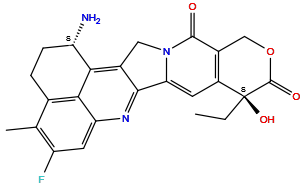
Exatecan
|
|||||
|---|---|---|---|---|---|---|
| Synonyms |
Exatecan; 171335-80-1; Exatecan [INN]; Exatecan mesylate; DX-8951; DX-8951f; OC71PP0F89; (1S,9S)-1-Amino-9-ethyl-5-fluoro-1,2,3,9,12,15-hexahydro-9-hydroxy-4-methyl-10H,13H-benzo(de)pyrano(3',4':6,7)indolizino(1,2-b)quinoline-10,13-dione; Dx 8951; UNII-OC71PP0F89; exatecan-mesylate; (1s,9s)-1-amino-9-ethyl-5-fluoro-1,2,3,9,12,15-hexahydro-9-hydroxy-4-methyl-10h,13h-benzo[de]pyrano[3',4':6,7]indolizino[1,2-b]quinoline-10,13-dione; EXATECAN [MI]; EXATECAN [WHO-DD]; SCHEMBL2512959; CHEMBL1614650; DTXSID60169061; CHEBI:135709; EX-A2683; NSC829066; AKOS005146469; AT33978; BCP9000674; DB12185; NSC-829066; 10H,13H-Benzo(de)pyrano(3',4':6,7)indolizino(1,2-b)quinoline-10,13-dione, 1-amino-9-ethyl-5-fluoro-1,2,3,9,12,15-hexahydro-9-hydroxy-4-methyl-, (1S,9S)-; 10H,13H-Benzo(de)pyrano(3',4':6,7)indolizino(1,2-b)quinoline-10,13-dione, 1-amino-9-ethyl-5-fluoro-1,2,3,9,12,15-hexahydro-9-hydroxy-4-methyl-, (1S-trans)-; AC-32495; BP-27995; BP-27996; HY-13631; DB-064817; DX8951;DX 8951;DX-8951; J-521361; Q5419343; (10S,23S)-23-amino-10-ethyl-18-fluoro-10-hydroxy-19-methyl-8-oxa-4,15-diazahexacyclo[14.7.1.02,14.04,13.06,11.020,24]tetracosa-1,6(11),12,14,16,18,20(24)-heptaene-5,9-dione; (1S,9S)-1-amino-9-ethyl-5-fluoro-9-hydroxy-4-methyl-2,3,12,15-tetrahydrobenzo[de]pyrano[3',4':6,7]indolizino[1,2-b]quinoline-10,13(1H,9H)-dione
Click to Show/Hide
|
|||||
| Target | DNA topoisomerase 1 (TOP1) | |||||
| Structure |
|
|||||
| Formula | C24H22FN3O4 |
|||||
| Isosmiles | CC[C@@]1(C2=C(COC1=O)C(=O)N3CC4=C5[C@H](CCC6=C5C(=CC(=C6C)F)N=C4C3=C2)N)O |
|||||
| PubChem CID | ||||||
| InChI |
InChI=1S/C24H22FN3O4/c1-3-24(31)14-6-18-21-12(8-28(18)22(29)13(14)9-32-23(24)30)19-16(26)5-4-11-10(2)15(25)7-17(27-21)20(11)19/h6-7,16,31H,3-5,8-9,26H2,1-2H3/t16-,24-/m0/s1
|
|||||
| InChIKey |
ZVYVPGLRVWUPMP-FYSMJZIKSA-N
|
|||||
| IUPAC Name |
(10S,23S)-23-amino-10-ethyl-18-fluoro-10-hydroxy-19-methyl-8-oxa-4,15-diazahexacyclo[14.7.1.02,14.04,13.06,11.020,24]tetracosa-1,6(11),12,14,16,18,20(24)-heptaene-5,9-dione
|
|||||
| Pharmaceutical Properties | Molecule Weight |
435.4 |
Polar area |
106 |
||
Complexity |
950 |
xlogp Value |
0.4 |
|||
Heavy Count |
32 |
Rot Bonds |
1 |
|||
Hbond acc |
7 |
Hbond Donor |
2 |
|||
The activity data of This Payload
| Standard Type | Value | Units | Cell line | Disease Model | Cell line ID | Reference |
|---|---|---|---|---|---|---|
| Half Maximal Inhibitory Concentration (IC50) | 0.16 | nM |
MOLT-4 cells
|
Adult T acute lymphoblastic leukemia
|
[1] | |
| Half Maximal Inhibitory Concentration (IC50) | 0.25 | nM |
CCRF-CEM cells
|
T acute lymphoblastic leukemia
|
[1] | |
| Half Maximal Inhibitory Concentration (IC50) | 0.49 | nM |
DU145 cells
|
Prostate carcinoma
|
[1] | |
| Half Maximal Inhibitory Concentration (IC50) | 0.58 | nM |
DMS 114 cells
|
Lung small cell carcinoma
|
[1] |
Each Antibody-drug Conjugate Related to This Payload
Full Information of The Activity Data of The ADC(s) Related to This Payload
Arcotatug tavatecan [New Drug Application]
Identified from the Human Clinical Data
| Experiment 1 Reporting the Activity Date of This ADC | [2] | ||||
| Efficacy Data | Progression Free Survival |
5.3 months
|
|||
| Patients Enrolled |
Inclusion criteria: Adults (≥18) with ECOG 0-1, adequate organ function, and measurable lesions (RECIST 1.1), stratified by tumor type (Phase Ia: solid tumors; Phase Ib: G/GEJ AC, PDAC, BTC with CLDN18.2 positivity). Exclusions: recent anticancer therapy (<4 weeks), uncontrolled infections, major surgery (<4 weeks), CNS metastases, HIV/HBV/HCV, cardiovascular risks, bowel obstruction, or prior allogeneic transplants. Pregnancy and prior severe allergies to monoclonal antibodies are excluded.
Click to Show/Hide
|
||||
| Administration Dosage |
IBI343 will be administered intravenously (IV) on Day 1 of every 21-day cycle.
|
||||
| Related Clinical Trial | |||||
| NCT Number | NCT05458219 | Phase Status | PHASE1 | ||
| Clinical Description |
A Phase 1a/b, Multicenter, Open-label, First-in-human Study of IBI343 in Subjects with Locally Advanced Unresectable or Metastatic Solid Tumors
|
||||
| Primary Endpoint |
The study evaluates safety through adverse events (AEs), treatment-emergent AEs (TEAEs), serious AEs (SAEs) assessed via NCI-CTCAE v5.0 over 90 days post-treatment, and dose-limiting toxicities (DLTs) monitored for 21 days post-first dose to determine MTD/RP2D. Efficacy is measured via investigator-assessed ORR per RECIST 1.1, tracking CR/PR rates over 2 years.
Click to Show/Hide
|
||||
| Other Endpoint |
Pharmacokinetic parameters include Cmax, AUC, CL, t1/2, V, Tmax, and Ctrough of IBI343 over 2 years, alongside anti-drug antibody (ADA) incidence. Efficacy outcomes feature ORR, TTR (time to first CR/PR), DoR (response duration until PD/death), DCR (CR/PR/SD rates), PFS (time to progression/death), and OS (time to death from any cause) assessed over 2 years (OS: 1 year average).
Click to Show/Hide
|
||||
| Experiment 2 Reporting the Activity Date of This ADC | [2] | ||||
| Efficacy Data | Objective Response Rate (ORR) |
24.40%
|
|||
| Patients Enrolled |
Inclusion criteria: Adults (≥18) with ECOG 0-1, adequate organ function, and measurable lesions (RECIST 1.1), stratified by tumor type (Phase Ia: solid tumors; Phase Ib: G/GEJ AC, PDAC, BTC with CLDN18.2 positivity). Exclusions: recent anticancer therapy (<4 weeks), uncontrolled infections, major surgery (<4 weeks), CNS metastases, HIV/HBV/HCV, cardiovascular risks, bowel obstruction, or prior allogeneic transplants. Pregnancy and prior severe allergies to monoclonal antibodies are excluded.
Click to Show/Hide
|
||||
| Administration Dosage |
IBI343 will be administered intravenously (IV) on Day 1 of every 21-day cycle.
|
||||
| Related Clinical Trial | |||||
| NCT Number | NCT05458219 | Phase Status | PHASE1 | ||
| Clinical Description |
A Phase 1a/b, Multicenter, Open-label, First-in-human Study of IBI343 in Subjects with Locally Advanced Unresectable or Metastatic Solid Tumors
|
||||
| Primary Endpoint |
The study evaluates safety through adverse events (AEs), treatment-emergent AEs (TEAEs), serious AEs (SAEs) assessed via NCI-CTCAE v5.0 over 90 days post-treatment, and dose-limiting toxicities (DLTs) monitored for 21 days post-first dose to determine MTD/RP2D. Efficacy is measured via investigator-assessed ORR per RECIST 1.1, tracking CR/PR rates over 2 years.
Click to Show/Hide
|
||||
| Other Endpoint |
Pharmacokinetic parameters include Cmax, AUC, CL, t1/2, V, Tmax, and Ctrough of IBI343 over 2 years, alongside anti-drug antibody (ADA) incidence. Efficacy outcomes feature ORR, TTR (time to first CR/PR), DoR (response duration until PD/death), DCR (CR/PR/SD rates), PFS (time to progression/death), and OS (time to death from any cause) assessed over 2 years (OS: 1 year average).
Click to Show/Hide
|
||||
| Experiment 3 Reporting the Activity Date of This ADC | [2] | ||||
| Efficacy Data | Disease control rate (DCR) |
80.50%
|
|||
| Patients Enrolled |
Inclusion criteria: Adults (≥18) with ECOG 0-1, adequate organ function, and measurable lesions (RECIST 1.1), stratified by tumor type (Phase Ia: solid tumors; Phase Ib: G/GEJ AC, PDAC, BTC with CLDN18.2 positivity). Exclusions: recent anticancer therapy (<4 weeks), uncontrolled infections, major surgery (<4 weeks), CNS metastases, HIV/HBV/HCV, cardiovascular risks, bowel obstruction, or prior allogeneic transplants. Pregnancy and prior severe allergies to monoclonal antibodies are excluded.
Click to Show/Hide
|
||||
| Administration Dosage |
IBI343 will be administered intravenously (IV) on Day 1 of every 21-day cycle.
|
||||
| Related Clinical Trial | |||||
| NCT Number | NCT05458219 | Phase Status | PHASE1 | ||
| Clinical Description |
A Phase 1a/b, Multicenter, Open-label, First-in-human Study of IBI343 in Subjects with Locally Advanced Unresectable or Metastatic Solid Tumors
|
||||
| Primary Endpoint |
The study evaluates safety through adverse events (AEs), treatment-emergent AEs (TEAEs), serious AEs (SAEs) assessed via NCI-CTCAE v5.0 over 90 days post-treatment, and dose-limiting toxicities (DLTs) monitored for 21 days post-first dose to determine MTD/RP2D. Efficacy is measured via investigator-assessed ORR per RECIST 1.1, tracking CR/PR rates over 2 years.
Click to Show/Hide
|
||||
| Other Endpoint |
Pharmacokinetic parameters include Cmax, AUC, CL, t1/2, V, Tmax, and Ctrough of IBI343 over 2 years, alongside anti-drug antibody (ADA) incidence. Efficacy outcomes feature ORR, TTR (time to first CR/PR), DoR (response duration until PD/death), DCR (CR/PR/SD rates), PFS (time to progression/death), and OS (time to death from any cause) assessed over 2 years (OS: 1 year average).
Click to Show/Hide
|
||||
| Experiment 4 Reporting the Activity Date of This ADC | [3] | ||||
| Patients Enrolled |
Inclusion: Adults (≥18) with CLDN18.2-positive unresectable/metastatic pancreatic adenocarcinoma (confirmed histopathology, measurable lesions per RECIST 1.1), ECOG 0-1, life expectancy ≥12 weeks, adequate organ function. Prior systemic therapy allowed in Part 1 but prohibited in Part 2 (treatment-naïve population). Exclusion: Recent anti-tumor therapy (within 4 weeks), CYP3A4 inhibitors (2 weeks/5 half-lives), untreated CNS metastases, gastrointestinal perforation/fistula (6 months), interstitial lung disease, prior topoisomerase inhibitor ADCs, pregnancy, or conditions contraindicating study participation. Palliative radiotherapy/surgery is permitted under specific conditions.
Click to Show/Hide
|
||||
| Administration Dosage |
There are two parts in this study, Part1 (safe lead-in phase) and Part2 (extension phase). In part1, patients with CLDN18.2-positive advanced pancreatic adenocarcinoma who had or had not previously received systemic therapy will be enrolled. The starting dose of the AG regimen was albumin-paclitaxel 100mg / m2 combined with gemcitabine 800mg / m2 by intravenous infusion (Intravenous, IV) D1 and D8 Q3W. If none of the first 3 subjects at 6 mg / kg had DLT during the DLT observation period, the combined high dose AG regimen was attempted. The investigator will adjust the dose of IBI343 combination chemotherapy according to the previous safety results and determine the safety of the combination dose, then entering the Part 2.
Click to Show/Hide
|
||||
| Related Clinical Trial | |||||
| NCT Number | NCT06770439 | Phase Status | PHASE2 | ||
| Clinical Description |
A Phase II Study to Evaluate the Safety, Tolerability, and Efficacy of IBI343 Combined with Chemotherapy in Advanced Pancreatic Cancer
|
||||
| Primary Endpoint |
The study evaluates the primary efficacy endpoint of Objective Response Rate (ORR per RECIST 1.1) and key safety measures including adverse events (hematotoxicity, hepatotoxicity, renal function) assessed via CTCAE 5.0 over 2 years.
|
||||
| Other Endpoint |
Secondary endpoints include Progression-Free Survival (PFS), Duration of Response (DOR), Disease Control Rate (DCR, incorporating PR/SD), Time to Response (TTR), and Overall Survival (OS) - all measured over 2 years to assess long-term clinical outcomes.
|
||||
| Experiment 5 Reporting the Activity Date of This ADC | [4] | ||||
| Patients Enrolled |
Key inclusion criteria involve signing informed consent, confirmed unresectable locally advanced or metastatic G/GEJ adenocarcinoma, CLDN18.2-positive status, ≥18 years old, ECOG PS 0-1, and progression after ≥2 prior systemic therapies (including specific regimens). Exclusion covers HER2-positive disease, concurrent interventional trials, prior topoisomerase inhibitor-based ADCs, recent anticancer treatments (within 4 weeks/5 half-lives), and planned non-study therapies (excluding palliative radiotherapy).
Click to Show/Hide
|
||||
| Administration Dosage |
IBI343: Subjects in the experimental arm will receive IBI343 6mg/kg intravenous infusion (IV) D1, Q3W in 3-week cycles.
|
||||
| Related Clinical Trial | |||||
| NCT Number | NCT06238843 | Phase Status | PHASE3 | ||
| Clinical Description |
A Multicenter, Randomized, Open-label, Phase 3 Study of IBI343 Monotherapy Versus Treatment of Investigator's Choice in Subjects With Previously Treated, Claudin (CLDN) 18.2-positive, HER2-negative, Locally Advanced, Unresectable or Metastatic Gastric or Gastroesophageal Junction Adenocarcinoma
|
||||
| Primary Endpoint |
The primary endpoints include progression-free survival (PFS), measured as time from randomization to disease progression or death within approximately 20 months, and overall survival (OS), assessed as time from randomization to death within around 26 months.
|
||||
| Other Endpoint |
Secondary endpoints consist of objective response rate (ORR), disease control rate (DCR), duration of response (DoR), time to response (TTR), and pharmacokinetic parameters like AUC, Cmax, Tmax, Ctrough, CL, and V. Additionally, immunogenicity assessments include incidence of anti-drug antibodies (ADA) and neutralizing antibodies (NAb), each evaluated within approximately 20 months.
Click to Show/Hide
|
||||
| Experiment 6 Reporting the Activity Date of This ADC | [5] | ||||
| Patients Enrolled |
Eligible participants must provide informed consent, have confirmed unresectable locally advanced/metastatic G/GEJ adenocarcinoma, CLDN18.2 positivity, ECOG PS 0-1, and adequate organ function. Exclusions cover active infections (HIV, HBV/HCV), uncontrolled comorbidities (cardiopulmonary, CNS metastases), recent major surgery/radiotherapy, immunosuppressive therapy, prior topoisomerase inhibitor ADCs, pregnancy, or conditions jeopardizing safety/study integrity. Specific thresholds apply for lab values (e.g., ANC ≥1.5×10⁹/L, platelets ≥100×109/L) and disease stability (e.g., asymptomatic brain metastases ≤1.5 cm).
Click to Show/Hide
|
||||
| Administration Dosage |
IBI343 Specifications: 100 mg/bottle Approval method: TBD Q3W intravenous infusion (IV) sintilimab Specifications: 100mg (10ml)/bottle Afghan way: 200 mg Q3W IV infusion
|
||||
| Related Clinical Trial | |||||
| NCT Number | NCT06321913 | Phase Status | PHASE2 | ||
| Clinical Description |
Phase II Study to Evaluate the Safety, Tolerability and Efficacy of IBI343 Combined With Sintilimab in Subjects With Advanced Gastric/Gastroesophageal Junction Adenocarcinoma
|
||||
| Primary Endpoint |
The primary endpoints include Objective Response Rate (ORR) assessed per RECIST v1.1 and safety evaluations such as Adverse Events (AE), Treatment-Emergent Adverse Events (TEAE), Adverse Events of Special Interest (AESI), Serious Adverse Events (SAE), and clinical monitoring parameters (laboratory exams, physical exams, vital signs), all tracked over 24 months.
Click to Show/Hide
|
||||
| Other Endpoint |
Secondary efficacy measures consist of Progression-Free Survival (PFS), Duration of Response (DoR), Disease Control Rate (DCR), Time to Response (TTR), and Overall Survival (OS), each evaluated within a 24-month timeframe.
|
||||
Rinatabart sesutecan [Phase 3]
Identified from the Human Clinical Data
| Experiment 1 Reporting the Activity Date of This ADC | [6] | ||||
| Patients Enrolled |
Inclusion: Part A/B-metastatic/unresectable solid tumors (ovarian/NSCLC/breast cancers, mesothelioma) refractory to prior therapy; Part C-BRCA-tested, platinum-resistant ovarian cancer (1-3 prior lines, FRalpha+ must have received mirvetuximab soravtansine); Part D-platinum-sensitive/refractory ovarian cancer (cohort-specific prior therapies); Part F-endometrial cancer (1-3 prior lines, post-PD-[L]1 inhibitor). Exclusions: ILD/pneumonitis, strong CYP3A inhibitors (dose escalation), prior topoisomerase-1 inhibitor ADCs.
Click to Show/Hide
|
||||
| Related Clinical Trial | |||||
| NCT Number | NCT05579366 | Phase Status | PHASE1|||PHASE2 | ||
| Clinical Description |
Phase 1/2 Study of Rina-S in Patients With Locally Advanced and/or Metastatic Solid Tumors
|
||||
| Primary Endpoint |
In Parts A, B, and D, safety assessments include incidence, severity, and seriousness of treatment-emergent adverse events (TEAEs) and dose-limiting toxicities (DLTs) evaluated through the end of treatment (up to ~1 year). DLTs are specifically analyzed at the end of Cycle 1 (21-day cycles). Parts C and F report objective response rate (ORR) via blinded independent central review (BICR) per RECIST v1.1.
Click to Show/Hide
|
||||
| Other Endpoint |
Efficacy measures include best overall response (BOR), ORR, disease control rate (DCR), progression-free survival (PFS), overall survival (OS), and duration of response (DOR). Pharmacokinetic parameters (Cmax, AUC, Tmax, Ctrough, t1/2) of Rina-S are assessed. Parts C and D evaluate CA-125 response using GCIG criteria, and Parts C and F assess adverse events (CTCAE v5.0).
Click to Show/Hide
|
||||
| Experiment 2 Reporting the Activity Date of This ADC | [7] | ||||
| Patients Enrolled |
Exclusions: prior topoisomerase-1 inhibitor ADCs; primary platinum-refractory disease (progression ≤91 days post-1st-line platinum); active malignancy within 3 years (exceptions: low-risk cancers); active CNS metastases (unless stable ≥4 weeks post-treatment); symptomatic GI obstruction/ascites requiring frequent paracentesis. Other protocol-specific criteria may apply.
Click to Show/Hide
|
||||
| Related Clinical Trial | |||||
| NCT Number | NCT06619236 | Phase Status | PHASE3 | ||
| Clinical Description |
A Phase 3 Randomized, Open-label Study of Rinatabart Sesutecan (Rina-S) Versus Treatment of Investigator's Choice (IC) in Patients With Platinum Resistant Ovarian Cancer
|
||||
| Primary Endpoint |
The primary efficacy endpoints include progression-free survival (PFS), defined as time from randomization to first progression or death per RECIST v1.1, and overall survival (OS), measured from randomization to death from any cause. Secondary endpoints include objective response rate (ORR), duration of response (DOR), CA-125 response per GCIG criteria (≥50% reduction), PFS2 (time to second progression/death), and quality of life assessments via EORTC-QLQ-C30 (GHS/QoL score changes and time to deterioration [TTD]). Safety will be monitored through TEAEs, lab abnormalities, and ECG/QTc changes (Holter monitoring during Cycle 1).
Click to Show/Hide
|
||||
| Other Endpoint |
Inclusion criteria: histologically confirmed high-grade serous/endometrioid ovarian, peritoneal, or fallopian tube cancer (regardless of FRalpha status) with 1-4 prior lines. Must have received platinum chemo, bevacizumab (if standard), and PARP inhibitors (if BRCA-mutated and eligible); prior mirvetuximab soravtansine required if FRalpha+ (unless contraindicated). Platinum-resistant disease defined as progression 91-183 days post-platinum (1st line) or ≤183 days (2nd-4th lines).
Click to Show/Hide
|
||||
| Experiment 3 Reporting the Activity Date of This ADC | [8] | ||||
| Related Clinical Trial | |||||
| NCT Number | NCT05579366 | Phase Status | Phase 1/2 | ||
| Clinical Description |
Phase 1/2 study of PRO1184 in patients with locally advanced and/or metastatic solid tumors.
|
||||
Precemtabart tocentecan [Phase 1/2]
Identified from the Human Clinical Data
| Experiment 1 Reporting the Activity Date of This ADC | [9] | ||||
| Efficacy Data | stable disease (SD) |
55%
|
|||
| Patients Enrolled |
Eligible participants have histologically confirmed advanced/metastatic CRC refractory to standard therapies (MSI-H must have received checkpoint inhibitors if available), ECOG PS ≤1, and adequate organ function. Exclusions include other active malignancies (exceptions: non-melanoma skin/cervical cancers), unstable brain metastases, Grade >1 diarrhea/ileus, active IBD, significant cardiovascular events (MI/stroke within 6 months), or QTc >470 ms. Bowel obstruction/intestinal perforation history is also excluded.
Click to Show/Hide
|
||||
| Administration Dosage |
This Phase 1 trial (NCT05464030) investigated the safety, tolerability, pharmacokinetics (PK), and preliminary clinical activity of M9140 as monotherapy (Q3W [Day 1 of 21-day cycles]; IV), At data cutoff (19 Jan 2024), 40 pts from the US, EU, and Japan were treated across 7 dose levels (DLs): 0.6 mg/kg, 1.2 mg/kg (n=3, each), 2.4 mg/kg (n=7), 2.6 mg/kg (n=4), 2.8 mg/ kg (n=12), 3.0 mg/kg (n 4), and 3.2 mg/kg (n=7, including 3 pts with primary G CSF prophylaxis).
Click to Show/Hide
|
||||
| Related Clinical Trial | |||||
| NCT Number | NCT05464030 | Phase Status | PHASE1 | ||
| Clinical Description |
A Phase I, Multicenter, Open-Label First in Human Study of Anti-CEACAM5 Antibody Drug Conjugate M9140 in Participants With Advanced Solid Tumors (PROCEADE-CRC-01)
|
||||
| Primary Endpoint |
This study evaluates M9140 in participants with locally advanced/metastatic colorectal cancer (CRC), divided into multiple parts. Part 1 assesses dose-limiting toxicities (DLTs) and adverse events (AEs) to determine the recommended dose expansion (RDE) over 4 months. Parts 2A, 2B, 2C, and 2D further examine safety (AEs/DLTs), objective response (OR) per RECIST v1.1, and duration of response (DoR) over 8 months.
Click to Show/Hide
|
||||
| Other Endpoint |
Pharmacokinetic (PK) analysis of M9140 plasma concentrations, anti-drug antibody (ADA) incidence/titers, ECG changes (QTc interval), and efficacy measures (OR, DoR, time to response, PFS) are assessed across all parts (1, 2A-2D). Part 2A includes overall survival (OS) and symptomatic AEs, while disease control is evaluated at Week 12.
|
||||
| Experiment 2 Reporting the Activity Date of This ADC | [9] | ||||
| Efficacy Data | Partial Response (PR) |
10%
|
|||
| Patients Enrolled |
Eligible participants have histologically confirmed advanced/metastatic CRC refractory to standard therapies (MSI-H must have received checkpoint inhibitors if available), ECOG PS ≤1, and adequate organ function. Exclusions include other active malignancies (exceptions: non-melanoma skin/cervical cancers), unstable brain metastases, Grade >1 diarrhea/ileus, active IBD, significant cardiovascular events (MI/stroke within 6 months), or QTc >470 ms. Bowel obstruction/intestinal perforation history is also excluded.
Click to Show/Hide
|
||||
| Administration Dosage |
This Phase 1 trial (NCT05464030) investigated the safety, tolerability, pharmacokinetics (PK), and preliminary clinical activity of M9140 as monotherapy (Q3W [Day 1 of 21-day cycles]; IV), At data cutoff (19 Jan 2024), 40 pts from the US, EU, and Japan were treated across 7 dose levels (DLs): 0.6 mg/kg, 1.2 mg/kg (n=3, each), 2.4 mg/kg (n=7), 2.6 mg/kg (n=4), 2.8 mg/ kg (n=12), 3.0 mg/kg (n 4), and 3.2 mg/kg (n=7, including 3 pts with primary G CSF prophylaxis).
Click to Show/Hide
|
||||
| Related Clinical Trial | |||||
| NCT Number | NCT05464030 | Phase Status | PHASE1 | ||
| Clinical Description |
A Phase I, Multicenter, Open-Label First in Human Study of Anti-CEACAM5 Antibody Drug Conjugate M9140 in Participants With Advanced Solid Tumors (PROCEADE-CRC-01)
|
||||
| Primary Endpoint |
This study evaluates M9140 in participants with locally advanced/metastatic colorectal cancer (CRC), divided into multiple parts. Part 1 assesses dose-limiting toxicities (DLTs) and adverse events (AEs) to determine the recommended dose expansion (RDE) over 4 months. Parts 2A, 2B, 2C, and 2D further examine safety (AEs/DLTs), objective response (OR) per RECIST v1.1, and duration of response (DoR) over 8 months.
Click to Show/Hide
|
||||
| Other Endpoint |
Pharmacokinetic (PK) analysis of M9140 plasma concentrations, anti-drug antibody (ADA) incidence/titers, ECG changes (QTc interval), and efficacy measures (OR, DoR, time to response, PFS) are assessed across all parts (1, 2A-2D). Part 2A includes overall survival (OS) and symptomatic AEs, while disease control is evaluated at Week 12.
|
||||
| Experiment 3 Reporting the Activity Date of This ADC | [14] | ||||
| Patients Enrolled |
Eligible participants must have histologically confirmed metastatic CRC refractory to standard therapies (fluoropyrimidine, irinotecan, platinum/EGFR/VEGF inhibitors) with ECOG PS ≤1 and adequate organ function. Key exclusions include active malignancies (exceptions: non-melanoma skin/cervical cancers), unstable brain metastases, uncontrolled diarrhea/ileus (Grade >1), or recent stroke (<6 months). MSI-H participants must have received checkpoint inhibitors unless contraindicated.
Click to Show/Hide
|
||||
| Administration Dosage |
M9140 will be administered every 3 weeks until progression, unacceptable toxicity, withdrawal of consent, or any criterion for withdrawal from the study. There will be 2 dose levels, if the low dose level is tolerated, then M9140 will be escalated to the high dose level.
|
||||
| Related Clinical Trial | |||||
| NCT Number | NCT06806046 | Phase Status | PHASE1 | ||
| Clinical Description |
A Phase 1, Open-label Study of AntiCEACAM5 AntibodyDrug Conjugate M9140 in Chinese Participants With Solid Tumors (PROCEADE-CRC-02)
|
||||
| Primary Endpoint |
The study evaluates M9140 in participants with advanced/metastatic CRC, assessing dose-limiting toxicities (DLTs) during the first 21-day cycle and treatment-emergent adverse events (TEAEs) over 8 months. These primary safety endpoints will determine the tolerability profile of the investigational therapy.
|
||||
| Other Endpoint |
Pharmacokinetic (PK) assessments will characterize plasma concentrations of M9140 across multiple cycles up to treatment discontinuation (≈20 months). Efficacy outcomes include objective response (OR), duration of response (DoR), and progression-free survival (PFS) per RECIST v1.1, measured from first treatment until disease progression/death (≈8 months).
Click to Show/Hide
|
||||
| Experiment 4 Reporting the Activity Date of This ADC | [15] | ||||
| Patients Enrolled |
Eligible participants must provide informed consent, have ECOG PS ≤1, adequate organ function, and ≥1 measurable lesion per RECIST v1.1. GC substudy requires HER2-negative advanced/metastatic adenocarcinoma with 1-2 prior lines including fluoropyrimidine/platinum (and ICI for MSI-H/PD-L1+), categorized by CEACAM5 expression. NSCLC substudy enrolls stage III/IV patients with 1-3 prior lines, analyzing CEACAM5 in EGFR-mutated tumors. PDAC substudy includes 1-2 prior lines (FOLFIRINOX/nal-IRI or gem/nab-paclitaxel) with CEACAM5high expression. Key exclusions include recent malignancies (exceptions apply), unstable brain metastases, Grade >1 diarrhea/ileus, inflammatory bowel disease, significant cardiac conditions (QTc>470ms), recent stroke (<6 months), and prior irinotecan use in GC/NSCLC substudies.
Click to Show/Hide
|
||||
| Administration Dosage |
All participants will receive 2.8 milligram per kilogram (mg/kg) M9140 intravenously (i.v.) every 3 weeks (q3w) on Day 1 of consecutive 21-day cycles.
|
||||
| Related Clinical Trial | |||||
| NCT Number | NCT06710132 | Phase Status | PHASE1|||PHASE2 | ||
| Clinical Description |
PROCEADE PanTumor: A Phase 1b/2, Multicenter, Open-Label Study of Anti-CEACAM5 Antibody-Drug Conjugate M9140 in Participants With Advanced Solid Tumors (Master Protocol)
|
||||
| Primary Endpoint |
The substudies in gastric cancer (GC), non-small cell lung cancer (NSCLC), and pancreatic ductal adenocarcinoma (PDAC) will assess objective response (OR) per RECIST v1.1 from first treatment through final assessment at approximately 48 months, serving as a key efficacy parameter across all three cancer types.
|
||||
| Other Endpoint |
Safety and efficacy outcomes for GC/NSCLC/PDAC substudies include adverse events (AEs), duration of response (DoR), disease control at Week 12, time to response, and progression-free survival (PFS) evaluated over 48 months. Pharmacokinetic analysis of M9140 plasma concentrations and anti-drug antibodies (ADA) will be monitored for approximately 12 months, with CEACAM5 expression specifically measured in the GC substudy on Day 1.
Click to Show/Hide
|
||||
OBI-992 [Phase 1/2]
Identified from the Human Clinical Data
| Experiment 1 Reporting the Activity Date of This ADC | [10] | ||||
| Patients Enrolled |
Eligible subjects must be ≥18yo with metastatic/advanced solid tumors (measurable per RECIST v1.1, ECOG 0-1) refractory to standard therapy, with adequate organ function (ALT/AST ≤3×ULN [≤5×ULN with liver mets], bilirubin ≤1.5×ULN, CrCl >50mL/min, ANC ≥1500/uL). Special populations: HIV+ (CD4≥350 cells/uL, VL<200 copies/mL), HBV (suppressed VL), HCV (curative treatment with undetectable VL). Part B requires NSCLC/SCLC histology. All subjects must provide pretreatment tumor biopsy (archival acceptable) and comply with contraception requirements (120 days post-treatment).
Click to Show/Hide
|
||||
| Administration Dosage |
OBI-992 at dose level 1, 2, 3, 4, 6, 8, 10 mg/kg, Q3W
|
||||
| Related Clinical Trial | |||||
| NCT Number | NCT06480240 | Phase Status | PHASE1|||PHASE2 | ||
| Clinical Description |
A Phase 1/2, Open-Label, Dose-Escalation and Cohort-Expansion Study Evaluating the Safety, Pharmacokinetics, and Therapeutic Activity of OBI-992 in Subjects With Advanced Solid Tumors
|
||||
| Primary Endpoint |
Primary objectives include assessing OBI-992 safety/tolerability (AEs/SAEs/lab abnormalities per NCI CTCAE v5.0), determining MTD/RP2D, and evaluating preliminary efficacy (ORR, CBR, DOR, DCR, PFS per RECIST v1.1) over a study duration of up to 2 years and 2 months.
|
||||
| Other Endpoint |
Secondary objectives involve characterizing OBI-992 immunogenicity (ADA incidence) and serum PK parameters (Cmax, AUC, T1/2, CL, Vdss) for both OBI-992 and active metabolite exatecan throughout the study period.
|
||||
PRO-1286 [Phase 1/2 (discontinued)]
Identified from the Human Clinical Data
| Experiment 1 Reporting the Activity Date of This ADC | [11] | ||||
| Patients Enrolled |
Key inclusion criteria: age ≥18; ECOG 0-1; measurable advanced solid tumors (RECIST 1.1); refractory to standard therapies; adequate organ function; willingness to provide tumor samples.
|
||||
| Related Clinical Trial | |||||
| NCT Number | NCT06685068 | Phase Status | PHASE1|||PHASE2 | ||
| Clinical Description |
A Phase 1/2 Study of GEN1286 in Patients With Advanced Solid Tumors
|
||||
| Primary Endpoint |
Primary endpoints include AE incidence (NCI-CTCAE v5.0) over 3 years 9 months and DLTs during first cycle (21 days) for GEN1286 safety evaluation.
|
||||
| Other Endpoint |
Secondary endpoints comprise efficacy measures (ORR, DCR, PFS, DOR per RECIST 1.1) and PK parameters (AUC, Cmax, Tmax, t1/2, CL, Vz, Ctrough of antibody-conjugated exatecan components) over 2 years 9 months, plus ADA assessment.
|
||||
TUB-030 [Phase 1/2]
Identified from the Human Clinical Data
| Experiment 1 Reporting the Activity Date of This ADC | [12] | ||||
| Patients Enrolled |
Eligible patients (≥18 years, ECOG 0-1) had adequate organ function, measurable disease per RECIST v1.1, and resolved prior treatment toxicities (≤grade 1). Exclusions included recent anticancer therapy (<4 weeks/5 half-lives), uncontrolled brain metastases, or inadequate contraception. WOCBP required highly effective contraception during and post-treatment (5 half-lives + 6 months).
Click to Show/Hide
|
||||
| Administration Dosage |
A complete treatment cycle is defined as 21 calendar days. TUB-030 will be administered as an intravenous (IV) solution on day 1 of each treatment cycle
|
||||
| Related Clinical Trial | |||||
| NCT Number | NCT06657222 | Phase Status | PHASE1|||PHASE2 | ||
| Clinical Description |
A Multicenter FIH Dose Escalation and Optimization Phase I/IIa Trial to Investigate Safety, Tolerability, PK, and Efficacy of the 5T4 ADC TUB-030 in Patients with Advanced Solid Tumors (5-STAR 1-01)
|
||||
| Primary Endpoint |
The MTD was defined as the highest dose where ≤1 of 3 patients experienced DLTs per NCI CTCAE v5.0, assessed from enrollment until 30 days post-treatment.
|
||||
| Other Endpoint |
Safety outcomes included AE incidence, PK parameters (Cmax, Cmin, Tmax, AUC, T1/2), immunogenicity (anti-TUB-030 antibodies), and efficacy (ORR per RECIST 1.1), all evaluated until 30 days post-treatment.
|
||||
TUB-040 [Phase 1/2]
Identified from the Human Clinical Data
| Experiment 1 Reporting the Activity Date of This ADC | [13] | ||||
| Patients Enrolled |
Eligible patients (≥18 years, ECOG 0-1) had incurable solid tumors refractory to SoC, measurable disease, adequate organ function, and resolved prior toxicities (≤grade 1). Exclusions included topoisomerase-I refractory disease, active ILD/pneumonitis, uncontrolled comorbidities, recent live vaccines, or infections (HBV/HCV/HIV exceptions applied). Contraception was mandatory for FCBP.
Click to Show/Hide
|
||||
| Administration Dosage |
A complete treatment cycle is defined as 21 calendar days. TUB-040 will be administered as an intravenous (IV) solution on day 1 of each treatment cycle
|
||||
| Related Clinical Trial | |||||
| NCT Number | NCT06303505 | Phase Status | PHASE1|||PHASE2 | ||
| Clinical Description |
A First-in-human Dose Escalation and Optimization Phase I/IIa Study to Investigate Safety, Tolerability, PK, and Efficacy of the NaPi2b ADC TUB-040 in Patients With Platinum-resistant High-grade Ovarian Cancer (PROC) or r/r Adenocarcinoma Non-small Cell Lung Cancer (NSCLC)
|
||||
| Primary Endpoint |
The MTD was determined as the highest dose where ≤1 of 3 patients experienced DLTs per NCI CTCAE v5.0, evaluated from enrollment until 30 days post-treatment.
|
||||
| Other Endpoint |
PK parameters (Cmax, Cmin, Tmax, AUC, T1/2) for TUB-040 components (ADC, mAb, payload) and immunogenicity (anti-TUB-040 antibodies) were assessed until 30 days post-treatment, alongside efficacy (ORR per RECIST 1.1).
|
||||
AMT-253 [Phase 1/2]
Identified from the Human Clinical Data
| Experiment 1 Reporting the Activity Date of This ADC | [16] | ||||
| Patients Enrolled |
Eligible patients aged 18-70 with histopathologically confirmed melanoma, non-small cell lung cancer (squamous), or head/neck squamous cell carcinoma must meet specific criteria including target protein expression, adequate venous access, and proper blood/liver/kidney function; exclusion factors cover active infections, prior CAR-T therapy, immunosuppressant use, severe systemic/autoimmune diseases, pregnancy, allergies, or prior organ transplants.
Click to Show/Hide
|
||||
| Related Clinical Trial | |||||
| NCT Number | NCT05117138 | Phase Status | PHASE1|||PHASE2 | ||
| Clinical Description |
Safety and Efficacy of Chimeric Antigen Receptor T Lymphocytes for Patients With Intermediate and Advanced Tumors
|
||||
| Primary Endpoint |
Primary endpoints include incidence of adverse events, overall response rate (ORR), and one-year recurrence rate, all evaluated over a 24-week timeframe.
|
||||
| Other Endpoint |
Secondary endpoints comprise progression-free survival (PFS) and relapse-free survival (RFS), also measured within a 24-week period.
|
||||
| Experiment 2 Reporting the Activity Date of This ADC | [17] | ||||
| Patients Enrolled |
Eligibility requires signed ICF, advanced solid tumors, progression after prior therapy, measurable lesions, ECOG 0-1, ≥3 month life expectancy, adequate organ function, and contraceptive use. Exclusions include prior target therapy, CNS metastases, severe skin disorders, unresolved toxicities (>Grade 1), recent treatments/surgeries, cardiac issues, thromboembolic events, active infections, or recent live vaccines.
Click to Show/Hide
|
||||
| Administration Dosage |
Administered intravenously
|
||||
| Related Clinical Trial | |||||
| NCT Number | NCT06209580 | Phase Status | PHASE1|||PHASE2 | ||
| Clinical Description |
Phase I/II Study of AMT-253 in Patients With Unresectable or Metastatic Malignant Melanoma and Other Advanced Solid Tumors
|
||||
| Primary Endpoint |
The study assesses DLTs (21 days post-dose), AEs/SAEs (24 months) including type, incidence and severity, and ORR per RECIST 1.1.
|
||||
| Other Endpoint |
Pharmacokinetic metrics over 24 months include Cmax, Tmax, AUC, t1/2 of ADC components, and ADA quantification.
|
||||
| Experiment 3 Reporting the Activity Date of This ADC | [18] | ||||
| Patients Enrolled |
Eligible patients must be ≥18 years, with progressive disease after systemic therapy, measurable lesions per RECIST v1.1, ECOG 0-1, adequate organ function, and life expectancy ≥3 months. Key exclusions include CNS metastasis, active infections, significant cardiac/autoimmune diseases, recent major surgery/radiotherapy, unresolved toxicities >Grade 1, pregnancy, or prior malignancies within 5 years (unless inclusion-related). Contraception and tumor tissue availability are required.
Click to Show/Hide
|
||||
| Administration Dosage |
Administered intravenously
|
||||
| Related Clinical Trial | |||||
| NCT Number | NCT05906862 | Phase Status | PHASE1 | ||
| Clinical Description |
First-in-Human, Phase 1 Study of AMT-253, in Patients With Advanced Solid Tumors
|
||||
| Primary Endpoint |
The study focuses on determining the Recommended Phase 2 Dose (RP2D) and Maximum Tolerated Dose (MTD) based on dose-limiting toxicities (DLTs) and other data over 24 months. Safety and tolerability will be assessed using Common Terminology Criteria for Adverse Events v5.0 to evaluate adverse event types, incidence, and severity.
|
||||
| Other Endpoint |
Key efficacy endpoints include Overall Response Rate (ORR) and Disease Control Rate (DCR) per RECIST v1.1, along with Progression-free Survival (PFS). Pharmacokinetic profiling will assess Cmax, AUC, terminal half-life (t1/2), and Tmax of AMT-253, while immunogenicity will be evaluated via anti-drug antibody (ADA) concentrations, all measured over 24 months.
Click to Show/Hide
|
||||
PRO1160 [Phase 1/2 (discontinued)]
Identified from the Human Clinical Data
| Experiment 1 Reporting the Activity Date of This ADC | [19] | ||||
| Patients Enrolled |
Eligible patients must have confirmed metastatic/unresectable RCC, NPC, or NHL (stage III/IV), be refractory to prior therapies, have ECOG 0-1, and measurable disease. Exclusions include previous anti-CD70 therapy, active CNS metastases (unless treated/stable), uncontrolled infections, HBV/HCV/HIV positivity, or recent strong CYP3A inhibitor use (dose escalation only).
Click to Show/Hide
|
||||
| Administration Dosage |
PRO1160 monotherapy in escalating doses in Part A and at the recommended phase 2 dose in Part B
|
||||
| Related Clinical Trial | |||||
| NCT Number | NCT05721222 | Phase Status | PHASE1|||PHASE2 | ||
| Clinical Description |
Phase 1/2 Study of PRO1160 in Patients With Renal Cell Carcinoma (RCC), Nasopharyngeal Carcinoma (NPC), or Non-Hodgkin Lymphoma (NHL)
|
||||
| Primary Endpoint |
Safety will be evaluated by assessing treatment-emergent adverse events (frequency, severity, and seriousness) and dose-limiting toxicities throughout the treatment period up to approximately 1 year.
|
||||
| Other Endpoint |
Efficacy measurements include objective response rate, disease control rate (assessed by RECIST v1.1 for solid tumors or Lugano 2014 for NHL), progression-free survival (analyzed up to 18 months), and duration of response (tracked until disease progression/withdrawal). Pharmacokinetic analysis will determine PRO1160's peak plasma concentration (Cmax).
Click to Show/Hide
|
||||
| Experiment 2 Reporting the Activity Date of This ADC | [20] | ||||
| Related Clinical Trial | |||||
| NCT Number | NCT05721222 | Phase Status | Phase 1/2 | ||
| Clinical Description |
Phase 1/2 study of PRO1160 in patients with renal cell carcinoma (RCC), nasopharyngeal carcinoma (NPC), or non-Hodgkin lymphoma (NHL).
|
||||
BAT8006 [Phase 3]
Identified from the Human Clinical Data
| Experiment 1 Reporting the Activity Date of This ADC | [21] | ||||
| Efficacy Data | Objective Response Rate (ORR) |
41.70%
|
|||
| Patients Enrolled |
Eligible participants aged 18-75 with advanced solid tumors (platinum-resistant ovarian cancer, NSCLC, etc.) must have measurable lesions (RECIST 1.1), ECOG 0-1, adequate organ function, and FRalpha-positive tumors (for expansion cohorts). Exclusions include recent systemic therapy, unresolved toxicities, active infections (HIV/HBV/HCV), uncontrolled cardiovascular disease, severe bleeding/thrombosis history, CNS metastases requiring treatment, pregnancy, or conditions compromising compliance.
Click to Show/Hide
|
||||
| Administration Dosage |
Intravenous infusion, once every 3 weeks (Q3W), the recommended infusion time of the first cycle is ≥90 minutes, if no infusion reaction occurs, the subsequent cycle can be completed within 30~120 minutes.
|
||||
| Related Clinical Trial | |||||
| NCT Number | NCT05378737 | Phase Status | PHASE1 | ||
| Clinical Description |
A Multicenter, Open Phase I Clinical Study to Evaluate the Safety, Tolerability, and Pharmacokinetic Characteristics of BAT8006 for Injection in Patients With Advanced Solid Tumors
|
||||
| Primary Endpoint |
The study evaluates dose-limiting toxicity (DLT) and maximum tolerated dose (MTD) of the investigational drug, with DLT defined as grade ≥3 toxicities within 21 days of first administration, and MTD identified as the highest dose level where ≤1/6 subjects experience DLT.
|
||||
| Other Endpoint |
Pharmacokinetic (PK) analysis focuses on Cmax during the first six 21-day treatment cycles, assessing drug exposure and concentration-time profiles.
|
||||
| Experiment 2 Reporting the Activity Date of This ADC | [21] | ||||
| Efficacy Data | Disease control rate (DCR) |
86.10%
|
|||
| Patients Enrolled |
Eligible participants aged 18-75 with advanced solid tumors (platinum-resistant ovarian cancer, NSCLC, etc.) must have measurable lesions (RECIST 1.1), ECOG 0-1, adequate organ function, and FRalpha-positive tumors (for expansion cohorts). Exclusions include recent systemic therapy, unresolved toxicities, active infections (HIV/HBV/HCV), uncontrolled cardiovascular disease, severe bleeding/thrombosis history, CNS metastases requiring treatment, pregnancy, or conditions compromising compliance.
Click to Show/Hide
|
||||
| Administration Dosage |
Intravenous infusion, once every 3 weeks (Q3W), the recommended infusion time of the first cycle is ≥90 minutes, if no infusion reaction occurs, the subsequent cycle can be completed within 30~120 minutes.
|
||||
| Related Clinical Trial | |||||
| NCT Number | NCT05378737 | Phase Status | PHASE1 | ||
| Clinical Description |
A Multicenter, Open Phase I Clinical Study to Evaluate the Safety, Tolerability, and Pharmacokinetic Characteristics of BAT8006 for Injection in Patients With Advanced Solid Tumors
|
||||
| Primary Endpoint |
The study evaluates dose-limiting toxicity (DLT) and maximum tolerated dose (MTD) of the investigational drug, with DLT defined as grade ≥3 toxicities within 21 days of first administration, and MTD identified as the highest dose level where ≤1/6 subjects experience DLT.
|
||||
| Other Endpoint |
Pharmacokinetic (PK) analysis focuses on Cmax during the first six 21-day treatment cycles, assessing drug exposure and concentration-time profiles.
|
||||
| Experiment 3 Reporting the Activity Date of This ADC | [31] | ||||
| Patients Enrolled |
Eligible participants must be ≥18 years old with platinum-resistant ovarian, peritoneal, or fallopian tube cancer, measurable lesions per RECIST v1.1, and adequate organ function. Exclusions include pregnancy, recent surgery or transplants, active infections, HIV/hepatitis B/C, prior malignancies, allergies to BAT8006, live vaccines within 4 weeks, or conditions undermining compliance.
Click to Show/Hide
|
||||
| Administration Dosage |
Intravenous infusion: once every three weeks.The infusion time in the first cycle is recommended to be ≥ 90 minutes. If no infusion reaction occurs, the subsequent cycle can be completed within 30~60 minutes.
|
||||
| Related Clinical Trial | |||||
| NCT Number | NCT06545617 | Phase Status | PHASE1|||PHASE2 | ||
| Clinical Description |
A Phase 1b/2, Multicenter, Open-Label Study of BAT8006, an Anti- FRalpha Antibody Drug Conjugate (ADC) for Platinum-resistant Ovarian Cancer Subjects
|
||||
| Primary Endpoint |
This study aims to determine the maximum tolerated dose (MTD) and recommended Phase 2 dose (RP2D) of BAT8006, assessing dose-limiting toxicities (DLTs) and overall tolerability. Safety evaluations include monitoring adverse events (AEs), physical examinations, ECOG score changes, vital signs, laboratory results, ECG, Echo/MUGA, and ophthalmologic findings, tracked from informed consent through 30 days post-treatment, up to 27 months.
Click to Show/Hide
|
||||
| Other Endpoint |
Immunogenicity of BAT8006 will be evaluated by measuring ADA/NAb levels, while efficacy endpoints include objective response rate (ORR), duration of response (DOR), best percentage change in tumor size, and progression-free survival (PFS). Pharmacokinetics (PK) parameters such as Cmax, Tmax, AUC, and terminal half-life (t½) will be analyzed across multiple cycles.
Click to Show/Hide
|
||||
| Experiment 4 Reporting the Activity Date of This ADC | [36] | ||||
| Related Clinical Trial | |||||
| NCT Number | NCT05378737 | Phase Status | Phase 1 | ||
| Clinical Description |
A multicenter, open phase 1 clinical study to evaluate the safety, tolerability, and pharmacokinetic characteristics of BAT8006 for injection in patients with advanced solid tumors.
|
||||
BAT8008 [Phase 2]
Identified from the Human Clinical Data
| Experiment 1 Reporting the Activity Date of This ADC | [22] | ||||
| Patients Enrolled |
Eligible patients are adults (≥18 years) with histologically confirmed advanced/metastatic solid tumors refractory to standard therapy, measurable lesions per RECIST 1.1, ECOG PS 0-1, adequate organ function, and compliance with contraception. Exclusions involve recent experimental/tumor therapy (within 4 weeks), prior Trop2-targeted treatment, severe topoisomerase I inhibitor toxicity, major surgery (within 4 weeks), or organ transplantation history.
Click to Show/Hide
|
||||
| Related Clinical Trial | |||||
| NCT Number | NCT05620017 | Phase Status | PHASE1 | ||
| Clinical Description |
A Multicenter, Open Phase I Clinical Study to Evaluate the Safety, Tolerance, Pharmacokinetics and Initial Efficacy of BAT8008 for Injection in Patients With Advanced Solid Tumor
|
||||
| Primary Endpoint |
The primary endpoints include dose-limiting toxicity (DLT), defined as grade ≥3 toxicity related to the investigational product within the first 21-day cycle, and maximum tolerated dose (MTD), determined as the highest dose with ≤1/6 subjects experiencing DLT during evaluation.
|
||||
| Other Endpoint |
Pharmacokinetic analysis includes AUC (0-inf) after cycle 6, measuring the area under the concentration-time curve from time 0 extrapolated to infinity, assessed 91 days post-first dose.
|
||||
| Experiment 2 Reporting the Activity Date of This ADC | [23] | ||||
| Patients Enrolled |
Eligible patients are adults (≥18) with advanced/metastatic epithelial solid tumors (e.g., triple-negative breast cancer, NSCLC) refractory to standard therapy, measurable lesions (RECIST 1.1), ECOG PS 0-1, and adequate organ function. Key exclusions: recent experimental/anti-tumor therapy (4 weeks), prior Trop2-ADC/toisomerase I inhibitor toxicity, uncontrolled CNS metastases, active infections (HIV/HBV/HCV), severe cardiovascular disease, or immunosuppressive therapy within 14 days.
Click to Show/Hide
|
||||
| Administration Dosage |
BAT1308 injection: 25 mg/mL concentrate for solution for infusion.200 mg on Day 1 of each 14-day cycle BAT8008 injection: 20 mg/mL concentrate for solution for infusion.Climbing group A: 2.1mg/kg on Day 1 of each 14-day cycle,and Climbing group B: 2.4mg/kg on Day 1 of each 14-day cycle
|
||||
| Related Clinical Trial | |||||
| NCT Number | NCT06341114 | Phase Status | PHASE1|||PHASE2 | ||
| Clinical Description |
A Multicenter, Open-label Phase Ib-II Clinical Study Evaluating the Safety, Tolerability, Pharmacokinetic Characteristics, and Preliminary Efficacy of the Combination of BAT8008 With BAT1308 in Patients With Advanced Solid Tumors
|
||||
| Primary Endpoint |
Primary outcomes include dose-limiting toxicity (DLT) assessed within the first 21-day cycle, vital signs, physical exams, adverse events (AEs) per CTCAE v5.0, clinical lab abnormalities, and efficacy metrics (ORR, DOR, DCR, PFS, and OS) evaluated over a 1-year period via RECIST 1.1 criteria.
|
||||
| Other Endpoint |
Pharmacokinetic parameters (Tmax, CL, t½, Cmax, ADA, and Nab levels) are assessed at multiple timepoints across cycles (C1D1-C4D1, then every 4 cycles up to 26 cycles, each lasting 2 weeks).
|
||||
IPH45 [Phase 1]
Identified from the Human Clinical Data
| Experiment 1 Reporting the Activity Date of This ADC | [24] | ||||
| Patients Enrolled |
Key inclusion: Nectin-4-expressing unresectable/metastatic solid tumors, prior systemic therapy, measurable disease (RECIST 1.1), adequate organ function. Key exclusion: brain metastases, active/latent infections, ILD, recent thromboembolic/cardiovascular events, recent surgery or immunosuppressive therapy, CYP3A4 modifiers, or live vaccines within specified periods.
Click to Show/Hide
|
||||
| Administration Dosage |
Part 1 (dose escalation) and Part 2 (dose optimization)
|
||||
| Related Clinical Trial | |||||
| NCT Number | NCT06781983 | Phase Status | PHASE1 | ||
| Clinical Description |
A Phase 1, Open-label, Multi-center Study of the Safety, Tolerability, and Efficacy of IPH4502 as a Single Agent in Advanced Solid Tumors
|
||||
| Primary Endpoint |
The study evaluates safety and tolerability, monitoring adverse events (AEs, SAEs, TEAEs) and dose-limiting toxicities (DLTs) over 24 months from first dose through treatment and follow-up.
|
||||
| Other Endpoint |
Pharmacokinetic analysis includes assessing Cmax, AUC, and ADA incidence against IPH4502, alongside preliminary antitumor activity metrics (ORR, DoR, PFS) over 24 months from informed consent through treatment and follow-up.
|
||||
LY-4170156 [Phase 1]
Identified from the Human Clinical Data
| Experiment 1 Reporting the Activity Date of This ADC | [25] | ||||
| Patients Enrolled |
Eligible participants include those with specific solid tumors like ovarian, endometrial, cervical, NSCLC, TNBC, pancreatic, or colorectal cancer across various cohorts. Exclusion criteria involve uncontrolled CNS metastases, carcinomatous meningitis, active infections, corneal issues, unresolved toxicities, cardiovascular disease, prolonged QTcF (≥470 ms), pneumonitis history, or pregnancy/breastfeeding.
Click to Show/Hide
|
||||
| Administration Dosage |
The study has 2 phases: phase 1a dose escalation/dose optimization and phase 1b dose expansion. Dose escalation follows the mTPI-2 method. Pts are allowed to backfill to previously cleared dose levels that have demonstrated therapeutically relevant exposures or shown direct evidence of clinical activity. LY4170156 is administered intravenously Q3W; DLT evaluation period is 21 days. In dose expansion, pts with select tumor types are enrolled into 4 cohorts: PROC with high (cohort B1) and moderate/low (cohort B2) FRalpha expression and select advanced/metastatic non-ovarian cancer with high (cohort C1) and moderate/low FRalpha expression (cohort C2).
Click to Show/Hide
|
||||
| Related Clinical Trial | |||||
| NCT Number | NCT06400472 | Phase Status | PHASE1 | ||
| Clinical Description |
A First-in-Human, Phase 1a/1b Trial to Assess the Safety, Tolerability and Preliminary Efficacy of LY4170156, an Antibody-Drug Conjugate Targeting Folate Receptor alpha-Expressing Tumor Cells, in Participants With Selected Advanced Solid Tumors
|
||||
| Primary Endpoint |
Phase 1a focuses on determining the recommended phase 2 dose (RP2D) of LY4170156, either as monotherapy or in combination with bevacizumab or carboplatin, measured by dose-limiting toxicities (DLTs) over a 21-day cycle. Phase 1b evaluates the antitumor activity of LY4170156 monotherapy, with overall response rate (ORR) assessed via RECIST 1.1 over approximately 48 months.
Click to Show/Hide
|
||||
| Other Endpoint |
This section characterizes the pharmacokinetics (PK) of LY4170156 through metrics like minimum plasma concentration (Cmin) and area under the curve (AUC) over 84 days. Additionally, it evaluates preliminary antitumor activity, including ORR, duration of response (DOR), time to response (TTR), progression-free survival (PFS), and disease control rate (DCR), all assessed via RECIST 1.1, with or without bevacizumab/carboplatin, over approximately 48 months.
Click to Show/Hide
|
||||
AMT-707 [Phase 1]
Identified from the Human Clinical Data
| Experiment 1 Reporting the Activity Date of This ADC | [26] | ||||
| Patients Enrolled |
Eligible patients (≥18 years) with advanced solid tumors after prior therapy provide informed consent, have measurable disease (RECIST 1.1), ECOG 0-1, and adequate organ function (ANC ≥1.5x10⁹/L, platelets ≥100x109/L, hemoglobin ≥9.0g/dL, CrCl ≥45mL/min, LVEF ≥50%). Exclusion criteria: prior TOP1-ADC treatment, active brain metastases, unresolved Grade >1 toxicities, recent systemic therapy/radiation/surgery, significant cardiac/liver disease, infections (HIV/HBV/HCV under control allowed), pregnancy, or concurrent clinical trials.
Click to Show/Hide
|
||||
| Related Clinical Trial | |||||
| NCT Number | NCT06234423 | Phase Status | PHASE1 | ||
| Clinical Description |
A Phase 1, First-in-Human Study of CUSP06, a Cadherin-6 (CDH6)-directed Antibody-Drug Conjugate, in Patients with Platinum-Refractory/Resistant Ovarian Cancer and Other Advanced Solid Tumors
|
||||
| Primary Endpoint |
Phase 1a and 1b evaluate the safety and tolerability of CUSP06 over 36 months, recording adverse events (AEs), serious adverse events (SAEs), dose interruptions, and reductions per NCI CTCAE v5.0, while Phase 1a determines the recommended dose for expansion (RDE) within 15 months. In Phase 1b, preliminary efficacy is assessed via RECIST 1.1, measuring the overall response rate (ORR) over 16 months, defined as confirmed partial (PR) or complete responses (CR).
Click to Show/Hide
|
||||
| Other Endpoint |
CUSP06's pharmacokinetics (PK) are evaluated, including maximum concentration (Cmax), time to Cmax (Tmax), area under the curve (AUC), and terminal half-life (t1/2) over 36 months. Efficacy metrics include RECIST 1.1-defined ORR (18 months), disease control rate (DCR), clinical benefit rate (CBR), duration of response (DoR), time to progression (TTP), progression-free survival (PFS), overall survival (OS), and PRROC patients' CA-125 reduction ≥50% (36 months). Immunogenicity is also assessed via antidrug antibodies (ADAs).
Click to Show/Hide
|
||||
LY4101174 [Phase 1]
Identified from the Human Clinical Data
| Experiment 1 Reporting the Activity Date of This ADC | [27] | ||||
| Patients Enrolled |
Eligible patients have specified advanced solid tumors (urothelial, TNBC, NSCLC, etc.) with disease progression after prior therapies (requirements vary by cohort). Key requirements include ECOG 0-1, measurable disease (except Cohort A1), and available tumor tissue. Exclusion criteria include CNS metastases, uncontrolled comorbidities (hypercalcemia, diabetes), corneal disease, recent thromboembolic events, QTcF ≥470ms, or active infections.
Click to Show/Hide
|
||||
| Related Clinical Trial | |||||
| NCT Number | NCT06238479 | Phase Status | PHASE1 | ||
| Clinical Description |
A Phase 1 Trial Investigating LY4101174, an Antibody-Drug Conjugate Targeting Nectin-4, in Participants With Recurrent, Advanced or Metastatic Solid Tumors
|
||||
| Primary Endpoint |
The Phase 1a primary objective is to establish LY4101174's recommended dose based on dose-limiting toxicities (DLTs) observed within the first two 28-day cycles. Phase 1b evaluates antitumor activity through overall response rate (ORR) as per RECIST 1.1 criteria over approximately 4 years.
|
||||
| Other Endpoint |
Pharmacokinetic analysis assesses minimum plasma concentration (Cmin) and area under curve (AUC) during initial treatment cycles (56 days). Antitumor evaluation includes multiple efficacy measures: ORR, duration of response (DOR), time to response (TTR), progression-free survival (PFS), disease control rate (DCR) and overall survival (OS) - all assessed per RECIST 1.1 over ~4 years.
Click to Show/Hide
|
||||
BAT8007 [Phase 1 (discontinued)]
Identified from the Human Clinical Data
| Experiment 1 Reporting the Activity Date of This ADC | [28] | ||||
| Patients Enrolled |
Eligible patients (18-75 years, ECOG 0-1) must have advanced solid tumors failing standard therapy, measurable lesions per RECIST 1.1, and adequate organ function. Key exclusions include prior Nectin-4 treatment, uncontrolled cardiovascular disease (NYHA≥2, QTc>450/470ms), active HIV/HBV/HCV/syphilis, untreated tuberculosis, recent major surgery/thromboembolism, or live vaccinations within 4 weeks. COVID-19 vaccination requires ≥14-day separation from treatment initiation.
Click to Show/Hide
|
||||
| Administration Dosage |
Subjects with advance solid tumor received BAT8007 on day 1 of a 21-day cycle until subject intolerance or disease progression.
|
||||
| Related Clinical Trial | |||||
| NCT Number | NCT05879627 | Phase Status | PHASE1 | ||
| Clinical Description |
A Multicenter, Open Phase I Clinical Study to Evaluate the Safety, Tolerance and Pharmacokinetics of BAT8007 for Injection in Patients With Advanced Solid Tumors
|
||||
| Primary Endpoint |
The study will assess dose-limiting toxicities (DLTs) within 21 days post-initial BAT8007 dose using NCI CTCAE v5.0, alongside continuous adverse event (AE) monitoring from first dose to 28 days post-treatment or until new antitumor therapy begins.
|
||||
| Other Endpoint |
Immunogenicity (ADA levels) and neutralizing antibodies (NAb) will be tracked through Cycle 3 (14-day cycles), alongside pharmacokinetic analyses including Cmax, Tmax, T1/2, and systemic clearance.
|
||||
AMT-562 [Phase 1]
Identified from the Human Clinical Data
| Experiment 1 Reporting the Activity Date of This ADC | [29] | ||||
| Patients Enrolled |
Eligible patients must be ≥18 years with histologically confirmed unresectable advanced solid tumors, prior systemic therapy failure, ECOG 0-1, adequate organ function, and at least one measurable lesion. Key exclusions include CNS metastasis, unresolved toxicities from prior therapy, active infections, recent major surgery or radiotherapy, significant cardiac disease, or concurrent investigational trial participation. Pregnancy, substance abuse, and uncontrolled medical/psychiatric conditions also disqualify candidates.
Click to Show/Hide
|
||||
| Administration Dosage |
Administered AMT-562 for injection intravenously
|
||||
| Related Clinical Trial | |||||
| NCT Number | NCT06199908 | Phase Status | PHASE1 | ||
| Clinical Description |
First-in-Human, Phase 1 Study of AMT-562 in Patients With Advanced Solid Tumors
|
||||
| Primary Endpoint |
The study assesses safety endpoints including Dose Limiting Toxicities (DLTs), Adverse Events (AEs), and Serious Adverse Events (SAEs), evaluated for type, incidence, and severity over a 24-month timeframe.
|
||||
| Other Endpoint |
Pharmacokinetic parameters such as Cmax, Tmax, AUC, t1/2, and Anti-Drug Antibodies (ADAs) are measured, alongside efficacy outcomes including ORR, DCR, PFS, TTR, and DOR, all assessed per RECIST v1.1 over 24 months.
|
||||
Discovered Using Patient-derived Xenograft Model
| Experiment 1 Reporting the Activity Date of This ADC | [37] | ||||
| Efficacy Data | Tumor Growth Inhibition value (TGI) | ≈ 71.80% | Low HER3 expression (HER3+) | ||
| Method Description |
AMT-562 (10 mg/kg, day 1) induces efficient tumor cell killing in cell line-derived models of Pancreatic cancer cell with HER3 expression with high expression.
|
||||
| In Vivo Model | Pancreatic cancer PDX model (PDX: PDX-200930) | ||||
| Experiment 2 Reporting the Activity Date of This ADC | [37] | ||||
| Efficacy Data | Tumor Growth Inhibition value (TGI) | ≈ 100% | Low HER3 expression (HER3+) | ||
| Method Description |
AMT-562 (10 m ug/kg, every seven days x3) induces efficient tumor cell killing in cell line-derived models of Pancreatic cancer cell with HER3 expression with high expression.
|
||||
| In Vivo Model | Pancreatic cancer PDX model (PDX: PDX-361319) | ||||
| Experiment 3 Reporting the Activity Date of This ADC | [37] | ||||
| Efficacy Data | Tumor Growth Inhibition value (TGI) | ≈ 100% | Low HER3 expression (HER3+) | ||
| Method Description |
AMT-562 (10 m ug/kg, every seven days x3) induces efficient tumor cell killing in cell line-derived models of Pancreatic cancer cell with HER3 expression with high expression.
|
||||
| In Vivo Model | Squamous cell carcinoma PDX model (PDX: PDX-361318) | ||||
BAT8009 [Phase 1 (discontinued)]
Identified from the Human Clinical Data
| Experiment 1 Reporting the Activity Date of This ADC | [30] | ||||
| Patients Enrolled |
Eligible participants must be 18-75 years old with advanced/metastatic solid tumors refractory to standard therapy, adequate organ function, and measurable disease per RECIST v1.1, while exclusions involve pregnancy, active CNS metastases, recent major surgery, severe infections, HIV/hepatitis B/C, or prior Grade 3-4 antibody therapy reactions, ensuring patient safety and protocol adherence.
Click to Show/Hide
|
||||
| Administration Dosage |
BAT8009 will be administered as a 90-minute (± 5min) IV infusion on Day 1 of Cycle 1. If there is no infusion related reaction after initial dose, the next dose of BAT8009 will be infused intravenously into each patient for approximately 30~120 minutes.
|
||||
| Related Clinical Trial | |||||
| NCT Number | NCT05405621 | Phase Status | PHASE1 | ||
| Clinical Description |
A Phase 1, Multi-Center, Open-Label Study to Assess Safety, Tolerability, Pharmacokinetics, and Preliminary Efficacy of BAT8009 in Patients With Advanced Solid Tumours
|
||||
| Primary Endpoint |
The primary endpoint assesses dose-limiting toxicity (DLT) occurring within 21 days post-initial BAT8009 administration, defining toxicity parameters during the observation period to evaluate safety tolerability.
|
||||
| Other Endpoint |
Secondary endpoints include pharmacokinetic measures like Cmax (maximum serum concentration) and AUC0-inf/AUC0-λ over 126 days, alongside immunogenicity monitoring for anti-drug antibodies (ADAs) and neutralizing antibodies (NAbs) to characterize drug exposure and immune response profiles.
|
||||
| Experiment 2 Reporting the Activity Date of This ADC | [35] | ||||
| Related Clinical Trial | |||||
| NCT Number | NCT05405621 | Phase Status | Phase 1 | ||
| Clinical Description |
A phase 1, multi-center, open-label study to assess safety, tolerability, pharmacokinetics, and preliminary efficacy of BAT8009 in patients with advanced solid tumours.
|
||||
BAT8010 [Phase 1/2]
Identified from the Human Clinical Data
| Experiment 1 Reporting the Activity Date of This ADC | [32] | ||||
| Patients Enrolled |
Eligibility requires ECOG 0-1, HER2-expressing tumors (IHC3+/2+), measurable lesions (RECIST 1.1), and adequate organ function. Key exclusions include prior HER2-targeted therapy with grade ≥3 toxicity, uncontrolled CNS metastases, major surgery <28 days, active HBV/HCV/syphilis infection, NYHA II-IV heart failure, interstitial lung disease, or pregnancy. Recent anti-tumor therapies (<28 days) or radiopharmaceuticals (<8 weeks) are prohibited, with investigator discretion for other compromising conditions.
Click to Show/Hide
|
||||
| Related Clinical Trial | |||||
| NCT Number | NCT05848466 | Phase Status | PHASE1 | ||
| Clinical Description |
A Phase 1, Open-label Study to Evaluate the Safety, Tolerability, Pharmacokinetics and Preliminary Efficacy of BAT8010 for Injection in Patients With Advanced or Metastatic Solid Tumors
|
||||
| Primary Endpoint |
The study defines dose-limiting toxicity (DLT) as grade 5 toxicity, grade 4 hepatotoxicity (ALT/AST >5xULN with bilirubin elevation), prolonged grade 4 hematologic toxicities (>7 days), febrile neutropenia, or any grade ≥3 non-hematologic toxicity. The maximum tolerated dose (MTD) is identified as the highest dose where DLTs occur in ≤1/6 subjects within the 3-week evaluation period.
Click to Show/Hide
|
||||
| Other Endpoint |
Pharmacokinetic analysis monitors Cmax per 3-week cycle up to 18 weeks, while immunogenicity tracks ADA/NAb levels throughout treatment (cycles 1-18 weekly, then every 4 cycles up to 1 year). Efficacy endpoints include ORR (CR+PR rates at 18 weeks and overall), DoR (response duration until progression/death), DCR (CR+PR+SD), PFS (time to progression/death), and OS (time to death from any cause) over a 2-year average follow-up.
Click to Show/Hide
|
||||
| Experiment 2 Reporting the Activity Date of This ADC | [33] | ||||
| Patients Enrolled |
Eligible patients must be ≥18 years with ECOG 0-1, HER2-positive tumors (IHC3+/2+ ± FISH), measurable lesions (RECIST 1.1), and adequate organ function. Key exclusions: prior HER2-targeted therapy with grade ≥3 toxicity/LVEF <50%, uncontrolled CNS metastases, major surgery (<28 days), active infections (HBV/HCV/syphilis), NYHA II-IV cardiac dysfunction, or interstitial lung disease. Prohibited concurrent therapies include recent anti-tumor treatments (<28 days), radiopharmaceuticals (<8 weeks), and pregnancy/lactation, with investigator discretion for other high-risk conditions affecting compliance.
Click to Show/Hide
|
||||
| Related Clinical Trial | |||||
| NCT Number | NCT06376136 | Phase Status | PHASE1|||PHASE2 | ||
| Clinical Description |
An Evaluation of BAT 8010 for Injection in Combination With BAT 1006 in Locally Advanced or Metastatic Entities Safety, Tolerability, Pharmacokinetic Profile, and Initial Clinical Efficacy of the Tumor in Patients Multicenter, Open Phase Ib/IIa Clinical Study
|
||||
| Primary Endpoint |
Safety assessments include monitoring dose-limiting toxicities (DLT) during the first 21-day cycle, tracking abnormal vital signs (including blood pressure, pulse, temperature), physical examinations, adverse events (AEs) from first dose until 28 days post-treatment or new therapy initiation, and clinical lab abnormalities (hematology, biochemistry) over 1 year, alongside efficacy metrics like duration of response (DOR) and disease control rate (DCR) tracking tumor response stability and shrinkage.
Click to Show/Hide
|
||||
| Other Endpoint |
Pharmacokinetic profiling evaluates Cmax, Tmax, clearance rate (CL), and half-life (T1/2) at multiple timepoints across cycles 1-6 and end-of-treatment (17 cycles of 2 weeks each). Immunogenicity testing measures anti-drug antibodies (ADA) and neutralizing antibodies (NAb) at cycle starts (cycles 1-3, 5-6) and EOT to assess drug exposure and immune response patterns over the treatment trajectory.
Click to Show/Hide
|
||||
AMT-676 [Phase 2]
Identified from the Human Clinical Data
| Experiment 1 Reporting the Activity Date of This ADC | [34] | ||||
| Patients Enrolled |
Eligible patients must have unresectable advanced solid tumors (e.g., colorectal, gastric, or pancreatic cancers), ECOG 0-1, and adequate organ function. Key exclusions include prior ADC/targeted therapy, CNS metastasis, active infections, severe cardiac/respiratory conditions, recent major surgery/radiation, pregnancy, or concurrent investigational treatment.
Click to Show/Hide
|
||||
| Administration Dosage |
Participants will receive AMT-676 administered intravenously. Participants will be observed for first instance of dose limiting toxicities (DLT).
|
||||
| Related Clinical Trial | |||||
| NCT Number | NCT06400485 | Phase Status | EARLY_PHASE1 | ||
| Clinical Description |
First-in-Human, Phase 1 Study of AMT-676 in Patients With Advanced Solid Tumors
|
||||
| Primary Endpoint |
The study focuses on determining the Recommended Phase 2 Dose (RP2D) and Maximum Tolerated Dose (MTD) based on dose-limiting toxicities (DLTs) and safety profiles, with assessments within 30 days post-dosing. Adverse events will also be evaluated using CTCAE v5.0 for severity and incidence.
|
||||
| Other Endpoint |
Pharmacokinetic parameters such as Cmax, Tmax, AUC, and t1/2 of AMT-676 will be measured within 30 days post-dosing. Immunogenicity will be assessed via anti-drug antibody (ADA) levels, while efficacy endpoints include ORR (CR/PR), DCR (CR/PR/SD), and PFS per RECIST v1.1.
|
||||
Trastuzumab-T1000-exatecan [Investigative]
Discovered Using Cell Line-derived Xenograft Model
| Experiment 1 Reporting the Activity Date of This ADC | [38] | ||||
| Efficacy Data | Tumor Growth Inhibition value (TGI) | ≈ 59% | Negative HER2 expression (HER2 -) | ||
| Method Description |
T moiety (We conducted a four-week (day 1, 8, 15, 22, and 29) intermittent intravenous dose toxicity study of exatecan mesylate in rats (six animals/group) with a four-week recovery period (three of the six animals).
|
||||
| In Vivo Model | MDA-MB-468 CDX model | ||||
| In Vitro Model | Breast adenocarcinoma | MDA-MB-468 cells | CVCL_0419 | ||
AU2023308528A1 ADC4 [Investigative]
Discovered Using Cell Line-derived Xenograft Model
| Experiment 1 Reporting the Activity Date of This ADC | [39] | ||||
| Efficacy Data | Tumor Growth lnhibition value (TGl) | > 20% | |||
| Method Description |
ADC4 was examined in a MDA-MB-231 (Triple Negative Breast Cancer), target antigen + model at 10 mg/kg single doses and was found to reduce the rate of tumor growth compared to vehicle
|
||||
| In Vivo Model | MDA-MB-231 Xenograft Model | ||||
| Experiment 2 Reporting the Activity Date of This ADC | [39] | ||||
| Efficacy Data | Tumor Growth lnhibition value (TGl) | > 50% | |||
| Method Description |
ADC4 was examined in a MDA-MB-231 (Triple Negative Breast Cancer), target antigen + model after three doses at 6 mg/kg on day 1, dayv8 and day 15. time lasted 57 days.
|
||||
| In Vivo Model | MDA-MB-231 Xenograft Model | ||||
| Experiment 3 Reporting the Activity Date of This ADC | [39] | ||||
| Efficacy Data | Tumor Growth lnhibition value (TGl) | > 80% | |||
| Method Description |
ADC4 was examined in a MDA-MB-231 (Triple Negative Breast Cancer), target antigen + model after three doses at 10 mg/kg on day 1, dayv8 and day 15. time lasted 57 days.
|
||||
| In Vivo Model | MDA-MB-231 Xenograft Model | ||||
AU2023308528A1 ADC3 [Investigative]
Discovered Using Cell Line-derived Xenograft Model
| Experiment 1 Reporting the Activity Date of This ADC | [39] | ||||
| Efficacy Data | Tumor Growth lnhibition value (TGl) | > 30% | |||
| Method Description |
ADC3 was examined in a MDA-MB-231 (Triple Negative Breast Cancer), target antigen + model at 6 mg/kg single doses and was found to reduce the rate of tumor growth compared to vehicle
|
||||
| In Vivo Model | MDA-MB-231 Xenograft Model | ||||
| Experiment 2 Reporting the Activity Date of This ADC | [39] | ||||
| Efficacy Data | Tumor Growth lnhibition value (TGl) | > 60% | |||
| Method Description |
ADC3 was examined in a MDA-MB-231 (Triple Negative Breast Cancer), target antigen + model at 10 mg/kg single doses and was found to reduce the rate of tumor growth compared to vehicle
|
||||
| In Vivo Model | MDA-MB-231 Xenograft Model | ||||
| Experiment 3 Reporting the Activity Date of This ADC | [39] | ||||
| Efficacy Data | Tumor Growth lnhibition value (TGl) | > 60% | |||
| Method Description |
ADC3 was examined in a MDA-MB-231 (Triple Negative Breast Cancer), target antigen + model after three doses at 10 mg/kg was found to reduce the rate of tumor growth compared to vehicle
|
||||
| In Vivo Model | MDA-MB-231 Xenograft Model | ||||
| Experiment 4 Reporting the Activity Date of This ADC | [39] | ||||
| Efficacy Data | Tumor Growth lnhibition value (TGl) | > 80% | |||
| Method Description |
ADC3 was examined in a MDA-MB-231 (Triple Negative Breast Cancer), target antigen + model after three doses at 6 mg/kg was found to reduce the rate of tumor growth compared to vehicle
|
||||
| In Vivo Model | MDA-MB-231 Xenograft Model | ||||
| Experiment 5 Reporting the Activity Date of This ADC | [39] | ||||
| Efficacy Data | Tumor Growth lnhibition value (TGl) | > 90% | |||
| Method Description |
ADC3 was examined in a MDA-MB-231 (Triple Negative Breast Cancer), target antigen + model after three doses at 3 mg/kg was found to reduce the rate of tumor growth compared to vehicle
|
||||
| In Vivo Model | MDA-MB-231 Xenograft Model | ||||
AU2023308528A1 ADC3 (DAR of 8) [Investigative]
Discovered Using Cell Line-derived Xenograft Model
| Experiment 1 Reporting the Activity Date of This ADC | [39] | ||||
| Efficacy Data | Tumor Growth lnhibition value (TGl) | > 50% | Positive CALU-6 expression (CALU-6+++/++) | ||
| Method Description |
ADC3 (DAR of 8) was examined in a NSCLC CALU-6 (lung cancer) model after dosing at Q7dx3 at 3 mg/kg.
|
||||
| In Vivo Model | NSCLC CALU-6 (lung cancer) model | ||||
| Experiment 2 Reporting the Activity Date of This ADC | [39] | ||||
| Efficacy Data | Tumor Growth lnhibition value (TGl) | > 50% | Positive CALU-6 expression (CALU-6+++/++) | ||
| Method Description |
ADC3 (DAR of 8) was examined in a NSCLC CALU-6 (lung cancer) model after dosing at Q7dx3 at 6 mg/kg.
|
||||
| In Vivo Model | NSCLC CALU-6 (lung cancer) model | ||||
| Experiment 3 Reporting the Activity Date of This ADC | [39] | ||||
| Efficacy Data | Tumor Growth lnhibition value (TGl) | > 50% | Positive CALU-6 expression (CALU-6+++/++) | ||
| Method Description |
ADC3 (DAR of 8) was examined in a NSCLC CALU-6 (lung cancer) model after dosing at Q7dx3 at 10 mg/kg.
|
||||
| In Vivo Model | NSCLC CALU-6 (lung cancer) model | ||||
| Experiment 4 Reporting the Activity Date of This ADC | [39] | ||||
| Efficacy Data | Tumor Growth lnhibition value (TGl) | > 50% | |||
| Method Description |
ADC3 (DAR of 8) was examined in a NSCLC CALU-6 (lung cancer) model after dosing at Q7dx3 at 3 mg/kg.
|
||||
| In Vivo Model | MDA-MB-231 (TNBC) model | ||||
| Experiment 5 Reporting the Activity Date of This ADC | [39] | ||||
| Efficacy Data | Tumor Growth lnhibition value (TGl) | > 50% | |||
| Method Description |
ADC3 (DAR of 8) was examined in a NSCLC CALU-6 (lung cancer) model after dosing at Q7dx3 at 6 mg/kg.
|
||||
| In Vivo Model | MDA-MB-231 (TNBC) model | ||||
| Experiment 6 Reporting the Activity Date of This ADC | [39] | ||||
| Efficacy Data | Tumor Growth lnhibition value (TGl) | > 50% | |||
| Method Description |
ADC3 (DAR of 8) was examined in a NSCLC CALU-6 (lung cancer) model after dosing at Q7dx3 at 10 mg/kg.
|
||||
| In Vivo Model | MDA-MB-231 (TNBC) model | ||||
DEVD ADC [Investigative]
Discovered Using Cell Line-derived Xenograft Model
| Experiment 1 Reporting the Activity Date of This ADC | [40] | ||||
| Efficacy Data | Tumor Growth lnhibition value (TGl) |
101%
|
|||
| Method Description |
Animal experiments were conducted in accordance with protocols approved by the Institutional Animal Care and Use Committee of Seoul National University. A heterogeneous tumor model was established by subcutaneously injecting a mixture of 1 × 10⁷ JIMT-1 cells and 2.5 × 10⁶ MDA-MB-231 cells in 100 uL PBS into the dorsal flank of 6-week-old female NU/J mice (OrientBio) [29]. This 4:1 co-implantation reflects the diverse composition often observed in advanced HER2-positive breast cancer while ensuring enough HER2-negative cells to model intratumor heterogeneity [29]. When tumors reached approximately 150 mm3, mice were randomly assigned to different experimental groups and received intravenous injections of PBS (Control), IgG DEVD ADC, HER2 DEVD ADC, or T-Dxd (trastuzumab deruxtecan) at a dose of 5 mg/kg weekly for four weeks. This 5 mg/kg dose aligns with the range commonly used in prior preclinical trastuzumab-based ADC evaluations [7,12] and follows recent analysis [30] suggesting that efficacy in mice is most meaningful when the mg/kg dose approximates the maximum tolerated dose seen in human trials. Tumor volumes and body weights were measured every three days. Tumor volume was calculated using the ellipsoidal formula: volume = (length × width2)/2. The tumor growth inhibition (%TGI) was calculated using the formula: %TGI = [1 - (Tt/T0)/ (Ct/C0)]/[1- (C0/Ct)] × 100, where Tt and Ct are the mean tumor volumes of the treatment and control groups at the endpoint, and T0 and C0 are the initial tumor volumes. Mice were euthanized when tumors exceeded 1000 mm3 or if severe distress was observed. Tumors were harvested for histological analysis.
Click to Show/Hide
|
||||
| In Vivo Model | HER2-positive JIMT-1 cells and HER2-negative MDA-MB-231 cells in a 4:1 ratio Immunodeficient mice model | ||||
US20240245795A1 Antibody Conjugate 6 [Investigative]
Revealed Based on the Cell Line Data
| Experiment 1 Reporting the Activity Date of This ADC | [41] | ||||
| Efficacy Data | Half Maximal inhibitory Concentration (lC54) |
0.049 nM
|
Positive HER2 expression (HER2+++/++) | ||
| Method Description |
Chemiluminescence staining (Luminescent Cell Viability Assay) was carried out, and IC9owas calculated after reading the fluorescence data.
|
||||
| In Vitro Model | Gastric tubular adenocarcinoma | NCI-N87 cells | CVCL_1603 | ||
US20240245795A1 Antibody Conjugate 5 [Investigative]
Revealed Based on the Cell Line Data
| Experiment 1 Reporting the Activity Date of This ADC | [41] | ||||
| Efficacy Data | Half Maximal inhibitory Concentration (lC53) |
18.5 nM
|
Positive HER2 expression (HER2+++/++) | ||
| Method Description |
Chemiluminescence staining (Luminescent Cell Viability Assay) was carried out, and IC8owas calculated after reading the fluorescence data.
|
||||
| In Vitro Model | Gastric tubular adenocarcinoma | NCI-N87 cells | CVCL_1603 | ||
| Experiment 2 Reporting the Activity Date of This ADC | [41] | ||||
| Efficacy Data | Half Maximal inhibitory Concentration (lC52) |
0.187 nM
|
Positive HER2 expression (HER2+++/++) | ||
| Method Description |
Chemiluminescence staining (Luminescent Cell Viability Assay) was carried out, and IC7owas calculated after reading the fluorescence data.
|
||||
| In Vitro Model | Gastric tubular adenocarcinoma | NCI-N87 cells | CVCL_1603 | ||
aCEA5-iduronide-exatecan [Investigative]
Revealed Based on the Cell Line Data
| Experiment 1 Reporting the Activity Date of This ADC | [42] | ||||
| Efficacy Data | Half Maximal inhibitory Concentration (lC50) |
0.07۪.01 nM
|
High CEACAM5 expression (CEACAM5 +++) | ||
| Method Description |
Human cancer cell lines were obtained from the American Type Culture Collection (CEA5-positive: SK-CO-1, MKN-45, LS174T; CEA5-negative MDA-MB-231) and maintained according to standard culture conditions (SK-CO-1, MKN-45: 37 °C, 5% CO2, 95% humidity; LS174T, MDA-MB-231: 37 °C, 10% CO2, 95% humidity). SK-CO-1 cells were cultured in Minimum Essential Medium Eagle (Sigma-Aldrich, FG0325) including l-alanylglutamine supplemented with 10% fetal bovine serum (FBS) and 1 mM sodium pyruvate. LS174T cells were cultured in Dulbecco's modified Eagle's medium (DMEM) (Sigma-Aldrich, FG0435) including l-alanyl-glutamine supplemented with 10% FBS, 1 mM sodium pyruvate, and 1% (v/v) nonessential amino acid 100× mix (Sigma-Aldrich, M7145). MDA-MBA-231 cells were cultured in DMEM including l-alanylglutamine supplemented with 10% FBS and 1 mM sodium pyruvate. MKN-45 cells were cultured in Roswell Park Memorial Institute (RPMI) 1640 (Sigma-Aldrich, FG1215) medium including l-alanylglutamine supplemented with 10% FBS and 1 mM sodium pyruvate. For subculturing, adherent cells were detached by the addition of TrypLE Express (1×) (Gibco, 12604-013), diluted with fresh medium, and transferred into a new culturing flask. For the evaluation of exatecan and exatecan conjugates, 90 uL of viable cell (vc) suspension was seeded into 96-well plates (SK-CO-1 2,500 vc/well, MKN-45 500 vc/well, LS174T 2,500 vc/well, MDA-MB-231 1,500 vc/well) followed by incubation (37 °C, 5 or 10% CO2) in a humid chamber overnight. Test compounds were formulated at a 10-fold starting concentration, prepared in serial dilution (1:4), and 10 uL was added to cells for each dilution in triplicates. The cell viability was determined after 6 days using the CellTiter-Glo reagent (Promega, G7573) according to the manufacturer's instructions. Luminescence values were measured by using a Varioskan plate reader (Thermo Fisher) and normalized to the luminescence of nontreated cells. Dose-response curves were fitted using the log (inhibitor) vs response variable slope 4-parameter fitting function of GraphPad Prism (GraphPad Software, Inc.). Data are shown as % relative cell viability versus molar compound concentration. Error bars indicate the standard deviation (SD) of triplicates. Geometric mean values of IC50's derived from multiple experiments were calculated.
Click to Show/Hide
|
||||
| In Vitro Model | Colon adenocarcinoma | SK-CO-1 cells | CVCL_0626 | ||
| Experiment 2 Reporting the Activity Date of This ADC | [42] | ||||
| Efficacy Data | Half Maximal inhibitory Concentration (lC50) |
0.2۪.8 nM
|
High CEACAM5 expression (CEACAM5 +++) | ||
| Method Description |
Human cancer cell lines were obtained from the American Type Culture Collection (CEA5-positive: SK-CO-1, MKN-45, LS174T; CEA5-negative MDA-MB-231) and maintained according to standard culture conditions (SK-CO-1, MKN-45: 37 °C, 5% CO2, 95% humidity; LS174T, MDA-MB-231: 37 °C, 10% CO2, 95% humidity). SK-CO-1 cells were cultured in Minimum Essential Medium Eagle (Sigma-Aldrich, FG0325) including l-alanylglutamine supplemented with 10% fetal bovine serum (FBS) and 1 mM sodium pyruvate. LS174T cells were cultured in Dulbecco's modified Eagle's medium (DMEM) (Sigma-Aldrich, FG0435) including l-alanyl-glutamine supplemented with 10% FBS, 1 mM sodium pyruvate, and 1% (v/v) nonessential amino acid 100× mix (Sigma-Aldrich, M7145). MDA-MBA-231 cells were cultured in DMEM including l-alanylglutamine supplemented with 10% FBS and 1 mM sodium pyruvate. MKN-45 cells were cultured in Roswell Park Memorial Institute (RPMI) 1640 (Sigma-Aldrich, FG1215) medium including l-alanylglutamine supplemented with 10% FBS and 1 mM sodium pyruvate. For subculturing, adherent cells were detached by the addition of TrypLE Express (1×) (Gibco, 12604-013), diluted with fresh medium, and transferred into a new culturing flask. For the evaluation of exatecan and exatecan conjugates, 90 uL of viable cell (vc) suspension was seeded into 96-well plates (SK-CO-1 2,500 vc/well, MKN-45 500 vc/well, LS174T 2,500 vc/well, MDA-MB-231 1,500 vc/well) followed by incubation (37 °C, 5 or 10% CO2) in a humid chamber overnight. Test compounds were formulated at a 10-fold starting concentration, prepared in serial dilution (1:4), and 10 uL was added to cells for each dilution in triplicates. The cell viability was determined after 6 days using the CellTiter-Glo reagent (Promega, G7573) according to the manufacturer's instructions. Luminescence values were measured by using a Varioskan plate reader (Thermo Fisher) and normalized to the luminescence of nontreated cells. Dose-response curves were fitted using the log (inhibitor) vs response variable slope 4-parameter fitting function of GraphPad Prism (GraphPad Software, Inc.). Data are shown as % relative cell viability versus molar compound concentration. Error bars indicate the standard deviation (SD) of triplicates. Geometric mean values of IC50's derived from multiple experiments were calculated.
Click to Show/Hide
|
||||
| In Vitro Model | Colon adenocarcinoma | LS174T cells | CVCL_1384 | ||
| Experiment 3 Reporting the Activity Date of This ADC | [42] | ||||
| Efficacy Data | Half Maximal inhibitory Concentration (lC50) |
0.35۪.05 nM
|
High CEACAM5 expression (CEACAM5 +++) | ||
| Method Description |
Human cancer cell lines were obtained from the American Type Culture Collection (CEA5-positive: SK-CO-1, MKN-45, LS174T; CEA5-negative MDA-MB-231) and maintained according to standard culture conditions (SK-CO-1, MKN-45: 37 °C, 5% CO2, 95% humidity; LS174T, MDA-MB-231: 37 °C, 10% CO2, 95% humidity). SK-CO-1 cells were cultured in Minimum Essential Medium Eagle (Sigma-Aldrich, FG0325) including l-alanylglutamine supplemented with 10% fetal bovine serum (FBS) and 1 mM sodium pyruvate. LS174T cells were cultured in Dulbecco's modified Eagle's medium (DMEM) (Sigma-Aldrich, FG0435) including l-alanyl-glutamine supplemented with 10% FBS, 1 mM sodium pyruvate, and 1% (v/v) nonessential amino acid 100× mix (Sigma-Aldrich, M7145). MDA-MBA-231 cells were cultured in DMEM including l-alanylglutamine supplemented with 10% FBS and 1 mM sodium pyruvate. MKN-45 cells were cultured in Roswell Park Memorial Institute (RPMI) 1640 (Sigma-Aldrich, FG1215) medium including l-alanylglutamine supplemented with 10% FBS and 1 mM sodium pyruvate. For subculturing, adherent cells were detached by the addition of TrypLE Express (1×) (Gibco, 12604-013), diluted with fresh medium, and transferred into a new culturing flask. For the evaluation of exatecan and exatecan conjugates, 90 uL of viable cell (vc) suspension was seeded into 96-well plates (SK-CO-1 2,500 vc/well, MKN-45 500 vc/well, LS174T 2,500 vc/well, MDA-MB-231 1,500 vc/well) followed by incubation (37 °C, 5 or 10% CO2) in a humid chamber overnight. Test compounds were formulated at a 10-fold starting concentration, prepared in serial dilution (1:4), and 10 uL was added to cells for each dilution in triplicates. The cell viability was determined after 6 days using the CellTiter-Glo reagent (Promega, G7573) according to the manufacturer's instructions. Luminescence values were measured by using a Varioskan plate reader (Thermo Fisher) and normalized to the luminescence of nontreated cells. Dose-response curves were fitted using the log (inhibitor) vs response variable slope 4-parameter fitting function of GraphPad Prism (GraphPad Software, Inc.). Data are shown as % relative cell viability versus molar compound concentration. Error bars indicate the standard deviation (SD) of triplicates. Geometric mean values of IC50's derived from multiple experiments were calculated.
Click to Show/Hide
|
||||
| In Vitro Model | Gastric adenocarcinoma | MKN-45 cells | CVCL_0434 | ||
| Experiment 4 Reporting the Activity Date of This ADC | [42] | ||||
| Efficacy Data | Half Maximal inhibitory Concentration (lC50) |
31.7۳.2 nM
|
Negative CEACAM5 expression (CEACAM5-) | ||
| Method Description |
Human cancer cell lines were obtained from the American Type Culture Collection (CEA5-positive: SK-CO-1, MKN-45, LS174T; CEA5-negative MDA-MB-231) and maintained according to standard culture conditions (SK-CO-1, MKN-45: 37 °C, 5% CO2, 95% humidity; LS174T, MDA-MB-231: 37 °C, 10% CO2, 95% humidity). SK-CO-1 cells were cultured in Minimum Essential Medium Eagle (Sigma-Aldrich, FG0325) including l-alanylglutamine supplemented with 10% fetal bovine serum (FBS) and 1 mM sodium pyruvate. LS174T cells were cultured in Dulbecco's modified Eagle's medium (DMEM) (Sigma-Aldrich, FG0435) including l-alanyl-glutamine supplemented with 10% FBS, 1 mM sodium pyruvate, and 1% (v/v) nonessential amino acid 100× mix (Sigma-Aldrich, M7145). MDA-MBA-231 cells were cultured in DMEM including l-alanylglutamine supplemented with 10% FBS and 1 mM sodium pyruvate. MKN-45 cells were cultured in Roswell Park Memorial Institute (RPMI) 1640 (Sigma-Aldrich, FG1215) medium including l-alanylglutamine supplemented with 10% FBS and 1 mM sodium pyruvate. For subculturing, adherent cells were detached by the addition of TrypLE Express (1×) (Gibco, 12604-013), diluted with fresh medium, and transferred into a new culturing flask. For the evaluation of exatecan and exatecan conjugates, 90 uL of viable cell (vc) suspension was seeded into 96-well plates (SK-CO-1 2,500 vc/well, MKN-45 500 vc/well, LS174T 2,500 vc/well, MDA-MB-231 1,500 vc/well) followed by incubation (37 °C, 5 or 10% CO2) in a humid chamber overnight. Test compounds were formulated at a 10-fold starting concentration, prepared in serial dilution (1:4), and 10 uL was added to cells for each dilution in triplicates. The cell viability was determined after 6 days using the CellTiter-Glo reagent (Promega, G7573) according to the manufacturer's instructions. Luminescence values were measured by using a Varioskan plate reader (Thermo Fisher) and normalized to the luminescence of nontreated cells. Dose-response curves were fitted using the log (inhibitor) vs response variable slope 4-parameter fitting function of GraphPad Prism (GraphPad Software, Inc.). Data are shown as % relative cell viability versus molar compound concentration. Error bars indicate the standard deviation (SD) of triplicates. Geometric mean values of IC50's derived from multiple experiments were calculated.
Click to Show/Hide
|
||||
| In Vitro Model | Breast adenocarcinoma | MDA-MB-231 cells | CVCL_0062 | ||
aCEA5-K (Ac)-exatecan [Investigative]
Revealed Based on the Cell Line Data
| Experiment 1 Reporting the Activity Date of This ADC | [42] | ||||
| Efficacy Data | Half Maximal inhibitory Concentration (lC50) |
0.2۪.04 nM
|
High CEACAM5 expression (CEACAM5 +++) | ||
| Method Description |
Human cancer cell lines were obtained from the American Type Culture Collection (CEA5-positive: SK-CO-1, MKN-45, LS174T; CEA5-negative MDA-MB-231) and maintained according to standard culture conditions (SK-CO-1, MKN-45: 37 °C, 5% CO2, 95% humidity; LS174T, MDA-MB-231: 37 °C, 10% CO2, 95% humidity). SK-CO-1 cells were cultured in Minimum Essential Medium Eagle (Sigma-Aldrich, FG0325) including l-alanylglutamine supplemented with 10% fetal bovine serum (FBS) and 1 mM sodium pyruvate. LS174T cells were cultured in Dulbecco's modified Eagle's medium (DMEM) (Sigma-Aldrich, FG0435) including l-alanyl-glutamine supplemented with 10% FBS, 1 mM sodium pyruvate, and 1% (v/v) nonessential amino acid 100× mix (Sigma-Aldrich, M7145). MDA-MBA-231 cells were cultured in DMEM including l-alanylglutamine supplemented with 10% FBS and 1 mM sodium pyruvate. MKN-45 cells were cultured in Roswell Park Memorial Institute (RPMI) 1640 (Sigma-Aldrich, FG1215) medium including l-alanylglutamine supplemented with 10% FBS and 1 mM sodium pyruvate. For subculturing, adherent cells were detached by the addition of TrypLE Express (1×) (Gibco, 12604-013), diluted with fresh medium, and transferred into a new culturing flask. For the evaluation of exatecan and exatecan conjugates, 90 uL of viable cell (vc) suspension was seeded into 96-well plates (SK-CO-1 2,500 vc/well, MKN-45 500 vc/well, LS174T 2,500 vc/well, MDA-MB-231 1,500 vc/well) followed by incubation (37 °C, 5 or 10% CO2) in a humid chamber overnight. Test compounds were formulated at a 10-fold starting concentration, prepared in serial dilution (1:4), and 10 uL was added to cells for each dilution in triplicates. The cell viability was determined after 6 days using the CellTiter-Glo reagent (Promega, G7573) according to the manufacturer's instructions. Luminescence values were measured by using a Varioskan plate reader (Thermo Fisher) and normalized to the luminescence of nontreated cells. Dose-response curves were fitted using the log (inhibitor) vs response variable slope 4-parameter fitting function of GraphPad Prism (GraphPad Software, Inc.). Data are shown as % relative cell viability versus molar compound concentration. Error bars indicate the standard deviation (SD) of triplicates. Geometric mean values of IC50's derived from multiple experiments were calculated.
Click to Show/Hide
|
||||
| In Vitro Model | Colon adenocarcinoma | SK-CO-1 cells | CVCL_0626 | ||
| Experiment 2 Reporting the Activity Date of This ADC | [42] | ||||
| Efficacy Data | Half Maximal inhibitory Concentration (lC50) |
0.28۪.05 nM
|
High CEACAM5 expression (CEACAM5 +++) | ||
| Method Description |
Human cancer cell lines were obtained from the American Type Culture Collection (CEA5-positive: SK-CO-1, MKN-45, LS174T; CEA5-negative MDA-MB-231) and maintained according to standard culture conditions (SK-CO-1, MKN-45: 37 °C, 5% CO2, 95% humidity; LS174T, MDA-MB-231: 37 °C, 10% CO2, 95% humidity). SK-CO-1 cells were cultured in Minimum Essential Medium Eagle (Sigma-Aldrich, FG0325) including l-alanylglutamine supplemented with 10% fetal bovine serum (FBS) and 1 mM sodium pyruvate. LS174T cells were cultured in Dulbecco's modified Eagle's medium (DMEM) (Sigma-Aldrich, FG0435) including l-alanyl-glutamine supplemented with 10% FBS, 1 mM sodium pyruvate, and 1% (v/v) nonessential amino acid 100× mix (Sigma-Aldrich, M7145). MDA-MBA-231 cells were cultured in DMEM including l-alanylglutamine supplemented with 10% FBS and 1 mM sodium pyruvate. MKN-45 cells were cultured in Roswell Park Memorial Institute (RPMI) 1640 (Sigma-Aldrich, FG1215) medium including l-alanylglutamine supplemented with 10% FBS and 1 mM sodium pyruvate. For subculturing, adherent cells were detached by the addition of TrypLE Express (1×) (Gibco, 12604-013), diluted with fresh medium, and transferred into a new culturing flask. For the evaluation of exatecan and exatecan conjugates, 90 uL of viable cell (vc) suspension was seeded into 96-well plates (SK-CO-1 2,500 vc/well, MKN-45 500 vc/well, LS174T 2,500 vc/well, MDA-MB-231 1,500 vc/well) followed by incubation (37 °C, 5 or 10% CO2) in a humid chamber overnight. Test compounds were formulated at a 10-fold starting concentration, prepared in serial dilution (1:4), and 10 uL was added to cells for each dilution in triplicates. The cell viability was determined after 6 days using the CellTiter-Glo reagent (Promega, G7573) according to the manufacturer's instructions. Luminescence values were measured by using a Varioskan plate reader (Thermo Fisher) and normalized to the luminescence of nontreated cells. Dose-response curves were fitted using the log (inhibitor) vs response variable slope 4-parameter fitting function of GraphPad Prism (GraphPad Software, Inc.). Data are shown as % relative cell viability versus molar compound concentration. Error bars indicate the standard deviation (SD) of triplicates. Geometric mean values of IC50's derived from multiple experiments were calculated.
Click to Show/Hide
|
||||
| In Vitro Model | Colon adenocarcinoma | LS174T cells | CVCL_1384 | ||
| Experiment 3 Reporting the Activity Date of This ADC | [42] | ||||
| Efficacy Data | Half Maximal inhibitory Concentration (lC50) |
0.53۪.09 nM
|
Negative CEACAM5 expression (CEACAM5-) | ||
| Method Description |
Human cancer cell lines were obtained from the American Type Culture Collection (CEA5-positive: SK-CO-1, MKN-45, LS174T; CEA5-negative MDA-MB-231) and maintained according to standard culture conditions (SK-CO-1, MKN-45: 37 °C, 5% CO2, 95% humidity; LS174T, MDA-MB-231: 37 °C, 10% CO2, 95% humidity). SK-CO-1 cells were cultured in Minimum Essential Medium Eagle (Sigma-Aldrich, FG0325) including l-alanylglutamine supplemented with 10% fetal bovine serum (FBS) and 1 mM sodium pyruvate. LS174T cells were cultured in Dulbecco's modified Eagle's medium (DMEM) (Sigma-Aldrich, FG0435) including l-alanyl-glutamine supplemented with 10% FBS, 1 mM sodium pyruvate, and 1% (v/v) nonessential amino acid 100× mix (Sigma-Aldrich, M7145). MDA-MBA-231 cells were cultured in DMEM including l-alanylglutamine supplemented with 10% FBS and 1 mM sodium pyruvate. MKN-45 cells were cultured in Roswell Park Memorial Institute (RPMI) 1640 (Sigma-Aldrich, FG1215) medium including l-alanylglutamine supplemented with 10% FBS and 1 mM sodium pyruvate. For subculturing, adherent cells were detached by the addition of TrypLE Express (1×) (Gibco, 12604-013), diluted with fresh medium, and transferred into a new culturing flask. For the evaluation of exatecan and exatecan conjugates, 90 uL of viable cell (vc) suspension was seeded into 96-well plates (SK-CO-1 2,500 vc/well, MKN-45 500 vc/well, LS174T 2,500 vc/well, MDA-MB-231 1,500 vc/well) followed by incubation (37 °C, 5 or 10% CO2) in a humid chamber overnight. Test compounds were formulated at a 10-fold starting concentration, prepared in serial dilution (1:4), and 10 uL was added to cells for each dilution in triplicates. The cell viability was determined after 6 days using the CellTiter-Glo reagent (Promega, G7573) according to the manufacturer's instructions. Luminescence values were measured by using a Varioskan plate reader (Thermo Fisher) and normalized to the luminescence of nontreated cells. Dose-response curves were fitted using the log (inhibitor) vs response variable slope 4-parameter fitting function of GraphPad Prism (GraphPad Software, Inc.). Data are shown as % relative cell viability versus molar compound concentration. Error bars indicate the standard deviation (SD) of triplicates. Geometric mean values of IC50's derived from multiple experiments were calculated.
Click to Show/Hide
|
||||
| In Vitro Model | Breast adenocarcinoma | MDA-MB-231 cells | CVCL_0062 | ||
| Experiment 4 Reporting the Activity Date of This ADC | [42] | ||||
| Efficacy Data | Half Maximal inhibitory Concentration (lC50) |
0.7۪.24 nM
|
High CEACAM5 expression (CEACAM5 +++) | ||
| Method Description |
Human cancer cell lines were obtained from the American Type Culture Collection (CEA5-positive: SK-CO-1, MKN-45, LS174T; CEA5-negative MDA-MB-231) and maintained according to standard culture conditions (SK-CO-1, MKN-45: 37 °C, 5% CO2, 95% humidity; LS174T, MDA-MB-231: 37 °C, 10% CO2, 95% humidity). SK-CO-1 cells were cultured in Minimum Essential Medium Eagle (Sigma-Aldrich, FG0325) including l-alanylglutamine supplemented with 10% fetal bovine serum (FBS) and 1 mM sodium pyruvate. LS174T cells were cultured in Dulbecco's modified Eagle's medium (DMEM) (Sigma-Aldrich, FG0435) including l-alanyl-glutamine supplemented with 10% FBS, 1 mM sodium pyruvate, and 1% (v/v) nonessential amino acid 100× mix (Sigma-Aldrich, M7145). MDA-MBA-231 cells were cultured in DMEM including l-alanylglutamine supplemented with 10% FBS and 1 mM sodium pyruvate. MKN-45 cells were cultured in Roswell Park Memorial Institute (RPMI) 1640 (Sigma-Aldrich, FG1215) medium including l-alanylglutamine supplemented with 10% FBS and 1 mM sodium pyruvate. For subculturing, adherent cells were detached by the addition of TrypLE Express (1×) (Gibco, 12604-013), diluted with fresh medium, and transferred into a new culturing flask. For the evaluation of exatecan and exatecan conjugates, 90 uL of viable cell (vc) suspension was seeded into 96-well plates (SK-CO-1 2,500 vc/well, MKN-45 500 vc/well, LS174T 2,500 vc/well, MDA-MB-231 1,500 vc/well) followed by incubation (37 °C, 5 or 10% CO2) in a humid chamber overnight. Test compounds were formulated at a 10-fold starting concentration, prepared in serial dilution (1:4), and 10 uL was added to cells for each dilution in triplicates. The cell viability was determined after 6 days using the CellTiter-Glo reagent (Promega, G7573) according to the manufacturer's instructions. Luminescence values were measured by using a Varioskan plate reader (Thermo Fisher) and normalized to the luminescence of nontreated cells. Dose-response curves were fitted using the log (inhibitor) vs response variable slope 4-parameter fitting function of GraphPad Prism (GraphPad Software, Inc.). Data are shown as % relative cell viability versus molar compound concentration. Error bars indicate the standard deviation (SD) of triplicates. Geometric mean values of IC50's derived from multiple experiments were calculated.
Click to Show/Hide
|
||||
| In Vitro Model | Gastric adenocarcinoma | MKN-45 cells | CVCL_0434 | ||
Tras-Exa [Investigative]
Revealed Based on the Cell Line Data
| Experiment 1 Reporting the Activity Date of This ADC | [43] | ||||
| Efficacy Data | Half Maximal inhibitory Concentration (lC50) |
0.6 nM
|
High HER2 expression (HER2 +++) | ||
| Method Description |
HCC-1954, JIMT-1 and MDA-MB-468 cells were plated in 24-well culture plates (5000, 5000 and 10,000 cells/well, respectively) and incubated for 24 h. Cells were then exposed to serial dilutions of trastuzumab, free exatecan, or Tras-Exa (DAR4) ADC. Cell viability was evaluated following 6 days of incubation using MTT (3 ug/mL, Sigma). MTT absorbance was measured at 570 nm using SpectraMax M5e multi-detection reader.
Click to Show/Hide
|
||||
| In Vitro Model | Breast ductal carcinoma | HCC-1954 cells | CVCL_1259 | ||
| Experiment 2 Reporting the Activity Date of This ADC | [43] | ||||
| Efficacy Data | Half Maximal inhibitory Concentration (lC50) |
40 nM
|
Positive HER2 expression (HER2+++/++) | ||
| Method Description |
HCC-1954, JIMT-1 and MDA-MB-468 cells were plated in 24-well culture plates (5000, 5000 and 10,000 cells/well, respectively) and incubated for 24 h. Cells were then exposed to serial dilutions of trastuzumab, free exatecan, or Tras-Exa (DAR4) ADC. Cell viability was evaluated following 6 days of incubation using MTT (3 ug/mL, Sigma). MTT absorbance was measured at 570 nm using SpectraMax M5e multi-detection reader.
Click to Show/Hide
|
||||
| In Vitro Model | Breast ductal carcinoma | JIMT-1 cells | CVCL_2077 | ||
| Experiment 3 Reporting the Activity Date of This ADC | [43] | ||||
| Efficacy Data | Half Maximal inhibitory Concentration (lC50) |
50 nM
|
Low HER2 expression (HER2+) | ||
| Method Description |
HCC-1954, JIMT-1 and MDA-MB-468 cells were plated in 24-well culture plates (5000, 5000 and 10,000 cells/well, respectively) and incubated for 24 h. Cells were then exposed to serial dilutions of trastuzumab, free exatecan, or Tras-Exa (DAR4) ADC. Cell viability was evaluated following 6 days of incubation using MTT (3 ug/mL, Sigma). MTT absorbance was measured at 570 nm using SpectraMax M5e multi-detection reader.
Click to Show/Hide
|
||||
| In Vitro Model | Breast adenocarcinoma | MDA-MB-468 cells | CVCL_0419 | ||
Ab[AL- LP1] 4 [Investigative]
Revealed Based on the Cell Line Data
| Experiment 1 Reporting the Activity Date of This ADC | [44] | ||||
| Efficacy Data | Half Maximal inhibitory Concentration (lC50) |
2.365 nM
|
Positive HER expression (HER+++/++) | ||
| Method Description |
In vitro cytotoxicity of the ADCs, isotype control ADCs, and reference free payloads were evaluated using
the CellTiter-Glo 2.0 Assay Kit
|
||||
| In Vitro Model | Breast adenocarcinoma | SK-BR-3 cells | CVCL_0033 | ||
IN202417103159A D04-Y180/F404/K42/E161-LP2 [Investigative]
Revealed Based on the Cell Line Data
| Experiment 1 Reporting the Activity Date of This ADC | [45] | ||||
| Efficacy Data | Half Maximal inhibitory Concentration (lC50) | > 10 nM | Negative ROR1 expression (ROR1-) | ||
| Method Description |
The cell killing EC5o and Span for RORI ADCs conjugated to different linker warheads at different DARs on RORI positive Ntera-2 cell and RORI negative MCF-7 cells
|
||||
| In Vitro Model | Invasive breast carcinoma | MCF-7 cells | CVCL_0031 | ||
| Experiment 2 Reporting the Activity Date of This ADC | [45] | ||||
| Efficacy Data | Half Maximal Effective Concentration (EC50) | > 10 nM | Positive ROR1 expression (ROR1+++/++) | ||
| Method Description |
The cell killing EC5o and Span for RORI ADCs conjugated to different linker warheads at different DARs on RORI positive Ntera-2 cell and RORI negative MCF-7 cells
|
||||
| In Vitro Model | Embryonal carcinoma | Ntera-2 cells | CVCL_0034 | ||
SA-7-49 [Investigative]
Revealed Based on the Cell Line Data
| Experiment 1 Reporting the Activity Date of This ADC | [46] | ||||
| Efficacy Data | Half Maximal inhibitory Concentration (lC50) |
28.28 nM
|
High TROP2 expression (TROP2 +++) | ||
| Method Description |
Panc 08.13, Panc 10.05, A375 and HCT116 cells were seeded in 96-well plate at a density of 5000 cells per well. After overnight adherence at 37 °C in a humidified incubator with 5 % CO2, drugs were added to the cells in a specific concentration gradient. After incubated at 37 °C, 5 % CO2 for 72h, cell viability was detected using the Cell Counting Kit-8 kit (Shandong Sparkjade Biotechnology Co., Ltd.), and the absorbance optical density (OD) values at 450 nm were read by a microplate reader (SpectraMax i3, MD, USA). The cell viability rate was calculated according to the following equation: viability % = (ODadministration - ODblank)/ (ODcontrol - ODblank) × 100 %. Olaparib and Adavosertib were purchased from MedChemExpress. KU-60019, Rabusertib, ML323, Berzosertib, RI-1 and AZD7648 were purchased from Selleck.
Click to Show/Hide
|
||||
| In Vitro Model | Pancreatic ductal adenocarcinoma | Panc 10.05 cells | CVCL_1639 | ||
| Experiment 2 Reporting the Activity Date of This ADC | [46] | ||||
| Efficacy Data | Half Maximal inhibitory Concentration (lC50) |
31.59 nM
|
High TROP2 expression (TROP2 +++) | ||
| Method Description |
Panc 08.13, Panc 10.05, A375 and HCT116 cells were seeded in 96-well plate at a density of 5000 cells per well. After overnight adherence at 37 °C in a humidified incubator with 5 % CO2, drugs were added to the cells in a specific concentration gradient. After incubated at 37 °C, 5 % CO2 for 72h, cell viability was detected using the Cell Counting Kit-8 kit (Shandong Sparkjade Biotechnology Co., Ltd.), and the absorbance optical density (OD) values at 450 nm were read by a microplate reader (SpectraMax i3, MD, USA). The cell viability rate was calculated according to the following equation: viability % = (ODadministration - ODblank)/ (ODcontrol - ODblank) × 100 %. Olaparib and Adavosertib were purchased from MedChemExpress. KU-60019, Rabusertib, ML323, Berzosertib, RI-1 and AZD7648 were purchased from Selleck.
Click to Show/Hide
|
||||
| In Vitro Model | Pancreatic ductal adenocarcinoma | Panc 08.13 cells | CVCL_1638 | ||
ZA202500202A D04-Y180/F404/K42/E161-LP4 [Investigative]
Revealed Based on the Cell Line Data
| Experiment 1 Reporting the Activity Date of This ADC | [47] | ||||
| Efficacy Data | Half Maximal Effective Concentration (EC50) |
0.003 nM
|
Positive ROR1 expression (ROR1+++/++) | ||
| Method Description |
Ntera-2 cell at 625 cells/25 pL were seeded in a 384-well plat. ADCs were formulated at 2x starting concentration. Filter sterilized samples were serial diluted (1:3) under sterile conditions and added onto cells in triplicates. For cell viability measurement, 30 microliter of Cell Titer-Glo@ reagent (Promega Corp, Madison, WI) was added into each well, and plates processed as per product instructions.
Click to Show/Hide
|
||||
| In Vitro Model | Embryonal carcinoma | Ntera-2 cells | CVCL_0034 | ||
| Experiment 2 Reporting the Activity Date of This ADC | [47] | ||||
| Efficacy Data | Half Maximal Effective Concentration (EC50) | > 10 nM | Negative ROR1 expression (ROR1-) | ||
| Method Description |
MCF-7 cells at 625 cells/25 pL were seeded in a 384-well plat. ADCs were formulated at 2x starting concentration. Filter sterilized samples were serial diluted (1:3) under sterile conditions and added onto cells in triplicates. For cell viability measurement, 30 microliter of Cell Titer-Glo@ reagent (Promega Corp, Madison, WI) was added into each well, and plates processed as per product instructions.
Click to Show/Hide
|
||||
| In Vitro Model | Invasive breast carcinoma | MCF-7 cells | CVCL_0031 | ||
IN202417103159A D04-Yl80/F404/K42/E161-LP4 8 [Investigative]
Revealed Based on the Cell Line Data
| Experiment 1 Reporting the Activity Date of This ADC | [45] | ||||
| Efficacy Data | Half Maximal Effective Concentration (EC50) |
0.003 nM
|
Positive ROR1 expression (ROR1+++/++) | ||
| Method Description |
The cell killing EC5o and Span for RORI ADCs conjugated to different linker warheads at different DARs on RORI positive Ntera-2 cell and RORI negative MCF-7 cells
|
||||
| In Vitro Model | Embryonal carcinoma | Ntera-2 cells | CVCL_0034 | ||
| Experiment 2 Reporting the Activity Date of This ADC | [45] | ||||
| Efficacy Data | Half Maximal Effective Concentration (EC50) | > 10 nM | Negative ROR1 expression (ROR1-) | ||
| Method Description |
The cell killing EC5o and Span for RORI ADCs conjugated to different linker warheads at different DARs on RORI positive Ntera-2 cell and RORI negative MCF-7 cells
|
||||
| In Vitro Model | Invasive breast carcinoma | MCF-7 cells | CVCL_0031 | ||
ZA202500202A D04-Y180/F404/K42/E161-LP4 (8) [Investigative]
Revealed Based on the Cell Line Data
| Experiment 1 Reporting the Activity Date of This ADC | [47] | ||||
| Efficacy Data | Half Maximal Effective Concentration (EC50) |
0.004 nM
|
Positive ROR1 expression (ROR1+++/++) | ||
| Method Description |
Ntera-2 cell at 625 cells/25 pL were seeded in a 384-well plat. ADCs were formulated at 2x starting concentration. Filter sterilized samples were serial diluted (1:3) under sterile conditions and added onto cells in triplicates. For cell viability measurement, 30 microliter of Cell Titer-Glo@ reagent (Promega Corp, Madison, WI) was added into each well, and plates processed as per product instructions.
Click to Show/Hide
|
||||
| In Vitro Model | Embryonal carcinoma | Ntera-2 cells | CVCL_0034 | ||
| Experiment 2 Reporting the Activity Date of This ADC | [47] | ||||
| Efficacy Data | Half Maximal Effective Concentration (EC50) | > 10 nM | Negative ROR1 expression (ROR1-) | ||
| Method Description |
MCF-7 cells at 625 cells/25 pL were seeded in a 384-well plat. ADCs were formulated at 2x starting concentration. Filter sterilized samples were serial diluted (1:3) under sterile conditions and added onto cells in triplicates. For cell viability measurement, 30 microliter of Cell Titer-Glo@ reagent (Promega Corp, Madison, WI) was added into each well, and plates processed as per product instructions.
Click to Show/Hide
|
||||
| In Vitro Model | Invasive breast carcinoma | MCF-7 cells | CVCL_0031 | ||
IN202417103159A D04-Y180/F404/K42/E161-LP4 [Investigative]
Revealed Based on the Cell Line Data
| Experiment 1 Reporting the Activity Date of This ADC | [45] | ||||
| Efficacy Data | Half Maximal Effective Concentration (EC50) |
0.004 nM
|
Positive ROR1 expression (ROR1+++/++) | ||
| Method Description |
The cell killing EC5o and Span for RORI ADCs conjugated to different linker warheads at different DARs on RORI positive Ntera-2 cell and RORI negative MCF-7 cells
|
||||
| In Vitro Model | Embryonal carcinoma | Ntera-2 cells | CVCL_0034 | ||
| Experiment 2 Reporting the Activity Date of This ADC | [45] | ||||
| Efficacy Data | Half Maximal Effective Concentration (EC50) | > 10 nM | Negative ROR1 expression (ROR1-) | ||
| Method Description |
The cell killing EC5o and Span for RORI ADCs conjugated to different linker warheads at different DARs on RORI positive Ntera-2 cell and RORI negative MCF-7 cells
|
||||
| In Vitro Model | Invasive breast carcinoma | MCF-7 cells | CVCL_0031 | ||
ZA202500202A D04-Y180/F241/F404/K42-LP4 [Investigative]
Revealed Based on the Cell Line Data
| Experiment 1 Reporting the Activity Date of This ADC | [47] | ||||
| Efficacy Data | Half Maximal Effective Concentration (EC50) |
0.005 nM
|
Positive ROR1 expression (ROR1+++/++) | ||
| Method Description |
Ntera-2 cell at 625 cells/25 pL were seeded in a 384-well plat. ADCs were formulated at 2x starting concentration. Filter sterilized samples were serial diluted (1:3) under sterile conditions and added onto cells in triplicates. For cell viability measurement, 30 microliter of Cell Titer-Glo@ reagent (Promega Corp, Madison, WI) was added into each well, and plates processed as per product instructions.
Click to Show/Hide
|
||||
| In Vitro Model | Embryonal carcinoma | Ntera-2 cells | CVCL_0034 | ||
| Experiment 2 Reporting the Activity Date of This ADC | [47] | ||||
| Efficacy Data | Half Maximal Effective Concentration (EC50) | > 10 nM | Negative ROR1 expression (ROR1-) | ||
| Method Description |
MCF-7 cells at 625 cells/25 pL were seeded in a 384-well plat. ADCs were formulated at 2x starting concentration. Filter sterilized samples were serial diluted (1:3) under sterile conditions and added onto cells in triplicates. For cell viability measurement, 30 microliter of Cell Titer-Glo@ reagent (Promega Corp, Madison, WI) was added into each well, and plates processed as per product instructions.
Click to Show/Hide
|
||||
| In Vitro Model | Invasive breast carcinoma | MCF-7 cells | CVCL_0031 | ||
IN202417103159A D04-Yl80/F241/F404/K42-LP4 [Investigative]
Revealed Based on the Cell Line Data
| Experiment 1 Reporting the Activity Date of This ADC | [45] | ||||
| Efficacy Data | Half Maximal Effective Concentration (EC50) |
0.005 nM
|
Positive ROR1 expression (ROR1+++/++) | ||
| Method Description |
The cell killing EC5o and Span for RORI ADCs conjugated to different linker warheads at different DARs on RORI positive Ntera-2 cell and RORI negative MCF-7 cells
|
||||
| In Vitro Model | Embryonal carcinoma | Ntera-2 cells | CVCL_0034 | ||
| Experiment 2 Reporting the Activity Date of This ADC | [45] | ||||
| Efficacy Data | Half Maximal Effective Concentration (EC50) | > 10 nM | Negative ROR1 expression (ROR1-) | ||
| Method Description |
The cell killing EC5o and Span for RORI ADCs conjugated to different linker warheads at different DARs on RORI positive Ntera-2 cell and RORI negative MCF-7 cells
|
||||
| In Vitro Model | Invasive breast carcinoma | MCF-7 cells | CVCL_0031 | ||
ZA202500202A D04-Y180/F404/K42/E161-LP5 [Investigative]
Revealed Based on the Cell Line Data
| Experiment 1 Reporting the Activity Date of This ADC | [47] | ||||
| Efficacy Data | Half Maximal Effective Concentration (EC50) |
0.008 nM
|
Positive ROR1 expression (ROR1+++/++) | ||
| Method Description |
Ntera-2 cell at 625 cells/25 pL were seeded in a 384-well plat. ADCs were formulated at 2x starting concentration. Filter sterilized samples were serial diluted (1:3) under sterile conditions and added onto cells in triplicates. For cell viability measurement, 30 microliter of Cell Titer-Glo@ reagent (Promega Corp, Madison, WI) was added into each well, and plates processed as per product instructions.
Click to Show/Hide
|
||||
| In Vitro Model | Embryonal carcinoma | Ntera-2 cells | CVCL_0034 | ||
| Experiment 2 Reporting the Activity Date of This ADC | [47] | ||||
| Efficacy Data | Half Maximal Effective Concentration (EC50) | > 10 nM | Negative ROR1 expression (ROR1-) | ||
| Method Description |
MCF-7 cells at 625 cells/25 pL were seeded in a 384-well plat. ADCs were formulated at 2x starting concentration. Filter sterilized samples were serial diluted (1:3) under sterile conditions and added onto cells in triplicates. For cell viability measurement, 30 microliter of Cell Titer-Glo@ reagent (Promega Corp, Madison, WI) was added into each well, and plates processed as per product instructions.
Click to Show/Hide
|
||||
| In Vitro Model | Invasive breast carcinoma | MCF-7 cells | CVCL_0031 | ||
IN202417103159A D04-Y180/F404/K42/E161-LP5 [Investigative]
Revealed Based on the Cell Line Data
| Experiment 1 Reporting the Activity Date of This ADC | [45] | ||||
| Efficacy Data | Half Maximal Effective Concentration (EC50) |
0.008 nM
|
Positive ROR1 expression (ROR1+++/++) | ||
| Method Description |
The cell killing EC5o and Span for RORI ADCs conjugated to different linker warheads at different DARs on RORI positive Ntera-2 cell and RORI negative MCF-7 cells
|
||||
| In Vitro Model | Embryonal carcinoma | Ntera-2 cells | CVCL_0034 | ||
| Experiment 2 Reporting the Activity Date of This ADC | [45] | ||||
| Efficacy Data | Half Maximal Effective Concentration (EC50) | > 10 nM | Negative ROR1 expression (ROR1-) | ||
| Method Description |
The cell killing EC5o and Span for RORI ADCs conjugated to different linker warheads at different DARs on RORI positive Ntera-2 cell and RORI negative MCF-7 cells
|
||||
| In Vitro Model | Invasive breast carcinoma | MCF-7 cells | CVCL_0031 | ||
ZA202500202A D04-Y180F404/K42/E161-LP4 [Investigative]
Revealed Based on the Cell Line Data
| Experiment 1 Reporting the Activity Date of This ADC | [47] | ||||
| Efficacy Data | Half Maximal Effective Concentration (EC50) |
0.013 nM
|
Positive ROR1 expression (ROR1+++/++) | ||
| Method Description |
Ntera-2 cell at 625 cells/25 pL were seeded in a 384-well plat. ADCs were formulated at 2x starting concentration. Filter sterilized samples were serial diluted (1:3) under sterile conditions and added onto cells in triplicates. For cell viability measurement, 30 microliter of Cell Titer-Glo@ reagent (Promega Corp, Madison, WI) was added into each well, and plates processed as per product instructions.
Click to Show/Hide
|
||||
| In Vitro Model | Embryonal carcinoma | Ntera-2 cells | CVCL_0034 | ||
| Experiment 2 Reporting the Activity Date of This ADC | [47] | ||||
| Efficacy Data | Half Maximal Effective Concentration (EC50) | > 10 nM | Negative ROR1 expression (ROR1-) | ||
| Method Description |
MCF-7 cells at 625 cells/25 pL were seeded in a 384-well plat. ADCs were formulated at 2x starting concentration. Filter sterilized samples were serial diluted (1:3) under sterile conditions and added onto cells in triplicates. For cell viability measurement, 30 microliter of Cell Titer-Glo@ reagent (Promega Corp, Madison, WI) was added into each well, and plates processed as per product instructions.
Click to Show/Hide
|
||||
| In Vitro Model | Invasive breast carcinoma | MCF-7 cells | CVCL_0031 | ||
ZA202500202A D04-Y180F404/K42/E161-LP15 [Investigative]
Revealed Based on the Cell Line Data
| Experiment 1 Reporting the Activity Date of This ADC | [47] | ||||
| Efficacy Data | Half Maximal Effective Concentration (EC50) |
0.018 nM
|
Positive ROR1 expression (ROR1+++/++) | ||
| Method Description |
Ntera-2 cell at 625 cells/25 pL were seeded in a 384-well plat. ADCs were formulated at 2x starting concentration. Filter sterilized samples were serial diluted (1:3) under sterile conditions and added onto cells in triplicates. For cell viability measurement, 30 microliter of Cell Titer-Glo@ reagent (Promega Corp, Madison, WI) was added into each well, and plates processed as per product instructions.
Click to Show/Hide
|
||||
| In Vitro Model | Embryonal carcinoma | Ntera-2 cells | CVCL_0034 | ||
| Experiment 2 Reporting the Activity Date of This ADC | [47] | ||||
| Efficacy Data | Half Maximal Effective Concentration (EC50) | > 10 nM | Negative ROR1 expression (ROR1-) | ||
| Method Description |
MCF-7 cells at 625 cells/25 pL were seeded in a 384-well plat. ADCs were formulated at 2x starting concentration. Filter sterilized samples were serial diluted (1:3) under sterile conditions and added onto cells in triplicates. For cell viability measurement, 30 microliter of Cell Titer-Glo@ reagent (Promega Corp, Madison, WI) was added into each well, and plates processed as per product instructions.
Click to Show/Hide
|
||||
| In Vitro Model | Invasive breast carcinoma | MCF-7 cells | CVCL_0031 | ||
IN202417103159A D04-Yl80F404/K42/E161- LP15 [Investigative]
Revealed Based on the Cell Line Data
| Experiment 1 Reporting the Activity Date of This ADC | [45] | ||||
| Efficacy Data | Half Maximal Effective Concentration (EC50) |
0.018 nM
|
Positive ROR1 expression (ROR1+++/++) | ||
| Method Description |
The cell killing EC5o and Span for RORI ADCs conjugated to different linker warheads at different DARs on RORI positive Ntera-2 cell and RORI negative MCF-7 cells
|
||||
| In Vitro Model | Embryonal carcinoma | Ntera-2 cells | CVCL_0034 | ||
| Experiment 2 Reporting the Activity Date of This ADC | [45] | ||||
| Efficacy Data | Half Maximal Effective Concentration (EC50) | > 10 nM | Negative ROR1 expression (ROR1-) | ||
| Method Description |
The cell killing EC5o and Span for RORI ADCs conjugated to different linker warheads at different DARs on RORI positive Ntera-2 cell and RORI negative MCF-7 cells
|
||||
| In Vitro Model | Invasive breast carcinoma | MCF-7 cells | CVCL_0031 | ||
ZA202500202A D04-Y180/F404/K42/E161-LP4 (7.52) [Investigative]
Revealed Based on the Cell Line Data
| Experiment 1 Reporting the Activity Date of This ADC | [47] | ||||
| Efficacy Data | Half Maximal Effective Concentration (EC50) |
0.019 nM
|
Positive ROR1 expression (ROR1+++/++) | ||
| Method Description |
Ntera-2 cell at 625 cells/25 pL were seeded in a 384-well plat. ADCs were formulated at 2x starting concentration. Filter sterilized samples were serial diluted (1:3) under sterile conditions and added onto cells in triplicates. For cell viability measurement, 30 microliter of Cell Titer-Glo@ reagent (Promega Corp, Madison, WI) was added into each well, and plates processed as per product instructions.
Click to Show/Hide
|
||||
| In Vitro Model | Embryonal carcinoma | Ntera-2 cells | CVCL_0034 | ||
| Experiment 2 Reporting the Activity Date of This ADC | [47] | ||||
| Efficacy Data | Half Maximal Effective Concentration (EC50) | > 10 nM | Negative ROR1 expression (ROR1-) | ||
| Method Description |
MCF-7 cells at 625 cells/25 pL were seeded in a 384-well plat. ADCs were formulated at 2x starting concentration. Filter sterilized samples were serial diluted (1:3) under sterile conditions and added onto cells in triplicates. For cell viability measurement, 30 microliter of Cell Titer-Glo@ reagent (Promega Corp, Madison, WI) was added into each well, and plates processed as per product instructions.
Click to Show/Hide
|
||||
| In Vitro Model | Invasive breast carcinoma | MCF-7 cells | CVCL_0031 | ||
ZA202500202A D04-Y180F404/K42/E161-LP17 [Investigative]
Revealed Based on the Cell Line Data
| Experiment 1 Reporting the Activity Date of This ADC | [47] | ||||
| Efficacy Data | Half Maximal Effective Concentration (EC50) |
0.019 nM
|
Positive ROR1 expression (ROR1+++/++) | ||
| Method Description |
Ntera-2 cell at 625 cells/25 pL were seeded in a 384-well plat. ADCs were formulated at 2x starting concentration. Filter sterilized samples were serial diluted (1:3) under sterile conditions and added onto cells in triplicates. For cell viability measurement, 30 microliter of Cell Titer-Glo@ reagent (Promega Corp, Madison, WI) was added into each well, and plates processed as per product instructions.
Click to Show/Hide
|
||||
| In Vitro Model | Embryonal carcinoma | Ntera-2 cells | CVCL_0034 | ||
| Experiment 2 Reporting the Activity Date of This ADC | [47] | ||||
| Efficacy Data | Half Maximal Effective Concentration (EC50) | > 10 nM | Negative ROR1 expression (ROR1-) | ||
| Method Description |
MCF-7 cells at 625 cells/25 pL were seeded in a 384-well plat. ADCs were formulated at 2x starting concentration. Filter sterilized samples were serial diluted (1:3) under sterile conditions and added onto cells in triplicates. For cell viability measurement, 30 microliter of Cell Titer-Glo@ reagent (Promega Corp, Madison, WI) was added into each well, and plates processed as per product instructions.
Click to Show/Hide
|
||||
| In Vitro Model | Invasive breast carcinoma | MCF-7 cells | CVCL_0031 | ||
IN202417103159A D04-Yl80/F404/K42/E161-LP4 7.52 [Investigative]
Revealed Based on the Cell Line Data
| Experiment 1 Reporting the Activity Date of This ADC | [45] | ||||
| Efficacy Data | Half Maximal Effective Concentration (EC50) |
0.019 nM
|
Positive ROR1 expression (ROR1+++/++) | ||
| Method Description |
The cell killing EC5o and Span for RORI ADCs conjugated to different linker warheads at different DARs on RORI positive Ntera-2 cell and RORI negative MCF-7 cells
|
||||
| In Vitro Model | Embryonal carcinoma | Ntera-2 cells | CVCL_0034 | ||
| Experiment 2 Reporting the Activity Date of This ADC | [45] | ||||
| Efficacy Data | Half Maximal Effective Concentration (EC50) | > 10 nM | Negative ROR1 expression (ROR1-) | ||
| Method Description |
The cell killing EC5o and Span for RORI ADCs conjugated to different linker warheads at different DARs on RORI positive Ntera-2 cell and RORI negative MCF-7 cells
|
||||
| In Vitro Model | Invasive breast carcinoma | MCF-7 cells | CVCL_0031 | ||
IN202417103159A D04-Yl80F404/K42/E161-LP17 [Investigative]
Revealed Based on the Cell Line Data
| Experiment 1 Reporting the Activity Date of This ADC | [45] | ||||
| Efficacy Data | Half Maximal Effective Concentration (EC50) |
0.019 nM
|
Positive ROR1 expression (ROR1+++/++) | ||
| Method Description |
The cell killing EC5o and Span for RORI ADCs conjugated to different linker warheads at different DARs on RORI positive Ntera-2 cell and RORI negative MCF-7 cells
|
||||
| In Vitro Model | Embryonal carcinoma | Ntera-2 cells | CVCL_0034 | ||
| Experiment 2 Reporting the Activity Date of This ADC | [45] | ||||
| Efficacy Data | Half Maximal Effective Concentration (EC50) | > 10 nM | Negative ROR1 expression (ROR1-) | ||
| Method Description |
The cell killing EC5o and Span for RORI ADCs conjugated to different linker warheads at different DARs on RORI positive Ntera-2 cell and RORI negative MCF-7 cells
|
||||
| In Vitro Model | Invasive breast carcinoma | MCF-7 cells | CVCL_0031 | ||
ZA202500202A D04-Y180F404/K42/E161-LP14 [Investigative]
Revealed Based on the Cell Line Data
| Experiment 1 Reporting the Activity Date of This ADC | [47] | ||||
| Efficacy Data | Half Maximal Effective Concentration (EC50) |
0.02 nM
|
Positive ROR1 expression (ROR1+++/++) | ||
| Method Description |
Ntera-2 cell at 625 cells/25 pL were seeded in a 384-well plat. ADCs were formulated at 2x starting concentration. Filter sterilized samples were serial diluted (1:3) under sterile conditions and added onto cells in triplicates. For cell viability measurement, 30 microliter of Cell Titer-Glo@ reagent (Promega Corp, Madison, WI) was added into each well, and plates processed as per product instructions.
Click to Show/Hide
|
||||
| In Vitro Model | Embryonal carcinoma | Ntera-2 cells | CVCL_0034 | ||
| Experiment 2 Reporting the Activity Date of This ADC | [47] | ||||
| Efficacy Data | Half Maximal Effective Concentration (EC50) | > 10 nM | Negative ROR1 expression (ROR1-) | ||
| Method Description |
MCF-7 cells at 625 cells/25 pL were seeded in a 384-well plat. ADCs were formulated at 2x starting concentration. Filter sterilized samples were serial diluted (1:3) under sterile conditions and added onto cells in triplicates. For cell viability measurement, 30 microliter of Cell Titer-Glo@ reagent (Promega Corp, Madison, WI) was added into each well, and plates processed as per product instructions.
Click to Show/Hide
|
||||
| In Vitro Model | Invasive breast carcinoma | MCF-7 cells | CVCL_0031 | ||
IN202417103159A D04-Yl80F404/K42/E161-LP14 [Investigative]
Revealed Based on the Cell Line Data
| Experiment 1 Reporting the Activity Date of This ADC | [45] | ||||
| Efficacy Data | Half Maximal Effective Concentration (EC50) |
0.02 nM
|
Positive ROR1 expression (ROR1+++/++) | ||
| Method Description |
The cell killing EC5o and Span for RORI ADCs conjugated to different linker warheads at different DARs on RORI positive Ntera-2 cell and RORI negative MCF-7 cells
|
||||
| In Vitro Model | Embryonal carcinoma | Ntera-2 cells | CVCL_0034 | ||
| Experiment 2 Reporting the Activity Date of This ADC | [45] | ||||
| Efficacy Data | Half Maximal Effective Concentration (EC50) | > 10 nM | Negative ROR1 expression (ROR1-) | ||
| Method Description |
The cell killing EC5o and Span for RORI ADCs conjugated to different linker warheads at different DARs on RORI positive Ntera-2 cell and RORI negative MCF-7 cells
|
||||
| In Vitro Model | Invasive breast carcinoma | MCF-7 cells | CVCL_0031 | ||
ZA202500202A 2188-D04-Y180/F404/K42/E161-LP1 [Investigative]
Revealed Based on the Cell Line Data
| Experiment 1 Reporting the Activity Date of This ADC | [47] | ||||
| Efficacy Data | Half Maximal Effective Concentration (EC50) |
0.022 nM
|
Positive ROR1 expression (ROR1+++/++) | ||
| Method Description |
Ntera-2 cell at 625 cells/25 pL were seeded in a 384-well plat. ADCs were formulated at 2x starting concentration. Filter sterilized samples were serial diluted (1:3) under sterile conditions and added onto cells in triplicates. For cell viability measurement, 30 microliter of Cell Titer-Glo@ reagent (Promega Corp, Madison, WI) was added into each well, and plates processed as per product instructions.
Click to Show/Hide
|
||||
| In Vitro Model | Embryonal carcinoma | Ntera-2 cells | CVCL_0034 | ||
| Experiment 2 Reporting the Activity Date of This ADC | [47] | ||||
| Efficacy Data | Half Maximal Effective Concentration (EC50) | > 10 nM | Negative ROR1 expression (ROR1-) | ||
| Method Description |
MCF-7 cells at 625 cells/25 pL were seeded in a 384-well plat. ADCs were formulated at 2x starting concentration. Filter sterilized samples were serial diluted (1:3) under sterile conditions and added onto cells in triplicates. For cell viability measurement, 30 microliter of Cell Titer-Glo@ reagent (Promega Corp, Madison, WI) was added into each well, and plates processed as per product instructions.
Click to Show/Hide
|
||||
| In Vitro Model | Invasive breast carcinoma | MCF-7 cells | CVCL_0031 | ||
ZA202500202A D04-Y180/F404/K42/E161-LP3 8 [Investigative]
Revealed Based on the Cell Line Data
| Experiment 1 Reporting the Activity Date of This ADC | [47] | ||||
| Efficacy Data | Half Maximal Effective Concentration (EC50) |
0.027 nM
|
Positive ROR1 expression (ROR1+++/++) | ||
| Method Description |
Ntera-2 cell at 625 cells/25 pL were seeded in a 384-well plat. ADCs were formulated at 2x starting concentration. Filter sterilized samples were serial diluted (1:3) under sterile conditions and added onto cells in triplicates. For cell viability measurement, 30 microliter of Cell Titer-Glo@ reagent (Promega Corp, Madison, WI) was added into each well, and plates processed as per product instructions.
Click to Show/Hide
|
||||
| In Vitro Model | Embryonal carcinoma | Ntera-2 cells | CVCL_0034 | ||
| Experiment 2 Reporting the Activity Date of This ADC | [47] | ||||
| Efficacy Data | Half Maximal Effective Concentration (EC50) | > 10 nM | Negative ROR1 expression (ROR1-) | ||
| Method Description |
MCF-7 cells at 625 cells/25 pL were seeded in a 384-well plat. ADCs were formulated at 2x starting concentration. Filter sterilized samples were serial diluted (1:3) under sterile conditions and added onto cells in triplicates. For cell viability measurement, 30 microliter of Cell Titer-Glo@ reagent (Promega Corp, Madison, WI) was added into each well, and plates processed as per product instructions.
Click to Show/Hide
|
||||
| In Vitro Model | Invasive breast carcinoma | MCF-7 cells | CVCL_0031 | ||
IN202417103159A D04-Y180/F404/K42/E161-LP3 [Investigative]
Revealed Based on the Cell Line Data
| Experiment 1 Reporting the Activity Date of This ADC | [45] | ||||
| Efficacy Data | Half Maximal Effective Concentration (EC50) |
0.027 nM
|
Positive ROR1 expression (ROR1+++/++) | ||
| Method Description |
The cell killing EC5o and Span for RORI ADCs conjugated to different linker warheads at different DARs on RORI positive Ntera-2 cell and RORI negative MCF-7 cells
|
||||
| In Vitro Model | Embryonal carcinoma | Ntera-2 cells | CVCL_0034 | ||
| Experiment 2 Reporting the Activity Date of This ADC | [45] | ||||
| Efficacy Data | Half Maximal Effective Concentration (EC50) | > 10 nM | Negative ROR1 expression (ROR1-) | ||
| Method Description |
The cell killing EC5o and Span for RORI ADCs conjugated to different linker warheads at different DARs on RORI positive Ntera-2 cell and RORI negative MCF-7 cells
|
||||
| In Vitro Model | Invasive breast carcinoma | MCF-7 cells | CVCL_0031 | ||
ZA202500202A D04-Y180/F404/K42/E161-LP6 [Investigative]
Revealed Based on the Cell Line Data
| Experiment 1 Reporting the Activity Date of This ADC | [47] | ||||
| Efficacy Data | Half Maximal Effective Concentration (EC50) |
0.028 nM
|
Positive ROR1 expression (ROR1+++/++) | ||
| Method Description |
Ntera-2 cell at 625 cells/25 pL were seeded in a 384-well plat. ADCs were formulated at 2x starting concentration. Filter sterilized samples were serial diluted (1:3) under sterile conditions and added onto cells in triplicates. For cell viability measurement, 30 microliter of Cell Titer-Glo@ reagent (Promega Corp, Madison, WI) was added into each well, and plates processed as per product instructions.
Click to Show/Hide
|
||||
| In Vitro Model | Embryonal carcinoma | Ntera-2 cells | CVCL_0034 | ||
| Experiment 2 Reporting the Activity Date of This ADC | [47] | ||||
| Efficacy Data | Half Maximal Effective Concentration (EC50) | > 10 nM | Negative ROR1 expression (ROR1-) | ||
| Method Description |
MCF-7 cells at 625 cells/25 pL were seeded in a 384-well plat. ADCs were formulated at 2x starting concentration. Filter sterilized samples were serial diluted (1:3) under sterile conditions and added onto cells in triplicates. For cell viability measurement, 30 microliter of Cell Titer-Glo@ reagent (Promega Corp, Madison, WI) was added into each well, and plates processed as per product instructions.
Click to Show/Hide
|
||||
| In Vitro Model | Invasive breast carcinoma | MCF-7 cells | CVCL_0031 | ||
IN202417103159A D04-Y180/F404/K42/E161-LP6 [Investigative]
Revealed Based on the Cell Line Data
| Experiment 1 Reporting the Activity Date of This ADC | [45] | ||||
| Efficacy Data | Half Maximal Effective Concentration (EC50) |
0.028 nM
|
Positive ROR1 expression (ROR1+++/++) | ||
| Method Description |
The cell killing EC5o and Span for RORI ADCs conjugated to different linker warheads at different DARs on RORI positive Ntera-2 cell and RORI negative MCF-7 cells
|
||||
| In Vitro Model | Embryonal carcinoma | Ntera-2 cells | CVCL_0034 | ||
| Experiment 2 Reporting the Activity Date of This ADC | [45] | ||||
| Efficacy Data | Half Maximal Effective Concentration (EC50) | > 10 nM | Negative ROR1 expression (ROR1-) | ||
| Method Description |
The cell killing EC5o and Span for RORI ADCs conjugated to different linker warheads at different DARs on RORI positive Ntera-2 cell and RORI negative MCF-7 cells
|
||||
| In Vitro Model | Invasive breast carcinoma | MCF-7 cells | CVCL_0031 | ||
ZA202500202A D04-F404-LP14 [Investigative]
Revealed Based on the Cell Line Data
| Experiment 1 Reporting the Activity Date of This ADC | [47] | ||||
| Efficacy Data | Half Maximal Effective Concentration (EC50) |
0.03 nM
|
Positive ROR1 expression (ROR1+++/++) | ||
| Method Description |
Ntera-2 cell at 625 cells/25 pL were seeded in a 384-well plat. ADCs were formulated at 2x starting concentration. Filter sterilized samples were serial diluted (1:3) under sterile conditions and added onto cells in triplicates. For cell viability measurement, 30 microliter of Cell Titer-Glo@ reagent (Promega Corp, Madison, WI) was added into each well, and plates processed as per product instructions.
Click to Show/Hide
|
||||
| In Vitro Model | Embryonal carcinoma | Ntera-2 cells | CVCL_0034 | ||
| Experiment 2 Reporting the Activity Date of This ADC | [47] | ||||
| Efficacy Data | Half Maximal Effective Concentration (EC50) | > 10 nM | Negative ROR1 expression (ROR1-) | ||
| Method Description |
MCF-7 cells at 625 cells/25 pL were seeded in a 384-well plat. ADCs were formulated at 2x starting concentration. Filter sterilized samples were serial diluted (1:3) under sterile conditions and added onto cells in triplicates. For cell viability measurement, 30 microliter of Cell Titer-Glo@ reagent (Promega Corp, Madison, WI) was added into each well, and plates processed as per product instructions.
Click to Show/Hide
|
||||
| In Vitro Model | Invasive breast carcinoma | MCF-7 cells | CVCL_0031 | ||
IN202417103159A D04-F404-LP14 [Investigative]
Revealed Based on the Cell Line Data
| Experiment 1 Reporting the Activity Date of This ADC | [45] | ||||
| Efficacy Data | Half Maximal Effective Concentration (EC50) |
0.03 nM
|
Positive ROR1 expression (ROR1+++/++) | ||
| Method Description |
The cell killing EC5o and Span for RORI ADCs conjugated to different linker warheads at different DARs on RORI positive Ntera-2 cell and RORI negative MCF-7 cells
|
||||
| In Vitro Model | Embryonal carcinoma | Ntera-2 cells | CVCL_0034 | ||
| Experiment 2 Reporting the Activity Date of This ADC | [45] | ||||
| Efficacy Data | Half Maximal Effective Concentration (EC50) | > 10 nM | Negative ROR1 expression (ROR1-) | ||
| Method Description |
The cell killing EC5o and Span for RORI ADCs conjugated to different linker warheads at different DARs on RORI positive Ntera-2 cell and RORI negative MCF-7 cells
|
||||
| In Vitro Model | Invasive breast carcinoma | MCF-7 cells | CVCL_0031 | ||
ZA202500202A D04-Y180/F241/F404/K42-LP3 [Investigative]
Revealed Based on the Cell Line Data
| Experiment 1 Reporting the Activity Date of This ADC | [47] | ||||
| Efficacy Data | Half Maximal Effective Concentration (EC50) |
0.042 nM
|
Positive ROR1 expression (ROR1+++/++) | ||
| Method Description |
Ntera-2 cell at 625 cells/25 pL were seeded in a 384-well plat. ADCs were formulated at 2x starting concentration. Filter sterilized samples were serial diluted (1:3) under sterile conditions and added onto cells in triplicates. For cell viability measurement, 30 microliter of Cell Titer-Glo@ reagent (Promega Corp, Madison, WI) was added into each well, and plates processed as per product instructions.
Click to Show/Hide
|
||||
| In Vitro Model | Embryonal carcinoma | Ntera-2 cells | CVCL_0034 | ||
| Experiment 2 Reporting the Activity Date of This ADC | [47] | ||||
| Efficacy Data | Half Maximal Effective Concentration (EC50) | > 10 nM | Negative ROR1 expression (ROR1-) | ||
| Method Description |
MCF-7 cells at 625 cells/25 pL were seeded in a 384-well plat. ADCs were formulated at 2x starting concentration. Filter sterilized samples were serial diluted (1:3) under sterile conditions and added onto cells in triplicates. For cell viability measurement, 30 microliter of Cell Titer-Glo@ reagent (Promega Corp, Madison, WI) was added into each well, and plates processed as per product instructions.
Click to Show/Hide
|
||||
| In Vitro Model | Invasive breast carcinoma | MCF-7 cells | CVCL_0031 | ||
IN202417103159A D04-Yl80/F241/F404/K42-LP3 [Investigative]
Revealed Based on the Cell Line Data
| Experiment 1 Reporting the Activity Date of This ADC | [45] | ||||
| Efficacy Data | Half Maximal Effective Concentration (EC50) |
0.042 nM
|
Positive ROR1 expression (ROR1+++/++) | ||
| Method Description |
The cell killing EC5o and Span for RORI ADCs conjugated to different linker warheads at different DARs on RORI positive Ntera-2 cell and RORI negative MCF-7 cells
|
||||
| In Vitro Model | Embryonal carcinoma | Ntera-2 cells | CVCL_0034 | ||
| Experiment 2 Reporting the Activity Date of This ADC | [45] | ||||
| Efficacy Data | Half Maximal Effective Concentration (EC50) | > 10 nM | Negative ROR1 expression (ROR1-) | ||
| Method Description |
The cell killing EC5o and Span for RORI ADCs conjugated to different linker warheads at different DARs on RORI positive Ntera-2 cell and RORI negative MCF-7 cells
|
||||
| In Vitro Model | Invasive breast carcinoma | MCF-7 cells | CVCL_0031 | ||
ZA202500202A D04-Y180/F404/K42/E161-LP3 7.46 [Investigative]
Revealed Based on the Cell Line Data
| Experiment 1 Reporting the Activity Date of This ADC | [47] | ||||
| Efficacy Data | Half Maximal Effective Concentration (EC50) |
0.119 nM
|
Positive ROR1 expression (ROR1+++/++) | ||
| Method Description |
Ntera-2 cell at 625 cells/25 pL were seeded in a 384-well plat. ADCs were formulated at 2x starting concentration. Filter sterilized samples were serial diluted (1:3) under sterile conditions and added onto cells in triplicates. For cell viability measurement, 30 microliter of Cell Titer-Glo@ reagent (Promega Corp, Madison, WI) was added into each well, and plates processed as per product instructions.
Click to Show/Hide
|
||||
| In Vitro Model | Embryonal carcinoma | Ntera-2 cells | CVCL_0034 | ||
| Experiment 2 Reporting the Activity Date of This ADC | [47] | ||||
| Efficacy Data | Half Maximal Effective Concentration (EC50) | > 10 nM | Negative ROR1 expression (ROR1-) | ||
| Method Description |
MCF-7 cells at 625 cells/25 pL were seeded in a 384-well plat. ADCs were formulated at 2x starting concentration. Filter sterilized samples were serial diluted (1:3) under sterile conditions and added onto cells in triplicates. For cell viability measurement, 30 microliter of Cell Titer-Glo@ reagent (Promega Corp, Madison, WI) was added into each well, and plates processed as per product instructions.
Click to Show/Hide
|
||||
| In Vitro Model | Invasive breast carcinoma | MCF-7 cells | CVCL_0031 | ||
IN202417103159A D04-Yl80/F404/K42/E161-LP3 [Investigative]
Revealed Based on the Cell Line Data
| Experiment 1 Reporting the Activity Date of This ADC | [45] | ||||
| Efficacy Data | Half Maximal Effective Concentration (EC50) |
0.119 nM
|
Positive ROR1 expression (ROR1+++/++) | ||
| Method Description |
The cell killing EC5o and Span for RORI ADCs conjugated to different linker warheads at different DARs on RORI positive Ntera-2 cell and RORI negative MCF-7 cells
|
||||
| In Vitro Model | Embryonal carcinoma | Ntera-2 cells | CVCL_0034 | ||
| Experiment 2 Reporting the Activity Date of This ADC | [45] | ||||
| Efficacy Data | Half Maximal Effective Concentration (EC50) | > 10 nM | Negative ROR1 expression (ROR1-) | ||
| Method Description |
The cell killing EC5o and Span for RORI ADCs conjugated to different linker warheads at different DARs on RORI positive Ntera-2 cell and RORI negative MCF-7 cells
|
||||
| In Vitro Model | Invasive breast carcinoma | MCF-7 cells | CVCL_0031 | ||
Ab[AL- LP8] 4 [Investigative]
Revealed Based on the Cell Line Data
| Experiment 1 Reporting the Activity Date of This ADC | [44] | ||||
| Efficacy Data | Half Maximal Effective Concentration (EC50) |
0.17 nM
|
Positive HER expression (HER+++/++) | ||
| Method Description |
In vitro cytotoxicity of the ADCs, isotype control ADCs, and reference free payloads were evaluated using the CellTiter-Glo 2.1 Assay Kit
|
||||
| In Vitro Model | Breast adenocarcinoma | SK-BR-3 cells | CVCL_0033 | ||
ZA202500202A D04-Y180F404/K42/E161-LP20 [Investigative]
Revealed Based on the Cell Line Data
| Experiment 1 Reporting the Activity Date of This ADC | [47] | ||||
| Efficacy Data | Half Maximal Effective Concentration (EC50) |
0.222 nM
|
Positive ROR1 expression (ROR1+++/++) | ||
| Method Description |
Ntera-2 cell at 625 cells/25 pL were seeded in a 384-well plat. ADCs were formulated at 2x starting concentration. Filter sterilized samples were serial diluted (1:3) under sterile conditions and added onto cells in triplicates. For cell viability measurement, 30 microliter of Cell Titer-Glo@ reagent (Promega Corp, Madison, WI) was added into each well, and plates processed as per product instructions.
Click to Show/Hide
|
||||
| In Vitro Model | Embryonal carcinoma | Ntera-2 cells | CVCL_0034 | ||
| Experiment 2 Reporting the Activity Date of This ADC | [47] | ||||
| Efficacy Data | Half Maximal Effective Concentration (EC50) | > 10 nM | Negative ROR1 expression (ROR1-) | ||
| Method Description |
MCF-7 cells at 625 cells/25 pL were seeded in a 384-well plat. ADCs were formulated at 2x starting concentration. Filter sterilized samples were serial diluted (1:3) under sterile conditions and added onto cells in triplicates. For cell viability measurement, 30 microliter of Cell Titer-Glo@ reagent (Promega Corp, Madison, WI) was added into each well, and plates processed as per product instructions.
Click to Show/Hide
|
||||
| In Vitro Model | Invasive breast carcinoma | MCF-7 cells | CVCL_0031 | ||
IN202417103159A D04-Yl80F404/K42/E161-LP20 [Investigative]
Revealed Based on the Cell Line Data
| Experiment 1 Reporting the Activity Date of This ADC | [45] | ||||
| Efficacy Data | Half Maximal Effective Concentration (EC50) |
0.222 nM
|
Positive ROR1 expression (ROR1+++/++) | ||
| Method Description |
The cell killing EC5o and Span for RORI ADCs conjugated to different linker warheads at different DARs on RORI positive Ntera-2 cell and RORI negative MCF-7 cells
|
||||
| In Vitro Model | Embryonal carcinoma | Ntera-2 cells | CVCL_0034 | ||
| Experiment 2 Reporting the Activity Date of This ADC | [45] | ||||
| Efficacy Data | Half Maximal Effective Concentration (EC50) | > 10 nM | Negative ROR1 expression (ROR1-) | ||
| Method Description |
The cell killing EC5o and Span for RORI ADCs conjugated to different linker warheads at different DARs on RORI positive Ntera-2 cell and RORI negative MCF-7 cells
|
||||
| In Vitro Model | Invasive breast carcinoma | MCF-7 cells | CVCL_0031 | ||
ZA202500202A D04-Y180F404/K42/E161-LP19 [Investigative]
Revealed Based on the Cell Line Data
| Experiment 1 Reporting the Activity Date of This ADC | [47] | ||||
| Efficacy Data | Half Maximal Effective Concentration (EC50) |
0.236 nM
|
Positive ROR1 expression (ROR1+++/++) | ||
| Method Description |
Ntera-2 cell at 625 cells/25 pL were seeded in a 384-well plat. ADCs were formulated at 2x starting concentration. Filter sterilized samples were serial diluted (1:3) under sterile conditions and added onto cells in triplicates. For cell viability measurement, 30 microliter of Cell Titer-Glo@ reagent (Promega Corp, Madison, WI) was added into each well, and plates processed as per product instructions.
Click to Show/Hide
|
||||
| In Vitro Model | Embryonal carcinoma | Ntera-2 cells | CVCL_0034 | ||
| Experiment 2 Reporting the Activity Date of This ADC | [47] | ||||
| Efficacy Data | Half Maximal Effective Concentration (EC50) | > 10 nM | Negative ROR1 expression (ROR1-) | ||
| Method Description |
MCF-7 cells at 625 cells/25 pL were seeded in a 384-well plat. ADCs were formulated at 2x starting concentration. Filter sterilized samples were serial diluted (1:3) under sterile conditions and added onto cells in triplicates. For cell viability measurement, 30 microliter of Cell Titer-Glo@ reagent (Promega Corp, Madison, WI) was added into each well, and plates processed as per product instructions.
Click to Show/Hide
|
||||
| In Vitro Model | Invasive breast carcinoma | MCF-7 cells | CVCL_0031 | ||
IN202417103159A D04-Yl80F404/K42/E161-LP19 [Investigative]
Revealed Based on the Cell Line Data
| Experiment 1 Reporting the Activity Date of This ADC | [45] | ||||
| Efficacy Data | Half Maximal Effective Concentration (EC50) |
0.236 nM
|
Positive ROR1 expression (ROR1+++/++) | ||
| Method Description |
The cell killing EC5o and Span for RORI ADCs conjugated to different linker warheads at different DARs on RORI positive Ntera-2 cell and RORI negative MCF-7 cells
|
||||
| In Vitro Model | Embryonal carcinoma | Ntera-2 cells | CVCL_0034 | ||
| Experiment 2 Reporting the Activity Date of This ADC | [45] | ||||
| Efficacy Data | Half Maximal Effective Concentration (EC50) | > 10 nM | Negative ROR1 expression (ROR1-) | ||
| Method Description |
The cell killing EC5o and Span for RORI ADCs conjugated to different linker warheads at different DARs on RORI positive Ntera-2 cell and RORI negative MCF-7 cells
|
||||
| In Vitro Model | Invasive breast carcinoma | MCF-7 cells | CVCL_0031 | ||
Ab[AL2- LP1] 4 [Investigative]
Revealed Based on the Cell Line Data
| Experiment 1 Reporting the Activity Date of This ADC | [44] | ||||
| Efficacy Data | Half Maximal Effective Concentration (EC50) |
0.372 nM
|
Positive HER expression (HER+++/++) | ||
| Method Description |
In vitro cytotoxicity of the ADCs, isotype control ADCs, and reference free payloads were evaluated using the CellTiter-Glo 2.6 Assay Kit
|
||||
| In Vitro Model | Breast adenocarcinoma | SK-BR-3 cells | CVCL_0033 | ||
ZA202500202A D04-Y180F404/K42/E161-LP18 [Investigative]
Revealed Based on the Cell Line Data
| Experiment 1 Reporting the Activity Date of This ADC | [47] | ||||
| Efficacy Data | Half Maximal Effective Concentration (EC50) |
0.373 nM
|
Positive ROR1 expression (ROR1+++/++) | ||
| Method Description |
Ntera-2 cell at 625 cells/25 pL were seeded in a 384-well plat. ADCs were formulated at 2x starting concentration. Filter sterilized samples were serial diluted (1:3) under sterile conditions and added onto cells in triplicates. For cell viability measurement, 30 microliter of Cell Titer-Glo@ reagent (Promega Corp, Madison, WI) was added into each well, and plates processed as per product instructions.
Click to Show/Hide
|
||||
| In Vitro Model | Embryonal carcinoma | Ntera-2 cells | CVCL_0034 | ||
| Experiment 2 Reporting the Activity Date of This ADC | [47] | ||||
| Efficacy Data | Half Maximal Effective Concentration (EC50) | > 10 nM | Negative ROR1 expression (ROR1-) | ||
| Method Description |
MCF-7 cells at 625 cells/25 pL were seeded in a 384-well plat. ADCs were formulated at 2x starting concentration. Filter sterilized samples were serial diluted (1:3) under sterile conditions and added onto cells in triplicates. For cell viability measurement, 30 microliter of Cell Titer-Glo@ reagent (Promega Corp, Madison, WI) was added into each well, and plates processed as per product instructions.
Click to Show/Hide
|
||||
| In Vitro Model | Invasive breast carcinoma | MCF-7 cells | CVCL_0031 | ||
IN202417103159A D04-Yl80F404/K42/E161-LP18 [Investigative]
Revealed Based on the Cell Line Data
| Experiment 1 Reporting the Activity Date of This ADC | [45] | ||||
| Efficacy Data | Half Maximal Effective Concentration (EC50) |
0.373 nM
|
Positive ROR1 expression (ROR1+++/++) | ||
| Method Description |
The cell killing EC5o and Span for RORI ADCs conjugated to different linker warheads at different DARs on RORI positive Ntera-2 cell and RORI negative MCF-7 cells
|
||||
| In Vitro Model | Embryonal carcinoma | Ntera-2 cells | CVCL_0034 | ||
| Experiment 2 Reporting the Activity Date of This ADC | [45] | ||||
| Efficacy Data | Half Maximal Effective Concentration (EC50) | > 10 nM | Negative ROR1 expression (ROR1-) | ||
| Method Description |
The cell killing EC5o and Span for RORI ADCs conjugated to different linker warheads at different DARs on RORI positive Ntera-2 cell and RORI negative MCF-7 cells
|
||||
| In Vitro Model | Invasive breast carcinoma | MCF-7 cells | CVCL_0031 | ||
Ab[AL- LP9] 4 [Investigative]
Revealed Based on the Cell Line Data
| Experiment 1 Reporting the Activity Date of This ADC | [44] | ||||
| Efficacy Data | Half Maximal Effective Concentration (EC50) |
0.382 nM
|
Positive HER expression (HER+++/++) | ||
| Method Description |
In vitro cytotoxicity of the ADCs, isotype control ADCs, and reference free payloads were evaluated using the CellTiter-Glo 2.2 Assay Kit
|
||||
| In Vitro Model | Breast adenocarcinoma | SK-BR-3 cells | CVCL_0033 | ||
Ab[AL- LP3] 4 [Investigative]
Revealed Based on the Cell Line Data
| Experiment 1 Reporting the Activity Date of This ADC | [44] | ||||
| Efficacy Data | Half Maximal Effective Concentration (EC50) |
1.465 nM
|
Positive HER expression (HER+++/++) | ||
| Method Description |
In vitro cytotoxicity of the ADCs, isotype control ADCs, and reference free payloads were evaluated using
the CellTiter-Glo 2.0 Assay Kit
|
||||
| In Vitro Model | Breast adenocarcinoma | SK-BR-3 cells | CVCL_0033 | ||
JP2025502147A ADC7 [Investigative]
Revealed Based on the Cell Line Data
| Experiment 1 Reporting the Activity Date of This ADC | [44] | ||||
| Efficacy Data | Half Maximal Effective Concentration (EC50) |
1.465 nM
|
Positive HER expression (HER+++/++) | ||
| Method Description |
In vitro cytotoxicity of the ADCs, isotype control ADCs, and reference free payloads were evaluated using the CellTiter-Glo 2.20 Assay Kit
|
||||
| In Vitro Model | Breast adenocarcinoma | SK-BR-3 cells | CVCL_0033 | ||
Ab[AL- LP2] 4 [Investigative]
Revealed Based on the Cell Line Data
| Experiment 1 Reporting the Activity Date of This ADC | [44] | ||||
| Efficacy Data | Half Maximal Effective Concentration (EC50) |
1.92 nM
|
Positive HER expression (HER+++/++) | ||
| Method Description |
In vitro cytotoxicity of the ADCs, isotype control ADCs, and reference free payloads were evaluated using
the CellTiter-Glo 2.0 Assay Kit
|
||||
| In Vitro Model | Breast adenocarcinoma | SK-BR-3 cells | CVCL_0033 | ||
JP2025502147A ADC6 [Investigative]
Revealed Based on the Cell Line Data
| Experiment 1 Reporting the Activity Date of This ADC | [44] | ||||
| Efficacy Data | Half Maximal Effective Concentration (EC50) |
1.92 nM
|
Positive HER expression (HER+++/++) | ||
| Method Description |
In vitro cytotoxicity of the ADCs, isotype control ADCs, and reference free payloads were evaluated using the CellTiter-Glo 2.19 Assay Kit
|
||||
| In Vitro Model | Breast adenocarcinoma | SK-BR-3 cells | CVCL_0033 | ||
JP2025502147A ADC5 [Investigative]
Revealed Based on the Cell Line Data
| Experiment 1 Reporting the Activity Date of This ADC | [44] | ||||
| Efficacy Data | Half Maximal Effective Concentration (EC50) |
2.365 nM
|
Positive HER expression (HER+++/++) | ||
| Method Description |
In vitro cytotoxicity of the ADCs, isotype control ADCs, and reference free payloads were evaluated using the CellTiter-Glo 2.18 Assay Kit
|
||||
| In Vitro Model | Breast adenocarcinoma | SK-BR-3 cells | CVCL_0033 | ||
Trastuzumab-Compound 30 [Investigative]
Revealed Based on the Cell Line Data
| Experiment 1 Reporting the Activity Date of This ADC | [39] | ||||
| Efficacy Data | Half Maximal Effective Concentration (EC50) |
3.07 nM
|
Positive HER2 expression (HER2+++/++) | ||
| Method Description |
NCI-N87 (HER2+++)
|
||||
| In Vitro Model | Gastric tubular adenocarcinoma | NCI-N87 cells | CVCL_1603 | ||
Ab[AL- LP4] 4 [Investigative]
Revealed Based on the Cell Line Data
| Experiment 1 Reporting the Activity Date of This ADC | [44] | ||||
| Efficacy Data | Half Maximal Effective Concentration (EC50) |
4.117 nM
|
Positive HER expression (HER+++/++) | ||
| Method Description |
In vitro cytotoxicity of the ADCs, isotype control ADCs, and reference free payloads were evaluated using the CellTiter-Glo 2.0 Assay Kit
|
||||
| In Vitro Model | Breast adenocarcinoma | SK-BR-3 cells | CVCL_0033 | ||
JP2025502147A ADC8 [Investigative]
Revealed Based on the Cell Line Data
| Experiment 1 Reporting the Activity Date of This ADC | [44] | ||||
| Efficacy Data | Half Maximal Effective Concentration (EC50) |
4.117 nM
|
Positive HER expression (HER+++/++) | ||
| Method Description |
In vitro cytotoxicity of the ADCs, isotype control ADCs, and reference free payloads were evaluated using the CellTiter-Glo 2.21 Assay Kit
|
||||
| In Vitro Model | Breast adenocarcinoma | SK-BR-3 cells | CVCL_0033 | ||
ZA202500202A D04-Y180/F404/K42/E161-LP2 [Investigative]
Revealed Based on the Cell Line Data
| Experiment 1 Reporting the Activity Date of This ADC | [47] | ||||
| Efficacy Data | Half Maximal Effective Concentration (EC50) | > 10 nM | Positive ROR1 expression (ROR1+++/++) | ||
| Method Description |
Ntera-2 cell at 625 cells/25 pL were seeded in a 384-well plat. ADCs were formulated at 2x starting concentration. Filter sterilized samples were serial diluted (1:3) under sterile conditions and added onto cells in triplicates. For cell viability measurement, 30 microliter of Cell Titer-Glo@ reagent (Promega Corp, Madison, WI) was added into each well, and plates processed as per product instructions.
Click to Show/Hide
|
||||
| In Vitro Model | Embryonal carcinoma | Ntera-2 cells | CVCL_0034 | ||
| Experiment 2 Reporting the Activity Date of This ADC | [47] | ||||
| Efficacy Data | Half Maximal Effective Concentration (EC50) | > 10 nM | Negative ROR1 expression (ROR1-) | ||
| Method Description |
MCF-7 cells at 625 cells/25 pL were seeded in a 384-well plat. ADCs were formulated at 2x starting concentration. Filter sterilized samples were serial diluted (1:3) under sterile conditions and added onto cells in triplicates. For cell viability measurement, 30 microliter of Cell Titer-Glo@ reagent (Promega Corp, Madison, WI) was added into each well, and plates processed as per product instructions.
Click to Show/Hide
|
||||
| In Vitro Model | Invasive breast carcinoma | MCF-7 cells | CVCL_0031 | ||
ZA202500202A D04-Y180/F404/K42/E161-LP7 [Investigative]
Revealed Based on the Cell Line Data
| Experiment 1 Reporting the Activity Date of This ADC | [47] | ||||
| Efficacy Data | Half Maximal Effective Concentration (EC50) | > 10 nM | Positive ROR1 expression (ROR1+++/++) | ||
| Method Description |
Ntera-2 cell at 625 cells/25 pL were seeded in a 384-well plat. ADCs were formulated at 2x starting concentration. Filter sterilized samples were serial diluted (1:3) under sterile conditions and added onto cells in triplicates. For cell viability measurement, 30 microliter of Cell Titer-Glo@ reagent (Promega Corp, Madison, WI) was added into each well, and plates processed as per product instructions.
Click to Show/Hide
|
||||
| In Vitro Model | Embryonal carcinoma | Ntera-2 cells | CVCL_0034 | ||
| Experiment 2 Reporting the Activity Date of This ADC | [47] | ||||
| Efficacy Data | Half Maximal Effective Concentration (EC50) | > 10 nM | Negative ROR1 expression (ROR1-) | ||
| Method Description |
MCF-7 cells at 625 cells/25 pL were seeded in a 384-well plat. ADCs were formulated at 2x starting concentration. Filter sterilized samples were serial diluted (1:3) under sterile conditions and added onto cells in triplicates. For cell viability measurement, 30 microliter of Cell Titer-Glo@ reagent (Promega Corp, Madison, WI) was added into each well, and plates processed as per product instructions.
Click to Show/Hide
|
||||
| In Vitro Model | Invasive breast carcinoma | MCF-7 cells | CVCL_0031 | ||
ZA202500202A AGFP-Y180/F241/F404/K42-LP3 [Investigative]
Revealed Based on the Cell Line Data
| Experiment 1 Reporting the Activity Date of This ADC | [47] | ||||
| Efficacy Data | Half Maximal Effective Concentration (EC50) | > 10 nM | Positive ROR1 expression (ROR1+++/++) | ||
| Method Description |
Ntera-2 cell at 625 cells/25 pL were seeded in a 384-well plat. ADCs were formulated at 2x starting concentration. Filter sterilized samples were serial diluted (1:3) under sterile conditions and added onto cells in triplicates. For cell viability measurement, 30 microliter of Cell Titer-Glo@ reagent (Promega Corp, Madison, WI) was added into each well, and plates processed as per product instructions.
Click to Show/Hide
|
||||
| In Vitro Model | Embryonal carcinoma | Ntera-2 cells | CVCL_0034 | ||
| Experiment 2 Reporting the Activity Date of This ADC | [47] | ||||
| Efficacy Data | Half Maximal Effective Concentration (EC50) | > 10 nM | Negative ROR1 expression (ROR1-) | ||
| Method Description |
MCF-7 cells at 625 cells/25 pL were seeded in a 384-well plat. ADCs were formulated at 2x starting concentration. Filter sterilized samples were serial diluted (1:3) under sterile conditions and added onto cells in triplicates. For cell viability measurement, 30 microliter of Cell Titer-Glo@ reagent (Promega Corp, Madison, WI) was added into each well, and plates processed as per product instructions.
Click to Show/Hide
|
||||
| In Vitro Model | Invasive breast carcinoma | MCF-7 cells | CVCL_0031 | ||
ZA202500202A AGFP-Y180/F241/F404/K42-LP4 [Investigative]
Revealed Based on the Cell Line Data
| Experiment 1 Reporting the Activity Date of This ADC | [47] | ||||
| Efficacy Data | Half Maximal Effective Concentration (EC50) | > 10 nM | Positive ROR1 expression (ROR1+++/++) | ||
| Method Description |
Ntera-2 cell at 625 cells/25 pL were seeded in a 384-well plat. ADCs were formulated at 2x starting concentration. Filter sterilized samples were serial diluted (1:3) under sterile conditions and added onto cells in triplicates. For cell viability measurement, 30 microliter of Cell Titer-Glo@ reagent (Promega Corp, Madison, WI) was added into each well, and plates processed as per product instructions.
Click to Show/Hide
|
||||
| In Vitro Model | Embryonal carcinoma | Ntera-2 cells | CVCL_0034 | ||
| Experiment 2 Reporting the Activity Date of This ADC | [47] | ||||
| Efficacy Data | Half Maximal Effective Concentration (EC50) | > 10 nM | Negative ROR1 expression (ROR1-) | ||
| Method Description |
MCF-7 cells at 625 cells/25 pL were seeded in a 384-well plat. ADCs were formulated at 2x starting concentration. Filter sterilized samples were serial diluted (1:3) under sterile conditions and added onto cells in triplicates. For cell viability measurement, 30 microliter of Cell Titer-Glo@ reagent (Promega Corp, Madison, WI) was added into each well, and plates processed as per product instructions.
Click to Show/Hide
|
||||
| In Vitro Model | Invasive breast carcinoma | MCF-7 cells | CVCL_0031 | ||
IN202417103159A D04-Y180/F404/K42/E161-LP7 [Investigative]
Revealed Based on the Cell Line Data
| Experiment 1 Reporting the Activity Date of This ADC | [45] | ||||
| Efficacy Data | Half Maximal Effective Concentration (EC50) | > 10 nM | Negative ROR1 expression (ROR1-) | ||
| Method Description |
The cell killing EC5o and Span for RORI ADCs conjugated to different linker warheads at different DARs on RORI positive Ntera-2 cell and RORI negative MCF-7 cells
|
||||
| In Vitro Model | Invasive breast carcinoma | MCF-7 cells | CVCL_0031 | ||
| Experiment 2 Reporting the Activity Date of This ADC | [45] | ||||
| Efficacy Data | Half Maximal Effective Concentration (EC50) | > 10 nM | Positive ROR1 expression (ROR1+++/++) | ||
| Method Description |
The cell killing EC5o and Span for RORI ADCs conjugated to different linker warheads at different DARs on RORI positive Ntera-2 cell and RORI negative MCF-7 cells
|
||||
| In Vitro Model | Embryonal carcinoma | Ntera-2 cells | CVCL_0034 | ||
IN202417103159A aGFP-Y180/F241/F404/K42-LP3 [Investigative]
Revealed Based on the Cell Line Data
| Experiment 1 Reporting the Activity Date of This ADC | [45] | ||||
| Efficacy Data | Half Maximal Effective Concentration (EC50) | > 10 nM | Negative ROR1 expression (ROR1-) | ||
| Method Description |
The cell killing EC5o and Span for RORI ADCs conjugated to different linker warheads at different DARs on RORI positive Ntera-2 cell and RORI negative MCF-7 cells
|
||||
| In Vitro Model | Invasive breast carcinoma | MCF-7 cells | CVCL_0031 | ||
| Experiment 2 Reporting the Activity Date of This ADC | [45] | ||||
| Efficacy Data | Half Maximal Effective Concentration (EC50) | > 10 nM | Positive ROR1 expression (ROR1+++/++) | ||
| Method Description |
The cell killing EC5o and Span for RORI ADCs conjugated to different linker warheads at different DARs on RORI positive Ntera-2 cell and RORI negative MCF-7 cells
|
||||
| In Vitro Model | Embryonal carcinoma | Ntera-2 cells | CVCL_0034 | ||
IN202417103159A aGFP-Y180/F241/F404/K42-LP4 [Investigative]
Revealed Based on the Cell Line Data
| Experiment 1 Reporting the Activity Date of This ADC | [45] | ||||
| Efficacy Data | Half Maximal Effective Concentration (EC50) | > 10 nM | Negative ROR1 expression (ROR1-) | ||
| Method Description |
The cell killing EC5o and Span for RORI ADCs conjugated to different linker warheads at different DARs on RORI positive Ntera-2 cell and RORI negative MCF-7 cells
|
||||
| In Vitro Model | Invasive breast carcinoma | MCF-7 cells | CVCL_0031 | ||
| Experiment 2 Reporting the Activity Date of This ADC | [45] | ||||
| Efficacy Data | Half Maximal Effective Concentration (EC50) | > 10 nM | Positive ROR1 expression (ROR1+++/++) | ||
| Method Description |
The cell killing EC5o and Span for RORI ADCs conjugated to different linker warheads at different DARs on RORI positive Ntera-2 cell and RORI negative MCF-7 cells
|
||||
| In Vitro Model | Embryonal carcinoma | Ntera-2 cells | CVCL_0034 | ||
37828728 ADC 5 [Investigative]
Revealed Based on the Cell Line Data
| Experiment 1 Reporting the Activity Date of This ADC | [48] | ||||
| Efficacy Data | Half Maximal Effective Concentration (EC50) |
12.5 ng/mL
|
Positive HER2 expression (HER2+++/++) | ||
| Method Description |
To investigate the cytotoxicity of the unconjugated small-molecule TOP1 inhibitors and ADCs, respective cells were incubated for 4 days (small molecules) and 7 days (ADCs) with increasing concentrations of small molecules (0.015-1,000 nmol/L) and ADCs (0.05-3 ug/mL) to generate a dose-response curve. Killing was analyzed using resazurin cell viability dye at a final concentration of 55 umol/L (Merck) by dividing the fluorescence from control cells in medium by the fluorescence of ADC-treated cells. Fluorescence emission at 590 nmol/L was measured on a microplate reader Infinite 200 Pro (Tecan Group Ltd.).
Click to Show/Hide
|
||||
| In Vitro Model | Breast adenocarcinoma | SK-BR-3 cells | CVCL_0033 | ||
| Experiment 2 Reporting the Activity Date of This ADC | [48] | ||||
| Efficacy Data | Half Maximal Effective Concentration (EC50) |
97.6 ng/mL
|
Negative HER2 expression (HER2-) | ||
| Method Description |
To investigate the cytotoxicity of the unconjugated small-molecule TOP1 inhibitors and ADCs, respective cells were incubated for 4 days (small molecules) and 7 days (ADCs) with increasing concentrations of small molecules (0.015-1,000 nmol/L) and ADCs (0.05-3 ug/mL) to generate a dose-response curve. Killing was analyzed using resazurin cell viability dye at a final concentration of 55 umol/L (Merck) by dividing the fluorescence from control cells in medium by the fluorescence of ADC-treated cells. Fluorescence emission at 590 nmol/L was measured on a microplate reader Infinite 200 Pro (Tecan Group Ltd.).
Click to Show/Hide
|
||||
| In Vitro Model | Lung adenocarcinoma | HCC-78 cells | CVCL_2061 | ||
37828728 ADC 3 [Investigative]
Revealed Based on the Cell Line Data
| Experiment 1 Reporting the Activity Date of This ADC | [48] | ||||
| Efficacy Data | Half Maximal Effective Concentration (EC50) |
15.5 ng/mL
|
Positive HER2 expression (HER2+++/++) | ||
| Method Description |
To investigate the cytotoxicity of the unconjugated small-molecule TOP1 inhibitors and ADCs, respective cells were incubated for 4 days (small molecules) and 7 days (ADCs) with increasing concentrations of small molecules (0.015-1,000 nmol/L) and ADCs (0.05-3 ug/mL) to generate a dose-response curve. Killing was analyzed using resazurin cell viability dye at a final concentration of 55 umol/L (Merck) by dividing the fluorescence from control cells in medium by the fluorescence of ADC-treated cells. Fluorescence emission at 590 nmol/L was measured on a microplate reader Infinite 200 Pro (Tecan Group Ltd.).
Click to Show/Hide
|
||||
| In Vitro Model | Breast adenocarcinoma | SK-BR-3 cells | CVCL_0033 | ||
| Experiment 2 Reporting the Activity Date of This ADC | [48] | ||||
| Efficacy Data | Half Maximal Effective Concentration (EC50) |
144.1 ng/mL
|
Negative HER2 expression (HER2-) | ||
| Method Description |
To investigate the cytotoxicity of the unconjugated small-molecule TOP1 inhibitors and ADCs, respective cells were incubated for 4 days (small molecules) and 7 days (ADCs) with increasing concentrations of small molecules (0.015-1,000 nmol/L) and ADCs (0.05-3 ug/mL) to generate a dose-response curve. Killing was analyzed using resazurin cell viability dye at a final concentration of 55 umol/L (Merck) by dividing the fluorescence from control cells in medium by the fluorescence of ADC-treated cells. Fluorescence emission at 590 nmol/L was measured on a microplate reader Infinite 200 Pro (Tecan Group Ltd.).
Click to Show/Hide
|
||||
| In Vitro Model | Lung adenocarcinoma | HCC-78 cells | CVCL_2061 | ||
37828728 ADC 4 [Investigative]
Revealed Based on the Cell Line Data
| Experiment 1 Reporting the Activity Date of This ADC | [48] | ||||
| Efficacy Data | Half Maximal Effective Concentration (EC50) |
18 ng/mL
|
Positive HER2 expression (HER2+++/++) | ||
| Method Description |
To investigate the cytotoxicity of the unconjugated small-molecule TOP1 inhibitors and ADCs, respective cells were incubated for 4 days (small molecules) and 7 days (ADCs) with increasing concentrations of small molecules (0.015-1,000 nmol/L) and ADCs (0.05-3 ug/mL) to generate a dose-response curve. Killing was analyzed using resazurin cell viability dye at a final concentration of 55 umol/L (Merck) by dividing the fluorescence from control cells in medium by the fluorescence of ADC-treated cells. Fluorescence emission at 590 nmol/L was measured on a microplate reader Infinite 200 Pro (Tecan Group Ltd.).
Click to Show/Hide
|
||||
| In Vitro Model | Breast adenocarcinoma | SK-BR-3 cells | CVCL_0033 | ||
| Experiment 2 Reporting the Activity Date of This ADC | [48] | ||||
| Efficacy Data | Half Maximal Effective Concentration (EC50) |
121.2 ng/mL
|
Negative HER2 expression (HER2-) | ||
| Method Description |
To investigate the cytotoxicity of the unconjugated small-molecule TOP1 inhibitors and ADCs, respective cells were incubated for 4 days (small molecules) and 7 days (ADCs) with increasing concentrations of small molecules (0.015-1,000 nmol/L) and ADCs (0.05-3 ug/mL) to generate a dose-response curve. Killing was analyzed using resazurin cell viability dye at a final concentration of 55 umol/L (Merck) by dividing the fluorescence from control cells in medium by the fluorescence of ADC-treated cells. Fluorescence emission at 590 nmol/L was measured on a microplate reader Infinite 200 Pro (Tecan Group Ltd.).
Click to Show/Hide
|
||||
| In Vitro Model | Lung adenocarcinoma | HCC-78 cells | CVCL_2061 | ||
37828728 ADC 7 [Investigative]
Revealed Based on the Cell Line Data
| Experiment 1 Reporting the Activity Date of This ADC | [48] | ||||
| Efficacy Data | Half Maximal Effective Concentration (EC50) |
114.7 ng/mL
|
Positive HER2 expression (HER2+++/++) | ||
| Method Description |
To investigate the cytotoxicity of the unconjugated small-molecule TOP1 inhibitors and ADCs, respective cells were incubated for 4 days (small molecules) and 7 days (ADCs) with increasing concentrations of small molecules (0.015-1,000 nmol/L) and ADCs (0.05-3 ug/mL) to generate a dose-response curve. Killing was analyzed using resazurin cell viability dye at a final concentration of 55 umol/L (Merck) by dividing the fluorescence from control cells in medium by the fluorescence of ADC-treated cells. Fluorescence emission at 590 nmol/L was measured on a microplate reader Infinite 200 Pro (Tecan Group Ltd.).
Click to Show/Hide
|
||||
| In Vitro Model | Breast adenocarcinoma | SK-BR-3 cells | CVCL_0033 | ||
| Experiment 2 Reporting the Activity Date of This ADC | [48] | ||||
| Efficacy Data | Half Maximal Effective Concentration (EC50) | > 3000 ng/mL | Negative HER2 expression (HER2-) | ||
| Method Description |
To investigate the cytotoxicity of the unconjugated small-molecule TOP1 inhibitors and ADCs, respective cells were incubated for 4 days (small molecules) and 7 days (ADCs) with increasing concentrations of small molecules (0.015-1,000 nmol/L) and ADCs (0.05-3 ug/mL) to generate a dose-response curve. Killing was analyzed using resazurin cell viability dye at a final concentration of 55 umol/L (Merck) by dividing the fluorescence from control cells in medium by the fluorescence of ADC-treated cells. Fluorescence emission at 590 nmol/L was measured on a microplate reader Infinite 200 Pro (Tecan Group Ltd.).
Click to Show/Hide
|
||||
| In Vitro Model | Lung adenocarcinoma | HCC-78 cells | CVCL_2061 | ||
37828728 ADC 8 [Investigative]
Revealed Based on the Cell Line Data
| Experiment 1 Reporting the Activity Date of This ADC | [48] | ||||
| Efficacy Data | Half Maximal Effective Concentration (EC50) |
182.4 ng/mL
|
Positive HER2 expression (HER2+++/++) | ||
| Method Description |
To investigate the cytotoxicity of the unconjugated small-molecule TOP1 inhibitors and ADCs, respective cells were incubated for 4 days (small molecules) and 7 days (ADCs) with increasing concentrations of small molecules (0.015-1,000 nmol/L) and ADCs (0.05-3 ug/mL) to generate a dose-response curve. Killing was analyzed using resazurin cell viability dye at a final concentration of 55 umol/L (Merck) by dividing the fluorescence from control cells in medium by the fluorescence of ADC-treated cells. Fluorescence emission at 590 nmol/L was measured on a microplate reader Infinite 200 Pro (Tecan Group Ltd.).
Click to Show/Hide
|
||||
| In Vitro Model | Breast adenocarcinoma | SK-BR-3 cells | CVCL_0033 | ||
| Experiment 2 Reporting the Activity Date of This ADC | [48] | ||||
| Efficacy Data | Half Maximal Effective Concentration (EC50) | > 3000 ng/mL | Negative HER2 expression (HER2-) | ||
| Method Description |
To investigate the cytotoxicity of the unconjugated small-molecule TOP1 inhibitors and ADCs, respective cells were incubated for 4 days (small molecules) and 7 days (ADCs) with increasing concentrations of small molecules (0.015-1,000 nmol/L) and ADCs (0.05-3 ug/mL) to generate a dose-response curve. Killing was analyzed using resazurin cell viability dye at a final concentration of 55 umol/L (Merck) by dividing the fluorescence from control cells in medium by the fluorescence of ADC-treated cells. Fluorescence emission at 590 nmol/L was measured on a microplate reader Infinite 200 Pro (Tecan Group Ltd.).
Click to Show/Hide
|
||||
| In Vitro Model | Lung adenocarcinoma | HCC-78 cells | CVCL_2061 | ||
37828728 ADC 1 [Investigative]
Revealed Based on the Cell Line Data
| Experiment 1 Reporting the Activity Date of This ADC | [48] | ||||
| Efficacy Data | Half Maximal Effective Concentration (EC50) |
251 ng/mL
|
Positive HER2 expression (HER2+++/++) | ||
| Method Description |
To investigate the cytotoxicity of the unconjugated small-molecule TOP1 inhibitors and ADCs, respective cells were incubated for 4 days (small molecules) and 7 days (ADCs) with increasing concentrations of small molecules (0.015-1,000 nmol/L) and ADCs (0.05-3 ug/mL) to generate a dose-response curve. Killing was analyzed using resazurin cell viability dye at a final concentration of 55 umol/L (Merck) by dividing the fluorescence from control cells in medium by the fluorescence of ADC-treated cells. Fluorescence emission at 590 nmol/L was measured on a microplate reader Infinite 200 Pro (Tecan Group Ltd.).
Click to Show/Hide
|
||||
| In Vitro Model | Breast adenocarcinoma | SK-BR-3 cells | CVCL_0033 | ||
| Experiment 2 Reporting the Activity Date of This ADC | [48] | ||||
| Efficacy Data | Half Maximal Effective Concentration (EC50) | > 3000 ng/mL | Negative HER2 expression (HER2-) | ||
| Method Description |
To investigate the cytotoxicity of the unconjugated small-molecule TOP1 inhibitors and ADCs, respective cells were incubated for 4 days (small molecules) and 7 days (ADCs) with increasing concentrations of small molecules (0.015-1,000 nmol/L) and ADCs (0.05-3 ug/mL) to generate a dose-response curve. Killing was analyzed using resazurin cell viability dye at a final concentration of 55 umol/L (Merck) by dividing the fluorescence from control cells in medium by the fluorescence of ADC-treated cells. Fluorescence emission at 590 nmol/L was measured on a microplate reader Infinite 200 Pro (Tecan Group Ltd.).
Click to Show/Hide
|
||||
| In Vitro Model | Lung adenocarcinoma | HCC-78 cells | CVCL_2061 | ||
37828728 ADC 6 [Investigative]
Revealed Based on the Cell Line Data
| Experiment 1 Reporting the Activity Date of This ADC | [48] | ||||
| Efficacy Data | Half Maximal Effective Concentration (EC50) |
265 ng/mL
|
Positive HER2 expression (HER2+++/++) | ||
| Method Description |
To investigate the cytotoxicity of the unconjugated small-molecule TOP1 inhibitors and ADCs, respective cells were incubated for 4 days (small molecules) and 7 days (ADCs) with increasing concentrations of small molecules (0.015-1,000 nmol/L) and ADCs (0.05-3 ug/mL) to generate a dose-response curve. Killing was analyzed using resazurin cell viability dye at a final concentration of 55 umol/L (Merck) by dividing the fluorescence from control cells in medium by the fluorescence of ADC-treated cells. Fluorescence emission at 590 nmol/L was measured on a microplate reader Infinite 200 Pro (Tecan Group Ltd.).
Click to Show/Hide
|
||||
| In Vitro Model | Breast adenocarcinoma | SK-BR-3 cells | CVCL_0033 | ||
| Experiment 2 Reporting the Activity Date of This ADC | [48] | ||||
| Efficacy Data | Half Maximal Effective Concentration (EC50) | > 3000 ng/mL | Negative HER2 expression (HER2-) | ||
| Method Description |
To investigate the cytotoxicity of the unconjugated small-molecule TOP1 inhibitors and ADCs, respective cells were incubated for 4 days (small molecules) and 7 days (ADCs) with increasing concentrations of small molecules (0.015-1,000 nmol/L) and ADCs (0.05-3 ug/mL) to generate a dose-response curve. Killing was analyzed using resazurin cell viability dye at a final concentration of 55 umol/L (Merck) by dividing the fluorescence from control cells in medium by the fluorescence of ADC-treated cells. Fluorescence emission at 590 nmol/L was measured on a microplate reader Infinite 200 Pro (Tecan Group Ltd.).
Click to Show/Hide
|
||||
| In Vitro Model | Lung adenocarcinoma | HCC-78 cells | CVCL_2061 | ||
CBX-12 [Phase 2]
Discovered Using Cell Line-derived Xenograft Model
| Experiment 1 Reporting the Activity Date of This ADC | [1] | ||||
| Efficacy Data | Tumor Growth Inhibition value (TGI) | ≈ 9.96% | |||
| Method Description |
Ceralasertib=25 mg/kg.
|
||||
| In Vivo Model | Colon cancer CDX model | ||||
| In Vitro Model | Colon cancer | HCT 116 cells | CVCL_0291 | ||
| Experiment 2 Reporting the Activity Date of This ADC | [1] | ||||
| Efficacy Data | Tumor Growth Inhibition value (TGI) | ≈ 42.76% | |||
| Method Description |
Ceralasertib=25 mg/kg.
|
||||
| In Vivo Model | Breast cancer CDX model | ||||
| In Vitro Model | Breast adenocarcinoma | MDA-MB-231 cells | CVCL_0062 | ||
| Experiment 3 Reporting the Activity Date of This ADC | [1] | ||||
| Efficacy Data | Tumor Growth Inhibition value (TGI) | ≈ 56.70% | |||
| Method Description |
CBX-12=5 mg/kg.
|
||||
| In Vivo Model | Colon cancer CDX model | ||||
| In Vitro Model | Colon cancer | Colon cancer cells | Homo sapiens | ||
| Experiment 4 Reporting the Activity Date of This ADC | [1] | ||||
| Efficacy Data | Tumor Growth Inhibition value (TGI) | ≈ 76.32% | |||
| Method Description |
CBX-12=10 mg/kg.
|
||||
| In Vivo Model | Breast cancer CDX model | ||||
| In Vitro Model | Breast adenocarcinoma | MDA-MB-231 cells | CVCL_0062 | ||
| Experiment 5 Reporting the Activity Date of This ADC | [1] | ||||
| Efficacy Data | Tumor Growth Inhibition value (TGI) | ≈ 81.22% | |||
| Method Description |
Ceralasertib=25 mg/kg + CBX-12=5 mg/kg.
|
||||
| In Vivo Model | Colon cancer CDX model | ||||
| In Vitro Model | Colon cancer | Colon cancer cells | Homo sapiens | ||
| Experiment 6 Reporting the Activity Date of This ADC | [1] | ||||
| Efficacy Data | Tumor Growth Inhibition value (TGI) | ≈ 95.40% | |||
| Method Description |
Ceralasertib=25 mg/kg + CBX-12=10 mg/kg.
|
||||
| In Vivo Model | Breast cancer CDX model | ||||
| In Vitro Model | Breast adenocarcinoma | MDA-MB-231 cells | CVCL_0062 | ||
References