
Payload Information
General Information of This Payload (ID: PAY0DWLYN)
| Name |
Glucocorticoid receptor modulator
|
|||||
|---|---|---|---|---|---|---|
| Synonyms |
Glucocorticoid receptor modulator
Click to Show/Hide
|
|||||
| Target | Glucocorticoid receptor (NR3C1) | |||||
| Structure |
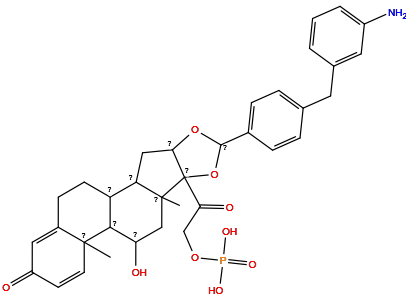
|
|||||
| Formula | C35H40NO9P |
|||||
| Isosmiles | CC12C=CC(=O)C=C1CCC1C2C(O)CC2(C)C1CC1OC(c3ccc(Cc4cccc(N)c4)cc3)OC12C(=O)COP(=O)(O)O |
|||||
| InChI |
InChI=1S/C35H40NO9P/c1-33-13-12-25(37)16-23(33)10-11-26-27-17-30-35(29(39)19-43-46(40,41)42,34(27,2)18-28(38)31(26)33)45-32(44-30)22-8-6-20(7-9-22)14-21-4-3-5-24(36)15-21/h3-9,12-13,15-16,26-28,30-32,38H,10-11,14,17-19,36H2,1-2H3,(H2,40,41,42)
|
|||||
| InChIKey |
HIJXVAAACYBVOP-UHFFFAOYSA-N
|
|||||
| Pharmaceutical Properties | Molecule Weight |
649.677 |
Polar area |
165.61 |
||
Complexity |
46 |
xlogp Value |
4.5794 |
|||
Heavy Count |
46 |
Rot Bonds |
7 |
|||
Hbond acc |
8 |
Hbond Donor |
4 |
|||
Each Antibody-drug Conjugate Related to This Payload
Full Information of The Activity Data of The ADC(s) Related to This Payload
ABBV-154 [Phase 2 (discontinued)]
Identified from the Human Clinical Data
| Experiment 1 Reporting the Activity Date of This ADC | [1] | ||||
| Patients Enrolled |
Eligible participants must have a BMI between 18.0 and 29.9 kg/m2. Key exclusions include use of medications/supplements within 2 weeks (or 5 half-lives), prior exposure to similar biologic therapies, and history of significant medical conditions (e.g., epilepsy, cardiac/respiratory/neurologic disorders, or uncontrolled illnesses).
|
||||
| Related Clinical Trial | |||||
| NCT Number | NCT05556226 | Phase Status | PHASE1 | ||
| Clinical Description |
A Phase 1 Study in Healthy Subjects to Evaluate the Relative Bioavailability of ABBV-154
|
||||
| Primary Endpoint |
This study evaluates the pharmacokinetic profile of the investigational drug over approximately 58 days, measuring key parameters including Cmax, Tmax, terminal elimination rate constant (beta), half-life (t1/2), and AUC values (AUCt and AUC∞). Safety is assessed through adverse event monitoring for approximately 72 days, with investigators determining causality between reported AEs and study treatment.
Click to Show/Hide
|
||||
| Experiment 2 Reporting the Activity Date of This ADC | [2] | ||||
| Patients Enrolled |
Comprehensive efficacy assessments focused on joint count improvements, composite disease activity scores, and patient-reported outcomes to evaluate treatment response, disease control, and functional status in this biologic-refractory RA population.
|
||||
| Related Clinical Trial | |||||
| NCT Number | NCT04888585 | Phase Status | PHASE2 | ||
| Clinical Description |
A Randomized, Double-Blind, Placebo-Controlled Study to Evaluate the Safety and Efficacy of ABBV-154 in Subjects With Moderately to Severely Active Rheumatoid Arthritis With Inadequate Response to Biologic and/or Targeted Synthetic Disease-Modifying Anti-Rheumatic Drugs (b/tsDMARDs)
|
||||
| Primary Endpoint |
The primary endpoint was achieving ACR50 response at Week 12, defined as ≥50% improvement in tender/swollen joint counts and ≥50% improvement in 3 of 5 additional measures including physician/patient global assessments, pain score, HAQ-DI, and hsCRP. Secondary endpoints included changes in DAS28 and CDAI scores, with lower scores indicating improvement, as well as ACR20/70 responses, low disease activity (DAS28 ≤3.2 or CDAI ≤10), clinical remission (DAS28 <2.6 or CDAI ≤2.8), and HAQ-DI improvement from baseline.
Click to Show/Hide
|
||||
| Other Endpoint |
Key inclusion criteria required confirmed RA diagnosis per 2010 ACR/EULAR criteria with ≥6 swollen/tender joints at baseline, inadequate response to prior biologics/tsDMARDs, and stable MTX dose. Exclusion criteria included prior discontinuation of adalimumab due to intolerance/toxicity.
|
||||
| Experiment 3 Reporting the Activity Date of This ADC | [3] | ||||
| Patients Enrolled |
The study evaluated disease stability under glucocorticoid tapering by measuring flare events, steroid exposure reduction, and sustained remission in this recurrent PMR population.
|
||||
| Related Clinical Trial | |||||
| NCT Number | NCT04972968 | Phase Status | PHASE2 | ||
| Clinical Description |
A Phase 2, Randomized, Double-Blind, Placebo-Controlled, Dose-Ranging Study to Evaluate the Safety and Efficacy of ABBV-154 in Subjects With Polymyalgia Rheumatica (PMR) Dependent on Glucocorticoid Treatment
|
||||
| Primary Endpoint |
The primary endpoint was time to PMR flare (requiring glucocorticoid dose increase) from first dose through Week 52. Secondary endpoints included flare-free status rates, cumulative glucocorticoid dose, and dose changes from baseline by Week 24.
|
||||
| Other Endpoint |
Eligible participants required confirmed PMR diagnosis per 2012 EULAR/ACR criteria with ≥2 prior flares, stable prednisone use, and willingness to follow protocol tapering. Key exclusions included prior TNF antagonist treatment or concurrent immunomodulators beyond prednisone/hydroxychloroquine.
|
||||
| Experiment 4 Reporting the Activity Date of This ADC | [4] | ||||
| Patients Enrolled |
The study aimed to demonstrate mucosal healing and sustained clinical remission in moderate-to-severe CD patients refractory to multiple biologics, using comprehensive endoscopic and symptom-based assessments.
|
||||
| Related Clinical Trial | |||||
| NCT Number | NCT05068284 | Phase Status | PHASE2 | ||
| Clinical Description |
A Randomized, Double-Blind, Placebo-Controlled Study to Evaluate the Safety and Efficacy of ABBV-154 in Subjects With Moderately to Severely Active Crohn's Disease (CD): AIM-CD
|
||||
| Primary Endpoint |
The primary endpoint was endoscopic response (SES-CD reduction >50% or ≥2-point decrease in isolated ileal disease) at Week 12. Secondary endoscopic and clinical endpoints included SES-CD response at Week 40 and clinical remission (CDAI <150 or stool frequency/abdominal pain criteria) at Weeks 12 and 40.
|
||||
| Other Endpoint |
Eligible participants required confirmed CD diagnosis ≥3 months, CDAI 220-450, and SES-CD ≥6 (≥4 for isolated ileal disease), with prior biologic failure/intolerance. Key exclusion was prior adalimumab intolerance.
|
||||
| Experiment 5 Reporting the Activity Date of This ADC | [6] | ||||
| Related Clinical Trial | |||||
| NCT Number | NCT04888585 | Phase Status | Phase 2 | ||
| Clinical Description |
A randomized, double-blind, placebo-controlled study to evaluate the safety and efficacy of ABBV-154 in subjects with moderately to severely active rheumatoid arthritis with inadequate response to biologic and/or targeted synthetic disease-modifying anti-rheumatic drugs (b/tsdmards).
|
||||
| Experiment 6 Reporting the Activity Date of This ADC | [7] | ||||
| Related Clinical Trial | |||||
| NCT Number | NCT04972968 | Phase Status | Phase 2 | ||
| Clinical Description |
A phase 2, randomized, double-blind, placebo-controlled, dose-ranging study to evaluate the safety and efficacy of ABBV-154 in subjects with polymyalgia rheumatica (PMR) dependent on glucocorticoid treatment.
|
||||
| Experiment 7 Reporting the Activity Date of This ADC | [8] | ||||
| Related Clinical Trial | |||||
| NCT Number | NCT05068284 | Phase Status | Phase 2 | ||
| Clinical Description |
A randomized, double-blind, placebo-controlled study to evaluate the safety and efficacy of ABBV-154 in subjects with moderately to severely active crohn's disease (CD): aim-cd.
|
||||
| Experiment 8 Reporting the Activity Date of This ADC | [11] | ||||
| Related Clinical Trial | |||||
| NCT Number | NCT05556226 | Phase Status | Phase 1 | ||
| Clinical Description |
A phase 1 study in healthy subjects to evaluate the relative bioavailability of ABBV-154.
|
||||
ABBV-3373 [Phase 2 (discontinued)]
Identified from the Human Clinical Data
| Experiment 1 Reporting the Activity Date of This ADC | [5] | ||||
| Patients Enrolled |
Inclusion criteria require confirmed RA (1987 ACR/2010 EULAR criteria) lasting >3 months, with ≥4 swollen/tender joints (28-count), DAS28-CRP ≥3.2, and inadequate MTX response (stable dose 15-25mg/week [≥10mg/week if intolerant] for ≥4 weeks). Exclusions include prior anti-TNF use (e.g., adalimumab) or non-anti-TNF biologics/tsDMARDs (unless used <3 months without efficacy/intolerability issues).
Click to Show/Hide
|
||||
| Administration Dosage |
Participants will be administered with 100 mg ABBV-3373 by intravenous infusion and placebo to adalimumab by subcutaneous injection every other week for 12 weeks. After 12 weeks, participants will receive placebo to adalimumab every other week until Week 22.
|
||||
| Related Clinical Trial | |||||
| NCT Number | NCT03823391 | Phase Status | PHASE2 | ||
| Clinical Description |
A Randomized, Double-Blind, Double-Dummy, Active Controlled Study to Evaluate the Safety, Tolerability, Pharmacokinetics, and Efficacy of ABBV-3373 in Subjects With Moderate to Severe Rheumatoid Arthritis
|
||||
| Primary Endpoint |
The primary endpoint is the change from baseline to Week 12 in Disease Activity Score 28 (DAS28-CRP), a composite index evaluating tender/swollen joint counts (28 joints), patient global assessment (VAS 0-100mm), and hsCRP (mg/L). Scores range from 0.96-10 (higher=worse activity); negative change indicates improvement.
|
||||
| Other Endpoint |
Secondary endpoints include Week 12 changes in CDAI (sum of tender/swollen joints + patient/physician global assessments [VAS 0-10cm]; score 0-76), SDAI (CDAI+CRP; score 0-86), and DAS28-ESR (similar to DAS28-CRP but using ESR). Negative changes denote improvement. Additional measures: proportion achieving DAS28-CRP ≤3.2 (low disease activity) and American College of Rheumatology 50% (ACR50) response (≥50% improvement in joint counts + ≥3 of 5 key parameters).
Click to Show/Hide
|
||||
| Experiment 2 Reporting the Activity Date of This ADC | [9] | ||||
| Related Clinical Trial | |||||
| NCT Number | NCT03823391 | Phase Status | Phase 2 | ||
| Clinical Description |
A randomized, double-blind, double-dummy, active controlled study to evaluate the safety, tolerability, pharmacokinetics, and efficacy of ABBV-3373 in subjects with moderate to severe rheumatoid arthritis.
|
||||
| Experiment 3 Reporting the Activity Date of This ADC | [10] | ||||
| Patients Enrolled |
RA (based on the 1987 American College of Rheumatology [ACR] classification criteria or 2010 ACR/EULAR criteria [16, 17]), with disease duration >3 months, and active disease defined as a Disease Activity Score in 28 joints using C-reactive protein (DAS28-CRP) (18) of 3.2 and 4 of 28 swollen joints and 4 of 28 tender joints.
|
||||
| Administration Dosage |
Intravenously (IV) ABBV-3373 100 mg every other week for 12 weeks, followed by placebo for 12 weeks, or subcutaneous adalimumab 80 mg every other week for 24 weeks.
|
||||
| Related Clinical Trial | |||||
| NCT Number | NCT03823391 | Phase Status | Phase 2 | ||
| Clinical Description |
A randomized, double-blind, double-dummy, active controlled study to evaluate the safety, tolerability, pharmacokinetics, and efficacy of ABBV-3373 in subjects with moderate to severe rheumatoid arthritis.
|
||||
| Primary Endpoint |
48 patients were randomized to ABBV-3373 (n=31) or adalimumab (n=17). At week 12, ABBV-3373 reduced DAS28 (CRP) versus historical adalimumab (2.65 versus 2.13; P=0.022) and combined in-trial/historical adalimumab (2.65 versus 2.29; probability=89.9%), with numerically greater improvement than in-trial adalimumab (2.51).
|
||||
| Other Endpoint |
For secondary endpoints, greater efficacy was observed with ABBV-3373 versus historical adalimumab; ABBV-3373 was predicted with 79.30-99.50% probability to be better than adalimumab based on combined in-trial/historical adalimumab data.
|
||||
Obtained from the Model Organism Data
| Experiment 1 Reporting the Activity Date of This ADC | [12] | ||||
| Efficacy Data | Paw swelling AUC |
81%
|
Positive TNF expression (TNF+++/++) | ||
| Method Description |
To evaluate the impact of the anti-mTNF GRM ADCs on inflammation in a chronic inflammatory setting,we progressed several ADCs into a mouse collagen-induced arthritis (mCIA) model. A single 3 mg/kg dose of the ADC was given at the first clinical signs of disease,a time point of intervention where anti-TNF treatment has a moderate impact.
|
||||
| In Vivo Model | Collagen-induced arthritis (mCIA) model | ||||
| Experiment 2 Reporting the Activity Date of This ADC | [12] | ||||
| Efficacy Data | Paw swelling AUC |
98%
|
Positive TNF expression (TNF+++/++) | ||
| Method Description |
To evaluate the impact of the anti-mTNF GRM ADCs on inflammation in a chronic inflammatory setting,we progressed several ADCs into a mouse collagen-induced arthritis (mCIA) model. A single 10 mg/kg dose of the ADC was given at the first clinical signs of disease,a time point of intervention where anti-TNF treatment has a moderate impact.
|
||||
| In Vivo Model | Collagen-induced arthritis (mCIA) model | ||||
| Experiment 3 Reporting the Activity Date of This ADC | [12] | ||||
| Efficacy Data | P1NP inhibition |
0%
|
Positive TNF expression (TNF+++/++) | ||
| Method Description |
In an acute in vivo model of contact hypersensitivity (CHS) mice were sensitized with fluorescein isothiocyanate (FITC) on the abdomen and challenged 6 days later with FITC on the ear,which resulted in an increase in ear swelling that was measured 24 h postchallenge. Anti-mTNF GRM ADCs were dosed at either 3 mg/kg once prior to FITC sensitization. Mice were challenged with adrenocorticotropic hormone (ACTH) 72 h following ADC dosing and plasma was collected 30 min later to assess P1NP level.
Click to Show/Hide
|
||||
| In Vivo Model | Acute contact hypersensitivity (CHS) model | ||||
| Experiment 4 Reporting the Activity Date of This ADC | [12] | ||||
| Efficacy Data | P1NP inhibition |
19%
|
Positive TNF expression (TNF+++/++) | ||
| Method Description |
In an acute in vivo model of contact hypersensitivity (CHS) mice were sensitized with fluorescein isothiocyanate (FITC) on the abdomen and challenged 6 days later with FITC on the ear,which resulted in an increase in ear swelling that was measured 24 h postchallenge. Anti-mTNF GRM ADCs were dosed at either 10 mg/kg once prior to FITC sensitization. Mice were challenged with adrenocorticotropic hormone (ACTH) 72 h following ADC dosing and plasma was collected 30 min later to assess P1NP level.
Click to Show/Hide
|
||||
| In Vivo Model | Acute contact hypersensitivity (CHS) model | ||||
| Experiment 5 Reporting the Activity Date of This ADC | [12] | ||||
| Efficacy Data | Ear swelling inhibition |
55%
|
Positive TNF expression (TNF+++/++) | ||
| Method Description |
In an acute in vivo model of contact hypersensitivity (CHS) mice were sensitized with fluorescein isothiocyanate (FITC) on the abdomen and challenged 6 days later with FITC on the ear,which resulted in an increase in ear swelling that was measured 24 h postchallenge. Anti-mTNF GRM ADCs were dosed at either 3 mg/kg once prior to FITC sensitization.
|
||||
| In Vivo Model | Fluorescein isothiocyanate (FITC)-induced CHS model | ||||
| Experiment 6 Reporting the Activity Date of This ADC | [12] | ||||
| Efficacy Data | Ear swelling inhibition |
88%
|
Positive TNF expression (TNF+++/++) | ||
| Method Description |
In an acute in vivo model of contact hypersensitivity (CHS) mice were sensitized with fluorescein isothiocyanate (FITC) on the abdomen and challenged 6 days later with FITC on the ear,which resulted in an increase in ear swelling that was measured 24 h postchallenge. Anti-mTNF GRM ADCs were dosed at either 10 mg/kg once prior to FITC sensitization.
|
||||
| In Vivo Model | Fluorescein isothiocyanate (FITC)-induced CHS model | ||||
| Experiment 7 Reporting the Activity Date of This ADC | [12] | ||||
| Efficacy Data | Corticosterone inhibition |
6%
|
Positive TNF expression (TNF+++/++) | ||
| Method Description |
In an acute in vivo model of contact hypersensitivity (CHS) mice were sensitized with fluorescein isothiocyanate (FITC) on the abdomen and challenged 6 days later with FITC on the ear,which resulted in an increase in ear swelling that was measured 24 h postchallenge. Anti-mTNF GRM ADCs were dosed at either 3 mg/kg once prior to FITC sensitization. Mice were challenged with adrenocorticotropic hormone (ACTH) 72 h following ADC dosing and plasma was collected 30 min later to assess corticosterone level.
Click to Show/Hide
|
||||
| In Vivo Model | Acute contact hypersensitivity (CHS) model | ||||
| Experiment 8 Reporting the Activity Date of This ADC | [12] | ||||
| Efficacy Data | Corticosterone inhibition |
15%
|
Positive TNF expression (TNF+++/++) | ||
| Method Description |
In an acute in vivo model of contact hypersensitivity (CHS) mice were sensitized with fluorescein isothiocyanate (FITC) on the abdomen and challenged 6 days later with FITC on the ear,which resulted in an increase in ear swelling that was measured 24 h postchallenge. Anti-mTNF GRM ADCs were dosed at either 10 mg/kg once prior to FITC sensitization. Mice were challenged with adrenocorticotropic hormone (ACTH) 72 h following ADC dosing and plasma was collected 30 min later to assess corticosterone level.
Click to Show/Hide
|
||||
| In Vivo Model | Acute contact hypersensitivity (CHS) model | ||||
Revealed Based on the Cell Line Data
| Experiment 1 Reporting the Activity Date of This ADC | [12] | ||||
| Efficacy Data | Half Maximal Effective Concentration (EC50) |
0.08 ug/mL
|
Positive TNF expression (TNF+++/++) | ||
| Method Description |
All the DAR purified ADCs were screened in both the TNF-expressing and wild-type K562 GRE reporter cell assay to confirm that their activity was consistent with ADCs having heterogeneous average DAR.
|
||||
| In Vitro Model | Chronic myelogenous leukemia | K-562 cells (TNF expression) | CVCL_0004 | ||
| Experiment 2 Reporting the Activity Date of This ADC | [12] | ||||
| Efficacy Data | Half Maximal Effective Concentration (EC50) |
5.8 ug/mL
|
Negative TNF expression (TNF-) | ||
| Method Description |
All the DAR purified ADCs were screened in both the TNF-expressing and wild-type K562 GRE reporter cell assay to confirm that their activity was consistent with ADCs having heterogeneous average DAR.
|
||||
| In Vitro Model | Chronic myelogenous leukemia | K-562 cells | CVCL_0004 | ||
ABBV-319 [Phase 1]
Identified from the Human Clinical Data
| Experiment 1 Reporting the Activity Date of This ADC | [13] | ||||
| Patients Enrolled |
Eligible participants include B-cell malignancy patients (WHO-confirmed, measurable disease) with lab values meeting protocol criteria; prior CD19-targeting therapy requires post-treatment biopsy. Exclusions: active CNS disease/lymphoma, uncontrolled infections, or ECOG ≥2.
|
||||
| Related Clinical Trial | |||||
| NCT Number | NCT05512390 | Phase Status | PHASE1 | ||
| Clinical Description |
A First In Human Multicenter, Open-Label Study to Determine the Safety, Tolerability, Pharmacokinetics, and Preliminary Efficacy of ABBV-319 in B-cell Malignancies
|
||||
| Primary Endpoint |
The study evaluates ABBV-319 safety through DLT assessment (within 42 days) and tracks AEs (≤30 months). PK parameters (Cmax, Tmax, t½, AUC) and ADA incidence are monitored for ≤6 months to assess drug exposure and immunogenicity.
|
||||
| Other Endpoint |
Efficacy endpoints measure PR or better (≤6 months), DOR, and time to response (CR/PR). PFS (≤30 months) tracks progression from first treatment, while OS records time to death from any cause.
|
||||
References