
Payload Information
General Information of This Payload (ID: PAY0DGDJZ)
| Name |
2-DDDX-d
|
|||||
|---|---|---|---|---|---|---|
| Synonyms |
2-DDDX-d
Click to Show/Hide
|
|||||
| Target | DNA topoisomerase 1 (TOP1) | |||||
| Structure |
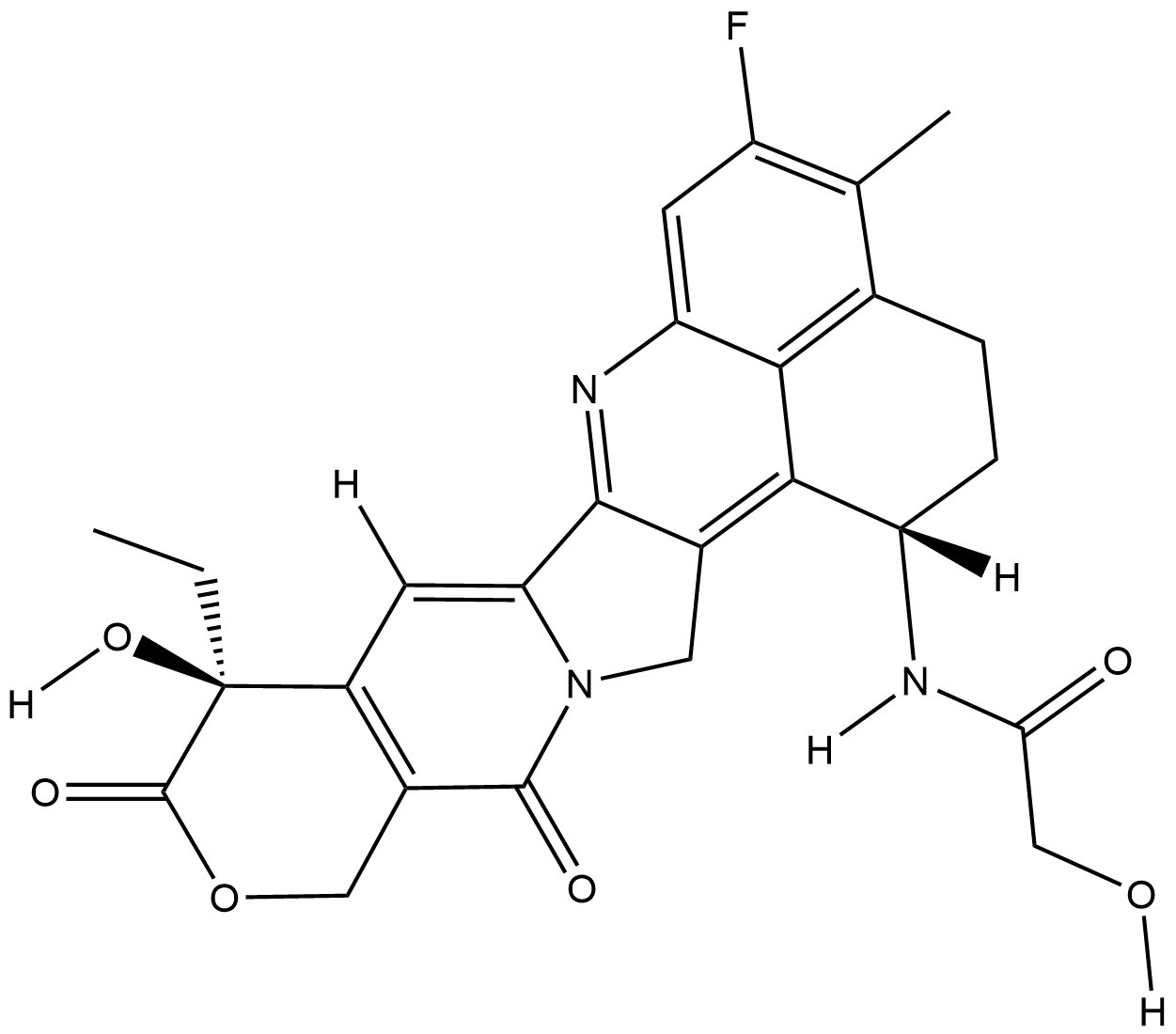
|
|||||
| Formula | C26H24FN3O6 |
|||||
| Isosmiles | FC1=C(C([H])([H])[H])C2=C3C([C@@](C([H])([H])C2([H])[H])([H])N([H])C(C([2H])([2H])O[H])=O)=C(C4=NC3=C1[H])C([H])([H])N5C4=C([H])C([C@]6(C([H])([H])C([H])([H])[H])O[H])=C(C([H])([H])OC6=O)C5=O |
|||||
| PubChem CID | ||||||
| InChI |
InChI=1S/C26H24FN3O6/c1-3-26(35)15-6-19-23-13(8-30(19)24(33)14(15)10-36-25(26)34)22-17(28-20(32)9-31)5-4-12-11(2)16(27)7-18(29-23)21(12)22/h6-7,17,31,35H,3-5,8-10H2,1-2H3,(H,28,32)/t17-,26-/m0/s1/i9D2
|
|||||
| InChIKey |
PLXLYXLUCNZSAA-SEPCXYQLSA-N
|
|||||
| Pharmaceutical Properties | Molecule Weight |
495.503204 |
Polar area |
130.75 |
||
Complexity |
2436.074238 |
xlogp Value |
1.62292 |
|||
Heavy Count |
36 |
Rot Bonds |
7 |
|||
Hbond acc |
8 |
Hbond Donor |
3 |
|||
Each Antibody-drug Conjugate Related to This Payload
Full Information of The Activity Data of The ADC(s) Related to This Payload
TQB2102 [Phase 3]
Identified from the Human Clinical Data
| Experiment 1 Reporting the Activity Date of This ADC | [1] | ||||
| Patients Enrolled |
Eligible participants are HER2+ recurrent/metastatic breast cancer patients (18-75 years, ECOG 0-1) with measurable disease (RECIST 1.1), adequate organ function, and progression after prior therapy. Reproductive-age subjects require contraception for 6 months post-study.
|
||||
| Administration Dosage |
Dose: 6.0 mg/kg or 7.5 mg/kg of TQB2102 for injection. Administration: Intravenous infusion, administered every 3 weeks, 21 days as a treatment cycle.
|
||||
| Related Clinical Trial | |||||
| NCT Number | NCT06115902 | Phase Status | PHASE1 | ||
| Clinical Description |
A Phase 1 Clinical Trial of TQB2102 for Injection in Patients With Human Epidermal Growth Factor Receptor 2 (HER2) -Expressing Relapsed/Metastatic Breast Cancer
|
||||
| Primary Endpoint |
Primary efficacy endpoint is ORR (CR+PR rate) assessed over 10 months, with safety monitoring including AE incidence/severity tracked from consent through 28 days post-treatment or new therapy initiation.
|
||||
| Other Endpoint |
Secondary outcomes include survival metrics (PFS up to 14 months, OS up to 20 months), disease activity measures (DOR/DCR/CBR), and PK/immunogenicity profiles (TQB2102 concentration, ADA development) evaluated through serial sampling across treatment cycles (21-day intervals).
|
||||
| Experiment 2 Reporting the Activity Date of This ADC | [2] | ||||
| Patients Enrolled |
Eligible participants are treatment-naïve HER2+ invasive breast cancer patients (T0-4/N0-3/M0) with ECOG 0-1, adequate organ function, and surgical eligibility post-neoadjuvant therapy. Reproductive-age subjects require contraception for 6 months post-study, confirmed by pregnancy testing.
|
||||
| Administration Dosage |
TQB2102 for injection is a HER2 dual-antibody-drug Conjugate (ADC), 6.0 mg/kg or 7.0 mg/kg.
|
||||
| Related Clinical Trial | |||||
| NCT Number | NCT06198751 | Phase Status | PHASE2 | ||
| Clinical Description |
A Phase 2, Randomized, Open-label, Multicenter Study to Evaluate the Efficacy and Safety of TQB2102 for Injection for Neoadjuvant Treatment of Breast Cancer With Positive HER2 Expression
|
||||
| Primary Endpoint |
Primary endpoints include pathological response rates (tpCR and bpCR) assessed within 12 months, evaluating complete tumor disappearance in breast tissue and lymph nodes, alongside comprehensive AE monitoring (incidence/severity per NCI CTCAE v5.0) from consent through 28 days post-treatment.
|
||||
| Other Endpoint |
Secondary outcomes measure efficacy via ORR (12 months), long-term survival (EFS/IDFS up to 60 months tracking recurrence and mortality), and immunogenicity (ADA incidence) through multi-cycle testing (21-day intervals) until 90 days post-treatment
|
||||
| Experiment 3 Reporting the Activity Date of This ADC | [3] | ||||
| Patients Enrolled |
Eligible participants are HER2-negative recurrent/metastatic breast cancer patients (18-75 years, ECOG ≤1) with progression after ≥1 line of chemotherapy (or CDK4/6 inhibitors for HR+ cases), measurable lesions (RECIST 1.1), and available tumor samples. Reproductive-age subjects require contraception for 6 months post-study with confirmed negative pregnancy testing.
Click to Show/Hide
|
||||
| Administration Dosage |
7.5mg/kg TQB2102, intravenous infusion, administered every 3 weeks, 21 days as a treatment cycle.
|
||||
| Related Clinical Trial | |||||
| NCT Number | NCT06452706 | Phase Status | PHASE2 | ||
| Clinical Description |
The Phase II Clinical Trial to Evaluate the Efficacy and Safety of TQB2102 for Injection in Human Epidermal Growth Factor Receptor 2 (HER2) Negative Recurrent/Metastatic Breast Cancer
|
||||
| Primary Endpoint |
Primary efficacy endpoint is ORR (CR+PR rate per RECIST 1.1) assessed over 24 months, with comprehensive safety monitoring including AE incidence tracked for 36 months and ADA development evaluated through multi-cycle testing (21-day intervals) until 30 days post-treatment.
|
||||
| Other Endpoint |
Secondary outcomes include survival metrics (PFS up to 36 months, OS up to 48 months), disease activity measures (duration of remission/DCR/CBR), and biomarker analyses (HER2 expression correlation, ctDNA dynamics) all evaluated within 24 months.
|
||||
| Experiment 4 Reporting the Activity Date of This ADC | [4] | ||||
| Patients Enrolled |
Eligible participants are treatment-compliant adults (18-75 years, ECOG 0-1) with confirmed unresectable HER2-low breast cancer (HR status documented), radiologically proven progression, ≥1 measurable lesion (RECIST 1.1), and adequate organ function.
|
||||
| Administration Dosage |
Administered by intravenous drip, 7.5 mg/kg per dose, 21 days as a treatment cycle.
|
||||
| Related Clinical Trial | |||||
| NCT Number | NCT06561607 | Phase Status | PHASE3 | ||
| Clinical Description |
A Randomized, Open, Parallel-Controlled Phase III Clinical Trial Evaluating the Efficacy and Safety of TQB2102 for Injection Versus Investigator-Selected Chemotherapy in HER2 Low-Expressing Recurrent/Metastatic Breast Cancer
|
||||
| Primary Endpoint |
The primary endpoint is IRC-assessed PFS (up to 25 months) comparing TQB2102 versus chemotherapy in both HR+/HER2-low and overall HER2-low recurrent/metastatic breast cancer populations.
|
||||
| Other Endpoint |
Secondary endpoints include investigator-assessed efficacy measures (PFS/OS/ORR/DOR/CBR) within 25 months, safety monitoring (AE/SAE incidence, lab abnormalities) for 52 months, PK analysis of TQB2102 components during treatment cycles, and ADA immunogenicity assessment at specified intervals.
|
||||
| Experiment 5 Reporting the Activity Date of This ADC | [5] | ||||
| Patients Enrolled |
Eligible patients (18-75 years, ECOG 0-1) must have signed consent, locally advanced HER2+ solid tumors refractory to standard therapy, ≥1 measurable lesion (RECIST 1.1), adequate organ function, and commitment to contraception for 6 months post-treatment.
|
||||
| Administration Dosage |
intravenous infuse TQB2102 injection every three weeks, 21 days as a treatment cycle. (1.5mg/kg, 3mg/kg, 4.5mg/kg, 6mg/kg, 7.5mg/kg, 9mg/kg)
|
||||
| Related Clinical Trial | |||||
| NCT Number | NCT05735496 | Phase Status | PHASE1 | ||
| Clinical Description |
A Phase I Study of TQB2102 Injection in Patients With Advanced Cancers
|
||||
| Primary Endpoint |
Primary endpoints include DLT assessment during first 21-day cycle to determine MTD, with comprehensive AE monitoring (incidence/severity per NCI CTCAE v5.0) from first dose until 28 days post-treatment or new therapy initiation.
|
||||
| Other Endpoint |
Secondary outcomes comprise immunogenicity (ADA incidence across treatment cycles), PK parameters (AUC/Cmax/T1/2 for ADC components), and efficacy measures (ORR/DCR/DOR/PFS/OS) evaluated over 2 years per RECIST v1.1 criteria.
|
||||
| Experiment 6 Reporting the Activity Date of This ADC | [6] | ||||
| Patients Enrolled |
Eligible subjects (18-75 years, ECOG 0-1) must have histologically confirmed unresectable/metastatic biliary cancer with ≥1 measurable lesion (RECIST 1.1), adequate organ function, failed prior therapy, and reproductive-age patients must use contraception for 6 months post-study.
|
||||
| Administration Dosage |
Intravenous infusion, administered every 3 weeks, 21 days as a treatment cycle, 6/8 cycles.
|
||||
| Related Clinical Trial | |||||
| NCT Number | NCT06431490 | Phase Status | PHASE1|||PHASE2 | ||
| Clinical Description |
A Study to Evaluate the Efficacy, Safety, and Immunogenicity of TQB2102 for Injection in the Treatment of HER2-positive Locally Advanced or Metastatic Biliary Tract Cancer
|
||||
| Primary Endpoint |
Primary endpoints include AE/SAE incidence and severity monitoring from informed consent until 28 days post-treatment, along with RP2D determination within 24 weeks.
|
||||
| Other Endpoint |
Secondary efficacy measures (ORR/PFS/DCR/DOR/OS) will be investigator-assessed per RECIST 1.1 over 36 weeks in HER2-positive (IHC 3+ or 2+/ISH+) advanced biliary tract cancer patients.
|
||||
| Experiment 7 Reporting the Activity Date of This ADC | [7] | ||||
| Patients Enrolled |
Eligible patients (18-75 years, ECOG 0-1) must have confirmed HER2+ (IHC 3+ or 2+/ISH+) unresectable/metastatic gastroesophageal adenocarcinoma, ≥1 measurable lesion (RECIST 1.1), adequate organ function, and no prior systemic therapy for metastatic disease (except adjuvant/neoadjuvant completed ≥6 months prior). PD-L1 testing capability and contraception use for 6 months post-treatment are required.
Click to Show/Hide
|
||||
| Administration Dosage |
TQB2102 for injection in combination with benmelstobart every three weeks for a cycle of 21 days
|
||||
| Related Clinical Trial | |||||
| NCT Number | NCT06767800 | Phase Status | PHASE2 | ||
| Clinical Description |
Phase II Clinical Trial Evaluating the Efficacy and Safety of TQB2102 for Injection in Chemotherapy With Behmosubstituted Monoclonalb/Pembrolizumab ± Capecitabine in Patients With Unresectable, Locally Advanced, Recurrent, or Metastatic HER2-Positive Gastroesophageal Adenocarcinoma
|
||||
| Primary Endpoint |
The primary endpoint is ORR (CR+PR) assessed by both RECIST v1.1 and iRECIST criteria over an average 1-year study period in HER2-positive gastroesophageal adenocarcinoma patients.
|
||||
| Other Endpoint |
Secondary endpoints include PFS (average 3 years), DOR (average 1 year), OS (average 3 years), and AE/SAE incidence (CTCAE v5.0) monitored until 28 days post-treatment.
|
||||
| Experiment 8 Reporting the Activity Date of This ADC | [8] | ||||
| Patients Enrolled |
Eligible subjects are female (≥18 years, ECOG 0-1) with histologically confirmed recurrent/metastatic gynecologic tumors (excluding IHC 0), ≥1 measurable lesion (RECIST 1.1), and premenopausal women must use high-efficacy contraception (failure rate <1%/year) with negative pregnancy testing at screening.
|
||||
| Administration Dosage |
Intravenous infusion, administered every 3 weeks, 21 days as a treatment cycle
|
||||
| Related Clinical Trial | |||||
| NCT Number | NCT06798207 | Phase Status | PHASE2 | ||
| Clinical Description |
A Phase 2 Clinical Trial of TQB2102 for Injection in the Treatment of Patients With Recurrent/Metastatic Advanced Gynecological Tumors to Evaluate the Safety and Efficacy
|
||||
| Primary Endpoint |
The primary endpoint is ORR (CR+PR rate) evaluated over 12 months in patients with HER2-expressing (IHC 1+/2+/3+) advanced gynecologic tumors who failed prior platinum-based chemotherapy.
|
||||
| Other Endpoint |
Secondary endpoints include DOR/PFS/DCR (12-month assessment), OS (17-month follow-up), AE frequency/severity monitoring from consent to 28 days post-treatment, and ADA incidence at specified treatment cycles (21-day intervals).
|
||||
| Experiment 9 Reporting the Activity Date of This ADC | [9] | ||||
| Patients Enrolled |
Eligible subjects must have histologically confirmed unresectable NSCLC, failed prior therapy, life expectancy ≥3 months, and reproductive-age patients require contraception for 6 months post-study with negative pregnancy testing at screening.
|
||||
| Administration Dosage |
TQB2102 for injection, intravenous infusion, administered every 3 weeks, 21 days as a treatment cycle; Benmelstobart injection, intravenous infusion, administered every 3 weeks, 21 days as a treatment cycle.
|
||||
| Related Clinical Trial | |||||
| NCT Number | NCT06496490 | Phase Status | PHASE2 | ||
| Clinical Description |
A Phase 2 Clinical Trial of TQB2102 for Injection in Locally Advanced or Metastatic Non-small Cell Lung Cancer With HER2 Gene Abnormality to Evaluate the Efficacy and Safety
|
||||
| Primary Endpoint |
Primary endpoint is ORR (CR+PR rate) assessed over 8 months in treatment-refractory NSCLC patients (18-75 years, ECOG 0-1) with measurable lesions (RECIST 1.1).
|
||||
| Other Endpoint |
Secondary outcomes include DOR/PFS (8-month assessment), OS (18-month follow-up), AE frequency/severity monitoring until 28 days post-treatment, and ADA incidence at treatment cycles (C1D1-C12D1) plus 90-day follow-up.
|
||||
| Experiment 10 Reporting the Activity Date of This ADC | [10] | ||||
| Related Clinical Trial | |||||
| NCT Number | NCT05735496 | Phase Status | Phase 1 | ||
| Clinical Description |
A phase 1 study of TQB2102 injection in patients with advanced cancers.
|
||||
TQB2103 [Phase 1]
Identified from the Human Clinical Data
| Experiment 1 Reporting the Activity Date of This ADC | [11] | ||||
| Patients Enrolled |
Eligible patients were aged 18-75 with advanced solid tumors, ECOG PS 0-1, and adequate organ function. Prior Claudin18.2-targeted therapy excluded, while Claudin18.2 testing was preferred. Exclusion criteria included major comorbidities, uncontrolled effusions, recent anticancer therapy, active CNS metastases, hypersensitivity to monoclonal antibodies, or conditions deemed unsafe by investigators.
Click to Show/Hide
|
||||
| Administration Dosage |
Dose escalation:intravenous infusion of TQB2103 for injection once every three weeks, 21 days as one treatment cycle. (0.5 mg/kg, 1.0 mg/kg, 2.0 mg/kg, 3.0 mg/kg, 4.0 mg/kg, 5.0mg/kg)Dose expansion:Chose one or two appropriate dose groups in the dose escalation experiment to expand.
|
||||
| Related Clinical Trial | |||||
| NCT Number | NCT05867563 | Phase Status | PHASE1 | ||
| Clinical Description |
A Phase I Clinical Trial Evaluating Tolerance, Safety, Pharmacokinetics, and Initial Effectiveness of TQB2103 for Injection in Patients With Advanced Cancers.
|
||||
| Primary Endpoint |
The study evaluated dose-limiting toxicity (DLT), maximum tolerated dose (MTD), and recommended Phase II dose (RP2D) during the first 21-day treatment cycle. DLT was defined as toxicities meeting NCI CTCAE v5.0 criteria, MTD as the highest dose with <33% DLT incidence, and RP2D was determined based on toxicity, pharmacokinetics, pharmacodynamics, and efficacy data.
Click to Show/Hide
|
||||
| Other Endpoint |
Key pharmacokinetic parameters included AUC, Cmax, T1/2, CL/F, and Vss/F, measured at specific timepoints over multiple 21-day cycles. Immunogenicity assessed anti-drug antibodies (ADA). Clinical outcomes included ORR, DCR, DOR, PFS, OS, and adverse event rates over up to 2 years, with response criteria per RECIST v1.1 and safety per CTCAE 5.0.
|
||||
References