
Payload Information
General Information of This Payload
| Payload ID | PAY0BBRSF |
|||||
|---|---|---|---|---|---|---|
| Name |
KL610023
|
|||||
| Synonyms |
KL610023
Click to Show/Hide
|
|||||
| Target | DNA topoisomerase 1 (TOP1) | |||||
| Structure |
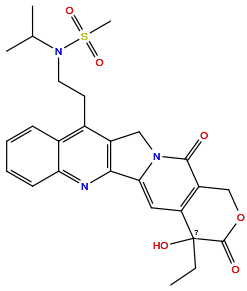
|
|||||
| Formula | C26H29N3O6S |
|||||
| Isosmiles | CCC1(O)C(=O)OCc2c1cc1n(c2=O)Cc2c-1nc1ccccc1c2CCN(C(C)C)S(C)(=O)=O |
|||||
| InChI |
InChI=1S/C26H29N3O6S/c1-5-26(32)20-12-22-23-18(13-28(22)24(30)19(20)14-35-25(26)31)16(17-8-6-7-9-21(17)27-23)10-11-29(15(2)3)36(4,33)34/h6-9,12,15,32H,5,10-11,13-14H2,1-4H3
|
|||||
| InChIKey |
PGWIUEMZGPWFBB-UHFFFAOYSA-N
|
|||||
| Pharmaceutical Properties | Molecule Weight |
511.6 |
Polar area |
118.8 |
||
Complexity |
36 |
xlogp Value |
2.2921 |
|||
Heavy Count |
36 |
Rot Bonds |
6 |
|||
Hbond acc |
8 |
Hbond Donor |
1 |
|||
The activity data of This Payload
| Standard Type | Value | Units | Cell line | Disease Model | Cell line ID | Reference |
|---|---|---|---|---|---|---|
| Half Maximal Inhibitory Concentration (IC50) | 1.36 | nM |
Calu-3 cells
|
Lung adenocarcinoma
|
[1] | |
| Half Maximal Inhibitory Concentration (IC50) | 1.505 | nM |
HCC1806 cells
|
Breast squamous cell carcinoma
|
[1] | |
| Half Maximal Inhibitory Concentration (IC50) | 2.007 | nM |
NCI-N87 cells
|
Gastric tubular adenocarcinoma
|
[1] | |
| Half Maximal Inhibitory Concentration (IC50) | 4.773 | nM |
NCI-H23 cells
|
Lung adenocarcinoma
|
[1] | |
| Half Maximal Inhibitory Concentration (IC50) | 5.996 | nM |
BxPC-3 cells
|
Pancreatic ductal adenocarcinoma
|
[1] |
Each Antibody-drug Conjugate Related to This Payload
Full Information of The Activity Data of The ADC(s) Related to This Payload
Sacituzumab tirumotecan [Apprpved in 2024]
Identified from the Human Clinical Data
| Experiment 1 Reporting the Activity Date of This ADC | [2] | ||||
| Patients Enrolled |
Adults (18-75) with histologically confirmed metastatic/locally advanced TNBC (HER2 IHC 0/1+ or FISH-negative; ER/PR <1%)
|
||||
| Administration Dosage |
5 mg/kg, IV (in the vein) on day 1 and Day 15 of each 28 day cycle.
|
||||
| Related Clinical Trial | |||||
| NCT Number | NCT05347134 | Phase Status | PHASE3 | ||
| Clinical Description |
A Randomized, Controlled, Open-label, Multi-center Phase III Clinical Trial of SKB264 for Injection Versus Investigator Selected Regimens in Patients with Unresectable Locally Advanced, Recurrent or Metastatic Triple-negative Breast Cancer Who Have Failed Second-line or Above Prior Standard of Care
|
||||
| Primary Endpoint |
Primary endpoint is progression-free survival (PFS) assessed by Independent Review Committee per RECIST 1.1 [Time Frame: up to 24 months].
|
||||
| Other Endpoint |
Secondary endpoints include investigator-assessed PFS, objective response rate (ORR), disease control rate (DCR), duration of response (DoR), and overall survival (OS) - all evaluated per RECIST 1.1 with 24-month timeframe.
|
||||
| Experiment 2 Reporting the Activity Date of This ADC | [3] | ||||
| Patients Enrolled |
Adults (18-75) with confirmed TNBC/HR+/HER2- BC (no prior systemic chemo for metastatic disease)
|
||||
| Administration Dosage |
SKB264 will be administered as an intravenous (IV) infusion every 2 weeks on Day 1 of each 14-day cycle
|
||||
| Related Clinical Trial | |||||
| NCT Number | NCT05445908 | Phase Status | PHASE2 | ||
| Clinical Description |
A Phase 2 Clinical Study of SKB264 With/Without KL-A167 in Patients With Unresectable Locally Advanced, Recurrent or Metastatic HER2-negative Breast Cancer Who Have Not Received Prior Systemic Therapy
|
||||
| Primary Endpoint |
Primary endpoints: Incidence/severity of AEs (CTCAE v5.0) [Time Frame: Baseline to 30 days post-last dose, up to 24 months]; ORR (CR+PR per RECIST 1.1) [Time Frame: Baseline to first response, up to 24 months].
|
||||
| Other Endpoint |
Secondary endpoints: PFS (baseline to PD/death) [24 months]; DOR (first response to PD/death) [24 months]; DCR (CR+PR+SD) [24 months]; PK (Cmax/Cmin of SKB264-ADC, SKB264-TAB, KL610023, KL-A167) [Cycles 1-3,5,7,9,11, q6 cycles from Cycle 17]; ADA for SKB264/KL-A167 [Same as PK].
|
||||
| Experiment 3 Reporting the Activity Date of This ADC | [4] | ||||
| Patients Enrolled |
Adults (18-75) with confirmed HR+/HER2- BC
|
||||
| Administration Dosage |
IV infusion on day 1 and Day 15 of each 28 day cycle
|
||||
| Related Clinical Trial | |||||
| NCT Number | NCT06081959 | Phase Status | PHASE3 | ||
| Clinical Description |
A Randomized, Open-label, Multicenter Phase 3 Study of SKB264 Versus Treatment of Physician's Choice (TPC) in Patients with Unresectable Locally Advanced, Recurrent or Metastatic HR+/HER2- Breast Cancer Who Had Failed At Least One Line of Chemotherapy
|
||||
| Primary Endpoint |
Primary endpoint: PFS assessed by BIRC per RECIST 1.1 (time from randomization to PD/death) [Time Frame: up to 24 months].
|
||||
| Other Endpoint |
Secondary endpoints: OS (randomization to death) [24 months]; investigator-assessed PFS [24 months]; ORR (CR+PR by BIRC/investigators) [24 months]; DCR (CR+PR+SD) [24 months]; DoR (first response to PD/death) [24 months]; EORTC QLQ-C30 for QoL [2 years]; AE/SAE incidence (CTCAE 5.0) [ICF signing to 30 days post-last dose].
|
||||
| Experiment 4 Reporting the Activity Date of This ADC | [5] | ||||
| Patients Enrolled |
Confirmed TNBC (de novo metastatic or relapsed ≥6 months post-curative therapy); no prior systemic therapy for metastatic disease
|
||||
| Administration Dosage |
Participants will receive SKB264 on Day 1 and Day 15 of each 4-week cycle
|
||||
| Related Clinical Trial | |||||
| NCT Number | NCT06279364 | Phase Status | PHASE3 | ||
| Clinical Description |
A Randomized, Open-Label, Multicenter Phase 3 Study of SKB264 Versus Investigator's Choice Chemotherapy as First-Line Treatment in Patients With Unresectable Recurrent or Metastatic Triple-Negative Breast Cancer
|
||||
| Primary Endpoint |
Primary endpoints: OS (randomization to death) [~40 months]; PFS by BICR (randomization to PD/death per RECIST 1.1) [~28 months].
|
||||
| Other Endpoint |
Secondary endpoints: ORR (CR+PR by BICR/investigator) [~28 months]; DoR (first response to PD/death) [~28 months]; investigator-assessed PFS [~28 months]; DCR (CR+PR+SD) [~28 months]; TTR (randomization to first response) [~28 months]; AE/SAE incidence (ICF signing to 30 days post-last dose).
|
||||
| Experiment 5 Reporting the Activity Date of This ADC | [6] | ||||
| Related Clinical Trial | |||||
| NCT Number | NCT06849492 | Phase Status | PHASE2 | ||
| Clinical Description |
An Open, Multicenter Study on the Treatment of Recurrent and Metastatic Triple-negative Breast Cancer Guided by Cell Surface Protein Typing (HIM) in Triple-negative Breast Cancer
|
||||
| Experiment 6 Reporting the Activity Date of This ADC | [7] | ||||
| Patients Enrolled |
Histologically confirmed cervical cancer (squamous/adenosquamous/adenocarcinoma); recurrent/metastatic disease progressing after 1 prior platinum-based chemo (+/- bevacizumab) with prior anti-PD-1/PD-L1
|
||||
| Administration Dosage |
Participants will receive 4 mg/kg of sacituzumab tirumotecan once every 2 weeks (Q2W) via intravenous (IV) infusion until progressive disease or discontinuation.
|
||||
| Related Clinical Trial | |||||
| NCT Number | NCT06459180 | Phase Status | PHASE3 | ||
| Clinical Description |
A Phase 3 Randomized, Active-controlled, Open-label, Multicenter Study to Compare the Efficacy and Safety of MK-2870 Monotherapy Versus Treatment of Physician's Choice as Second-line Treatment for Participants With Recurrent or Metastatic Cervical Cancer (TroFuse-020/GOG-3101/ENGOT-cx20)
|
||||
| Primary Endpoint |
Sacituzumab Tirumotecan Run-in phase endpoints: ORR (CR+PR per RECIST 1.1 by BICR) [~51 months]; AE incidence [~51 months]; treatment discontinuation due to AEs [~51 months]. Phase 3 primary endpoints: OS (randomization to death) [~43 months]; PFS by BICR (randomization to PD/death per RECIST 1.1) [~43 months].
|
||||
| Other Endpoint |
Phase 3 secondary endpoints: ORR (CR+PR by BICR) [~43 months]; DOR (first response to PD/death) [~43 months]; AE incidence [~51 months]; treatment discontinuation due to AEs [~51 months]; EORTC QLQ-C30 outcomes (TTD, score changes in GHS/QoL, physical/role functioning) [~51 months].
|
||||
| Experiment 7 Reporting the Activity Date of This ADC | [8] | ||||
| Patients Enrolled |
Unresectable/metastatic colorectal cancer, PDAC or BTC; prior cancer therapy completed with recovery from treatment-related toxicities.
|
||||
| Administration Dosage |
Participants will receive sacituzumab tirumotecan in one of two dose levels and chemotherapy by intravenous (IV) infusion, every 2 weeks. Participants will continue to receive the treatment until the cancer gets worse or they don't tolerate treatment.
|
||||
| Related Clinical Trial | |||||
| NCT Number | NCT06428409 | Phase Status | PHASE1|||PHASE2 | ||
| Clinical Description |
A Phase 1/2 Study to Evaluate the Safety and Efficacy of MK-2870 Monotherapy or in Combination With Other Anticancer Agents in Gastrointestinal Cancers
|
||||
| Primary Endpoint |
Primary endpoints: DLT incidence (Cycle 1, first 4 weeks); AE incidence [~53 months]; treatment discontinuation due to AEs [~53 months]; ORR by BICR (CR+PR per RECIST 1.1) [~53 months].
|
||||
| Other Endpoint |
Secondary endpoints: DOR by BICR (first response to PD/death) [~53 months]; PFS by BICR (treatment start to PD/death) [~53 months]; OS (treatment start to death) [~53 months].
|
||||
| Experiment 8 Reporting the Activity Date of This ADC | [9] | ||||
| Patients Enrolled |
Histologically confirmed endometrial carcinoma/carcinosarcoma; measurable disease per RECIST 1.1 (BICR-assessed); prior platinum-based chemo and anti-PD-1/PD-L1 therapy (sequential/combined).
|
||||
| Administration Dosage |
Participants will receive 4 mg/kg of sacituzumab tirumotecan via intravenous (IV) infusion on Day 1 of each 14-day cycle.
|
||||
| Related Clinical Trial | |||||
| NCT Number | NCT06132958 | Phase Status | PHASE3 | ||
| Clinical Description |
A Phase 3, Randomized, Active-controlled, Open-label, Multicenter Study to Compare the Efficacy and Safety of MK-2870 Monotherapy Versus Treatment of Physician's Choice in Participants With Endometrial Cancer Who Have Received Prior Platinum-based Chemotherapy and Immunotherapy (MK-2870-005/ENGOT-en23/GOG-3095)
|
||||
| Primary Endpoint |
Primary endpoints: PFS by BICR per RECIST 1.1 (randomization to progression/death) [~4 years]; OS (randomization to death) [~4 years].
|
||||
| Other Endpoint |
Secondary endpoints: ORR by BICR (CR+PR) [~4 years]; DOR (response to progression/death) [~4 years]; AE incidence and treatment discontinuation due to AEs [~4 years]; EORTC QLQ-C30 GHS/QoL score change [baseline to ~4 years].
|
||||
| Experiment 9 Reporting the Activity Date of This ADC | [10] | ||||
| Patients Enrolled |
Age 18-75; locally advanced/metastatic epithelial cancers (breast/ovarian/NSCLC/gastric/SCLC/urothelial); measurable disease; refractory to standard therapy; adequate hematologic/organ function
|
||||
| Administration Dosage |
Five dose levels have been selected for evaluation in the Phase I part of the study: 2, 4, 6, 9, and 12 mg/kg of SKB264
|
||||
| Related Clinical Trial | |||||
| NCT Number | NCT04152499 | Phase Status | PHASE1|||PHASE2 | ||
| Clinical Description |
A Phase I-II, First-in-Human Study of SKB264 in Patients With Locally Advanced Unresectable /Metastatic Solid Tumors Who Are Refractory to Available Standard Therapies
|
||||
| Primary Endpoint |
Phase I primary: MTD/RDE determination [12 months]; Phase II primary: ORR (CR+PR per RECIST 1.1) [12 months].
|
||||
| Other Endpoint |
Phase I secondary: DLTs [28 days]; safety profile (AEs/SAEs ≥Grade 3 per CTCAE v5.0) [treatment+30 days]; preliminary efficacy (ORR/DOR/PFS/OS) [12 months]; ADA formation [6 cycles]; PK parameters (SKB264-ADC/TAB/free payload) [6 cycles]. Phase II secondary: safety profile; efficacy (DOR/PFS/OS) [12 months]; ADA formation; PK parameters; TROP2 expression correlation [screening to EOT].
Click to Show/Hide
|
||||
| Experiment 10 Reporting the Activity Date of This ADC | [11] | ||||
| Patients Enrolled |
Histologically confirmed 2L gastric/GEJ/esophageal adenocarcinoma (non-HER2+); metastatic/unresectable disease; progression on 1L platinum/fluoropyrimidine±immunotherapy; available tumor tissue; ECOG 0-1; resolved toxicities (≤Grade 1); life expectancy ≥3 months; controlled HBV/HCV/HIV permitted.
|
||||
| Administration Dosage |
Participants will receive ramucirumab at 8mg/kg via intravenous (IV) infusion on days 1 and 15 of each 4-week cycle for up to ~60 weeks plus paclitaxel at 80 mg/M^2 via IV infusion on Days 1, 8, and 15 of each 4-week cycle (3 weeks on and 1 week off) for up to ~60 weeks.
|
||||
| Related Clinical Trial | |||||
| NCT Number | NCT06445972 | Phase Status | PHASE1|||PHASE2 | ||
| Clinical Description |
A Phase 1/2 Open-Label, Umbrella Platform Design Study to Evaluate the Safety and Efficacy of MK-2870 Plus Paclitaxel as the Second-Line Treatment of Participants With Advanced/Metastatic Gastroesophageal Adenocarcinoma: Substudy 06D
|
||||
| Primary Endpoint |
Primary endpoints: DLT incidence (NCI CTCAE v5.0) [~28 days]; AE incidence [~60 days]; treatment discontinuation due to AEs [~28 days]; ORR (CR+PR per RECIST 1.1 by BICR) [~30 months].
|
||||
| Other Endpoint |
Secondary endpoints: PFS by BICR (randomization to PD/death) [~52 months]; DOR by BICR (response to PD/death) [~52 months]; OS (randomization to death) [~52 months]; AE incidence and treatment discontinuation during efficacy phase [~52 months]; MK-2870 ADA formation [~52 months].
|
||||
| Experiment 11 Reporting the Activity Date of This ADC | [12] | ||||
| Patients Enrolled |
Inclusion: Histologically confirmed untreated 1L unresectable/metastatic gastroesophageal adenocarcinoma (non-HER2+); no prior systemic therapy for metastatic disease; measurable disease per RECIST 1.1; recovered toxicities (
|
||||
| Administration Dosage |
Participants will receive pembrolizumab 400 mg via intravenous (IV) injection on day 1 of every 6 week cycle for up to 18 cycles (up to ~2 years)
|
||||
| Related Clinical Trial | |||||
| NCT Number | NCT06469944 | Phase Status | PHASE1|||PHASE2 | ||
| Clinical Description |
A Phase 1/2 Open-Label, Umbrella Platform Design Study of MK-2870 With Pembrolizumab (MK-3475) and Chemotherapy in Participants With 1L Locally Advanced Unresectable/Metastatic Gastroesophageal Adenocarcinoma (Gastric Adenocarcinoma, Gastroesophageal Junction Adenocarcinoma, and Esophageal Adenocarcinoma): Substudy 06C
|
||||
| Primary Endpoint |
Primary endpoints: DLT incidence (NCI CTCAE v5.0) [~28 days]; AE incidence and treatment discontinuation due to AEs [~28 days]; ORR (CR+PR per RECIST 1.1 by BICR) [~28 months].
|
||||
| Other Endpoint |
Secondary endpoints: PFS by BICR (randomization to PD/death) [~55 months]; DOR by BICR (response to PD/death) [~55 months]; OS (randomization to death) [~55 months]; AE incidence and treatment discontinuation [~55 months]; ADA formation against sac-TMT (MK-2870) [up to Cycle 5].
|
||||
| Experiment 12 Reporting the Activity Date of This ADC | [13] | ||||
| Patients Enrolled |
Inclusion: Histologically confirmed metastatic/unresectable ESCC; progressed on prior platinum+anti-PD1/PD-L1 therapy; evaluable tumor sample; controlled BP; recovered toxicities (≤Grade 1, ≤Grade 2 neuropathy permitted); endocrine AEs with stable hormone replacement eligible.
|
||||
| Administration Dosage |
Participants receive paclitaxel 80-100 mg/m^2 intravenously (IV) on days 1, 8, and 15 every 28-day cycle until progressive disease (PD) or discontinuation
|
||||
| Related Clinical Trial | |||||
| NCT Number | NCT05319730 | Phase Status | PHASE1|||PHASE2 | ||
| Clinical Description |
A Phase 1/2 Open-Label, Umbrella Platform Design Study of Investigational Agents With or Without Pembrolizumab (MK-3475) and/or Chemotherapy in Participants With Advanced Esophageal Cancer Previously Exposed to PD-1/PD-L1 Treatment (KEYMAKER-U06): Substudy 06B
|
||||
| Primary Endpoint |
Primary endpoints: DLT incidence (NCI CTCAE v5.0) [~3 weeks]; AE incidence and treatment discontinuation due to AEs [~3 weeks]; ORR (CR+PR per RECIST 1.1 by BICR) [~92 weeks].
|
||||
| Other Endpoint |
Secondary endpoints: PFS by BICR (allocation to PD/death) [~189 weeks]; DOR by BICR (response to PD/death) [~189 weeks]; OS (allocation to death) [~189 weeks]; AE incidence and treatment discontinuation during efficacy phase [~189 weeks].
|
||||
| Experiment 13 Reporting the Activity Date of This ADC | [14] | ||||
| Patients Enrolled |
Histologically confirmed advanced/metastatic gastric/GEJ/esophageal adenocarcinoma; measurable disease per RECIST 1.1; progressed on ≥2 prior regimens; HER2 status-independent (HER2+ must have prior trastuzumab); adequate organ function; tumor tissue for TROP2 assessment; recovered toxicities (≤Grade 1); ECOG 0-1; controlled HIV/HBV/HCV permitted; oral medication ability.
Click to Show/Hide
|
||||
| Administration Dosage |
Participants will receive sacituzumab tirumotecan at a dose of 4mg/kg by intravenous (IV) infusion on days 1, 15, and 29 of every 42-day cycle.
|
||||
| Related Clinical Trial | |||||
| NCT Number | NCT06356311 | Phase Status | PHASE3 | ||
| Clinical Description |
A Phase 3, Multicenter, Open-label, Randomized Study to Compare the Efficacy and Safety of MK-2870 Versus Treatment of Physician's Choice in 3L+ Advanced/Metastatic Gastroesophageal Adenocarcinoma (Gastric Adenocarcinoma, Gastroesophageal Junction Adenocarcinoma, and Esophageal Adenocarcinoma)
|
||||
| Primary Endpoint |
OS (randomization to death) [~31 months].
|
||||
| Other Endpoint |
PFS by BICR per RECIST 1.1 (randomization to PD/death) [~25 months]; ORR (CR+PR) by BICR [~25 months]; DOR by BICR (response to PD/death) [~48 months]; AE incidence and treatment discontinuation due to AEs [~48 months].
|
||||
| Experiment 14 Reporting the Activity Date of This ADC | [15] | ||||
| Patients Enrolled |
Eligible participants had histologically confirmed advanced/metastatic non-squamous NSCLC with specific mutations, RECIST 1.1 progression after prior therapy (EGFR TKI + platinum-based therapy for mutated cases), measurable disease, and available tumor tissue. Required criteria: recovery from prior therapy AEs (Grade ≤1), controlled HBV/HIV if applicable, and ECOG performance status 0-1 within 3 days pre-randomization.
Click to Show/Hide
|
||||
| Administration Dosage |
Participants will receive 4 mg/kg of sacituzumab tirumotecan via intravenous (IV) infusion on Days 1, 15 and 29 of each 6-week cycle.
|
||||
| Related Clinical Trial | |||||
| NCT Number | NCT06074588 | Phase Status | PHASE3 | ||
| Clinical Description |
A Randomized, Open-label, Phase 3 Study of MK-2870 vs Chemotherapy (Docetaxel or Pemetrexed) in Previously Treated Advanced or Metastatic Nonsquamous Non-small Cell Lung Cancer (NSCLC) With EGFR Mutations or Other Genomic Alterations
|
||||
| Primary Endpoint |
Progression-free Survival (PFS) in NSCLC patients with EGFR mutations was assessed up to 35 months, defined as time from randomization to first disease progression per RECIST 1.1 (BICR) or death. Overall Survival (OS) in this cohort was measured up to 41 months as time from randomization to death. For all NSCLC participants, PFS (up to 35 months) and OS (up to 41 months) were similarly defined. Objective Response Rate (ORR) in EGFR-mutated NSCLC (up to 35 months) and all NSCLC participants (up to 35 months) was the percentage achieving Complete Response (CR: disappearance of target lesions) or Partial Response (PR: ≥30% decrease in target lesion diameters) per RECIST 1.1 (BICR). Duration of Response (DOR) in all NSCLC participants (up to 6 years) was time from first CR/PR to progression/death.
Click to Show/Hide
|
||||
| Other Endpoint |
Quality of Life metrics included changes from baseline in EORTC QLQ-C30 scores (Global Health Status/QoL [Items 29-30], Dyspnea [Item 8]) and QLQ-LC13 scores (Cough [Item 31], Chest Pain [Item 40]) up to 48 weeks, with higher scores indicating better QoL for Global Health but worse symptoms for others. Time to Deterioration (TTD) was defined as first ≥10-point score decline (confirmed by subsequent ≥10-point drop) in Global Health Status/QoL, Dyspnea, Cough, and Chest Pain scores up to 48 weeks. Safety outcomes included number of participants with ≥1 Adverse Event (AE) (up to 6 years) and treatment discontinuations due to AEs (up to 4 years).
Click to Show/Hide
|
||||
| Experiment 15 Reporting the Activity Date of This ADC | [16] | ||||
| Patients Enrolled |
Inclusion criteria: Histologically/cytologically confirmed NSCLC (squamous/nonsquamous) without EGFR/ALK/ROS1 targets, PD-L1 ≥50% (central IHC), ECOG 0-1, life expectancy ≥3 months, and controlled HIV on ART if applicable.
|
||||
| Administration Dosage |
Participants receive sacituzumab tirumotecan via intravenous (IV) infusion on Days 1, 15 and 29 of each 6-week cycle + 400 mg Pembrolizumab every 6 weeks (q6w) via IV infusion on Day 1 of each 6-week cycle for 18 cycles.
|
||||
| Related Clinical Trial | |||||
| NCT Number | NCT06170788 | Phase Status | PHASE3 | ||
| Clinical Description |
A Randomized, Open-label, Phase 3 Study of MK-2870 in Combination With Pembrolizumab Compared to Pembrolizumab Monotherapy in the First-line Treatment of Participants With Metastatic Non-small Cell Lung Cancer With PD-L1 TPS Greater Than or Equal to 50% (TroFuse-007)
|
||||
| Primary Endpoint |
Overall Survival (OS) was defined as time from randomization to death from any cause (up to 48 months).
|
||||
| Other Endpoint |
Progression-free survival (PFS) was defined as time from randomization to first documented disease progression per RECIST 1.1 (BICR) or death (up to 48 months). Objective Response (OR) required confirmed CR/PR per RECIST 1.1 (BICR), with Duration of Response (DOR) measuring time from first CR/PR to progression/death. Quality of Life assessments included EORTC QLQ-C30 (Items 29/30: 7-point scale for GHS/QOL; Item 8: 4-point dyspnea scale) and QLQ-LC13 (Items 31/40: 4-point scales for cough/chest pain), with Time to Deterioration (TTD) analyzed for each (baseline to 24 months). Safety outcomes covered AE rates (27 months) and treatment discontinuations due to AEs (24 months).
Click to Show/Hide
|
||||
| Experiment 16 Reporting the Activity Date of This ADC | [17] | ||||
| Patients Enrolled |
Inclusion criteria: Histologically/cytologically confirmed advanced nonsquamous NSCLC; recovered from prior treatment AEs (Grade <1); controlled HBV/HCV/HIV if applicable; life expectancy ≥3 months.
|
||||
| Administration Dosage |
Participants receive 4 mg/kg sacituzumab tirumotecan via intravenous (IV) infusion every 2 weeks (Days 1, 15, and 29 of every 6-week cycle) until discontinuation criteria is met.
|
||||
| Related Clinical Trial | |||||
| NCT Number | NCT06305754 | Phase Status | PHASE3 | ||
| Clinical Description |
A Randomized, Open-label, Phase 3 Study of MK-2870 vs. Platinum Doublets in Participants With EGFR-mutated, Advanced Nonsquamous Non-small Cell Lung Cancer (NSCLC) Who Have Progressed on Prior EGFR Tyrosine Kinase Inhibitors
|
||||
| Primary Endpoint |
Progression-Free Survival (PFS) was defined as time from randomization to first documented disease progression per RECIST 1.1 (BICR) or death (up to 51 months). Overall Survival (OS) was defined as time from randomization to death from any cause (up to 51 months). Both PFS and OS will be reported for all randomized participants.
|
||||
| Other Endpoint |
Objective Response Rate (ORR) required confirmed CR (disappearance of all target lesions) or PR (≥30% decrease in sum of target lesion diameters) per RECIST 1.1 (BICR). Duration of Response (DOR) measured time from first CR/PR to progression/death. Quality of Life assessments included EORTC QLQ-C30 (Items 29/30: 7-point GHS/QOL scale; Item 8: 4-point dyspnea scale) and QLQ-LC13 (Items 31/40: 4-point scales for cough/chest pain), with Time to Deterioration (TTD) defined as ≥10-point score decrease (baseline to 6 years). Safety outcomes covered AE incidence and treatment discontinuations (up to 6 years).
Click to Show/Hide
|
||||
| Experiment 17 Reporting the Activity Date of This ADC | [18] | ||||
| Patients Enrolled |
Histologically/cytologically confirmed resectable Stage II-IIIB (N2) NSCLC; eligible for neoadjuvant pembrolizumab+chemotherapy and surgery; post-surgery without pCR; disease-free on imaging; recovered AEs (Grade≤1); controlled HIV/HBV/HCV if applicable. Required tumor tissue for central PD-L1/TROP2 testing.
|
||||
| Administration Dosage |
Participants will receive pembrolizumab 200 mg intravenous (IV) infusion every 3 weeks (Q3W) for up to 12 weeks + double-platinum chemotherapy per neoplasm histology classification at the investigator's discretion as neoadjuvant therapy prior to surgery; followed by sacituzumab tirumotecan 4 mg/kg IV infusion every 2 weeks (Q2W) for up to 12 doses (~24 weeks) with pembrolizumab monotherapy 200 mg IV infusion every 6 weeks (Q6W) for up to 7 cycles (~42 weeks).
Click to Show/Hide
|
||||
| Related Clinical Trial | |||||
| NCT Number | NCT06312137 | Phase Status | PHASE3 | ||
| Clinical Description |
A Phase 3 Randomized Open-Label Study of Adjuvant Pembrolizumab With or Without MK-2870 in Participants With Resectable Stage II to IIIB (N2) NSCLC Not Achieving pCR After Receiving Neoadjuvant Pembrolizumab With Platinum-based Doublet Chemotherapy Followed by Surgery
|
||||
| Primary Endpoint |
Disease-Free Survival (DFS) was assessed by Blinded Independent Central Review (BICR) as time from randomization to any recurrence (local/locoregional/regional/distant), new primary NSCLC, or death (up to 93 months).
|
||||
| Other Endpoint |
Overall Survival (OS) measured time to death (up to 118 months). Secondary endpoints included Distant Metastasis-Free Survival (DMFS; time to first distant metastasis/death), investigator-assessed DFS, and Lung Cancer-Specific Survival (LCSS). Safety outcomes covered AE incidence and treatment discontinuations. Quality of Life was evaluated via EORTC QLQ-C30 (GHS/QoL, physical/role functioning, dyspnea) and QLQ-LC24 (cough, chest pain) scales (0-100; higher scores indicate better function except symptom scales).
Click to Show/Hide
|
||||
| Experiment 18 Reporting the Activity Date of This ADC | [19] | ||||
| Patients Enrolled |
Eligible participants must have previously untreated, resectable Stage II-IIIB (N2) NSCLC confirmed as EGFR wild-type, demonstrate ECOG performance status 0-1, provide tumor tissue samples, and meet criteria for both neoadjuvant therapy and subsequent surgical intervention.
|
||||
| Related Clinical Trial | |||||
| NCT Number | NCT06788912 | Phase Status | PHASE2 | ||
| Clinical Description |
KEYMAKER-U01 Substudy 01E: A Phase 2 Umbrella Study With Rolling Arms of Investigational Agents With or Without Chemotherapy in Combination With Pembrolizumab in Treatment of Participants With Newly Diagnosed Resectable Stages II-IIIB (N2) Non-small Cell Lung Cancer (NSCLC)
|
||||
| Primary Endpoint |
The primary endpoints focus on pathological response, including Pathological Complete Response (pCR) defined as no residual viable tumor in resected specimens and Percent Residual Viable Tumor (%RVT) quantifying remaining tumor cells in the tumor bed, both evaluated within approximately 20 weeks after neoadjuvant therapy.
|
||||
| Other Endpoint |
Secondary endpoints encompass safety outcomes (adverse event incidence over 5 years, treatment discontinuations within 1 year, and perioperative complications within 20 weeks), efficacy measures (event-free survival, overall survival, and distant metastasis-free survival over 5 years, plus objective response rate at 12 weeks), and surgical parameters (hospitalization duration, readmission rates, operative time, and transfusion requirements within 20 weeks).
Click to Show/Hide
|
||||
| Experiment 19 Reporting the Activity Date of This ADC | [20] | ||||
| Patients Enrolled |
Eligible participants must be aged 18-75 with histologically confirmed NSCLC, stratified into three cohorts: Cohort 1 (EGFR/ALK wild-type, ≤1 prior chemotherapy line), Cohort 2 (EGFR/ALK wild-type, treatment-naïve), and Cohort 3 (EGFR-mutant, EGFR-TKI failures). Additional criteria include provision of tumor tissue for biomarker analysis, ≥1 measurable lesion (excluding skin/bone-only disease), ECOG 0-1, life expectancy ≥12 weeks, adequate organ function, and agreement to use contraception during and for 6 months post-treatment. All patients must provide informed consent and comply with protocol requirements.
Click to Show/Hide
|
||||
| Administration Dosage |
SKB264 will be administered as an intravenous (IV) infusion every 3 weeks on Day 1 of each 21-day cycle (5mg/kg)
|
||||
| Related Clinical Trial | |||||
| NCT Number | NCT05351788 | Phase Status | PHASE2 | ||
| Clinical Description |
A Phase II Clinical Study of Combination Therapy of SKB264 in Patients With Advanced or Metastatic Non-small Cell Lung Cancer
|
||||
| Primary Endpoint |
The primary endpoints include safety evaluation through incidence and severity of adverse events (AEs) graded by CTCAE v5.0, assessed from baseline up to 30 days after the last dose or until initiation of new anti-cancer therapy (up to 24 months), as well as efficacy measured by Objective Response Rate (ORR), defined as the percentage of participants achieving Complete Response (CR) or Partial Response (PR) per RECIST v1.1 criteria, evaluated from baseline to the first documented response (up to 24 months).
Click to Show/Hide
|
||||
| Other Endpoint |
Secondary endpoints comprise Progression-Free Survival (PFS), defined as time from baseline to disease progression or death (up to 24 months); Duration of Response (DOR), measuring time from first response to progression or death in responders only (up to 24 months); Disease Control Rate (DCR), combining CR, PR, and Stable Disease (SD) rates per RECIST v1.1 (up to 24 months); pharmacokinetic parameters (Cmax and Cmin) for SKB264-ADC, SKB264-TAB, free KL610023, and KL-A167, assessed during Cycles 1-8 and every 4 cycles thereafter (up to 24 months); and Anti-Drug Antibodies (ADA) for SKB264 and KL-A167, evaluated similarly.
Click to Show/Hide
|
||||
| Experiment 20 Reporting the Activity Date of This ADC | [21] | ||||
| Patients Enrolled |
Eligible subjects must be ≥18 years with histologically confirmed locally advanced/metastatic NSCLC, either EGFR wild-type/ALK-negative (treatment-naïve or with ≤1 prior therapy) or EGFR-mutant (TKI-naïve or TKI-resistant), able to provide tumor samples, have ≥1 measurable lesion per RECIST v1.1, ECOG 0-1, ≥3-month life expectancy, adequate organ function, recovery from prior treatment toxicities, compliance with contraceptive requirements, and willingness to sign informed consent and adhere to protocol procedures.
Click to Show/Hide
|
||||
| Administration Dosage |
intravenous (IV) infusion (Q2W or Q3W)
|
||||
| Related Clinical Trial | |||||
| NCT Number | NCT05816252 | Phase Status | PHASE2 | ||
| Clinical Description |
A Phase II Study of SKB264 as Monotherapy or as Combination Therapy in Subjects With Advanced or Metastatic Non-small Cell Lung Cancer
|
||||
| Primary Endpoint |
The study evaluates safety and tolerability through dose-limiting toxicity (DLT), incidence/severity of adverse events (AEs), and treatment discontinuation due to AEs, assessed from informed consent until 30 days post-treatment (up to 36 months), while efficacy is measured by objective response rate (ORR) per RECIST v1.1, defined as the proportion of subjects achieving complete (CR) or partial response (PR) during the study period (up to 36 months).
Click to Show/Hide
|
||||
| Other Endpoint |
Key secondary endpoints include duration of response (DOR) for responders (time from first CR/PR to progression/death), progression-free survival (PFS) (time from treatment initiation to progression/death), and overall survival (OS) (time from treatment start to death from any cause), all evaluated over approximately 36 months using radiographic assessments and clinical follow-up.
Click to Show/Hide
|
||||
| Experiment 21 Reporting the Activity Date of This ADC | [22] | ||||
| Patients Enrolled |
Eligible participants must be 18-75 years old with histologically confirmed stage IIIB/IIIC/IV non-squamous NSCLC harboring EGFR-sensitive mutations after EGFR-TKI failure, have ≥1 measurable lesion per RECIST 1.1, ECOG 0-1, ≥12-week life expectancy, adequate organ function, use effective contraception, and voluntarily comply with study procedures through signed informed consent.
Click to Show/Hide
|
||||
| Administration Dosage |
SKB264 by IV infusion on Days 1 and 15 of each 4-week cycle;
|
||||
| Related Clinical Trial | |||||
| NCT Number | NCT05870319 | Phase Status | PHASE3 | ||
| Clinical Description |
A Randomized, Open-Label, Multicenter Phase 3 Study to Evaluate SKB264 Monotherapy Versus Pemetrexed in Combination with Platinum in Patients with Locally Advanced or Metastatic Non-squamous Non-small Cell Lung Cancer with EGFR Mutation Who Have Failed to Epidermal Growth Factor Receptor Tyrosine Kinase Inhibitor (EGFR-TKI) Therapy
|
||||
| Primary Endpoint |
The study evaluates efficacy through progression-free survival (PFS) assessed by both blinded independent review committee (BIRC) and investigators per RECIST 1.1, measured from baseline until disease progression or death (up to 36 months), along with overall survival (OS) from randomization to death (up to 2 years), objective response rate (ORR), disease control rate (DCR), duration of response (DOR), and time to response (TTR) - all assessed by investigators and BIRC per RECIST 1.1 within 2 years.
Click to Show/Hide
|
||||
| Other Endpoint |
Safety assessments include incidence/severity of adverse events (AEs) and serious adverse events (SAEs) per CTCAE 5.0 from informed consent until 30 days post-treatment, while quality of life is measured through changes in EORTC QLQ-C30 and QLQ-LC13 questionnaires over 2 years to evaluate disease-related symptoms and health-related quality of life impact.
Click to Show/Hide
|
||||
| Experiment 22 Reporting the Activity Date of This ADC | [23] | ||||
| Patients Enrolled |
Eligible patients must have untreated, PD-L1 TPS ≥1% stage IIIB/IIIC/IV NSCLC ineligible for radical therapy, ≥1 measurable lesion per RECIST 1.1, ECOG 0-1 performance status, ≥12-week life expectancy, and adequate organ function.
|
||||
| Administration Dosage |
Participants will receive SKB264 on Day 1, Day 15 and Day 29 of each 6-week cycle,Pembrolizumab on Day1 of each 6-week cycle.
|
||||
| Related Clinical Trial | |||||
| NCT Number | NCT06448312 | Phase Status | PHASE3 | ||
| Clinical Description |
A Randomized, Open-Label, Multicenter Phase III Clinical Study of SKB264 in Combination With Pembrolizumab Versus Pembrolizumab as First-Line Treatment for PD-L1 Positive Patients With Locally Advanced or Metastatic Non-Small Cell Lung Cancer
|
||||
| Primary Endpoint |
The primary efficacy endpoint is Progression-Free Survival (PFS) assessed by Blinded Independent Central Review (BICR) per RECIST 1.1, measuring time from randomization to first documented disease progression or death (up to 22 months).
|
||||
| Other Endpoint |
Secondary endpoints include Overall Survival (OS) from randomization to death (up to 40 months), investigator-assessed PFS (up to 22 months), Objective Response Rate (ORR), Disease Control Rate (DCR), Duration of Response (DoR), and Time to Response (TTR) - all evaluated by both BICR and investigators per RECIST 1.1 within 22 months.
|
||||
| Experiment 23 Reporting the Activity Date of This ADC | [24] | ||||
| Patients Enrolled |
Eligible participants must be aged 18-75 with histologically confirmed treatment-naïve stage IIIB-IV non-squamous NSCLC harboring EGFR-sensitive mutations, have ≥1 measurable lesion per RECIST v1.1, ECOG PS 0-1, ≥12-week life expectancy, available tumor samples, and adequate organ function, ensuring a well-defined patient population for this clinical investigation.
Click to Show/Hide
|
||||
| Administration Dosage |
Participants will receive SKB264 on Day 1 and Day 15 of each 4-week cycle, Osimertinib once-daily for each 4-week cycle.
|
||||
| Related Clinical Trial | |||||
| NCT Number | NCT06670196 | Phase Status | PHASE3 | ||
| Clinical Description |
A Randomized, Open-Label, Multicenter, Phase III Clinical Study of SKB264 in Combination with Osimertinib Versus Osimertinib Alone As First-Line Treatment for Patients with Epidermal Growth Factor Receptor (EGFR) Mutations, Locally Advanced or Metastatic Non-Squamous Non-Small Cell Lung Cancer
|
||||
| Primary Endpoint |
The primary efficacy endpoint is progression-free survival (PFS) assessed by blinded independent central review (BICR) per RECIST 1.1 criteria, measuring time from randomization to first documented disease progression or death from any cause, with evaluation continuing for approximately 36 months.
|
||||
| Other Endpoint |
Secondary endpoints include overall survival (OS) assessed up to 49 months, investigator-evaluated PFS (36 months), objective response rate (ORR), disease control rate (DCR), duration of response (DoR), and time to response (TTR) - all measured by both BICR and investigators per RECIST 1.1 standards over 36 months, providing comprehensive efficacy evaluation across multiple dimensions.
Click to Show/Hide
|
||||
| Experiment 24 Reporting the Activity Date of This ADC | [25] | ||||
| Patients Enrolled |
Eligible patients (18-75 years) must have histologically confirmed NSCLC (with specific EGFR/ALK status requirements per cohort) or nasopharyngeal carcinoma, disease progression after prior therapies (including EGFR-TKIs, platinum chemotherapy, or PD-1/L1 inhibitors where applicable), ≥1 measurable lesion, ECOG 0-1, ≥12-week life expectancy, adequate organ function, and willingness to provide tumor tissue samples and comply with contraceptive requirements during and for 6 months post-treatment.
Click to Show/Hide
|
||||
| Administration Dosage |
SKB264 will be administered as an intravenous (IV) infusion on Day 1 and Day 15 of each 28-day cycle
|
||||
| Related Clinical Trial | |||||
| NCT Number | NCT05631262 | Phase Status | PHASE2 | ||
| Clinical Description |
A Multicenter, Open-label, Phase 2 Study to Evaluate the Efficacy and Safety of SKB264 Monotherapy in Selected Subjects with Advanced Solid Tumors
|
||||
| Primary Endpoint |
The primary efficacy endpoint is objective response rate (ORR), defined as the proportion of patients achieving complete response (CR) or partial response (PR) per RECIST 1.1 criteria, assessed from baseline until disease progression or death (up to 21 months). Safety will be evaluated through incidence and severity of adverse events (graded by CTCAE v5.0) monitored from informed consent through 30 days post-treatment.
Click to Show/Hide
|
||||
| Other Endpoint |
Secondary endpoints include progression-free survival (PFS), duration of response (DOR), and disease control rate (DCR) - all assessed per RECIST 1.1 over 21 months - along with overall survival (OS) until death. Pharmacokinetic parameters (Cmax/Cmin of SKB264-ADC, SKB264-TAB and free KL610023) and immunogenicity (anti-drug antibodies) will be evaluated for 12 months post-enrollment to characterize drug exposure and potential immune responses.
Click to Show/Hide
|
||||
| Experiment 25 Reporting the Activity Date of This ADC | [26] | ||||
| Patients Enrolled |
Eligible participants must have ECOG performance status 0-1, ≥3 month life expectancy, and measurable disease per RECIST 1.1 across five cancer cohorts: recurrent/metastatic cervical cancer (Cohort A), advanced urothelial carcinoma (Cohort B), recurrent ovarian cancer (Cohort C), metastatic prostate cancer (Cohort D), and advanced endometrial cancer (Cohort E). Additional requirements include providing tumor samples for biomarker analysis, adequate organ function, recovery from prior treatment toxicities (excluding non-safety concerns), compliance with contraception guidelines, and ability to provide informed consent.
Click to Show/Hide
|
||||
| Administration Dosage |
be administrated as an intravenous (IV) infusion on Day 1,15, 29 of each 42-day cycle;
|
||||
| Related Clinical Trial | |||||
| NCT Number | NCT05642780 | Phase Status | PHASE2 | ||
| Clinical Description |
A Multicenter, Open-label, Phase 2, Basket Study to Evaluate the Efficacy and Safety of SKB264 in Combination With Pembrolizumab in Subjects With Selected Solid Tumors
|
||||
| Primary Endpoint |
The study evaluates safety through dose-limiting toxicities (DLTs) and adverse events (AEs) graded by CTCAE v5.0 from informed consent through 30 days post-treatment, while efficacy is assessed via objective response rate (ORR) per RECIST 1.1 (confirmed CR/PR) and, for prostate cancer patients (Cohort D), PSA response rate (≥50% decrease confirmed ≥3 weeks apart), both measured from baseline until progression/death (up to 21 months).
Click to Show/Hide
|
||||
| Experiment 26 Reporting the Activity Date of This ADC | [27] | ||||
| Patients Enrolled |
Eligible participants must have histologically confirmed locally advanced/metastatic urothelial carcinoma (la/mUC) with evaluable tumor tissue. Part 1 requires prior platinum chemotherapy (≤2 lines; avelumab maintenance counts as one line), while Part 2 excludes prior systemic therapy for la/mUC. All subjects must have recovered from prior treatment toxicities (≤Grade 1) and meet standard organ function requirements.
Click to Show/Hide
|
||||
| Administration Dosage |
Participants will receive sacituzumab tirumotecan as an intravenous (IV) infusion and EV as an IV infusion on Days 1 and 8 of every 3-week cycle until disease progression, intolerable toxicity, or investigator decision.
|
||||
| Related Clinical Trial | |||||
| NCT Number | NCT06483334 | Phase Status | PHASE1|||PHASE2 | ||
| Clinical Description |
A Phase 1/2 Randomized, Umbrella Study to Evaluate the Efficacy and Safety of MK-2870 Plus Enfortumab Vedotin (EV) With and Without Pembrolizumab, as Treatment for Participants With Advanced Urothelial Carcinoma (KEYMAKER-U04): Substudy 04C
|
||||
| Primary Endpoint |
The study evaluates safety through dose-limiting toxicities (DLTs) and adverse events (AEs) graded by CTCAE v5.0 in both Part 1 (up to 3 years) and Part 2 (up to 2 years), including treatment discontinuations due to AEs. Efficacy is assessed via objective response rate (ORR) per RECIST 1.1 (confirmed CR/PR) in Part 2 (up to 3 years), with DLTs specifically monitored during the first 21 days of each part.
Click to Show/Hide
|
||||
| Other Endpoint |
Secondary endpoints include pharmacokinetic parameters (Cmax/Ctrough of sacituzumab tirumotecan-ADC, free payload, enfortumab vedotin-ADC, and pembrolizumab-ADC) measured through serial blood sampling across treatment cycles (up to Cycle 35), along with immunogenicity (antidrug antibody incidence) for all study drugs. Part 1 additionally evaluates ORR, while Part 2 assesses duration of response (DOR) from first CR/PR to progression/death per RECIST 1.1.
Click to Show/Hide
|
||||
| Experiment 27 Reporting the Activity Date of This ADC | [28] | ||||
| Patients Enrolled |
Eligible participants must have recurrent low-grade Ta NMIBC with visible tumors on recent cystoscopy, meeting intermediate-risk criteria (multiple/recurrent tumors >3cm or treatment failure), with ECOG 0-2 performance status confirmed within 14 days prior to treatment initiation.
|
||||
| Administration Dosage |
Participants receive intravesical Sacituzumab Tirumotecan for 6 weeks
|
||||
| Related Clinical Trial | |||||
| NCT Number | NCT06637423 | Phase Status | PHASE1|||PHASE2 | ||
| Clinical Description |
A Phase 1/2 Open-label Clinical Study to Evaluate the Safety and Efficacy of Intravesical Sacituzumab Tirumotecan (Sac-TMT, MK-2870) in Participants With Intermediate-risk Nonmuscle Invasive Bladder Cancer (NMIBC)
|
||||
| Primary Endpoint |
The study evaluates safety through dose-limiting toxicities (DLTs) during the first 7 weeks using NCI CTCAE v5.0 criteria, while monitoring all adverse events (AEs) - defined as any unfavorable medical occurrence temporally associated with treatment - for up to 10 weeks, including treatment discontinuations due to AEs within approximately 6 weeks.
|
||||
| Other Endpoint |
Pharmacokinetic analysis of sacituzumab tirumotecan (sac-TMT) includes serum/plasma measurements (AUC, Cmax, Cmin, half-life) for both ADC and free payload over 6 weeks, with efficacy endpoints assessing complete response rate (CRR) by cystoscopy/cytology within 6 months and duration of response (DCR) tracking recurrence-free survival up to 24 months.
Click to Show/Hide
|
||||
| Experiment 28 Reporting the Activity Date of This ADC | [29] | ||||
| Related Clinical Trial | |||||
| NCT Number | NCT05347134 | Phase Status | Phase 3 | ||
| Clinical Description |
A randomized, controlled, open-label, multi-center phase 3 clinical trial of SKB264 for injection versus investigator selected regimens in patients with unresectable locally advanced, recurrent or metastatic triple-negative breast cancer who have failed second-line or above prior standard of care.
|
||||
| Experiment 29 Reporting the Activity Date of This ADC | [30] | ||||
| Related Clinical Trial | |||||
| NCT Number | NCT05642780 | Phase Status | Phase 2 | ||
| Clinical Description |
Amulticenter, open-label, phase 2, basket study to evaluate the efficacy and safety of SKB264 in combination with pembrolizumab in subjects with selected solid tumors.
|
||||
| Experiment 30 Reporting the Activity Date of This ADC | [31] | ||||
| Related Clinical Trial | |||||
| NCT Number | NCT05351788 | Phase Status | Phase 2 | ||
| Clinical Description |
A phase 2 clinical study of combination therapy of SKB264 in patients with advanced or metastatic non-small cell lung cancer.
|
||||
| Experiment 31 Reporting the Activity Date of This ADC | [32] | ||||
| Related Clinical Trial | |||||
| NCT Number | NCT05445908 | Phase Status | Phase 2 | ||
| Clinical Description |
A phase 2 clinical study of SKB264 with/without KL-A167 in patients with unresectable locally advanced, recurrent or metastatic triple-negative breast cancer (TNBC) who have not received prior systemic therapy.
|
||||
| Experiment 32 Reporting the Activity Date of This ADC | [33] | ||||
| Related Clinical Trial | |||||
| NCT Number | NCT05631262 | Phase Status | Phase 2 | ||
| Clinical Description |
A multicenter, open-label, phase 2 study to evaluate the efficacy and safety of SKB264 monotherapy in selected subjects with advanced solid tumors.
|
||||
Discovered Using Patient-derived Xenograft Model
| Experiment 1 Reporting the Activity Date of This ADC | [34] | ||||
| Efficacy Data | Tumor Growth Inhibition value (TGI) | < 30% | Negative TROP2 expression (TROP2-) | ||
| Method Description |
The tumor-bearing mice were treated with SKB264 via i.v. injection at doses of 3 mg/kg for gastric cancer PDX models twice a week for six times.
|
||||
| In Vivo Model | Gastric cancer PDX model (PDX: A11068) | ||||
| Experiment 2 Reporting the Activity Date of This ADC | [34] | ||||
| Efficacy Data | Tumor Growth Inhibition value (TGI) | < 30% | Negative TROP2 expression (TROP2-) | ||
| Method Description |
The tumor-bearing mice were treated with SKB264 via i.v. injection at doses of 1 mg/kg for gastric cancer PDX models twice a week for six times.
|
||||
| In Vivo Model | Gastric cancer PDX model (PDX: A11068) | ||||
| Experiment 3 Reporting the Activity Date of This ADC | [34] | ||||
| Efficacy Data | Tumor Growth Inhibition value (TGI) | ≈ 38.40% | Moderate TROP2 expression (TROP2++) | ||
| Method Description |
The tumor-bearing mice were treated with SKB264 via i.v. injection at doses of 1 mg/kg for gastric cancer PDX models twice a week for six times.
|
||||
| In Vivo Model | Gastric cancer PDX model (PDX: A11068) | ||||
| Experiment 4 Reporting the Activity Date of This ADC | [34] | ||||
| Efficacy Data | Tumor Growth Inhibition value (TGI) | ≈ 42.90% | Low TROP2 expression (TROP2+) | ||
| Method Description |
The tumor-bearing mice were treated with SKB264 via i.v. injection at doses of 1 mg/kg for gastric cancer PDX models twice a week for six times.
|
||||
| In Vivo Model | Gastric cancer PDX models (PDX: 0501116) | ||||
| Experiment 5 Reporting the Activity Date of This ADC | [34] | ||||
| Efficacy Data | Tumor Growth Inhibition value (TGI) |
44%
|
High TROP2 expression (TROP2+++) | ||
| Method Description |
The tumor-bearing mice were treated with SKB264 via i.v. injection at doses of 0.5 mg/kg for BR1282 PDX models twice a week for six times.
|
||||
| In Vivo Model | Breast cancer PDX model (PDX: BR1282) | ||||
| Experiment 6 Reporting the Activity Date of This ADC | [34] | ||||
| Efficacy Data | Tumor Growth Inhibition value (TGI) | < 50% | Negative TROP2 expression (TROP2-) | ||
| Method Description |
The tumor-bearing mice were treated with SKB264 via i.v. injection at doses of 10 mg/kg for gastric cancer PDX models twice a week for six times.
|
||||
| In Vivo Model | Gastric cancer PDX model (PDX: A11068) | ||||
| Experiment 7 Reporting the Activity Date of This ADC | [34] | ||||
| Efficacy Data | Tumor Growth Inhibition value (TGI) | ≈ 66.70% | High TROP2 expression (TROP2+++) | ||
| Method Description |
The tumor-bearing mice were treated with SKB264 via i.v. injection at doses of 1 mg/kg for gastric cancer PDX models twice a week for six times.
|
||||
| In Vivo Model | Gastric cancer PDX models (PDX: 406022) | ||||
| Experiment 8 Reporting the Activity Date of This ADC | [34] | ||||
| Efficacy Data | Tumor Growth Inhibition value (TGI) |
92.60%
|
High TROP2 expression (TROP2+++) | ||
| Method Description |
The tumor-bearing mice were treated with SKB264 via i.v. injection at doses of 1.5 mg/kg for BR1282 PDX models twice a week for six times.
|
||||
| In Vivo Model | Breast cancer PDX model (PDX: BR1282) | ||||
| Experiment 9 Reporting the Activity Date of This ADC | [34] | ||||
| Efficacy Data | Tumor Growth Inhibition value (TGI) |
100%
|
Low TROP2 expression (TROP2+) | ||
| Method Description |
The tumor-bearing mice were treated with SKB264 via i.v. injection at doses of 10 mg/kg for gastric cancer PDX models twice a week for six times.
|
||||
| In Vivo Model | Gastric cancer PDX models (PDX: 0501116) | ||||
| Experiment 10 Reporting the Activity Date of This ADC | [34] | ||||
| Efficacy Data | Tumor Growth Inhibition value (TGI) |
100%
|
Low TROP2 expression (TROP2+) | ||
| Method Description |
The tumor-bearing mice were treated with SKB264 via i.v. injection at doses of 3 mg/kg for gastric cancer PDX models twice a week for six times.
|
||||
| In Vivo Model | Gastric cancer PDX models (PDX: 0501116) | ||||
| Experiment 11 Reporting the Activity Date of This ADC | [34] | ||||
| Efficacy Data | Tumor Growth Inhibition value (TGI) |
100%
|
Moderate TROP2 expression (TROP2++) | ||
| Method Description |
The tumor-bearing mice were treated with SKB264 via i.v. injection at doses of 10 mg/kg for gastric cancer PDX models twice a week for six times.
|
||||
| In Vivo Model | Gastric cancer PDX model (PDX: A11068) | ||||
| Experiment 12 Reporting the Activity Date of This ADC | [34] | ||||
| Efficacy Data | Tumor Growth Inhibition value (TGI) |
100%
|
Moderate TROP2 expression (TROP2++) | ||
| Method Description |
The tumor-bearing mice were treated with SKB264 via i.v. injection at doses of 3 mg/kg for gastric cancer PDX models twice a week for six times.
|
||||
| In Vivo Model | Gastric cancer PDX model (PDX: A11068) | ||||
| Experiment 13 Reporting the Activity Date of This ADC | [34] | ||||
| Efficacy Data | Tumor Growth Inhibition value (TGI) |
100%
|
High TROP2 expression (TROP2+++) | ||
| Method Description |
The tumor-bearing mice were treated with SKB264 via i.v. injection at doses of 10 mg/kg for gastric cancer PDX models twice a week for six times.
|
||||
| In Vivo Model | Gastric cancer PDX models (PDX: 406022) | ||||
| Experiment 14 Reporting the Activity Date of This ADC | [34] | ||||
| Efficacy Data | Tumor Growth Inhibition value (TGI) |
100%
|
High TROP2 expression (TROP2+++) | ||
| Method Description |
The tumor-bearing mice were treated with SKB264 via i.v. injection at doses of 3 mg/kg for gastric cancer PDX models twice a week for six times.
|
||||
| In Vivo Model | Gastric cancer PDX models (PDX: 406022) | ||||
| Experiment 15 Reporting the Activity Date of This ADC | [34] | ||||
| Efficacy Data | Tumor Growth Inhibition value (TGI) |
100%
|
High TROP2 expression (TROP2+++) | ||
| Method Description |
The tumor-bearing mice were treated with SKB264 via i.v. injection at doses of 5 mg/kg for BR1282 PDX models twice a week for six times.
|
||||
| In Vivo Model | Breast cancer PDX model (PDX: BR1282) | ||||
Discovered Using Cell Line-derived Xenograft Model
| Experiment 1 Reporting the Activity Date of This ADC | [34] | ||||
| Efficacy Data | Tumor Growth Inhibition value (TGI) |
51.20%
|
High TROP2 expression (TROP2+++) | ||
| Method Description |
When the average tumor volume reached about 120 mm3, mice were randomized into five groups (n = 8) and subsequently administered by intravenous (i.v.) injection with the testing item twice a week for six times. SKB264 treatments were performed at doses of 3 mg/kg in the NCI-N87.
|
||||
| In Vitro Model | Gastric tubular adenocarcinoma | NCI-N87 cells | CVCL_1603 | ||
| Experiment 2 Reporting the Activity Date of This ADC | [34] | ||||
| Efficacy Data | Tumor Growth Inhibition value (TGI) |
75.60%
|
High TROP2 expression (TROP2+++) | ||
| Method Description |
When the average tumor volume reached about 120 mm3, mice were randomized into five groups (n = 8) and subsequently administered by intravenous (i.v.) injection with the testing item twice a week for six times. SKB264 treatments were performed at doses of 1 mg/kg in the HCC1806.
|
||||
| In Vitro Model | Breast squamous cell carcinoma | HCC1806 cells | CVCL_1258 | ||
| Experiment 3 Reporting the Activity Date of This ADC | [34] | ||||
| Efficacy Data | Tumor Growth Inhibition value (TGI) |
78.40%
|
High TROP2 expression (TROP2+++) | ||
| Method Description |
When the average tumor volume reached about 120 mm3, mice were randomized into five groups (n = 8) and subsequently administered by intravenous (i.v.) injection with the testing item twice a week for six times. SKB264 treatments were performed at doses of 0.3 mg/kg in the NCI-N87.
|
||||
| In Vitro Model | Gastric tubular adenocarcinoma | NCI-N87 cells | CVCL_1603 | ||
| Experiment 4 Reporting the Activity Date of This ADC | [34] | ||||
| Efficacy Data | Tumor Growth Inhibition value (TGI) |
98.50%
|
High TROP2 expression (TROP2+++) | ||
| Method Description |
When the average tumor volume reached about 120 mm3, mice were randomized into five groups (n = 8) and subsequently administered by intravenous (i.v.) injection with the testing item twice a week for six times. SKB264 treatments were performed at doses of 3 mg/kg in the HCC1806.
|
||||
| In Vitro Model | Breast squamous cell carcinoma | HCC1806 cells | CVCL_1258 | ||
| Experiment 5 Reporting the Activity Date of This ADC | [34] | ||||
| Efficacy Data | Tumor Growth Inhibition value (TGI) |
100%
|
High TROP2 expression (TROP2+++) | ||
| Method Description |
When the average tumor volume reached about 120 mm3, mice were randomized into five groups (n = 8) and subsequently administered by intravenous (i.v.) injection with the testing item twice a week for six times. SKB264 treatments were performed at doses of 1 mg/kg in the NCI-N87.
|
||||
| In Vitro Model | Gastric tubular adenocarcinoma | NCI-N87 cells | CVCL_1603 | ||
| Experiment 6 Reporting the Activity Date of This ADC | [34] | ||||
| Efficacy Data | Tumor Growth Inhibition value (TGI) |
100%
|
High TROP2 expression (TROP2+++) | ||
| Method Description |
When the average tumor volume reached about 120 mm3, mice were randomized into five groups (n = 8) and subsequently administered by intravenous (i.v.) injection with the testing item twice a week for six times. SKB264 treatments were performed at doses of 10 mg/kg in the HCC1806.
|
||||
| In Vitro Model | Breast squamous cell carcinoma | HCC1806 cells | CVCL_1258 | ||
Revealed Based on the Cell Line Data
| Experiment 1 Reporting the Activity Date of This ADC | [34] | ||||
| Efficacy Data | Half Maximal Inhibitory Concentration (IC50) |
1.28 nM
|
High TROP2 expression (TROP2+++) | ||
| Method Description |
Tumor cells were seeded on 96-well plates at the following concentrations:Calu-3 (8,000 cells per well),After overnight incubation,the diluted testing items were added respectively. After 72 h, cell viability was evaluated using a CellTiter-Glo Luminescent Cell Viability Assay.
|
||||
| In Vitro Model | Lung adenocarcinoma | Calu-3 cells | CVCL_0609 | ||
| Experiment 2 Reporting the Activity Date of This ADC | [34] | ||||
| Efficacy Data | Half Maximal Inhibitory Concentration (IC50) |
2.24 nM
|
High TROP2 expression (TROP2+++) | ||
| Method Description |
Tumor cells were seeded on 96-well plates at the following concentrations: NCI-N87 (5,000 cells per well),After overnight incubation,the diluted testing items were added respectively. After 72 h, cell viability was evaluated using a CellTiter-Glo Luminescent Cell Viability Assay.
|
||||
| In Vitro Model | Gastric tubular adenocarcinoma | NCI-N87 cells | CVCL_1603 | ||
| Experiment 3 Reporting the Activity Date of This ADC | [34] | ||||
| Efficacy Data | Half Maximal Inhibitory Concentration (IC50) |
3.41 nM
|
High TROP2 expression (TROP2+++) | ||
| Method Description |
Tumor cells were seeded on 96-well plates at the following concentrations: NCI-H23 (TROP2+, 3,000 cells per well),After overnight incubation,the diluted testing items were added respectively. After 72 h, cell viability was evaluated using a CellTiter-Glo Luminescent Cell Viability Assay.
|
||||
| In Vitro Model | Lung adenocarcinoma | NCI-H23 cells | CVCL_1547 | ||
| Experiment 4 Reporting the Activity Date of This ADC | [34] | ||||
| Efficacy Data | Half Maximal Inhibitory Concentration (IC50) |
5.7 nM
|
High TROP2 expression (TROP2+++) | ||
| Method Description |
Tumor cells were seeded on 96-well plates at the following concentrations: HCC1806 (3,000 cells per well),After overnight incubation,the diluted testing items were added respectively. After 72 h, cell viability was evaluated using a CellTiter-Glo Luminescent Cell Viability Assay.
|
||||
| In Vitro Model | Breast squamous cell carcinoma | HCC1806 cells | CVCL_1258 | ||
| Experiment 5 Reporting the Activity Date of This ADC | [34] | ||||
| Efficacy Data | Half Maximal Inhibitory Concentration (IC50) |
11.03 nM
|
High TROP2 expression (TROP2+++) | ||
| Method Description |
Tumor cells were seeded on 96-well plates at the following concentrations: BxPC-3 (2,000 cells per well),After overnight incubation,the diluted testing items were added respectively. After 72 h, cell viability was evaluated using a CellTiter-Glo Luminescent Cell Viability Assay.
|
||||
| In Vitro Model | Pancreatic ductal adenocarcinoma | BxPC-3 cells | CVCL_0186 | ||
| Experiment 6 Reporting the Activity Date of This ADC | [34] | ||||
| Efficacy Data | Half Maximal Inhibitory Concentration (IC50) |
18.83 nM
|
Negative TROP2 expression (TROP2-) | ||
| Method Description |
Tumor cells were seeded on 96-well plates at the following concentrations: NCIH23 (parental, 3,000 cells per well).After overnight incubation,the diluted testing items were added respectively. After 72 h, cell viability was evaluated using a CellTiter-Glo Luminescent Cell Viability Assay.
|
||||
| In Vitro Model | Lung adenocarcinoma | NCI-H23 cells | CVCL_1547 | ||
AMT-116 [Phase 1/2]
Identified from the Human Clinical Data
| Experiment 1 Reporting the Activity Date of This ADC | [35] | ||||
| Patients Enrolled |
Eligible patients are aged 18-70 with melanoma, NSCLC (squamous), or head and neck SCC, confirmed target protein expression, and adequate organ function. Exclusions include active HBV/HCV/HIV, prior CAR-T therapy, immunosuppressant use, severe comorbidities, or pregnancy. Subjects must consent and comply with follow-up.
|
||||
| Related Clinical Trial | |||||
| NCT Number | NCT05117138 | Phase Status | PHASE1|||PHASE2 | ||
| Clinical Description |
Safety and Efficacy of Chimeric Antigen Receptor T Lymphocytes for Patients With Intermediate and Advanced Tumors
|
||||
| Experiment 2 Reporting the Activity Date of This ADC | [36] | ||||
| Patients Enrolled |
Eligible patients are aged 18-70 with melanoma, NSCLC (squamous), or head and neck SCC, confirmed target protein expression, and adequate organ function. Exclusions include active HBV/HCV/HIV, prior CAR-T therapy, immunosuppressant use, severe comorbidities, or pregnancy. Subjects must consent and comply with follow-up.
|
||||
| Administration Dosage |
Pts received escalating doses of AMT-116 Q2W starting from 1.5 mg/kg guided by the Bayesian logistic regression model (BLRM) following escalation with overdose control (EWOC) principle.
|
||||
| Related Clinical Trial | |||||
| NCT Number | NCT05725291 | Phase Status | PHASE1 | ||
| Clinical Description |
First-in-Human, Phase 1 Study of AMT-116 in Patients With Advanced Solid Tumors
|
||||
| Primary Endpoint |
Safety and efficacy endpoints include incidence of adverse events, Overall Response Rate (ORR), and 1-year recurrence rate, all assessed over a 24-week timeframe.
|
||||
| Other Endpoint |
Key survival metrics include Progression-Free Survival (PFS) and Relapse-Free Survival (RFS), both evaluated over a 24-week period.
|
||||
| Experiment 3 Reporting the Activity Date of This ADC | [37] | ||||
| Patients Enrolled |
Eligible patients ≥18 years with progressive advanced solid tumors after prior therapy, adequate organ function and measurable disease. Key exclusions: prior Top1-ADC therapy, CNS metastases, major cardiac disease, recent systemic therapy/surgeries, ocular disorders, or active skin conditions requiring treatment. Both genders must comply with contraception requirements.
Click to Show/Hide
|
||||
| Related Clinical Trial | |||||
| NCT Number | NCT06782334 | Phase Status | PHASE1|||PHASE2 | ||
| Clinical Description |
Phase 1/2 Study of AMT-116 in Patients with Advanced Solid Tumors
|
||||
| Primary Endpoint |
Primary safety and dosing parameters include determination of RP2D and MTD based on DLTs over 24 months, along with comprehensive assessment of adverse events using CTCAE v5.0 criteria.
|
||||
| Other Endpoint |
Efficacy measures include ORR, DCR and PFS per RECIST v1.1, along with extensive pharmacokinetic characterization of AMT-116 (ADA, Cmax, AUC, t1/2, Tmax) over 24 months of evaluation.
|
||||
References