
Linker Information
General Information of This Linker (ID: LIN0AROFL)
| Name |
Mal-adipamide-Ala-Ala
|
|||||
|---|---|---|---|---|---|---|
| Linker Type |
Cathepsin-cleavable linker
|
|||||
| Antibody-Linker Relation |
Cleavable
|
|||||
| Structure |
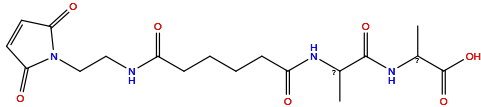
|
|||||
| Formula |
C18H26N4O7
|
|||||
| Isosmiles |
CC(NC(=O)C(C)NC(=O)CCCCC(=O)NCCN1C(=O)C=CC1=O)C(=O)O
|
|||||
| InChI |
InChI=1S/C18H26N4O7/c1-11(17(27)21-12(2)18(28)29)20-14(24)6-4-3-5-13(23)19-9-10-22-15(25)7-8-16(22)26/h7-8,11-12H,3-6,9-10H2,1-2H3,(H,19,23)(H,20,24)(H,21,27)(H,28,29)
|
|||||
| InChIKey |
CPKFQVOFDMYIRV-UHFFFAOYSA-N
|
|||||
| Pharmaceutical Properties |
Molecule Weight
|
410.427
|
Polar area
|
161.98
|
||
|
Complexity
|
29
|
xlogp Value
|
-1.318
|
|||
|
Heavy Count
|
29
|
Rot Bonds
|
12
|
|||
|
Hbond acc
|
6
|
Hbond Donor
|
4
|
|||
Each Antibody-drug Conjugate Related to This Linker
Full Information of The Activity Data of The ADC(s) Related to This Linker
Pivekimab sunirine [Apprpved in 2026]
Identified from the Human Clinical Data
| Experiment 1 Reporting the Activity Date of This ADC | [1] | ||||
| Efficacy Data | Objective Response Rate (ORR) |
33%
|
|||
| Patients Enrolled |
Eligibility requires CD123+ hematologic malignancies (6 cohorts: relapsed/refractory BPDCN/AML/ALL/MDS/MPN or frontline BPDCN). Key exclusions: available standard therapies (Cohorts 1-5), active CNS disease (frontline), prior VOD, grade 4 capillary leak syndrome, or anticancer therapy within 14 days (28 days for checkpoint inhibitors).
|
||||
| Administration Dosage |
IMGN632 was administered by IV on 2 different schedules for participants with relapsed/refractory AML, ALL, or BPDCN.
|
||||
| Related Clinical Trial | |||||
| NCT Number | NCT03386513 | Clinical Status | PHASE1|||PHASE2 | ||
| Clinical Description |
A Phase 1/2, Multi-center, Open-label Study of IMGN632 Monotherapy Administered Intravenously in Patients With CD123-positive Acute Myeloid Leukemia and Other CD123-positive Hematologic Malignancies
|
||||
| Primary Endpoint |
Primary endpoint evaluates composite complete response rate (CR+CRc) in BPDCN patients per 21-day treatment cycles.
|
||||
| Other Endpoint |
Secondary endpoints include 24-month assessments of CR duration, treatment-emergent AEs (CTCAE v4.03), expanded response rates (CR+CRc+CRh), ORR (CR+CRc+CRh+CRi+PR), OS, transplant bridging rates, PK/immunogenicity of IMGN632, and transfusion independence conversion.
|
||||
| Experiment 2 Reporting the Activity Date of This ADC | [2] | ||||
| Efficacy Data | Objective Response Rate (ORR) |
59%
|
|||
| Patients Enrolled |
Eligibility requires adults (≥18) with CD123+ AML (excluding APL) confirmed by local flow/IHC, adequate organ function (LVEF≥45%, eGFR>30mL/min), and specific disease status per regimen: untreated (Regimen C expansion), relapsed/refractory (≤2 prior lines), or MRD+ post-CR (Regimen D). Key exclusions: active CNS disease, SOS/VOD history, IMGN632 hypersensitivity, uncontrolled infections, or recent anticancer therapy (14-day washout, 28-day for checkpoint inhibitors). Special provisions address transplant recipients (≥120-day interval, no ≥G2 GVHD) and unfit patients (age≥75 or comorbidities precluding intensive therapy).
Click to Show/Hide
|
||||
| Administration Dosage |
IMGN632, administered intravenously on Day 7 of a 28 day cycle at 0.015 mg/kg, 0.045 mg/kg, or 0.09 mg/kg, in combination with azacitidine, administered subcutaneously or intravenously daily at 75 mg/m2 on Days 1 to 7 of a 28 day cycle. Cycle 1 azacitidine dose in subsequent cohorts may be reduced.
|
||||
| Related Clinical Trial | |||||
| NCT Number | NCT04086264 | Clinical Status | PHASE1|||PHASE2 | ||
| Clinical Description |
A Phase 1b/2 Study of IMGN632 as Monotherapy or Combination With Venetoclax and/or Azacitidine for Participants With CD123-Positive Acute Myeloid Leukemia
|
||||
| Primary Endpoint |
Primary objectives include evaluating safety/tolerability and determining RP2D of IMGN632 combinations (with azacitidine/venetoclax) in relapsed/refractory CD123+ AML over ~3 years through TEAE monitoring, while assessing preliminary antileukemic activity (CR/CRh/CRp/CRi/MLFS/PR) and MRD levels via central flow cytometry over ~18-20 months.
|
||||
| Other Endpoint |
Secondary endpoints comprise TEAE incidence (12-month), pharmacokinetic profiles (IMGN632/ADA concentrations), and MRD dynamics during dose escalation/expansion phases, with all parameters monitored for approximately 7-12 months using standardized analytical methods.
|
||||
| Experiment 3 Reporting the Activity Date of This ADC | [3] | ||||
| Patients Enrolled |
Eligibility requires adults (≥18) with untreated CD123+ AML (excluding APL/FLT3-mutated cases) and ELN adverse-risk features, adequate organ function (LVEF≥45%, CrCl≥60mL/min), and TRM score ≤13.1. Exclusions include CML blast phase, uncontrolled infections, pregnancy, or prior grade ≥3 antibody hypersensitivity.
|
||||
| Related Clinical Trial | |||||
| NCT Number | NCT06034470 | Clinical Status | PHASE1 | ||
| Clinical Description |
Phase 1 Study of FLAG-Ida With Pivekimab Sunirine (PVEK [IMGN632]) for Adults With Newly Diagnosed Adverse-Risk Acute Myeloid Leukemia and Other High-Grade Myeloid Neoplasms
|
||||
| Primary Endpoint |
Primary endpoint assesses dose-limiting toxicities (DLTs) during cycle 1 (42-day observation), defined as grade ≥4 organ toxicity or prolonged severe myelosuppression (ANC<500/uL & platelets<25,000/uL for >42 days post-FLAG-Ida initiation) per ELN criteria.
|
||||
| Other Endpoint |
Secondary outcomes include 5-year AE incidence (NCI CTCAE v5.0), MRD rates (flow cytometry), relapse-free/overall survival, complete remission rates, cytopenia duration, and transplant proportions, all analyzed via standard statistical methods (Wilcoxon, Fisher's exact, Kaplan-Meier).
|
||||
| Experiment 4 Reporting the Activity Date of This ADC | [4] | ||||
| Patients Enrolled |
Eligibility requires CD123+ hematologic malignancies (AML/ALL/MPAL) in patients aged 1-22 years (weight ≥10kg), stratified by cohort: relapsed/refractory disease (Cohort 1), first-relapse AML (Cohorts 2-3). Key requirements include adequate organ function (EF≥55%, CrCl≥70mL/min), CNS1-3 status without neurological symptoms, and specified washout periods from prior therapies (14 days for chemotherapy, 21 days for antibodies). Exclusions cover APL/JMML, Down syndrome, active infections, copper metabolism disorders, pregnancy/breastfeeding, and prior grade ≥3 VOD/SOS.
Click to Show/Hide
|
||||
| Administration Dosage |
Patients receive IMGN632 IV on days 1 and 22. Treatment repeats every 42 days for up to 6 cycles in the absence of disease progression or unacceptable toxicity.
|
||||
| Related Clinical Trial | |||||
| NCT Number | NCT05320380 | Clinical Status | PHASE1|||PHASE2 | ||
| Clinical Description |
A PedAL/EuPAL Phase 1/2 Trial of IMGN632 in Pediatric Patients With Relapsed or Refractory Leukemia
|
||||
| Primary Endpoint |
Primary objectives include determining RP2D for IMGN632 monotherapy (Cohort 1) and combination therapy with daunorubicin/cytarabine liposome (Cohort 2) using rolling 6 design during 42-day cycle 1 DLT evaluation, while assessing flow-based ORR (CR/CRi/CRp) in Cohort 1 and MRD-negative response rates (<0.01% blasts) after two treatment cycles in pediatric AML patients (Cohort 3) through Fisher's Exact test comparisons.
Click to Show/Hide
|
||||
| Other Endpoint |
Pharmacokinetic parameters (AUC, Cmax, Vss, t1/2, CL, Tmax) will be analyzed via non-compartmental methods during cycles 1-2 across all cohorts, with serial plasma sampling to characterize IMGN632 exposure profiles and establish dose-exposure relationships in pediatric/adolescent populations.
|
||||
TAK-164 [Phase 1 (discontinued)]
Identified from the Human Clinical Data
| Experiment 1 Reporting the Activity Date of This ADC | [5] | ||||
| Efficacy Data | stable disease (SD) |
44%
|
|||
| Patients Enrolled |
Inclusion requires GCC+ (H-score ≥10) advanced GI tumors (CRC, gastric/esophageal/pancreatic), ≥18 years, adequate organ function (ANC ≥1.5×10⁹/L, platelets ≥100×109/L, CrCl ≥60 mL/min), ECOG 0-1, and ≥12-week life expectancy. Exclusions: recent anticancer therapy (<28 days), CYP3A/P-gp modulators, bleeding disorders/biopsy contraindications, concurrent alcohol abuse, or other malignancies (exceptions: nonmelanoma skin/carcinoma in situ). For Part C (imaging substudy), ≥2 cm extrahepatic metastasis is required.
Click to Show/Hide
|
||||
| Administration Dosage |
Adult pts with GCC-positive, advanced/metastatic GI cancers received TAK-164 intravenously on day 1 of a 21-day cycle (Q3W). Dose escalation proceeded based on cycle 1 safety data via a Bayesian model of modified toxicity probability interval starting at 0.004 mg/kg.
|
||||
| Related Clinical Trial | |||||
| NCT Number | NCT03449030 | Clinical Status | PHASE1 | ||
| Clinical Description |
An Open-Label, Dose Escalation, Phase 1, First-in-Human Study of TAK-164, an Antibody-Drug Conjugate, in Patients With Advanced Gastrointestinal Cancers Expressing Guanylyl Cyclase C
|
||||
| Primary Endpoint |
The study evaluates dose-limiting toxicities (DLTs) based on NCI CTCAE v5, including Grade 4 neutropenia (ANC <500/mm 3), thrombocytopenia (<25,000/mm 3), febrile neutropenia, Grade ≥3 bleeding thrombocytopenia, and Grade ≥3 nausea/vomiting/diarrhea despite optimal care. Adverse event rates (≥Grade 3, drug-related, serious, and leading to discontinuation) were monitored over 22 months, alongside determination of the recommended Phase 2 dose (RP2D).
Click to Show/Hide
|
||||
| Other Endpoint |
Pharmacokinetics (Cmax, Tmax, AUClast, Ctrough) were assessed over Cycles 1-2, with efficacy endpoints including ORR (CR/PR per modified RECIST v1.1), DCR (CR/PR/SD), DOR, and PFS (PD ≥20% lesion growth or new lesions). ADA positivity was screened over 22 months.
|
||||
| Experiment 2 Reporting the Activity Date of This ADC | [6] | ||||
| Patients Enrolled |
GCC-positive (H-score10 as indicated by IHC) GI cancers for whom standard treatment was no longer effective, or not available, Eligible GI malignancies included, but were not limited to: metastatic colorectal carcinoma, gastric carcinoma, esophageal carcinoma, small intestine cancer, and pancreatic cancer.
|
||||
| Administration Dosage |
TAK-164 as a single intravenous infusion with a duration of up to 2 h, on day 1 of each 21-day cycle or every 3 weeks, until disease progression, unacceptable toxicity, or withdrawal from the study. Doses of 0.004 mg/kg, 0.008 mg/kg, 0.016 mg/kg, 0.032 mg/kg, 0.064 mg/kg, 0.12 mg/kg, 0.16 mg/kg, 0.19 mg/kg, 0.25 mg/kg, and 0.32 mg/kg were planned. To guide dose escalation, a method based on a Bayesian model of modified toxicity probability interval (mTPI) was used.
Click to Show/Hide
|
||||
| Related Clinical Trial | |||||
| NCT Number | NCT03449030 | Clinical Status | Phase 1 | ||
| Clinical Description |
An open-label, dose escalation, phase 1, first-in-human study of TAK-164, an antibody-drug conjugate, in patients with advanced gastrointestinal cancers expressing guanylyl cyclase C.
|
||||
| Primary Endpoint |
Dosing was capped at 0.19 mg/kg due to hepatic toxicity. The RP2D was determined as 0.064 mg/kg but was considered insufficient to derive significant clinical benefit.
|
||||
| Other Endpoint |
No pts had dose-limiting toxicities (DLT) in cycle 1 up to 0.32 mg/kg. TAK-164 appeared to have a manageable safety profile up to 0.064 mg/kg in pts with advanced GI cancers.
|
||||
References