
Linker Information
General Information of This Linker (ID: LIN0ZQDJX)
| Name |
N-succinimidyl 3-(2-pyridyldithio) propionate (SPDP)
|
|||||
|---|---|---|---|---|---|---|
| Linker Type |
Flexible dual-reactive (amino/thiol) linker; Thiol-sensitive linker
|
|||||
| Antibody-Linker Relation |
Cleavable
|
|||||
| Structure |
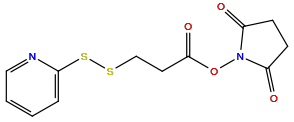
|
|||||
| Formula |
C12H12N2O4S2
|
|||||
| Isosmiles |
C1CC(=O)N(C1=O)OC(=O)CCSSC2=CC=CC=N2
|
|||||
| PubChem CID | ||||||
| InChI |
InChI=1S/C12H12N2O4S2/c15-10-4-5-11(16)14(10)18-12(17)6-8-19-20-9-3-1-2-7-13-9/h1-3,7H,4-6,8H2
|
|||||
| InChIKey |
JWDFQMWEFLOOED-UHFFFAOYSA-N
|
|||||
| IUPAC Name |
(2,5-dioxopyrrolidin-1-yl) 3-(pyridin-2-yldisulfanyl)propanoate
|
|||||
| Pharmaceutical Properties |
Molecule Weight
|
312.4
|
Polar area
|
127
|
||
|
Complexity
|
376
|
xlogp Value
|
0.7
|
|||
|
Heavy Count
|
20
|
Rot Bonds
|
7
|
|||
|
Hbond acc
|
7
|
Hbond Donor
|
0
|
|||
Each Antibody-drug Conjugate Related to This Linker
Full Information of The Activity Data of The ADC(s) Related to This Linker
Quinoin cetuximab immunoconjugate [Investigative]
Revealed Based on the Cell Line Data
| Experiment 1 Reporting the Activity Date of This ADC | [1] | ||||
| Efficacy Data | Half Maximal Inhibitory Concentration (IC50) |
27.7 nM
|
Positive EGFR expression (EGFR +++/++) | ||
| Method Description |
Cells were treated with different concentrations of drugs for 72 h. The viability was determined using the MTT assay.
|
||||
| In Vitro Model | Colon carcinoma | GEO cells (Cetuximab-resistant) | CVCL_0271 | ||
Y-TR1 SPDP [Investigative]
Revealed Based on the Cell Line Data
| Experiment 1 Reporting the Activity Date of This ADC | [2] | ||||
| Efficacy Data | Half Maximal Inhibitory Concentration (IC50) |
35 ug/mL
|
Positive CD26 expression (CD26+++/++) | ||
| Method Description |
Viability assay of Jurkat cells incubated for 72 h with ADC.
|
||||
| In Vitro Model | T acute lymphoblastic leukemia | Jurkat cells | CVCL_0065 | ||
T4H11-DM4 [Investigative]
Revealed Based on the Cell Line Data
| Experiment 1 Reporting the Activity Date of This ADC | [3] | ||||
| Efficacy Data | Half Maximal inhibitory Concentration (lC50) |
3.35۪.53 nM
|
Positive DDR1 expression (DDR1+++/++) | ||
| Method Description |
The in vitro cytotoxicity of T4H11 and T4H11-DM4 were evaluated in BC cell lines that expressed different levels of DDR1. The cells were plated at a density of 3.5-5 × 10² cells per 96-well in 100 ul of medium. After overnight incubation, T4H11 and T4H11-DM4 were diluted by consecutive double dilutions and added to different wells. The concentrations of the two drugs ranged from 1.95 to 1000 nM. After 72 h of drug exposure, cell viability was measured by Cell Counting Kit-8 (CCK-8; Dojindo, China) assays. The half-maximal inhibitory concentration (IC50) of the ADC was calculated using GraphPad Prism.
Click to Show/Hide
|
||||
| In Vitro Model | Invasive breast carcinoma | ZR-75-1 cells | CVCL_0588 | ||
| Experiment 2 Reporting the Activity Date of This ADC | [3] | ||||
| Efficacy Data | Half Maximal inhibitory Concentration (lC50) |
7.44۫.18 nM
|
Positive DDR1 expression (DDR1+++/++) | ||
| Method Description |
The in vitro cytotoxicity of T4H11 and T4H11-DM4 were evaluated in BC cell lines that expressed different levels of DDR1. The cells were plated at a density of 3.5-5 × 10² cells per 96-well in 100 ul of medium. After overnight incubation, T4H11 and T4H11-DM4 were diluted by consecutive double dilutions and added to different wells. The concentrations of the two drugs ranged from 1.95 to 1000 nM. After 72 h of drug exposure, cell viability was measured by Cell Counting Kit-8 (CCK-8; Dojindo, China) assays. The half-maximal inhibitory concentration (IC50) of the ADC was calculated using GraphPad Prism.
Click to Show/Hide
|
||||
| In Vitro Model | Invasive breast carcinoma of no special type | T47D cells | CVCL_0553 | ||
| Experiment 3 Reporting the Activity Date of This ADC | [3] | ||||
| Efficacy Data | Half Maximal inhibitory Concentration (lC50) |
13.85۬.08 nM
|
Positive DDR1 expression (DDR1+++/++) | ||
| Method Description |
The in vitro cytotoxicity of T4H11 and T4H11-DM4 were evaluated in BC cell lines that expressed different levels of DDR1. The cells were plated at a density of 3.5-5 × 10² cells per 96-well in 100 ul of medium. After overnight incubation, T4H11 and T4H11-DM4 were diluted by consecutive double dilutions and added to different wells. The concentrations of the two drugs ranged from 1.95 to 1000 nM. After 72 h of drug exposure, cell viability was measured by Cell Counting Kit-8 (CCK-8; Dojindo, China) assays. The half-maximal inhibitory concentration (IC50) of the ADC was calculated using GraphPad Prism.
Click to Show/Hide
|
||||
| In Vitro Model | Invasive breast carcinoma | BT-474 cells | CVCL_0179 | ||
| Experiment 4 Reporting the Activity Date of This ADC | [3] | ||||
| Efficacy Data | Half Maximal inhibitory Concentration (lC50) |
47.49۫.14 nM
|
Positive DDR1 expression (DDR1+++/++) | ||
| Method Description |
The in vitro cytotoxicity of T4H11 and T4H11-DM4 were evaluated in BC cell lines that expressed different levels of DDR1. The cells were plated at a density of 3.5-5 × 10² cells per 96-well in 100 ul of medium. After overnight incubation, T4H11 and T4H11-DM4 were diluted by consecutive double dilutions and added to different wells. The concentrations of the two drugs ranged from 1.95 to 1000 nM. After 72 h of drug exposure, cell viability was measured by Cell Counting Kit-8 (CCK-8; Dojindo, China) assays. The half-maximal inhibitory concentration (IC50) of the ADC was calculated using GraphPad Prism.
Click to Show/Hide
|
||||
| In Vitro Model | Breast adenocarcinoma | SK-BR-3 cells | CVCL_0033 | ||
| Experiment 5 Reporting the Activity Date of This ADC | [3] | ||||
| Efficacy Data | Half Maximal inhibitory Concentration (lC50) |
107.5۪.25 nM
|
Positive DDR1 expression (DDR1+++/++) | ||
| Method Description |
The in vitro cytotoxicity of T4H11 and T4H11-DM4 were evaluated in BC cell lines that expressed different levels of DDR1. The cells were plated at a density of 3.5-5 × 10² cells per 96-well in 100 ul of medium. After overnight incubation, T4H11 and T4H11-DM4 were diluted by consecutive double dilutions and added to different wells. The concentrations of the two drugs ranged from 1.95 to 1000 nM. After 72 h of drug exposure, cell viability was measured by Cell Counting Kit-8 (CCK-8; Dojindo, China) assays. The half-maximal inhibitory concentration (IC50) of the ADC was calculated using GraphPad Prism.
Click to Show/Hide
|
||||
| In Vitro Model | Breast adenocarcinoma | MDA-MB-231 cells | CVCL_0062 | ||
| Experiment 6 Reporting the Activity Date of This ADC | [3] | ||||
| Efficacy Data | Half Maximal inhibitory Concentration (lC50) | > 1000 nM | Positive DDR1 expression (DDR1+++/++) | ||
| Method Description |
The in vitro cytotoxicity of T4H11 and T4H11-DM4 were evaluated in BC cell lines that expressed different levels of DDR1. The cells were plated at a density of 3.5-5 × 10² cells per 96-well in 100 ul of medium. After overnight incubation, T4H11 and T4H11-DM4 were diluted by consecutive double dilutions and added to different wells. The concentrations of the two drugs ranged from 1.95 to 1000 nM. After 72 h of drug exposure, cell viability was measured by Cell Counting Kit-8 (CCK-8; Dojindo, China) assays. The half-maximal inhibitory concentration (IC50) of the ADC was calculated using GraphPad Prism.
Click to Show/Hide
|
||||
| In Vitro Model | Invasive breast carcinoma | MCF-7 cells | CVCL_0031 | ||
References