
Linker Information
General Information of This Linker (ID: LIN0ZHZRH)
| Name |
DBCO-Val-Cit-PABA
|
|||||
|---|---|---|---|---|---|---|
| Antibody-Linker Relation |
Cleavable
|
|||||
| Structure |
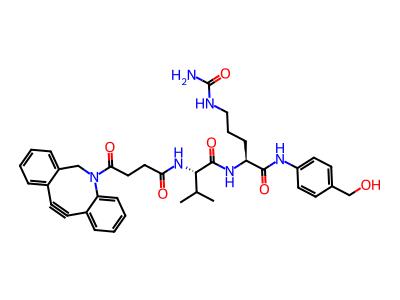
|
|||||
|
|
||||||
Each Antibody-drug Conjugate Related to This Linker
Full Information of The Activity Data of The ADC(s) Related to This Linker
Luveltamab tazevibulin [Phase 2/3 (discontinued)]
Identified from the Human Clinical Data
| Experiment 1 Reporting the Activity Date of This ADC | [1] | ||||
| Efficacy Data | Objective Response Rate (ORR) |
37.50%
|
|||
| Patients Enrolled |
Eligible patients (≥18 years, ECOG 0-1, measurable disease) include platinum-resistant (1-3 prior regimens) or sensitive ovarian cancers (Cohorts A/C) and endometrial cancers progressing post-platinum/immunotherapy (Cohort B, ≤3 regimens). Exclusions: low-grade/rare histologies, prior FolRalpha-targeting therapies, CNS metastasis, >3 prior lines, or severe comorbidities. Tumor tissue submission is mandatory.
Click to Show/Hide
|
||||
| Administration Dosage |
Enrollment has been completed with 39 pts treated at 9 dose levels (0.5 to 6.4 mg/kg). Data cut-off is Jan 30, 2021.
|
||||
| Related Clinical Trial | |||||
| NCT Number | NCT03748186 | Clinical Status | PHASE1 | ||
| Clinical Description |
A Phase 1 Open-Label, Safety, Pharmacokinetic and Preliminary Efficacy Study of STRO-002, an Anti-Folate Receptor Alpha (FolRalpha) Antibody-Drug Conjugate (ADC), in Patients With Advanced Epithelial Ovarian Cancer (Including Fallopian Tube or Primary Peritoneal Cancers) and Endometrial Cancers
|
||||
| Primary Endpoint |
The study evaluates STRO-002's safety and defines its recommended/maximum tolerated doses (RP2D/MTD) via dose-limiting toxicity assessments over 18 months. Preliminary efficacy in ovarian/Fallopian/primary peritoneal and endometrial cancers is measured by RECIST 1.1 ORR over 24 months.
|
||||
| Other Endpoint |
Pharmacokinetic analysis (18-24 months) includes Cmax, t1/2, AUCinf, CL, and Vss measurements, with anti-drug antibody monitoring. Expansion cohorts assess safety through AE incidence, DOR, PFS (RECIST 1.1), CA-125 changes (GCIG criteria), and repeat PK evaluations.
|
||||
| Experiment 2 Reporting the Activity Date of This ADC | [2] | ||||
| Patients Enrolled |
Eligible patients are adults (≥18, ECOG 0-1) with FOLR1-positive, platinum-resistant high-grade serous ovarian/fallopian/primary peritoneal cancer (1-3 prior regimens). Prior bevacizumab is required unless contraindicated. Exclusions: rare histologies, prior FOLR1-targeting ADCs/tubulin inhibitors, platinum-refractory disease, severe comorbidities, CNS involvement, or ongoing trials. Measurable disease per RECIST v1.1 and adequate organ function are required.
Click to Show/Hide
|
||||
| Related Clinical Trial | |||||
| NCT Number | NCT05870748 | Clinical Status | PHASE2|||PHASE3 | ||
| Clinical Description |
REFRaME-O1: A Phase 2/3 Open-label Study Evaluating the Efficacy and Safety of Luveltamab Tazevibulin (STRO-002) Versus Investigator's Choice (IC) Chemotherapy in Women With Relapsed Platinum-resistant Epithelial Ovarian Cancer (Including Fallopian Tube or Primary Peritoneal Cancers) Expressing Folate Receptor Alpha (FOLR1)
|
||||
| Primary Endpoint |
The study measures Progression-Free Survival (PFS) and Objective Response Rate (ORR) per RECIST 1.1 over up to 24 months, tracking the time from first dose to disease progression/death (PFS) and the best response of complete (CR) or partial response (PR).
|
||||
| Other Endpoint |
Secondary endpoints include Overall Survival (OS), Duration of Response (DOR), and adverse event incidence/severity. Quality of life is evaluated using the QLQ-OV28 questionnaire, assessing abdominal symptoms, neuropathy, chemotherapy side effects, hormonal changes, body image, disease/treatment attitude, and sexual function over 24 months.
|
||||
| Experiment 3 Reporting the Activity Date of This ADC | [3] | ||||
| Patients Enrolled |
Eligible patients must be ≥18 years with ECOG 0-1, high-grade serous EOC/fallopian tube/primary peritoneal cancer, measurable lesions (RECIST v1.1), and adequate organ function. Dose Escalation participants require specific platinum therapy history (1-4 prior regimens), while Expansion Cohort requires platinum-resistant disease (≤4 regimens). Key exclusions include non-serous histologies, prior tubulin-inhibitor ADCs, >4 regimens, contraindications to bevacizumab, active infections, significant comorbidities (cardiac/pulmonary/neurological), HIV/HBV/HCV (with exceptions), and concurrent trial participation. Pregnancy requires contraception through treatment and extended follow-up periods.
Click to Show/Hide
|
||||
| Related Clinical Trial | |||||
| NCT Number | NCT05200364 | Clinical Status | PHASE1 | ||
| Clinical Description |
A Phase 1 Open-Label, Safety, Pharmacokinetic and Preliminary Efficacy Study of STRO-002, an Anti-Folate Receptor Alpha Antibody Drug Conjugate, in Combination With Bevacizumab in Patients With Advanced Epithelial Ovarian Cancer (Including Fallopian Tube or Primary Peritoneal Cancers)
|
||||
| Primary Endpoint |
This study evaluates the safety and tolerability of STRO-002/bevacizumab combination therapy by assessing adverse events and clinical lab abnormalities across various dose levels, with DLT monitoring during initial treatment (Days 1-21). It also aims to establish the recommended Phase 2 dose (RP2D) by analyzing DLT frequency over approximately 24 months.
Click to Show/Hide
|
||||
| Other Endpoint |
Pharmacokinetic characterization of STRO-002 includes measurements of maximum plasma concentration (Cmax) and area under the plasma concentration-time curve (AUC) throughout the study period. Additionally, the study assesses anti-drug antibody (ADA) formation against STRO-002 when administered with bevacizumab over the 24-month timeframe.
|
||||
| Experiment 4 Reporting the Activity Date of This ADC | [4] | ||||
| Patients Enrolled |
Eligible patients must be <12 years with CBFA2T3::GLIS2-fusion AML (≥5% marrow blasts), refractory/relapsed, and adequate organ function (Lansky ≥50). Exclusions: active CNS disease, corneal disorders, uncontrolled infections, prior FOLR1-targeting/tubulin-inhibitor ADCs, recent transplant (<84 days), or active GVHD requiring immunosuppression beyond low-dose steroids.
Click to Show/Hide
|
||||
| Administration Dosage |
This trial has two parts, Part 1 will use a parallel model by assessing two luveltamab tazevibulin doses (3.5 and 4.3 mg/kg every 2 weeks). Two cohorts will be run in parallel. The transition from part 1 to part 2 is sequential, with part 2 testing the dose selected at the end of part 1.
|
||||
| Related Clinical Trial | |||||
| NCT Number | NCT06679582 | Clinical Status | PHASE1|||PHASE2 | ||
| Clinical Description |
A Phase 1/2, Open-label Study Evaluating the Efficacy, Safety, and Pharmacokinetics (PK) of Luveltamab Tazevibulin (STRO-002) in Infants and Children < 12 Years of Age with CBFA2T3::GLIS2 Acute Myeloid Leukemia (AML)
|
||||
| Primary Endpoint |
The primary objective is to evaluate the efficacy of luveltamab tazevibulin monotherapy by assessing the complete remission (CR) rate within 12 weeks.
|
||||
| Other Endpoint |
Secondary measures include long-term efficacy assessments (up to 2 years) such as duration of CR, response rate (CRh), EFS, RFS, and OS. Safety is monitored via AEs (CTCAE v5.0), while PK evaluates blood concentrations of luveltamab tazevibulin components (ADC, TAb, SC209). ADA incidence determines immunogenicity.
|
||||
| Experiment 5 Reporting the Activity Date of This ADC | [5] | ||||
| Patients Enrolled |
Eligible patients (life expectancy >3 months, RECIST v1.1 measurable lesions, CTCAE v5.0 Grade ≤1 residual toxicity) require organ function adequacy and QTcF <500 msec. Cohort-specific criteria apply: ovarian (Cohorts A/B), endometrial (Cohort C), NSCLC (Cohort D), or TNBC (Cohort E) with 1-4 prior therapies. Exclusions: prior tubulin-inhibitor ADCs, FolRalpha-targeting agents, severe allergies, recent anticancer therapies (chemotherapy/immunotherapy/surgery/radiation), active ocular disorders, or folate supplement use. Ocular exclusions encompass corneal diseases, transplants, and conditions like uncontrolled glaucoma or diabetic retinopathy.
Click to Show/Hide
|
||||
| Related Clinical Trial | |||||
| NCT Number | NCT06238687 | Clinical Status | PHASE1|||PHASE2 | ||
| Clinical Description |
A Phase I/IIa Study to Evaluate the Safety, Tolerability , Pharmacokinetics and Preliminary Efficacy of STRO-002 in Chinese Adults With Advanced Epithelial Ovarian Cancer, Endometrial Cancer, and Other Advanced Malignant Solid Tumors.
|
||||
| Primary Endpoint |
This study investigates STRO-002's safety and efficacy, assessing DLTs (Days 1-21 post-dose), AE frequency, and key PK parameters (AUC, Cmax, t½) over 28 days post-treatment. ORR (RECIST v1.1) and RP2D determination are primary efficacy endpoints evaluated up to 24 months.
|
||||
| Other Endpoint |
Secondary outcomes include ADA incidence, DOR, and PFS over 24 months, alongside tumor biomarker analysis (FolRalpha/CA-125) requiring ≥50% CA-125 reduction sustained for 28 days. These measures track immunogenicity, response durability, and disease progression post-STRO-002 administration.
|
||||
| Experiment 6 Reporting the Activity Date of This ADC | [6] | ||||
| Patients Enrolled |
Eligible patients are adults (≥18 years, ECOG 0-1) with FOLR1-positive, unresectable Stage IIIb/c or IV NSCLC (non-squamous/adenosquamous), progressing after 2-4 systemic therapies and measurable lesions per RECIST 1.1. Exclusions: prior FOLR1/tubulin-inhibitor ADC treatment, untreated CNS metastases, immunosuppressive therapy (except for controlled brain metastases), severe allergies, ocular/cardiopulmonary disorders, organ transplants, or concurrent trial participation.
Click to Show/Hide
|
||||
| Related Clinical Trial | |||||
| NCT Number | NCT06555263 | Clinical Status | PHASE2 | ||
| Clinical Description |
A Phase 2, Open-label Study Evaluating STRO-002, an Anti-folate Receptor Alpha (FOLR1) Antibody-Drug Conjugate, in Subjects with Previously Treated Advanced or Metastatic Non-small Cell Lung Cancer Expressing FOLR1
|
||||
| Primary Endpoint |
The primary efficacy endpoint is Objective Response Rate (ORR), defined as the proportion of patients achieving CR or PR per RECIST 1.1 criteria, assessed over a 24-month timeframe.
|
||||
| Other Endpoint |
Secondary endpoints include DOR (time from first response to progression/death), PFS (time from first dose to progression/death), and safety (AE incidence/lab abnormalities). PK analysis evaluates luveltamab tazevibulin via ADC concentration, total antibody, and cytotoxic warhead measurements over 24 months.
|
||||
Discovered Using Patient-derived Xenograft Model
| Experiment 1 Reporting the Activity Date of This ADC | [7] | ||||
| Efficacy Data | Tumor Growth Inhibition value (TGI) |
15%
|
Negative FOLR1 expression (FOLR1-) | ||
| In Vivo Model | STRO-002 monotherapy PDX model (PDX:PDX model 5) | ||||
| Experiment 2 Reporting the Activity Date of This ADC | [7] | ||||
| Efficacy Data | Tumor Growth Inhibition value (TGI) |
53%
|
Low FOLR1 expression (FOLR1+) | ||
| In Vivo Model | PDX model | ||||
| Experiment 3 Reporting the Activity Date of This ADC | [7] | ||||
| Efficacy Data | Tumor Growth Inhibition value (TGI) |
70%
|
Moderate FOLR1 expression (FOLR1++) | ||
| In Vivo Model | PDX model | ||||
| Experiment 4 Reporting the Activity Date of This ADC | [7] | ||||
| Efficacy Data | Tumor Growth Inhibition value (TGI) |
80%
|
High FOLR1 expression (FOLR1+++) | ||
| In Vivo Model | PDX model | ||||
| Experiment 5 Reporting the Activity Date of This ADC | [7] | ||||
| Efficacy Data | Tumor Growth Inhibition value (TGI) |
100%
|
High FOLR1 expression (FOLR1+++) | ||
| In Vivo Model | PDX model | ||||
| Experiment 6 Reporting the Activity Date of This ADC | [7] | ||||
| Efficacy Data | Tumor Growth Inhibition value (TGI) |
100%
|
High FOLR1 expression (FOLR1+++) | ||
| In Vivo Model | PDX model | ||||
Discovered Using Cell Line-derived Xenograft Model
| Experiment 1 Reporting the Activity Date of This ADC | [7] | ||||
| Efficacy Data | Half Maximal Effective Concentration (EC50) |
0.24 nM
|
Low FOLR1 expression (FOLR1+) | ||
| In Vitro Model | Lung squamous cell carcinoma | NCI-H1703 cells | CVCL_1490 | ||
| Experiment 2 Reporting the Activity Date of This ADC | [7] | ||||
| Efficacy Data | Half Maximal Effective Concentration (EC50) |
0.74 nM
|
Low FOLR1 expression (FOLR1+) | ||
| In Vitro Model | Breast adenocarcinoma | MDA-MB-468 cells | CVCL_0419 | ||
| Experiment 3 Reporting the Activity Date of This ADC | [7] | ||||
| Efficacy Data | Half Maximal Effective Concentration (EC50) |
0.84 nM
|
Low FOLR1 expression (FOLR1+) | ||
| In Vitro Model | Lung non-small cell carcinoma | NCI-H2110 cells | CVCL_1530 | ||
| Experiment 4 Reporting the Activity Date of This ADC | [7] | ||||
| Efficacy Data | Half Maximal Effective Concentration (EC50) |
1.4 nM
|
Low FOLR1 expression (FOLR1+) | ||
| In Vitro Model | Skin squamous cell carcinoma | A431 cells | CVCL_0037 | ||
| Experiment 5 Reporting the Activity Date of This ADC | [7] | ||||
| Efficacy Data | Half Maximal Effective Concentration (EC50) |
1.42 nM
|
Low FOLR1 expression (FOLR1+) | ||
| In Vitro Model | Breast adenocarcinoma | SK-BR-3 cells | CVCL_0033 | ||
| Experiment 6 Reporting the Activity Date of This ADC | [7] | ||||
| Efficacy Data | Half Maximal Effective Concentration (EC50) |
1.7 nM
|
Low FOLR1 expression (FOLR1+) | ||
| In Vitro Model | Breast adenocarcinoma | MDA-MB-231 cells | CVCL_0062 | ||
| Experiment 7 Reporting the Activity Date of This ADC | [7] | ||||
| Efficacy Data | Half Maximal Effective Concentration (EC50) |
1.8 nM
|
Low FOLR1 expression (FOLR1+) | ||
| In Vitro Model | Amelanotic melanoma | MDA-MB-435 cells | CVCL_0417 | ||
| Experiment 8 Reporting the Activity Date of This ADC | [7] | ||||
| Efficacy Data | Half Maximal Effective Concentration (EC50) |
2.2 nM
|
Low FOLR1 expression (FOLR1+) | ||
| In Vitro Model | Human papillomavirus-related endocervical adenocarcinoma | KB cells | CVCL_0372 | ||
| Experiment 9 Reporting the Activity Date of This ADC | [7] | ||||
| Efficacy Data | Half Maximal Effective Concentration (EC50) |
2.29 nM
|
Low FOLR1 expression (FOLR1+) | ||
| In Vitro Model | Amelanotic melanoma | MDA-MB-435 cells | CVCL_0417 | ||
| Experiment 10 Reporting the Activity Date of This ADC | [7] | ||||
| Efficacy Data | Half Maximal Effective Concentration (EC50) |
2.42 nM
|
Low FOLR1 expression (FOLR1+) | ||
| In Vitro Model | Plasma cell myeloma | OPM-2 cells | CVCL_1625 | ||
| Experiment 11 Reporting the Activity Date of This ADC | [7] | ||||
| Efficacy Data | Half Maximal Effective Concentration (EC50) |
3.18 nM
|
Low FOLR1 expression (FOLR1+) | ||
| In Vitro Model | Colon cancer | HT29 cells | CVCL_A8EZ | ||
| Experiment 12 Reporting the Activity Date of This ADC | [7] | ||||
| Efficacy Data | Half Maximal Effective Concentration (EC50) |
3.59 nM
|
Low FOLR1 expression (FOLR1+) | ||
| In Vitro Model | Breast adenocarcinoma | SK-BR-3 cells | CVCL_0033 | ||
| Experiment 13 Reporting the Activity Date of This ADC | [7] | ||||
| Efficacy Data | Half Maximal Effective Concentration (EC50) |
7.9 nM
|
Low FOLR1 expression (FOLR1+) | ||
| In Vitro Model | Lung adenocarcinoma | A-549 cells | CVCL_0023 | ||
| Experiment 14 Reporting the Activity Date of This ADC | [7] | ||||
| Efficacy Data | Half Maximal Effective Concentration (EC50) |
9.18 nM
|
Low FOLR1 expression (FOLR1+) | ||
| In Vitro Model | Colon carcinoma | HCT 116 cells | CVCL_0291 | ||
| Experiment 15 Reporting the Activity Date of This ADC | [7] | ||||
| Efficacy Data | Half Maximal Effective Concentration (EC50) |
9.2 nM
|
Low FOLR1 expression (FOLR1+) | ||
| In Vitro Model | Lung adenocarcinoma | NCI-H1651 cells | CVCL_1484 | ||
| Experiment 16 Reporting the Activity Date of This ADC | [7] | ||||
| Efficacy Data | Half Maximal Effective Concentration (EC50) |
0.07 ng/mL
|
Moderate FOLR1 expression (FOLR1++) | ||
| Method Description |
STRO-002 in lgrov1 cell.
|
||||
| In Vitro Model | Ovarian endometrioid adenocarcinoma | IGROV-1 cells | CVCL_1304 | ||
| Experiment 17 Reporting the Activity Date of This ADC | [7] | ||||
| Efficacy Data | Half Maximal Effective Concentration (EC50) |
0.35 ng/mL
|
High FOLR1 expression (FOLR1+++) | ||
| Method Description |
STRO-002 in KB cell.
|
||||
| In Vitro Model | Human papillomavirus-related endocervical adenocarcinoma | KB cells | CVCL_0372 | ||
| Experiment 18 Reporting the Activity Date of This ADC | [7] | ||||
| Efficacy Data | Half Maximal Effective Concentration (EC50) |
1.42 ng/mL
|
Low FOLR1 expression (FOLR1+) | ||
| In Vitro Model | Diffuse large B-cell lymphoma | SU-DHL-6 cells | CVCL_2206 | ||
| Experiment 19 Reporting the Activity Date of This ADC | [7] | ||||
| Efficacy Data | Half Maximal Effective Concentration (EC50) |
1.6 ng/mL
|
Low FOLR1 expression (FOLR1+) | ||
| In Vitro Model | Endometrial adenocarcinoma | Ishikawa cells | CVCL_2529 | ||
| Experiment 20 Reporting the Activity Date of This ADC | [7] | ||||
| Efficacy Data | Half Maximal Effective Concentration (EC50) |
2.1 ng/mL
|
Low FOLR1 expression (FOLR1+) | ||
| In Vitro Model | Gastric tubular adenocarcinoma | NCI-N87 cells | CVCL_1603 | ||
| Experiment 21 Reporting the Activity Date of This ADC | [7] | ||||
| Efficacy Data | Half Maximal Effective Concentration (EC50) |
2.2 ng/mL
|
Moderate FOLR1 expression (FOLR1++) | ||
| In Vitro Model | Ovarian endometrioid adenocarcinoma | IGROV-1 cells | CVCL_1304 | ||
| Experiment 22 Reporting the Activity Date of This ADC | [7] | ||||
| Efficacy Data | Half Maximal Effective Concentration (EC50) |
2.8 ng/mL
|
Low FOLR1 expression (FOLR1+) | ||
| In Vitro Model | High grade ovarian serous adenocarcinoma | OVKATE cells | CVCL_3110 | ||
| Experiment 23 Reporting the Activity Date of This ADC | [7] | ||||
| Efficacy Data | Half Maximal Effective Concentration (EC50) |
3.6 ng/mL
|
Moderate FOLR1 expression (FOLR1++) | ||
| Method Description |
SC209 in lgrov1 cell.
|
||||
| In Vitro Model | Ovarian endometrioid adenocarcinoma | IGROV-1 cells | CVCL_1304 | ||
| Experiment 24 Reporting the Activity Date of This ADC | [7] | ||||
| Efficacy Data | Half Maximal Effective Concentration (EC50) |
3.9 ng/mL
|
High FOLR1 expression (FOLR1+++) | ||
| Method Description |
SC209 in KB cell.
|
||||
| In Vitro Model | Human papillomavirus-related endocervical adenocarcinoma | KB cells | CVCL_0372 | ||
| Experiment 25 Reporting the Activity Date of This ADC | [7] | ||||
| Efficacy Data | Half Maximal Effective Concentration (EC50) |
291 ng/mL
|
Moderate FOLR1 expression (FOLR1++) | ||
| Method Description |
SC239 in lgrov1 cell.
|
||||
| In Vitro Model | Ovarian endometrioid adenocarcinoma | IGROV-1 cells | CVCL_1304 | ||
| Experiment 26 Reporting the Activity Date of This ADC | [7] | ||||
| Efficacy Data | Half Maximal Effective Concentration (EC50) |
400 ng/mL
|
High FOLR1 expression (FOLR1+++) | ||
| Method Description |
SC239 in KB cell.
|
||||
| In Vitro Model | Human papillomavirus-related endocervical adenocarcinoma | KB cells | CVCL_0372 | ||
References