
Linker Information
General Information of This Linker (ID: LIN0RPVYC)
| Name |
Mc-Gly-Gly-Phe-Gly (ring-opening derivative)
|
|||||
|---|---|---|---|---|---|---|
| Antibody-Linker Relation |
Cleavable
|
|||||
| Structure |
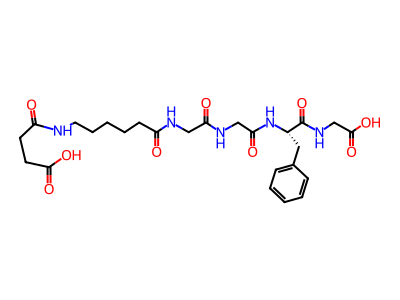
|
|||||
|
|
||||||
Each Antibody-drug Conjugate Related to This Linker
Full Information of The Activity Data of The ADC(s) Related to This Linker
GQ1005 [Phase 3]
Identified from the Human Clinical Data
| Experiment 1 Reporting the Activity Date of This ADC | [1] | ||||
| Efficacy Data | Objective Response Rate (ORR) |
27.60%
|
|||
| Patients Enrolled |
Eligible participants are adults (≥18 years) with advanced/metastatic HER2-expressing solid tumors (IHC 1+/2+/3+ or HER2 mutations) who failed or are intolerant to standard therapy. Key inclusion criteria: ECOG 0-1, adequate organ function, measurable lesions per RECIST 1.1, and washout from prior therapies. Exclusion criteria include uncontrolled brain metastases, cardiovascular disease, significant pulmonary conditions, prior topoisomerase I inhibitor-ADCs, active infections (HIV/HBV/HCV), pregnancy, and unresolved toxicity >Grade 1 from prior treatments.
Click to Show/Hide
|
||||
| Administration Dosage |
GQ1005 will be administered intravenously every 21 days.
|
||||
| Related Clinical Trial | |||||
| NCT Number | NCT06154343 | Clinical Status | PHASE1 | ||
| Clinical Description |
A Phase 1, First-In-Human, Multicenter, Open-Label,Dose-Escalation and Extension Study of GQ1005 in Subjects With HER2-Expressing Advanced Solid Tumors
|
||||
| Primary Endpoint |
The study evaluates the safety and tolerability of GQ1005, including incidence and severity of adverse events (AEs) graded by NCI-CTCAE v5.0, dose-limiting toxicities (DLTs) during the first 21-day cycle, and determination of the maximal tolerance dose (MTD) or recommended phase II dose (RP2D) based on cumulative cohort data.
|
||||
| Other Endpoint |
The pharmacokinetics (PK) of GQ1005 will be assessed via maximum concentration (Cmax), time to peak concentration (Tmax), and area under the curve (AUC). Antitumor efficacy measures include overall response rate (ORR), duration of response (DOR), disease control rate (DCR), time-to-response (TTR), progression-free survival (PFS), and overall survival (OS), all evaluated per RECIST 1.1. Immunogenicity will be assessed by anti-drug antibody (ADA) formation.
Click to Show/Hide
|
||||
| Experiment 2 Reporting the Activity Date of This ADC | [1] | ||||
| Efficacy Data | Disease control rate (DCR) |
69%
|
|||
| Patients Enrolled |
Eligible participants are adults (≥18 years) with advanced/metastatic HER2-expressing solid tumors (IHC 1+/2+/3+ or HER2 mutations) who failed or are intolerant to standard therapy. Key inclusion criteria: ECOG 0-1, adequate organ function, measurable lesions per RECIST 1.1, and washout from prior therapies. Exclusion criteria include uncontrolled brain metastases, cardiovascular disease, significant pulmonary conditions, prior topoisomerase I inhibitor-ADCs, active infections (HIV/HBV/HCV), pregnancy, and unresolved toxicity >Grade 1 from prior treatments.
Click to Show/Hide
|
||||
| Administration Dosage |
GQ1005 will be administered intravenously every 21 days.
|
||||
| Related Clinical Trial | |||||
| NCT Number | NCT06154343 | Clinical Status | PHASE1 | ||
| Clinical Description |
A Phase 1, First-In-Human, Multicenter, Open-Label,Dose-Escalation and Extension Study of GQ1005 in Subjects With HER2-Expressing Advanced Solid Tumors
|
||||
| Primary Endpoint |
The study evaluates the safety and tolerability of GQ1005, including incidence and severity of adverse events (AEs) graded by NCI-CTCAE v5.0, dose-limiting toxicities (DLTs) during the first 21-day cycle, and determination of the maximal tolerance dose (MTD) or recommended phase II dose (RP2D) based on cumulative cohort data.
|
||||
| Other Endpoint |
The pharmacokinetics (PK) of GQ1005 will be assessed via maximum concentration (Cmax), time to peak concentration (Tmax), and area under the curve (AUC). Antitumor efficacy measures include overall response rate (ORR), duration of response (DOR), disease control rate (DCR), time-to-response (TTR), progression-free survival (PFS), and overall survival (OS), all evaluated per RECIST 1.1. Immunogenicity will be assessed by anti-drug antibody (ADA) formation.
Click to Show/Hide
|
||||